Implications
Animal feed strategies are used to obtain products with a composition more consistent with human dietary guidelines. However, for local pig breeds production chains, the market of products requires also the respect of breeding systems and quality of product obtained. This study shows both feeding and rearing system manipulation influence growth, carcass composition and the nutritional quality of meat. These two variables have complementary effects and the combination of these effects lead to a neutral lipid profile in pork similar to the one present in valued high quality carcasses from pigs traditionally finished on oak woodland pasture.
Introduction
In recent years, more attention was given to free-range rearing systems worldwide due to environmental sustainability, social benefits of the sector, and increasing consumer interest in organic and natural pig production (Pugliese et al., Reference Pugliese, Sirtori and Franci2013). Alentejano (AL) pig, a local breed from the southern region of Portugal genetically similar to the Iberian pig, has been traditionally reared under free-range conditions and finished on oak woodland pasture during autumn/winter months. This obese breed (Fernández-Fígares et al., Reference Fernández-Fígares, Conde-Aguilera, Nieto, Lachica and Aguilera2008) is characterized by slow growth rates and high lipogenic activity at early stages of development (López-Bote, Reference López-Bote1998). Slaughtered at heavy BW (~150 kg), the carcass obtained is used to manufacture high quality dry-cured products (López-Bote, Reference López-Bote1998). Nowadays, a semi-extensive system based on the production of high quality fresh meat (Carne de Porco Alentejano – Protected Designation of Origin, PDO) throughout the year is been increasingly used. Although fed with balanced mixed diets with no growth promoters and antibiotics, these pigs are reared outdoors, with access to natural resources (pasture grazing) and slaughtered before the fattening period, at lower BW (90 to 110 kg).
Although suspicious of the subcutaneous or abdominal fat depots, European consumers prefer meat with a minimal amount of intramuscular fat (IMF; e.g. Fernandez et al., Reference Fernandez, Monin, Talmant, Mourot and Lebret1999; Wood et al., Reference Wood, Enser, Fisher, Nute, Sheard, Richardson, Hughes and Whittington2008), one of the most important traits influencing meat quality. Fatty acids (FA) composition of IMF also plays an important role in meat quality, and an appropriate ratio of saturated fatty acids (SFA), monounsaturated fatty acids (MUFA) and polyunsaturated fatty acids (PUFA) should be maintained in order to assure superior eating quality, and nutritional quality of meat (e.g. Lebret, Reference Lebret2008; Wood et al., Reference Wood, Enser, Fisher, Nute, Sheard, Richardson, Hughes and Whittington2008). Adipose tissue of the AL pig has a high content in oleic acid (Cava et al., Reference Cava, Ruiz, López-Bote, Martín, García, Ventanas and Antequera1997; López-Bote, Reference López-Bote1998), healthier in relation to human nutrition than fat from commercial breeds, richer in SFA (St. John et al., Reference St. John, Young, Knabe, Thompson, Schelling, Grundy and Smith1987). In pigs, especially when fed a higher feed fat content, a close relation between feed FA composition and that of neutral (St. John et al., Reference St. John, Young, Knabe, Thompson, Schelling, Grundy and Smith1987; Miller et al., Reference Miller, Shackelford, Hayden and Reagan1990) and phospholipid (Monahan et al., Reference Monahan, Buckley, Morrissey, Lynch and Gray1992) adipose tissue fractions is present. Therefore, animal feed strategies and processing technologies can be used to alter product composition to be more consistent with human dietary guidelines (Wood et al., Reference Wood, Enser, Fisher, Nute, Sheard, Richardson, Hughes and Whittington2008; Hocquette et al., Reference Hocquette, Gondret, Baéza, Médale, Jurie and Pethick2010). Several authors have explored the possibility of dietary FA manipulation to change pork composition, namely by increasing dietary MUFA (e.g. Miller et al., Reference Miller, Shackelford, Hayden and Reagan1990). This is most easily accomplished with oleic acid, an FA ~10 times more oxidatively stable than PUFA such as linolenic acid (McClements and Decker, Reference McClements and Decker2008).
Local pig breed production chains only become sustainable when optimisation of production systems is achieved and their products are viable on the market. For many of these breeds, like the AL pig, the niche market of products requires the respect of breeding systems (Pugliese et al., Reference Pugliese, Sirtori and Franci2013). Ultimately, pork quality depends on multiple interactive effects of genotype, rearing conditions, pre-slaughter handling, and carcass and meat processing (reviewed by Lebret, Reference Lebret2008). Yet, to feed the pigs with natural resources such as acorns is not always possible (Ventanas et al., Reference Ventanas, Tejeda and Estévez2008), and AL pig producers are increasingly using the semi-extensive system in which animals, still reared outdoors, consume concentrate feeds and the spontaneously grown native pastures. This system is based on the preference by consumers of meat and dry-cured products of pigs reared outdoors, and lead to a reduction in the duration and cost of the production cycle. Nowadays, when associated to outdoor rearing, the use of oleic acid-enriched diets, simulating the FA composition of acorns, is one of the strategies that could be used to obtain higher meat sensory quality than the one present in meat from pigs reared indoors with mixed diets (Rey et al., Reference Rey, Daza, López-Carrasco and López-Bote2006). Nevertheless, and to our knowledge, no data is available evaluating the effect of oleic-enriched diets and outdoor rearing (with access to pasture but not to acorns) on the quality of AL pork.
The purpose of this study was to evaluate the effects of feeding mixed diets enriched with oleic acid on growth performance, and carcass and pork characteristics of AL pigs reared in individual pens, or outdoor with access to pasture. Effects on productive variables, carcass characteristics, as well as on the chemical and nutritional parameters of m. longissimus dorsi and m. semimembranosus were determined.
Material and methods
Animals, diets and experimental design
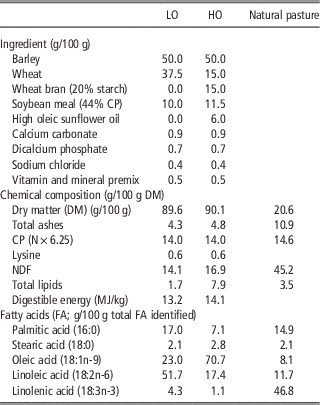
Thirty female and male purebred AL pigs, surgically castrated at about 3 months of age under anaesthesia and additional prolonged analgesia, were used. These animals were randomly allotted within sex to open-air individual pens (3 m2; n=18) and outdoors, in a free-range rearing area (3 ha; n=12), at an initial BW of 61.5±0.6 kg (mean±s.e.m.). Animals were divided by two dietary treatments, a low oleic diet (LO) and a high oleic diet (HO). Feed analyses of the experimental diets are presented in Table 1. Pigs were individually fed in a single daily meal (0900 h), at a weekly adjusted daily rate. Outdoor animals were also manually fed once a day in pens similar to the ones where IND pigs were allocated, in order to control their individual feed intake. Diet was offered at 85% estimated ad libitum consumption according to the INRA scale, as previously described (Martins et al., Reference Martins, Neves, Freitas and Tirapicos2012). The amount of feed given was calculated in order to provide a similar energy intake in all experimental groups. All animals had free access to water and the daily diet refusals and spillage were measured. Animals reared outdoors had also access to the natural pasture spontaneously grown in the free-range area during the trial (from mid-August to mid-November). This study was carried out in accordance with the regulations and ethical guidelines set by the Portuguese Animal Nutrition and Welfare Commission (DGAV, Lisboa, Portugal).
Ingredients and chemical and main fatty acid composition of the experimental diets and pasture

DM=dry matter; LO=low oleic diet; HO=high oleic diet.
Pigs were divided into four experimental groups: pigs reared in individual pens (IND) and consuming the LO (n=9) and HO (n=9) diets, and pigs reared outdoors (OUT) and consuming the LO (n=6) and HO (n=6) diets. Minimum and maximum temperatures as well as the relative humidity, to which OUT- and IND-reared pigs were submitted, were daily recorded.
Pigs were slaughtered at ~100 kg BW by electronarcosis and bleeding at an industrial slaughterhouse. Each left side of the carcass was submitted to commercial cuts according to the Portuguese Norm as described (Martins et al., Reference Martins, Neves, Freitas and Tirapicos2012) and their weights and those of the belly, lard and perirenal fat were recorded. Commercial yield and fat cuts weights were also expressed as a percentage of the cold left-side carcass weight. Longissimus dorsi and backfat thicknesses were obtained with a caliper rule by an average of three measurements (10th to 11th ribs, last rib and 3rd to 4th lumbar vertebrae). Finally, longissimus dorsi, and semimembranosus were removed from the left half carcasses, freed from visible fat, vacuum packaged and frozen (−30°C) until analysis.
Diet composition
Chemicals and solvents of the highest purity were purchased from Merck (Darmstadt, Germany), and Sigma-Aldrich (St. Louis, MO, USA). Experimental diets and pasture dry matter (UM 500; Memmert, Schwabach, Germany), total ashes, CP (N×6.25; Kjeldatherm KB-20; Gerhardt, Bonn, Germany, and Kjeltec Auto 1030 Analyzer; Tecator, Bristol, UK), and NDF were determined as previously described (Martins et al., Reference Martins, Neves, Freitas and Tirapicos2012). Total lipids were determined using a Soxtherm automatic apparatus (SE416; Gerhardt) and FAs were determined on the obtained lipid extract following the method of Folch et al. (Reference Folch, Lees and Stanley1957). FA samples were identified by GC (6890 Hewlett Packard gas chromatograph) and a 30 m×0.32 mm×0.25 µm cross-linked polyethylene glycol capillary column (OmegawaxTM Supelco 24152, Supelco Inc., Bellefonte, PA, USA), as previously described (Martins et al., Reference Martins, Neves, Freitas and Tirapicos2012). Fatty acid methyl esters (FAME) identification was based on retention time of reference compounds (Supelco cat. no. 47801 and 47885-U). FA composition was expressed as g/100 g of total FAME identified.
Muscles composition
Loin (longissimus dorsi) and leg (semimembranosus) muscles were chosen as representing meat cuts of greatest mass and economic value.
Total protein from muscle samples (2 g) were obtained through the Kjeldahl method, as previously described (Martins et al., Reference Martins, Neves, Freitas and Tirapicos2012). Total intramuscular lipids resulted from the sum of neutral and polar lipids obtained from muscle samples (10 g), following the method of Marmer and Maxwell (Reference Marmer and Maxwell1981).
FA composition of the neutral and polar lipid extracts obtained was analysed and identified as described in the ‘diet composition’ section, and expressed as g/100 g of total FAME identified (12:0, 14:0, 16:0, 16:1n-7, 17:0, 17:1n-7, 18:0, 18:1n-9, 18:2n-6, 18:3n-3, 20:0, 20:1n-9, 20:2n-6, 20:4n-6 and 22:0). Saturation, atherogenic and thrombogenic indexes were calculated based on FA composition, as proposed by Ulbricht and Southgate (Reference Ulbricht and Southgate1991).
Statistical analyses
Results are presented as means±r.s.d. (residual standard deviation). Statistical analysis was performed by a two-way ANOVA for rearing system and diet effects with the statistical software Statview 5.0 (SAS Institute Inc., Cary, NC, USA) and the individual pig as the experimental unit. When interactions were significant, a Scheffé multiple comparison test was used as a post-hoc test. For the carcass evaluation data, hot carcass weight was included as a covariate in the model. Differences were considered significant when P<0.05.
Results
Productive parameters and carcass characteristics
Pigs remained in good health throughout the experimental period. Average daily mean temperatures and relative humidity recorded for OUT- and IND-reared pigs throughout this period were 18.7°C and 17.5°C, and 55.0% and 48.7%, respectively.
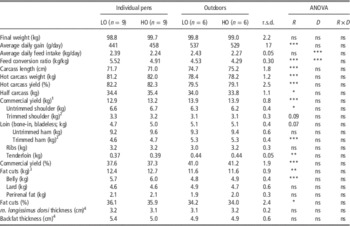
When compared with pigs reared in IND, those reared OUT presented higher average daily gain (ADG; P<0.001) with similar daily diet intake, leading to a lower feed conversion ratio (P<0.001) (Table 2). On the other hand, pigs fed the HO diet consumed less feed than the ones fed the LO diet, and presented lower feed conversion ratios (P<0.001). Carcass characteristics were only affected by rearing system. OUT pigs presented longer and lighter carcasses (P<0.001) and half carcasses (P<0.05), but with higher commercial yield (high value meat cuts), due mainly to heavier trimmed ham (~14%, P<0.001) and tenderloin (~15.8%, P<0.01) cuts. Contrarily, pigs reared OUT presented lower weight in fat cuts, mainly due to a ~17% lower belly weight (P<0.001). Average longissimus dorsi and backfat thickness were not significantly affected by treatments (Table 2).
Growth data and carcass characteristics of Alentejano pigs kept on individual pens or outdoors and fed different levels of oleic acid from 60 to 100 kg BW

LO=low oleic diet; HO=high oleic diet; r.s.d.=residual standard deviation; R=rearing system effect; D=diet effect; R×D=interaction rearing system×diet.
1 Sum of the trimmed shoulder, loin (bone-in, bladeless), trimmed ham and tenderloin cuts.
2 Without rind, external fat and (front or hind) feet.
3 Sum of the belly, lard and perirenal fat.
4 Average of measurements taken at the 10th to 11th ribs, last rib, and 3rd to 4th lumbar vertebrae.
Significance: ***P<0.001; **P<0.01; *P<0.05; ns, not significant (P⩾0.05).
Muscles chemical composition
The chemical composition of the two muscles was mainly affected by rearing system.
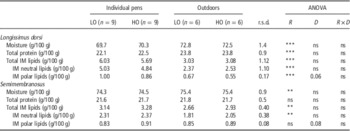
Moisture and total protein content of longissimus dorsi were higher in OUT- than in IND-reared pigs, and the contrary was observed for total, neutral and polar intramuscular lipids (P<0.001; Table 3). Intramuscular polar to total lipids ratio was higher (P<0.05) in OUT- than in IND-reared pigs (0.21 and 0.16, respectively, data not shown). Semimembranosus moisture was higher (P<0.01) and total intramuscular lipids (mainly due to the neutral lipids fraction) lower (P<0.01) in OUT pigs, but no difference was observed on total protein content (Table 3). Finally, intramuscular polar to total lipids ratio was also higher (P<0.01) in OUT- than in IND-reared pigs (0.31 and 0.28, respectively, data not shown).
Chemical composition of m. longissimus dorsi and m. semimembranosus of Alentejano pigs kept on individual pens or outdoors and fed different levels of oleic acid from 60 to 100 kg BW

IM=intramuscular; LO=low oleic diet; HO=high oleic diet; r.s.d.=residual standard deviation; R=rearing system effect; D=diet effect; R×D=interaction rearing system×diet.
Significance: ***P<0.001; **P<0.01; ns, not significant (P⩾0.05).
Intramuscular lipids and FA profile
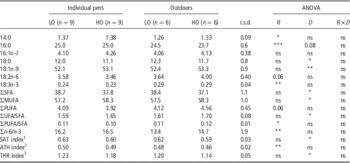
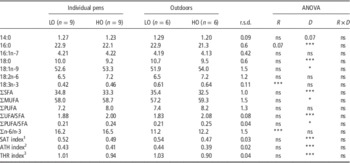
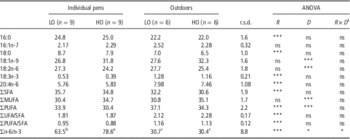
The most abundant FA present on the intramuscular neutral lipids of AL pigs was oleic acid (18:1n-9). For longissimus dorsi, oleic acid values varied between 52.1 and 53.3 g/100 g (IND-LO and OUT-HO pigs, respectively) and for semimembranosus, between 51.9 and 54.0 g/100 g (OUT-LO and OUT-HO pigs, respectively) of total FAME analysed.
Composition of the major FA of neutral lipids from longissimus dorsi and semimembranosus was affected by rearing system and experimental diets. For longissimus dorsi, palmitic acid (16:0), the second most abundant FA, presented a lower proportion (P<0.001) in OUT than in IND pigs. Oleic acid was not affected by rearing system, but linolenic (18:3n-3) acid was 23.4% higher (P<0.001) in longissimus dorsi of OUT than IND pigs (Table 4). Experimental diets affected longissimus dorsi palmitic and stearic (18:0) acid proportions, which were, respectively, 3.6% (P=0.08) and 6.2% lower (P<0.05) in HO- than in LO-fed pigs. On the other hand, oleic acid content was higher (P<0.01) in HO-fed pigs (Table 4). In semimembranosus, palmitic acid tended (P=0.07) to be less abundant in OUT- than in IND-reared pigs (Table 5). Oleic acid proportion was also not affected by rearing, but as to linolenic acid, its proportion was 42% more abundant (P<0.001) in pigs reared OUT than in IND. Experimental diets also affected some major FA proportions of semimembranosus. Palmitic and stearic acid proportions were lower (P<0.001) in HO- than in LO-fed pigs, and oleic acid content was higher (P<0.05; Table 5). Overall, in pigs fed HO diet, longissimus dorsi and semimembranosus presented significantly lower SFA (−2.9% and −6.3%, respectively) and higher MUFA (1.7% and 2.4%), leading to lower saturation indexes (−4.8% and −9.4%) (Tables 4 and 5). On the other hand, n-6/n-3 ratios from pigs reared OUT were significantly lower than the ones observed in those reared IND (−14.1% and −28.4% for longissimus dorsi and semimembranosus, respectively). Finally, rearing system affected the atherogenic index (−5.1% for longissimus dorsi from pigs reared OUT, P<0.01) and HO diet consumption reduced atherogenic (−3.1% for longissimus dorsi, NS, and −8% for semimembranosus, P<0.001) and thrombogenic (−4.5% for longissimus dorsi, P<0.05, and −9.8% for semimembranosus, P<0.001) indexes (Tables 4 and 5).
Fatty acid profile of neutral intramuscular lipids (g/100 g) of m. longissimus dorsi of Alentejano pigs kept on individual pens or outdoors and fed different levels of oleic acid from 60 to 100 kg BW

SFA=saturated fatty acids; PUFA=polyunsaturated fatty acids; MUFA=monounsaturated fatty acids; LO=low oleic diet; HO=high oleic diet; r.s.d.=residual standard deviation; R=rearing system effect; D=diet effect; R×D=interaction rearing system×diet.
Significance: ***P<0.001, **P<0.01; *P<0.05; ns, not significant (P⩾0.05).
1 Saturation index=(14:0+16:0+18:0)/(ΣMUFA+ΣPUFA).
2 Atherogenic index=[12:0+(4×14:0)+16:0]/(ΣMUFA+Σn-6+Σn-3).
3 Thrombogenic index=(14:0+16:0+18:0)/[(0.5×ΣMUFA)+(0.5×Σn-6)+(3−Σn-3)+(Σn-3/Σn-6)].
Fatty acid profile of neutral intramuscular lipids (g/100 g) of m. semimembranosus of Alentejano pigs kept on individual pens or outdoors and fed different levels of oleic acid from 60 to 100 kg BW

SFA=saturated fatty acids; MUFA=monounsaturated fatty acids; PUFA=polyunsaturated fatty acids; LO=low oleic diet; HO=high oleic diet; r.s.d.=residual standard deviation; R=rearing system effect; D=diet effect; R×D=interaction rearing system×diet.
1 Saturation index=(14:0+16:0+18:0)/(ΣMUFA+ΣPUFA).
2 Atherogenic index=[12:0+(4×14:0)+16:0]/(ΣMUFA+Σn-6+Σn-3).
3 Thrombogenic index=(14:0+16:0+18:0)/[(0.5×ΣMUFA)+(0.5×Σn-6)+(3×Σn-3)+(Σn-3/Σn-6)].
Significance: ***P<0.001, *P<0.05; ns, not significant (P⩾0.05).
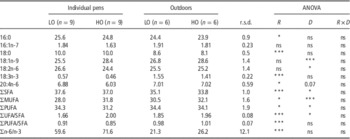
On polar lipids, the most abundant FA was also oleic acid, which varied between 26.8 and 32.3 g/100 g in longissimus dorsi, and 25.5 and 28.6 g/100 g in semimembranosus (IND-LO and OUT-HO pigs, respectively). Furthermore, a higher proportion of PUFA was observed on this fraction when compared with the neutral lipid fraction.
In both muscles, rearing system and experimental diets affected the composition of major FA of polar lipids. In longissimus dorsi, palmitic and stearic acids were less abundant in OUT- than in IND-reared pigs (−11.2% and −18.7%, respectively; P<0.001), but oleic acid was not significantly affected (Table 6). As for PUFA, linolenic and arachidonic (20:4n-6) acid proportions were affected by rearing system, presenting higher values (165.2% and 33.2% respectively; P<0.001) in pigs reared OUT. When compared with that of LO, HO diet consumption led to changes in the content of oleic (+17.8%), and linoleic (−9.8%) acids (P<0.001; Table 6). For semimembranosus, palmitic and stearic acids content decreased by 4.2% (P<0.05) and 16.5% (P<0.001) in OUT- when compared with IND-reared pigs, leading to a reduction of 7.6% (P<0.001) on total SFA (Table 7). Oleic acid proportion was not affected by rearing system, and linolenic and arachidonic acid proportions were 187.4% and 4.9% higher (P<0.001 and P<0.05, respectively) in pigs reared OUT. Experimental diets affected two FA proportions of semimembranosus. Oleic acid content was 9% higher (P<0.001) in HO- than in LO-fed pigs, and linoleic acid was reduced by 4.8% (P<0.05; Table 7). Overall, when compared with IND-reared pigs, those reared OUT presented a reduction in SFA (−10.9% and −7.6%, respectively), an increase in PUFA (11% and 4.6%) and of their ratios (∑ unsaturated fatty acids (UFA)/SFA and ∑PUFA/SFA) in longissimus dorsi and semimembranosus. A reduction of n-6/n-3 FA ratios was also observed (Tables 6 and 7). Diet effects were also present, and when compared with pigs fed LO, those consuming the HO diet presented higher proportions of MUFA (14.1% and 9.2% for longissimus dorsi and semimembranosus, respectively) and lower of PUFA (−8.9% and −4.9%).
Fatty acid profile of intramuscular polar lipids (g/100 g) of m. longissimus dorsi of Alentejano pigs kept on individual pens or outdoors and fed different levels of oleic acid from 60 to 100 kg BW

SFA=saturated fatty acids; MUFA=monounsaturated fatty acids; PUFA=polyunsaturated fatty acids; LO=low oleic diet; HO=high oleic diet; r.s.d.=residual standard deviation; R=rearing system effect; D=diet effect; R×D=Interaction rearing system×diet.
1 Values within a row with different superscripts differ significantly, P<0.05 by the Scheffé test; Significance: ***P<0.001, *P<0.05; ns, not significant (P⩾0.05).
Fatty acid profile of intramuscular polar lipids (g/100 g) of m. semimembranosus of Alentejano pigs kept on individual pens or outdoors and fed different levels of oleic acid from 60 to 100 kg BW

SFA=saturated fatty acids; MUFA=monounsaturated fatty acids; PUFA=polyunsaturated fatty acids; LO=low oleic diet; HO=high oleic diet; r.s.d.=residual standard deviation; R=rearing system effect; D=diet effect; R×D=interaction rearing system×diet.
Significance: ***P<0.001, *P<0.05; ns, not significant (P⩾0.05).
Discussion
In this study, ADG of OUT-reared pigs was higher than the one observed in IND-reared ones, for a similar daily feed intake of experimental diets. This suggests the consumption of pasture by OUT animals contributed to increase their ADG. Reared in the Dehesa, Iberian pigs present an average voluntary intake of 0.4 kg DM of grass per day plus acorn (Rodríguez-Estévez et al., Reference Rodríguez-Estévez, García, Peña and Gómez2009) and forage for a range of different foodstuffs (Lebret, Reference Lebret2008). On the other hand, the higher daily intake of experimental diets observed in LO- as compared with HO-fed pigs was a result of the diet restriction to provide a similar energy intake among experimental groups. Both facts influenced feed conversion ratio, lower in OUT-reared and HO-fed pigs.
In outdoor rearing systems, pigs have often a lot of environmentally diverse space, which allows physical activity and expression of investigative behaviour, and potential to forage for a range of different feedstuffs complementarily to the ‘conventional’ feed provided. All these factors interact to determine the animal response in terms of growth and meat quality (Lebret, Reference Lebret2008). Influence of outdoor rearing on muscle composition, particularly lipid concentration, seems to be related to the actual rearing conditions of animals (climate, feeding level). In fact, both similar (Daza et al., Reference Daza, Rey, Olivares, Cordero, Toldrá and López-Bote2009) or decreased (Sather et al., Reference Sather, Jones, Schaefer, Colyn and Roberston1997; Bee et al., Reference Bee, Guex and Herzog2004) muscle lipid contents have been reported for outdoor- compared with indoor-reared pigs.
In our study, carcass characteristics of AL pigs were affected by rearing system. OUT pigs presented lighter carcasses and half carcasses, still with higher commercial yield, due mainly to heavier trimmed ham and tenderloin cuts. Contrarily, they presented lower weight in fat cuts, due to lower belly weight. Backfat thickness, a fatness trait related to fattening efficiency, although ~6% lower in OUT-reared pigs, did not attain statistical significance. In animals consuming similar amount of dietary fat, this difference in body fat deposition suggests pigs presented dissimilar fat catabolism and/or endogenous FA synthesis. General activity is commonly reported as increasing in pigs reared outdoors, whereas in intensive farming systems animals remain physically inactive most of the time (Daza et al., Reference Daza, Rey, Olivares, Cordero, Toldrá and López-Bote2009; Velazco et al., Reference Velazco, Sanz, Barber and García2013). In our OUT-reared pigs, with access to a free-rearing area but with no access to acorns, which are highly caloric (López-Bote, Reference López-Bote1998), the extra energy cost of exercise (Bee et al., Reference Bee, Guex and Herzog2004) could have contributed to increased fat catabolism. On the other hand, abrupt drops of temperature, several days of cold, and hard wind affect the growth rate and backfat thickness of OUT animals, as recently observed (Velazco et al., Reference Velazco, Sanz, Barber and García2013). In our trial, the temperature evolution pattern was different for OUT- and IND-reared pigs. In fact, when compared with the previous 10-day period, in the last 10 days of trial OUT pigs were submitted to a ~24% reduction in average maximum and minimum temperatures (from 18.0°C to 13.7°C and from 12.1°C to 7.8°C, respectively), while IND pigs thrived in similar temperatures (from 19.3°C to 20.3°C and from 9.3°C to 8.7°C). This temperature drop potential deleterious effect seem to be confirmed by weight measurements in the last 11 days of trial, when compared with the previous 15-day period, where OUT pigs presented ~257 and ~550 g ADG, respectively.
Increased protein catabolism is a consistent feature of all experimental models with decreased muscle activity (Goldspink, Reference Goldspink1991; López-Bote et al., Reference López-Bote, Toldrá, Daza, Ferrer, Menoyo, Silió and Rodríguez2008). In our study, higher protein content observed in longissimus dorsi of OUT-reared pigs may have been due to the exercise effect. Yet, this effect was not detected in semimembranosus muscle, which is difficult to explain. Meanwhile, visual observations of outdoor pigs showed these animals preferred to be seated or lying down, rather than standing. Since the absolute rates of protein synthesis and degradation, as well as muscle length and stretch (Goldspink, Reference Goldspink1991) correlate with the level of activity expressed in muscles, we can hypothesize longissimus dorsi was a frequently active and more stretched muscle than semimembranosus in OUT-reared pigs.
IM lipid deposition was also affected by rearing system in both muscles, being lower in OUT pigs than in IND-reared ones. This decrease, mainly due to the effect on neutral lipid concentrations, was of ~48% on longissimus dorsi, and ~13% on semimembranosus. This effect could have been due to the effect of environmental temperatures previously mentioned, since feed could have been diverted from fat deposition to thermoregulation (Sather et al., Reference Sather, Jones, Schaefer, Colyn and Roberston1997). Exercise may also have contributed to this effect, as previously observed (Sather et al., Reference Sather, Jones, Schaefer, Colyn and Roberston1997; Bee et al., Reference Bee, Guex and Herzog2004). Marbling fat of AL/Iberian breed is positively associated to some meat quality characteristics, as juiciness, taste and flavour (Cava et al., Reference Cava, Ruiz, López-Bote, Martín, García, Ventanas and Antequera1997; Hocquette et al., Reference Hocquette, Gondret, Baéza, Médale, Jurie and Pethick2010). These characteristics are considered to be affected if IMF content is lower than ~2.5% (Fernandez et al., Reference Fernandez, Monin, Talmant, Mourot and Lebret1999), a limit that was not attained in our trial. Finally, and although considered a rather stable fraction (Wood et al., Reference Wood, Enser, Fisher, Nute, Sheard, Richardson, Hughes and Whittington2008), intramuscular polar lipids fraction of longissimus dorsi was affected by rearing system. This fraction is mostly formed by phospholipids, which are the main constituents of membrane lipids, and the unexpected reduction in OUT-reared pigs longissimus dorsi is difficult to explain but could indicate a slower increase of adipose cell numbers. On the other hand, intramuscular polar to total lipids ratio was higher in both muscles of OUT-reared pigs, reflecting the higher neutral lipid mobilization in these animals.
Meat quality from local breeds can be manipulated through feeding and rearing systems, thereby demonstrating positive genotype×environment interactions (Lebret, Reference Lebret2008; Wood et al., Reference Wood, Enser, Fisher, Nute, Sheard, Richardson, Hughes and Whittington2008).
Rearing system affected neutral FA composition in both muscles. Even though myristic (in longissimus dorsi) and palmitic acids (in both muscles) were reduced in OUT-reared pigs, this did not affect the sum of SFA and the saturation index, being similar in both muscles of OUT- and IND-reared pigs. Daza et al. (Reference Daza, Rey, Olivares, Cordero, Toldrá and López-Bote2009) also detected lower palmitic acid content in Psoas major from exercised Iberian pigs. Exercise may decrease lipogenic enzymes activity (Fiebig et al., Reference Fiebig, Griffiths, Gore, Baker, Oscai, Ney and Ji1998), thus affecting tissues SFA content. Linoleic acid (n-6) is derived entirely from diet and a positive influence of diet supply on linoleic acid content of fat tissues in pigs has been described (reviewed by Wood et al., Reference Wood, Enser, Fisher, Nute, Sheard, Richardson, Hughes and Whittington2008). Of the two major PUFA, the efficiency of uptake from diet into both pig adipose and muscle tissues is greater for linoleic than for linolenic acid (Nguyen et al., Reference Nguyen, MCGA, Everts, Salden and Beynen2003). In our trial, although present in pasture (11.7 g/100 g), linoleic acid only tended (P=0.06) to increase in longissimus dorsi from OUT-reared pigs, and several authors have previously reported no significant differences in linoleic acid of pigs fed high-content linoleic diets (Cava et al., Reference Cava, Ruiz, López-Bote, Martín, García, Ventanas and Antequera1997; Andrés et al., Reference Andrés, Cava, Mayoral, Tejeda, Morcuende and Ruiz2001). Therefore, it seems that some other factors may influence the linoleic acid content of neutral lipids, probably related to the regulation of desaturation and elongation of FA (Andrés et al., Reference Andrés, Cava, Mayoral, Tejeda, Morcuende and Ruiz2001) and to the muscle studied. As to linolenic acid (n-3) content, an increase was observed in both muscles of OUT pigs, in accordance with the consumption of a linolenic-rich feed (46.8 g/100 g natural pastures) by these pigs. This effect, of interest from consumer’s health point of view (Wood et al., Reference Wood, Enser, Fisher, Nute, Sheard, Richardson, Hughes and Whittington2008), was previously observed in commercial (Rey et al., Reference Rey, Kerry, Lynch, López-Bote, Buckley and Morrissey2001; Bee et al., Reference Bee, Guex and Herzog2004) and Iberian pigs (Andrés et al., Reference Andrés, Cava, Mayoral, Tejeda, Morcuende and Ruiz2001). In addition, n-3 PUFA appear to have the ability to re-partitioning FA away from triacylglycerol synthesis and toward oxidation, enhance thermogenesis and thereby reduce the efficiency of body fat deposition (reviewed by Clarke, Reference Clarke2000), which could have contributed to the lower body fat deposition observed in OUT-reared pigs (Tables 2 and 3).
In longissimus dorsi from OUT-reared pigs, the increase in linolenic acid, added to the increase in linoleic acid (P=0.06) led to a higher PUFA to SFA ratio. The increase in linolenic acid in both muscles of OUT pigs led to a significant reduction in n-6/n-3 ratio, showing that, according to FA, the influence of pasture intake on lipidic profile seems clear. This is particularly important when a high n-6/n-3 ratio seems to be a prime risk factor for coronary heart diseases (Wood et al., Reference Wood, Enser, Fisher, Nute, Sheard, Richardson, Hughes and Whittington2008). When compared with the ratio obtained from commercial pigs (~27, Estévez et al. (Reference Estévez, Morcuende and López2003)) ratio values obtained on the intramuscular neutral lipids of the studied AL pigs muscles present a healthier profile.
Experimental diets also affected neutral FA proportion in both muscles. Palmitic and stearic acid were reduced in HO-fed pigs, when compared with LO-fed, leading to a significantly lower content of SFA (and of the saturation index) in longissimus dorsi and semimembranosus. This slightly lower proportion of SFA in neutral lipids of pigs fed HO diet could be due to the higher lipid content inhibitory effect on de novo lipid synthesis and to a dilution effect by higher contents of C18:1, as previously reported (Cava et al., Reference Cava, Ruiz, López-Bote, Martín, García, Ventanas and Antequera1997; Ruiz et al., Reference Ruiz, Cava, Antequera, Martín, Ventanas and López-Bote1998; Andrés et al., Reference Andrés, Cava, Mayoral, Tejeda, Morcuende and Ruiz2001). HO-fed pigs presented significantly higher contents of oleic acid when compared with LO-fed ones, as previously observed in commercial (St. John et al., Reference St. John, Young, Knabe, Thompson, Schelling, Grundy and Smith1987; Miller et al., Reference Miller, Shackelford, Hayden and Reagan1990) and Iberian pigs (Rey et al., Reference Rey, Daza, López-Carrasco and López-Bote2006) fed diets rich in oleic acid. Although monounsaturated proportions of muscles reflected monounsaturated content in the oleic-enriched diet, the magnitude of this increase was small (+1.8 and +2.7% in longissimus dorsi and semimembranosus, respectively) when compared with the ~200% higher oleic acid content in HO when compared with LO diet. In fact, the C16 and C18 SFA and MUFA interconversions may limit the impact of dietary additions (Wood et al., Reference Wood, Enser, Fisher, Nute, Sheard, Richardson, Hughes and Whittington2008).
Changes in SFA and MUFA contents led to an increase in UFA to SFA ratio in both muscles. As previously mentioned, MUFA, as opposed to SFA, has been related with positive effects in human health (St. John et al., Reference St. John, Young, Knabe, Thompson, Schelling, Grundy and Smith1987). Also, dietary MUFA-enrichment can lead to a reduction in n-6 content of pork (Rey et al., Reference Rey, Kerry, Lynch, López-Bote, Buckley and Morrissey2001), thus leading to a lower n-6/n-3 FA ratio as observed in our study. This is interesting from the nutritional point of view, since current dietary guidelines recommend decreasing this ratio (Wood et al., Reference Wood, Enser, Fisher, Nute, Sheard, Richardson, Hughes and Whittington2008).
When analysing the atherogenic and thrombogenic indexes, which in meat vary generally from 0.5 to 1.0 and from 0.8 to 1.6, respectively (Ulbricht and Southgate, Reference Ulbricht and Southgate1991), the effect of experimental diet was more noticeable than the one of rearing system. Feeding high oleic diets reduced indexes in both muscles, even though atherogenic index reduction in longissimus dorsi (−3.1%) did not attain statistical significance. In fact, although longissimus dorsi and semimembranosus are both predominantly glycolytic muscles, these differences were more marked in the latter, suggesting an influence of muscle type on these parameters.
Rearing system affected polar FA proportion in both muscles. Myristic and palmitic acids were reduced in OUT-reared pigs, lowering the sum of SFA in both muscles of OUT- then IND-reared pigs. Linolenic and arachidonic PUFAs increased in OUT-reared pigs, also affecting the sum of PUFA in both muscles. When compared with neutral lipids, polar lipids are highly susceptible to undergo oxidative reactions, the higher the proportion of PUFA, the greater the susceptibility to oxidation (Cava et al., Reference Cava, Ruiz, Ventanas and Antequera1999; Andrés et al., Reference Andrés, Cava, Mayoral, Tejeda, Morcuende and Ruiz2001). However, grass is an important source of α- and γ-tocopherols, and an increased deposition in cellular membranes of these compounds could prevent excessive lipid oxidation and development of thiobarbituric acid-reactive substances during meat storage, as observed in Iberian pigs fed with acorns, pasture and mixed diets enriched in tocopherols (Andrés et al., Reference Andrés, Cava, Mayoral, Tejeda, Morcuende and Ruiz2001; Ventanas et al., Reference Ventanas, Tejeda and Estévez2008).
As to n-3, its content increased dramatically in both muscles of OUT-reared pigs, influencing n-6/n-3 ratio, which was lower than in IND-reared pigs. Previous studies have shown a positive influence of rearing Iberian pigs outdoors on the linolenic content of polar FA (Andrés et al., Reference Andrés, Cava, Mayoral, Tejeda, Morcuende and Ruiz2001). This is in accordance with the consumption of a linolenic-rich feed (natural pastures) by these pigs. However, FA profile of polar lipids in the present study seemed to be overall more influenced by FA composition of diet than the FA profile from neutral lipids. One explanation could be that, since polar lipids have a shorter turnover rate than triacylglycerols (Hellerstein et al., Reference Hellerstein, Neese and Schwarz1993) they are more directly influenced in their FA composition by diet fed a short time before analysis (pasture regrowth at the end of trial). Similar results were previously found by Ruiz et al. (Reference Ruiz, Cava, Antequera, Martín, Ventanas and López-Bote1998) in Iberian pigs.
Experimental diets also affected polar FA composition in both muscles, although not so extensively as rearing system. Oleic acid was increased and linoleic acid decreased in HO- when compared to LO-fed pigs, leading to an increase in MUFA and a decrease in PUFA. These results support that dietary MUFA-enrichment can lead to a reduction in the n-6 content of polar lipids from pork, as reported by Rey et al. (Reference Rey, Kerry, Lynch, López-Bote, Buckley and Morrissey2001).
Oleic enriched diets appear to be a successful strategy to increase the monounsaturated profile, which has been highlighted as one of the main reasons for the high quality of meat products from AL/Iberian pigs (Cava et al., Reference Cava, Ruiz, Ventanas and Antequera1999). Also, high proportion of oleic acid in AL muscles could help reducing cholesterol levels in pigs, since MUFAs depress low-density lipoproteins-cholesterol without modifying high-density lipoproteins-cholesterol levels. Furthermore, free rearing reduces the n-6/n-3 ratio in pork, a known prime risk factor for coronary heart diseases. In a similar manner, the consumption of grass influences the FA profile and the antioxidant content of pig muscles, and the subsequent quality of pork products (López-Bote, Reference López-Bote1998). Therefore, grazing outdoors appears as an interesting approach to improve the healthy image of natural pig production. However, and despite AL pig rusticity, climatic conditions can play a significant role in animal performance in an outdoor production system.
In conclusion, this study shows both feeding and rearing system influence growth performance, carcass composition and the nutritional quality of meat. These two variables have complementary effects and interestingly, the combination of these effects in OUT-HO group led to a neutral lipid profile in both muscles similar to the one present in valued high quality carcasses from pigs traditionally reared under free-range conditions and finished on oak woodland pasture (see Daza and López-Bote, Reference Daza and López-Bote2007).
Acknowledgement
This work was supported by the AGRO research programme (AGRO 226, INIAP, Ministério da Agricultura, Lisboa, Portugal) and by the Instituto de Ciências Agrárias e Ambientais Mediterrânicas (ICAAM, Évora, Portugal). The authors would like to thank ANPCA, Portugal, for technical assistance. This work was funded by FEDER Funds through the Operational Programme for Competitiveness Factors – COMPETE and National Funds through FCT - Foundation for Science and Technology under the Strategic Projects PEst-C/AGR/UI0115/2011 and PEst-OE/AGR/UI0115/2014.