

INTRODUCTION
Many scholars tend to assume that religion begets a more ethical climate in business (Lambert III, Reference Lambert2009; Miller, Reference Miller2007). Empirical support, however, for this hypothesis is murky. Agle and Van Buren III (Reference Agle and Van Buren1999) hypothesize that religious practices and Christian beliefs should lead to positive attitudes toward corporate social responsibility (CSR), yet find only weak support for their hypotheses. Brammer, Williams and Zinkin (Reference Brammer, Williams and Zinkin2007) find mixed evidence in support of the notion that religious membership is positively associated with support for CSR. Vitell and Paolillo (Reference Vitell and Paolillo2003) find no support for a direct positive relationship between religiosity and consumer business ethics. Further research, however, finds that intrinsic (i.e., an inner spiritual life) and extrinsic religiosity (external manifestation of religion without inner spiritual life) better predicts consumer ethics attitudes (Patwardhan, Keith, & Vitell, Reference Patwardhan, Keith and Vitell2012; Vitell, Paolillo, & Singh, Reference Vitell, Paolillo and Singh2005; Vitell, Singh, & Paolillo, Reference Vitell, Singh and Paolillo2007). These studies operationalize “business ethics” in different ways, but in general, test the notion that religion provides resources (e.g., religious beliefs) that lead to more ethical business conduct. Weaver and Agle (Reference Weaver and Agle2002) usefully transcend the dominant individual-level approach to the topic by considering how the interplay between organizational culture and religious identity salience might impact ethical behavior. In this article, I further expand the level of analysis by focusing on the institutional processes that shape the relationship between religion and ethical business behavior. In doing so, I elucidate why religion may not always beget a more ethical business climate.
Existing individual-level research on religion and business tacitly assumes that religion has moral authority over business, and that religious actors are willing and able to exert this moral authority. It also tends to assume that the comingling of religion in business is necessary and sufficient for the exercise of religious morality authority in business. However, a closer look at the inter-institutional interface of religion and business problematizes these assumptions. In this article I pursue the following research questions: How do institutional-level processes shape the religion-business interface? More specifically, how does the symbolic boundary work (of religious actors) around religion and business shape their ability to exert moral authority in business?
To theorize four inter-institutional processes by which religion exerts (or fails to exert) moral authority in business, I meld together three rather disparate literatures. Sociology of religion’s Secularization Theory (Chaves, Reference Chaves1994) adds a valuable historical dimension to the changing role of religious moral authority in modern societies. The literature on Institutional Complexity (Greenwood, Raynard, Kodeih, Micelotta, & Lounsbury, Reference Greenwood, Raynard, Kodeih, Micelotta and Lounsbury2011; Peifer, Reference Peifer2014) magnifies the inherent difficulty of harmonizing competing institutional logics, such as religion and business. And lastly, the Symbolic Boundary literature (Lamont, Reference Lamont, Smelser and Baltes2001) helps theorize the symbolic boundary blurring (i.e., entanglement) of and boundary building (i.e., separation) of religion and business. Through focusing on two dimensions of moral authority (strong exertion of religious moral authority and weak or no exertion of religious moral authority) and two dimensions of symbolic boundary work (boundary blurring and boundary building), I identify four inter-institutional processes that social actors may exhibit in instances where authority from one institution may be exerted over phenomena in another institution: Disengagement, Engagement, Co-optation, and Adjudication.
As an empirical case of these inter-institutional processes, I focus on the relationship between religion and the financial market in the 20th century in the United States (US). Through a grounded theoretical approach (Corbin & Strauss, Reference Corbin and Strauss2008), I engage in qualitative analysis of religious magazines from 1927-1931 and 1985-1989. This means both the theoretical motivation and the empirical display in this article is the result of an iterative process, where I moved back and forth from theory and my qualitative magazine content. I provide numerous examples of each inter-institutional process, and end with a discussion of how my findings relate to the scholarship on Religion and Business in particular and business ethics more broadly.
RELIGIOUS MORAL AUTHORITY
Research on religion and business can benefit from a broader understanding of how the institutions of religion and business have interfaced over time. Following the well-known narrative attached to the Age of Enlightenment, the secularization thesis is typically interpreted as some version of “religious decline.” This general claim has been usefully segmented into three levels of analysis (i.e., individual, organizational and societal), opening more precise avenues to empirically test this claim of religious decline (Dobbelaere, Reference Dobbelaere1981, Reference Dobbelaere1999). Most important to this article is a societal-level articulation of secularization theory, which asserts that societal-level institutions (such as science, education, the state, and the economy) have separated from religion over time (Gorski, Reference Gorski2000; Tschannen, Reference Tschannen1991). Chaves (Reference Chaves1994) suggests secularization is best understood as the decline of religious authority over other societal-level institutions. Religious authority refers to the control of access “to some desired goods, where the legitimation of that control includes some supernatural component, however weak” (Chaves, Reference Chaves1994: 755-756). The desired goods are not important in this Weberian inspired definition of religious authority; what matters is the supernatural legitimation of that control.
The United States was “born” a modern equal inter-institutional society, meaning, among other things, that religion never held direct control over business (as opposed, for instance, to the mediaeval Catholic Church’s more direct control over the economy or Islamic scholars’ control over sharia finance). Therefore, instead of insisting religion formally control the levers of US business to proceed, I consider how religious actors “flex their muscles” of moral authority, so to speak, or what I refer to as religious moral authority. The term “moral” refers to pronouncements of appropriate (i.e. good) and inappropriate (i.e., bad) behavior. These moral pronouncements are legitimate because of some supernatural component attached to the pronouncement or the one making the pronouncement. It is important to clarify that religious moral authority is a distinct concept from religious control, which would clearly specify an undesired material consequence of immoral behavior (e.g., a monetary fine or some other form of punishment). Importantly, moral control likely requires moral authority. Despite religion’s lack of formal control over society in the US, religious moral authority in an equal inter-institutional society should not be trivialized, as evidenced by the important role religious moral authority has played in social movements in the United States, such as the Civil Rights movement in the 1960’s.
Tying this discussion of religious moral authority back to the literature on religion and business, we see the ability of religion to “leaven” business is contingent on the moral authority of religion in a secular society. Classical notions of secularization strongly suggest religious authority is weakening. More empirically-minded social scientists prefer to rely on data that elucidates the conditions under which religious authority is waning, and conditions under which it is not (Casanova, Reference Casanova1994; Chaves, Reference Chaves1994; Smith, Reference Smith2003). This introduces variance in the extent to which religion is able to exert moral authority in business—variance that is ripe for empirical study. It should be clarified, however, that there is no universally agreed upon understanding of what “moral behavior” in business means. Instead, the content of religious moral pronouncements in business is likely to vary across religious traditions, religious actors and time.
INSTITUTIONAL COMPLEXITY AND SYMBOLIC BOUNDARIES
To help theorize the conditions that shape the ability of religious moral authority to be exerted in business, I turn to the literature on Institutional Logics (Friedland & Alford, Reference Friedland, Alford, Powell and DiMaggio1991; Orlitzky, Reference Orlitzky2011; Thornton, Ocasio, & Lounsbury, Reference Thornton, Ocasio and Lounsbury2012). This theory asserts that individual and organizational behavior is strongly determined by a few macro-level phenomena referred to as institutional logics, e.g., the state, religion, capitalism, family, and community. Recent scholarship in this vein has taken particular interest in the notion of institutional complexity, which refers to the “incompatible prescriptions from multiple institutional logics” (Greenwood et al., Reference Greenwood, Raynard, Kodeih, Micelotta and Lounsbury2011). Religion and business are a fitting example of incompatible logics (Peifer, Reference Peifer2014). For instance, a religious logic tends to rely upon moral legitimacy while business relies on a different type of legitimacy, pragmatic legitimacy (Suchman, Reference Suchman1995; Thornton et al., Reference Thornton, Ocasio and Lounsbury2012). The notion of institutional complexity suggests that the institutional logics of religion and business are incompatible, making it difficult to serve both “masters.” This insight problematizes the basic premise of much religion and business scholarship: that religion easily permeates business, resulting in more ethical business practice (Agle and Van Buren III, Reference Agle and Van Buren1999; Lambert III, Reference Lambert2009; Miller, Reference Miller2007).
In this article, I also highlight the symbolic boundary work that accompanies the institutional complexity of religion and business. Symbolic boundaries or “distinctions made by social actors to categorize objects, people, practices…” have become an important concept in cultural sociology (Lamont & Molnar, Reference Lamont and Molnar2002:168). While some boundary scholars focus on the boundaries that social actors create around groups of people (Lamont, Reference Lamont1992, Reference Lamont2000), in this present study I am most interested in the symbolic boundaries between institutions. Much of the existing symbolic boundary research on institutions has focused on scientific and religious institutions (Cadge, Ecklund, & Short, Reference Cadge, Ecklund and Short2009; Ecklund, Reference Ecklund2010; Gieryn, Reference Gieryn1999; Gieryn, Bevins, & Zehr, Reference Gieryn, Bevins and Zehr1985). I am interested in analyzing the ways social actors engage in symbolic boundary work between religion and business. Boundary building refers to a clean separation or distinction of the institutions, while boundary blurring refers to joining them together. For example, Peifer (Reference Peifer2014) exemplifies boundary building when fund managers of religiously-affiliated socially responsible mutual funds claim that their religious beliefs have nothing to do with their investment practices because religion is more about their inner spiritual life. Boundary blurring occurs when fund managers claim the same religious sensibilities instruct their behavior on Sunday morning (during worship) as Monday morning (in their job as fund managers). To gain a richer understanding of religion and business, one needs to be attentive to the symbolic boundary work social actors engage in at their institutional interface.
INTER-INSTITUTIONAL PROCESSES
Through focusing on two dimensions of religious moral authority (strong exertion of religious moral authority and weak/no exertion of religious moral authority) and two dimensions of symbolic boundary work (boundary blurring and boundary building), I identify four processes that social actors may exhibit in instances where authority from one institution may be exerted over phenomena in another institution. The four inter-institutional processes I coin are Disengagement, Engagement, Co-optation and Adjudication (see Table 1). To be clear, in this article, I make the simplifying assumption that these processes are unidirectional, where authority stems from one institution and is directed toward another. It is acknowledged, however, that in reality the exertion of moral authority operates in both directions.
Inter-Institutional Processes

Disengagement
Classical secularization theorists have worked from the assumption that Disengagement is dominant in modern society. Namely, boundary building occurs between religion and other institutions, resulting in weak or no religious moral authority over these institutions. Casanova (1994) refers to this marginalization of religion as “privatization” which suggests religion is mostly a “private” affair. And Weber’s (1905 [2009]) influential The Protestant Ethic and the Spirit of Capitalism embodies his stature as a classical secularization theorist. In his explanation for the origins of modern rational capitalism, Weber explains the necessity of religious assent through a distinct Protestant ethic of asceticism and the pursuit of one’s calling. Importantly, however, Weber argues the religious moorings of capitalism were abandoned over time because the “acquisitive manner of life” associated with modern rational capitalism had been so thoroughly secularized that “it no longer needs the support of any religious forces” and attempts of religion to influence economic life are “an unjustified interference” (Weber, Reference Weber1905 [2009]: 36). In other words, modernity is marked by religion’s trivialized position relative to business.
Instead of coining this inter-institutional process something like secularization, however, I use the term Disengagement in order to enhance the generalizability of these theorized processes to multiple institutional dyads, including non-religious institutions. The term Disengagement refers to boundary building, which creates a clean symbolic distinction between two institutions. In other words, there is “social distance” between the two institutions. This social distance might be marked by a position of irrelevance, where the two institutions are perceived to be too different from one another to warrant any meaningful dialogue. Or it may be marked by a general lack of knowledge about the other, leading to ineffectual dialogue among social actors from each institution. In either case, the boundary building results in weak or no exertion of moral authority from one over the other. This process evokes the caricature of an “aloof outsider” who is removed, unconcerned and perhaps unaware of the institutional phenomena in question and therefore not engaged in any significant moral exertion over it.
Engagement
The second inter-institutional process combines boundary blurring with strong exertion of moral authority. This best represents, in my view, the underlying assumption of most religion and business research. While the empirical evidence in support of this notion may be murky (Agle and Van Buren III, Reference Agle and Van Buren1999; Brammer, Williams, & Zinkin, Reference Brammer, Williams and Zinkin2007; Vitell & Paolillo, Reference Vitell and Paolillo2003), some scholars nevertheless tend to assume that the boundaries between religion and business can be easily blurred so that religion can exert its moral authority over business, a process I coin as Engagement. In other words, religious moral pronouncements are clearly articulated and resonant with the intended audience, despite the interface of two distinct institutions. Typically, these religious moral pronouncements are made from an informed position within business. An “internal whistleblower” is an example of an actor uttering a moral critique of business from a position of close proximity to the organization. On the positive side, an “internal advocate” is an example of an internal actor offering moral approval of some aspect of business.
Secularization theorists refer to such an institutional process as deprivatization. Casanova (Reference Casanova1994) explains, “By deprivatization I mean the fact that religious traditions throughout the world are refusing to accept the marginal and privatized role which theories . . . of secularization had reserved for them. Social movements have appeared which either are religious in nature or are challenging in the name of religion the legitimacy and autonomy of the primary secular spheres, the state and the market economy” (5).
Co-optation
Disengagement is clearly articulated in the Secularization literature and, I argue, Engagement is tacitly assumed in most religion and business literature. A novel contribution of this article is the introduction of two less-recognized processes: Co-optation and Adjudication. Co-optation represents a process whereby, as with Engagement, the boundaries between religion and business are blurred. But instead of this blurring yielding increased moral authority, it attenuates it. Again, to simplify the analysis of this article’s magazine data, I only focus on the co-optation of religion by business, when in reality; either institution can by co-opted by the other. Put another way, Co-optation by business reinforces the important point that religion is passive and fails to exert moral authority in this inter-institutional process. We need look no further than Emerson’s (Reference Emerson1962) Power-Dependence Theory and Pfeffer and Salancik’s (Reference Pfeffer and Salancik1978) Resource Dependence Theory to generate a theoretically defensible case for this inter-institutional process.
Intending his theory to generalize beyond the individual-level of analysis, Emerson (Reference Emerson1962) states power does not reside in a social actor, but “power is a property of the social relation” (32). More specifically, Emerson explains that “the power of A over B is equal to, and based upon, the dependence of B upon A” (33). Pfeffer and Salancik’s (Reference Pfeffer and Salancik1978) Resource Dependence Theory applies this logic to an organizational setting. They assert that an organization depends upon many other actors (or stakeholders) for resources that are vital to its operations.
I focus on the simple but powerful idea that being dependent on another party for resources erodes one’s power in relation to that party. In other words, a particular type of symbolic boundary blurring is at play here, one that includes dependence on the other for needed resources. In the case of religion and business, an obvious example would be that religion depends on business for financial resources, but one could also consider non-financial resources, like the legitimacy that being “run like a business” might bring. This dependence on business, Resource Dependence Theory suggests, decreases the power religion has over business. More on point for this article, religion’s moral authority over business is eroded. This erosion may be motivated out of a pragmatic decision for religious actors to refrain from “biting the hand that feeds it,” for fear of somehow stemming the financial flows from business. Alternatively, dependence on business might foster justificatory meaning making that renders certain business issues to be amoral affairs (i.e., devoid of moral content). A “silent insider” depicts this posture of failing to exert moral authority over business.
Adjudication
Following resource dependence theory (Pfeffer & Salancik, Reference Pfeffer and Salancik1978) to its logical conclusion, boundary building between two institutions suggests minimal resource dependence between the two. Applying this lack of dependence (i.e., boundary building) to moral authority, an inter-institutional relationship of Adjudication frees one institution to exert moral authority over the other. This inter-institutional process is in some ways counter intuitive, because we typically associate moral authority with those who are close enough and informed enough to make legitimate moral claims (i.e., Engagement).
This raises an important question; can moral authority from a social distance (i.e., despite symbolic boundaries) have any legitimacy? I think it can. As Resource Dependence Theory suggests, a lack of dependency frees actors from one institution to make unconstrained pronouncements of another without fear of any direct negative repercussions. In other words, one needn’t worry about “biting the hand that feeds it.” This relationship may lend itself to more strongly worded moral authority, instead of “tip-toing” around the central issue. Moral pronouncements of adjudication can also be deemed unbiased and therefore more legitimate by onlookers. In this way, the target of moral exertion is more vulnerable because onlookers may be more apt to believe the moral claims that are being made. Of course, this legitimacy is likely contingent on the perception that the one who is exerting the moral critique is not simply trying to deface the target at all costs, which would compromise the unbiased nature of adjudication.
This process of adjudication mirrors the familiar recommendation that third-party actors are most ably suited to offer unbiased social reporting of a business (Hess, Reference Hess2007). Zelizer (Reference Zelizer1978) too provides an example of adjudication in her historical work on the refusal of religious actors in the late 1800’s to purchase life insurance out of religiously-held moral motivations. This refusal to buy life insurance was accompanied by a strident moral critique thereof. The term adjudication is meant to evoke the portrait of an “impartial judge” who is able to offer an unbiased decision on the available facts at hand. This implies the social distance resulting from the boundary building may limit the information or expertise about the other institution. Yet the lack of dependency frees one to make unconstrained moral pronouncements.
DATA
Religion and Finance
The financial market is an appropriate case within the broader institution of business to address this article’s key research question: how does the symbolic boundary work (of religious actors) around religion and business shape their ability to exert moral authority in business? Firstly, given the Financial Crisis of 2008 and the concomitant Occupy Wall Street movement, the financial market is a prime target of moral vitriol these days. This potentially justifies the financial market as a case ripe for analysis of religious moral authority, although this study’s historical analysis signifies my interest in avoiding any uninformed generalizations of contemporary moral outrage over the financial market into earlier time periods. More theoretically, Peifer (Reference Peifer2014) argues religion and finance are an appropriate example of competing institutional logics. For instance, a religious logic tends to rely upon normative legitimacy while business relies on a different type of legitimacy; pragmatic legitimacy. In sum, the contradistinction between religion and finance make them appropriate for this article’s focus.
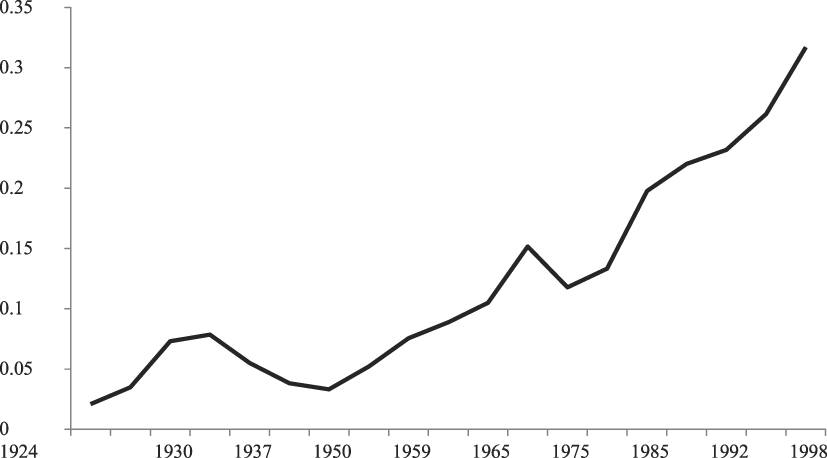
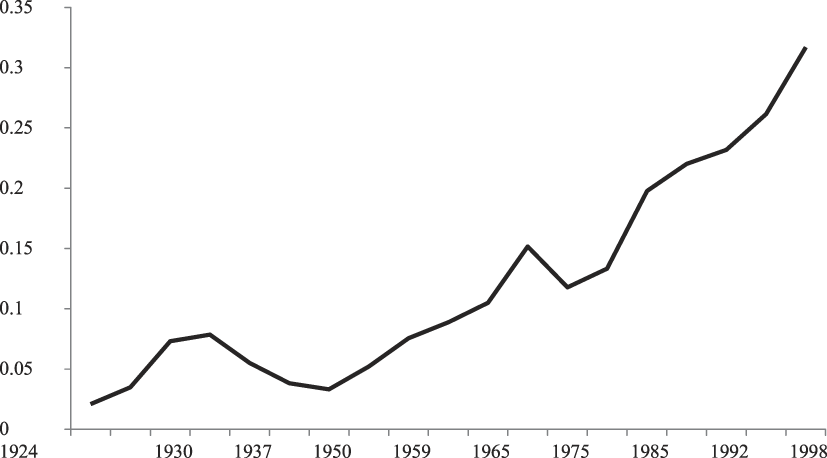
The term financial represents something other than normal consumption behavior and household economic behavior. Instead, social action within the financial market is oriented toward the “hope of reaping profit at later points in time” (Knorr-Cetina & Preda, Reference Knorr-Cetina and Preda2005:1). This profit orientation, also a defining characteristic of “business,” enables this article’s data on the financial market to help generate theoretical insights that are generalizable to business. Most of the data analyzed here pertains to stocks and bonds, and combinations thereof (i.e., mutual funds, annuities, and life insurance). In 1924, about two percent of residents of the United States were stock shareholders. In the run up to the stock market crash of 1929, this grew quickly to about eight percent and then dropped again. This did not increase substantially until the 1950s, after which it reached 32 percent in 1998 (see Figure 1). Indeed, the financial market has grown in importance in the United States (Davis, Reference Davis2009).
Percentage of the United States Population that is a Stock Market Shareholder, 1924-1998.
Notes. Estimation of number of shareholders for 1924 comes from Davis (Reference Davis2009). Estimates for 1927-1985 come from Burk (Reference Burk1988). Estimates from 1989-1998 come from NYSE Market Data (2014). Decennial US population estimates (Hobbs & Stoops, Reference Hobbs and Stoops2002) are averaged together to produce a denominator estimate for shareholder estimates that do not fall on exact decade.
Religious Magazines
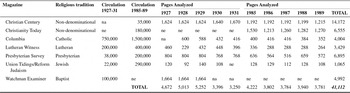
Institutional-level phenomena are inherently difficult to study due to their abstract nature. Given my societal-level approach to the topic, it is appropriate to analyze religious magazines. These magazines provide cultural snapshots of various religious voices surrounding the financial market. These voices include the magazine’s editorial staff, advertisers, denominational leaders, clergy, and the readership (through letters to the editors). In other words, I not only analyze what clergy are saying, but how readers are responding and the advertisements that are directed at that readership. This mixture of both organizational and individual-level data nicely relays the institutional-level phenomena of interest (i.e., moral authority and symbolic boundary work). In order to isolate religious magazine content for analysis, I select a sample of seven high circulation religious magazines from Fackler and Lippy’s (Reference Fackler and Lippy1995) compilation entitled Popular Religious Magazines in the United States. In selecting this non-random sample of religious magazines, I adhered to three criteria. I gave preference to high circulation magazines, I considered my ability to access magazine editions for the years covered in this analysis (which I discuss below), and I wanted to incorporate magazines affiliated with the three main religious groups in the 20th century in the United States, i.e., Protestants, Catholics and Jews.
My sample includes magazines devoted to a particular Protestant denominational readership (i.e., Lutheran Witness, Presbyterian Survey, and Watchman Examiner (Baptist)) and a more general Protestant audience (Christian Century and Christianity Today).Footnote 1 These Protestant magazines strike an appropriate balance between theological and political conservativeness (Watchman Examiner, Christianity Today, and the Missouri Synod’s Lutheran Witness) and liberalness (Christian Century and the latter century’s Presbyterian Survey, which was affiliated with Presbyterian Church U.S.A.). Additionally, I analyze one prominent Catholic (Columbia) and reformed Jewish magazine (Union Tidings in early century and Reformed Judaism in latter century) (see Table 2 for list of magazines analyzed). Mott (Reference Mott1957) points out there are a variety of religious magazine genres (which can change over time, even within the same magazine), ranging from the “well edited denominational spokesmen” to “organs of religious actions groups” to “magazines of comment and literature with church backgrounds” (289). I have intentionally selected high circulation magazines, regardless of the magazine’s genre. Admittedly, this makes it difficult to generalize from my sample to all religious magazines. This is not problematic, however, because such generalization is not my intent. I am most interested in capturing the inter-institutional interface of religion and finance to which many Americans were exposed. My “high circulation” criterion meets this objective.
Sample of Religious Magazines and Number of Pages Analyzed by Year

ne: Non-existent; magazine was not in circulation
na: Not available; unable to borrow magazine for analysis.
Note. Circulation numbers are taken from Fackler and Lippy (Reference Fackler and Lippy1995). When circulation figures are not available for time periods of interest, I include an estimate from the nearest year available. For instance, the Union Tidings 1927-1931 circulation figure (22,000) comes from the recorded circulation of the Union Bulletin (the precursor to Union Tidings) from 1912.
Worldwide, financial markets can be traced back to the 1300’s. I narrow my scope of analysis, however, to the 20th century because few people interfaced with the financial market before then. Given this original data collection process, focusing on a century when average people were more likely to interface with the financial market maximizes the relevant content for analysis. To further maximize the amount of content for analysis, I focus on time periods around the two largest stock market crashes of the 20th century: 1929 and 1987. The five-year windows that centered on these events (i.e., 1927-1931 and 1985-1989, respectively) include the years of stock market boom as well as the years following the crash. Admittedly, this pragmatic sampling decision leads to potentially biased examples of religion and finance interface, leaving out the inter-institutional phenomena at play during less eventful financial market time periods.
METHODOLOGY
I follow a grounded theoretical approach (Corbin & Strauss, Reference Corbin and Strauss2008) to my qualitative analysis of historic magazine content. This means both the theoretical and empirical display in this article is the result of an iterative process where I moved back and forth between theory and data. In other words, although the four inter-institutional processes are presented prior to my presentation of the empirical evidence, in reality, the empirical data presented below helped elucidate the theoretical concepts discussed above.
A research assistant and I browsed 41,112 religious magazine pages (see Table 2 for years that were unable to be analyzed). I browsed the majority of these magazine pages. By browse, I mean one of us quickly looked at each page, particularly article titles, headings and pictures. Any hint of money or the economy piqued closer scrutiny in search of a specific mention of the financial market. To give an idea of the types of economic topics not analyzed because they were not directly related to the financial market, I omitted from analysis the general idea of saving money, charitable giving, frugality, capitalism versus communism, and macro- economic phenomena, such as recession or economic growth. Each mention of the financial market was photocopied and I entered a summary of the content into one row of a spreadsheet for analysis. Some mentions are just a few words, such as glib referral to the “. . . wild orgy of stock market speculation in which the nation indulged in 1929 continued unrebuked by the churches” (Niebuhr, Reference Niebuhr1930). Longer magazine articles directly on the topic of the financial market often produced more than one mention, provided more than one distinct idea about the financial market is presented. In total, there are 1,100 mentions of the financial market for analysis.
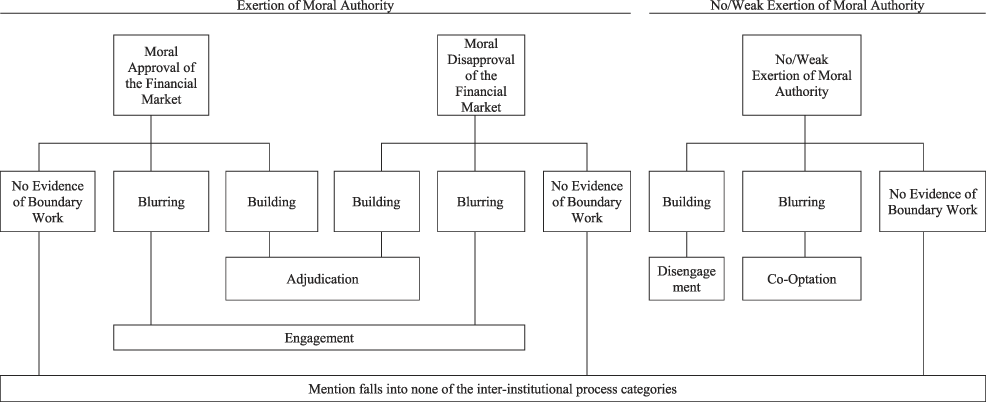
To help immerse myself in these data, I developed a coding scheme that was intended to categorize each mention into one of the four inter-institutional processes (see Figure 2). The first step was to determine whether the mention represents an exertion of moral authority over the financial market or not. If there is exertion of moral authority, I made the determination of whether it is an example of moral approval (i.e., an aspect of the financial market is “good”) or moral disapproval (i.e., an aspect of the financial market is “bad”). All other mentions represent weak or no exertion of moral authority over the financial market. The second step was to determine if there is sufficient evidence of symbolic boundary work. Symbolic boundary building between religion and the financial market is evident when the incompatibly of the two are emphasized, while boundary blurring is evident when the two institutions are comfortably coupled together. Twenty (20.4) percent of mentions did not have evidence of boundary work, in which case the mention does not fall into any of the inter-institutional process categories. For mentions that contained evidence of moral approval or disapproval of the financial market, evidence of boundary blurring led to the Engagement categorization (76.4 percent of mentions fall into this category), while evidence of boundary building to Adjudication (1.5 percent). Alternatively, when mentions with weak or no moral exertion are accompanied by boundary blurring, it was categorized as Co-optation (1.4 percent) and those accompanied by boundary building as Disengagement (0.5 percent). When calculated by time period of analysis, there are minimal differences (i.e., no larger than one percent) in these proportions. For example, of all mentions from 1927-1931, 76 percent fall into the Engagement category while 77 percent of 1985-1989 mentions are Engagement. A potential benefit of this coding scheme is the ability to count how many mentions fall into each inter-institutional category.
Inter-Institutional Processes Coding Scheme.
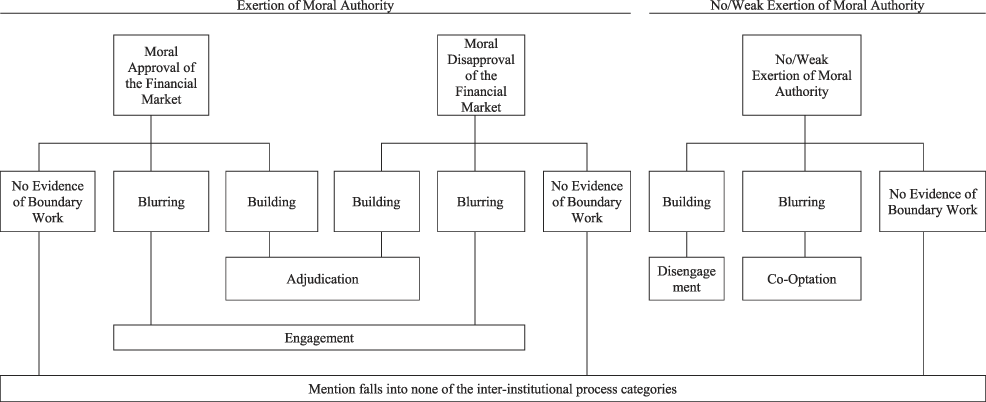
After attempting to put this coding scheme into practice, however, I determined the religious magazine data at hand and this article’s focus on inter-institutional processes are not amenable to such quantitative treatment. Having an independent researcher code a simple random sample of 200 magazine mentions yields a Krippendorff alpha estimate (for nominal outcome data) of 0.69, suggesting a lack of confidence in the coding scheme results (Krippendorff, Reference Krippendorff2004). Upon further consideration, the main reason this quantitative coding approach was unsuccessful (and therefore not further pursued in this article) is twofold. First, the nuanced nature of the magazine content at time featured multiple voices, necessitating nuanced interpretation. For instance, the editorial voice might exert moral authority over an event (sometimes a hypothetical event) with actors who might fail to exert moral authority. Crafting clear coding rules for these “multi-voice” mentions proved difficult.
Secondly, quantitative interpretation of coding results might lead to inaccurate overemphasis of Engagement. The majority of mentions in the engagement category are about religiously affiliated financial products (e.g., clergy pension plans, life insurance for clergy, gift annuities, etc.), many of which are advertisements that are present in multiple volumes of the same magazine. The coding scheme is too blunt of a tool to cleanly categorize these mentions into one category because it is difficult to interpret whether each mention is one of “moral approval” or more neutrally a “lack of moral authority.” If one interprets the former, the obvious evidence of symbolic blurring with religion would lead to the Engagement categorization. In some ways, this seems appropriate because it might go without saying that a denominational pension fund for clergy is a “good” thing, unless provided with textual evidence to the contrary. If, however, one interprets the mention to lack exertion of moral authority (because it is neutrally stated), the Co-optation category results. To move forward with my coding scheme analysis, I decided to code these mentions of religious financial products as offered in a spirit of moral approval, and therefore categorized them as Engagement. But this determination was ambiguous and the quantitative coding scheme obfuscates this important nuance.
For these specific reasons, and due to the generally nuanced nature of the magazine data, I therefore take a qualitative approach to the magazine data for the remainder of this article and will not dwell on the number (or proportion) of mentions that fall into each category. Instead, I will present illustrative examples of each inter-institutional process. These examples include letters to the editor, advertisements and articles written by magazine editorial staff. Since the author was often unreported in magazines, exemplary quotes reported below can be assumed to be written by editorial staff, unless otherwise noted.
FINDINGS
Disengagement
In the early 1900’s, clergy were frequently and colorfully depicted as unfit to meddle in the financial market. In 1927, during a stock market boom, The Watchman Examiner (Baptist) includes the following advice:
The stock market is no place for a minister of the gospel to invest his savings. Stocks are up today and down tomorrow. To watch the ticker tape is too exciting for a man whose business is to think of other things. Good gold bonds vary little in price, bring a steady if small income, and are always marketable. Buy good bonds, and always advise with a reputable bond house or your banker before making your purchase (Stock Market is No Place 1927).
A Christian Century article reports,
It is traditional that ministers are peculiarly susceptible to the wiles of swindlers, both professional and amateur. This is one tradition which the most rigorous criticism and the most exhaustive research serve only to confirm. If it is commonly believed that preachers are more gullible than the average citizen of equal sophistication, intelligence, and resources, the reason is plain. They are. (When Ministers are Swindled 1928).
This same Christian Century article goes on to mention stock investments as an example of ministerial swindling. For instance, a stock market “swindler” might couch their investment advice as getting “in on the ground floor. Suppose you had put one thousand dollars in Ford Motor stock thirty years ago” (When Ministers are Swindles 1928). Ministers are advised to be vigilant and aware of their own naiveté.
John Raskob, a Catholic philanthropist who earned his fortune in part by refining the installment payment plan for General Motors, donated $500,000 to the Wilmington, Delaware, diocese. Instead of just handing the donation over to the Bishop, Raskob had another plan. He explained,
We take our young men inspired for the priesthood and train them to be theologians. Then, when they come to us to teach us our theology and its social and religious consequences, we ask them to become financiers to plan for and administer capital investment in the material necessities of the church often of a size to require the most highly developed business plan and financial judgment. In Wilmington we are going to make the effort to relieve the clergy of that burden. We have incorporated a diocesan foundation controlled by the Bishop and his three clerical consulters by three laymen. Thus we do not fly in the face of the tradition of the Church which gives the Bishop ultimate responsibility. But we do ask the laymen to assume functions for which their character and training must be presumed to fit them better than those primarily concerned with the spiritual affairs of the Church [italics mine] (Stuart Reference Stuart1928).
These examples represent an early century portrait of boundary building between religion and finance. In sum, clergy were best off maintaining a clean separation from the financial market in order to 1) avoid being swindled and 2) focus instead on the “spiritual affairs,” for which they were trained.
In a sense, clergy are depicted as aloof when it comes to the financial market, strongly implying a lack of moral authority over it. This is an example of disengagement. Indeed, it is hard to imagine how clergymen could be expected to wield much moral authority given their perceived ignorance of it. Furthermore, the symbolic boundary building evokes a picture of clergyman running away from the stock market to avoid being swindled, not to mount a significant moral critique of the swindlers or the stock market more generally.
Adjudication
Prior to the upheaval of the 1929 crash, a lively debate ensued on the relationship between stock market speculations and gambling. For instance, the suicide of a well-known financier spurred the following irreverent chiding in the pages of the Christian Century, “Mr. White played the game of a gambler according to the accepted rules and could not endure failure.” In addition, the following excerpt from White’s suicide note was published, “My heart throbs and I bend my knees and look to God, for I have been guilty of the folly of gambling and the price has to be paid” (Shilitto, 1927).
The Christian Century also published an article that directly compared gambling with stock market speculation. “Is speculation wrong? Is it gambling? Or is it investment?” The nuanced discussion that ensued explained that speculation entails ownership of an object while gambling (an obvious case of immorality) does not. For instance, the gambler does not own the horse that he bets on, whereas a speculator does own the equity. The author argues, however, that speculation may be motivated by turning a quick profit and in this way “the speculator’s mind may be as unsocial as the gambler’s.” In contrast, the investor is not looking for a quick return, but has a long term orientation (The Bishop and the Bucket Shop, 1929). In a similar vein, a clergyman contributor to Watchmen Examiner quips, “Speculation is oftener gambling than legitimate” (Burrows, Reference Burrows1929).
Despite this nuanced moral discussion of speculation and investment, this same magazine also offered more strident judgments on stock market speculation after Black Tuesday, the start of the 1929 crash. For instance, one article chides, “The wild orgy of stock market speculation in which the nation indulged in 1929 continued unrebuked by the churches” (Niebuhr, Reference Niebuhr1930). This clearly paints stock speculation as a moral issue the church should “rebuke.” Another mention queries, “Is there any essential difference between the motives which drive boys from the slums into racketeering and those from college into stock speculation?” (America’s Enemy, 1930). In the same article mentioned earlier that encourages ministers to beware of various types of financial “swindlers,” the author criticizes earning returns that are incommensurate to the effort put in. The swindler’s pitch might sound something like this, “So nothing is really risked by putting your capital into the Golden Stream oil company. . . .A little courage now, a little patience while the business is getting on its feet, affluence and dignity in your old age!” (When Ministers are Swindled, 1928). The author then exhorts, “The minister ought to be immune to such arguments, because he ought to know the essential immorality of all those economic processes which produce a return wholly disproportionate to the investment of money and effort.” In other words, this author argues that catching a “wholly disproportionate” stock market windfall is immoral.
A Columbia editorial criticizes corporate management for putting the creditor or shareholder before the worker. “The moral claim to interest or dividends is inferior to the moral claim to living wages . . . Our leaders assure us . . . that the country is fundamentally sounder and sounder. Some day, perhaps they will have as much faith in the teachings of Christ” (Sacred Dividends, 1931).
Adjudication of the financial market continues in the latter century. In 1986, Ivan Boesky was accused of amassing a fortune in stocks by acting on insider stock information and was eventually found guilty by the Securities Exchange Commission. Boesky proved to be a popular scapegoat for financial corruption, alerting attention to the financial market from Reform Judaism (Polish, Reference Polish1987), Christianity Today, and Christian Century. Both Christian Century (Easy Consciences on Wall Street, 1987) and Christianity Today (Maltby, Reference Maltby1988) used the incident to deride the woeful ethical training many financiers receive at the top business schools in the country. Christianity Today also published an editorial entitled “The Boesky Touch,” which criticizes both Boesky and “corporate raiders” (Muck, Reference Muck1987). While agreeing more regulation is needed, the article explains the root problem is “creeping individualism and lack of accountability that has made business dealings in our country an amoral, long-distance exchange between computers, with only form-letter assurances and inadequate laws to regulate the transactions.” The subtitle of the article further explains, “When business is no longer conducted under public scrutiny, honesty lacks the protest of human contact.” These Boesky-inspired moral critiques of finance primarily placed blame on dishonest individuals.
It is admittedly difficult to ascertain the symbolic boundary work at play in some of the mentions cited above. I interpret, however, the early century critiques aimed at the underlying gears of finance to indicate a comfortable distance from it. Indeed, strongly worded moral critiques that strike at the heart of financial market tend to come from early century magazines. With this in mind, I interpret these mentions to be examples moral authority stemming from a posture of boundary building. By latter century, the moral authority of religious magazine writers focused on the dishonesty of individual financiers in the market, a clear target of religious moral criticism. This form of boundary building seeks to separate religion from unethical financiers as opposed to the financial market itself.
Co-optation
In the same even-keeled discussion that compared and contrasted the gambler, speculator and investor (The Bishop and the Bucket Shop, 1929), the author quips, “Speculation . . . Let him who is without dividends cast the first stone.” The moralizing around the topic of stock market speculation is thwarted, the author suggests, by the fact that many of those moralizers are likely monetary beneficiaries of the stock market, an example of Co-optation.
In a letter to the editor, Le Blonc (Reference Le Blonc1987) responds to a previously published Christianity Today article.
David L. McKenna’s “Financing the Great Commission” has, perhaps inadvertently, shown itself to be part of the problem. We do not “invest” in the Great Commission; we go and do it. Third World leadership training is not a “risk venture”; it is an equipping for ministry. The article is rife with the language of financiers, and that is precisely the reason that I (and many other Christians) are leery of “Christian fund raisers.” They may speak of doing God’s work; but their words and actions show themselves mired in the world’s viewpoints and methods.
This writer contends that being mired in the language of financiers disqualifies Christian fund raisers from truly doing God’s work.
An early century Christian Century editorial praises the Presbyterian Church for formalizing a pension fund to benefit their retired clergy, but warns,
At the same time, the churches which are gathering these large funds need to give heed to the ethical problems involved in their investment. The church which seeks to right a wrong done to one class of men [their clergy] by the raising of an endowment will hardly want to inflict a wrong on another class of men by so investing that endowment as to prop up other social abuses. The ministers who are the beneficiaries of these great campaigns should be the first to demand knowledge of the way in which such funds are handled [bracketed words are mine] (Presbyterians Obtain Their Pension Fund, 1927).
In this example, there is a reflexive awareness of potential Co-optation where church investments in the financial market can easily lead churches not only to weak or no exertion of moral authority, but also involvement in “injustice or unrighteousness.” By latter century, this same type of warning against Co-optation was echoed by a reader of Christianity Today. The clergyman writes to the editor, “I deplore the horrible system of apartheid, but I find it repulsive that so many ‘rich’ churches are feeling so righteous about their divestment in South Africa. Do they not realize that having nearly $10 billion to divest is a condemnation of themselves?” (Goodwin, Reference Goodwin1986). This clergyman is suggesting that $10 billion could have been better spent on other things instead of investments and that the moral clarity of the “rich” churches is compromised by their wealth in the financial market.
Examples from both time periods of analysis reflect concern among religious actors that their religious institutions are in danger of being morally compromised by their involvement in the financial market, or what I am referring to as Co-optation. It is acknowledged that by warning against the possibility of Co-optation, some authors cited above are engaged in Adjudication, i.e., they are exerting their moral disapproval of religious actors from a posture that the boundaries of religion and finance ought not to be blurred. In this section, I have focused my interpretation on the events being written about, not the editorial judgment of the events.
Engagement
Financial Products
In analysis of religious magazines, I find an abundance of Engagement examples. Many examples of Engagement are magazine text about financial products, most of which were religiously affiliated financial products and many of these mentions were advertisements. Financial products (either religiously affiliated or purchased by religious bodies) represent the boundary blurring of religion and finance and tacit moral approval of finance, I argue. A 1929 Watchman Examiner article (Merriam, Reference Merriam1929) relayed the history of a popular financial investment vehicle with close ties to religion: the gift annuity. In 1880, Edmund Merriam joined the American Baptist Union. Surprised by the large number of funds that were being diverted away from the Union “because of the breaking or suppression of wills having benevolent bequests,”Footnote 2 Merriam devised the gift annuity system. Through this new financial investment vehicle, donors could ensure a portion of their money would be successfully transferred to their charity of choice upon their death, while still earning an investment income (i.e., interest) for the remainder of their lifetime. Depending on how long the annuity holder lived, the charity would receive more or less of the remaining investment. With no desire to place a copyright on the financial innovation, the Baptist Union freely shared the idea of the investment vehicle, which became widely adopted. By 1929, the annuity gift system had taken hold. “The plan of giving money to religious, missionary, educational and charitable societies and institutions, on condition that the donors receive an income during life has now become so universally adopted and has brought so many hundreds of millions of dollars into benevolent enterprises of various kinds” (Merriam, Reference Merriam1929: 408). This is but one example of religious organizations formally offering their own religious versions of financial product to investors.
Other examples of religious financial products were found in the religious magazines analyzed. In early century, Columbia frequently advertised its fraternal Knights of Columbus life insurance. The Presbyterian Survey featured advertisements for bonds issued for its denominational college, Davidson College. The Lutheran Witness advertised a “Ten-Year Five- per-cent Note” to raise $200,000 for construction of a new building for the denomination’s Home Mission board. Assuring future market liquidity for the financial product, this Lutheran advertisement added, “Should the owner of any of these notes be obliged to sell, the Mission Board promises to purchase and cancel them or to help find a buyer” (Ten-Year, 1929). In the 1980’s, the Christian Century along with Christianity Today included advertisements for life insurance products for ministers and religious career workers. The Presbyterian Survey advertised a gift annuity that pays up to 14% while the investor enjoyed tax benefits, earns an income, and helps homeless children (Gift Annuity, 1988). Reform Judaism advertised investment opportunities that focused on Israel with the marketing appeal “increase your interest in Israel” (Increase Your Interest, 1987). Columbia continued to advertise various insurance products to fraternity members during the 1980’s. Lutheran Witness most heavily advertised its various financial products in its denominational magazine. For instance, the Lutheran Church Extension Fund offered Individual Retirement Accounts (IRA) whose proceeds are “loaned to build churches, schools and missions where the Gospel of Jesus Christ will be shared throughout the world” (Nothing Has Changed, 1987).
The Presbyterian Survey reported that Presbyterian philanthropist, John Templeton, would roll out “a new mutual fund designed specifically for the investments of religious and other nonprofit groups.” The fund would consider “‘social, ethical and moral concerns’ of nonprofit groups in selecting securities” (A new mutual fund, 1987). Similarly, the pages of Christian Century frequently advertised Pax World Mutual Fund (e.g., Concerned?, 1985), the first SR mutual fund in the United States, founded in 1971.
Clearly, religious groups have invented and operated their own religious financial products since at least the early 20th century, an example of boundary blurring between religion and finance. There are also many examples of moral approval of the financial market because of the upright use the returns on investments provided for causes religious groups deemed worthy. An article in the Lutheran Witness explained the Lutheran General Church Extension Fund “is sometimes used by our members as a trustee for various purposes.” For instance, “A congregation in the East paid $5,000 in the . . . Fund, with the provision that a certain amount of the interest be paid annually to the widow of a former pastor of the congregation as long as she lives, after which the money is to remain the property of the fund (Trust Funds, 1930). The Union Tidings, a Jewish publication, notes that the interest to be earned (estimated at five percent) from a $25,000 gift made to Union Hebrew College will fund one student to study Jewish philosophy (Establishes Leo W. Simon Memorial, 1927). Linfield College, the only Baptist college in the Pacific Northwest, received a large endowment from the Linfield family and “a California oil man who prefers to remain anonymous.” The “10,000 shares of oil stock, three fourths of which was sold for $280,000” provided a new building and a larger endowment for the college (This Oil Stock Was All Right, 1928). In another example of an endowment benefiting an educational institution, the interest accruing from “the million dollars endowment” at Fiske University would “increase its facilities and remove the major portion of the annual financial deficit” (Negro Education Going Forward, 1927).
This emphasis on the morally sanctioned use of investment income was also observed during the 1980’s period of analysis. A Christianity Today article devoted to restoring the “Protestant work ethic” begins with the story of a janitor who invested money in the stock market, following the advice from economists at the college he mopped floors for, and earned a million dollar fortune. He lived frugally, wore hand-me down suits, and left $600,000 for Bethany College, his former employer (Shelly, Reference Shelly1989). Columbia tells a story about a recent widow who received a knock at the door from the Knights of Columbus life insurance agent with the death benefits check in hand. “Scenes like this are not uncommon between Knights of Columbia field agents and the widows of members who took advantage of the Order’s insurance program” (Hickey, Reference Hickey1989). In addition to lauding the aid provided to widows, the article also differentiates the fraternal order’s life insurance from other policies by the fact that it is “without capital stock—that is, there are no ‘Knights of Columbus stockholders,’ and the K of C is organized and carried on solely for the benefit of its members and their beneficiaries, not for profit” (Hickey, Reference Hickey1989). In the case of Knights of Columbus life insurance, moral approval of aid directed at widows is augmented by the fact that shareholders, and their quest for profits, are not involved.
Moral Approval of Financial Market
Shifting attention away from moral approval of financial products, I also find evidence of moral approval of stock ownership, particularly employee-owned stock programs. The Watchman Examiner praised Mr. Coleman’s good labor relations at Coleman Lamp and Stove Company where “The employees share with the stockholders in the annual earnings . . .” (Hidden, Reference Hidden1928). The same magazine approvingly noted, “More than 16,000 employees own stock in the Standard Oil Company of New Jersey. Nearly one-half of the 80,000 stockholders of Armour and Company are employees. More than half the stockholders of the New York Central Railway are employees (The Uses of Prosperity, 1927). The Christian Century as well praised companies where workers own their company (Brotherhood and the Machine, 1928; Workers and Capitalists, 1927). These religious voices were sanguine about this growing trend of employee stock ownership as a promising cooperative arrangement between management and labor.
It is noteworthy that latter century moral approval of the financial market took a more defensive posture and was apparently in dialogue with opinions to the contrary. Just a month after Black Friday (the day the stock market dropped and ushered in the 1987 stock market crisis), a Christian Century article emphasized that Jesus does not directly condemn the financial market. “Jesus’ admonition not to lie up . . . treasures . . . is not meant to be an attack on the social security system or on retirement programs. Rather, we are cautioned to avoid placing our trust in that which will always disappoint” (Wall, Reference Wall1987). Likewise, in a letter to the editor, a reader cried foul in response to an earlier article that queried whether “there have ever been any ethics on Wall Street.” Schmidt (Reference Schmidt1987) satirically writes, “I’ll bet that the pastors in the New York City area who have members of their congregation working on Wall Street were interested to learn that none of these members have any ethics.” Interestingly, this exertion of the moral propriety of finance is accented by pointing out that congregational members work on Wall Street. This is intended to blur the distinction between congregational life and Wall Street, and it is tacitly assumed that such blurring proves that “ethics” must exist on Wall Street.
Moral Disapproval of Financial Market
The Presbyterian PCUSA Committee on Mission Responsibility Through Investments filed a shareholder resolution with the 8th largest bank in the United States. Because the denomination owned 30,000 shares of the bank’s common stock, it was able to successfully pressure the bank to discontinue making “new loans to or engaging in any credit-related activity with any sector of the South African economy” (Bankers Trust Ends Credit, 1986). In other words, because the denomination owned shares in the bank (i.e., boundary blurring), it was able to leverage its moral disapproval over a bank’s lending practices.
Indeed, by the 1980’s, I find evidence of the religious origins of the socially responsible (SR) investment industry through mention of South African Apartheid, as existing scholarship recognizes (Kurtz, Reference Kurtz, Crane, McWilliams, Matten, Moon and Siegel2008; Landier & Nair, Reference Landier and Nair2009; Robinson, Reference Robinson, Wuthnow and Evans2002; Shapiro, Reference Shapiro, Kinder, Lydenberg and Domini1992). Pastor Leon Sullivan created a campaign to end Apartheid by pressuring South African corporations to adopt a fair employment code, which came to be known as Sullivan Principles (What is the Solution, 1985). This emphasis on corporations in South Africa helped galvanize a movement for shareholders of those same South African corporations (and other corporations with close business ties to South Africa) to do all they could to quickly bring an end to the Apartheid regime.
In sum, I find a lot of evidence that religious actors created their own financial products, many of which were religiously affiliated. I interpret most mentions of such financial products as examples of moral approval (as opposed to weak or no exertion of moral authority), and therefore an example of Engagement. This seems to be a safe assumption because it would seem to “go without saying” that a denominational pension fund for aging clergy, for example, is a “good” thing. But I also recognize that one could also interpret the ubiquity of financial product mentions as evidence of Co-optation, because often they are mentioned as a “matter of fact” and conceivably devoid of moral salience. More clearly, however, many religious actors morally approved of the good causes to which these products’ financial market returns were devoted. It is also interesting to note that early century moral approval of employee stock ownership gave way to a new form of corporate governance that focused on non-employee shareholders. Namely, socially responsible investing enabled religious shareholders to exert their moral authority over corporations. These are all examples of Engagement where religious voices blurred the boundaries between religion and finance, and religious voices exerted moral authority over finance.
DISCUSSION
Religion and Business
In the beginning of this article, I raised two research questions. How do institutional-level processes shape the religion-business interface? More specifically, how does the symbolic boundary work (of religious actors) around religion and business shape their ability to exert moral authority in business? To briefly summarize my answers to these questions, the key institutional-level insight of this article is the institutional complexity between religion and business logics. This institutional-level reality highlights 1) the potential inability of religious actors to exert their religious moral authority in business and 2) the necessity of religious actors to engage in symbolic boundary work in the process. Recognizing these dynamics helps elucidate the conditions under which religion is more or less likely to beget a more ethical business climate.
Many scholars focus on how business might better train its leaders to conduct business in an ethical manner. In reality, however, we know that one’s ethical training begins much earlier in life than business school matriculation or entering the workforce. More broadly speaking, in order to better understand how societal factors shape business ethics, we need to look outside business. In doing so, the interface of multiple institutions becomes inevitable. Recent literature in Institutional Complexity (Greenwood et al., Reference Greenwood, Raynard, Kodeih, Micelotta and Lounsbury2011) highlights the tenuous interface when competing logics collides, helping me theorize boundary building and blurring inter-institutional processes. Classical versions of Secularization Theory suggest religious authority over other societal institutions is waning. Although some scholars balk at this broad historical claim (Chaves, Reference Chaves1994; Gorski, Reference Gorski2000; Smith, Reference Smith2003), it reveals the importance of understanding larger historical trends that shed light on the topic of religion and business. Therefore, instead of assuming that religious moral authority is easily exerted over business, I also recognize the possibility of weak or no moral exertion.
Through focusing on two dimensions of symbolic boundary work (boundary blurring and boundary building) and two dimensions of moral authority (strong exertion of religious moral authority and weak/no exertion of religious moral authority), I identify four processes that social actors may exhibit in instances where authority from one institution may be exerted over phenomena in another institution: Disengagement, Engagement, Co-optation and Adjudication. Existing literature’s myopic focus on the potential of religion to leaven the business world with ethical conduct is a case of Engagement. Importantly, this article expands our understanding of the topic by theorizing additional ways that religion and business might interface. For instance, this article’s theoretical insights help explain why existing research has yielded mixed evidence regarding the ability of religion to beget a more ethical business climate.
It seems reasonable to assume the exertion of religious moral authority over business is more likely to beget business ethics than a lack of moral exertion, although future research should empirical verify this claim. In doing so, scholars should scrutinize the symbolic boundaries that accompany attempts of religious actors to wield their moral authority over business. For instance, in terms of inducing ethical employee conduct, one might consider how consultation with a clergyperson (who is significantly removed from the business realm) differs from consultation with employee sponsored chaplains, an example of boundary blurring. One might also consider the presence of official religious statements regarding economic matters. For example, Pope Francis has exerted his religious moral authority, mainly disapproval, over an “economy of exclusion” (Francis, Reference Francis2013) and sustainability problems in business (Francis, Reference Francis2015). Future research might determine the ways Francis’ moral disapproval of “business” is perceived to stem from a posture of boundary building between religion and business or boundary blurring. This consideration of symbolic boundary work adds an important element to understanding whether Catholic laity’s ethical stances on capitalism are impacted by the Pope’s exertion of religious moral authority. For instance, given Pope Francis’ vow of poverty, Catholic laity may be more inclined to interpret his pronouncements as an example of Adjudication, which may lead to a stronger “Pope Francis Effect” on business related issues. More generally, future scholarship should consider whether Engagement or Adjudication is more successful in producing ethical outcomes in business, and under what conditions.
Perhaps the most novel contribution of this article is the acknowledgement that religious moral authority can be muted (i.e., not exerted) in business, represented by the inter-institutional processes of Co-optation and Disengagement. These inter-institutional processes will likely not enhance (and perhaps depress) the ethical climate in business. In fact, both the literature on Secularization and Institutional Complexity lead one to expect the inability of religion to beget a more ethical business climate because of a lack of religious moral authority. This awareness might shift scholarly focus to the ways business is inconsonant with religion. For instance, instead of the using the individual-level metaphor of one “checking their religious values at the door,” as one would check a coat, this article suggests the temperature in the workplace might render the coat unnecessary, so to speak. In other words, building symbolic boundaries between religion and business so that the two are not in meaningful dialogue with one another may cause religion to simply be irrelevant in business (i.e., Disengagement). Alternatively, blurring the boundary between the two institutions may create a hospitable business environment for religion, perhaps too hospitable to foment a distinctly religious point of view (i.e., Co-optation). These are just a few examples of how future research on religion and business might build upon the theoretical insights of this article.
Religion and the Financial Market in 20th Century
Although not the key research objective of this article, the religious magazine data enable me to make some claims about historical changes between the institutions of religion and finance in the United States. It is acknowledged, however, that by focusing on data from the years surrounding the largest stock market crises in the 20th Century, the data analyzed in this article may not easily generalize to less eventful time periods. However, many of the references cited above are not specifically about a stock market boom or bust, suggesting the themes gleaned herein are adequately generalizable beyond their unique time periods.
The burgeoning number of religious financial products (e.g., socially responsible investment options) and the latter century dearth of symbolic boundary building (e.g., claims that clergy and finance are poor bedfellows) suggests a historical trajectory of boundary blurring where religious actors have waded into the financial market. Indeed, from the data at hand, it is difficult to argue that religion has retreated from the financial market, which would be a historical trajectory of boundary building. The concomitant question is whether this boundary blurring is accompanied by increased or decreased exertion of religious moral authority over finance (i.e., Engagement or Co-optation, respectively). I find evidence of both.
On the one hand, religious voices exert less strident moral critiques of the financial market. In early century, stock speculation was commonly equated with gambling, a practice surely worthy of moral consternation. By latter century, however, religious condemnation of the financial market tended to isolate immoral actors within the market (e.g., Boesky and corporate raiders) instead of problematizing the essence of the financial market. This represents a historical trajectory toward decreased exertion of moral authority. When coupled with a historical trajectory of increased blurring of religion and finance, this represents Co-optation. On the other hand, the boundary blurring has also helped give birth to the socially responsible investing industry, which includes strong exertion of moral authority over business. This historical trajectory toward Engagement has gained religion the ability to engage with corporations on corporate governance issues of moral concern.
This combination of Co-optation and Engagement might be summarized by the following tradeoff. In exchange for the ability of religion to be “engaged” with business, its moral toolkit, so to speak, has been thinned out. In the case of religion and finance, contemporary religious moral authority over finance tends to be contained within the bounds of corporate governance. Indeed, religious actors are in a poor position to offer substantial criticism of the “underlying gears” of the financial market because of its heavy involvement in it. Future research should explore if similar processes of Co-optation and Engagement are afoot in other interfaces of religion and business. If so, scholars should explore ethical domains that religion is free to engage with, and those domains left off limits due to Co-optation.
Business Ethics
Religion is one important institution that has the potential to enhance the ethical climate in business. There are others, however, such as family and university education. Of course, by subtracting religion from one’s focus and replacing it with another non-business institution we lack salient historical claims that the non-business institution is receding in importance, as we clearly glean from Secularization theory. Nevertheless, we can still easily theorize that social actors must engage in symbolic boundary work as phenomena from the non-business institution may or may not yield a more ethical climate in business. For instance, business ethicists have called for feminist ethics to provide a more sure ethical foundation for stakeholder theory (Dobson & White, Reference Dobson and White1995; Wicks, Gilbert, & Freeman, Reference Wicks, Gilbert, Daniel and Freeman1994). Many of the characteristics of feminist ethics (e.g., the importance of relationships and the ethic of care) are also hallmark characteristics of the family, a central institution in society (Friedland & Alford, Reference Friedland, Alford, Powell and DiMaggio1991; Thornton et al., Reference Thornton, Ocasio and Lounsbury2012). Indeed Alter (Reference Alter and Wharton2007) describes feminist organizations as more democratic, less hierarchical and more amenable to displays of emotion. All of these family characteristics might be assumed to enhance the ethical climate of business, but this article instructs scholars to recognize the oft times tenuous interface of competing institutional logics and therefore better theorize the conditions necessary for the importation of family institutional characteristics to lead to a more ethical business climate. In an interesting study of business in the Arab world, Sidani and Thornberry (Reference Sidani and Thornberry2013) find “family” erodes Western notions of an ethical business climate because it engenders nepotism in business. This represents an interesting variation on this article’s theme because the engagement of family in business introduces moral values (e.g., loyalty to family members) that are deemed unethical in a different culture’s business context.
In a similar vein, historical work on the origins of business schools explain how founders hoped that by placing business education in universities (as opposed to stand-alone vocation schools) students would receive holistic moral training (Abend, Reference Abend2013, Reference Abend2014; Khurana, Reference Khurana2007). Nevertheless, the ability of business schools to inculcate moral training is routinely questioned and one can surmise whether universities have compromised their holistic training mission as a result of welcoming business schools into their fold, perhaps an example of Co-optation.
Limitations
There are limitations to this article, which warrant consideration. First, it is important to point out that “religion” is not one homogenous institution. There are multiple religious traditions, denominations and fissures within denominations that are likely to influence this article’s topic of interest. For instance, many examples of Adjudication come from the pages of early century Christian Century magazine, which reflects a more progressive stream of Christianity in the United States. With the data at hand, however, it is difficult to argue for more nuanced interpretations of differences across different religious traditions. Future research should pursue this important issue. Demonstrating the generalizability beyond the United States context, an inter-institutional approach to Islam and business, in particular, would be especially interesting given the more overt moral authority (perhaps even direct control) Islamic scholars seem to wield over sharia finance in certain countries. Of course, this overt Islamic authority stems from different societal conditions than the United States case explored here. Nevertheless, while at first glance Islamic Sharia would seem to foster Engagement (i.e., boundary blurring and strong Islamic moral authority over business), this article calls for closer empirical analysis of the exertion of moral authority. Boundary blurring can also lead to Co-optation.
It is also important to note that to simplify analysis this article only focuses on the unidirectional authority that religion wields (or does not wield) over business. The reality of the religion-business nexus, however, is more complicated than that. Business also exerts its moral authority over religion. For instance, many non-profit organizations (some of which are religious) are being forced to adopt business style metrics in order to maintain capital inflows. Future inter-institutional research should theorize and develop research designs that allow for analysis of bidirectional exertion of moral authority. This will enrich theoretical insights and more closely match reality.
Analysis of magazine data includes certain benefits, such as the ability to analyze multiple voices in society (e.g., editorial, letters to editor, advertisements, etc.). Its nuanced portrayal of the inter-institutional processes is also likely a realistic portrait. These boons, however, also present some difficulties which were most evident from my attempt to use my coding scheme (see Figure 2) to cleanly categorize each mention into one conceptual category. The shortcomings of this coding scheme suggest future scholars who wish to advance quantitative research on this topic would be wise to carefully select data that is more amenable to cleanly operationalizing symbolic boundary work and exertion of moral authority. One possibility might be analyzing institutional investors (e.g., a denominational pension fund), where boundary blurring could be operationalized by the quantity of assets the fund holds in a firm, and issuance of shareholder resolutions would operationalize exertion of moral authority over a firm. Of course, more work would need to be done to explain why this exertion of moral authority and boundary blurring is an important phenomenon to study, and perhaps only some of the inter-institutional processes would be germane, but this demonstrates an example of locating data that is more amenable to quantitative analysis.
CONCLUSION
In conclusion, this article demonstrates the importance of understanding how institutional complexity shapes the ability of non-business institutions, such as religion, to exert moral authority and thereby enhance the ethical climate of business. This insight leads to this article’s presentation of a broader range of potential inter-institutional processes. Hopefully this work will spur on a more nuanced yet empirically tractable body of research that advances our understanding of the conditions under which non-business institutions might leaven business with increased ethical conduct, and the conditions under which they are unlikely to do so.
ACKNOWLEDGEMENTS
Thanks are due to Esther Chan, Sergio Chaves, Elaine Howard Ecklund and Anne-Laure Winkler for providing insightful feedback on this article. Special thanks to Lavanya Rao for her assistance in data collection. Funding from the Religion and Public Life Program at Rice University aided in data collection expenses.