The current condition of Army manpower, like the situation in Iraq, is grave and deteriorating. The January 2007 decision by the George W. Bush administration to send additional ground combat and support troops to the wars in Iraq and Afghanistan has thrown the Army's manpower shortages into stark relief. This latest escalation, however, not only runs the risk of breaking the all-volunteer Army but also undermines our national security. Several questions must therefore be addressed: Is an all-volunteer Army desirable? What are the current difficulties facing Army recruitment and retention? What consequences have the wars in Iraq and Afghanistan had on the service? Before engaging a more substantive discussion which includes the present demographics of the force and the recruitment process, one point should be made clear. We believe the all-volunteer model is the right one and should be maintained if at all possible.
The Case for Maintaining the All-Volunteer Army
The president and the Congress should make every effort to maintain the total Army on an all-volunteer basis. While the Army is composed of over a million volunteers, only about a half is on full-time active duty. The other half is in the reserve component, which is composed of the selected reserve and the individual ready reserve. These three groups comprise the total Army. Returning to the draft would not address the manpower and capability problems the total Army currently faces. Rather, a return to the draft would diminish the Army's overall experience and education level, leading to an Army that is not as well-suited to today's challenges. In addition, a mixed force of draftees and volunteers would be more expensive due to increases in turnover and, therefore, much higher training costs.
Any discussion of a reinstatement of the draft introduces several problems, both logistical and political. While the average volunteer enlists for four years and about half of them reenlist, draftees typically served for only two years and less than 10% of those drafted from 1948 to 1973 reenlisted (Rostker 2007). Moreover, Pentagon studies show that recruits need up to three years to reach full competency in combat, combat support, and combat service support skills. In addition, reinstating a draft at this time would open up a whole host of issues that this nation has not addressed satisfactorily since the 1960s—in particular, the question of who shall serve when not all must serve. Reinstating the draft would also further isolate the United States from our NATO allies, most of whom have abolished conscription at our urging.
Force Demographics
It is important to note that the goal of the all-volunteer force (AVF) is to maintain high standards for its soldiers so as to ensure a professional and competent force. Ideally, the AVF should be broadly representative of the population it defends. Yet, the rising American death toll nearly four years after the beginning of the war in Iraq has brought criticism that it is mainly uneducated, poor, and minority soldiers who are enlisting for wartime duty and paying the greatest toll in the war effort. Recent studies on the AVF suggest otherwise.
A report by the Heritage Foundation entitled, “Who Are the Recruits? The Demographic Characteristics of U.S. Military Enlistment, 2003–2005,” (Kane 2006) supports the finding that U.S. military recruits are more similar than dissimilar to the overall American youth population. The slight difference between new military enlistees and the average youth population is, surprisingly, that wartime U.S. military recruits and soldiers are better educated and wealthier but also more rural on average than their civilian peers.
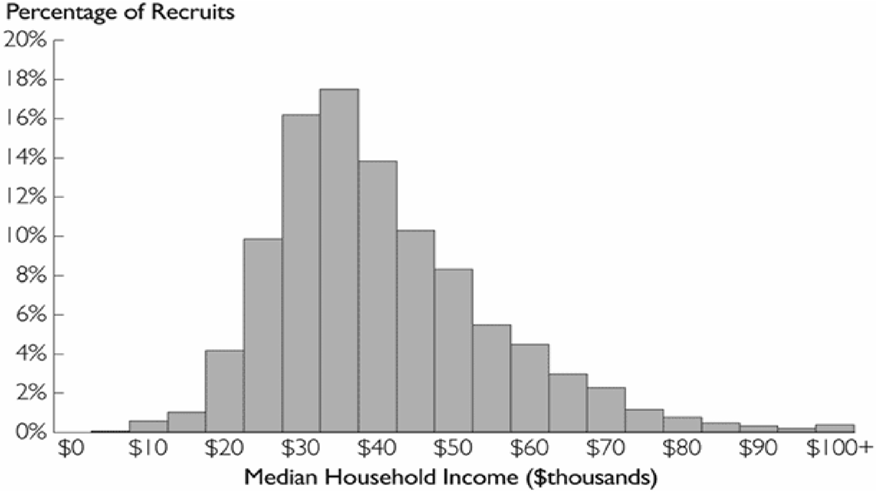
Another study by the Center for American Progress entitled, “Two Years and Counting,” also contradicts claims that minorities and the underprivileged are disproportionately paying the highest price for the war in Iraq. Of those soldiers killed in Iraq, 96% had graduated from high school versus 94% of all military personnel and 86% of all Americans 18 to 44 years old. Similarly, 73% of these fallen have been White, a higher figure than the 67% of all military personnel who are White (12% of those killed in Iraq have been Hispanic as compared to 9% of military personnel, 11% of those killed have been African American as compared to 19% of all military personnel). Finally, roughly 29% of those soldiers killed in Iraq come from public high schools in neighborhoods above the average poverty rate as compared to the national average of 30%. However, as shown in Chart 1, while the poor and uneducated are not bearing the burden of this war, neither is the upper-middle class or the elite. And, overall, the people of this nation do not have the same emotional or material involvement in our current wars as they did in Vietnam. This is the first extended war in the nation's history when we have not had a draft or raised taxes—instead we have reduced them.

Chart 1: Wartime Recruits by Household Income, 2003–2005
*Median household income was calculated by ZIP code tabulation area, based on Census 2000.
Sources: Heritage Foundation calculations based on data from U.S. Department of Defense, Office of the Under Secretary of Defense for Personnel and Readiness, October 2002–September 2005 Non-Prior Service Active Duty Accessions, and U.S. Census Bureau, United States Census 2000, Summary File 3, at factfinder.census.gov/servlet/Dataset/MainPageServlet (October 17, 2006).
Current Difficulties
While trying to achieve the goal of an AVF, the Army is finding out how difficult recruiting can be while soldiers and marines are dying in an unpopular war which is increasingly viewed by the public as unnecessary. Indeed, this is the first time the military has had to recruit for the AVF during a time of protracted war. As a result the Army has resorted to various strategies including lowering enlistment standards, augmenting age restrictions, manipulating drop-out rates, offering extremely large cash bonus and incentive programs, using pressure and coercion tactics, and implementing a “back-door draft” Stop-Loss policy in order to keep the ranks filled.
It is important to note that except for the total Army, the current manpower situation of the four armed services is in good shape. The Navy and the Air Force, which are not heavily involved in the war in Iraq, are actually forcing people to leave because fewer personnel are needed to operate their new high-tech weapons. The Marine Corps, which furnishes about 20% of the force in Iraq but is only one-fifth the size of the Army, has so far been able to maintain its quality standards.
Questionable Recruiting Practices
Relaxing Enlistment Standards, Age Restrictions, and Drop-Out Rates
The Army has made much of its ability to meet its fiscal year 2006 recruitment goals. Upon closer inspection, such self congratulation is not merited. In an effort to prevent the overstretched forces from breaking, the Army has not only raised its maximum age for enlistment (from 35 to 42), it has shortened the enlistment period for some recruits from four years to 15 months, and it has reduced basic training drop-out rates in the first six months of 2006 (8% of recruits failed basic training, down from 18% in May 2005). Further, other recruitment standards have been relaxed. The number of Army recruits who scored below average on the ASVAB aptitude test doubled in 2005, as did the number of high school drop-outs in the first half of 2006. According to a recent report (New York Times 2007), even with these relaxed standards, the Army still had to give more than 8,000 of its new recruits moral waivers, some for criminal convictions, including 900 for felons. While such measures have ensured that the Army achieves the quantity of recruits it needs, they have resulted in a decrease in the quality the nation demands.
Cash Bonuses and Incentives
The Army has resorted to large cash bonuses and incentives in order to retain and lure new recruits. Last year alone, the Pentagon's struggle to keep soldiers (and Marines) in the military became a $1.03 campaign (Associated Press, 2007). Recently, the Army has offered as much as $40,000 for high-demand military occupational specialty assignments; generally for special forces, as well as advanced linguistic and specific civilian skills. It also is paying bonuses of up to $50,000 to senior enlisted soldiers in 16 hard-to-fill job categories, including truck drivers and bomb-disposal specialists. According to a USA Today investigation (Moniz 2005) into military recruitment, the “Pentagon is using cash bonuses on an unprecedented scale to try to boost re-enlistments, recruiting and morale among active-duty and reservist troops.” Examples of such programs include offering bonuses of up to $150,000 for long-serving Army (as well as Air Force and Navy special operations) troops who agree to stay in the military for up to six more years. It is also offering re-enlistment payments of up to $15,000 to soldiers in 49% of its enlisted job categories—regardless of rank or where they are stationed; it is offering the same bonus to any soldier who agrees to re-enlist while serving in a combat zone (Moniz 2005).
Coercion and Manipulation
The state of manpower affairs is such that the Army has had to scramble for new recruits, prompting allegations of Army recruiters' misleading students in order to fill their quota. A November 2006 ABC investigative report provides some evidence that recruiters, under pressure, are misleading young people. ABC showed Army enlistment officers lying to students from New York, New Jersey, and Connecticut who had been given hidden cameras. The recruiters claimed that, “We are not at war. War ended a long time ago,” and that the Army was in fact, “Bringing people back” from Iraq. In the report several recruiters were filmed telling students that if they enlisted, there was little chance that they would go to Iraq. On his own initiative, one Colorado student taped a recruiting session while posing as a drug addicted dropout. When the student brought up the subject of drugs and asked if he was, “Going to get in trouble” for it, the recruiter told him “No”, and according to the report, “helped him cheat to sign up.”
ABC News even found one recruiter who went so far as to claim that if you did not like the Army, you could just quit. “It's called a ‘Failure to Adapt’ discharge,” the recruiter said. “It's an entry-level discharge so it won't affect anything on your record. It'll just be like it never happened.” Robert Manning, the U.S. Army Colonel responsible for recruitment throughout the Northeast, said “It's hard to believe some of things they are telling prospective applicants.” He added, “I still believe that this is the exception more than the norm…. I've visited many stations myself, and I know that we have many wonderful Americans serving in uniform as recruiters.”
According to a recent recruiting investigation, this exception has become more frequent. WTVF, a CBS affiliate in Nashville, recently conducted a similar hidden-camera report showing Army recruiters instructing potential recruits how to lie on medical screening forms. “Bottom line is I take Zoloft,” the investigative producer told each recruiter—re-enacting the real life story of Pvt. Jay Mallard, who killed himself during basic training after, his family says, a recruiter urged him to lie about his long-term dependence on antidepressants. When presented with this information, the sergeant told the potential recruit that, “There's ways around the system.” The recruiter went one step further to speak with his commander who told the sergeant, “the only thing they (the Army) know about you is what you tell them.”
Stop-Loss
While the Army insists that this strategy of lying to recruits is not the norm, the service has employed several strategies in order to get and keep soldiers in uniform. Perhaps the most questionable of these tactics has been the Army's Stop-Loss policy; essentially a “back-door draft” practice which has prevented more than 70,000 soldiers from retiring or leaving the Army when their enlistment contract expires (Thompson 2007). Were it not for the Stop-Loss policy, which even high-ranking officials admit is inconsistent with the principles of voluntary service, the all-volunteer Army would be in even more jeopardy than it already is. There simply would not be enough personnel for the Army to complete its missions. For example, one infantry battalion commander deployed in Kuwait and headed for Iraq commented that he would have lost a quarter of his unit at the time if were it not for the order (Tice and Cox 2003).
Tail-End Effects
An often overlooked consequence of the wars in Iraq and Afghanistan is the burden placed on the equipment used in the wars and the tail-end cost it is having on our troops. The toll of attrition coupled with the effects of the harsh environment in both Iraq and Afghanistan has only added to the beleaguered state of manpower and equipment readiness. The Army's preferred measure of equipment usage is operational tempo, or “OPTEMPO.” Not surprisingly, high OPTEMPOs have resulted in an accelerated aging of equipment, in some cases producing OPTEMPOs as high as six times their peacetime rate (as with the Army's M1A2 Abrams tank and the M2 Bradley tracked fighting vehicle). This results not only from the frequency of use but also the unforgiving conditions in both Iraq and Afghanistan. To ensure that troops on the ground in both theatres are supplied with proper equipment, the military has been forced to transfer new or refurbished equipment from non-deployed active units and National Guard and Reserve units training at home to troops forwardly deployed—a process known as “cross-leveling.” Consequentially, some active troops and most Guard and Reserve troops being called to duty in both Iraq and Afghanistan are frequently trained with aged and inadequate equipment different from what they will eventually be using.
The 3,500 soldiers of the Third Infantry Division's First Brigade scheduled to deploy to Iraq in the spring of 2007 demonstrate a different training problem. In place of learning vital knowledge about Iraq and its peoples that could help them defeat the insurgency and quell sectarian violence, these soldiers have instead had to use their training time on equipment that commanders say should have been available to them eight months earlier. According to the Wall Street Journal (Jaffe 2006), Lt. Col. Clifford Wheeler, who commands one of the brigade's 800-soldier units, has stated that, “We haven't spent as much time as I would like on learning the local culture, language, and politics—all the stuff that takes a while to really get good at.” Again, rather than intensive language and cultural immersion programs, vital to success in any counterinsurgency mission, soldiers have been occupied with training on such essential equipment as their M-4 rifles and rifle sights for the first time. Some soldiers being deployed still lack experience with the machine guns and long-range surveillance systems that they will use in Iraq. They have been told that they would get their training with that equipment only upon arrival in Iraq.
Resetting the gutted Army in the wake of the ongoing wars in Iraq and Afghanistan will be a challenging task, especially in the face of pressures from the administration and the Congress to hold down overall spending. Adding to the difficulty of the budgetary situation is the dilemma the Pentagon is facing because of its desire to look to the future and to “transform” the services even while financing and resetting the Army in the midst of two costly wars.
Moreover, the Department of Defense apparently does not see the necessity of making difficult trade-offs. In fact, neither the 2006 Quadrennial Defense Review or the Fiscal Year 2008 defense budget, both issued by the Pentagon, called for the cancellation of a single major weapons program, despite the fact that the wars in Iraq and Afghanistan show the irrelevancy of some of these weapons to current threats. As noted by Ike Wilson in this symposium, the Department of Defense should seek funding for the weapons systems that combat the actual twenty-first century threats, and that it should cease development and production of unnecessary weapons systems and/or those that do not meet performance standards. Such weapons include the F/A 22 Raptor, the SSN-774 Virginia class submarine, the DD(X) destroyer, the V-22 Osprey, the C-130J transport aircraft, and offensive space-based weapons, as well as further deployment of the National Missile Defense System.
Avoiding these hard choices will restrict the Army's ability to continuously repair, rebuild, and replace equipment worn out or destroyed by the war effort and will only exacerbate the spiral of tail-end consequences outlined above.
Conclusion
Addressing the Army's glaring manpower and equipment problems will be a daunting task. Its difficulties in recruiting and maintaining the nation's Army at existing levels will be exacerbated by the recent decision to add over 92,000 service men and women to the Army and Marines. While the war in Iraq has demonstrated the necessity for these additional ground forces, even a cursory understanding of the hardships plaguing the Army outlined above indicates the difficulty of raising such numbers on an all-volunteer basis. Still, reinstituting the draft does not seem to be an option supported by the military leadership or the American people. Therefore, the Department of Defense must make the difficult decisions necessary to ensure the strength and quality of its Army. One decision must be to emphasize manpower over hardware; people not hardware must be our highest priority. That could mean transferring resources from the Navy and Air Force to the Army—an argument it is difficult for the Army to make.
A second will require new ideas and options related to recruitment. Should the Army have a pay scale different from the Air Force and Navy? Will better advertising help? A promise of more rapid advancement?
A third would be to institute a program of national service, along the lines suggested by Congressman Charles Rangel (D-NY), which would require every American to spend two years serving the country, either in the armed forces or in a non-defense agency such as the Peace Corps or AmeriCorps.
The country must provide the all-volunteer Army with the best equipment and the qualified men and women it needs to prepare for, fight, and win the nation's wars and secure the peace. To do any less would endanger our national security.
Appendix: Force Demographics