INTRODUCTION
The family Cirratulidae Ryckholt, 1851, is currently composed of 11 valid genera (Read, Reference Read, Read and Fauchald2015). On the French Atlantic and Channel coasts, Cirratulidae are represented by nine genera (European Institute for Marine Studies (IUEM) and French Marine Biological Stations network (RESOMAR) databases): Aphelochaeta Blake, 1991, Caulleriella Chamberlin, 1919, Chaetozone Malmgren, Reference Malmgren1867, Cirratulus Lamarck, 1818, Cirriformia Hartman, 1936, Dodecaceria Örsted, 1843, Monticellina Laubier, 1961, Protocirrineris Czerniavsky, 1881 and Tharyx Webster & Benedict, 1887.
The genus Chaetozone is very speciose and currently includes 51 valid species worldwide (Read, Reference Read, Read and Fauchald2015). Until the late 1990s–early 2000s, most authorities considered that the only Chaetozone species present within North-east Atlantic waters was C. setosa Malmgren, Reference Malmgren1867 (Malmgren, Reference Malmgren1867; Fauvel, Reference Fauvel1927; Gentil & Mora Bermudez, Reference Gentil and Mora Bermudez1976; Hily, Reference Hily1987; Dauvin et al., Reference Dauvin, Dewarumez and Gentil2003). However, C. setosa was originally described from Spitzbergen in the Norwegian Arctic and is now considered to be restricted to the northern waters of Europe, including the Arctic, North Sea and west coast of Scotland (Chambers, Reference Chambers2000; Chambers et al., Reference Chambers, Dominguez-Tejo, Mair, Mitchell and Woodham2007; Blake, Reference Blake2015). Moreover, Chambers & Woodham (Reference Chambers and Woodham2003) suggested that C. setosa was a complex of species. According to Blake (Reference Blake2015): ‘the greater majority of the older records of C. setosa from worldwide locations are now believed to refer to other taxa’. Therefore, we believe that records of C. setosa from south of the North Sea to the Mediterranean Sea prior to the late 1990s should be considered carefully. For instance, four species of Chaetozone were identified from the Bay of Biscay and western English Channel: C. gibber Woodham & Chambers, Reference Woodham, Chambers, Dauvin, Laubier and Reish1994, C. christiei Chambers, Reference Chambers2000, C. zetlandica McIntosh, 1911 and C. caputesocis (de Saint-Joseph, Reference de Saint-Joseph1894); the two latter species are poorly known and were previously included in the genus Caulleriella Chamberlin, 1919. Moreover, the status of the species C. caputesocis needs to be reviewed and probably needs redescription, but it was not the aim of the present paper.
From 1996 to 2015, specimens of an unidentified species of the genus Chaetozone, as defined by Chambers (Reference Chambers2000) and Blake (Reference Blake2015), were regularly identified within long-term French monitoring surveys (Marine Observatory of the European Institute for Marine Studies of Brest) from the Atlantic French coasts. During the same period, this species was also identified from benthic mapping programmes off the coasts of southern Brittany and Pays de la Loire, as well as from impact studies off the south of Brittany. Morphological characteristics of these specimens did not match any of the above cited species. According to descriptions by Blake (Reference Blake, Blake, Hilbig and Scott1996) and Çinar & Ergen (Reference Çinar and Ergen2007), these specimens were identified as Chaetozone corona Berkeley & Berkeley, Reference Berkeley and Berkeley1941, originally described from Southern California in the Pacific Ocean.
In the present study, we report the first records of C. corona along the North-east Atlantic coasts, including a detailed morphological description of the specimens. We discuss the hypothesis of an introduction of this species to the Brittany coasts as well as the potential vectors of its introduction. We also discuss a possible manner in which the species has spread in the northern Bay of Biscay (southern Brittany). Finally, an identification key for species of the genus Chaetozone in European waters is provided.
MATERIALS AND METHODS
Samples were collected between 1996 and 2015 during several benthic studies (Table 1, Figure 1), including long-term monitoring programmes covering the whole coasts of Brittany, e.g. the REBENT programme (Réseau Benthique) or the Water Framework Directive, and the large scale mapping programme CARTHAM Natura 2000 (Cartographie des Habitats Marins). Macrofauna was collected using several different samplers (Smith McIntyre, Hamon or Day grabs, Rallier-du-Baty dredge). Sediment was sieved through a 1 or 2 mm mesh size, the remaining fraction was fixed in 4–8% seawater formalin solution and later transferred into 70% ethanol for morphological studies. Specimens were identified to species level using a high magnification stereomicroscope. Methyl green staining, useful to recognize species of polychaetes, particularly cirratulids (Blake, Reference Blake, Blake and Hilbig1994), was employed. Specimens were placed into a saturated methyl green solution (prepared with 70% ethanol) for at least 1 min, and then bathed a few seconds in clean 70% ethanol, as described in Blake (Reference Blake, Blake and Hilbig1994) and Magalhães & Bailey-Brock (Reference Magalhães and Bailey-Brock2015). Photographs were taken using a Canon EOS 600D fixed on the stereomicroscope (Zeiss Stemi 2000-C) and compound microscope (Olympus BX40). The specimens examined as part of this study are deposited at the European Institute for Marine Studies (IUEM), Brest, France, pending deposition in a National Museum collection. Some 60 comparative specimens from California examined by one of us (JAB) were borrowed from the Los Angeles County Museum of Natural History (LACM-AHF).
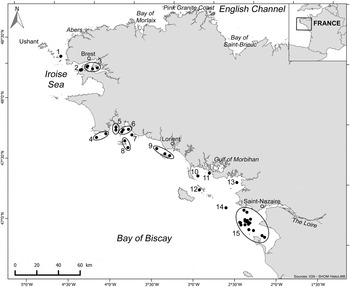
Map of the study area with location of the stations where Chaetozone corona Berkeley & Berkeley (Reference Berkeley and Berkeley1941) was collected. 1: Molène archipelago; 2: Bay of Camaret; 3: Bay of Brest; 4: Penmarc'h; 5: Glénan Natura 2000; 6: Concarneau; 7: Trévignon; 8: Glénan archipelago; 9: Groix; 10: Quiberon; 11: Méaban; 12: Houat; 13: Bay of Vilaine; 14: Plateau du Four; 15: Loire.

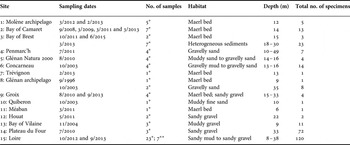
Records of Chaetozone corona Berkeley & Berkeley (Reference Berkeley and Berkeley1941), in the northern Bay of Biscay.

No., number; *quantitative sampling; **qualitative sampling.
RESULTS
SYSTEMATICS
Class polychaeta Grube, 1850
Family cirratulidae Ryckholt, 1851
Genus Chaetozone Malmgren, Reference Malmgren1867
Type species: Chaetozone setosa Malmgren, Reference Malmgren1867, by monotypy
GENERIC DIAGNOSIS (FROM BLAKE, Reference Blake2015)
Prostomium blunt to conical, usually lacking eyespots, with a pair of small nuchal slits or depressions at posterior edge; peristomium with a single pair of grooved dorsal tentacles arising from posterior edge, or sometimes more posterior on an achaetous anterior segment, or rarely an anterior setiger. First pair of branchiae arising from an achaetous segment or first setiger; or sometimes with first two pairs of branchiae on a single anterior segment. Body basically thick and fusiform over many segments, rarely with middle or posterior body segments beaded or moniliform. Setae include capillaries on most setigers and acicular spines in neuropodia and notopodia, spines typically concentrated in posterior segments, forming distinct cinctures with spines emerging from elevated membranes; cinctures with few to many spines and with none to many alternating capillaries; some species with posterior noto- and neuropodial sigmoid acicular spines numerous, encircling entire posterior parapodia; bidentate spines sometimes present in juveniles or occasionally in ventral-most position of far posterior setigers of adults accompanying unidentate spines in cinctures; some species with long, natatory-like capillaries, sometimes limited to gravid individuals. Pygidium a simple lobe, disk-like, or with long, terminal cirrus.
Chaetozone corona Berkeley & Berkeley, Reference Berkeley and Berkeley1941
(Figure 2)
Chaetozone spinosa corona: Berkeley & Berkeley, Reference Berkeley and Berkeley1941, pp. 45–46.
Chaetozone corona: Hartman, Reference Hartman1960, p. 125; Hartman, Reference Hartman1961, pp. 109–110; Hartman, Reference Hartman1969, p. 235, Figures 1–3; Blake, Reference Blake, Blake, Hilbig and Scott1996, pp. 285–287, Figure 8.6; Çinar & Ergen, Reference Çinar and Ergen2007, pp. 341–345, Figures 2–4; Dean & Blake, Reference Dean and Blake2007, pp. 46–47, Figure 3; Çinar, Reference Çinar2009, pp. 2304–2305; Çinar et al., Reference Çinar, Dagli and Açik2011, p. 2115; Çinar et al., Reference Çinar, Katagan, Öztürk, Bakir, Dagli, Açik, Dogan and Bitlis2012a, p. 1462; Çinar et al., Reference Çinar, Katagan, Öztürk, Dagli, Açik, Bitlis, Bakir and Dogan2012b, p. 960; Çinar & Dagli, Reference Çinar and Dagli2013, p. 925; Blake, Reference Blake2015, Table 2.
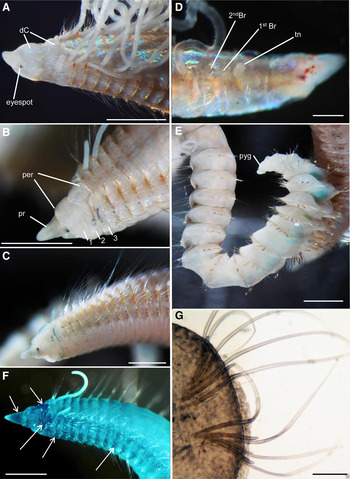
Chaetozone corona Berkeley & Berkeley (Reference Berkeley and Berkeley1941). (A) Specimen from Bay of Brest (North-east Atlantic Ocean) collected in a maerl bed (October 2011): dorso-lateral view. Specimen from Trévignon (North-east Atlantic Ocean, Bay of Biscay) collected in a maerl bed (February 2013): (B) lateral view; (C) anterior part in dorso-lateral view; (E) posterior part. (D) Living specimen from Bay of Brest (North-east Atlantic Ocean) collected in a maerl bed (June 2015). Specimen from Plateau du Four (North-east Atlantic Ocean, Bay of Biscay) collected in sandy gravel (July 2010): (F) stained with methyl-green; (G) detail of setae of left noto- and neuropodia from setiger 1. Br, branchiae; dC, dorsal crest; per, peristomium; pr, prostomium; pyg, pygidium; tn, tentacle. Numbers 1, 2, 3 refer to the three peristomial annuli. Arrows denote areas where methyl green stain is concentrated. Scale bars: A, G, 1 mm; B, C, E, F, 500 µm; D, 250 µm.

MATERIAL EXAMINED
North-east Atlantic Ocean: Bay of Biscay, Molène archipelago, 11 March 2012, station 1, 48°23′15.66″N 4°51′14.10″W, 12 m, in maerl bed, 1 specimen (IUEM-ANTEC01A01); 11 March 2012, station 2, 48°23′15.66″N 4°51′14.10″W, 12 m, in maerl bed, 1 specimen (IUEM-ANTEC01A02); 11 March 2012, station 3, 48°23′12.48″N 4°51′15.36″W, 12 m, in maerl bed, 1 specimen (IUEM-ANTEC01A03); 15 February 2013, station 2, 48°23′15.66″N 4°51′14.10″W, 12 m, in maerl bed, 1 specimen (IUEM-ANTEC01A04); 15 February 2013, station 3, 48°23′12.48″N 4°51′15.36″W, 12 m, in maerl bed, 1 specimen (IUEM-ANTEC01A05); Bay of Camaret, September 2008, station 1, 48°17′35.70″N 4°34′47.82″W, 14 m, in maerl bed, 1 specimen (IUEM-ANTEC01A06); 12 February 2013, station 1, 48°17′35.70″N 4°34′47.82″W, 14 m, in maerl bed, 3 specimens (IUEM-ANTEC01A07); 12 February 2013, station 2, 48°17′23.00″N 4°35′41.00″W, 14 m, in maerl bed, 1 specimen (IUEM-ANTEC01A08); Bay of Brest, Rozegat, October 2011, station 1, 48°19′13.40″N 4°23′15.50″W, 15 m, in maerl bed, 2 specimens IUEM-ANTEC01A09); 25 June 2015, station 1, 48°19′13.40″N 4°23′15.50″W, 15 m, in maerl bed, 1 specimen (IUEM-ANTEC01B02); Trévignon, 11 February 2013, station 3, 47°47′29.70″N 3°53′8.76″W, 13 m, in maerl bed, 1 specimen (IUEM-ANTEC01A10); Glénan archipelago, September 1996, station GP2, 47°44′22.20″N 3°57′57.20″W, 9 m, in maerl bed, 1 specimen (IUEM-ANTEC01B07); Groix, 18 August 2010, station Gx87, 47°39′28.80″N 3°27′41.40″W, 17 m, in maerl bed, 1 specimen (IUEM-ANTER01G04); September 2013, station GRIMM3, 47°41′44.80″N 3°34′00.00″W, 33 m, in sandy gravel, 6 specimens (IUEM-ANTEC01B01); Méaban, 5 March 2011, station 2, 47°31′32.90″N 2°56′04.10″W, 6 m, in maerl bed, 1 specimen (IUEM-ANTEC01B03); Bay of Vilaine, November 2007, station 8, 47°27′54.40″N 2°33′14.40″W, 9 m, in muddy gravel, 1 specimen; Plateau du Four, 8 July 2010, station PF8, 47°14′57.60″N 2°39′52.80″W, 33 m, in sandy gravel, 5 specimens (IUEM-ANTEC01B04); Loire, October 2012, station EL155, 47°13′27.40″N 2°24′21.30″W, 13 m, in sandy gravel, 1 specimen (IUEM-ANTEC01B05); September 2013, station LB24, 47°07′08.00″N 2°25′07.70″W, 22 m, in sandy gravel, 5 specimens (IUEM-ANTEC01B06).
Out of 35 examined specimens of Chaetozone corona, 10 were complete specimens (without complementary information, the widths are given for the widest part of the body): Bay of Brest, 10/2011, station 1, 1 specimen (IUEM-ANTEC01A09), 11 mm long, 1 mm wide, 51 setigers (Figure 2A); 25/6/2015, station 1, 1 specimen (IUEM-ANTEC01B02), 12.5 mm long and 0.7 mm wide with 49 setigers (Figure 2D); Bay of Camaret, 9/2008, station 1, 1 specimen (IUEM-ANTEC01A06), 7.5 mm long, 0.5 mm wide, 44 setigers; 12/2/2013, station 1, 1 specimen, 15 mm long, 1.2 mm wide, 57 setigers; Trévignon, 11/2/2013, station 3, 1 specimen (IUEM-ANTEC01A10), 15 mm long, 2.2 mm wide across widest part of the thorax (around setiger 25), 59 setigers (Figure 2B, C, E); Plateau du Four, 8/7/2010, station PF8, 2 specimens (IUEM-ANTEC01B04): the first of 5 mm long and 1 mm wide for 34 setigers, the second of 13 mm long and 2 mm wide for 58 setigers; Loire, 09/2013, station LB24, 3 specimens (IUEM-ANTEC01B06): reaching 11, 14 and 16 mm long, 1.0, 1.3 and 1.2 mm wide and 50, 55 and 51 setigers, respectively. Other specimens were incomplete (16–38 setigers), ranging from 0.9 to 2.2 mm wide across the widest part of the body. The description is mainly based on the complete specimens from the Bay of Camaret, the Bay of Brest and Trévignon.
ADDITIONAL MATERIAL EXAMINED
Pacific Ocean: Southern California, off Point Vincent light, 6 May 1940, Velero III, station 1142-40, 33°44′10.00″N 118°24′0.00″W, 34–48 m, in coarse sand and mud, 10 specimens (LACM-AHF); SEE of Long Beach breakwater light, 16 May 1953, Velero IV, station 2311-53, 33°40′0.00″N 118°05′4.80″W, 24 m, in fine mud, 50 specimens (LACM-AHF).
DESCRIPTION
Body cylindrical in anterior half (up to setigers 22–30) then dorsoventrally flattened in posterior half. Intersegmental area of posterior segments narrowest, constricted, particularly in posterior-most setigers, providing segments with an accordion-like appearance (Figure 2E). Ventral surface with shallow furrow along body (apparent from setiger 10 in entire specimen from Plateau du Four: IUEM-ANTEC01B04). Some specimens with furrow on dorsal surface, more or less pronounced (very pronounced for specimens from Bay of Brest: IUEM-ANTEC01A09, and Plateau du Four: IUEM-ANTEC01B04). Colour in ethanol creamy white, iridescent (Figure 2A–D), with numerous black spots on lateral and ventral sides of peristomium and laterally or ventrolateral on posterior border of the setiger 1 (Figure 2B, C); few specimens with these spots on additional anterior setigers, up to setiger 5.
Prostomium triangular, pointed; eyespots present, black, clearly visible (Figure 2A); peristomium with three annulations (Figure 2B), second developed dorsally into a domed crest, extending posteriorly over setiger 1 (Figure 2A, B); dorsal tentacles on anterior of last peristomial annulation (Figure 2D). First pair of branchiae on posterior margin of last peristomial annulation, clearly visible on living specimens (Figure 2D), difficult to observe on preserved material. Most segmental branchiae lost, situated dorsally, above and posterior to notosetae on the posterior margin of each setiger.
Notosetae thin capillaries, arranged in single row of 5–9 setae, increasing in length up to about setiger 20 (up to setiger 22 in specimen from Trévignon: IUEM-ANTEC01A10), longer than body width; notopodial spines first appear on setigers 1–8, with 2–5 spines on anterior segments (Figure 2G), 4–6 on posterior notopodia.
Neuropodial capillaries and acicular spines first present from setiger 1; 4–9 simple capillaries; 1–4 spines initially (Figure 2G), increasing to 6–8 in posterior neuropodia. All specimens from California had 1–4 neuropodial spines from setiger 1. Spines forming partial cinctures in posterior segments accompanied by thin capillaries (Figure 2E); up to 14 spines on a side alternating with capillaries. Anteriorly, spines slightly curved, bluntly pointed, pale yellow; thicker in posterior setigers, slightly curved, bluntly pointed, dark yellow to amber.
Pygidium with simple ventral lobe, anus dorsal.
METHYL GREEN STAINING PATTERN
Tip of prostomium weakly coloured, whitish or very slightly greenish; second and third peristomial annulations and first setiger darker than remainder of body which was uniformly green (Figure 2F). Parapodia and ventral side between neuropodia of the anteriormost setigers darker in specimen from station 3 of Molène (IUEM-ANTEC01A05, February 2013).
REMARKS
Examination of our material revealed that for 21 specimens (out of 35), the notopodial spines first appear from setiger 1 and from setigers 4–8 for the other specimens. No correlation was found between length, width, number of setigers and first appearance of the notopodial spines for all the specimens examined. This early appearance of notopodial spines is newly reported for C. corona; prior reports from California had them first present from setigers 8–9 (Berkeley & Berkeley, Reference Berkeley and Berkeley1941; Hartman, Reference Hartman1960, Reference Hartman1961, Reference Hartman1969; Blake, Reference Blake, Blake, Hilbig and Scott1996, Reference Blake2015).
DISTRIBUTION
According to Berkeley & Berkeley (Reference Berkeley and Berkeley1941) and Blake (Reference Blake, Blake, Hilbig and Scott1996, Reference Blake2015), Chaetozone corona was originally described from the East Pacific, off the coasts of Southern California. The species was subsequently recorded from the coasts of California (Santa Barbara Channel) and Baja California (Mexico) to Costa Rica (Hartman, Reference Hartman1960, Reference Hartman1961, Reference Hartman1969; Blake, Reference Blake, Blake, Hilbig and Scott1996; Dean & Blake, Reference Dean and Blake2007). Omena & Creed (Reference Omena and Creed2004) also reported this species in the South Atlantic basin along the coast of Rio de Janeiro State (Brazil). In 2007, Çinar & Ergen made the first observation of C. corona for European waters, from the Turkish coast of the Aegean Sea (Mediterranean Sea) (samplings from 1980 to 2005). Two years later, the species was observed in samples from the İskenderun Bay on the Turkish coast of the Levantine Sea (eastern Mediterranean) (Çinar, Reference Çinar2009). Simboura et al. (Reference Simboura, Kurt Sahin, Panagoulia and Katsiaras2010) mentioned the species from samples dating back to 1982 off the Greek coasts (previously identified as Chaetozone sp. B). Çinar et al. (Reference Çinar, Dagli and Açik2011, Reference Çinar, Katagan, Öztürk, Bakir, Dagli, Açik, Dogan and Bitlis2012a, Reference Çinar, Katagan, Öztürk, Dagli, Açik, Bitlis, Bakir and Doganb) reported the species in the western part of the Sea of Marmara (Turkey) and in Izmir and Mersin Bays (western and southern coasts of Turkey, respectively). The species has recently been identified from coastal waters of the east coast of Florida, USA (Blake, unpublished).
The present study extends the range of C. corona to the northern Bay of Biscay (North-east Atlantic), from the Molène archipelago to offshore the Loire estuary (Figure 1). Furthermore, according to our samples, the distribution of C. corona on the Atlantic coast of France appears to be limited to this defined area. To date, there are no records of C. corona either from the western English Channel (thus including northern coast of Brittany) or further south in the Bay of Biscay (Bachelet, unpublished data).
HABITAT
In the Pacific Ocean, Chaetozone corona was sampled from the intertidal zone to 119 m depth within heterogeneous habitats including coarse sand and either silt or mud (Berkeley & Berkeley, Reference Berkeley and Berkeley1941; Hartman, Reference Hartman1960, Reference Hartman1961, Reference Hartman1969; Blake, Reference Blake, Blake, Hilbig and Scott1996, Reference Blake2015). The specimens recorded by Omena & Creed (Reference Omena and Creed2004) from the Brazilian coast were found in seagrass beds (Halodule wrightii Ascherson, 1868) growing on muddy to fine sands, between 0.5 and 3.0 m depths. In the eastern Mediterranean Sea (Aegean Sea and western Sea of Marmara), specimens were collected from 2.5 to 90 m depths, in muddy, sandy or mixed sediments and Posidonia oceanica (Linnaeus) Delile, 1813 habitats (Çinar & Ergen, Reference Çinar and Ergen2007; Simboura et al., Reference Simboura, Kurt Sahin, Panagoulia and Katsiaras2010; Çinar et al., Reference Çinar, Dagli and Açik2011).
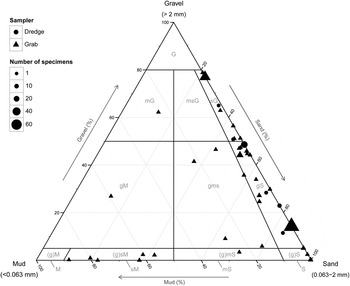
In the present study, the specimens were collected from a wide variety of soft bottoms off south-western Brittany. Figure 3 presents the granulometry of the samples where C. corona was found. It provides information of the ecological preferences of the species in terms of habitat. Considering occurrence, C. corona appears to have preferences for gravelly and sandy bottoms (fine to gravelly sands: Plateau du Four, Loire, Groix, between 12 and 17 m depth) and occasionally in maerl beds (Molène archipelago, Bay of Brest, Bay of Camaret, Trévignon, Méaban, between 9 and 33 m depth). Moreover, highest abundances were observed in gravelly sands (Figure 3).
Sediment grain size ternary plot showing the position of the stations around Brittany where specimens of Chaetozone corona Berkeley & Berkeley (Reference Berkeley and Berkeley1941) were sampled (G, gravel; sG, sandy gravel; mG, muddy gravel; msG, muddy sandy gravel; S, sand; gS, gravelly sand; mS, muddy sand; gmS, gravelly muddy sand; (g)mS, slightly gravelly muddy sand; (g)S, slightly gravelly sand; M, mud; sM, sandy mud; gM, gravelly mud; (g)M, slightly gravelly mud; (g)sM, slightly gravelly sandy mud).

DISCUSSION
Chaetozone corona: a newly introduced species in the Chaetozone group for the North-east Atlantic
According to Chambers & Woodham (Reference Chambers and Woodham2003) and Chambers et al. (Reference Chambers, Lanera and Mikac2011), only three Chaetozone species having eyespots occur in the North-east Atlantic waters: C. carpenteri McIntosh, 1911, C. gibber Woodham & Chambers, Reference Woodham, Chambers, Dauvin, Laubier and Reish1994 and C. zetlandica McIntosh, 1911.
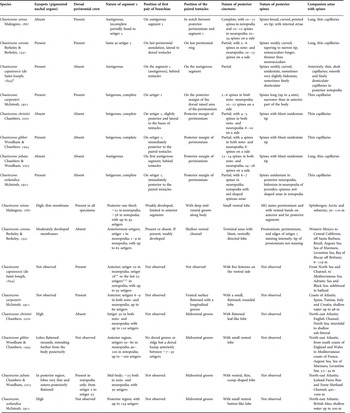
Chaetozone carpenteri possesses up to about 60 setigers and has notopodial and neuropodial spines both starting from setigers 6–9 while its first pair of branchiae appears on the setiger 1 (Chambers et al., Reference Chambers, Lanera and Mikac2011). Chaetozone gibber is up to 200 setigers long, it has no intersegmental constriction posteriorly; its neuropodial spines start from setigers 50–80 and notopodial spines from setigers 65–70. Moreover, its dorsal surface is swollen anteriorly giving a characteristic hump-back appearance (Woodham & Chambers, Reference Woodham, Chambers, Dauvin, Laubier and Reish1994). In their re-description of C. zetlandica, Woodham & Chambers (Reference Woodham, Chambers, Dauvin, Laubier and Reish1994) indicate that this species possesses up to about 150 setigers, no intersegmental constriction posteriorly and with heavy spines occurring only in posterior neuropodia; awl-like spinous setae occur in the notopodia (see Table 2 for detailed comparison among closely related species).
Comparative table of main morphological characters of the eight valid species of Chaetozone recorded in European waters (after de Saint-Joseph, Reference de Saint-Joseph1894; Southern, Reference Southern1914; Woodham & Chambers, Reference Woodham, Chambers, Dauvin, Laubier and Reish1994; Hartmann-Schröder, Reference Hartmann-Schröder1996; Petersen, Reference Petersen1999; Chambers, Reference Chambers2000; Chambers & Woodham, Reference Chambers and Woodham2003; Chambers et al., Reference Chambers, Dominguez-Tejo, Mair, Mitchell and Woodham2007; Simboura et al., Reference Simboura, Kurt Sahin, Panagoulia and Katsiaras2010; Chambers et al., Reference Chambers, Lanera and Mikac2011; Çinar et al., Reference Çinar, Dagli and Açik2011; Çinar & Dagli, Reference Çinar and Dagli2013; Blake, Reference Blake2015; this study).

* See paragraph 2 of the Introduction; **Hartmann-Schröder (Reference Hartmann-Schröder1996); ***de Saint-Joseph (Reference de Saint-Joseph1894).
Caulleriella caputesocis (de Saint-Joseph, Reference de Saint-Joseph1894) was transferred to the genus Chaetozone by Petersen (Reference Petersen1999), but no details were provided. This eyed species described from northern Brittany also occurs in the north-eastern Atlantic (Hartmann-Schröder, Reference Hartmann-Schröder1996). Chaetozone caputesocis (de Saint-Joseph, Reference de Saint-Joseph1894) bears up to 95 setigers, with neuropodial spines occurring from setigers 10–13 and notopodial spines from setiger 16 (Hartmann-Schröder, Reference Hartmann-Schröder1996).
In this study, we report C. corona from the North-east Atlantic basin for the first time, off the coast of Brittany (France). Our specimens were characterized by the appearance of neuropodial spines from setiger 1 and notopodial spines from setigers 1–8, presence of eyespots, spines forming partial cinctures with 10–14 spines on a side, a ventral furrow along the body and prostomium, peristomium and first setiger darkly coloured by methyl green. The early occurrence of notopodial spines from setigers 1–2 reported here was also reported by Çinar & Ergen (Reference Çinar and Ergen2007) from the Mediterranean Sea and differs from specimens from offshore southern California and offshore Costa Rica where they are reported to first occur from setigers 8–9 (Blake, Reference Blake, Blake, Hilbig and Scott1996; Dean & Blake, Reference Dean and Blake2007). However, a new examination of 49 specimens from offshore southern California by one of us (JAB) finds the notopodial spines first present from setigers 3–9 as follows: setiger 3 (1 specimen); 5 (4); 6 (6); 7 (14); 8 (21); and 9 (3). There is thus greater variability in the first appearance of the notopodial spines than previously reported from the eastern Pacific. Apart from this variability, the Bay of Biscay specimens agree closely to the descriptions of the same species from the eastern Pacific (Berkeley & Berkeley, Reference Berkeley and Berkeley1941; Hartman, Reference Hartman1961, Reference Hartman1969; Blake, Reference Blake, Blake, Hilbig and Scott1996, Reference Blake2015; Blake & Ruff, Reference Blake, Ruff and Carlton2007; Dean & Blake, Reference Dean and Blake2007) and the eastern Mediterranean Sea by Çinar & Ergen (Reference Çinar and Ergen2007).
The Bay of Biscay specimens possess black spots on the peristomium and anterior setigers as also reported by Çinar & Ergen (Reference Çinar and Ergen2007) for specimens from the eastern Mediterranean Sea. Moreover, the methyl green pattern of the specimens from the northern Bay of Biscay is similar to that of specimens from California and Pacific coast of Costa Rica observed by Blake (Reference Blake, Blake, Hilbig and Scott1996) and Dean & Blake (Reference Dean and Blake2007): prostomium, peristomium and edges of setiger 1 are stained dark, except for the very tip of the prostomium.
The species with greatest morphological similarity to C. corona is C. carpenteri known from the Mediterranean Sea. However, the presence of neuropodial spines from setiger 1 and the first pair of branchiae inserted on the third (last) peristomial annulation are the two criteria distinguishing C. corona from C. carpenteri. The latter has long and large noto- and neuropodial spines from setigers 6–9, becoming narrower but remaining long from mid-body segments to posterior end (Chambers et al., Reference Chambers, Lanera and Mikac2011; Blake, Reference Blake2015). The first pair of branchiae is inserted on the setiger 1 (Chambers et al., Reference Chambers, Lanera and Mikac2011). Chaetozone corona therefore represents the fifth Chaetozone species with eyespots recorded in the north-eastern Atlantic.
Why was Chaetozone corona not identified in the Bay of Biscay before the 2000s?
The recent and regularly repeated observations of this species in the northern Bay of Biscay lead to two hypotheses regarding its presence: (1) either the species may have been present, although misidentified, before the late 1990s; (2) it may be considered as a non-indigenous species.
Prior to about 1990, species of Chaetozone had been largely identified globally as the type-species, C. setosa. Since the early 2000s the increasing exchange of data and information between marine scientists has greatly improved our knowledge of the cirratulids worldwide. The Marine Observatory of the University of Brest has been studying maerl beds for more than two decades in the Bay of Brest and the Glénan archipelago (Grall, Reference Grall2002). As part of this study, we re-examined samples from surveys conducted in the 1990s. One specimen recorded from the Glénan archipelago sampled in 1996, and previously identified as Chaetozone sp., was re-identified as C. corona. The sample was collected in an exploited maerl bed. This represents the first record of C. corona off the north-east Atlantic coasts. Chaetozone gibber was identified off Brittany from the mid-1990s, and the specimens previously identified as C. setosa in the Bay of Brest (Hily, Reference Hily1987) were in fact C. gibber. Re-examination of our ‘old’ samples of maerl beds, leads to the conclusion that C. corona was neither recorded at the mouth of the Gulf of Morbihan in 2003–2004, nor in the Bay of Brest before 2011. Nonetheless it is not possible to state precisely how many years C. corona has been present in the northern Bay of Biscay.
The two main vectors of introduction of marine alien species in the western part of Europe are shipping and aquaculture (Gollash, Reference Gollash2006; Çinar, Reference Çinar2013; Katsanevakis et al., Reference Katsanevakis, Zenetos, Belchior and Cardoso2013; Nunes et al., Reference Nunes, Katsanevakis, Zenetos and Cardoso2014). The northern Bay of Biscay is an important maritime crossroad with three main commercial harbours: Saint-Nazaire (Loire estuary), Lorient (southern Brittany) and Brest (western Brittany), and the Ushant Traffic Separation Scheme which is the gate of the marine commercial traffic to the Channel and the North Sea. Also, Brittany is a major region for sailing which includes transatlantic traffic. The introduction of species by shipping could be from ballast waters or fouling species fixed to the hulls (Gollash, Reference Gollash2006; Çinar, Reference Çinar2013; Katsanevakis et al., Reference Katsanevakis, Zenetos, Belchior and Cardoso2013). Shipping is known to be the main vector for species introductions to Europe with a total of 400 taxa (38.8%) introduced before 2005 (ballast waters: 230 taxa (22.3%), hull fouling: 170 taxa (16.5%)) (Gollash, Reference Gollash2006). In 2013, Katsanevakis et al. showed that almost 52% of marine alien species introduced in European waters probably arrived via shipping activities. In the case of C. corona, Çinar & Ergen (Reference Çinar and Ergen2007) hypothesized that the species may have been introduced from southern California into the East Mediterranean basin through ballast waters. This hypothesis would imply that the species has a pelagic phase during its life cycle. In addition, the species is not known to be associated with fouling communities. In our study area, C. corona may have been introduced by way of commercial shipping in the mouth of the Loire estuary and then would have been transported by currents towards the north-west along the coast of Brittany.
Regarding aquaculture, oyster farming is well developed on the south coast of Brittany and in the Bay of Brest. During the growing period 2011–2012, the production of the Pacific oyster Crassostrea gigas (Thunberg, 1793) was 17,000 tonnes in northern Brittany (including the Bay of Brest) and 8000 tonnes in southern Brittany (Comité National de la Conchyliculture, 2011). During the late 1960s and early 1970s, the Portuguese oyster Crassostrea angulata (Lamarck, 1819) was cultivated in France and was affected by a disease causing high mortalities. From 1971 to 1976, in order to compensate for the loss in production of oysters, oyster spat from Japan and broodstock from British Columbia (Canada) were introduced (562 tonnes of adult oysters from Canada and 10,015 tonnes of spat from Japan, all French rearing areas were included) (Grizel & Héral, Reference Grizel and Héral1991). The introduction of Pacific seaweeds and animals by the transfers of C. gigas from western Pacific coasts (mainly Japan and Korea) to European coasts (including transfers from the Pacific coast of the USA) is well known and documented (Gruet et al., Reference Gruet, Héral and Robert1976; Verlaque, Reference Verlaque2001; Le Roux, Reference Le Roux2008; Mineur et al., Reference Mineur, Le Roux, Stegenga, Verlaque and Maggs2012, Reference Mineur, Le Roux, Maggs and Verlaque2014). Verlaque (Reference Verlaque2001) also indicates that the Thau Lagoon (Mediterranean coast of France) is both a major site of importation of Pacific oysters and an important exportation site of bivalve molluscs to other rearing areas of France and abroad. In France, the oysters are transferred between all the rearing areas, from Thau Lagoon to Brittany and Normandy, via Arcachon Bay, Marennes-Oléron (Goulletquer et al., Reference Goulletquer, Bachelet, Sauriau, Noël, Leppäkoski, Gollasch and Olenin2002). However, to our knowledge, C. corona has not been recorded within any of these areas, while Thau Lagoon, Arcachon Bay or Marennes-Oléron Bay are famous oyster farming sites that have experienced several introductions of Asiatic species, associated with oysters from Japan (Verlaque, Reference Verlaque2001; Goulletquer et al., Reference Goulletquer, Bachelet, Sauriau, Noël, Leppäkoski, Gollasch and Olenin2002; Jourde et al., Reference Jourde, Sauriau, Guenneteau and Caillot2013; Lavesque et al., Reference Lavesque, Sorbe, Bachelet, Gouillieux, de Montaudouin, Bonifácio, Blanchet and Dubois2013, Reference Lavesque, Gouillieux, de Montaudouin, Bachelet, Bonifácio and Simonet2014; Gouillieux et al., Reference Gouillieux, Lavesque, Leclerc, Le Garrec, Viard and Bachelet2015). Moreover, C. corona is not known in either Japan or western Canada where C. gigas stocks were obtained and imported. This seems to rule out oyster aquaculture as a mode of introduction of this species to French Atlantic coasts and reinforces the hypothesis of an introduction through ballast waters.
Finally, one could also hypothesize that C. corona is a cryptogenic species (Carlton, Reference Carlton1996) that has been in our study area for a long time. Çinar & Ergen (Reference Çinar and Ergen2007) and Zenetos et al. (Reference Zenetos, Gofas, Verlaque, Çinar, García Raso, Bianchi, Morri, Azzurro, Bilecenoglu, Froglia, Siokou, Violanti, Sfriso, San Martín, Giangrande, Katağan, Ballesteros, Ramos-Esplá, Mastrototaro, Ocaña, Zingone, Gambi and Streftaris2010) have proposed the same status for the species from the Mediterranean Sea. In our study, C. corona could be a ‘rare’ cryptogenic species that, under certain environmental conditions would have increased its abundance and presence in our samples.
Distribution of Chaetozone corona in the North-east Atlantic
To date, C. corona has only been observed in the northern Bay of Biscay, between the Iroise Sea and the Loire estuary, in infra-littoral muddy to sandy substrates. In the Loire estuary and Plateau du Four, 120 and 72 specimens of C. corona were recorded, respectively (Table 1), which is the highest number of records of the species in the Northern Bay of Biscay since 1996. This distribution may be mainly explained by two environmental factors occurring off the southern and western coasts of Brittany: (1) the residual currents and (2) a thermic barrier.
Koutsikopoulos & Le Cann (Reference Koutsikopoulos and Le Cann1996) have shown that the residual currents over the Armorican shelf of the Bay of Biscay are driven by wind, tides and water density. These currents are oriented towards the north-west, along the southern and western coasts of Brittany, with an average speed of 3 cm s−1. Also, according to these authors, the plume of the Loire and Vilaine estuaries are directed north-west, along the south coast of Brittany. The discharge of the Loire is higher during winter with the maximum peak occurring in February–March (Lazure & Jégou, Reference Lazure and Jégou1998). The freshwater flow largely affects the northern Bay of Biscay, and is oriented toward the west along the southern coast of Brittany and northward in the Iroise Sea and western Channel. Several authors have shown that in the Iroise Sea the variations in salinity (Kelly-Gerreyn et al., Reference Kelly-Gerreyn, Hydes, Jégou, Lazure, Fernand, Puillat and Garcia-Soto2006), the distribution of nutrients (Morin et al., Reference Morin, Le Corre, Marty and L'Helguen1991) or the composition in chemical elements like trace metals (Waeles et al., Reference Waeles, Riso, Maguer and Le Corre2004, Reference Waeles, Riso, Maguer, Guillaud and Le Corre2008) are directly influenced by the Loire flow. Southward & Southward (Reference Southward and Southward1977) have shown that the population of the hermit crab Clibanarius erythropus (Latreille, 1818) on the south-western coast of Britain is unable to reproduce in the western Channel due to cold summer water (rarely exceeding 18°C in August), originating from the south of Brittany. Ayata et al. (Reference Ayata, Lazure and Thiébaut2010) have also shown that the shelf hydrodynamism in the northern Bay of Biscay impacts the transport of planktonic organisms mainly to the north-west. All these factors could explain the distribution of C. corona north to the Loire estuary rather than towards the south.
A cold seawater mass, which does not exceed 13°C in summer, is present in the north-west end of Brittany, between Ushant and the continent (Gallon et al., Reference Gallon, Robuchon, Leroy, Le Gall, Valero and Feunteun2014). This colder water could be a thermic barrier, limiting the progression of the species into the Channel, along the northern coast of Brittany. This progression could be also limited to the south and west of the Armorican shelf due to the presence of a permanent cold water mass (<12°C) off southern Brittany, centred over the 100 m depth zone (Koutsikopoulos & Le Cann, Reference Koutsikopoulos and Le Cann1996). Despite potential suitable habitats in the north of Brittany (i.e. Bay of Morlaix and Bay of Saint-Brieuc), C. corona has never been observed, as long-term yearly benthic surveys in these areas have not yet recorded the species (Pierre Noire (Roscoff Marine Station, 2015) and REBENT program (Vasquez, Reference Vasquez2013)). Further, the species was not observed on the northern coast of Brittany during the large scale CARTHAM Natura 2000 programme despite several habitats being sampled (Abers, Bay of Morlaix, Pink Granite Coast, Bay of Saint-Brieuc). This reinforces the thermic barrier hypothesis as factor that limits the distribution of the species.
The reproductive biology of Chaetozone corona could also partly explain its limited distribution off Brittany. Few data are available regarding breeding and development of Chaetozone species. Petersen (Reference Petersen1999) indicates that epitoky is not known in this genus; Chambers & Woodham (Reference Chambers and Woodham2003) found no documented records of epitokous development in Chaetozone. However, Blake (Reference Blake2015) documented the presence of long natatory-like capillary setae in several species, some of which were associated with the presence of gametes which would suggest spawning in the water column. Other species, including the type-species, C. setosa, have long capillaries present in all specimens (Chambers, Reference Chambers2000; Blake, Reference Blake2015). Such setae have not been observed in C. corona. Petersen (Reference Petersen1999) suggested that some Chaetozone species might be able to reproduce asexually by architomic scissiparity, i.e. direct development excluding large-scale dispersal (Petersen, Reference Petersen1999), but this has not been directly observed for any species. Another possible mode of dispersal is nocturnal migration of adults in the water column. By this pathway, benthic polychaetes swim with or may be carried by currents to adjacent locations. This behaviour is unrelated to reproduction and is considered as an inherent behavioural pattern and has been reported for polychaetes by several authors particularly during winter nights i.e. outside of the breeding season (Pettibone, Reference Pettibone1963; Dean, Reference Dean1978a, Reference Deanb; Dauer et al., Reference Dauer, Ewing, Tourtelotte and Barker1980, Reference Dauer, Ewing, Sourbeer, Harlan and Stokes1982). We believe these pathways might together have contributed to the dispersal of C. corona in the Bay of Biscay.
CONCLUSION
Chaetozone corona has been identified from the northern Bay of Biscay since 1996 and despite possible misidentifications prior to the 2000s, we believe that the species is likely to be a recent arrival off the coasts of Brittany, and present in the area for less than two decades.
Heretofore, records of C. corona were limited to the southern and western Brittany. Currently, the northern limit of the distribution of the species is the Molène archipelago. We here hypothesize that the species was introduced to the area through ballast waters and that its current distribution is limited by a requirement of muddy to sandy habitats, residual currents and a colder water mass occurring in the Iroise Sea. Although the repeated observations from 2003 suggest that the population seems to be well established and self-sustaining, nothing suggests that the species would be invasive. However, its presence raises the question of its ecological niche and potential competitiveness with respect to native species. Further explorations or existing monitoring programmes should be able to track the very likely expansion of the species towards the southern Bay of Biscay and/or into the English Channel.
Finally, following Petersen (Reference Petersen1999), Chambers (Reference Chambers2000), Chambers & Woodham (Reference Chambers and Woodham2003) and Chambers et al. (Reference Chambers, Lanera and Mikac2011), we recommend that available Chaetozone collections, originating from the North-east Atlantic and Mediterranean Sea, and identified historically as C. setosa, be re-examined. Moreover, re-examination of Chaetozone specimens from laboratories or Museum collections could determine whether C. corona occurs in Europe outside the spatial and temporal distribution given in this study. In the near future, we will collect new specimens in order to conduct genetic investigations which could allow us to define the origin and introduction history of C. corona.
KEY FOR THE IDENTIFICATION OF CHAETOZONE SPECIES KNOWN IN EUROPEAN WATERS (ADAPTED FROM CHAMBERS & WOODHAM, Reference Chambers and Woodham2003 AND GIL, Reference Gil2011).
-
1. Eyespots absent 2
-
— Eyespots present 4
-
-
2. Very long capillary setae (2–3 times body width) present from setiger 2 or from ~setiger 20; well-defined constrictions (about half of setiger width) between posterior setigers 3
-
— No setae longer than body width; slight constrictions (about 1/5 of setiger width) between posterior setigers Chaetozone christiei Chambers, Reference Chambers2000
-
-
3. Very long capillary setae present from the setiger 2; 12–14 spines in each ramus in posterior setigers Chaetozone jubata Chambers & Woodham, Reference Chambers and Woodham2003*
-
— Very long capillary setae present from ~setiger 20; 6–8 spines in each ramus in posterior setigers Chaetozone setosa Malmgren, Reference Malmgren1867
-
-
4. Very long capillary setae, longer than body width; constrictions well marked between posterior setigers 5
-
— No setae longer than body width; constrictions few between posterior setigers 6
-
-
5. Notopodial spines start from setigers 1–9 and neuropodial spines start from setiger 1; first pair of branchiae on the peristomium Chaetozone corona Berkeley & Berkeley, Reference Berkeley and Berkeley1941
-
— Noto- and neuropodial spines start from setigers 6–9; two types of spines present: (1) large and up to 0.5 mm long from anterior to mid-body region and (2) narrower and up to 4 mm in posterior part; first pair of branchiae on the first setiger Chaetozone carpenteri McIntosh, 1911
-
-
6. Body surface iridescent; anterior dorsal surface rounded; thick posterior spines only in neuropodia; notopodia with awl-shaped spinous setae Chaetozone zetlandica McIntosh, 1911
-
— Body surface opaque; thick spines in posterior notopodia and neuropodia 7
-
-
7. Anterior dorsal surface with obvious hump; neuropodial spines from anterior region (setigers 50–80) to end of body; notopodial spines from mid-body (setigers 90–100) Chaetozone gibber Woodham & Chambers, Reference Woodham, Chambers, Dauvin, Laubier and Reish1994
-
— Anterior dorsal surface without hump; neuropodial spines from setigers 10–13 Chaetozone caputesocis (de Saint-Joseph, Reference de Saint-Joseph1864)**
*deep-sea species (from 350 to 1800 m depth) (Chambers et al., Reference Chambers, Dominguez-Tejo, Mair, Mitchell and Woodham2007).
**de Saint-Joseph (Reference de Saint-Joseph1894) wrote that Chaetozone caputesocis possess notopodial spines in the last 23 setigers only, whereas Hartmann-Schröder (Reference Hartmann-Schröder1996) mentioned the presence of notopodial spines from setiger 16: ‘Ab 10. Neuropod und ab 16. Notopod dazu leicht S-förmig gebogene Hakenborsten […]’. See remarks in paragraph 2 of the Introduction.
-
ACKNOWLEDGEMENTS
The authors thank Marion Maguer for sampling and acquisition data phases, Ruth Barnich for discussions on polychaetes, Christophe Lambert for discussion and bibliographic information on oyster aquaculture, David Borg, the ship ‘Tzigane II’ and its captain Thierry Longépée, the crews of the Research Vessels ‘Thalia’, ‘Côtes de la Manche’ and ‘Albert Lucas’. We thank the RESOMAR Benthic Team (French Marine Biological Stations network) for the helpful discussions on Chaetozone species distribution in France, especially: Guy Bachelet, Aurélie Garcia, Stanislas Dubois, Céline Houbin and Régis Gallon. Finally, we wish to thank the two anonymous reviewers for constructive criticism.
FINANCIAL SUPPORT
The data acquisition was supported by the Marine Observatory of the European Institute for Marine Studies of Brest, the Brittany Region, the European Regional Development Fund and Ifremer through the REBENT programme, the BenthoVAL project (ANR-13-BSV7-0006), the Agence des Aires Marines Protégées (AAMP) and the Direction Régionale Environnement Aménagement Logement (DREAL) of Brittany and Pays de la Loire regions, making it possible to obtain valuable data.