Three aging train cars creaked along the weed-covered single track and wended their way up the Nagano valley toward the station. If a train were to come from the opposite direction, it would have stopped in the station while the other passed. But that rarely happened. Trains in either direction came barely once an hour. Mostly, they served high school students commuting from the scattered hamlets to the central school a few train stops away.
After cresting the mountain range, the train stopped at Kurohime Station. The station served several of the hamlets in Shinano village. In 1960, 13,700 people lived in Shinano, and 60 percent of them farmed. By 2015, barely 8,500 lived in Shimano anymore, nearly 40 percent of them were 65 or older, and barely 760 of them farmed (Shinano 2019).
Were a traveler to leave Kurohime Station, he would walk past one shuttered building after another—windows broken, siding unhinged, and front rooms littered with trash. Despite the distance to the sea, a sushi restaurant operated here during the booming 1980s. Tokyo vacationers came in their BMWs back then. No longer. An electrical appliance shop once did business. So did a bakery, a supermarket, a pottery shop. The stores are all closed now. With no demand for the land, owners have no incentive to clear the buildings. Instead, they have boarded them up, and left them to rot. Tattered Communist Party posters hang from the walls.
A mile down the highway, past more abandoned storefronts, the traveler would pass a booming pachinko gambling establishment. He would pass a similarly booming funeral home. On the other side of the street from the gambling parlor, he would locate the one remaining supermarket. And behind the supermarket he would find a small complex of buildings. Some are small, with faded creosoted wooden paneling. The rest are sheathed in slowly rusting metal siding. This is the town brewery, the creator of Matsuo sake.
If the traveler came with an appointment, the firm president Takahashi, son of the chairman of the board Takahashi, would proudly meet him in the entryway. Everything about the young president contrasts with the environment. Heir to the 150-year-old family brewery, he is young. He is energetic. And he is extraordinarily articulate. He will happily offer a visitor tastes of several of the firm’s products. Ask him questions, and he will begin to describe his firm’s philosophy of “terroir.”Footnote 1
Takahashi uses the French word. The ever-so-glossy Wine Spectator (Steiman Reference Steiman2014) defines it as “all the physical elements of a place that can affect the character of wine made from it, … the sum total of a site’s constants, including soil composition, latitude, elevation, contour, sun exposure and climate ….” Of course, Wine Spectator also reminds the reader that “[m]ost of us certainly can cite the different characteristics we expect from a comparison of say, Chambolle-Musigny with Nuits-St.-Georges ….” Certainly? Never mind—Takahashi will happily explain the arrangements he has negotiated with several farmers in the tiny hamlet of Arasebara on the foothills of nearby Mt. Madarao. They grow premium sake rice varieties optimized for Nagano. And with that Arasebara rice, he has fashioned a sake that he hopes captures the character of the mountainside hamlet. Six times, he has won the national sake championship (junmai daiginjo and daiginjo divisions).
Sixty kilometers away in Nechi valley sits the Watanabe brewery. But 60 km only as a crow or drone might fly. The 2,500-meter Mt. Myoko lies between. Were a traveler to attempt the trip by train, he would spend two and a half hours, and find the rails single-tracked at the Nechi end as well. On an average day in 2018, only four people used the Nechi train station. Were the traveler to try to drive, in winter and spring he would find the roads closed by snow. Headed by Yoshiki Watanabe, sixth-generation head of the family firm, the Watanabe brewery uses its own local rice to showcase the terroir of the tiny Nechi valley hamlet. It too focuses on sake-optimized rice varieties, but also distinguishes its bottles by vintage. In 2010, it won the champion sake award (junmai ginjo division) at the London International Wine Challenge.
Over the course of the last century, Japanese consumers have gradually lost their taste for sake. A few producers in Kobe dominated the mass market through economies of scale. The smaller regional brewers steadily went out of business. In this environment, ambitious (and perhaps desperate) brewers like Takahashi and Watanabe have tried to create a market for unambiguously delicate and subtle high-end sake that showcases environmental variation. To create their terroir sake, they must convince local farmers to grow the high-risk and high-cost varieties of rice optimized for premium sake. The necessary arrangements involve extraordinarily complex incentive and informational requirements.
Brewers and farmers do not address these requirements either through elaborate contracts with verifiable terms or through vertical integration. Rather than pursue either strategy, they (1) deliberately cultivate a dense network of social capital, and combine (2) simple and short-term renewable (and conversely, terminable) contracts, (3) what economists call “efficiency-wage” level payments, (4) close monitoring, and (5) free intervention to give the brewer close control over the farming process. They do not draft elaborate contracts or vertically integrate for a simple reason: Within dense networks of social capital, their terminable contracts paying high prices give them all the control they need.
I begin by surveying the literature on vertical integration and on the interplay between contracting and its social context. I explain the history of sake and the process by which to brew it, and the state of the industry. I describe the way in which innovative regional brewers created a market for premium sake. Finally, I turn to the contractual approach that the brewers and farmers have devised to create their terroir sake.
THE LITERATURE
The Problem
For their premium terroir sake, the brewers need the right kind of rice. More specifically, they need (a) sake rice (far more difficult to grow than table rice) (b) of a variety optimized for their peculiar location (and, being an unusual variety, one without well-established best practices), (c) grown to the exacting standards required for premium sake, (d) but which standards are ones that the brewer can observe but often cannot specify at levels sufficiently verifiable for explicit contracting.
Ethnic Groups
The brewers need farmers whom they can trust—farmers on whom they can rely to produce rice at quality levels higher than that for which they could draft verifiable contract terms. To cultivate that trust, the farmers and brewers will choose to draw on those aspects of their respective reputations that convey information about their own trustworthiness. The modern iteration of this literature began with Stewart Macaulay (Reference Macaulay1963), of course. In his famous study of Wisconsin business practice, he (1963, 58) quotes an attorney who was “sick of being told, ‘We can trust old Max.’” His businessmen dealt with people they knew and trusted (1963, 63).
To increase the information about the trustworthiness of possible contract partners, some traders in some industries focus their trades within distinctive religious, ethnic, or familial lines. Within these densely intertwined communities, information about contractual trustworthiness travels. And to the extent that it travels, contractual partners learn about each other and trade on that reputation for probity. Modern scholars typically illustrate the informational nexus between reputations and ethnic ties through several sets of articles. Three of the better known involve those of Janet Landa, Lisa Bernstein, and Avner Greif. Landa (Reference Landa1981) examines Chinese middlemen in the Southeast Asian rubber market. There, she finds trade dominated by several clans bound together through “a tightly knit kinship structure” and “linked in complex networks of particularistic exchange relations” (350). She and Robert Cooter describe them as “ethnically homogenous middlemen groups” (1984, 15–16). They traded, Landa and Cooter continue, within “a repository of trust which reduces the probability of breach on a contract between insiders” (16). Because of their personal ties, they were able “to rely upon informal means of enforcement of contracts” (16).
Bernstein (Reference Bernstein1992) studies the New York diamond market. There, she observes that “the diamond industry has long been dominated by Orthodox Jews” (141). Their ethnic ties, she posits, gave them both access to relatively high levels of information about their contracting partners and an ability to punish those who reneged on their promises. The Orthodox Jewish community provided, she explains, “geographical concentration, ethnic homogeneity, and repeat dealing” (140). Within this world, traders organized their industry “to minimize the cost of obtaining information about dealers’ reputations” (133).
Greif (Reference Greif2012, 445) examines the agency contracts among eleventh-century Jewish Maghribi traders in the Mediterranean. These traders “deterred opportunism in bilateral agency relations [through] a credible threat of losing future profitable relations in the traders’ broader community,” writes Greif (445). The traders could rely on this informal punishment strategy because they traded through “coalitions,” Greif contends; Bernstein (2019) more plausibly argues that they could punish opportunism because they traded within “small-scale networks.”
Social Capital as an Ethnic Substitute
Landa, Bernstein, and Greif study the reputations of merchants located within strongly bonded ethnic groups. In Japan, brewers and farmers choose to replicate some of the effect of those ethnic connections through dense and deliberately cultivated networks of social ties. The concept is that of “social capital.” Political scientist Robert Putnam (Reference Putnam1995, Reference Putnam2000) popularized the concept two decades ago when he argued that that America suffered from its decline. As Putnam articulates the idea, mid-twentieth-century Americans had carefully built and maintained ties with each other. They had helped the PTA, joined the Lions Club, attended churches and synagogues, and coached little league. Now, they did so only haphazardly. They no longer lived within webs of intersecting relationships, and suffered for that loss.
Putnam had not invented the term, and sociologists quickly noted their own antecedents in Durkheim and Marx (Portes Reference Portes1998, 2). They cited more recent discussions by Pierre Bourdieu (Reference Bourdieu and Richardson1985) and James Coleman (Reference Coleman1988, Reference Coleman1990). As Coleman (Reference Coleman1988, 1990; see Burt Reference Burt2000, 351) explains it, people can hold each other most closely to communal norms—people can most reliably trust each other—when they maintain a network of overlapping ties dense enough to create “closure” (Coleman Reference Coleman1988, S105–07). Suppose, explains Coleman (Reference Coleman1988), that members in one society maintain ties with other members that do not intertwine. A knows B and C, but B and C do not know each other and neither do they know anyone else in common. Absent those mutual connections, they find it harder to punish people who break norms.
By contrast, if people live within a network of intertwined relationships, their world is “closed.” Should anyone deviate from the norms (e.g., should a farmer sell substandard rice to a brewer), many in the network will know, and many can punish (Coleman Reference Coleman1988, S106). “In a structure with closure,” Coleman continues, “B and C can combine to provide a collective sanction, or either can reward the other for sanctioning A.” As Ronald S. Burt explains, “network closure facilitates sanctions that make it less risky for people in the network to trust one another” (Reference Burt2000, 351). It “enables local monitoring,” write Hillmann and Aven (Reference Hillmann and Aven2011, 486). It helps “ensure that members know how their exchange partners behaved in the past, whether the behavior complied with community norms or not, and if these partners should be trusted in future transactions” (486).
Vertical Integration
Rather than buy their rice, the brewers could—hypothetically—grow it themselves. In the language of the law, they could acquire their rice by contract, or integrate vertically into rice production. In the language of economics workshops, they could either “make or buy.” As early as 1937, Ronald Coase noted that rational firms will make component parts internally when the costs of contracting across the market exceed the costs of administering a transaction within the firm (Coase Reference Coase1937).
Coase left open the question of what those market and administrative costs might be. During the 1980s and 1990s, scholars focused on whether a transaction involved assets whose value was specific to the transaction. Such a “transaction-specific investment” would generate “quasi rents,” they explained. Should the two parties try to contract for the assets across the market, those rents would create incentives for them to try to “hold up” each other (for example, Klein, Crawford, and Alchian Reference Klein, Crawford and Alchian1978; Williamson Reference Williamson1985). Unfortunately, the question lacked an extensive application. Scholars had initially focused primarily on one historical example (the GM-Fisher Body merger). That example, however, turned on factors later shown to be entirely orthogonal to the “transaction-specific asset” hypothesis (Coase Reference Coase2000; Casadesus-Masanell and Spulber Reference Casadesus-Masanell and Spulber2000). When scholars did find other applications, many of them involved clearly nonstandard venues like government procurement (for example, Masten, Meehan, and Snyder Reference Masten, Meehan and Snyder1991).
In his own theory of the firm, Oliver Hart (Grossman and Hart Reference Grossman and Hart1986; Hart and Moore Reference Hart and John1990) suggests that assets should be owned by the institution whose involvement raises the value of the asset to its highest use. As Halonen-Akatwijuka (Reference Halonen-Akatwijuka2016) summarizes the argument:
If … assets are so complementary that they are productive only when used together, they should have a single owner…. Furthermore, if there are such strong complementarities between an asset and a party that the asset is productive only with that party, then this indispensable party should own the asset.
If the land is most valuable when used for the production of sake, it should be owned by the entity whose role is most important in producing that sake.
In fact, however, Klein, Williamson, and Hart may be selling lawyers (or the human imagination more generally) short. People can replicate much of the administrative immediacy of a single firm by contract. Writing in this journal, Thomas Dietz (Reference Dietz2012, 44) notes that German companies negotiating software procurement contracts across national boundaries did the same: They used reputational mechanisms, social capital, and contracts with short-term termination options to obtain much the same control that vertical integration would give.
Efficiency Wages
When transacting across the market, a firm can increase the incentive of its contracting partner to keep its word by paying it extraordinarily high prices. Obviously, firms do not generally increase profitability by raising the prices they pay. They raise profitability through higher prices only if those prices induce a contracting partner to so increase its reliability that the firm can produce in a way otherwise not possible.
Consider it the contractual analogue to the concept of “efficiency wages.” Sometimes, an employer can raise profitability by raising wages. It can do so when those higher wages raise productivity by an amount that more than offsets the higher wage costs. The classic example is Henry Ford. He had conceived a new manufacturing technique: the assembly line. To make the technique work, he needed workers who would stay on the job. He needed workers who would accumulate experience, and then draw on that experience to make the hundreds of changes necessary to make the assembly line work. As long as he paid the going rate in Detroit—$2.50 per day—workers quit as they pleased. Ford doubled the pay to $5.00, and workers now stayed on the job. They studied the assembly line and made it work (Raff and Summers Reference Raff and Summers1986, 1; see also Shapiro and Stiglitz Reference Shapiro and Stiglitz1984).
SAKE
The Drink
At least some version of sake dates to prehistory. Migrants from Korea or Sakhalin (no one knows which) brought wet rice agriculture to Japan sometime around the third century BCE. Probably Japanese began to drink a fermented rice drink soon thereafter.
In the two millennia since, sake has played a prominent role in Japanese culture. Seventh-and eighth-century poets sang its praises. The fifteenth-century bakufu elites paired the “way of tea” with a Zen-ish “way of sake.” No one knows how it tasted back then, but everyone drank it. Farmers drank it, merchants drank it, swordsmen drank it.
Over time and across the country, the brewers doubled as bankers. Fans of classic cinema will remember Mifune playing off the village brewer against the village brothel owner in Kurosawa’s 1961 Yojimbo. In premodern villages, the sake brewers were often among the richest. They financed paddies, irrigation networks, and entrepreneurship more generally.
Sake brewing is easy to describe, but uncommonly hard to execute well. Through the fermentation process, yeast turns sugars into alcohol. Yet rice contains no sugar. To create the sugar, brewers need first to add mold (koji) to a small amount of steamed rice (koji mai). The mold then transforms the starch in the kernel into a sugar. To this starter, the brewers add additional rice (shubo mai, or moto mai) and yeast (kobo). This creates a culture (shubo), to which the brewers will add more mold, steamed rice (kakemai), and water. They take this last step multiple times. They precipitate out the solid particles. And they typically close the process by heating the mixture to kill the active ingredients.
The Industry
Before the 1868 Meiji coup, most sake production was local. Most major towns (and many small ones) had their local brewer. Out of the local rice, the brewers brewed the sake for their local customers.
For a few years after the coup, production remained local. In 1876, brewers operated 26,000 breweries (Ninomiya Reference Ninomiya2012, 58; Suzuki Reference Suzuki2015, 71). Soon, however, this changed—as the incipient transportation network allowed the most efficient producers to exploit economies of scale. By 1899, nearly half the breweries had disappeared, and only 15,000 remained. By 1942, the number had fallen to 7,000, and by 1958 to 4,000. In 2017, barely 1,378 still survived (Osake Sutatisutikkusu n.d.).
Today’s 1,378 breweries vary enormously. The 11 largest each brew more than 10,000 kl of sake. Together, they employ over 4,300 employees and produce 47.5 percent of all sake (2017 data). Another 838 firms brew less than 100 kl each. Together, they employ 7,600 people and produce only 5.1 percent of all sake. Indeed, 830 of the breweries are seasonal firms that run only during the winter (Kokuzeicho 2018c) (fiscal 2018 survey).Footnote 2
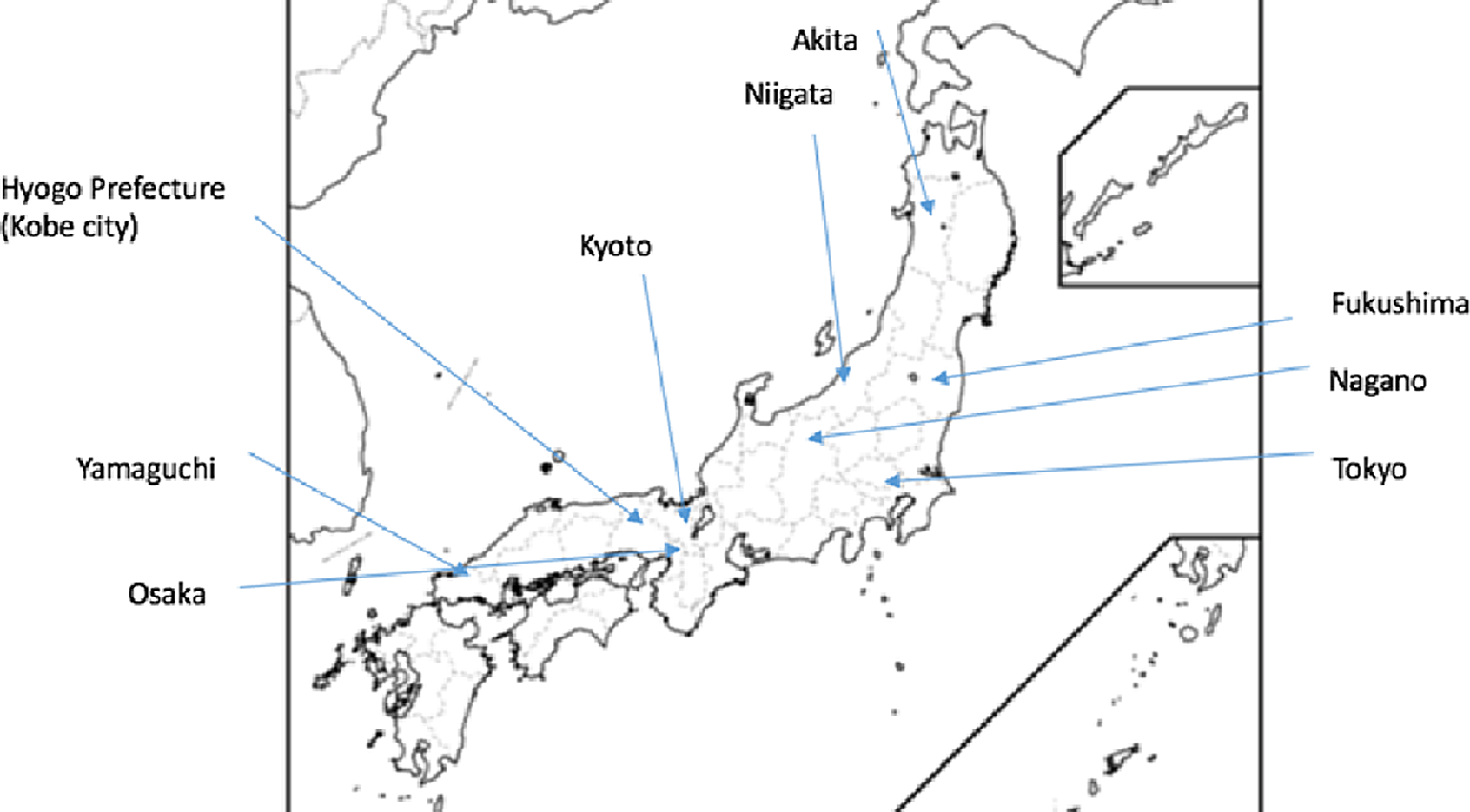
Most of the biggest brewers operate from the Nada area of Kobe or the Fushimi area of Kyoto (see Figure 1). Now a center of 1.5 million and the capital of Hyogo prefecture, Kobe also serves as port to the massive city of Osaka to its east. Nada lies along the eastern coast of Kobe, where the brewers enjoy access to an unusually clear stream of underground water. They traditionally bought their rice inland, brewed it with the local water, and—even during the Tokugawa period—shipped the sake to ports as far away as the Edo (now Tokyo) capital (Ninomiya Reference Ninomiya2012, 51–53).

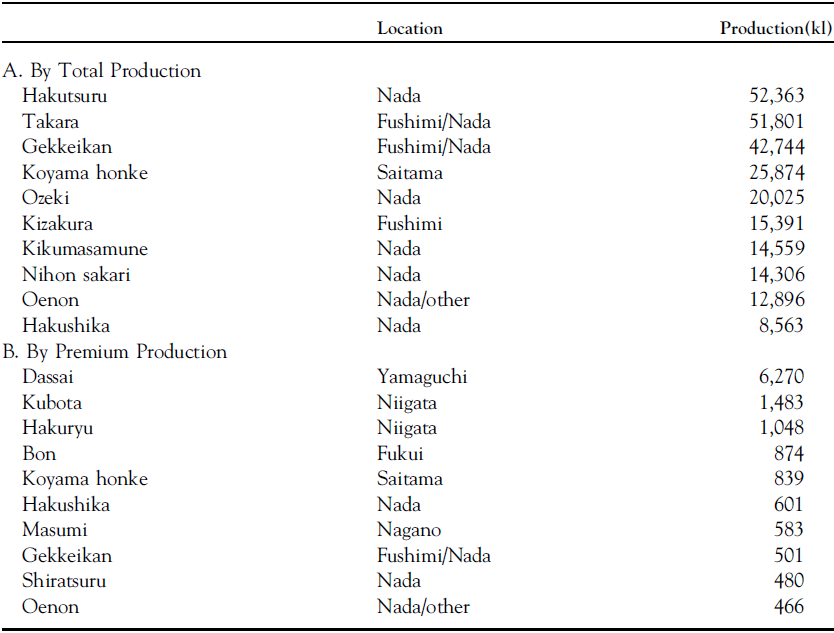
Nada and Fushimi remain the base for the very largest producers. In Table 1, I give the market shares of the ten largest modern firms. Of these ten, only Koyama Honke does not operate from either Nada or Fushimi.
Largest Breweries, 2018

Note: Premium—Junmai ginjo
Sources: Yoshio Ono, ”Shuzogyo keieisha no henkaku kodo [Transformation of Brewery Managers].” Shiga daigaku keizaigakubu kenkyu nenpo 26 (Reference Ono2019): 13–38; ”Shuin naki fushin ni ochiitta seishu shijo [The Sake Market That Is Thrown into Instability without Reason].” Shurui shokuhin tokei geppo, February 2019.
The Rice
Japanese farmers grow about 8.6 million tons of rice a year (Norin suisan sho n.d.). Most of this they grow as table rice, and for 35.9 percent of the table rice use the variety known as koshihikari. It is an enormously popular rice. Even the second and third most popular varieties are koshihikari derivatives. Farmers grow the largest amount of table rice in Niigata prefecture along the Japan Sea coast (K.K. Kaneko shoten 2016; Okome no chishiki 2016).
For their high-quality sake, brewers use more expensive rice varieties optimized for the drink. This sake rice is not a different species. Like the table rice, it still falls within the Japonica rice used in Japan, Korea, and China. But within Japonica, the varieties that farmers grow specifically for sake will not double for food. Sake rice simply is not a grain that consumers would choose to eat (Suzuki and Takada Reference Suzuki and Osamu2017, 140).
For their very best sake, brewers use only this sake-optimized rice. Difficult to raise and producing a smaller yield, sake rice costs substantially more than table rice. Because of this cost, brewers sometimes skip the sake rice entirely for their cheapest sake. Given that the taste of the sake depends most critically on the first steps in the process, even brewers who use some sake rice may use it only for the initial starter (as koji mai) and culture (as shubo mai). They then add cheaper table rice for the rest of the process (as kake mai; this is 70 percent of the total) (Koike Reference Koike1995, 162; Maikoku kiko 2014, 12).
In 2018, Japanese farmers grew only 93,000 tons of sake rice. Sake rice has a relatively large kernel (which brewers need in order to remove the outer layers that muddy the taste). Sake rice will absorb the mold (koji) into the heart of the kernel more readily than table rice, and will often contain a large starchy (shimpaku) core. It will have low levels of fat and protein (Koike Reference Koike1995, 161; Kadono et al. Reference Kadono2011; Daiginjo jidai no ishizue 2014, 2; Saito Reference Saito2015, 2).
Yamada nishiki is the koshihikari of sake rice—indeed, 36.8 percent (34,059 tons) of all sake rice (Norin suisan sho 2018). It is particularly hard to grow. Developed in the 1930s, it is unusually susceptible to disease, and with a long stem is especially vulnerable to late season typhoons.
Yet where koshihikari grows well across most of the country, yamada nishiki thrives only in a few areas. By latitude, the main islands of the Japanese archipelago stretch roughly from San Diego to Portland. The northern island of Hokkaido contains enormous ski resorts; the southern island of Kyushu was once a semitropical tourist destination. The island chain is relentlessly mountainous, and the area near Nagano hosted the 1998 winter Olympics. Rain falls massively on the western side as the winds sweeping off Siberia pick up moisture over the Japan Sea and then drop it when they hit the mountains. The eastern side is drier. Given that the mountains are essentially volcanic, soil content varies widely.
Yamada nishiki grows best in Hyogo prefecture (not coincidentally, near the Nada brewers). It needs moderate temperatures—ruling out both the northeast and the south. It does best in valleys (ideally, positioned east to west), with good sun exposure, with a large temperature variation from day to night, with good drainage, and with a clay base (Takeyasu et al. Reference Takeyasu2018, 69). More than any other prefecture, Hyogo offers these conditions and in 2018 Hyogo farmers grew 58.5 percent of the yamada nishiki crop (Norin suisan sho 2018).
Outside of Hyogo, farmers grow other varieties of sake rice. At 21,000 tons (22.7 percent of the total), gohyakuman goku is the next most common sake rice. Farmers in Niigata prefecture produced 46.1 percent of the variety. Miyama nishiki (6,000 tons, 6.9 percent), of which Nagano farmers produced 61.0 percent, is third (Norin suisan sho 2018).
THE SAKE MARKET
Relative Decline
As the twenty-first century opened, Japanese were drinking less alcoholic beverages. In 1990, they had drunk 100.1 liters per adult capita per year.Footnote 3 By 2000, they drank only 95.5 liters, and by 2010 only 82.3. Middle-aged men and women drink more than younger men and women, but they also drink more than the elderly. As the Japanese population aged, the fraction in middle age declined, and with it fell per capita alcohol consumption (Kokuzeichio 2018b).
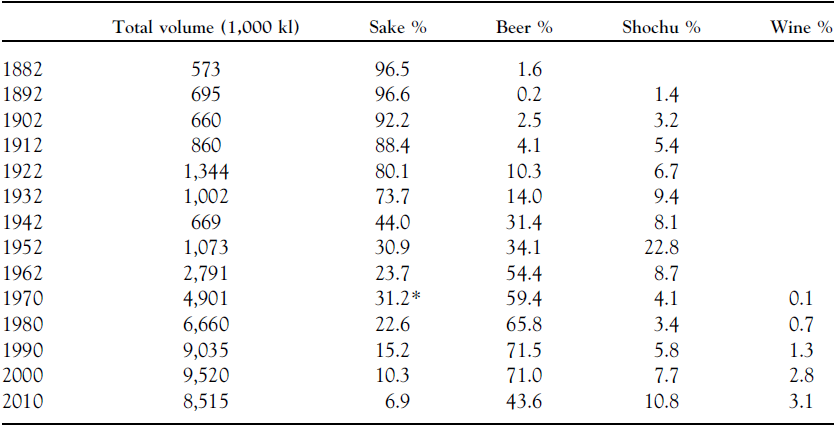
And sake accounted for less of what Japanese were drinking. For over a century, they had been steadily switching from sake to beer (Table 2). In 1902, they had drunk 92 percent of their alcohol as sake, and only 2 percent as beer. By 1952, they drank 31 percent as sake and 34 percent as beer. By 2000, they drank only 10 percent of their alcoholic beverages as sake and 71 percent as beer.Footnote 4 Some urban professionals were beginning to drink wine, and some were returning to the traditional drink of shochu (once a distilled rotgut for impoverished peasants and factory hands) as a mark of retro-cool. Having peaked in 1973 at 1.4 million kl, annual sake consumption fell by 2012 to 439,000 kl (Maikoku 2014, 2; Ono Reference Ono2019, 13).
Consumption of Alcoholic Beverages

*The total volume of sake consumed peaked in 1973.
Sources: Fujio Oana, “Shuzogyo no suii [Trends in the Brewing Industry].” Jokyo 65 (1970): 307–11; Kokuzeicho no “sake no shiori” … [The “Guide to Sake” from the National Tax Office …], Hatena blog, November 9, 2014. http://longlow.hatenablog.com/entry/20141109/p1.
The decline hit brewers everywhere. As noted earlier, across the country as a whole the number of brewers fell from 4,000 in 1958 to 1,378 in 2017. In Nada itself, the number fell from 67 breweries in 1973 to 29 firms in 2011. In 1973, those 67 had made 582,000 kl of sake. In 2011, the remaining 29 made only 163,000 kl (Nihon seisaku toshi ginko 2013).
Historical Context
Introduction
Tastes change. Over the course of the last 150 years, Japanese consumers have adopted Western dress. They listen to Western music. They watch Western movies. And they have learned to drink Western beverages.
But the story is not just one of drinking fashion. It is also a story about science and politics. It is a story that involves technological progress on the one hand, but military aggression and regulatory pressure on the other.
The Science
During the early Meiji decades, the most entrepreneurial brewers studied and incorporated modern science. Tokugawa brewers had not understood the chemistry of fermentation. They did not understand yeast, and did not add it. Instead, their rice fermented because of the yeast in the environment—because of the fungi that happened to live in the air and grew on brewery surfaces themselves.
Once brewers learned the biology of fermentation, they began to approach yeasts deliberately. Rather than rely on haphazard environmental cultures, they searched for yeasts that had produced successful drinks in the past. They cultured those yeasts and began to add them with care. In the process, they lowered the fraction of batches that failed and raised the quality of the sake they produced (Suzuki Reference Suzuki2015, 114).
Brewers also learned to accelerate the creation of the initial fermentation culture (the shubo). In the traditional process (called kimoto), brewers let the environmental yeast grow in the rice-mold mixture and turn the sugars into alcohol (Ozeki Reference Ozeki1996, 560). The yeast initially competed with other bacteria in the mixture. As the (naturally occurring) lactic acid bacteria steadily multiplied, however, they eventually killed the other bacteria and let the fermentation proceed. This process took about a month. By deliberately adding lactic acid at the outset, the brewers found that they could halve the time necessary to finish the culture (Ozeki Reference Ozeki1996, 560; Suzuki Reference Suzuki2015, 111–16).
In 1941, brewers also discovered that they could increase the amount of sake from a given quantity of rice by adding brewer’s alcohol (Suzuki Reference Suzuki2015, 167–68). Many (perhaps most) brewers still do. They note that the alcohol stabilizes the sake and helps to prevent spoilage. When critics complain, some producers protest that they are not adding a chemical from an antiseptic modern factory, but instead the traditional shochu distilled drink. They argue that the alcohol enhances the taste of the sake, and that pre-Meiji brewers had done something like this as well. All this may be true, but critics point out that the mid-twentieth-century brewers (working in interwar Manchuria, no less) did not add the alcohol for any of these reasons. They added it because rice was expensive, and adding alcohol cut the cost of production (Yamakata Reference Yamakata1977, 344–45).
Regulatory Constraints
Social tensions rose steadily during the interwar years, and the government responded by increasing control.Footnote 5 As they had since the late nineteenth century, peasants continued to abandon the farms and move to the cities. There, they crowded into newly created slums. Some rioted, and in 1918 they rioted over the price of rice. Within this environment, political entrepreneurs organized communist and anarchist cells.
As the Tokyo government worried about the leftist cells, the army expanded its territory over the continent. It evaded efforts by Tokyo politicians to control it. It created a massive colony in Manchuria. And by the late 1930s, it had dragged the country into a war it could not win.
The government responded to the fiscal strains by adopting increasingly stringent controls over an ever wider swath of the economy. Central to this program, it began to control the market for rice. As it moved the country increasingly to a war footing, it relentlessly intensified this control (Ito Reference Ito1981; Furuichi Reference Furuichi1996; Ozeki Reference Ozeki1996, 426; Ninomiya Reference Ninomiya2015, 470).
The Allied (effectively American) occupation government continued much of the prewar control structure. Although Shigeru Yoshida dismantled the bulk of the program when he replaced socialist Tetsu Katayama as prime minister in 1948, he retained many of the controls over rice. During the next two decades, the government allocated rice among the brewers by quota. It had begun the quotas in 1938, but continued them after the war. A brewer could use the rice allocated to him or her, but (unless he or she bought another brewer’s quota) could acquire no more (Nishinomiya shuzo Reference Nishinomiya shuzo1989, 226–27, 263; Suzuki Reference Suzuki2015, 147–55, 164–82; Ono Reference Ono2019, 22; Shibuya Reference Shibuya and Shibuya2020, 89).
The Nada-Fushimi Response
Deregulation would eventually come, but only after sake brewers (in response to the regulation) had so badly depreciated sake quality as to alienate most of their sophisticated potential customers. It was not until 1969 and 1974 that the government finally dismantled the regulatory strictures on the sake and rice markets (Ito Reference Ito1981; Ozeki Reference Ozeki1996, 425–26; Ninomiya Reference Ninomiya2015, 492; Suzuki Reference Suzuki2015, 199; Sando Reference Sando2018, 2019; Ono Reference Ono2019, 22, 25). Over the four preceding decades, brewers had learned to weather regulatorily created rice shortages. Now they needed to survive in a competitive market. To that goal, they would find their learned strategies badly mismatched.
The brewers had focused almost entirely on making sake as cheaply as possible. In 1922, a chemist had developed a synthetic sake that used very little (if any) rice (Ishiguro Reference Ishiguro2015a; Ninomiya Reference Ninomiya2015, 472; Ono Reference Ono2019, 23). With this technology, brewers had developed what would become the infamous “treble sake.” Although they started with rice, mold, and water, they added a variety of other ingredients that let them triple the amount of drink they could produce from a given quantity of rice (Yamakata Reference Yamakata1977, 344; Ishiguro Reference Ishiguro2015a; Ninomiya Reference Ninomiya2015, 472, 482; Ono Reference Ono2019, 23).
Synthetic sake remains on the market, and is often used for cooking. The treble-sake drink it spawned constituted a large part of the market in the 1950s and only disappeared in 2006. It had been the very worst sake. By 2006 too few people wanted to drink it to warrant production anymore (Nishinomiya shuzo Reference Nishinomiya shuzo1989, 264–65; Ishiguro Reference Ishiguro2015b, Reference Ishiguro2015c).
In this desultory market, the Nada and Fushimi brewers did have name recognition. When during the 1950s and 60s they lacked high-enough rice quotas to meet the market demand, they simply filled the resulting shortage by buying additional sake. They bought it from less well-known regional brewers in bulk and resold it under their own names (Ono Reference Ono2019, 24). They did not buy this bulk sake from brewers with whom they maintained long-term relations. Instead, they merely bought the available sake on the spot market: One brewery needed more sake; another had more than it could sell. In 1975, the Nada giant Hakutsuru brewed 109,000 koku (1 koku = 180 l) of sake; it sold 404,000 (Yamakata Reference Yamakata1977, 390; Ninomiya Reference Ninomiya2015, 488).
Note the obvious implication of these bulk sales: By midcentury, cheap sake was everywhere the same. By deliberately controlling the chemical transformations involved—standardizing yeast quality, introducing lactic acid, adding alcohol, and scientifically controlling quantities and timing—brewers had eliminated nearly all random variation. In the course of shifting to mechanized and sanitized processes, they had cut most of the variation not only within their own output, but from brewer to brewer as well (Ninomiya Reference Ninomiya2015, 473, 490).
Although the government deregulated much of the rice and sake markets in the early 1970s, the Nada-Fushimi brewers continued to position their sake as a low-cost mass-market beverage. They focused first on price. Japan had not been rich in 1960, and they had positioned their drink as a low-cost beverage for ordinary Japanese. By the 1970s, Japanese were no longer poor, but the mass-market brewers continued to make the same drink.
In fact, the Nada-Fushimi brewers kept this strategy through the end of the century. The number two Gekkeikan firmly controlled a solid presence as the Budweiser of Japanese sake: ubiquitous, cheap, and defiantly working class (see generally Kawaguchi and Fujimoto Reference Kawaguchi and Masayo2007). The number four Ozeki found its own niche for cheap sake in a one-drink-quantity bottle that it distributed the country over: “One Cup Ozeki,” they called it. In 1965, One Cup was 0.9 percent of Ozeki output. In 1967, Ozeki loaded the One Cup into vending machines, and by 1991, it constituted 34.0 percent of Ozeki output (Ozeki Reference Ozeki1996, 334–35).
Consistent with this mass-market strategy, in the 1970s the Nada makers began to sell sake in paper cartons like those used for milk. The cartons save money, fit in refrigerators—and look aggressively antigourmet. Ozeki introduced its first paper-carton sake in 1976. By 1983, carton sake constituted 18.7 percent of its output (Ozeki Reference Ozeki1996, 368). Gekkeikan introduced paper cartons in 1980 (Gekkeikan Reference Hart and John1987, 178). By 2000, paper-carton sake was about 40 percent of all sake volume; by 2016, it constituted more than half (Osake Sutatisutikkusu n.d.).
CRAFT BREWERIES
Introduction
As Japanese grew wealthier, many consumers developed a taste for premium alcoholic drinks. Tariffs came down (Ishiguro Reference Ishiguro2015c), and good scotch and cognac offered a complexity lost in most other distilled drinks. French and Napa wines presented subtleties that the Nada-Fushimi brewers had long since erased from sake.
In the competition for mass-market alcohol, the regional sake brewers could not win. The contest rewarded investments in the large-scale equipment that generated economies of scale. The Nada-Fushimi brewers brewed a drink that differed little from maker to maker, and competed mostly by price. Unable to beat that price, the local brewers steadily disappeared.
It was within this rapidly deteriorating market that a few local brewers gambled on premium sake. They gambled big.
The Premium Niche
The Formula
To shift their product upmarket, brewers focused first on three elements. They stopped adding brewers’ alcohol. They removed more of the kernel’s coarse-tasting outer layers. And they used costly sake rice varieties for a larger fraction of their rice.
Junmai
Pivotal to the rediscovery (or perhaps invention) of premium sake was the concept of junmai (meaning “pure rice”). By midcentury, Japanese brewers had learned to cut costs by adding brewers’ alcohol to their sake. In doing so, they could use less rice and routinize, stabilize, and mechanize large-scale production.
Local brewers offered a return to a conceptually simpler but practically more difficult drink: sake made only with rice, mold, water, and yeast. This was a costlier process. It required nearly twice as much rice and (if the brewers are to be believed) more patience, subtlety, and expertise. They were rediscovering the classical sake-brewing tradition. In truth, they brewed a sake that was almost certainly much better than anything in the nineteenth century. But never mind. They were returning sake to the premechanized, pre-adulterated pristine past (Ishiguro Reference Ishiguro2015b; Shibuya Reference Shibuya and Shibuya2020, 83; Tamanohikari n.d.).
A midsized Fushimi brewer named Tamanohikari had made the first of the postwar junmai in 1964 (Ishiguro Reference Ishiguro2015b). It continues to proclaim that fact boldly on its company Web site. Steadily after the 1980s, local brewers began to focus on junmai sake. Many jettisoned their mass-market lines and started producing only junmai (Sando Reference Sando2018; Akita no shinsei shuzo 2019; Tamanohikari n.d.).
Ginjo
Local breweries also began to focus production on their ginjo and daiginjo offerings. To make sake, brewers do not directly steam the rice kernels. Instead, they first mill (grind) the rice to remove the germ and some of the outer layers. Those layers contain material that introduce unwanted flavors into sake. Mill the rice first, and the drink will present a cleaner taste. It will also cost more to produce.
To make ordinary sake, a brewer might grind off as little as 10 to 20 percent of the kernel. To make ginjo sake he (or she—most are men) will remove 40 percent, and to make daiginjo (meaning “great ginjo”) he will remove 50 percent. He will also need to ferment the rice at a lower temperature and at a slower pace. The process is obviously more expensive. A sake that is both junmai (no alcohol added) and daiginjo (50 percent removed) will require six times as much rice as an ordinary sake (Suzuki Reference Suzuki2015, 52–53; Shibuya Reference Shibuya and Shibuya2020, 83; Kokuzeicho n.d.).
The ginjo (and daiginjo) sakes offer a cleaner taste than ordinary sake. Fans describe them as crisp, delicate, aristocratic, and clear. Note that the ginjo technique is relatively new. Several Hiroshima breweries produced the earliest versions of ginjo near the beginning of the twentieth century. A midsized Fushimi brewer, Tsuki no katsura, produced the first daiginjo in 1966 (Ishiguro Reference Ishiguro2015b; Suzuki Reference Suzuki2015, 89, 160–61; Ono Reference Ono2019, 26).
Rice Variety
The regional brewers also began to focus heavily on premium rice varieties. Recall that brewers add rice at three stages. They mix a small amount with the mold (koji mai), add a larger amount when they introduce yeast and start fermentation (shubo mai), and then add the majority in later stages (kake mai). For mass-market sake, brewers might use table rice for all three processes. Those selling into the middle tier might use table rice for the third stage, but sake rice for the first two (Saito Reference Saito2015, 1).
Brewers selling into the premium market sometimes use only sake rice for the entire process. Recall that the sake rice varieties tend to grow only in limited areas, and that the yamada nishiki grows primarily in Hyogo. Some regional growers simply import Hyogo yamada nishiki for their sake. Others mix local sake rice varieties with imported yamada nishiki. And still others—the terroir breweries described below—will focus primarily or exclusively on distinctive local varieties.
The Dassai Success
Asahi Shuzo’s Dassai brand embodies the premium local sake boom. As a success story, it has also inspired beleaguered small breweries the country over. The Asahi sake brewery (unrelated to the company that makes Asahi beer) had been founded in 1948 in Yamaguchi prefecture in southwestern Japan. As sake consumption fell, it found itself in dire straits. Total sales had plummeted to 97 million yen (at the approximate conversation rate of 100 yen per dollar, $970,000).
In 1984, Hiroshi Sakurai took over as third-generation head of the family firm. He was thirty-four, the firm was failing, and he gambled big. The firm had been making ordinary sake. He jettisoned the line, and over the next several years would develop a clear firm policy: He would make only junmai, he would make only daiginjo, and he would use only yamada nishiki. Not only would he only make daiginjo, he made history in 1992 when he introduced a daiginjo milled down to the last 23 percent.
As of 2005, Dassai still sold only 216 kl in the year. By 2010 sales had trebled to 776 kl, by 2013 to 2,052 kl, and by 2018 to 6,270 kl. Some of its bottles now sell for close to 40,000 yen (about $400). By 2018, it was far and away the largest maker of premium sake (Table 1) (“Dassai” 2013; Nihon 2018; Yamaguchi san no Nihonshu 2018).
At about the time that the third-generation Sakurai arrived at Dassai, the brewers trade association for Niigata prefecture made roughly the same collective gamble. Faced with the secular decline in sake consumption and the scale economies in Nada and Fushimi, the Niigata brewers together decided to move upmarket (Ono Reference Ono2019, 25). With a source for water with very low mineral content and the local gohyakuman goku sake rice, they have cultivated a distinctive Niigata taste, which they describe as tanrei karakuchi—light and dry. Largely, they have succeeded. After Dassai, the two breweries producing the most premium sake are both Niigata firms (Table 1), and by total volume Niigata ranks third after Hyogo and Kyoto.
Akita prefecture hosts an unusually large number of very high-end breweries as well. Like Niigata, Akita provides low-mineral water, and distinctive local sake rice varieties: Akita sake komachi and miyama nishiki. When the Sake Time gourmet news ranked the top twenty bottles in 2020, five were from Akita (Zenkoku no Nihon shu rankingu 2020). Three each were from Nagano and Fukushima, and none were from either Hyogo or Kyoto.
The Industry Transformation
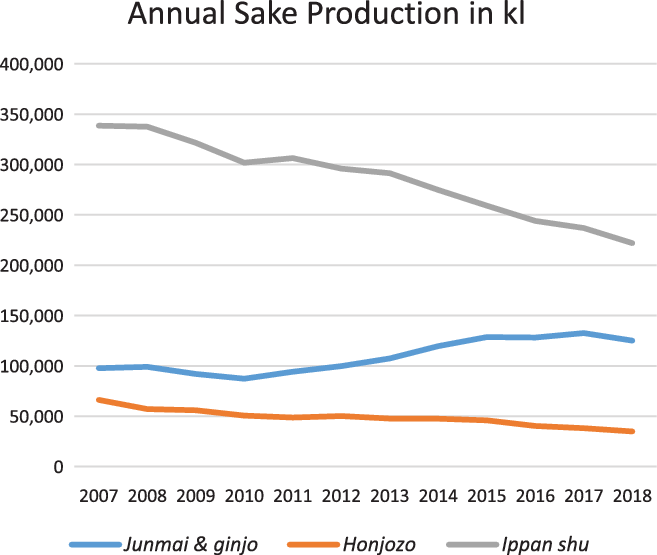
Steadily, one-time local breweries like Dassai have begun to transform the sake industry. Overall, Japanese continue to drink less alcohol (Table 2). They also continue to drink less mass-market sake (Figure 2). From 2007 to 2018, annual sales of ordinary sake fell from 339,000 kl to 222,000 kl. Those of the intermediate category honjozo (described in the subsection on certification, below) fell from 67,000 kl to 35,000 kl.
Annual Sake Production in kl.
Source: Kokuzeicho, Shuzo nendo ni okeru seishu no seizo jokyo to ni tsuite [Regarding the Production Circumstances, Etc., of the Brewing of Sake], various years.

Over the same period, however, premium junmai and ginjo sales rose from 98,000 kl to 125,000 kl. This is growth that the regional breweries have driven. By total 2018 production, nine of the top ten breweries were in either Nada or Fushimi (Table 1). Yet of the top producers of junmai ginjo sake, only four of the top ten were from Nada or Fushimi, and none of the top five were.Footnote 6
During the war-impoverished and heavily regulated midcentury, Nada-Fushimi breweries had cultivated a competitive advantage in low-cost production. Exploiting their economies of scale, they had focused on the mass-market sector. Hyogo producers still brew 85 percent of their sake as general (futsu or ippan) sake (2014 numbers). The Kyoto producers brew 90 percent as general. By contrast, in Dassai’s Yamaguchi prefecture producers brew barely 21 percent of their sake as general (Yamagata ken kogyo gijutsu sentaa 2015; see generally Shibuya Reference Shibuya and Shibuya2020, 86).
The regional brewers have deliberately crafted a new image. For decades, sake was a drink that middle-aged men (especially working-class men) drank in dirty bars on their way home from work. They drank it heated in small ceramic cups. By contrast, the regional brewers have nurtured an image of sake drunk by urbane thirty- and forty-something gourmets. They drink it cold, in long-stemmed wine glasses (Ono Reference Ono2019, 13).
The regional brewers present sake as a distinctively Japanese drink, but one to be savored by these successful young professionals. On its Web site, Niigata brewer Kikusui describes sake as a drink for all seasons. There is a sake to drink when relaxing with friends at a restaurant. There is a sake for men to drink while flirting with a waitress. And there is a sake for women to drink while recalling their first crush, continues Kikusui, while commiserating with each other over the sadnesses that only women can know, or while (alluding to a well-known passage in the Tale of Genji) trashing the actual men in their lives (Kunifuda Reference Kunifudan.d.).
Extensions
Encouraged by the success of Dassai and its hundreds of competitors, entrepreneurial sake brewers experiment with a wide range of new approaches. Recall that since the Meiji period brewers have added lactic acid to eliminate competing bacteria and accelerate fermentation. Some regional brewers have returned to the earlier fermentation process (kimoto) and use no lactic acid at all (Sando Reference Sando2018; Akita no shinsei shuzo 2019).
Some brewers experiment with other long-discarded techniques. One Akita brewer abandoned stainless steel containers for the earlier wooden vats. The vats require more work in terms of cleaning and repairing, but they “bring a deeper taste to the sake,” claims the brewer. Another brewer turned to the panoply of other wooden hand tools that brewers had discarded. Another abandoned added yeast and relies on the wild yeasts living in the brewery. Yet others—like the Watanabe brewery in the Nechi valley—are introducing the concept of vintages (Bumu 2015; Saito and Yamada Reference Saito and Toshiaki2017, 18; Akita no shinsei shuzo 2019).
Some brewers have revived discontinued local rice varieties. Despite the dominance of yamada nishiki, gohyakuman goku, and miyama nishiki, in 2019 farmers grew 119 different varieties of sake rice. Many are new, experimental varieties. Others are varieties farmers discarded long ago as sake production centralized in Nada-Fushimi and brewers converged on homogeneous tastes (Norin 2018; Zenkoku kinsho mezasu 2019).
And still other brewers cater to the distinctly modern demand for “organic” and “sustainable” products. A wide variety of regional brewers include sake made from low- or no-pesticide and low- or no-chemical-fertilizer rice. Kikusui advertises itself as “an environmentally friendly business” that donates a share of its revenue to the World Wildlife Fund (Kobayashi Reference Kobayashi2004). The Izumibashi brewery in Kanagawa promotes its “sustainable” production techniques (Kobayashi Reference Kobayashi2004; Sando Reference Sando2019; Miyajima Reference Miyajiman.d.).
Certification
In 1990, the government introduced a standard certification regime for the terms junmai, ginjo, and daiginjo. It had graded sake by a different metric for much of the midcentury, though nominally by quality. It had also taxed the brewers according to those quality grades, however, so brewers began to manipulate the grades to lower their tax bill. By the end the twentieth century the earlier grades had ceased to reflect quality, and the government repealed the system (Iga Reference Iga2008, 152; Ishiguro Reference Ishiguro2015c; Ono Reference Ono2019, 22).Footnote 7
Under the new 1990 certification regime, the tax office defined several of the new premium categories.Footnote 8 The rules have changed modestly over the years, but as of 2020:
Junmai: sake with only rice and rice-based mold (koji).
Ginjo: sake in which each kernel is milled to 60 percent or less of its initial size, and in which any brewers’ alcohol constitutes less than 10 percent of the weight of the rice.
Daiginjo: sake in which each kernel is milled to 50 percent or less of its initial size, and in which any brewers’ alcohol constitutes less than 10 percent of the weight of the rice.
Honjozo: sake in which each kernel has been milled to 70 percent or less of its initial size, and any brewers’ alcohol constitutes less than 10 percent of the weight of the rice.
Junmai offers classic nineteenth-century-style sake. Brewers use it to showcase their distinctive flavors. Ginjo and daiginjo offer smooth, clear tastes. Because differences attributable to soil, weather, fertilizers, and rice variety tend to concentrate in the outer layers, however, ginjo and daiginjo offer less variation across breweries. A ginjo with no added alcohol would be called a junmai ginjo. Honjozo represents a sake intermediate both in quality and in price between the other certified sakes and ordinary uncertified sake (futsu or ippan shu).
THE INVENTION OF TERROIR
The Competitive Logic
The local breweries had sparked a renaissance in sake. By cultivating a taste for quality, they had created a market where none had existed before. The Nada-Fushimi brewers had responded to the wartime regulatory regime by using technology to lower cost and generate consistent products, but ignored the potential market for premium sake. The smaller local breweries now exploited the resulting opportunity and succeeded.
Unfortunately for the local breweries, the Nada-Fushimi breweries can compete in the market for ginjo and daiginjo if they choose. They will need better rice. They will need to shift production technique. They will need expertise. But they already have sophisticated equipment. They have capital. And if they lack the requisite experience and technique, they can hire it.
They can, and they have. All of the top mass-market producers (see Table 1) have premium products. Ozeki still stocks its One Cup Ozeki in vending machines, but it also offers an award-winning junmai daiginjo at 5,118 yen. Hakutsuru sells a 200 ml can of ordinary sake for 218 yen, but also offers an award-winning junmai daiginjo for over 10,000 yen. Gekkeikan sells its perennial working-class drink, but produces an award-winning junmai daiginjo besides. Takara offers enough varieties in cardboard cartons to fill a refrigerator, but sells a junmai daiginjo to boot.
What is more, a local brewery looking to move upscale will worry about more than Nada-Fushimi. It will face direct competition from Dassai and the Niigata-Nagano-Akita-Fukushima breweries that already dominate the “best sake” rankings. These breweries are local in name only. For the young Matsuo president in Shinano village, his competitors include the many premium breweries striving to replicate the Dassai success.
Crucially, the more successful two daiginjo rivals might be, the closer they will taste. Rice does indeed acquire flavors that reflect the mineral content of the water, the character of the soil, and the weather. But these differences are located almost entirely in a kernel’s outer layers. Grind off 40 to 50 percent of the kernel, and rice loses most of that distinctiveness (Sugihara Reference Sugihara2012; Ninomiya Reference Ninomiya2014, 469–70; Bumu 2015; Miyajima Reference Miyajiman.d.). All too often, as one brewer cruelly put it, ginjo will be to sake what the “valedictorian” was to the high school class—never wrong, but never interesting either (Miyajima Reference Miyajiman.d.).
Hence the appeal of “terroir.” If the Matsuo president in Shinano village and his peers around the country can convince consumers to distinguish and enjoy regional variation, they can create a niche that the other breweries cannot readily fill. Perhaps small Niigata breweries like Watanabe can fashion a taste that reflects the windswept Nechi valley, the brutally cold winters, and the massive snowstorms. Perhaps Matsuo can fashion a taste distinctive to the Arasebara hamlet (population 219) on the foothills of Mt. Madarao. To be sure, even connoisseurs of the best French and Napa wines roll their eyes at some terroir claims; many sake fans retain a similar suspicion too. As one reader of an earlier draft put it, mostly this shows that people have too much money.
But what the Matsuo and Watanabe presidents and their allies hope to create is an appreciation for a wide variety of very different, but each appealing sakes. In New York, a connoisseur might choose a white wine one night, a red another. Among the reds, he might choose a pinot noir one night, a cabernet sauvignon another. Among the pinot noir, he might choose a Cote de Nuits one night, a Givry another. If the Matsuo and Watanabe presidents and their allies have their way, the sake industry will offer connoisseurs choices just as rich.
Certification Problems
Give him half a chance, however, and President Takahashi will complain about his certification problems. He (and others championing terroir sake) (see, for example, Nihonshu 2019; Shibuya Reference Shibuya and Shibuya2020, 94; Miyajima Reference Miyajiman.d.) would like to adopt something close to the French appellation d’origine controlee (AOC). Under AOC, a winery can advertise its offerings as coming from a given district—a system in which, as Orley Ashenfelter (Reference Ashenfelter2007, 2) put it, the “best wines of Bordeaux are made from grapes (typically cabernet sauvignon and merlot) grown on specific plots of land and the wine is named after the property, or chateau, where the grapes are grown.” Under AOC, the size of the certified district can vary, depending on how selective the winery chooses to be. A winery can market its product as a Bordeaux wine, as a Haut-Medoc (within Bordeaux), or as a Pauliac (within Haut-Medoc). Some Nagano breweries sell distinctively Nagano sake. Matsuo offers a sake distinctive to Arasebara.
In fact, Takahashi would like to go further, and certify rice variety as well. The French chateaux blend wines, but the AOC rules specify the grapes they can blend (for example, Ashenfelter and Storchman Reference Ashenfelter and Karl2016, 39–40). Premium California wineries usually specify the grape. For his nonterroir sake at the Matsuo brewery, Takahashi sometimes uses yamada nishiki from areas outside Nagano. But for his local sakes, he uses several different varieties. For some, he uses miyama nishiki, the standard Nagano premium sake rice. For others, he celebrates the more recent local alternative, sankei nishiki.
In 2015, the Ministry of Agriculture, Forestry and Fisheries (MAFF) bureau for northeastern Japan launched the “Tohoku Sake Terroir Project” (it too uses the French word). The surviving local breweries in the region were trying to move into premium sake, much like the Niigata breweries had done four decades earlier. The bureau hoped to facilitate their shift by encouraging a distinctively northeastern taste. The MAFF bureau sponsored a study group. It met several times. It assembled a roster of eighty breweries that hoped to market sake with the new designation. Largely, however, it seems to have gone inactive (Matsuo Reference Matsuo2017, 42; Tohoku n.d.).
In any case, for breweries like Matsuo the project did not go far enough. To qualify under the project, a brewery had to use local water, use at least 50 percent local (prefectural, or at least northeastern) rice, and communicate directly with its supplying farmers (Tohoku n.d.). For advocates of a narrower terroir approach, this was far too broad. The project proposed certifying the sake’s prefecture. Yet Nagano has a population of 380,000, more than the entire Bordeaux area (population 250,000). In effect, the project would preclude all of the finer AOC partitions.
When Japan joined the World Trade Organization, it adopted a completely separate, national program for geographical certification (Kokuzeicho 2020a). As of mid-2020, it had haphazardly approved four sake designations under the program. In 2005, it had certified the sake from the town of Hakusan on the Japan sea coast: Local breweries could use the designation if they used local water and only Japanese rice (i.e., rice from anywhere in Japan) of grade 1. In 2016, they certified sake from the prefecture of Yamagata: Prefectural breweries could use the designation if they used local water and—again—Japanese rice. In 2020, they certified a much more finely partitioned designation for the Harima area of Hyogo: Harima breweries could use the designation if they used local water and yamada nishiki rice from Hyogo prefecture.
Alas for terroir brewers like Matsuo, the government saved its ultimate insult for 2018. That year, under its World Trade Organization geographical certification, it designated “Nada Gogo.” To advertise the certification, the Nada firms had to use local water. They had to use Japanese rice (again, from anywhere in Japan). And that rice had to be of at least grade 3 (rarely does anyone designate sake rice below grade 3).
Takahashi and his fellow terroir brewers have not constructed (either publicly through the government, or privately among each other) a certification program—yet. But this does not mean too much. They want a program. And they have only begun to try.
CONTRACTING FOR TERROIR
Introduction
For terroir offerings, breweries cannot obtain rice through the usual routes. For high-quality sake more generally, some breweries specify desired rice variety and quality grade, and buy it anonymously through intermediaries. For terroir sake, breweries cannot do this. They will need to contact local farmers and negotiate the transaction directly. In the process, they will encounter contracting problems common to buyers more generally—whether Midwestern heavy industry manufacturers, Japanese car companies, or Silicon Valley tech firms.
The brewers and farmers rarely draft elaborate contracts with verifiable terms; they seldom vertically integrate. Instead, they deliberately maintain extensive social networks. Within these networks, they combine short-term renewable (and hence terminable) contracts, efficiency-wage level prices, close monitoring, and free intervention. In the process, they give the brewer close control over the farming process.
The JA Cooperative Network
Most firms buy their sake rice through their local agricultural cooperative. More precisely, in recent decades sake brewers have been buying about 70 percent of their sake rice through their prefectural sake brewers’ association and the JA, the national network of Japanese agricultural cooperatives (Saito Reference Saito2015, 3; Suzuki and Takada Reference Suzuki and Osamu2017; Hirogaru sakamai seisan (ka) 2018; Keiyaku saibai de hinshitsu kojo 2018; Nihon okome kyokai 2018).
Under this arrangement, each year the brewers’ association solicits rice orders from its members for the season two years hence. It places the orders with the agricultural cooperative. The cooperatives then distribute the orders among their membership (Koike Reference Koike1995, 163; Maikoku kiko 2014, 13; Hayashi Reference Hayashi2017, 55).
The brewers will use this sake rice mostly for their initial steps. Recall that they add rice in three broad steps: They mix a small amount of rice with the mold (the koji mai); they add more rice with the yeast (the shubo mai); and after the fermentation has progressed they add the rest of the rice (the kake mai). Many (if not most) brewers use table rice for the third, high-volume step. They use this costlier sake rice primarily for the first two steps.
Muramai
Classic
In their official histories, the Nada-Fushimi firms recount the way they had insured a supply of high-quality rice before war. They had contracted directly with Hyogo farming villages, they write. Their problems had begun in 1874. That year, according to these standard industry accounts, the government started collecting taxes in cash. The Tokugawa domains had collected their taxes in rice, and in Hyogo had carefully inspected the rice submitted. They had rejected low-quality rice and imposed penalties on those who had submitted it. Once the government adopted a cash tax, however, farmers switched to low-quality rice that they could easily market. Why the farmers would not be able to sell high-quality rice at high prices the standard histories do not say. They report only that the brewers found themselves without the high-quality rice that they needed for their sake (see Hyogo 1961, 99–102; Daiginjo jidai no ishizue 2014, 4; Ninomiya Reference Ninomiya2014, 471–72).
Somewhere around the turn of the century, Nada firms began contracting for high-quality rice from selected Hyogo hamlets. Muramai, they called the arrangements: “village rice.” Some writers place the first muramai contract in the early 1890s with the Kamikume hamlet in Yoneda village. Others name the nearby hamlet of Ichinose in Yokawa village (see Hyogo 1961, 100; Ozeki Reference Ozeki1996, 432; Saito Reference Saito2015, 8; Sakamai n.d.).
By the early twentieth century, the major Nada-Fushimi breweries were buying large portions of their sake rice from a portfolio of hamlets. The details of the arrangements varied, but usually the brewery agreed to buy a hamlet’s entire crop. In return, the villagers promised to work to improve rice quality. The firms obtained a steady supply of quality rice. The villages obtained a reliable outlet at a good price (see Hyogo 1961, 98–104; Mori Reference Mori1983, 126l; Ninomiya Reference Ninomiya2013, 311; Daiginjo jidai no ishizue 2014, 3; Ninomiya Reference Ninomiya2014, 471–72; Mori Reference Mori1983, 124; Toku A chiiki shitei no yurai Reference Tokun.d.).
The parties waited to decide the price of the rice until November or December, after its delivery. At that point, a hamlet representative, the brewer, and the rice broker (if one were involved) met to negotiate the price. Usually, they adopted a standard discount (or more rarely a premium) from the muramai contract price for the original Kamikume hamlet. Despite the obvious possibility of corruption, the other brewers and hamlets apparently took this price as an honest reference point.Footnote 9
The Kamikume price similarly followed negotiations among a hamlet representative, the brewer, and a rice broker. Given its larger significance, however, the negotiations could take time. Generally, the parties looked to such factors as the previous year’s price, to general economic circumstances, to fluctuations in the spot market price for rice, and to the annual yield. Reflecting their higher quality, muramai rice tended to sell for a premium over other sake rice (see Hyogo 1961, 99–109; Mori Reference Mori1983, 126; Nishinomiya shuzo Reference Nishinomiya shuzo1989, 197; Ninomiya Reference Ninomiya2014, 472–73).
Crucially, brewers and hamlets did not always renew the muramai contracts. Instead, villages maintained their contracts only if they worked collectively and steadily to improve the quality of the rice they supplied. Those that did not sometimes found their contracts terminated (see Hyogo 1961, 98–105; Nishinomiya shuzo Reference Nishinomiya shuzo1989, 197; Ozeki Reference Ozeki1996, 432; Ninomiya Reference Ninomiya2014, 471–72; Toku A chiiki shitei no yurai Reference Tokun.d.).
Modern
Some Nada-Fushimi brewers again maintain contracts with Hyogo hamlets, but these are not continuations of the earlier contracts. After the rice riots of 1918, the Japanese government had begun ever more intrusively to regulate the market for rice. As the country drifted into war during the 1930s, the army increased its control over the economy. During the earliest years of these rice-market controls, the Nada breweries had negotiated exceptions for their muramai contracts (Ninomiya Reference Ninomiya2014, 475–76).
Yet the regulatory exceptions for the Hyogo muramai contracts did not survive the war. Given that the government retained many of its earlier rice-market controls after the war, neither did they reappear during the early postwar years. Only in the 1970s did firms reacquire their ability to negotiate their own supply contracts. By then, however, the Nada firms no longer produced much high-quality sake.
Nevertheless, some of the Nada producers did begin to negotiate muramai contracts again. By the 1970s, some of the firms wanted yamada nishiki for their best offerings, and the hamlets that had provided sake rice before the war now grew some of the best of the yamada nishiki. As of 1981, the ten largest Nada brewers obtained their yamada nishiki through muramai contracts with 326 hamlets (Mori Reference Mori1983, 126).
These new muramai contracts were not simple continuations of the old. Hyogo in 1980 was not the Hyogo of 1930. Within Yokawa village, thirty-eight groups of farmers now sell to brewers. They include classic hamlets that produced the best sake rice before the war (Saito Reference Saito2015, 9). But other villages that had maintained muramai contracts prewar no longer do, while hamlets without prewar muramai antecedents now do negotiate them (Koike Reference Koike1995, 166; Nihonshu no korekara 2017). The late-nineteenth-century brewers and farmers negotiated the contracts that enabled the brewers to obtain the rice they needed for premium sake. By midcentury, regulatory restrictions killed the market for that premium sake. As the regulatory restrictions disappeared, the brewers began slowly to recreate premium offerings. To obtain the rice they needed for this sake, they began to contract directly with farmers. As they did, they turned to contracts much like the contracts they had used decades before.
Direct Contracts
Introduction
Should brewers want to make sake that reflects the weather and soil of their area, they will need to approach farmers themselves. If President Takahashi of the Matsuo brewery wants to make a sake that reflects the Arasebara paddies on the foothill of Mt. Madarao, he will need to contact the Arasebara farmers himself.
Increasingly, premium regional sake brewers are doing exactly that. Over the course of the past decades, brewers had been procuring about 70 percent of their sake rice through the agricultural cooperatives. In 2010, they bought 73.8 percent of their sake rice through the coop. By 2015, they bought only 58.3 percent. In 2011, Akita prefecture brewers directly contracted for 167 ha of sake rice. By 2014, they had 292 ha under contract.Footnote 10
Consider first the nature and structure of the contracts that the brewers use, and then how and when they intervene in the farming itself.
The Nature of the Contracts
Brewers pay a generous price
Regional breweries pay their farmers more than what they would pay the coop—sometimes substantially more. In his recent study of Akita brewers, Futoshi Hayashi (Reference Hayashi2017, 62) examines the way they set the price. Often, he finds, they simply add a premium to the coop’s price. They do not use formulas that turn on the results of quality inspections or on the methods that the farmers use to cultivate.
Instead, Akita brewers take what the farmer could obtain from the coop and pay him substantially more. “We want a price where the farmers will want to raise sake rice even if table rice is selling for 20,000 yen [per 60 kg],” said one brewer. To do this, he needed to pay two or three times the usual price for table rice (Hayashi Reference Hayashi2017, 62).
Prior to the war, the Hyogo brewers paid high prices under their muramai contracts as well. In 1933, Hyogo sake rice sold for an average 23.30 yen per koku (180 l); the Kamikume muramai rice sold for 27.30. In 1935, the Hyogo sake rice sold for 32.63, while Kamikume muramai went for 35.60. In 1937, the Hyogo average was 36.64 while Kamikume sold for 40.00. And in 1938, the Hyogo sake rice sold for 37.73, while Kamikume muramai sold for 43.10—a 14.2 percent premium (Ninomiya Reference Ninomiya2014, 474; see also Mori Reference Mori1983, 124).Footnote 11
Brewers use renewable (and therefore terminable) contracts
A simple high price presents a risk of moral hazard, of course. A farmer can renege on the deal in myriad observable but not legally verifiable ways (a distinction at the core of Hart and Moore (Reference Hart and John1990)). The breweries mitigate this risk straightforwardly: They offer only one-year contracts. They renew the contracts if a farmer cooperates and look elsewhere if he or she does not. Should a farmer adopt opportunistic strategies, he or she will find himself or herself next year without a high-priced contract.
The history of the muramai contracts in Hyogo indicates that brewers do terminate contracts. If farmers failed to live up to brewers’ hopes, prewar brewers did indeed refuse to renew the contracts, and turned to other growers (see Hyogo 1961, 98–105; Nishinomiya shuzo Reference Nishinomiya shuzo1989, 197; Ozeki Reference Ozeki1996, 432; Ninomiya Reference Ninomiya2014, 471–72; Toku A chiiki shitei no yurai Reference Tokun.d.). Given the quick termination, however, one would not necessarily expect the parties to litigate disputes. At least in the Westlaw database, no record of any litigation over premium sake-rice quality remains.
Brewers select for the person
Over and over, the brewers insist that they “need to be able to see the farmer’s face” (for example, Hirogaru sakamai seisan (ka) 2018; Keiyaku saibai de hinshitsu kojo 2018). To obtain consistently high quality, they need to contract with men and women of character and ability. Were they obtaining their rice from the cooperative, brewers could specify the graded quality they wanted. When obtaining rice from a farmer under contract, matters are more complex. They will take the rice the farmer delivers—and the quality of their sake for the year will turn in part on that rice.
Whether through opportunism or simple incompetence, a farmer can easily sabotage a brewer’s product, and a lawsuit will not help. To be sure, brewers can specify some verifiable quality metrics. If a farmer failed to meet a metric, the brewer could sue for breach. But if any brewer ever did—again—no record of it remains on the Westlaw database. For the most part, Japanese farmers are low-income retirees with a tiny paddy of little economic value and a dilapidated two- or three-cylinder truck. Seventy-two percent of the farmers own less than a hectare of paddy (2.47 acres; Hatsuki Reference Hatsuki2015, 128), and the trucks are fifty-horsepower machines that sell for as little as $7,000 new. If a farmer has few assets to attach, the brewer gains little from any claim for breach.
The brewers and farmers draft a contract to build a relationship. As Thomas Dietz (Reference Dietz2012, 39) puts it in his study of international transactions (where state enforcement is obviously problematic), a contract serves as “a communication document.” It facilitates “mutual communication, but not the enforcement, of legal claims.” Lisa Bernstein (Reference Bernstein2015, 562) makes the same point about Midwestern heavy machinery manufacturers: Their contracts simply “are not designed to create incentives for performance.” The brewers negotiate the contract to build a collaborative relationship. Toward that end, they pick their suppliers carefully. They pick by talent. They pick by character. And in the brutal candor of small towns the world over, they pick by family: Know a farmer’s last name, explained the muramai chair for Yokawa village, and you know the quality of his rice (Nihonshu no korekara 2017).
Brewers select for the land
And almost as often, the brewers insist that “to buy the rice, you need to see the land” (for example, Mori Reference Mori1983, 124; Ozeki Reference Ozeki1996, 432). Brewers do not offer contracts on just any paddy; they select for the quality of the land. To raise sake rice properly, “you need to see the rice paddy,” explained the Yokawa muramai chair (Nihonshu no korekara 2017). “You need to talk to the yamada nishiki.” By soil, by location, by drainage, some farms produce better rice than others. The same is true in Burgundy and Bordeaux, of course. Even within Yokawa village—the very origin of the muramai contract—some paddies yield better rice than others (Nihonshu no korekara 2017). The Miyajima brewery (Miyajima Reference Miyajiman.d.) in Nagano stresses the importance of water: The fields upstream must not use heavy pesticide; the homes upstream cannot discharge their sewage. It stresses the importance of sunlight, and it stresses the importance of the wind patterns.
Brewers monitor observable inputs
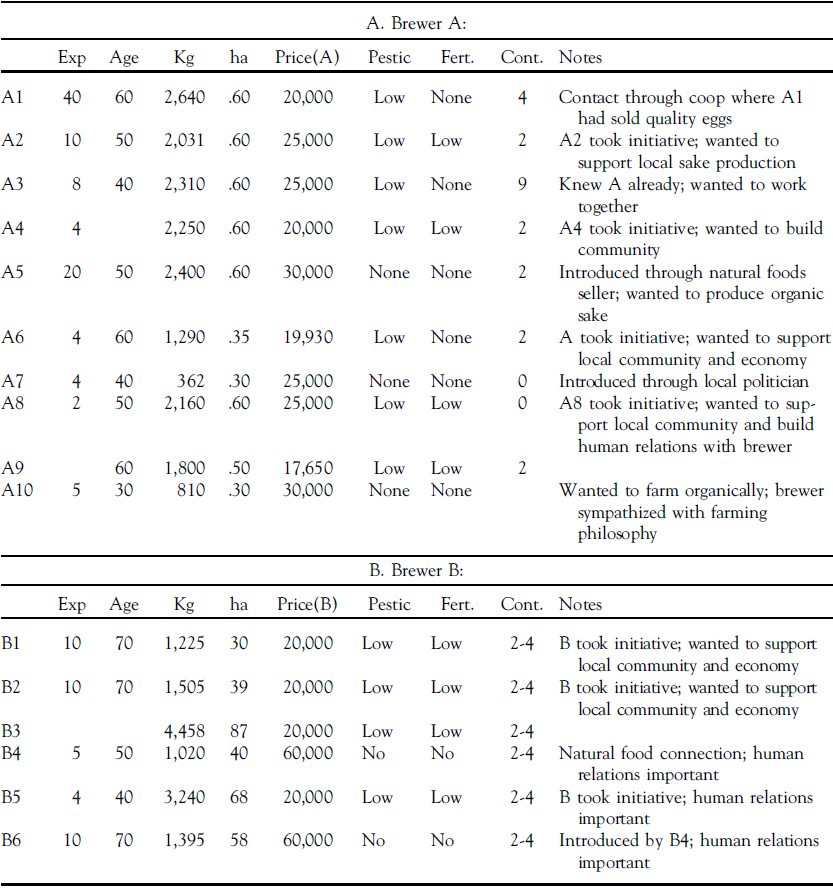
Verifiable inputs can correlate with rice quality, and many brewers mandate the levels of the inputs that do. Brewers often specify cultivation methods. Masaya Iga examines closely the contracts that one regional premium brewer maintained. Should a farmer insist on using pesticides and chemical fertilizers at ordinary levels, the brewer would offer no contract at all.Footnote 12 Should he or she agree to use them at only low levels, the brewer might offer one price. Should he or she agree to use none, the brewer would pay a 50 percent premium (Table 3, Panel A; Iga Reference Iga2008, 157).
Two Regional Brewers and Supplying Farmers

Brewer A is Yamana Shuzo, a brewer in Tamba city, Hyogo, specializing in premium sake. In 2006, Yamana consumed 42.4 tons of rice per year. Of these, it purchased 18.8 by direct contract. It promises to buy all rice produced on designated fields.
Brewer B is Taketsuru, a brewer in Takehara city, Hiroshima. Taketsuru only advertises versions of junmai sake. In 2006, it consumed 59.9 tons of rice, of which it acquired 12.8 tons by direct contract. Like Yamana, it promises to buy all rice produced on designated fields.
Notes:
Exp: Years of experience in sake rice production
Age: Age of male household head, deciles
Kg: Kg of sake rice supplied
ha: hectares of land devoted to sake rice
Price (A): yen per 60 kg
Price (B): Market price plus adjustments plus number in table, per .1 hectare
Pest.: Pesticides use—none, or low
Fert.: Chemical fertilizer use—none, or low
Contact: Number of regular contacts with brewery per year.
Source: Masaya Iga. “Seishu kyokyu taikei ni okeru shuzogyosha to sakamai seisansha no teikei kankei [The Relationship between the Sake Breyers and the Sake-Optimized Rice Producers under the Sake Supply Structure].” Chiri gaku hyoron 81 (2008): 150–78.
Other brewers focus on yield—as in, they want low yields. Wine quality tends to correlate inversely with vineyard productivity, and so it is with sake.Footnote 13 As a result, both wineries and sake breweries contract to buy the entire yield of a field. They then discourage farmers from ramping the productivity by adopting pricing formulas that track yields only up to a given volume, and pay nothing for any excess (Iga Reference Iga2008, 157; Washington 2015, 10 (grapes); Hayashi Reference Hayashi2017, 62 (rice)).
Sometimes (but only sometimes), brewers contract over observable outputs
Brewers can observe rice quality, and can verify that quality—in part. They can measure the percentage of broken kernels. They can measure the level of protein in a kernel. And they can adjust the price they pay by these verifiable measures (Hayashi Reference Hayashi2017, 56).
And some do—but not all. The problem with setting price by verifiable quality is precisely that it works, and may work too well: It may skew an agent’s effort toward the verifiable measures, but away from other possibly more important aspects of quality. Quality is a subtle thing, and only some measures are verifiable. As Holmstrom and Milgrom (Reference Holmstrom and Paul1991) point out, a principal who pays his agent only by verifiable indices of quality may cause the agent to bias his efforts away from aspects of quality not incorporated into the pricing formula. If the cost of that bias is sufficiently high, the principal may rationally choose to offer instead a contract with only muted incentives. Wineries face the same problem. Grape quality turns in part on observable characteristics, but “more subtle characteristics are harder to measure” (Goodhue Reference Goodhue2002).
And so it is that many premium sake brewers omit quality measures from their pricing formula. Instead, they meet regularly with the farmers and discuss how better to raise that quality. If a farmer produces defective rice, they bring samples with them and talk to him or her about what to do (Hayashi Reference Hayashi2017, 60). But when so many of the distinguishing measures of rice quality are observable but not verifiable, many of them rationally decide not to key their contracts to the verifiable measures of quality. Instead, they monitor and talk: They follow the progress of the rice, they talk with the farmer, they watch for potential problems, and they try to forestall a disaster before it arrives.
Direct Intervention
Introduction
Let me restate the point: Rather than structure contracts on verifiable measures of output quality, the premium regional breweries intervene regularly in the farming itself. These brewers want farmers to use as little fertilizer and pesticides as possible (Hayashi Reference Hayashi2017, 60). But they want much more. They want the farmers to watch the crop, and to change as needed the steps they take and when they take them. Toward these ends and more, the brewers monitor the progress of the crop. They may meet with the farmers, consult about schedules, suggest new techniques. To facilitate this collaboration, they do what they can to build trust. And to encourage the farmers to welcome their intervention, they pay the high prices that they do.
The brewers and farmers negotiate contracts, in other words, to structure what they envision as a working, collaborative relationship. Lisa Bernstein (Reference Bernstein2015, 563) made a similar point about Midwestern manufacturers: They negotiate contracts “to create a framework for growing relational social capital and leveraging network governance.” “Contracts serve mutual communication,” wrote Dietz (Reference Dietz2012, 39) in the context of software contracts. As Bozovic and Hadfield (Reference Bozovic and Hadfield2015, 8 (italics in original)) put it in the context of technology firms: The parties negotiate their contracts to “coordinate beliefs” about what they intend to do, to create the “essential scaffolding to support the beliefs and strategies that make informal means of enforcement such as reputation and the threat of termination effective.” I turn now to the component aspects of this strategy.
The brewers monitor intensively
To gauge when and how to intervene, the brewers need information about a crop’s progress. Toward that end, they monitor the paddy. For truly local operations, they can do this informally. The brewer lives in the area. He or she knows the weather. He or she can watch the rice grow in the paddy. Brewers more remote can engineer more elaborate arrangements. Dassai installs sensors in its farmers’ fields to record rainfall and temperature (Nihon okome kyokai 2018). Other brewers follow the progress of the crops with drones (Sekai he habatakutame ni ‘Terowaaru’ kara Nihon shu wo kataru 2019).
The brewers intervene directly
As necessary, these brewers then intervene. The necessity varies: Some farmers need it more; some brewers have more to offer. But in order to intervene, the brewers meet with their contracting farmers. Some hold conferences among all of their farmers. Some meet each farmer at the beginning of the season and then again at harvest. They may help the farmers plant the rice and then harvest it (Iga Reference Iga2008, 158). Others meet with them on an ad hoc basis throughout the growing cycle. Masaya Iga describes a brewer who meets with his farmers as often as nine times a year (Reference Iga2008).
Should a crop fall short on some dimension, the brewers work with the farmer to devise a way to skirt the problem the next year (Hayashi Reference Hayashi2017, 60). They review their farmers’ plans (2017). At root, they meet with their farmers to discuss and collaborate. Again, as Bernstein (Reference Bernstein2015, 576) wrote of Midwestern manufacturers, the brewers “interact with their suppliers throughout the production, delivery, and quality assessment process to try and catch problems sooner rather than later ….” They intervene in order to work with their suppliers to improve the quality of the rice they will obtain.
The brewers build social capital
To enable this monitoring and intervention, the brewers work to build the “relational social capital” that fosters trust. “If you can see a farmer’s face,” explained several brewers, “it’s easier to specify the quality you want” (Keiyaku saibai de hinshitsu kojo 2018; see also Hirogaru sakamai seisan (ka) 2018; Miyajima Reference Miyajiman.d.). “If you can see his face, both of you will feel as though you’re making sake together,” said another (“Saitama jishu” ni kodawaru Ishii shuzo 2017). Learn to know each other personally and a brewer can communicate more effectively the type, quality, and quantity of rice that he or she needs (Matsuo Reference Matsuo2017, 44).
The Miyajima (Reference Miyajiman.d.) brewery in Nagano wants its rice grown in an “environmentally sustainable” fashion. To work with its farmers to do this, it assures the public, it needs to be able to trust them. “This is not about finding farmers who will follow the terms of the contract,” it explains. “We need to be able to talk with a farmer. We need to be able to trust each other. This is true everywhere in the world.”
For this consultative approach to work, the brewers need farmers who can in turn trust them. President Takahashi of the Matsuo brewery has lived in Shinano village all his life. His father ran the brewery before him, and his grandfather before that. He lives within a dense network of “structural social capital” in which information about how he treats one farmer will travel quickly to all of his other suppliers.
But this structural social capital is not just an attribute of birth. It is also a characteristic that firms can—and do—deliberately build. More specifically, they deliberately build Coleman’s “closure” among their farmers. They deliberately build ties among their farmers that would let them learn about their own (the brewer’s own) contractual breach—because by doing so, they strengthen the credibility of their own promise not to breach. Bernstein (Reference Bernstein2015, 608) notes how Midwestern manufacturers construct networks among their suppliers through which each supplier can rapidly learn how the manufacturer has treated other suppliers. Miwa and Ramseyer (Reference Miwa and Mark Ramseyer2000) detail the way in which Japanese car assemblers organize tight associations of their suppliers. And so too here: Brewers sometimes organize their contracting farmers into “study groups” where the farmers can meet each other and discuss the course of their work (Hayashi Reference Hayashi2017, 56). The networks “increase the reputational harm and nonlegal sanctions for misbehavior,” observes Bernstein (Reference Bernstein2015, 604), and expand “the type of misbehavior that can be policed through multilateral nonlegal sanctions.”
Summary
For these brewers, the key to buying the rice that meets their desired level of quality is price. The brewer wants rice that meets not just the verifiable indices of quality that the cooperative can provide, but indices that are observable but nonverifiable (and therefore not contractible) as well. For that, the brewer wants to be able to work closely with the farmers. Toward that end, he (or she) wants to monitor the crop, and intervene whenever he believes it helpful. Crucially, when he does so, he wants the farmer to welcome his intervention.
The contractual measure by which the brewers address this problem is simple: a one-year contract to buy all of the yield of a field at a high price, subject to renewal at the discretion of the two parties. In effect, the brewers pay the farmers “efficiency wages.” The farmer could grow sake rice for the coop, and receive a given price. Should he or she grow rice for the local brewery, he or she will receive a substantially higher price. In effect, that higher contractual price gives the farmer (even farmers who also care about factors other than money) an incentive to work closely with the brewer to grow a crop that more closely matches the (observable but not verifiable) attributes that the brewer so badly wants.
Leasing, Ownership, and Vertical Integration
Why Do Some Breweries Contract across the Market?
Introduction
For their best wines, many wineries do not use grapes they buy on the market. Instead, they use grapes they grow themselves. Sometimes, they grow them on land they hold under long-term leases. Usually, they grow them on land they own.
The question is obviously one of make or buy—the extent of vertical integration. A winery or sake brewer can integrate vertically into agriculture, or it can contract across the market to buy its agricultural supplies. High-end wineries in France tend to integrate vertically, while mass-market wineries buy their grapes on the market.Footnote 14 In the sake industry, even high-end breweries generally buy their rice on the market.
The law
Until 2003, the explanation for the different patterns of integration between wine and sake was simple, and legal. Japanese law banned rice farming by corporations. In the late 1940s, the occupation-dominated government had redistributed paddy land. It effectively took (the payment was trivial) land from its owners, and gave (the price was trivial) it to those who had earlier leased the land. The government lowered agricultural productivity in the process, but the occupation forced through the program in the name of “democratizing” rural society (Ramseyer Reference Ramseyer2015). Lest market participants transfer the land back to the earlier equilibrium, the occupation mandated a wide range of transfer restrictions. For the most part, it stopped people from taking land out of rice production. And, relevant here, it banned corporations from owning or renting paddies (Ramseyer Reference Ramseyer2015).
During the first decade of the twenty-first century, the government changed the law. By the 1990s, farmers were abandoning their fields. Because agriculture now paid low returns to labor compared to other employment, young men and women were choosing not to farm at all. Those who owned paddy fields found that no one wanted to farm their land. Faced with increasing numbers of abandoned fields, the government finally loosened the restrictions on paddy transfers. It began to allow limited leasing of rice paddies by corporations in 2003, and further liberalized leasing in 2009. Subject to greater restrictions, it began to allow corporate ownership as well (Shibuya Reference Shibuya2016, 73; 2020, 89; Takayama and Nakatani Reference Takayama and Tomoaki2017, 77–79).Footnote 15
Relational specificity
Sake brewers do have less reason to integrate than wineries. “Vines are perennials with a productive lifetime of more than 25 years,” note Ashenfelter and Storchmann (Reference Ashenfelter and Karl2016, 26). As a result, they constitute substantial long-term investments. Because their value hinges in part on the relationship between the vineyard and the winery, they present the risk of holdups so famously explored by Williamson (Reference Williamson1975, Reference Williamson1985), Klein, Crawford, and Alchian (Reference Klein, Crawford and Alchian1978), Masten (Reference Masten1984), and others.Footnote 16
A rice farmer makes no such multiyear investment toward producing sake rice. He (or she) makes some, of course. Perhaps most notably, he invests in the knowledge and expertise he will need to grow the idiosyncratic varieties that the brewery wants and in the way that the brewery wants. But he will make few physical investments: a paddy to produce sake rice is little different from one to produce table rice. Should a brewery decide—however opportunistically—not to renew his contract, a farmer can safely return to table rice.
And the theory of the firm
Recall that Hart (Grossman and Hart Reference Grossman and Hart1986; Hart and Moore Reference Hart and John1990) suggests that assets should be owned by the institution whose involvement raises the value of the asset to its highest use. If the land is most valuable when used for the production of sake, it should be owned by the firm that best produces the sake. This, of course, would imply that since 2003 the premium breweries should be integrating vertically into farming on a massive scale. Some indeed are, but the shift is leisurely and modest. In turn, that relaxed pace reinforces the point made by many observers in other contexts: in a wide variety of situations, vertical integration and contracts are close substitutes. In a wide variety of situations, firms can replicate the incentives produced by vertical integration through contract.
Why Do Other Breweries Integrate?
Aging farmers
And yet—leisurely as their pace may be—some breweries do integrate vertically into farming. Why? The breweries themselves suggest several reasons.
Often, the brewers explain that they started growing sake rice because the local farmers had grown so old. Their contracting partners were about to retire, and their partners’ children were not staying on the farm. Their suppliers were about to disappear, and they needed to prepare (Nihonshu no korekara 2017; Niigata no Sake: 3 2019; Shibuya Reference Shibuya and Shibuya2020, 74, 94–96).
Young people are indeed leaving farming villages. Regional breweries that rely on farmers skilled enough to raise temperamental sake rice do face the risk their suppliers will die without a replacement. Take the Sekiya brewery in Aichi prefecture (Sekai he habatakutame ni ‘Terowaaru’ kara Nihon shu wo kataru 2019; Shibuya Reference Shibuya and Shibuya2020, 95–98). After visiting European wineries, the firm’s president decided to focus its production on local rice. Yet in his community, a sixty-year-old farmer was on the young side. “With another 10 years,” explained the president, “I doubted there would be anyone around to farm for us.” Nothing seemed feasible except to grow the rice himself. He asked the retiring farmers to teach him how to farm, and by 2018 had 24 ha (hectare)Footnote 17 under cultivation.
The Watanabe brewery in Nechi valley reached much the same conclusion (Shibuya Reference Shibuya and Shibuya2020, 93–94; Watanabe shuzoten n.d.). It wanted local sake rice, but the nearby farmers were growing old and had no successors in sight. The Watanabe family already owned a very small piece of land. The brewery rented another 15 ha and now grows its own rice. Its employees brew in the winter and farm in the summer.
Seasonal work for employees
Like Watanabe, some breweries rent the farms to provide off-season employment for their own workers (Shibuya Reference Shibuya2016, 76). Brewers traditionally made sake in the winter when the cold temperatures helped prevent spoilage and hired their help on a seasonal basis. As long as the local community was agricultural, they could hire men and women in the winter and expect them to return to their own farms in the spring. With the agricultural industry in economic freefall and local farms no longer using young labor, that coordination became increasingly difficult. When breweries like the Watanabe terroir brewery raise the rice themselves, they assign their employees to make the sake in the winter and work the paddies in the summer (Shibuya Reference Shibuya and Shibuya2020, 93–94; Watanabe shuzoten n.d.).
Contractual problems
Some breweries report that they started farming themselves because they could not convince independent farmers to cooperate. In the discussion above, I explain the logic by which breweries use contractual structures to induce farmers to grow the high-quality sake rice they need. If only life were so simple, these other breweries seem to imply. Some of them simply could not induce their supplying farmers to grow the high-quality rice they needed. Despairing of a contractual option, they integrated vertically into agriculture themselves.
The small Marumoto brewery in Okayama prefecture has fourteen employees and focuses on organic sake (Shibuya Reference Shibuya2016, 92; Marumoto shuzo n.d.). The owner begged local farmers to supply him with low-fertilizer rice, but could not convince them to do so. Despairing of obtaining the rice any other way, he went into farming himself. His family had owned some land. He leased more, and by 2019 his firm was farming 18 ha. Again, his employees brewed sake in the winter and farmed the firm’s paddies in the summer.
The informational advantage
And some—perhaps most—of the brewers who integrate into farming do so to improve their ability to coach the farmers who still supply them with the rest of their rice under contract. Through contract, the brewers have negotiated the right to intervene in the farming. To intervene effectively, they need to understand farming itself. By tending even a modest-sized field, they acquire some of that essential technique.
Ichinokura is a large brewer in Miyagi prefecture. It farms some plots in order to test new varieties and farming methods. It still contracts extensively with local farmers, but grows rice itself to learn how better to advise those suppliers. “By cultivating sake rice and using abandoned fields,” it explains, “we learn cultivation techniques, and become better able to convey that information to local farmers” (Shibuya Reference Shibuya and Shibuya2020, 100; Ichinokura n.d.).
“The quality of sake rice and the quality of sake are inextricably intertwined,” explained one group of partially vertically integrated brewers. “But there is not yet enough information flowing between farmers and brewers.” The group turned to growing to obtain that information. They started growing some of their rice themselves in order first to acquire and then to “be able to convey the experience and skill” to others raising the temperamental sake rice (Sekai he habatakutame ni ‘Terowaaru’ kara Nihon shu wo kataru 2019; No to ieru shuzo no kai n.d.).
You learn as you farm, the Marumoto brewery in Okayama explained. The firm grows 18 ha itself, and plans to expand. When you farm, you learn that “you can grow koji mai on this field. This other paddy would do better with kakemai.” The brewery continued: “Each paddy has its own individuality.” As a result, “we study the soil in each paddy.” And “we study what rice works best in which field, match the field to our goals, and then proceed with the cultivation.” Grow rice, and you come to appreciate more closely the connection between raising rice and brewing sake. “Rather than sake rice made by a farmer who doesn’t brew sake,” the firm explained, “we wanted a sake rice grown under the eye of a brewer” (Denno Reference Denno2018; Shibuya Reference Shibuya and Shibuya2020, 93–94; Marumoto shuzo n.d.).
The Izumibashi brewery in Kanagawa prefecture both grows rice and buys rice. It uses five different kinds of rice, and allocates the varieties among its supplying farmers according to farmer expertise and paddy suitability. It monitors rice growth with drones. And it ties that growth to paddy output and soil characteristics through computers. The firm grows some rice itself, it studies growth and outcomes scientifically, and it advises its contracting farmers. “Ultimately, we learn who, using which paddy with what kind of soil, grew a rice that upon brewing” produced what kind of sake.
CONCLUSIONS
For over a century now, Japanese consumers have been losing their taste for sake. But until the last few decades, sake brewers gave them little to taste. Stringent controls begun during the war drove a few producers in Kobe to dominate the mass market through economies of scale. They flooded the country with mediocre but cheap drinks, and the regional brewers steadily went out of business.
Within this environment, desperate regional brewers began to explore whether they could create a market for unambiguously delicate and subtle high-end sake. A few of them succeeded spectacularly. Several more regional brewers then began to explore whether they could create a market for delicate sake that showcased environmental variation. By most measures, several of them seem to be succeeding as well.
In creating this new terroir sake, the regional brewers face a complex contracting problem. A few of them skirt the contracting process by vertically integrating into rice farming, but not many. Most of the new premium brewers contract with independent local farmers and pay them to grow the high-risk and high-cost varieties of rice optimized for their premium sake.
The brewers and farmers solve their information and incentive problems through deceptively simple arrangements. They virtually never conclude contracts with elaborate panoplies of verifiable terms. Instead, they deliberately cultivate a dense network of “closed” social capital. They then negotiate and enforce simple, short-term renewable (and hence terminable) contracts within it. The contracts provide a structure for their relationship. Through these contracts, they let the brewer monitor closely, and let him intervene as necessary to maintain close control over the farming process. To induce the farmer to let the brewer do this, the brewers pay extremely high prices—prices high enough to convince the farmers to cooperate with the brewer’s efforts to raise rice quality.
Most of the brewers do not vertically integrate, and none of them negotiate long-term, complex contracts. Instead, through short-term, terminable contracts paying high prices, they negotiate all the control they need. Through simple contracts embedded within dense networks of deliberately cultivated social capital, they obtain results that they could never generate through long-term complex terms, and that duplicate instead the effects of vertical integration.