Introduction
Conservation and protection of soil resources are widely recognized goals within the purview of sustainable agriculture. Cover cropping can help achieve these objectives because it is an accessible and adaptable management practice that can be integrated into many types of production systems. Cover cropping is often described as a sustainable farming practice and, although the concept of sustainability has been embraced by a wide spectrum of audiences in recent years, the farming community in particular emphasizes the effects of agricultural practices on both ecological and socio–economic factorsReference Dunlap, Beus, Howell and Waud 1 . Some of the benefits attributed to cover cropping, which support its categorization as a sustainable farming practice, include: soil and water quality improvement; soil conservation; non-chemical weed, pest and disease management; pollinator attraction; fertilizer and herbicide input reduction; and carbon sequestrationReference Janzen and Schaalje 2 – Reference Shepherd, Harrison and Webb 4 .
There is a lack of information about the prominence of cover crop use in the USA, although the pervading opinion is that only a small percentage of farmers use themReference Dabney, Delgado and Reeves 5 . Surveys on the topic have reported a wide range of adoption levels. For example, two separate studies conducted in the Midwestern region found that approximately 11% of farmers (n=1096)Reference Singer, Nusser and Alf 6 or 21% of farmers (n=809)Reference Grau 7 used cover crops regularly. Approximately 56% of Utah farmers reported utilizing cover crops (n=351)Reference Drost, Long, Wilson, Miller and Campbell 8 compared to 69% of vegetable farmers in western New York (n=118)Reference Stivers-Young and Tucker 9 . In 1998, the Maryland Department of Agriculture implemented a state-wide cover crop cost-share program in an effort to improve Chesapeake Bay water quality. By 2012, the program reported more than 42% or 162,000 ha of eligible farmland enrolled 10 , 11 .
The regional focus of these types of surveys is appropriate given that a combination of environmental, political and cultural factors often influence farming practicesReference Duram 12 . However, many regions with important agricultural sectors, such as the Southern US region, remain under-represented in the literature. The Southern region in 2007, as defined by the Southern Sustainable Research and Education program (S-SARE) (Fig. 1, omitting Puerto Rico and the Virgin Islands), represented 40% of all farms in the US (∼890,000 farms), 30% of all farmland (∼111,000,000 ha) and 28% of the market value of agricultural products sold (∼US$84,000,000,000) 13 .
Survey participants were solicited from the Sustainable Agriculture Research and Education Program (SARE), Southern Region, which is the darkest area. The number of participants from each state or territory are reflected within parentheses: Alabama (8), Arkansas (1), Florida (3), Georgia (18), Kentucky (17), Louisiana (10), Mississippi (3), North Carolina (96), Oklahoma (2), South Carolina (14), Tennessee (15), Texas (6), Virginia (13), Puerto Rico (0) and the US Virgin Islands (2).

Farm operations located in the Southern region are often able to integrate both cool- and warm-season cover crops due to the predominant subtropical climate (i.e., mild temperatures and frequent rainfall). Cover cropping is promoted as a sustainable practice that can help address common regional challenges such as soils with a low nutrient supply capacity (e.g., Ultisols and Alfisols) and heavy weed, pest and disease pressure. In this study, we defined cover crops as those grown between or intercropped with cash crops, generally not harvested or sold for profit, but rather used as part of the overall farm management system.
The effects of cover crops on a variety of agricultural issues in the Southern region including: weed and disease suppressionReference Creamer and Baldwin 14 – Reference Hansen and Keinath 18 , nitrogen retention or donationReference Creamer and Baldwin 14 , Reference Sainju and Singh 16 , Reference Hansen and Keinath 18 – Reference Wilson and Hargrove 20 , tillage reductionReference Reberg-Horton, Grossman, Kornecki, Meijer, Price, Place and Webster 17 , Reference Wilson and Hargrove 20 , Reference Hoyt, Monks and Monaco 21 , crop yieldsReference Hansen and Keinath 18 , Reference Treadwell, Creamer, Hoyt and Schultheis 22 , Reference Parr, Grossman, Reberg-Horton, Brinton and Crozier 23 and carbon sequestrationReference Sainju, Schomberg, Singh, Whitehead, Tillman and Lachnicht-Weyers 24 have been explored. Cover crops may decrease weed pressure by modifying the soil environment during crop growth or after termination by a physical or chemical treatment. Reberg-Horten et al.Reference Reberg-Horton, Burton, Danehower, Ma, Monks, Murphy, Ranells, Williamson and Creamer 15 evaluated the allelopathic properties of rye cover crops. They found that cultivar selection, biomass production and cover crop growth stage at termination were all critical factors for optimizing concentrations of the allelochemical DIBOA (2,4-dihydroxy-1,4-(2H)benzoxazine-3-one)Reference Reberg-Horton, Burton, Danehower, Ma, Monks, Murphy, Ranells, Williamson and Creamer 15 . In addition to weed suppression, phytotoxic chemicals may be able to suppress soilborne diseases. A variety of brassica cover crops were evaluated for biofumigation effects from isothiocyanates (ITC) and crop yield in SCReference Hansen and Keinath 18 . Hansen and KeinathReference Hansen and Keinath 18 , found that ‘Pacific Gold’ mustard was effective at decreasing the population of Rhizoctonia solani compared to other treatments and had no effect on bell pepper yields.
A variety of warm-season legumes, grasses and biculture mixes were evaluated by Creamer and Baldwin for aboveground biomass production, nitrogen (N) contribution and weed management in NCReference Creamer and Baldwin 14 . All cover crops studied provided some level of weed suppression and legume and grass cover crops were found to donate between 32–97 and 39–88 kg N ha−1, respectivelyReference Creamer and Baldwin 14 . Another study assessed the N release rates from cool-season cover crops in NC and found the following average contributions after 8 weeks of field decomposition: hairy vetch (132 kg N ha−1), rye–hairy vetch (108 kg N ha−1), crimson clover (60 kg N ha−1), rye–crimson clover (48 kg N ha−1) and rye (24 kg N ha−1)Reference Ranells and Wagger 19 . In GA, researchers found that crimson clover residues followed an exponential decomposition pattern that leveled off after 16 weeks in both tilled and no-tilled systemsReference Wilson and Hargrove 20 . Approximately one-third of the residue N remained after 16 weeks but was subsequently characterized as part of the resistant fractionReference Wilson and Hargrove 20 . Sainju and SinghReference Sainju and Singh 16 found that a vetch cover crop as well as a vetch–rye biculture resulted in increased levels of total soil N, indicating increased N storage capacity in both tilled and no-till systems.
A review of the benefits and challenges of cover crops in conservation tillage vegetable production systems by Hoyt et al.Reference Hoyt, Monks and Monaco 21 is informative. They concluded that large-seeded and transplanted seedlings performed better in no-till or strip-till systems because these methods were found to be more competitive with weeds and less susceptible to allelochemicals from decomposing cover cropsReference Hoyt, Monks and Monaco 21 . A different research study focusing on sweetpotato production found similar yields between organic and conventional methods when a hairy vetch–rye cover crop biculture was included in the organic systemReference Treadwell, Creamer, Hoyt and Schultheis 22 . Another research team focused on organic no-till corn production found that treatments with a hairy vetch cover crop attained the highest crop yields and those with hairy vetch bicultures resulted in the greatest weed suppressionReference Parr, Grossman, Reberg-Horton, Brinton and Crozier 23 . Carbon sequestration by a variety of cool-season cover crops was indicated by increased levels of carbon in the active soil organic matter fraction (i.e., microbial biomass carbon and potential carbon mineralization) in a GA cotton conservation tillage system; however, changes to the total soil organic carbon pool were not measurable after 2 years of cover croppingReference Sainju, Schomberg, Singh, Whitehead, Tillman and Lachnicht-Weyers 24 .
In order to expand the current knowledge about cover cropping, we created a survey to identify the current practices as well as the perceived benefits and challenges associated with cover cropping. Survey participants were comprised of farmers engaged with two popular sustainable farming organizations operating in the Southern region, (1) the Carolina Farm Stewardship Association (CFSA) and (2) the Southern Sustainable Agriculture Working Group (S-SAWG). Both CFSA and S-SAWG represent a wide diversity of agricultural operations in the Southern region (e.g., product type, acreage under production, geography, etc.).
CFSA is the oldest and one of the largest sustainable agriculture groups in the South. It was started in 1979, by a group of farmers. CFSA's mission is to help people in the Carolinas grow and eat local, organic food by offering educational programming, policy advocacy, efforts to eliminate market barriers, technical support to promote organic practices, good agricultural practices and conservation planning. CFSA currently has 3100 members, approximately half of whom are farmers. Members are solicited primarily through farm and food events.
S-SAWG was formed in 1991, by representatives of 17 Southern organizations. S-SAWG is not a membership organization but rather a regional network to promote sustainable agriculture and rural development. S-SAWG's mission is to empower and inspire farmers, individuals and communities in the South to create an agricultural system that is ecologically sound, economically viable, socially just and humane. They are committed to including all community members in the South without bias. They organize the largest annual sustainable farming conference in the Southern region, attracting 1000–1200 attendees each year, of whom approximately 60–75% are farmers.
Identifying the perceived benefits and challenges of cover cropping is critical to understanding which factors are most influential for adoption and management choices. We expected that farmers who cover crop would perceive greater environmental and economic benefits derived from these practices in order to offset the associated direct and indirect costs of the practice. Previous studies have found that demographic and/or farm characteristics may influence a farmer's perspective and management decisionsReference Abadi Ghadim and Pannell 25 – Reference Soule 28 and we assumed that these variables would also have an influence within our survey population. Lastly, we hypothesized that organic farmers would employ greater levels of cover cropping compared to non-organic farmers surveyed, because it is a highly encouraged practice under the USDA National Organic Program.
Materials and Methods
The survey was developed by the authors in conjunction with an advisory board comprised of university personnel, extension professionals and farmers. The advisory board provided reviews on preliminary versions of the survey that were used to improve the content and clarity of the final instrument. The survey was distributed during two popular sustainable farming annual conferences, organized by CFSA and S-SAWG. Farmer attendance was estimated to be 200 (∼36% of total attendees) at the CFSA conference (North Carolina, December 2009) and 650 (∼60% of total) at the S-SAWG conference (Tennessee, January 2010). The survey questionnaire was distributed in two manners, both of which allowed for anonymous participation. The primary means of distribution was soliciting farmers, in-person, to fill out a paper-based survey. Participation was incentivized by offering the chance to win farm-related books through a raffle. Post-conference, both CFSA and S-SAWG extended the invitation to participate in an online version of the same survey (Survey Builder, LeadPro247) through their respective newsletter outlets. The online version of the survey was active from February 1–March 15, 2010. The majority of survey participants were categorized as the in-person, paper format (73%) with the remainder (27%) completed online.
A total of 224 surveys were completed and 221 were usable. Surveys with more than 10% incomplete responses were not analyzed. We estimated a response rate of approximately 20% from the in-person surveys, resulting in ±6% sampling error. North Carolina farmers had by far the greater representation of any state (46%) in our survey. This was likely due to two factors, (1) the majority of CFSA membership was from North Carolina, and (2) the research team was comprised of individuals associated with North Carolina State University, a well-known public university lending credibility to in-state solicitation efforts. Although we acknowledge that this uneven representation may have affected our results, at the same time there is considerable farmer, crop and climatic diversity within North CarolinaReference Krueger 29 that reflects variability within the Southern region as a whole. In addition, although the overall categorical breakdown of race and ethnicity among farmers of survey participants was similar to national averages 11 , minority representation was very small within our dataset; therefore, we abstained from making conclusions based on these characteristics.
The survey consisted of 53 questions inquiring about farm and market operations, experiences and opinions regarding cover cropping, management practices and demographic information. Demographic categories were aligned with 2010 US Census Bureau groupings wherever possible. Questions were constructed to allow responses in one of the following formats: choose one response from a list of choices, check all responses that apply from a list of choices, fill in the blank with one or more responses or choose a response from five ranked levels of agreement (i.e., Likert item).
Statistical analysis
Data from the in-person and online survey responses appeared to be drawn from the same distribution according to a 2-sample Kolmogorov–Smirnov test and therefore were combined and analyzed as one dataset (SPSS for Windows 17.0). Descriptive statistics, including frequency counts of various responses were conducted (SPSS for Windows 17.0). In addition, we explored farmer perceptions and beliefs about cover cropping using a factor analysis. Factor analysis is a data dimensionality reduction technique frequently used to analyze the underlying relationships among a pattern of responsesReference Rummel 30 . The shared variances are decomposed into their major components in order to reduce the number of variables necessary to represent the same relationships. The composite variables derived from this analysis are called factors and represent the different considerations survey respondents make when deciding how and/or whether to integrate cover crops in their farming systems.
The methodology of our factor analysis follows. Survey participants indicated their level of agreement using a 5-point Likert-type scale (strongly disagree[1], disagree[2], neutral[3], agree[4] and strongly agree[5]) for a series of 22 statements about the benefits and challenges of cover cropping. Tests were carried out to determine if our dataset was factorable and which type of factor analysis would provide the most interpretable structure. A maximum likelihood extraction with an oblique rotation (e.g., oblimin in SPSS), listwise deletion of missing data and the Kaiser normalization method were utilized. The Kaiser–Meyer–Olkin measure of sampling adequacy was 0.828 and the Bartlett's test of sphericity was 933.8 (P=0.000) indicating the appropriate application of our chosen factor analysis. The goodness-of-fit test had a χ2 value of 60.836 (P=0.482) and communality scores (measuring the amount of variance accounted for by the factors) ranged from 0.217 to 0.629, suggesting that we were conservative with our model selection with a threshold-value of P≤0.05.
The number of extracted factors was determined with a combination of three criteria: visual analysis of the scree plot, the Kaiser–Guttman rule (i.e., associated eigenvalues >0.99), and the interpretability of the factors (i.e., those with theoretical meaningfulness). A minimum of two variables loading per factor was present and only variables with rotated factor loadings (≥0.4) were presented in our results for ease of interpretation. Each respondent included in the factor analysis was assigned a score based on a weighted linear average combination of their responses. These scores were then used in subsequent analyses to evaluate difference among the five factor groupings.
One-way analysis of variance (ANOVA) and/or planned contrasts of means were conducted to compare the practices and beliefs of different participant groups using SPSS ANOVA. Levene's test of homogeneity of variances was utilized to evaluate equality of variance among the populations. If variances were equal, then Tukey's honestly significant differences (HSD) was used to evaluate differences among means and minimize experiment-wise error rate using α≤0.05. If variances were deemed unequal and/or sample sizes in the groups were very different, the Welch's F test was used to evaluate significant differences among means using α≤0.05. In addition, Pearson correlation coefficients were computed to assess relationships between selected variables.
Results
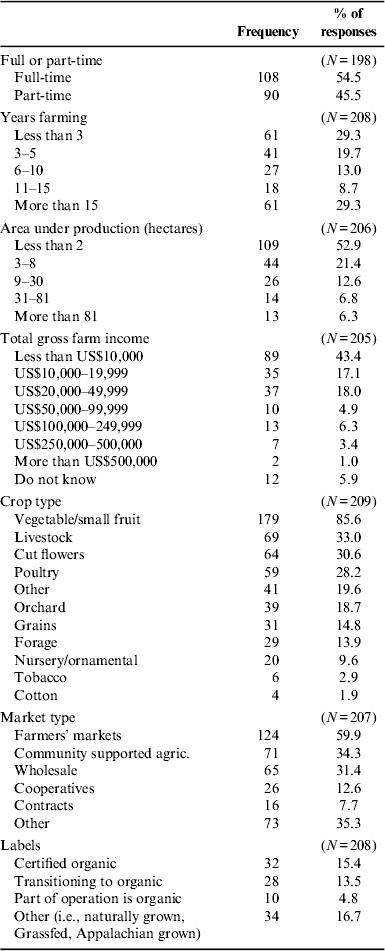
State or territory representation of participants is displayed in Figure 1. Demographic characteristics indicate that the majority of respondents were between 25 and 60 years old (69%), college-educated (94%), male (55%) and white (94%) (Table 1). Age and years of farming experience were positively correlated (r=0.427, P<0.01). Most farmers fell into one end of the farming experience spectrum with either ‘less than 3 years’ (29%) or ‘more than 15 years’ experience (29%) (Table 2). More than half of participants were full-time farmers (55%) and managed less than 8 ha of production (74%). Total gross farm income was defined in the survey as the total combined ‘value of products sold, farm rental income, custom works, government programs, etc.’. Ninety-five percent of our survey population reported less than US$250,000 in total gross farm income and 83% reported less than US$49,999 (Table 2). Total gross farm income was positively correlated with years of farming experience (r=0.363, n=192, P≤0.001), farm-scale when defined as the ‘area under production’ (r=0.371, n=190, P≤0.001) and full-time farming status (r=0.465, n=182, P≤0.001).
Demographic profile of survey participants.

Farm characteristics of survey participants.

The majority of farmers surveyed produced 1–3 different types of products and the top five product categories in descending order included: vegetable/small fruits, livestock, cut flowers, poultry and orchard (Table 2). Only farmers with more than 10 years experience produced tobacco or cotton. The majority of participants reported 1–2 types of sales outlets (Table 2). Farmer's markets, community-supported agriculture programs (CSA), and wholesale outlets were the most frequently utilized marketing venues (Table 2). Approximately, one-third of the respondents had a portion of production area certified under the USDA National Organic Program (NOP), while 16% adhered to alternative labels (e.g., ‘Certified Naturally Grown’, ‘Appalachian Grown’, GAP, Master farmer/cattleman and/or Grassfed) (Table 2).
According to the survey results, crop rotation was practiced by 89% of respondents. Eighty-nine percent of farmers with crop rotation plans also reported using cover crops, therefore, 79% of total surveyed population utilized cover crops. The survey also reported a positive correlation between crop rotation planning and cover cropping (r=0.653, n=204, P≤0.01). Annual cover cropping was by far the most common type of cover cropping reported (87%). Farmers who included cover crops in their rotation plans were more likely to be full-time compared to part-time (P=0.005) and they also reported greater total gross farm incomes than those who did not use cover crops (P=0.049).
No significant differences were present between certified organic and non-organic farmers in terms of implementation of crop rotations or cover cropping. Producers of vegetables/small fruits and cut flowers, the first and third most popular crop types reported by participants, were more likely to use cover crops than other product categories (P≤0.023); livestock producers were less likely to use cover crops than other product categories (P=0.007). Cover crop users were more likely to sell direct at farmers' markets and through CSA's compared to other sales outlets (P≤0.001).
Farmers reported diverse cover crop management practices including the use of more than 25 different types of cover crops (Fig. 2). Ninety-one percent of farmers planted cool-season varieties (i.e., fall or winter planting) while 55% used warm-season varieties (i.e., spring or summer planting). More than 62% of farmers reported achieving cover crop stands deemed satisfactory following recommended seeding rates and 31% reported applying pre-plant fertilizer or soil amendments for cover crops. Intercropping or overseeding a cash crop with a cover crop was employed by 46% of respondents. Inoculation of legume cover crops was carried out routinely by 45% of farmers whereas 16% applied inoculant only when introducing a new legume.
The most popular cool- and warm-season cover crops being utilized by survey participants (N=209). Cool-season types included: crimson clover (Secale cereale), hairy vetch (Vicia villosa), annual ryegrass (Lolium multiflorum), arrowleaf clover (Trifolium vesiculosum), Austrian winter/field pea (Pisum sativum), cereal/winter rye (Secale cereale), oat (Avena sativa), red clover (Trifolium pratense), wheat (Triticum aestivum), oilseed radish (Raphanus sativus), rapeseed/canola/mustard (Brassica sp.), sweet clovers (Melilotus sp.), subterranean clover (Trifolium sp.), triticale (×Triticosecale), berseem clover (Trifolium alexandrinum), arrowleaf clover (T. vesiculosum), and ‘other’. Warm-season types included: buckwheat (Fagopyrum esculentum), cowpea (Vigna unguiculata), sorghum-sudangrass (Sorghum bicolor × S. bicolor var. sudanese), pearl millet (Panicum miliaceum), soybean (Glycine max), sunflower (Helianthus annuus), Japanese millet (Echinochloa frumentacea), foxtail millet (Setaria italica), sunn hemp (Crotalaria juncea), and ‘other’. Respondents were able to indicate multiple selections. N=168 (warm-season) N=182 (cool-season).

After the cover crop growing period, farmers waited an average of 1–4 weeks between cover crop termination and planting new crops. The most utilized cover crop termination methods included mowing (70%), rototilling (51%) and disking (48%). Fifty percent of farmers responded that the availability of particular tools affected their management decisions, including the lack of roller-crimpers (72%), planting implements (31%) and incorporation (18%) tools.
Years of farming experience rather than farmer age was a stronger predictor of cover crop practices and perceptions. First, we compared the practices or perceptions of farmers with more or less than 10 years of experience and found very few differences between these two groups. Subsequently, we compared farmers with more or less than 3 years of farming experience. In general, farmers with less than 3 years experience, representing 29% of our participants, expressed stronger agreement with statements about positive cover crop attributes. They were less likely to view residue incorporation as a challenge and had stronger agreement that cover crops increase soil organic matter, suppress weeds, as well as break pest and disease cycles (P≤0.05). Farmers with less than 3 years experience were also more likely to use no-till equipment to manage cover crops compared to farmers with more than 15 years experience (P=0.003).
Overall, surveyed farmers supported statements about both the environmental and economic benefits from cover cropping. Approximately 50% or more of respondents were in strong agreement with the following seven statements: (1) cover crops increase soil organic matter (81%), (2) cover crops decrease soil erosion (79%), (3) cover crops increase soil moisture (62%), (4) selected cover crops contribute nitrogen to subsequent cash crops (59%), (5) cover crops suppress weeds (52%), (6) cover crops break hard pans with their roots (48%) and (7) cover crops provide beneficial insect habitat (46%) (Fig. 3). More than half of the respondents disagreed that cover crops require too much water or have negative effects on subsequent cash crops (Fig. 3). Forty-six percent of participants agreed or strongly agreed that incorporating residues was a challenge and 31% indicated there is a lack of available information about cover crops (Fig. 3).
Survey respondent rankings of 22 statements about the benefits and challenges related to cover cropping (N=209). The statements all began ‘cover crops…’.

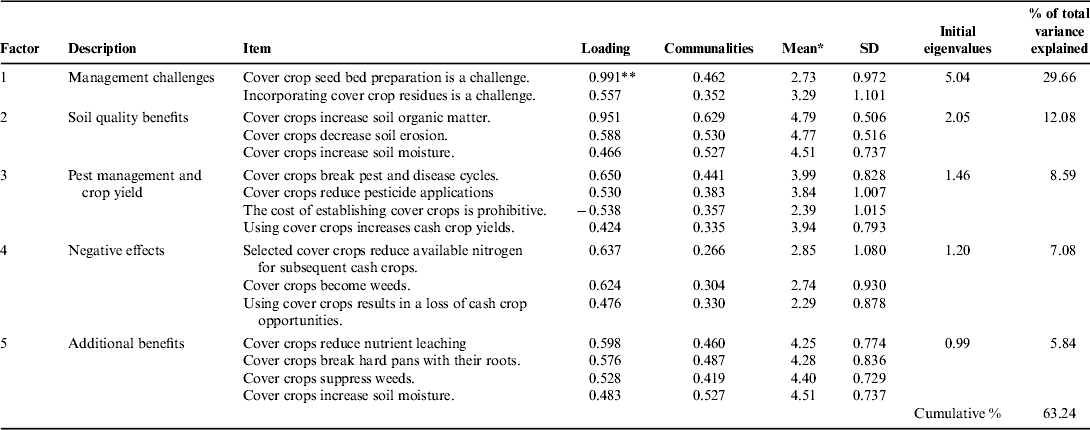
In the ranking of 22 statements about the benefits and challenges of cover crops, 63% of the variance among survey responses was explained by five key factors (Table 3). Factor 1 was labeled pre- and post-‘management challenges’ and reflected rankings of both seed bed preparation and residue incorporation statements. The two variables comprising this factor were able to explain almost 30% of variance within the dataset (Table 3). In particular, seed bed preparation was 99% positively correlated with the amount of variance within factor 1, indicating it was the main predictor for this theme. Although the response with the highest frequency to the statement that ‘cover crop seed bed preparation is a challenge’ was disagree there was a wide distribution of responses (7% strongly disagree, 38% disagree, 30% neutral, 18% agree and 4% strongly agree) (Fig. 3). The second item in factor 1, ‘incorporating cover crop residues is a challenge’, was 56% positively correlated with the amount of variance within factor 1. The response with the highest frequency to the statement that ‘incorporating cover crop residues is a challenge’ was agree (3% strongly disagree, 22% disagree, 29% neutral, 34% agree and 10% strongly agree) (Fig. 3). The resulting score from factor 1 was used in subsequent analysis which indicated that survey participants who reported that the availability of tools influenced their decision to use cover crops were more likely to agree that seed bed prep was a challenge (F[1,173]=12.449, P=0.001). Also, participants who indicated a lack of equipment as an issue and also those with less than 3 years of farming experience were more likely to agree with the statement incorporating cover crop residues was a challenge ([F(1,174)=14.054, P=0.000] [F(1,200)=5.833, P=0.017], respectively).
Factor analysis results for cover cropping survey of Southern sustainable farmers.

* Means from Likert scale ranging from 1 to 5 (strongly disagree to strongly agree).
** Only variables with loading factors >0.40 are presented; positive factor loadings indicated a positive correlation between the variable and factor, while negative loadings indicated an inverse correlation.
‘Soil quality benefits’ represents the three items comprising factor 2 and explained 12% of variance within the dataset (Table 3). Overall, participants strongly agreed that cover crops increase soil organic matter (81%), decrease soil erosion (79%) and increase soil moisture (62%) (Table 3). Full-time farmers and those with less than 3 years farming experience had greater levels of agreement that cover crops increase soil organic matter compared to part-time and more experienced farmers ([W(1,145)=5.415, P=0.021], [W(1,182)=4.793, P=0.030]). Full-time farmers also had stronger levels of agreement with the second item, ‘cover crops decrease soil erosion’ compared to part-time [W(1,135)=7.417, P=0.007].
Factor 3 was labeled ‘pest management and crop yield’ and had the most heterogeneous composition of item topics, ranging from cover crop effects on cash crop yield, pest and disease management, and frequency of pesticide applications. All together, these items explained approximately 9% of variance within the dataset (Table 3). The only inverse correlation present in the analysis was within this factor. Farmers who disagreed with the statement ‘the cost of establishing cover crops is prohibitive’ were likely to agree with the rest of the variables in factor 3. In addition, full-time farmers had stronger agreement that cover crops increase cash crop yields compared to part-time farmers ([F(1,193)=4.387, P=0.009], respectively) and those with less than 3 years of experience had stronger agreement that cover crops break pest and disease cycles compared to those with more experience [F(1,198)=4.005, P=0.047].
‘Negative effects of cover cropping’ characterize the items that comprise factor 4. More than 80% of farmers disagreed with the statement that selected cover crops reduce available nitrogen for subsequent cash crops, indicating that this is not a major concern. Overall, participants disagreed or were neutral about cover crops becoming weeds or resulting in a loss of cash crop opportunities. Participants who had stronger agreement with the statement that cover crops become weeds were also those who practiced rototilling [F(1,173)=5.186, P=0.014]. Farmers who reported using cover crop seeding rates lower than what was recommended, also had stronger agreement that cover crops become weeds [F(2,165)=5.275, P=0.046]. Farmers who included cover crops in their rotation plans reported less agreement with the statement that ‘using cover crops results in a loss of cash crop opportunities’ [F(2,197)=5.010, P=0.036].
And lastly, factor 5 categorized as ‘additional benefits’ reflects other positive attributes of cover crops (Table 3). Although these variables did not explain as much variance as factor 1, more than 80% of participants were in agreement with three out of four items: cover crops reduce nutrient leaching, cover crops break hard pans with their roots and cover crops suppress weeds. Survey participants who used intercropping or overseeding reported greater levels of agreement with all items in factor 5 compared to those who did not use these techniques [F(1,175)=3.33, P≤0.028]. Full-time farmers had stronger agreement than part-time that cover crops suppress weeds [F(1,195)=8.532, P=0.004].
Discussion
Greater levels of cover crop utilization were found among our survey population compared to most other survey studiesReference Singer, Nusser and Alf 6 – Reference Stivers-Young and Tucker 9 . Participants who used cover crops were strongly, positively correlated with those who had crop rotation plans. Crop rotation involves growing a succession of different crops on the same land over multiple seasons in a recurring sequence, often with a goal of maintaining soil quality for long-term crop productivityReference Mohler and Johnson 31 . It is plausible that the Southern region's sub-tropical climate may provide both an incentive (i.e., weathered soils and high pest, disease and weed pressure) and added flexibility (i.e., long growing season) for the integration of cool- and warm-season cover cropping within farming rotations.
The relationship between crop rotation plans and cover cropping suggests that the integration of cover crops within the overall farming system was given a greater priority when long-term planning occurred, or that farmers with crop rotation plans assigned more value to the benefits of cover cropping. Liebman and DyckReference Liebman and Dyck 32 assert that the very concept of crop rotation implies the use of cover crops and green manures even if they are no longer included in many modern rotation schedules. Farmers who included cover crops in their rotation plans were also more likely to have greater than 10 years of farming experience, indicating that it may take many years to develop successful rotation schemes. This may be related to acquiring equipment, accumulating knowledge and/or developing markets over time.
The statements about cover crop benefits which received the strongest support in our survey rankings were related to soil quality improvement (i.e., increased soil organic matter and soil moisture, breaking hard pans), soil conservation, nitrogen donation to subsequent cash crops, weed suppression and providing beneficial insect habitat. These findings provide insight into the priorities among surveyed growers, and reinforce that they value both short- and long-term gains from cover crops. All of the aforementioned benefits are commonly expressed as major benefits from cover cropping, with the exception perhaps of increasing soil moisture. The effect of cover cropping on soil moisture may depend on whether soil moisture is a limiting factor for crop production (e.g., regional climate, irrigation capability, etc.)Reference McGuire, Bryant and Denison 33 and/or the type of crop residue management system (i.e., till or no-till)Reference Kornecki, Price, Raper and Arriaga 34 .
The incorporation of cover crop residues was identified as the greatest challenge by surveyed growers. The ability and/or ease of residue incorporation may compromise the ability of growers to optimize benefits related to high crop biomass production (e.g., weed suppression, organic matter contribution, nitrogen donation, etc.). Other studies have also found that vigorous cover crop growth may lead to management challengesReference Stivers-Young and Tucker 9 . Interestingly, farmers in our survey did not always appear to implement practices that would maximize cover crop growth. For example, the majority of growers did not provide pre-plant fertilizer which would likely boost cover crop production. Given the difficulties associated with residue management it is plausible that they chose not to optimize cover crop growth in order to avoid related management difficulties and/or costs. It appears that there is a need for additional investigation and knowledge about residue management techniques to minimize trade-offs.
A cover crop management technique that was not as widely adopted as expected was rhizobia inoculation. Only 45% of those surveyed reported regularly inoculating legume cover crops with matching effective rhizobia bacteria. This practice has been recognized to increase the nitrogen fixation capability of legumes when indigenous rhizobia strains are not present or are present in sub-optimal numbersReference Catroux, Hartmann and Revellin 35 . It is unclear why more farmers have not adopted this technique, although there is some recognition that commercial inoculant varies in quality and also uncertainty whether inoculation provides a substantial advantage if soils have sufficient levels of effective resident rhizobia presentReference Mothapo, Grossman, Sooksa-nguan, Maul, Brauer and Shi 36 .
About half of survey participants indicated that the unavailability of particular tools factored into their cover crop decision-making. These participants also presented stronger agreement that pre- and post-management issues were challenging. They overwhelmingly desired access to roller-crimper tools, presumably for no-till residue management during the termination phase of a cover crop. This indicates that many of the farmers surveyed were interested in alternative ways to manage cover crop residues, perhaps because cover crop residue incorporation is challenging. No-till systems that mow or crimp cover crop biomass in order to create a layer of surface mulch are becoming more popular but species-specific management practices, including timing and method, are critical to ensuring their successReference Reberg-Horton, Grossman, Kornecki, Meijer, Price, Place and Webster 17 and are currently limited. Our results suggest that research and education efforts related to no-till management of cover crop residues in a variety of cropping systems is a priority area for these farmers.
Participants reported diverse cover crop choices and management practices. The most popular cover crops were grasses, legumes and buckwheat, indicating that crop selection was one way that farmers set priorities and implemented cover crop goals. Our data were limited in terms of assessing the use of crop mixtures but we recognize this is also a popular strategy to capture the benefits from different crop types at the same time. Almost half of those surveyed indicated that they practice intercropping or overseeding, indicating that cash and cover crop cycles are being overlapped, presumably to maximize benefits and minimize time restrictions. Approximately 62% of farmers surveyed reported satisfactory cover crop stands when following recommended seeding rates. Based on these levels of satisfaction it appears that seeding rates may be an area that requires additional assessment. Although cool-season cover crops were the most popular choices recorded, the use of warm-season cover crops was also very common. There is far less information available about warm-season cover crops compared to cool-season in the literature and so this is also an area of study that would likely be very beneficial.
Survey participants reported diverse operations both in terms of product type and sales outlets. Because most participants sold more than one product type it was difficult to compare perceptions and practices between product types. However, we were able to conclude that producers of vegetables/small fruits and cut flowers were more likely to use cover crops, while livestock producers were less likely to use cover crops compared to other product categories. A stronger relationship between vegetables/small fruits and cut flower growers and cover cropping may have been present because these product types were well-represented among our survey population. It is also possible that the integration of cover cropping on farms that focus on these product types is more manageable, advantageous or a more accepted practice compared to the other top product categories (i.e., livestock, poultry and orchards).
Overlapping but distinct concepts for cover cropping in non-horticultural or non-agronomic production systems exist. For example, crop–livestock systems often discuss cover cropping in terms of perennial pasture management. One study examining the barriers associated with cover crop integration within crop–livestock systems found that low adoption levels are due to the lack of immediate economic benefit, increasing specialization and/or non-recognition as a social traditionReference Franzluebbers 37 . In orchard systems, aspects of cover cropping may be integrated into perennial groundcover systems although practices and concerns related to pest management and competition with cash crops for water and nutrients may differ substantiallyReference Bugg and Waddington 38 , Reference Sirrine, Letourneau, Shennan, Sirrine, Fouch, Jackson and Mages 39 . Therefore, although these types of growers were represented in our survey, we may have failed to capture the specifics about their practices due to our survey definition of cover cropping or different applications of the cover crop concept.
Previous studies have suggested that demographic variables or other characteristics may help explain why certain farmers have different perceptions about topics or employ different practicesReference Abadi Ghadim and Pannell 25 – Reference Soule 28 although we did not see much evidence of this in our survey. Years of farming experience and farming status (i.e., full versus part-time) were the most influential variables on cover cropping practices. Overall, we did not find evidence that formal education level, gender, total gross farm income, farm-scale (i.e., area of land under production), or organic certification resulted in significant differences in practices or perceptions related to cover cropping. This lack of separation among groups may be a result of the strong communalities among surveyed farmers who shared a ‘community of practice’ with others involved in CFSA and/or SSAWG. Communities of practice are based around social learning opportunities that may lead to links between practices and identityReference Wenger 40 . This exchange of information may result in more homogeneous practices. Alternatively, the lack of separation may indicate the need for a larger sample size, and/or a lack of heterogeneity in our study population.
We expected that farm-scale would be positively correlated with cover cropping, based on a number of studies which assert a positive correlation between conservation or best management practices (BMPs) and farm-scaleReference Abadi Ghadim and Pannell 25 , Reference Rummel 30 , Reference Habron 41 . The reasoning behind this relationship is that there is a relatively smaller capital investment required by larger-scale operations to adopt new technology and thus they reap higher benefitsReference Westra and Olson 42 . However, we did not find differences in terms of cover crop practices or perceptions related to farm-scale in our study. One possible reason was that there was not a wide enough range in our study population. More than 74% of our participants farmed on less than 8 ha and 94% reported less than 81 ha. These farms are considerably smaller than the 2010 national farm-scale average of 162 haReference Hoppe and Banker 43 and therefore may not be comparable to results from other studies that reflect larger scales of economy. Alternatively, a negative correlation between farm-scale and the perceived importance of environmental stewardship may existReference Buttel, Gillespie, Larson and Harris 44 . Other studies have found that there are positive relationships between small farm-scale and non-economic decision-making related to environmental concernsReference Bergtold, Duffy, Hite and Raper 26 , Reference Buttel, Gillespie, Larson and Harris 44 and this trend may be reflected in our survey population.
In general, farmers with less than 3 years experience compared to more experienced farmers expressed stronger agreement with statements about positive cover crop attributes, yet farmers with more than 10 years experience had greater levels of cover crop implementation within crop rotations. One possible explanation is that more experienced and/or older farmers have tempered perceptions or become more risk adverseReference Abadi Ghadim and Pannell 25 . This result was similar to those found by Bergtold et al., evaluating perceived benefits of winter cover crops in the SoutheastReference Bergtold, Duffy, Hite and Raper 26 .
Full-time farmers compared to part-time farmers expressed stronger agreement with statements about positive cover crop attributes. Parallels may be drawn with an integrated pest management study which concluded that full-time farmers may put greater effort into analyzing management decisions and seek out more educational materials and/or training compared to part-time farmers because their major income source is directly tied to farm incomeReference Alston and Reding 45 . And, in fact, total gross farm income was positively correlated with full-time farming status in our survey population.
Although organic and sustainable are not synonymous terms, organic farming strives to achieve an ecological balance, foster the cycling of resources and conserve biodiversity (NOP, 2010). Organic farming objectives certainly reflect key concepts within agricultural sustainability. Cover cropping itself is a highly encouraged practice under the USDA national organic certification program to attain soil fertility and crop nutrient management goals. Therefore, we expected that organic farmers participating in the study would have greater levels of crop rotation and cover cropping compared to non-organic participants, but found no significant differences. This suggests that within our survey population there were similar values and experiences related to cover cropping, perhaps due to adherence with sustainable farming beliefs and practices promoted by CFSA or S-SAWG and/or adoption of what could be categorized as organic practices by the survey population.
Conclusion
Farmers represented by our survey population reported high levels of cover cropping along with strong support for statements that described a variety of environmental, soil and crop management benefits received from the practice. The perceived benefits of cover crops appeared to outweigh associated challenges and further validation of these findings was evident through disagreement and/or neutrality about potential unfavorable effects from cover cropping. Incorporating cover crop residues was the number one challenge identified. In addition, many respondents indicated that a lack of access to no-till, roller-crimper tools influenced their decisions about using cover crops. Economic costs associated with cover cropping were not viewed as an obstacle to implementation nor were negative effects on subsequent cash crops.
A wide diversity in terms of cover crop choices and management practices were reported but some common choices and themes can be extracted that may be helpful for focusing future research efforts. Cover cropping and crop rotation appeared to be overlapping practices in this survey population, indicating that cover crops are considered a key element within crop rotation planning. Directions for future studies based on survey results include evaluating the ability of the most popular cover crops (crimson clover, hairy vetch, annual ryegrass, Austrian winter pea, buckwheat, cowpea and sorghum-sudangrass) to deliver perceived benefits, including: soil quality improvement, soil conservation, nitrogen donation to subsequent cash crops, weed suppression and providing beneficial insect habitat. Other topics to explore based on survey results include alternative residue management systems, access to no-till equipment, assessment of long-term gains associated with cover crops, recommended seeding rates, warm-season cover crops, and greater exploration into the perceptions and practices of farmers with greater than 10 years of experience.
Acknowledgements
The authors would like to thank Ken Dawson, Stefan Hartmann, Alex and Betsy Hitt for assistance with survey development, the Carolina Farm Stewardship Association (CSFA) and Southern Sustainable Agriculture Working Group (SSAWG) for solicitation of their networks, and the Organic Crop Improvement Association (OCIA) for financial support.