INTRODUCTION
Pancreatic cancer is an aggressive disease that is almost uniformly fatal: 1- and 5-year survival rates are 26% and 5% (van der Molen, Reference van der Molen2007). In the United States, approximately 30,000 people are diagnosed with pancreatic cancer annually. Although many other cancers—including colon, lung and breast—have a higher incidence (James et al., Reference James, Daniels and Rahman2007), the high mortality rate for pancreatic cancer makes the disease the fourth leading cause of cancer death in the United States (Lowenfels & Maisonneuve, Reference Lowenfels and Maisonneuve2004). The etiology of the disease is not well understood. Cigarette smoking is the major known risk factor. Family history of pancreatic cancer also has been associated with increased risk: genetic factors are estimated to account for 5%–10% of all cases (Vimalachandran et al., Reference Vimalachandran, Ghaneh and Costello2004).
A number of characteristics of pancreatic cancer differentiate it from other forms of cancer. Diagnosis is difficult due to its inaccessible location in the abdomen, which means most cases are not diagnosed until the cancer is advanced (Lowenfels & Maisonneueve, 2004). The location also means that there is little opportunity for early detection, and biopsy is the only means of achieving a certain diagnosis (van der Molen, Reference van der Molen2007). Second, the disease affords few treatment options. Surgical resection of the pancreas is considered to be the only approach that offers the possibility of a cure (Matsuno et al., Reference Matsuno, Egawa and Arai2001). This option is largely unsuccessful; the mortality rate for those undergoing a surgical resection is extremely high, nearly 100%. Unfortunately, treatment has not improved significantly over the past few decades (Michaud, Reference Michaud2004). Finally, the disease process is painful and difficult, and patients often die shortly after diagnosis. The combination of these characteristics could make the experience of pancreatic cancer different from the experience of other cancers, both for patients and families. But, so far, the literature is scarce on this topic. A few studies of patients with pancreatic cancer provide hints of this process, finding that patients with pancreatic cancer demonstrated the highest mean scores on measures of anxiety and depression (Zabora et al., Reference Zabora, BrintzenhofeSzoc and Curbow2001) and that control over information giving about the disease was of critical importance to patients (Fitzsimmons et al., Reference Fitzsimmons, George and Payne1999). There is no parallel literature on pancreatic cancer families.
The limited research on family members from a variety of other cancer diagnoses indicates that the familial reactions often parallel the reactions of the patient during and after treatment (Turner-Cobb et al., Reference Turner-Cobb, Bloor and Whittemore2006). Both patients' and family members' distress persists after the conclusion of cancer treatment (Northouse et al., Reference Northouse, Templin and Mood1998, Reference Northouse, Mood and Templin2000). The demands and contingencies of cancer, in addition to burdening the patient, also weigh heavily on the family (Lewis, Reference Lewis1990). Families may be burdened in a number of ways, not the least of which is to shoulder the emotional burden of supporting a family member through his or her cancer diagnosis (Rabow et al., Reference Rabow, Hauser and Adams2004) and treatment, and in some cases, his or her death. Coping strategies are necessary to deal with the burdens of emotional adjustment, financial strain, role conflict and caregiving, and physiological repercussions such as sleep disturbances. Families must also deal with the psychological aspects of uncertainty, worry, and tension (Yates, Reference Yates1999). Family members must handle the impact of diagnosis on their own perceived risk of developing cancer (Montgomery et al., Reference Montgomery, Erblich and DiLorenzo2003). In other research, families coping with a BLAH diagnosis have been found to develop ways of adapting and adjusting successfully that include acceptance and rationalization of their family member's deterioration, taking time for themselves, and taking things one day at a time (Hull, Reference Hull1992).
Concerns about the stresses and burdens faced by family members of patients with cancer should lead to the development of models of family members' adjustment to cancer (Mellon & Northouse, Reference Mellon and Northouse2001). A model describing the factors that facilitate or impair the family's ability to successfully adjust to and deal with a pancreatic cancer diagnosis, treatment, and follow-up is essential to the development of effective interventions to assist struggling families through this difficult process. The frameworks most often described are those of individuals' stress and coping built on the work of Lazarus and Folkman (Sherwood et al., Reference Sherwood, Given and Dorrenbos2004). Other models have used a quality of life approach (Ferrel et al., 1995), articulating a multidimensional system of quality of life as important for long-term patient functioning. Family issues do not find their way into these individually focused models. Recent reviews call for new conceptual models to be developed and clearly articulated (Northouse et al., Reference Northouse, Mellon, Harden, Miller, Bowen and Croyle2008), specifically ones that take into account family other than spouses and children.
To design effective interventions for struggling families, we need to better understand how families adjust to a family member's diagnosis of and experience with pancreatic cancer. The first step toward building such a putative model is to reach a better understanding of the factors that may help or hinder their experiences. The aim of this project was to describe the experience of family members in communicating about and adjusting to a first-degree relative's diagnosis of pancreatic cancer, treatment, and subsequent survival or death. Common themes were identified using a qualitative analysis of retrospective interviews with first-degree relatives. Knowledge gained from this analysis will help lay groundwork for the development of a descriptive model that will inform both the development of future intervention studies for these families and contribute to evidence-based practice strategies for the clinicians working with patients and families to ease family distress. This work also has implications for understanding how families deal with familial risk of cancer and understanding family communications.
METHODS
Cancer Genetics Network
The National Cancer Institute established the Cancer Genetics Network (CGN) to support collaborative investigations into the genetic basis of cancer susceptibility, explore mechanisms to integrate this new knowledge into medical practice, and identify ways of addressing the associated psychosocial, ethical, legal, and public health issues (Anton-Culver et al., Reference Anton-Culver, Ziogas and Bowen2003).
Participants were recruited into the CGN from four population-based centers and four clinic-based centers. The centers with population-based cancer registries used them to contact and enroll patients and their family members. In the clinic-based centers, physicians and other health care professionals directly referred patients to CGN Centers.
Description of the Present Study
This project was a pilot study to examine family communications about a family member's diagnosis of pancreatic cancer, treatment, and his or her survival or death. Trained clinical interviewers and a genetic counselor conducted interviews with participants over the phone. Within the CGN, individuals were classified as cases, spouses/partners, and first-degree relatives. The present study sampled 22 first-degree relatives (FDRs) from this pool. Eligible participants were at least 18 years of age and had never been diagnosed with cancer. The sample included 7 offspring, 4 parents, and 11 siblings of cases. Among these were 12 males and 10 females. Nine interviewees had relatives deceased from pancreatic cancer, and the remaining 11 had diagnosed relatives who were still living at the time of the interview.
Initial Contact with Participants
Once identified, participants were sent a letter from the study office describing the research. A follow-up phone call confirmed their receipt of the letter and invited them to participate. Participants discussed informed consent with study staff and all participants agreed to participate using methods approved by the Investigational Review Board of the Fred Hutchinson Cancer Research Center. Interviews were audiotaped when participants gave permission and transcribed in cases where permission was refused.
Telephone Interviews
The data were collected via the telephone with participants. Participants were first asked in general about their experience following their family member's diagnosis of pancreatic cancer. This was followed by general family questions and questions about their relationship with the individual who developed pancreatic cancer. The final set of questions asked about other family members and relationships following the pancreatic cancer diagnosis.
Qualitative Analysis
The interview transcripts were analyzed using qualitative coding methods. This process was carried out in a number of steps, including reviewing the transcripts, taking notes from each that captured individual themes of the pancreatic cancer experience, and marking illustrative quotes associated with emerging themes. After all transcripts were read, notes and highlighted portions were reviewed and compared to capture larger themes emerging from the analysis. Themes were reviewed and revised as the process continued. Once all themes were synthesized, previously excluded data were captured from the original interview transcripts that were relevant to the identified themes. Once all the data were incorporated into the analysis, the information was arranged to form a coherent narrative representing the coping behavior of family members dealing with a first-degree relative's diagnosis of pancreatic cancer.
RESULTS
Feelings Surrounding News of the Diagnosis
Many themes emerged in discussions of how the individual dealt with a family member's diagnosis of pancreatic cancer. Many reported initial shock and disbelief upon learning the news. This was often followed by a period of denial and devastation. These emotions were followed by a sense of fear of the disease and what the future might bring coupled with an overall sadness. The respondents ascribed these emotions not only to themselves but to other family members as well.
I think right after the diagnosis it was very difficult. It was a shock. (Offspring, living relative)
My father and I had a close relationship and [the news] was devastating. (Offspring, living relative)
It was definitely emotional and very hard to take. … [I was] feeling scared and upset and … I guess sad too. (Offspring, deceased relative)
All participants described the pancreatic cancer diagnosis as having a significant impact on their lives.
Coping in the Aftermath of the Diagnosis
Family members coped with the diagnosis in a variety of ways. Information seeking was one of the most common coping-related themes. Learning more about what they were to face via the Internet, medical journals, and one another helped families to handle their situation. Some participants sought information about what caused the disease, both for purposes of understanding and to grasp how they might avoid becoming affected in the future.
I needed to get more information I think was the big thing. I needed to find out … so exactly what does this mean? How big is the tumor? What's going on? You know, how did he know he was even sick? I mean, what was he feeling? You know, I just needed to know everything. (Sibling, deceased relative)
Others were more concerned with getting a handle on their family member's prognosis and what they could expect in the months ahead. They wanted to know how long their loved one could be expected to survive, how severe the symptoms would be, and what treatments were available. Many described the rapid rate at which events happened and labeled this as overwhelming. One son of an individual with pancreatic cancer reported
I was in school and had access to PubMed. … I [read] a lot of the journal articles myself so I had kind of a good idea of what the research said about life expectancies and different treatments. (Offspring, living relative)
A second coping-related theme was a focus on the process of handling the illness. This began with a feeling that things were happening quickly and that time was of the essence.
[I]t was so far along when he was diagnosed. It was really hard. And it just kind of went—it was like a steam engine. You know, everything just went fast, fast, fast. You know, he was in the hospital and he had his treatments and he had his surgery and everything just went—seemed to go so fast. (Sibling, living relative)
Family members felt responsible for helping the patient by taking care of scheduling and attending doctor's appointments and treatments, activities that seemed to be to take one's mind off of the emotional handling of the illness. Participants, especially offspring, often noted their caretaking behaviors in response to being asked about the initial diagnosis period. One son of a cancer patient described a need to manage aspects of his own life:
I had to take care of my children. Try and straighten out my financial matters and household and … have to work of course. (Offspring, living relative)
Others were concerned with managing their family member's illness. By focusing on everyday activities, they were able to manage the day-to-day aspects of the illness without confronting the larger issues that loomed ahead. Some expressed uncertainty about whether they were doing the right thing, but the feeling of being able to contribute in some way was helpful.
No one really had time to stop and to pause to do any, you know, reflection. … We'd have to keep … going with all the medical appointments and surgery and treatment. (Offspring, living relative)
Another common theme was to make more time for the ill relative. This included both spending physical time with him or her or to talking to him or her on the phone. Often these were simple gestures, such as a brief phone call or stopping by for dinner and a talk. Other times they involved visits from out of town as often as one could manage.
[J]ust being with him was the big thing … just our normal stuff, had Saturday dinners and played games and watched movies and stuff. Just tried to make it as normal as possible. I tried to go see him more. (Offspring, deceased relative)
I try to get over there as much as possible to see [my father] so [we're] probably closer. Visit … a little more often. Make sure he's okay. And do a couple of things with the rest of the family that he used to do. (Offspring, living relative)
If visiting was not an option, because of a physical distance, for example, this was a source of significant stress. One woman described her weight gain that she ascribed to her frustration at not being able to spend time with her ailing brother:
I attribute it to … I guess having a lot, you know, like being so far away and not being able to just drop in and see him whenever I want to and still going to work every day and coming home and being stressed out and eating and also I attribute it to the antidepressants. (Sibling, living relative)
The increased time spent benefited the relationships for those with surviving relatives. These participants often reported a better relationship with their relative since the time of the diagnosis.
We'll talk three or four times a month. Where 10 years ago it might be 6 months or 10 months you know between phone calls. (Sibling, living relative)
Overall, coping in the aftermath of the diagnosis seemed to be challenging for participants. Family members' stress stemmed from both the emotional and physical aspects of managing the illness; it was clear that this was a time of significant strain in their lives.
Addressing One's Own Feelings
The interview focused largely on capturing the experience of first-degree relatives in learning of a family member's diagnosis of pancreatic cancer. Many participants, however willing to discuss emotions with the interviewer, confessed to having hidden their feelings during the time of crisis. Rather than being a conscious decision on their part, this seemed to be a natural reaction to handling the situation at hand. Many felt strongly that it was important to focus their energies on the relative with pancreatic cancer; expressing their own emotions was unimportant and would only get in the way.
My life was rather hectic at the time. And I just—I just had too much to do and too much to think about to be—let myself be overwhelmed by grief or anything like that. (Offspring, living relative)
Sometimes you have to put aside your own feelings and emotions and … concentrate on the one that's sick and just be there for him. (Sibling, deceased relative)
Support System
The degree to which individuals felt they received support and sources of that support varied. Many described the importance of communicating with family members, often with the ill individual him- or herself.
Kind of the nature of our family to—you can argue on the outside but when something's important you just kind of hang together and take care of it. (Offspring, living relative)
Others took comfort in being able to talk to friends, particularly those who had a similar experience of dealing with an ill family member. Still others sought solace in the church, both in attending church services as well as engaging in religious observance in private.
I have a strong faith and … I have a lot of good friends and … I have a lot of people that stand behind me. … I think I did okay, you know. (Sibling, living relative)
A minority of participants sought professional therapy. The individuals who took this route discussed other family concerns, for example, a second family member or close friend also dealing with cancer. Therapy included counseling and, in one instance, a course of antidepressant therapy. Those who coped in this way found it to be helpful in sorting out their feelings and in dealing with them.
[The counselor] just helped me kind of deal with the fact that, um, it's not something that's catchy, you know, that I don't have to sit around and keep myself from my children in bubbles in hopes that we don't get it. (Sibling, living relative)
Though many individuals described rich support networks, others were hampered by a lack of family communication or more formal types of social support.
I felt like I couldn't open up and talk to [my husband] about it because … I don't think it was because he didn't want to hear it. I think he just didn't want to see me so upset. (Sibling, living relative)
[T]here was no support system. A support group or any group or resources out there that would assist the family that can, you know, go through the process. Same way you feel like the only one going through it and have no provider that we can ask clear questions. (Offspring, living relative)
Support systems were variable both in the level of assistance provided and degree of success. This seemed to be consistent with how the individual might have found their support system prior to the diagnosis; no participants expressed any level of surprise at the degree of support received.
Family Dynamics
Many individuals described few changes in family dynamics, conveying either implicitly or explicitly that whatever underlying foundation had existed prior to the diagnosis remained intact. The son of one pancreatic cancer victim expressed a common sentiment:
How families deal with things is how they're going to deal with this. Kind of almost predetermined in their relationship than it is something that's pancreatic specific, I guess. (Offspring, deceased relative)
Families that were close tended to remain close and be a valuable source of support for one another during the difficult time. Those with this type of family support seemed very grateful for it, but also would have expected nothing less in a time of family crisis. Those families that were initially distant maintained this pattern as well.
We are all individuals and I think we kind of reacted as individuals. (Sibling, living relative)
Although not the rule, some participants coming from families that were distant harbored resentment over being burdened with caring for the ill family member. They felt that they had to handle more than their share of helping to manage the illness. These individuals described themselves as very tired, both physically and emotionally exhausted from dealing with the day-to-day management of pancreatic cancer.
I feel like, you know, there should be more of the share of the responsibility instead of myself running the whole show and dealing with it, emotionally and financially. So, I feel there is a great sense of resentment. (Offspring, living relative)
There was not a consistent reaction among families of pancreatic cancer patients to the news of illness. Some handled the news well; others did not. Some families came together, others became increasingly divided.
The Future
Participants discussed the pancreatic cancer diagnosis as impacting their life in many ways. Many participants, particularly siblings and offspring, expressed concern about their own future health and that of other family members. This concern was expressed both in an awareness of lifestyle factors contributing to cancer (smoking, etc.) as well as knowledge of the impact of family history in predicting one's risk of illness.
[I wonder] what is the probability of my having cancer and going through this and fear of pain. And fear of, you know, if I, if this is genetic that it would pass down to my son. (Offspring, living relative)
I spend more time taking care of myself, you know, having yearly checkups and worrying about, you know, am I going to be the next one? Am I going to be able to finish raising my kids? Or am I going to see them reach adulthood? Am I going to be the one that gets it and doesn't live? (Sibling, living relative)
With regards to lifestyle factors, many individuals resolved to positively change their behavior. Among these changes were quitting smoking, getting more exercise, and eating a more healthy diet.
[My sister's diagnosis] made me take notice and do something that I hadn't been able to do in a long time. I smoked cigarettes for 40 years and I quit. (Sibling, living relative)
I must say that maybe 2 years ago I was probably in the poorest physical condition that I've been in my life and I don't think that's necessarily true now. So I've been working hard on improving my own physical fitness and, again, who's to say if, you know, I didn't say, “gee, my sister's got cancer. I've got to start looking after myself,” but maybe it had something to do with it. (Sibling, living relative)
One individual, however, expressed the opposite sentiment. Her brother, now stricken with pancreatic cancer, had always been extremely health conscious. She concluded fatalistically, “It doesn't matter how you take care of your body” (Sibling, living relative).
Others expressed a newfound awareness of their own mortality and a new appreciation for the value of their own lives. Many took steps to balance their lives accordingly:
I just don't put up with as much, you know. Life's too short. If I don't want to do something, I'm not going to do it. If I don't want to go somewhere, I'm not going to go. (Sibling, living relative)
Your family and friends are not going to be around forever so you better, you know, take what you got and enjoy it while you can. (Sibling, deceased relative)
Individuals with a relative surviving at the time of the interview had divergent reactions. Some expressed less worry with the passage of time:
But as time goes by and he's getting along so well, you kind of relax. (Parent, living relative)
Others seemed disbelieving, even in the face of evidence that the patient's cancer was in remission:
I'm feeling a little better about the whole thing. I'm sure it'll come back, but, anyhow, he's doing pretty good and does a lot of the stuff that he used to do. (Offspring, living relative)
Family members of patients who succumbed to pancreatic cancer described a challenging experience. One sibling described his concern that his brother's physicians had not been completely forthcoming with information about his prognosis:
My brother didn't really do some of the things he should have if he had known [his pancreatic cancer] was terminal—and I could have told him at any time—but I wasn't going to do that. (Sibling, deceased relative)
Others struggled with accepting the prognosis:
I had a real hard time because I just didn't want to give up. I didn't want to relinquish the fact that she was going to pass on so I was constantly looking and reading and doing whatever I could trying to find something … that we could try that … might help her. (Sibling, deceased relative)
Nearly all participants expressed concern about how their experience with pancreatic cancer would affect their futures, both in terms of their personal health status and continuing emotional troubles. Lingering problems were common. Some described difficulty in getting over the experience. A year after her brother's death, one woman said, “I'm still kind of in shock about the whole thing” (Sibling, deceased relative). Other family members expressed the same sentiment a year or more after a family member's death.
Family members of individuals who survived pancreatic cancer expressed continued concern for the patient's health and their ability to cope with future events.
I know when the time comes, it's going to be bad for me. (Parent, living relative)
Individuals saw pancreatic cancer as having an impact on their lives for many years to come.
DISCUSSION
This study sought to examine the process by which family members of patients with pancreatic cancer cope with their relative's illness. In the sparse literature on family member coping, there are similarities as well as differences. One study found that coping by disengaging from the problem, as well as support and family cohesion, predicted the level of functioning among women with a family history of breast cancer (Turner-Cobb et al., Reference Turner-Cobb, Bloor and Whittemore2006). These variables can protect and buffer family members from the most invasive effects of the patient's difficulties, potentially reducing the overall distress of the family member. Open family communication predicted the patient's positive mental health outcomes, but the effects on the family members were not measured in all studies (Mallinger et al., Reference Mallinger, Griggs and Shields2006). It is likely that this communication had some effects on the family members (Edwards & Clarke, Reference Edwards and Clarke2005), and the data collected here indicated that communication is relevant to the process of dealing with pancreatic cancer in the family.
Results of this qualitative study suggest that the ways families cope with a family member's pancreatic cancer are similar in some ways to the strategies families use to cope with other cancers. The initial reaction to the pancreatic cancer diagnosis, including aspects of anxiety and distress, is similar to that reported in the literature about the impact of other cancers on families (Kronenwetter et al., Reference Kronenwetter, Weidner and Pettengill2005). Seeking information about the disease, including treatment options and prognosis information, is a common behavior in individuals and families facing a life-threatening disease (James et al., Reference James, Daniels and Rahman2007, van der Molen, Reference van der Molen2007). Issues of denial of the initial diagnosis or of the seriousness of the diagnosis were expressed by our participants, and these types of reactions are reported by patients and family members with other types of cancer in the family (Turner-Cobb et al., Reference Turner-Cobb, Bloor and Whittemore2006). Also, like family members dealing with other cancers, many individuals experiencing a relative's diagnosis of pancreatic cancer feared that they would become ill as well (Montgomery et al., Reference Montgomery, Erblich and DiLorenzo2003).
This qualitative study also shows that the coping process for families dealing with pancreatic cancer has some significant differences from that of other cancers. One useful way of dealing with cancer and treatment is taking things one day at a time (Hull, Reference Hull1992). With pancreatic cancer, however, many family members felt that everything was happening too fast to slow down and process what was going on. Pancreatic cancer families may be unable to cope by taking one day at a time and must find other ways of dealing with stress.
Other themes suggest that certain more common coping behaviors may be heightened by the acceleration of the period of time between diagnosis and death. Participants often spoke of evaluating their priorities and making behavior changes accordingly. Within the cohort of family members with relatives deceased from pancreatic cancer, one-third described themselves as still in shock at the time of the interview, years after their relative's passing. At least half of all participants described their relative's cancer experience as leading them to count their blessings, reevaluate what was important to them, and/or make lifestyle changes, such as quitting smoking.
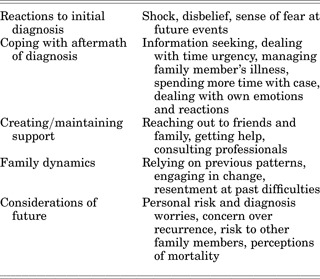
The next research step is to conduct a well-designed, rigorously recruited study of pancreatic families using both quantitative and qualitative methodologies. Each provides information in different ways to illuminate the issues identified here. The elements of any future model would include initial negative reactions, the need for familial communication and support, information and support about personal familial risk, and reactions over time that include preparation for the morbidity and death of the patient, feelings of loss and grief that will accompany the loss, and providing time after the probable death of the patient to continue the process of grieving and remembering that, for other cancers, can occur during the life of the patient (see Table 1). Quantitative methodologies will allow for direct comparisons over time and among subgroups of families (e.g., demographic subgroups, patient alive or dead, etc.). Qualitative methodologies will allow for a deeper exploration of the meaning of the patient's illness and their often brief struggle with the disease. Family support models for cancer are beginning to work their way into the literature and include elements of support, mediation, and facilitating adjustment (Yates, Reference Yates1999).
Characteristics needed for a model of adjustment to pancreatic cancer

The study is valuable because it is the first of its kind to examine how family members of individuals with pancreatic cancer cope with and recall the diagnosis and the subsequent rapid deterioration of health, both in terms of personal experience and family dynamics. The findings provide a foundation for future research on this topic, suggesting both similarities and differences in the experience of these families as compared to families with other cancers. These results lay the groundwork for building the model of familial response and coping that will inform the development of appropriate interventions for families struggling with a diagnosis of pancreatic cancer.