INTRODUCTION
Centralized management by the state was the norm in natural resource management for the latter part of the nineteenth and most of the twentieth century in many countries. However, during the 1980s, a confluence of pressures began to encourage governments to devolve natural resource management to local institutions located inside and outside of government. By the end of the 1990s, more than 80% of all developing countries and countries with economies in transition were experimenting with some form of decentralization (Gregerson et al. Reference Gregerson, Contreras-Hermosilla, White, Phillips, Colfer and Capistrano2005). While such policies have been developed for most natural resources, the most far reaching have been in management of the world's forests (Edmunds et al. Reference Edmunds, Wollenberg, Contreras, Dachang, Kelkar, Nathan, Sarin, Singh, Edmunds and Wollenberg2003; Agrawal et al. Reference Agrawal, Chatre and Hardin2008). It is estimated that community-owned and administered forest in developing countries totals at least 377 million hectares, or c. 22% of all forests (White & Martin Reference White and Martin2002; World Bank 2008).
The most common influence in this change in forest governance is considered to be the desire on the part of overextended central bureaucracies to reduce costs (Edmunds et al. Reference Edmunds, Wollenberg, Contreras, Dachang, Kelkar, Nathan, Sarin, Singh, Edmunds and Wollenberg2003; Colfer Reference Colfer2005; Larson Reference Larson, Colfer and Capistrano2005; Lemos & Agrawal Reference Lemos and Agrawal2006). This coincided with pressure from bilateral, multilateral and private donors for better forest governance, as well as local communities’ vehement demands for greater recognition of their need for forest products and their role in managing local forests (Agrawal et al. Reference Agrawal, Chatre and Hardin2008; Larson Reference Larson, Colfer and Capistrano2005). There was also pressure to right the wrong of exclusion of local people from access to forest resources as a result of a state emphasis on commercial logging (Edmunds et al. Reference Edmunds, Wollenberg, Contreras, Dachang, Kelkar, Nathan, Sarin, Singh, Edmunds and Wollenberg2003; Larson Reference Larson, Colfer and Capistrano2005). Environmentalists emphasized that local people living close to forests had local knowledge and cultural connections that would enable them to be more effective in resource management. Additionally, the intellectual grounds for a shift toward co-management, community-based natural resource management (CBNRM) and environmental policy decentralizations was provided by extensive research in the area of common property, which emphasized the capacity of communities to manage resources (Ostrom Reference Ostrom1990; Lemos & Agrawal Reference Lemos and Agrawal2006).
Proponents of community forestry viewed it as a mechanism to address both environmental and socioeconomic goals, having the potential to improve livelihoods while resulting in positive ecological outcomes (Brown et al. Reference Brown, Malla, Schreckenberg and Springate-Baginski2002a; Ribot Reference Ribot2002). In their meta-analysis of 69 case studies of community forestry from around the world, Pagdee et al. (Reference Pagdee, Kim and Daugherty2006) defined success in terms of outcomes of ecological sustainability, social equity and economic efficiency. That is to say that community forestry has the potential to improve forest management, enhance equitable sharing of management responsibilities and benefits, and thereby reduce poverty. However, as with other CBNRM schemes, its success in achieving multiple goals has been questioned (Kellert et al. Reference Kellert, Mehta, Ebbin and Lichtenfeld2000; Edmunds & Wollenberg Reference Edmunds and Wollenberg2003; Blaikie Reference Blaikie2006; Sunderlin Reference Sunderlin2006; Larson & Ribot Reference Larson and Ribot2007; Tacconi Reference Tacconi2007). While acknowledging the multiple implementation problems, Ribot and Oyono (Reference Ribot, Oyono, Wisner, Toulmin and Chitiga2005) questioned whether or not true transfer of real authority to local institutions had actually taken place in natural resource management.
Five factors have been identified as being of critical importance to successful community forest management: property rights regimes; institutions; incentives and interests; financial and human resource support; and physical features of the forests themselves (Pagdee et al. Reference Pagdee, Kim and Daugherty2006). Ostrom (Reference Ostrom1999) identified key characteristics of both forest and resource users that were important for success in managing commons resources, without which sustainable management of forest resources is unlikely. Campbell et al. (Reference Campbell, Shackleton, Wollenberg, Kowero, Campbell and Sumaila2003) cited weak local institutions, lack of an enabling policy environment, household strategies of the poor with few alternatives but to exploit woodlands unsustainably and the characteristics of the resources themselves as limiting factors in management of common forest resources in Zimbabwe.
Since one of the factors critical in successful community-based management is institutions, with this research we explored the importance of the establishment of appropriate local institutions to the success of community forestry management. Using Cameroon as a case study, we describe the outcomes of decentralization of forest management in Cameroon in relation to the institutional structure of community forests. Furthermore, the basis upon which local institutions for forest management gain legitimacy was investigated. This case study provides insight into the development of models of CBNRM and suggests that those which incorporate culturally appropriate requirements of legitimacy and accountability in crafting local institutions may have a better chance of success in accomplishing both socioeconomic and environmental goals than those that do not.
First, we outline the history of forest management in Cameroon, including the legalization of community forests. The study area and research methodologies are described which included both an extensive literature review of studies of community forest management structure and outcomes in Cameroon and field research. Results of analysis of successes and challenges in decentralization of forest management in Cameroon are presented. Qualitative field research results revealed the customary criteria for local legitimacy particularly for endowing authority over forest resources at the community level. We end with a discussion of alternative institutional arrangements for structuring community forests that may result in greater success.
Forest management in Cameroon
In the humid forest zone of Cameroon prior to colonization, management of the forest can be characterized as predominantly ‘clanic ownership’. Semi-nomadism was the principal way of life for Bantu forest peoples. When they settled in a particular area, these ethnic-territorial groups confirmed their collective rights of first occupancy by putting it into productive use (Diaw Reference Diaw1997; Etoungou Reference Etoungou and Ribot2003) Their view of the forest was integrative rather than specialized as the forest, as well as fields, fallow land and swamps, were considered to be an integral part of agricultural lands. The resources contained therein were managed as common property by the lineage or the clan (Diaw Reference Diaw1998; Diaw et al. Reference Diaw, Mekoulou and Dikongue1999; Etoungou Reference Etoungou and Ribot2003). Diaw (Reference Diaw1997) referred to ‘corporate lineage’ as the kinship unit endowed with a given territorial and natural resource base and able to make both operational and collective choice decisions related to that resource base. It is this operational unit that deals with land sharing, land access, succession, litigation and all other aspects of the tenure system at the local level. They consist of nuclear lineages, which is the basic lineal unit covering three generations (parents, children and grandchildren of the male line.) Prior to colonization, among the Bantu in the humid forest zone, there were no institutionalized leadership positions above the corporate lineage. This system differs from the management system in other parts of Cameroon, particularly in the west and north-west regions, which are characterized by more hierarchical societies (Van den Berg & Biesbrouck Reference Van Den Berg and Biesbrouck2000).
A new era of state ownership of the forest began when Cameroon became a German protectorate in 1884. The colonial regime forbad further migrations and forced people to resettle along the roads. The newly created villages often consisted of members from different clans or lineages (Van den Berg & Biesbrouck Reference Van Den Berg and Biesbrouck2000). The colonizers claimed all the forest and land that was considered to be ‘vacant and without masters’. After the First World War, when power was transferred to France and Great Britain, they continued by a series of decrees the sovereignty of the colonial state on land and forest considered vacant. The forests were for the colonial powers a source of valuable timber which was to be exploited and managed efficiently by the state (Van den Berg & Biesbrouck Reference Van Den Berg and Biesbrouck2000; Oyono Reference Oyono2005a). Some customary regulations were accommodated and local people were allowed use rights.
After Cameroon's independence in 1960, the passing of the forest legislations of 1973 (Ordinance no. 73/18 and its instruments of application) and 1981 (Law no. 81/13) continued the colonial legacy of state authoritarianism in the forest and marginalization of the local population (Van den Berg & Biesbrouck Reference Van Den Berg and Biesbrouck2000; Oyono Reference Oyono2005a). The 1974 Land Ordinances abolished customary land tenure and nationalized all land held under such tenure, except for land registered as public or private property and land under cultivation (Cleuren Reference Cleuren2001; Delville et al. Reference Delville, Toulmin, Colin and Chauveau2002; Van den Berg & Biesbrouck Reference Van Den Berg and Biesbrouck2000). Local people were granted user rights on national lands to meet domestic needs, but these could be overruled by the state for reasons of public interest.
Due to recognition that the 1981 Forestry Law was outdated, the government passed the 1994 Forestry Law (Law no. 94/01 of 20 January 1994 and its Decree of Application no. 94/436 of 23 August 1995) which classifies forests in Cameroon into two main categories: the permanent forest estate or classified forest, which can only be used for forestry or as wildlife habitat, and the non-permanent forest estate, consisting of forested land which can be converted to non-forest uses (Djeumo Reference Djeumo2001). The change in Law had three major goals: promoting popular participation in forest management, promoting sustainable management and contributing to the fight against poverty (Ekoko Reference Ekoko2000; Oyono Reference Oyono2005c). While the legislation addressed several aspects of the sharing of responsibilities and benefits in forest management, one aspect transferred management responsibilities and powers to village communities for the creation of community forests.
A community forest is defined as a forest ≤5000 hectares in size in the non-permanent domain that is subject to a management agreement between a village community and the administration in charge of forests (Djeumo Reference Djeumo2001). It is equipped with a simple plan for its management, conservation and exploitation for the interests of the communities with the technical support of the forestry administration (Vabi et al. Reference Vabi, Ngwasiri, Galega and Oyono2000; Oyono Reference Oyono2004c). All products, wood, non-wood, wildlife, fishery resources and special products, with the exception of those forbidden by law, are deemed the property of the community concerned. Most community forests in Cameroon have primarily focused on harvesting timber (De Blas et al. Reference De Blas, Ruiz Pérez, Sayer, Lescuyer, Nasi and Karsenty2009). The normal duration of the community forest management plan is 25 years, however, the administration retains the authority to suspend or nullify a management agreement without any prior warning to the community (Vabi et al. Reference Vabi, Ngwasiri, Galega and Oyono2000; De Blas et al. Reference De Blas, Ruiz Pérez, Sayer, Lescuyer, Nasi and Karsenty2009).
METHODS
The study included both an extensive literature review and field research. Both print and web-based peer-reviewed and grey literature, published up until the end of 2009, on the research outcomes of community forest management in Cameroon were reviewed. Field research was also conducted in nine villages in the humid forest zone of the East and Central regions of Cameroon, West Africa. This formed part of a larger research study of community forests and non-wood forest product management systems in the humid forest zone of Cameroon (Brown Reference Brown2005; Brown et al. Reference Brown, Wolf and Lassoie2007, Reference Brown, Buck and Lassoie2008). Of the nine villages, eight were part of, or were waiting for government approval of a community forest; in total, the villages were part of three community forests. The villages in these two regions primarily comprised Bantu smallholder farmers of various ethnicities. The villages in the Central region were settled by the Eton, part of the Bëti ethnic group, and those in the Eastern region were settled almost exclusively by the Nzime, with a small enclave of Kako in two villages. Several study communities in the Eastern region had associated camps of Baka Pygmies.
Data were collected to ascertain the customary criteria for local legitimacy particularly for endowing authority over forest resources at the community level. This was done using qualitative techniques, particularly focus group meetings and semi-structured interviews (Appendix 1, see supplementary material at Journals.cambridge.org/ENC; Patton Reference Patton2002). Information was also gained from discussion with key informants in each area. To begin the research in each village, an initial meeting was held with the local village chief and the village council (les notables) and also included any important heads of local groups or committees. At a later time, two focus group meetings were scheduled in each community. To accommodate cultural differences, meetings were held separately with men and women in each village. Individual semi-structured interviews were also conducted with eight local village chiefs. This qualitative approach allowed the interviewer to use a guide to explore similar questions with all the chiefs, with the flexibility necessary to ask further questions in order to elucidate the subject matter (Appendix 1, see supplementary material at Journals.cambridge.org/ENC; Patton Reference Patton2002). Interviews were tape recorded for later transcription and analysis. H. C. P. Brown collected all the data, with the help in each region of a field assistant, who provided translation from French to the local language as needed. We analysed data content in order to identify patterns following the key theme of understanding the customary process and criteria for choosing local community authorities responsible for resource management (Strauss & Corbin Reference Strauss and Corbin1998; Patton Reference Patton2002). Field data collection took place during June–August 2002, May–September 2003 and February–March 2004.
RESULTS
Outcomes of community forest management
Results of the literature review on studies of the local level outcomes of the legislation indicate that results of the new community forest legislation have been mixed. While there have been some positive social outcomes from the decentralization of forest management to forest communities, outcomes have also been negative. Additionally, the economic impact has overall been weak and many community forests are not being managed sustainably (Oyono Reference Oyono2005c; Oyono et al. Reference Oyono, Ribot, Larson and Ribot2006).
Social outcomes
To some extent, local communities have been empowered as a result of the legislation, which opened up a recognized space for forest management that was closer to local people. While significant for all forest dwellers, the change in legislation has created a sphere of social recognition particularly for marginalized groups, such as the Baka and Bagyeli, who are commonly referred to as Pygmies (Oyono Reference Oyono and Colfer2005b, Reference Oyonoc; Mvondo Reference Mvondo2006). In the Eastern region of Cameroon, a group of sedentary Pygmies signed a management agreement for the Moangé-Le-Bosquet community forest in August 2000 (Etoungou Reference Etoungou and Ribot2003; Oyono Reference Oyono2005c). This is a unique case of power transfer to Pygmies in Cameroon, and its community forest is an example of a positive social outcome. However, in other communities, Pygmies have been marginalized from decision-making in community forests and have received little, if any, benefit (Oyono Reference Oyono and Colfer2005b; Mvondo Reference Mvondo2006; Oyono et al. Reference Oyono, Ribot, Larson and Ribot2006).
The legislation has also helped to curtail the exodus of rural youth to cities. The prospect of accessing their own share of the abundant forestry resources has encouraged them to stay in the village, where their innovative ideas and their education can contribute to social and economic innovations (Oyono Reference Oyono2005c). While many young people had felt marginalized from access to forest benefits, the principle of community forest management has fostered the potential for social negotiation between older and younger generations, as well as the potential participation of women (Brown et al. Reference Brown, Wolf and Lassoie2007, Reference Brown, Buck and Lassoie2008). To date, however, involvement of both youth and women in community forest management has been limited (Oyono et al. Reference Oyono, Ribot, Larson and Ribot2006).
This approach to community forestry management has not been without its problems. First, the complicated process for obtaining a community forest meant that the first community forests were legalized in 2000, six years after the passing of the Act (Djeumo Reference Djeumo2001). Non-governmental organizations (NGOs) have played a key role in helping communities through the long process. However, this has been detrimental to the autonomy of many communities (Etoungou Reference Etoungou and Ribot2003). Second, the law does not adequately define a ‘community’ within the cultural reality of Cameroon. According to the law, a community is a local population or village living close to the forest with recognized forest access and use rights (Vabi et al. Reference Vabi, Ngwasiri, Galega and Oyono2000). However, application of this definition excludes many important users because a community's perception of forest resource use often does not correspond to the criteria of proximity (Diaw et al. Reference Diaw, Mekoulou and Dikongue1999). Third, the law specifies that the management agreement must be between the state forestry administration and a legalized group from the community, which can take any of four forms: associations, common initiative groups, economic interest groups or cooperatives (Djeumo Reference Djeumo2001). This completely ignores traditional systems of natural resource management and accountability in Cameroon (Diaw Reference Diaw1997; Vabi et al. Reference Vabi, Ngwasiri, Galega and Oyono2000; Oyono Reference Oyono2004c).
Forest management in societies across the humid forest zone falls under the responsibility of traditional authorities such as elders, lineage leaders and village chiefs. Replacement of these figures who have recognized powers and legitimacies over forests and other common property resources, with community forest management committee members who perhaps have more education has become a source of conflict (Oyono Reference Oyono2005c). In many villages, misunderstandings are deep between committee members and traditional authorities. By creating new organizations rather than using indigenous institutions, Oyono (Reference Oyono2005c) felt that the architects of decentralization had disabled the existing instruments of social regulation and cleared the way for social distortion and conflict. The members of village management committees are often retired civil servants who have returned to their natal village and educated young men who have not been able to find employment in urban areas in a time of economic recession. These new ‘forestry elite’ have often dominated the process and excluded other local people from the benefits of community forests (Etoungou Reference Etoungou and Ribot2003; Oyono Reference Oyono2004b, Reference Oyono2005c). This has led to conflicts, which have sometimes become violent.
As competitive elections are generally presented as the best way to realize representative democracy, the Manual of the Procedures for the Attribution, and Norms for the Management of Community Forests (Ministry of Environment and Forests 1998) stated that management committees should be elected (Oyono Reference Oyono2006). In reality, one study found that only 10% of community forest management committees were chosen through a democratic process (Oyono & Efoua Reference Oyono and Efoua2006). Twenty per cent were chosen by consensus. Most often, members of community forest management committees were self-appointed (43%), or added by already self-appointed members (27%). For example, Oyono and Efoua (Reference Oyono and Efoua2006) found that in several villages, the chief or one of the educated elite who had already appointed himself as a member co-opted his dependents, his clients or others who were obligated to him as members.
The forest management committees also have the view that their authority comes from the central government and that they are therefore accountable only to state agents in the forestry administration. For the most part they do not inform villagers about their activities (Oyono Reference Oyono2005c) and are not regularly monitored by the central authorities. Therefore, the decentralized management of forests has not promoted local democracy, as might be expected through free debate, public discussion, civic responsibility, transparency and downward accountability. Furthermore, the government appears to be ‘resisting’ decentralization and, particularly since 2005, seems to be focusing on regaining centralized control (Oyono Reference Oyono2004b; Oyono et al. Reference Oyono, Ribot, Larson and Ribot2006; De Blas et al. Reference De Blas, Ruiz Pérez, Sayer, Lescuyer, Nasi and Karsenty2009).
Economic outcomes
Some economic benefits have come to local communities as a result of community forests. For example, money has been used to provide aluminium roofing for village households or construction of classrooms (Oyono Reference Oyono2005c; Oyono et al. Reference Oyono, Ribot, Larson and Ribot2006). However, corruption has been a problem in community forest management committees and revenues have been stolen (Oyono Reference Oyono2004b, Reference Oyono2005c; Oyono et al. Reference Oyono, Ribot, Larson and Ribot2006). In spite of these problems, the money has likely been used at the local level rather than leaving the community and being embezzled by corrupt higher-level officials (Oyono et al. Reference Oyono, Ribot, Larson and Ribot2006), although no investment in community development projects such as small-scale agricultural projects has taken place.
Ecological outcomes
From an ecological perspective, community forests do not seem to be sustainably managed. According to De Blas et al. (Reference De Blas, Ruiz Pérez, Sayer, Lescuyer, Nasi and Karsenty2009), industrial logging with heavy machinery and the transport of logs for outside processing, although formally banned, are not uncommon in community forests because of the weakness of law enforcement. Although artisanal logging is the recommended method for community forests, communities often opt to contract to an external industrial operator for the more immediately profitable large-scale logging (Oyono Reference Oyono, Ribot and Larson2005d; Oyono et al. Reference Oyono, Ribot, Larson and Ribot2006). At least one community forest in the study was practising artisanal logging. In addition, simple management plans are often not respected in the absence of control activities by the state forestry administration. The most common problems are failure to respect the logging rotation cycle and logging beyond community forest borders (De Blas et al. Reference De Blas, Ruiz Pérez, Sayer, Lescuyer, Nasi and Karsenty2009). Some community forests exhausted their 25 year allotment of timber within only two months (Oyono Reference Oyono2005c).
System of village chiefs and local authorities in the humid forest zone
Process of choosing village authorities
The qualitative field data indicated that originally in the research villages, the Germans appointed as chief someone who had collaborated with them in forming the village, or they allowed the local people to choose an individual they respected who had some experience communicating with the colonizers. This person often came from the largest corporate lineage represented in the village. Today, the village chiefs of the third order, as they are called, are chosen based on two criteria that appear to be equally important. Normally the person is chosen from the same family as the chief who was first installed by the Germans. One chief explained, ‘If we are four in my father's family, they take one person, one of the brothers, who has good understanding and can learn.’ However, the person is also chosen on the basis of their character. Another chief added, ‘It is not necessarily hereditary. . .. Of first importance is if someone conducts themselves well in front of the people of the village, if they don't look for problems and are calm, then this person is capable of taking the responsibility the village is giving to him.’ One chief summarized the criteria in this way: ‘To be chief you must be a member of the family that typically governs. . .. You also have to have good morality.’
In most cases, an elderly chief will choose one of his sons who he feels will make a good chief, not necessarily the eldest, and propose their name to the villagers. The chief may choose a nephew as his successor if he does not have any sons. The local population then will either approve or disapprove this choice. This may be in the form of an election after the old chief has died or may be simply by general consensus. There are exceptions, however, as in one research village the new chief was selected from a different corporate lineage than the old chief. The previous chief had sons, but he did not feel they had the skills for the position and so designated a person he felt would best fill the role. It should be noted that the village chief may also be the head of his corporate lineage. It is rare to have a female chief, but it has happened in some parts of Cameroon. Ultimately the chief is approved by the state administration in the area, the sous-préfet.
The chief is the head of the village council (les notables). One chief defined a notable as: ‘a person who knows the village really well, who can give careful reports to the authorities who come to visit. If someone like the sous-préfet comes to see me because there is some problem over land. The sous-préfet asks les notables, who are very knowledgeable about the limits of the plantations, the land boundaries and the whole population of the village. It is them who can put him on the right road.’ The heads of the corporate lineages in all villages, who are always men, are always notables. They were the traditional authorities prior to colonization and still continue to manage forest resources through the customary system (Diaw Reference Diaw1997; Van den Berg & Biesbrouck Reference Van Den Berg and Biesbrouck2000). In addition, elderly women and men, who are of good character, may also be chosen as notables. A young man said, ‘My mother was a notable because of her dignity, her character, she didn't lie, and she was a very good person.’ One chief described the criteria for women to be a notable in this way: ‘When I see that a woman manages her home and family well, she is honest, and she is also elderly; then I choose her to be a notable.’
Depending on the village, there were also other people who could be considered members of the village council. Another chief described the choice of other members in this way: ‘This is how we choose a notable. You choose them by their wisdom, their knowledge; if they know how to resolve problems in the village then you choose them.’ Such members may represent different groups within the village, for example, the heads of important common initiative groups, associations, village development committees, or political organizations. In some cases a representative of the youth in the village is asked to be a member. It should also be noted that the leaders of other groups and organizations in the communities are typically elected or approved by general consensus. The chiefs noted that a member of the village council could be removed for doing a poor job.
Village authorities and forest management
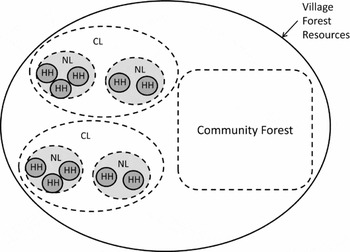
The forest belongs to the state, which ultimately makes decisions about its use, for example, the awarding of timber concessions. Village chiefs are informed of the decision to grant such an award, but they have no say in the decision. The forest, otherwise, is under the jurisdiction of the village chief and les notables because they are the state's representatives. However, they are guided on a day-to-day basis by the customary management system (Diaw Reference Diaw1997, Reference Diaw1998) (Fig. 1). The chief views the task as working together with the whole village rather than as a state representative. One chief stated, ‘The chief can't manage alone. He is not the only one responsible for the forest. It is the forest of our ancestors. If we need to manage it then we manage it together.’
General schematic showing spheres of influence of village level actors in management of village forest resources. Village forest resources are under the control of the state and are managed by the village council. Community forests are managed by the community forest management committee. CL = corporate lineage; NL = nuclear lineage; HH = household.

In theory the chief and les notables have the power to tell people where to cultivate or establish a plantation in the primary forest. In practice there is an informal understanding among villagers as to where certain families cut their fields. According to Diaw (Reference Diaw1998), the socialization of individuals within the clan and lineage system means that it is rare for someone to ask for authorization to clear the forest in order to make a field. Commonly, only outsiders need to consult the chief and the village council before clearing forest. In areas where all the forest is secondary growth held under the customary tenure system, decisions that are made about the land are made at either the corporate or nuclear lineage, or the household level. Any dispute between the lineages over the forest and its resources would normally be handled by the village council (Diaw Reference Diaw1998).
More recently, community forests have seen the emergence of other local authorities who have in some way usurped the position of les notables and the village chiefs in regulating forest resources, namely internal and external elites. Such individuals often work in the state bureaucracy with large salaries that offer the possibility of binding village people to them. Their authority is based on their role as mediators between the village and the outside world (Van den Berg & Biesbrouck Reference Van Den Berg and Biesbrouck2000). In one village, the President of the Community Forest Association was a doctor who lived in the city, but who had been born in the village. Internal elites are those who have retired from their positions in the city and moved back home. Two community forests in this study were begun in part at the initiative of such internal elites. While the elites can help a village financially and through mediating contact with the outside world, they also can take advantage of their authority. In some cases they have used their privileged position for their own financial interests. As noted earlier, research on community forests has found that in many cases the control over the forest and its benefits were captured by local elites (Etoungou Reference Etoungou and Ribot2003; Oyono Reference Oyono2004c).
DISCUSSION
One factor important to the success of community forest management is the existence of effective institutions (Pagdee et al. Reference Pagdee, Kim and Daugherty2006), yet the literature review and field results indicates that the institutions put in place during decentralization are ineffective in achieving significant socioeconomic or environmental goals. This lack of effectiveness has been explained, in part, as a result of the imposition of inappropriate institutions that marginalized those who have recognized customary powers and legitimacies over forests, while privileging those to whom decentralization reforms have given power (Oyono Reference Oyono2005c).
A community must create one of four legal entities to obtain a community forest in Cameroon (Ministry of Environment and Forests 1998). This is not without precedent in Africa, where organizations in civil society can in some circumstances be important participants in service delivery and enforcing accountability (Lewis Reference Lewis2002; Akinola Reference Akinola2007). The types of legal entities designated in Cameroon do not bear resemblance to local indigenous institutions for management of natural resources. They are for the most part similar to other organizational structures imposed by the central government for rural reform, such as village development committees (Oyono & Temple Reference Oyono and Temple2003). These entities lack social and historical legitimacy for managing forest resources (Diaw Reference Diaw1997; Oyono Reference Oyono2004a) and, therefore, garner little respect at the local level.
Beyond the lack of legitimacy of the designated institutions for managing community forests, there are often problems in the way that management committee members have been chosen. In spite of the government's statement that the committee must be representative of all sections of the community, in fact they are not. This was particularly evident for the Baka. The process for choosing members in most communities did not reflect the typical process for choosing community leaders, such as chiefs and members of the village council, through consensus or election. The requirement to be of good moral character as a basis of legitimacy appears to have also been neglected. This emphasis on the character of a person as a criterion for being a chief reflects the deeply rooted ideal of ‘equality of all’ in the ethnic groups of this area (Oyono Reference Oyono and Ribot2004a; Van den Berg & Biesbrouck Reference Van Den Berg and Biesbrouck2000). Instead the complicated nature of the imposed system to obtain a community forest opened the door for exploitation by those who had more education, or access to powerful stakeholders in government or the forestry industry. This lack of local participation in choosing committee members in turn led to the view that the committee was accountable only to the central government, and not to the local population. With little government enforcement of forest management practices, committees are not held accountable and the forest is not being managed sustainably (De Blas et al. Reference De Blas, Ruiz Pérez, Sayer, Lescuyer, Nasi and Karsenty2009).
Given the limitations of such institutional arrangements, it is appropriate to ask how these problems in structuring CBNRM can be remedied in future situations. Which local institutions are most appropriate at the local level: traditional institutions, neo-traditional institutions or externally introduced ‘modern’ institutions? Some feel that only democratic decentralization of natural resource management, which has not happened in Cameroon's forestry sector, will lead to truly representative management committees that are downwardly accountable to local people (Ribot Reference Ribot2002, Reference Ribot2004). In fact, Ribot (Reference Ribot2008) stated that agencies intervening in the environmental arena have a responsibility to build local democracy through their natural resource interventions. Any new local institution ideally should be subject to a democratic local government (Ribot Reference Ribot2008). This is a challenge, as in many countries governments may not be elected democratically and government officials are seldom downwardly accountable to the local population.
At the community level, it is important that institutions empowered by decentralization policies to manage natural resources reflect the criteria for local legitimacy. Kayambazinthu et al. (Reference Kayambazinthu, Matose, Kajembe, Nemarundwe, Kowero, Campbell and Sumaila2003) stated that institutions that are better integrated in terms of traditional sociocultural traits and incentives, and are given moral and political legitimacy at the local level, are more stable and enduring. This does not necessarily mean an uncritical reinstatement of traditional authorities, but rather recognition of the local system of accountability. For example, in the humid forest zone of Cameroon, the system of accountability for forest resources included those with historical traditional authority, in the form of lineage heads, as well as the village chief, a legacy of colonial power. In keeping with the ideals of liberal democracy, it also potentially included other members of the village council who are representative of other sections of the community. Community forest management committees may be more successful if they are a hybrid of customary authorities and other segments of the population, capturing the best of historical social regulation. The choice of members should also follow the criteria for local legitimacy, which in Cameroon, as in many countries, is having a good moral character. A local committee formed in this way may be seen as being accountable to the local population.
Defining the role of traditional authorities within new systems of democratic governance is increasingly being practised in African countries (Kyed & Buur Reference Kyed, Buur, Buur and Kyed2007), but not without problems. In Zimbabwe, the ‘unholy alliance’ between the ruling party, the chiefs, and other lower tier traditional leaders has undermined the last's capacity to function as neutral arbitrators in natural resource management (Mapedza Reference Mapedza, Buur and Kyed2007). They have in many cases become pawns in the political game of the ruling party. In Africa, the recognition of traditional authority within the context of democratization is often directly or indirectly combined with regaining state control over people, territory and resources (Kyed & Buur Reference Kyed, Buur, Buur and Kyed2007). Such processes are often influenced by the state authorities’ patronage interests and the relative economic value of the resources (Nelson & Agrawal Reference Nelson and Agrawal2008). The placement of local management committees within a system of accountability to a democratic local government may serve in helping to limit corruption.
Community forest management can also be an entry point for governance reform, as the transfer of rights over resources can be a tool for opening public space, and turning ‘participation’ into the basis for future democracy (Brown et al. Reference Brown, Schreckenberg, Shepherd and Wells2002b). Nepal was one of the first countries to have a national forestry policy allowing communities to be involved in managing forest resources (Brown et al. Reference Brown, Malla, Schreckenberg and Springate-Baginski2002a; Dangol Reference Dangol and Colfer2005). Through the work of a local NGO with an emphasis on equity, democracy and transparency, community forest user groups were able to minimize corruption and elite capture. According to the World Bank (2008), these committees were the only democratically elected bodies in Nepal in 2004. This experience showed not only the potential of community forestry to bring about governance reform, but also the importance of the involvement of skilled facilitators and group analysis in that process (Dangol Reference Dangol and Colfer2005; World Bank 2008).
CONCLUSIONS
Community-based approaches have great potential for sustainable resource management, however CBNRM can be rendered ineffective if schemes are not implemented in such a way as to ensure that management institutions are legitimate and accountable at the local level. Imposition of inappropriate institutions, which did not reflect local systems of accountability in resource management, was a key limitation to successful socioeconomic and ecological outcomes from community forestry management in Cameroon. It is possible that institutions would be more effective in managing community forests if they included those who have held traditional authority over forests and who therefore may hold more legitimacy at the local level. Results from the humid forest zone of Cameroon, showed that, prior to the implementation of the 1994 forestry law, management of forest resources at the local level was in the hands of corporate lineage leaders, village chiefs and the village council. Village councils are made up of heads of corporate lineages and also potentially include women and youth representatives. A key criterion in choosing a village chief or member of the village council was their being of good moral character.
In overcoming the challenges of CBNRM, it is possible that the formation of hybrid institutions composed of customary authorities and representatives of other segments of the population chosen by locally legitimate means may successfully promote sustainable management. However, such institutions are not without their risks. Therefore, it is important that these institutions be accountable to a local democratic government to further increase their transparency and accountability. While implementation hurdles remain, given the current development policy context, it may no longer be a question as to whether decentralized natural resource management will be better or worse, but rather how it can be made to work (Larson Reference Larson2002).
ACKNOWLEDGEMENTS
The Center for International Forestry Research hosted this research and the Central African Regional Program of the Environment of the World Wildlife Fund and Cornell University funded the fieldwork. The cooperation of the local communities in data collection was greatly appreciated. We would also like to thank Phil René Oyono for his helpful comments on an earlier version of this manuscript, while three reviewers substantially improved this paper.