Introduction
Strawberry is an important small-fruit crop in Florida. During the 2017–2018 growing season, Florida growers harvested a total of 124 million kg of strawberries from 3,966 ha, with a value of more than $281 million (USDA-NASS 2019). Florida strawberries are grown as a winter annual crop in a plasticulture production system. This production system involves the preparation of raised beds with drip tape installed and covered with polyethylene mulch (Fennimore and Boyd Reference Fennimore, Boyd, Korres, Burgos and Duke2019; Yu and Boyd Reference Yu and Boyd2017). In the primary production area of Florida, strawberries are typically planted between September and early October, and berry harvests begin in November and terminate in March, when berry price and quality start to decline. Florida is the major supplier of strawberries during winter months when other states are unable to produce berries (Fennimore and Boyd Reference Fennimore, Boyd, Korres, Burgos and Duke2019). For this reason, berries produced in Florida usually sell for a premium price during the early growing season in December and January (Nyoike and Liburd Reference Nyoike and Liburd2014).
The adoption of plasticulture in strawberry production has many benefits, such as improved water-use efficiency, increased soil temperature, soil-water conservation, and weed suppression (Bonanno Reference Bonanno1996; Fernandez et al. Reference Fernandez, Butler and Louws2001; Locascio et al. Reference Locascio, Gilreath, Olson, Hutchinson and Chase2005; Poling Reference Poling1993; Yu et al. Reference Yu, Nathan and Guan2018). Plastic mulch can improve fumigant efficacy for pest control by trapping fumigants during preplant fumigation (Lamont Reference Lamont1996; Stapleton Reference Stapleton1996). However, the adoption of plasticulture makes strawberry one of the most expensive crops to grow, due, in part, to the high cost of bed preparation and installation of plastic mulch and the irrigation system (Nyoike and Liburd Reference Nyoike and Liburd2014). To reduce the production cost, Florida strawberry growers are increasingly interested in reusing the same beds and plastic mulch for growing multiple crops. This is accomplished by planting the second crop in the same bed and plastic mulch before (relay cropping) or after (multicropping) the termination of strawberries (Nyoike and Liburd Reference Nyoike and Liburd2014; Yu et al. Reference Yu, Nathan and Guan2018).
After final strawberry harvest, strawberries and weeds present in the field need to be removed by hand when relay cropping (Duval Reference Duval2005; Santos et al. Reference Santos, Esmel, Slamova and Golden2008; Yu et al. Reference Yu, Nathan and Guan2018). However, when multicropping is adopted, strawberry plants need to be desiccated and late-emerging weeds need to be controlled with nonselective herbicides that are broadcast applied over the entire field or with fumigants injected through drip tape (Fennimore and Boyd Reference Fennimore, Boyd, Korres, Burgos and Duke2019; Stapleton Reference Stapleton1996). In Florida, strawberries are typically grown in sandy soil with low levels of organic matter (USDA 2019). Because of this soil type, drip-applied fumigants may not effectively move with irrigation water to the edges of the beds, which may result in poor weed control on the edges of the beds (Candole et al. Reference Candole, Csinos and Wang2007; Jacoby Reference Jacoby2012). In addition, most currently available fumigants do not provide effective control of perennial nutsedge spp. (Cyperus spp.) (Fennimore and Boyd Reference Fennimore, Boyd, Korres, Burgos and Duke2019; Hanson and Shrestha Reference Hanson and Shrestha2006; Yu et al. Reference Yu, Sharpe and Boyd2019). Moreover, fumigants are generally more expensive than herbicides. For these reasons, use of nonselective herbicides is sometimes a better choice, particularly when multicropping is practiced.
Diquat and paraquat are bipyridylium herbicides and are commonly used as desiccants for preharvest burndown. These herbicides inhibit photosynthesis by blocking electrons from the electron transport chain at photosystem I, which generate a series of reactive oxygen species, including superoxide radicals, hydrogen peroxides, and hydroxyl radicals (Shaner Reference Shaner2014). The reactive oxygen species can destroy unsaturated lipids, including membrane fatty acids and chlorophyll, which ultimately cause plant death (Shaner Reference Shaner2014). Glufosinate inhibits the activity of glutamine synthetase (Lea et al. Reference Lea, Joy, Ramos and Guerrero1984), and the enzyme converts glutamate and ammonia to glutamine (Tachibana et al. Reference Tachibana, Watanabe, Sekizawa and Takematsu1986). Ammonia accumulation in plants destroys plant cells and inhibits photosystem I and II reactions (Hess Reference Hess2000; Wild et al. Reference Wild, Sauer and Rühle1987). Among these nonselective herbicides, paraquat is the only herbicide currently registered for after-harvest strawberry termination (Anonymous 2017a).
Current diquat and glufosinate labels do not include strawberry crop termination (Anonymous 2015, 2017b, 2017c). However, due to new restrictions on paraquat use, growers are looking for alternative products to be registered for crop termination. Growers are interested in diquat for crop termination because it is safer than paraquat and has fewer label restrictions (Fortenberry et al. Reference Fortenberry, Beckman, Schwartz, Prado, Graham, Higgins, Lackovic, Mulay, Bojes and Waltz2016; US EPA 2019). Moreover, the use of herbicides with an alternative mode of action such as glufosinate is desirable because of the increasing incidence of paraquat-resistant weeds (Buker et al. Reference Buker, Steed and Stall2002; Busi and Powles Reference Busi and Powles2011; Chiang et al. Reference Chiang, Wu, Chiang and Wang2008; Hidayat et al. Reference Hidayat, Baker and Preston2006). In this particular study, we applied multiple rates of glufosinate and diquat to determine if they were effective and what rate achieved optimal control in strawberry. Therefore, the objective of this research was to (1) find potential replacements to paraquat, and (2) compare the efficacy of diquat, paraquat, and glufosinate, and determine the optimum herbicide rate for strawberry termination.
Materials and Methods
Three field experiments were conducted at the Gulf Coast Research and Education Center (27.7594°N, 82.2612°W) in Balm, FL, to evaluate diquat (Reglone® Desiccant; Syngenta Crop Protection, LLC, Greensboro, NC), paraquat (Gramoxone® SL 2.0; Syngenta Crop Protection), and glufosinate (Rely®; Bayer CropScience LP, Research Triangle Park, NC) efficacy for annual strawberry termination. The experiments in 2017 had two experimental runs and were performed in separate locations at the research center. Soil was a Myakka fine sand (sandy, siliceous, and hyperthermic Aeric Alaquods) with 1.5% organic matter and pH 6.0.
Beds were formed, drip tapes installed, and the beds were covered with virtually impermeable, polyethylene film mulch (Berry Plastics Corp., Evansville, IN) in late August 2016 and 2017. Two rows of strawberry transplants were planted per bed with 38-cm spacing between plants in early October 2016 and 2017. The plots were fertilized and irrigated throughout the season per industry standards (Whitaker et al. Reference Whitaker, Boyd, Peres, Desaeger, Noling, Lahiri, Dittmar, Freeman, Paret and Smith2019).
The treatment design was a factorial arrangement of herbicide and herbicide rate. Each plot was a single, 4.5-m long bed. Herbicide treatments included diquat, paraquat, and glufosinate. Diquat and paraquat were applied at 0, 140, 280, 560, 1,120, or 2,240 g ai ha−1; glufosinate was applied at 0, 164, 328, 656, 1,312, or 2,624 g ai ha−1. Herbicide rates were based on 0×, 0.25×, 0.5×, 1.0×, 2.0×, and 4.0× the recommended rate on the herbicide label, where the 1.0× rate of diquat or glufosinate was the rate registered for preharvest desiccation of other crops or preplant burndown of weeds. Herbicide treatments were applied after final harvest on April 11 and 18, 2017 and April 3, 2018, with a backpack sprayer (Bellspray Inc., Opelousa, LA) equipped with a single flat-fan nozzle (8002EVS; TeeJet Spraying Systems Co., Roswell, GA) delivering 187 L ha−1 water. Herbicide treatments were applied on April 11, 2017, April 18, 2017, and April 3, 2018.
Visual strawberry control (i.e., leaf chlorosis, necrosis, and stunting) was evaluated 7 and 14 d after treatment (DAT) on a percentage scale, where 0 was no control and 100 represented complete plant death. Strawberry control ratings did not occur after 14 DAT, because the plants began to recover and the highest level of control was observed 14 DAT. Strawberry desiccation was evaluated using the point-transect method, using a quadrat in which strings were spaced equally to form a grid. The quadrat contained a total of 121 crosshairs (i.e., points where two strings crossed one another). At 14 DAT, the quadrat was randomly placed at two locations in each plot and the number of crosshairs with green material was counted. The herbicide efficacy of foliar desiccation relative to the nontreated control was calculated.
Experiments were randomized complete blocks with four blocks. Strawberry cultivars, including ‘Florida 127,’ ‘Radiance,’ ‘12121-5,’ and ‘Winterstar’ were the blocking factor in each experimental run. Data were analyzed in SAS, version 9.4 (SAS Institute Inc., Cary, NC), and the Levene test for homogeneity of variances was conducted before combining the data from the experimental runs. Strawberry control and desiccation data were regressed with the following two-parameter growth function equation (Equation 1):
 $$y = {\rm{ }}{{\rm{\beta }}_{\rm{0}}}\,\left\{{{\rm{1}} - \left[ {{\rm{exp}}\left( { - {{\rm{\beta }}_{\rm{1}}}x} \right)} \right]} \right\}$$
where y is plant response, β0 is the asymptote, β1 the slope estimate, and x is herbicide rate. The effective herbicide rates that provide 50% (C50) and 80% (C80) strawberry control and 50% (D50) and 80% (D80) desiccation were determined from the regression equation. These values were chosen because 50% control or desiccation indicates significant herbicide activity, and 80% control or desiccation may be considered acceptable efficacy for strawberry termination. The 95% confidence intervals (CIs) for these values were determined in SigmaPlot, version 12.5 (Systat Software Inc., San Jose, CA) with the aforementioned two-parameter regression analysis.
Results and Discussion
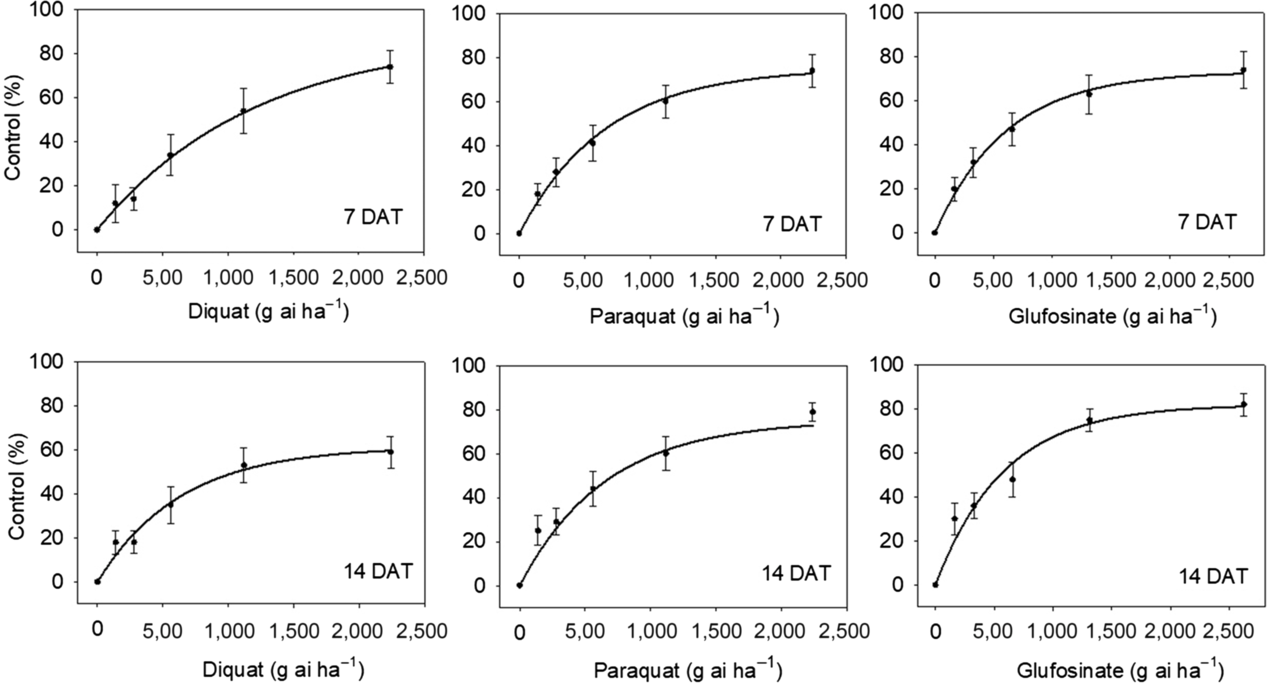
Results for strawberry control and desiccation were pooled over three experimental runs, because we lacked an experimental run–by-treatment interaction. Strawberry termination improved with increasing rate of all herbicides at 7 and 14 DAT (Figure 1). The highest rate each of diquat, paraquat, and glufosinate provided 74%, 75%, and 74% control of strawberry at 7 DAT, respectively, and provided 59%, 79%, and 82% control at 14 DAT, respectively. At 7 and 14 DAT, the C50 for diquat, paraquat, and glufosinate was 1,050, 700, and 720 g ha−1, and 1,100, 650, and 550 g ha−1, respectively (Table 1). At 14 DAT, C80 for diquat and paraquat was greater than 2,240 g ha−1, and for glufosinate was 2,020 g ha−1.
Strawberry control after diquat, paraquat, and glufosinate applications in field experiments in 2017 and 2018, Balm, FL. Strawberry control data are presented on a percent scale, where 0 is no control and 100 represents complete plant death. Results were pooled over three experimental runs. Vertical bars represent SE of the mean (n = 12). Abbreviation: DAT, d after treatment.

Estimates from regression analysis for 50% and 80% strawberry control at 7 and 14 d after diquat, paraquat, and glufosinate applications in field experiments in Balm, FL, in 2017 and 2018.a

a Data were regressed with the equation  $y = {\rm{ }}{{\rm{\beta }}_0}\,\left\{ {1{\rm{ }} - {\rm{ }}\left[ {{\rm{exp}}\left( { - {{\rm{\beta }}_1}x} \right)} \right]} \right\}$
, where y is plant response, β0 is the asymptote, β1 the slope estimate, and x is herbicide rate. The effective herbicide rates required to provide 50% and 80% strawberry control was determined from the regression equations.
b Abbreviations: C50, 50% herbicide control of strawberry; C80, 80% herbicide control of strawberry; CI, confidence interval; DAT, d after treatment; MSE, mean squared error; NA, not applicable.
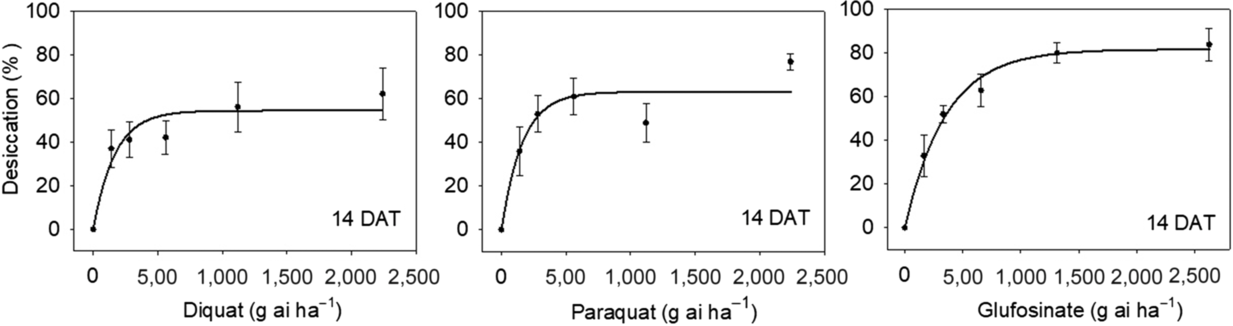
Strawberry desiccation increased with increasing rate of diquat and paraquat, but never exceeded 62% and 77%, respectively (Figure 2). The highest rate of glufosinate caused 84% foliar desiccation. The D50 for diquat, paraquat, and glufosinate was 480, 550, and 330 g ha−1, respectively, and the D80 was greater than 2,240 g ha−1 for diquat and paraquat, and 1,150 g ha−1 for glufosinate (Table 2).
Strawberry foliar desiccation after diquat, paraquat, and glufosinate applications in field experiments in 2017, Balm, FL. Strawberry desiccation data are presented on a percent scale, where 0 is no desiccation and 100 represents complete foliage desiccation. Results were pooled over two experimental runs. Vertical bars represent SE of the mean (n = 8). Abbreviation: DAT, d after treatment.

Estimates from regression analysis for 50% and 80% foliar desiccation at 14 d after diquat, paraquat, and glufosinate applications in field experiments in Balm, FL in 2017 and 2018.a

a Data were regressed with the equation
$y = {\rm{ }}{{\rm{\beta }}_0}\,\left\{ {1{\rm{ }} - {\rm{ }}\left[ {{\rm{exp}}\left( { - {{\rm{\beta }}_1}x} \right)} \right]} \right\}$
, where y is plant response, β0 is the asymptote, β1 the slope estimate, and x is herbicide rate. The effective herbicide rates required to provide 50% (D50) and 80% foliar desiccation (D80) were determined from the regression equations.
b Abbreviations: CI, confidence interval; D50, 50% strawberry plant desiccation; D80, 80% strawberry plant desiccation; MSE, mean squared error; NA, not applicable.
Diquat, paraquat, and glufosinate are commonly used for preharvest burndown. At present, diquat at 420 to 560 g ha−1 is registered for preharvest desiccation of canola (Brassica napus L.) and potato (Solanum tuberosum L.). Paraquat, at 335 to 560 g ha−1, is registered for preharvest desiccation of a variety of crops, such as canola, dry beans (Phaseolus vulgaris L.), and potato, and, at 670 to 1,050 g ha−1, is registered for after-harvest desiccation of tomato (S. lycopersicum L.). Glufosinate, at 430 g ha−1, is registered for preharvest desiccation of potato. In this study, results showed the recommended label rates of diquat, paraquat, and glufosinate for preharvest desiccation of other crops, or paraquat for after-harvest desiccation of tomato provided less than 80% strawberry control and, therefore, were ineffective for strawberry termination. Overall, results suggest that higher herbicide rates are needed for effective strawberry termination. However, we postulate that greater strawberry termination can probably be achieved by using higher spray-solution volumes (>187 L ha−1) for better penetration into the strawberry canopy, thus achieving better coverage.
There is limited research reporting the relationship between antioxidant capacity and detoxification of diquat or glufosinate in plants; however, plant tolerance to paraquat has been related to its scavenging capacity for reactive oxygen species (Bowler et al. Reference Bowler, Slooten, Vandenbranden, Rycke, Botterman, Sybesma, Montagu and Inzé1991, Reference Bowler, Montagu and Inzé1992; Ekmekci and Terzioglu Reference Ekmekci and Terzioglu2005; Iannelli et al. Reference Iannelli, Van Breusegem, Van Montagu, Inzé and Massacci1999; Kraus et al. Reference Kraus, McKersie and Fletcher1995). For example, Ananieva et al. (Reference Ananieva, Christov and Popova2004) reported that pretreatment with salicylic acid enhanced the expression of the antioxidant enzymes dehydroascorbate reductase (enzyme commission no. [EC] 1.8.5.1) and guaiacol peroxidase (EC 1.11.1.7) in barley (Hordeum vulgare L.), which, in turn, antagonized the phytotoxic effect of paraquat. Strawberry plants are rich in various antioxidant enzymes, such as ascorbate peroxidase (EC 1.11.1.11), catalase (EC 1.11.1.6), and superoxide dismutase (EC 1.15.11) (Muradoglu et al. Reference Muradoglu, Gundogdu, Ercisli, Encu, Balta, Jaafar and Zia-Ul-Haq2015; Wang and Lin Reference Wang and Lin2000; Wang and Zheng Reference Wang and Zheng2001). In this study, a relatively high rate of diquat, paraquat, or glufosinate was needed for strawberry termination, possibly due to the high content of antioxidant enzymes in strawberry plants that have scavenged a portion of reactive oxygen species after the herbicide application, although there is no clear evidence to support this assumption.
In summary, these results suggest glufosinate is the most effective herbicide for strawberry termination, whereas diquat is the least effective herbicide. Based on these results, the recommended label rates of diquat, paraquat, and glufosinate for preharvest desiccation of other crops or weed control are ineffective for controlling strawberry; as a result, high rates are needed for effective strawberry termination.
Acknowledgements
This research received no specific grant from any funding agency, commercial or not-for-profit sectors. No conflicts of interest have been declared. The authors thank Mike Sweat for providing technical assistance and the farm crew at the Gulf Coast Research and Education Center for assistance with crop management.