INTRODUCTION
Depression is a frequent problem in cancer patients, with an estimated frequency of 16.3%, according to the Diagnostic and Statistical Manual of Mental Disorders (DSM) or International Classification of Diseases (ICD) criteria (Mitchell et al., Reference Mitchell, Chan and Bhatti2011a). Depression leads to a reduction in quality of life, along with an aggravation of physical symptoms such as pain, fatigue, and anxiety (Lloyd-Williams et al., Reference Lloyd-Williams, Dennis and Taylor2004; Delgado-Guay et al., Reference Delgado-Guay, Parsons and Li2009). Moreover, recent studies have shown that depression is an independent predictive factor for cancer-related mortality (Lloyd-Williams et al., Reference Lloyd-Williams, Shiels and Taylor2009; Satin et al., Reference Satin, Linden and Phillips2009).
Almost half of cancer patients who have depression are not treated for the depression, (Pascoe et al., Reference Pascoe, Edelman and Kidman2000; Lawrie et al., Reference Lawrie, Lloyd-Williams and Taylor2004) although the benefit of such treatment has been well established (Breitbart, Reference Breitbart1995; Newell et al., Reference Newell, Sanson-Fisher and Savolainen2002; Uitterhoeve et al., Reference Uitterhoeve, Vernooy and Litjens2004; Rodin et al., Reference Rodin, Lloyd and Katz2007; Strong et al., Reference Strong, Waters and Hibberd2008; Rayner et al., Reference Rayner, Price and Evans2011a). This situation can be explained by the difficulties encountered in diagnosing depression in this patient population. Patients may show a mix of symptoms related to cancer, depression, and other psychiatric disorders (e.g., anxiety and adaptation disorders), some of which may have multiple etiologies (such as fatigue, anorexia, and sleep disorders) (Clayton, Reference Clayton1974).
Other factors also play a part in the underdiagnosis of depression among cancer patients, including the stigmatization of psychiatric disorders by patients, families, and even health professionals. The patient–health professional emotional countertransference (i.e., the therapist's emotional involvement with a client) (Hughes & Kerr, Reference Hughes and Kerr2000) may generate an attitude of avoidance, doubt about the effectiveness of treatment, fear, and reluctance to use psychotropic drugs even though there are recommendations backing the value of drug treatment (as long as the customary precautions are followed) (Steinman et al., Reference Steinman, Frederick and Snowden2007). Another factor that may play a role in the underdiagnosis of depression in cancer patients is the frequent assumption that depression is normal in a cancer patient, indicating common confusion between sadness and depression.
In patients with cancer, an interview conducted by an experienced psychiatrist based on the criteria of the DSM, Fourth Edition remains the gold standard for depression diagnosis (Power et al., Reference Power, Kelly and Gilsenan1993). However, few oncology or palliative care (PC) teams include a psychiatrist. Consequently, it is essential that screening be conducted by the general practitioner, oncologist, or nursing staff (Stiefel et al., Reference Stiefel, Die Trill and Berney2001).
Recently, the diagnosis of depression by oncologists was investigated, and it was found that physicians did not identify a large majority of patients who were depressed according to the Zung Self-Rating Depression Scale (Passik et al., Reference Passik, Dugan and McDonald1998); the same outcome was observed when nurses or general practitioners were asked to make the diagnosis (Little et al., Reference Little, Dionne and Eaton2005; Mitchell et al., Reference Mitchell, Vaze and Rao2009, Reference Mitchell, Rao and Vaze2011b).
In order for the diagnosis of depression to be reliable, physicians need to undergo specialized training and dedicate time to identifying this pathology. Several tools for depression screening and diagnosis have been developed that can be used by healthcare providers with no previous psychiatric experience. The latest European Association for Palliative Care recommendations concerning depression suggest that the use of structured tools is more effective than an intuitive diagnosis (Stiefel et al., Reference Stiefel, Die Trill and Berney2001; Rayner et al., Reference Rayner, Price and Hotopf2011b). Furthermore, the last update of the guideline for distress management from the National Comprehensive Cancer Network (NCCN) suggests that all the patients should be screened to check their level of distress at their initial visit by using screening tools as the distress thermometer (Holland & Alici, Reference Holland and Alici2010) . Despite the growing knowledge and national and international guidelines recommending systematic screening and active management of depression, implementation in daily clinical practice remains difficult (Mitchell et al., Reference Mitchell, Kaar and Coggan2008; Jacobsen et al., Reference Jacobsen, Shibata and Siegel2010). To our knowledge, there is no study exploring depression assessment strategies of PC physicians and oncologists.
The main objective of this study was to evaluate and improve the depression assessment strategies of PC physicians and oncologists.
METHOD
This study was approved by the local ethics committee and Institutional Review Board of the coordinating center (Hospices Civils de Lyon) in compliance with French law and the Declaration of Helsinki included all amendments and revisions. Computerized data were processed anonymously. Oral information about the study and its aim was given to all participants, and all gave consent before enrolling on the study.
This prospective pilot multicenter study was conducted in institutions that treat cancer patients on an outpatient basis. To collect data representing a wide spectrum of oncology and palliative care specialists, we chose to conduct this study in three different settings:
• A comprehensive cancer center (Centre Léon Bérard),
• A medical oncology unit in a university hospital (Centre Hospitalier Lyon-Sud, Hospices Civils de Lyon), and
• A private cancer clinic (Clinique Francois Chenieux in Limoges)
Participants
At each of the three cancer centers, we identified physicians who were involved in treating cancer patients in an ambulatory setting. The physicians identified included medical oncologists and PC physicians. All were invited to participate.
To keep our sample homogeneous, we decided not to include surgical oncologists and radiotherapists. At the first center, the comprehensive cancer center, we met the chair of the medical oncology department to explain to him the aim of our study and the methods we planned to use. He then suggested that we present the study during a weekly meeting of all the medical oncologists at the center.
Procedures
For each physician, we documented demographic characteristics, including age, sex, specialty, and years in practice. The study was conducted in five steps
Step 1
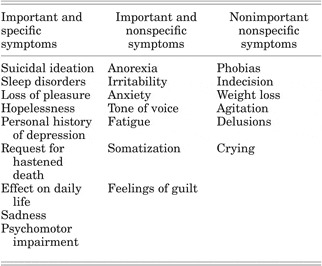
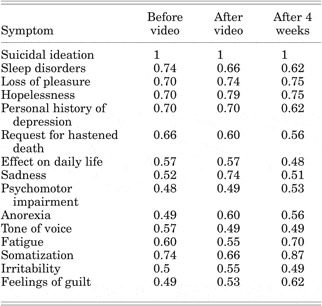
In the “card-rank test,” physicians were invited to classify a total of 22 cards representing different symptoms, some of which are generally recognized as being related to depression (suicidal ideation, sleep disorders, loss of pleasure, hopelessness, personal history of depression, effect on daily life, sadness, psychomotor impairment, and irritability) and some of which are related to depression but not specific to the oncology field (anorexia, anxiety, tone of voice, fatigue, somatization, and feelings of guilt) and some symptoms unrelated to depression (phobias, indecision, weight loss, agitation, delusions, and crying) (Froissart et al., Reference Froissart, Chauchat and Terra1985). This list of symptoms was established based on the current literature having to do with depression in the PC setting (Table 1) (Endicott, Reference Endicott1984; Chochinov et al., Reference Chochinov, Wilson and Enns1994; Akechi et al., Reference Akechi, Okamura and Kugaya2000; Breitbart et al., Reference Breitbart, Rosenfeld and Pessin2000; Emanuel et al., Reference Emanuel, Fairclough and Emanuel2000; Hotopf et al., Reference Hotopf, Chidgey and Addington-Hall2002; Bailey et al., Reference Bailey, Geyen and Scott-Gurnell2005; van der Lee et al., Reference van der Lee, van der Bom and Swarte2005; Rayner et al., Reference Rayner, Loge and Wasteson2009, Reference Rayner, Price and Hotopf2011b).
Symptom importance and specificity for depression diagnosis

We asked participants to sort the cards by importance for the diagnosis of depression by placing each card into one of four envelopes labeled “very important,” “important,” “less important,” and “not important.” They were asked to include at least five cards per envelope.
Step 2
After this baseline test, we showed participants a 6-minute video of a psychiatric consultation (more information about the video is provided later in this article). This consultation was conducted with a volunteer patient at the comprehensive cancer center, who was being evaluated for depressive symptoms.
Step 3
Immediately after the video, the card-rank test was repeated to see if there was an improvement in physicians' scores.
Step 4
After 4 weeks, we asked all participants to repeat the card-rank test to assess the stability of their scores over time.
Step 5
Finally, the physicians were asked to complete a questionnaire about the acceptability and effectiveness of depression screening in cancer patients.
Video Development
The video consultation was performed using a complete consultation between a psychiatrist at the comprehensive cancer center and an actual patient. The patient's gender and type of cancer were chosen to reflect a typical outpatient consultation: a woman with breast cancer discussing adjuvant therapy. Although this video reflected a standard outpatient oncology consultation, the specific focus was on depression assessment. The length of the video was 6 minutes. Five members of our team, including a social scientist specializing in patient communication, reviewed the video for its appropriateness and accuracy. The video was created specifically for this study. The patient was informed of the aim of the video and gave written informed consent (for the videotaping and use of the video). The institutional ethics committee also approved the videotaping and use of the video for this study.
Data Analysis
We summarized physicians' demographic data using descriptive statistics. Univariate analyses were completed to examine associations between physician characteristics and their responses.
For the analysis of the card-rank test, we used conventional parametric methods (comparison tests) and a multivariate analysis of variance. Chi-squared and Fisher exact tests were used to find the relationship between the physicians' demographic variables, scores on the card-rank test, and answers on the questionnaire. For the analysis of the card-rank test, we merged the four subcategories into two main categories (“very important” and “important” into important; “less important” and “not important” into not important). We considered the answer as correct when the participants chose important for the related and specific symptoms and not important for the related and nonspecific symptoms and the unrelated symptoms.
Agreement among physicians on the classification of the importance of the symptoms for depression diagnosis was assessed using Cohen's unweighted κ scores (Mielke et al., Reference Mielke, Berry and Johnston2009). These statistical values are appropriate when there are more than two raters. Kappa values of 0.20–0.40 were considered to indicate a fair level of correlation; 0.40–0.59 were considered to indicate moderate correlation; 0.60–0.79 were considered to indicate substantial correlation; and 0.80 was considered to indicate outstanding correlation (Landis & Koch, Reference Landis and Koch1977).
P < 0.05 was considered significant in all statistical tests. Statistical analyses were performed using SPSS, version 17 software (SPSS Inc, Chicago, IL).
RESULTS
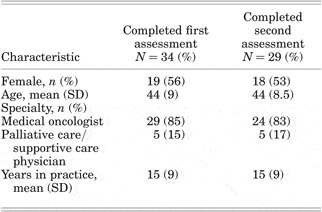
The physicians identified included 19 medical oncologists and 5 PC physicians from the comprehensive cancer center, 6 medical oncologists from the medical oncology unit in the university hospital, and 4 medical oncologists from the private cancer clinic. All of the identified physicians (34) agreed to participate in the study.
Physician characteristics are summarized in Table 2. Most of the participants were oncologists; 34 physicians participated in the first two card-rank tests. For the last card-rank test and the questionnaire, the four oncologists from the private clinic and one of the oncologists from the comprehensive cancer center were unable to participate.
Physician characteristics

SD, standard deviation.
Card-Rank Test Results
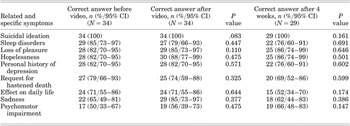
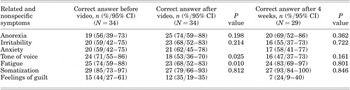
Before the video (Tables 3 and 4), >70% of the participants correctly classified the related and specific symptoms, except for sadness (65%) and psychomotor impairment (50%; Table 3). For the related but nonspecific symptoms, >70% of the participants correctly classified three symptoms: tone of voice (71%), fatigue (74%), and somatization (85%; Table 4).
Rates of correct classification of symptoms related to depression and specific to cancer at baseline, after video, and after 4 weeks

CI, confidence interval.
Rates of correct classification of symptoms related to depression but not specific to cancer at baseline, after video, and after 4 weeks

CI, confidence interval.
We found substantial agreement among the physicians (κ ≥ 0.60) for several symptoms (Table 5):
• For related and specific symptoms:
○ Suicidal ideation, sleep disorders, loss of pleasure, hopelessness, personal history of depression, and request for hastened death
• For related but nonspecific symptoms:
○ Fatigue and somatization
Degreea of agreement among physicians in classification of symptoms related to depression

a Cohen's unweighted κ.
After the video, >70% of participants correctly ranked the related and specific symptoms, with the exception of psychomotor impairment (56%). More than 70% correctly ranked the related but nonspecific symptoms of anorexia (74%) and somatization (79%).
We found substantial agreement (κ ≥ 0.60) between different participants for several symptoms:
• For related and specific symptoms:
○ Suicidal ideation, sleep disorders, loss of pleasure, hopelessness, personal history of depression, sadness, and request for hastened death
• For related but nonspecific symptoms:
○ Somatization and anorexia
After 4 weeks, >70% of participants correctly ranked the related and specific symptoms (Table 3), except for effect on daily life (52%), sadness (62%), psychomotor impairment (66%), and request for hastened death (69%). More than 70% correctly ranked the related but nonspecific symptoms (Table 4) of fatigue (83%) and somatization (93%).
We found substantial agreement (Table 5; κ ≥ 0.60) among the different participants on several symptoms after 4 weeks:
• For related and specific symptoms:
○ Suicidal ideation, sleep disorders, loss of pleasure, hopelessness, and personal history of depression
• For related but nonspecific symptoms:
○ Fatigue and somatization
For several symptoms, we found significant associations between the correctness of the rating and physician characteristics:
• Oncologists were more likely to classify requests for hastened death as not important for a depression diagnosis than were PC physicians (p = 0.009, Fisher exact test).
• Inexperienced physicians (i.e., those with fewer years in practice) were more likely to classify a personal history of depression (p = 0.02) and feelings of guilt (p = 0.006) as important for a depression diagnosis than were experienced physicians.
Questionnaire Results
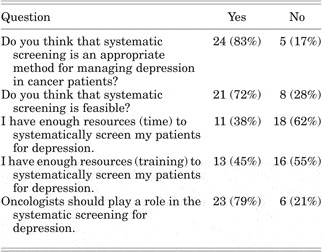
According to our final questionnaire (Table 6), the oncologists and palliative care physicians endorsed systematic screening but also expressed a lack of time for screening patients, and the need for training regarding such screening. They believed themselves to have a role in this process but thought that screening would need to be adapted to their current practice.
Responses to questionnaire about screening acceptability and effectiveness (N = 29)

DISCUSSION
Depression is underdiagnosed among cancer patients; however, our findings suggest that the main cause of this underdiagnosis is not a deficiency in physicians' knowledge about depression. Our findings suggest that the physicians' knowledge levels about depression are quite good, with substantial correctness as to the importance of different symptoms in a depression diagnosis. These results seemed to remain stable before and after the educational video and over time (4 weeks; Tables 3 and 4). Our assessments suggest that most of the oncologists were already quite well trained and, therefore, that the educational video was not needed to modify their knowledge.
Our data suggest that oncologists and PC physicians had very good baseline knowledge about the symptoms specific and related to depression in an oncology setting. There was less understanding about related but nonspecific symptoms. However, the physicians appeared to be quite capable of determining potential confounding factors for nonspecific symptoms that could decrease their relevance for the diagnosis of depression. Furthermore, in daily clinical practice, physicians reported using the major correlates of depression (related and specific symptoms) for the diagnosis of depression among their population of cancer patients. The lack of improvement in the rates of correct symptom classification over time suggests that the video education program was unsuccessful in improving knowledge and understanding of the nonspecific symptoms. The physicians were scoring the specific and related symptoms very well at baseline and therefore did not need much improvement.
Our findings suggest that the educational video intervention did not improve the physicians' diagnostic skills. For the related and specific symptoms, this was simply because the physicians were already well trained. For the related but nonspecific symptoms such as irritability, about which the physicians were less knowledgeable at baseline, our findings should be used to improve medical schools' undergraduate and postgraduate curricula and their handling of depression.
Therefore, the problem of underdiagnosis is probably related to the working environment (including logistical issues such as time available for each patient in the clinic) rather than a lack of knowledge. Our findings also suggest that the video education program was not effective. Therefore, we can suspect that rather than trying to improve medical knowledge about depression diagnosis, we should try to improve physicians' interview skills with formal training in communication to increase their efficiency and comfort while exploring psychosocial concerns (Barth & Lannen, Reference Barth and Lannen2011; Lenzi et al., Reference Lenzi, Baile and Costantini2011). Oncologists and PC physicians reported that they had limited time to diagnose depression. They also reported that they needed training (i.e., how to ask patients about suicidal ideation, what type of antidepressants they should prescribe, and when patients should discontinue antidepressants) to increase their level of comfort with exploring depression symptoms.
Our results suggest that the lack of time reported by oncologists might be a better explanation for depression's underdiagnosis than a lack of training. We should help physicians manage the flow of patients to improve depression's assessment. For example, patients screening positive for depression on a single-item screening questionnaire such as the one mentioned earlier in this section might be given appointments late in the day, allowing physicians to spend more time on these patients' assessment and treatment without disturbing the clinic schedule. Additionally, it is important to reinforce collaborations and links between oncologists and PC physicians and psychiatrists to allow for early referrals of patients for treatment of depression.
As for pain, until we succeed in implementing the general recommendation to systematically screen for emotional distress, depression will remain underdiagnosed and undertreated (Holland & Bultz, Reference Holland and Bultz2007).
Structured clinical interviews are considered the gold standard for the diagnosis of depression because of their rigorous criteria (Spitzer et al., Reference Spitzer, Williams and Gibbon1992). However, these interviews have the disadvantage of being time consuming and therefore expensive to use, and of requiring a significant amount of training for their proper administration and scoring (Lynch, Reference Lynch1995). On the other hand, the administration and scoring of single-item screening questionnaires is easy, and these constitute an interesting alternative approach for assessing depression in cancer patients. Therefore, we recommend conducting depression screening in daily clinical practice using self-assessment forms that can then be brought to the attention of the physician or that can be administered by nurses or other healthcare professionals before patients are seen in the oncology clinic. Further research is needed to gauge the effect of such assessments on patient care patterns but also to determine the best way to inform oncologists about the rapid screening tools and to increase their use in outpatient clinics.
During this study, we were surprised to have such a high rate of participation (100%). We can suggest two main reasons for this high rate of participation:
• The first center to participate was the comprehensive cancer center, and the first two participants were the chair of the department and his co-director. This engagement by the leaders of the department probably helped us to recruit all the other oncologists at the center. When we went to the other centers, the oncologists there were impressed by the high rate of participation at the first center, and it was therefore easier to motivate them to participate in our study.
• We developed our methodology with an oncologist and a psychiatrist to ensure that it would be adaptable to the oncologist's practice. That is why we chose to use the card-rank test and the video.
However, our sample was a select group (physicians caring for cancer outpatients) of medical oncologists and PC physicians. There may be oncologists who know much less about depression who could benefit from a video intervention such as the one that we developed and tested here. Furthermore, our sample of PC physicians was very small (n = 5), and it will not allow us to extrapolate our results. The next step would be to perform assessments among a wider group of oncologists and other physicians and to test the selective use of the video and/or other interventions with those who score poorly in their baseline assessment.
The lack of improvement after watching the video could be caused by the small size of the cohort tested. However, our findings were very encouraging with regard to the physicians' basic knowledge, attitudes, and beliefs regarding depression in the oncology and PC setting.
Depression worsens the symptom burden and prognosis of cancer patients (Lloyd-Williams et al., Reference Lloyd-Williams, Dennis and Taylor2004, Reference Lloyd-Williams, Shiels and Taylor2009; Satin et al., Reference Satin, Linden and Phillips2009); however, depression in this specific setting remains underdiagnosed and undertreated, despite its severe effect on the quality of life of cancer patients. It is a “silent” symptom that is very often neglected by caregivers and physicians, who mistake it for sadness, which is a common understandable emotion among patients facing life-threatening diseases. Further research is necessary to confirm our results and test methods of improving the working environment to positively affect depression assessment and, consequently, patients' quality of life.
ACKNOWLEDGMENTS
We thank Maude Veech and Stephanie Deming for their manuscript review. This research was supported by a grant from the Association de Prévoyance Interprofessionnelle des Cadres et Ingénieurs de la région Lyonnaise foundation and Eli Lilly and Company Foundation (200012051).