There is general agreement that the number of individual investors in financial securities grew on both sides of the Atlantic from the late-nineteenth century onward. This rise in the numbers of shareholders came to be called “people’s capitalism,” “shareholder democracy,” and “democratization of investment.” Footnote 1 The term democratization indicates diffusion of shareholdings and the rise in number of relatively small-scale shareholders. The latter, the investors of “moderate means,” as Berle and Means put it many decades ago, Footnote 2 have always been at the core of financial discussions. Nevertheless, research on the size of shareholder populations in the United Kingdom and the United States has been fragmented, with little overall or comparative perspective. Footnote 3
Focus on the importance of small shareholders can capture significant aspects of financial development because “confident” minority investors are generally related to ease in raising capital by firms. Shifts in market participation rates are thus generally related to the number of listed firms and their size, the value of stock markets, and historical developments in both corporate finance and the structure of stock exchange markets. This is why, before the 1970s, empirical research on financial development both in the United Kingdom and United States was mostly driven by attempts to quantify the extent of shareholder diffusion. In addition, empirical estimates of the extent of the democratization of investment were rooted in the debates and policy conflicts linked to the causes of stock exchange development.
There has been dramatic growth in market capitalizations of stock markets in both more and less developed economies post-1980s, and shareholder and shareholding numbers are relatively well recorded. Footnote 4 In this financial landscape, the effort involved in estimating the extent of shareholder diffusion and democratization may seem redundant in the context of financial debates. This was not the case in the past. Understanding the size and nature of the shareholder population was seen as a key issue in the rather heated topic of the drivers of stock exchange financial development. The number of shareholders relative to the overall population of a country is (and was) perceived as a critical factor in explaining not only structures in corporate finance, but also in political and economic preferences, market developments, and overall economic activity and welfare economics. Footnote 5
This study offers a comprehensive review of the existing literature on the historical evolution of shareholder populations on both sides of the Atlantic from the end of the nineteenth century to 1970. The pulling together of available historical estimates of UK and U.S. shareholder numbers, even though they may only be approximations, allows significant differences in trends between the United Kingdom and the United States from 1895 to 1970 to be identified. Within the scope of this comparative study, we aim to highlight some important factors behind those trends not covered in the existing literature. Footnote 6 Finally, this article also explores what triggered the studies that produced these estimates of shareholder numbers, and how these estimates influenced the political and corporate governance debates of the day, such as those that followed in the wake of the crash of 1929 in the United States and after World War II in the United Kingdom.
Trends in UK share ownership, documented by Rutterford, Green, Owens, and Maltby, have highlighted rising shareholder numbers from the 1870s to World War I, boosted by a growing financial press, a plethora of new issues, aggressive marketing by company promoters, extensive investor education, and access to a wide range of securities in both domestic and international concerns. Explanatory factors also include the development of diversified investment vehicles, such as investment trusts, which blossomed in the United Kingdom from as early as the 1860s. Footnote 7 In the United States, commentators became aware of significant growth in shareholder numbers during the 1920s, a decade that saw campaigns by companies to encourage employees and customers to invest in their securities and a boom in investment trusts. Footnote 8 Aggressive marketing campaigns in the 1920s and after World War II by brokerage firms and the New York Stock Exchange (NYSE) also helped to substantially boost U.S. shareholder numbers, as did the promotion of investment trusts in the 1920s. In the United Kingdom, by contrast, there were no major efforts to promote shareholder democratization. Neither did the London Stock Exchange engage in campaigns, as did the NYSE, to improve business for its broker members. It was not until the relatively low-key UK corporate-sponsored Wider Share Ownership campaign of the 1960s that, together with rising share prices, shareholder numbers increased.
Corporate, NYSE, and member-focused marketing strategies were behind a large part of U.S. shareholder numbers growth, whereas the relative stagnation of UK shareholder numbers after 1914 can be explained by financial repression of government in terms of high taxation on investment income, capital and dividend controls, expropriation, and nationalization. Footnote 9 The small shareholdings identified by commentators as evidence of the democratization of capitalism in the United Kingdom can be attributed not to large numbers of individual investors, but rather to fewer investors with more diversified portfolios, with the rentier class retaining its grip on direct investment until selling out to investing institutions in the 1970s.
As well as exploring trajectories in shareholder numbers for the United Kingdom and the United States, this article also explores who the shareholders were and whether the rhetoric of democratization was reflected in shareholder registers. Both countries did experience some shift from wealthy to less wealthy investors, particularly in the early-twentieth century, but the major change in both countries was the rising importance of women investors in the market, outnumbering men by the 1940s and 1950s, in at least some types of investment. Although these investors did not have sufficient shareholdings to control the companies in which they invested, their sheer numbers and the factors they took into account when making investment decisions influenced the financial and corporate governance strategies of companies on both sides of the Atlantic.
The remainder of this article explores trends and factors in shareholder numbers in the United Kingdom and the United States during three distinct periods: before World War I, between the wars, and after World War II. It also discusses some of the challenges in the measurement of shareholder populations and possible related biases, particularly in earlier estimates. Despite these limitations, the numbers do provide evidence of trends over time and possible comparisons between the United States and the United Kingdom.
Democratization’s First Stage: Pre-World War I
After the Companies Acts of 1856 and 1862, which facilitated the setting up of limited liability companies, the early investor “was wealthy, tended to confine his investments to two or three companies and was interested to a certain degree in the running of these companies.” Footnote 10 However, soon a wider potential pool of investors had access to information on potential investments. In Britain, from the railway boom of the 1840s onward, investors could turn to newspapers or periodicals, reports of annual general meetings, new issue prospectuses, and associated commentary to have information, for example, on railway passenger numbers. As the number of securities listed on the London Stock Exchange (LSE) increased, the number of financial periodicals grew—from 19 in 1874 to 109 in 1914—boosted by cable communication, the growth in the number of limited liability companies, and the increased demand for prospectus advertising. Footnote 11 One new issue in 1899, for preference shares and debenture stock in a Thames shipbuilding company, received comment from no less than 48 national and regional newspapers. Footnote 12 However, potential investors were not just targeted via the press. In 1870, Chadwicks, a firm of accountants based in Manchester, began a monthly newsletter to prospective investors in envelopes marked “private and confidential,” inviting “friends” to subscribe to the new issues discussed. By 1878 it is estimated that Chadwicks had 5,000 contacts. Footnote 13
Company promoters in the 1880s and 1890s were able to use professional mailing services. The first British mail order firm of G. Smith Dalby-Welch Limited, founded in 1868, listed 510,000 individual investors in Great Britain in its pamphlet, Finding the Buyer, published in 1911. Footnote 14 The company compiled and collated The Investors’ Register, and was able to provide companies with lists of investors in different categories of companies, such as theaters and music halls or home railways. They were able to do this as companies were required to provide annual lists of shareholders to the Registrar of Companies, and these were available for public inspection. The names on the shareholder lists represented the “modern investing public, its personnel numbered by hundreds of thousands, and representing every class of society except the absolutely destitute.” Footnote 15 Also, by the early-twentieth century, there were numerous financial pamphlets and books available to investors, with titles such as The Small Investor, Scientific Investment, How to Operate Successfully in Stocks, The Successful Investor, Everyone’s Guide to Investment Matters, and Women as Investors.
As early as the 1890s, during a boom period for new issues, stock-broking firms were regularly sending pamphlets and circulars to their clients, with suggestions of stocks and shares to buy. Footnote 16 For example, one broker’s circular was enthusiastic about a planned Guinness share placement, commenting: “The dividend should therefore not be less than 18 per cent, for this year and the earnings should reach 24 per cent.” Footnote 17 Brokers were beginning to replace bankers and solicitors as financial advisers of choice. By 1910 there were 19 stock exchanges in the United Kingdom and Ireland where investors could buy shares. Footnote 18 Would-be small investors were also helped by the decline in partly paid shares (removing the risk of further calls); the fall in the typical nominal value of each share to £5, £2, or even less; and the increased number of small “hand-to-mouth” issues of corporate fixed interest stocks and shares, such as preference shares and debenture stock. Footnote 19 London stockbrokers Foster and Braithwaite made a good living by applying for new issues of fixed interest securities on behalf of their growing list of clients. Footnote 20 The influence of the small investor could also be felt in the pricing of stocks that they favored. Lowenfeld complained in Reference Lowenfeld1907 that, with the Tube and omnibuses in London bringing in crowds from the suburbs, the shares of drapery stores and light-refreshment establishments had rocketed to yield less than could be obtained on first-class brewery debentures. Footnote 21
In the United States, early common stock investors were primarily bankers and industrialists. It was not until after the merger boom, from 1897 to 1904, that common stocks, and in particular preference shares, were issued to fund the large corporations being formed, and began to be held by a broader spectrum of investors, albeit a relatively small number in total. Footnote 22 Individual investors tended to prefer relatively low risk investments, with bond and preference share issues outweighing common stock issues until the late 1920s. Also, the nominal value of most common stock issues remained relatively high at $100: Pennsylvania Railroad was an exception at $50. In addition, U.S. stocks were typically traded in lots of 100, with the “odd-lot” system catering, more expensively in relative terms, for smaller amounts. Footnote 23 Margin accounts were only available for holdings of $1,000 or more, putting investing in shares out of reach of smaller U.S. investors. Footnote 24
As in the United Kingdom, there were U.S. investment newspapers, books, and pamphlets, such as William Buck Dana’s Commercial and Financial Chronicle, Sereno Pratt’s The Work of Wall Street (1903), and Edmund Stedman’s The New York Stock Exchange (1905). Footnote 25 Some, such as Henry Lowenfeld’s All About Investment (first edition in 1909), were made available in both London and New York. There were financial newspapers, with the Wall Street Journal founded in 1889 and Financial World founded in 1902, and familiarity with the stock market was enhanced by novels about speculation and investment, and by parlor games such as Bull and Bear and Commerce. Footnote 26
The use of mailing lists did not flourish in the United States, as share registers were—and still are not—in the public domain. Footnote 27 There was never a requirement, such as that of the UK’s Companies Act of 1867, for limited liability companies to file an annual list of shareholders each year with the Registrar of Companies within 14 days of an annual general meeting. Footnote 28 However, more informal lists of investors were established in the United States: 24 regional stock exchanges allowed investors to invest in local banks, railroads, and utilities from early in the nineteenth century. Footnote 29 By World War I, retail dealers in these securities kept lists of individual investors interested in specific types of securities, such as mortgage bonds, insurance company securities, or oil companies. Footnote 30
Investor Characteristics
Before World War I, for new substantial bond issues ($100 million bond issues were not uncommon), U.S. companies began to turn to relatively accessible groups of individual investors: customers and employees. The first customer-ownership campaign recorded in the United States was in 1908 for the Central Maine Power Company; another early example was the Pacific Gas and Electric Company, which successfully sold its first issue of preference shares to customers. The Emerson Drug Company gave away individual shares with a free sample of Bromo Seltzer, when the company first floated. However, sales of stock to customers were still at an early stage by World War I; before 1914, utility companies sold no more than 100,000 shares to customers. There was also a limited attempt to sell securities to employees. For example, in March 1914, United Drug Company sent out a circular offering stock to employees. By World War I, there were 53 companies with employee stock ownership plans (ESOPs) in the United States. Footnote 31
Up until World War I, British management preferred profit-sharing schemes to employee-share schemes. For example, by 1915, there were 98 profit-sharing schemes compared to 10 employee-share schemes, and a further 30 with a partial-share element. Footnote 32 Existing shareholders, customers, and suppliers were particularly easy to target by mailing and could also be useful in testing the waters for potential capital-raising exercises. For example, Claudius Ash, merchant and manufacturer of mineral teeth and dental materials, in a 1913 prospectus for the issue of £50,000 of 5½ percent preference shares and £50,000 of ordinary shares, stated that they would allot preferentially to existing shareholders and to members of the dental profession. In the United Kingdom, the chairman of Spratts Patent, at the 17th Annual General Meeting in 1903, commented on the fact that of their shareholders, a considerable portion included trade customers who readily subscribed to the new preference issue as soon as it was offered. Footnote 33
In Britain, the gas industry was the most active sector targeting employees and customers, well before its U.S. counterparts: eight such schemes were set up before 1880. Footnote 34 Dr. Carpenter, chairman of the South Metropolitan Gas Company, in evidence to the 1918 Select Committee on Gas Undertakings, stated that they reserved a certain proportion of new issues for employees, but employees had to pay the market price to obtain these shares. Footnote 35 The South Metropolitan Gas Company also specifically targeted customers:
In the early days of the gas industry, and for many years afterwards, stock was held by comparatively few people. We felt, however, that it would be an advantage to our business if we could induce our customers, to whom we are necessarily bound in a somewhat different manner from the ordinary commercial undertaking, to take shares in our business; and with whatever new issues of stock we made during the last five-and-twenty or thirty years, we took care to give facilities for the purchase of smaller quantities, and to see that these facilities were brought under the eyes of the small investor. That policy proved very successful. Footnote 36
Observers on both sides of the Atlantic also noted, although only anecdotally, the growing importance of women in their share registers. In both countries, spinsters and widows had long had the same property rights as men, and married women acquired individual property rights through nineteenth-century legislation. By 1865, in the United States, 29 states had a Married Women’s Property Act on their statute books; in the United Kingdom, there were two Married Women’s Property Acts, in 1870 and 1882. Footnote 37 In the United States, William Lough commented in 1914 that, for both New Haven Railroad and Pennsylvania Railroad, women represented almost half of the shareholder base. Footnote 38 In the United Kingdom, the chairman of Spratts Patent, at the 1903 Annual General Meeting, noted that of the 1,482 shareholders, there were 585 “ladies, who were generally investors and who were therefore, as a rule, preferable to those who bought the shares merely as a speculation.” Footnote 39 Women also attended annual general meetings and were not afraid of asking critical questions about the share price or dividend performance. “It is said that where women are serious investors, they are generally conscientious shareholders, attending the meetings of companies in which they are interested, taking intelligent interest in reports, and faithful in using their votes.” Footnote 40
Indeed, Americans, in general, were impressed by British annual general meetings. In comparison, America’s (and the world’s) largest quoted corporation in 1899, Standard Oil, had less than 100 shareholders attending its annual general meetings. Footnote 41 The Wall Street Journal commented on the fact that British stockholders’ meetings were often held in London, “in a hall that accommodates two thousand people and it is frequently crowded. There is always a good attendance. The questions are shrewd and searching, and woe betide the director who tries to evade them.” Footnote 42
Shareholder Numbers
By the early-twentieth century, observers of the stock market were noting a rise in the number of U.S. and UK shareholders. For example, reporting on a Wall Street Journal survey of American stockholders in 1901, 1906, and 1910, the Economist noted an increase between 1901 and 1910 of 175 percent, or 125 percent if allowances were made for new companies and capitalization increases. The consensus that “[c]apital has to a great extent been democratised” on both sides of the Atlantic increased awareness of the spread of shareholding and led to the first tentative estimates of how many there were. Footnote 43 However, in the United States, overall shareholder numbers attracted less popular attention than the concentration of ownership among the “robber barons” before 1914; and, in any case, shareholder registers for companies in non-regulated sectors were mostly unavailable to would-be researchers. David Hawkins’s later estimates of half a million quoted company shareholders in 1900, and two million by 1920 (a rise from 0.7 percent to 1.9 percent of the population) are unsubstantiated. Footnote 44
Shareholder numbers in the United Kingdom showed rapid growth from the mid-nineteenth century onward. Contemporary government surveys found UK railway shareholders numbered 170,000 (0.6 percent of the population) in 1855, and 640,824 (1.5 percent) in 1902. Shareholders in quoted domestic banks numbered 81,577 in 1850 and around 260,000 in 1911 (an increase from 0.1 percent to 0.6 percent of the population). Writing in 1938, Clapham estimated that, by 1914, there were 900,000 railway shareholders and 300,000 bank shareholders, and argued that the total number of shareholders was close to 1.3 million, or 2.8 percent of the population. Footnote 45 However, there were no contemporary estimates of shareholder numbers in the United Kingdom.
Company directors did, though, note their significant shareholder numbers. J. P. Coats had 25,000 shareholders as early as 1896. At the first annual general meeting of Thomas J. Lipton Limited, the tea company, in 1888, the chairman announced that there had been an enormous number of applications for shares, “as evidenced by the fact that there are now 74,000 shareholders.” He believed “that this was the largest number of shareholders of any British industrial company.” Footnote 46
Another aspect of the diffusion of shareholding can be viewed as the number of companies with large numbers of shareholders. For example, looking at U.S. company shareholdings in 1900, Leslie Hannah finds that of the 50 large non-railway corporations for which shareholder details could be obtained, only one—American Sugar—had as many as 19,000 stockholders in total: 9,800 common shareholders and 9,200 preference shareholders. Not even AT&T came into that category, having only 7,535 shareholders. Only four railroad companies (Pennsylvania; New York Central; Atchison, Topeka, and Santa Fe; and Union Pacific)—and no banks—had more than 10,000 shareholders. Footnote 47 In comparison, Hannah estimates that circa 1900 for the United Kingdom, in addition to large industrial and commercial companies, four British banks and 10 British railway companies already had more than 10,000 shareholders. Footnote 48 However, by 1913, U.S. corporations with more than 10,000 shareholders included General Electric, United States Steel Corporation, and AT&T. Footnote 49 Lough, writing in Reference Lough1914, commented that AT&T had more than 25,000 shareholders, Pennsylvania Railroad over 60,000, and United States Steel almost 110,000 shareholders. Footnote 50
Despite the rapid growth in large shareholder registers in the United States, as compared with the United Kingdom, the latter maintained a wider spread of companies with relatively large shareholder numbers. For example, James Foreman-Peck and Leslie Hannah’s analysis of 337 British companies with share capital of £1 million or more, listed in the 1911 edition of The Four Shilling Investor Handbook, showed an average of 6,166 holders per company, with a total number of shareholders of 2,081,790. Lough’s 1913 survey of a similar number of 327 U.S. quoted companies found only 1,251,468 shareholders, a smaller average of 3,827 per company. Footnote 51
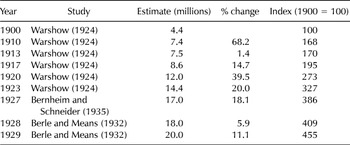
Focusing on the total number of individual ordinary and preference shareholders in U.S. corporations before World War I, H. T. Warshow, the corporate treasurer of National Lead, used a sample of 68 companies for which he had shareholder data from 1900 through 1923, and extrapolating to the population of all public corporations—listed or not—which filed capital-stock tax returns (a total of 326,100 in 1923), estimated there were 4.4 million stockholders in 1900, 7.4 million in 1910, 7.5 million in 1913, 8.6 million in 1917, and 12.0 million in 1920. The results are summarized in Table 1.
Warshow and related estimates of U.S. shareholding

Warshow, later followed by Adolf Berle and Gardiner Means, as well as A. L. Bernheim and M. G. Schneider, used a method that involved dividing IRS statistics on aggregate corporate share capital at par by sampled average shareholdings of a group of corporations (from 68 in 1900 to 281 in 1923) assuming $100 nominal share values for all shares. First, as Warshow himself acknowledged, his sample was of larger-than-average corporations and, since he believed that larger corporations had smaller average size of holdings, this might have introduced an upward bias in his shareholding estimates. Second, the method used for estimating total capital stock in all corporations was probably accurate for 1923, but may have understated shareholdings in previous years, as he estimated total capital stock for earlier years by extrapolating backward from the 1923 total capital stock estimate, using new issue data for the NYSE only. Footnote 52 Also, Warshow’s calculations of the number of shareholdings in any one year were for all corporations; but in 1914, for example, about half of the capital was in closed corporations. Thus, Warshow’s estimate is an overestimate of those shareholdings in publicly quoted securities. Footnote 53
Such estimates of total shareholder numbers are problematic, partly due to the population of companies being sampled and partly to how the sample relates to the population. For example, Lough’s, Foreman-Peck and Hannah’s, and Clapham’s figures, discussed above, relate to subsamples of publicly quoted companies, whereas Warshow’s estimates relate to all corporations, whether publicly quoted or not. Most observers are interested in publicly quoted companies and so, in this article, we concentrate on such estimates. Another major issue relates to the confusion between shareholdings and shareholders. The estimates provided above by Lough, Clapham, Foreman-Peck and Hannah, and Warshow are of shareholdings, rather than shareholders, as investors typically hold more than one security in their portfolios. Estimating total shareholder numbers, therefore, requires an estimate of the average number of holdings per portfolio as well as the number of shareholdings.
Foreman-Peck and Hannah, extrapolating from the data in their sample of 337 quoted companies in 1911, which contain a total of 2,081,790 shareholdings, assume that there were a further 150 percent of shareholdings in the many other thousands of quoted UK companies, making a total of five million shareholdings overall. In order to estimate the number of shareholders rather than shareholdings, this shareholding estimate should be divided by the average number of shares held per investor. Rutterford and Sotiropoulos have estimated that the average number of such holdings was 4.5 for a sample of 508 decedents between 1870 and 1902. Footnote 54 Using this figure gives an estimate of 1.1 million shareholders in the United Kingdom in 1911, or 2.4 percent of the population.
The estimate of 4.5 holdings per portfolio in the early-twentieth century does not necessarily apply to the United States for a number of reasons. First, the United States had, on average, higher par value shares than the United Kingdom (which had many at £1 [$5] and £10 [$50]); and second, U.S. investors had larger average holdings than did their UK counterparts. For example, the average nominal shareholding in Warshow’s sample of 68 companies in 1913 was $10,199 (down from $16,387 in 1900), comparable with the sample of 327 companies by Lough, who noted a decline in average shareholding from $22,000 in 1900 to $8,500 in 1913. These average shareholdings are substantially higher than Foreman-Peck and Hannah’s £912 ($4,432) for their sample of 337 UK-listed companies in 1911. Footnote 55 Rutterford, Green, Owen, and Maltby, in a survey of 223 UK share registers of 47 companies from 1870 to 1935, found average shareholdings peaked in the 1890s at £1,446 ($7,070), fell in the 1900s to £1,106 ($5,386), and fell again in the 1910s to £689 ($3,280). Footnote 56 There is evidence that British investors and their advisers well understood the modern principles of portfolio diversification before 1914, Footnote 57 and that LSE investors had more choice than NYSE investors. Footnote 58 There is thus an argument for assuming a lower average number of holdings for U.S. investors as compared to the 4.5 estimate for UK investors. For comparative purposes, we assumed three holdings per U.S. portfolio.
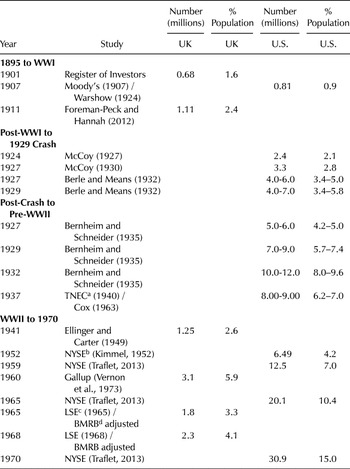
Returning to Warshow’s shareholding estimates for pre-World War I, we exclude shareholdings in closed corporations by using Moody’s estimate for the par value of all U.S. quoted securities in 1907, and assume a shareholding nominal value of $9,500 (between Warshow’s 1900 and 1913 estimates). Thus, we obtain an estimate for 1907 of 2,431,579 U.S. shareholdings. Dividing by 3 gives 810,526 stockholders, or 0.9 percent of the U.S. population. When the divisor is 4.5, the estimated number of stockholders in the United States in 1907 is smaller at 540,351, or 0.6 percent of the population. Footnote 59 For a summary of the main estimates of shareholder numbers pre-World War I, see the first part of Table 2.
Estimates of U.S. and UK shareholders, numbers, and percent of total population

Note:
a TNEC is Temporary National Economic Committee.
b NYSE is New York Stock Exchange.
c LSE is London Stock Exchange.
d BMRB is British Market Research Board.
Thus, Ott’s suggestion that there were fewer than 300,000 to 350,000 stockholders in the United States before 1914 is implausible. Footnote 60 Even so, our higher estimate for the U.S. shareholder population in 1907 is barely half the UK level at the turn of the century, and about one-third of Clapham’s (upper-bound) UK estimate for 1914. In one respect, it clearly exaggerates domestic shareholder numbers in that it counts all stocks of U.S. quoted companies listed by Moody’s as held by Americans, while we know that many were held abroad. Footnote 61 Growth was rapid after the 1907 recession, so it is likely that the number of shareholders in U.S. quoted companies by 1914 had increased, possibly to above one million (thus perhaps equaling UK shareholder numbers in absolute terms), but this would still have constituted only 1 percent of the U.S. population, and included foreign holders of U.S. stocks.
Despite the approximations inherent in the above estimates, they point to the United Kingdom having more shareholders as a percentage of the population than did the United States before World War I. UK investors also had, on average, smaller shareholdings and more holdings per portfolio than did their U.S. counterparts. Only a limited number of U.S. companies, although many were of substantial size, had more than 10,000 shareholders. As Lough commented, in Reference Lough1914 in England “stock is on the whole more widely scattered and held in smaller lots than in this country.” Footnote 62
A number of factors can explain this difference. One is the greater choice available to British investors of both domestic and foreign company shares, and another is the earlier British use of sophisticated marketing techniques to reach potential investors. Another reason for the difference may be the greater per capita wealth accumulated from past savings of the British compared to Americans pre-World War I. Neymarck, for example, calculated that in 1912 the British and French had each accumulated twice the level of transferable securities per head versus Americans. Footnote 63
Between the Wars
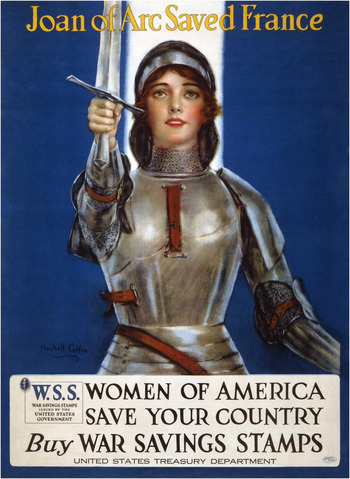
The sale of war savings certificates and government bonds during World War I boosted the “savings” culture among the population and taught them how to think as investors. The sheer size of the finance needed had led to advertising and publicity being used on a hitherto unprecedented scale to access the savings of the entire population—men and women, girls and boys, young and old, rich and poor, workers and those at leisure—to save as much as they could in the national interest. In Britain, by 1919 there were more than 40,000 war savings associations in workplaces, schools, and post offices, all with a weekly subscribing membership of more than seven million people. Between 1916 and 1918, 140 million certificates were sold. In the United States, the U.S. Treasury Department’s War Loan Organization was responsible for the sale of Liberty Bonds, Victory Bonds, and War Savings Stamps and Certificates. A total of 21 million subscribed to the four Liberty Loans, with 85 percent investing sums of $50 or $100. A further one billion War Savings Certificates were sold. Women on both sides of the Atlantic were asked to think of themselves as Joan of Arc, as in the advertising poster for War Savings Stamps aimed at American women (see Figure 1). An almost identical image was used to exhort British women to buy War Savings Certificates.
Joan of Arc encouraging women to invest in government securities during World War I. Source: Poster designed by Haskell Coffin. Library of Congress, Prints & Photographs Division, WWI Posters (reproduction number LC-USZC2-565).

This need for finance did not stop in 1918. Americans were then encouraged to “save and invest in restoring Europe to health.” Footnote 64 In Britain, the War Savings Committee was retained to “teach and induce people to save who never saved before.” Advertising campaigns played on patriotic fervor. By June 1929, a total of 908 million certificates had been sold in Britain, representing a cash investment of £720 million. Footnote 65 In doing their patriotic duty, on both sides of the Atlantic, these new investors were viewed very differently from the previous “hate” figures: the “bloated” American and the “insatiable” British bondholders. Footnote 66 These terms derived from a perception in the United States that the stock market was for speculation rather than for investment, and in the United Kingdom from disapproval of rentiers, who paid higher taxes on investment income than did workers on the same amount of earned income, from the 1909 so-called People’s Budget and onward.
In Britain, Ellis Powell, writing in Reference Powell1920, contrasted the large holdings of a handful of individuals in the share register of the Alamillos Company in 1864 with the much smaller and more numerous individual holdings in twentieth-century share registers for Lipton, and for Harrods or Selfridge department stores. Footnote 67 In Powell’s study of change over more than 50 years, he noted in the Selfridge’s share registers the most recent investors included: “a cabinet maker, a gas collector, a clerk, a nurse, a housekeeper, a school mistress, and a housekeeper.” As evidenced by this list, it was recognized that women investors “of all classes” were now saving and investing as they “consolidated for themselves well-paid occupations in quite a number of walks of life to which in earlier times they were strangers.” Footnote 68 Women had also been educated to invest through the war loan prospectuses, which had been “simply and clearly written, with many women receiving their first lesson in investment from these prospectuses.” Footnote 69 In the United States, J. H. Sears, referring to a National Industrial Conference Board (NICB) analysis of the top nine occupations of buyers (out of more than 50 of a utility’s 7 percent preferred stock), noted that housewives were by far the largest of these occupational categories, numbering 3,347 out of 7,088. Footnote 70
Yet there was a major difference between the United Kingdom and the United States in the interwar years. British investors were targeted neither by companies nor by brokers, as in the United States, and this difference had a major impact on relative shareholder numbers. Sears, commenting on the growth of one million shareholders in the five years leading up to 1928, attributed this to increased interest in investment, the desire to hold shares beneficially, and to customers and employees being targeted as potential investors. Footnote 71
Customers and Employees
Companies in the United States were keen to spread share ownership more widely after World War I to counter growing trade union power. American utilities in particular were under pressure: for example, AT&T was threatened with nationalization; and electric utilities needed support to maintain monopolies and were especially keen to keep funding costs low as the rates of return they could earn were regulated. By directly targeting customers, they could save on intermediaries’ commissions. Employee shares were also viewed as a less dependent approach to providing for old age than were pensions. Footnote 72 In addition, managers worried that heavy surtaxes imposed by the U.S. Revenue Act of 1917 on “rich men” might have “dimmed their appetite for further investment in stocks and bonds,” because it was possible instead to invest in tax-exempt bonds, real estate, and insurance. Tax-exempt securities totaled $4.1 billion at the end of 1921, and $12.3 billion at the end of 1923. The sheer number of employees and customers of the new giant corporations was a tempting market for capital raisers, and the old “soulless” image of the corporation had been dispelled through familiarity. By 1923, for example, over half of all American employees worked for firms with more than 250 employees. Footnote 73
Techniques applied to the selling of war loans were transferred to AT&T when Secretary of the Treasury David Houston resigned to join AT&T’s share distribution subsidiary in 1921. Footnote 74 AT&T employees were targeted not only to buy shares on their own account but also to sell to customers. It was felt that customers would be happier to see high profits if they felt they were participating through high dividends.
The telephone employee who assists his friend in acquiring the stock is not only helping to strengthen the credit of the company, but he is aiding his friend to become an investor in a security which is one of the soundest in the market. He is promoting thrift and the habit of safe investment. He is making friends for himself and for his company, and, in reality, is helping to make this country of ours a better one. Footnote 75
AT&T proudly advertised the large number of small shareholders in the firm as early as 1910: “35,510 out of 35,823 hold less than $1,000 each.” Footnote 76
Other company executives soon followed suit. For example, in January 1925, New York Central Railroad offered 35,000 shares to employees at a price of $110, which was $10 less than the market price. Sixty-eight thousand shares were allotted (out of 97,000 subscribed for) and subscriptions for small numbers of shares were favored. This had the impact of increasing the number of shareholders from 36,500 in January to 78,000 by April 1925. In an even more spectacular fashion, the number of AT&T stockholders rose from 60,000 in 1914 to 139,448 in 1920, and to 469,801 by 1929, an average annual growth rate of 37.4 percent for the 1920s. Between 1919 and 1927, the number of new employee-share ownership plans in the United States averaged 33 a year, and, allowing for 89 earlier schemes, reached a total of 386 by 1929. Footnote 77
For employees, partial payment plans and investment support groups similar to those for war savings societies were common. Employee-share schemes also involved some kind of benefit over and above that available to the normal investor, typically a small discount on the purchase price. This helped to overcome labor opposition. In 80 offerings made between 1925 and 1929, the median discount was four points lower than the market price, with 36 firms, including AT&T, offering more than a four-point discount. Footnote 78 The number of stock sales to customers by public utilities also grew rapidly, with 251 new customer plans adopted between 1914 and 1929. By 1929 the National Electric Light Association promoted the fact that it had more than 1.5 million customer-owners in 230 utility companies. Footnote 79
Women became an important element in marketing to both employees and customers. AT&T used its mostly female telephone operators to sell to customers they spoke to. By 1920 AT&T was proudly boasting that it had more women shareholders than men. Footnote 80 Companies used the image of the female shareholder, often depicted as old and helpless, to good effect. “A company is known by the shareholders it keeps.” Footnote 81 Companies often included the number of shareholders in their marketing material.
Who is Swift & Company? Swift & Company is not a one-man or one-family affair. It is a company owned by more than 40,000 people scattered over the face of the globe. … Thirteen thousand of them are women. Nearly fourteen thousand of them are employees. The average individual holdings are small—about thirty seven shares apiece. These shareholders are the men and women … jealous of the character and reputation of their organization, proud of what it is doing, proud to have a part in supplying to the world such products as Swift’s Premium Ham and Bacon, Brookfield Sausage, Silverleaf Brand Pure Lard, Wool Soap, Swift & Company’s fresh meats etc.
The coincidence of stock ownership with consumption opened up new vistas of advertising, as shareholders were encouraged to buy their company’s products and to act as advertisers to friends and acquaintances. So the “customer owner” became the “owner customer.” Footnote 82 Thus, companies were beginning to realize that not only did customers allow them to reduce their cost of finance, but customers also gave them access to a captive audience to whom to sell their products. Taking this a step further, some companies realized that women shareholders were a positive bonus. Warshow, in his analysis of shareholder numbers from 1900 to 1923, quotes from a letter from the secretary of the National Biscuit Company in 1924:
There is only one class of stockholder we are really interested in keeping track of and that is, the number of women stockholders, as they are the real purchasers of this company’s product. On December 31, 1923, we had 7,283 women stockholders; virtually 50 per cent of the number of stockholders of the company are women. We have not tabulated the number of shares of stock being held by them; the only thing we are really interested in is to note the constant increase in the number of women stockholders. On January 1, 1914, we had but 4,140 women stockholders, so you can see there has been a handsome increase in nine years in the number of women stockholders. Footnote 83
By 1929, Good Housekeeping had become aware of the importance of women shareholders, arguing:
The woman shareholder should be given prominence in the classification for some companies, particularly corporations dealing in household products, food stuffs, and clothing, where such companies desire to develop the stockholder-customer idea.
The woman of today is a shareholder in the well-managed industries that supply the wants of American life and the needs of her family. Today any director of any great company will tell you what a large shareholder she is. Also Good Housekeeping’s Editor can show you thousands of letters from women with substantial means who ask advice about their investments. Footnote 84
In the United Kingdom, after World War I, companies were also under pressure to respond to labor unrest, but were less willing to set up subsidized employee-share ownership schemes. The British government commissioned a comprehensive survey of employee profit-sharing, co-partnerships, and employee-share schemes, and the resulting report on Profit-Sharing and Labour Co-Partnership in the United Kingdom was published in 1920. It detailed 182 existing profit-sharing or co-partnership schemes, of which 41 involved some form of employee-share ownership (including 12 gas company schemes), with 29 new profit-sharing schemes, including five employee-share schemes set up in 1919 alone. Footnote 85
At the 1920 Annual General Meeting of the Ebbw Vale Steel, Iron and Coal Company, a “lady shareholder,” Mrs. Thompson-Price, put to the chairman the possibility of the company starting an employee-share ownership scheme:
Probably you are aware, as I am myself, that quite a large number of companies—some of them new companies—have during the last year or two arranged for their employees to be paid a certain commission upon their earnings, such commission to be translated at the end of the year into shareholdings, and I think that in some cases the Board or a number of gentlemen who are trustees hold those shares for employees and pay them a certain amount of dividend thereon, to be arranged, of course, by the directors.
The chairman replied that “anything worth having is worth paying for,” and that employees “like everyone else” should buy shares at market price and take their chances. Footnote 86 The chairman of J. Lyons & Co., which owned a chain of restaurants, felt obliged at its 1920 Annual General Meeting to dismiss the press comment that waitresses were inadequately paid, and countered “agitator” claims that the shareholder return on capital was too high at 47.5 percent by saying that it averaged out at a mere 9.4 percent, or 5.4 percent after tax. All he could come up with to appease public opinion on the capital–labor divide was to announce that both shareholders and staff would be given the same “favourable consideration” Footnote 87 if they wanted to apply for the forthcoming issue of preference shares. For firms such as these, no employee shares were offered at a discount. Some employee-share schemes were launched after World War I, perhaps in reaction to the increase in the number of trade union members, from two to five million between 1911 and 1919. In 1930 the UK Ministry of Labour noted there were 187,000 workers in share-issuing companies but only 37,000 participating in the schemes, with “only a minority of the employees … able, or have wished, to take advantage of the facilities offered.” Footnote 88
The J. Lyons chairman’s comments about labor and capital were typical of speeches at many UK annual general meetings, in particular after a higher rate of income tax was charged on unearned rather than earned income starting in 1907. The chairman of Pearson and Knowles Iron Coal and Iron Company felt he spoke for many: “How about £631,186 of wages and £24,400 dividend? This is our own instance as you know and we represent many like companies. (Hear, Hear.)” Footnote 89 However, Shell Transport and Trading, as early as 1902, made a small concession by changing its shares from £100 to £1 nominal value to encourage the entry of “many agents and servants” of the company onto the share register, with the splitting of the shares allowing them to be placed within the reach of “men of moderate means.” This was not pure altruism. The chairman revealed that the key reason for requiring a larger shareholder base was that the company was constantly having to appeal to the government for facilities and protection around the world, and the larger the body of shareholders, the stronger its negotiating position. Footnote 90
The antipathy between labor and capital increased after World War I, with higher tax rates, as evidenced by the J. Lyons case above, causing resentment. Income tax was deducted before the dividend was paid, thus many investors did not understand why they were suffering so. Mrs. Ada Gurrin wrote in 1919 to the secretary of the Prudential Assurance Company: “Is there any chance of getting my pre-war dividend? … I think your Board should remember that the shares are very carefully held by people with fixed incomes like myself.” Two years later, in 1921, she was openly complaining about how labor as well as capital should share the pain:
As one of the shareholders in your company I am writing to ask you to consider US in this new financial year … as the staff in other firms has to have its salary reduced now food is cheaper why not y[ou]rs, is it fair that long suffering shareholders should go on with a depleted income? Footnote 91
This is in line with Cheffins’s argument that one of the causes of an increase in shareholder numbers was the disposal of large holdings by wealthy investors subject to high income tax rates on their investment income. Footnote 92
It is worth remembering that a capital levy on wealth of more than £1,000 was in the Labour Party manifesto for both 1919 and 1923 elections, with much concern as to how to reduce the disparities in income, and particularly the disparities in wealth, exercising the minds of politicians throughout the 1920s. Footnote 93 It was feared that issuing too many shares to employees would lead to “over capitalisation” and to too much voting power being transferred to employees. Footnote 94 To counter these risks, the shares issued to employees were limited in number or given as quasi-shares. Indeed, only one company in the 1920 Report of the Committee on Profit-Sharing and Labour Co-Partnership allowed employee shareholders to attend its annual general meeting, and then only if they held at least £200 nominal value of shares. After the 1920 government-commissioned report, produced by the committee, there were no more official British investigations into employee-share schemes. Footnote 95
In the United States, although the total number of employee shares represented only 4.26 percent of the share capital of the 20 large corporations studied in 1926 by Princeton University, this was still a much more significant figure than anything in the United Kingdom. Footnote 96
Investment Trusts
Another route to increasing the number of shareholders was the investment trust, or closed-end fund. These trusts allowed small “investors of moderate means” access to a diversified portfolio. In the United Kingdom, the first investment trust units were offered to investors in 1868. Each £100 unit represented part ownership of an underlying portfolio of 18 different government and colonial bonds. The issue was successful, and so was followed by a rash of so-called average investment trust issues. By 1875, 18 trusts were listed on the London Stock Exchange. There were further booms: between 1887 and 1890, 70 new investment trust companies were floated, with a further 44 between 1905 and 1914. They were considered appropriate for the “confused investor.” One such trust, launched in 1914, was the so-called People’s Trust. This was not aimed at investors of moderate means, but at the “industrial and working classes.” As Powell commented, this meant that such trusts were available to all who could save. Footnote 97 The largest boom of all was between 1924 and 1929, with 103 new investment trusts floated on the stock market.
In contrast, the U.S. investment trust market did not develop fully until the mid-1920s: only 18 trusts were formed prior to 1924. However, by mid-1928, the U.S. investment trust market had overtaken that of the United Kingdom, with an aggregate capital of $1.2 billion, as compared with an equivalent $1 billion for UK investment trusts. The pace quickened as U.S. investment trust issuance rose to a peak in 1929, with more than $7 billion invested in a single year in 675 investment companies of all types, of which 193 were investment management companies with assets of $2.7 billion. Footnote 98
Retail brokerages in the United States followed in the wake of the mass marketing techniques used for customer- and employee-share plans. Although initially slow to capitalize on the number of potential investors, brokerage firms did catch up, and even used the employee- and customer-share plans in advertising to increase their customer base. In particular, brokers benefited from selling shares in investment trusts, which offered an infinite supply of new shares to sell. The number of securities affiliates launched by banks grew from 11 in 1920 to 200 in 1929. In 1908 the National City Bank had 83 prospective investors on its books; by 1929 the bank’s securities affiliates sold around $2 billion of securities to 150,000 investors. By the late 1920s, more than 7,000 securities dealers and 30,000 banks competed with each other for each new issue. As the supplies of industrial and commercial stocks began to dry up, new investment companies were floated to invest in the common stock of other investment trust companies, creating pyramid structures. Bonus shares were paid to promoters, and management expenses rocketed. The radio was used to promote investment through such programs as Old Counsellor on NBC. Stock prices were broadcast daily to “even the most remote localities.” Footnote 99 Such programs, the broadcasting of share prices, and brokerage marketing campaigns via radio were much more important in the United States, where newspapers could not so easily reach the more geographically diffuse U.S. population. Footnote 100
Brokerage houses had women’s rooms, and banks opened women’s departments staffed by female bank employees. In 1915 one of the first banks representing this trend, the Columbia Trust Company of New York, appointed Virginia D. H. Furman as manager of its new women’s department. By the early 1920s, women-run women’s departments had taken off. Women’s departments were observed throughout the country, although commentators noted regional variations, “with the Mid-west being more supportive than the East, while the South was the most resistant.” Footnote 101 A 1928 study by the Investment Research Committee of the Financial Advertising Association credited women with buying between 15 percent and 20 percent of new securities issues. Footnote 102
In the United Kingdom, there was no major shift from investing in government bonds to investing in corporate bonds, as happened in the United States; there were no employee or customer schemes; and there was a more laissez-faire approach from brokers and the LSE. Also, there were no war bond marketing techniques applied to corporate securities. New issues were still marketed in the press and via circulars, but there were no major efforts to set up customer- or employee-share schemes, as occurred in the United States. Door-to-door selling, or “hawking,” did take place, until banned by the Companies Act of 1928. Footnote 103 In the main, however, UK brokers continued to act for an élite group of private clients, with firms such as James Capel acting directly or on behalf of bank clients for commission. Regular visits by James Capel partners to the bank Coutts in the West End were used to answer private client queries and save on correspondence. There was little effort at mass marketing; and the brokers accepted clients, rather than the other way round. Footnote 104
After the Crash of 1929
The crash of 1929 had a terrible impact on Wall Street. Brokerage houses and banks suffered with the nearly complete collapse of the investment trust market, which had been so profitable for them. The number of individual brokerage accounts fell. Women were reported to have been more emotional than men at their losses, and “on the verge of returning to bridge.” Traflet contrasts the “masses of women who once crowded brokerage desks in the 1920s” with their virtual disappearance from the market in the 1930s and 1940s. Footnote 105 Wendt, analyzing a random sample of 1,000 accounts in a Wall Street brokerage house from 1933 to 1938, found that 278 were women, including 102 classified by marital status and the remaining 176 in other occupations. Despite appearances, therefore, women were still active investors after the crash, fewer in number than their male counterparts but trading in one (anonymous) brokerage house as much as the men, and professional women were still attracted to stock market investment. Footnote 106
The number of U.S. employee-share plans, however, plummeted. In a survey of employee-share plans after the crash, Davis found that the median price of 18 preference shares and 17 common shares, which had been the subject of employee plans and active in 1926, stood at 98 7/8 in 1926, peaked at 115 in 1929, and fell to 14 7/8 by 1932. Of the 50 plans Davis studied, 31 had been terminated. In many cases, corporations made some concessions to the dramatic falling prices so that most employees who had bought in the heady years of 1926 to 1928 did not lose out. For example, United Cigar Stores allowed employees to cancel their plans, but many were reluctant to do so in case they lost their jobs. Most corporations suspended their plans indefinitely, although there were six new plans in 1931 and four in 1932. The conclusion reached by Davis in Reference Davis1935 was that employee-share plans would in the future be limited to senior executives. Corporations would not dare to put their employees (as opposed to their managers) at so much market risk again. Footnote 107
U.S. investment trusts suffered, more so than their UK counterparts, for a number of reasons. Trusts had diversified across U.S. equities, rather than the global fixed interest portfolios of their UK counterparts. They also had more leverage and more cross-holdings, and investments valued at market value rather than book value were more vulnerable to a market downturn. In June 1931 the Economist reported that the Standard Statistics index of common stocks of 30 leading American investment trusts showed a fall of no less than 75 percent from their peak, whereas the Institute of Actuaries index of the shares of 15 leading British investment trusts showed a fall from their peak of only 17 percent. In Britain, in 1933, the worst year of the bear market, only seven pre-World War I and one-third of post-World War I investment trusts passed their dividends. Footnote 108 In the United States, by 1934, nearly 200 investment management companies had disappeared, and with them the savings of many small investors.
Shareholder Numbers before and after the Crash
The significant rise in U.S. shareholder numbers during the 1920s attracted attention. Both broad-brush and more detailed attempts were made to quantify the increase. Sears, for example, referred in 1929 to an additional one million stockholders in the previous five years. Footnote 109 Warshow, aware of the increase in shareholder numbers in the company National Lead, of which he was treasurer, made the first serious attempt to estimate total shareholder numbers in 1924. Means, and later Berle and Means, estimated total stockholder numbers at the end of the 1920s, extrapolating from Warshow’s Reference Warshow1924 analysis of stockholder registers. Using the same sample of companies, which appeared on all of Warshow’s lists from 1900 onward, Means estimated 18 million shareholdings of record (which he called “book stockholders”) for 1928, which could be compared with Warshow’s figure of 12 million for 1920. Berle and Means, using the same Warshow methodology, estimated 20 million book stockholders for 1929 Footnote 110 (see Table 1). Of the eight million extra book stockholders recorded since 1920, Means estimated that one million came from customer-share plans set up in the intervening years, and a further 800,000 from employee-share plans. Means’s primary concern was also the diffusion of shareholdings; for example, he commented on the switch in holdings from the relatively wealthy to the less well off, particularly from 1913 to 1921, which was also a factor in the United Kingdom. Footnote 111
However, Means also noted that some growth in shareholder numbers might have been due to an increase in the number of shares held in individual shareholder portfolios. Joseph McCoy, an actuary in the U.S. Treasury, attempted to avoid this shareholdings versus shareholders problem by estimating the number of shareholders through the dividend income disclosed in corporate and individual tax returns. He estimated 2.4 million individual stockholders in 1924, and 3.3 million by 1927: equivalent to 2.1 percent and 2.8 percent of the population, respectively. He also estimated for 1927 a further 1.3 million individual bondholders. Footnote 112 However, since not all investors completed tax returns, this is likely to be an underestimate of the number of shareholders. Berle and Means, using the McCoy approach, estimated “at best, very approximate” shareholder numbers to be in the range of four to six million for 1927, and four to seven million for 1929. The 1928 estimate is based on 18 million book stockholdings and average holdings per portfolio of between 3 and 4.5; the 1929 estimate appears to be a pure guess Footnote 113 (see Table 2 for a summary of these shareholder estimates in absolute terms and as a percentage of the population).
In the United States, the crash of 1929 led to a number of investigations into what had gone wrong. Interest in how many people had been caught up in the stock market was high, in particular whether small investors were to blame for the crash or were victims. Footnote 114 The crash led to a demand not only for analysis of what had gone wrong, but also for improved protection of shareholders, small and large, leading to the Securities Act of 1933 and the Securities Exchange Act of 1934. Footnote 115 It was important to find out who these shareholders were. All estimates agreed that the number of shareholders for the early 1930s was higher than at the market peak of 1929. For example, the Standard Statistics Survey of 50 companies, published in Printers’ Ink, found 4,998,383 holdings in 1933, as compared with 3,076,379 in 1929. Footnote 116 Lewis H. Kimmel later attributed this unexpected rise to two factors: investors switching from brokerage to own name accounts—a trend also identified by Sears—and investors beginning to buy again when they thought stocks were relatively cheap. Footnote 117 Bernheim and Schneider, editors of The Twentieth Century Fund, for the most part using Berle and Means’s methodology to estimate of growth in numbers from 1927 to 1932 of shareholders in a sample of 69 companies, estimated 9.5 to 11 million shareholders in 1931 (8.3 percent of the population taking the mid-point) and 10 to 12 million in 1932 (8.8 percent). Footnote 118
A detailed pre-World War II estimate of shareholder numbers came from the Temporary National Economic Committee (TNEC), set up to investigate the crash of 1929, with a remit to examine the concentration of economic power, a recognition that shareholder numbers measured diffusion but not necessarily democratization. It estimated shareholder numbers using four methods: the first two were refined versions of McCoy’s method, varying in how to account for shares held by individuals not included in the tax return data and also for shareholders holding non-dividend paying stock. The third method used the shareholdings of record method of Warshow and of Berle and Means, and it estimated average securities held per individual from a sample of 5,000 Federal income tax returns with assumptions being made for those not filing returns or holding non-dividend paying stocks. The fourth method used an estimate obtained from a sample survey by Elmer Roper of the NYSE. The TNEC in all cases estimated beneficial shareholdings rather than simply shareholdings of record, finding 26 million beneficial shareholdings as compared to 24 million shareholdings of record for 1937. Footnote 119
The four different TNEC methods gave estimates of six to seven million, seven to eight million, 10 million, and nine million stockholders, respectively. Cox takes likely figures to be around eight to nine million shareholders at the time of the TNEC estimates in 1937—equivalent to 6.2 percent to 7.0 percent of the population—and argues that these figures reflect a rise in stockholder numbers, which peaked in 1933 followed by a decline to levels of five to six million—around half the numbers in the early 1930s—a decline that lasted until the mid-to-late 1950s. Footnote 120
In the United Kingdom, the impact of the stock market crash was not as great in the United States. The LSE reached pre-1929 levels again in 1934, whereas the same was not true for the NYSE until 1954. In the United Kingdom, during 1935 and 1936, for example, there were 209 initial public offerings worth £97.7 million, as compared with 287 worth £96.7 million for 1928 and 1929. Footnote 121 There was no inquisition into the causes of the crash, and no attempted estimates of shareholder numbers until after World War II. It is clear, though, that by this stage there were many more U.S. companies with large numbers of shareholders than in the United Kingdom. For example, a post-World War II backward-looking survey by P. Sargant Florence of 44 companies in 1936—and still in existence in 1951—found two companies in 1936 with more than 10,000 shareholders, with an average number of shareholders of 19,644 and a median number of shareholders of 10,250. By comparison, a Standard Statistics Survey of 50 U.S. corporations, published in 1933, at the peak of the shareholder boom, found 13 corporations with more than 100,000 shareholders and an average and median number of 99,968 and 59,131 respectively. Footnote 122
An informal survey by the Economist in 1929 of 18 large- and medium-sized UK companies found that one company had more than 100,000 shareholders, and that the average number of shareholders was 27,944, with a median of 19,500. The main purpose of the Economist survey, though, was to ascertain the impact of the broad distribution of shareholdings—“the scattered body of small holders”—on corporate control. The survey found that more than one-third of shareholders owned less than £100 nominal of shares, and more than 85 percent less than £500. The concern was that such limited holdings, probably held as part of portfolios, led to “inertia” and “abuse,” with the The Economist citing examples of companies where changes in capital structure had not been challenged by shareholders despite the consequence of apathy being a reduction in voting rights for minority shareholders. Footnote 123
Post-World War II
Customer Relations
In the United States, the National Industrial Conference Board conducted a questionnaire survey on shareholder relations in 1950, and 217 companies replied: 99 industrials, 63 utilities and railroads, 37 banks and investment companies, and 18 insurance companies. The survey was designed to explore whether stockholders could be grouped into unions (in the same way as employees were grouped into trade unions), and whether stockholder associations could be used to lobby for such things as to lower taxes on dividends via the Investors’ League. Many firms had highly developed stockholder relations departments—for example, AT&T had a staff of 200—and used their shareholder base to create customer loyalty and effective lobbying groups. Scott Paper Company sent a welcome letter to all new stockholders, which included a gift package of their principal products. Borden Company asked new stockholders to complete a descriptive questionnaire, and ascertained that more than 58 percent of their stockholders were women and that the most common stockholding ranged from 10 shares to 24 shares. The survey found that one-third of shareholders derived very little income from stocks and bonds, and another one-third derived less than one-third of their income from this source; thus, the majority of shareholders had some form of occupation. Of a total of 52,000 shareholders, more than one-half responded to Borden’s offers of free coffee, and later, cheese.
Many of the companies responding to the National Industrial Conference Board’s questionnaire answered that shareholder meetings included presentations and product displays that would appeal to the individual shareholder. General Mills had this down to a fine art. At a series of regional shareholder meetings, a motion picture was shown, employees and managers were in attendance to answer questions, Betty Crocker split pea soup was sampled, and there were demonstrations of Tru-Heat irons by local home appliance representatives. Special chiffon cakes were presented to various stockholders; one went to a woman whose birthday fell on the founding of General Mills, one to a female stockholder who had held her stock the longest, one to a woman who had travelled furthest for the meeting, and finally one to the longest-serving female employee. Such meetings for GM date back to 1939 (although they were suspended during World War II), with more than one-third of stockholders, who were local to where the meetings were held in areas visited, attending, “with about equal representation of men and women owners.” Footnote 124 This emphasis on marketing to shareholders marks a reversal of the attitude of U.S. corporations to their shareholders in the 1920s. At that time, corporations targeted customers to become shareholders. By the 1950s, they were targeting shareholders to become customers.
There is no equivalent market research on UK shareholders or how they were used, if at all, to promote the goods of the companies in which they invested. American firms asked their shareholders whether they wanted the annual report in black and white or in color, and whether they wanted more photographs or less. Anecdotal evidence is provided for the United Kingdom by a 1960 advertisement in the Economist for Simon-Carves, an engineering company. It was in reply to a female shareholder who had written in to complain to the secretary of Simon-Carves: “You build such hideous plants. Don’t send me any more annual reports because I hate the pictures.” The ad goes on to explain how essential the company’s products are to her cutlery, radio, and electric lighting, to which “our hideous plants contribute in more ways than space allows us to mention” Footnote 125 (see Figure 2).
Simon-Carves advertisement. Source: The Economist, January 23, 1960. Economist Reference 1960-0123.

Shareholder Numbers Post-World War II
Concern about shareholder numbers in the United Kingdom after World War II was linked to two issues: nationalization of major British industries (including coal, utilities, and transport), and a resurgence of the labor–capital debate. On the former issue, Hargreaves Parkinson had long championed the small investor. In his Reference Parkinson1930 book, The Small Investor, he cited the 1929 survey in the Economist, which showed that average holdings in major British industrial companies were often £300 or less. He pointed out that large numbers of orders of securities from £25 to £100 were forwarded day by day to London stockbrokers’ offices from bank branches all over the country. Footnote 126 He then wrote a series of articles for the Financial News, published in 1944 and all titled “Who Owns the Railways?” He sampled every tenth shareholder in each of the four remaining railway companies, and found 98 percent of shareholdings were for a nominal value of £5,000 or less, with more than half the dividend warrants—after tax—for £10 or less. Footnote 127 In 1951 Parkinson published Ownership of Industry, using Reference Parkinson1944 and 1945 share registers—being the latest available data—and explored the ownership of the top 30 companies by market capitalization included in the FT30 share index. Looking at both ordinary and preference shares, totaling £347 million in nominal value, he found a total of 1,112,970 shareholdings, with 286,330 preference shareholders having an average nominal holding of £388, and 826,640 ordinary shareholders having an average nominal holding of £286. Parkinson also analyzed the railway, coal, and electricity companies. He found, for a capital of £850 million, a total of 1,047,780 shareholdings, with 618,489 preference shareholders having an average nominal holding of £883, and 429,291 ordinary shareholders having an average nominal holding of £758. Parkinson’s concern was with the distribution of ownership, not with the characteristics of investors except whether they were “small.” Footnote 128 His anti-nationalization view was that ownership could not be more democratic if the companies concerned were indeed nationalized. Footnote 129 He argued that having large numbers of small shareholders empowered medium-sized shareholders to influence corporate governance. P. Sargant Florence viewed this as misguided. Major diffusion of shareholding, he asserted, could lead a “resolute minority” of shareholders holding as little as 10 percent of voting capital to easily take advantage of an “indifferent majority.” Footnote 130 Parkinson lost his case against nationalization, with £2 billion of company capital in rail, utilities, and coal being replaced by government or government-guarantees post-World War II. Footnote 131
The first formal estimate of the number of UK shareholders was by Ellinger and Carter, who published their results in 1949 in the Financial Times. As they argued, “It is curious, but no one hitherto has ever inquired how many investors there are.” Footnote 132 As did Parkinson, they counted shareholdings in the FT30 share index, but this time used 1941 registers. Footnote 133 Ellinger and Carter found total ordinary shareholdings of 815,977, which compares closely with Parkinson’s estimate of 826,640. However, they went further, trying to estimate shareholders, not shareholdings. By comparing duplication of holdings between shareholders in a set of 40 companies chosen because they were of different sizes and industries, and of shareholders in two very widely held companies, they estimated there were, in total, more than 10 million shareholdings but only 1.25 million shareholders. The number of shareholders was surprisingly similar to more ad hoc estimates made much earlier in the century (see Table 2), and the percentage of the population holding shares was 2.6 percent, hardly higher than in 1914. The average number of holdings, though, was assumed to be eight, rather higher than the estimate of 4.5 for the early 1900s. Indeed, Ellinger and Carter argued that investors had “turned themselves into investment trusts.” Footnote 134 They also noted that 47 percent of the holders were male; 40 percent female; 8 percent joint holders; and 5 percent charities, nominees, and corporate. Women were more important investors in certain types of companies that were “household names or which are reputed to be very safe, and low in, for example, mining concerns. The female investor is less venturesome than the male.” Footnote 135 As Sargant Florence commented, “to judge from British evidence, nearly half of them [shareholders] are women, many of them shy (without reason) of business.” Footnote 136 However, Ellinger and Carter did not find evidence of the “democratisation of investment,” rather just the opposite, describing the investor “to be found in retirement in the pleasanter climes of Southern and South-Western England and North Wales. This is the section of the public reviled by class haters, discriminated against fiscally, and given inadequate compensation on nationalisation.” Footnote 137
They showed, as had the Economist in 1929 and Hargreaves Parkinson in Reference Parkinson1944, that most investors had holdings of £500 or less, making them vulnerable to nationalization. At the time of the Financial Times survey, railway nationalization had already taken place, with more to come. Such investors, argued Ellinger and Carter, were wide open to the one tactic of government: “Their Railway Stocks are taken. Well, they still have their Electricity Stocks and more. Then their Electricity stocks go, but there is still Steel. After Steel, there will be Chemicals, Breweries, Insurance and others.” Footnote 138
After nationalization, the debate in the United Kingdom as to the number of shareholders continued, this time as part of the labor–capital divide. It rose to a crescendo in the late 1950s, after the market had tripled in value between 1948 and 1957, and after a succession of good years for company profits and dividends. The growth in the industrial and commercial sector more than compensated for the loss of company securities through nationalization. Between 1946 and 1962, the nominal value of shares in that sector rose from £1,629 million to £5,930 million. Footnote 139 In fact, companies appeared to make large profits partly because dividends were declared as a percentage of nominal, not market, value. Inflation after World War II had also led governments to impose wage controls on labor and, encouraged by the trade unions, dividend controls on share-owning capitalists. Footnote 140 A pamphlet titled The Poor Man’s Guide to the Stock Exchange, published by the Labour Research Department, was skeptical of the wider ownership statistics:
A vigorous attempt is now being made to persuade everyone to believe that British industry is really owned by a mass of small investors. Some of the biggest companies have published lists of their shareholders—details I mean—for example, in 1958 Imperial Chemical Industries had 261,663 shareholders with an average holding of £551 and 93,000 shareholders in Woolworth, F. W. & Co. with an average of £172 each. Footnote 141
The number and characteristics of shareholders had again become a political issue. In 1958 Sir Ian Lyle, the president of Aims for Industry, announced that Tate & Lyle and 20 other companies would set up shops to sell shares at their production sites to attract worker-shareholders. The Wider Share Ownership Council, supported by a number of Conservative Members of Parliament, also lobbied for bearer shares to avoid onerous stamp duty on small trades. However, the threat of further nationalization was clearly a factor behind the campaign. The chairman of Rugby Portland Cement, in 1960 in his annual general meeting speech, followed the Hargreaves Parkinson line that wider share ownership was a superior form of nationalization, with public ownership of shares giving people access to retained profits as well as dividends. Footnote 142
In the United States in post-World-War II, the market did not recover its 1929 value until 1954, but this was twice the value of 1945. Attempts to revive employee-share plans had proved unsuccessful. In its 1953 report, the National Industrial Conference Board found only 68 formal plans for selling shares to employees, of which only 28 were active. All but two were for common stock, whereas schemes in the 1920s had been evenly split between preference and common stocks. AT&T revived its scheme in 1947 (which has been closed in 1929), and in 1949 International Harvester revived the scheme it had opened in 1930 and closed in 1931. F. B. Bower, the author of the report, was gloomy on further growth in the sector. She believed that companies had been burned by having to compensate employees for losses incurred after the 1929 crash and, although they saw such plans as helping to shield employees from rising inflation, she predicted that they would stick to senior executive plans in the future. Footnote 143
However, the New York Stock Exchange, suffering from poor business since the 1930s, was keen to encourage new customers for its members. Another reason was to provide a capitalist riposte to the communist threat of the Cold War. Footnote 144 Before beginning a campaign to attract more individuals to invest in the American economy, the NYSE felt the need to discover who the existing investors were and how many of them there were. Footnote 145 There had been no investigations into shareholder numbers since 1937, so in 1952 the NYSE commissioned Kimmel, of the Brookings Institution, to conduct a detailed survey of share ownership: the number of investors in publicly owned companies, who were they, and where they lived. This involved asking for information on shareholdings in nearly 5,000 corporations that were listed on the 20 organized stock exchanges (including the NYSE) and the New York Curb Exchange, as well as unlisted banks and investment and other companies. Footnote 146 One in 10 shareholdings was sampled from information provided on 3,954 share issues, representing around 25 percent of all publicly owned stocks as listed in Moody’s Manual. Footnote 147 This yielded 20.3 million shareholdings of record (from 25.2 beneficial shareholdings), which Kimmel estimated implied a total of 30.3 million shareholdings of record for all stock issues that had a significant public interest. Footnote 148 However, the number of shareholders, rather than shareholdings, was estimated by interviewing a sample of one in 10 5,000 households or family spending units (equivalent to 15,552 people) and asking how many individuals in each household were shareholders. This yielded an estimate of 6.49 million adult individual shareholders in 1951, equivalent to only 4.2 percent of the population, a 50 percent drop from the early 1930s. The average number of share issues held by each investor was 4.1. Footnote 149 This was the first serious estimate of shareholder numbers in the United States since the TNEC investigation, but the Brookings report estimates was more comprehensive, detailed, and accurate than those produced by the TNEC.
After the euphoric estimates of the late 1920s and early 1930s, the Brookings report was a disappointment to the NYSE, showing half the number of shareholders expected. Footnote 150 However, the big news from the definitive Kimmel survey was that there were almost as many women investors as men, and that they had slightly more holdings than men. The NYSE had no clear idea as to why this was, but speculated that wives had inherited shares from their husbands or that they held shares separately for tax reasons, Footnote 151 “but, whatever the reason, this fact was clear.” Footnote 152 Of these, 32 percent of investors were housewives, the largest socioeconomic group. There was little evidence of democratization: 69 percent of shareholders were either housewives or professionals. Footnote 153
The relatively low stockholder numbers in the Brookings report led the NYSE to initiate a major advertising campaign, called Own Your Own Share of American Business, aimed at individual investors, which ran from 1954 to 1969. This, aided by a series of stock splits that made round lots affordable for small investors, had a dramatic effect on stockholder numbers. These went from 6.5 million in 1952 (4.2 percent of the population) to 12.5 million in 1959, to 20 million in 1965, and to 30 million in 1970 (14.6 percent of the population). As a percentage of the population, by 1960, individual shareholders overtook the 8 percent peak of the 1930s. In absolute terms, by 1970 there were three times as many direct individual shareholders as there had been in 1929. One major difference was that these modern investors bought and held, rather than traded on margin. Turnover was only 13 percent in 1952, as compared with 100 percent or more in 1929. Footnote 154
In the United Kingdom, there were no more formal surveys of shareholder numbers until 1965, when the LSE began estimating the shareholder population, although a Labour Party publication cited an Inland Revenue survey of those with incomes above £135 per annum in 1949–1950 that found the number “enjoying” interest and dividends was no larger than 1.5 million, or 3 percent of the population. Footnote 155 G. Copeman, in his Reference Copeman1958 book The Challenge of Employee Shareholding: How to Close the Gap between Capital and Labour, cited MacRae’s estimates of the total number of shareholders as being between 1.1 million and 1.35 million in total (2.1 percent to 2.6 percent of the population), but this included holders of fixed interest government debt and nationalization securities. Footnote 156 The number of shareholders had again become a political issue by remaining steadfastly at 2 percent to 3 percent of the population, which was no higher than in 1914. As markets rose in the United Kingdom, as in the United States, so too did shareholder numbers. A UK Gallup poll in 1960 estimated that there were then 3.1 million shareholders (5.9 percent of the population). Two LSE surveys in 1965 and 1968 estimated the shareholder population in the United Kingdom to be 1.8 million (3.3 percent) and 2.3 million (4.1 percent), respectively. Footnote 157 It was not until the arrival of Margaret Thatcher as prime minister in 1979, and her program of privatization, that direct shareholder numbers in the United Kingdom began to approach post-World War II U.S. levels. Until that time, the shareholding population remained static, adding shares to existing portfolios. R. A. Vernon, M. Middleton, and D. G. Harper, writing in 1973, found, based on a sample survey of unnamed Blue Chip companies with more than 100,000 individual shareholders, that 52 percent of respondents held more than four securities in their portfolios. The Brookings report had found, from a much larger sample, that 80 percent of respondents in the United States held only one to four securities. In the United States, the average number of holdings was 4.1; the median for the small UK sample was a high of 21. Footnote 158 The average individual shareholding in the United Kingdom, in value terms, was also smaller: £860 in the UK in 1963 ($2,804) as compared with $6,500 in the United States in 1952. Footnote 159 UK investor portfolios still included more securities held in smaller amounts than did their U.S. counterparts.
The NYSE may not have expected more women investors than men, but Kimmel, in the Brookings report, is candid on this point. He found it “not unexpected” that there were 7.03 million male stockholdings of record, as opposed to 7.62 million female stockholdings of record, and argued that a partial explanation for female dominance was the AT&T stockholder register. This single register accounted for one-half of the “excess” of women in the figures. For preference shares, there was an even greater female dominance: 812,100 female versus 543,800 male shareholdings of record. The average value of male and female holdings was $4,290 for men and $3,558 for women for ordinary shares, and $2,973 for men and $2,550 for women for preference shares. Footnote 160 Although the NYSE did not expect female dominance, it was common knowledge to others. Good Housekeeping had already referred to “what a large shareholder she is” in the 1920s. In Reference Kidd1948 Elizabeth Kidd, in the foreword to her book, Women Never Go Broke, wrote:
With so much of the nation’s wealth falling, by default and demise, into the dainty little fingers of females, this could be serious. In fact it is. Visualize for yourself 80% of the private life insurance, 70% of estates, 50% of the privately owned stock of corporations, 48% of railway and utility holdings, 40% of the nation’s homes, 74% of suburban homes, 66% of mutual savings bank accounts, to say nothing of about 104 ½ billion dollars’ annual spending money, all held in this fragile but febrile grasp. Footnote 161
Also, post-World War II, brokers and companies were well aware of their female investor base. In 1950, three years before the NYSE even started its Own Your Own Share of American Business marketing campaign, Merrill Lynch held ladies-only investment seminars in 62 different cities, attracting a combined audience of more than 30,000 women. Footnote 162 Companies, particularly those selling consumer products, recognized that women shareholders were a positive attribute.
In the United States, as shareholder numbers and stock market prices rose, there was some attempt by U.S. corporations to revive the “people’s capitalism” argument, as happened in the United Kingdom. This was helped be detailed surveys, styled after the Brookings report, in the 1950s and 1960s. Footnote 163 By mid-twentieth century, AT&T had over one million shareholders and 20,000 investors attending its annual general meetings. Footnote 164 Somehow, with large numbers of shareholders, the world must be a better, more democratic place, because U.S. corporations began to peddle this line in their advertisements, as they had done in the 1920s. General Electric stated: “People’s Capitalism: the 376,000 owners with savings invested in General Electric are typical of America, where nearly every citizen is a capitalist.” Footnote 165 A. D. H. Kaplan wrote:
The number of stockholders now equals or exceeds the number of employees in many large American corporations. The effect of prevailing tax rates on inheritance and income is toward progressive diffusion of the personal capital holdings in American corporations. Footnote 166
High tax rates post-World War II (as with post-World War I) had driven high-income earners to tax-exempt securities, requiring lower-taxed individuals to take their place. However, this diffusion did not lead to shareholder control, as Perlo demonstrated. Footnote 167 Starting in the 1950s and continuing, institutional investors were the major acquirers of new issues on both sides of the Atlantic. Footnote 168
Conclusion
This article has explored the trends in—and contemporary estimates of the extent of—democratization and diffusion of shareholding from the late-nineteenth century to 1970 in both the United Kingdom and the United States. It has identified three key periods for this process: pre-World War I, between World War I and II, and post-World War II. Before World War I, shareholdings in the United Kingdom were more diffuse for a larger number of quoted companies, helped by marketing, new issue booms, and securities suited to small investors. As a result, on the cusp of World War I, the United Kingdom had more individual shareholders as a percentage of the population than did the United States. There were no formal attempts to quantify shareholder numbers at the time, though company chairmen and periodicals noted the upward trend, and comparisons of shareholder numbers of similar-sized samples of UK and U.S. companies show a larger UK shareholder base as a percentage of the population.
After World War I, the United States overtook the United Kingdom in shareholder numbers, peaking in 1932 at a contemporary estimate of 10 million (8 percent of the population), fueled by an increase in customer and employee shareholders, the switch of the wealthy after World War I toward tax-exempt securities, marketing strategies linked to sales techniques that had proved successful with Liberty Bonds, and also to the rise of securities houses marketing shares in investment trusts. Numerous attempts were made to measure the extent of this democratization of the 1920s with differing and flawed methodologies, which nevertheless all pointed to U.S. shareholder numbers peaking in the early 1930s. In the late 1930s, the U.S. Temporary National Economic Committee used four different methods to quantify the importance of small investors in corporate America, in order to better regulate the investment industry. The U.S. democratization process suffered a reversal starting in the early 1930s, falling to around 4 percent of the population by the 1950s, when the NYSE sponsored a detailed study to find out the actual number of investors. A rising stock market—in 1954 the market reached its pre-1929 level and continued rising—and a very successful NYSE-led campaign saw shareholder numbers increase rapidly thereafter, with the 1960s equaling 1933 levels, and reaching 30 million (nearly 15 percent of the population) by 1970. From the 1960s onward, there were frequent surveys by the NYSE of stockholder numbers and characteristics to measure progress, and by companies themselves in order better understand their shareholder base.
In the United Kingdom after World War I, companies did not feel obliged to encourage customers and employees to invest to the same extent as in the United States, and share investment remained the domain of the privileged few. The London Stock Exchange and stockbrokers did not aggressively market securities investment. Although there was no major boom and bust in the 1920s in the United Kingdom, forced sales of dollar securities during World War I, nationalization of overseas companies whose shares were listed on the LSE between the wars, and nationalization of core industries (as a form of government-led financial repression) after World War II had the combined effect of shrinking the size of the stock market by as much as one-third, significantly reducing the potential size of the investor population. It was in the face of the major nationalization program post-World War II that the first formal attempt at measuring shareholder numbers was conducted in 1949, and estimates of average shareholding size were calculated in order to promote share ownership as an alternative to nationalization. There was no equivalent financial repression in the United States. Even after a bull run in the 1950s and 1960s, and a half-hearted Wider Share Ownership campaign, UK direct shareholder numbers never exceeded two million to three million, which was at most 4 percent to 5 percent of the population by 1970. A smaller élite number of UK investors bought and held more shares in smaller amounts than did their U.S. counterparts. It was not until the election of Margaret Thatcher in 1979, and the introduction of her privatization program, that shareholder numbers (in percentage terms) reached U.S. levels.
This comparative study of the democratization patterns in the United Kingdom and the United States has also allowed us to discuss important factors going beyond the current literature that emphasizes common law origins and real income growth. Both countries experienced shareholder diffusion in terms of the size of the investor population, although the crash of 1929 severely impacted U.S. shareholder numbers from the early 1930s to the late 1950s. However, the more aggressive marketing strategies of U.S. companies and the NYSE increased shareholder numbers in the U.S. in the 1920s and after the 1950s. In the United States, the post-World War II anti-communist perspective perfectly suited the “small capitalist” marketing stance of the NYSE. In the United Kingdom, shareholder numbers were depressed by the lack of aggressive marketing campaigns by companies (until the 1960s), stockbrokers, and the LSE, as well as by financial repression, and in particular the nationalization of the 1940s and 1950s.
However, there are interesting similarities. Corporate governance and regulation were affected on both sides of the Atlantic by the large numbers of individual investors. For example, substantially increased shareholder regulation in the United States was introduced after many small investors suffered in the crash of 1929, and large shareholder numbers were used as marketing tools for companies as well as for political ammunition against the break-up of major U.S. utilities, such as AT&T. In the United Kingdom, the large number of individual investors in UK companies was used as an argument that companies were already democratized in the anti-nationalization campaign that took place during and after World War II. Another similarity was the rise in importance of female investors. The Anglo-Saxon legal framework can perhaps explain the importance of women as investors on both sides of the Atlantic, enfranchised throughout this period to buy shares in their own names, attend, and vote at annual general meetings. There are other factors, though, related to unearned income, inheritance, and tax laws. Yet, it is only toward the end of the period covered by this article that the importance of women in the shareholding population became clear, highlighted in the Kimmel report on U.S. shareholding and by Ellinger and Carter on UK shareholding. Shareholder diffusion can partly be explained by the increasing importance of women investors.