Introduction
Friedrich Nietzsche is best known for his books The Birth of Tragedy (1872), Human, All Too Human (1878), The Gay Science (1882), Thus Spoke Zarathustra (1883), Beyond Good and Evil (1886), and On the Genealogy of Morality (1887), and for the various philosophical ideas they contain.Footnote 1 These included the Nietzschean concepts of: the ‘will to power’; amor fati (a love of one's fate);Footnote 2 and ‘self-overcoming’ in the context of an Übermensch (superman of strength and passion)Footnote 3 by admitting to envy, rejecting Christianity, engaging in abstinence, and acknowledging the end of faith.Footnote 4
Nietzsche was born on 15 October 1844 in Rocken, near Leipzig, in the Prussian province of Saxony, to his father Carl Ludwig Nietzsche, a Lutheran pastor, and his mother, Franziska, who was also the offspring of a priest, David Ernst Oehler. Franziska lived in Naumburg with Nietzsche's younger sister, Elizabeth. A younger brother died at the age of two in 1850. Nietzsche's father had died the year before of a ‘softening of the brain’.Footnote 5 Nietzsche was a prodigy who, after studying at the Universities of Leipzig and Bonn, took up the chair of classical philology at the University of Basel in 1869 at the age of 24.Footnote 6 He had not yet completed his doctorate; one was awarded shortly after his appointment based on published work. He resigned the chair in 1879 when he was 35 years old. Suffering from ill-health and dissatisfied with academia, he became a private writer. He spent the majority of his time in Sils-Maria in the Engadine region of Switzerland. He renounced his Prussian citizenship and attempted to take Swiss citizenship in April 1869. Having not met the formal requirements for Swiss citizenship he remained stateless for the rest of his life. He died in 1900 following a complete mental breakdown in 1889 when he was aged 44.Footnote 7 At least one commentator has attributed this mental collapse to the adolescent contraction of syphilis during an unplanned visit to a Cologne brothel in 1865.Footnote 8
Why is this late nineteenth century philosopher of relevance to insolvency?Footnote 9 Nietzsche provides an excellent lens through which to examine insolvency mattersFootnote 10 and, in particular, deep and recurrent themes in insolvency law over lengthy time periods.Footnote 11 He wrote on Egyptian and early Roman debt law and the idea of ‘bodily collateral’Footnote 12 in his 1887 book On the Genealogy of Morality.Footnote 13 This work involved a relatively close examination of the debtor and creditor relationship and its impact on early notions of guilt. Nietzsche also suggests that the creditor and debtor relationship is the genesis for the idea that there is an equivalence between injury and pain.Footnote 14
He also had some experience of dealing with indebtedness. His own books sold poorly during his sane lifetime and he frequently borrowed from friends. He was from a poor family. He witnessed at first hand the financial issues behind Richard Wagner's Bayreuth project. He was also deeply indebted in the friendship sense to his composer friend and sometime amanuensis, Peter Gast. Nietzsche recognised Gast's labours on his behalf and reciprocated by helping him with his musical career.Footnote 15
Nietzsche is also perhaps best known for his work on dealing with difficulties. Indeed, his well-known phrase, ‘what doesn't kill me makes me stronger’Footnote 16 could easily be deployed in the context of bankruptcy and its debt relief and rehabilitation qualities. The foundation of the rejuvenating rescue culture,Footnote 17 saving viable elements of a business via the difficulties of near insolvency and financial hardship, encompasses and typifies a major plank of Nietzschean philosophy, namely, the idea that it is only through adverse circumstances that true fulfilment can be achieved. In the context of a struggling entity, this of course means a return to liquidity following a constructive and beneficial, albeit financially and emotionally painful, restructuring process. In Nietzschean terms this process can be broken down into three stages: (1) sublimate (sublimieren); (2) spiritualise (vergeistigen); and (3) raise (aufheben). The various stages and struggles affect all stakeholders in the troubled entity. In the alternative, it can be argued that the relief and rehabilitation functions of bankruptcy can also be seen as a complete abrogation of the struggle to repay indebtedness and credit commitments. These qualities of a bankruptcy law are therefore inconsistent with one of the major planks of Nietzsche's philosophy.
In the bankruptcy scholarship sphere Nietzsche has been used in work on the context of objectivity,Footnote 18 belief in a cause,Footnote 19 tragedy and cosmic myth,Footnote 20 and cruelty.Footnote 21 As Bratton and Skeel have noted, ‘the Nietzschean vision of history as Eternal Recurrence has surprising explanatory power in the bankruptcy context’.Footnote 22 This brings us to the crux of this paper. Amongst Nietzsche's philosophical ideas, he proposed the idea of Eternal Recurrence, also known as eternal return. This is the thought experiment that all existence and energy in the Universe has been recurring and will continue to recur for an infinite number of times across infinite time and space.
This paper explores whether insolvency Eternal Recurrence exists and whether it adversely impacts on the formulation of well-thought through insolvency law reform. The application of Nietzsche and a normative reform lens to insolvency law contributes a much-needed novel perspective, drawing philosophical concepts across to the terrain of insolvency law. This article treatment exerts a significant influence on the academic field of insolvency law by providing a touchstone point from which future researchers will commence their work. More broadly, the paper impacts insolvency practitioners (lawyers and accountants) and government policy makers who have previously had no substantial treatment of insolvency law viewed through a Nietzschean lens. This paper changes our appreciation of how Nietzsche can be used to examine insolvency law reform over time and how reform efforts might be improved in the current climate.
The paper is divided into three sections. In section 1 we examine Nietzschean Eternal Recurrence and how it is manifested in insolvency. In section 2 we examine three examples of Eternal Recurrence in English and Welsh insolvency law. These include: the plight of unsecured creditors; the use of trusts in corporate insolvency; and, finally, accountability of directors with particular reference to their human rights protections. In section 3 we explore damage to and the impossibility of innovation wrought by Eternal Recurrence. A conclusion then follows.
1. Eternal Recurrence and its drivers in English and Welsh insolvency law
(a) Nietzsche's Eternal Recurrence
At paragraph 341 of The Gay Science in an aphorism, or apercu, which is entitled ‘the heaviest weight’, Nietzsche proposes a thought experiment. He states:
What if some day or night a demonFootnote 23 were to steal into your loneliest loneliness and say to you: ‘This life as you now live it and have lived it you will have to live once again and innumerable times again; and there will be nothing new in it, but every pain and every joy and every thought and sigh and everything unspeakably small or great in your life must return to you, all in the same succession and sequence – even this spider and this moonlight between the trees, and even this moment and I myself. The eternal hour glass of existence is turned over again and again, and you with it, speck of dust!’ Would you not throw yourself down and gnash your teeth and curse the demon who spoke thus?Footnote 24
Nietzsche's ‘best known thought…’Footnote 25 was a thought experiment, or cosmological hypothetical question, that was designed to test the reader's ability to ‘not be overcome by the world's horror and meaninglessness’.Footnote 26 Here we see Nietzsche as the ‘philosopher of… Eternity’.Footnote 27 He returned to his ‘most peculiar of his many peculiar ideas’Footnote 28 again in a work ‘where Eternal Recurrence is the basic inspiration of the whole’Footnote 29 book. The third part of the book was written in Nice during January 1884. In Thus Spoke Zarathustra Nietzsche posited Eternal Recurrence as a metaphysical truth:
Behold this gateway…; it has two aspects. Two paths come together here; no one has ever reached their end. This long lane behind us: it goes on for an eternity. They are in opposition to one another, These paths; they abut on one another. The name of the gateway is written above it; ‘Moment’. But if one were to follow them further and ever further; do you think… that these paths would be in eternal opposition?… Behold this moment!… From this gateway Moment a long, eternal lane runs back; an eternity lies behind us. Must not all things that can run have already run along this lane? Must all things that can happen have already happened, been done, run past? And if all things have been here before; what do you think of this moment… must not this gateway too have been here – before? And are not all things bound fast together in such a way that this moment draws after it all future things? Therefore – draws itself too? For all things that can run must also run once again forward along this long lane. And this slow spider that creeps along in the moonlight, and this moonlight itself, and I and you at this gateway whispering together whispering of eternal things – must we not all have been here before? – and must we not return and run down that other lane out before us, down that terrible long lane – must we not return eternally?Footnote 30
In recognising the Eternal Recurrence Zarathustra says:
My sighing sat upon all human graves and could no longer stand up; my sighing and questioning croaked and choked and gnashed and lashed day and night: – ‘alas, human beings recur eternally! The small human beings recur eternally!Footnote 31
By way of explanation the eagle and serpent continue:
For your animals know well, oh Zarathustra, who you are and must become; behold, you are the teacher of the Eternal Recurrence – that now is your destiny…Behold, we know what you teach: that all things recur eternally and we ourselves along with them, and that we have already been here times eternal and all things along with us…like an hourglass it must turn itself over anew, again and again, so that it runs down and runs out anew – so that all those years are the same as each other, in what is greatest and also in what is smallest – so that we ourselves in every great year are the same…Footnote 32
In The Twilight of the Idols Nietzsche mulls on the importance of Eternal Recurrence briefly when he states, ‘I, the teacher of eternal recurrence’.Footnote 33 Finally,Footnote 34 Nietzsche revisits Eternal Recurrence in Ecce Homo. He also makes reference to Heraclitus, the pre-Socratic Greek philosopher,Footnote 35 and potential inspiration for Nietzsche's Eternal Recurrence. Nietzsche states:
The doctrine of ‘eternal return’, which is to say the unconditional and infinitely repeated cycle of all things – this is Zarathustra's doctrine, but ultimately it is nothing Heraclitus couldn't have said too.Footnote 36
In terms of genesis of the idea, a little later in the book he continues, ‘Now I will tell the history of Zarathustra. The basic idea of the work, the thought of eternal return, the highest possible formula of affirmation – belongs to August of the year 1881…’.Footnote 37 Nietzsche had recently moved to the Engadine region. It was here that ‘he experiences the abysmal thought of the Eternal Recurrence of the same’.Footnote 38
The point of Nietzsche's The Gay Science thought experiment (above) is to test whether the reader can cope with the enormity of answering the daemon's question in the positive, without the need to collapse or seek help in comprehending the enormity of existence by taking refuge in a God and a transcendental consolation. The reader in this sense is the Übermensch. As is well known, Nietzsche despised Judaism and Christianity because of their championing of weakness. The thought experiment grows out of his position on the death of God. Without God there is a gigantic void. If the test is passed and the reader understands the value of life without teeth gnashing or God then she has accepted the world and her place within it. In this sense Eternal Recurrence replaces Christianity, although it has much deeper roots as an idea, stretching back to the work of Heraclitus and other ancient Greek philosophers, as noted above. As Hollingdale has noted, ‘Nietzsche arrived at the theory of the Eternal Recurrence as a consequence of two requirements; the need to explain the world and the need to accept it’.Footnote 39 He continues, noting that this ‘new description of reality… [provides] instead of eternal life – the eternal recurrence… it is the most extreme form of life-acceptance; acceptance, that is, not only of what is good in life but of what is bad also’.Footnote 40
In this paper we leave aside the difficulties with the thought experiment, eg surely the daemon would have appeared innumerable times before posing the same question to which we have already responded. Instead, we focus on Eternal Recurrence to encapsulate the result of unthinking, lazy and time-wasting repetition and the damage that causes to the insolvency law reform process. In that sense it is being used in a slightly different sense to Nietzsche, who toyed ‘with Eternal Recurrence as a physical theory in his notebooks, but wisely chose not to enter it under that aspect in any of his published works’.Footnote 41 Here we are using a modified version of the repetition aspects of Eternal Recurrence, not the reassuring replacement of Christianity with the weight of Eternal Recurrence. Eternal Recurrence states that space is limited and finite; similarly the number of atoms in the Universe is finite. With sufficient time these atoms will recur in a similar manner to that in which they have already occurred during the infinite time period of existence. This means that recurrence is capped, as there can only be a certain number of recurrences.Footnote 42 In this paper Eternal Recurrence is used to demonstrate that: (1) there are endless cycles within the context of reform but finite ingredients; (2) if recurrence is capped we need to try and break free to develop new versions of recurrence, eg in this context, ideas. In short, we need fresh ingredients.
Where Nietzsche's daemon asked, ‘Do you desire this once more and innumerable times more?’,Footnote 43 in the context of insolvency law reform the emphatic response must be no if the law is to flourish. The science of insolvency requires no more of the same old tired suggestions being mooted for want of imagination and a lack of familiarity with what has gone before. We desperately need and want something else.
(b) Eternal Recurrence in insolvency lawFootnote 44
As noted above, Eternal Recurrence is being used here as a working theory to test movements and themes in English and Welsh insolvency law. Eternal Recurrence is being used as a conceit, as an extended metaphor, to shed fresh light on the movements and themes of insolvency. The unusual example of the Eternal Recurrence encourages close engagement with the thought experiment and the insolvency themes under discussion. It makes the arguments more compelling and stimulating because it allows for an examination beyond doctrinal analysis into deeper movements of law and policy and potentially recurrent policy themes. Using the Eternal Recurrence leads to a more sophisticated understanding of insolvency movements and themes. It pushes those engaging with insolvency law through the Eternal Recurrence lens to look beyond the doctrinal to deeper movements which exist behind the temporary and immediate.
The nub of the approach is that repetition, as represented by Eternal Recurrence, stifles innovation in insolvency policy making and subsequent legislative reform. In this sense Eternal Recurrence at a micro-level could equally apply to numerous alternative areas of law. Insolvency law is neither special nor unique.Footnote 45 Eternal Recurrence as a signifier of repetition in policy formulation is a transferrable analytical tool that can be applied broadly. The approach fits particularly well with insolvency law for two reasons: first, insolvency Eternal Recurrence is occurring, as this paper demonstrates; secondly, Nietzsche's own experience of insolvency issues and his writing on the debtor and creditor relationshipFootnote 46 makes the application of one of his thought experiments to insolvency an interesting exercise.
If insolvency Eternal Recurrence is viewed as a reform repetition signifier there is no requirement to draw similarities with the characters in Nietzsche's The Gay Science aphorism. We do not need to ask who is the daemon and the potential Übermensch when applying Eternal Recurrence to insolvency law. It is enough to view insolvency Eternal Recurrence as the suggestion of damaging repetition that must be overcome and replaced with novel reform. However, parallels can be drawn. The daemon is representative of wider stakeholders, or commentators, telling the Insolvency Service policy makers, and wider readers, that they need to accept the fact that insolvency Eternal Recurrence is occurring and by extension address its problematic effects. The recipients of the information are the policy makers. They represent the Übermensch being asked to pass the test of the insolvency Eternal Recurrence. With insolvency Eternal Recurrence the test is whether the recipient agrees that reform repetition exists; if they do agree, then they must respond.
(c) How does insolvency Eternal Recurrence arise?
Eternal Recurrence exists in English and Welsh insolvency law in a number of ways and across a number of technical areas, as Section 2 of this paper demonstrates (see below). Before examining those areas, we must first explain how Eternal Recurrence comes to exist in English and Welsh insolvency law and what effect it has on policy formulation and subsequent legislation.Footnote 47
The way in which the Insolvency Service, and the Civil Service more generally, recruits and manages its employees has a major effect on policy formulation and the direction of decision making. This policy formulation process is important, as it informs and drives what the final legislative provisions may contain. If employees who formulate policy are deployed and re-deployed on a regular and relatively transitory basis then they are, by definition, not in post for long. When they are moved to their next position they take their accumulated knowledge and expertise with them. This type of posting arrangement has advantages and disadvantages.
On the positive side, these employees are able to inject new ideas and cross-fertilised thinking from other Government departments or outside bodies, including non-governmental organisations (NGOs), public companies, think tanks, universities, etc. They are able to bring fresh perspectives and enliven the policy debate within their new government department. Differences in government department or business culture may help inform the novelty of ideas.
(i) Narrow Eternal Recurrence
On the negative side, such transitory employees are prone to re-invent the wheel. They tend to be unfamiliar with the department and underlying industry to which they have been appointed (eg insolvency). They exhibit a lack of knowledge of the history of developments in that area. This is when the first version of Eternal Recurrence is allowed to operate. Here this is referred to as narrow eternal recurrence. Unfortunately, on occasion supposedly new solutions are mooted for reform which amount to little more than a rehash of previously-rejected proposals.Footnote 48 This represents a waste of precious reforming time, money and general resources. That this stems from a lack of familiarity of previous reform movements is problematic. Policy makers have not reached, ‘the outlook of the supra-historical man [which] leads to the eternal recurrence’.Footnote 49 Whilst some ministers of state believe we can do without experts,Footnote 50 some specialised knowledge in a given area is usually helpful, particularly when the individual is formulating policy that will lead to legislation.Footnote 51 This will in turn affect many thousands of people, some of whom are desperate for relief and rehabilitation mechanisms that function effectively.
(ii) Broad Eternal Recurrence
Eternal Recurrence also occurs in a broader sense. Here it is referred to as broad eternal recurrence. There are broader cycles of ideas, themes and agendas (collectively ‘approaches’) that are prevalent within the subject of insolvency that appear again and again over time. Some of these approaches, eg collectivisation, have been persistent in insolvency law since its inception in England and Wales in 1542. Areas such as the control and management of directorial behaviour also have a long and fluctuating history dating back into the mid- nineteenth century. Over a similar time period the increasingly successful demands of security have also been recognised through the widespread use of receivership up until the reforms of 2002. Broad Eternal Recurrence is not the recycling of specific ideas, eg super-priority financing, but rather the great debates that have been present in insolvency law and policy formulation, in some instances for centuries.
(iii) Deep Eternal Recurrence
The final species of insolvency Eternal Recurrence goes beyond the narrow and broad versions: it is more elemental. Here it is referred to as deep eternal recurrence. If Nietzsche's work can be categorised as a description of atoms as energy and the movement and transfer of that energy,Footnote 52 we might say the third species of Eternal Recurrence in insolvency is sub-atomic. It represents deep tensions and movements beyond stakeholders in insolvency, so includes consideration of the transfer of wealth and value in a credit cycle, how debt and equity is used and shifts in the energy of production. Indeed, Nietzsche dwelt on the debtor-creditor relationship and its consequences at some length.Footnote 53
It may be the case that certain approaches are the only solutions to a given problem, or perhaps (more depressingly), the policy ideas could be the hackneyed solutions that a given body advocate because of vested interests. This may be the case with security and its priority within the waterfall of distribution. Either way certain approaches, eg the dominance of security interests, collectivistion, liberal director treatment, super-priority financing, moratoria, appear with unnerving regularity.
For its novelty, we could say that the Cork Report and the resultant Insolvency Act 1986 mark the last great epoch of insolvency reform.Footnote 54 The Cork Report promulgated a number of entirely fresh and novel ideas. These included, inter alia: the Individual Voluntary Arrangement;Footnote 55 administration (albeit with qualities drawn from receivership);Footnote 56 and the professionalisation of insolvency practitioners with the introduction of compulsory examinations. These were entirely new and represent the antithesis of eternal recurrence.
For the previous major shift predating Cork we need to travel back to 1883, with the advent of officialism, that is the introduction of the Official Receiver and the advent of major government administration of insolvency.Footnote 57 Or in the alternative we can travel to 1869, with the abolition of imprisonment for debt and the opening up of the bankruptcy jurisdiction to non-traders.Footnote 58 The reform of the bankruptcy and imprisonment for debt jurisdictions became necessary as the use of the limited liability form for trade gradually usurped the need for limited liability through a bankruptcy law, a function the bankruptcy jurisdiction had provided to traders, as a narrowly-defined term of art and legal fiction, since 1571.Footnote 59
Stretching back still further, mention can be made of the 1705 statue of Queen Anne and the introduction of the aforementioned discharge provisions into the bankruptcy acts and the quality of limited liability for traders that has just been noted.Footnote 60 For completeness, mention should also be made of the capital punishment aspects of the same statute, an elevation of the corporal punishment that had come before. Debtors who were in contempt and who did not disclose the whereabouts of their assets to the commissioners in bankruptcy could be put to death.Footnote 61 These epochs of insolvency are represented in Figure 1 (below):
Insolvency epochs from the 17th century to the 21st century

In more recent history the pre-pack version of administration threatened to move practice significantly onwards in the early 2000s but liquidation far surpasses administration, as Figure 2 makes clear. Hiving off, or pre-packs, are not as prevalent as unsecured creditors may have feared they would become.Footnote 62 The diminishing importance of these variations of administration is perhaps indicated by the fact that they are now subsumed under ‘Other company insolvencies’ in the official statistics, whereas previously they warranted their own specific graphical representation.Footnote 63
Corporate insolvency statistics in England and Wales: 2009–2019

A new epoch of seismic and fundamental change has yet to arrive in the realm of insolvency law. Without significant political change this is unlikely to occur. If a fundamental change did come to pass, it might reflect values that are currently under-represented, ie communitarian interests of wider stakeholders and a greater emphasis on the plight of the employee in corporate insolvency.Footnote 64
(iv) Dogmatic repetition?
Insolvency Eternal Recurrence could also exist as a result of conscious agenda-setting activity, ie to counteract the continued dominance of security the Insolvency Service may have repeatedly suggested reforms to the prescribed part. Or, as an attempt to promote the rescue culture, the Insolvency Service may be repeatedly revisiting the question of super-priority financing, despite numerous rejections of this policy over time. This aspect of insolvency Eternal Recurrence will be taken up in section 3 below. First, we must explore a number of examples of both narrow Eternal Recurrence and broad Eternal Recurrence in the context of English and Welsh insolvency law, to demonstrate how Nietzsche's thought experiment can aid analysis, critique and future reform of insolvency law in those jurisdictions.
2. Examples of Eternal Recurrence in insolvency
There are numerous examples of themes, undercurrents, ideas, and policy proposals (‘approaches’) appearing recurrently, which demonstrate broad and narrow Eternal Recurrence, and which have vexed policy makers and the legislature consistently over time. These have included, inter alia, systems of priority within corporate insolvency that promote the interests of certain classes of creditor, sometimes referred to as the ‘Waterfall’;Footnote 65 the balance between officialism and private practice in relation to the administration and management of insolvent estates;Footnote 66 the nature and function of the rescue culture in English and Welsh corporate insolvency law;Footnote 67 debtor discharge availability and the length of discharge in personal insolvency as a constituent part of a mechanism for relief and rehabilitation;Footnote 68 the balance between rehabilitation and public protection in both corporate insolvency (directors’ disqualification orders and undertakings)Footnote 69 and personal insolvency (bankruptcy restrictions orders and undertakings);Footnote 70 the adoption of employment contracts and the position of employees in insolvency;Footnote 71 the balance between rescue, debtor company and landlord interests in high street insolvency;Footnote 72 the use and cost of, and regulatory compliance with, moratoria in corporate insolvency; and the use and adoption of super-priority financing in England and Wales, which has been raised on multiple occasions (eg 2009Footnote 73 and 2016Footnote 74). Here we will concentrate on three examples that are indicative of deep and pervasive issues within the subject of insolvency, and which clearly demonstrate both broad and narrow Eternal Recurrence.
(a) Unsecured creditors: themes of apathy and disregard
In 2011 the Insolvency Service published its consultation responseFootnote 75 to the Office of Fair Trading's July 2010 reportFootnote 76 into the regulation of insolvency practitioners and the insolvency market. Both documents raised a number of interesting issues, including the plight of the unsecured creditor in corporate insolvency. The status of the unsecured creditor is a constant and recurrent theme in corporate insolvency law. It amounts to an example of broad insolvency Eternal Recurrence.
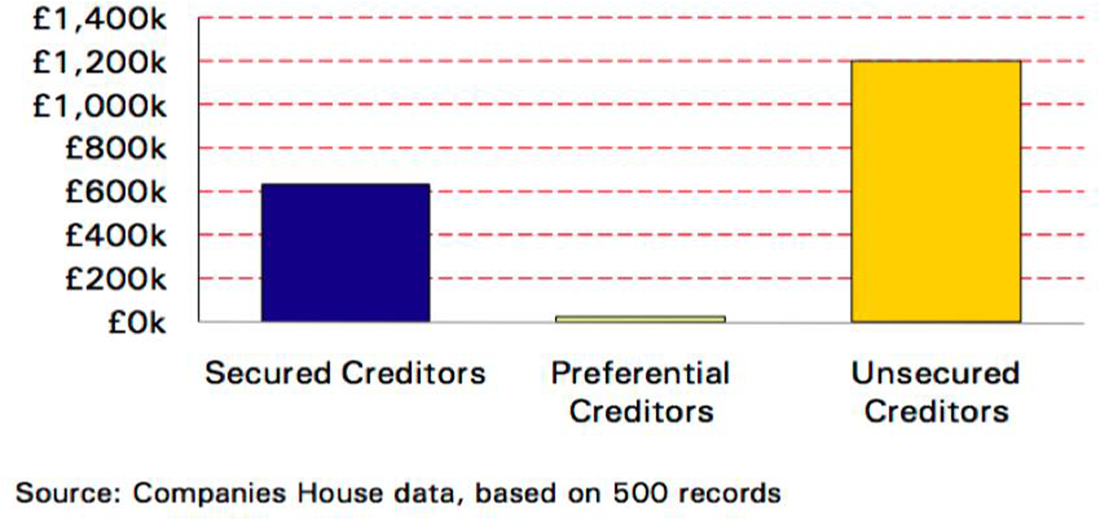
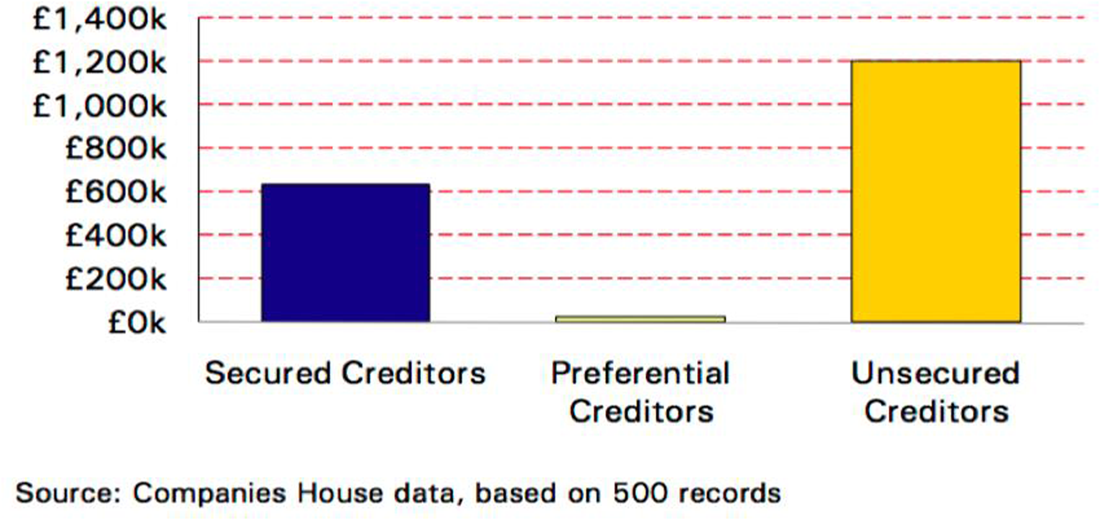
However, despite this ever-present tension the Insolvency Service's consultation featured terms of reference that were unduly limited, particularly in relation to the unsecured creditor. Neglect of this stakeholder is particularly alarming when their contribution to lending is analysed. Over a decade ago this was put in the billions, as Figure 3 demonstrates. The rates of lending were also higher than secured creditors. Protection was, however, very much lower.
Unsecured creditor lending rates, OFT, 2009
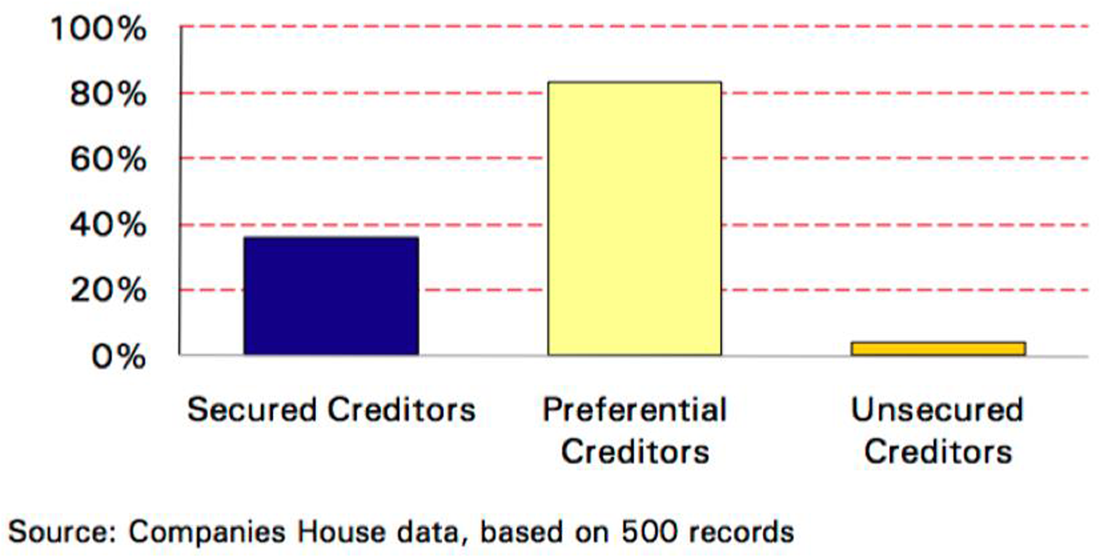
Unsecured creditors’ rates of return on their lending activity was shown to be abysmal, as Figure 4 demonstrates:
Unsecured creditor returns, OFT, 2009

So an unsecured creditor's lot is not a happy one. This fact was viewed with some ‘sympathy’ as early as 1897, when the Lord Macnaghten gave judgment in the famous Salomon case.Footnote 77 Treatment of unsecured creditors was seemingly as poor in the 1890s as it is today. Lord Macnaghten's sympathetic approach was short-lived. He went on to observe that unsecured creditors ‘… have only themselves to blame for their misfortunes’.Footnote 78 These misfortunes were exacerbated by the advent of the floating charge in 1870.Footnote 79 As Milman has acknowledged,Footnote 80 the sweeping up effect of the floating charge did not actuate on Lord Macnaghten's mind sufficiently to cause him to ameliorate some of its effects on the unsecured creditor. On these instruments Lord Macnaghten went on to observe that, ‘a floating charge is too convenient a form of security to be lightly abolished’.Footnote 81 Here we see the dominance of secured creditors as an example of broad Eternal Recurrence.Footnote 82
Eighty-five years after Lord Macnaghten's opinion, the Cork Committee took a somewhat different view about the benefits of the floating charge when they observed:
The matter for wonder is that such a device should ever have been invented by a Court of Equity. It is not easy to discern on what principle of equity the holder of a floating charge should obtain security over goods for which his money has not paid, in priority to the claim of the unpaid supplier of the goods.Footnote 83
This is a powerful insight, not least because it recognises an even broader thematic influence than broad Eternal Recurrence, namely the approach of the Court of Equity in the pre-Judicature Acts period. With the Court of Equity's unique development of a system of rules based on equitable maxims, unconscionability, in personam jurisdiction, and with its genesis in an effort to ameliorate the rigours of the common law,Footnote 84 the Court of Equity seems to have introduced an instrument the effect of which generates the very opposite of a fair outcome for all stakeholders in a corporate insolvency.
Kahn-Freund's 1944 defence of the interests of creditors took a slightly different and more global approach in that he focused on the consequences for creditors who dealt with limited liability companies. Nevertheless, he was still able to show that creditors, and arguably unsecured creditors, could be defrauded and be ‘exposed to grave injury…’.Footnote 85 Lord Walker made a similar point in his 2010 dissenting judgment in Holland v. Revenue and Customs Commissioners and Another Footnote 86 when he observed:
The court's decision will, I fear, make it easier for risk-averse individuals to use artificial corporate structures in order to insulate themselves against responsibility to an insolvent company's unsecured creditors.Footnote 87
It could be argued that this limited liability critique and the sentiments that lay behind it have come to the fore again recently but not with general limited liability company use. Instead, the use of pre-pack administrations has caused difficulty. The effect this form of administration has on the interests of unsecured creditors is problematic.Footnote 88 As Finch has noted, pre-pack administrations present a, ‘fait acompli which tends to ride roughshod over the procedural and substantive interests of less powerful creditors’.Footnote 89 This procedure represents another example of unsecured creditor disenfranchisement and our latest example of broad Eternal Recurrence in the context of unsecured creditors. The same arguments on priority and affect are being played out again and again, with the latest iteration being in the context of pre-pack administrations.
The floating charge was not the only late nineteenth century incursion into the interests of the general body of creditors. The Preferential Payments in Bankruptcy Act 1888 saw the introduction of a further set of measures that made inroads into the distributable pool.Footnote 90
Unsecured creditors came in for mixed treatment in the 1970s. On the one hand they suffered the multiple blows of the Romalpa clauseFootnote 91 and the cunning deployment of trust instruments.Footnote 92 On the positive side, the Cork Committee attempted to come to their aid with sympathetic rhetoric but also with some practical measures to increase their participation, monetarily and procedurally, in the corporate insolvency process.
In Borden v Scottish Timber Products Footnote 93 Templeman LJ set the disgruntled tone when he lamented that ‘Unsecured creditors rank after preferential creditors, mortgagees and the holders of floating charges and they receive a raw deal’.Footnote 94 This theme was picked up by the Cork Committee,Footnote 95 who – when they examined the plight of the unsecured creditor – found much to regret. There are multiple references throughout the 1982 paragraphs of the report on both the unsatisfactory nature of the unsecureds’ position, but also in relation to creditors’ failure to get involved in the process. This perhaps highlights an important issue which also comes across in the IS Consultation, ie mechanisms exist to involve creditors but they are not used.
As Milman argues, the Cork Committee's dissatisfaction with the plight of the unsecured creditor did not, however, cause them to look more closely at the global effect of what were then two relatively new devices, namely, retention of title (Romalpa) clauses or the use effect of trusts on the make-up of the insolvent estate. Milman lamented that whilst ‘these developments did offer an escape for a privileged few from the misery felt by most unsecured creditors, they merely exacerbated the plight of the remainder of the other unsecured creditors by removing from their grasp even more items from the pool of realisable assets’.Footnote 96
Nevertheless the Cork Committee did propose the 10% fund.Footnote 97 This mechanism would have directly benefited unsecured creditors, as it allowed a receiver to allocate 10% of the proceeds of realisation for their benefit. This proposal was not taken up in the mid-1980s programme of legislative reform. It had to wait. It was not until the enactment of the Insolvency Act 1986, s 176A, following the Enterprise Act 2002 reforms, that the ‘prescribed part’, a version of the 10% fund promulgated by the Cork Committee, was created. Section 176A states that a liquidator, administrator or receiver shall make a prescribed part of the company's net property available for the satisfaction of unsecured debts, and shall not distribute that part to the proprietor of a floating charge, except in so far as it exceeds the amount required for the satisfaction of unsecured debts. This enactment received fierce opposition from the banks, who suggested that they would be forced to raise interest rates and that they would refuse to lend to riskier businesses.
The provision may not be particularly useful in practiceFootnote 98 anyway, as the case of Re Courts plc (in liquidation) Footnote 99 demonstrates. Liquidators applied for an order under s 176A(5) of the Insolvency Act 1986 that s 176A(2) was not to apply so as to require a distribution of the prescribed part to unsecured creditors for £28,000 or less because the cost of making a distribution to unsecured creditors would be disproportionate to the benefits.
The other main effect of the Enterprise Act 2002 on unsecured creditors was the abolition of Crown preference as a result of s 251 of that statute. Finch has put total realisations from this abolition at £70 million,Footnote 100 whilst the figure of £90 million has also been given.Footnote 101 In the recurrent theme sense HMRC have recently revisited the carefully-thought-through reforms and published a consultation document in which they propose to re-introduce Crown preference.Footnote 102 Little regard seems to be paid to the interests of the rescue culture and the knock-on effect on unsecured creditors.Footnote 103
Despite these reform initiatives the OFT Report still pointed out the weak ineffectual position of unsecured creditors. Whilst recognising that unsecured creditors ‘are responsible for a significant amount of credit in the economy’,Footnote 104 the IS Consultation goes on to note that insolvency practitioners’ fees ‘can erode or exhaust what would otherwise be available to creditors, particularly unsecured creditors as the lowest ranking creditor group’.Footnote 105 Not only have unsecured creditors suffered due to their ranking position according to the OFT, by they have also overpaid by around £15 million in fees per annum in the administration process.Footnote 106
Further judicial discontent with the unsecured creditor's lot can be garnered from the law reports. The starting point of analysis for this species of creditor invariably starts with a rather low expectation of their expected return, or with their status as unsecured creditors generally. For example, in Società Esplosivi Industriali Spa v Ordnance Technologies (UK) Ltd (formerly SEI (UK) Ltd) and Others (No 2)Footnote 107 Lindsay J noted ‘I have not seen the statement of affairs in OTL's liquidation, nor have I been told what sort of dividend, if any, can be expected by its unsecured creditors’.Footnote 108 An expectation of zero return comes across in a number of judgments. For example, in Fiorentino Comm Giuseppe Sr1 v Farnesi and Another Footnote 109 Mr Nicholas Warren QC (sitting as a Deputy High Court Judge) noted, ‘I am satisfied – and this is not in any event disputed – that there will be no dividend for unsecured creditors’.Footnote 110 In Goel v Pick Footnote 111 Sir Francis Ferris noted that the claimant ‘…would only be an unsecured creditor in respect of any damages that might be awarded’,Footnote 112 as if unsecured creditor status – perhaps quite rightly – has no real value at all.Footnote 113 In Re The Designer Room Ltd Footnote 114 Rimer J noted how the officeholder's view of procedures was influenced by the lack of distributable funds for unsecured creditors. After observing that ‘There will be nothing for any of the unsecured creditors’,Footnote 115 he went on to observe that ‘the administrators also consider that it would be uneconomic to prepare a proposal for a voluntary arrangement, circulate it to all creditors, and then hold a meeting to seek approval for the sole purpose of making a distribution to the preferential creditors’.Footnote 116
The picture is perhaps not entirely bleak for unsecured creditors. Cases such as Re GHE Realisations Ltd (formerly Gatehouse Estates Ltd) Footnote 117 show that distributions are made to this residual class of creditor. Unfortunately, the distributions to this species of creditor are invariably low, if not non-existent. For an example of low distributions, cases such as Re PF Murray A Debtor, ex parte The Debtor v Official Receiver Footnote 118 are instructive. In the case Cross J noted that ‘It is common ground that the amount required to pay the unsecured creditors is 5s in the pound’.
Are unsecured creditors apathetic and does this allow insolvency Eternal Recurrence?Footnote 119
As the Cork Committee, the OFT (as it then was) and the Insolvency Service have identified, and as noted above, there is a certain amount of apathy amongst unsecured creditors. On this point the Cork Committee noted ‘… it has been suggested to us that the elaborate structure for creditor control in bankruptcy and compulsory winding up is illusory, largely owing to apathy and indifference on the part of creditors themselves’.Footnote 120 They continued:
We consider it unsatisfactory that creditors, whose experience would be invaluable to the liquidator or trustee, are discouraged from participating in the administration of an insolvent estate. We are in no doubt that the machinery should be such as to allow, and indeed encourage, those creditors who have a genuine interest to involve themselves in all types of insolvent administration.Footnote 121
On creditor apathy the Cork Committee noted that ‘because of the indifference of creditors towards supervising the administration of insolvent estates… there has also been an increasing measure of judicial control’.Footnote 122 The Cork Committee proposed three reasons for this indifference:
– There is a generally held belief that most trustees and liquidators are efficient, reliable and experienced.
– There is a lack of interest on the part of business creditors, who allow for the occasional bad debt in fixing their prices and write if off when it occurs, thereby reducing their taxable profits.
– Thirdly, and perhaps of greatest significance there is a resigned acceptance of the fact that in most cases the general body of creditors are only likely to receive a small divided.Footnote 123
It could be argued that the position of unsecured creditors has parallels with shareholders in companies with dispersed ownership. The famous Berle and Means thesisFootnote 124 showed that shareholders become apathetic within large widely-dispersed ownership model companies, as they can have little impact on the way in which the company is managed. The separation of ownership and control can lead – and Pettet has called this an axiom in modern timesFootnote 125 – to the imposition of a self-perpetuating oligarchy.Footnote 126 Shareholders simply feel powerless and therefore disengage with the proper monitoring of management. A similar pattern of behaviour may be occurring with unsecured creditors. The Cork Committee noted that unsecured creditors had little, if any, involvement in Committees of Inspection because they felt confusion over the rules governing the committees of inspection and how these were constituted. They noted that they ‘received evidence of confusion over the interpretation of these provisions and precise nature of the functions to be performed by Committees of Inspection… most unsatisfactory’.Footnote 127 Creditors should involve themselves in the insolvency process as ‘the underlying principle is that since the estate is being administered primarily for the benefit of the creditors, they are the persons best calculated to look after their own interests’.Footnote 128
One could respond to this unsecured creditors apathy by arguing that it is not that complaints mechanisms and such like are defective but that unsecured creditors’ engagement is problematic. This is the issue at the heart of the problem that the IS Consultation identifies, and it is because of this that we need to examine why the number of unencumbered assets is so small, rather than focusing on participation in the management of distributing such a small fund. Methods of distribution are importantFootnote 129 but they do not resolve the question of the quantum of what is available to be distributed. A more far-reaching evaluation of the nature and functions of our corporate insolvency laws is required for that task.Footnote 130 For well over 150 years unsecured creditors have experienced numerous incursions into the pot that may have been available for their satisfaction, but for insolvency practitioner fee claims,Footnote 131 security devices, ROT clauses, trust instruments, preferred creditors, etc. At a relatively recent Insolvency Service conference on the use of information technologies, the then Director of Policy at the Insolvency Service, Nick Howard, responded to a question from Professor Sir Roy Goode QC by suggesting that he might like to chair a Cork Mark II.Footnote 132
The OFT report perhaps highlights that this may not have been an entirely unreasonable suggestion. If there is no substantive change, then strong creditors will continue to dominate corporate insolvency. It could therefore be argued that the OFT Report and resulting IS Consultation amount to nothing more than an exercise in moving the deck chairs around. Cork was critiqued by one commentator for not visiting the fundamentals.Footnote 133 A similar charge could perhaps be laid on the current consultation and reform process. One could respond, however, by noting that engaging in Warren-like paternalism for unsecured creditors is commendable, but like apathetic shareholders, or missing tutorial undergraduates, there comes a stage when this paternalism is destructive of individual creditor motivation. As the IS Consultation has observed, the systems are there – use them.
Reform which truly affects unsecured creditors may involve, inter alia, a consideration of alternatives to pari passu, such as paying in order of time of creation of the debt, payment by reference to ethical considerations, according to the size of sum owed, according to the need of each individual creditor and their inability to sustain losses, payment on public policy grounds, etc.Footnote 134 An alternative view, suggested by Milman, is that ‘as far as unsecured creditors generally are concerned, the main hope for the immediate future lies not in terms of classical priority rules being changed but more in the trend towards making directors personally liable for corporate debts’.Footnote 135 Given our traditional adherence to limited liability, this is controversial, and realisations from s 214 or s 239 of the Insolvency Act 1986 have not recouped much for the unsecured creditors.Footnote 136 However, things may change. The rise of litigation funders, such as Manolete Partners plc,Footnote 137 certainly seems to make the pursuit of this species of litigation, and associated settlements, much more likely.
The unsecured creditors’ position will only be ameliorated if the entire structure of corporate insolvency is re-evaluated and changed.Footnote 138 This calls for a wider reform process; a mere tinkering with the communication mechanisms for unsecured creditors will achieve little.
(b) The protection quest: trusts and insolvency – themes of consolidation and ‘security’ protection
Our second Nietzschean broad Eternal Recurrence theme relates to the seemingly permanent quest for protection. Trusts and their deployment within the realm of insolvency are one example of this attempt by one group of creditors, or a single creditor, to place themselves outside the insolvency waterfall and in the most favourable position upon insolvency. In so doing the creditor escapes the problems which have just been discussed, which attach to the unsecured creditor.
There has been a diminution in protection provided by security as a result of the Enterprise Act 2002 reformsFootnote 139 on administrative receivership and, by extension, fixed and floating charges.Footnote 140 What alternatives exist that credit providers can seek redress from? Stevens and Finch, amongst others, have begun the search by highlighting the possible use of trusts in the context of post-administration funding protection for creditors who advance new monies in a rescue environment.Footnote 141 The establishment of a trust helps a given ‘creditor’ escape this ranking.
Fletcher observed that the establishment of a trust helps the creditor escape ‘the fate destined to be experienced by the other ordinary, unsecured creditors’.Footnote 142 The effect of escaping priority ranking or pari passu treatment is the same for the beneficiary of any trust, namely that they avoid participating in a pool of assets alongside other creditors in whatever form of participation is being used. If it is accepted that the use of a trust is a true exception to pari passu principles of distribution,Footnote 143 other examples can also be given, such as set-offFootnote 144 and Romalpa clauses,Footnote 145 which aid one creditor in its attempts to circumvent the distribution mechanisms, or indeed the effect of the insolvency laws in their totality. This is because the property against which the creditors are seeking to claim, in the context of trusts and Romalpa clauses, never formed part of the insolvent estate. Set-off, of course, does fall within the insolvency laws but operates automatically, causing value to be removed before collectivised interests take hold. The property in the trusts and Romalpa sense is, therefore, not available to the officeholder for realisation and subsequent distribution according to collectivised interests and any given distribution mechanism, but can be sought by the trust ‘creditor’ alone to satisfy their claims as beneficiaries (or owners in the case of Romalpa clauses).
The impact of equity and trusts on insolvent situations is of course long standing and has again risen to the fore with the case of Re Farepak Food and Gifts Ltd (in administration). Footnote 146 The law of insolvency is itself a creature of the equitable jurisdiction of the Court of Chancery.Footnote 147 In a post-Enterprise Act 2002 lending environment, the trust can provide ‘an indispensable protection against risk’.Footnote 148 Simply put, it can replace the dominance previously afforded to security devices.
(c) Accountability of directors – the balance of human rights protection within insolvency
Our third Nietzschean Eternal Recurrence theme relates to the treatment of directors and how they are held to account. This is an example of narrow Eternal Recurrence, in that it relates to a specific and relatively narrow time period. It is also narrow as it relates to specific statutory provisions and their use and interpretation over time. The subject of director accountability is voluminous if you include directors’ duties, wrongful and fraudulent trading, preferences, transactions in fraud of creditors, etc. Here, there is a focus on directors and their human rights set against the creditors’ desire to find out as much as possible about the insolvency. This tension between a key officeholder, the director, and the creditors provides a major example of a relationship that has existed in insolvency since the creation of the company form in the nineteenth century. This example, and how it has been treated in a relatively short time period, provides another area upon which the beam of insolvency Eternal Recurrence can be directed.
The rise in complex fraud cases in the 1980s and early 1990sFootnote 149 highlighted the problem of, on the one hand, balancing the basic right of a witness to rely on the privilege of not self-incriminating and the right to silence, against, on the other hand, the public interest requirements in punishing and properly investigating such frauds. The matter has been somewhat resolved by s 11 of the Insolvency Act 2000. Nevertheless, for a period of time during the 1980s English and Welsh insolvency law and practice was not in step with the European Court of Human Rights on the issue.Footnote 150
It is a fundamental principle of English law that an accused has a privilege against self-incrimination, together with a right to remain silent.Footnote 151 The genesisFootnote 152 of these dual rights arose from the activities of the Star Chamber, compelling confessions on pain of personal injury.Footnote 153 These dual criminal law privileges caused problems for the Department for Business Innovation and Skills (now the Department for Business, Energy and Industrial Strategy) investigators when interviewing directors who have pleaded the dual rights in defence to questions and when the information is used pursuant to the Insolvency Act 1986, s 433 (as enacted). Unfortunately, the statute as enacted made no mention of the rights and the courts have had to grapple with this complex question.Footnote 154
The case law in this area is voluminous and the enactment of the Human Rights Act 1998 led to much controversy in the area.Footnote 155 The Companies Act 1985 (as it then was, now the Companies Act 2006) and the Insolvency Act 1986 contained provisions that were broadly similar in terms of compulsion powers. Four examples will be given.Footnote 156
Re Jeffrey S Levitt Ltd Footnote 157 concerned the Insolvency Act 1985, s 236 and the Insolvency Act 1986, s 235 and the question of the right to the privilege against self-incrimination. Vinelott J held that an officer cannot refuse to answer questions because they might incriminate him. The judge held that the officeholder's overriding statutory duty to assist the insolvency practitioner trumped human rights considerations. The decision was upheld by the Court of Appeal.Footnote 158
In Re London United Investments plc,Footnote 159 the question before the court concerned the Companies Act 1985, s 432 (as it then was) and whether the respondent was entitled to the privilege against self-incrimination. Scott J held that a witness cannot rely on the privilege so as to refuse to answer questions put to him by the inspectors.
In R v Seelig,Footnote 160 one of the many cases arising from the take-over of Distillers Co plc by Guinness plc,Footnote 161 the Court of Appeal held that an answer given by a witness to inspectorsFootnote 162 could be used against them in criminal proceedings. The defendants were accused of attempting to induce the disposal and acquisition of securities. At a preparatory hearing it was held that the contents of the interviews obtained by the inspectors of the Department of Trade and Industry (as it then was) were admissible in evidence at their trial. The accused appealed, contending that there was a conspiracy between the DTI inspectors and the Crown Prosecution Service prosecutors to obtain evidence to convict them. Further, they claimed use of such evidence was unfair in that if they had known of its potential admissibility they would have remained silent and faced contempt proceedings. The Court of Appeal, agreeing with the reasoning of Henry J, held in light of the fact the defendants were ‘extremely astute professional men who have been advised at one time or another by very experienced city solicitors’, they had not been prejudiced by the admissibility of the evidence. The evidence being properly obtained, in pursuance of the statutory purpose which Parliament intended, the relevant Companies Act provisions applied.
Private examinations under the Insolvency Act 1986 again came before the House of Lords in Re Arrows Ltd (No 4). Footnote 163 The case concerned an appeal against the Court of Appeal's reversal of Vinelott J's decision in Re Arrows (No 2), that access to transcripts obtained under s 236 should be restricted.Footnote 164 Following the decision in Bishopsgate Investment Management Ltd v Maxwell,Footnote 165 the House of Lords held that, ‘a person examined under s 236 can be compelled to give self-incriminating answers which are admissible against him in criminal proceedings’.Footnote 166 The case, however, went further and as Lord Browne-Wilkinson noted, ‘the SFO is seeking to obtain answers given in the course of investigations initiated for the purpose of safeguarding the company's property (and for that purpose deprived of the privilege against self-incrimination) for use in evidence in a criminal prosecution’.Footnote 167
We have explored a relatively small selection of cases from a much larger dataset which demonstrate narrow Eternal Recurrence, in that the same solution is offered again and again by the judges in relation to a balanced and nuanced question on the extraction and admissibility of evidence in the context of an insolvent company and its controlling directors. The cases demonstrate that English insolvency law has in the past taken an approach to the European Convention of Human Rights and Fundamental Freedoms that was inconsistent with Article 6. The Saunders judgment (noted above) and the reforms which that caused will now be examined. Article 6Footnote 168 of the Convention states, inter alia, that:
‘In the determination of his civil rights and obligations or of any criminal charge against him, everyone is entitled to a fair and public hearing within a reasonable time by an independent and impartial tribunal established by law…’
In a further case emanating from the Guinness plc takeover of Distillers plc, Saunders v UK,Footnote 169 the European Court of Human Rights had the opportunity to consider the legality of the admissibility of evidence obtained by compulsion, and its compliance with Article 6 of the European Convention on Human Rights. This case has had a fundamental effect on the usage of evidence obtained under the Companies and Insolvency Act and its subsequent admissibility in criminal trials. The court held by a majority of sixteen votes to four that the use of a self-incriminating statement, in criminal proceedings, obtained under compulsion pursuant to the Companies and Insolvency Acts provision, was unfair and a breach of Article 6(1) of the European Convention on Human Rights.
Section 11 of the Insolvency Act 2000 provided for an amendment to s 219 of the Insolvency Act 1986 in light of the decision of the European Court of Human Rights in Saunders v UK.Footnote 170 As a result of this amendment there are restrictions on the use of answers obtained under compulsion, namely, any answers given under compulsion cannot be used against a director who would has been compelled to give answers pursuant to the Insolvency Act 1986 provisions, except in limited circumstances. We are, therefore, now domestically in line with the approach of the European Court of Human Rights.
In terms of Nietzschean Eternal Recurrence, we can see that it is the theme of director accountability and its obverse – creditor appeasing – that is in play in this run of cases. This creditor satisfaction theme is as old as the insolvency laws.
3. Damage to or the impossibility of innovation?
The critical problem with insolvency Eternal Recurrence is that it stifles innovation and productive, genuinely novel, policymaking. Instead, we have lazy recycling of tired old ideas that were not deemed beneficial or helpful on their first venture into the policy consideration forum: plus ça change, plus c'est la même chose. To wheel out the same solutions, no matter how often, will not make them more attractive. Indeed, to seemingly ignore the considered feedback of consultees during various and repeated consultations will eventually lead to the exasperation of those stakeholders from whom views have been solicited. Eventually this may lead to a lack of meaningful engagement in the reform process by the majority of stakeholders. Much that could be productively done will potentially be lost.
In the worst-case scenario, certain stakeholders, such as secured creditors, will capitalise on this reform apathy and will seek to monopolise and dictate the course of future reform for self-serving purposes. The repetitive status quo cannot be permitted to continue. Unlike Zarathustra's unreceptive bovine audience, we need policy makers to shake off their complacency. They should instead be engaging in the ‘hard and rigorous thought’Footnote 171 Nietzsche was trying to encourage in The Gay Science. Nothing less than ‘daring… creative bloody-mindedness’Footnote 172 in the pursuit of thinking would satisfy Nietzsche. Policy makers should reject insolvency Eternal Recurrence and the ‘peace of non-existence’ in favour of novelty and fresh ideas. They should return to the fray with gusto, and relish the challenge of innovation.
If the insolvency community is not alive to the phenomena of insolvency Eternal Recurrence and the repetition its represents, there is a real danger that innovation will be stifled. This is deeply problematic. If we hope to identify and engage in the creation of a well-functioning insolvency law, with settled targets, aims and objectives, it is imperative that the super-structure within which the work is occurring is well understood. Any peculiar features, reform foibles or dangers to innovation must be eliminated in their infancy otherwise the given targets of reform and perfection will be seriously undermined, if not lost entirely.
To revitalise the rescue culture, or formulate an entirely new approach to English and Welsh insolvency law and policy, we need to freshen up thinking and ideas, particularly those emanating from the policy sector. The same can also be said of the academy and practice. This renaissance may also mean the abandonment of old principles hitherto considered sacrosanct. Vulnerable areas ripe for re-consideration could foreseeably include the rescue culture, and vested interests, such as security and the waterfall, preferential creditors, the prescribed part, self-regulation and the reduction of recognised professional bodies. There should be no sacred cows. We could either tinker in the Manson sense of piecemeal reform or undertake a Benthamite sweeping away of the old apparatus, leaving us with an entirely clean slate upon which to write a new well-functioning and genuinely communitarian insolvency law.
If possible, some of Nietzsche's own apparent qualities must be engendered. It has been said of him that ‘Nietzsche's originality and unusual ability to intuit and anticipate future developments and trends must be fully recognised…’Footnote 173 Some attempts have been made to emulate Ibsen's Eilert Løvborg but with future gazing in the realm of insolvency.Footnote 174 However, much more work of this nature needs to be undertaken to alleviate the funk. Taking a completely fresh and revitalised approach has occurred and paid dividends in other areas. For example, Birks’ work on unjust enrichment at Oxford provided for a novel approach to private law.Footnote 175 More of this in insolvency law and policy is sorely needed.
New areas of thought
We must move away from hackneyed recycling if it is stifling novel policy making. We must instead seek out fresh ideas. What else might be proposed which would move the agenda forward?
We could advocate sweeping away security interests entirely, leading to a new kind of true pluralism. This would make all stakeholders equal. We could reject a system based on collectivisation of creditor interests and introduce competitiveness with race-to-the-bottom techniques. We could reassess the theatre of claimants from a Marxist perspective.Footnote 176 We could reject the language of insolvency, which hides and masks the underlying tensions of what is in fact occurring. Unsecured creditor is relatively vague as a term of art and masks who and what we might be dealing with, ie a jobless employee.
Conclusion
This paper has critically examined Nietzsche's Eternal Recurrence thought experiment and how it can be applied to English and Welsh insolvency law through broad, narrow and deep versions of insolvency Eternal Recurrence. The application of Nietzsche's thought experiment and the original creation of insolvency versions of Eternal Recurrence in this paper has provided a novel contribution to the subject of insolvency in England and Wales.
This paper has demonstrated that both broad and narrow Eternal Recurrence exists in English and Welsh insolvency law and that it debilitates the process of policy formulation and subsequent reform. Eternal Recurrence stifles innovation and novelty. Until policymakers are properly acquainted with previous policy consultations, we cannot hope to break the cycle or repetition and staleness. If there is to be a Cork Mark II reform committee on insolvency law reform then previous reform baggage must be ejected. If this cannot be done, then Eternal Recurrence should be a mantra, oft repeated, that is constantly borne in mind during the currency of the policy formulation process.
To move forward in a new and clear way, policymakers need to be more imaginative in policy setting and move away from vested interests and the constraints these bring to fresh policy making. In this way we will be breaking the cycle of Eternal Recurrence (of the same ideas and approaches) in insolvency law. It is one discrete area of private law but it would provide a catalyst for change.