Implications
Sulla is a legume forage species with excellent agronomic traits that positively impacts ruminant production. Its favourable chemical composition and moderate condensed tannin (CT) content results in increased forage intake, milk yield and casein in ewes, leading to cheese that is higher in polyunsaturated and n-3 fatty acids (FA), which have beneficial effects on human health. Accordingly, the introduction of sulla to crop–livestock farming systems could enhance the yield of dairy products as well as their healthy content. Although grazing for 8 h on sulla was effective in further improving the nutritional properties of cheese fat, prolonging the grazing time (GT) from 8 to 22 h/day improved the performance of ewes, thus resulting in a viable strategy to increase the economic productivity of grazing farming systems.
Introduction
Sulla (Sulla coronarium L.) is a biennial legume, which is typical of cereal-based crop rotations in Mediterranean regions, and is used for hay production or grazing (Ruisi et al., Reference Ruisi, Siragusa, Di Giorgio, Graziano, Amato, Carimi and Giambalvo2011). This forage species (FS) has excellent agronomic traits, and as fresh or preserved forage, is valued for its positive impact on ruminant productivity and product quality. Feeding green sulla forage to dairy ewes (Bonanno et al., Reference Bonanno, Di Grigoli, Di Trana, Di Gregorio, Tornambè, Bellina, Claps, Maggio and Todaro2007; Molle et al., Reference Molle, Decandia, Giovannetti, Cabiddu, Fois and Sitzia2009), goats (Bonanno et al., Reference Bonanno, Di Grigoli, Vargetto, Tornambè, Di Miceli and Giambalvo2013a) and lambs (Bonanno et al., Reference Bonanno, Di Grigoli, Montalbano, Bellina, Mazza and Todaro2011) improves their performance compared with grass-based diets. The beneficial effects of sulla on ruminant production is particularly attributable to its high protein content, high ratio of non-structural to structural carbohydrates and moderate CT concentration ranging from 0.8% to 5% of whole-plant dry matter (DM) (Ruisi et al., Reference Ruisi, Siragusa, Di Giorgio, Graziano, Amato, Carimi and Giambalvo2011). Moderate CT levels (<6% DM) protect dietary protein from ruminal degradation due to the ability of CT to bind protein, thereby increasing its utilisation in the intestinal tract, and are active in the control of gastrointestinal nematode parasitism (Min et al., Reference Min, Barry, Attwood and McNabb2003; Piluzza et al., Reference Piluzza, Sulas and Bullitta2014).
In previous research, the intake of sulla forage containing CT increased casein levels in milk (Bonanno et al., Reference Bonanno, Di Grigoli, Vargetto, Tornambè, Di Miceli and Giambalvo2013a and Reference Bonanno, Di Miceli, Di Grigoli, Frenda, Tornambè, Giambalvo and Amato2013b). Furthermore, exposure of ewes (Cabiddu et al., Reference Cabiddu, Decandia, Addis, Piredda, Pirisi and Molle2005 and Reference Cabiddu, Molle, Decandia, Spada, Fiori, Piredda and Addis2009) and goats (Bonanno et al., Reference Bonanno, Di Miceli, Di Grigoli, Frenda, Tornambè, Giambalvo and Amato2013b) to the CT contained in sulla forage increased the polyunsaturated fatty acid (PUFA) content in milk, which has beneficial effects on human health as CT inhibits the complete ruminal biohydrogenation of dietary PUFA. In addition, due to its CT content, sulla fresh forage-based diets were able to improve the plasma oxidative status and increase the polyphenol content and total antioxidant capacity of milk in goats (Di Trana et al., Reference Di Trana, Bonanno, Cecchini, Giorgio, Di Grigoli and Claps2015).
Among grazing management practises, the timing and duration of daily grazing have significant effects on animal performance. In Mediterranean environments, the most common practise for small dairy ruminants is grazing for 4 to 8 h/day during the diurnal period. Generally, an increase in the duration of daily grazing improves animal productivity. The prolongation of grazing from 8 h/day to the entire day allows ewes to spend more time eating, thereby increasing the intake of forage DM and milk yield (Bonanno et al., Reference Bonanno, Di Grigoli, Di Trana, Di Gregorio, Tornambè, Bellina, Claps, Maggio and Todaro2007). In this regard, additional nocturnal grazing has benefits on body condition and tolerance to heat stress, and increase grass intake (Iason et al., Reference Jenkins, Wallace, Moate and Mosley1999). As the level and quality of herbage intake by grazing animals greatly depend on pasture management, the latter plays a key role in determining milk and cheese quality, also in relationship to FA composition. The content of PUFA in milk and cheese is particularly enhanced by pasture feeding, increasing proportionally with the amount of green forage ingested by dairy ruminants (Chilliard et al., Reference Chilliard, Glasser, Ferlay, Bernard, Rouel and Doreau2007). Cabiddu et al. (Reference Cabiddu, Decandia, Addis, Piredda, Pirisi and Molle2005) demonstrated how the FA composition of sheep milk is influenced by the FS consumed by ewes at pasture, also with regard to its phenological phase and grazing intensity. Currently, there is a lack of information on the influence of daily grazing duration on the FA profile of milk and cheese.
Thus, the aim of this study was to investigate the effects of feeding CT-containing sulla forage to ewes, and prolonging the daily GT, on forage intake and milk production, as well as the physicochemical properties of cheese, particularly with regard to its FA profile. To this end, grazing sulla pasture was compared with grazing annual ryegrass, and GT was prolonged from 8 to 22 h/day.
Material and methods
Animals and experimental design
The field experiment was performed on the ‘Pietranera’ farm (Università degli Studi di Palermo), which is located in a semi-arid hilly area of Sicily, Italy (37°32′N; 13°31′E; 178 m above sea level).
Two adjacent fenced plots of 4000 m2, cultivated with 2-year sulla (S. coronarium L. var. Sparacia) or annual ryegrass (Lolium multiflorum Lam, subsp. Wersterwoldicum, var. Elunaria) and not previously grazed, were subdivided into two equal subplots. In all, 28 ewes of the Comisana breed were randomly distributed into four homogeneous experimental groups on the basis of days in milk (142±57.0), milk yield (900±124.1 g/day) and live weight (44.7±6.32 kg).
For 6 weeks in April to May 2011, each group grazed one subplot. Two groups grazed for 8 h during the interval between the two daily hand milkings (0800 to 1600 h), and the other groups grazed for the entire day (22 h), except during the milking time (2 h). The experimental groups were as follows: grazing sulla for 8 h (S8), grazing sulla for 22 h (S22), grazing ryegrass for 8 h (R8) and grazing ryegrass for 22 h (R22). Water was provided ad libitum by tanks to ewes at pasture. During the night, the ewes that grazed for 8 h were housed in a wide straw-bedded pen within a semi-open fold, equipped with a water trough; they received no feeding supplement. The ewes were managed according to the guidelines for accommodation and care of experimental animals of the European Union Directive 86/609/EEC and the recommendation of the Commission of the European Communities 2007/526/EC.
Measurements, sampling and analyses
The initial and final forage biomass of pasture were estimated by cutting four areas of 2 m2 per subplot at ground level, and drying the relative samples at 105°C for DM determination.
Measurements and sampling of eating activity and forage intake, and recording of individual milk yield of ewes were performed four times during the trial with 10-day intervals. Eating activity of ewes at pasture, expressed as time spent eating (min/day), was monitored for 24 h by direct observations and recorded every 15 min. During eating time, the plant parts ingested by ewes were also observed and recorded. Successively, samples of forage intake were collected by hand-plucking plant parts simulating the ewes’ bites and respecting their recorded incidence.
Freeze-dried samples of forage intake by ewes were analysed for DM, CP (N×6.25), ether extract, ash, NDF, ADF and ADL. Non-fibre carbohydrates (NFC) were calculated as (100−(CP+ether extract+ash+NDF)). Freeze-dried samples of sulla forage intake were analysed for CT by the butanol–HCl method, using delphinidin as the standard (Porter et al., Reference Porter, Hrstick and Chan1986).
The forage DM intake and in vivo DM digestibility of grazing ewes were assessed by the n-alkane method (Dove and Mayes, Reference Dove and Mayes1991). During the trial, the ewes were continuously dosed orally twice daily (0730 and 1700 h) with a pure cellulose stopper containing 30 mg C32-alkane. For each of the four measurement periods to estimate DM intake, faecal grabs were collected twice daily after milking from each ewe during a 4-day period, then freeze-dried and grouped (using about 1 g for each of the eight freeze-dried grabs) into individual samples. No discomfort was observed among ewes as a result of stopper intake or faeces collection. The concentration of natural odd-chain alkanes and the dosed even-chain C32-alkane in faeces and forage were determined in freeze-dried samples with C34 added as an internal standard, extracted with n-hexane and purified in a silica gel column. Quantification of alkanes was performed using an HP 6890 GC system equipped with an auto-sampler and flame ionisation detector (FID) (Agilent Technologies, Santa Clara, CA, USA) and an HP-5 5% phenyl methyl siloxane stationary phase (30 m, 0.32 mm ID, 0.25 µm film thickness) (J&W Scientific, Folsom, CA, USA). Data obtained were used to estimate forage DM intake and digestibility. Intake rate (g/min of DM) was calculated on the basis of DM intake and time spent eating at pasture.
The FA composition of freeze-dried forage samples (50 mg) was determined using the one-step extraction and trans-esterification procedure (Sukhija and Palmquist, Reference Sukhija and Palmquist1988). Forage FA was identified and quantified as described for cheese FA.
Cheese was made on days 1, 3 and 5 in the 3rd week of the experiment (three replicates for each group), and repeated in the 6th week. In each of the six cheese-making sessions, 48 h bulk milk from each group was separately collected, refrigerated and transformed according to the Pecorino Siciliano cheese-making procedure. Cheeses were placed in a ripening cellar for 15 days at 18°C and 75% relative humidity.
The 48 h bulk milk from each group was sampled and analysed for lactose, fat, protein, casein and somatic cell count (SCC) by infrared methods (Combifoss 6000; Foss Electric, Hillerød, Denmark). Samples of 15-day aged cheeses were freeze-dried and analysed for DM, fat, protein (N×6.38) and ash, according to International Dairy Federation standards.
FAs in freeze-dried cheese samples (100 mg) were methylated in 1 ml hexane with 2 ml 0.5 M NaOCH3 at 50°C for 15 min followed by 1 ml 5% HCl in methanol at 50°C for 15 min (Lee and Tweed, Reference Lee and Tweed2008). Fatty acid methyl esters (FAME) were recovered in hexane (1.5 ml). A quantity of 1 μl of each sample was injected by auto-sampler into a HP 6890 GC system equipped with FID, and a 100 m length, 0.25 mm ID, and 0.25 µm film thickness capillary column (CP-Sil 88; Chrompack, Middelburg, The Netherlands) for FAME separation. FAs were identified by a FAME hexane mix solution (Nu-Chek-Prep, Elysian, MN, USA). A standard mixture of methyl esters of c9,t11-C18:2 and c10,t12-C18:2 (Sigma, Milano, Italy) and published isomeric profile (Kramer et al., Reference Kramer, Cruz-Hernandez, Deng, Zhou, Jahreis and Dugan2004; Luna et al., Reference Luna, de la Fuente and Juárez2005) were used to help in identifying the conjugated linoleic acid (CLA) isomers. Total FAs were quantified using C23:0 (Sigma) as an internal standard (4 mg/g freeze-dried sample). The health-promoting index (HPI) was calculated as unsaturated FA (UFA)/[C12:0+(4×C14:0)+C16:0] (Chen et al., Reference Chen, Bobe, Zimmerman, Hammond, Luhman, Boylston, Freeman and Beitz2004).
Statistical analysis
Data were statistically analysed using SAS 9.2 software. For individual data of eating activity (min/day), forage intake and milk yield, with the ewe as experimental unit, the fixed effects of sampling day (SD; 1 to 4), FS (sulla and ryegrass), daily GT (8 and 22 h) and FS×GT interaction were assessed by a MIXED model for repeated measures, with SD as the repeated measure, and the ewe within the FS×GT as the repeated subject, regarded as a random error term. The traits of bulk milk and cheese, with the group as experimental unit, were analysed by the GLM procedure with a model considering the effects of sampling week (3rd and 6th), FS, GT and FS×GT. The SCC values were transformed logarithmically (log10). When a significant effect (P⩽0.05) of the FS×GT interaction was detected, means were compared using P values that were adjusted according to the Tukey–Kramer multiple comparisons test.
Results
Ewe performance
The initial forage biomass resulted in 4.56, 4.46, 2.31 and 2.50 t/ha of DM, with incidences of cultivated species of 99.0%, 99.3%, 87.4% and 84.4% in S8, S22, R8 and R22 subplots, respectively, and decreased to 3.20, 2.10, 2.48, and 1.50 t/ha of DM, with 82.0%, 84.1%, 62.6% and 80.4% of cultivated species, at the end of the 42-day grazing period.
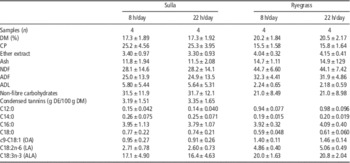
The sulla forage was higher in CP and NFC, and lower in NDF, ether extract, oleic (OA) (c9-C18:1), linoleic (LA) (C18:2n-6) and α-linolenic acid (ALA) (C18:2n-3) than ryegrass, and with a CT content of 3.3% DM (Table 1).
Chemical (% dry matter (DM)) and fatty acid composition (g/kg DM) of sulla and ryegrass forage intake of ewes grazing for 8 or 22 h/day (means±SD)

DE=delphinidin equivalent; OA=oleic acid; LA=linoleic acid; ALA=α-linolenic acid.
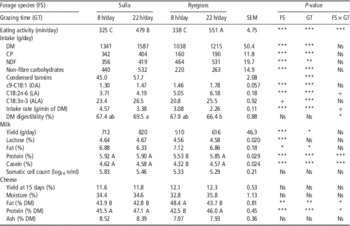
The eating activity (Table 2) did not differ between the S8 and R8 ewes, but increased for both forages with longer grazing, although this increase was greater with ryegrass, explaining the significant FS×GT interaction.
DM intake was higher with sulla than ryegrass; consequently, ewes grazing sulla had increased CP, ether extract and NFC intake, but had reduced ingestion of NDF, OA and LA (Table 2). Ewes that grazed for 22 h had higher DM, nutrient and FA intake than those that grazed for 8 h. Due to the higher DM intake, longer grazing on sulla pasture increased CT intake.
Eating activity, dry matter (DM), nutrients and fatty acid intake, DM digestibility, milk yield and quality traits of bulk milk and cheese of ewes grazing sulla or ryegrass for 8 or 22 h/day

OA=oleic acid; LA=linoleic acid; ALA=α-linolenic acid; Ns=not significant.
a,b,c P<0.05; A,B,C P<0.01.
***P<0.001, **P<0.01, *P<0.05, + P<0.10.
The intake rate (g/min of DM) was lower with sulla than ryegrass, whereas the reduction due to 22 h grazing tended to be less intense with ryegrass. The S22 ewes showed increased in vivo DM digestibility compared with R22 ewes. Higher milk yield was observed with sulla forage and 22 h grazing (Table 2).
Bulk milk and cheese
The components of bulk milk, with the exception of SCC, were affected by FS and daily GT (Table 2). Grazing sulla and prolonged grazing to 22 h/day reduced milk fat. The milk protein and casein showed a significant interaction due to the lower levels emerged in R8 milk.
Cheese yield was similar among groups, whereas its composition reflected that of the bulk milk of origin. Indeed, R8 cheese was higher in fat and lower in protein (Table 2).
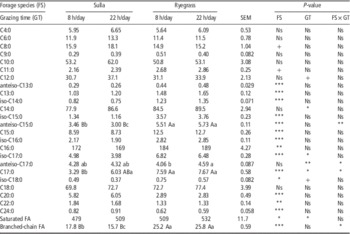
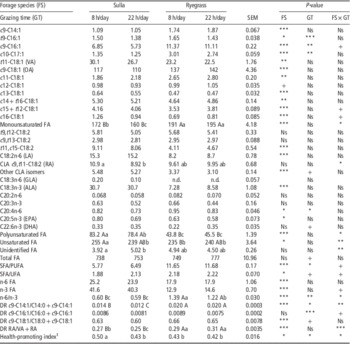
Both FS and daily GT influenced the FA composition of cheese fat (Tables 3 and 4), whereas they did not change the content of total FA (Table 4).
Saturated fatty acid (FA) composition (mg/g fat) of cheese from milk of ewes grazing sulla or ryegrass for 8 or 22 h/day

Ns=not significant.
a,b,c P<0.05; A,B P<0.01.
***P<0.001, **P<0.01, *P<0.05, + P<0.10.
Unsaturated fatty acid (FA) composition (mg/g fat) of cheese from milk of ewes grazing sulla or ryegrass for 8 or 22 h/day

Ns=not significant; VA=trans vaccenic acid; OA=oleic acid; LA=linoleic acid; RA=rumenic acid; GLA=γ-linolenic acid; ALA=α-linolenic acid; EPA=eicosapentaenoic acid; DHA=decosahexaenoic acid; DR=Δ-9 desaturase ratio.
a,b,c P<0.05; A,B,C P<0.01.
***P<0.001, **P<0.01, *P<0.05, + P<0.10.
Saturated fatty acid (SFA) levels (Table 3) were lower in sulla than in ryegrass cheese, and in cheese produced from 8 h compared with 22 h of grazing, in large part due to the smaller contribution of C16:0 and C14:0, respectively. Compared with sulla, ryegrass increased the level of most branched-chain fatty acids (BCFA) and their total amounts. The significant interaction shows that longer grazing decreased total BCFA in only sulla cheese.
Most of the monounsaturated fatty acids (MUFA) (Table 4), among which OA predominates, were lower in sulla than in ryegrass cheese. Consequently, total MUFA was lower in sulla cheese, with decreased levels in S22 compared with S8 cheese. An exception emerged for the trans vaccenic acid (VA) (t11-C18:1), which was detected at higher concentrations in sulla cheeses, regardless of grazing duration.
Total PUFA (Table 4) was almost two-fold higher in sulla than in ryegrass cheese. A slight but significant reduction of PUFA emerged in S22 compared with S8 cheese. Sulla cheeses were particularly enriched in LA, ALA and eicosapentaenoic acid (EPA) (C20:5n-3). The rumenic acid (RA) (CLA c9,t11-C18:2) had a significant interaction due to its reduction in S22 compared with S8 cheese. However, the total content of other CLA isomers was higher in sulla than in ryegrass cheese.
Sulla cheeses, which are lower in SFA and MUFA and higher in PUFA, had lower SFA/PUFA and SFA/UFA ratios than ryegrass cheeses. Compared with 22 h grazing, 8 h grazing led to a reduction in SFA, regardless of FS, but had increased MUFA and PUFA only in sulla cheese. Consequently, the SFA/PUFA and SFA/UFA ratios tended to be lowest in S8 cheeses. Total n-6 and n-3 FA were affected by FS, being higher in sulla cheeses. The n-6/n-3 ratio was lower in sulla cheeses and showed a trend towards reduction in R22 cheeses. With regard to FS, the Δ-9 desaturase ratios (DR) of the desaturase products to the sum of precursors and products (Table 4) were lower in sulla than in ryegrass cheeses, with exception of the DR of C16:0 that, affected by GT, was lower in 22 h than in 8 h cheeses. A less pronounced reduction of both DR of C14:0 and RA occurred when sulla pasture was grazed for 8 h than for 22 h. The HPI was highest in S8 cheeses.
Discussion
Ewe performance
During the 42-day grazing period, sulla pasture ensured higher forage availability for ewes than ryegrass, whereas 22 h grazing corresponded to a lower final biomass than 8 h grazing. Nevertheless, the forage biomass in each subplot seemed not to limit the ewes from expressing their selective behaviour and voluntary feed intake.
The chemical composition of forages grazed by ewes was in line with that of the respective plant species (Molle et al., Reference Molle, Decandia, Fois, Ligios, Cabiddu and Sitzia2003; Bonanno et al., Reference Bonanno, Di Grigoli, Vargetto, Tornambè, Di Miceli and Giambalvo2013a).
Sulla CT level (3.3% DM) was moderate (<6% DM) in relation to the potential adverse effects on feed utilisation by the animals in accordance with Min et al. (Reference Min, Barry, Attwood and McNabb2003).
Similar to every other green forage, both sulla and ryegrass were rich in PUFA (>75% of total FA), which mostly consisted of ALA (>60%), in line with Cabiddu et al. (Reference Cabiddu, Decandia, Addis, Piredda, Pirisi and Molle2005). The lower levels of OA, LA and ALA in sulla forage were mainly due to the lower levels of lipid (ether extract).
Prolonging grazing from 8 to 22 h/day significantly increased the ewes’ eating activity with ryegrass compared with sulla, demonstrating their preference for ryegrass during the evening and night, as observed by Harvey et al. (Reference Harvey, Parsons, Rook, Penning and Orr2000). As ryegrass was lower in NFC than sulla, the major preference for eating ryegrass after sunset could be explained by the better palatability linked to the increase in water-soluble carbohydrates (WSC) in forage, due to the accumulation of diurnal photosynthesis products (Avondo et al., Reference Avondo, Bonanno, Pagano, Valenti, Di Grigoli, Alicata, Galofaro and Pennisi2008). As ryegrass was higher in NDF than sulla, this behaviour could also be caused by the exigency to eat more fibre in the night, as high-fibre intake during the day may compete with rumination (Dumont et al., Reference Dumont, Meuret, Boissy and Petit2001).
The higher DM intake of ewes grazing sulla compared with those grazing ryegrass could be related to sulla composition, which is lower in NDF and higher in NFC than ryegrass, favouring voluntary intake as observed by Molle et al. (Reference Molle, Decandia, Fois, Ligios, Cabiddu and Sitzia2003). The lower intake rate with ryegrass may be explained by the low amount of biomass per bite, which characterises the prehension of grass forage by ewes (Orr et al., Reference Orr, Penning, Rutter, Champion, Harvey and Rook2001). The 8 h grazing ewes had higher intake rates than the 22 h grazing ewes to counterbalance the shorter presence at pasture, in line with previous studies that found that short grazing is generally compensated by faster intake rate compared with grazing for the entire day (Romney et al., Reference Romney, Sendalo, Owen, Mtenga, Penning, Mayes and Hendy1996) and that sheep can regulate intake rate as a function of the time allowance at pasture when herbage availability is high (Iason et al., Reference Jenkins, Wallace, Moate and Mosley1999). Accordingly, 22 h grazing would have allowed the ewes to modulate herbage intake in smaller and more numerous meals.
Despite their higher forage intake and intake rate, S22 ewes showed higher DM digestibility than R22 ewes. This result could be linked to a wider and more uniform distribution of eating activity throughout the whole day, which Bonanno et al. (Reference Bonanno, Di Grigoli, Di Trana, Di Gregorio, Tornambè, Bellina, Claps, Maggio and Todaro2007) observed on ewes grazing sulla compared with ewes grazing ryegrass and attributed to CT. Similarly, Landau et al. (Reference Landau, Silanikove, Nitsan, Barkai, Baram, Provenza and Perevolotsky2000) demonstrated that CT-exposed cattle spent less time on main meals and had increased frequency of small meals; these authors interpreted this eating pattern as a means to preserve the ruminal environment from the negative effects of high CT intake, such as partial deactivation of microbial cellulase, and consequently lower fibre degradation in the rumen (Min et al., Reference Min, Barry, Attwood and McNabb2003) and impairment of DM and CP digestibility (Molle et al., Reference Molle, Decandia, Giovannetti, Cabiddu, Fois and Sitzia2009). On the contrary, in this study, the hypothesised eating pattern of S22 ewes (more small meals widely distributed throughout the day), attributed to CT, could have favoured a slower passage of ingesta along the digestive tract, or a more constant rumen environment, in this way improving nutrient utilisation, as can be presumed by the higher DM digestibility of S22 ewes.
The ewes’ milk yield showed a trend corresponding to DM intake, being higher with sulla forage and 22 h grazing. On the whole, grazing sulla forage and the extension of grazing from 8 to 22 h allowed the ewes to spend more time eating, and increased their voluntary DM intake and milk yield, according to Bonanno et al. (Reference Bonanno, Di Grigoli, Di Trana, Di Gregorio, Tornambè, Bellina, Claps, Maggio and Todaro2007).
Bulk milk and cheese
With regard to bulk milk composition, the reduction in fat occurred with sulla and 22 h grazing, which can be attributed to the dilution effect caused by a higher milk yield. On the contrary, milk protein and casein did not show a dilution effect, and were lowest in R8 milk, corresponding to the lowest milk yield. Thus, there were positive effects of both sulla and ryegrass in maintaining and increasing milk protein and casein composition, respectively, when grazing was prolonged, consequently leading to an increase in milk yield. The favourable effect of feeding sulla on milk protein and casein was also observed by Bonanno et al. (Reference Bonanno, Di Grigoli, Vargetto, Tornambè, Di Miceli and Giambalvo2013a and 2013b), and attributed to the intake of CT. This was able to reduce protein degradability in the rumen, and consequently increase the amount of amino acids to be absorbed in the intestinal tract (Min et al., Reference Min, Barry, Attwood and McNabb2003), thereby contributing to the improved efficiency of dietary protein utilisation for milk casein synthesis in the udder tissue. The increase in milk protein and casein in R22 milk could be a consequence of improved microbial protein synthesis in the rumen due to a higher WSC/CP ratio in the forage grazed after sunset, as hypothesised by Avondo et al. (Reference Avondo, Bonanno, Pagano, Valenti, Di Grigoli, Alicata, Galofaro and Pennisi2008).
On the whole, compared with GT, FS had a higher impact on the FA profile of cheese. The total SFA content was lower in cheese from sulla, due to the lower content in C16:0, and in cheese from 8 h grazing ewes, due to the lower contribution of C14:0 and, tendentially, C12:0. These three medium-chain SFA have hypercholesterolaemic effects by increasing low-density lipoprotein cholesterol (Ohlsson, Reference Ohlsson2010). The higher content in C14:0 in cheese from 22 h grazing ewes, regardless of FS, does not seem to be completely linked to the activity of the Δ-9 DR of C14:0, which was lower only in S22 cheese; then, its increase, together with that of C12:0, could be attributed to the higher NDF intake induced by the longer grazing duration, as the even-chain SFA from C:6 to C14:0 are entirely synthesised de novo within the mammary gland from acetate, produced during cellulose fermentation in the rumen (Bauman and Griinari, Reference Bauman and Griinari2003). The BCFA content was lower in sulla cheese, especially when sulla was grazed for a longer period of time. Milk BCFA, which has garnered interest because of its anti-cancer activity, is particularly recognised for its iso-C15:0 and iso-C16:0 content (Parodi, Reference Parodi2009), which is mainly derived from the biosynthesis of cellulolytic bacteria leaving the rumen. For this reason, they are favoured by diets with higher fibre levels or forage/concentrate ratio, and are considered markers of rumen microbial fermentation and microbial flow from rumen to the duodenum (Vlaeminck et al., Reference Vlaeminck, Fievez, Cabrita, Fonseca and Dewhurst2006). Accordingly, the higher BCFA level in ryegrass cheese can be linked to the higher NDF intake of ewes. Vlaeminck et al. (Reference Vlaeminck, Fievez, Cabrita, Fonseca and Dewhurst2006) suggested that variation in the BCFA profile could reflect changes in the rumen environment and microbial population induced by diet. Hence, the decreasing total BCFA in S22 cheeses could be justified by the higher NFC intake of ewes that could have reduced the contribution of cellulolytic bacteria to the ruminal population, and the relative biosynthesis of BCFA (Vlaeminck et al., Reference Vlaeminck, Fievez, Cabrita, Fonseca and Dewhurst2006).
The sulla cheese, compared with ryegrass cheese, was lower in MUFA, with the exception of VA, and was markedly higher in PUFA, especially LA, ALA and EPA, in accordance with Cabiddu et al. (Reference Cabiddu, Decandia, Addis, Piredda, Pirisi and Molle2005) who similarly compared the milk from ewes grazing sulla or ryegrass for the entire day, and Bonanno et al. (Reference Bonanno, Di Miceli, Di Grigoli, Frenda, Tornambè, Giambalvo and Amato2013b), who compared the milk from goats fed sulla or a hay-based diet.
The reduction of MUFA in sulla cheeses was mainly due the lower OA, presumably linked to its lower intake, and also to the lower activity of Δ-9 desaturase in mammary gland, as indicated by the DR ratio of C18:0.
Due to the increased level of PUFA and n-3 FA, the sulla cheeses resulted in a more beneficial FA profile for the health needs of consumers (Bauman et al., Reference Bauman, Mather, Wall and Lock2006; Dewhurst et al., Reference Dewhurst, Shingfield, Lee and Scollan2006; Chilliard et al., Reference Chilliard, Glasser, Ferlay, Bernard, Rouel and Doreau2007). These results do not appear to be supported by the LA and ALA intake due to grazing sulla, which were comparable with those with ryegrass, but can be explained by the intake of sulla CT that would have been able to inhibit the activity of ruminal microorganisms in biohydrogenating PUFA, as demonstrated by Cabiddu et al. (Reference Cabiddu, Molle, Decandia, Spada, Fiori, Piredda and Addis2009), and then favour PUFA transfer in milk and cheese.
The effect of daily GT was relevant only on sulla pasture where shorter grazing resulted in S8 cheeses that were higher in RA, MUFA and PUFA content. The RA is the most abundant among CLA isomers, and is known for its benefits on human health due to its anti-cancer and anti-atherogenic effects (Parodi, Reference Parodi2009). Hence, the HPI, which assigns a health value to cheese fat, was the highest in S8 cheeses that consequently appeared to be less detrimental to human health. In addition, the Δ-9 DR of C14:0 that provides the best estimation of the mammary Δ-9 desaturase activity (Corl et al., Reference Corl, Baumgard, Dwyer, Griinari, Phillips and Bauman2001) and that of RA improved in S8 cheeses in comparison with S22 cheeses.
Also, these results could be related to the CT intake of S8 ewes that, although lower than that of S22 ewes, was presumably more frequent and concentrated over a shorter eating time, as indicated by the higher intake rate. This intake pattern could have provoked a certain CT accumulation in the rumen that would have further inhibited the PUFA biohydrogenating activity of ruminal microorganisms. Accordingly, this supposed lower degree of PUFA biohydrogenation in S8 ewes can be linked to the higher formation of intermediates of the saturation process among which RA contributed to increase the levels of PUFA. The incomplete saturation of dietary PUFA into stearic acid gives origin to both VA and RA in the rumen; VA is the last intermediate of LA and ALA biohydrogenation, formed also by the isomerisation of OA, whereas RA is formed at the first step of biohydrogenation of LA (Bauman et al., Reference Bauman, Mather, Wall and Lock2006; Chilliard et al., Reference Chilliard, Glasser, Ferlay, Bernard, Rouel and Doreau2007). However, the increase in RA in S8 cheeses has to be linked mainly to the conversion of VA flowing from the rumen into RA, occurring in the mammary gland through the activity of the Δ-9 desaturase enzyme system (Chilliard et al., Reference Chilliard, Glasser, Ferlay, Bernard, Rouel and Doreau2007; Jenkins et al., Reference Iason, Mantecon, Sim, Gonzalez, Foreman, Bermudez and Elston2008), and favoured by a high level of VA (Bauman et al., Reference Bauman, Mather, Wall and Lock2006).
The decrease in PUFA and RA in S22 cheeses, compared with S8 cheeses, due to longer grazing is in accordance with the observations by Cabiddu et al. (Reference Cabiddu, Decandia, Addis, Piredda, Pirisi and Molle2005 and 2009) on milk from ewes exposed to sulla CT. This result could be linked to the eating pattern previously described for S22 ewes (more small meals widely partitioned throughout the day) that, in addition to improving DM digestibility, would have also mitigated the adverse effects of CT accumulation on PUFA biohydrogenating bacteria in the rumen, as supported by the slight (but not significant) decrease in VA acid, to which can be linked the lower DR of RA.
Conclusions
This study confirmed the potential of sulla forage to enhance ruminant productivity and the nutritional content of dairy products. Grazing sulla forage improved ewes’ dairy performance. In addition, due to the ability of CT to inhibit dietary PUFA biohydrogenation by ruminal microorganisms, this forage induced a more beneficial cheese FA profile for consumer health, by increasing the level of PUFA and n-3 FA. Short grazing on sulla pasture was effective for further improving the nutritional properties of cheese fat, as it increased the contents of BCFA, MUFA, PUFA, RA as well as the HPI. Nevertheless, prolonging daily grazing from 8 to 22 h improved the ewes’ productive responses, thus resulting in a viable strategy to increase the economic productivity of grazing farming systems.
Acknowledgements
This research was conducted within the project PROLACTIS and the ‘Project for the development of organic farming in Sicily’, funded by the Regione Siciliana, Italy.