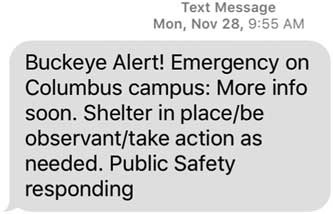
At 9:55 AM on Monday, November 28, we received the page that no one wants to get (Figure 1).
Buckeye Alert Text From November 28, 2016, at 9:55 AM.

The first 2 things I did were to call down to the emergency department (ED) to alert the 3 emergency physicians working and then to check social media to verify the possibility of an actual emergency on campus.
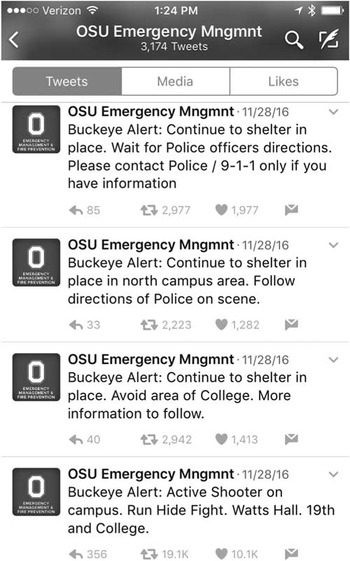
When I saw the tweet giving instructions to “Run Hide Fight” (Figure 2), I immediately headed down to the ED from our administrative offices. I had worked 3 to 11 in the ED the night before. Begrudgingly, I was in early that Monday to catch up on e-mail.
Tweets Sent From One Ohio State University Twitter Feed the Morning of the Terrorist Attack. Notice that the nature of the alert, directions for the students, and the location of the event are all given.

When we arrived in the ED, nurses and residents were already congregating in the trauma bays near the emergency medical services (EMS) entrance. Our ED director had been quickly briefed by our chief medical officer. As in most mass casualty events, we had a paucity of information at the onset. We heard that we were getting as many as 12 patients from an “active shooter event.” We started to implement our Emergency Operations Plan like we had in many disaster drills. We immediately opened our 3 trauma bays and an additional 3 critical care bays. Of the 6 additional physicians who came down when the Buckeye Alert went out, one was specifically tasked with discharging “nonemergent” patients and getting the admitted, boarding patients upstairs. We called in from off-service rotations our emergency medicine (EM) residents who were already in the hospital.
Information at the beginning of the event was sporadic and unreliable. As it turned out, a terrorist had run his car into a group of students and faculty and then emerged with a knife. The only shots fired were at the assailant. We ultimately received 5 of the 11 patients immediately from the scene. Columbus EMS did a great job of spreading the initial patients out not knowing how many total casualties we would have. Initially, we had an EM physician and trauma surgeon in the first 2 bays expecting to receive gunshot wound victims. We had EM physicians in the next 3 trauma bays for blunt motor vehicle collision victims (ultimately, pedestrians struck at the scene). Two operating rooms were immediately put on hold and were ultimately used for victims of the campus attack.
In retrospect, we were lucky. Only the terrorist assailant perished in the attack. The victims were treated for nonfatal injuries including stab wounds and broken bones. The event occurred on a Monday morning at 10 AM. As you can imagine, ultimately we had more providers in our large tertiary care center than we had roles to fill. Although we initially only saw 5 victims, many more worried well or minor injuries crowded the ED throughout the day.
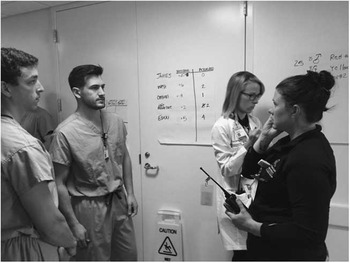
Lessons learned from this event are similar to other disasters and mass casualty events. We could have done a better job communicating with the scene (about 5 blocks from our ED). We also could have done a better job of communicating with our Emergency Operations Center (EOC), because the radio to the communications center was not obtained immediately and text messages to the EOC were initially used. We have since decided that the lead triage physician should appoint a communications delegate just to communicate for him or her given the amount of work that occurred initially. We have also discussed using a secure iOS app like WhatsApp (https://www.whatsapp.com/; WhatsApp Inc, Mountain View, CA) for secure mobile phone messaging. On a positive note, the actual event was handled much like a Federal Aviation Administration-mandated airport mass casualty drill from earlier in the year (Figure 3).
Lead Triage Physician, Dr. Creagh Boulger, participating in a Disaster Drill in Spring 2016 with Nurse Manager, Miranda Gill. Both were present and participated in the armed aggressor event on November 28, 2016, reprising their roles from earlier that year. Notice the white boards behind them documenting the number of available beds and victims in the department during the drill. This was again utilized during the actual event.

I started this passage mentioning the text communication and use of social media during this event. At our institution, if your cell phone number is in our Student Information System (BuckeyeLink) or PeopleSoft (faculty/staff), then you are automatically registered for the Buckeye Alert Text Messaging System. The Buckeye Alert System is a multi-modal, emergency notification system that includes nearly 2 dozen communication methods. Buckeye Alerts, usually sent via text message, are issued when it is determined that the campus community needs to take immediate action to remain safe. In this case, students and faculty were kept as up-to-date as possible in real time about the event. Although communication in an emergency is always an issue, I can’t imagine how much worse things could have been without smart phones and real-time communication.