I paused, hoping he'd make a tiny connection between his own government-funded education and the kids on the South Side, but I didn't see a dawning light of empathy in his face.
V.I. Warshawski, Fire Sale (Paretsky, Reference Paretsky2005, p. 96)
It seems likely that past experience will influence both our ability and willingness to empathise with others, and yet there have been few empirical investigations of this idea. Researchers appear to have been more concerned with understanding personal similarity (e.g., shared attitudes) than similarity of experience (see Davis, Reference Davis1994). When past experience has been specifically investigated — either by experimental manipulation or by drawing on participants’ own previous experience — the focus of most studies has been on identifying the outcomes of the empathy process (such as emotional arousal or the accuracy with which the participant has understood another person). Perspective taking, which can be defined as ‘the imaginative transposing of oneself into the thinking, feeling, and acting of another’ (Dymond, Reference Dymond1950, p. 343), is the main cognitive process thought to be involved here. However, this process has received even less attention, despite Vorauer and Cameron's (Reference Vorauer and Cameron2002) contention that it ‘is arguably one of the most important challenges that individuals face in their interactions with others’ (p. 1344). The purpose of the present study was to address how past experiences influence the perspective-taking process in a new situation: specifically, to assess the extent to which similarity between an individual's past experience and that of a target individual's present situation makes it subjectively easier to take that person's perspective.
The Role of Similar Past Experience in Empathy
Early theoretical accounts of the relation between empathy and past experience were influenced by conditioning principles, with perspective taking only indirectly addressed. Humphrey (Reference Humphrey1922), for example, posited that notions of a conditioned reflex may explain the potential for ‘fellow feeling’ (p. 113) — which he termed sympathy — to be elicited during another's similar experience. In this account, the situation of the other need not be one that the empathiser has directly experienced. Similarly, Allport (1924/Reference Allport1967) advocated a conditioned emotional response explanation. His discussion, however, stressed the importance of the level of similarity between one's own experience and that of the other, with the ability to ‘sympathize’ (p. 236) declining with decreasing similarity. It was only later that Hoffman (e.g., Reference Hoffman1975, Reference Hoffman and Keasey1978a, Reference Hoffman, Lewis and Rosenblum1978b, Reference Hoffman2000) identified perspective taking as one way in which an empathic response to another's distress might be elicited. Hoffman (Reference Hoffman, Lewis and Rosenblum1978b) suggested that imagining oneself in the other's place had ‘the power to evoke associations with real events in one's own past’ (pp. 234–235).
Empirical studies investigating the relation between similar past experience and empathy have largely focused on examining empathic outcomes such as interpersonal accuracy (i.e., an individual's success in predicting another's thoughts and feelings and understanding their behaviour) and reactive emotional responses (i.e., experiencing sympathy, compassion, and empathic concern for another person), rather than investigating the perspective-taking experience itself. These studies provide only limited support for a link between similar past experience and the ability to accurately predict another's emotions and cognitions (e.g., Gibbs & Woll, Reference Gibbs and Woll1985; Hodges, Reference Hodges, Malle and Hodges2005; cf. Kitano & Chan, Reference Kitano and Chan1978). However, this may relate to the problems in measuring empathic accuracy, including the possibility that a person may be accurate in inferring another's thoughts or feelings through non-empathic processes, such as projecting their own feelings onto the other person (Cronbach, Reference Cronbach1955; Davis & Kraus, Reference Davis, Kraus and Ickes1997). There is also the possibility that the results of studies that have utilised child samples (e.g., Gibbs & Woll, Reference Gibbs and Woll1985; Kitano & Chan, Reference Kitano and Chan1978) may be confounded by developmental changes in empathy and perspective taking at younger ages.
In contrast, a number of studies provide general support for a link between previous similar experience and emotional empathic reactions (e.g., Barnett, Reference Barnett1984; Barnett, Tetreault, Esper, & Bristow, Reference Barnett, Tetreault, Esper and Bristow1986; Barnett, Tetreault, & Masbad, Reference Barnett, Tetreault and Masbad1987; Hodges, Kiel, Kramer, Veach, & Villanueva, Reference Hodges, Kiel, Kramer, Veach and Villanueva2010; Stotland & Dunn, Reference Stotland and Dunn1963). Here, there seems to be a pronounced gender difference, with females displaying greater empathic reaction (e.g., empathic concern, sympathy, and compassion) when exposed to another's similar experience than males (Batson, et al. Reference Batson, Sympson, Hindman, Decruz, Todd, Weeks and Burris1996), although some of this research investigated specific situations (e.g., being a rape survivor) and involved only female participants (e.g., Barnett et al., Reference Barnett, Tetreault, Esper and Bristow1986; Barnett, Tetreault, & Masbad, Reference Barnett, Tetreault and Masbad1987). Furthermore, these studies did not measure whether, and to what extent, participants took the perspective of the other person.
Research that has directly assessed perspective taking is relatively rare. Studies have found that participants who identify as rape survivors (or were classified as rape survivors using the Sexual Experiences Survey; Koss & Oros, Reference Koss and Oros1982) score higher on measures of the tendency to take the perspective of other rape survivors (Ching & Burke, Reference Ching and Burke1999; Deitz, Blackwell, Daley, & Bentley, Reference Deitz, Blackwell, Daley and Bentley1982; Smith & Frieze, Reference Smith and Frieze2003). In the study by Smith and Frieze (Reference Smith and Frieze2003) both trait perspective taking (e.g., ‘I find it easy to take the perspective of a rape victim’) and empathic emotion (e.g., ‘Hearing about someone who has been raped makes me feel that person's upset’) were measured. Other studies, however, such as Hatcher et al.’s (Reference Hatcher, Favorite, Hardy, Goode, Deshetler and Thomas2005) investigation of therapist perceptions of similarity between their own personal experiences and those of hypothetical clients, have not observed an association between past experience and empathic response (measured in that study as degree of perspective taking and empathic concern demonstrated in participant narratives). In qualitative investigations of other past experiences, participants have reported that their strategies for taking the perspective of vignette characters involved reflecting on similar past experiences and imagining how they would feel in the other's situation (Van Boven & Loewenstein, Reference Van Boven and Loewenstein2003). Perceptions of similarity of experience range from the same or highly similar experience to those similar at a fundamental or abstract level (Håkansson & Montgomery, Reference Håkansson and Montgomery2003). However, participants do report imagining themselves in situations they have not experienced (Van Boven & Loewenstein, Reference Van Boven, Loewenstein, Malle and Hodges2005), and researchers have questioned whether drawing upon personal experiences reflects perspective taking rather than familiarity with the other's experience (Kerem, Fishman, & Josselson, Reference Kerem, Fishman and Josselson2001).
Most of this tells us little about the actual process of perspective taking when one has experienced a similar situation, or how this past experience might affect the specific strategies that people use. In a recent qualitative study, Gerace, Day, Casey, and Mohr (Reference Gerace, Day, Casey and Mohr2013) asked participants to reflect on the strategies they used in attempting to take the perspective of another person. Among the strategies discussed (e.g., imagining oneself in the other's position, considering common responses to certain types of situation), past experiences were commonly used to understand the other person. However, participants needed to make a connection between their own experience and the other person's present situation for these to influence the perspective-taking process. The extent to which this occurred was associated with how subjectively easy the participant found the perspective-taking task. Thus, a focus on ease may be particularly useful to understand the role of past experience in the process of perspective taking.
Similar Past Experience and Ease of Perspective Taking
The influential work of Jacoby and colleagues (e.g., Jacoby, Reference Jacoby1983, Reference Jacoby1991; Jacoby & Dallas, Reference Jacoby and Dallas1981; Johnston, Dark, & Jacoby, Reference Johnston, Dark and Jacoby1985) on recognition memory and perceptual recognition can help to understand how past experience and the notion of ease might be related. In the series of studies reported by Jacoby and Dallas (Reference Jacoby and Dallas1981) participants were presented with words in a study phase and a test phase. For recognition memory, the time taken to judge correctly whether a word in the test phase had been previously presented was recorded. For perceptual recognition, participants were assessed on their ability to distinguish a word that flashed on the screen (with words in the test phase both new and previously presented in the study phase). As expected, previous presentation of a word increased performance on both tasks. Two processes were hypothesised to account for task performance: elaboration, where the individual retrieves unique details about when the stimulus was first encountered; and relative perceptual fluency, or how subjectively smooth or fluent the task feels. The former process was suggested to be specific to recognition memory, and the latter involved in both recognition memory and perceptual recognition tasks (cf. Jacoby, Reference Jacoby1983).
Perhaps most relevant to the present study, these results suggest that prior exposure to a stimulus will influence the fluency with which it is later processed. These and other studies show that even when processing fluency is experimentally manipulated (e.g., by providing primes before presenting a test item), prior exposure to the original stimulus independently affects perceptual task performance and recognition memory (see also Whittlesea, Reference Whittlesea1993; Whittlesea, Jacoby, & Girard, Reference Whittlesea, Jacoby and Girard1990). Processing fluency has also been found to function as a heuristic for other judgments, such as assessing statement truth, and affective judgments of attractiveness and liking (e.g., Reber & Schwarz, Reference Reber and Schwarz1999; Reber, Winkielman, & Schwarz, Reference Reber, Winkielman and Schwarz1998; Unkelbach, Reference Unkelbach2007). A distinct, but relevant, line of research into ease of retrieval (e.g., Briñol, Petty, & Tormala, Reference Briñol, Petty and Tormala2006; Schwarz et al., Reference Schwarz, Bless, Strack, Klumpp, Rittenauer-Schatka and Simons1991) further suggests that both metacognitive experience (ease/difficulty of retrieval of relevant cognitive content) and actual content (what is brought to mind) are important to a range of judgments and decision-making processes (e.g., Rothman & Schwarz, Reference Rothman and Schwarz1998; Schwarz, Reference Schwarz1998, Reference Schwarz2005; Schwarz et al., Reference Schwarz, Bless, Strack, Klumpp, Rittenauer-Schatka and Simons1991).
The studies reviewed point to a potential difficulty, however, in conceptualising the relation of past experience to empathy. Jacoby and Kelley (Reference Jacoby and Kelley1987) outlined how memory could be understood with reference to notions of object and tool (Polanyi, Reference Polanyi1958). Thus, memory for a previous experience can be of a conscious and reflective nature; that is, the object of one's perception and cognition, demonstrated in recognition memory research. Alternatively, it can be of an unconscious nature but impact on particular perceptions and processes as a tool used to accomplish a task; this is as demonstrated in perceptual recognition research. Indeed, Preston and Hofelich (Reference Preston and Hofelich2012) recently proposed that common past experiences between an empathiser and a target may or may not be consciously recalled during an interaction but still exert an influence on empathy (cf. Eisenberg & Sulik, Reference Eisenberg and Sulik2012).
However, there are several reasons to believe that past experiences of relevance to a current situation can (at least often) be reflected upon. For example, participants in the studies by Gerace et al. (Reference Gerace, Day, Casey and Mohr2013) and Van Boven and Loewenstein (Reference Van Boven and Loewenstein2003) either explicitly referred to past experiences they used to take another's perspective, or demonstrated the ability to reflect upon their similar past experiences when asked. Hodges and Wegner (Reference Hodges, Wegner and Ickes1997) have also suggested that the empathy experience involves ‘such a generalized structural transformation in thought and emotion that it must be conceptualized more broadly than many less sweeping changes in mental content’ (p. 312), with the implication that ‘empathy is a state of our minds upon which we can reflect’ (p. 313). As such, so long as the experience itself can be recalled (either during or outside of the perspective-taking task), the assessment of both the influence of past experience and reflection on that past experience on the process of perspective taking can still occur.
The role of past experiences in influencing subjective ease of taking another's perspective has not been investigated directly. However, in a series of studies by Chambers and Davis (Reference Chambers and Davis2012), an ease of self-simulation heuristic was proposed, where the ease with which a person can imagine him or herself in another's situation is used ‘for gauging their empathic reactions to the target’ (p. 154). These studies support the idea that ease predicts empathic outcomes (sympathy and willingness to help). They did not, however, consider the influence of similar past experiences on either ease of perspective taking or empathic outcomes.
The Present Study
This study investigated the influence of similar past experience on the ease with which an individual can perspective take. Specifically, it was predicted that participants who had experienced a situation similar to that of another (target) individual in a new situation would find it easier to take the perspective of the target. It was also predicted that ease would be increased by the extent to which participants reflected upon their similar past experience. Given the limited empirical research in this area, the influence of other perspective strategies that have been identified in the literature (e.g., imaginatively switching places with the other person) and trait empathic ability on ease were also investigated. Following Chambers and Davis’ (Reference Chambers and Davis2012) finding of a relation between ease and empathic reactions, it was predicted that similar past experience would lead to both increased emotional reactions to the other individual and perceptions of accuracy in one's perspective-taking effort. The relations between similar past experience and these outcomes were expected to be mediated by ease.
Method
Participants
A sample of 154 undergraduate university psychology students (116 female, 36 male, two unspecified) were recruited for the study. The mean age of participants was 25.76 years (SD = 8.66; range = 18–55 years). Participants identified the following ethnicities (they could report multiple): Australian (n = 118), European (n = 37), Asian (n = 24), and ‘Other’ (n = 5).
Design and Procedure
Participants first completed a dispositional measure of empathy and were then randomly presented with one of four vignettes developed for the study and an induction to take the perspective of the vignette protagonist (the perspective-taking task). The dispositional measure was presented first to minimise the possible influence of the perspective-taking task on judgments of empathic propensity. The influence of the dispositional measure on state perspective taking was considered of lesser concern, as perspective taking was being primed via the induction.
The perspective-taking induction was designed through adaptation of previous inductions (e.g., Batson, Early, & Salvarani, Reference Batson, Early and Salvarani1997; Batson et al., Reference Batson, Lishner, Carpenter, Dulin, Harjusola-Webb, Stocks and Sampat2003; Davis et al., Reference Davis, Soderlund, Cole, Gadol, Kute, Myers and Weihing2004; Stotland, Reference Stotland and Berkowitz1969; Van Boven & Loewenstein, Reference Van Boven and Loewenstein2003). In this literature, participants are primed to take the perspective of another person through either adopting an imagine-other (i.e., to focus as much as possible on the other person) or an imagine-self (i.e., mentally switching places with the person to imagine how you would feel in their place) approach. The imagine-other approach was adopted here as this reflects more general definitions of perspective taking, rather than focusing on the more specific strategy of imagining oneself in the other's place (Gerace et al., Reference Gerace, Day, Casey and Mohr2013). The induction is presented below:
Now that you have read the description, I would like you to spend some time (perhaps two to three minutes) thinking about your friend's situation. Try to take your friend's perspective, considering how they are feeling and what they are thinking about what has occurred. Visualise as much as possible their situation and what is happening to them. Attempt, as much as possible, to take the perspective of your friend.
After reading the vignette and induction, participants completed a measure of ease of perspective taking and two manipulation check items. In the last section of the questionnaire, participants completed measures of empathic concern and personal distress, perspective-taking strategies used, and a similarity of past experience item.
The study was approved by the University of South Australia Human Research Ethics Committee.
Materials
Interpersonal Reactivity Index
The Interpersonal Reactivity Index (IRI; Davis, Reference Davis1980) is a 28-item self-report questionnaire that measures four components of trait empathy via four seven-item subscales: Perspective-Taking (PT) measures individual propensity to take the perspectives of others in various situations (e.g., ‘I sometimes try to understand my friends better by imagining how things look from their perspective’); Empathic Concern (EC) and Personal Distress (PD) measure emotional empathic reactions, with the former measuring reactions such as sympathy and concern (e.g., ‘I often have tender, concerned feelings for people less fortunate than me’) and the latter more distress-type reactions in troublesome emotional situations involving others (e.g., ‘Being in a tense emotional situation scares me’); and Fantasy (FS) measures propensity to engage emotionally and cognitively with fictitious characters and situations (e.g., ‘After seeing a play or movie, I have felt as though I were one of the characters’). Respondents are asked to indicate how well items describe them on a Likert-type response scale from 0 (does not describe me well) to 4 (describes me very well). Scores on each subscale can range from 0 to 28, with a higher score indicating a greater disposition to experience the particular component of empathy being measured. Davis (Reference Davis1980) reported α reliability coefficients of ≥.70 for each subscale. Internal consistency reliabilities (using Cronbach's α) in the present study were .80 (PT), .79 (EC), .84 (PD), and .86 (FS).
The vignettes
Four vignettes, each depicting a situation in which perspective taking may be important, were designed for the study. In order to develop a range of scenarios, life-event measures were examined for the types of events that they included (e.g., Social Readjustment Rating Scale, Holmes & Rahe, Reference Holmes and Rahe1967; Life Events Questionnaire, Norbeck, Reference Norbeck1984; Life Experiences Survey, Sarason, Johnson, & Siegel, Reference Sarason, Johnson and Siegel1978), as well as the situations used or described in previous empathy studies (e.g., Barnett et al., Reference Barnett, Tetreault and Masbad1987; Batson et al., Reference Batson, Sympson, Hindman, Decruz, Todd, Weeks and Burris1996; Gerace et al., Reference Gerace, Day, Casey and Mohr2013). Vignettes were constructed to minimise the inclusion of potential confounds, such as sex, age, or ethnicity of the vignette protagonist (i.e., these were not provided), or the priming of particular attitudes or attributions (e.g., by not discussing particular aspects of the nature of the sexual act in the third vignette). The specific situations described in the vignettes involved a person: (1) considering ending an intimate relationship, (2) experiencing work-related difficulties, (3) having experienced coercion to engage in sexual intercourse, and (4) having lost a parent. In each situation, participants were invited to take the role of a friend listening to the individual recount their experiences. The vignettes are included in the Appendix.
Ease of Perspective Taking Measure
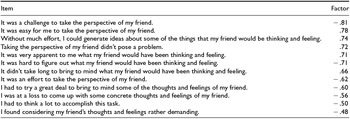
The Ease of Perspective Taking Measure was specifically designed for the study, using terms drawn from definitions of ease in dictionary and thesaurus listings; these included ‘easy’, ‘effort’, ‘effortless’, ‘hard’, ‘difficulty’, ‘accomplish’ and ‘un/demanding’. The ease-of-retrieval research, which often made use of single items to assess ease or difficulty (e.g., Echterhoff & Hirst, Reference Echterhoff and Hirst2006; Schwarz et al., Reference Schwarz, Bless, Strack, Klumpp, Rittenauer-Schatka and Simons1991; Tormala, Petty, & Briñol, Reference Tormala, Petty and Briñol2002), was also used to guide operationalisation. Twelve items were constructed to assess the overall ease of process (e.g., ‘It was easy for me to take the perspective of my friend’), as well as the more specific task of generating content (thoughts and feelings; e.g., ‘It was hard to figure out what my friend would have been thinking and feeling’). Table 1 presents the original 12 items. All items were completed on a 1 (strongly disagree) to 5 (strongly agree) Likert-type response scale. The factor structure of the measure was assessed prior to use.
Item Loadings for a Forced Single-Factor Model Using Principal Axis Factoring

Note: Items loading < ± .60 were not included in the final measure.
Manipulation checks
Participants completed two items to assess effectiveness of the perspective-taking induction: ‘I attempted to take the perspective of my friend’ and ‘I considered what the thoughts and feelings of my friend were’. Items were answered on a 1 (strongly disagree) to 5 (strongly agree) Likert-type response scale.
Perceived accuracy
Perceived accuracy in taking the perspective of the vignette character was measured by two items: ‘I think that I was accurate in inferring what my friend would be thinking and feeling’, and ‘I am confident in what I thought my friend was thinking and feeling’. Both were completed using a 1 (strongly disagree) to 5 (strongly agree) Likert-type response scale.
Empathic concern and personal distress indexes
Measures of state empathic emotional response, which have been used in some form in the work of Batson (e.g., Batson et al., Reference Batson, Early and Salvarani1997; Batson et al., Reference Batson, Sympson, Hindman, Decruz, Todd, Weeks and Burris1996; Coke, Batson, & McDavis, Reference Coke, Batson and McDavis1978), were administered. The empathic concern index consists of six adjectives (sympathetic, compassionate, softhearted, tender, warm, moved) measuring ‘an other-oriented emotional response congruent with the perceived plight of the person in need; it taps feeling for the other’ (Batson et al., Reference Batson, Early and Salvarani1997, p. 752). The personal distress index consists of eight adjectives (alarmed, grieved, troubled, distressed, upset, disturbed, worried, perturbed) measuring ‘more direct feelings of discomfort evoked by witnessing the plight of the other’ (p. 752). Respondents are asked to rate the extent to which they experienced each emotional reaction on a Likert-type response scale from 1 (not at all) to 7 (extremely). Scores can range from 6 to 42 (empathic concern) and from 8 to 56 (personal distress), with higher scores indicative of higher levels of the emotional response. Scores are converted to a mean for each participant. Internal consistency reliabilities (using Cronbach's α) were .84 (empathic concern) and .90 (personal distress) for the present study.
Perspective-taking strategies
Six items were designed to measure the strategies used by the participant in order to take the perspective of the vignette character. Items were devised based on strategies identified in previous research (Batson et al., Reference Batson, Early and Salvarani1997; Davis et al., Reference Davis, Soderlund, Cole, Gadol, Kute, Myers and Weihing2004; Gerace et al., Reference Gerace, Day, Casey and Mohr2013). The extent to which participants reflected on their similar past experience was measured with the item: ‘I thought about a time/times when I was in a similar situation to my friend’. The other strategies measured were: ‘I tried as much as possible to “get into their head” or “step into their shoes”, seeing things through their eyes’; ‘I imagined what I would think and how I would feel if I were in their situation’; ‘I considered what may have led up to my friend's current situation’; ‘I thought about a time when someone I knew/knew of had experienced a similar situation’; ‘I considered some of the common or typical ways that people react in these sorts of situations’. All items were answered on a 1 (not at all) to 5 (very much) Likert-type response scale.
Similarity of past experience
Past experience was assessed with a single item question similar to that used by Batson et al. (Reference Batson, Sympson, Hindman, Decruz, Todd, Weeks and Burris1996). The question asked participants, ‘How similar is the situation of your friend in the scenario to one which you have experienced?’, with a 1 (not at all) to 7 (extremely similar) Likert-type response scale employed.
Results
Preliminary Data Screening
Data screening for univariate (z > 3.29) and multivariate outliers (via Mahalanobis distance; p < .001) resulted in the removal of three univariate outliers; no multivariate outliers were identified. Participants were assessed on the two manipulation check measures and, based on an a priori decision, those scoring below 3 on the 5-point Likert-type response scale for either item (n = 3) were removed. Four participants with substantial missing data and the two participants who did not specify gender were also removed. All other missing values were negligible; these were replaced with a series mean. The final sample for analysis consisted of 142 participants (110 female, 32 male).
Manipulation checks revealed that the induction was successful. Participants attempted to take the perspective of the other person (M = 4.56, SD = .55), and considered their thoughts and feelings (M = 4.49, SD = .57). A preliminary 2 (sex) × 4 (vignette) between-groups multivariate analysis of variance (MANOVA) was conducted to investigate differences by sex and vignette on the dependent variables: ease, similarity of past experience, empathic concern and personal distress, perceived accuracy, and the two manipulation check measures. There were significant multivariate effects for sex, Wilks’ λ = .87, F(8, 127) = 2.47, p = .02, η2 partial = .14, and vignette, Wilks’ λ = .57, F(24, 368.94) = 3.31, p < .001, η2 partial = .17. The sex-by-vignette interaction was not significant, Wilks’ λ = .86, F(24, 368.94) = .81, p = .72, η2 partial = .05. Subsequent analyses therefore controlled for sex and vignette, but not the interaction of the two variables.
Psychometric Properties of the Ease of Perspective Taking Measure
Prior to testing of the main hypotheses, the 12 ease items were submitted to exploratory factor analysis. The Kaiser-Meyer-Olkin measure of sampling adequacy (.92) and Bartlett test of sphericity (750.70 p < .001) indicated the suitability of the data for factor analysis. The anti-image correlation matrix revealed that all measures of sampling adequacy were above 0.60 (Tabachnick & Fidell, Reference Tabachnick and Fidell2012). Parallel analysis, using a Monte Carlo analysis with 1,000 replications, suggested the extraction of one factor. Following principal axis factoring, Ease of Perspective Taking Measure scores were calculated as the sum of the nine items that loaded ≥.60 on the factor (nine items: M = 37.42, SD = 5.48, range = 20–45). Cronbach's α = .90. Table 1 presents the factor loadings of all items.
Descriptive Statistics
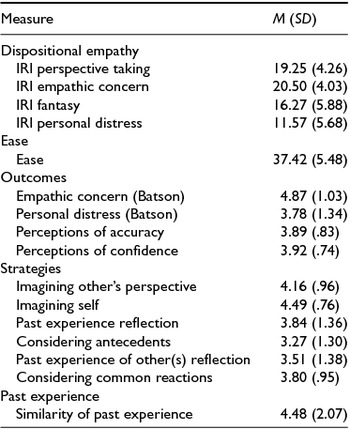
Table 2 presents the means and standard deviations for the measures. Participants reported finding the task of taking another's perspective relatively easy (M = 37.42, SD = 5.48, range = 20–45). Participants perceived a moderate degree of similarity between the situation with which they were presented and their own previous experience (M = 4.48, SD = 2.07, range = 1–7). For the six perspective-taking strategies, the highest mean scores were for the items ‘I imagined what I would think and how I would feel if I were in their situation’ (M = 4.49, SD = .76) and ‘I tried as much as possible to “get into their head” or “step into their shoes”, seeing things through their eyes’ (M = 4.16, SD = .96). Participants indicated that they utilised the strategy of past experience reflection (‘I thought about a time/times when I was in a similar situation to my friend’) to a lesser extent (M = 3.84, SD = 1.36). This strategy was, not surprisingly, significantly correlated with participant judgments of having experienced a similar situation to that of the vignette character, r = .65, p < .001 (two-tailed).
Means and Standard Deviations of the State Empathy Measures (n = 142)

Predictors of Ease of Perspective Taking
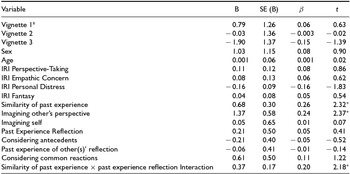
Ease of perspective taking was used as the dependent variable in a standard multiple regression analysis with similarity of past experience, reflection on past experience (one of the six perspective-taking strategies measured), the interaction of these measures, and other measured variables (i.e., sex, age, trait empathy, perspective-taking strategies) to test the hypothesis that participants who had experienced a situation similar to that of a target individual would find it easier to take the perspective of the target. The analysis explained 23.80% of the total variance in ease of perspective taking, F(17, 124) = 2.28, p = .01.
Examination of standardised coefficients revealed that the strongest significant predictors were similarity of past experience (β = .26) and imagining the other's perspective (β = .24), and the interaction term (β = .20), while personal distress approached significance (β = -.16, at p = .07). Table 3 presents the results of the multiple regression.
Standard Multiple Regression for the Prediction of Ease

Note: a Vignette 4 was the reference variable.
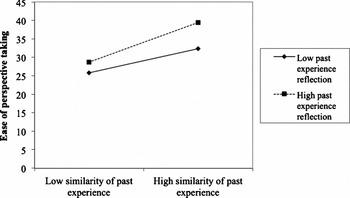
To determine the source of the interaction effect, the relation between the independent (similar past experience) and dependent (ease) variables was considered at increments of one standard deviation above and below the mean of the moderator (reflection on past experience; Aiken & West, Reference Aiken and West1991; Cohen & Cohen, Reference Cohen and Cohen1983). Figure 1 shows that the effect involves greater ease at high levels of reflection as past experience becomes more similar. There is less variation when low past experience is considered, or when low reflection is used. Two regression analyses were used to determine whether the (simple) slopes were significantly different from zero (Aiken & West, Reference Aiken and West1991). Reflection calculated at one standard deviation either above the mean (in one analysis) or below the mean (in the other analysis), similarity of past experience (centred), and the product of centred similarity of past experience and reflection, were included in two standard multiple regressions. The regression coefficients for the independent variable in the two analyses were then considered. This confirmed that similarity of past experience was a significant predictor of ease at high levels of reflection, β = .37, t = 2.68, p = .01, but not at low levels of reflection, β = -.02, t = -.17, p = .87.
The interaction between similarity of past experience and ease, at high and low levels of past experience reflection.

Ease as a Mediator Between Similar Past Experience and Empathic Outcomes
The prediction that ease would mediate the relation between similar past experience and each of empathic concern, personal distress and judgments made about perceived accuracy was tested in a series of standard multiple regressions. To demonstrate mediation, a number of relations need be present: that the predictor/independent variable affects the criterion/dependent variable; that the predictor variable affects the mediator variable; and that the mediator affects the criterion variable. The extent to which the relation between the predictor and criterion variables is accounted for by the mediator is reflected in a reduction in the relation between predictor and criterion when the effects of the mediator variable are controlled (see Baron & Kenny, Reference Baron and Kenny1986; Judd & Kenny, Reference Judd and Kenny1981; Kenny, Reference Kenny2014; Kenny, Kashy, & Bolger, Reference Kenny, Kashy, Bolger, Gilbert, Fiske and Lindzey1998). Given the nature of the variables under consideration, partial rather than full mediation was expected. To assess the significance of these indirect effects (the mediation), 95% bias-corrected bootstrap confidence intervals based on 5,000 bootstrap samples were generated (using the SPSS INDRECT macro developed by Preacher & Hayes, Reference Preacher and Hayes2008). Confidence intervals that do not contain zero indicate a significant effect (Hayes, Reference Hayes2013).
Empathic concern and personal distress
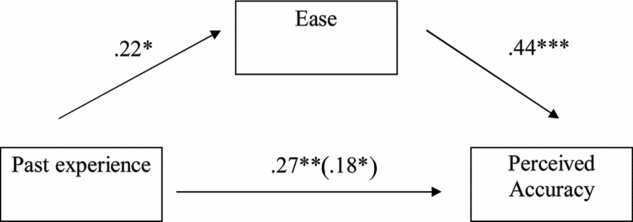
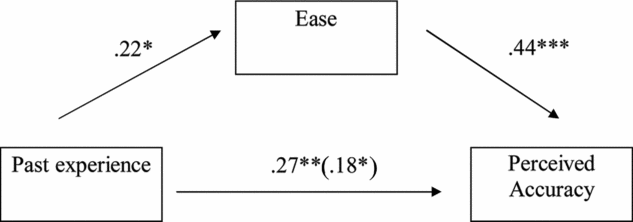
Contrary to expectations there was neither a significant direct effect between similar past experience and empathic concern or personal distress, nor one that was mediated by ease. The only significant relation was between past experience and ease (β = .22, t = 2.69, p = .01).
Perceived accuracy
Responses to the two items measuring perceived accuracy were highly correlated, r = .75, p < .001 (two-tailed), and therefore summed to give a single measure. The mediating role of ease in the relation between past experience and perceived accuracy (Figure 2) was supported. The relation between past experience and perceived accuracy was significant (β = .27, t = 3.36, p = .001), as was the relation between ease and perceived accuracy (β = .44, t = 5.91, p < .001). There was a reduction in the relation between past experience and perceived accuracy when ease was included in regression analysis (β = .18, t = 2.34, p = .02), although the effect was still significant, supporting partial mediation. A 95% bias-corrected bootstrap confidence interval for the indirect effect based on 5,000 bootstrap samples was significant (.02 to .14).
Standardised regression coefficients (β) for the mediational model of past experience, ease, and perceived accuracy. Note: *p < .05, **p < .01, ***p < .001.
The path models for empathic concern, personal distress, and perceived accuracy were also investigated with sex and vignette as covariates. In each case, controlling for sex and vignette was found to have no effect on these results.
Discussion
The present findings provide support for the hypothesis that the greater the similarity between one's own past experiences and the situation of another person, the easier it is to understand that person's perspective — a process that is further influenced by how much one reflects upon those experiences. In addition, how easily one could take the perspective of another was found to mediate the relation between having a similar past experience and the perceived accuracy of one's inferences about the thoughts and feelings of the target. However, having a similar past experience was not found to influence one's emotional response toward this other person.
These findings build on qualitative studies of the relation between past experience and perspective taking (e.g., Gerace et al., Reference Gerace, Day, Casey and Mohr2013; Van Boven & Loewenstein, Reference Van Boven and Loewenstein2003), and also extend this line of research by considering the influence of similar past experience on the ease with which another's perspective is taken. Past experience appears to be most useful when it is of a higher degree of similarity to that of the other's situation and when it is actively reflected upon. Not surprisingly, when past experience is less similar, high or low reflection on it has little effect on ease. This suggests that memories utilised to understand another person's situation may need to be made more explicit or actively recalled and drawn upon in order to be maximally effective (Jacoby & Kelley, Reference Jacoby and Kelley1987; cf. Preston & Hofelich, Reference Preston and Hofelich2012).
The importance of similar past experience and reflection support the assertions of various researchers that the self is central to the perspective-taking effort. In one model, perspective taking is proposed to involve the use of an anchoring and adjustment heuristic, where individuals adjust from their own perspective to take account of differences between themselves and others in knowledge, ability, and experiences (Epley, Keysar, Van Boven, & Gilovich, Reference Epley, Keysar, Van Boven and Gilovich2004). While this model does not deal explicitly with past experience, reflecting on one's own experiences to assess whether these apply to the other person's circumstances may be required and form part of the ‘adjustment’ process (Gerace et al., Reference Gerace, Day, Casey and Mohr2013). Indeed, findings from cognitive neuroscience regarding the activation of unique neural networks in individuals taking another's perspective versus those focusing on their own (e.g., Ruby & Decety, Reference Ruby and Decety2004) support conceptions that propose ‘true’ perspective taking does not involve simple projection of one's own experiences to another person.
It is important to consider the other perspective-taking strategies measured. The only other significant predictor of ease was the strategy of imagining the other's perspective. This finding may reflect adherence to task instructions, given similarities between the wording of this item and that used in the perspective-taking induction. The lack of effect of the other strategies may reflect the use of vignettes rather than actual scenarios, or the nature of the strategies measured. Perhaps some strategies (e.g., reflecting on another person's similar past experience; considering antecedents to the situation) only allow indirect access to the thoughts and emotions involved and, therefore, may not make perspective taking easier. It is noteworthy that the strategy of considering common or typical reactions failed to predict ease, since it is plausible that considering stereotypic responses would make the task easier, particularly when somewhat limited information is available (see Ames, Reference Ames2004; Cronbach, Reference Cronbach1955). However, because perspective taking requires, at its core, a ‘taking-on’ of the individual's situation as much as possible, a focus on the typical may be inefficacious, particularly for participants who are high in dispositional ability or who undertake the task very seriously (Karniol & Shomroni, Reference Karniol and Shomroni1999).
Participants reported that they were able to imagine themselves in the other's situation, but this strategy did not predict how easy they found the task. It is here that the edge of past experience may become apparent. While imagining oneself in another's situation is a common strategy used to understand another person and can be undertaken by anyone (Davis et al., Reference Davis, Soderlund, Cole, Gadol, Kute, Myers and Weihing2004), similar past experiences to aid perspective taking are only available for those with an applicable situation to draw upon. Thus, although reflection on past experiences may be effortful as the individual needs to examine and ‘adjust’ from their own perspective (Epley, Morewedge, & Keysar, Reference Epley, Morewedge and Keysar2004), it has been posited that physiological similarities between persons (e.g., nervous system) and experiences common to individuals (e.g., as a result of socialisation) may mean that an empathiser ‘discovers that his feelings resemble the feelings experienced independently by others in similar situations’ (Hoffman, Reference Hoffman1975, p. 616). Indeed, that formulating thoughts and feelings of another came about more easily as a result of reflecting on one's own thoughts and feelings in similar situations fits with earlier conceptions such as that of Hebb (Reference Hebb1949) where ‘any two cells or systems of cells that are repeatedly active at the same time will tend to become “associated,” so that activity in one facilitates activity in the other’ (p. 70).
Dispositional measures of empathy failed to predict ease of perspective taking, although participants with higher levels of personal distress reported that taking the perspective of the vignette character was more difficult (p = .07). This supports previous research which suggests that a more self-oriented disposition is at odds with perspective taking (e.g., Mohr, Howells, Gerace, Day, & Wharton, Reference Mohr, Howells, Gerace, Day and Wharton2007). However, there was not an association between similar past experience and state-based empathic emotion. Although the use of short vignettes may have meant that participants in this study did not engage to the same extent as those of previous studies using extended vignettes (e.g., Batson et al., Reference Batson, Sympson, Hindman, Decruz, Todd, Weeks and Burris1996; Hodges et al., Reference Hodges, Kiel, Kramer, Veach and Villanueva2010), an examination of mean scores on the empathic concern and personal distress measures indicated that participants reported moderate-to-high emotional engagement with the scenarios. In many of the studies that have found an effect of similar past experience on empathic outcomes, the researcher either classified the participant as having had a similar experience (Barnett et al., Reference Barnett, Tetreault and Masbad1987; Batson et al., Reference Batson, Sympson, Hindman, Decruz, Todd, Weeks and Burris1996) or chose participants on the basis of an objective similar experience such as motherhood (Hodges et al., Reference Hodges, Kiel, Kramer, Veach and Villanueva2010). For participants in the present study, who determined their own similarity, there may be more proximally related variables to consider, such as the degree of connection made. Researchers have also questioned whether differences observed between groups (i.e., those with and without similar past experience) reflect increased empathic responses from participants with similar past experience, or whether those participants without a relevant experience attempt to distance themselves from victims of harm to reduce perceptions of threat to oneself (Barnett et al., Reference Barnett, Tetreault and Masbad1987; Lerner, Reference Lerner1980; Mason, Riger, & Foley, Reference Mason, Riger and Foley2004; Shaver, Reference Shaver1970; Zaki, Reference Zaki2014). In regard to the lack of relation between ease and empathic emotion, it may be that ease is not as powerful a marker of one's empathic emotion when the person is focusing on taking the other's perspective, rather than being distracted by another task (Chambers & Davis, Reference Chambers and Davis2012).
Support was found for the partial mediating role of ease on perceptions of empathic accuracy. The use of heuristic-based processing could help explain this finding, with ease based on past experience becoming a marker for assessing one's accuracy in taking the perspective of another person (see Schwarz et al., Reference Schwarz, Bless, Strack, Klumpp, Rittenauer-Schatka and Simons1991; Tversky & Kahneman, Reference Tversky and Kahneman1973, Reference Tversky and Kahneman1974; see also Chambers & Davis, Reference Chambers and Davis2012, regarding empathic emotion). The partial mediating role may reflect that, in real-life situations, another marker of perspective-taking accuracy or confidence would be the reactions and feedback of the other person. While not measured in the present study, the relation between perceived and actual accuracy of empathic perceptions is likely to be complex. Participants could fail to adequately weight their experience to consider how characteristic or useful it is to understand the situation the person is in (see Griffin & Tversky, Reference Griffin and Tversky1992). Hodges et al. (Reference Hodges, Kiel, Kramer, Veach and Villanueva2010) found that those participants who told a target about their similar experiences were considered to be more understanding by targets, although they were not more accurate in correctly perceiving target-reported thoughts.
The present study has several limitations. Vignettes cannot reflect the complex nature of real-world perspective taking. It may be that some perspective-taking strategies did not emerge as significant predictors of ease due to the use of vignettes. However, while a vignette may not have revealed the full range of use of perspective-taking strategies and their relative importance to ease, previous studies have supported the use of these strategies (e.g., Gerace et al., Reference Gerace, Day, Casey and Mohr2013; Van Boven & Loewenstein, Reference Van Boven and Loewenstein2003). It is predicted, therefore, that similarity would exist between the use of these strategies in the present study and those in more naturalistic settings (see Gordon, 1986/Reference Gordon, Davies and Stone1995, for a somewhat similar notion regarding the use of ‘offline’ systems). The use of fictitious vignettes also meant that self-reported perceived ease, empathic emotion and accuracy were assessed and not objective benchmarks (e.g., manipulating the unique nature of situations to function as a measure of ease; target-perceived accuracy). The study did use participants’ perceptions of similarity, reflecting a more ecologically valid approach to the use of past experiences than random allocation to an experience in the laboratory that the participant had little time to reflect upon.
In order to maintain consistency with previous research, the vignettes were designed to focus on more problematic or negatively toned events. It is likely that positively and negatively toned situations (and, indeed, more neutral experiences) will result in qualitatively different responses of individuals, such as empathic emotion (Krebs, Reference Krebs1975). Indeed, in one study, a positive-mood induction influenced participants’ ability to set aside their own perspective, with negative-mood and no induction conditions less likely to impede perspective taking in this way (Converse, Lin, Keysar, & Epley, Reference Converse, Lin, Keysar and Epley2008).
Finally, the main and mediational analyses were based on cross-sectional data, and it is important to examine these hypothesised associations over time in a longitudinal design. The results are also based on the responses of psychology undergraduate students, with the need for replication of the study with other groups.
Implications
The results may be of particular interest to psychologists and other health professionals who work with individuals to increase their perspective taking and understanding of others, including clients who experience relationship conflict, interpersonal difficulties, or those who are aggressive and violent (e.g., Mohr et al., Reference Mohr, Howells, Gerace, Day and Wharton2007; Perrone-McGovern et al., Reference Perrone-McGovern, Oliveira-Silva, Simon-Dack, Lefdahl-Davis, Adams, McConnell and Gonçalves2014). They suggest that an important component of any intervention may be to encourage clients to draw on their previous experiences, teaching them how to apply their own perspectives to those of others (as well as when to discriminate their experience from that of others). Methods that are designed to facilitate the development of perspective-taking skills, such as chair-work (a psychotherapeutic tool where the individual engages in a dialogue between different aspects of the self or between the self and — through taking the other's perspective — another person; see Day, Howells, Mohr, Schall, & Gerace, Reference Day, Howells, Mohr, Schall and Gerace2008; Greenberg, Elliott, & Lietaer, Reference Greenberg, Elliott, Lietaer, Stricker and Widiger2003), may benefit from the inclusion of this component. Therapists might also reflect on how their own past experiences influence attempts to take the perspectives of clients. However the lack of significant findings in Hatcher et al.’s (Reference Hatcher, Favorite, Hardy, Goode, Deshetler and Thomas2005) study of therapist empathy and similar past experience suggests that the effects of the use of past experience may be influenced by both other personal characteristics (e.g., degree of trait empathy) and professional requirements for distance and lack of self-disclosure (see Peternelj-Taylor & Yonge, Reference Peternelj-Taylor and Yonge2003; Rogers, Reference Rogers1957).
Conclusions and Future Research
The present study provides support for the view that similar past experiences are important to the perceived ability of an individual to take another person's perspective. Perspective taking has been identified as an effortful task (Epley et al., Reference Epley, Keysar, Van Boven and Gilovich2004), but when past experiences are similar and can be readily reflected upon, the perspective-taking process is an easier one. There are a number of areas for future research. First, since similar past experience leads to perceptions of accuracy (both by the empathiser and target), but not necessarily objective accuracy, future work could examine in what ways individuals are ‘better’ or ‘worse’ empathisers because of past experience. It may be, for example, that increased judgments of similarity and accuracy come from individuals reflecting on their past experiences in a way that moves beyond rumination and increases the assimilation and abstraction of these experiences (e.g., Stiles, Reference Stiles2001). Alternatively, an individual may have reflected and assimilated their experiences to an extent where it is difficult for them to put themselves into the perspective of someone at a different stage of working through a problem. Indeed, assumed but not actual similarity could lead to problems in an interaction (Dymond, Reference Dymond1954). Other parts of the empathic experience, such as emotional reactions toward the person, could then be compromised. A related question is the extent to which reflection on past experience can be increased. It may be that individual difference variables, such as the tendency to self-reflect (Fenigstein, Scheier, & Buss, Reference Fenigstein, Scheier and Buss1975), need to be considered. Such future work should be undertaken using not only self-report, but other cognitive tasks and, indeed, neuroscientific approaches.
Acknowledgment
The authors would like to thank Rosalind Dymond Cartwright for useful comments on an earlier version of the manuscript.
Appendix: Vignettes
Vignette 1: Over drinks, a friend confides to you that they are thinking about breaking up with their partner. They suspect that their partner has been cheating on them with another person. Your friend also tells you that they have been fighting on and off with their partner for some time, although the fights have not always been ‘serious’ or about big things.
Vignette 2: Over drinks, a friend discusses with you an experience they had at work that day, where a customer became very angry when an item was not available. The customer would not leave the store without the item and it took quite a lot of time for your friend to be able to resolve the problem. Your friend's boss also suggested to them that taking this amount of time to solve the problem resulted in other work not being completed and was not appropriate.
Vignette 3: Over drinks, a friend discusses with you how they went out on a date the previous night. Your friend tells you that the individual they were on a date with came back to their place, and initiated sexual contact. While your friend tried to avoid the contact by deflecting the advances of their date, the date persisted and continued to act sexually towards your friend both in what they were saying and how they were acting (e.g., touching). Your friend tells you that they did engage in sexual intercourse with the date.
Vignette 4: You go out for a drink with a friend whose father has recently passed away. They discuss with you the last couple of months since he has passed away, the arrangements that had to be made regarding the funeral and other matters, how their mother and siblings have been reacting, as well as their interactions with their mother and siblings.