ARCHITECTURE AND THE URBAN POOR IN A RAPIDLY CHANGING METROPOLIS
How can architecture be articulated as a political practice in the context of rapidly changing societies?Footnote 1 This question reverberated throughout the twentieth century, when modern architecture emerged as a material, spatial, and ethical project that had at its center the problem of organizing large industrial and post-industrial metropolises. From its beginnings, modern architecture and urbanism could not dissociate themselves from the “social question” and the housing question, in their various local manifestations.
In all its national variations, architecture in the developing world was mobilized as a set of material and discursive practices endowed with the mission of engendering a modern society, despite the crucial variations in the structure of the architectural fields and the connections between architecture and state power. To produce progressive architecture was a pragmatic problem of articulating a progressive political repertoire and a set of practices of design and construction.Footnote 2
The question of the politics of architecture gained particularly drastic connotations in the context of rapidly expanding cities of the Global South, of which São Paulo provides a dramatic example. During the twentieth century, the city developed from a small provincial city into a metropolis of 2.6 million inhabitants in 1950 and 8.1 million in 1970. The metropolitan population grew 78 percent during the 1950s and then 72 percent during the 1960s (Kowarick Reference Kowarick2009: 277). São Paulo's growth reflected the contradictory processes of urbanization that most cities in the developing world faced at the time or would face in the following decades. Its central area was still characterized by the presence of many tenement houses, the traditional form of popular housing in the city until the definitive growth of the peripheries from the 1940s on. At the same time, the city outskirts boomed with the influx of migrants, mostly from rural areas, searching for better conditions of life. The urban environment, with all its problems, was a space of hope, where a steady minimum-wage job and the possibility of owning a self-built house in one of the growing peripheral neighborhoods provided a horizon of expectations that oriented the decisions of millions of rural migrants.
The 1950s and 1960s also saw the consolidation of modernism as the dominant language of architecture in São Paulo, as in many countries of the Global South (Bergdoll et al. Reference Bergdoll, Comas, Liernur and Real2015; Gorelik Reference Gorelik2005; Guillen Reference Guillen2006; Molnar Reference Molnar2005). This is also a moment when, in Europe and the United States, new architectural discourses and practices either challenged or re-elaborated modern architectural paradigms as they had been formulated during the interwar period (Banham Reference Banham1966; Cohen Reference Cohen2012; Vidler Reference Vidler2008; Zimmerman and Crinson Reference Zimmerman and Crinson2010). In the developing world, modernism was not so much a response to modernity as a force for its constitution (Guillen Reference Guillen2006: 91–107; Lara Reference Lara2011). Architecture provided a language and an expertise that contributed to national discussions about modernization, but it was also a field of dispute among different material, aesthetic, and political projects (Molnar Reference Molnar2010; Zarecor Reference Zarecor2011). The production of the built environment had to address the pressing issues at hand in societies that faced enormous pressure from urban migration and fast demographic growth, but it was also an arena for the production of new collectivities and (expected) new futures, and a space of conflict between urban professionals, state elites, market forces, and urban subjects—either actual subjects or entities imagined by those other actors.Footnote 3
João Vilanova Artigas, a member of the Brazilian Communist Party and São Paulo's leading architect of the period, clearly framed this challenge in an article published in 1952: “It is certain that while the connection between architects and the popular masses is not established, is not organized, while the work of architects does not receive the highest glory of being discussed in factories and farms, there will be no popular architecture. Until then, one must maintain a critical attitude toward reality” (Reference Artigas1981: 77). Artigas illustrates here two important points: First, the connection between politics and the production of the built environment is pragmatic; it always involves adjustment and negotiation with the materials, economic constraints, discourses, skills, and other social conditions at hand. Second, the production of modern architecture in this period was haunted by a political quest for the emergence of the “nation” and the “people.” Artigas personifies the central political problem of modern architectural practice in both its international and local manifestations: the connection between the individual project and the social.
Leading Brazilian architects in the mid-twentieth century were aware of the significant gap between the aspiration to produce progressive architecture and the limitations of the practice of architecture in a developing society. Architects produced only a small fraction of the built environment in mid-twentieth-century São Paulo, when the city experienced frantic expansion (Corona Reference Corona1966: 18). Artigas in 1952 reaffirmed a bleaker position: a progressive architecture, directly influenced by “the people” and prone to the promotion of a harmonious connection between their interests and the development of the country, would be impossible under capitalism. Artigas, a pragmatist, was also the idealist prophet of a future connection between the people and architects.
Practical and political limitations led to partial, pragmatic, and tentative architectural answers to political dilemmas, particularly that of how to integrate the urban poor into the discourses and practices of the field of architecture. This dilemma, typical of modernism in several of its variations, had two central dimensions: First, how could architects establish a progressive connection with the largest segment of the population that was destitute of basic living conditions, including housing and urban infrastructure? Second, how could architectural practice maintain a critical attitude toward reality when economic and technical resources were lacking? The first dimension is political and epistemic: forging a connection with low-income families involves taking a political stance and developing a shared set of assumptions about the world, society, the city, and possible futures. The second dimension is semiotic and technical: engendering a built environment that can signify and instill progressive values. In addition, in both dimensions, a certain image of the social and the people is mobilized, transformed, and (re)constituted. Although these questions have emerged in many moments in the history of modern architecture, the responses to them have varied depending on local political, social, economic, technical, artistic, and academic factors.
In this article, I address how progressive architects in São Paulo, who occupied the culturally dominant position in the field of architecture, addressed the practical dilemma of the passage from the single to the multiple. Or put another way, I examine how they articulated a political repertoire of national developmentalism and the dominant practices that characterized the Brutalist architecture at the time. I begin by introducing the concepts of “political repertoires” and “semio-material practices,” which will inform my analysis of the São Paulo case, and also elucidate the production of the built environment in other historical and geographic contexts.
CONCEPTUAL FRAMEWORK: ARTICULATING POLITICAL REPERTOIRES AND SEMIO-MATERIAL PRACTICES
The relation between meanings and materiality is a classic philosophical question, but also a problem that recurs in several canonical works in sociology. Many of the central concepts and topics developed by the founding thinkers of the discipline mobilize, or at least assume, some type of relationship between the two.Footnote 4
Many contemporary social theorists and cultural sociologists have built on those critical insights. A main thrust of much of the contemporary literature has been the need to avoid any form of unidirectional determinism, whether material or cultural. This literature has emphasized that culture and the built environment are intertwined and that social practices necessarily involve the deployment of meanings and materials (Alexander Reference Alexander2010; Jones Reference Jones2011; McDonnell Reference McDonnell2010; Mukerji Reference Mukerji1997; Steets Reference Steets2016; Wagner-Pacifici Reference Wagner-Pacifici2005; Zubrzycki Reference Zubrzycki2013). Most sociologists of culture agree that objects are bearers of social meanings but also that those meanings are further elaborated and renegotiated through the production of and interaction with nonhumans (Jerolmack and Tavory Reference Jerolmack and Tavory2014; Sewell Reference Sewell2005).
In conversation with this literature and with the recent revival of pragmatism in social theory (Bernstein Reference Bernstein2010; Gross Reference Gross2009; Reference Gross2018; Joas Reference Joas1997; Ogien Reference Ogien2015; Reed Reference Reed2017; Swidler Reference Swidler1986), I propose that there is no direct, unmediated connection between certain forms, styles, and architectural programs, on the one hand, and certain systems of meanings and practices, on the other, particularly political repertoires or ideologies. My analysis also rejects the idea that there is a necessary homology between political ideologies and certain architectural forms. Similarly, the concept of “reflection” that oriented much of the sociology of culture and knowledge (as in the idea that cultural texts or objects reflect the social position of their authors or of the societies in which they were created) provides insufficient conceptual clarification of the mechanisms through which “the social” and “the built” are connected.
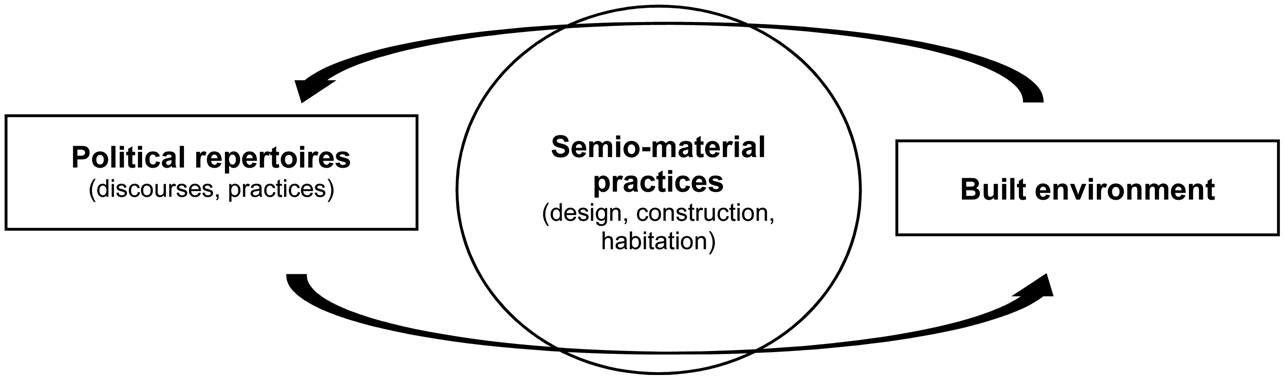
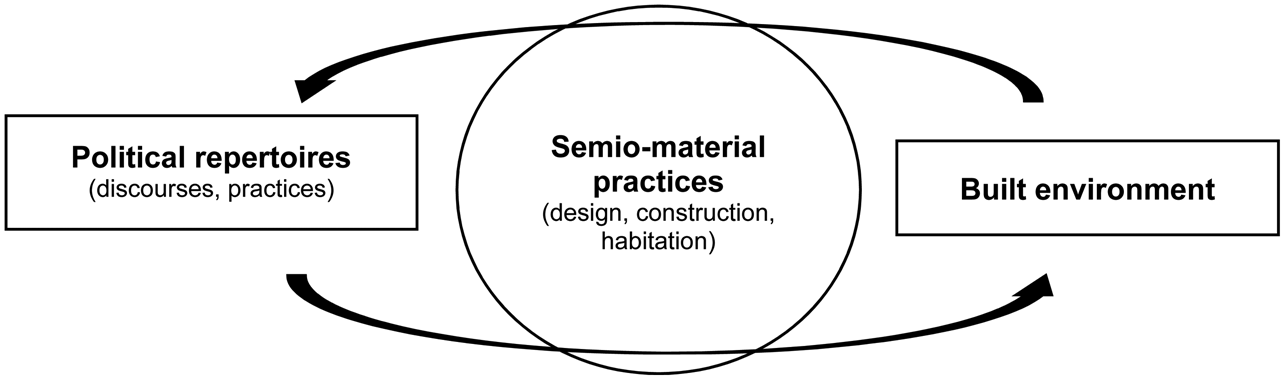
My main theoretical claim is that semio-material practices mediate the practical translation between political repertoires (discourses and practices) and the built environment. These semio-material practices are embedded in communities of practice of which social fields are one possible example, as in the case of the field of architecture. Individuals (in this case, particularly architects) pragmatically articulate political discourses and practices and the built environment via the deployment of socially available semio-material practices of design and construction.
“Semio-material practices” are socially shared and individually effective sets of practices that guide the interpretation of and condition the forms of engagement with the built environment. These practices are socially situated, either in social fields, across fields, or within certain sectors of the social space. They provide conscious guidelines for or unconscious dispositions about how to draw inferences from the built environment, how to produce and change it, and how to engage it in social practice. Also, they can be transformed through those many possible forms of engagement, because those sets of practices of interpretation and engagement are always precarious (that is, they are open to further revision and re-elaboration) and because the built environment also challenges the adequacy of those sets of practices.
In addition, I understand a political repertoire as a set of socially available but situationally mobilizable claims as well as practices associated with those claims about how individuals and social groups act (theory of the subject), what groups constitute society (social ontology), how social change happens (theory of history), and how material and symbolic resources should be distributed (economy of dignity). Those repertoires are historically and geographically specific, although certain matrixes, such as several versions of liberalism or socialism, or certain repertoires of contention such as the practices associated with autonomism, can be identified in a diversity of contexts. This concept combines both a discursive formation and a range of practices that at a certain point in time and space are understood to be associated with those discourses and narratives.Footnote 5
Nevertheless, what is relevant here is that individuals deploy elements of available political repertoires in specific situations to either guide or justify their practices. By deployment I do not mean a completely rational process of picking and choosing from all the elements of political repertoires available. Instead, socialization, social position, and participation in specific social fields or communities of practice lead to a higher or lower propensity to mobilize elements of certain repertoires. That said, social determination is never complete. Individuals pragmatically deploy those discourses and structures of justification, in the sense that they (more or less) creatively interpret their social situations and the prospects of interfering in them by taking elements of available political repertoires as blueprints and guidelines. “Pragmatically,” in this sense, means that social practices are always situated in a continuum between creativity and determination, as the classical literature on pragmatism properly argues, particularly the work of Charles Peirce, and as many social scientists who have recently taken up the theoretical project of pragmatism have also pointed out (Gross Reference Gross2009; Joas Reference Joas1997; Wilf Reference Wilf2014).
Political repertoires and semio-material practices are relatively autonomous: the ways individuals and social groups produce and inhabit their built environment is not a direct, causal consequence of the ways in which narratives and practices pertaining to power operate. I propose that semio-material practices function as mediators between political repertoires and the built environment. This mediation is not unidirectional: the built environment also acts upon those repertoires, but only through sets of practices that guide the understanding, production, and manipulation of the built environment. Like any mediator, these practices do not leave the political repertoires intact; they transform them, either in form, medium, or content.Footnote 6 Through the deployment of semio-material practices, individuals and social groups involved in the production and inhabiting of the built environment articulate political repertoires and the built environment (figure 1).
Schema of a program for the built environment.
In this article, I deploy these concepts to analyze how architects in São Paulo were able to pragmatically articulate the dominant leftist repertoire of national developmentalism and the semio-material practices developed within the culturally dominant sector of the field of architecture in São Paulo. I start by analyzing the semio-material practices of design and construction that characterized this architecture. Next, I reconstruct the main elements of the political repertoire of national developmentalism, showing that its image of the urban poor is marked by a severe distancing from their empirical life experiences. I then show how progressive architects deployed two sets of semio-material practices to operationalize the articulation between that political repertoire and the field of architecture: metaphorical indexicality and the impetus for industrialization of construction. Throughout these sections, I show that the distancing of architecture from the spaces of social engagement and politics of the urban poor affected how architects deployed the semio-material practices available in their field to articulate the repertoire of national developmentalism with a program for architecture and construction.
BRUTALIST SEMIO-MATERIAL PRACTICES OF DESIGN AND CONSTRUCTION: KEY ELEMENTS
In many respects, the types of material that São Paulo architects employed and the structural choices they made in the 1950s and 1960s were deeply aligned with international trends in architecture (Banham Reference Banham1966; Zimmerman and Crinson Reference Zimmerman and Crinson2010), no matter how much Artigas and other influential architects avoided such comparisons. Brutalism, as an architectural movement that dominated a significant part of international production in the 1950s and 1960s, is not an exclusive product of the dynamics of the field of architecture in São Paulo or anywhere else. This observation goes against dominant narratives in architecture that have always relied on an idea of a unilateral transmission of ideas, techniques, materials, and discourses from the Global North to the Global South, as if this process of appropriation did not involve a more complex dynamics of connections, influences, appropriations, and reinventions (Jarzombek and Prakash Reference Jarzombek and Prakash2010).
With that in mind, it is important to note that the semio-material practices that characterized that architecture were pragmatic manipulations of different ideas and materials, in a situation of economic, political, and urban constraints. They were responses to many different inputs: from the state of the architectural field at the time and the need to advance the process of its autonomization from the field of engineering; from the market and from the state; disputes within the field; the availability of a large contingent of low-wage construction workers; the low level of development of the construction industry when compared with its European (both Eastern and Western) or North American counterparts; and the dissemination of a certain leftist political repertoire, which was highly influential in this sector.
In terms of the main material and constructive characteristics of this culturally dominant architecture, many of its elements are radicalizations of international trends, particularly the postwar architecture of Le Corbusier in France and the developments in mass construction in Eastern Europe (Banham Reference Banham1980; Cupers Reference Cupers2014). In this collectively elaborated program, structures were to be visibly exposed, sometimes almost excessively or didactically (Conduru Reference Conduru, Andreoli and Forty2004; Ferro Reference Ferro1986), and concrete was the primary modern material. Architects and builders were not to hide the “truth of materials” and structures (Banham Reference Banham1966; Forty Reference Forty2012). The most exemplary buildings produced during these decades in São Paulo, from single family houses to schools and bus stations, deployed exposed concrete, usually with very visible marks of its casting process.
The literature on the history of architecture in São Paulo has devoted considerable attention to describing with precision this architecture's main elements (Acayaba Reference Acayaba1985; Zein Reference Zein2005). Marlene Acayaba provided a useful synthesis (or, in her somewhat ironic words, the “Ten Commandments”) of São Paulo Brutalism:
1. Houses will be singular objects in the landscape; 2. The logic of placement will be determined by the geographic situation; 3. The program will be organized in a single block; 4. The house is intended to be an ordering model for the city; 5. The house will be a machine for inhabiting; 6. The house will be ordered as a function of its internal space: the patio, the inner garden, or a central open space; 7. Independent volumes will contain the necessary closed spaces and will define the open spaces; 8. Spaces evolve one from another, no matter whether they are internal or external; 9. Materials will be generic and industrial if possible; 10. Social relations will take place under a new ethics (Acayaba Reference Acayaba1985: 47).Footnote 7
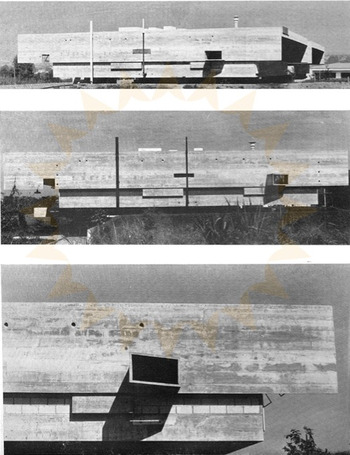
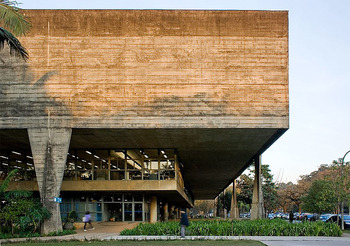
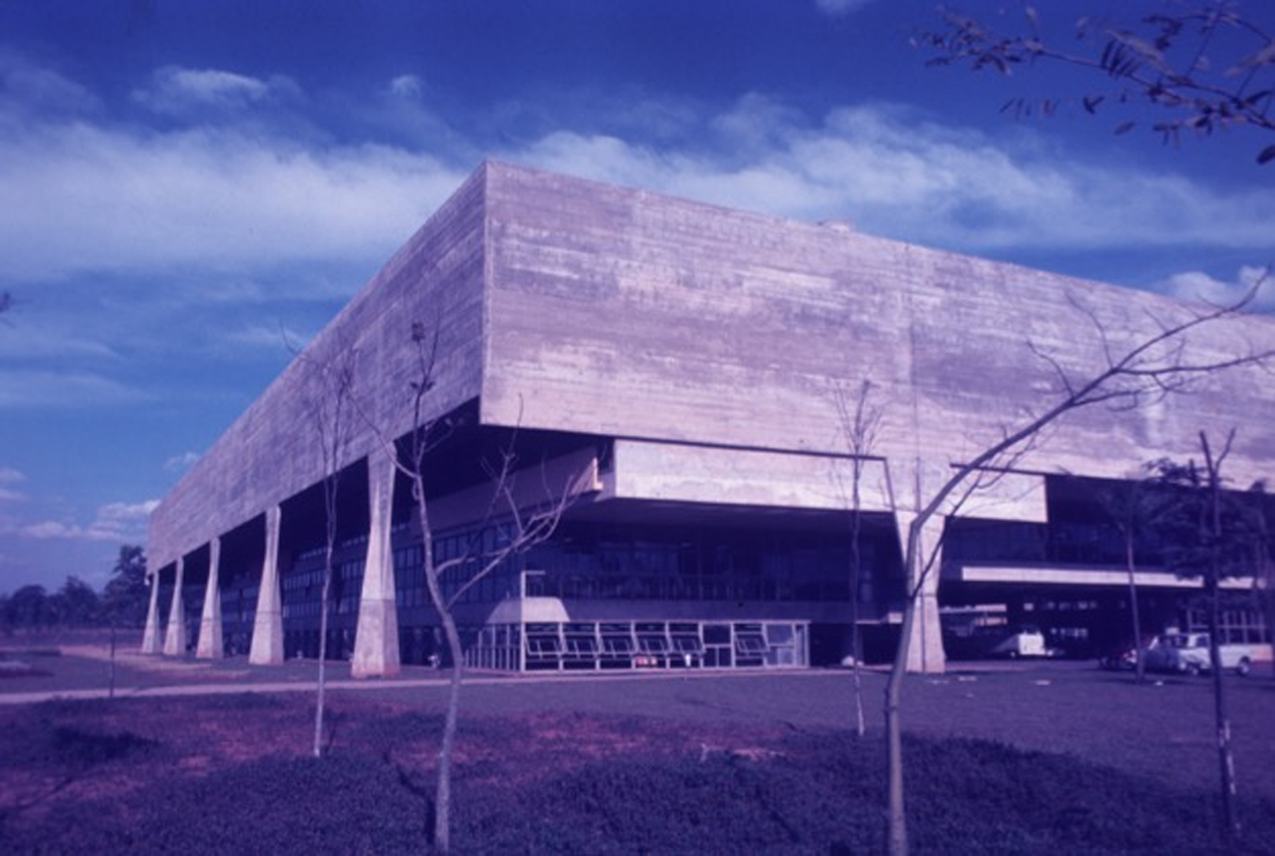
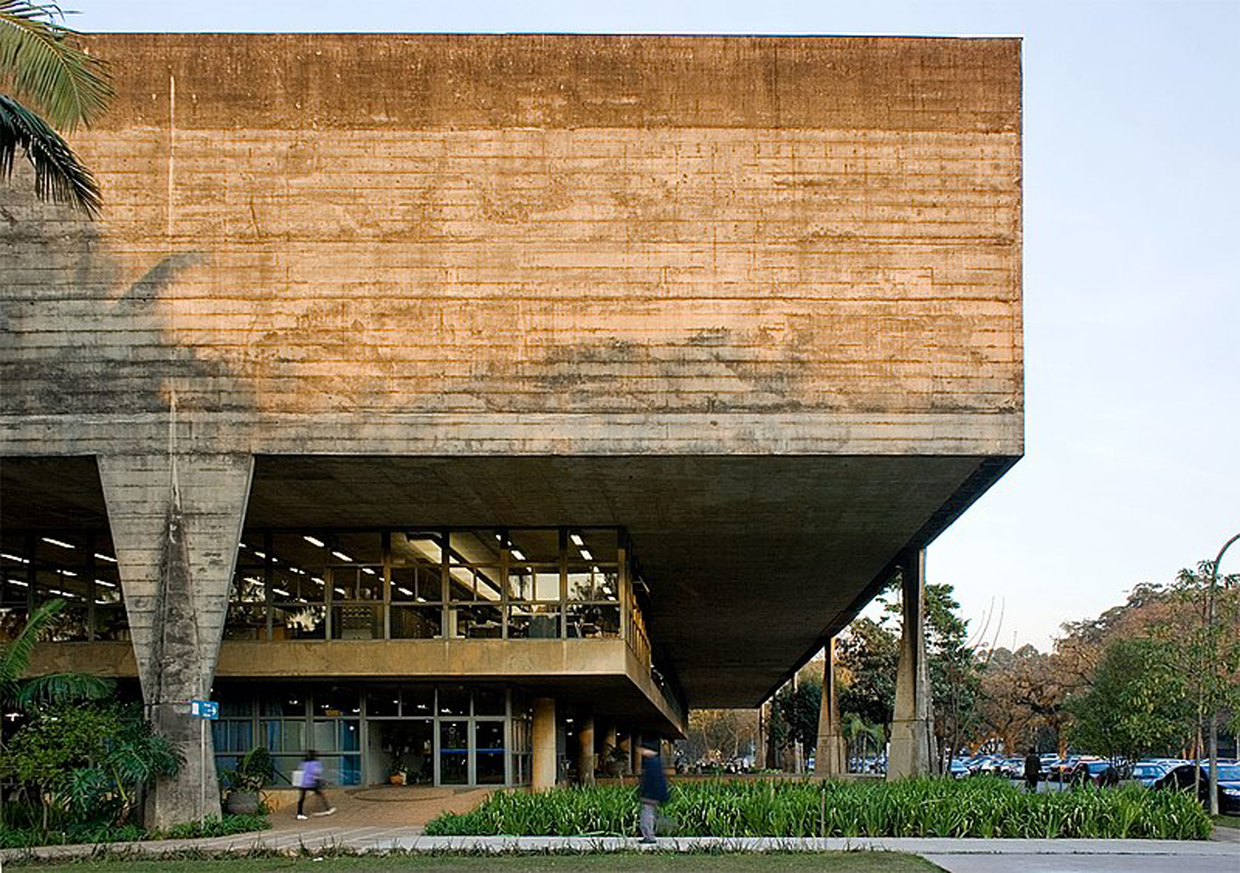
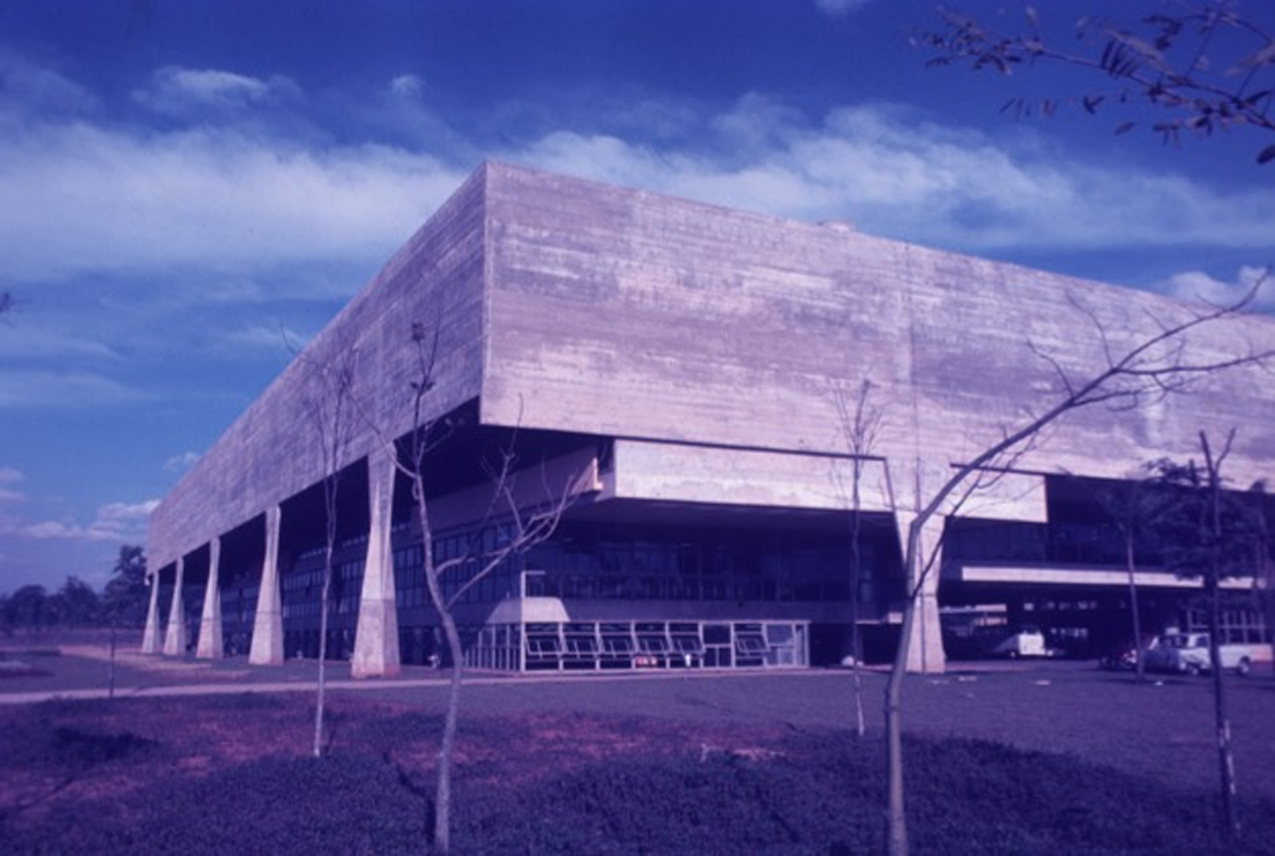
Some of these points are particularly notable. First, the house (i.e., single-family bourgeois house) is the main built object through which Brutalism in São Paulo was elaborated and experienced. The Brutalist house was an austere space made of concrete, usually organized as a single block under a unifying roof. It allowed for the creation of a certain “generative scheme” that would later be adapted to the design and construction of much larger projects. It is no surprise, then, that some of the most representative buildings of this school are single-family houses, such as the Paulo Mendes da Rocha House (image 1) and the Acayaba House. Some of these elements can also be seen in public projects that came to define the public face of that architecture, such as the School of Architecture and Urbanism of the University of São Paulo, probably Artigas's most significant project (images 2 and 3).
Paulo Mendes da Rocha House, 1964. Source: uncredited photo, Acrópole 143 (Sept. 1967): 32.
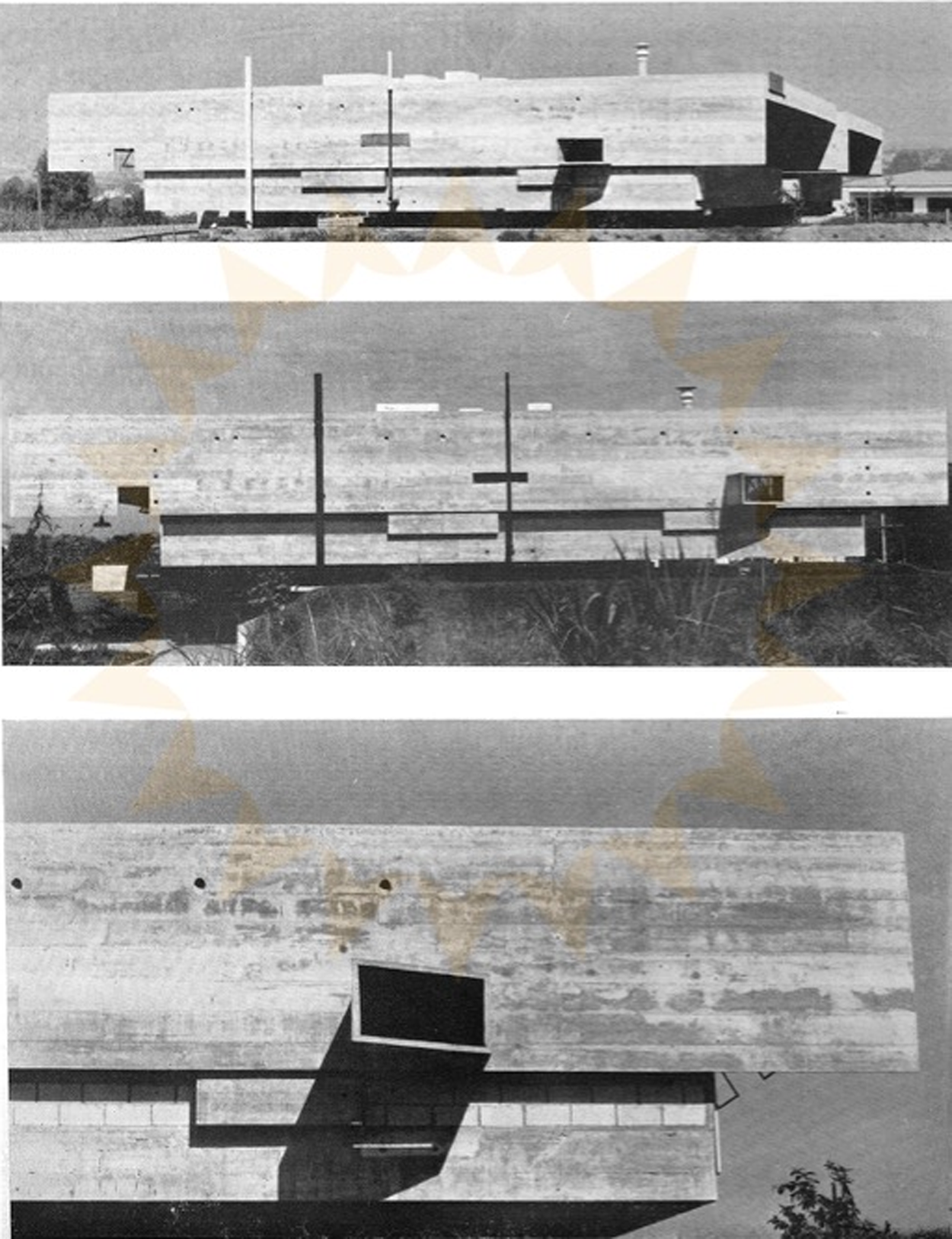
School of Architecture and Urbanism of the University of São Paulo (Vilanova Artigas). Source: photo by Fernando Stankuns 2010.
School of Architecture and Urbanism of the University of São Paulo (Vilanova Artigas). Source: Acrópole 377 (Sept. 1970): 15, FAU-USP archives.
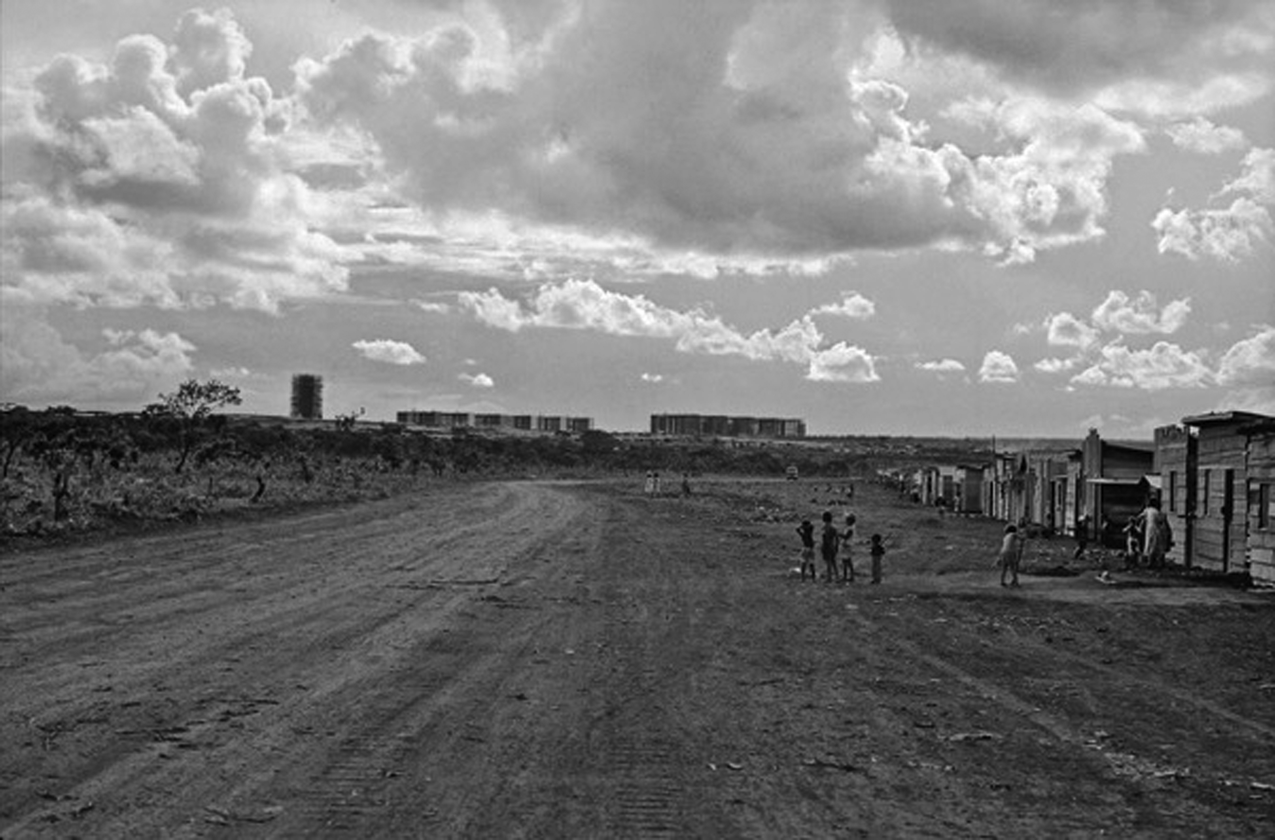
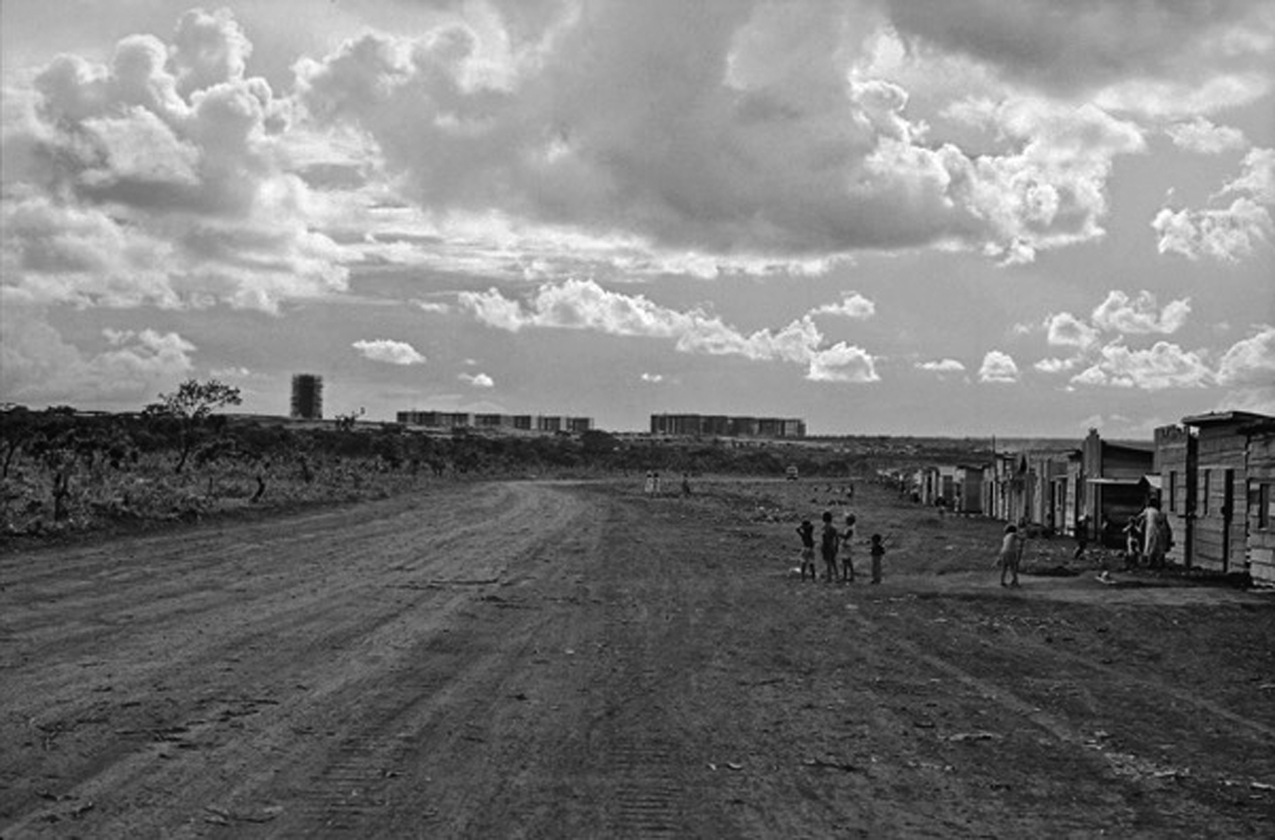
“From Nothing, the Capital” (Do nada, a capital). Brasília. Source: Thomas Farkas, ca. 1959, Instituto Moreira Salles. The image shows the modernist capital being erected on the background and the makeshift houses built on Brasília's fringes. The latter would house the families of construction workers employed in the project. These peripheral makeshift neighborhoods later expanded into low-income dormitory towns.
The middle- and upper-class house—or, in the terminology of the time, single-family bourgeois house—was the main space of experimentation of that architecture. This was largely due to a lack of stable state patronage of the field and the resistance of this culturally dominant sector to “surrendering” to the demands of the market (Zein Reference Zein2005). The socialization of many prominent architects in the circles of a growing intellectualized middle and upper middle class afforded them a higher degree of creative autonomy. The bourgeois house could operate as a space of aesthetic freedom and material experimentation. That kind of project allowed for specific material and material affordances, since they were conceptualized as pre-figurations of larger projects that could hopefully reach a national scale (Wisnik Reference Wisnik, Andreoli and Forty2004: 48)—that is, could move from the single to the multiple.
This was not only a political dilemma but also a professional one, since it also had to do with the constitution of the field as relatively autonomous from the field in Rio de Janeiro, which until the late 1950s dominated national architecture and was the face of Brazilian production for international consumption (Andreoli and Forty Reference Andreoli and Forty2007; Lara Reference Lara2008). Despite the importance of the architecture produced by Oscar Niemeyer, Lucio Costa, and the Roberto brothers (Marcelo, Milton, and Maurício Roberto), among others, the social question was not at the center of “Escola Carioca” (i.e., Rio de Janeiro School of Modern Architecture), with a few commendable exceptions.Footnote 8 Or, more precisely, the political repertoire that informed their practices did not have the social question at its core, but instead the problem of the constitution of the nation, a consequence of their proximity to the field of power in Brazil (Lara Reference Lara2011). A certain ideal of national development nearly stripped Brazilian architecture until the 1960s from one of the main ideological concerns of modern architecture—“its social extroversion with an emphasis on housing and design” (Recamán Reference Recamán2006).
Before analyzing how this repertoire provided the bases for translation between the political repertoire of the left and the production of the built environment, I will present the main elements of that political repertoire, emphasizing the image of the “people” that it sustained and intended to articulate.
THE PEOPLE IN THE REPERTOIRE OF NATIONAL DEVELOPMENTALISM
The dominant sector of the architectural field in São Paulo during this period was deeply immersed in a broad intellectual and political coalition that, by and large, organized the political thinking and artistic practices of the majority of the cultural elite as well as some of the main political forces. This coalition of center-to-left politicians, progressive artists and intellectuals, and socialist or communist militants supported a politics of “national developmentalism,” as the literature commonly describes it. This politics was one manifestation of a certain form of “middle-class radicalism” (Candido Reference Candido1990) in association with a nationalist communism in a country with growing levels of urbanization and industrial production. It proposed that the state intervene as the bearer of progressive national interests against the “reactionary” power of traditional agrarian oligarchies. In the economy, one central tenet was the idea of “import substitution,” with centralized state action to foster national industrialization.
In the cultural terrain, national developmentalism proposed a strong conception of a national art that also embraced and reinvented the work of the most “advanced” international avant-gardes (Amaral Reference Amaral2003). In all its manifestations, it contended that Brazilian society should break its colonial ties in order to produce a true “nation” (Arantes Reference Arantes, Xavier and Katinsky2012). Brasília, the capital planned by Lucio Costa and marked by Niemeyer's distinct architecture, was the foremost materialization of such politics (image 4). Inaugurated in 1960, it was the culmination of the modernist dream of designing and building a modern city from scratch, combined with a strong local reading of architecture and made possible by the availability of a vast low-wage labor force, during a government that promised that Brazil would advance “50 years in 5” (during Juscelino Kubitschek's presidency, from 1956 to 1961).
The quest for the nation was a central trope among the Brazilian cultural elite from at least the 1920s, when modern art became a new material for thinking about the relations between Brazil and the world as well as between intellectuals and the people. The Week of Modern Art of 1922 in São Paulo was the epicenter of the dissemination of this quest, although it was certainly not the only source. Moreover, the important generation of intellectuals who, starting in the 1930s, wrote general essays on the character of Brazil as a nation helped to raise the issue of the incompleteness of Brazilian social formation, and, in some cases, of its artificiality and dependence on the importation of foreign ideas (Arantes Reference Arantes1992; Schwarz Reference Schwarz1992). This quest for the nation also took the form of a quest for the Brazilian people, during decades in which Brazil, and especially São Paulo, slowly became mostly urban and, in some areas, industrial. During the 1950s and 1960s, this quest for the people and for the nation dominated production in the arts and in academia (Bernardet Reference Bernardet1985; Fernandes Reference Fernandes1965).
The political repertoire of national developmentalism was marked by a future-oriented theory of history. The shrinkage of the present and the expansion of an imaginary future were central aspects of the social imagination of a large segment of the Brazilian cultural and political elites until the 1980s. São Paulo's dominant modernist architects helped to reinforce this aspect of that political repertoire. Architects had to design and, in many cases, build in the context of a less-than-ideal present.
But this shrinkage of the present was not simply another name for “pragmatism,” as one might imagine. It was also the materialization of a concept of “the people” that dissociated it from the immediate forms of collective practice of the lower classes in Brazil's urban settings. These impoverished populations had to bear a large share of the burden of materially producing the city with limited resources, techniques, and materials, and they embodied a concept of self-worth still deeply marked by the centrality of house ownership (Holston Reference Holston2009).
This population, composed mostly of migrant workers and families, was also moved by the larger idea that the city would improve their lives. Most of them had moved from some of the poorest regions of the country, especially the northeast and poor regions of the state of Minas Gerais (Durham Reference Durham1984; Sader Reference Sader2010). For many, migration to the city and the acquisition (and usually self-construction) of a house in even the city's least urbanized areas constituted not only an improvement in their life prospects but also an exercise in the production of a certain notion of citizenship (Caldeira Reference Caldeira1984; Holston Reference Holston2009; Kowarick Reference Kowarick1997).
The political repertoire of national developmentalism turned its back on most of these native conceptualizations of citizenship and politics. For example, the Communist Party, although it had been illegal since 1947, devoted the majority of its political formulations about the people to discussions of the revolutionary potential of rural and industrial workers and the need to establish alliances with “progressive” sectors of the Brazilian bourgeoisie (Prado Júnior Reference Prado Júnior1966; Reis Reference Reis1999). Absent from its agenda were problems of everyday life and conflicts in the realm of relations “in production,” such as structures of domination in factories and construction sites. The orthodoxy of the Brazilian Communist Party, as formulated by intellectuals such as Jacob Gorender and Nelson Werneck Sodré and in party documents produced from the 1920s until the 1964 military coup, described the Brazilian situation as pre-capitalist and fundamentally dominated by agrarian elites. In this sense, the party—an important intellectual and, at times, political ally in the national developmentalist coalition—considered that the Brazilian situation posed dilemmas like those of Russia in the prerevolutionary period, which required a reformulation of many traditional Marxist categories.
In a “feudal” social formation, it was said, the party should foster a bourgeois-democratic alliance against the dominant agrarian and imperialist capital (Brandão Reference Brandão1997: 190, 207). This alliance, within the contours of a language of national development, should bring together industrial workers and progressive sectors of the emergent national bourgeoisie. At the same time, rural workers should play a revolutionary role against rural oligarchies by demanding the extinction of large rural estates rather than improvements in their work and life conditions (Cardoso Reference Cardoso1964; Prado Júnior Reference Prado Júnior1966; Reis Reference Reis1999).Footnote 9 The Marxism of the Brazilian Communist Party was “radically anti-romantic, illuminist, evolutionist, and piously admiring of industrial-capitalist ‘progress’” (Brandão Reference Brandão1997: 240).
To be sure, this intellectual framework was contested within the Brazilian left, as attested by the work of nonorthodox Marxist social scientists and historians such as Caio Prado Jr, Florestan Fernandes, and Fernando Henrique Cardoso, and other emerging theories and practices, such as the radical pedagogy elaborated by Paulo Freire in the 1960s (Cardoso Reference Cardoso1964; Fernandes Reference Fernandes1975; Freire Reference Freire2014; Prado Júnior Reference Prado Júnior1966). Moreover, although the Communist Party was culturally hegemonic on the left, it was part of a constellation of organizations that structured the progressive political field from the mid-1950s to 1964. This constellation was also composed of leftist nationalists such as the partisans of Leonel Brizola (the combative governor of Rio Grande do Sul), progressive Catholic students organized as the Juventude Universitária Católica (Catholic University Youth, or JUC), and small militant groups that had broken from the party. The latter small groups defied the party's revolutionary temporality oriented to the future and also its reformist methods, and proposed a more direct strategy of armed revolutionary struggle (Ridenti Reference Ridenti2010: 26–27).Footnote 10
A few elements of the dominant theory illuminate the distance between urban professionals and the booming peripheral populations. First, those migrant workers and families moving to the peripheries of the largest Brazilian cities or, in some cases to slums, did not occupy a central place in this political repertoire, since they did not fall neatly within the social ontology or the philosophy of history that informed the party. This growing urban population was not conceptualized after a specific analysis of their experiences in the city, but only when certain elements were employed as industrial workers.
When the party defined these people as workers, they were disembodied and dematerialized, which obliterated not only their daily habits and routines but also their practices of subsistence, daily struggle, and engagement with their communities. Likewise, their gender, given that a masculine perspective dominated the left at this time. This conflicted with the reality that the limited but existent forms of associativism in the peripheries were dominated by women (Holston Reference Holston2009). In order to adapt to the complexity of the social, this political repertoire relied on imported or local abstract categories to the detriment of understanding the actual practices, challenges, and habits of that growing population. These people were transforming Brazilian cities with their feet—turning Brazil into a mostly urbanized country, and hands—building their houses and often the infrastructure that would serve them.Footnote 11
This shrinkage of the present—when the only plausible solution was a democratic revolution in alliance with an idealist vision of a national bourgeoisie against the agrarian-imperialist capital—was complemented by a belief in the future role of a loosely defined “people” in an eventual socialist revolution. It is true that during the months before the military coup of 1964 institutionalized political channels materialized the national developmentalist alliance at the top, giving it a more pragmatic bent and boosting the role of the state in the political culture of the left. Particularly so when president João Goulart (1961–1964) started to propose reforms that inflated the “historical present,” such as a project of agrarian reform that enraged most of the Brazilian elites. At the time, a proto-revolutionary rural movement in the northeast known as ligas camponesas (peasant leagues), led by Francisco Julião, posed a challenge to the local rural oligarchies and inflamed many of the progressive national forces. However, most of the leftist cultural elite remained devoted to a repertoire that would replace the actual political dynamics of the lower classes with the idealized version of how the historical process should unfold.
CONCRETE ARTICULATIONS: BRUTALISM AND THE URBAN POOR
Architecture, like any set of defined practices within a cultural field, cannot perfectly translate the political repertoire of national developmentalism in any of its variations. In fact, one extrapolation of the theoretical argument that I am developing here is that no set of practices could perfectly translate a political repertoire, but the practices within each field refract that repertoire into their specific “world,” helping to change that repertoire at the same time. In this sense, it would be fruitless to try to map how each of the aspects of the political repertoire previously described find an equivalent in the practices of architects of the period.
Despite that, architects pragmatically attempted to connect their practices and discourses with the main points of that political repertoire. In the case of São Paulo in the 1950s and 1960s, this attempt took two central forms: a practice of critical irony via a semio-material mechanism of “metaphorical indexicality,” and several attempts and discursive investments in the industrialization of construction in order to increase the production of low-income housing. Both of these were pragmatic attempts to operationalize this articulation between the political repertoire of national developmentalism (especially in its communist variation) and semio-material practices in the field of architecture, in a situation in which the collective desire for industrialization of construction sometimes had to be compensated by formal originality in view of the limits and the sluggish pace of the Brutalist industrialization process (Conduru Reference Conduru, Andreoli and Forty2004: 66). This condition sets apart the Brazilian version of Brutalism from those of the British, French, and several Eastern Europe countries, where industrialization attempts were considerably more successful (Dobrenko Reference Dobrenko2007; Fehérváry Reference Fehérváry2013; Zimmerman and Crinson Reference Zimmerman and Crinson2010). At the same time, they are two pragmatic solutions (one with a formal and one with a technical emphasis) to the continuous problem in architecture of bridging the single and the multiple.
METAPHORICAL INDEXICALITYFootnote 12
As many commentators suggest, the Brutalist School of architecture in São Paulo was capable of advancing a very particular and sophisticated program for connecting ethics and aesthetics, or more broadly, between the practice of architecture and politics.Footnote 13 This contribution was possible due to several conditions of architectural practice at the time in Brazil, and in São Paulo in particular: the political context, in which the left emerged as a central political and intellectual player; the professional prestige of architects and the growing presence of their activities in public debates after the construction of Brasília; the centrality of São Paulo for a project of industrial development; and the connection between the practice of architecture in the city and its origins in the field of engineering (in contrast with the field of architecture in Rio de Janeiro) (Ficher Reference Ficher2005).
A key element of this architectural design ethic was what I will call a metaphorical indexicality. Particularly in some of the most autonomous projects of Artigas and architects who shared the core principles of Brutalism, such as Paulo Mendes da Rocha, the construction of the “bourgeois house” and a few key public buildings served as formal and material experiments for a critique of the social. Very commonly in these buildings, material indexesFootnote 14 of labor functioned as metaphors for a social state of things—a critique endowed with irony, especially in the use of techniques regarded as archaic in the management of exposed concrete. This use of concrete would serve at the same time as a metaphor for the combination of progress and backwardness that characterized Brazilian modernity.Footnote 15
The contrast between the use of concrete and an almost performative exaggeration in the printing of the wooden forms in the material served in many works as a metaphor for the nation's drama in its process of conservative modernization. Concrete as a material as well as a constructive process is commonly seen as modern, with a wide array of possible uses and cultural connotations (Forty Reference Forty2012). Yet, the application of concrete at the construction site using low-skilled labor deploying low-technology methods, such as wood form casting, allowed architects to advance a material comment on the anachronistic state of social relations and industry in Brazil. Marks of wood forms on concrete and other indexes of labor could work as signifiers of the low production level of industrialization in the country and the continuity of traditional relations of production at the construction site. With that, Artigas, Mendes da Rocha, and several other prominent architects materially conveyed a certain reading of their country's history that was gaining popularity among different sectors of the left: the idea that Brazil was becoming modern by means of an association with and the perpetuation of the most backward forces and social relations. This frame was also common in several other developing societies (Moore Reference Moore1993). The houses these architects designed for their highly educated and wealthy clientele would work as material essays to communicate these ideas.Footnote 16
Concrete, the favored material at the time, lent itself to this task of indexing a tension between the old and the new. Concrete itself is widely open to semiotic manipulation (Forty Reference Forty2012). It can be simultaneously modern (since it emerges in its modern form after its industrial elaboration) and traditional (since concrete construction, in loco, is a low-skill technique). More importantly, concrete as a material is not dissociable from the work that led to its specific use in a certain building. It comes into existence only when pressure is exerted through the cast—concrete does not exist prior to its application (ibid.: 51).
So, concrete maintains the marks of the labor that produced it, in contrast to industrialized materials such as steel or plastic that more efficiently hide the processes of their production. In this way, concrete lends itself to the indexicality of labor. Yet, indexes are only one level of operation of a sign. In the work of Brutalists in São Paulo, those indexes could work as symbols of a tension between the modernity of those forms and spaces that that architecture could produce and the backward labor and social conditions that provided the context for its production, and of political conditions after the 1964 coup. This sits in stark contrast to the white, clean architecture of Brasília, as many commentators would later point out (Conduru Reference Conduru, Andreoli and Forty2004; Ferro Reference Ferro and Arantes2006).
By conceiving and deploying the semiotic mechanism of metaphorical indexicality, these architects problematized the disjuncture between advanced engineering and an “oligarchic society that has systematically resisted mass production and the spread of durable goods” (Wisnik Reference Wisnik, Andreoli and Forty2004: 48). The semio-material practices of design and construction that sustain the semiotic mechanism of a metaphorical indexicality allow for a reading of the architectural object along the lines of a poetics of material contradiction, and evoke an ironic politics, a not so subtle material comment on the politics of the time.
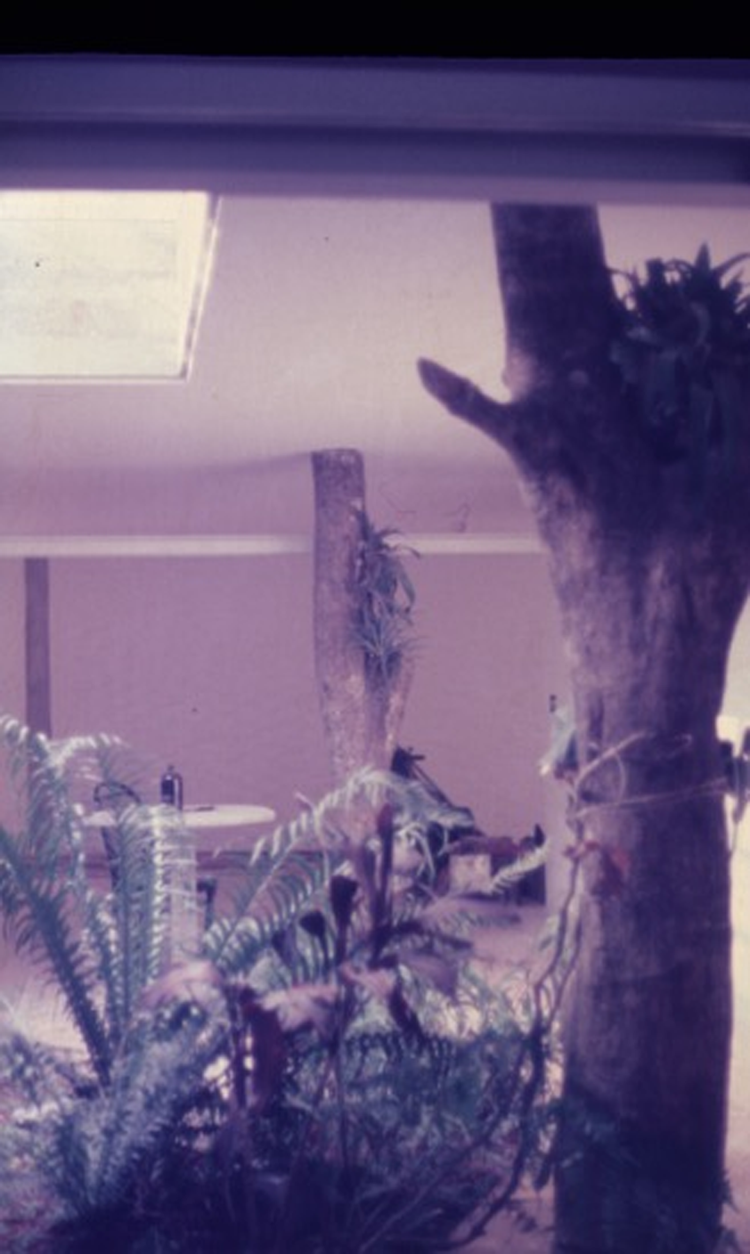
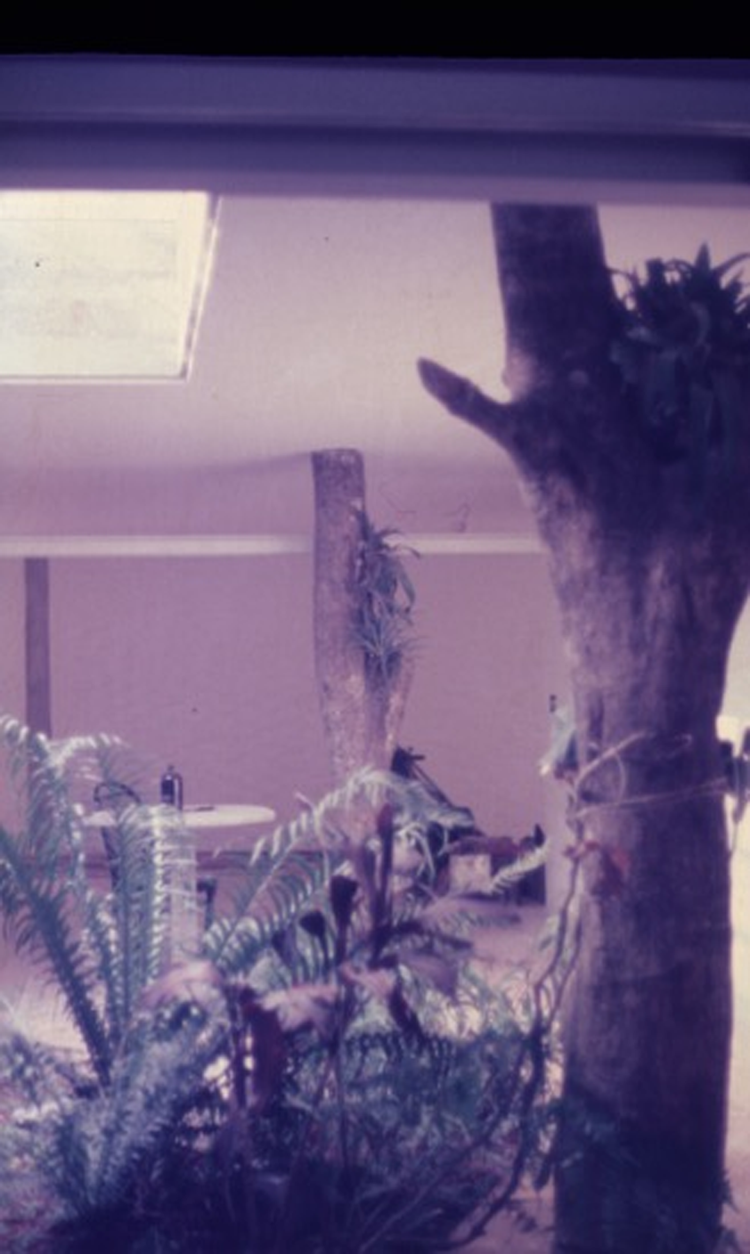
This critical irony also appears in a number of other deliberately exaggerated contrasts that Artigas, more than anyone else, introduced in his works. Examples are the contrast between the lightness of concrete columns and the apparent weight of the slabs in the FAU-USP building, or between modern exposed concrete and the use of an “archaic” trunk as a pillar in the important Casa Elza Berquó (image 5), which Artigas designed, at least in part, during his time in prison. Regarding this house, Artigas stated:
I made a home for Elza Berquó, for example, that is sarcastic, ironic, because it was a time when I could not have another thought in relation to such culture of our homeland except with the will to really laugh at everything that was being done … and did the design of this house as a ‘prisoner architect’…. I made a reinforced concrete structure supported by wooden logs, in order to say that on this occasion, this whole technique of reinforced concrete, which made this magnificent architecture, is just a hopeless folly in the face of all the political conditions in which we lived at that time (Reference Artigas1989: 47).
Elza Berquó House, internal garden and pillars (Vilanova Artigas), 1968. Source uncredited photo, 1968, FAU-USP archives.
The development of this politics of critical irony, which treated social issues as dramas that the architect could elaborate metaphorically, was largely a response to the lack of conditions for a mass intervention in the production of the built environment, particularly in the production of low-income housing in São Paulo. Until the late 1960s, the architecture of São Paulo was rarely called upon to contribute to the production of social housing.
Through this first semio-material mechanism, the “people” was articulated as a distant reality, only thematized as an absence or as a hopeful future presence, dependent upon unlocking the historical forces that prevented the development of the nation. Since a popular architecture seemed an impossibility until that occurred, one strategy that remained was the politics of critical irony and of architecture as critique. This tendency was radicalized after the military coup in 1964, when the epistemic and social distance between progressive architects and the urban poor was reinforced by the risks of establishing stronger connections with the lower classes (Arantes Reference Arantes2011).
Moreover, in order to be understood as an index of this historical drama, those indexes rely on the dissemination of a certain semiotic ideology among the public. Indexes of labor might still work as such for individuals not immersed in the critical narratives of architecture and politics at the time, but the next semiotic step—indexes working as metaphors for a state of things—worked only with the support of critical narratives and certain dispositions that were disseminated exclusively among the most intellectualized segments of the population of São Paulo at the time. As Peirce argues, symbols (and metaphors are symbolic mechanisms) are more arbitrary than are indexes (Keane Reference Keane2003; Peirce Reference Peirce1991): they need a cultural context in order to operate. The engagement with the materiality of the house, or any materiality, certainly relies on discursive framings about the material and cultural properties of those built environments. In São Paulo, such a discursive elaboration was necessary if indexes were to work as symbols of the national drama, and it is unclear to what extent it really informed how these buildings were engaged with by those who dwelled in them or the larger public.
Nevertheless, the engagement with those houses was relatively autonomous with respect to those discourses, in phenomenological and affective dimensions.Footnote 17 For many families, the austere architecture was rather shocking, something that Artigas, Mendes da Rocha, Sergio Ferro, and other key architects were conscious of. In the discourses of these architects, houses for bourgeois families should be rigid and austere; they should work as pedagogical, modern, and anti-oligarchical machines, forcing a more genuine contact with materials and structures. They also materially conditioned a dissolution between the exterior and the interior, or between the public and the private, a political and spatial cleavage that was of central importance to the emergent local bourgeoisie. Lina Bo Bardi summarized the perception of the political effect of the open, austere, concrete architecture: “Each house Artigas designs shatters all the mirrors of the bourgeois salon” (Reference Bo Bardi1950: 15). However, this expected shattering of the images, artifacts, and narratives of the bourgeoisie that the Brutalist house as a critical pedagogical machine was meant to foster was only one of the possible forms of experience of the canonical houses of São Paulo Brutalism. For instance, ownership of such a house was also a sign of material and cultural capital and a crucial instrument of class distinction. In other words, the process of signification on which the mechanism of metaphorical indexicality depended coexisted with other semiotic repertoires, ideologies, habitus, and narratives.
Therefore, the mechanism of metaphorical indexicality, although it was a mark of much of what is considered the best architecture ever produced in São Paulo, was limited in at least three ways. First, it was informed by a political imagination that observed the social problem, particularly the urban question, from a geographic, political, and historical distance. Second, in order to operate accordingly, it depended on a highly developed narrative about its supposed semiotic operation. Finally, with the dissemination of the program, this mechanism was routinized and lost much of its intended critical capacity (Ferro Reference Ferro1986; Penteado Reference Penteado2004; Recamán Reference Recamán2006). It comes as no surprise that this mechanism had to coexist with other projects, such as limited attempts to rationalize and industrialize construction, and was later, in the 1970s and 1980s, criticized by new generations of architects more interested in designing and building for and with low-income urban communities (Bortoluci Reference Bortoluci2018; Gohn Reference Gohn1991). Those critiques of modern discourses and practices were part of an international reflection on the limits of high-modernism (Alexander et al. Reference Alexander, Davis, Martinez and Corner1985; Fathy Reference Fathy2000; Turner Reference Turner1972; Reference Turner2000).
INDUSTRIALIZATION AND LOW-INCOME HOUSING
Housing, and the housing deficit, became common topics in the discourse of Brazilian architects of the mid-1960s. Architecture journals published numerous articles throughout the decade about rational construction techniques, mainly of prefabricated components. This also echoed international concerns of the time: the efforts toward reconstruction in Western Europe and national socialist projects of development in Eastern Europe accentuated the role of the architect as a technician (Zarecor Reference Zarecor2011: 295). In São Paulo, the limited connections between the field of architecture and the field of power constrained the possibilities for the establishment of such a role relative to, for example, developments in Eastern Europe or in France (Cupers Reference Cupers2014; Dobrenko Reference Dobrenko2007; Guillen Reference Guillen2006; Molnar Reference Molnar2005).
Until then, despite the construction of a considerable stock of modern public housing, particularly through major projects in the 1930s and 1940s financed by IAPI (created by law no. 367 of 31 December 1936), public housing had occupied a secondary role in the country's architecture (Bonduki Reference Bonduki1998), at least within what is conventionally treated as its hegemonic group, the Carioca School. That housing occupied a secondary position in a place dealing with such serious urban and social issues was criticized by many Brazilian and foreign commentators, most famously the Swiss architect Max Bill. During a controversial 1953 visit to Brazil, Bill condemned the architecture of Niemeyer and his colleagues and disciples for the excessive formal liberties they took and a deficit of rationality and replicability (de Aquino Reference de Aquino1953).
More profoundly, the Italian historian and critic Giulio Argan outlined in 1954 the paradox of Brazilian architecture up to that point: the vitality of the local architecture emerged in a society where modernity was being configured side by side with the preservation of structural traces of the past, without the leadership of popular forces to subvert that order. In his words, “An immature and self-indulgent self-satisfaction, obtained in the limited scale of individual buildings, obscured a deeper analysis of the social reasons that had informed the creation of modern canons in Europe” (quoted in Wisnik Reference Wisnik, Andreoli and Forty2004: 28). Argan and Bill both echo one of the key concerns of modern architecture, which deeply influenced key urban experiments in the mid-twentieth-century: it was felt that with rationalization of planning and construction architects should serve a national social project in which large-scale programs to produce low-income housing should find a central place (Blau Reference Blau1999; Cupers Reference Cupers2014; Wright Reference Wright1983).
Brazilian modernism did not emerge within political and economic conditions conducive to this modern “mission.” This detachment from the issue of affordable housing was dealt a first blow in the mid-1960s, largely owing to the increasing politicization of the period, especially during the presidency of João Goulart, which deeply affected the mostly progressive political circles. This was also a moment in which Brazilian architects felt a kind of post-Brasília blues, with a growing sense of how much the capital had fallen short of its promises of working as a national symbol. Given the limits of the discourses emphasizing the search for a nation, the topic of development and progress became central (Comas Reference Comas1994; Zein Reference Zein2005).
A milestone of this period was the National Architecture Seminar of 1963, organized by the Rio de Janeiro chapter of the Institute of Architects of Brazil (IAB-RJ). Several São Paulo architects participated, such as Joaquim Guedes and Jorge Wilheim, who were members of its organizing committee. In the early years of the decade, the issue of housing shortages and poor living conditions in slums and other Brazilian popular neighborhoods came to occupy more space in architecture and engineering journals, especially Arquitetura (Rio de Janeiro), and Acrópole and Habitat (São Paulo). An editorial published in Acrópole in 1965 provides a glimpse of this: “All technicians, especially architects, are breathless from debating solutions and constructive technical procedures that could provide a faster, more economical, more rational, more logical solution. So, there are conversations about prefabrication, modulation, standardization, light materials, blocks of this or that kind, apparent concrete, walls of cellular concrete, and such and such” (Corona Reference Corona1965: 18).
Ultimately, more euphoric proponents of industrialization came to recommend the elimination of brick as the primary construction material. “Brick” here served as a metaphor for the unskilled labor that dominated Brazil's construction “industry.” For example, Teodoro Rosso, in an article entitled “An Urgent Imperative: The Industrialization of Construction,” argued:
In our country, where the most categorical statistical sources indicate a current deficit of three million households, only 100,000 homes are built a year…. This is a problem universally discussed, and it has not found a satisfactory solution even in countries where the ‘métier’ of mason, a true traditional craftsmanship, is transmitted from father to son, as a real heritage of art and skill.… Among us, given the current situation of our labor force, the application of principles of labor rationalization is truly utopian (Reference Rosso1962: 32).
These architects were often knowledgeable about the experiences of industrialization of construction in other national contexts, especially France and the Soviet Union after the Second World War (Bruna Reference Bruna1983). The latter seemed particularly relevant, and several speeches and journal articles at the time mentioned the Soviet experiences with prefabrication. National developmentalism's obsession with the advance of progressive forces, an interest also fostered by the Brazilian Communist Party, helps to explain this interest in the Soviet model. In addition, the historical mission of the progressive sectors of Brazilian society, of liberating the country from the shackles of backwardness, implied that housing needed to be produced on a large scale and that skill deficiencies in the labor force had to be overcome. These were also the two main objectives of the Soviet program of industrializing the construction industry, together with its symbolic role in fostering a vision of Soviet modernity and state power and in instilling a modern, Soviet subjectivity in the population (Fehérváry Reference Fehérváry2013: 83; Forty Reference Forty2012: 157; Humphrey Reference Humphrey2005).
One of the most advanced attempts to rationalize housing construction was the designing and building of Conjunto Residencial da Universidade de São Paulo (Residential Center of the University of São Paulo, or CRUSP) in 1963. The project, led by Eduardo Kneese de Mello, consisted of twelve six-story residential blocks, with ten apartments per floor. The complex was initially built to shelter athletes during the Pan-American Games of 1963 and was later converted into student apartments. The project was heralded as exemplary within the dominant sector of the architectural field, with its unconventional use of light structures and materials in their natural colors, and its reliance on prefabricated elements (Acrópole 1962). Like any other important project of the time, CRUSP was seen not only as an accomplishment in itself but also a laboratory for future developments: “This breakthrough in the field of industrialization of construction displays promising perspectives on solutions to serious national problems, such as popular housing, educational edifices, hospitals, etc.” (ibid.: 100).Footnote 18
CRUSP was not the only project seen as a seed for future constructive practices. This was particularly notable in the design and construction of Cecap Guarulhos, the most important housing project developed in São Paulo in the 1960s and a central experiment in the practices and discourses of the Brutalist program for low-income housing. The project was designed by a group of eminent architects (Vilanova Artigas, Paulo Mendes da Rocha, and Fabio Penteado) who understood it not only as a set of buildings with housing functions, but also as an experiment and platform for Brazil's industrial development. When complete, the project would have 10,519 units that would house 55,000 people, a population larger than 94 percent of Brazilian cities at the time. It would have the same scale as the mythical Conjunto Urbano Nonoalco Tlatelolco in Mexico City—the paradigmatic case for the ideology of public housing via state intervention in Latin America in the 1960s. According to the optimistic designers and state agents associated with the project, Cecap Guarulhos would ignite a rationalization of the construction industry that would transform housing design and construction in Brazil.
In a later interview, Artigas articulated these two dimensions of that political repertoire: “I was always sure that there would be a proletarian revolution and that development would result in the creation of a national industry capable of serving our people and rendering favorable the emergence of a working class, as it was envisioned by Karl Marx” (Xavier 2003: 218). For Artigas, at least, the community spaces and the unavoidable corridors that the design team proposed, and the industrialization dynamics that Cecap Guarulhos would trigger, were not to be architectural antidotes against a popular uprising. Instead, they would work as limited but hopefully effective instruments for bringing such an uprising into being, in stark opposition to the federal government's directives.
The project was deemed exceptional by many important architects and publications (Veja 1973: 92). One of the most celebratory statements was published in Acrópole. Corona, the editor, argued that architects “created a magnificent design that will actually solve an important problem…. This will be a definitive solution because it will make men's lives better…. All this … combined with intelligent design and a decent architecture … make the Cumbica housing project the most important human, social, economic, and political achievement of recent times in Brazil” (Corona Reference Corona1968: 12).
For several reasons beyond the scope of this article, Cecap did not function as the expected laboratory of practices of industrial and rational construction. In the mid-1980s, when the last apartment blocks were built, Cecap had 4,680 units—less than half the number initially planned. Also, the piecemeal construction process had not provided the scale necessary to raise the need to build an industrial complex to supply Cecap, as well as other projects, with prefabricated materials. Most of the housing complex was instead built with traditional materials and methods, although there were a few improvements, such as a method of casting concrete using steel frames, a faster technique of concrete curing, and the use of light wood panels on the internal walls.Footnote 19 Most of the original plans, initially conceived for a construction process using prefabricated materials and rational methods, had to be revised.
It is important to point out that the framing of a specific project as a laboratory also corresponds to an attempt to solve the dilemma of the single and the multiple, since it provides a language for operationalizing a translation between certain semio-material practices in the field and the political repertoire within which most of the architects were immersed. As the architect Arnaldo Martino argues, showing that this rhetoric has survived the decades since it was formulated,
this school in which we were educated, the architects of the 1960s and 1970s, we considered any project that we made as an experiment…. A house was an experiment. Artigas's houses are very typical; they are not house projects; they are prototypes of much larger projects, because they rehearse technologies and spatial experiments that extrapolate the house itself.… That was transmitted to this entire generation. We had this spirit: architecture was a laboratory; we were always experimenting with new techniques, new processes, and that was contagious, because you'd transmit what you did to your colleagues.Footnote 20
With conditions unconducive to undertaking larger projects to industrialize construction, which most architects deemed necessary to solve the drastic housing deficit, architects framed their limited, “single” projects as pre-figurations of the multiple.
CONCLUSION
The problem of connecting the single (the project) with the multiple (the people, the nation, the social) is a key concern of modern architects throughout the world. Yet, the strategies for advancing such connections vary widely, depending on the political repertoires and semio-material practices available, and how local actors articulate those two sets of shared discourses and practices.
“São Paulo Brutalism” is an important example of such an articulation. As I have shown, the imagination about “the people” that helped to define discourses and certain practices of design and construction in São Paulo during the 1950s and 1960s was not informed by a continuous and real experience of interaction and exchange with the population in São Paulo's peripheries and their urban settings. The mechanisms of metaphorical indexicality and experiments in industrialization were pragmatic responses to pressing political, economic, and social factors, particularly the dependence on traditional methods of construction and the coexistence of economic growth and traditional forms of labor relations, and to the semio-material practices that characterized architecture in mid-century São Paulo. As such, they selectively helped to define what the housing problem was: mostly a quantitative problem that the state had to address, guided by architects. This quantitative delineation of the housing question reinforced the dissociation between architects and the urban poor, who were either reduced to a mythical image or incorporated into the politics of the present as an abstract, quantifiable entity, synthesized in the idea of the “housing deficit,” which divorced them from crucial features of their social experiences.
The conceptual framework I have mobilized here transcends the case at hand and provides a theoretical entry point for analyzing the politics of built environments in different local and social contexts. The idea that the built environment is political via the pragmatic articulation of political repertoires and semio-material practices of design, construction, and inhabiting illuminates a number of cases, many of which have received considerable attention from social scientists in recent years. These include the production of spaces of memory after traumatic social events or as iconic celebrations of power (Jones Reference Jones2011; Zubrzycki Reference Zubrzycki2006; Reference Zubrzycki2013); the interplay between international and national forces that set the stage for the connections between architecture, politics, and modernizing ideologies throughout the twentieth century (Guillen Reference Guillen2006; Humphrey Reference Humphrey2005; Molnar Reference Molnar2013); and the emergent sociological analysis of architecture as an assemblage of social practices (Jones Reference Jones2011; Latour and Yaneva Reference Latour, Yaneva and Geiser2008; Yaneva Reference Yaneva2009).
The concepts introduced in this article invite a pragmatic theorization of the ways in which individuals in different social positions (more or less) creatively mobilize available elements of political repertoires and repertoires of semio-material practices to produce and inhabit built environments as political spaces.