Introduction
The waste or refuse produced by the colonies of leaf-cutting ants is composed of the remnants of the fungus garden used for food, of leaves and cadavers of workers and brood. The waste represents a reservoir of micro organisms such as fungi, bacteria and mites. Among the contaminant fungi, Escovopsis sp. Muchovej & Della Lucia (Ascomycota: Hypocreales) (Bot et al., Reference Bot, Currie, Hart and Boomsma2001) may be present; and, according to Currie (Reference Currie2001), it is capable of reducing the numbers of larvae, pupae and workers leading to a lower colony reproductive success and even death.
The ants, on the other hand, possess several strategies to overcome the waste hazards. The majority of Atta species build underground chambers to isolate the fungus garden from the colony refuse (Autuori, Reference Autuori1947). Other species deposit their waste outside the nest (Weber, Reference Weber1972) or have task partitioning and division of labor when manipulating waste (Hart & Ratnieks, Reference Hart and Ratnieks2001; Lacerda et al., Reference Lacerda, Della Lucia, Lima, Campos and Pereira2006).
According to Bot et al. (Reference Bot, Currie, Hart and Boomsma2001), workers of Acromyrmex echinatior Forel kept in contact with their refuse died significantly earlier when compared with those maintained in sterile environments.
Investigations on colony refuse manipulation in leaf-cutting ants are scarce and recent. The majority of these studies emphasize Escovopsis sp. as the main non-mutualist fungus present in the association. However, Asp. flavus has also been mentioned as an opportunistic pathogen by Hughes et al. (Reference Hughes, Thomsen, Eilenberg and Boomsma2004) and T. viride, an antagonist of the fungus garden, has been reported as being harmful to the symbiotic fungus of leaf-cutting ants (Ortiz & Orduz, Reference Ortiz and Orduz2000). Several plants have been reported as toxic to the ant workers and/or to their symbiotic fungus. Alade & Irobi (Reference Alade and Irobi1993) reported that plants such as A. wilkesiana have antimicrobial activities and inhibit bacteria and fungal growth. Furthermore, colony waste affects foraging activity as reported for Atta colombica Santschi by Hart & Ratnieks (Reference Hart and Ratnieks2002). In colonies of this species that are contaminated by Escovopsis sp., there is a modification in the behavior of workers which increase cleaning activities such as transport of the parasite and waste dispersal away from the colony (Hart et al., Reference Hart, Bot and Brown2002). The influence of different plant substrates on the diversity of non-mutualistic fungi on colony waste and the resulting worker mortality has not been explored.
The purpose of this work was to study the influence of the waste of Atta sexdens rubropilosa colonies supplied with various plant substrates on the workers mortality. This study also investigated the diversity of fungal species present in the refuse of these colonies.
Materials and methods
Workers survival
Eight colonies of A. sexdens rubropilosa maintained at 25±2°C, 75±5% RH and 12:12 L:D conditions (Della Lucia et al., Reference Della Lucia, Vilela, Anjos, Moreira and Della Lucia1993) generated the waste which was subsequently used to evaluate workers survival after exposure. These nests were named 1–8 and had, respectively, 1.5, 0.75, 5.5, 6.0, 0.75, 1.0, 2.0 and 2.5 l of fungus garden. All these colonies were actively foraging in open arenas so that they could move freely. The colony pairs were used as replicates in this study.
Plant species were selected because they are normally well cut by leaf-cutting ants. Acalypha contains large amounts of antibiotics in the leaves (Alade & Irobi, Reference Alade and Irobi1993); however, leaf-cutting ants exhibit strong preference for these leaves, both in the field and laboratory. The plants supplied to the colonies to obtain waste were grown in a garden adjacent to the Universidade Federal de Viçosa Entomology Department building. These were grown without the use of pesticides; weeding was manual and fertilizer was applied as needed to maintain vigorous growth. Approximately 60 g of leaves from each plant species were offered daily to each colony over a period of two months. Colonies 1 and 2 were supplied with leaves of Acalypha wilkesiana as substrate for fungus growth. Colonies 3 and 4 were offered Ligustrum japonicum leaves. Colonies 5 and 6 were supplied with Eucalyptus urophylla leaves. Colonies 7 and 8 received the three plant species in equal proportions (20 g of each plant species) in individual piles. Plant species in each pile was randomly alternated on a daily basis so that no plant species was favored within this treatment.
After two months of exposure to the plant treatment, the waste from the respective colonies was collected, and the moisture content determined. For each colony, 20 Petri plates (8.5 cm dia.×1.5 cm height) were used, ten units which contained approximately 1.5 g of waste and the other ten which contained 1.5 g of ground filter paper moistened in such a way as to maintain humidity conditions similar to that of the refuse. Each Petri plate received ten young media workers from its original colony (head capsule width=2.2 mm, on average) following the methodology of Bot et al. (Reference Bot, Currie, Hart and Boomsma2001) with a modified moisture control. Constant moisture in the Petri plates was maintained through capillarity, with one end of yarn placed inside the plate and the other inside a 50 ml container with distilled water. All workers were fed a solution of 1:1 v:v honey and water through a plastic straw (0.5 cm dia.×2 cm height) containing a cotton swab immersed in the honey water solution and inserted in a hole in the Petri plate lid. The upper portion of the straw was surrounded by aluminum foil to avoid the attraction of other insects. This apparatus was replaced every three days to avoid microbial contamination, which would render the honey solution unsuitable as food for the workers.
Worker treatments were named Acalypha+waste, Acalypha−waste, Ligustrum+waste, Ligustrum−waste, Eucalyptus+waste, Eucalyptus−waste, mixture+waste and mixture−waste. The ‘−waste’ treatments had filter paper only.
The Petri plates were kept in a laboratory room under 26±3°C and 70±5% RH for approximately 30 days, and the number of survivors was recorded daily. Survival rate (Y) data was adjusted according to the logistic model E(Y)=1/(1+e(a+bx)) (Ratkowsky, Reference Ratkowsky1983; Crawley, Reference Crawley2002), which was reparameterized to facilitate data interpretation and discussion. The reparameterized model, after substituting a=cd and b=c was: E(Y)=1/1+ec(d+x), where c is related to the average survival rate (Ratkowsky, Reference Ratkowsky1983) and d is the value of x (time variable) at the inflexion point in the curve, which corresponds to 50% of workers survival (Crawley, Reference Crawley2002). The non-parametric test proposed by Baumgartner et al. (Reference Baumgartner, Weiß and Schindler1998) was used to compare different treatments. In this test, pairs of treatments were compared, considering that two samples originated from the same population or that two treatments had the same effect on the ants (pairwise comparisons).
Fungal diversity on the colonies waste
The evaluation of waste fungal diversity was accomplished by placing waste fragments from each colony on potato-dextrose agar (PDA). Four fragments were arranged equidistantly per Petri plate, with five replications per colony for a total of 20 fragments tested per colony. The growth medium had 50 mg of antibacterial substances (Penicillin-G and Streptomycin Sulfate) as in Bot et al. (Reference Bot, Currie, Hart and Boomsma2001), in addition to 2.0 g of peptone, 1.5 g of hydrolyzed casein, 2.0 g of Brewer's yeast and 10.0 g of glucose per liter.
The Petri plates were incubated in a climatic chamber at 28°C until fungal sporulation was verified. Fungal identification was conducted by morphological characterization according to Domsch et al. (Reference Domsch, Gams and Anderson1980).
Results
Workers survival
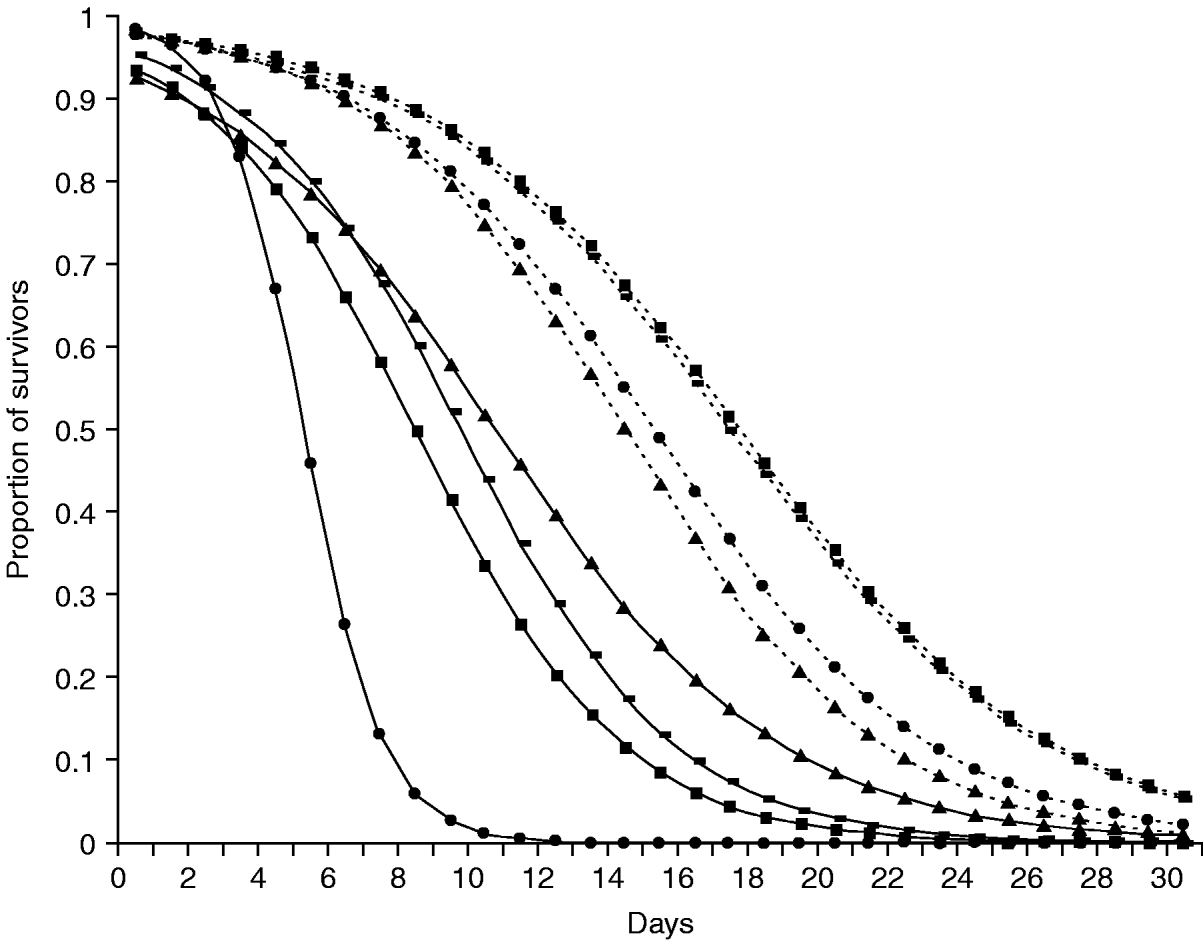
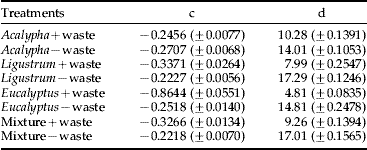
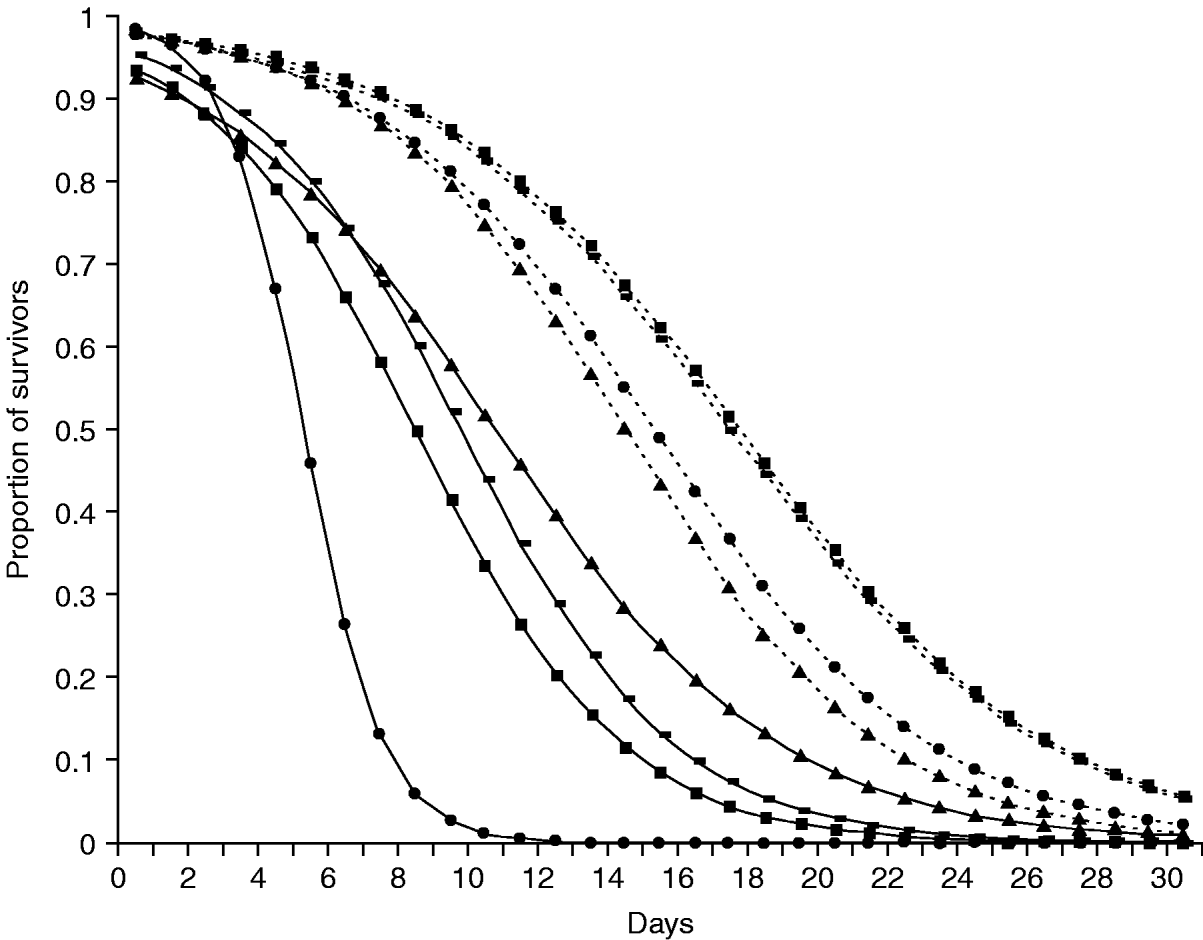
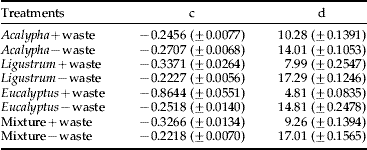
Workers maintained in contact with waste from colonies supplied with Acalypha had a higher average survival ratio (c) when compared with those fed with Eucalyptus; however, no differences were observed between colonies supplied with the remaining treatments (tables 1 and 2). This survival ratio is related to the slope of the survivorship curve (fig. 1). The x-axis value at the inflexion point of this curve (d=10.28) was slightly higher for the treatments with waste from Ligustrum (d=7.99) and the mixture (d=9.26), and was much higher than that of the treatment with waste from Eucalyptus (d=4.81). This indicates that more time was necessary for 50% reduction in the number of surviving workers in the treatment Acalypha+waste (table 1). For the treatment Eucalyptus+waste, the average survival ratio, as well as the inflexion point, was the smallest amongst all treatments, with 50% of the workers dead within four days of exposure.
Adjusted survival curves of A. sexdens rubropilosa workers exposed to several treatments represented according to the logistic model E(Y)=1/(1+ec(d+x)) (–––▴–––, Acalypha+waste; - - -▴- - -, Acalypha−waste; –––▪–––, Ligustrum+waste; - - -▪- - -, Ligustrum−waste; –––•–––, Eucalyptus+waste; - - -• - - -, Eucalyptus−waste;  , mixture+waste;
 , mixture−waste).
Estimation of the parameters of the model E(Y)=1/(1+ec(d+x)) (±SE) for each one of the treatments used, where c is related to the average survival rate and d is the value of x days at the inflexion point in the curve (50% mean survival).
P-values of statistical non-parametric tests according to Baumgartner et al. (Reference Baumgartner, Weiß and Schindler1998).

* values in bold indicate comparisons where the hypothesis that the samples belonging to a same population were not rejected. A+W, Acalypha+waste; A−W, Acalypha−waste; L+W, Ligustrum+waste; L−W, Ligustrum−waste; E+W, Eucalyptus+waste; E−W, Eucalyptus−waste; M+W, mixture+waste.
When the inflexion points were compared as pairs (tables 1 and 2) in terms of different treatments within the same plant (for example: Acalypha+waste, Acalypha−waste), the value of the curves for the treatments with waste was always lower than that of the curves without waste. The same paired comparison on the average survival rate could be made; and, except for treatments involving Acalypha, all treatments had lower survival rates of the workers in the presence than in the absence of waste.
Diversity of fungi in colony waste
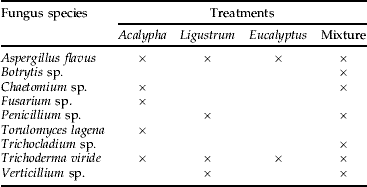
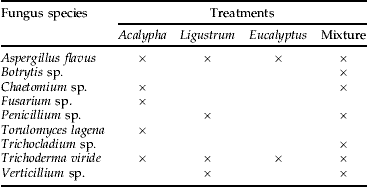
Waste with the greatest fungal diversity came from the colonies supplied with Acalypha and the three substrates together (table 3). A total of three species and six genera were present in the refuse of all colonies. Among them were: T. viride, an antagonist in the fungus garden (Ortiz & Orduz, Reference Ortiz and Orduz2000); Asp. flavus, an opportunistic entomopathogen that also infects leaf-cutting ants (Hughes et al., Reference Hughes, Thomsen, Eilenberg and Boomsma2004); and Fusarium sp. Link that is also a secondary agent of diseases in insects and a plant pathogen. The other fungi detected are known to be soil organic matter decomposers; and some genera, such as Botrytis Mich ex Sr and Verticillium Nees ex Link, are plant pathogens.
Fungi present in the waste of colonies of A. sexdens rubropilosa, supplied with Acalypha wilkesiana, Ligustrum japonicum, Eucalyptus urophylla and a mixture of Acalypha, Ligustrum and Eucalyptus.
Discussion
Independently of leaf substrate, worker mortality was higher in the ants exposed to waste. Workers that received A. wilkesiana and were exposed to waste had later mortality when compared with those from the remaining treatments with waste. In that treatment, it took ten days to kill 50% of the workers; the average survival rate was the highest in terms of absolute values among treatments with waste. Interestingly, mortality of ants in contact with waste of A. wilkesiana was very similar to that of workers in a supposedly clean environment. Furthermore, for the Eucalyptus treatment, ants lived three times as long without waste when in the presence of waste. This demonstrates that the waste originated from Acalypha is more aseptic than that from the others treatments. Earlier work by Alade & Irobi (Reference Alade and Irobi1993) reported antibiotic properties of A. wilkesiana, with both bactericidal and fungicidal effects. Therefore, it is reasonable to suppose that these compounds were acting directly on the ants and/or directly on the colony waste. Another possible hypothesis is that the Acalypha antibiotics are acting directly on the waste by reducing pathogenic microorganisms populations.
Aspergillus flavus, a facultative entomopathogen also detected in the waste of At. colombica colonies (Hughes et al., Reference Hughes, Thomsen, Eilenberg and Boomsma2004), was present in the waste of colonies fed A. wilkesiana. Despite the presence of this pathogen, the workers' mortality in this treatment occurred later since the growth of Asp. flavus is inhibited by that plant as reported by Alade & Irobi (Reference Alade and Irobi1993). Therefore, A. wilkesiana may not reduce the diversity of non-mutualistic fungi in the colony but could have reduced the pathogenic action of Asp. flavus. This is evidenced by later mortality of workers in the treatment Acalypha+waste in comparison with the mortality in the other treatments in the presence of waste. In addition, the mixture treatment+waste that contained Acalypha ranked second in terms of later workers deaths among those in the presence of waste.
Trichoderma viride, a fungus that is antagonistic to the ant-fungus garden, was present in the waste of colonies fed Acalypha. However, it is not known if this plant has any inhibitive effect on this fungus. In vitro studies conducted by Ortiz & Orduz (Reference Ortiz and Orduz2000) have shown Trichoderma sp. to inhibit mycelial growth of the mutualistic fungus of leaf-cutting ants, probably due to its ability to colonize and compete for nutrients. In nests infected with this fungus and Escovopsis sp., physical removal of fungus hyphal fragments and of spores is a normal behavior observed in the workers of A. colombica (Currie & Stuart, Reference Currie and Stuart2001). The presence of T. viride in this work supports the finding of task partitioning during waste manipulation with indirect transfer of waste among workers during waste transport in the same colonies, as demonstrated by Lacerda et al. (Reference Lacerda, Della Lucia, Lima, Campos and Pereira2006).
Workers died fastest when exposed to Eucalyptus+waste (table 1). Fifty percent of the workers died within four days of the 30-day period of the experiment. It is known that Eucalyptus spp. have large quantities of secondary compounds, essential oils (Penfold & Willis, Reference Penfold and Willis1961) and phenols, including tanins (Hillis, Reference Hillis, Hillis and Brown1978) that may act as inhibitors of the ant-fungus garden (Swain, Reference Swain, Rosenthal and Janzen1979) and may reduce the digestibility of the substrate by the ants and by the fungus (Feeny, Reference Feeny1970). It seems reasonable to speculate that fungal species present in the waste of these colonies were Asp. flavus and T. viride, among others. Therefore, the fungus garden was probably in competition for nutrients with T. viride, and the ants of the treatment with waste could be suffering harmful effects from Asp. flavus. In addition, nutritional stress of the workers could be a contributing factor in the accelerated mortality of the workers when in contact with the waste since leaf consumption was low, although not measured.
For all treatments, workers in contact with the waste died faster than those in a clean/waste-free environment, resulting in a lower survival rate. This result is similar to those obtained by Bot et al. (Reference Bot, Currie, Hart and Boomsma2001) with workers of Acromyrmex echinatior.
Escovopsis sp. was absent from all colonies, although several inoculations of fungus garden and waste fragments of other colonies were made in enriched PDA in attempt to isolate this pathogen.
We believe that the fungicidal properties de A. wilkesiana are responsible for the health of our laboratory colonies since it is the most commonly used plant substrate to raise our leaf-cutting ant colonies for both maintenance and other research studies. This may also be the reason for the absence of Escovopsis sp.; however, further investigation is necessary to confirm this.
We also hypothesize that the type of plant substrate may have implications in the ant colony other than nutrition. For instance, social insects can use plant compounds to reduce the risk of colony infection. The most widely known example is the honeybee, which uses resin to avoid this. More recently, it was found that resin of conifers collected and incorporated in the nest by workers of Formica paralugubris reduce colony contamination (Chapuisat et al., Reference Chapuisat, Oppliger, Magliano and Christe2007). Therefore, it would be interesting to investigate if leaf-cutting ants evolved similar ways to prevent pathogens presence.
Our findings lead us to conclude that the extent of colony contamination risks by pathogens presented in the waste also varies with the plant species used as fungus substrate.
Acknowledgements
The authors are grateful to CNPq–grant #474819/2006-0 for Funding this research and for assistantships and fellowships. We are grateful to Dr Rosa M.Muchovej, University of Florida, for revisions, comments and suggestions.