Introduction
Pearl millet [Pennisetum glaucum (L.) R. Br.] is a major dryland cereal in regions that are hot, dry and have degraded soils. It is a highly versatile crop with the potential to become a valuable component of non-traditional agriculture. Therefore, the importance of pearl millet is expected to increase under various climate change scenarios (Lane et al., Reference Lane, Jarvis and Atta-Krah2007). It is the staple food grain of the Sahelian Zone of West and Central Africa, parts of Eastern and Southern Africa and of the dry regions of Indian Subcontinent and Yemen in Asia. It is a forage crop in the Americas and South Korea. The major pearl millet growing countries include Nigeria, Niger, Burkina Faso, Togo, Ghana, Mali, Senegal, Central African Republic, Cameroon, Sudan, Botswana, Namibia, Zambia, Zimbabwe and South Africa in Africa; and India, Pakistan and Yemen in Asia.
A wide genetic base and the access to it are the key for sustainable crop improvement programme and for mitigating the effects of climate change on crop production. Generally, diverse populations and species-rich ecosystems have greater potential to adapt to climate change (FAO, 2007). Genetic variability accumulated over centuries is at risk, mainly due to replacement of landraces by improved cultivars, concomitant natural catastrophes (droughts, floods, fire hazards, etc.), human settlements, overgrazing, climate change and destruction of plant habitats for irrigation projects (Upadhyaya and Gowda, Reference Upadhyaya and Gowda2009). To ensure the availability of a wide genetic base to the present and future crop improvement programmes, there is a need to assemble and conserve crop genetic resources. Therefore, critical assessment of existing collections, identifying geographical and diversity gaps and launching germplasm collection missions in unexplored and under-explored areas are important to increase the variability and to achieve near completion of the collection to support crop improvement programmes.
The genebank at the International Crops Research Institute for the Semi-Arid Tropics (ICRISAT), Patancheru, India, holds the world's largest collection of 21,594 pearl millet germplasm accessions from 50 countries. Pearl millet germplasm at ICRISAT from Asia, which is considered as secondary centre of diversity for pearl millet, contains collections mainly from India, Pakistan and Yemen. Though the collections from these countries are considerable, it is not complete. Since ICRISAT genebank serves as world repository for pearl millet genetic resources, it is important that the full diversity is collected and conserved. Therefore, there is a need to look for gaps in the collections and to assess completeness of the collection to increase the diversity in the collection. In the present study, the geographical distribution of existing pearl millet germplasm assembled at ICRISAT genebank from Asia was examined, and the geographical and diversity gaps were identified for possible exploration before the valuable material is lost forever.
Materials and methods
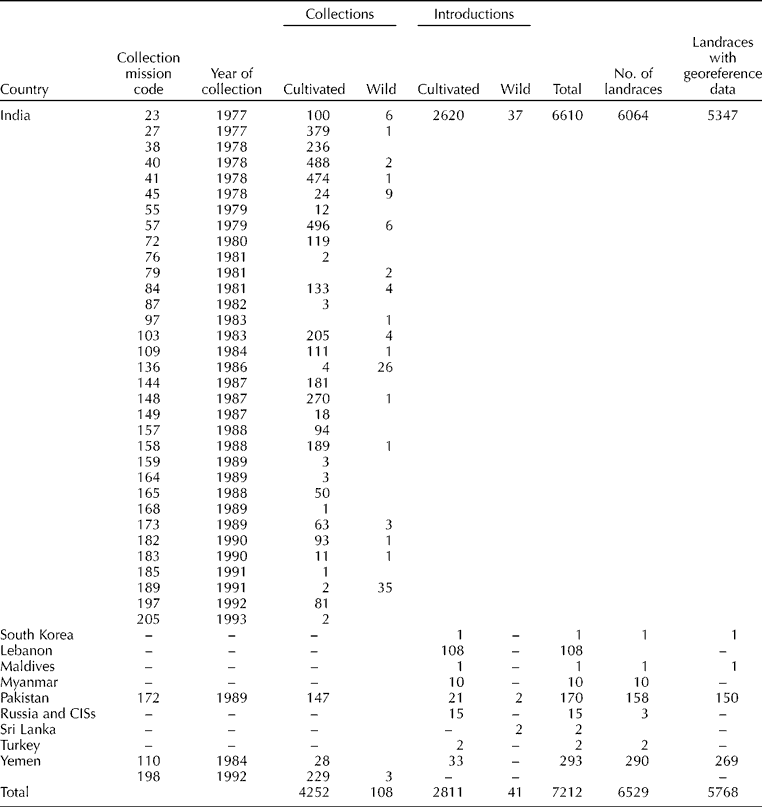
Available passport information of the pearl millet germplasm assembled at ICRISAT genebank from Asia was used in the present study. The collection at ICRISAT genebank includes 18,447 landraces, 2268 breeding materials, 129 improved cultivars and 750 accessions of wild relatives from 50 countries (Upadhyaya and Gowda, Reference Upadhyaya and Gowda2009). A total of 7212 accessions were assembled from ten Asian countries including India (6610), Yemen (293), Pakistan (170), Lebanon (108), Russia and Commonwealth Independent States (CISs) (15), Myanmar (10), Sri Lanka (2), Turkey (2), South Korea (1) and Maldives (1) (Table 1). Biological status of the collection from Asia indicates 6529 landraces, 533 breeding materials, 149 wild accessions belonging to 17 species and one improved cultivar. Landraces assembled from India (6064), Yemen (290) and Pakistan (158) were considerable in number and were used in the present study to identify gaps in collections from these countries. Passport data, particularly, for information on precise location of collecting site and corresponding geographic coordinates were updated by referring back to all related records, collection reports and catalogues. Using Microsoft EncartaR, an electronic atlas (MS EncartaR Interactive World Atlas, 2000), geographic coordinates were retrieved for accessions having location information. Accuracy of coordinates was checked by plotting all accessions on political maps of each country. Korea and Maldives representing with only one landrace each were not considered for the analysis. The final set of 5766 landraces from India, Pakistan and Yemen having geographic coordinates was used to identify gaps in the collections.
Summary of pearl millet germplasm assembled at ICRISAT genebank, Patancheru, India, from Asia

Geographical gaps were identified by using the available information on crop cultivation and by predicting the probability for pearl millet occurrence using FloraMap, a geographical information system (GIS) tool. Diversity gaps were identified for important traits using DIVA-GIS, a GIS tool. To identify geographical gaps in the collection from India, district level agricultural statistics for pearl millet cultivation (Bureau of Economics and Statistics, 2003) was mapped, and the assembled landraces at ICRISAT genebank were overlaid on the pearl millet areas and the districts with few or no collection sites were recognized as gaps in the collection (Fig. 1(a)). Information on statistics for area of pearl millet cultivation in Pakistan and Yemen was not available.
Geographical gaps (districts shaded) identified by using agricultural statistics for pearl millet in India (a) and by using predicted probability in India (b) and Pakistan (c).

FloraMap, a GIS tool developed at Centro Internacional de Agricultura Tropical (Jones and Gladkov, Reference Jones, Gladkov and Jones1999), was used to analyse the passport data and to predict the probability of pearl millet occurrence in India and Pakistan. For Yemen, climate information for collection sites was not available, and hence it was not possible to predict the probability of pearl millet occurrence in Yemen. The basic input in the FloraMap software was the geographic coordinates (latitude and longitude) of the sampling site with a unique identifier (accession numbers). The FloraMap system is based on calculating the probability that a climate record belongs to a multivariate normal distribution described by climates at collection points of organisms. With its user-friendly software linked to agroclimatic database, biodiversity specialists can create maps showing most likely distribution of any particular species in nature. FloraMap assigns climate data (monthly rainfall, minimum and maximum temperature, diurnal range in temperature) to each of the collection sites. A logarithmic or exponential transformation was applied to normalize the rainfall data. Weights were allocated to climatic variables depending on climate of the country/region. A probability density function was calculated on these few uncorrelated variables to find out the probability of finding a similar location for the population. More than 95% of total variation was explained by first five principal components. To achieve more precision in predicting the probability, landraces from India were grouped based on different agroclimatic zones (arid, semi-arid dry, semi-arid moist, sub-humid and humid-perhumid). FloraMap was run for each zone separately to predict the probability for pearl millet occurrence within each zone. While estimating the probability of pearl millet occurrence, multiple accessions with same coordinates were treated as single collection site. Collection sites or sampled sites were overlaid on the probability map of all climatic zones together, and districts with high probability (>75%) areas with no collection and/or few collections were identified. All districts identified (shaded area) as gaps along with the collection sites of already collected landraces are shown in the country maps of India and Pakistan (Figs 1(b) and (c)).
To have complete information on gaps in existing collections, gaps in diversity for important traits of pearl millet germplasm from India, Pakistan and Yemen were also identified. Characterization data of pearl millet germplasm assembled at ICRISAT genebank from these countries was used, and data on days to 50% flowering, plant height, number of total and productive tillers, panicle length and width, 1000 seed weight, seed colour and green fodder yield potential were considered for the present study (IBPGR and ICRISAT, 1993). Accessions were evaluated in batches of 500–1000 at ICRISAT, Patancheru, India (17°25′N latitude, 78°00′E longitude and 545 m.a.s.l.) in alfisols, in rainy season (June–November) during 1977–2009. Each accession was sown in two, 4-m long rows with spacing of 75 cm between rows and 10 cm between plants. Irrigation was provided whenever needed. Fertilizers were applied at the rate of 100 kg/ha N and 40 kg/ha P2O5. Rainy season at Patancheru is characterized by long (13.9 h in June to 12.4 h in November) and warm (mean minimum temperature: 21.8°C; mean maximum temperature: 30.9°C) days during the crop growth.
DIVA-GIS version 5.2, a GIS tool (Hijmans et al., Reference Hijmans, Gaurino and Rojas2005), was used to assess the diversity for each trait. The basic input in the DIVA-GIS software was the geographic coordinates (latitude and longitude) of the sampling site with a unique identifier (accession number). DIVA-GIS was run for each trait separately to estimate geographical diversity. All accessions were plotted on the map of India and Pakistan together, but it was done separately for Yemen. Diversity grids were mapped using the Shannon and Weaver (Reference Shannon and Weaver1949) method. Districts with high diversity cells/grids without or with few collection sites were recorded as gaps in diversity for each trait (Figs 2 and 3). Due to large number of collection sites in India and Pakistan, the diversity maps for important traits do not depict the collection sites avoiding the possible clutter. Province-wise gaps (districts) in diversity for each trait were summarized in Table 3. Eurasia Landcover characteristics database version 2.0 (2008) was used to know the type of vegetation and land cover in the districts identified and excluded lakes, forests and other areas, where crop cultivation is not known.
Diversity areas (grids) for different traits of pearl millet landraces from India and Pakistan.

Diversity areas (grids) for different traits of pearl millet landraces from Yemen.

Results
The summary of passport information for entire collection reveals that a total of 65 organizations located in different countries donated 10,764 accessions including those contributed over years by different disciplines at ICRISAT. ICRISAT and its partners have launched collection missions in priority areas identified in partnership with All India Coordinated Pearl Millet Improvement Project, National Bureau of Plant Genetic Resources (NBPGR) and Agricultural Universities in India; and in collaboration mostly with the International Board for Plant Genetic Resources (IBPGR, now Bioversity International), National Agricultural Research System (NARS), networks and universities in other countries. So far, ICRISAT has launched 212 collection missions for all its mandate crops and collected 10,830 pearl millet germplasm accessions during 76 collection missions in 28 countries (Table 1). A total of 2852 accessions that originated in Asian countries were acquired from 32 organizations located in nine countries (Table 1). The introductions include 2277 landraces, 533 breeding materials, 41 wild accessions and one advanced cultivar. The major introductions were from India (2657) and Lebanon (108). All other countries have donated less than 35 accessions. Among the organizations, Rockefeller Foundation, New Delhi, India (1298 accessions) followed by Mahatma Phule Krishi Vidyapeeth, Rahuri, Maharashtra, India (234 accessions) and All India Coordinated Pulse Improvement Project, Kanpur, Uttar Pradesh, India (207 accessions), are the major donors donating more than 200 accessions to ICRISAT (Table 1).
ICRISAT and its partners had launched 36 germplasm collection missions in three Asian countries and collected a total of 4360 samples including 108 samples of wild relatives. In India, 3848 landraces and 105 wild accessions were collected during 33 collection missions launched between 1977 and 1993 in collaboration with NBPGR, NARS and universities. In Pakistan, ICRISAT had launched a collection mission during 1989 in collaboration with National Agricultural Research Centre, Islamabad, and collected 147 landraces (Weltzien and Bhatti, Reference Weltzien and Bhatti1989). In Yemen, two collection missions were launched during 1984 and 1992 in collaboration with Agricultural Research and Extension Authority, Dhamar, and collected 28 and 229 landraces, respectively (Prasada Rao and Abdulla, Reference Prasada Rao and Abdulla1986; Appa Rao et al., Reference Appa Rao, Mukred, Mengesha, Amer, Reddy, Alsurai and Saeed1993; Narsimha Reddy et al., Reference Narsimha Reddy, Kameshwara Rao and Irshad Ahmed2004). All landraces from Myanmar (10), Russia and CISs (3), Turkey (2), Maldives (1) and South Korea (1) are introductions in the ICRISAT genebank. The landraces in India are from the provinces of Andhra Pradesh (596), Bihar (1), Delhi (1), Gujarat (698), Haryana (256), Himachal Pradesh (1), Jammu and Kashmir (21), Karnataka (234), Kerala (1), Madhya Pradesh (274), Maharashtra (970), Orissa (47), Punjab (277), Rajasthan (850), Tamil Nadu (658) and Uttar Pradesh (879); Baluchistan (2), Punjab (143) and Sind (5) in Pakistan; and Abhyan (10), Aden (14), North Yemen-1 (240) and Shabwah (5) in Yemen.
Of 6529 landraces from eight Asian countries, 5347 from India, 269 from Yemen, 150 from Pakistan and one each from Korea and Maldives have the information on geographic coordinates. Since multiple accessions having the same coordinates were considered as a single collection site, the number of actual geographical sites within an area of 18 × 18 km2 in the present study is lesser than the number of sampled sites. Therefore, the accessions having georeference data represent a total of 2134 geographical sites of germplasm collection in India (1982), Pakistan (76), Yemen (74), Korea (1) and Maldives (1). The collection from Pakistan has an average of about two samples per site (18 × 18 km2) followed by about three samples in India and four in Yemen indicating the intensity of germplasm collection in these countries.
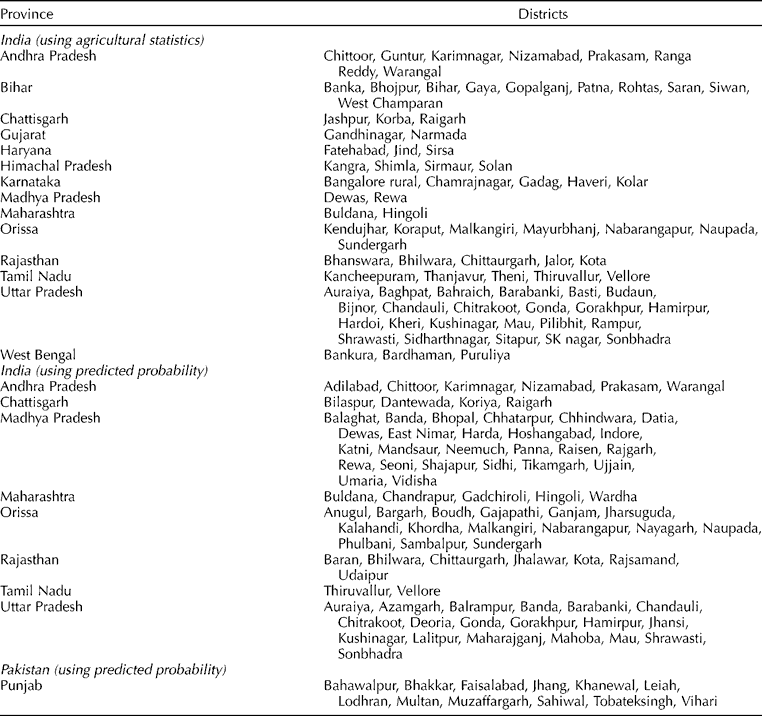
Mapping the geographical distribution of pearl millet cultivation in India and already collected landraces from India indicated 81 districts in 14 provinces as geographical gaps in the collection (Fig. 1(a)). A maximum of 23 districts in Uttar Pradesh followed by ten districts in Bihar were identified as major gaps. All other provinces were represented with less than ten districts as gaps. A high probability (>75%) area (districts) identified in the present study showed 83 districts of eight provinces in India and 12 districts of Punjab province in Pakistan as the major geographical gaps (Figs 1(b) and (c); Table 2).
Geographical gaps (districts) identified in the world collection of pearl millet germplasm at ICRISAT genebank, Patancheru, India, from Asia

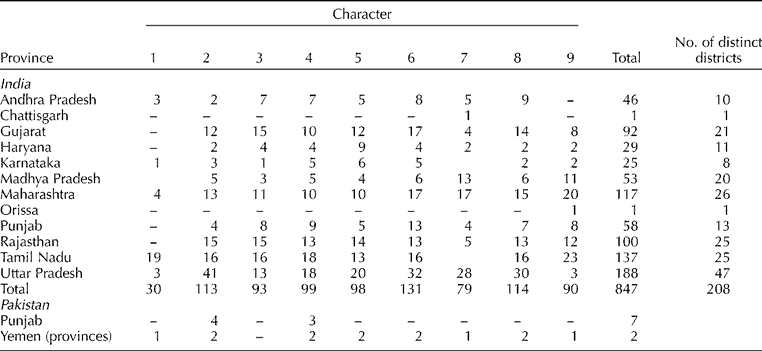
In India, a total of 208 distinct districts of 12 provinces were identified as gaps in diversity for nine traits (Fig. 2 and Table 3). A maximum of 47 districts in Uttar Pradesh followed by 26 districts in Maharashtra, 25 districts each in Rajasthan and Tamil Nadu, 21 districts in Gujarat and 20 districts in Madhya Pradesh were identified as the important gaps in diversity for different traits. Less than 20 districts in all other provinces without much exploration were identified as gaps in high diversity area. One district from Chattisgarh for seed colour and one from Orissa for green fodder yield potential were found as gaps in diversity. Districts in all other provinces were found as gaps in diversity for more than one trait. In Pakistan, under-explored or unexplored high diversity districts include Rajanpur, Muzaffargarh, Multan and Lodhran for panicle length and Chakwal and Sargodha for panicle width (Fig. 2). As the district information was not available for Yemen, province names were recorded. In Yemen, North Yemen (southern parts) and Lahiz were the two provinces identified as gaps in diversity (Fig. 3). In India, Warangal in Andhra Pradesh; Rewa in Madhya Pradesh; Hingoli in Maharashtra; Vellore in Tamil Nadu; and Auraiya, Chandauli, Chitrakut, Gorakhpur and Mau in Uttar Pradesh were identified as gaps in diversity for one or more traits under the study and found common to all three methods of identifying gaps. In Pakistan, Lodhran, Multan and Muzaffargarh were identified as gaps common to probability and diversity methods.
Province-wise number of high diversity districts unexplored and under-explored in Asia

1 = Days to 50% flowering, 2 = plant height, 3 = total tillers, 4 = productive tillers, 5 = panicle length, 6 = panicle width, 7 = seed colour, 8 = seed weight, 9 = green fodder yield potential.
Discussion
Many international genebanks have already assembled and conserve a considerable number of germplasm accessions of different crops. However, in view of fast changing scenario of climate change resulting in loss of biodiversity, there is a need to analyse the existing collections to identify geographical and diversity gaps in the collections and collect as much variability as possible before it is eroded forever. GIS tools provide more precise cartographic representation of the eco-geographic regions and of the germplasm collecting sites (Marilia et al., Reference Marilia, Celia Maria, Jaime, de Melo, de Belem das Neves Alves and Abadie2003). Using the georeference data, we can retrieve the information on environmental conditions of the collection sites, which is normally associated with the patterns of genetic variability (Marilia et al., Reference Marilia, Celia Maria, Jaime, de Melo, de Belem das Neves Alves and Abadie2003). Most of the older germplasm collections do not have complete passport information, particularly, the georeference data (latitude and longitude) of the colleting sites posing a problem in assessing the geographical completeness of collections. Availability of georeference data not only helps in identifying the geographical gaps but also enables to retrieve the environmental data, which is crucial in predicting the likely occurrence of a particular species in nature and its diversity distribution.
The gaps identified in India using crop cultivation statistics and predicted probability layers developed with the help of FloraMap provide valuable information (Marilia et al., Reference Marilia, Celia Maria, Jaime, de Melo, de Belem das Neves Alves and Abadie2003). A total of 134 distinct districts of 14 provinces were identified as gaps, which include 81 districts identified based on crop cultivation statistics and 83 distinct districts identified based on predicted probability. Irrespective of method of identification, 30 districts in Uttar Pradesh, 26 districts in Madhya Pradesh, 18 districts in Orissa and 10 districts in Bihar were identified as major gaps. As many as 29 districts were found as common to both methods of identification. The common districts include Chittoor, Karimnagar, Nizamabad, Prakasam and Warangal in Andhra Pradesh; Raigarh in Chattisgarh; Dewas and Rewa in Madhya Pradesh; Buldana and Hingoli in Maharashtra; Malkangiri, Nabarangapur, Naupada and Sundergarh in Orissa; Bhilwara, Chittaurgarh and Kota in Rajasthan; Thiruvallur and Vellore in Tamil Nadu; and Auraiya, Chandauli, Chitrakoot, Gonda, Gorakhpur, Hamirpur, Kushinagar, Mau, Shrawasti and Sonbhadra in Uttar Pradesh. These districts may be given priority for exploration. Among the gaps in diversity, Beed, Latur and Osmanabad were identified as gaps in diversity for all nine traits. Ahmednagar in Maharashtra; Jamnagar and Rajkot in Gujarat; Coimbatore, Dindigul, Karur, Madurai, Namakkal, Perambalur, Pudukottai, Ramanathapuram, Salem, Sivaganga, Theni, Virudhunagar in Tamil Nadu; Srikakulam and Vizianagaram in Andhra Pradesh; and Sawai Madhopur in Rajasthan found as high diversity areas for eight traits without much or no collection may be considered for exploration to increase the variability for important traits.
Wide latitudinal variation of landraces from 0°36″E in Maldives to 34°87″E in South Korea indicated that the landraces are from diverse climate and can adapt to varying climatic conditions. India being the secondary centre of diversity for pearl millet, the districts identified can be considered as the potential areas for exploration (Harlan et al., Reference Harlan, de Wet, Stemler, Harlan, de Wet and Stemler1975). In India, almost all past collections are from arid and semi-arid dry regions, where pearl millet is grown extensively. In the present study, a maximum of 55 districts in sub-humid, 36 districts in semi-arid moist, 15 districts in semi-arid dry and 7 districts in humid-perhumid regions were identified as geographical gaps in the collection. No geographical and diversity gaps were found in areas of major pearl millet cultivation indicating extensive collection of germplasm in almost all major pearl millet regions excluding it from further exploration (Figs 1(a) and (b)). Some of the districts identified in the present study were explored partly in the past, and a few samples were collected.
Genetic diversity offers an insurance against the devastating impact of climate change, and crop wild relatives are particularly likely to contain the breadth of genetic diversity necessary to combat climate change because of diverse habitats in which they grow and wide range of conditions in which they are adapted (FAO, 2008). Similar to other genebanks in different countries, ICRISAT had also launched only a few collection missions exclusively for wild relatives of pearl millet and conserves only a fraction of total genetic variability that exists in wild relatives (Jarvis et al., Reference Jarvis, Lane and Hijmans Robert2009). Crop wild relatives are important components of agroecosystems as potential gene contributors for breeding programmes. When the levels of resistance to various biotic and abiotic stresses in cultivated germplasm are low or the range of genetic variability is narrow and selection pressure results in virulent biotypes of the pests and diseases, the discovery and incorporation of additional genes for resistance from wild species become key to sustain crop productivity. Wild species are more important when they possess resistance to biotic and/or abiotic stresses in addition to traits of agronomic importance. For example, Pennisetum pedicellatum is a high tillering grass of short duration and fits well in the small period left in between two arable crops and also considered as an important source for higher levels of downy mildew resistance. Singh and Navi (Reference Singh and Navi2000) screened all accessions of P. pedicellatum for resistance to downy mildew [Sclerospora graminicola (Sacc.) J. Schröt] at ICRISAT, Patancheru, India, and reported all (129) but two accessions of P. pedicellatum as completely free from the disease. India is the major source for P. pedicellatum with 58 out of 134 accessions assembled at ICRISAT genebank. More variable habitat results in greater species diversity within it. Therefore, germplasm collection plans for the identified gaps should target both cultivated and wild relatives germplasm of pearl millet in both unexplored and under-explored areas to increase the variability in collections.
In view of fast changing cropping patterns, habitat loss, importance of pearl millet, food habits, etc. in different parts of India, Pakistan and Yemen, it is suggested that the final area for exploration in the districts identified in the present study should be decided prior to the launch of the collection mission in consultation with local government officials, NARS scientists, extension officers and non-governmental organizations, who have the knowledge about the extent of pearl millet cultivation in the districts. It is also suggested that the exploration team leader should review all reports and publications of past collections and high diversity areas to prepare collection plans for districts (gaps) identified in the present study and to collect complete information including georeference data while sampling.
Climate change and variability are among the most important challenges that are being faced by many developing countries because of their strong economic reliance on natural resources and rainfed agriculture. In addition, urbanization, infrastructure, irrigation projects etc. are causing genetic erosion at a faster rate. Habitat change is already underway in many parts of the world including Asian countries leading to species range shifts, changes in plant diversity, which include indigenous crops (FAO, 2007). Therefore, it is essential for the genebanks to increase variability in the germplasm collections.
Acknowledgements
The authors sincerely acknowledge the contribution of all former and present staff of Genetic Resources Unit (GRU), ICRISAT in the collection, assembly and conservation of pearl millet genetic resources. The help of D. Bapa Rao, G. Ram Reddy and G. Dasaratha Rao, Senior Research Technicians, GRU, in processing and documenting the data for the present study is highly appreciated.