Implications
The implementation of field cardio-respiratory measurements in horses opens new perspectives in both exercise physiology and nutrition. They allow conducting investigations in genuine conditions, which is complementary to treadmill conditions. This is particularly interesting for assessing endurance horses’ energy expenditure, which depends on the extra load by the rider or the conditions of the ground surface. The present study demonstrated that the present equine K4b2, a gas exchanges portable device, could be used in Arabian endurance horses in a controlled environment, but would require technical adjustments for routine use during outdoor workouts. The prediction of EE from HR measurements may be an interesting method to evaluate EE, particularly if an initial individual calibration is performed.
Introduction
Among equine sporting disciplines, endurance is perhaps the most demanding, as the horses are required to complete distances of up to 160 km in a single day. Maintenance of these high work rates poses several nutritional challenges for the endurance horses, particularly in terms of energy supply (Geor, Reference Geor2005). However, no precise quantification of the energy expended in racing has been done yet (National Research Council, 2007).
In humans, field respiratory gas measurements are largely used to estimate energy expenditure (EE) during exercise, thanks to portable devices that continously analyze oxygen consumption (VO2) and carbon dioxide production (VCO2). VO2 is converted to EE from its caloric equivalent (Levine, Reference Levine2005), and respiratory exchange ratio (RER) is calculated from VO2 and VCO2, together giving information regarding substrate utilization during exercise. Although first attempts were made to develop portable devices for horses since 1974 (Hörnicke et al., Reference Hörnicke, Ehrlein, Tolkmitt, Nagel, Epple, Decker, Kimmich and Kreuzer1974; Pagan et al., Reference Pagan and Hintz1986; Hanak, Reference Hanak1987), it has only been in the last decade that the equine K4b2 was validated (Art et al., Reference Art, Duvivier, van Erck, de Moffarts, Votion, Bedoret, Lejeune, Lekeux and Serteyn2006; Leprêtre et al., Reference Leprêtre, Metayer, Giovagnoli, Pagliei and Barrey2009). This system presents the advantage of measuring EE in genuine endurance conditions, including the extra load by the rider and tack or the condition of the ground surface (Lawrence, Reference Lawrence2007). However, the air collection facemask may be to be too large for small horses, such as Arabian endurance horses (Art et al., Reference Art, Duvivier, van Erck, de Moffarts, Votion, Bedoret, Lejeune, Lekeux and Serteyn2006). Moreover, controversial VCO2 data have been observed, with two studies revealing that VCO2 measurements were not consistent with physiological values reported in athletic horses (Votion et al., Reference Votion, Caudron, Lejeune, van der Heyden, Art and van Erck2006; van Erck et al., Reference van Erck, Votion, Serteyn and Art2007), yielding aberrant RER.
Based on the significant relationship that exists between heart rate (HR) and VO2, heart-rate monitoring would be an alternative way to evaluate EE of exercises performed in genuine field conditions. A prediction model of VO2 from HR has been recently developed from literature data in exercising horses (Coenen, Reference Coenen2010). However, in humans, individual variations including gender, age and training status, as well as variance in co-variables that affect HR such as emotion, have been demonstrated to impact the HR–VO2 relationship in terms of slope, intercept and curve characteristics (Levine, Reference Levine2005). Establishing the HR-VO2 regression for each individual horse would be an essential pre-requisite for estimating EE from HR measurements during exercise.
Therefore, the objective of this study was to obtain field cardio-respiratory measurements in Arabian endurance horses using the equine K4b2 in order to assess EE.
Material and methods
The project was conducted under the license from the Department of Health and Animal Care of the French Veterinary Authority (No. A21002) and ethics committee approval No. B0710.
Horses
A total of five trained pure-bred Arabian horses (one mare and four geldings) were included in the study. Horses were aged 11±2 years (8 to 13), with a BW of 438±34 kg (392 to 471), and a body condition score (BCS) of 3.25±0.25 (3 to 3.5) (on a scale of 0 to 5; Arnaud et al., Reference Arnaud, Dubroeucq and Rivot1997) at the beginning of the experiment.
Horses were housed separately in 4×3.5 m free stalls on pelleted wood bedding and were turned out in a paddock for 7 h a day for free exercise. They were weighed and their BCS were recorded weekly throughout the year. Their diet was based on first-cut meadow hay, providing an average digestible energy (DE) of 2 Mcal/kg dry matter (DM) and 7.2% CP/kg DM, offered in two equal meals at 0900 and 1800 h, and a pelleted complementary feed (DP Puissance; InVivo NSA, Louhans, France), providing 3.2 Mcal DE/kg DM, 12.5% CP, 18% starch and 3.5% fat/kg DM, offered in two equal meals at 0830 and 1700 h. On average, the level of feed intake varied from 2.5% to 2.9% BW (Goachet and Julliand, Reference Goachet and Julliand2011), and hay represented at least 80% of the total DM intake. Salt blocks and water were available ad libitum.
All the horses competed in advanced-level endurance events (130-km races) the year before the study – that is, 6 months previously. They underwent a regular endurance training program, based on outdoor rides (15 to 30 km) performed two to three times a week in hilly countryside and varied grounds (Goachet and Julliand, Reference Goachet and Julliand2011) and walk sessions (60 min at 1.6 m/s) 5 days a week.
K4b2 and equimask
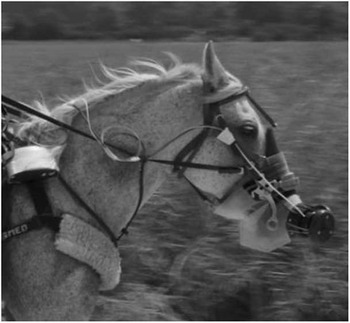
The equine K4b2 (Cosmed, Rome, Italy) is a portable metabolic measurement system composed of a facemask (Equimask, Cosmed, Rome, Italy) and a portable unit for gas analysis and data acquisition (Figure 1). The system has been described elsewhere (Art et al., Reference Art, Duvivier, van Erck, de Moffarts, Votion, Bedoret, Lejeune, Lekeux and Serteyn2006). In brief, Equimask is a plastic airtight facemask placed on the horse’s forehead, which has two respiratory openings oriented along the axis of the nostrils. The volume of the mask is closed by an elastic rubber membrane adjusted tightly to the nose, just under the zygomatic arch. Respiratory airflow is measured using two bidirectional turbines attached to the openings of the mask. A cap is positioned 3 cm in front of the turbine openings to minimize the influence of wind associated with the motion of horses on the turbine’s rotation. Expired gases are sampled and analyzed in the portable unit on a breath-by-breath basis using a Cosmed-certified oxygen-polarographic cell-analyzer and an IR non-dispersive thermostatically controlled carbon dioxide analyzer. The collection of expired air is done through a sampling port, which is connected to the analyzer by way of two semi-permeable sampling catheters designed to avoid condensation.
Illustration of one horse equipped with the equine K4b2 and Equimask during exercise on track. The reins were attached to the halter and a string connecting the Equimask and the halter between the horse’s ears was added to maintain tight the mask on the horse’s forehead. The portable unit and the battery were fixed on a collar, which was tied to the saddle and the girth using two straps on both sides of the horse.

Measurements
After 4 months of endurance training, measurements were carried out at rest and during an exercise test, between 1400 and 1600 h systematically. Measurements at rest were carried out the day before the exercise test. Data were recorded over a period of 10 min on horses maintained calm and standing, with no access to food or water. Measurements at exercise were carried out on a 1150-m flat sandy track. Horses were equipped with the K4b2 system and HR monitor (RS800; Polar Electro Yo, Kempele, Finland) after a 40-min warm-up (at walk, trot and canter). The exercise consisted of the following four consecutive steps at increasing speeds, chosen to range within the usual paces in endurance (Goachet and Julliand, Reference Goachet and Julliand2011): 5-min walk at 1.6 m/s, 5-min trot at 3.7 m/s, 5-min canter at 5.1 m/s and 5-min gallop at 6.2 m/s. The speed was displayed, recorded and controlled by the rider using a GPS logger. Horses were ridden by the same rider (55 kg BW+10 kg with the tack). Before each test, the O2 and CO2 analyzers were calibrated using a two-point calibration: (1) ambient air assumed to have a fractional O2 concentration of 20.9% and fractional CO2 concentration of 0.03% and (2) a gas of known concentration (O2: 16% and CO2: 5%). A pre-test was also done to establish a delay calibration between airflow and gas signals. The following respiratory variables were continuously measured: HR, oxygen uptake (VO2), VCO2, respiratory frequency (RF), tidal volume (VT) and minute expired volume (VE).
Data analysis
Once downloaded to a PC using the K4b2 management data software, the captured data were filtered and averaged over 15 s, and then transferred onto Excel files to convert VO2 and VCO2 in ml/min per kg BW and to calculate RER as VCO2 (l/min)/VO2 (l/min). EE (kJ/min) was calculated by multiplying total oxygen consumption by 20.1. The mean was calculated for each variable (RF, VE, VT, HR, VO2, VCO2, RER and EE) at rest, trot and canter from the last 3 min of each step. The relationship between HR and VO2 (ml/min per kg BW) was determined for each horse from all the data captured at rest and during exercise, as well as from the average values obtained at rest and during each step of exercise.The EE of the exercise session – that is, the 20-min measurement phase – was calculated from direct VO2 measurements, individual HR-VO2 regression and Coenen’s prediction model (y=0.002816×1.9955) (Coenen, Reference Coenen2010). Correlations (R s ) between speed and RF, VE, VT, HR, VO2, VCO2, RER and EE were determined using Pearson’s correlations analysis.
Statistical analysis was carried out following the GLM procedure of Statistical Analysis Systems Institute SASv8 (SAS Institute Inc., Cary, NC, USA). The effects of the ‘speed’ and ‘horse’ were tested on the cardio-respiratory variables and EE variables, according to the following statistical model: X ij =μ+α i +ε ij , where X ij is the studied variable; µ the overall mean; α i the fixed effect of ith ‘speed’; C j the effect of jth ‘horse’; and ε ij the normally distributed error. Means were compared using linear contrast (PDIFF option of SAS). Differences were considered statistically significant at P<0.05.
Results and discussion
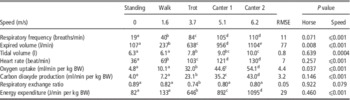
Measurements of respiratory exchanges in field conditions are undoubtedly of interest to more definitively understand the energy needs of exercising horses. Such measurements must be made under safe conditions in order to preserve the material, the horse and the rider, while providing reliable physiological data. Now, riding and controlling a horse fitted with a large respiratory mask is not safe at first sight. In the present study, 2 weeks were necessary to adapt the horses to wear the Equimask. The large caps positioned in front of the turbines frightened some horses, particularly when they looked up. Therefore, horses were first introduced to wearing a home-made mask, consisting of a plastic anti-graze muzzle, equipped with two 10-cm-long plastic hoses, at rest, at lunging and in the walker. Contrary to Standardbred trotters who accepted rapidly to wear the facemask (Goachet et al., Reference Goachet, Fortier, Julliand, Assadi and Lepers2011), only four of the five Arabian horses finally tolerated the equipment; the fifth horse was withdrawn from the study. This highlights the necessity to familiarize horses to the facemask, not only to perform measurements in safe conditions but also to minimize the stress induced by the procedure. Indeed, as VO2 is related to all systems involved in O2 supply, thus to cardiac output, influence of fear, pain or excitement could result in higher VO2 and HR and consequently overestimate EE, particularly during submaximal exercise (Evans and Rose, Reference Evans and Rose1988). HR values observed in the present study at rest and during exercise (Table 1) were consistent with previous data reported at various speeds (Coenen, Reference Coenen2010), revealing that horses were only slightly stressed, or not at all, by the procedure.
Cardio-respiratory responses and energy expenditure at rest and during a submaximal continuous incremental exercise field test in four Arabian horses using the equine K4b2

RMSE=root mean square of error.
a,b,c,d,eValues within a row with different superscripts differ significantly at P<0.05.
As suggested by the study of Art et al. (Reference Art, Duvivier, van Erck, de Moffarts, Votion, Bedoret, Lejeune, Lekeux and Serteyn2006), the Equimask was too large for Arabians. Consequently, airtightness of the system was compromised by the large movements of the facemask because of the pressure exerted by the reins on the hackamore. As it was not possible to substitute the hackamore by a bit, because the Equimask fully covered the horse’s mouth (Goachet et al., Reference Goachet, Fortier, Julliand, Assadi and Lepers2011), it was substituted by a halter passed on the Equimask and tightly adjusted around the horse’s head (Figure 1). The reins were attached to the halter and a string connecting the Equimask and the halter between the horse’s ears was added to maintain the tightness of the mask on the horse’s forehead. A martingale was used to prevent excessive movements of the horses’s head. This greatly increased the stability of the mask, and consequently limited air leakages. However, this procedure was not optimal; although it may not have had any consequences in the present study at low-to-moderate paces, it might not allow an effective control of the horse at higher speeds. The objective is that the equine K4b2 becomes a practical tool that is easy to use in field conditions, on any horse, and any training center, as it is used in human athletes. In the present state, the use of the equine K4b2 and Equimask might be adequate in Arabian horses in controlled environments (arena or track) providing an adaptation period. However, its use during outdoor workouts is questionable and would certainly require some adaptations – for example, the concept of a mask adapted to smaller horse breeds such as Arabians. This would enable the use of a bit for a better control of horses.
The VO2 values obtained in the present study, 4.8±0.9 ml/min per kg BW at rest, and from 10.1±3.5 to 54.1 ml/min per kg BW from walk to canter (R s =0.89; P⩽0.001) (Table 1), were consistent with previous values reported in Arabian horses on treadmill conditions with no incline (Wickler et al., Reference Wickler, Hoyt, Cogger and McGuire2002; Castejon-Riber et al., Reference Castejon-Riber, Munoz, Trigo, Riber, Santisteban and Castejon2012). Although underestimated or aberrant VCO2 values were reported in two of the studies that used the equine K4b2 in exercising horses (Votion et al., Reference Votion, Caudron, Lejeune, van der Heyden, Art and van Erck2006; van Erck et al., Reference van Erck, Votion, Serteyn and Art2007), the VCO2 data in the present study – increasing from 7.2±2.0 to 43.0±4.0 ml/min per kg BW from walk to canter, respectively, (R s =0.97; P⩽0.001) (Table 1) – were consistent with figures reported in Arabian horses exercised on flat treadmill at walk and trot (Castejon-Riber et al., Reference Castejon-Riber, Munoz, Trigo, Riber, Santisteban and Castejon2012). This discrepancy between the K4b2 studies might be explained by the exercise intensities: our horses were exercised at low-to-moderate intensity, which did not elicit elevated respiratory rates. During the K4b2 validation study (Art et al., Reference Art, Duvivier, van Erck, de Moffarts, Votion, Bedoret, Lejeune, Lekeux and Serteyn2006), inconsistent VCO2 was observed only at high and maximal workloads when respiratory rates >115 breaths/min were achieved. In this case, the response time of the IR analyzer that measured expired fraction of CO2 (FeCO2) might have been too slow (Art et al., Reference Art, Duvivier, van Erck, de Moffarts, Votion, Bedoret, Lejeune, Lekeux and Serteyn2006). Accordingly, the RER values obtained in our Arabian horses (Table 1) ranged in physiological values, although lower than usual RER reported in the literature in Arabian horses exercised on a flat treadmill, particularly at trot (Prince et al., Reference Prince, Geor, Harris, Hoekstra, Gardner, Hudson and Pagan2002; Castejon-Riber et al., Reference Castejon-Riber, Munoz, Trigo, Riber, Santisteban and Castejon2012). As an indicator of which fuel is being metabolized to supply energy, an RER of 1.0 indicates exclusive reliance on aerobic carbohydrate utilization, whereas an RER of 0.7 is indicative of total reliance of fat oxidation (Prince et al., Reference Prince, Geor, Harris, Hoekstra, Gardner, Hudson and Pagan2002). Variations in RER may reflect the effect of different factors involved in aerobic metabolism during exercise, in particular the breed, the training status and the duration and intensity of exercise (Lawrence, Reference Lawrence1990). Due to their higher proportion of oxidative muscle fibers (Lopez-Rivero et al., Reference Lopez-Rivero, Aguera, Monterde, Rodriguez-Barbudo and Miro1989), Arabian horses present a better adaptation for fat metabolism during exercise, which yields to lower RER during submaximal exercise compared with those obtained in Thoroughbreds and Standardbreds (Prince et al., Reference Prince, Geor, Harris, Hoekstra, Gardner, Hudson and Pagan2002). Moreover, by increasing oxidative capacity of the horse, physical training induces a decrease in the contribution of carbohydrate to EE and consequently a lower RER during moderate-intensity exercise (Geor et al., Reference Geor, McCutcheon, Hinchcliff and Sams2002). Finally, it is known that RER tends to decrease during prolonged submaximal exercise (Pösö et al., Reference Pösö, Hyyppa and Geor2008), with carbohydrates being the predominant substrate in the early part of exercise, and then the contribution of carbohydrates and fats is almost equal after 1 h of workout. This shift in energy metabolism during exercise was observed in trained Arabian horses submitted to a constant exercise on 3° inclined treadmill at 35% of their maximal oxygen uptake (VO2 max): RER decreased continuously from 0.91 to 0.80 after 15 and 75 min of exercise, respectively (Prince et al., Reference Prince, Geor, Harris, Hoekstra, Gardner, Hudson and Pagan2002). In the present study, horses have been competing in endurance racing for several years, and they received a training program for 16 weeks before measurements. According to the VO2 max of 122±8 ml/min per kg BW reported in Arabian horses (Pagan et al., Reference Pagan, Geor, Harris, Hoekstra, Gardner, Hudson and Prince2002; Prince et al., Reference Prince, Geor, Harris, Hoekstra, Gardner, Hudson and Pagan2002; Watanabe et al., Reference Watanabe, Silveira, Machado, Yonezawa, Kohoyagawa and Thomassian2009), it is likely that our horses were exercised between 10% and 45% VO2 max during 60 min, including the 40 min warm-up. Thus, we can assume that the relatively low RER observed in our study might be the consequence of both physiological and exercise protocol factors. More studies on the metabolic responses to exercise of Arabian horses would still be necessary to confirm this hypothesis.
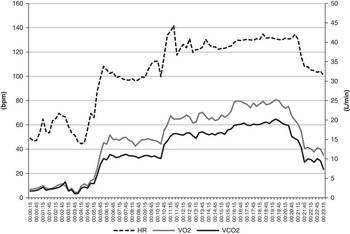
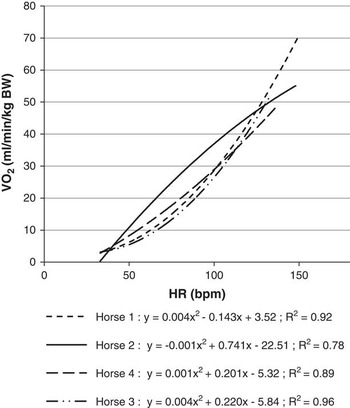
Given the cardio-respiratory data observed in the present study and the RER values that remained under 1, we can state that the exercise session mainly relied on aerobic metabolism. Therefore, the calculation of EE from VO2 measurements provided an estimation of the total energy expended during exercise. EE values measured at the different gaits, ranging from 133 to 1095 J/min per kg BW from walk to canter, respectively, (R s =0.98; P⩽0.001) (Table 1), were concordant with previous data reported in horses exercised in field conditions (Meixner et al., Reference Meixner, Hörnicke and Ehrlein1981; Pagan et al., Reference Pagan and Hintz1986; Hanak et al., Reference Hanak, Jahn, Kabes, Sedlinska, Zert, Mezerova and Chvatal2001). The relationship between EE and HR was best described as a polynomial function for each horse, with coefficients of determination above 80% for three horses. Using the last 3 min of recordings (corresponding to 65 observations) likely contributed to increase the regression, as it allowed to exclude the overshoot of HR, which may occur at the beginning of submaximal exercise at HRs below 120 beats/min (Evans and Rose, Reference Evans and Rose1988) – which was effectively observed at the beginning of trot and canter 1 (Figure 2) – and to take into account the VO2 kinetics – that is, the rate at which VO2 adjusted to meet the new energy demand at the transition from one metabolic rate to another – which would be estimated at 60 s at those workloads (Poole, Reference Poole2003). As it was shown in humans, the slope, curvature and intercept of the HR-VO2 regression varied between horses, which demonstrated the individual impact on the metabolic responses, particularly during exercise (Figure 3). Consequently, individual HR–VO2 relationship resulted in a close estimation of the EE of the 20-min submaximal exercise, compared with direct VO2 measurements: 6258±237 and 6332±425 from direct VO2 measurements and individual HR–VO2 relationships, respectively. Using Coenen’s model (Coenen, Reference Coenen2010), the estimates were 5796±328 kJ. Althought the statistical analysis did not detect any difference between the methods (P=0.19), the Coenen’s model appeared to slighty underestimate EE.
Average heart rate, VO2 and VCO2 kinetics measured with the equine K4b2 during a 20-min submaximal continuous incremental exercise on track in four ridden Arabian horses. A total of four consecutive steps of 5 min each were performed at walk (1.6 m/s), trot (3.7 m/s) and canter (5.1 and 6.2 m/s).

Heart rate-oxygen uptake (HR-VO2) regressions in four endurance horses obtained from measurements (n=65) obtained at rest and during a four-step submaximal exercise test on track, with x=HR and y=VO2.

From the data obtained in the present study, it was possible to estimate the EE of some usual workouts used to train endurance horses (Goachet and Julliand, Reference Goachet and Julliand2011), assuming that they are mainly performed aerobically. Thus, a 60-min walk session at 1.7 m/s would represent 5000 kJ. A 75-min canter session on a flat track, composed of a 20-min warm-up at walk and trot, 2×20-min canter periods with a 5-min intermediate recovery period at trot and a 10 min cool-down at walk, would cost ~22 000 kJ. When reduced to the hour, a walk and a canter would cost 5.0 and 17.2 MJ/h, respectively. Conversely, it is difficult to give a precise estimation of EE of outdoors workouts, which are performed in various conditions and altitudes. Measurements of VO2 or HR during outdoor training sessions and endurance races are now necessary to determine their energy costs and will help to get more precise energy requirements of horses performing in that discipline.
Acknowledgments
This study was funded by Le Conseil Régional de Bourgogne and AgroSup Dijon. Authors are very grateful to Astrid Loriers, who managed the measurements phase, to the students who helped with training horses, to the people of AgroSup for the care of the horses and to Marcel Mézy and Jean-Claude Guillaume, the horses’ owners. The authors also thank Justine Fortier for the review of this manuscript.