1 Introduction
Spoken language is produced in chunks delimited by prosodic cues such as a coherent intonation contour and pauses. These chunks are recognised in all models of prosodic analysis, albeit with different names and definitional criteria. Tone group (Halliday Reference Halliday1967) and intonation unit (Chafe Reference Chafe1980, Reference Chafe1994) are widely known, alongside intonational phrase, the term used here and in most work applying an autosegmental-metrical approach to prosody (Shattuck-Hufnagel & Turk Reference Shattuck-Hufnagel and Turk1996: 206, Ladd Reference Ladd2008). They also play a role in models of speech production (Levelt Reference Levelt1989), and are basic units in the type of discourse and conversation analysis inspired by Chafe (Reference Chafe1994).
Intonational phrases (IPs) are widely held not to pose particular problems of identification. Thus Shattuck-Hufnagel & Turk (Reference Shattuck-Hufnagel and Turk1996: 211) note that ‘perceptually, the boundaries of an Intonational Phrase are quite clear’, while Chafe (Reference Chafe1994: 62) writes:
In spite of problematic cases, intonation units emerge from the stream of speech with a high degree of satisfying consistency, not just in English, but in all languages I have been able to observe and in fact in all styles of speaking.
To date, this assumption has not been subject to scrutiny in a way standard to research concerned with segmentation tasks, i.e. by evaluating interrater agreement. As we will discuss in §2, previous interrater studies on IP boundaries (IPBs) are typically limited, in that (i) they involve short examples (< 30 seconds) specifically recorded for the task or excerpted from longer recordings, and (ii) they usually combine several tasks, i.e. labelling prosodic boundaries and prominences (e.g. pitch accents).
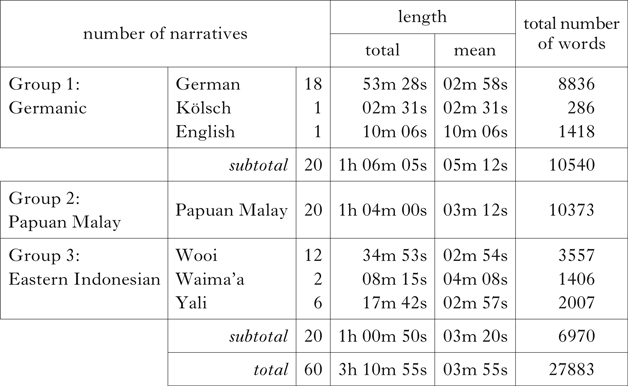
In contrast, the current study is concerned exclusively with IPBs, and involves the segmentation of a corpus of more than three hours of spontaneous narrative speech (see Table I in §3). Most importantly, it is primarily concerned with the question of whether IPs are cross-linguistically identifiable across unrelated languages, which, as far as we know, has not been addressed in the literature. Specifically, we ask whether non-native listeners are able to identify IPBs in unfamiliar languages without being able to understand the utterances to be segmented, and without familiarising themselves with the prosodic system of the language in question.
Composition of the corpus.

Experiments from machine learning suggest that at least some cues for IPBs are applicable across unrelated languages. In such experiments, models for IPB detection are trained on data from one language (e.g. English) and applied to data from another language (e.g. Mandarin). Results are often surprisingly good, in that boundary classifiers trained on foreign language data achieve results similar to those of classifiers trained on data from the same language. Soto et al. (Reference Soto, Cooper, Rosenberg and Hirschberg2013) provide an instructive example comparing classifiers trained on English, German, Mandarin and Italian. Our findings for human annotators show important parallels to this line of work, which are discussed in §6.
This study thus differs from other interrater studies primarily with regard to its cross-linguistic perspective. The material to be segmented is comparable between languages, as it consists of retellings of a short film in four languages: German, the native language of the annotators; Papuan Malay, the lingua franca of the major centres of West Papua (Indonesia); Wooi, an Austronesian language spoken on Yapen Island in West Papua; and Yali, a Papuan highland language spoken in West Papua. Two of the authors have first-hand experience with the West Papuan languages.Footnote 1 All other annotators participating in the experiment were unfamiliar with them.
The core questions to be answered by this study are given in (1).
(1)

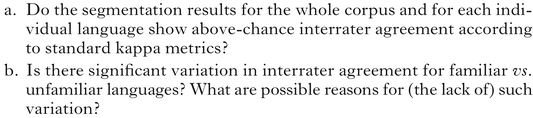
With respect to (1b), there are two ways in which familiarity with a language may influence interrater agreement in the segmentation task. First, it could be that the prosodic cues used as segmentation criteria come in language-specific forms, and are more readily recognised in familiar languages. Prima facie, such language-specific forms are less likely for pauses, probably the perceptually strongest cue for IPBs. But they have some plausibility for other IPB cues, such as pitch resets and unit-final lengthening. If there are in fact such language-specific forms, this would predict significantly worse interrater agreement results for unfamiliar languages, unless these effects are offset by other factors (e.g. the usefulness of pauses as boundary cues).
Second, as is well-known from the literature (e.g. Cole, Mo & Baek 2010), prosodic boundary perception is not influenced only by prosodic factors, but also by non-prosodic ones, in particular syntactic structure and semantic and pragmatic coherence. IPBs have a strong tendency to overlap with clause boundaries, and there is a concomitant tendency to hear IPBs at clause boundaries. The unfamiliar-language condition completely removes the potential influence of non-prosodic factors, giving two possible outcomes. On the one hand, interrater agreement could be significantly less strong for unfamiliar languages, because of the missing non-prosodic information. However, as non-prosodic information introduces a different set of factors, it also increases the potential for conflict between different segmentation cues (cf. Ladd Reference Ladd2008: 288–290). Consequently, interrater agreement in familiar languages could be worse than in unfamiliar ones, as in the latter annotators are forced to focus exclusively on prosody.
The paper is structured as follows. §2 reviews previous interrater studies concerning IPBs, and highlights the points where our study diverges from these. It also provides details on the boundary cues focused on here and their complex interrelationship. §3 details task design and data, and the empirical core of the study is presented in §4 and §5. The experimental results provided in §4 demonstrate robust interrater agreement for the whole corpus, as well as for individual languages. The main question in evaluating this result is whether the robust interrater agreement is due to the fact that pauses play a major role in detecting IPBs. It could be the case that annotators identify pauses rather than IPBs, especially in unfamiliar languages. §5, therefore, takes a closer look at the experimental results and the distribution of pauses in the corpus, and shows that annotators do not rely on pauses to a greater extent in unfamiliar languages than in the familiar German.
§6 discusses the theoretical import of our results for current concepts of IPs and their functions. It reviews different possible interpretations of the results, including the view that they only show that German hearers can identify German-like IPs in other languages. The main alternative interpretation is the hypothesis that an IP-sized unit is found across all languages, and that the phonetic cues delimiting its boundaries can be perceived by speakers of any language. What we might call a universal phonetic IP needs to be distinguished from language-specific phonological IPs, which can be interpreted as a language-specific grammaticisation of the universal phonetic IP.Footnote 2 Our results support a view of prosodic categories as partially universal, in as much as they are grounded in the mechanics of speaking, but partially also language-specific, in as much as they reflect the contingencies of historical developments in the grammaticisation of prosodic features.
2 Prosodic interrater agreement studies and their targets
Interrater agreement studies of prosodic phenomena can be classified into two types. One type tests an annotation scheme of prosodic categories. It requires a theoretical understanding of these categories and practical training for handling them. A recent example is the study by Breen et al. (Reference Breen, Dilley, Kraemer and Gibson2012), who compare two annotation schemes, the Rhythm and Pitch (RaP) system (Dilley & Brown Reference Dilley and Brown2005) and the Tones and Break Indices (ToBI) system (Silverman et al. Reference Silverman, Beckman, Pitrelli, Ostendorf, Wightman, Price, Pierrehumbert, Hirschberg, Ohala, Nearey, Derwing, Hodge and Wiebe1992, Pitrelli et al. Reference Pitrelli, Beckman and Hirschberg1994). They also present a useful survey of previous interrater studies of this type and their methodological challenges (see also Cole, Mo & Baek 2010: 1143–1145).
This type of study is concerned with language-specific phonological categories, i.e. tonal targets and different prosodic boundaries. The annotation schemes tested differ in the consistency and directness of the auditory and acoustic evidence used, but the decisions are clearly about (abstract) phonological categories and not about phonetic events. Part of the training for this type of study is the provision of examples illustrating typical auditory and acoustic correlates of the intended categories. Labellers are usually provided with acoustic data (minimally waveform and F0 contour), in addition to audio files.
The other type of study tests the perception of prosodic prominences and boundaries by naive listeners without expertise in prosodic theory and annotation, and investigates which properties correlate with the points in the transcript marked by them as prominences or boundaries. The focus is usually on phonetic cues (e.g. pitch changes), but may also include syntactic, semantic or pragmatic information. Mo et al. (Reference Mo, Cole and Lee2008) is a prototypical study along these lines,Footnote 3 with analytical follow-ups on phonetic factors in Cole, Mo & Hasegawa-Johnson (2010), and on syntactic (and other non-prosodic) factors in Cole, Mo & Baek (2010). In this study, more than 70 undergraduate students of linguistics marked prosodic prominences and boundaries in 18 short excerpts of spontaneous American English, based solely on their auditory impressions. Mo et al. (Reference Mo, Cole and Lee2008: 736) summarise the instructions regarding prominences and boundaries as follows:
A prominent word is defined as a word that is ‘highlighted for the listener, and stands out from other non-prominent words’, while a chunk is defined as a grouping of words ‘that helps the listener interpret the utterance’, and that chunking is ‘especially important when the speaker produces long stretches of continuous speech’.
In their study, the annotators marked prominences and boundaries on print-outs of the transcripts, which included word boundaries, speech errors and disfluencies, but no punctuation or capitalisation. The relevant findings of this study are: (i) there is significant interrater agreement with regard to boundaries, with a mean Cohen's κ coefficient of 0.58 across all pairs of transcribers (the values for prominences are much lower); (ii) there is significant variation with regard both to speakers, where Fleiss' κ coefficients (measuring agreement between all listeners at the same time) range from 0.35 to 0.95, and to listeners, with some pairs only reaching a Cohen's κ as low as 0.24, while others agree to a large extent, as reflected in a Cohen's κ coefficient of 0.85.
In some ways, Buhmann et al.’s (Reference Buhmann, Caspers, van Heuven, Hoekstra, Martens, Swerts, Rodríguez and Arauj2002) study, based on Dutch corpus data, is very similar. However, their procedure is different in a number of important respects. First, working with non-expert annotators, they included an intensive training period in which the annotators, after receiving instructions and examples, worked through a 15-minute learning corpus, and were given feedback on their performance. Second, the test corpus was substantially larger than those used in most other studies, consisting of more than 8000 words (45 minutes) of read, scripted and unscripted speech. Third, an online working environment was used, which included the audiovisual display of waveforms, as well as time-aligned text. Finally, the test corpus was pre-segmented into pause-bounded phrases of roughly ten seconds, using automatically detected pauses (> 0.5 seconds) as indicators for strong prosodic boundaries. Given the intensive training and the pre-segmentation, it is not surprising that Buhmann et al. obtained a fairly high interrater agreement. For boundaries, the Cohen's κ coefficients for interrater pairs range from 0.70 to 0.88 (Buhmann et al. Reference Buhmann, Caspers, van Heuven, Hoekstra, Martens, Swerts, Rodríguez and Arauj2002: 782).
In their instructions on detecting prosodic boundaries, Buhmann et al. (Reference Buhmann, Caspers, van Heuven, Hoekstra, Martens, Swerts, Rodríguez and Arauj2002: 779) use the term ‘break’, a non-technical category which is presumably part of the non-expert understanding of spoken language. They distinguish strong and weak breaks, defining them as in (2) (Reference Buhmann, Caspers, van Heuven, Hoekstra, Martens, Swerts, Rodríguez and Arauj2002: 780–781).
(2)
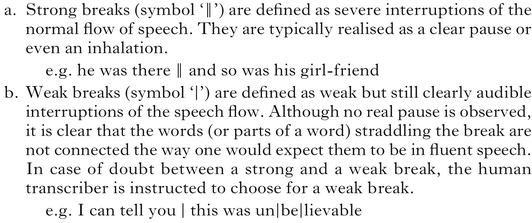
Note that while the instructions in Mo et al. (Reference Mo, Cole and Lee2008) are concerned with what they presume to be a function of chunking (cf. ‘that helps the listener interpret the utterance’ in the quote above), Buhmann et al. focus on auditory impressions, with an emphasis on pauses, and no explicit appeal to coherent melody contours.
The study in this paper belongs to the second type, in that it tests the perception of prosodic boundaries by non-expert listeners. But there are two major points of difference. The most important is that our study compares the performance of annotators across familiar and unfamiliar languages. This task design assumes that the chunking of speech can be auditorily identified across languages, which in turn presupposes that some relevant cues occur cross-linguistically. In the latter regard, note that there is probably no discussion of the intonation of a particular language which does not make reference to the fact that the coherence of the melody sets off one IP from adjacent ones. Furthermore, Fletcher (Reference Fletcher, Hardcastle, Laver and Gibbon2010) provides a wealth of references for pauses (Reference Fletcher, Hardcastle, Laver and Gibbon2010: 573–575) and tempo changes (Reference Fletcher, Hardcastle, Laver and Gibbon2010: 540–547) as cross-linguistically attested boundary cues.
The cross-linguistic identifiability of boundary cues, however, has not been explored systematically, and is the topic of this investigation. Hence it is important which cues we used and how we explained them to the annotators. This is the second point where the present study diverges from Mo et al. (Reference Mo, Cole and Lee2008) and Buhmann et al. (Reference Buhmann, Caspers, van Heuven, Hoekstra, Martens, Swerts, Rodríguez and Arauj2002). Our written instructions (see Appendix A for details) characterise IPs as distinct units perceivable by means of a coherent melody. They draw attention to two major types of IPB cues: (i) the interruption of the rhythmic delivery by, inter alia, a pause or final lengthening, and (ii) the disruption of the pitch contour by a jump in pitch (up or down) between the end of one unit and the beginning of the next.
As in the Buhmann et al. study, our annotators were thus also clearly instructed to follow prosodic cues for boundaries only, but unlike that study, a distinction was made between melodic and rhythmic cues. Importantly, the instructions also reflected the complex interdependence between melodic and rhythmic cues, and the fact that both are ambivalent as boundary cues. Rhythmic cues in part depend on, and can be overridden by, melodic coherence. Lengthening is heard as unit-final only if such an interpretation is consistent with the melody (otherwise, it may be heard as emphasis on a particular syllable). Similarly, pauses are heard as boundaries only when the melodic contour appears to have reached its projected endpoint.
However, the reverse also holds: the identification of a coherent contour partly depends on its interplay with rhythmic cues. The clearest example of this is the fact that there are limits to the length of a silence across which a melody can be heard as coherent. While the exact length may vary depending on language, culture and speaker, coherent contours rarely span silences longer than one second. Furthermore, a possible melodic endpoint tends to be heard as an actual melodic endpoint more clearly and easily when it is accompanied by segmental lengthening and followed by silence.
In practical operational terms, a relation of mutual reinforcement exists: the more cues – melodic and rhythmic – come together, the clearer, and possibly also stronger, the boundary. By ‘practical operational’ we refer primarily to the segmentation task at hand. However, it is not very speculative to assume that this also holds for speaker-hearers engaged in the actual production and comprehension of speech.
The ambivalence of pauses as boundary indicators arises from the fact that they occur both between and within IPs. There is thus a need to distinguish between IP-external and IP-internal pauses. External pauses are pauses that occur between two adjacent IPs. On one widespread view (e.g. Goldman Eisler Reference Goldman Eisler1968, Levelt Reference Levelt1989, Chafe Reference Chafe1994, Krivokapić Reference Krivokapić2014), they usually arise because speakers need time to plan the next IP (hence they are referred to as planning pauses), but may sometimes also be used deliberately, as an IPB signal. Also, external pauses often give the speaker the opportunity to breathe. Internal pauses, in contrast, occur during the production of an IP. They mostly result from production difficulties, such as problems with lexical access, self-corrections, etc., and are also called hesitation pauses (cf. §3). Evidence from gestural coordination in articulation suggests that these two pause types can be distinguished by the position of the articulators during the resting period (Krivokapić Reference Krivokapić2014: 4f; see also Katsika et al. Reference Katsika, Krivokapić, Mooshammer, Tiede and Goldstein2014: 75f). This research also suggests that external pauses are themselves planned.
In practical operational terms, pauses are probably the easiest IPB cue to identify. External pauses, if correctly identified, are therefore an important practical cue for IPBs. A large number of internal pauses, in contrast, may render identification of IPBs more difficult, as they can be misinterpreted as IPB cues, especially when the hearer does not understand the content of a given segment.
On the other hand, it is much more difficult to perceive melodic coherence consistently when conscious attention is paid to it in a segmentation task. In our instructions, we drew attention to jumps in pitch between offsets and onsets of IPs as indicators of interrupted coherence. However, such pitch jumps are often not larger than the micro-perturbations caused by obstruents; the correlation with rhythmic interruptions provides the best diagnostic for distinguishing between these two types of pitch jumps.
There are many further phonetic cues that occur at IPBs, such as fading intensity, creaky voice, the absence of coarticulation, unit-initial glottal stops, etc. (Shattuck-Hufnagel & Turk Reference Shattuck-Hufnagel and Turk1996, Ladd Reference Ladd2008, Wagner & Watson Reference Wagner and Watson2010). These cues, however, tend to be less frequent and systematic. When they occur, they contribute to the two overarching perceptual constructs, melodic and rhythmic coherence. Fading intensity and creaky voice, for example, contribute to the interruption of melodic coherence. It is likely that our annotators also made use of these additional cues, even though they were not mentioned in our instructions. However, this aspect will not be further discussed in this paper.
To summarise, our study focuses on prosodic boundary cues and, in the case of languages unfamiliar to the annotators, actually forced them to pay attention to them exclusively. Annotators were advised to pay attention to both melodic and rhythmic cues in their identification of IPBs. These cues reinforce each other when they are temporally aligned (cf. Pijper & Sanderman Reference Pijper and Sanderman1994, Krivokapić & Byrd Reference Krivokapić and Byrd2012), but may lead to disagreements when not synchronised. Pauses have a special status, because they can be identified relatively easily and consistently, but they are not unequivocal boundary cues, because of the occurrence of IP-internal pauses.
3 Data and procedure
The corpus used in this study consists of sixty retellings of the Pear Film, a six-minute film made in 1975 for the cross-linguistic study of cognitive, cultural and linguistic aspects of narrative production (Chafe Reference Chafe1980). The soundtrack does not contain speech, consisting only of sounds associated with the actions depicted (such as a bicycle accident).
The sixty pear stories were told in different languages, primarily German and three languages from Eastern Indonesia, the major fieldwork site of the first author. Table I provides details of the corpus, which is partitioned into three groups for processing and presentation purposes, each comprising twenty stories. For practical and explorative purposes, the corpus also includes one pear story in English, one in Kölsch (the German dialect of Cologne) and two in Waima'a, an Austronesian language from East Timor. Segmentation results for these varieties do not differ from those obtained for the four main languages, and are therefore included in our overall statistics. They are excluded from those parts of the study concerned with cross-linguistic comparison, because they are too small for valid statistical modelling. Appendix B provides further details of recording procedures and corpus compilation, as well as our statistical procedures.
The three languages from Eastern Indonesia that this study mainly focuses on are typologically and genetically very diverse, and show very different prosodic characteristics. While both Papuan Malay and Wooi are Austronesian languages, they belong to two different major branches of this family (Western-Malayo Polynesian and South Halmahera-West New Guinea respectively) and have very different grammatical profiles. Papuan Malay has little morphology, has a fairly strict SVO pattern and has bare nouns as the most frequent type of noun phrase. Wooi has an elaborate subject-marking paradigm, as well as a complex set of NP markers, makes frequent use of serial verb constructions and, while also following a basic SVO pattern, places negation and other particles at the end of the clause, rather than before or after the verb, as in Papuan Malay. Yali belongs to a different language family altogether (Trans-New Guinea), is an SOV language, and has a moderate amount of (postpositional) case marking and complex verbal morphology, with hundreds of forms in a paradigm (cf. Riesberg Reference Riesberg, Zöllner, Zöllner and Riesberg2017).
Prosodically, these three languages illustrate systems very different from German, but found in many other parts of the world. As is typical of Malayic and other western Indonesian languages, Papuan Malay has neither tone nor stress, but two major levels of prosodic phrasing. The IP is marked by the combination of a phrase accent and a boundary tone occurring within a two-syllable window at the end of the phrase, similar to what is described by Maskikit-Essed & Gussenhoven (Reference Maskikit-Essed and Gussenhoven2016) for Ambon Malay and Stoel (Reference Stoel, van Heuven and van Zanten2007) for Manado Malay. The smaller phonological phrase is marked by a high tone on the final syllable, similar to Manado Malay (Stoel Reference Stoel, van Heuven and van Zanten2007) and Waima'a (Himmelmann Reference Himmelmann, Ewing and Klamer2010). See §6.1 for further discussion and exemplification.
Wooi is similar to Papuan Malay in delimiting IPs by the combination of a phrase accent and a boundary tone, but differs in having both lexical stress and lexical pitch accents, similar to Papiamento (Remijsen & van Heuven Reference Remijsen and van Heuven2005). The small group of Austronesian West Guinea languages it belongs to are known for their unusual prosodic systems; Remijsen (Reference Remijsen2001) and Kamholz (Reference Kamholz2014) provide details. Finally, Yali is a typical Papuan lexical pitch-accent language, where each content word is marked with a final high tone, with more complex regularities holding for the (clause-final) verbal complex. See Heeschen (Reference Heeschen1992: 13f) for a description of a similar prosodic system in neighbouring Yale (Kosarek).
Prior to the study, all sixty pear-story narratives had been transcribed by native speakers of the respective languages using elan, a multimedia annotation tool for multimodal research.Footnote 4 For current purposes, all information pertaining to the temporal alignment of the transcription to the audio stream was eliminated, and a plain text version was created. The task of the annotators was to segment the narratives into IPs on the basis of the audio stream and the plain text script. For each narrative, the annotators were given a .wav file (but no video file), a plain text file containing the transcript without any hints with regard to prosodic phrasing (no punctuation, line breaks, paragraphs, capitals, etc.) and a (largely empty) elan file. Note that, unlike in the studies mentioned in §2, disfluencies were not marked as such, but the transcript did contain a representation of unclear segments which could not be transcribed (indicated roughly by one ‘x’ for each unclear syllable). Further details on experimental procedure are given in Appendix B.
Four linguistics students, all native speakers of German, were recruited for this task, and paid a fixed rate for participating. They were students in different linguistics programmes at the University of Cologne, with varying degrees of familiarity with prosodic analyses. R1 was a female Bachelor student in Linguistics, R2 and R3 were Master students in Linguistics, male and female respectively. R1–R3 all had a basic introduction to prosody as part of the introductory courses of their BA programme. R4 was a female Master student in Linguistics, specialising in phonetics and writing an MA thesis on a prosodic topic at the time of her involvement in the project.
In addition, the authors of the paperFootnote 5 produced a consensus version, which, importantly, involved native speaker input in the creation phase, and was based on specific hypotheses regarding the phonological structure of IPs in each of the languages investigated. This version was produced in several steps. First, each narrative was transcribed by a native speaker or by a language specialist working together with a native speaker. The primary segmentation unit of the transcription was the IP, defined in the same way as in Appendix A. Most of the narratives had been transcribed before the current study was designed. Second, the transcriptions were independently checked by two of MS, JS and VU. Third, these three authors compared their changes to the original transcripts, and produced a first consensus version, after resolving any disagreements through re-listening and discussion. As a final step, this version was checked by NPH, who focused on problematic cases and overall consistency in instances where the exact placement of the boundary was arguably arbitrary (due to noise in the recording, for example, or disfluencies, as discussed below). In contrast to the four student annotators, the authors made regular use of instrumental evidence in the form of F0 plots and waveforms produced by Praat (Boersma & Weenink Reference Boersma and Weenink2015), in order to decide especially difficult cases. Given that the consensus version is based on phonological hypotheses regarding the structure of IPs in each language, and was created by annotators with expert training in prosody and, in the case of NPH and VU, first-hand knowledge of the languages and their prosodic systems, we decided to treat the consensus version (henceforth cons) as the reference segmentation in the analysis, against which the performance of the other annotators can be evaluated.
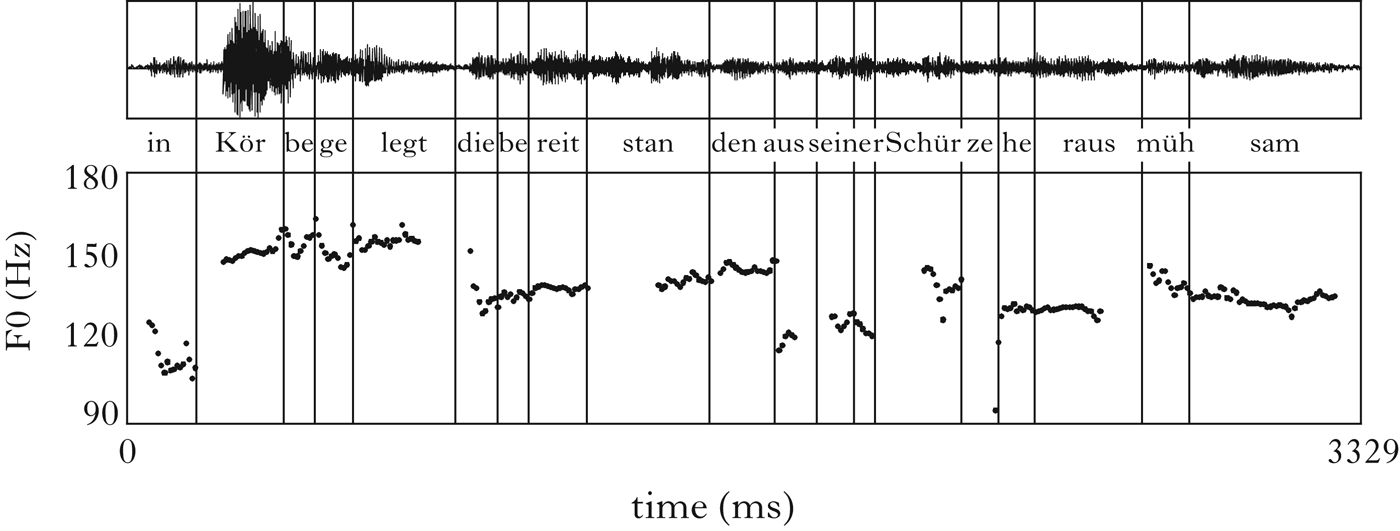
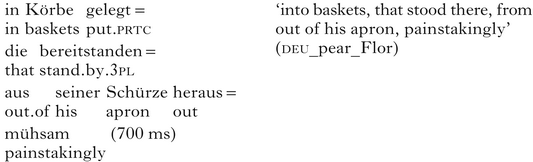
Instances of disagreement in the creation of the cons version never exceeded 20% of the boundaries in a given narrative, and involved fewer than 10% of all boundaries in the corpus. Most disagreements pertained to two types of well-known problematic cases. First, boundary decisions tend to be difficult when the speaker produces a sequence of IPs in rapid succession without intervening pauses, known as latching in the discourse- and conversation-analytic literature. In the German example in (3), latching occurs in three successive IPs. The main cues for IPBs here are pitch jumps interrupting the melodic contour, downward after gelegt and bereitstanden, and upward after heraus, as shown in Fig. 1. All student annotators agreed with the boundary after mühsam, but only two had boundaries after gelegt und bereitstanden, and only one after heraus.Footnote 6
(3)
Waveform and F0 track for the German example in (3).

The other factor giving rise to disagreements involves disfluencies. Disfluencies are a special case, because they are inherently ambiguous with regard to the boundary issue, as the speaker does not properly deliver an IP already in production, either interrupting or abandoning it. Consequently, disfluencies could be handled by a convention stipulating that all instances of disfluency either always or never induce a boundary. While we drew attention to the problem of IP-internal disfluencies in the instructions, we did not propose conventions for handling these, as this would have required major training efforts to be useful.
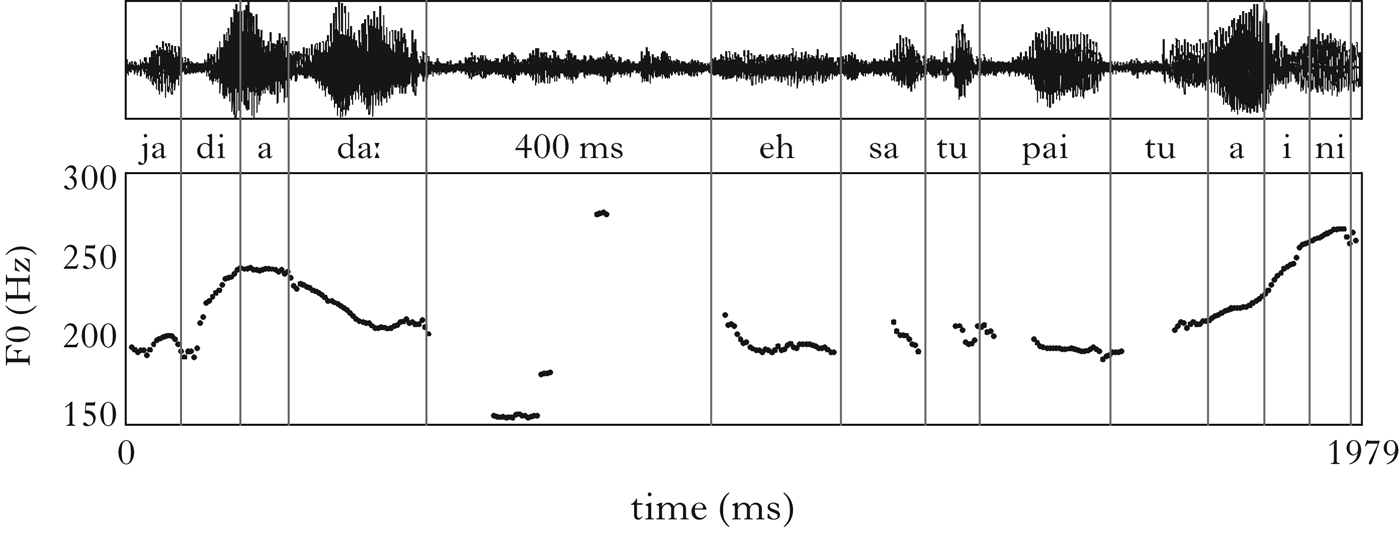
In the cons version, we tried to distinguish consistently between hesitations (IP-internal disfluencies) and truncations, i.e. the abandonment of a unit currently underway. This distinction is primarily based on pitch evidence, but also on the length of the interruption. Interruptions lasting more than one second were generally considered to be truncations. Otherwise, a disfluency was considered to be IP-internal only if speech was resumed after the disfluency on the same pitch level as before. In this case, it is likely that the speaker will continue with the delivery of an IP begun before the disfluency. This is illustrated by (4), from Papuan Malay, where the F0 extraction in Fig. 2 clearly shows that the pitch on satu continues on almost exactly the same level as it was on adaː right before the hesitation break (the IP-internal pause is partially filled by the hesitation marker eh).
(4)

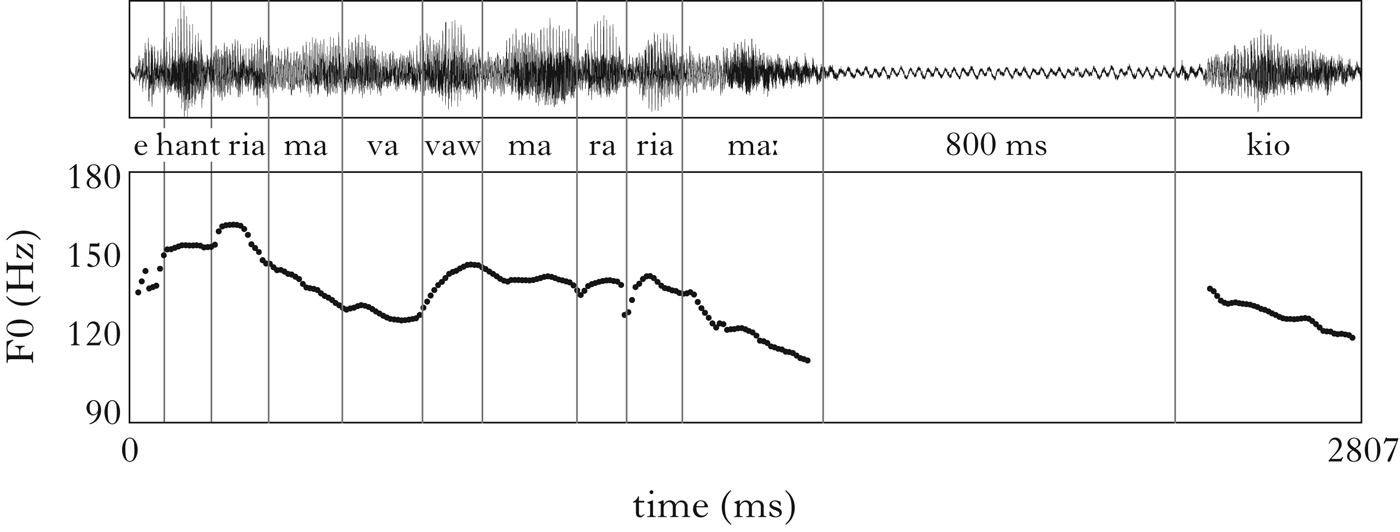
In truncations, on the other hand, there is clear evidence for the start of a new IP, for example in (5), from Wooi. As shown in Fig. 3, the speaker aborts the utterance at the end of ria maː, and after a short break starts a new one, instead of repairing or resuming the old one. The truncation is clearly cued by a pitch reset (falling pitch on maː, followed by a new onset on kio) and considerable lengthening of the last syllable. The difference in F0 between maː and kio is almost four semitones, so that it is safe to assume that the speaker has no intention of connecting back to the previous pitch contour.
(5)

Waveform and F0 track for the Papuan Malay example in (4). The F0 traces seen during the 400 ms pause are caused by background noises.

Waveform and F0 track for the Wooi example in (5).

While there are many instances in which the distinction between a hesitation and a truncation is reasonably clear, it is also to some degree arbitrary, in that it would be difficult to give a principled reason for the decision to set the maximal length of IP-internal pauses at exactly one second, rather than, say, 0.9 or 1.2 seconds.
4 Interrater agreement results
In this section, we first look at interrater agreement on the entire corpus, to assess the validity and reliability of the IP as a cross-linguistically identifiable unit. Second, we compare the segmentations of individual annotators to our consensus (cons) segmentation, to look for differences in the behaviour of individual annotators. Third, we compare interrater agreement on individual languages, to determine whether annotators agree equally on the segmentation of IPs across different languages.
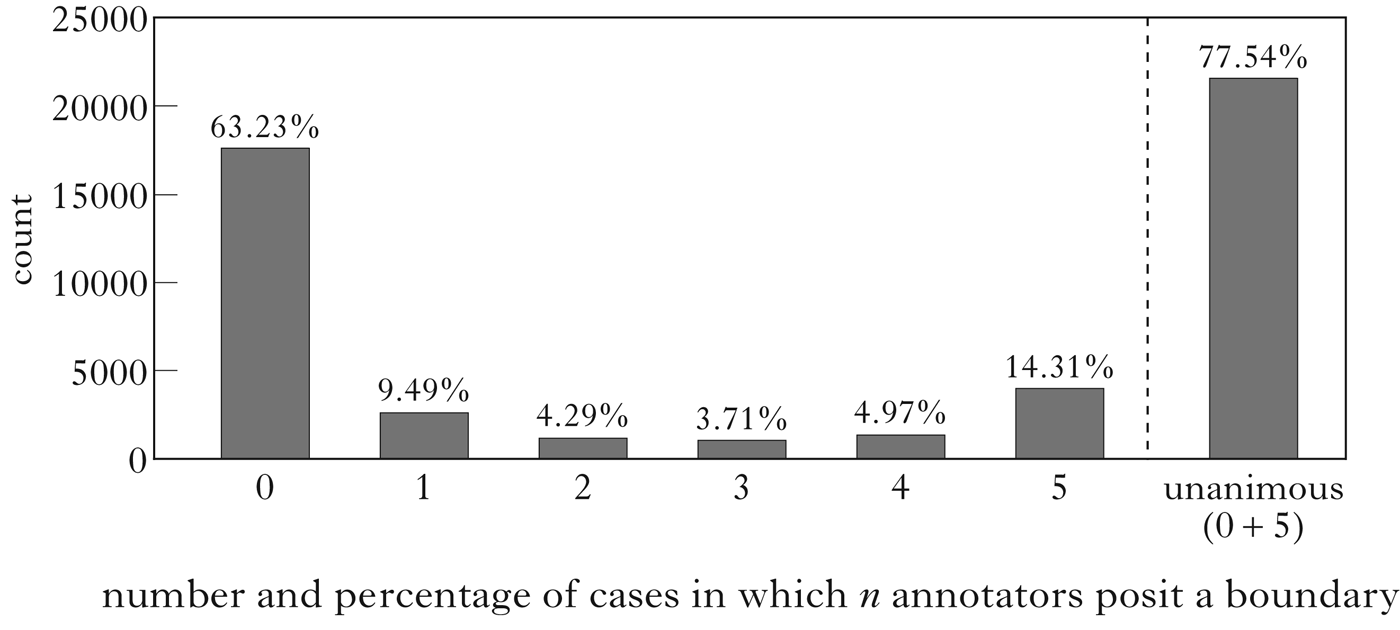
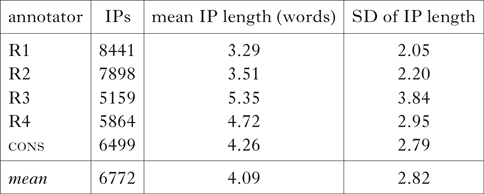
The entire corpus comprises 27883 words. Since the start of the first IP and the end of the last IP in a narrative always coincide with the first and last words, and are thus given by definition, we excluded them from the evaluation, leaving 27823 potential IPBs in all (one fewer than the number of words for each of the sixty narratives). Table II provides an overview of the segmentations created by the five annotators (four students and cons), and shows that the corpus was divided into 6772 IPs on average, resulting in a mean IP length of about four words. For the entire corpus, as shown in Fig. 4, we obtain a raw agreement of 77.54% across all five annotators, and a statistically significant Fleiss' κ score of 0.71, which represents substantial agreement (see Landis & Koch Reference Landis and Koch1977). If we consider only the four student annotators, we find a raw agreement of 78.21% and a statistically robust and substantial interrater agreement (n = 27823, κ = 0.68, z = 277, p<0.001). Figure 4 provides the number and percentage of cases in which a particular subset of the five annotators posited an IPB, ranging from zero for cases where no annotator posited an IPB to five for places where all annotators assumed an IPB. The rightmost column shows the total of all ‘unanimous' decisions, i.e. cases where all annotators agreed that there was or was not a boundary. These results show that recordings of spontaneous speech in different languages can be reliably segmented into IPs even by non-expert annotators without special training.
Overall agreement on the IP segmentation of the whole corpus (n = 27823, Fleiss’ k = 0.71, z = 375, p<0.001).

Overview of IP segmentation by annotator.

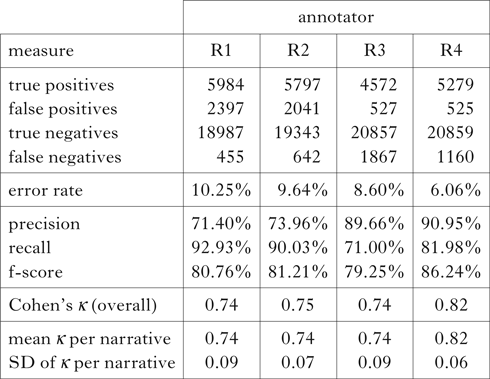
If we take our consensus segmentation as reference and compare it with individual student annotators' segmentations, we obtain the results in Table III. Individual student annotators' segmentations agree quite well with the cons segmentation, with Cohen's κ (overall) ranging from 0.74 to 0.82, in all cases statistically significantly above chance (R1: κ = 0.74, n = 27823, z = 125, p<0.001; R2: κ = 0.75, n = 27823, z = 126, p<0.001; R3: κ = 0.74, n = 27823, z = 125, p<0.001; R4: κ = 0.82, n = 27823, z = 138, p<0.001). All four student annotators were thus able to provide a reliable IP segmentation that agreed to a large extent with the authors' expert segmentation.
Comparison of annotators to reference segmentation on the whole corpus.

Student annotators nonetheless differed amongst themselves in their tendency to either assume more or fewer IPBs than cons: R1 and R2 posited a relatively large number of IPBs (cf. Table II), and segmented the narratives into relatively short IPs, resulting in high recall values above 90% (i.e. more than 90% of the IPBs marked in cons are also found in these segmentations), but lower precision values of slightly above 70% (i.e. only about 70% of the boundaries marked by these student annotators are also found in cons). R3 and R4, in contrast, assumed fewer IPBs and therefore longer IPs (cf. Table II), resulting in high precision values of about 90%, as well as lower recall values of around 71% and 82% respectively (cf. Table III). R4 had the lowest standard deviation. R4 thus displayed most agreement with cons across all 60 narratives. This is probably related to the fact that R4 was the only student annotator who had had in-depth training in prosodic analysis, albeit not specifically for the present study.
Nevertheless, the overall results demonstrate a well-above-chance agreement between annotators of different levels of expertise in determining IPBs in an extensive corpus of spontaneous narrative speech in both familiar and unfamiliar languages. This suggests that phonetic boundary cues for IPs (cf. §2) can be applied reliably and consistently in familiar and unfamiliar languages. To further scrutinise this finding, we now turn our focus to individual languages in our corpus, and to possible differences with regard to the interrater reliability of IP segmentation on these subcorpora.
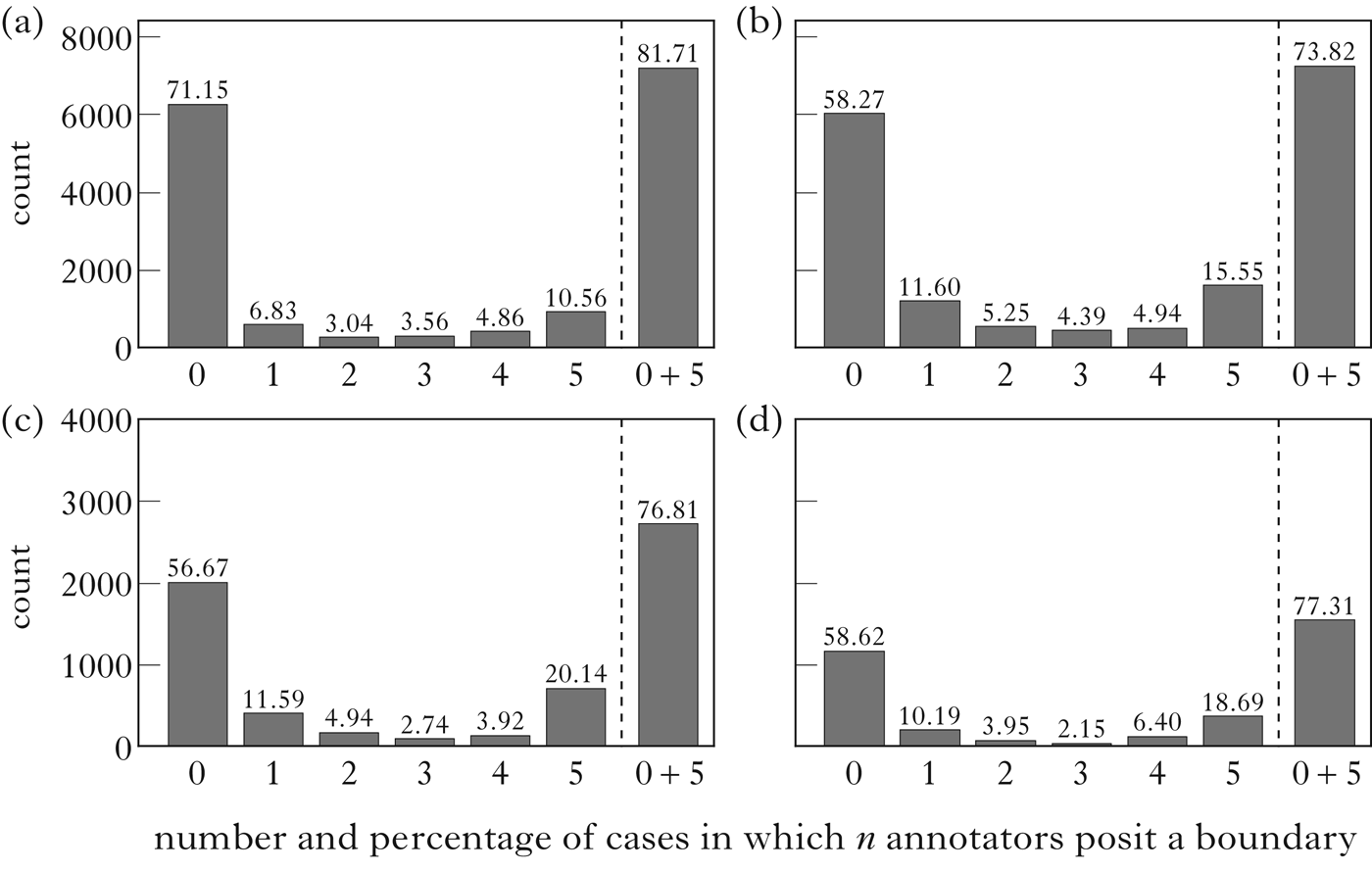
Figure 5 show interrater-agreement values for the four larger subcorpora, using the format of Fig. 4. Interrater agreement is remarkably similar across the four languages, the value for three of the languages being close to the overall Fleiss' κ of 0.71 (German: κ = 0.72; Wooi: κ = 0.74; Yali: κ = 0.75). Papuan Malay is somewhat lower (κ = 0.68). The test statistics thus display substantial agreement between the five annotators' segmentations of each of these four subcorpora.Footnote 7 These results suggest that the familiar vs. unfamiliar language distinction is not the most important factor in determining interrater agreement. That is, it does not seem to be necessary to understand spontaneous speech in order to be able to consistently segment it into IPs.
Interrater agreement on the IP segmentation for the individual languages in the corpus: (a) German (n = 8818, Fleiss’ k = 0.72, z = 214, p<0.001); (b) Papuan Malay (n = 10353, Fleiss’ k = 0.68, z = 219, p<0.001); (c) Wooi (n = 3545, Fleiss’ k = 0.74, z = 139, p<0.001); (d) Yali (n = 2001, Fleiss’ k = 0.75, z = 106, p<0.001).

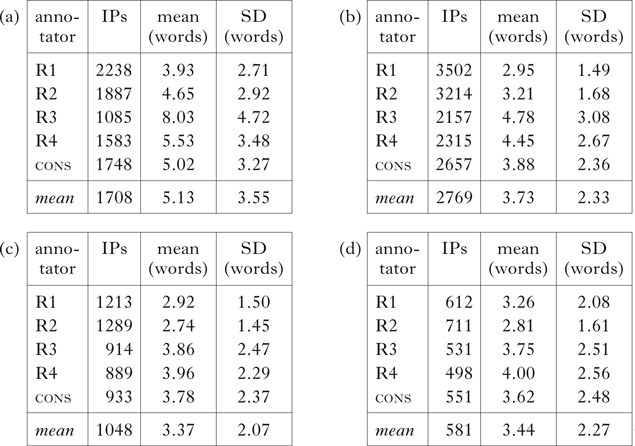
To conclude, let us see whether the statistics for the individual annotators agree with this overall pattern. Table IV gives an overview of the number and average length of IPs in the segmentations by annotator and language. At first sight, the table appears to reveal one conspicuous difference between German and the West Papuan languages: German IPs appear to be substantially longer, both overall and for individual annotators, including cons. This may raise doubts as to the claim that the units identified in all four corpora are of the same granularity, i.e. that they are all IP-sized. Rather, the units identified in the West Papuan languages might instantiate another, smaller kind of prosodic phrase (e.g. a phonological or intermediate phrase), which happens to be delimited by the same boundary cues as IPs in German.
Number and mean length of IPs per annotator and language: (a) German; (b) Papuan Malay; (c) Wooi; (d) Yali.

However, the difference in mean IP length in words in Table IV is largely due to differences in grammatical structure and orthographic conventions, i.e. the frequency and the orthographic representation of function words. In German, articles, prepositions and particles such as ja and also, for example, are very frequent, and written as separate orthographic words. Yali enclitic postpositions, on the other hand, form an orthographic unit with their morphosyntactic hosts (e.g. orthographic <inggiken> is morphological inggik = en (hand = instr) ‘with (his) hands’). More generally, the West Papuan languages have fewer function words than German, and many are not written separately.
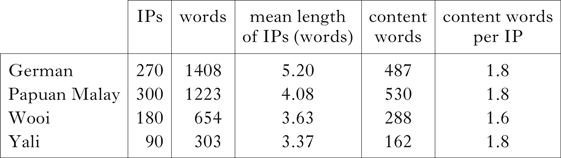
To lend support to this explanation, we arbitrarily selected 15 IPs from each narrative in the four languages, and counted the number of content words per IP. Content words include nouns, verbs (but not auxiliaries), adjectives and lexical adverbs such as tomorrow or boldly (but not again, thereafter and the like, which primarily have grammatical or discourse-organising functions). As seen in Table V, the sample reflects the imbalance in the average number of words per IP across the four languages found in Table IV. However, no comparable imbalance is found with regard to the average number of content words per IP. Consequently, the higher average number of words per IP in German must be due to the higher number of orthographically independent function words.Footnote 8
Average number of content words per IP per language (based on sample from cons version).

The data in Table V suggest that with regard to content words – and thus informational content – the units delimited in each of the four languages are roughly equivalent. Clearly, this evidence does not settle all questions concerning the cross-linguistic comparability of the units identified by the annotators (cf. §6.1). Table V should, however, give some plausibility to the claim that we are dealing with units of a comparable size (i.e. comparable informational content), and allow us to continue to speak of IPs in the further discussion of our results.
Apart from the difference in the mean length of IPs, the statistical trends in Table IV are surprisingly similar to those in Table II for the whole corpus. Cons and R4 again posited a similar number of IPs, resulting in similar mean IP length for the four individual subcorpora in Table IV. Compared to the other annotators, R1 and R2 again segmented the narratives into shorter units. There are thus individual differences in annotator behaviour that hold across the different subcorpora. This may indicate that segmentation strategies are similar across the four languages.
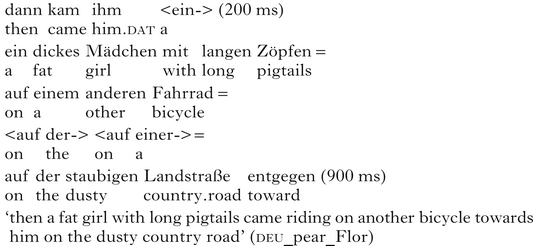
That this is not necessarily the case, however, is shown by R3, who segmented the German narratives, which she is able to understand, into IPs with an average length of more than eight words.Footnote 9 Boundaries here were preferably placed at clause boundaries, ignoring the fact that clauses in spontaneous speech are often chunked into several IPs.Footnote 10 (6) is a typical case, where R3 considered a longish clause with several PPs to be a single IP. All other annotators, including cons, chunked this clause into five IPs.
(6)
In contrast, R3 behaved more like the other annotators with regard to the three unfamiliar West Papuan languages. This suggests that R3 used different segmentation strategies in familiar and unfamiliar languages. Segmentation in the familiar languages takes non-prosodic factors more strongly into account, while segmentation in the unfamiliar languages relies exclusively on prosodic cues. The inclusion of non-prosodic factors in IP segmentation may thus increase the potential for disagreements (cf. §1). While sentence boundaries, for example, are typically also IPBs, the reverse does not hold. This is especially clear in narrative speech, where long strings of syntactically coordinated constructions (and then … and … and …) may occur.
The data presented in this section show robust interrater agreement for IPB identification across the whole corpus, as well as for individual subcorpora. However, IPBs often coincide with pauses, and in the computational literature it has been noted that, among all possible predictors for IPBs, pauses are usually the strongest (e.g. Soto et al. Reference Soto, Cooper, Rosenberg and Hirschberg2013). Hence the question arises whether the high interrater agreement is simply due to the fact that student annotators made good use of pauses as boundary cues, especially in unfamiliar languages.
5 The significance of pauses
There are different ways in which pauses could have influenced the interrater-agreement results reported in the previous section. First, pauses may happen to be better boundary predictors in the West Papuan languages, thereby offsetting the advantages resulting from familiarity with German. Second, annotators may have based their decisions exclusively on pauses in the unfamiliar languages, but on a complex mix of prosodic, syntactic, semantic and pragmatic factors in the familiar German, so that the fact that interrater agreement is similar across the four languages is due to chance.
In this section, we first describe how we determined pauses and their length in our recordings, then present some raw figures on pause frequencies in the corpus and finally discuss two logistic regression models incorporating information on pauses.
Pause extraction was based on the cons version. As the recordings were done under field conditions, they contain substantial noise, which made it unfeasible to do this automatically. Instead, pauses were annotated manually during the transcription stage detailed in §3. Non-silent interruptions such as coughing and sneezing were not included in the statistical model.
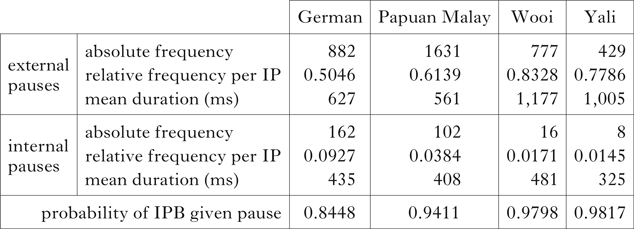
Table VI provides, for each language, the absolute frequency of external and internal pauses, as well as their relative frequency per IP and their average duration. The last row gives the probability that a pause signals an IPB, calculated as the number of IP-external pauses divided by the number of all pauses in a particular language. This measure is an indication of the reliability of pauses as IPB cues, and the last row shows that pauses are more reliable as IPB cues in Wooi and Yali than in German and Papuan Malay. Moreover, the German subcorpus contains fewer external pauses between IPs than the other subcorpora, with Papuan Malay being somewhat closer to German than to Wooi and Yali. German thus also contains more instances of latching. For internal pauses, the converse holds: both German and Papuan Malay have more internal pauses per IP than the other two languages. Finally, external pauses are on average only about 50% longer than internal pauses in German and Papuan Malay, but more than twice as long in Wooi and Yali, and thus probably more noticeable.
Frequency of internal and external pauses in the four main subcorpora.

Pauses are thus more robust cues for IPBs in Wooi and Yali than in German and Papuan Malay, both in terms of frequency and duration. However, it is not clear that this difference can be attributed to a systematic difference in linguistic structure. It is more likely due to coincidental properties of the different subcorpora. For example, the German and Papuan Malay subcorpora are better gender-balanced than the Wooi and Yali subcorpora, which are heavily male-dominated. The German and Papuan Malay speakers were probably also more at ease with the task of retelling a film than the Wooi and Yali speakers, for whom watching films is not part of everyday culture. Note that the duration of internal hesitation pauses does not vary much between languages. This suggests that the longer external pauses in Wooi and Yali are not simply due to slower speech rates.
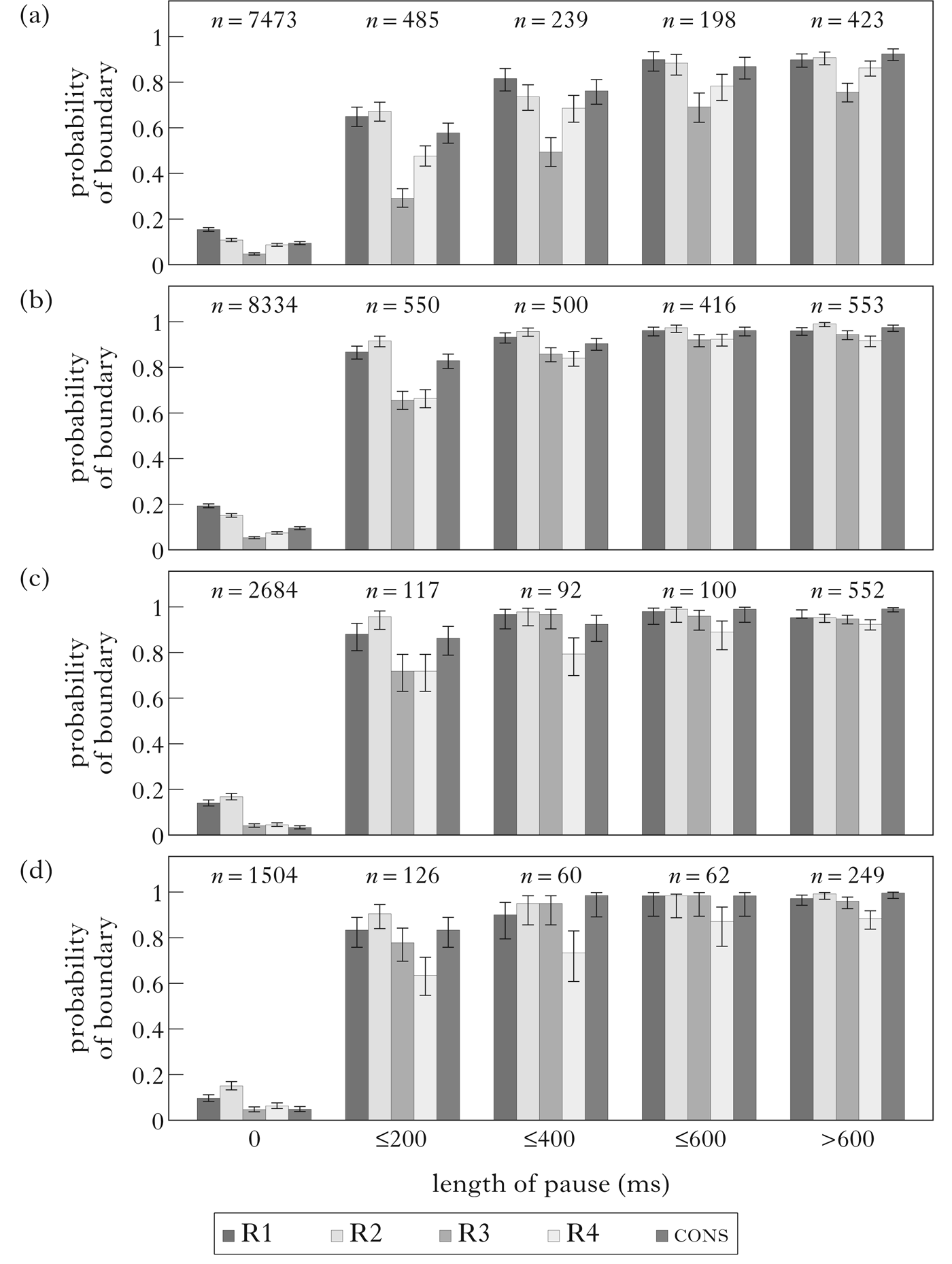
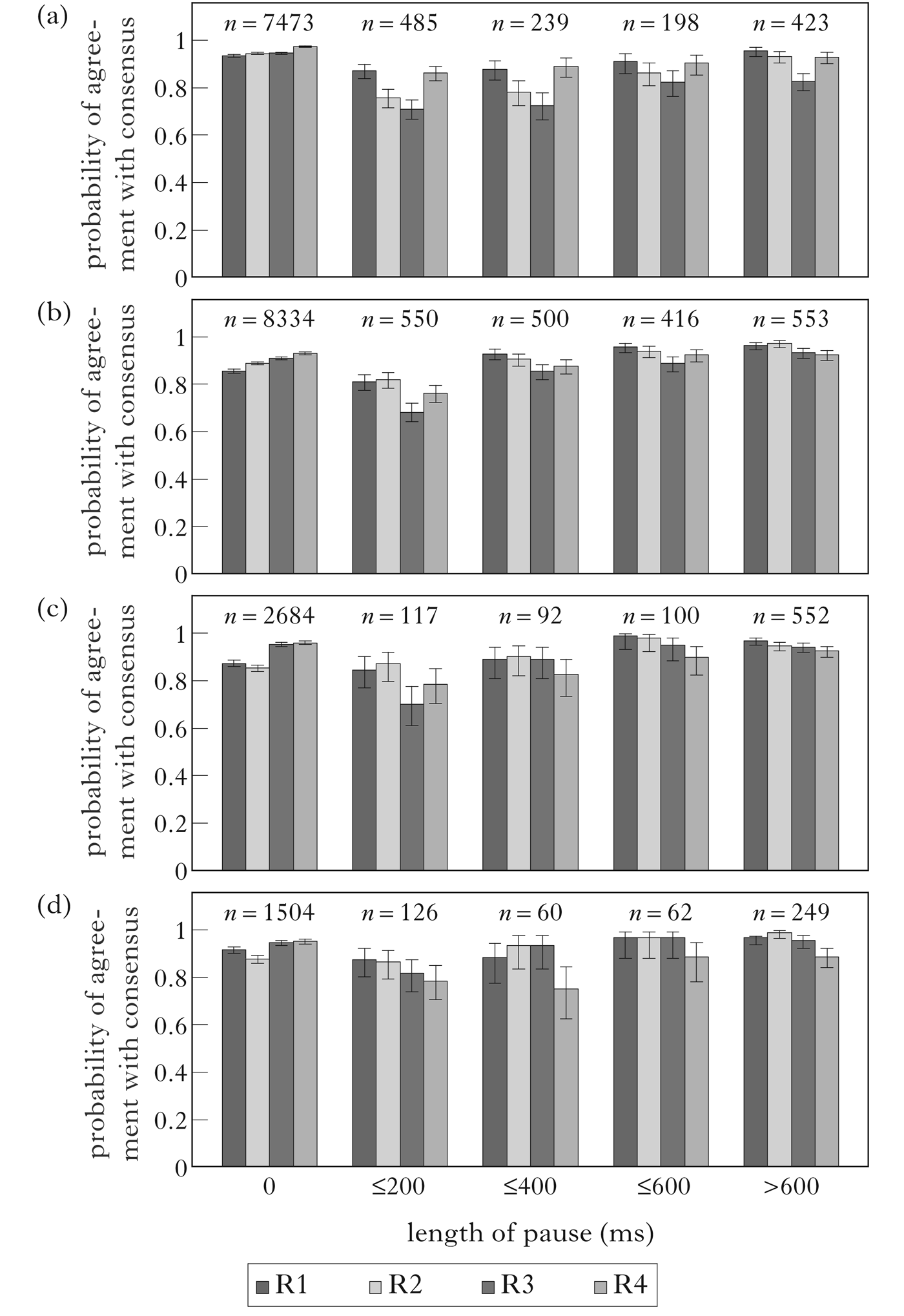
The differences in the frequency and length of pauses documented in Table VI probably contribute to the high interrater agreement scores in two of the three West Papuan languages, Wooi and Yali. Hence, the core question of this section becomes even more pressing: did annotators base their boundary decisions in the unfamiliar languages on pauses to a significantly larger degree than in the familiar German, perhaps even exclusively so? Figure 6 shows that this is not the case.
Effect display of logistic regression model predicting the probability that each annotator will assume an IPB: (a) German; (b) Papuan Malay; (c) Wooi; (d) Yali.

Figure 6 is based on a logistic regression model of our experimental data that predicts the probability of assuming an IP boundary between two words depending on the particular language, the annotator making the decision and the length of a possible pause between the two words in question. We decided to code pause length as an ordinal variable with the five levels shown in Fig. 6, to make it easier to relate the probability of an IPB at a certain pause-length category to the actual number of cases in our experimental results that this probability is derived from. Since there are very few cases of long pauses, all pauses longer than 600 ms were put into one category.
We fitted our logistic regression model using the glm (generalised linear model) function in the R statistical environment (R Core Team 2017), starting with the maximal model, including all two- and three-way interactions in addition to the three simple factors. The model formula in expanded form is as in (7).
(7)

We then tested whether the interactions were necessary for a good model fit. The likelihood-ratio test of the three-way interaction indicated that it is required in the model (χ 2 = 149.77, df = 48, p<0.001), which accordingly cannot be further simplified. The high number of factor levels (five levels of pause length, four languages and five annotators) and the inclusion of two- and three-way interactions mean that our model comprises 100 coefficients, making it very hard to discuss it in the usual tabular format. For this reason, we present the modelling results in Fig. 6 as an effect display (Fox Reference Fox2003), which, for each language, shows the predicted probability of an IPB for each pause-length category and each annotator as a bar graph, with confidence intervals based on the model.
The overall trends are not surprising: lack of a pause correlates strongly with no IPB, while pauses of 600 ms or longer are associated with a very high likelihood of an IPB. Note that the number of decisions varies substantially across the pause-length categories, with the leftmost group of bars representing between 56% and 71% of all decisions made with regard to a given subcorpus.
Three more specific observations are relevant in the current context. First, the correlation between pauses and IPBs indeed varies according to the distribution of pauses in the four subcorpora. It is weakest in German, and strongest in Wooi and Yali, with Papuan Malay clustering more strongly with the latter two. Accordingly, the predicted probabilities of an IPB in Fig. 6 are lowest overall for German, and increase more slowly with a higher pause length than in the other three languages, for all annotators. The weaker association of IPs with pause length in German, however, is due to the distribution of pauses in the respective corpora (cf. Table VI), not to the fact that annotators made more use of pauses in the unfamiliar West Papuan languages than in the familiar German.
Second, annotators did not posit IPBs in unfamiliar languages solely on the basis of pauses. Otherwise, one would expect zero probabilities in the case of no pause (the leftmost group of bars) and a probability of 1 in the case of a longer pause (≥ 400 ms). Instead, the student annotators assumed a comparable, though of course relatively low, likelihood of latching cases across all four subcorpora, and were also quite constant in their relative propensity to allow for latching. R1 and R2 were more likely to posit IPBs without a pause than R3 and R4 both in German and in all three unfamiliar languages. Conversely, while the predicted probabilities of the student annotators assuming a substantial IPB rise (to > 0.9) for longer pauses in the unfamiliar languages, they are fully in line with, and often even lower than, the respective probabilities predicted for cons. This suggests that the high probability of assuming an IPB for longer pauses, especially for Wooi and Yali, results from the high reliability of long pauses as IPB cues in these languages (Table VI).
Third, according to the model, the four student annotators in general showed a stable tendency to assume more or fewer IPBs compared to cons across all four languages and also, crucially, across the different pause conditions: R1 and R2 were more likely to posit an IPB than cons in all languages and for all pause lengths (except for the longest pauses, where cons sometimes had a higher predicted probability of an IPB, and thus seemed to be more sensitive to pauses than the student annotators), while R3 and R4 were less likely to assume an IPB than cons in all four languages and for all pause lengths. The observation that R3 segmented the familiar German subcorpus according to syntactic and semantic criteria rather than on the basis of prosodic cues alone (cf. §4) is also reflected in the low sensitivity of R3 to pauses in German (cf. Fig. 6).
To compare the four student annotators more directly to the reference segmentation, we fitted an additional logistic regression model to our data. This time, however, the dependent variable is agreement with cons: for each boundary decision, the dependent variable was set to ‘true’ if the student annotator agreed with cons in that particular case, and to ‘false’ if he or she did not. As independent variables, we again included Pause length, Language and Annotator, as well as all possible two- and three-way interactions between them. The model formula in short form is given in (8).
(8)

A likelihood-ratio test indicated that the three-way interaction is required for a good model fit (χ 2 = 110.49, df = 36, p = 0.001) and that the model should not be further simplified. Figure 7 displays the effects of Pause length, Language and Annotator according to the final model. Despite the significance of the three-way interaction, it shows a largely uniform probability of agreeing with cons across languages and pause lengths. Unsurprisingly perhaps, the probability of agreeing with cons for individual annotators within one language is reduced somewhat for cases with short pauses (≤ 400 ms) compared both to cases without any pause (0 ms) and to cases with longer, more noticeable pauses (> 400 ms). This effect is apparent for all student annotators in all four languages. Crucially, however, there is no clear contrast in the pattern of agreement with cons in familiar vs. unfamiliar languages. This is further evidence that the segmentation behaviour of student annotators for unfamiliar languages was not completely different as a result of their relying exclusively on pauses.
Effect display of model predicting agreement by each annotator with cons: (a) German; (b) Papuan Malay; (c) Wooi; (d) Yali.

This section has shown differences in the distribution of pauses in the four main subcorpora of our study. Specifically, pauses are less useful boundary cues in German and Papuan Malay than in Wooi and Yali. Consequently, the relatively high interrater agreement for the latter two can partly be explained by the fact that pauses in Wooi and Yali coincide with IPBs in 98% of all cases (but the converse does not hold; approximately 20% of the IPBs in these subcorpora lack external pauses). While the predictive power of pauses for IPBs thus varies across the languages, there are no clear trends separating familiar from unfamiliar languages. Specifically, there is no evidence that student annotators relied more heavily on pauses in the unfamiliar languages than in their native German. Instead, other boundary cues (pitch, final lengthening, etc.) also play a role in boundary identification, and contribute to the overall high interrater agreement across our corpus. In this regard, our results match findings from the automatic boundary detection literature which also find that non-silence features add extra predictive power to boundary classifiers (cf. e.g. Soto et al. Reference Soto, Cooper, Rosenberg and Hirschberg2013: Table 6).
6 Discussion
The empirical results reviewed in the preceding two sections make it clear that the cues for IPBs provided in our instructions (cf. §2) were robustly identifiable by listeners with differing degrees of prosodic expertise across a substantial multilingual corpus. The inclusion of languages unfamiliar to the annotators proves that identification of these cues is possible even when annotators do not understand the content of the audio signal and are not familiar with the prosodic system of the language in question.
This section discusses how this finding may be explained, and what it implies for our understanding of prosodic phrasing. Staying strictly on the level of (phonetic) boundary cues, one could argue that there is not much to explain. What our data show is that German listeners are able to identify the kinds of prosodic cues they are familiar with from their native language across a range of diverse and unrelated languages. This may be mildly interesting when compared to the ability of German speakers to identify other kinds of phonetic phenomena across unfamiliar languages (e.g. a specific consonant or vowel), but it would appear to be largely devoid of theoretical importance. The findings become theoretically relevant on the assumption that our annotators identify prosodic units of the same basic type, i.e. IPs, across unrelated languages. This assumption of ‘sameness’ can be challenged (and has been challenged by almost all the reviewers of this paper) on two interrelated grounds. First, the same kind of cues might identify different kinds of units in unrelated languages, an issue taken up in §6.1. Second, it might be the case that native speakers of other languages hear completely different things, and that the units identified are therefore essentially German perceptual IPs, and irrelevant to the native speakers of the unfamiliar languages. We address this issue in §6.2.
If we can counter these challenges, our findings suggest the hypothesis that there is a universal phonetic basis to IP chunking that allows speakers to identify IPs across familiar and unfamiliar languages. §6.3 briefly expounds this hypothesis, pointing out some of the empirical and theoretical issues that need to be resolved to further substantiate it.
6.1 On the cross-linguistic comparability of prosodic units
The challenges in comparing grammatical categories across languages are well-known in typological work, and have recently again become a major concern in the field (e.g. Lazard Reference Lazard2002, Haspelmath Reference Haspelmath2010). With regard to prosodic units, Hyman's (Reference Hyman2015) examination of the evidence for syllables in Gokana is an instructive example. We cannot provide a comprehensive discussion of the cross-linguistic comparability of prosodic units here, but will try to justify the plausibility of the claim that the units identified by our annotators are the ‘same’ across the languages of the sample.
The core issue with regard to our data pertains to a specific region of the prosodic hierarchy, i.e. the IP level and the next lower level, widely known as phonological phrase (PhP, the term we will use) or intermediate phrase.Footnote 11 We thus assume that the units delimited by all annotators are larger than syllables and phonological words, but smaller than utterances, paragraphs or other kinds of macro units proposed above the IP level. It is a matter of controversy how many levels need to be assumed between phonological words and IPs, and whether such levels are actually found in all languages. In this regard, we side with the arguments against a proliferation of prosodic levels and the requirement that each level be defined by specific properties that distinguish its boundary from boundaries at other levels (cf. Ladd Reference Ladd1986, Reference Ladd2008: 288–299, Frota Reference Frota2000, Tokizaki Reference Tokizaki2002, Wagner Reference Wagner2010, Krivokapić & Byrd Reference Krivokapić and Byrd2012: 438).
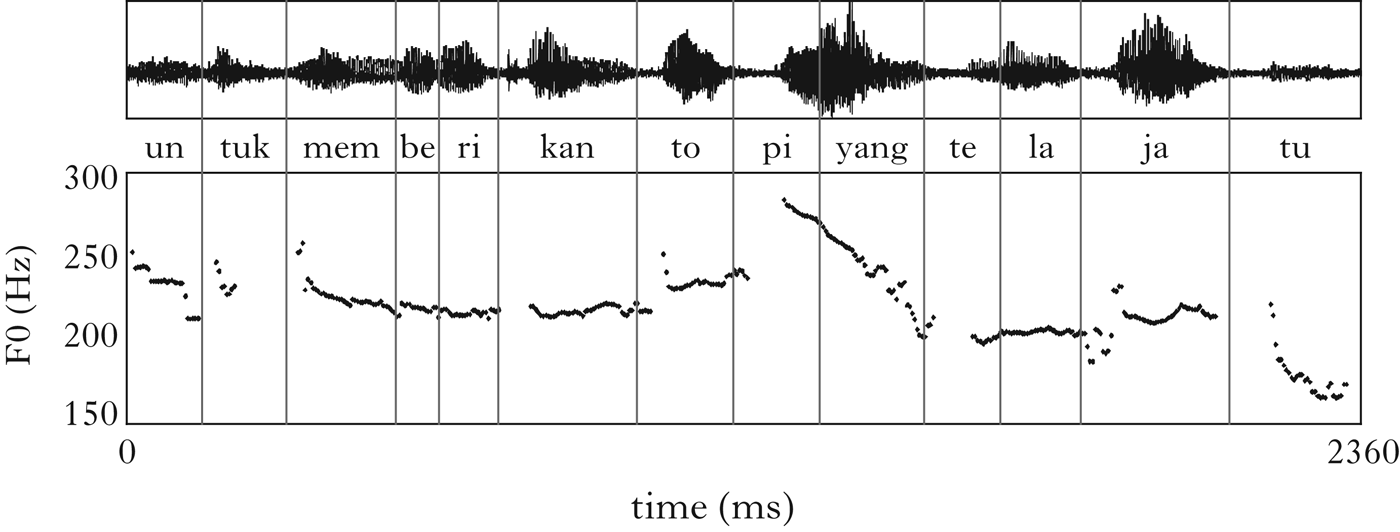
A case in point are the highly conspicuous and systematic PhP boundaries occurring in two of the languages. In Papuan Malay and Wooi, IPs are optionally segmented into PhPs, which are marked by a high tone on the final syllable of the phrase. Importantly, PhP boundaries in these two languages do not involve a pause or pitch reset. The overall melodic and rhythmic coherence is thus not interrupted, as illustrated by the Papuan Malay example in (9).
(9)

As seen in Fig. 8, the high PhP boundary tone on pi (the final syllable of topi, which functions as head noun for the following relative clause) is immediately followed by a fall that continues across the next word, the relative pronoun yang. PhP-final syllables may be slightly lengthened, but this is the exception rather than the rule, and is not found in Fig. 8. IPBs, on the other hand, are generally followed by a new pitch onset, and often by a pause, i.e. they involve an interruption of rhythmic and melodic coherence. Additionally, IPBs in both Papuan Malaya and Wooi involve two tonal targets, a phrase accent and a final boundary which occurs in a two-syllable window at the end of the unit (cf. §3). This is illustrated in Fig. 8 by the combination of a high phrase accent and a falling boundary tone on the final verb jatu. Both penultimate and final syllables tend to be considerably lengthened.
Waveform and F0 track for the Papuan Malay example in (9).

Crucially, the boundary strength within each unit type may vary, and such differences may be perceived by listeners (see e.g. Ladd Reference Ladd2008: 293–297, Wagner & Watson Reference Wagner and Watson2010, Krivokapić & Byrd Reference Krivokapić and Byrd2012). As noted in §2, IPBs without pauses are more difficult to perceive than ones where pause, pitch reset, final syllable lengthening and possibly other features such as creaky voice and fading intensity all indicate a major prosodic boundary. This is clearly reflected in our interrater agreement data, where disagreements rarely arise at such clearly marked boundaries.
Given the variability in boundary strength and the fact that many boundary cues are highly language-specific (such as the edge-tone combination just illustrated for Papuan Malay), it is not surprising that some annotators occasionally interpreted PhP boundaries as IPBs. In fact, R1 – the student annotator with the shortest IPs on average (cf. Table II) – had a tendency to mark PhP boundaries occurring within larger IPs.
Turning to our segmentation data, our expert segmentation (cons) distinguished PhPs from IPs in three of the four languages, German, Papuan Malay and Wooi. Importantly, PhP boundaries in these languages do not involve the interruption of melodic coherence (pitch jumps), and are thus clearly distinguished from IPs.Footnote 12 Insofar as our analyses of these languages are correct, it follows that the units identified as IPs are larger than PhPs in all three languages, and, moreover, comparable with regard to the phonetic boundary cues used in our segmentation instructions. Thus our first argument for the claim that the units identified in the different subcorpora are of the same type is that the expert annotation followed standard procedures in prosodic analysis, using standard criteria for distinguishing prosodic phrasing levels, and that the same two major phrasing levels above the phonological word were used in three of the four languages. In as much as the student annotators’ segmentations match the expert annotation across the four subcorpora (cf. Fig. 7), they also target the same phrasing level, i.e. IPs. This argument may be less forceful for Yali, where we do not assume an additional phrasing level between phonological word and IP.
This type of argument implicitly underlies all cross-linguistic work on prosody, and particularly cross-linguistic collections such as Jun (Reference Jun2005, Reference Jun2014). In these collections, the prosodic descriptions of all languages assume an IP level without explicitly arguing for the cross-linguistic comparability of the language-specific IP constructs. The tacit assumption appears to be that, if the same procedures are followed in the analysis of two or more languages, then the postulated units with the same name are at least roughly comparable.
Still, use of the same analytical framework and procedure may not be sufficient to support cross-linguistic sameness. How can we be sure that levels with the same name really have the same status and function in two different prosodic systems? Phonetic similarities and analytic consistency may be suggestive, but they hardly constitute full proof. Other, preferably non-prosodic, parameters for assessing similarity are needed to further substantiate claims of cross-linguistic similarity.
We proposed one such parameter in §4, with respect to differences in mean IP length across the four main subcorpora. The data in Table V show that the units are of a comparable size with regard to their information content, i.e. they contain on average 1.6–1.8 content words. This informational measure is relevant, on the widely shared assumption that IPs are major processing units in speech production and comprehension. There are very few proposals for how the informational content of IPs should be specified; one such is Chafe's (Reference Chafe1994: 108–119) proposal that IPs present exactly one ‘new idea’. But there is wide agreement that IPs represent informational ‘chunks’ that the speaker processes as one unit and presents to the hearer as such (cf. Sanderman & Collier Reference Sanderman and Collier1997, Frazier et al. Reference Frazier, Carlson and Clifton2006, Krivokapić Reference Krivokapić2007, Wagner & Watson Reference Wagner and Watson2010). It is unclear to what extent this also holds for lower-level prosodic constituents such as PhPs.
A second non-prosodic parameter for cross-linguistic comparison is variability in size. The units identified in our segmentation data are highly variable in size, ranging from discourse particles and short phrases without content words, to NPs or PPs, to clausal and multi-clausal units. This is typical of IPs, whereas lower-level prosodic units are more regularly associated with syntactic constituents of a narrowly delimited size. Langus et al. (Reference Langus, Marchetto, Bion and Nespor2012: 286) explicitly contrast the PhP and the IP in this regard and note that the IP is ‘a more variable constituent as to its domain’.
In sum, there are good reasons to assume that the units identified in our segmentation experiment are essentially of the same kind across familiar and unfamiliar languages. A fundamental challenge to the line of argument presented in this section, however, is that none of the above proves that the units identified in our experiment are relevant and perceptible for native speakers of the West Papuan languages. It might well be that we are consistently identifying IP-sized units across the four languages, but that these units are constructs of an analytical framework based on European languages, and that West Papuan speakers are sensitive to substantially different kinds of segmentation cues and possibly also arrive at substantially different segmentations. The next section will address this objection.
6.2 What do native speakers of the West Papuan languages hear?
To fully counter the objection that our findings only show that German speakers hear German IPs, we would have to replicate the experiment with native speakers of the West Papuan languages. A replication using the same corpus with speakers of the three West Papuan languages, however, is not straightforward, for a number of practical reasons, including the substantial size of the corpus (> 3 hours). Crucially, the practical orthographies used for the West Papuan languages were relatively easy to process for the German annotators, as the phoneme–grapheme correspondences are very regular and easily identifiable for them. German listeners could relatively easily match the audio recording with the transcript. German orthography, on the other hand, is not so easy to process for the West Papuan speakers. Furthermore, levels of literacy, and in particular the computer literacy needed to handle the elan program, vary dramatically among the West Papuan speakers, and it would be difficult to find enough Wooi and Yali speakers who could engage in tasks requiring the processing of written language.
However, we have been conducting pilot experiments with speakers of Papuan Malay to determine ways to collect comparable interrater agreement data for this population. These pilot experiments more closely follow the procedures of Mo et al. (Reference Mo, Cole and Lee2008), using smallish sets of excerpts of spontaneous speech, and having speakers mark boundaries on print-outs of the transcripts of these excerpts (cf. §2). Most importantly, following the Rapid Prosody Transcription (RPT) method (Cole & Shattuck-Hufnagel Reference Cole and Shattuck-Hufnagel2016), speakers were allowed to hear each excerpt only twice. Consequently, the results of these pilot projects are not directly comparable to the current results. However, they provide at least some support for the claim that Papuan Malay speakers can make use of the same boundary cues as those used in the segmentation task reported here, and arrive at roughly the same kinds of units as the German annotators.
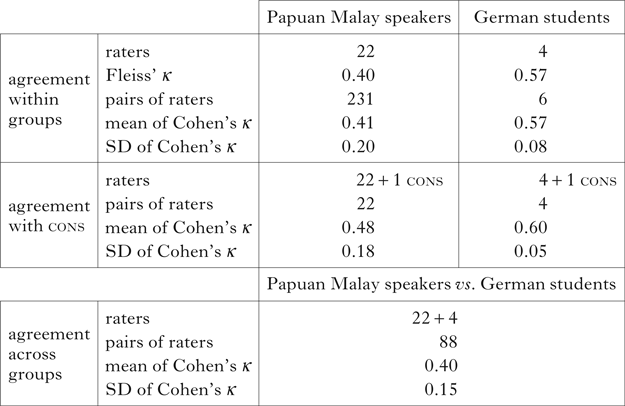
One of these pilot experiments is reported in Riesberg et al. (Reference Riesberg, Kalbertodt, Baumann, Himmelmann, Riesberg, Shiohara and Utsumi2018), which investigates both prominence and boundary perception using the RPT method. 22 speakers of Papuan Malay annotated transcripts of 56 excerpts of spontaneous narrative and conversational speech produced by 28 different speakers. While interrater agreement for prominence was negligible (Fleiss' κ = 0.10), interrater agreement for boundaries (Fleiss' κ = 0.41) was within the range found in comparable studies for English.
38 of the 56 excerpts used in this experiment come from the Papuan Malay pear stories also used here. Hence we can compare the units identified by the Papuan Malay speakers with those in our cons version, as well as with the units identified by our student annotators. This allows us to calculate interrater-agreement statistics within and across the different groups of annotators. Table VII provides agreement statistics within the group of Papuan Malay native speakers and within the group of German student annotators. In addition, it also shows mean κ values for agreement between members of each of these two groups and with our consensus version. Finally, we also computed agreement across groups by comparing the boundary decisions of each of the Papuan Malay native speakers with those of each of our German student annotators.
Interrater agreement within and between different groups of annotators on 38 excerpts of Papuan Malay pear stories (480 boundary decisions).

As noted above, Fleiss' κ for agreement within the group of Papuan Malay native speakers (0.40) is comparable to results obtained in similar studies for English. Interrater agreement among the four German student annotators is clearly higher (Fleiss' κ = 0.57). This difference in agreement values is likely due to the different experimental methods and the stricter time constraints which the native speakers were subjected to in the RPT approach. In addition, it may have to do with the fact that German annotators based their decision exclusively on phonetic cues for IPBs, while the Papuan Malay speakers probably also made use of syntax, semantics and pragmatics.
A direct comparison of the IP segmentations created by Papuan Malay native speakers with our consensus segmentation results in a mean κ value of 0.48, representing moderate agreement, according to Landis & Koch (Reference Landis and Koch1977). This suggests that our consensus segmentation does agree to a large extent with intuitions of native speakers, and does not constitute a completely irrelevant German-based IP segmentation of the data.
The comparison across the native and non-native groups of annotators in the bottom of Table VII also supports this conclusion. The mean agreement between all different pairs of one Papuan Malay native speaker annotator and one German student annotator (mean κ = 0.40) is quite close to the mean agreement among Papuan Malay native speakers themselves (mean κ = 0.41). This indicates that native and non-native speakers segment the Papuan Malay speech into comparable units. It also supports the conjecture that the greater agreement among German annotators is due to differences in the experimental methods.
We are currently also running an experiment where Papuan Malay speakers identify IPBs in excerpts of the German pear stories used here. Preliminary results again suggest substantial interrater agreement between the segmentations produced by German and Papuan Malay speakers. We therefore believe that it is plausible to assume not only that the units identified in our experiment are the same prosodic analytical constructs (i.e. IPs), but that speakers from different populations would arrive at similar segmentations, given the same instructions. Obviously, this hypothesis requires further empirical scrutiny. We nonetheless conclude our study with a brief exploration of the theoretical implications that arise if it can be shown to be empirically well supported.
6.3 The universal phonetic IP hypothesis
Strictly speaking, the student annotators in our experiment did not identify phonological units, at least not in the languages unfamiliar to them. With regard to these languages, they did not know anything about the prosodic system in general and the phonological structure of IPs in particular. The current study thus differs markedly from the kind of interrater agreement study briefly mentioned in §2, in which annotators were trained to identify phonological categories defined within a specific framework, such as ToBI. The claim made repeatedly throughout this paper – that IPs are robustly identifiable across familiar and unfamiliar languages – is based on the fact that there is robust interrater agreement between the student annotators' segmentation and the consensus version, which identified IPs as phonological units (cf. §3 and §6.1).
At least for the languages under investigation, the current study therefore shows that IPs can be consistently identified in spontaneous speech without familiarity with their phonological structure, simply on the basis of phonetic boundary cues which appear not to be specific to a particular language. This finding can be interpreted in a number of ways. In the two preceding subsections, we argued against the view that it shows only that German speakers are able to identify German IPs everywhere. Instead, we propose that it supports what we call the universal phonetic IP hypothesis (UPIPH), which claims that all natural languages make use of the same kinds of phonetic cues for IPs, and that these cues can be perceived by speaker-hearers even in unfamiliar languages. The main cues are the interruption of melodic coherence, as manifested in pitch resets between IPs and major rhythmic breaks, particularly pauses. Both types of cues are considerably more complex than just stated, and involve language-specific and probably also speaker-specific further features.
In addition, IPs may be – and usually are – phonologically organised units, with the phonological organisation being manifested in particular in tonal events. The prototypical example of this are the edge tones found in all prosodic systems described so far. They are the clearest phonological markers for prosodic boundaries, and tend to be intricately interlinked with segmental articulatory gestures (e.g. Krivokapić & Byrd Reference Krivokapić and Byrd2012). In this view, IP boundary tones are regularised (grammaticised) descendants of the universal pitch resets associated with the interruption of melodic coherence.
We propose to conceive of the relation between universal phonetic IPs and language-specific phonological IPs along the lines of Gussenhoven's (Reference Gussenhoven2004: 49–96) account of the relation between universal biological codes and the language-specific phonological organisation of pitch variation. Specifically, we assume that the chunking of speech into IP-sized units is a universal necessity of human speech, arising from the physiology of speaking (e.g. breathing), as well as from cognitive demands on speech planning and processing (cf. §6.1). The physiology of speaking and processing demands are also the source of the universal melodic and rhythmic boundary characteristics of the universal phonetic IP, specifically melodic coherence and processing-related interruptions of speech delivery (planning pauses and unit-final lengthening).Footnote 13 These boundary characteristics can be further grammaticised into language-specific phonological categories, giving rise to a phonologically organised category, the intonational phrase. Such grammaticisations typically involve the development of a limited set of unit-final (and, more rarely, also unit-initial) pitch movements, which usually form part of a more comprehensive system of grammaticised pitch movements, serving other functions such as marking information status (postlexical pitch accents) and distinguishing lexemes (lexical tones).
Note that this scenario specifically targets IPs, and does not necessarily apply to other levels of prosodic phrasing. Thus, for example, to support the claim that there are also universal phonetic PhPs, it would be necessary to identify a distinct set of phonetic cues for PhP boundaries, which should likewise be derivable from aspects of speech physiology or processing (cf. §6.1).
We believe that it is quite likely that phonological IPs are part of the prosodic system of all natural languages. If this is the case, IPs would be a prime example of a universally attested phonological category (in addition to being a universally attested phonetic category). Such a claim, however, presupposes not only the analysis of the prosodic systems of all languages, but also that the units labelled IPs in these analyses are cross-linguistically comparable with regard to independent parameters such as informational content and size variability (cf. §6.1). In principle, however, the UPIPH allows for the possibility that there are languages in which spontaneous speech is produced in IP-sized chunks (delimited by universal phonetic boundary cues), but where the phonological analysis of the prosodic system does not require (or support) an IP level. More importantly, perhaps, the hypothesis predicts that IP units and their boundaries are grammaticised to different degrees, i.e. that prosodic systems exist where the IP level is only weakly grammaticised, its structure consisting simply of a single final boundary tone, for example.
The UPIPH, of course, needs further conceptual and empirical scrutiny. Empirically, it predicts that segmentation tasks of the type employed in this study will result in substantial interrater agreement across every combination of languages, speaker populations and speaking styles (an obvious limitation of this study is its restriction to narrative speech). Unlike in the current study, native speakers of all the languages represented in a sample should ideally also be included among the annotators.
While the current sample covers a range of prosodic systems (cf. §3), crucial test cases are still to be investigated. Syllable-tone languages such as Mandarin or Thai, for example, may provide particular challenges. In such languages, tonal sandhi may provide a conspicuous cue to melodic coherence, and it remains to be seen whether non-native annotators can make use of this. Conversely, it may turn out that (monolingual) Mandarin or Thai native speakers encounter difficulties in segmentation tasks involving German or Wooi data, where these tonal sandhi cues are absent.
Empirical testing of the UPIPH is not restricted to the exact task design used in this study, which would not be feasible in many speech communities, for the reasons noted in §6.2. In fact, it is not restricted to segmentation tasks targeting IPBs and referring to the universal phonetic cues of melodic and rhythmic coherence. In principle, it should be applicable to any kind of evidence associated with phonetic IPs. Thus, for example, if the (auditory) processing of IPs indeed involves a brain signature of the type proposed by Steinhauer et al. (Reference Steinhauer, Alter and Friederici1999), who claim that IPBs are associated with a ‘closure positive shift’,Footnote 14 then we would expect this signature to occur across a worldwide sample of speakers and languages.
Conceptually, it needs to be further clarified and empirically tested whether and how the presumed universal phonetic boundary cues are linked to the physiology of speaking and the cognitive demands on speech processing (cf. §6.1). A fully explicit account of this link should also cover the complex interplay between the two basic phonetic cue types for IPBs (melodic and rhythmic) that has been discussed throughout the preceding sections.
7 Summary
The present work has provided evidence for the following claims.
(i) Intonational phrases are empirically viable units, according to standard measures for interrater agreement. Multirater as well as pairwise κ coefficients show a substantial and statistically significantly above-chance agreement on the placement of IPBs, and thus demonstrate the reliability of IP segmentation. This holds both for languages familiar and unfamiliar to the annotator (cf. §4).
(ii) IPB identification can, and probably should, be based on prosodic cues only. Paying attention to non-prosodic information in the material to be segmented (syntactic boundaries, semantico-pragmatic units) leads to more disagreements.
(iii) Melodic coherence, pauses, unit-final lengthening and increased unit-initial speaking rate are universal cues for IPBs. On the basis of these cues, it is possible to segment narratives in unknown languages with roughly the same reliability as in one's native language.
(iv) The empirical findings support the hypothesis of universal phonetic IP chunking linked to the physiology of speaking and the cognitive demands on speech processing. Languages differ as to whether and to what degree phonetic IPs are further grammaticised into phonological IPs, which are language-specific structural units arising from, and continually undergoing, processes of diachronic change.
Supplementary materials and methods
The supplementary material for this article can be found at https://doi.org/10.1017/S0952675718000039