


INTRODUCTION
Interdisciplinary microlevel scholarship demonstrates a robust finding that individuals discriminate on ethnic lines in commonplace economic activities (Habyarimana et al. Reference Habyarimana, Humphreys, Posner and Weinstein2007; Landa Reference Landa1994; Riach and Rich Reference Riach and Rich2002). Meanwhile, political science literature has established that ethnic identity is instrumentalized, or otherwise made salient by political leaders, ethnic leaders, and citizens during political competition (Chandra Reference Chandra2004; Eifert, Miguel, and Posner Reference Eifert, Miguel and Posner2010; Mendelberg Reference Mendelberg2001), giving rise to the common belief that elections exacerbate ethnic tensions (Basadau et al. Reference Basadau, Erdmann, Lay and Stroh2011; Bates Reference Bates1974; Horowitz Reference Horowitz1985; Rapoport and Weinberg Reference Rapoport and Weinberg2005; Snyder Reference Snyder2000). This work therefore questions whether political forces have the power to shape the importance of ethnicity in ordinary economic activities. In particular, do competitive multiparty elections exacerbate interethnic discrimination in everyday economic activity?
An equally compelling question is whether competitive multiparty elections exacerbate interpartisan discrimination in economic activities. Recent cross-national research has shown that partisanship strength waxes around electoral competition and wanes towards the midpoint of the electoral cycle (Michelitch and Utych Reference Michelitch and Utych2014), consistent with the cyclical nature of party campaigning (Box-Steffensmeier and Lin Reference Box-Steffensmeier and Lin1997; Fisher Reference Fisher1999; Lindberg Reference Lindberg2010). Further, partisanship is not only widely known to color opinions (Bartels Reference Bartels2002) and govern political behavior (Campbell et al. Reference Campbell, Converse, Miller and Stokes1960; Green, Palmquist, and Schickler Reference Green, Palmquist and Schickler2002), but individuals discriminate on partisan lines in favor of copartisans in ostensibly nonpolitical laboratory behavior (e.g., “divide the dollar” tasks, trust games, implicit association tests) (Carlin and Love Reference Carlin and Love2013; Fowler and Kam Reference Fowler and Kam2007; Iyengar and Westwood Reference Iyengar and Westwoodforthcoming; Loewen Reference Loewen2010). Taken together, these works point to the viability of the proposition that discrimination on partisan lines exists in everyday economic activity, and may be exacerbated by party competition. Indeed, such a proposition is consistent with the interdisciplinary finding that escalating group competition exacerbates individual-level discrimination on group lines, even amongst minimally induced group identities (Cikara and van Bavel Reference Cikara and van Bavel2014; Riach and Rich Reference Riach and Rich2002).
To adjudicate whether elections exacerbate interethnic or interpartisan discrimination in economic activity (if at all), I study small-scale market price bargaining at three points in time around Ghana’s 2008 National Elections in the capital city. Ghana is an optimal setting for study because Ghana has fixed-term elections between two major parties, elections are highly competitive, and the party system is stable. Ethnicity is readily discernible through language, accent, and name, while partisanship is inferable from ethnicity because parties have historically nested ethnic groups (Birnir Reference Birnir2007; Ferree Reference Ferree and Chandra2012; Lipset and Rokkan Reference Lipset and Rokkan1967; Posner Reference Posner2005). Small-scale market price bargaining is perhaps the most frequent economic activity in the course of daily life in low-income countries. Over 70% of Ghanaian urbanites are employed in selling (Afrobarometer 2008), while all are buyers. For most products, buyers must haggle a price from a seller, yielding the potential for price discrimination on group lines. The market price discrimination literature demonstrates that this scenario generally allows buyers to negotiate lower prices from sellers who share group membership (Riach and Rich Reference Riach and Rich2002; Zussman Reference Zussman2013).
In order to maximize causal, construct, and ecological validity, I conduct within-subjects field experiments utilizing actual taxi fare bargaining transactions.Footnote 1 The data show that electoral competition exacerbates interpartisan rather than interethnic discrimination. Coethnic riders are able to bargain a lower price from drivers than noncoethnic riders regardless of temporal proximity to the election. However, at election time, and only at election time, prices accepted from noncoethnics diverge based on partisanship. Prices for noncoethnic riders sharing the driver’s political party are significantly lower, while they are significantly higher for noncoethnics affiliated with the opposing political party. Differences in average price are nontrivial. Amongst noncoethnics at election time, the difference between a copartisan and a noncopartisan fare approximates a day’s supply of clean water, and between a coethnic copartisan and a noncoethnic noncopartisan, a meal of local food.
This research contributes important findings to political science. First, electoral cycle effects have largely escaped the behavior subfield, while established evidence shows that the electoral cycle affects government expenditure (Golden and Min Reference Golden and Min2013), coup likelihood (Przeworski Reference Przeworski2012), political violence (Dunning Reference Dunning2011), and even racial bias in death penalty executions (Kubik and Moran Reference Kubik and Moran2003). This research is the first to demonstrate that the electoral cycle affects commonplace behavior between ordinary citizens. Second, partisanship has been widely shown to affect political participation and attitudes (Bartels Reference Bartels2002; Campbell et al. Reference Campbell, Converse, Miller and Stokes1960; Green, Palmquist, and Schickler Reference Green, Palmquist and Schickler2002), and more recently, laboratory decisions (Carlin and Love Reference Carlin and Love2013; Fowler and Kam Reference Fowler and Kam2007; Iyengar and Westwood Reference Iyengar and Westwoodforthcoming; Loewen Reference Loewen2010). The findings shown here expand our understanding of partisanship’s effect to ordinary behavior considered outside the political realm. Finally, the findings challenge the dominant paradigm that elections merely serve to exacerbate interethnic tensions in new ethnically diverse democracies (Basadau et al. Reference Basadau, Erdmann, Lay and Stroh2011; Bates Reference Bates1974; Horowitz Reference Horowitz1985; Rapoport and Weinberg Reference Rapoport and Weinberg2005). While discrimination was exacerbated between ethnic groups that were in opposing political parties (noncopartisans), it was mitigated between ethnic groups in the same political party (copartisans).
THE ELECTORAL CYCLE, IDENTITY SALIENCE, AND DISCRIMINATION
Group Conflict, Identity Salience, and Individual-level Discrimination
A significant interdisciplinary literature documents the pervasiveness of individual-level discrimination on group lines: across a wide variety of behaviors, in the lab as in the field, and amongst naturally occurring as well as minimally induced identity groups.Footnote 2 Such ingroup/outgroup discrimination takes place on dimensions unrelated to the nature of the groups, and has been found in subjects as young as five years (Fehr, Bernhard, and Rockenbach Reference Fehr, Bernhard and Rockenbach2008). Recent social neuroscience has shown that the emergence of ingroup/outgroup discrimination, as well as responses to recategorization of ingroups and outgroups, occurs within minutes of exposure (Cikara and van Bavel Reference Cikara and van Bavel2014). Much scholarship on naturally occurring identities examines discrimination based on (un)shared ethnicity in both the lab and the field (e.g., Bernhard, Fischbacher, and Fehr (Reference Bernhard, Fischbacher and Fehr2006); Shayo and Zussman (Reference Shayo and Zussman2010); Whitt and Wilson (Reference Whitt and Wilson2007)), while four recent studies demonstrate discrimination based on (un)shared partisanship in the lab (Carlin and Love Reference Carlin and Love2013; Fowler and Kam Reference Fowler and Kam2007; Iyengar and Westwood Reference Iyengar and Westwoodforthcoming; Loewen Reference Loewen2010).
In a second robust finding, increasing the salience of group identity cleavages increases individual-level discrimination on group lines (Brewer and Kramer Reference Brewer and Kramer1985; Cikara and van Bavel Reference Cikara and van Bavel2014; Tajfel Reference Tajfel1981).Footnote 3 First, researchers have found that exogenously increasing ingroup cohesion (e.g., network ties, team-building activities, cues) increases individual-level discrimination (Goette, Huffman, and Meier Reference Goette, Huffman and Meier2006). Second, escalating intergroup competition or outgroup threat has been found to exacerbate individual-level discrimination (Shayo and Zussman Reference Shayo and Zussman2010; Sherif et al. Reference Sherif, Harvey, White, Hood and Sherif1961; Whitt and Wilson Reference Whitt and Wilson2007).
Elections are the climax of intense group competition over state resources and policy control that promote both ingroup cohesion and outgroup threat amongst political parties and interest groups (Dunning Reference Dunning2011; Iyengar and Simon Reference Iyengar and Simon2000; Schattschneider Reference Schattschneider1960; Wilkinson Reference Wilkinson2004). Electoral competition catalyzes elite mobilization efforts with the mass electorate in jostling for power at the polls (Box-Steffensmeier and Lin Reference Box-Steffensmeier and Lin1997; Lindberg Reference Lindberg2010; Steger, Kelly, and Wrighton Reference Steger, Kelly and Wrighton2006). Such mobilization may persist even after an election during any disputes or protests over election results or coalition formation (Fisher Reference Fisher1999; Tucker Reference Tucker2006). This is not to say that party or interest group campaigning is eliminated between elections, but merely that outside of campaign season, resources are shifted away from mass mobilization to routine expenditure on organizational operations, assistance in governing to leadership, and fund-raising.
Given that elections are times of intense group competition, I propose that they may exacerbate discrimination on partisan or ethnic lines.Footnote 4 Moreover, I propose that such political competition may engender or intensify discrimination in commonplace but consequential economic activities outside what is considered the political realm. To motivate these propositions, I walk the reader through theory as to (a) why elections may increase partisan identity salience, (b) why elections may increase ethnic identity salience, and (c) why fluctuations in such identity salience may lead to discrimination in one of the most commonplace but consequential economic activities in low-income countries—market price bargaining.
The Electoral Cycle and Partisan Identity Salience
Party campaigning is theorized to increase the intensity of partisanship through two primary pathways (for an elaboration see Michelitch and Utych (Reference Michelitch and Utych2014)). First, by increasing the net benefit of political participation, partisanship is reinforced.Footnote 5 Parties lower the cost of political participation by making available events such as rallies, candidate visits, and neighborhood party meetings. Citizens, especially those in low-income democracies, expect to receive two types of material benefits through such political participation. They expect cash or in-kind goods at election campaign events—t-shirts, sugar, soap, rice, stickers, yard signs—much like one expects to consume drinks and snacks at a party. Citizens further believe that if they participate—supporting candidates at rallies, meetings, and later at the polls—they will be rewarded by favorable access to state resources if their party wins (Hicken Reference Hicken2011; van de Walle Reference van de Walle, Kitschelt and Wilkinson2007). Of course, at election time, citizens and citizen interest groups have the most leverage in extracting demands from parties in exchange for political support (Khemani Reference Khemani2004).
Behavioral choices supporting a party, especially repetitive choices, result in a sense of commitment and loyalty, intensifying partisan attachments (Brader and Tucker Reference Brader and Tucker2001; Dinas Reference Dinas2014). Internally, behaviors and attitudes serve as internal “self-signals” to engender or reinforce one’s identity. Further, by seeking conformity between political behaviors, attitudes, and identity, individuals reduce the disutility of cognitive dissonance (Dinas Reference Dinas2014; Festinger Reference Festinger1957). Visible acts of support—wearing t-shirts, staking yard signs, flying flags, attaching bumper stickers—remind others of one’s loyalty, reinforcing identity externally. Repetitive acts can lead to “escalating commitments” toward an identity (Benabou and Tirole Reference Benabou and Tirole2006).
Second, party campaigning and accompanying media coverage reinvigorate partisan loyalties through an influx of political information that organizes political conflict on partisan lines (Iyengar and Simon Reference Iyengar and Simon2000; Schattschneider Reference Schattschneider1960). Increased access and attention to such information allow citizens to “update” their fit with political parties, strengthening partisanship (Brader and Tucker Reference Brader and Tucker2008; Lupu Reference Lupu2013). Further, the influx of information on partisan conflict at election time can have an agenda-setting effect. Increased exposure to such information increases its accessibility in the minds of citizens and the importance of partisanship for citizens’ attitudes and behaviors (McCombs and Shaw Reference McCombs and Shaw1972). Selective exposure to partisan media and biased processing of the same information through partisan lenses may also reinforce initial partisan differences (Bartels Reference Bartels2002; Campbell et al. Reference Campbell, Converse, Miller and Stokes1960).
The difference in access to political information between campaign season and the rest of the electoral cycle is more extreme in low-income, weak-state capacity settings. Especially in rural areas, it cannot be overemphasized how brutally absent national state actors and media coverage of those actors are from the lives of citizens outside campaign season (van de Walle Reference van de Walle, Kitschelt and Wilkinson2007). Politicians avoid visiting their constituencies to avert demands and obligations for handouts (Lindberg Reference Lindberg2010). Further, parties and candidates often have no constituency offices, staff, or communication channel for citizens. Mass media infrastructure is weak and citizens have little information about party politics between active campaigns (Pande Reference Pande2011).
Michelitch and Utych (Reference Michelitch and Utych2014) find evidence of an association between the electoral cycle and partisanship in an 85 country study.Footnote 6 The predicted probability of being a partisan increases from the midpoint of the cycle to an election, where the magnitude of the effect is larger in low-income new democracies. The intensity of partisanship was also assessed for a subset of the cases for which data were available. Indeed, partisanship intensity similarly fluctuated over the electoral cycle, especially in low-income new democracies, but also in the USA.Footnote 7 That escalating competition between parties increases partisanship strength quite broadly gives a firm foundation upon which to apply interdisciplinary wisdom; namely, individual-level discrimination on partisan lines may increase at election time.
The Electoral Cycle and Ethnic Identity Salience
The literature on elections, especially regarding low-income ethnically diverse new democracies, holds that elections increase the strength of ethnic identity (Eifert, Miguel, and Posner Reference Eifert, Miguel and Posner2010). This may occur through two major channels, which rest on the classical and global regularity that party systems nest ethnic groups (Birnir Reference Birnir2007; Ferree Reference Ferree and Chandra2012; Lipset and Rokkan Reference Lipset and Rokkan1967; Posner Reference Posner2005).Footnote 8 Ethnic groups may be especially useful for electoral mobilization versus other social groups due to their relative visibility and stickiness (difficulty of alteration) on average, versus other types of groups (Chandra Reference Chandra2012).
First, party campaigns aim to woo core constituencies served by the party, increasing the salience of such constituencies. Parties may “play the ethnic card,” or engage in ethnic appeals to court constituent ethnic groups (Mendelberg Reference Mendelberg2001; Eifert, Miguel, and Posner Reference Eifert, Miguel and Posner2010). Campaigns often find it advantageous to heighten ethnic fears, resentment, or even violence to activate ethnic identity and mobilize voters to the polls to support their party (Horowitz Reference Horowitz1985; Wilkinson Reference Wilkinson2004). Further, parties’ ethnic appeals generate voters’ expectations for ethnic favoritism, reinforcing parties’ ethnic appeals (Chandra Reference Chandra2004; Eifert, Miguel, and Posner Reference Eifert, Miguel and Posner2010). This self-reinforcing cycle activates the importance of ethnicity at election time.
The second channel by which ethnic identity may become more salient at election time is mobilization efforts by ethnic group leadership. Ethnic leaders have incentives to mobilize constituents to extract demands for their members in return for partisan support at election time, when they have the most leverage visavis parties (Hicken Reference Hicken2011; Piattoni Reference Piattoni2001). In this way, ethnic groups are much like any other interest groups pursuing benefits in the context of party competition.
Consistent with these arguments, Eifert, Miguel, and Posner (Reference Eifert, Miguel and Posner2010) find that citizens name ethnic identity as the group to which they belong first and foremost at election time versus class, religion, and gender identity, using a cross-national sample of African countries.Footnote 9 If elections increase ethnic identity salience, it would provide an empirical basis for many claims in the literature that elections exacerbate interethnic conflict. Bates stated that “there can be no doubt that electoral competition arouses ethnic competition” (Reference Bates1974, 161). Rapoport and Weinberg remark that “No matter who wins, elections generally exacerbate and complicate [ethnic] divisions further” (Reference Rapoport and Weinberg2005, 36). Basadau et al. claim that elections exacerbate interethnic conflict by opening an “ethnic Pandora’s box” (Reference Basadau, Erdmann, Lay and Stroh2011, 10). Given the dominant wisdom in the literature, we may therefore observe that individuals discrimination more on the basis of (un)shared ethnicity at election time than otherwise.
However, there is some reason to doubt that ethnic identity salience increases at election time. First as Eifert, Miguel, and Posner (Reference Eifert, Miguel and Posner2010) relate, the study does not tell us whether ethnic identity is absolutely more salient at election time, but rather that it is relatively more salient than class, gender, and religion. The implication is that all these identities could very well be highly salient throughout the electoral cycle, but change in their rank order. It is not inconceivable that ethnic, gender, class, and religious identity—being visible and sticky, as well as often involving dense network ties, frequent contact, or shared language and traditions (Chandra Reference Chandra2012; Fearon and Laitin Reference Fearon and Laitin1996; Landa Reference Landa1994)—are activated in the context of everyday life interactions throughout the electoral cycle. Discrimination on ethnic lines may thus occur regardless of political competition.
Identity-Based Discrimination in Market Price Bargaining
This study focuses on discrimination on interethnic or interpartisan lines in one-shot market price bargaining with strangers. Prices are not fixed, but up to negotiation, and price discrimination along identity cleavages may occur. This activity was selected because market price bargaining is perhaps the most frequent, commonplace, and allocative situation individuals have with strangers in low-income countries (Castillo et al. Reference Castillo, Petrie, Torero and Vesterlund2013). Although less common in high-income countries, the product bargaining literature nonetheless mostly examines such scenarios.Footnote 10
Ordinary experiences tell us that buyers are able to negotiate lower prices from ingroup versus outgroup sellers, consistent with the general theories of ingroup/outgroup discrimination. Why? Culling theories from the interdisciplinary literature, I outline four main channels through which buyers may achieve lower prices from ingroup sellers, and why changes in group identity salience may exacerbate such discrimination. Common across all four channels is the cognitive heuristics theory (Brewer and Kramer Reference Brewer and Kramer1985; Tversky and Kahneman Reference Tversky and Kahneman1974). Individuals use mental shortcuts to make quick decisions in the face of limited information about interaction partners. Group membership serves as a typical mental shortcut used to make inferences about interaction partners (Brewer and Kramer Reference Brewer and Kramer1985; Chandra Reference Chandra2012).
Taste-Based Discrimination
Applying a prominent “taste-based” theory (Becker Reference Becker1957; Riach and Rich Reference Riach and Rich2002), sellers may receive utility from the process of dealing with an ingroup buyer, and disutility with an outgroup buyer. Outgroup buyers must therefore pay a premium or “compensate” the seller monetarily for the disutility of the interaction, while ingroup members may receive a discount for the positive utility gained from the interaction. Indeed, social psychological research corroborates that individuals express a higher degree of explicit amity, show implicit preferences for, assign positive attributes to, and desire to spend time with ingroup members (Brewer and Kramer Reference Brewer and Kramer1985). Increasing group salience, especially through group competition, has been shown to increase amity towards ingroup members and enmity toward outgroup members (Cikara and van Bavel Reference Cikara and van Bavel2014; Sherif et al. Reference Sherif, Harvey, White, Hood and Sherif1961). Indeed, one of the critical amplifiers of such bias is perceptions of zero-sum relationships between the groups’ goals.
Applying these theories to the present study, activation of partisan or ethnic identity through electoral competition may intensify existing enmity towards outgroup members, and amity towards ingroup members, leading to increased premiums (discounts) buyers must pay to compensate outgroup (ingroup) sellers. This proposition is consistent with literature on ethnicity and partisanship. The received wisdom in political science states that elections intensify ethnic outgroup hostility, even stymieing violence (Basadau et al. Reference Basadau, Erdmann, Lay and Stroh2011; Bates Reference Bates1974; Horowitz Reference Horowitz1985; Rapoport and Weinberg Reference Rapoport and Weinberg2005; Snyder Reference Snyder2000).Footnote 11 A robust result in behavioral neuroscience backs up this assertion, showing that individuals feel more empathy towards coethnics, while feeling apathy towards noncoethnics, based on behavioral and neural response to watching pain administered to others (Cikara and van Bavel Reference Cikara and van Bavel2014).
Similarly, “political homophily,” in which individuals are more apt to associate with copartisans, has been shown to be quite strong (Zuckerman Reference Zuckerman2005). Recent work has shown that stronger partisanship is associated empirically with anger towards noncopartisans and enthusiasm towards copartisans in survey data, and that political stimuli in the laboratory exacerbate such feelings amongst strong partisans (Iyengar and Westwood Reference Iyengar and Westwoodforthcoming). Given that elections are strong political stimuli, indeed null sum political competition, they could engender or exacerbate existing ingroup amity and outgroup enmity, resulting in taste-based ingroup/outgroup discrimination.
Statistical Discrimination
Arrow (Reference Arrow, Ashenfelter and Rees1972) and Phelps (Reference Phelps1972) pioneered the “statistical” discrimination theory, in which discrimination results when actual or perceived—but unobservable—differences in aggregate characteristics exist across groups, and such characteristics affect the calculus of interaction. Individuals use group membership as a proxy for the unobserved but relevant characteristics, yielding discrimination on group lines. Relating this theory to discrimination in market exchange, many authors emphasize trust differences across group membership in compliance with the exchange (Carlin and Love Reference Carlin and Love2013; Falk and Zehnder Reference Falk and Zehnder2013; Zussman Reference Zussman2013).Footnote 12 As Arrow relates: “virtually every commercial transaction has within itself an element of trust” (Reference Arrow, Ashenfelter and Rees1972, 357). When buyers are perceived as likelier to cheat by not paying, gains from trade occur at higher prices, and sellers charge a risk premium (Fafchamps Reference Fafchamps2004).
A robust literature finds that ingroup buyers are believed to be more trustworthy in complying with exchange than outgroup buyers, thus spurring risk premiums for outgroup members and “discounts” for ingroup members (Cook, Levi, and Hardin Reference Cook, Levi and Hardin2009; Landa Reference Landa1994). Foddy and Yamagishi (Reference Foddy, Yamagishi, Cook, Levi and Hardin2009) separate theories into two types: stereotype based and expectations based. First, individuals tend to stereotype their ingroup with positive traits, including being more trustworthy than outgroup members, and this effect increases in the salience of the group identity (Brewer and Kramer Reference Brewer and Kramer1985). Second, individuals expect generalized or indirect reciprocity within the bounds of the ingroup but not the outgroup. Such expectations are not tied to particular ingroups and outgroups, but repeated experience with ingroups and outgroups that make any ingroup a “venue of trust” in exchange. Activation of an ingroup/outgroup categorization activates trust expectations.
The literature on ethnicity and partisanship supports the trust channel through which increasing ethnic or partisan salience increases ingroup/outgroup discrimination. For instance, Zussman (Reference Zussman2013) finds that discrimination against Arabs in the Israeli used car market is associated with strength of perceptions that Arabs are less trustworthy, but not associated with “taste-based” prejudices regarding Arabs (e.g., against living nearby, marrying). Carlin and Love (Reference Carlin and Love2013) find that copartisans trust one another more than noncopartisans, and the effect is increasing in strength of partisanship. They attribute the finding to what Foddy and Yamagishi deem the stereotyping mechanism. However, party and ethnic leaders may seek to create expectations of ingroup trust and outgroup distrust, consistent with the second explanation.Footnote 13
Other-Regarding Preferences Discrimination
While the first two channels are based on maximizing egoistic utility, a third channel states that sellers may have other-regarding preferences, whereby they gain positive utility from the welfare of ingroup members, and no or negative utility from the welfare of outgroup members (Cooper and Kagel Reference Cooper, Kagel, Kagel and Roth2014; Fehr, Bernhard, and Rockenbach Reference Fehr, Bernhard and Rockenbach2008; Fehr and Schmidt Reference Fehr and Schmidt1999; Tajfel and Turner Reference Tajfel and Turner1979; Whitt and Wilson Reference Whitt and Wilson2007). In the context of market price bargaining, sellers may be eager to make as large a profit as possible off an outgroup member, wishing to maximize own profit and transfer resources away from the outgroup. By contrast, sellers may be willing, at the personal cost of less profit, to grant their product for far less to ingroup buyers in order to preserve equity in the trade outcome or enrich an ingroup member.
Such other-regarding preferences root in the idea that individuals think of themselves as interchangable “exemplars” with other ingroup members, leading them to deprioritize egoistic utility maximization and prioritize ingroup members’ welfare (Turner et al. Reference Turner, Hogg, Oakes, Reicher and Wetherell1987). Social neuroscience shows that brain processing of considerations regarding the self overlaps much more when we regard ingroup versus outgroup members (Cikara and van Bavel Reference Cikara and van Bavel2014). Further, increasing group salience increases perceptions of ingroup members sharing a common fate and more concern for ingroup members’ welfare (Brewer and Kramer Reference Brewer and Kramer1985). Scholars have theorized that this tendency may be hard-wired and rooted in evolutionary competition between groups (Choi and Bowles Reference Choi and Bowles2007; Fehr, Bernhard, and Rockenbach Reference Fehr, Bernhard and Rockenbach2008). As the argument goes, groups whose members favor ingroup members while acting hostile toward outgroup members—“parochial altruists”—outcompete groups that do not, and persist rather than die off.
These theories have been substantiated amongst both ethnic and partisan ingroups and outgroups. In the context of Bosnia, for example, strength of ethnic outgroup threat perceptions exacerbated divergence in other-regarding behaviors between coethnics and noncoethnics (Whitt and Wilson Reference Whitt and Wilson2007). In the context of North America, strength of partisanship increased divergence in other-regarding behaviors on copartisan/noncopartisan lines (Fowler and Kam Reference Fowler and Kam2007; Iyengar and Westwood Reference Iyengar and Westwoodforthcoming; Loewen Reference Loewen2010). Thus, elections may increase other regarding preference considerations in market price bargaining if they act to increase ethnic or partisan group salience.
Norm-Based Discrimination
A fourth channel suggests that individuals do not make calculations entirely according to utility maximization within the exchange, but rather, behave according to an ingroup/outgroup norm or prototype behavior. First, a norm may be rooted in the first through third theories; instead of going through the calculus, individuals chose to cut cognitive costs and simply charge a lower price to an ingroup member versus an outgroup member. Landa (Reference Landa1994) suggests that this occurs in large populations when the probability of subsequent interaction may be unknown or difficult to calculate.
Second, there may be automaticity in the application of an ingroup/outgroup norm. Cikara and van Bavel review the social neuroscience literature, finding that biological responses to our desire to categorize and react to individuals as ingroup or outgroup are “reflexive and difficult to override” (Reference Cikara and van Bavel2014, 247). Third, group leaders often act to prescribe or foster ingroup/outgroup discrimination norms, perhaps in a ploy to increase group allegiance to survive in group competition (Dickson Reference Dickson2008). Individuals may gain utility from embodying a group norm behavior, curtailing individual utility maximizing concerns—often encouraged by group leaders to mobilize followers (Akerlof and Kranton Reference Akerlof and Kranton2000).
One question about the application of this theory is whether such ingroup/outgroup heuristics change with changing group salience over the electoral cycle, or if such norms may only develop over a long time horizon. The dominant wisdom of the literature is that ingroup/outgroup discrimination is incredibly fluid (Cikara and van Bavel Reference Cikara and van Bavel2014; Foddy and Yamagishi Reference Foddy, Yamagishi, Cook, Levi and Hardin2009). What is stable is the norm of ingroup/outgroup discrimination, but what is considered the ingroup and outgroup is constantly redefined, since groups have always shifted alliances, fractionalized, and fused together to meet competing needs in competition. Once recategorization occurs, individuals very quickly apply ingroup/outgroup discrimination norms—within minutes (Cikara and van Bavel Reference Cikara and van Bavel2014; Sherif et al. Reference Sherif, Harvey, White, Hood and Sherif1961). Applying this theory to elections and market price bargaining, ingroup discounts and outgroup premiums may be an application of a norm that can shift in the context of malleable ethnic and party landscapes.
Discrimination and Nested Identities
The classic nesting structure of ethnic groups into parties renders partisanship a superordinate identity (Birnir Reference Birnir2007; Ferree Reference Ferree and Chandra2012; Lipset and Rokkan Reference Lipset and Rokkan1967; Posner Reference Posner2005). Individuals have, of course, multiple identities simultaneously. How might such identity structure affect discrimination?
Gaertner and Dovidio (Reference Gaertner and Dovidio2014) review two possible consequences. First, when a superordinate identity is activated, people expand the ingroup to the common superordinate shared group, and are fully inclusive of the former outgroup members within the superordinate identity as new ingroup members. Ingroup/outgroup discrimination is eliminated within the superordinate identity group. Second, a complete recategorization does not take place, but individuals maintain multiple identities. Individuals perceive one another in terms of “social distance.” The more shared groups, the shorter the social distance. The shorter the social distance, the more favoritistic the behavior. The scholarship emphasizes the quickness and automaticity of the reduction in ingroup/outgroup discrimination when superordinate identity groups are introduced (Cikara and van Bavel Reference Cikara and van Bavel2014; Sherif et al. Reference Sherif, Harvey, White, Hood and Sherif1961).
Thus, superordinate partisan identity may mitigate interethnic tensions within parties but exacerbate them towards those associated with competing parties. Individuals might show the most favoritism towards a person with whom both ethnicity and partisanship is shared, then someone with whom only partisanship is shared, and then someone with whom no identity groups are shared. Significantly, Posner (Reference Posner2004) finds that two ethnic groups who had been long time copartisans in one country, as opposed to noncopartisans in a contiguous country, perceived their identity as closer as a long-run consequence. Copartisanship may therefore “melt” ethnic identity divides, or even eliminate them, within parties in the long run. This present study aims not only at illuminating whether sharing partisanship mitigates interethnic discrimination in ordinary behavior, but also, whether any such patterns of discrimination fluctuate over the electoral cycle.
Identification and Hypothesis Testing
When parties nest ethnic groups, we have to carefully consider identification in determining whether discrimination exists on ethnic or partisan lines, and whether electoral competition exacerbates interethnic or interpartisan discrimination. Consider that the incumbent party nests ethnic groups {A, F} and the opposition nests {E, G} as depicted in the stylized example in Figure 1. For the moment, consider identifying discrimination at a snapshot in time.
Stylized Example of Political Parties Nesting Ethnic Groups

Suppose that, for instance, one observed discrimination between an E : A Noncoethnic Noncopartisan dyad—such discrimination may represent discrimination based on ethnicity OR partisan affiliation; they are observationally equivalent.Footnote 14 In order to conclude that interethnic discrimination exists, one would need to observe, for example, similar behavior in E : G Noncoethnics Copartisans dyads as in E : F and E : A Noncoethnic Noncopartisans dyads. Such behavior towards noncoethnics would stand in contrast to systematically different behavior amongst the E : E Coethnic Copartisan dyad. (Un)shared partisanship would not determine behavior, only (un)shared ethnicity.
If the superordinate identity of partisanship matters alone, while ethnicity does not, we would expect to see different patterns. One would need to observe similar behavior in the E : G Noncoethnic Copartisan dyad as the E : E Coethnic Copartisan dyad. Further, one would view systematically different behavior towards E : F and E : A Noncoethnic Noncopartisan dyads. A last expectation is that one might expect discrimination on both ethnic and partisan cleavages, whereby discrimination increases in social distance: E : E Coethnic Copartisans, versus E : G Noncoethnic Copartisans, versus E : A and E : F Noncoethnic Noncopartisans. Finally, there may be no systematic differences in behavior across the dyads, indicating no discrimination.
Table 1 lists the following hypotheses to guide our expectations for price discrimination at a given snapshot in time: Ho : No Pattern—no significant differences in average price on group lines, H 1 : Interethnic—lower average price for coethnics and higher for all noncoethnics regardless of partisanship, H 2 : Interpartisan—lower average price for copartisans and higher for noncopartisans, regardless of ethnicity, H 3 : Shared Group—lowest average price for coethnic copartisans, followed by noncoethnic copartisans, followed by noncoethnic noncopartisans. Reading across each row, we note that each hypothesis is observationally differentiable. To test the hypotheses for discrimination at each snapshot in time, pairwise difference in means tests can be employed.
Hypothesis Comparison Table: Snapshot in Time

Now consider identifying change in patterns of discrimination. Adjudicating whether the election exacerbates interethnic versus interpartisan discrimination requires additional testing. Do discrimination gaps expand or contract on different cleavages? A difference-in-differences approach can identify whether pairwise gaps in mean price expand or contract at election time between these dyads. The sample data would be used to estimate the following population model: price = β0 * dyad1 + β1 * Election + β2 * dyad2 + β3 * election*dyad2 + ε, in which we would be interested in
 $\hat{\beta }_3$
.
Table 2 lists hypotheses regarding fluctuation in discrimination gaps due to the election. The first column lists the discrimination gaps between the three treatment dyads. The remaining columns list hypotheses for change in the magnitude of those gaps at election time versus otherwise. First, the Election could have no effect on patterns of discrimination (H 0△ : No Exacerbation). Second, if the dominant wisdom that elections exacerbate interethnic discrimination is correct, we would need to observe the gap expand between coethnics and noncoethnics, and observe no difference between noncoethnics on the basis of partisanship (H 1△ : Interethnic). Third, if partisanship strengthens at election time, discrimination against noncoethnic copartisans may decrease as the superordinate partisan identity “melts” nested ethnic identities. We would observe a contracting gap between coethnic and noncoethnic copartisans and an expanding gap between noncoethnics on partisan lines (H 2△ : Interpartisan).Footnote 15
Hypothesis Comparison Table: Election Effect

RESEARCH DESIGN
Case Selection - Ghana
Ghana is a low-income, ethnically diverse, new democracy in West Africa. Market bargaining is ubiquitous: 70.54% of individuals make a living from selling, though all citizens bargain as consumers. Ghana has a presidential system with de facto respected fixed-term elections. Presidents are elected with an absolute majority, whereby runoffs are held if necessary. While democracy is young—1996 was the first year that an elected president completed his term without a coup since independence in 1957—Ghana is currently heralded as one of the most stable democracies in Africa. The December 2008 election was the fourth free and fair election and the second peaceful partisan transfer of power.
The New Patriotic Party (NPP) and the National Democratic Congress (NDC), which have roots harkening back to parties born earlier in previous Ghanaian Republics (Fridy Reference Fridy2007), compete fiercely to win elections. The 2008 election was particularly close; in the runoff, the NDC candidate John Atta Mills triumphed with a wafer-thin lead with 50.23% to NPP’s Nana Akufo-Addo with 49.77%. Since the dawn of the fourth and current Ghanaian Republic, this two party system has been remarkably stable (Weghorst and Bernhard Reference Weghorst and Bernhard2014). The parties are formal networks of individuals comprised of a “flag-bearer” (the presidential candidate), members of parliament, local party leaders, party executives/agents, party mobilizers, party members, and partisan voters. The presidential candidates are elected by party executives, who are themselves elected by card-carrying party members from each polling station area (Ichino and Nathan Reference Ichino and Nathan2012).
Party executives, leaders, and members act as electoral mobilizers for candidates in exchange for cash, in-kind benefits, and prospective favorable access to resources if the candidate wins (Lindberg Reference Lindberg2010). Parties have youth wings and women’s wings, as well as local offices or meeting spots in villages or city neighborhoods. They utilize radio and newspaper media (Conroy-Krutz and Moehler Reference Conroy-Krutz and Moehler2013). The party leadership make appeals to members to act like a team to strengthen the party mission of getting elected—appeals to turn out to vote, to go to rallies and party meetings, wear party paraphernalia, to protect the ballot boxes from cheaters in the other party, etc.Footnote 16 The parties rarely distinguish themselves ideologically. In a study of major newspapers, Bleck and van de Walle (Reference Bleck and Nicolas2012) estimate that 71% of the 2008 Ghanaian election campaign rhetoric regarded valance development issues. Thus, one can characterize competition not over what development policy is implemented, but who gets access to the development goods.
While competitive multiparty democracy is young, the stability and history of the parties render partisanship meaningful in Ghana. Thus, we may hypothesize that elections exacerbate interpartisan discrimination. If the hypothesis bears out, it would be a testament to how quickly partisan identity could take hold to affect behavior in a new democracy.Footnote 17
Yet, we can still hypothesize that elections exacerbate interethnic discrimination in Ghana. The Ghanaian parties nest particular ethnic groups that have historically competed in the precolonial, colonial, and postindependence periods (Fridy Reference Fridy2007). Figure 1 depicts the nesting of four ethnic groups featured in this study leading up to the 2008 election: the incumbent NPP with the Ashanti and Fanti, and the opposition NDC with the Ewe and Ga (Fridy Reference Fridy2007).Footnote 18 Both the leadership and followership have exhibited this nesting, though particular ethnic groups are perceived to dominate. The NDC is heavily associated with the Ewe because it was founded by Jerry Rawlings, an Ewe and former authoritarian leader from 1981 to 1992 and President from 1992 to 2000. The leadership of the NPP is associated with the Ashanti (and Akyem) due to its own founding heritage and current leadership.
General Design Strategy
The purpose of the empirical design is to investigate whether interethnic or interpartisan market price discrimination exists and discover whether patterns of discrimination fluctuate around a national election. One would like to take Ghana and treat it with a national election, and take an identical Ghana and have no election so as to compare patterns of discrimination under the two counterfactual states. In approaching this untenable ideal, I collected data on discrimination varying the temporal proximity to the election: six months prior to the December 2008 election before campaigning had begun, directly before the election, and exactly one year after the election. Recall that elected officials in Ghana serve fixed terms which have been de facto respected, rendering election timing de jure and de facto exogenous to interethnic or interpartisan strife, or an omitted factor which would directly or indirectly affect both intergroup strife and holding elections (e.g., economic changes).Footnote 19 In each wave, the data collection on individual behavior was conducted identically to give confidence that any difference in patterns of discrimination are due to the level of electoral competition.
I utilized a field experiment to generate behavioral data on discrimination. If designed and implemented properly with a deep understanding of the context, this method can achieve a high degree of validity. The research began with semistructured field interviews, participant observation, and piloting for 1.5 months ahead of the first experimental data collection. I sold tiger nuts and magazines in a local neighborhood market to build trust and intimacy with sellers and buyers and understand market price bargaining. I conducted field interviews with ordinary individuals, the electoral commission, and political party representatives during the preparatory phase as well as during the three rounds of data collection. During the election phase, I visited political events, and acted as an election observer.
Experimental Design
To identify whether patterns of market price discrimination exist on partisan or ethnic lines, I utilized taxi-fare bargaining in Ghana’s ethnically diverse capital city, Accra. Specifically, individuals hail a taxi, the fare negotiation takes place privately outside the vehicle until the terms of exchange are established, the driver takes the rider to the agreed upon location, and the rider pays the driver upon exiting. Taxi fare has also been studied as a one-shot stranger interaction in work on ethnic discrimination in Belfast and New York by Gambetta and Hamill (Reference Gambetta and Hamill2005), as well as in a gender discrimination in Peru by Castillo et al. (Reference Castillo, Petrie, Torero and Vesterlund2013).
I recruited a sample of Ashanti, Fanti, Ewe, and Ga males between 18 and 45 as taxi riders.Footnote 20 Three hours prior to the experiment, I distributed flyers around the major market area “Kwame Nkrumah Circle,” one of the two biggest transportation hubs and market areas. Potential subjects were told that they could participate in paid research on taxi fare transportation prices. The recruitment was purposefully spontaneous so that subjects would not have time to invent scams, seek information on transportation or bargaining, or otherwise “pretreat” themselves, which could bias results. A same day recruitment improves the ability to obtain a random sample because time lags allow friends to sign up together, and increases costs to participate for the poor.
Observing proceedings of the experiment in Figure 2, each round a rider receives a data slip and 3.5 Ghana cedis (US$3.50), hails the third empty taxi, and relays an opening script in his ethnic mother tongue to begin the negotiation. Rider and driver negotiate until agreeing on a price and drive to the other location, using either the initial mother tongue or English, the official administrative and common language of Ghana. Via the negotiation, the rider and driver learn one another’s ethnicity through language and accent and infer partisanship based on the typical nesting of ethnic groups in parties, just as they would in the course of everyday life. For naturalism, ethnic groups, politics, or partisanship are not mentioned in the experiment.Footnote 21 The subject fills in the data slip on the way to the other location, exits the vehicle, pays, and keeps the profit from the negotiation. The experiment is “within subjects,” whereby, subjects repeat the negotiation between Location 1 and Location 2 for 8–14 rounds.Footnote 22 Table 3 depicts the treatment groups. The random assignment mechanism is the natural flow of traffic, such that the third taxi that comes down the road and is hailed by the subject provides a random match-up of rider and driver in terms of their group identity categories.
Proceedings

Treatment Groups

Taxi fare bargaining fits into the class of one-shot, small-scale bargaining between strangers in which individuals have the opportunity to discriminate based on the “cheaply available” identities of their bargaining counterpart. Given the briefness of the bargaining, drivers and riders have limited information about the other, and we can expect cognitive heuristics to apply. All four group-based discrimination mechanisms could potentially be at play. First, taste-based discrimination could arise in that drivers require a higher price from outgroup members to compensate them for the displeasure of spending the taxi ride together—up to an hour in some cases. Second, statistical discrimination could occur due to a higher (perceived) risk of nonpayment from outgroup riders. Indeed, the rider pays the driver after the ride, and it is not uncommon that a rider may come up empty handed or exit the taxi without payment.Footnote 23 Third, drivers could have other-regarding preferences, whereby they are eager to act egotistically to make as large a profit as possible from an outgroup member, but care about ingroup members’ utility and are more willing to grant their service at worse terms to themselves. Last, discrimination may be automatic, due to a norm.
Validity
Construct and Ecological
Many design features score high on construct and ecological validity. High construct validity indicates that the experimental exchange situation used to generate the data on bargaining resembles the constructs of the theory. High ecological validity—the “fieldness” or similarity between the research environment and the target environment—allows us to infer that the behavior observed in research represents natural life.
First, this experiment uses naturally occurring groups and a real bargaining situation in the context of a real election rather than artificial identities or simulated bargaining and political events. By contrast, the vast majority of studies on group-based discrimination use simulated activities and often minimally induced group identities. Further, many experiments on discrimination only reveal one particular group identity (e.g., “you are group X, your partner is group X”), and strip away all other aspects of subjects’ identity. By heavily priming a singular group membership, subjects may discriminate on group lines, having little else on which to base behavior. Alternatively, subjects might avoid group discrimination due to social desirability. Either way, we do not know the extent to which the behavior is reminiscent of everyday life, where multiple group identities and the political environment of an election may affect interactions.
Second, the experiment respects induced value theory, the theory that reward media such as financial incentives induce subjects to hold preferences as theoretically assumed in natural life (Morton and Williams Reference Morton and Williams2010). I reasonably assume that taxi drivers “on the job” prefer higher prices ceteris paribus to earn higher income, and these incentives are preserved in the experiment. Subject-riders receive a fixed amount of money before each negotiation, of which they kept the remainder after paying.Footnote 24 I assume that riders prefer lower prices to retain more income. Without financial incentives, it is not clear that subject-riders would have had the incentive to negotiate the price down, as in natural life.
Third, poor measurement can arise when subjects alter their behavior in artificial research settings versus natural life. Behavioral measurement is therefore desirable to reduce measurement error when individuals are likely to self-censor expressions, such as research on discrimination. Taxi fare bargaining was chosen to reduce such “research effects.” Because taxi drivers are mobile, they do not have the opportunity to become suspicious due to the research team’s sustained presence in the market. Possible locations were pretested, and the two chosen were on busy major roads so as not to attract attention.
Causal Validity
The better the experimental design achieves causal validity ex ante, the less one must rely on control techniques (e.g., matching or regression) in the estimation phase to “make up” for design flaws (Gerber and Green Reference Gerber and Green2012; Morton and Williams Reference Morton and Williams2010). Three assumptions must be met. First, the assignment to treatment must be orthogonal to potential outcomes (orthogonality assumption), which researchers can expect to achieve in expectation through random assignment to treatment status. Subject-riders were required to start in a random order and hail and take the third empty taxi that came down the road. They could not “select into” or “select out of” an assigned taxi to take a different taxi. The assignment procedure was successful because subjects were monitored with the knowledge that violations of the protocol would result in discontinuation and loss of participation payment.Footnote 25 Further, no attrition is allowed under this assumption, because missing data from attrition are unlikely to be missing at random, leading to correlation between treatment assignment and potential outcomes. To eliminate attrition, each subject’s data were collected after each round.
Second, the potential outcomes of the subjects may only respond to their own treatment assignments and not the treatment statuses of others (noninterference assumption or Stable Unit Treatment Value Assumption (SUTVA)). Interferences were minimized because subjects negotiated privately.Footnote 26 Further, subjects were not told that the purpose of the study was to uncover patterns of discrimination based on unshared ethnicity or partisanship. Knowledge of the treatment statuses can induce interference if subjects then seek to minimize or maximize treatment effects based on treatment status.
One could imagine conducting an alternative experiment with a few small ethnic groups which have no fixed allegiance to a particular party (“swing voters”) to gain noncoethnic copartisans. However, such a design would likely introduce interference. First, swing groups account for much less of the population. To have enough observations in the treatment table strata, one would need to recruit subjects with snowball sampling—eliciting information about ethnicity and partisanship for eligibility for participation. Further to this point, the subjects would then need to interact with one another in a simulated bargaining game—a “lab in field” experiment—because one could not achieve enough desired dyads through natural occurrences with taxi drivers. Second, the researcher would have to announce or display subjects’ partisanship during the experiment—perhaps by wearing party paraphernalia. It is certain that such procedures would in and of themselves arouse awareness of the nature of the research, and introduce interference. The direction of the bias would be uncertain.Footnote 27
Last, the intervention by the researcher must be substitutable for the desired treatment and exclusion restrictions must be met such that the treatment is not confounded by a separate factor (substitutability and excludability assumption).Footnote 28 Riders and drivers must be aware on some level of cognizance of the (un)shared ethnic or partisan match-up in order to be treated. The design sought to walk the fine line between ensuring that individuals were treated to meet the substitutability assumption, but in a subtle and natural way to maximize ecological validity and minimize interference.
Thus, the design relies on the ability of Ghanaians to identify one another’s ethnicity by accent in English or other Ghanaian languages, or ability to speak a certain language as a mother tongue.Footnote 29 I allow partisanship to be inferred naturally according to widespread societal beliefs. It is important to establish citizens’ beliefs about who copartisans and noncopartisans are rather than making assumptions. I collected three waves of survey data in Accra on citizens’ beliefs about how typical members of particular ethnic groups vote in Accra. Table 4 shows beliefs about the voting patterns from a random sample of citizens in Accra in the three waves of research.Footnote 30 The beliefs largely confirm the results of Fridy (Reference Fridy2007). Respondents overwhelmingly report Ashantis voting NPP and Ewes voting NDC. Beliefs about the Fanti and the Ga are somewhat weaker.Footnote 31 Of note is the decline in certainty regarding the Accra Fanti’s partisanship with NPP in the postelection round, which dropped to 62%, due mostly to “I don’t know”s.Footnote 32 The experimental protocol called for subjects to use their mother tongue in an opening script to taxi drivers, and that they could continue to use this language or English for the remainder of the negotiation how they pleased.Footnote 33 Subjects were told that this rule was to make the negotiations comparable to one another (“starting off the same”) to generate average prices people were paying for taxi fare.Footnote 34 If anything, this design decision would bias against finding evidence for partisan-based discrimination.
Accra Residents’ Beliefs about Accra Residents’ Voting

Note: N = 1532. Percentage out of those responding.
A number of design decisions were undertaken to control for confounding factors that would violate the excludability assumption. First, the object of negotiation is held constant in negotiation for taxi fare between the same two locations. By contrast, many other negotiable goods (e.g., agricultural goods) are variable in size, quality, or seasonality; even with random assignment, such variability might coincidentally confound the treatment (or election) effect in a finite sample. The rainy seasons were avoided as a potential seasonal confounder to the election effect, and the day of the week and time of day were held constant.
Second, the design is “within-subjects”—the same individuals are observed in multiple treatment statuses and individual unobservable characteristics are thus “balanced” across treatment status in each wave of data collection. If each subject only undertook one negotiation, we would worry about the ability of the randomization procedure to create appropriate counterfactual groups to compare across treatments in a finite sample.Footnote 35
Last, the ethnic groups were selected to minimize if not eliminate the presence of identity cleavage confounders. One strength of the study is using naturally occurring rather than induced group identities to improve construct and ecological validity. However, the cost is that the substance of natural identities and their dyadic histories cannot be controlled to be perfectly equivalent. Relations between groups are complex and historically driven, which is why they capture our interest in the first place.
Yet, particular naturally occurring groups can be selected to hold as much constant as possible. The groups in this study are all Christian and Southern, eliminating the Christian/Muslim or Northern/Southern cleavages in Ghana as confounders. One may worry about class, but class consciousness has not significantly developed in Africa. In the foremost work on the social cleavage origins of partisanship in Ghana, Fridy (Reference Fridy2007) shows that ethnicity, not socioeconomic status, determine party allegiance in Ghana. Last, economic activity is relatively similar—members of all groups are involved primarily in agriculture, although the Fanti, Ga, and Ewe are coastal and the Ashanti are inland. All four groups are distinct tribesFootnote 36 and commonly understood group identities. They have their own political structure from precolonial times to the present day (e.g., Fanti Confederacy), “homeland” regions of concentrated population, and officially recognized distinct languages by the Bureau of Ghana Languages.Footnote 37
RESULTS
Main Results
There are two main results from the empirical analysis comparing fares negotiated between coethnic copartisans, noncoethnic copartisans, and noncoethnic noncopartisans. First, riders continually negotiate the lowest prices from coethnic versus noncoethnic drivers on average, regardless of temporal proximity to the election. Second, at election time and only at election time, the average price riders are able to negotiate from noncoethnic drivers depends critically on partisan affiliation. Amongst noncoethnics, copartisan drivers accept much lower prices than noncopartisan drivers, while no statistically significant difference exists on the basis of partisanship in the absence of the election. Importantly, after just four free and fair elections, partisanship is shown to govern discrimination between ordinary citizens in one of the most ordinary yet consequential economic activities. Skeptics doubting whether partisanship is “real” in new African democraciesFootnote 38 could alternatively strike interest in the findings to mean that electoral competition mitigates interethnic discrimination within parties and exacerbates it across parties. In other words, even if individual partisan identification is weaker than in advanced democracies, behavior toward noncoethnics is conditional on partisan cleavages.
Figure 3 illustrates the key findings with graphical representations of the raw average price premiums noncoethnic copartisans and noncoethnic noncopartisans must pay above and beyond coethnic copartisans (left panel) and the price premium noncoethnic noncopartisans must pay above and beyond noncoethnic copartisans (right panel). One can observe that at election time, price premiums for noncoethnics diverge based on the partisan cleavage. The Online Appendix lists the number of observations by treatment and shows violin plots of the price at each round.
Price Premiums with Confidence Intervals from Difference of Means Tests

These differences are statistically significant according to the pairwise nonparametric difference in means tests (recalling hypotheses in Table 1). Confidence intervals from these tests are depicted in Figure 3 with the vertical lines around the price premium means.Footnote 39 At the Election, the data support H 3 : Shared Group price discrimination. Discrimination exists both on the coethnic/noncoethnic divide, but also on the copartisan/noncopartisan divide. Sharing ethnicity allows riders to bargain the lowest prices, while for noncoethnics, sharing partisanship allows riders to bargain lower prices. Noncoethnic noncopartisans pay 16% more and noncoethnic copartisans 6% more than coethnic copartisans. In the Pre, Post, and pooled Non-Election rounds, the data support H 1 : Interethnic price discrimination, in which coethnic riders can bargain lower prices than noncoethnics, regardless of partisanship. Absent the election, noncoethnics pay 9% more than coethnics. To sum up, while the partisan cleavage does not seem to matter in the absence of the election, surprisingly large differences exist in price based on partisanship at election time.
These findings are of substantive magnitude. The gap between coethnic copartisans and noncoethnic noncopartisans at election time is equivalent to a meal of local food. Copartisan/noncoppartisan price gap at election time between noncoethnics is equivalent to a day’s supply of clean drinking water.
Although the design was careful, I conduct further testing to quell worries about possible confounders to the causal validity of the findings. Table 5 presents the results of the very strict conditions of estimating an unbiased sample average treatment effect (SATE) in which all subjects for whom the treatment statuses in question exist and all subjects count equally.Footnote 40 The data continue to lend support to the H 1 : Interethnic discrimination hypothesis in the nonelection rounds both independently and pooled. At election time, the data continue to support H 3 : Shared Group discrimination.
Patterns of Discrimination in Pesawas

Notes: Results of OLS with standard errors clustered at the rider level and weighted to estimate the sample average treatment effect with equal subject contribution. Estimated treatment effect coefficient displayed with standard errors in parentheses. † Indicates that the result is significant in some but not other specifications. *** p <= 0.01, ** p <= 0.05, *p <= 0.10.
These tests dispel two types of worries emerging from randomization in a finite sample. First, this test ensures that appropriate counterfactuals exist by requiring exact matching on subject identity across treatments, allaying any worry that results are driven by some particular subjects landing disproportionately in some treatment statuses and not others. Second, negotiations are weighted such that (a) riders’ negotiations contribute equally with other riders’ in each treatment status, and (b) the different probabilities of attaining different treatment statuses in the randomization procedure is incorporated. The randomization implies an existence of different natural probabilities of Ashanti, Ewe, Fanti, and Ga riders being assigned to different treatment statuses because different proportions of Ashanti, Ewe, Fanti, and Ga drivers exist in society.Footnote 41 Each observation is weighted by the inverse of the probability of being in that treatment status, given the group memberships of the subject and the probability distribution of the group memberships of the drivers, multiplied by the inverse of the number of times the subject has appeared in that treatment status. By estimating this weighted SATE, one can alleviate worries that the result is driven by the more plentiful groups in society.Footnote 42
We learned that discrimination exists based on (un)shared ethnicity and (un)shared partisanship at election time, but only on (un)shared ethnicity otherwise. Does the election engender or exacerbate discrimination gaps on ethnic or partisan cleavages? Table 6 documents the results of difference-in-differences testing. The data support H 2△ : Interpartisan Discrimination from the election to the nonelection rounds pooled, as well as the election to just the pre-election or just the postelection round individually. The gap between noncoethnics and coethnics who share partisanship shrinks at election time. The gap widens if partisanship is not shared. The largest fluctuation is between noncoethnics on the partisan divide—copartisanship decreases the price between 10 and 15 percent.Footnote 43
Election-Induced Fluctuations in Discrimination in Pesewas
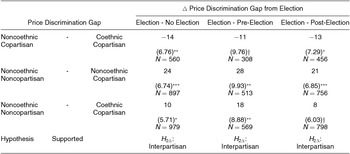
Notes: Results of OLS with standard errors clustered at the rider level and weighted to estimate the sample average treatment effect with equal subject contribution. Estimated difference-in-differences coefficients displayed with standard errors in parentheses. † Denotes significance in some specifications but not others. *** p <= 0.01, ** p <= 0.05, *p <= 0.10.
Additional Analysis
Further exploration of the data can take place by disaggregating results.Footnote 44 Is the effect of the election different depending on party? Being in an opposition or incumbent party may lead to different tendencies towards partisan bias. In fact, the effects are very similar by party. Are the effects consistent across ethnic dyads? Indeed, they are consistent broken down to each of the ethnic dyads. There is large symmetry within the dyads, meaning that, for example, a Ga driver with an Ewe rider is no different than an Ewe driver with a Ga rider. Results are further robust to a recode and an exclusion of the Fanti in the postelection round due to the weaker beliefs about their partisan affiliation at that time.
In digging deeper into the negotiations, I conducted identical analyses for the driver’s first offer and the rider’s first counteroffer as for the ultimate price. (Un)shared group was not significant in determining the driver’s first offer. As for the rider’s first counteroffer, limited support exists for interpartisan discrimination at election time and interethnic discrimination in the postelection round. Thus, differences in average price paid are a result of the riders’ ability to negotiate the price down to a lower acceptable price from the driver, not an initial automatic favor on behalf of the driver. This result cannot adjudicate between the channels responsible for price discrimination (taste-based, statistical, other-regarding preferences, or norms). However, the data do indicate that these mechanisms do not “kick in” immediately — they must be evoked during negotiation.
Confounders of Election Effect?
Two concerns exist regarding the causal validity of the claim that the election caused interpartisan discrimination. First, in an ideal world, one could increase confidence in the effect of the election by repeating the experiments at many more time points than 3. By conducting the postelection round of experiments one year after the election and finding similar results as the first round of experiments six months prior to the election, it reduces any omitted variables which simply act to increase or decrease interpartisan or interethnic discrimination monotonically over time. Additionally, any seasonal effects would be controlled for through comparison of the December 2008 (election) and December 2009 (postelection) waves.
Second, although the election was exogenously timed through fixed timing of elections, we have to brainstorm any omitted variable fluctuating coincidentally with the election that has nothing to do with the election itself. It is difficult to think of such an omitted variable that exacerbates interpartisan discrimination only at election time, yet is not the election. I considered macro variables such as laws passed favoring particular ethnic groups, unemployment shocks, violence unrelated to the election, and changes in the price of fuel. From monitoring the news, no evidence exists for unemployment shocks, laws passed blatantly favoring some ethnic or partisan groups, or major nonelection related violence. Inflation increased prices monotonically over time (see Online Appendix), though this change can not account for the results because the postelection experimental results showed that the election effect melted back to the pre-election experimental results.
One potential concern for taxi fare is changes in petrol price over this time period. Time-series petrol price data collected from a sample of nearby petrol stations reveal that, and perhaps as a consequence of the election, the price per liter was 18 pesewas lower at election time. If average prices under all treatment dyads had decreased, we could worry that the result was caused by lower fuel prices. Yet average price did not decrease at the election (in absolute terms and July 2008 GHcedis), and prices increased for noncoethnic noncopartisans.
Discussion
While the data support the hypothesis that the coethnic/noncoethnic cleavage matters at each snapshot in time, the data did not support the hypothesis that the election exacerbated this cleavage. Instead, the partisan cleavage emerged at election time. This result suggests two conclusions. First, coethnicity may be highly salient and relevant for behavior throughout the electoral cycle, even if its salience relative to other social identities changes (Eifert, Miguel, and Posner Reference Eifert, Miguel and Posner2010). Ethnicity in this context is visible and sticky (Chandra Reference Chandra2012) and entails persistent group properties such as networks and shared language that may not vary over the electoral cycle (Fearon and Laitin Reference Fearon and Laitin1996; Landa Reference Landa1994).
Second, the superordinate partisan identity was activated through party mobilization, but it did not completely melt the ethnic identity categories within the superordinate partisan identities. Rather, multiple identities were important for economic activity at election time, whereby the more groups that were shared, the more favoritistic the behavior. This study challenges those assertions that elections merely serve to exacerbate interethnic discrimination in ethnically diverse democracies (Basadau et al. Reference Basadau, Erdmann, Lay and Stroh2011; Bates Reference Bates1974; Horowitz Reference Horowitz1985; Rapoport and Weinberg Reference Rapoport and Weinberg2005; Snyder Reference Snyder2000). Interethnic discrimination was not exacerbated all around—copartisanship reduced interethnic discrimination, but noncopartisanship exacerbated it.
This nuanced result helps us understand that, while ethnicity continues to be important in everyday encounters, it is not the only identity that matters. Indeed, some might mistake interpartisan discrimination for interethnic discrimination, due to their observational equivalence where such cleavages coincide. Brubaker and Laitin have lamented that scholars have continued to wear ethnic lenses to interpret contemporary politics in such settings, and as a result, see “ethnicity at work everywhere” (Reference Brubaker and Laitin1998: 428). Ake, speaking on African politics in particular, states similarly that, “Africa is seen to be ridden with ethnic conflict” and “ethnic conflicts are actually the false face of something else” (Reference Ake1993: 7). True to these authors’ words, if this study had focused on ethnicity and ignored partisan cleavages, the research would have gone home as yet another study confirming the existence of interethnic discrimination.
These results from a new democracy join the results of those finding evidence of interpartisan discrimination in advanced democracies (Carlin and Love Reference Carlin and Love2013; Fowler and Kam Reference Fowler and Kam2007; Iyengar and Westwood Reference Iyengar and Westwoodforthcoming; Loewen Reference Loewen2010). However, the results in this study expand such existing studies on two counts. First, the electoral cycle matters for interpartisan discrimination. That Michelitch and Utych (Reference Michelitch and Utych2014) find that the salience of partisanship increases at election time in the USA begs the question of whether the electoral cycle may matter in advanced democracies just as well. Second, this study shows the existence of interpartisan discrimination outside the laboratory in an everyday activity, responding to natural political competition in the form of an election. The robustness to field behavior complements and provides robustness to the laboratory findings. Moreover, the discovery of interpartisan discrimination at election time in frequent, allocative, and ordinary economic activity substantiates why elections are times of upheaval for citizens. Elections don’t just affect elite competition—the political contest permeates ordinary behavior between citizens. Future work could consider connections between interpartisan economic discrimination and other discriminatory acts (e.g., political violence) at election time.
CONCLUSION
Elections are the apex of political competition during the electoral cycle, representing null sum competition over access to state resources and policy control. This article questioned whether elections have the power to exacerbate discrimination between ordinary citizens on partisan or ethnic lines in a commonplace activity “outside” the realm of politics—market price bargaining. This question is important because we should better understand how elite political competition trickles down to affect citizen interactions. If elections exacerbate citizen discrimination in particular ways, it gives us insight into why elections are so often destabilizing and polarizing for society.
In answering this question, I first provided original theoretical argumentation culled from interdisciplinary literature. Elections increase party mobilization of the electorate, increasing the salience of partisan identity by increasing (a) the net benefit of identity-reaffirming political participation acts, and (b) the amount of political information aimed at engendering and reinforcing partisanship (Michelitch and Utych Reference Michelitch and Utych2014). Meanwhile, the dominant wisdom in the literature holds that elections increase the salience of ethnic identity through (a) parties’ use of ethnic appeals to woo ethnic constituencies, and (b) ethnic leaders’ mobilization of their followers to extract (promises of) policy resources from parties. Last, the interdisciplinary literature shows a robust empirical regularity that ingroup/outgroup discrimination is exacerbated when identity group salience increases, especially at times of group competition. Applying the literature to elections and market price discrimination, I outlined four potential channels through which ingroup/outgroup discrimination on partisan or ethnic lines may emerge: taste-based discrimination, statistical discrimination, other-regarding preferences, and adherence to norms.
A field experiment with high ecological, construct, and causal validity adjudicated between interethnic and interpartisan discrimination. In particular, subjects negotiated for taxi fare. This experiment was conducted three times around the the fourth election in Ghana, an ethnically diverse new democracy in Africa. The data show that electoral competition exacerbates interpartisan rather than interethnic discrimination. Coethnic riders are able to bargain a lower price from drivers than noncoethnic riders regardless of temporal proximity to the election. However, at election time, and only at election time, prices accepted from noncoethnics diverge based on partisanship. Prices for noncoethnic riders sharing the driver’s political party are significantly lower, while they are significantly higher for noncoethnics affiliated with the opposing political party. An alternative interpretation, for skeptics of meaningful partisanship in new democracies, is that electoral competition mitigates interethnic discrimination within parties and exacerbates it across parties. In other words, behavior toward noncoethnics is conditional on partisan cleavages.
This research yields three contributions to broader political science, which serve as springboards to future research. First, this study is the first to demonstrate that major political events, here an election, have the power to significantly influence citizens’ simple everyday economic behaviors. Electoral cycle effects have largely escaped the behavior subfield, while we have established evidence that the electoral cycle affects government expenditure (Golden and Min Reference Golden and Min2013), coup likelihood (Przeworski Reference Przeworski2012), political violence (Dunning Reference Dunning2011), and even racial bias in state death penalty executions (Kubik and Moran Reference Kubik and Moran2003). Future research into microlevel citizen behavior should reach beyond institutional or individual level explanations to theorize and test the effect, not only of the electoral cycle, but of other temporally dynamic (political) events. Shayo and Zussman (Reference Shayo and Zussman2010)’s recent study, for instance, shows that terrorist attacks increase ethnic bias in Israeli small-claims courts.
Second, this study is the first to show interpartisan discrimination between ordinary citizens in everyday activities in the field, complementing recently conducted laboratory experiments (Carlin and Love Reference Carlin and Love2013; Fowler and Kam Reference Fowler and Kam2007; Iyengar and Westwood Reference Iyengar and Westwoodforthcoming; Loewen Reference Loewen2010). Future work should seek to assess whether and to what extent interpartisan discrimination exists in yet other behaviors and political contexts. The Ghanaian context is a new democracy of relatively high party system institutionalization and competition (Weghorst and Bernhard Reference Weghorst and Bernhard2014). Can interpartisan discrimination only exist under conditions where the party system is stable and parties have organizational infrastructures, or do voters quickly adapt to new partisan cleavages in volatile systems (e.g., Poland, Kenya)? Must the elections be competitive to yield interpartisan discrimination or could they be dominated by one party (e.g., Singapore, Venezuela, Tanzania)? Further, the Ghanaian context is a new democracy characterized by clientelism (Lindberg Reference Lindberg2010). Does interpartisan discrimination characterize partisanship to a larger extent in new democracies across Africa, Eastern Europe, and Asia versus old democracies across Western Europe and the Americas? Rather than age of democracy, perhaps the style of state resource distribution as formulaic of contingent on incumbent support affects the level of interpartisan discrimination. These questions underscore a broad need to embark on a research agenda investigating partisanship cross-nationally and intertemporally, especially in new democracies (although see Brader and Tucker (Reference Brader and Tucker2008); Ishiyama and Fox (Reference Ishiyama and Fox2006); Lupu (Reference Lupu2013); Michelitch and Utych (Reference Michelitch and Utych2014)).
Last, this work challenges the dominant paradigm that elections merely serve to exacerbate ethnic tensions across new ethnically diverse democracies, especially in Africa (Basadau et al. Reference Basadau, Erdmann, Lay and Stroh2011; Bates Reference Bates1974; Horowitz Reference Horowitz1985; Rapoport and Weinberg Reference Rapoport and Weinberg2005; Snyder Reference Snyder2000). While discrimination was exacerbated between ethnic groups in opposing political parties (noncopartisans), it was mitigated between ethnic groups in the same political party (copartisans). Only by considering that citizen behavior may be adapting to the political forces widely known to govern behavior elsewhere across the globe, was this study able to detect the nuanced interplay between elections, partisanship, and ethnicity. While ethnicity surely remains an important topic of further study in ethnically diverse new democracies, the findings here point to the importance of considering partisanship as an important political identity.
SUPPLEMENTARY MATERIAL
To view supplementary material for this article, please visit http://dx.doi.org/10.1017/S0003055414000628

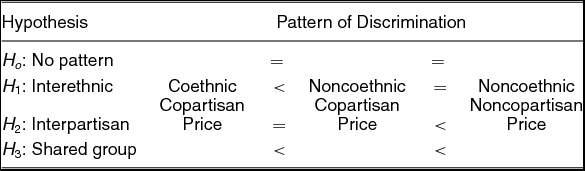
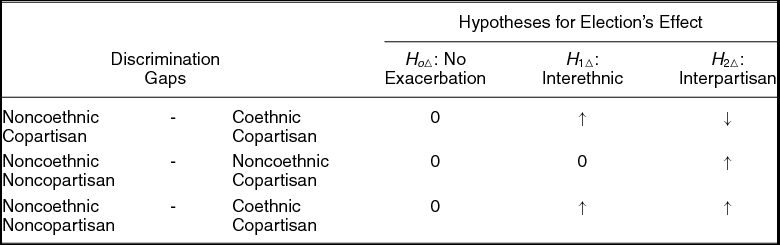
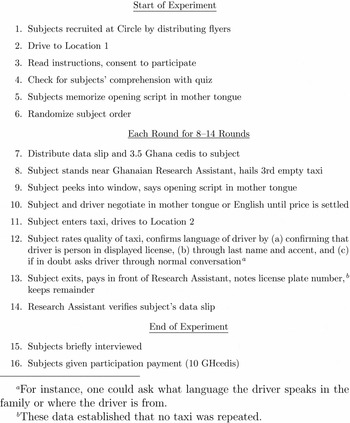
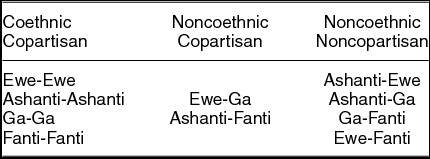
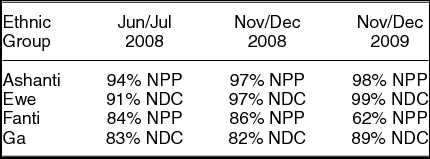
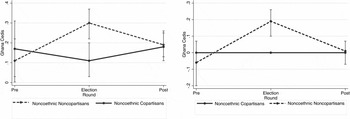
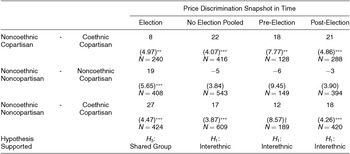
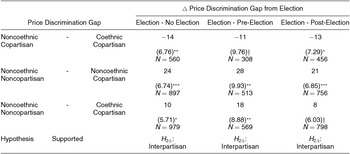




Comments
No Comments have been published for this article.