In 2018, the U.S. Supreme Court handed down a landmark decision in Janus v. American Federation of State, County, and Municipal Employees, Council 31. The controversial 5–4 ruling overturned a forty-year-old precedent in American labor law. Footnote 1 That precedent had allowed public-sector labor unions in the twenty-three U.S. states without “right-to-work” (RTW) laws to negotiate and levy agency fees on dissenting non-members. Janus upended this regime by effectively ushering in a national RTW policy for the entire government workforce, meaning such fees are henceforth banned in all states. Footnote 2 Significant attention is now being paid to forecasting union membership losses in states that are losing access to agency fees (e.g., Malkus Reference Malkus2018). For example, the National Education Association (NEA), the nation’s largest union of public employees, announced that it would trim its operating budget in excess of $50 million in anticipation of a potential 10% membership loss (Antonucci Reference Antonucci2018b).
Attention to the effects of weaker labor laws on union membership is both theoretically and politically important. Public-sector unions number among the most powerful interest groups in the United States (DiSalvo Reference DiSalvo2015), with the strength of union security provisions—like agency shop fees—helping unions solve collective action problems in member recruitment (Olson Reference Olson1965). Indeed, a large literature focuses on how RTW laws that prohibit agency fees encourage free riding, thereby decreasing union density (Ichniowski and Zax Reference Ichniowski and Zax1991; Moore Reference Moore1998; Zax and Ichniowski Reference Zax and Ichniowski1990, Reference Zax and Ichniowski1991). Undoubtedly then, Janus will prompt a new wave of studies that can more precisely quantify how much agency fees impact an individual worker’s union membership decision.
But does Janus represent a broader threat to the organizational power of labor groups in American politics? We argue that it does because it undermines the central means by which federated unions ensure their affiliates’ organizational maintenance: cross-state financial transfers. This is because the organizational strength of a national union’s state affiliates is directly tied to the favorability of the particular labor laws in each affiliate’s state. These laws, which until the Great Recession era of labor retrenchment had essentially been frozen in equilibrium since the 1980s (Moe Reference Moe2011), enabled state union affiliates in strong labor law states to become the dominant “revenue-producers” for their national union’s treasury. In turn, national federated unions came to rely on their revenue-producing affiliates to maintain the financial strength of the entire federated organization, most notably by subsidizing affiliates in states without strong labor laws. By eliminating the agency shop in all fifty states, Janus will, we posit, fundamentally challenge the ability of federated-union interest groups to generate sufficient financial support to ensure the organizational maintenance and survival of their affiliates.
As a way to understand the future impact of Janus, we examine the extent to which federated unions redistribute resources from their stronger to their weaker affiliates, a process that we call “financial solidarity.” Specifically, we test whether the National Education Association (NEA) weathered state labor law challenges in the years leading up to Janus by engaging in financial solidarity, supporting embattled affiliates by transferring additional resources drawn from their more secure branches. Drawing on the NEA’s annually reported tax forms, we show, first, that national federated unions like the NEA are funded primarily by membership dues and agency fees, the bulk of which come from affiliates located in states that long ago adopted labor laws favorable to union organizing. Second, we show that national federated unions sit atop a diverse landscape of affiliates that operate under very different state labor laws; affiliates that never obtained favorable labor laws came to rely significantly more on national support (subsidy) from their parent union compared to NEA affiliates in strong labor law states that instead generate the vast majority of the national union’s dues revenue. Finally, we leverage recent changes in states’ labor laws to estimate the causal effect of legal retrenchment on federated-union activity at the national level. Our findings demonstrate the ubiquity of financial solidarity; variation in sub-national laws directly influences whether and when national federated interest groups aid embattled affiliates.
This study has relevance beyond labor unions because it speaks to the broader role and importance of organized groups in the American political system. In recent years, a number of scholars have called for interest groups to return to the center of political analysis, noting that the role of organized interests is central to understanding political battles and policy outcomes (Anzia Reference Anzia2018; DiSalvo Reference DiSalvo2018; Hacker and Pierson Reference Hacker and Pierson2014; Moe Reference Moe2015). Federated interest groups, in particular, are an important part of the interest group universe. Virtually all labor unions in the United States operate on a federated structure (Martin Reference Martin2007), as well as many types of interest groups (McCarthy Reference McCarthy and Davis2005) and membership organizations (Skocpol, Ganz, and Munson Reference Skocpol, Ganz and Munson2000; Skocpol Reference Skocpol2003). For federated interest groups, organizational maintenance and survival is a core concern, as it is for all organizations (Wilson Reference Wilson1973), but almost no attention has been given to the way in which federated structures impact groups’ organizational maintenance and survival. While many groups rely on patrons for financial support (Walker Reference Walker1983), the strength and survival of federated interest groups depends on maintaining organizational strength throughout the affiliate network. In short, federated interest groups need to ensure that their affiliates are in financial solidarity with one another. For public-sector labor unions, this is precisely what Janus challenges: the ability of federated organizations to maintain themselves by relying on affiliates in favorable subnational legal environments.
Labor Law and Union Power in American Politics
The impact of Janus—and the labor retrenchment leading up to it—represent a critical juncture in U.S. labor law that will profoundly shape the future direction of American politics. Between 2009 and 2012, roughly a dozen states passed legislation uprooting an equilibrium in American labor law that had, since the late 1970s, granted the majority of the nation’s public employees mandatory and exclusive collective bargaining rights (DiSalvo Reference DiSalvo2015; Wieder Reference Wieder2012). During this short time frame, six states enacted RTW laws—twice the number enacted in the previous fifty years. Footnote 3 Meanwhile, numerous states enacted so-called “paycheck protection” laws, which require public workers to opt-in to the automatic deduction of part of their dues for political purposes. Footnote 4 Janus now bans agency fees for public workers in all fifty states. Irrespective of one’s normative views about the merits of these policies, there are (at least) two reasons to anticipate that this critical juncture of labor law retrenchment will have consequences for American politics and public policymaking that merit study.
First, variation in the strength of states’ labor laws have powerful policy feedback effects that shape electoral politics. Public-sector workers are the only remaining semblance of a viable union movement in the United States (DiSalvo Reference DiSalvo2015). While private-sector union membership began falling in the 1950s, public-sector unionism flourished, as states passed new laws requiring state governments to bargain with public employees (Saltzman Reference Saltzman1985; Lipset and Katchanovski Reference Lipset and Katchanovski2001). Public, not private, unionized workers now comprise much of the voice of organized labor within the Democratic Party, with public employees reaching almost half of all the delegates to the Democratic nominating convention (Hartney Reference Hartney2015). To the extent that Janus and similar labor retrenchment reforms in the American states weaken public-sector unions, these laws would hobble an important coalition group within a political party that is, at its core, a “coalition of social groups” (Grossmann and Hopkins Reference Grossmann and Hopkins2015, 120). Footnote 5 At the individual level, states’ labor laws have a significant impact on who gets organized and participates in mass politics (Feigenbaum, Hertel-Fernandez, and Williamson Reference Feigenbaum, Hertel-Fernandez and Williamson2018; Flavin and Hartney Reference Flavin and Hartney2015; Hertel-Fernandez Reference Hertel-Fernandez2018), with the Democratic Party long relying on organized labor as an important ally in campaign get-out-the-vote operations (Asher et al. Reference Asher, Herberlig, Ripley and Snyder2001; Dark Reference Dark1999; Flavin and Radcliff Reference Flavin and Radcliff2011). Some have suggested that the weakening of public-sector labor laws is a deliberate attempt by Republicans to hinder the political mobilization of Democratic-leaning constituencies (Wade Reference Wade2018; Hertel-Fernandez Reference Hertel-Fernandez2018), an argument that attests to the profound potential consequences of labor retrenchment for American politics.
Second, the weakening of labor laws could lead to worsening inequality. Strong labor unions may operate as an essential mediating institution that helps reduce political (Flavin Reference Flavin2016; Gilens Reference Gilens2012; Hacker and Pierson Reference Hacker and Pierson2011) and economic inequality (Farber et al. Reference Farber, Herbst, Kuziemko and Naidu2018). Many look to unions as the groups best positioned to attenuate upper-class biases in American politics (Schlozman, Verba, and Brady Reference Schlozman, Verba and Brady2012), with high union membership levels encouraging more redistributive policy (Becher, Stegmuller, and Käppner Reference Becher, Stegmueller and Käppner2018). In sum, the weakened state of public-sector labor law will likely have major political, electoral, and societal consequences that warrant study. We seek to contribute to this undertaking by looking to the recent past of state-by-state labor retrenchment to shed light on a crucial dimension of Janus’ potential impact: limiting the ability of federated unions to engage in financial solidarity to sustain weaker affiliates.
Theory
Favorable state labor laws are the bedrock of public-sector labor’s organizational maintenance and survival. This is because affiliates are part of a federated whole, which allows federated unions to lean on branches in favorable legal environments—which can more easily generate funds—to ensure their foremost concern for the entire affiliate network: organizational maintenance and survival (Halpin and Nownes Reference Halpin, Nownes, Cigler and Loomis2012; Hansen Reference Hansen1985; Moe Reference Moe1981; Walker Reference Walker1983; Wilson Reference Wilson1973). To the extent that the national organization shares resources with state affiliates, stronger affiliates in favorable state legal environments help support their weaker counterparts in other states. There is reason to believe that unions are no different than the many other types of federated interest groups in this respect. Skocpol, Ganz, and Munson (Reference Skocpol, Ganz and Munson2000) explain in their study of American voluntary organizations how a federated structure meant that the higher-level or national leadership could support struggling local branches: when “a local club or lodge ran into trouble . . . supralocal leaders could make a real difference, especially in the larger, well-established federations. They might ask neighboring chapters to support faltering units . . . During economic downturns, national or state officials might forgive shares of local dues; when meeting houses burned down, they orchestrated appeals for aid” (537).
For public-sector unions, the organizational strength of each state affiliate hinges on the favorability of the labor laws in each affiliate’s state. Unlike the private sector, which is governed by the 1935 National Labor Relations Act (NLRA), U.S. public-sector labor law is highly fragmented and decentralized (Walker Reference Walker2014). This has the practical effect of leaving national (parent) unions sitting atop a diverse landscape of state affiliates that operate under very different labor laws: some enjoy the benefits of favorable laws that promote organizing and boost union revenues, whereas others operate under weak laws that do the opposite. For their part, national union leaders are keenly aware of the need to support struggling affiliates in weak labor law states: “[Since] we’re only as strong as our weakest link . . . almost a third of our budget goes directly into [our] affiliates,” the NEA’s chief financial officer Michael McPherson explained in 2006 to an Education Week reporter. The reporter further noted: “Often that means a redistribution of money to affiliates struggling to build numbers in so-called ‘right to work’ states, where nonmembers pay no dues.”
How is a national union’s ability to support its affiliates impacted by the relative strength of states’ labor laws? Individual workers first decide whether to join the federated union that represents them in collective bargaining. Prior to Janus, in strong labor law states (i.e., non-RTW and mandatory bargaining), negotiated contracts often required non-union workers to nevertheless pay an agency or “fair share” fee to the union. This increased the incentive for all workers in these states to join the union and pay dues to the local, state, and national chapters. Footnote 6 Importantly, dues and (before Janus) agency fee rates are both set and paid separately to a member’s local, state, and national union. Dues that are paid to the local and state affiliates stay nearby, funding state and local program efforts (e.g., collective bargaining, state and local newsletter production). However, the dues and fees that workers pay directly to the national union are often redistributed back to the unions’ state affiliates. Some of these funds flow from the national union back to state affiliates in amounts proportional to membership. Footnote 7 However, not all national-to-state affiliate transfers are so closely tethered to membership, and even seemingly non-discretionary transfers can serve discretionary purposes, with unions strategically distributing resources to aid affiliates on a need-by-need basis. Footnote 8 This is the principle in American labor law known as “affiliated representation,” which is the fact that federated unions pool and redistribute dues and fees across distinct, and even sometimes unrelated affiliates. Indeed, this principle—which in practice means that members and fee-payers cannot object to their national union pooling and sharing general dues revenue throughout the union’s affiliate network—has been reaffirmed by the U.S. Supreme Court on numerous occasions and in some of the court’s most important labor law jurisprudence. Footnote 9
Prior to Janus, affiliated representation operated in perfect and logical conjunction with American federalism (i.e., decentralized labor law), thereby encouraging federated unions to pragmatically organize their interest group operations on a model of transfers and subsidies. We argue that federated unions have been able to build and maintain a strong fifty-state affiliate network by pooling and transferring resources primarily garnered from their affiliates located in strong labor law states.
If our financial solidarity theory—that federated-union interest groups rely on a model of transfers and subsidies to support affiliates—is correct, then the following should be true: first, federated unions should be funded primarily by membership dues and agency fees paid by workers in strong labor law states. Second, as revenue-producers, states with favorable labor laws should depend less on national union revenue than states operating under RTW laws or without mandatory bargaining. Third, if affiliates in states with weaker labor laws do, in fact, rely on affiliates in states with stronger labor laws via transfers from the national organization’s budget, then the passage of a labor retrenchment law should theoretically lead to subsequent increases in the share of state affiliates’ budgets coming from their national (parent) union, compared to the budgets of union affiliates in states without such labor law changes. Put succinctly, if federated unions are engaged in financial solidarity, the following three hypotheses should be true:
-
H1: Federated unions are funded primarily by member funds generated by affiliates in favorable legal contexts
-
H2: The strength of a state’s labor law is inversely correlated with a federated-union affiliate’s reliance on its national (parent) union for financial support
-
H3: In a federated union, the national (parent) union responds to threatened affiliates by transferring additional resources to help subsidize the endangered affiliate
Altogether, our financial solidarity theory suggests a major impact of Janus that is counterintuitive: not only will states newly operating under RTW regimes have to adjust with fewer members and funds, as many have predicted, but the union’s weakest affiliates will no longer be able to rely as heavily on their national (parent) union’s transfers. This is because the parent union will not be able to utilize resources from strong affiliates’ now-illegal agency fees. In sum, as labor law becomes weaker, a domino effect takes hold: the political power of federated unions in the United States will be narrowed, especially geographically.
The NEA as a Case Study
Although there are many different types of public-sector unions and various categories of public employees, the National Education Association (NEA) and its fifty state affiliates offer a strong test of our theory for several reasons. First, the NEA remains the largest trade union (public or private) in the U.S. today with 3.2 million workers represented (Freeman and Han Reference Freeman and Han2012, 401). Moreover, compared to other categories of public workers, teachers are organized into unions that number among the oldest federated-membership unions in the United States. (Goldfield Reference Goldfield1989). Public schoolteachers are among the most unionized U.S. public-sector employee category, with union density rates ranging from 70 to 80% from 1985 to 2003, while union density rates of firemen and policemen were between 55% and 63% in the same period (Farber Reference Farber, Hannaway and Rotherham2006; Lipset and Meltz Reference Lipset and Meltz2004, 136). Importantly, every state has state and local-level NEA affiliates which provides important analytic leverage for us to study whether financial solidarity is in effect, meaning that threats to affiliates spur transfers from the national union.
Substantively, the NEA makes for an attractive case study because teachers’ unions are typically classified as one the most widely influential public-sector unions in sub-national politics, making them important to study (Hrebenar and Thomas Reference Hrebenar, Thomas, Gray and Hanson2004; Nownes, Thomas, and Hrebenar Reference Nownes, Thomas, Hrebenar, Gray and Hanson2007). Some have argued that, as a result of favorable labor laws and teacher activism, teachers’ unions are able to protect their favored policies and prevent adverse initiatives (Moe Reference Moe2011). However, there is an important and ongoing debate about where teachers’ unions are “strong” in the United States and how to best measure this (Finger Reference Finger2018, Reference Finger2019; Hartney and Flavin Reference Hartney and Flavin2011; Winkler, Scull, and Zeehandelaar Reference Winkler, Scull and Zeehandelaar2012). Regardless, our focus on establishing whether and how teachers’ unions support each other across state lines can help illuminate how arguably the most influential public-sector union in the United States operates in the face of long-term and immediate threats.
Data and Empirical Strategy
We examine NEA financial flows (national to state affiliates) to determine whether federated-union interest groups engage in financial solidarity to ensure organizational maintenance and survival. Below, we briefly describe each component of our analysis.
We first document that federated unions like the NEA rely near-exclusively on membership dues and fees to fund overall interest group operations. This is important because financial solidarity is only possible if the majority of the national union’s revenue is secured from individual members whose dues payments are then transferred by the national union to needy affiliates with whom many of those original dues-paying members’ share no direct membership relationship.
We next examine whether NEA affiliates that never obtained these favorable state labor laws rely more on national support (subsidy) from their parent union in Washington than affiliates in states that long ago adopted such laws. It is here that we begin to establish quantitative evidence of the union engaging in financial solidarity. Specifically, we show that NEA affiliates in states that never cemented strong public-sector labor laws in the 1960s and 1970s disproportionately depend on the national organization to finance their internal state operations. Third, we leverage recent changes in states’ labor laws during the Great Recession wave of labor retrenchment to test whether the national union’s tendency to subsidize affiliates is directly responsive to threats to the affiliate’s financial independence. Fourth and finally, we show that financial solidarity extends into the electoral arena; the NEA is far more likely to give to state political campaigns where labor retrenchment policies recently passed, suggesting that the NEA is aiding in state political battles to combat changes that could undermine future union mobilization (Feigenbaum, Hertel-Fernandez, and Williamson Reference Feigenbaum, Hertel-Fernandez and Williamson2018).
Labor Union Interest Groups Are Dues-Dependent
If financial solidarity is how federated unions sustain themselves, the national parent organization should rely primarily on membership funds for revenue and those membership funds should be disproportionately generated by teacher members and fee payers in strong labor law states. To first establish that national NEA revenues do, in fact, come primarily from the dues of rank-and-file members and (before Janus) from the fees paid by dissenting non-members, we turn to archived LM-2 reports on file with the Department of Labor (DOL), which provide annual information on a labor union’s total revenues and an itemization of revenue sources. Footnote 10 We are fortunate to have the complete set of these annual reports which begin in 1976–1977 and extend all the way to the most recent report released by DOL in November 2018 (covering the NEA’s 2017–2018 fiscal year).
We first calculate the percentage of the national NEA’s revenues that were generated from dues paid by members and agency fees paid by non-members. We find that over the past four decades, the national union has relied almost exclusively on the dues and fees of individual members to fund its operations, including, importantly, any funds the union transfers to its sub-national affiliates. Specifically, from 1977 to 2018 the average overall share of NEA revenue coming from dues and fees was ≈83%. If anything, NEA’s reliance on dues and fees as its chief revenue source has increased over time. As of 2018, dues and fees accounted for over 95% of the union’s revenue, with the rest coming primarily from investments and grants.
Although our analysis of nearly 40 years of historical LM-2 reports clearly reveals that NEA relies primarily on member dues to sustain the organization’s operations, financial solidarity also implicitly requires that we show that the bulk of these member dues and fees come to the national organization primarily from members in strong labor law states. This is a key part of the financial solidarity theory because it means that funds going to embattled affiliates in weak labor law states originate with dues-paying members in the stronger affiliate states, suggesting that cross-state redistribution is occurring. If the bulk of funds instead came from investments or foundation grants, organizational maintenance would not rely on solidarity across affiliates; it would rely on external sources. This is where the “solidarity” aspect of our theory comes into play.
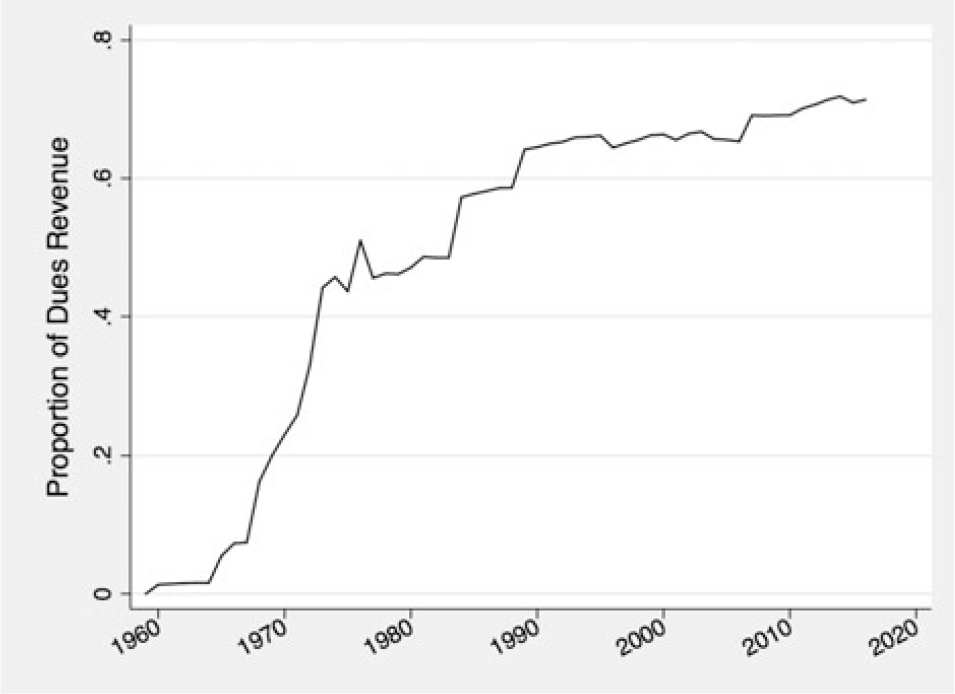
To demonstrate that the NEA’s budget depends primarily on dues collected from affiliates in states with favorable labor laws, we first gathered historical data on national NEA dues rates beginning in 1959 when Wisconsin became the first state to adopt a teacher bargaining law. Next, we gathered annual NEA membership totals for each state from 1959 to 2016. Both data points were assembled by hand-entering data reported each year in the NEA’s annual NEA Handbook publication. Finally, we classified state affiliates as strong labor law states if, in a given year, the affiliate had the benefit of a mandatory teacher bargaining law without any RTW restrictions precluding the affiliate from negotiating and levying agency fees on non-members. The result of this nearly sixty-year analysis of where national NEA dues membership originated from is shown visually in figure 1. Figure 1 illustrates that, of the large percentage of the NEA’s budget coming from dues, most of those are coming from affiliates in states that both mandate collective bargaining and do not prohibit agency fees. The figure shows that the proportion coming from such affiliates unsurprisingly increased during the 1960s and 1970s as more states passed collective bargaining bills. By 2016, over 70% of NEA dues revenue came from members located in states with collective bargaining laws and no prohibition on agency fees. Footnote 11 Note that this is a conservative estimate of how much the NEA relies on strong affiliates; historical data on agency fee collection is unavailable, and agency fee dollars can only come from strong labor law states that allow such fee collection. In other words, the NEA’s budget is even more dependent on affiliates in strong labor law states than this figure suggests. In sum, the first condition for financial solidarity appears to hold: the NEA’s national programming budget has long been funded and maintained by funds collected from teachers located in strong labor law states with union security provisions and mandatory collective bargaining.
The share of NEA dues revenue coming from affiliates in pro-labor legal contexts
Note: The figure shows the annual estimated proportion of total NEA dues revenue that the organization received from members located in strong labor law states. The measure is generated by multiplying the annual dues rate with the total number of members in each strong labor law state affiliate that year.

State Labor Law, Retrenchment, and National Union Support
Having established that the NEA relies mostly on member dues and fees to fund operations, we proceed to test the second and third hypotheses that underlie our theory that union organizational maintenance and survival is reliant on financial solidarity. We test whether the strength of a state’s labor law is inversely correlated with an affiliate’s financial reliance on its national (parent) union, and we test whether the national (parent) union supports endangered affiliates by transferring additional resources.
Testing these hypotheses requires two types of data. First, we need an outcome measure that captures the amount of resources transferred from the national union to each of its separate state union affiliates over time. Second, we need a way to measure the relative strength of each state’s public-sector labor law across that same time period (our key explanatory variable).
For our outcome measure, we rely on data supplied directly from the NEA in their annual LM-2 reports filed with the Department of Labor (DOL). LM-2s are a rich data source since, in addition to providing information on membership, dues, and other basic measures of the national union’s organizational capacity, unions are required to report disaggregated expenditures by category and function, including itemized expenditure transfers to specific organizations (including subsidiary state affiliates—our key unit of interest). Footnote 12 Altogether, these LM-2 reports allow us to measure the total amount in dollars of financial support the national NEA provided to each of its state affiliates, annually, over the course of fourteen separate fiscal years. Footnote 13 To correct for differences in transfers due to larger membership, we calculate the amount transferred to each state affiliate per member.
As an alternative measure of an affiliate’s “reliance” on the national parent union (NEA) for financial support, we calculate transfers as a percentage of state affiliates’ budgets. Not all affiliates file LM-2s, so we pair the NEA’s LM-2 data on transfers to state affiliates with each state affiliate’s 990 form, which each does have to file annually. Most tax-exempt organizations, including labor unions, must file 990s yearly with the IRS, providing basic information about their revenues, expenditures, governance, and other organizational information. The forms are available through GuideStar, and we recorded all fifty state affiliates’ total revenues each year from 2005 to 2016. Footnote 14 This allows us to generate a measure of the percentage of each state affiliate’s overall revenues that came directly from the national union, as opposed to revenues generated internally by the affiliate itself. In sum, we end up with two main outcome measures: the dollars per NEA member that an affiliate obtains from the national union (2005–2018) and the percentage of each affiliate’s revenues that came from national union transfers (2005–2016).
For our key explanatory variable of interest—variation in the strength of states’ public-sector labor laws for K–12 teachers—we rely on the Valletta and Freeman (Reference Valletta, Freeman, Freeman and Ichniowski1988) NBER Public Sector Collective Bargaining Law Data, which we update using a series of NEA reports entitled “Collective Bargaining Laws for Public Sector Education Employees” and “NEA Collective Bargaining Laws Manual State Summaries.” We begin by focusing on two key aspects of states’ teacher bargaining laws: (1) whether state law mandates that school districts bargain collectively with teacher employees and (2) whether state law allows union affiliates to negotiate agency or “fair share” fees that can be assessed on non-members whom the union represents in collective bargaining. Descriptively, thirty-four states had mandatory teacher collective bargaining while sixteen states did not at the start of the study period. Prior to Janus, twenty-two states had both mandatory bargaining laws and (at least) allowed unions to negotiate agency fees, while twenty-eight states either had RTW laws in place or expressly prohibited agency fees for teachers. Together, these two provisions provide our baseline categories for classifying state labor laws as either “strong/favorable” or “weak/unfavorable” to the union affiliates operating therein.
Federated Unions Rely on Dues from Affiliates
We first consider whether the NEA’s state affiliates are equally reliant on internally generated dues revenue and, in particular, whether state union affiliates in traditionally “weaker” labor states—those without mandatory bargaining and agency fees—have come to rely disproportionately on the national NEA to subsidize their annual operations. This is an important descriptive point to establish. After all, if state union affiliates—irrespective of the internal political and labor characteristics of their state—receive a similar share of their budgets from the NEA, or if unions in pro-labor states, but not those in anti-labor states, receive most of their budgets from NEA transfers, the adoption of a labor retrenchment law in historically strong-union states (e.g., California, Michigan, Wisconsin) may not impact weaker union affiliates’ operations very much. If, however, the parent union in effect redistributes funds toward its weaker affiliates, then labor retrenchment laws adopted in traditionally strong union states will likely have important consequences for weaker affiliates, those unions that most depend on national funds.
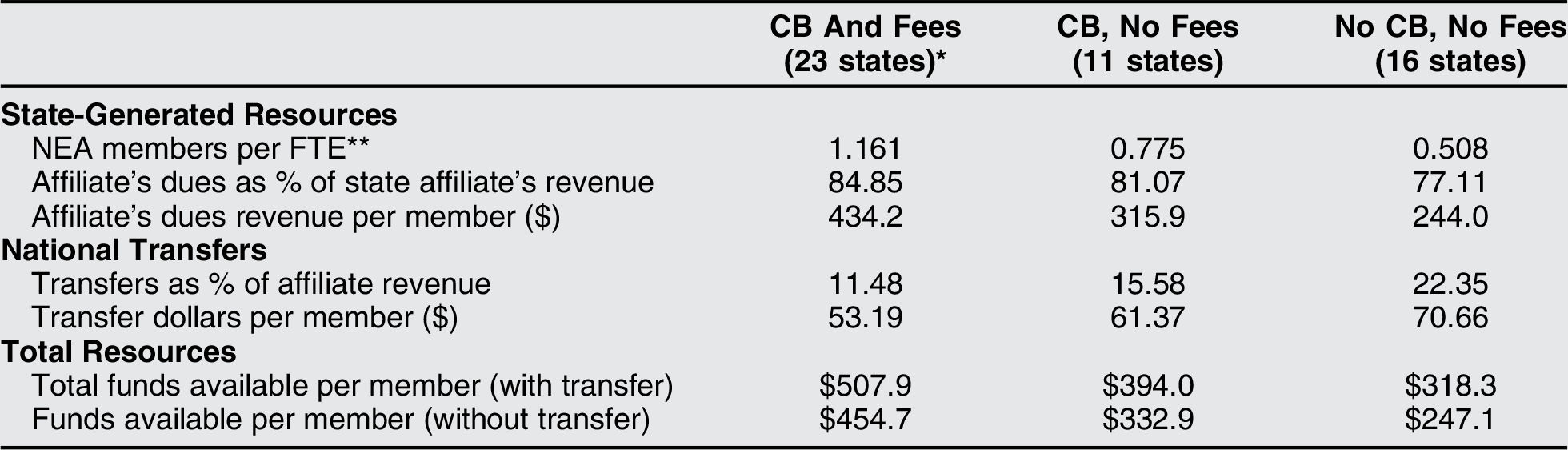
Table 1 provides some basic descriptive statistics for NEA affiliates broken down by whether affiliates operate under a state labor law that provides both bargaining and fees, bargaining alone, or neither bargaining nor fees. It shows that in states where school districts are not required to bargain with teachers’ unions, membership rates are lower, dues rates are lower, and dues revenue constitutes less of the budget; in other words, affiliates in states with a duty to bargain and fees benefit from more dues revenue as a function of more dues-paying membership and higher dues. They also rely less on national revenue transfers than peer affiliates in states without bargaining laws and agency fees. In contrast, where collective bargaining is not required and especially where fees are also prohibited, state affiliates have smaller operations and fewer of their own resources to spend, and more of their revenues are drawn from the national union’s treasury. Importantly, all these differences are statistically significant at conventional levels. These results are consistent with the expectations of our second hypothesis, namely, that the strength of a state’s labor law correlates inversely with a federated-union affiliate’s reliance on its national (parent) union for financial support.
Mean financial characteristics of state affiliates, by labor law, pre-Janus (2005–2016)

Notes: CB = Collective Bargaining.
* Number of states in 2016, prior to Janus.
** Number of NEA members (including retirees) divided by the number of full time teachers. Michigan’s state affiliate (MEA) is coded as a mandatory bargaining and fees state from 2005–2012 but subsequently is coded as just mandatory bargaining for 2013–2016, reflecting the state’s adopting of a RTW law in 2012. Similarly, Wisconsin (WEAC) switches from mandatory bargaining and fees to only mandatory bargaining in 2012. Otherwise all affiliates stay in the same classification for the entire duration of the pooled time series.
Retrenchment Provokes Federated Unions to Subsidize Embattled Affiliates
Our third hypothesis goes further. It stipulates that federated unions like the NEA will engage in financial solidarity when the legal framework an affiliate faces suddenly changes, thereby moving an affiliate from a strong labor law environment to a weak one. Although variation in state public-sector labor law was largely set and frozen in place by the late 1980s, we are able to leverage the fact that the aforementioned Great Recession period brought a wave of disruption to state labor law. Since we are ultimately interested in a causal analysis that necessitates an over-time research design, our most important analysis thus relies on the construction of our own original labor law retrenchment database capturing these state-level changes. Our original dataset captures key changes in teacher labor laws between 2005–2018, during the onset and aftermath of the Great Recession. Specifically, we document the three most common types of retrenchment legislation that states enacted during this time frame:
-
1. A statewide ban on agency fees (prior to Janus)
-
2. A statewide ban on payroll deduction (eliminating laws that allow unions to use payroll deduction to solicit dues and/or contributions to a union’s political action committee [PAC])
-
3. A statewide weakening of teacher collective bargaining
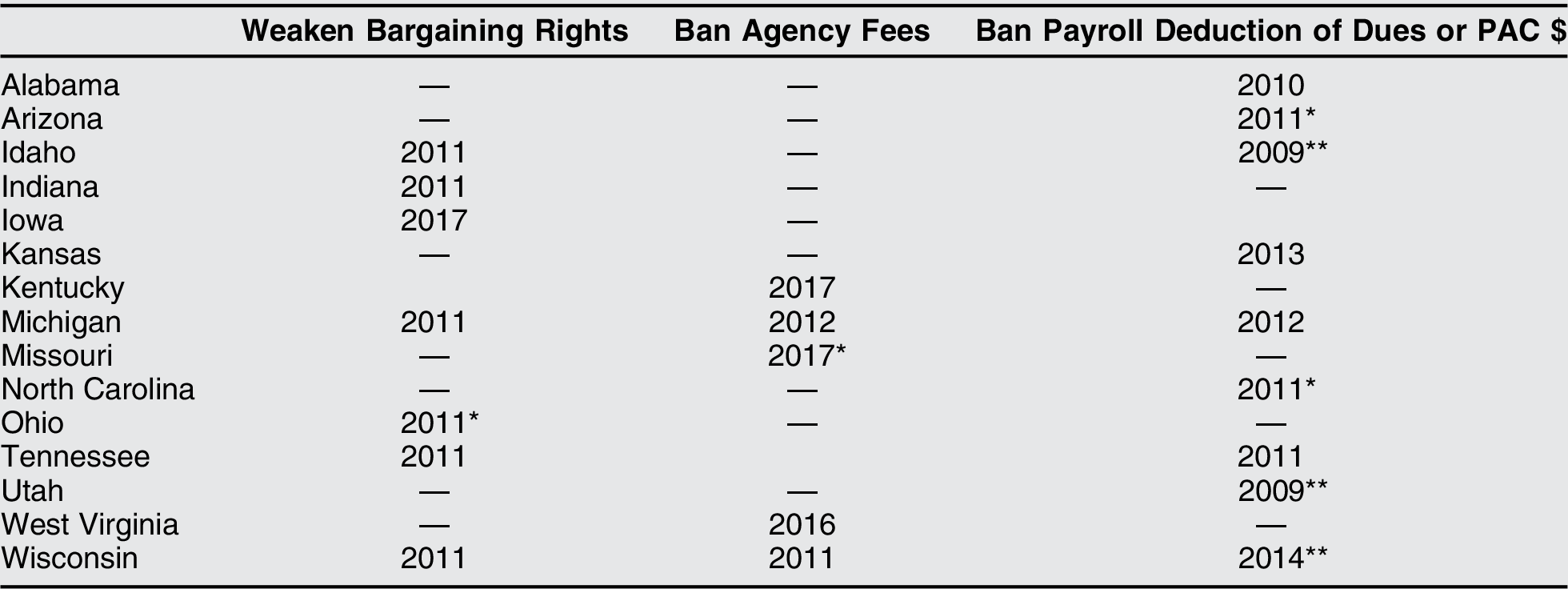
Our original dataset of labor retrenchment laws was constructed by consulting a wide variety of sources including the National Conference of State Legislatures’ (NCSL) database of collective bargaining and labor union legislation and various labor law reports compiled by the Education Commission of the States (ECS). Additionally, we consulted state and national newspapers, relevant advocacy organizations (e.g., AFSCME, NEA, National Right to Work Committee), and prior scholarly work that focused on similar recent elements of retrenchment in labor law (Hertel-Fernandez Reference Hertel-Fernandez2018; Olney Reference Olney2014; Malin Reference Malin2012). The results of these efforts are shown in table 2, which lists the teacher labor law changes occurring during this time period of the study.
States enacting labor retrenchment laws between 2005 and 2017

Notes: *Law never took effect because it was overturned by the courts (AZ, NC) or popular referendum (OH, MO) shortly after passage. For this reason, we do not include these laws.
** Denotes date of implementation (stalled due to court challenges that issued injunctions).
To systematically assess the effect of retrenchment on the national union’s propensity to subsidize its affiliates, we leverage differences in the timing of the retrenchment laws shown earlier to estimate the following regression equation:
 $${\text{Transfers}}_{{\text{sy}}} = \mu _{\text{s}} + \varphi _{\text{y}} + {\text{Retrenchment}}_{{\text{sy}}} \beta _1 + {\text{Initiative}}_{{\text{sy}}} \beta _2 + \varepsilon _{{\text{sy}}}$$
Transferssy represents an outcome of interest (either dollars per-member transferred by the national union to an affiliate, or the percentage of an affiliate’s total revenues coming from national union transfers) in state s during fiscal year y. μs are state dummies that account for any time-invariant state characteristics, while φy are dummies that account for year fixed effects.
Our key explanatory variable of interest is Retrenchmentsy, which is a simple binary indicator (1=yes; 0=no) that measures whether during a given year of the analysis a state affiliate is operating in a context where retrenchment legislation has been enacted. Our preferred estimates focus on a lagged retrenchment indicator such that an affiliate has been operating under retrenchment for a complete fiscal year. Footnote 16 We also include a dummy variable represented by Initiativesy that controls for whether a given state during a given year had a ballot initiative or referendum being contested. We include this variable because ballot initiatives may prompt the NEA to send additional revenues to an affiliate. This is an important control variable because we want to make sure that the national NEA transfers are directed at an affiliate to offset the deleterious effects of retrenchment laws rather than an episodic instance of the national interest group seeking to send dollars for an idiosyncratic ballot initiative in the state of interest. Footnote 17 Although we do not present them here, all of our models are fully robust to including other state-year measures including: government ideology (Berry et al. Reference Berry, Fording, Ringquist, Hanson and Klarner2010), partisan control of the legislature, and measures that capture the general power of public-sector unions in a state such as union density and collective bargaining coverage (Hirsch and Macpherson Reference Hirsch and Macpherson2003). Footnote 18
The basic identification strategy is to incorporate both state and year-fixed effects so that the coefficient β1 provides an estimate of the within-state effect of an affiliate undergoing retrenchment on the amount of transfers from the national union. In all our models, we cluster standard errors by state to account for the fact that the process determining an affiliate’s annual finances are nested within the same state and are thus not statistically independent from one another (Arceneaux and Nickerson Reference Arceneaux and Nickerson2009).
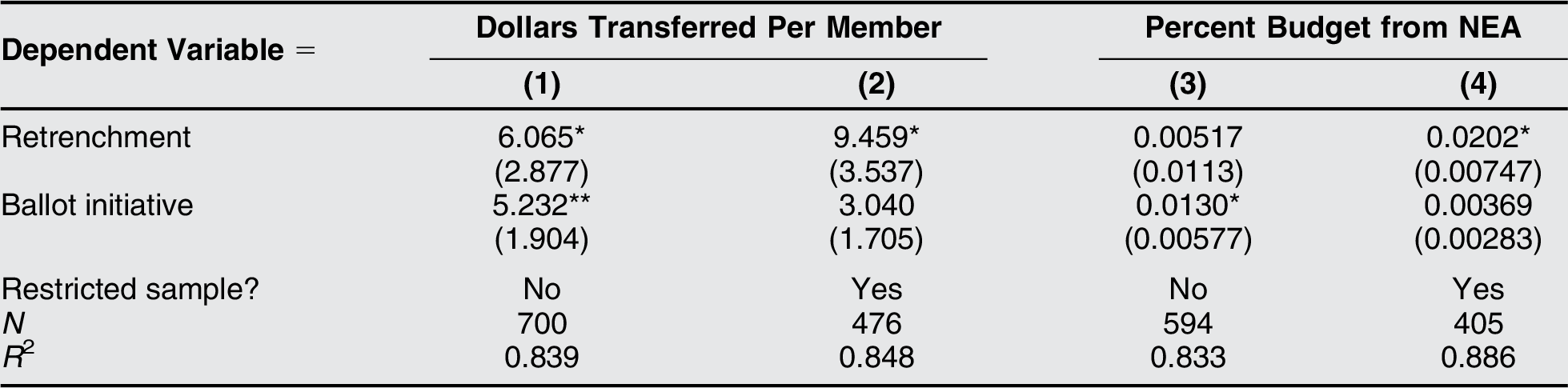
Using this more rigorous unit fixed effects analysis, the ≈$8–18 per-member difference in states with favorable labor law and states with weaker labor law shown earlier in table 1 (cross-sectionally) are reduced, but not by much. As column 1 of table 3 shows, the adoption of any retrenchment law (irrespective of the type of retrenchment) is associated with a statistically significant subsequent increase in the amount transferred by the national union to a newly weakened state affiliate by approximately $6 per member (p < .05). In our preferred specification (shown in column 2 of table 3) we estimate the relationship between retrenchment and additional dollars transferred to an affiliate to be $9.50 (p < .05). In this preferred estimation, we focus on the sample of thirty-four state affiliates that began the period of our analysis with a mandatory collective bargaining law. This is our preferred sample since those states experiencing retrenchment were most similar to other mandatory bargaining states entering the Great Recession-era period of retrenchment. To put these effect sizes in perspective, consider a state NEA affiliate like the Michigan Education Association (MEA) that experienced some of the most notable retrenchment during the Tea Party-dominated political era following the Great Recession. An additional $9.50 per MEA member would, in the aggregate, represent a difference of just under one million dollars to the MEA as an organization. Those are financial resources that MEA could spend on voter mobilization efforts, mass communication, or lobbying advocacy campaigns. Or MEA could simply use it as overhead to offset the loss of the advantageous security provisions that previously existed in Michigan labor law that had enabled it to garner more of its own resources in an earlier time.
The effect of labor law retrenchment on NEA transfers to state affiliates

Notes: ∗ p < 0.05∗∗; p < 0.01∗∗∗; p < 0.001.
Standard errors are clustered by state in parentheses. All models include state and year fixed effects. In our preferred estimates, we restrict our sample to include only the pool of the thirty-four states that had adopted mandatory collective bargaining laws by the beginning of our analysis (2005). This is based on the intuition that we want to construct the best counterfactual possible. In column 3, there are fewer than 700 observations due to 990 tax forms being unavailable for 2017 and 2018, and a few missing data points on tax forms the other years.
If we instead examine the effect of retrenchment on changes in the composition of an affiliate’s revenue source, we uncover similar results. For example, in column 4 of table 3, we estimate that a state affiliate that had mandatory bargaining in 2005 but subsequently underwent retrenchment on just a single labor law provision between 2005 and 2018 ended up filling 2% more of their budget with dollars taken from national transfers (p < .05). Substantively, this is non-trivial considering the average overall size of an affiliate’s budget is roughly $23 million per annum; the average affiliate receives 15% of total revenues from the national union with a standard deviation of 9%. An analysis that substitutes the Retrenchment variable with an additive variable for the number of retrenchment policies yields very similar results, with an additional retrenchment policy increasing transfers per member by $6, and leading the NEA to supply an additional 1% of the affiliate’s budget. Both results (not displayed) come from the restricted model and are statistically significant (p < .05).
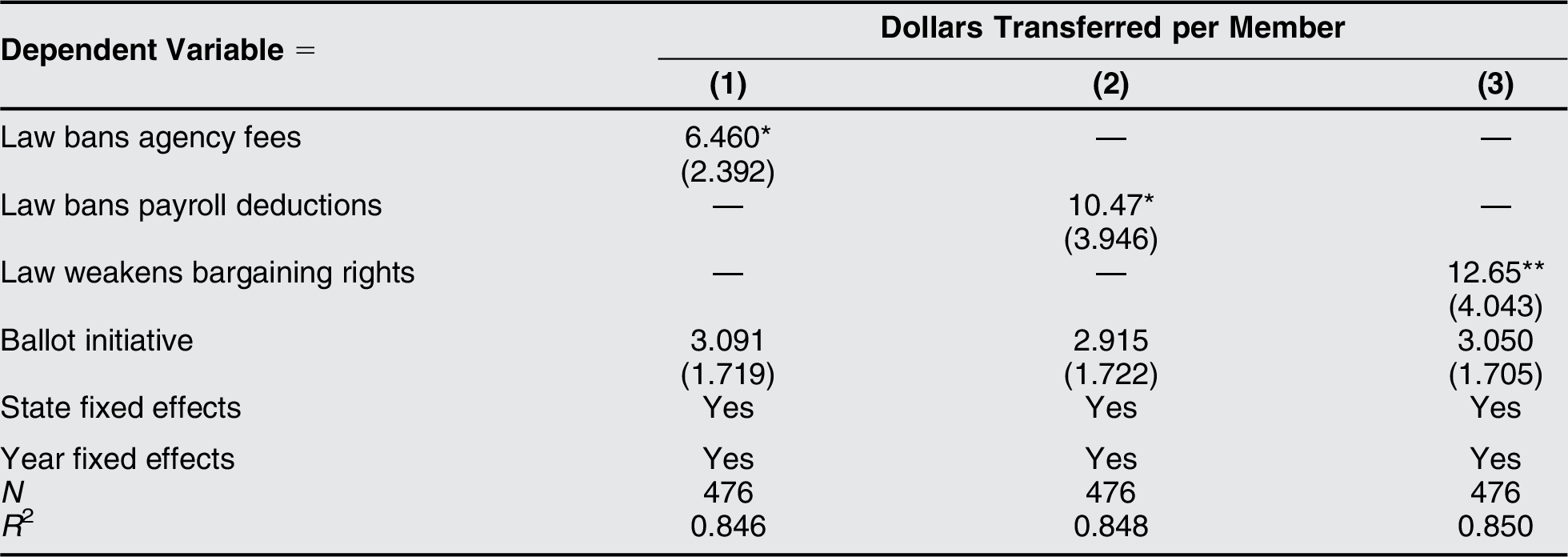
Finally, table 4 focuses on the effects of each separate labor law retrenchment policy to determine if any one particular policy change stands out and ratchets up financial solidarity via subsidy from the national union. The results of these analyses confirm that no specific type of retrenchment is driving our results. However, they show that curtailing mandatory collective bargaining appears to have the largest effect on an affiliate turning to the national union to find more resources to fund the state union’s operations. Specifically, we find that when an NEA affiliate experienced collective-bargaining retrenchment, an affiliate subsequently drew nearly an additional $13 per member from the national union’s treasury to keep union interest group operations running at the state level (p < .01).
The effect of specific retrenchment policies

Notes: ∗ p < 0.05∗∗; p < 0.01∗∗∗; p < 0.001.
Standard errors clustered by state in parentheses. All models include state and year fixed effects. Only the thirty-four states with required collective bargaining at the start of the study period included in order to construct the best counterfactual possible.
Retrenchment Provokes Unions to Finance Affiliates’ Political Battles
As an additional test of our third hypothesis, we examine whether financial solidarity extends directly into electoral politics. If our theory of financial solidarity is correct, we would expect it to hold not just for dues transfers, but for other kinds of financial flows that could help state affiliates in important state-level political contests—from gubernatorial races to ballot initiative campaigns—when affiliates are under acute attack. To wit, our final set of analyses focuses squarely on the national union’s propensity to make financial contributions to state-level political campaigns in response to episodes of state-level retrenchment.
This is especially important since these state-level political battles can and often do involve contests to shape public policies that influence the capacity of state-level affiliates to fight their own political battles as strong independent interest groups in their own right. Recall that prior research has shown that labor laws have important mobilizing effects on union activism in politics (e.g., Feigenbaum, Hertel-Fernandez, and Williamson Reference Feigenbaum, Hertel-Fernandez and Williamson2018; Flavin and Hartney Reference Flavin and Hartney2015). Hence, national groups have a strong incentive to deploy resources to help affiliates that are losing their mobilization capacity or to stop the bleeding once the internal politics of the state has put the union affiliate on the defensive. Moreover, labor retrenchment threatens the ability of union affiliates to engage in their fundamental role as union representatives. This is largely why in 2000 the NEA introduced the Ballot Measure/Legislative Crisis Fund (BMLC)—to make national resources available to fight state-level ballot initiative campaigns that threaten the union. Footnote 19 The BMLC added $5.00 to each member’s national dues (which were $123 in 2000) for the short-term purpose of helping state affiliates wage ballot initiative campaigns and media relations campaigns using national resources. The NEA raised it first to $10 and then to $20 per member in 2011. In 2015, the assembly officially made the BMLC a permanent part of dues. An Education Week article from 2000 explained the logic of this electoral involvement well, stating that “the ability of unions to represent their members through labor negotiations depends on labor laws adopted—and often modified—by politicians.” The NEA’s general counsel elaborated, “So you tell me how I can possibly separate NEA’s collective bargaining efforts from politics—you just can’t . . . It’s all politics” (Archer Reference Archer2000).
The best example of this may be the scenario that unfolded in Ohio in 2011. A few months after Ohio governor John Kasich signed legislation curtailing public employees’ collective bargaining rights, opponents successfully overturned the law—known as Senate Bill 5—in a referendum campaign held in November 2011. Tellingly, while the largest donor to defeat Kasich’s retrenchment law was the NEA’s Ohio affiliate, the Ohio Education Association (OEA), the third largest contributor in support of repeal was the OEA’s parent union, the NEA. In total, OEA spent just over $6.5 million to repeal Senate Bill 5, while the national NEA sent over $4 million of the national organization’s resources to aid its embattled Ohio affiliate. The NEA’s contribution alone accounted for nearly 10% of all of the money contributed to the ballot initiative, on both the pro- and anti-sides. Footnote 20 It was crucial to overturn this legislation because it was a devastating blow to the OEA’s ability to engage in its regular operations. Footnote 21
To test whether financial solidarity extends into state politics, we use the same basic model we used earlier to examine national union transfers to affiliates reported in LM-2 reports (tables 3 and 4). Again, the intuition is to leverage recent changes in labor law to estimate the within-state effects of retrenchment on the national NEA’s financial transfers to newly embattled affiliates. The chief difference here is that our outcome variable is focused not on parent-to-affiliate transfers but rather on the national union’s propensity to make political contributions to state-level campaigns in an affiliate’s state. We use a simple binary outcome measure that captures whether, in a given state during a given year between 2003 and 2018, the national NEA made any campaign contribution to either a gubernatorial race, a ballot initiative campaign, or a state party committee (1=yes; 0=no). Footnote 22 We include this binary measure rather than the total amount of dollars contributed or contributions as a share of the NEA’s total contributions because amount or percentage measures are impacted by wide differences in states’ campaign finance laws, party committee structures, and electoral rules and procedures, rendering the overall quantity of dollars donated less theoretically important than the baseline decision of the national union to make any contribution to a state-level political battle. Footnote 23 Moreover, the national organization’s propensity to contribute to state-level political contests is relatively rare since most contests are funded through the state affiliates’ own political action committees, so whether NEA national contributed anything to a state race is a significant action. All contribution data comes from the National Institute on Money in Politics, which has a full repository of campaign donation data for our relevant state political offices of interest (governors, party committees, and ballot initiatives). We use data from 2003 to 2018. Footnote 24 Descriptively, the states receiving the most contributions were Iowa, Maine, and Virginia, where the NEA contributed to state campaigns for 11 of the 16 years we examine. On average, states received NEA donations during 4.5 of the years in our dataset.
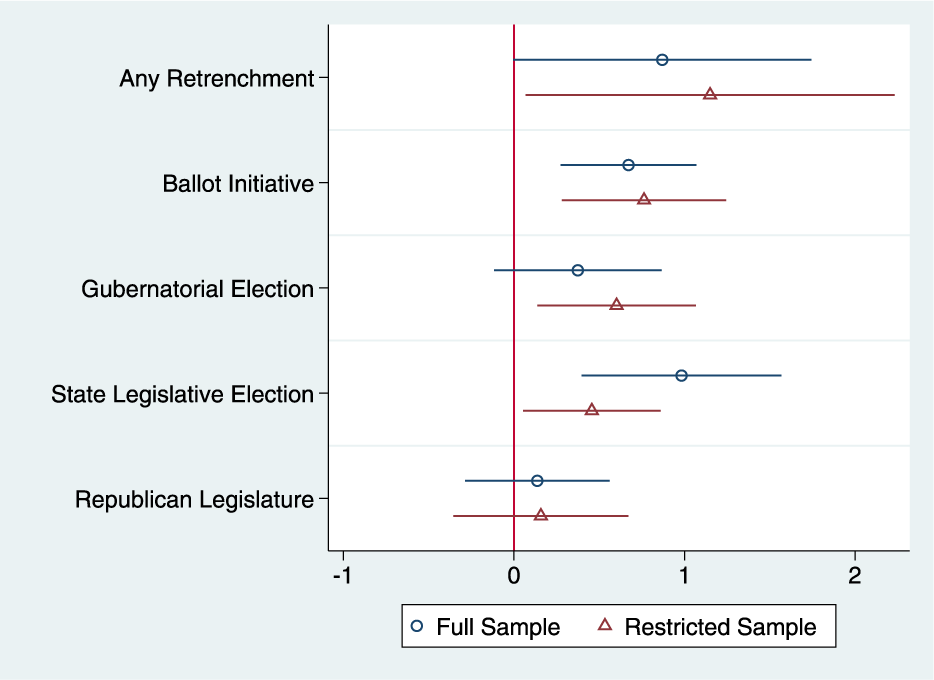
Alongside our key explanatory variable of interest (whether an affiliate has undergone retrenchment), our model controls for whether in a given state during a given year there was a ballot initiative or referendum, a governor was up for election, and any state legislative seats were contested. We also include the partisan control of the legislature. For ease of interpretation, figure 2 presents the coefficients from our maximum likelihood estimations of retrenchment on the propensity of the national union to make a state-level campaign contribution. Similar to our earlier analyses presented in tables 3 and 4, we report results for the entire sample of states as well as our preferred estimates that focus on those states where affiliates had mandatory collective bargaining rights at the beginning of the analysis.
The impact of labor retrenchment on NEA campaign contributions to states
Note: With 95% confidence intervals. The figure displays coefficients from probit regressions where the dependent variable is an indicator for whether NEA made a campaign donation for any state-level race or ballot initiative, as well as to state party committees. We include state and year fixed effects and cluster standard errors by state.

What do we find? Unsurprisingly, the NEA is far more likely to make a contribution when more offices are up for election. For example, when a gubernatorial race is on the ballot, the NEA is, all else equal, 12.6 percentage points more likely to send national union dollars to a state (p < .05 in the restricted sample). Interestingly, partisan control of the legislature is not a significant predicator of NEA activism in state politics. On our main explanatory variable of interest—retrenchment—we find strong and robust support for financial solidarity extending into the political arena. In the aftermath of a state adopting a labor retrenchment law, the NEA is 24.1 percentage points more likely to make a contribution in state-level politics in their newly embattled affiliate’s state (p < .05 in the restricted sample).
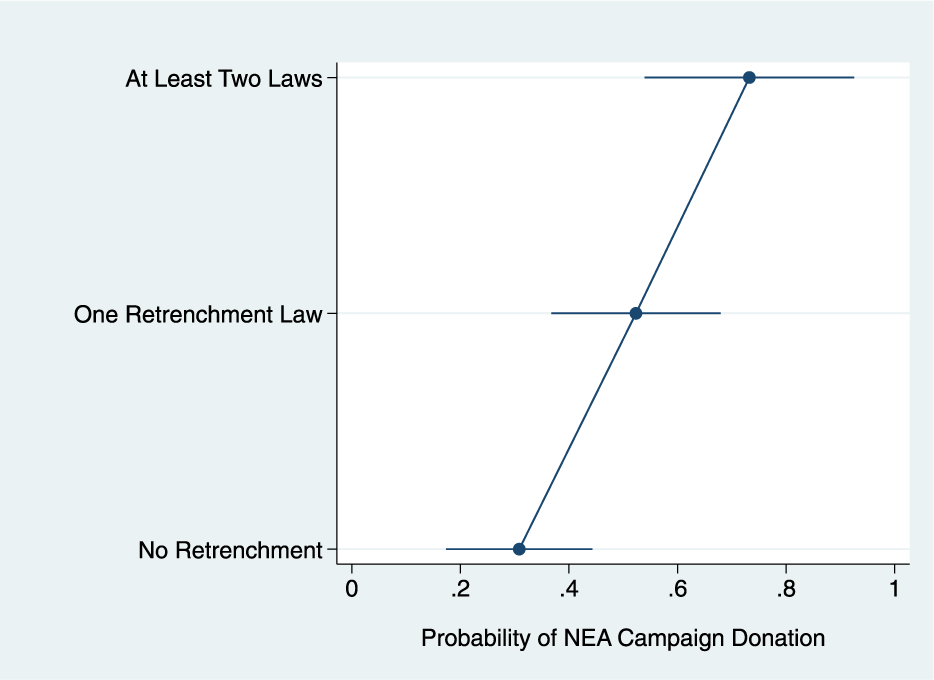
Figure 3 pushes the analysis a bit further by examining whether the propensity of the NEA to support its state affiliates increases in relation to the number of legal attacks an affiliate has faced. The answer seems to be yes. The probability that the NEA sends political contributions to fight political battles in an affiliate’s home state increases in proportion to the number of retrenchment laws passed in the state. Recall from table 2 earlier that some states faced multiple episodes of retrenchment. In the most well-known examples (Wisconsin and Michigan), state lawmakers adopted several rollbacks including bans on agency fees, curtailed bargaining rights, and limitations on payroll deduction.
Predicted probability of an NEA campaign contribution as retrenchment accumulates
Note: With 95% confidence intervals. The dependent variable is an indicator for whether the NEA made any campaign contribution to a gubernatorial race, ballot initiative campaign, or state party committee. Controls include whether there was a gubernatorial election the year of the donation, whether there was a state legislative election, whether there was a ballot initiative, and whether Republicans control the legislature. We also include state and year fixed effects and cluster standard errors by state. Predicted values are taken holding ballot initiatives at 0, Republican legislature at 1, and gubernatorial and legislative elections at 1. The specification displayed here comes from the restricted sample of states with required collective bargaining, but the results hold for the full sample.

As figure 3 shows, the likelihood that the NEA assists state affiliates undergoing retrenchment rises with the number of laws passed. The NEA’s baseline probability of contributing in a state with no retrenchment is 30.8% (p < .001). Where one law passes, the probability of the NEA making contributions increases 21.5 percentage points (p < .001). The chance of contributions increases another 20.9 percentage points to reach 73.2% (p < .001). Each of these predicted probabilities and their marginal effects are statistically significant. As to the specific policies that matter most, when we carry out separate analyses for each of the three policies (with the same controls and the restricted sample), we find the strongest effects for agency fee and collective bargaining rollbacks, with the former increasing the probability of a campaign contribution from the NEA 40 percentage points (p < .001) and the latter increasing the probability 29.7 percentage points (p < .1).
In sum, we find clear and consistent evidence that from 2003 to 2018, the nation’s largest public-employee union became far more aggressive in redistributing its revenues to fight state-level political battles for affiliates facing labor retrenchment policies. Such policies had the potential to undermine those affiliate’s efforts to organize and mobilize their own members at the ballot box. This is an especially important finding for federated groups like public-sector unions because once the implementation of Janus reduces the amount of union revenue flowing upward to the national organization, there will be fewer resources available for parent unions to send back to chapter affiliates to help them defend themselves in political battles.
Conclusion and Discussion
In this study, we used the case of the NEA to show that public-sector unions engage in financial solidarity to support state affiliates and maintain the financial strength of the entire federated organization. Specifically, the NEA relies on its affiliates in strong labor law states, meaning affiliates in states with mandatory collective bargaining and agency fees, to transfer funds to the national union and then redistribute those funds to peer affiliates operating in more constrained legal environments. We then provided evidence that, with this dues revenue in hand, NEA engages in financial solidarity to support its embattled affiliates: labor retrenchment laws adopted in the wake of the Great Recession led the NEA to provide an additional $9.50 per member, or approximately 2% of an affiliate’s budget, to affiliates in newly retrenched states. Finally, we showed that the NEA engages in financial solidarity through its political contributions as well, increasing donations to state-level political contests from gubernatorial races to ballot initiative campaigns and state party committees when one of the organization’s affiliates has come under attack.
What should we expect now that Janus has ushered in a nationwide RTW regime, where public-sector unions cannot charge agency fees to non-members? Without agency fees, national public-sector unions will no longer be able to rely as heavily on unions in friendly labor law states for funds to bolster affiliates already struggling under labor law retrenchment; indeed, even NEA affiliates in some of the most labor-friendly states, like Massachusetts, plan to cut budgets in anticipation of membership losses (Antonucci Reference Antonucci2018b). National public-sector unions will also face limitations on how much they can increase dues, since without agency fees the incentive to drop one’s membership becomes much higher. Along with fewer resources, the NEA will now face a larger range of affiliates in need of support; organized labor will continue to face the same uphill battle that it has long confronted in southern and other hostile regions of the country, but unions will now be forced to commit an ever-dwindling pool of resources to organizing, retaining, and mobilizing members in states (e.g., Wisconsin, Michigan) that have historically been reliable generators of money and members for the national union’s treasury. As a result of these simultaneous demands on fewer funds, public-sector unions will have to choose which efforts to prioritize when transferring discretionary funds to affiliates, deciding whether to fund bargaining assistance, legal aid, membership recruitment, political advocacy, professional resources or other activities. Activities in one or more of these areas could be severely hampered with major political and socioeconomic consequences for public-sector employees. In other words, our findings suggest that, without reliable resources from affiliates in strong labor states, Janus will make it much more difficult to support those affiliates that have always struggled, even if they do not experience a policy change as a result of Janus, thus leading to weaker organizations as a whole.
However, it is not the case that this is the end of public-sector labor unions. They can still bargain collectively in a majority of the American states. Indeed, states have enacted specific laws to counteract the effect of the Janus ruling. In the lead-up to the Supreme Court’s widely anticipated decision, eight agency-fee states had already passed laws to soften the blow to public-sector unions. New Jersey, for example, enacted a bill that only allowed non-members to opt out of agency fees during annual 10-day periods (Toutant Reference Toutant2018). Hawaii and Delaware also enacted laws stipulating specific time periods for opting out, while the legislatures in California, Maryland, New Jersey, and Washington provided public-sector unions increased access to newly hired employees (Quinton Reference Quinton2018). While this is only speculative at this point, some of these laws may have lessened the impact of Janus on membership losses. According to the Current Population Survey, Footnote 25 the states mentioned here have been fairly resilient; while the membership rate of public-sector unions in California fell 4.7 percentage points between 2017 and 2018, they grew in Hawaii, Maryland, and New Jersey, with small losses (2.7 percentage points) in Delaware. Over all, half of all states lost public-sector union members, while the other half gained members. It is still too early to tell how Janus will impact membership rates and whether new laws (which are being challenged in court) will encourage employees to maintain their affiliation. More importantly for our findings, these new laws reflect that variation in labor law will likely still allow federated public-sector unions to lean on affiliates in more favorable legal environments to aid those in not-so-favorable contexts.
Whatever the future holds for federated labor unions, they are but one type of membership-based advocacy group in the United States, and the findings developed in this study have broad implications for other interest groups as well. Outside of a rich literature on lobbying and campaign contributions, little is known about how interest groups achieve influence in the United States (Baumgartner and Leech Reference Baumgartner and Leech1998; Lowery Reference Lowery2013; Lowery and Gray Reference Lowery and Gray2004). Anzia (Reference Anzia2018) argues that this is because scholars usually study interest groups at the federal level (e.g., Baumgartner et al. Reference Baumgartner, Berry, Hojnacki, Kimball and Leech2009). She calls for scholars to pay greater attention to subnational levels in order to better understand interest group behavior and influence; because subnational governments address fewer policy areas and there are fewer interest groups, groups can have a larger impact than they would federally. However, our results suggest that for interest groups structured as federated advocacy organizations, their subnational chapters, affiliates, or branches do not operate in a void. Key to understanding their political activities and capacity may be an examination of their broader support structure and the legal regimes that help or inhibit it.
The insight that federated structures allow national advocacy organizations to aid affiliates can be applied more broadly by interest group scholars. Indeed, many interest and advocacy organizations already embrace a federated structure, including Planned Parenthood; the National Rifle Association (NRA); the Sierra Club; the American Civil Liberties Union (ACLU); the Family Research Council; the Koch network’s suite of organizations, including the federated Americans for Prosperity (Hertel-Fernandez, Skocpol, and Sclar Reference Hertel-Fernandez, Skocpol and Sclar2018; Skocpol and Hertel-Fernandez Reference Skocpol and Hertel-Fernandez2016); and many others. One study goes so far as to estimate that fully a quarter of all of the social movement organizations (SMOs) in the United States are affiliates of a national advocacy organization (McCarthy Reference McCarthy and Davis2005).
This politically diverse array of federated groups could easily be transferring and redistributing funds across chapters, carrying out the same financial solidarity that we uncovered in this present study. Whereas sub-national public-sector labor laws were the key element shaping federated unions’ ability to maintain organizational strength throughout their affiliate network, we can envision a variety of other subnational public policies that would play an analogous role for non-union federated interest groups. Many interest groups must abide by particular policies in the subnational jurisdiction in which they are located. These policies vary tremendously across states: laws governing political contributions, lobbying, membership dues, tax breaks, charitable contributions, disclosure requirements, and the like could shape the resources that affiliates of federated unions, PACs, nonprofits, and other kinds of organizations can accumulate and transfer to their less well-off counterparts.
Planned Parenthood, for example, has been at the center of a recent and contentious national debate concerning whether the organization should be eligible for government funding. But one might also ask whether Planned Parenthood affiliate chapters are more or less reliant on the national organization depending on the type of abortion regulation and litigation unfolding at the sub-national level with its implications for a particular chapter’s strength. This and other types of policy variation may shape the structure and political strength of interest groups across geographic jurisdictions in federalist democracies. Some of the interest groups mentioned earlier—Americans for Prosperity, the NRA, the ACLU—are tremendously influential, and understanding how federalism enables this influence would be a valuable undertaking. Whether these groups utilize subnational legal environments to engage in financial solidarity, ultimately strengthening the political power of affiliates in adverse environments is an important area for future research. This avenue may open up still other questions for public policy scholars to find and understand policy feedback processes that unfold vertically and horizontally across different levels and layers of government.