INTRODUCTION
Trypanosoma cruzi is the causative agent of Chagas' disease, with 200 000 new cases occurring each year in 15 Latin American countries (Moncayo and Ortiz Yanine, Reference Moncayo and Ortiz Yanine2006). The chemotherapy of Chagas' disease is based on benznidazol, which has undesirable adverse reactions, so the search for new and more specific drugs is encouraged to control the disease (Urbina and Docampo, Reference Urbina and Docampo2003; Paulino et al. Reference Paulino, Iribarne, Dubin, Aguilera-Morales, Tapia and Stoppani2005).
Cyclosporin A (CsA), an immunosuppressant drug, has an anti-parasitic activity (Bell et al. Reference Bell, Roberts and Chappell1996). The molecular targets of CsA are the cyclophilins (CyPs) (Handschumacher et al. Reference Handschumacher, Harding, Rice, Drugge and Speicher1984), enzymes involved in protein folding through its peptidyl-prolyl cis-trans isomerase activity (PPIase) (Takahashi et al. Reference Takahashi, Hayano and Suzuki1989). The binary complex CyP-CsA is able to bind calcineurin, blocking its serine-threonine protein phosphatase activity, inhibiting the expression of interleukin-2 in T cells, and triggering immunosuppression (Liu et al. Reference Liu, Farmer, Lane, Friedman, Weissman and Schreiber1991). There are CsA non-immunosuppressive analogues that poorly bind or do not bind at all to calcineurin (Wenger, Reference Wenger1986). On the other hand, P-glycoprotein activity is involved in drug resistance, and it has been shown that CsA and some of its derivatives blocked the transporter activity of P-glycoprotein in certain protozoan parasites (Silverman et al. Reference Silverman, Hayes, Luft and Joiner1997; Carrero et al. Reference Carrero, Lugo, Perez, Ortiz-Martínez and Laclette2004). In our laboratory we confirmed that the most expressed parasite cyclophilin, TcCyP19, exhibited a CsA-sensitive PPIase activity (Búa et al. Reference Búa, Åslund, Pereyra, García, Bontempi and Ruiz2001). Additionally, we showed the trypanocidal activity of some non-immunosuppressive CsA derivatives on all parasite stages in vitro (Búa et al. Reference Búa, Ruiz, Potenza and Fichera2004), described the cyclophilin gene family in T. cruzi and isolated the main native CsA-binding proteins (Potenza et al. Reference Potenza, Galat, Minning, Ruiz, Durán, Tarleton, Marín, Fichera and Búa2006).
In the present work we studied the parasiticidal effect of 5 CsA non-immunosuppressive analogues on in vitro and in vivo T. cruzi infection. We investigated their possible mechanisms of action such as the inhibitory effects on parasite cyclophilin PPIase and P-glycoprotein activities. Moreover, some aspects of drug toxicity were studied on mammalian cells with these compounds. Altogether, our results show that the CsA non-immunosuppressive analogues H-7-94, F-7-62 and MeVal-4, are potent inhibitors of T. cruzi and promissory parasiticidal drugs.
MATERIALS AND METHODS
Compounds
Cyclosporin A, MeVal-4-CsA (SDZ 220-384) (Ko and Wenger, Reference Ko and Wenger1997); D-MeAla-3-EtVal-4-CsA (EtVal-4), [Intern. Patent of DEBIOPHARM S.A. (13.01.2000) WO 00/01715], MeIle-4-CsA (NIM811) (Traber et al. Reference Traber, Kobel, Loosli, Senn, Rosenwirth and Lawen1994) were synthesized and gifted by Dr R. M. Wenger, from Wenger Chemtech, Riehen, Switzerland. H-7-94, SDZ 208-849, (7-phenyl) (7-desmethyl) MeBmt-1-CsA (6,7 trans double bond) and F-7-62, SDZ 208-851, (7-phenyl-6,7-dihydro-(7-desmethyl) MeBmt)-1-CsA, were originally synthesized by Sandoz, Ltd, Basel, Switzerland, and gifted by Dr Horst Zahner from the University of Giessen, Germany. Me is methyl and Bmt1 is 4 butenyl-4-methyl threonine.
Parasites
T. cruzi CL Brener clone epimastigotes and cell culture-derived trypomastigotes were cultured as previously described (Búa et al. Reference Búa, Ruiz, Potenza and Fichera2004). T. cruzi Tulahuén strain, Tul 2 stock bloodstream trypomastigotes, were obtained from BALB/c mice (Ruiz et al. Reference Ruiz, Esteva, Cabeza Meckert, Laguens and Segura1985).
Effect of CsA and CsA derivatives on epimastigote proliferation
T. cruzi epimastigotes, at a density of 5×10⁵ parasites/ml, were cultured in 15 ml polystyrene disposable tubes (Falcon, Oxnard, California), in 1 ml of Brain Heart Infusion medium (BHI) (Difco, Detroit, Michigan) incubated at 28°C. Cultures were then supplemented with different drug concentrations ranging from 0 to 200 μm. The concentration of the diluent, ethanol, remained below 0·125%. The number of parasites was microscopically determined in samples obtained at 48, 72, 96 and 144 h of incubation using a Neubauer chamber. CsA and derivative concentrations producing a 50% inhibition (IC50) proliferation at 72 h, were estimated from non-linear regression analysis of parasite growth rate versus drug concentration, fitting the equation for a sigmoid plot.
Inhibition of T. cruzi trypomastigote penetration in vitro
We used 24-well tissue-culture plates (Nunc, Naperville, Illinois) seeded with 104 VERO cells per well, on 12 mm cover-slips (Fisher, USA). Culture-derived trypomastigotes were pre-treated with CsA and CsA analogues, at 25 μm concentration for 1 h in triplicate for each drug. We chose this dose based on our previous results, in which this drug concentration was effective in in vitro experiments (Búa et al. Reference Búa, Ruiz, Potenza and Fichera2004). After drug treatment, parasites were washed with drug-free medium and counted. The infection of VERO cell monolayers was performed at a 10:1 parasite-to-cell ratio for 2 h and then cells were thoroughly washed. Parasite-infected cells were incubated for 24 h at 37°C in 5% CO2 with medium supplemented with 5% fetal bovine serum. Control parasite-infected cells were performed with 0·3% drug diluent, ethanol. Covers with cells were removed from culture plates, rinsed with phosphate-buffered saline, air-dried, fixed in methanol and stained with Giemsa. The infection rate was determined as the number of cells containing amastigotes in the cytoplasm. In total, 300 cells (100 cells/cover) were evaluated for each treatment in randomly selected fields. The percentage of penetration inhibition was calculated using (average number of experimental infected cells)−(average number of control infected cells)×100, divided by (average number of control infected cells).
Inhibition of T. cruzi amastigote development in vitro
VERO cells were incubated in 24-well tissue-culture plates on 12 mm cover-slips as described above, and were infected with 105 culture-derived trypomastigotes for 2 h. After washes, infected cells were incubated with CsA and analogues, at 25 μm concentration, for 48 h. After drug treatment, covers were processed as indicated above, and cells with intracellular amastigotes were counted. In total, 300 cells (100 cells/cover) were evaluated for each treatment in randomly selected fields.
Treatment of the experimental T. cruzi infection in mice
CsA and analogues were diluted in olive oil and administered subcutaneously, 40 mg drug/kg mice/dose, an amount of drug that has proven to be effective in a previous study (Rottenberg et al. Reference Rottenberg, Cardoni, Sinagra, Riarte, Rodríguez Nantes, Lauricella and Segura1991). Groups of 5 male Balb/c mice, 2 months old, were pre-treated with CsA and derivatives 12 h in agreement with previous pharmacokinetics studies (McCabe et al. Reference McCabe, Remington and Araujo1985) and 12 h before infection with 50 T. cruzi Tulahuén strain bloodstream trypomastigotes. Drug schedule treatment was performed with 1 drug dose per day, for 5 days after infection. Mice survival was checked daily. Parasitaemia was microscopically assessed from 15 to 40 days post-infection, analysing fresh blood collected from mice tails. Ten mice were evaluated for each drug group, in 2 independent experiments.
Cytotoxic effect measured by MTT viability test
This test was assessed in attached VERO and U937 cell lines. Cells were seeded in 96 wells at a density of 8×10³ cells/well. Incubation medium was RPMI 1640 supplemented with 2 mm glutamine and 0·1% BSA containing CsA derivatives at different concentrations: 6·25, 12·5, 25, 50, and 100 μm. Stock drugs were dissolved in absolute ethanol and this drug diluent concentration in medium was within 0·03-0·5%. After 18 h, the incubation medium from VERO cells was aspirated, and 0·5 mg/ml of MTT (3-{4,5-dimethylthiazol-2-yl}-2·5 diphenyltetrazolium bromide), prepared in RPMI 1640 medium was added. Cells were incubated for 3 h and then 100 μl of propanol were added to dissolve the MTT (Fotakis and Timbrell, Reference Fotakis and Timbrell2006). Colour was measured at 540 nm in a microplate reader (Bio-Rad, model 3550). A 100% viability was considered for control cells incubated only with medium or treated with ethanol. Results were expressed as percentage viability related to log10 dose concentration. MTT assays were performed in triplicate, in 3 independent experiments for each cell line.
Effects of CsA analogues on aminopyrine-N-demethylase activity
The aminopyrine-N-demethylase activity was measured in cell cultures with a slightly modified method (Orrenius, Reference Orrenius1968). VERO cells were cultured in RPMI 1640 (Sigma, St Louis, MO, USA) medium supplemented with 5% heat-inactivated fetal calf serum. Cells were seeded at a density of 106 cells per well, in 24-well culture plates (Nunc, Naperville, Illinois). Cultures were kept in a 5% CO2 incubator at 37°C for 24 h and growth medium was changed with RPMI 1640 supplemented with 2 mm glutamine, 0·1% BSA. CsA and CsA analogues were added at a concentration of 25 μm. The final ethanol concentration remained below 0·1% including the non-treated control cultures. Cells were incubated with CsA and derivatives for 18 h, the incubation medium was aspirated and replaced by PBS containing 10 mm glucose, 2 mm glutamine and the substrates needed for the enzymatic reaction: 32 μm aminopyrine, 4·2 mm MgCl2, 7·5 mm semicarbazide and 10 μm dicoumarol (3,3 methylene bis (4-hydroxy coumarin) (Sigma, St Louis, MO, USA) for inhibition of NADPH-cytochrome C reductase. Cells were incubated overnight, then 15% ZnSO4 solution was added to stop the reaction and cold, saturated Ba(OH)2 was used for protein precipitation. Supernatants were carefully transferred to another 96-well plate. Formaldehyde diluted in PBS 0; 0·3; 1·56; 3·12; 6·25 to 10 μm was used as colour standard related to formaldehyde concentration. Colour was developed with Nash-reactive in 30% ammonium acetate (w/v), 0·4% ethyl acetone (v/v) (Nash, Reference Nash1953) incubating in a shaker bath at 40°C (Haake SWB20) and measured at 415 nm in a microplate reader (Bio-Rad Model 3550). The enzymatic activity was expressed in nanomoles of formaldehyde formation from aminopyrine/mg of protein (Yoshimura et al. Reference Yoshimura, Yoshimura, Ohyama, Ohmachi, Yamamoto, Kishimoto and Wada1999). Measurements resulted from 3 independent assays in triplicate. The Bradford method was used to estimate protein concentrations (Bradford, Reference Bradford1976).
E. coli expression and purification of T. cruzi cyclophilin recombinant proteins
T. cruzi genes coding for cyclophilins of 19, 21, 25, 28, 34 and 40 kDa, named TcCyP19, TcCyP21, TcCyP25, TcCyP28, TcCyP34 and TcCyP40 were cloned in several bacterial expression vectors. TcCyP19 and TcCyP40 genes were cloned in pQE30 plasmid (Qiagen, GmbH, Germany) and expressed in E. coli XL1Blue and M15 respectively. TcCyP25 and TcCyP34 genes were cloned in pRSETA plasmid (Invitrogen, CA, USA) and expressed in E. coli Origami and Bl21 DE3 strain respectively. TcCyP28 gene was cloned in pET41.b plasmid (Novagen, CA, USA) and expressed in E. coli BL21 RIL. TcCyP21 was cloned in pET14, (Novagen, CA, USA), kindly given by Dr Christopher Mehlin, from SGPP, at the University of Washington, USA, and expressed in E. coli BL21 PLys strain. All TcCyPs expressed cyclophilins were purified by affinity chromatography on a Ni2-nitriloacetate agarose column (Qiagen, GmbH, Germany) following the manufacturer's protocol. Purified protein fractions were pooled, dialysed against 50 mm HEPES (N-2-hydroxyethylpiperazine N′-2 ethanesulfonic acid sodium salt), pH 7·5, checked by SDS-PAGE, and quantified according to the Bradford method.
Peptidyl prolyl cis-trans isomerase activity assay of TcCyP19 expressed protein
Progress of chymotryptic cleavage of the substrate N-succinyl-Ala-Ala-Pro-Phe-p-nitroanilide (Sigma, St Louis, MO, USA) in the enzymatic activity assays was monitored by measuring A390 on a Beckman Coulter DU640 spectrophotometer (Beckman Instruments, CA, USA), essentially as described (Fischer et al. Reference Fischer, Bang and Mech1984; Kofron et al. Reference Kofron, Kuzmic, Kishore, Colon-Bonilla and Rich1991). The reaction was initiated by adding 75 μm substrate to 0·5 ml of assay mixture containing 35 mm HEPES, 100 mm NaCl buffer, pH 7·9. Different amounts of purified expressed TcCyP19, TcCyP21, TcCyP25, TcCyP28, TcCyP34 and TcCyP40 recombinant proteins were added (at concentrations ranging from 0 to 200 nm) together with 100 μg α-chymotrypsin (Sigma, St Louis, MO, USA) to cleave the chromogenic p-nitroanilide. Reactions were performed at 5°C. No recombinant protein was added in control samples.
Inhibition of recombinant proteins PPIase activity
The effect of CsA and derivatives: H-7-94, F-7-62 and MeVal-4 were tested as inhibitors of the enzymatic activity of the T. cruzi cyclophilins: TcCyP19, TcCyP21, TcCyP25, TcCyP28, TcCyP34 and TcCyP40. Purified recombinant proteins were pre-incubated with different drug concentrations ranging from 0 to 1 μm, for 10 min at 5°C. Then, the reaction was initiated as described above.
Rhodamine efflux assays
Several sets of 1×10⁸T. cruzi CL Brener clone epimastigotes were resuspended in phosphate-buffered saline, pH 7·4 (PBS) containing 1 μg/ml rhodamine and incubated for 30 min at 28°C. For the dead parasite control, epimastigotes were heat-killed at 65°C for 30 min prior to dye incubation. Parasites were washed twice with ice-cold PBS in the presence or absence of drug inhibitors such as CsA, F-7-62 or Verapamil (Sigma, St Louis, MO, USA). Then, epimastigotes were resuspended in 10 ml of BHI plus drugs, and control parasites in BHI plus ethanol, the drug vehicle, and incubated at 28°C. Parasites were pelleted at 9000 g for 10 min at 15, 30, 60 and 240 min. Supernatants were collected and Rhodamine 123 efflux fluorescence was measured at an excitation and emission of 485 and 530 nm wavelength, respectively, using a Jasco-770 spectrofluorometer (Jasco, Japan), a facility kindly provided by Dr Carlos Stella, from the Department of Biological Chemistry, Faculty of Medicine, University of Buenos Aires. The concentration of released rhodamine 123 was calculated by interpolation on a dye standard curve using serum-free BHI as diluent. Experiments were performed in duplicate samples, in 3 independent experiments.
Statistical analysis
Assays were performed in duplicate or triplicate, as previously indicated, in 2–4 independent experiments. The dose response curves were obtained by linear regression analysis using the computer program Origin Version 6. Statistical analysis of the in vitro parasite experiments was performed using Student's t-test, for paired values, using Microsoft Excel, 97. The values presented are the means±s.d. of 2 or more independent experiments. Values of P<0·05 were considered statistically significant.
RESULTS
Effect of CsA derivatives on T. cruzi in vitro
Effect of CsA and CsA derivatives on epimastigote growth
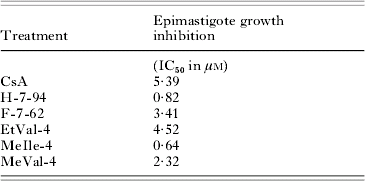
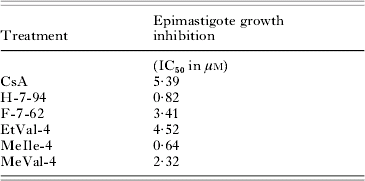
Inhibition of epimastigote proliferation by CsA and 3 new CsA analogues was studied. The reduction of epimastigote growth rate was established at 72 h after treatment in comparison with parasites that were cultured in drug-free medium. The IC50 obtained for EtVal-4, MeIle-4 and MeVal-4 were 4·52, 0·64 and 2·32 μm respectively, while CsA showed an IC50 of 5·39 μm (Table 1). Results obtained with CsA, H-7-94 and F-7-62 have previously been published elsewhere (Búa et al. Reference Búa, Ruiz, Potenza and Fichera2004) and were included in this table for comparison.
Parasites grown in the presence of CsA and CsA derivatives
(Drug non-treated parasites with ethanol, as negative control. IC50 values for inhibition of epimastigote proliferation were estimated at 72 h after treatment. Four independent experiments, in duplicate, were done for each drug concentration.)
Inhibition of trypomastigote penetration in VERO cells
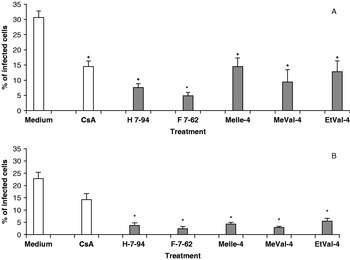
The anti-parasitic effects of CsA analogues MeVal-4, MeIle-4 and EtVal-4 were analysed in comparison with H-7-94 and F-7-62. The best inhibition on trypomastigote penetration in VERO cells was obtained when parasites were pre-incubated with 25 μm of the H-7-94, F-7-62 and MeVal-4 CsA analogues, a dose which has previously been found effective on in vitro infection (Búa et al. Reference Búa, Ruiz, Potenza and Fichera2004). In this report, other experimental conditions were tested in which viability of treated trypomastigotes was followed by microscopical observation and viable parasite counting. Control experiments were performed with 0·25% ethanol, as vehicle. F-7-62 inhibited 84% of trypomastigote penetration as compared to the drug-free control. H-7-94 and MeVal-4 exhibited an inhibition of 75 and 70% respectively (Fig. 1A). CsA, EtVal-4 and MeIle-4 inhibited 52 to 58% of parasite penetration. The effects of all CsA derivatives at 25 μm concentration were significantly different (P<0·05) with respect to the control experiment.
Effects of CsA analogues on Trypanosoma cruzi in vitro. Drugs were used at a 25 μm concentration. (A) Inhibition of trypomastigote penetration by CsA analogues. Parasites were pre-incubated for 1 h with drugs and infected VERO cells. F-7-62 was the best drug, inhibiting 84% of parasite penetration. All CsA derivatives exhibited inhibition effects significantly different (P<0·05) as compared to the drug-free medium control. (B) Effects of CsA analogues on the development of intracellular amastigotes. CsA analogues were present in the cell culture medium for 48 h. All CsA analogues showed inhibitory effects on amastigote development. F-7-62, the most effective drug, inhibited 88·6% as compared to drug-free medium-infected cells.

Inhibition of the development of intracellular amastigotes
Infected cell cultures were incubated for 48 h with CsA analogues at a drug concentration of 25 μm. All drugs showed a marked inhibitory effect on intracellular amastigote development, showing an inhibition of 88·6% for F-7-62, 87% for MeVal-4, 83·6% for H-7-94 and 76% for EtVal-4, as compared to the control drug-free medium-treated cells. CsA inhibited 37·5% of the intracellular amastigote development. Fig. 1B shows the percentage of VERO cells containing T. cruzi amastigotes and the effect of CsA derivatives H-7-94, F-7-62, MeVal-4, MeIle-4 and EtVal-4 treatment, which resulted in a significant decrease in infected cells.
Treatment of experimental T. cruzi infection in mice
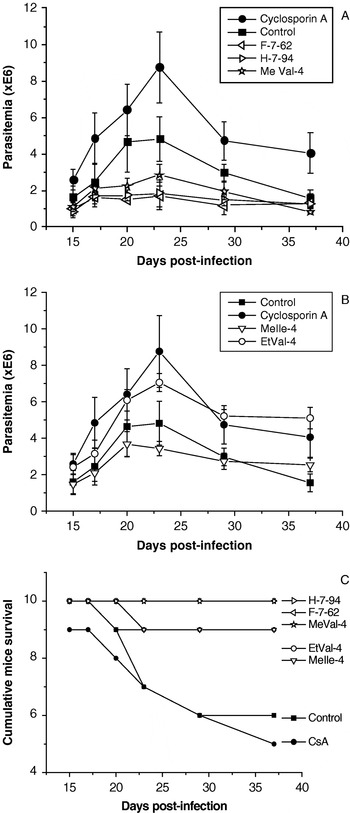
Balb/c mice infected with T. cruzi bloodstream trypomastigotes, were treated with CsA analogues prior to and during the first 5 days post-infection (p.i.). Parasitaemia and mice survival were recorded until 40 days p.i. Survival was 100% in animals treated with H-7-94, F-7-62 and MeVal-4. The peak parasitaemia, at 23 days p.i., for these drugs was significantly different (P<0·01) from the parasitaemia of control animals, inoculated with olive oil, (4·81±1·2×106/ml) and CsA-treated and infected mice (8·7±1·9×106/ml). F-7-62, H-7-94 and Me Val-4 reduced the circulating parasites to 1·71±0·75×106/ml, 1·85±0·74×106/ml and 2·85±0·61×106/ml, respectively (Fig. 2A).
Effects of CsA analogues on Trypanosoma cruzi in vivo. Balb/c mice were treated with drugs as described and infected with bloodstream trypomastigotes. Peaks of parasitaemia were recorded at 23 days p.i. (A) The most effective drugs, F-7-62, H-7-94 and MeVal-4, showed significantly different parasitaemias than control animals. (B) Less effective drugs, MeIle-4 and EtVal-4, showed no significant differences from control groups. Fig. 2C. Mice survival was 100% with F-7-62, H-7-94 and MeVal-4 treatment.

Mice treated with the MeIle-4 and EtVal-4 CsA analogues did not exhibit significant differences in parasitaemia with respect to control mice (Fig. 2B) and survival was 90%. It is worth noting that 50% of mice survived with CsA treatment and 60% of the non-treated control group (Fig. 2C).
Toxicity evaluation of CsA derivatives on mammalian cells
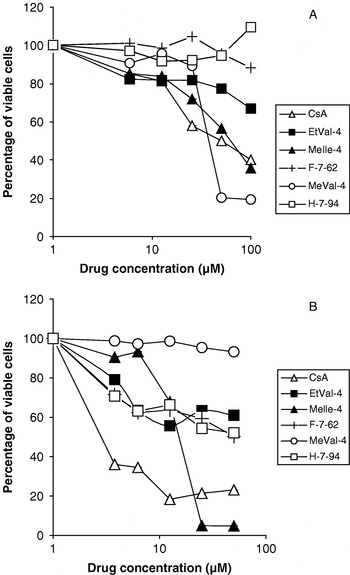
We have analysed the toxicity of the CsA analogues H-7-94, F-7-62 and 3 new ones: MeVal-4, MeIle-4 and EtVal-4 on mammalian cell viability by the MTT test. As previously shown in our laboratory, H-7-94 and F-7-62 CsA derivatives are not toxic for VERO cells as shown by the Trypan blue viability method (Búa et al. Reference Búa, Ruiz, Potenza and Fichera2004). In this report, VERO cells, derived from green monkey kidneys and U937 cells, derived from a human myeloid lymphoma, were used. MeIle-4 and CsA decreased cell viability as measured by the MTT method in both cell lines, U937 cells being more sensitive than VERO cells.
The CsA ED50 (effective dose for 50% cell viability) was 21·61 μm±4·2 in VERO cells but 4·08 μm±5·53 in U937 cells. The MeIle-4 CsA analogue showed an ED50 equal to 42·5 μm±6·85 in VERO cells but 12·5 μm±5·85 in U937 cells (Fig. 3B). EtVal-4, H-7-94 and F-7-62 derivatives, exhibited less toxic effects, not affecting VERO cells, U937 cells being once again more sensitive at higher doses than the ED50. MeVal-4 CsA analogue, was not toxic for U937 cells. On VERO cells, 90% of cells were viable at a 25 μm MeVal-4 concentration, although at 50 μm, 80% of VERO cells died; however, this dose exceeds the range in which trypanocidal effects are evident (Fig. 3A).
Toxicity of CsA analogues in mammalian cells. The MTT test was assayed in mammalian cells. Drugs were tested at different concentrations as described. A 100% viability was considered for ethanol-treated cells as a control. Experiments were performed in triplicate. (A) Cyclosporin A and analogues, effect on VERO cell viability by the MMT test. (B) Cyclosporin A and analogues, effect on U937 cell viability by the MMT test.

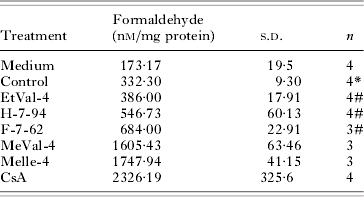
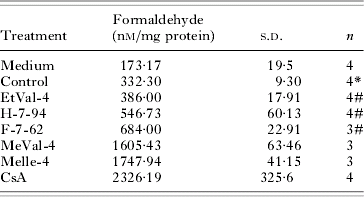
Since CsA is metabolized by the cytochrome P450 system, which catalyses the hydroxylation and demethylation of the drug, another toxicity parameter was also tested in cell cultures treated with CsA and derivatives: the aminopyrine demethylase enzymatic activity (Bertault-Peres et al. Reference Bertault-Peres, Bonfils, Fabre, Just, Cano and Maurel1987; Watkins, Reference Watkins1990; Pichard et al. Reference Pichard, Fabre, Domergue, Fabre, Saint Aubert, Mourad and Maurel1991; Gan et al. Reference Gan, Moseley, Khosla, Augustijns, Bradshaw, Hendren and Thakker1996). A significant increase in enzymatic activity was found in cells treated with CsA and most of its analogues at 25 μm concentration, compared to cells treated with ethanol. As CsA is considered a positive control, it is worth noting that H-7-94 and F-7-62-treated cells showed significantly less augmentation of enzymatic activity than CsA-treated cells. EtVal-4 was the only CsA derivative tested in this assay that showed similar levels of aminopyrine N-demethylase enzymatic activity, as ethanol-treated cells (Table 2).
Aminopyrine N-demethylase activity in Vero cells treated with 25 μm CsA and CsA analogues
(Control VERO cells treated with ethanol showed an increased enzymatic activity (*P<0·001) compared to the cells cultured only with medium. In cells treated with the H-7-94, F-7-64 and Etval-4 CsA analogues the enzymatic activity significantly decreased (# P<0·05) compared to cells treated with CsA.)
Susceptibility of T. cruzi cyclophilin enzymatic activity to CsA analogues
The isomerization of the Ala-Pro bond coupled with chymotryptic cleavage of the trans-peptide was measured as the increase of absorbance at 390 nm. The purified His-tagged recombinant cyclophilins: TcCyP19, TcCyP21, TcCyP25, TcCyP28, TcCyP34 and TcCyP40 clearly accelerated the rate of cis – trans isomerization of the peptide substrate compared to the control without the recombinant proteins, showing that they are active PPIases that could be inhibited by the 3 most efficient trypanocidal CsA derivatives, H-7-94, F-7-62 and MeVal-4.
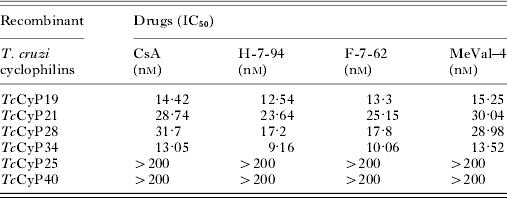
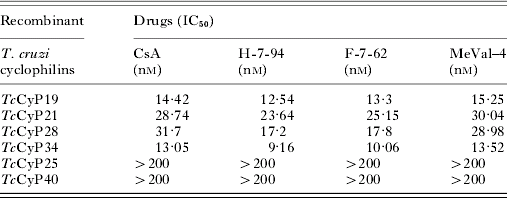
The IC50 was determined for each compound and is displayed in Table 3 for each T. cruzi cyclophilin. The inhibition of the PPIase assay of these T. cruzi enzymes was performed using concentrations of 0·020 to 4 μm of recombinant protein pre-incubated with different concentrations, from 0 to 1 μm, of CsA, H-7-94, F-7-62 and MeVal-4. TcCyP25 and TcCyP40 showed a much higher IC50 for these drugs (over 200 nm concentration) being coincident with the histidine substitution, in these two T. cruzi cyclophilins, for the critical tryptophan residue for CsA binding (Potenza et al. Reference Potenza, Galat, Minning, Ruiz, Durán, Tarleton, Marín, Fichera and Búa2006).
Inhibition of PPIase activity of several recombinant Trypanosoma cruzi cyclophilins
(CsA analogues were pre-incubated in different concentrations from 0 to 1 μm with the recombinant proteins, and PPIase activity was performed as described. IC50 was calculated from computer programs as Excel and Origin version 6.)
Effect of CsA on rhodamine efflux of T. cruzi epimastigotes
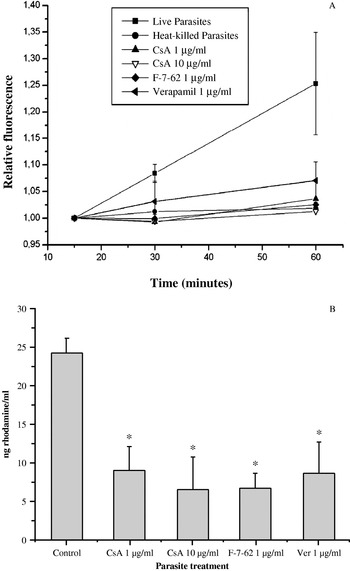
To study the inhibition capacity of CsA on the parasite P-glycoprotein, the hydrophobic fluorescent dye rhodamine 123 efflux assay was used (Efferth et al. Reference Efferth, Lohrke and Volm1989). Untreated T. cruzi epimastigotes accumulated rhodamine 123, and an efflux into the culture medium could be observed. This dye efflux was clearly inhibited by CsA and F-7-62 CsA derivative, as well as by Verapamil, a classic P-glycoprotein inhibitor. Heat-killed parasites showed no rhodamine efflux activity (Fig. 4A). After 4 h of dye efflux, the percentages of inhibition were similar for CsA and Verapamil, at a concentration of 1 μg/ml for both drugs, being 63% and 64% respectively. A better inhibition, of 72%, was observed for F-7-62 at 1 μg/ml, and 73% for CsA at 10 μg/ml. These results showed a 10-fold more efficient inhibition performance of this CsA analogue regarding CsA, as indicated in Fig. 4B.
Effect of CsA and F-7-62 analogues on the rhodamine 123 efflux in Trypanosoma cruzi epimastigotes. (A) CsA at 1 and 10 μg/ml or F-7-62 at 1 μg/ml were tested as inhibitors of rhodamine 123 efflux. Verapamil and heat-killed parasites were used as negative controls. Rhodamine fluorescence was determined in the supernatant at an excitation of 485 nm and emission of 530 nm at different times. Y-axis standard deviation is shown only for live parasites and Verapamil-treated parasites in order to avoid multiple overlapping lines. (B) Inhibition of rhodamine efflux was measured after a 4-h parasite incubation. For Verapamil (Ver), CsA and the F-7-62 CsA analogue-treated parasites, rhodamine efflux significantly diminished (P<0·05) compared to untreated parasite controls. Three independent experiments, in duplicate, were done for each drug concentration.

Discussion
In this work it is shown that CsA and the non-immunosuppressive analogues H-7-94, F-7-62 and MeVal-4, had a clear anti-T. cruzi effect in vitro and on T. cruzi experimental infections in vivo. The trypanocidal drugs with the best performance inhibited the enzymatic activities of 6 T. cruzi recombinant cyclophilin proteins, including those best expressed in the parasite. It was also established that CsA and 1 of the CsA derivatives inhibited a P-glycoprotein activity on T. cruzi. Moreover, these derivatives exhibited less toxic effects on cell viability and on activation of cell aminopyrine-N-demethylase than CsA.
H-7-94 and F-7-62, have less immunosuppressive activity than CsA (Zahner and Schultheiss, Reference Zahner and Schultheiss1987) and MeVal-4 is non-immunosuppressive (Zenke et al. Reference Zenke, Baumann, Wenger, Hiestand, Quesniaux, Andersen and Schreier1993), not binding calcineurin. These analogues had a trypanocidal activity at the micromolar level. H-7-94, F-7-62 and MeVal-4-CsA were 1·25 to 1·5-fold and 2·0 to 2·3-fold more effective than CsA in inhibiting trypomastigote penetration and amastigote development, respectively.
The studies of these trypanocidal drugs were further evaluated in experimental T. cruzi infections. H-7-94, F-7-62 and MeVal-4 CsA analogues protected T. cruzi-infected mice from high parasitaemias such as those observed in control animals. CsA-treated infected animals showed even higher parasitaemias than non-treated animals, as previously observed (McCabe et al. Reference McCabe, Remington and Araujo1985). These drug treatments exhibited a remarkable fact regarding mice survival. None of the CsA analogue-treated mice died after 40 days post-infection, while a mortality of 40% was observed in control non-treated animals, and 50% in CsA-immunosuppressed mice.
The CsA analogues H-7-94 and F-7-62 were also used in other pathologies such as infections by Litomosoides carinii (Zahner et al. Reference Zahner and Schultheiss1987) and in malaria (Grau et al. Reference Grau, Gretener and Lambert1987). The NIM811 (MeIle-4) CsA analogue, used in this work, has proven to be active against HIV virus (Billich et al. Reference Billich, Hammerschmid, Peichl, Wenger, Zenke, Quesniaux and Rosenwirth1995), Hepatitis C (Ma et al. Reference Ma, Boerner, TiongYip, Weidmann, Ryder, Cooreman and Lin2006) and was also cytoprotective in neuronal cells (Waldmeier et al. Reference Waldmeier, Feldtrauer, Qian and Lemasters2002; Hansson et al. Reference Hansson, Mattiasson, Mansson, Karlsson, Keep, Waldmeier, Ruegg, Dumont, Besseghir and Elmer2004). Although this CsA analogue was used as an anti-malaria drug on Plasmodium vivax, with a similar parasiticidal activity as CsA (Kocken et al. Reference Kocken, Van der Wel, Rosenwirth and Thomas1996), NIM811 (MeIle-4) has not been very effective against T. cruzi.
Toxicity was studied on cell viability measured by the MTT test, an accepted reliable method used to measure toxic concentrations of chemicals in human blood (Jover et al. Reference Jover, Ponsoda, Gómez-Lechon and Castell1992). The aminopyrine demethylase enzymatic activity was also used as a toxicity parameter in cell cultures. The cells treated with H-7-94, F-7-62, and EtVal-4 did not exhibit toxic effects while MeIle-4 and CsA were toxic. It is remarkable that Me-Val-4 exhibited a different behaviour regarding the cell line tested, it was innocuous on U937 human cells (Song et al. Reference Song, Lee, Kim, Park, Paik and Jo2003) although VERO cells were sensitive to the drug.
As previously stated, CsA has been shown to be metabolized by the cytochrome P450 system, which catalyses the hydroxylation and demethylation of the drug. The activity of this enzyme was also described in kidneys, and localized in proximal tubular cells (Yoshimura et al. Reference Yoshimura, Yoshimura, Ohyama, Ohmachi, Yamamoto, Kishimoto and Wada1999); it is induced by many xenobiotics in vivo and in vitro (Guillouzo, Reference Guillouzo1998). H-7-94 and F-7-62 CsA analogues proved to induce an aminopyrine-N-demethylase activity significantly lower than CsA. To evaluate the enzyme activity, a concentration of 25 μm, that highly exceeded the IC50 previously reported for the most effective CsA analogues (0·82–7·19 μm), was used on epimastigotes, trypomastigotes and inhibition of parasite penetration (Búa et al. Reference Búa, Ruiz, Potenza and Fichera2004).
The in vitro and in vivo trypanocidal activity of some CsA derivatives shown in this study could be associated with inhibition of their target molecules in the parasite, the cyclophilins. A previous study demonstrated that the T. cruzi cyclophilin of 19 kDa, TcCyP19, had a CsA-susceptible PPIase activity (Búa et al. Reference Búa, Åslund, Pereyra, García, Bontempi and Ruiz2001) and it was also shown that all CsA analogues tested had an inhibitory effect on the TcCyP19 enzymatic activity, inhibited best by H-7-94 and F-7-62 CsA derivatives (Búa et al. Reference Búa, Ruiz, Potenza and Fichera2004). H-7-94, F-7-62 and MeVal-4 CsA derivatives were able to inhibit the peptidyl prolyl cis-trans isomerase activity of TcCyP19, the most expressed paralogue in the parasite (Potenza et al. Reference Potenza, Galat, Minning, Ruiz, Durán, Tarleton, Marín, Fichera and Búa2006), and also the enzymatic activity of TcCyP21, TcCyP25, TcCyP28, TcCyP34 and TcCyP40 recombinant proteins. Although the inhibition of PPIase activity by these drugs was confirmed for every T. cruzi recombinant cyclophilin tested, in the case of TcCyP25 and TcCyP40 a much higher concentration of CsA analogues, between 200 and 400 nm, was necessary to inhibit the enzymatic activity. A histidine substitution for tryptophan was observed in these two cyclophilins (Potenza et al. Reference Potenza, Galat, Minning, Ruiz, Durán, Tarleton, Marín, Fichera and Búa2006), and this residue was shown to be essential for CsA binding. This fact is in accordance with several other reports in which large cyclophilins bind CsA with less affinity than smaller cyclophilins (Galat, Reference Galat1999). Since the IC50 of CsA, H-7-94, F-7-62 and MeVal-4-CsA on cyclophilins TcCyP25 and TcCyP40, was over 200 nanomolar, these molecules would not be the primary targets for the CsA and CsA analogues tested in this work, and very unlikely responsible for the trypanocidal activity observed on these drugs in vitro and in vivo.
The gene coding for the human archetypal cyclophilin CyPA or hCyP18, was cloned and expressed in the pQE vector yielding an active and CsA-sensitive PPIase activity. An IC50 of 23 nm was obtained for CsA on this human enzyme, in good agreement with a previous report (Picken et al. Reference Picken, Eschenlauer, Taylor, Page and Walkinshaw2002). The inhibition of hCyP18 enzymatic activity by H-7-94 and F-7-62 CsA analogues appeared to be less efficient than CsA, suggesting a weaker binding with the human cyclophilin. The IC50 for both drugs was 3-fold higher (65–70 nm) than the CsA IC50. This fact could be attributed to the phenyl group present in these two CsA analogues, on MeBmt in position 1 of CsA that probably is less tolerated by hCyP18.
A recent study of molecular modelling and dynamic simulation has shown that the phenyl group in the MeBmt1 residue present in the H-7-94 and F-7-62 CsA analogues, provided a higher potential energy, which means a higher stability of these complexes compared with the TcCyP19-CsA complex (Carraro et al. Reference Carraro, Búa, Ruiz and Paulino2007). Based on this, the inhibitory effects of the H-7-94 and F-7-62 CsA analogues against T. cruzi parasites could be attributed to their chemical structure.
All T. cruzi cyclophilins tested so far, despite the level of protein expression in the parasite, could be potential targets of these parasiticidal drugs, such as TcCyP21, TcCyP28, TcCyP35, and with less affinity, TcCyP25 and TcCyP40. But, as previously shown, TcCyP19 is the CsA-binding protein most widely expressed in the parasite (Potenza et al. Reference Potenza, Galat, Minning, Ruiz, Durán, Tarleton, Marín, Fichera and Búa2006) thus, the CsA trypanocidal effects are probably mainly exerted by the TcCyP19-CsA analogue complex.
In addition, another probable target molecule for CsA and the most active derivative, F-7-62, was described by us on T. cruzi. Both drugs inhibited the rhodamine efflux suggesting an inhibition of a parasite P-glycoprotein. Two T. cruzi genes were described for P-glycoproteins so far, tcpgp2 and tcpgp1 (Dallagiovanna et al. Reference Dallagiovanna, Gamarro and Castanys1996; Torres et al. Reference Torres, Barreiro, Dallagiovanna, Gamarro and Castanys1999). These molecules belong to the ATP-binding cassette (ABC) superfamily of transporters and play an important role in multi-drug resistance in eukaryotic cells and in protozoan parasites (Silverman et al. Reference Silverman, Hayes, Luft and Joiner1997; Carrero et al. Reference Carrero, Lugo, Perez, Ortiz-Martínez and Laclette2004). It is worth noting that F-7-62 inhibition of rhodamine efflux at a concentration of 1 μg/ml exhibited a similar level of inhibition as CsA at 10 μg/ml. This feature has been observed before, when the F-7-62 and H-7-94 CsA analogues were tested on inhibition of T. cruzi epimastigote proliferation (Búa et al. Reference Búa, Ruiz, Potenza and Fichera2004). In this experiment, higher concentrations of the F-7-62 derivative resulted in a massive dye efflux due to a lytic effect on the parasite.
A more detailed analysis of the T. cruzi target molecules, the cyclophilins and P-glycoproteins complexed with CsA analogues will be useful in understanding the mode of action of these drugs. The results obtained in this work with the more efficient trypanocidal compounds, H-7-94 and F-7-62, warrant a pre-clinical study to improve the chemotherapy against Chagas' disease.
We thank Dr Horst Zahner for sending the CsA analogues as a gift, which were originally donated by J. F. Borel, from Novartis, Basel, Switzerland. We acknowledge Dr Berta Franke de Cazzulo, from the Universidad de San Martín, Buenos Aires, for providing VERO cells. We are indebted to Dr Marta Lauricella and Lic Cristina Maidana for providing T. cruzi CL Brener epimastigotes, and Dr Carlos Stella from the Faculty of Medicine, University of Buenos Aires for providing equipment technical facilities. We thank Dr Mirta Carlomagno and Dr Lilian Joensen for critical review of this manuscript. A. M. R, J. B., L. F. and M. D. are members of the Research Career of the Consejo Nacional de Investigaciones Científicas y Técnicas (CONICET), Argentina. A. G. F. was supported by a grant of Roemmers Laboratory SAICF Argentine. This work was supported by the Instituto Nacional de Parasitología ‘Dr Mario Fatala Chabén’, A. N. L. I. S. ‘Dr Carlos G. Malbrán’, the NASA/ChagaSpace network, CONICET (Argentina) and the Network for Research and Training in Parasitic Diseases at the Southern Cone of Latin America SIDA/SAREC.