Evidentiality refers to the linguistic marking of the source of knowledge of an asserted event, that is, whether an event was experienced firsthand or in some nonfirsthand form. In about a quarter of the world's languages, especially Native American and Eurasian languages, evidentiality is grammaticalized, that is, conveyed through obligatory marking, typically through morphosyntactic cues (Aikhenvald, Reference Aikhenvald, Aikhenvald and Dixon2003), whereas in other languages it is conveyed at the level of the lexicon. Although some scholars maintain that evidential marking must be grammaticalized for the language in question to be considered to have this property (Anderson, Reference Anderson, Chafe and Nichols1986; Bybee, Reference Bybee1985; Faller, Reference Faller2002; Mithun, Reference Mithun, Chafe and Nichols1986; Willett, Reference Willett1988), others consider languages with grammaticalized evidentials as “strong” and “systematic” and those with lexical marking of evidentials as “weak” and “strategic” (Aikhenvald, Reference Aikhenvald2004, p. 11) and use the term “evidential strategy” to refer to languages that have secondary evidential meanings of nonevidential forms or grammatical structures (Aikhenvald, Reference Aikhenvald2004, p. 105).
Whether grammaticalized or not, many languages do have ways of distinguishing between direct and indirect sources of asserted knowledge. Direct or firsthand knowledge typically relies on information obtained from sensory sources, including visual, auditory, or other sensory sources. Indirect sources of knowledge include inference or hearsay. One may infer something on the basis of results or on the basis of reasoning. The former type involves basing one's inference on some observable or tangible evidence, such as inferring the presence of a mouse on the basis of seeing footprints made by a mouse without seeing the mouse itself. Inference from reasoning/assumption refers to inferences that rely on logical reasoning, previous experience, intuition, general knowledge, or some other mental construct (Aikhenvald, Reference Aikhenvald2004). For example, if one knows that one's father comes home at 7 p.m. every weekday and it is already past that hour, one can infer that one's father has arrived home without having to see him at home or see any other signs that would indicate that he is at home. Hearsay or reported evidence might refer to second hand information, that is, something heard from someone who was a direct witness, or thirdhand information, where the person who reports the situation was not a direct witness.
Some linguists (e.g., Aikhenvald, Reference Aikhenvald2004) view evidentiality to be strictly a marker of source of knowledge. However, others have attributed additional functional significance to this property. Evidential markers have been suggested to signal speakers’ commitment to truth or certainty (Lyons, Reference Lyons1977), judgment and understanding (Palmer, Reference Palmer2001), psychological distance between a speaker and an event (Slobin & Aksu, Reference Slobin, Aksu and Hopper1982), distance between the speaker and his/her own discourse (Lazard, Reference Lazard2001), and/or attitudes about the reliability of the source of knowledge of an asserted event (Chafe, Reference Chafe, Chafe and Nichols1986; Ifantidou, Reference Ifantidou2001).
Although somewhat contested, an evidential hierarchy in terms of degree of reliability of a source has also been proposed among languages that mark evidentials in the grammar. There is general consensus that sensory-based firsthand sources are the most reliable type of source (de Haan, Reference de Haan, Cienki, Luka and Smith1998; Faller, Reference Faller2002; Willett, Reference Willett1988) because they are the most direct and involve the speaker the most. There is disagreement about whether inference or hearsay would be the next reliable source. Inference may be considered more reliable than hearsay because making an inference requires a speaker to be attentive to visual/perceptual signs related to the situation (de Haan, Reference de Haan, Cienki, Luka and Smith1998, Reference de Haan2001). However, hearsay may be considered more reliable than inference because it is more direct; that is, the person who reported the information actually directly witnessed the event (Willett, Reference Willett1988).
Linguistic scholarship on evidentiality has recently been supplemented by a growing number of crosslinguistic empirical studies that have examined the developmental trajectory of evidential forms (i.e., the order of acquisition of different forms in comprehension and production), and whether obligatory marking of the source of knowledge enhances language users’ source monitoring ability compared to the situation where source is marked optionally. For example, Aksu-Koc, Ögel-Balaban, and Alp (Reference Aksu-Koç, Ögel-Balaban, Alp, Fitneva and Matsui2009), comparing the source monitoring findings based on Turkish first reported by Ögel (Reference Ögel2007) with those of Drummey and Newcombe (Reference Drummey and Newcombe2002) based on English-speaking children, found that 4-year-old Turkish-speaking children's nonlinguistic source monitoring performance was superior to that of 4-year-old English-speaking children's performance, which was at the same level as 3-year-old Turkish-speaking children's performance. However, the difference in source monitoring performance disappeared by the age of 6. In a study with adults, Tosun, Vaid, and Geraci (Reference Tosun, Vaid and Geraci2013) compared source recognition accuracy in an incidental memory task for sentences presented in Turkish versus English. They found that Turkish speakers were more accurate in recognizing firsthand form statements than they were in recognizing sentences that had previously been presented in nonfirsthand form. By contrast, English-speaking participants did not demonstrate any difference in recognizing the form of sentences.
These studies, among others, show that the level at which evidentiality is conveyed in a language appears to have an effect on how information is coded and treated. Coding the source of information on a regular basis in the grammar leads Turkish speakers to look for distinctions between direct and indirect evidential sources and treat them differently. In contrast, coding the evidential sources on an optional basis leads speakers of English to be less attentive to source differences and to treat firsthand and nonfirsthand sources equally.
Whether this differential attentiveness to source noted in source monitoring contexts extends to how source information may be used in a discourse context is at present not known. This is in part because there is very little experimental research to date on evidentiality that has been directed at the level of discourse. However, discourse is a particularly compelling domain for exploring the impact of evidentiality in that it requires language users to establish cohesion and coherence within and across sentences. Evidential markers may offer one way in which cohesion can be established. Moreover, the study of discourse brings into play other factors, such as the nature of the asserted information (whether it represents a general state of affairs or a particular event) and the temporal presentation of the asserted information, which may combine in interesting ways with evidential information to affect discourse comprehension.
In a recent special issue of Pragmatics and Society on “Evidentiality in Interaction,” it was argued that there is a need to go beyond a focus on evidential markers in the grammar or lexicon and to “show how evidential markers and strategies fit into broader conversational structures” (Hanks, Reference Hanks2012, p. 175). Identifying discourse functions of evidentials is an emerging focus of recent work in evidentiality (e.g., Nuckholls & Michael, Reference Nuckolls and Michael2012). Evidential marking has also been accorded a central place in a recent mental model theory of how people acquire and use knowledge; in laying out this theory, van Dijk (Reference van Dijk2014, p. 265) notes that there is a need for research on the cognitive basis of an epistemics of conversation and interaction more generally, and that such research should examine both speakers of languages with grammaticalized evidentials and those in which evidentials are not grammaticalized. Similarly, Mushin (Reference Mushin2013, p. 627) notes that there has been “little direct attention on whether the deployment of evidential strategies in discourse varies according to the grammatical status of the grammatical resources available to the speaker.” To date, empirical studies of evidential use in discourse have tended to be based more on speakers of languages with evidential strategies than on those with grammaticalized evidentials.
Given this emerging interest in exploring evidentiality in a discourse context, the present research was designed to contribute to this issue by examining the relative impact of evidential marking in establishing discourse coherence, using a story completion task. The stories to be completed were constructed using different pairings of firsthand and nonfirsthand markers and juxtaposing a general statement with a particular statement with a somewhat discordant meaning. Following earlier findings from the developmental literature that evidential markers differentially signal source reliability, one should expect that in circumstances when one is trying to make sense of utterances that contain somewhat conflicting meanings, greater weight may be given to utterances that convey stronger source reliability (e.g., firsthand assertions would carry more weight than nonfirsthand assertions such as inference or hearsay).
One goal of the study was thus to test whether evidentiality matters in the process of making sense of discourse, and whether it matters more in users of languages with grammaticalized evidential forms (such as Turkish) than in users of languages that only have evidential strategies (such as English). A second goal was to test whether the temporal placement of firsthand evidential information may make a difference in how it is relied on in story construction. We also examined the role of type of information, that is, particular versus general information presented in a story, as a factor influencing story completion strategies. Before describing the rationale for the study, we first briefly summarize properties of Turkish and English.
EVIDENTIALITY MARKING IN TURKISH AND ENGLISH
Turkish is an example of what Aikhenvald (Reference Aikhenvald2004) describes as two-choice evidential languages. Such languages make a distinction only between firsthand and nonfirsthand sources of knowledge. Aksu-Koc and Slobin (Reference Aksu-Koc, Slobin, Chafe and Nichols1986) refer to the two as “direct” versus “indirect” sources of knowledge. The past-tense suffix –di conveys directly experienced sources of knowledge; nonfirsthand sources (inference or hearsay) are marked with the suffix –mIş (Slobin & Aksu, Reference Slobin, Aksu and Hopper1982). (Turkish also has several nonevidential markers, such as the aorist –Ir/Ar and its nominal counterpart –DIR, which is a generalizing suffix. These were not examined in the present study.)
Two things are worth noting about evidential marking in Turkish. First, the firsthand evidential marker is not simply a default or unmarked version of the past tense in Turkish. Rather, it is one of two distinct morphosyntactic markers that speakers must select in order to indicate the source of knowledge. Thus, choosing the firsthand marker shows that the speaker intends to indicate that she witnessed an event and convey that certainty (Aksu-Koc, Reference Aksu-Koc, Johanson and Utas2000; Kornfilt, Reference Kornfilt1997). Second, it is important to note that although Turkish uses a single suffix (–mIş) to indicate both hearsay and inference, it nevertheless allows the use of different adverbials in combination with past-tense suffixes that would distinguish between the two evidential sources. Thus, for example, the adverbial duyduğuma göre is roughly comparable to the English adverbial “reportedly” and is used to indicate hearsay, whereas the adverbial görünüşe göre (like the English “apparently”) is used to indicate inference. A search we conducted in a Turkish spoken word corpus (Turkish National Corpus) confirmed that both of these adverbs are used with –di and with –mIş verbs but they especially co-occur with the latter.
Unlike the case in Turkish, evidentiality is not obligatorily marked in English. It is possible, however, to express source of knowledge of asserted events in English as in other languages in which evidentiality is not grammaticalized. As Aikhenvald (Reference Aikhenvald2004, p. 1) notes, expressing evidentiality in English is like expressing gender in genderless languages. Speakers do not have to indicate the source of information, but they can if they want to. Evidentiality in English may be conveyed in English in various ways: by sensory verbs (e.g., see), cognitive verbs (e.g., think), adjectives (e.g., supposed), adverbs (e.g., apparently), and modal auxiliaries (e.g., must; see Chafe, Reference Chafe, Chafe and Nichols1986; Nuyts, Reference Nuyts2001; Whitt, Reference Whitt, Diewald and Smirnova2010, Reference Whitt2011). In the present study, we used reportedly as the marker of the hearsay source (Aikhenvald, Reference Aikhenvald2004; Mushin, Reference Mushin2001) and apparently as the primary marker of inference (Gisborne & Holmes, Reference Ginsborne and Holmes2007; Izvorski, Reference Izvorski, Lawson and Cho1997; Mortensen, Reference Mortensen2006).Footnote 1
THE PRESENT STUDY
Previous experimental investigations of evidentiality have been conducted mostly with child samples (e.g., Aksu-Koc & Alici, Reference Aksu-Koc, Alici and Clark2000; Fitneva, Reference Fitneva2001, Reference Fitneva2008, Reference Fitneva, Fitneva and Matsui2009; Matsui, Yamamoto, & McCagg, Reference Matsui, Yamamoto and McCagg2006; Öztürk & Papafragou, Reference Öztürk and Papafragou2005) and have used tasks such as the hidden object task to assess source reliability. They demonstrated that children find information conveyed using firsthand source markers more reliable and trustworthy than that conveyed using nonfirsthand markers. The present study extends the scope of inquiry into the perceived reliability of evidential markers by studying adults and uses a task that involves an implicit judgment of trustworthiness.
The task used in our study requires participants to make sense of a piece of discourse that contains different combinations of evidential markers that yield somewhat conflicting meanings. The rationale guiding our use of this task was that in the process of sense making, listeners may give more weight to certain information in discourse over others. We sought to determine if participants would rely more on information conveyed by firsthand markers over that conveyed by nonfirsthand markers in making sense of discourse, and further whether they would rely more on certain nonfirsthand markers than other nonfirsthand markers. As previously noted, some authors claim that inference is more reliable than hearsay (de Haan, Reference de Haan, Cienki, Luka and Smith1998) due to the greater involvement of the speaker in the asserted event, whereas others argue that hearsay is more reliable than inference (Willett, Reference Willett1988), because hearsay is more direct. Our study will provide a test of these competing claims. Although the notion of an evidential hierarchy was primarily raised in the context of languages in which hearsay and inference sources are marked in the grammar, our test of these claims will rest on a lexicalized distinction between inference and hearsay in the languages we are comparing.
Because discourse coherence may also be affected by other factors, we wanted to see how evidentiality may fare with respect to these other influences. One factor we manipulated is the temporal placement of firsthand information. This allows us to ask if firsthand information carries even more weight relative to nonfirsthand information when it follows nonfirsthand information or when it precedes it. The other factor we examined is the nature of the asserted information. For example, if information that asserts a particular fact is given more weight than information that asserts a general fact, might there be certain situations in which participants may rely more on this property of the discourse, especially when it is conveyed by nonfirsthand markers? Finally, by comparing Turkish with English speakers, our study allows a test of the generalizability of the influence of evidential marking on sense making in discourse, or whether there may be language-specific differences.
In previous work, the sentence/story completion task has primarily been used as a measure of an individual's attitudes or beliefs when presented with an ambiguous or contradictory stimulus complex (see Frank, Reference Frank1948). The present study, to our knowledge, is the first attempt to use this task in the context of examining the impact of evidential marking on discourse coherence. The task was constructed as follows: participants read a pair of sentences containing different combinations of three different evidential markers (firsthand, inference, and hearsay). The sentences are somewhat discordant in their meaning. Participants are asked to think of and write down a third sentence that would make sense of the situation described. For example, they might be given the following sentence pair: “Bill apparently did not like his stepsister. But he reportedly cried when she left home for college” (“Görünüşe göre Bilal üvey kardeşinden hoşlanmazmış. Fakat duyduğuma göre kardeşi üniversiteye gitmek için evden ayrıldığında Bilal ağlamış”).
A previously developed framework based on how individuals tend to respond to contradictory situations is of some relevance. According to Peng and Nisbett (Reference Peng and Nisbett1999), there may be four types of psychological responses to contradictory information: denial, whereby individuals pretend that there is no contradiction; discounting, whereby individuals distrust both pieces of information provided because they are contradictory; differentiation, whereby individuals decide that one is the correct or more reliable piece of information and the other is incorrect or unreliable, to resolve cognitive dissonance; and dialectical thinking, whereby both facts are accepted as potentially true and reliable.
In our experiment, although all four types of responses may well occur, we expect that the latter two (differentiation and dialectical thinking) are most likely. We are particularly interested in the differentiation response type, because we expect that participants will give more weight to one fact over another in resolving the inconsistency in the narrative.
We hypothesize that participants will complete the story by making reference to the information conveyed by the evidential source that they perceive to be the more reliable source. We are not claiming here that reliability of source of evidence is the sole or even primary means of establishing discourse coherence. However, our study is designed to uncover if source information is systematically used at all by participants in arriving at their story completions, and whether Turkish speakers give firsthand source information more weight than do English speakers. Thus, our experiment treated the question of whether source of evidence influences discourse coherence as an empirical issue.
Besides examining the role of evidential source type, we are interested in delimiting the scope of the evidentiality effect by seeing whether the effect is moderated by two additional variables that could also potentially influence language users’ judgments about the coherence of a text. As already noted, these include the order of presentation of the evidential source (i.e., whether a particular evidential marker is placed first or second in the sentence pair) and the nature of the asserted information (general vs. particular).
With respect to temporal placement of information, prior research on discourse comprehension indicates a strong advantage of first mention whereby first heard information is perceived as highly salient relative to subsequently heard information in meaning construction (Gernsbacher, Reference Gernsbacher1989, Reference Gernsbacher2013). Although the paradigm used in studies of the advantage of first mention uses a speeded comprehension measure and does not involve presentation of discordant information as was the case in our study, a prediction extrapolated from this prior work is that first presented information may carry more weight than subsequent information. By contrast, work on serial position effects in decision making in various contexts has shown that individuals are more influenced by more recently presented information (Bruine de Bruin, Reference Bruine de Bruin2005; Bruine de Bruin & Keren, Reference Bruine de Bruin and Keren2003). This research would lead one to predict a greater effect of the more recently presented evidential marker. Within the context of our specific study, a recency effect may be more likely in story completion given that it may require less cognitive effort to elaborate on a recently mentioned fact than to refer back to an earlier mentioned one.
With respect to the other additional variable examined (whether the information conveyed refers to a general fact or a particular one) prior research again suggests two possible outcomes. For example, some studies (e.g., Nisbett, Borgida, Crandall, & Reed, Reference Nisbett, Borgida, Crandall, Reed, Carroll and Payne1976) claim that participants may find particular information more influential than general information because particular information is often perceived as more vivid. Alternatively, other studies, such as those in decision making, find that information that is stated in a more general form is more likely to be construed as more reliable than information conveyed in a particular form (Kahneman, Reference Kahneman2003; Kahneman & Tversky, Reference Kahneman and Tversky1973). To date, there has been very little cross-cultural work on this issue. Moreover, previous work has placed general versus particular information in conflict, as was the case in the present study. We therefore suggest that in the context of our task, participants may be more likely to give the particular information more weight in arriving at their response because the particular sentence represents an actualized event that happened (e.g., John rented an apartment on the 10th floor) that went against some general state of affairs (e.g., John was afraid of heights).
Taken together, our study allows for a determination of the relative contribution of language, source type, source presentation order, and general versus particular information on individuals’ discourse coherence strategies.
METHOD
Participants
A total of 74 Turkish-speaking college students (65 females) and 75 English-speaking ones (48 females) were recruited for the experiment.Footnote 2 Turkish participants were volunteers recruited from a university in Istanbul and were tested in Turkish, their native and primary language. They ranged in age from 18 to 38 years with a mean age of 22.6. English speakers were recruited from a university in the southwestern region of the United States. They were native speakers of English and ranged in age from 18 to 27 years with a mean age of 18.57.
Materials and design
Thirty sentence pairs per language were prepared (see Appendix A for the complete list of stimuli). The pairs were constructed as follows: one sentence in each pair asserted a general fact about a person and the other sentence asserted a particular fact. For half the stimuli, the general fact preceded the particular one, and for the remainder the reverse was true. Moreover, of the 30 sentence pairs, 10 pairs contained a firsthand versus inference source comparison (i.e., one sentence contained a firsthand assertion and the other contained an inferred assertion), 10 contained a firsthand versus hearsay comparison, and 10 compared inference versus hearsay. Each participant was given all 30 sentences in a fixed random order.
Within each sentence pair, the particular ordering of the sentences (general–particular or particular–general) and the ordering of the sources (e.g., inference first or hearsay first) was counterbalanced across participants.
Sample stimuli per source pair type are provided below in English, followed by the Turkish equivalents.
-
Firsthand versus hearsay:
-
Jack was afraid of heights.Footnote 3
-
But he reportedly rented an apartment on the 10th floor.
-
Hakan’ın yükseklik korkusu vardı.
-
Fakat duyduğuma göre bir gökdelenin onuncu katından daire kiralamış.
-
-
Firsthand versus inference:
-
Jack was afraid of heights.
-
But he apparently rented an apartment on the 10th floor.
-
Hakan’ın yükseklik korkusu vardı.
-
Fakat görünüşe göre bir gökdelenin onuncu katından daire kiralamış.
-
-
Inference versus hearsay:
-
Jack was apparently afraid of heights.
-
But he reportedly rented an apartment on the 10th floor.
-
Görünüşe göre Hakan’ın yükseklik korkusu varmış.
-
Fakat duyduğuma göre bir gökdelenin onuncu katından daire kiralamış.
-
For each source pair, an analysis of variance (ANOVA) was conducted on mean reliance on the stronger source as a function of source order (i.e., whether the stronger source appeared in the first sentence of the pair or in the second sentence), sentence order (whether the first sentence contained a particular statement followed by a general one or vice versa), and group (Turkish vs. English speakers). All three variables were between subjects.
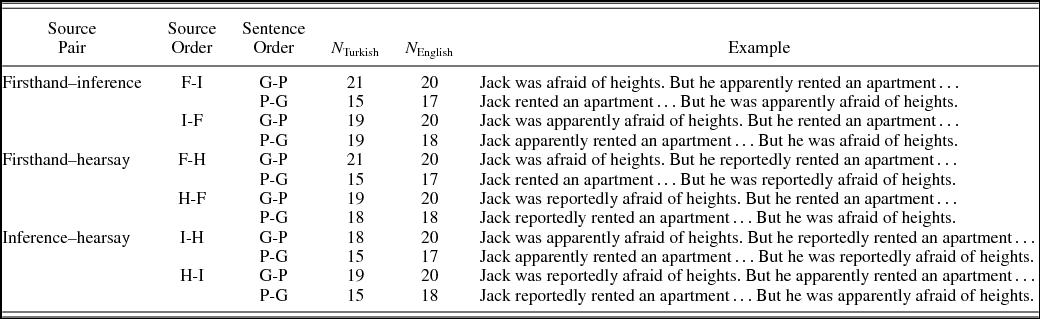
For ease of comparison, see Table 1 for a summary of the design, sample English stimuli per condition, and the number of participants who participated in each condition.
Summary of experimental conditions with sample stimuli

Note: F-I, Firsthand–inference; G-P, general–particular; P-G, particular–general; I-F, inference–firsthand; F-H, firsthand–hearsay; H-F, hearsay–firsthand; I-H, inference–hearsay; H-I, hearsay–inference.
Procedure
On each trial participants were shown two sentences that described a situation (presented in the respective language of the speaker). They were to write down a third sentence that completed the story in a coherent manner. In each instance, they were given a word with which to begin the third sentence (for the examples above it was “Jack. . .”).
Participants were tested in groups. A booklet containing 30 sets of sentences was provided. Instructions were given as follows: “In this study, we want to investigate how language users make sense of discourse. In this experiment, you will see a set of two sentences at a time. Please read those sentences as if they were part of a story. Then you will be given a part of a third sentence and asked to complete it so that it makes sense, given the preceding sentences.”
A practice example was presented to make the instructions clear. After participants completed the experiment, they were asked to fill out a language background questionnaire.
Data coding and analysis
For each of the 10 sentence pairs per source pair condition, two coders (the first author and a student who was not aware of the purpose of the study) independently read the third sentence produced by the participant and based on its content made a decision about which of the two antecedent sentences that sentence relied on more. If the completed sentence made use of information in both of the antecedent sentences or if it did not provide any clear link to either of the antecedent sentences, it was excluded from further analysis.
The coding rubric used to determine which of the antecedent sentences was relied on more to complete the third sentence was as follows:
-
• Definitely denying one of the facts: If one of the facts in the sentences was denied, then it was coded that the other fact was relied on more. For example, the stimulus “Jessica reportedly had a lot of genuine leather bags. But she wore an imitation leather bag today. Jessica. . .” was completed as “lied when she said she had genuine leather bags.” This example is coded as one that was relies on the second sentence.
-
• Definitely accepting one of the facts: If one of the facts was totally accepted, then it was coded that that sentence was relied on more. For example: The stimulus “Carl believed in superstitious sayings. But he apparently acted reasonably yesterday. When he saw a black cat, Carl. . .” was completed as “made sure not to cross its path.” This example is coded as one that relies on the first sentence.
-
• Rationalize denying one of the facts: If the third sentence rationalizes why the fact happened accidentally, then the other fact was considered more reliable. For example: The stimulus “Matt did not like musicals. But he reportedly went to the theater to see Les Miserables. Matt. . .” was completed as “did not know it was a musical” or “was forced by his girlfriend to see that movie.” This example is coded as one that relies on the first sentence.
-
• Weaken the fact by mentioning a change: If the third sentence mentioned a change in one of the facts, then it was coded that the other fact was considered stronger and more reliable. For example: The stimulus “Jack was apparently afraid of heights. But he reportedly rented an apartment on the 10th floor of a high-rise. Jack. . .” was completed as “tolerated and overcame his fear.” This example is coded as one that relies on the second sentence because now Jack is not afraid of heights.
-
• Playing with the meaning of the words: If participants completed the sentence in such a way that the meaning of a fact changed, it was considered that they denied the fact stated in the sentence and that the other sentence was coded more reliable. For example: The stimulus “Bill did not like his stepsister. But he apparently cried when she left home for college. Bill. . .” was completed as “cried for joy.” This example is coded as one that relies on the first sentence. Another example was “Chase apparently did not drink alcoholic beverages. But he reportedly was drunk last night. Chase. . .” was completed as “was drunk for love.” This example is also coded as one that relies on the first sentence.
After evaluating each completed sentence using the above rubric, the percentage reliability on the firsthand source (for firsthand vs. hearsay and firsthand vs. inference pairs) or the inference source (for inference vs. hearsay pairs) was computed. For example, out of the 10 sentence sets in the firsthand versus hearsay condition, how many were completed relying on the firsthand source, hearsay source, and unidentifiable were coded. Then the number of sentences in this condition that showed firsthand reliance was divided by the sum of firsthand and hearsay reliance (excluding the uncodable responses) and this was multiplied by 100. Because the scores were computed as the proportion of the reliance on the firsthand (stronger) evidence over the nonfirsthand (weaker) evidence, any mean scores that were greater than 50% are taken to demonstrate greater reliance on the stronger evidence, and means under 50% are taken to indicate greater reliance on the weaker evidence. Similarly, for the inference versus hearsay comparison, the data were coded as relative reliance on inference. The data were entered into three separate 2 (source order) × 2 (sentence order) × 2 (group) ANOVAs for each of the three source pair conditions.
RESULTS
The percentage of items per condition that did not show a clear reliance on one source over the other and were therefore excluded from the analyses ranged from 30% to 52%. A majority of the excluded responses were excluded because they integrated the two sentences. A small number of the excluded responses were uncodable because they did not show any clear relationship to either of the antecedent sentences. A preliminary analysis of the excluded responses showed that they were not disproportionately represented across the different experimental conditions. To determine if there was an overall preference for relying on one type of information, another set of preliminary analyses were conducted in which relative reliance on particular over general information was the dependent measure. These analyses showed a clear weighting of particular over general information.Footnote 4
Intercoder reliability of the coded responses was computed as a correlation coefficient of the data from the two independent coders. There was a very high correlation both for Turkish, r (36) = .85, p < .01, and English, r (36) = .81, p < .01, coding. Further, intracoding reliability was computed; the first coder (the first author) coded the same data after 3 weeks. This analysis also demonstrated a high reliability correlation, r (12) = .89, p < .01.
Three sets of 2 × 2 × 2 ANOVAs were conducted, one for each source pair condition: firsthand versus inference, firsthand versus hearsay, and inference versus hearsay. For each analysis, we examined the percentage reliance on the firsthand source relative to the other source (and inference relative to hearsay) using the procedure outlined earlier, as a function of language group (Turkish vs. English), source order (stronger evidence first or stronger evidence second), and sentence type order (general first or particular first). In these analyses, mean responses that are above 50% are taken to reflect greater reliance on the stronger evidence (defined here as firsthand sources compared to nonfirsthand sources, and inference compared to hearsay). The mean scores per condition are summarized in Table 2.
Mean (standard deviation) percentage reliance on strong evidence by group, sentence order, and source order

Note: F-I, Firsthand–inference; F-H, firsthand–hearsay; I-H, inference–hearsay; G-P, general–particular; P-G, particular–general.
Firsthand versus hearsay
For this set of items, the mean reliance on firsthand source ranged from a low of 24% to a high of 78%. The 2 × 2 × 2 ANOVA showed no main effect of sentence order but a main effect of source order, F (1, 141) = 27.51, p < .001, ηp 2 = 0.16, and of language, F (1, 141) = 4.34, p < .05, ηp 2 = 0.03. Reliance on the firsthand source was greater when firsthand information was presented second than first (63% vs. 41%). Further, the firsthand source was relied on more by English speakers (58%) than Turkish speakers (48%).
A two-way interaction of Source Order × Sentence Order, F (1, 141) = 31.25, p < .001, ηp 2 = 0.18, showed that, within the firsthand second condition, participants who received the sentences in general–particular order (76%) relied on firsthand source much more than those who received the sentences in the particular–general order (51%), t (74) = 4.34, p < .001. In addition, the source order effect was significant only in the general–particular sentence order: participants who received the firsthand source second (76%) relied on the firsthand significantly more than those who received it in the first sentence (33%), t (78) = 8.05, p < .001.
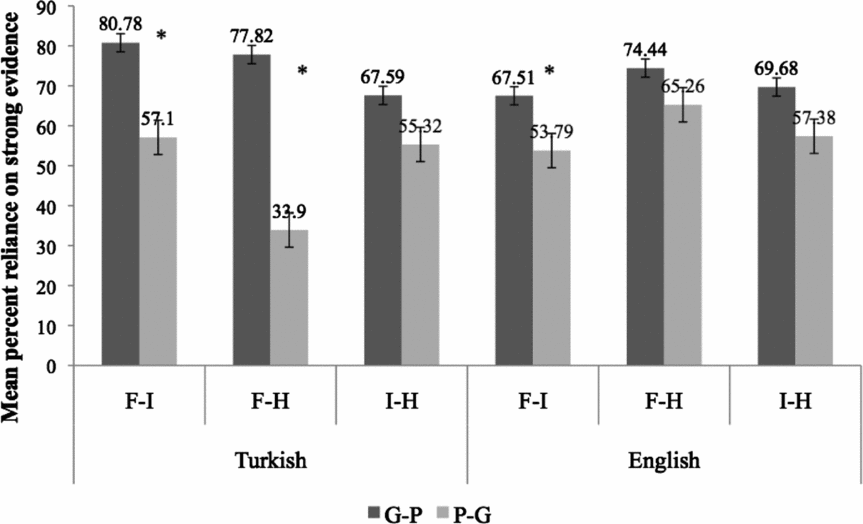
The two-way interaction was qualified by a three-way interaction of Source Order × Sentence Order × Language, F (1, 141) = 16.85, p < .001, ηp 2 = 0.11. This showed that English speakers relied on firsthand information more when it appeared in the second sentence, whether in the particular–general condition (65%), t (33) = –2.37, p = .024, or the general–particular condition (74%), t (38) = –4.36, p < .001; however, Turkish speakers relied on firsthand information more when it appeared in the second sentence only in the general–particular condition (78%), t (38) = –7.35, p < .001; in the particular–general condition, a majority of the responses of Turkish speakers favored the hearsay source (66%), t (32) = 2.42, p = .021.
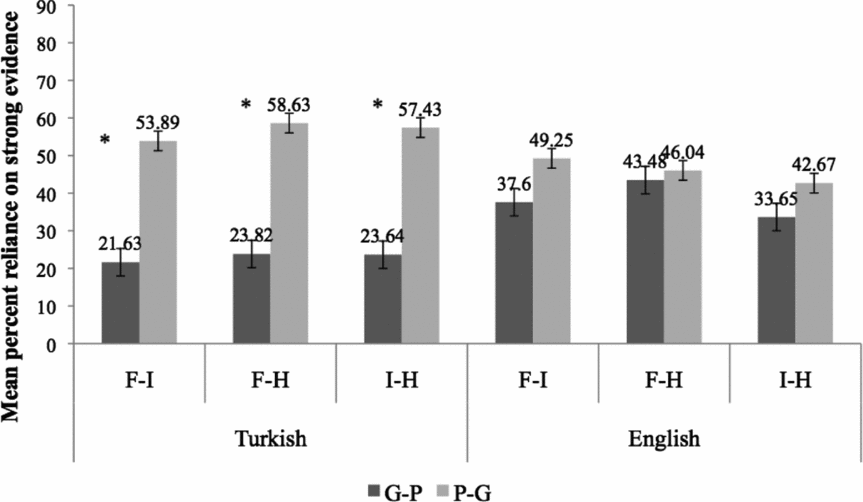
Further, when comparing Turkish and English speakers directly per condition, English speakers (43%) relied on firsthand information more than Turkish speaker did (24%), t (39) = 2.84, p < .01, for the general–particular order (when firsthand information was received first) and in the particular–general order when firsthand information was received second, t (35) = 3.52, p < .001 (English 65% vs. Turkish 34%). No other comparisons were significant.
Thus, the pattern observed in the three-way interaction may be summarized as follows: firsthand information was relied on more than hearsay by both Turkish and English speakers when it occurred second and referred to particular information. For English speakers, a greater reliance on firsthand over hearsay was also found when firsthand information was presented second and referred to general information. However, Turkish speakers showed a reverse effect here, favoring hearsay over firsthand information. Stated differently, Turkish speakers showed a pattern whereby they relied more on the particular information; that is, they showed a greater reliance on firsthand over hearsay only when firsthand was particular and presented second. Moreover, they showed a greater reliance on hearsay than firsthand when hearsay was particular (regardless of whether it was presented first or second).
See Figures 1 and 2 for a summary of the results for the firsthand versus hearsay comparison.
The source type per language group and sentence order for strong evidence was presented first. Error bars indicate standard errors.

The source type per language group and sentence order for strong evidence was presented second. Error bars indicate standard errors.

Firsthand versus inference
The mean percentage reliance on firsthand source information in the comparison of firsthand with inference sources ranged from 22% to 81%. The results of the 2 × 2 × 2 ANOVA demonstrated a significant source order main effect, F (1, 141) = 37.54, p < .001, ηp 2 = 0.21, indicating that participants who saw firsthand source information second (63%) relied on it more than those who saw it first (40%). There were no main effects of sentence order or language.
The Source Order × Sentence Order interaction was significant, F (1, 141) = 33.1, p < .001, ηp 2 = 0.19. It revealed an effect of source order only in the general–particular sentence order condition: participants who received the firsthand source in the second sentence relied on it more (74%) than those who received the firsthand source in the first sentence (30%), t (78) = 8.76, p < .001. By contrast, in the particular–general sentence order group, there was no effect of source order (firsthand first: 51%; firsthand second: 53%), t (67) = 0.27, p = .79. Furthermore, within the firsthand source presented first condition, participants who received the sentences in particular–general order (51%) relied on the firsthand source more than those who received the sentences in general–particular order (30%), t (71) = –3.77, p < .001. However, within the firsthand source presented second condition, participants who received the sentences in general–particular order (74%) relied on the firsthand source more than those who received the sentences in particular–general order (53%), t (74) = 4.27, p < .001.
The Source Order × Sentence Order × Language interaction was also significant, F (1, 141) = 5.31, p = .023, ηp 2 = 0.04. In the general–particular sentence order, English speakers relied on the firsthand source more when they received it second (68%) than when they received it first (38%); t (38) = 3.85, p < .001; similarly, Turkish speakers relied on the firsthand source more when it was presented second (81%) than when it was presented first (22%), t (38) = 10.22, p < .001. However, in the particular–general condition, neither group showed an effect of source order: English speakers: t (33) = –0.58, p = .56; Turkish speakers: t (32) = 0.22, p = .83.
Further, a direct comparison of Turkish and English speakers per condition showed that in the particular–general order, the groups did not differ: firsthand first: t (30) = 0.52, p = .61; 54% versus 49%; firsthand second: t (35) = –0.24, p = .81, 52% versus 54%. However, in general–particular sentence order, English speakers relied on the firsthand source more than Turkish speakers (38% vs. 23%) but only when they received the firsthand source first, t (39) = 2.07, p < .05. When the firsthand source was presented second in the general–particular order, Turkish speakers relied on the firsthand source more than did English speakers, t (37) = 2, p = .053. The other comparisons in the interactions were not significant. See Figures 1 and 2 for a summary of the results of the firsthand versus inference comparison.
Inference versus hearsay
The mean percentage reliance on the inference source type ranged from 24% to 70%. The results of the 2 × 2 × 2 ANOVA demonstrated a main effect of source order, F (1, 134) = 37.47, p < .001, ηp 2 = 0.22. Participants who received the inference source second (63%) relied on inference more than those who received the inference source first (38%).
The Source Order × Sentence Order interaction was significant, F (1, 134) = 19.85, p < .001, ηp 2 = 0.13. Within the general–particular sentence order group, people who received the inference source second (69%) relied more on inference than those who received inference first (29%), t (75) = 8.45, p < .001. However, within the particular–general sentence order group, participants did not show a significant difference between the source orders, t (63) = 1.12, p = .27. Further, when the inference source was presented first, participants relied on inference in the particular–general order more than in the general–particular order, t (68) = 3.97, p < .01; 50% versus 29%. However, when the inference source was presented second, participants relied on inference more in the general–particular order (69%) than in the particular–general order (56%), t (70) = 2.22, p < .05. There was no higher order interaction.
Thus, the results suggest a picture in which both Turkish and English speakers show a greater reliance on particular information: they rely on inference more than hearsay when inference is presented second (and is particular) and they rely on hearsay more than inference when hearsay is presented second (and is particular). When particular information is presented first, there is no effect of source order. Figures 1 and 2 summarize the results of the inference versus hearsay comparison.
DISCUSSION
This was the first experimental investigation of the potential impact of evidential marking on the establishment of discourse coherence. The participants were presented with two facts that somewhat contradicted each other and had to find a way to reconcile the discordant meanings of the two statements and arrive at a third response that would make sense of the story. The two discordant facts were framed with different pairings of three evidential sources: firsthand, inference, and hearsay. Participants had to weigh the different meanings conveyed by the two statements and arrive at some coherent whole.
We note that up to half of the responses reflected attempts to reconcile the discordance by integrating elements from each antecedent sentence. Thus, the dialectical strategy was one of the favored strategies adopted by our participants. In our discussion, however, we will focus on the use of the differentiated response strategy, that is, instances where participants tried to make sense of the discordant meanings by placing greater weight on one of the prior sentences than on the other. If evidentiality type is used at all to establish discourse coherence, we would expect participants to give more weight to firsthand sources than to nonfirsthand sources. Participants were not asked directly which of the facts/evidential source they relied on (if any) in arriving at their response. By noting whether participants selected information from one of the preceding sentences more than from the other, we are able to determine whether discourse coherence is affected by evidential marking.
Our findings do not show a clear and consistent reliance on firsthand sources. The mean percentage reliance on firsthand information varied widely across the different conditions of the study. We turn, therefore, to a closer examination of what did appear to be influencing participants’ response strategy and then consider whether evidentiality is used in certain conditions.
As we hypothesized, our results showed a preference on the part of participants for the information conveyed in the particular sentence than in the sentence describing some general state of affairs; this was especially the case when the particular information followed the general information. In other words, when presented with a general statement followed by some particular fact that contradicts the general statement, participants tend to continue the story along the lines of the particular information. Given that the particular information almost invariably referred to some actual event that had occurred (that contradicts some general state), the fact that participants give more weight to the particular event than the general state makes sense, because it would take more cognitive effort to go against a statement about an actual event. Thus, there is greater commitment to information that reflects some particular event than to information that asserts some general state of affairs.
Against this backdrop of an overall greater weighting of the particular information, especially when it is presented second, one may ask whether there was still an effect of evidential marking. It was somewhat unexpected that, in the firsthand versus hearsay comparison, we found that it was English speakers who showed a consistent reliance on firsthand information (especially when it was presented second), regardless of whether that information was general or particular. For Turkish speakers, firsthand information presented second has to refer to particular information in order for it to be relied on more than hearsay information. When it is not particular, then firsthand information is relied on less than hearsay by Turkish speakers and is also relied on less than reliance on firsthand information by English speakers.
Similarly, in the firsthand versus inference comparison, for general–particular sentences, reliance on firsthand information presented second was greater than reliance on firsthand information presented first; this was particularly so for Turkish speakers, suggesting that Turkish speakers were again influenced by the particular nature of the information. Turkish speakers relied on inference more than did English speakers when inference information was particular, and they relied on inference less than English speakers when inference information was general.
For the comparison of inference versus hearsay, our findings allow us to weigh in on two competing predictions. According to de Haan (Reference de Haan, Cienki, Luka and Smith1998), inference should be relied on more than hearsay; according to Willett (Reference Willett1988), inference should be relied on less than hearsay. Although the results showed some support for the pattern predicted by de Haan of a preference for relying on inference over hearsay, it was by no means clear that the effect is attributable to evidentiality rather than to particularity. A “particularity (second) bias” characterized both Turkish and English speakers: both groups preferred inference information over hearsay when it was presented second and was particular. When inference information was particular but presented first, neither group preferred it over hearsay. Furthermore, hearsay information was preferred over inference when hearsay was particular and presented second.
Taken together, only limited support was obtained for an evidentiality effect. The findings instead showed that the effect of evidential marking occurred only under certain conditions: when firsthand (or inference) information was presented second, and when it coincided with particular information. Furthermore, in two of the three analyses (both involving comparisons between firsthand and nonfirsthand sources), there was a consistent pattern of group differences, with Turkish participants being more sensitive than English participants to the nature of the information, relying on particular information more than general information. In the third source pair analysis (inference vs. hearsay), both groups showed a particularity bias.
Our results thus show that the type of evidential marking by itself plays only a modest role in influencing discourse coherence production. Its effect emerges only for information that is presented more recently, and especially when the more recent information refers to particular rather than general information. This finding is not surprising in the context of the design of the present study, given that more recently presented information is also likely to be new information and given that the particular information almost always referred to an actual action that had been completed at some specified time. This factor could have made participants feel a greater commitment to the particular event and thus more inclined to rely on it in their discourse completion.
Given the overall greater reliance on particular information presented second, we decided to look at this condition more closely to see if there is a residual effect of evidentiality that can be detected. To get at this question, we analyzed each group's reliance on firsthand information for each of the following comparisons: (firsthand vs. inference) versus (firsthand vs. hearsay), (firsthand vs. inference) versus (inference vs. hearsay), and (firsthand vs. hearsay) versus (inference vs. hearsay) for items that had particular information presented second. If evidentiality matters, then there should be higher reliance on the firsthand information in the comparisons involving the firsthand markers than in the conditions with only nonfirsthand markers. The results of this analysis revealed that for English speakers, there was no significant difference in any of the three contrasts; however, for Turkish speakers, reliance on firsthand information was significantly greater for the (firsthand vs. inference) versus (inference vs. hearsay) contrast, t (18) = 2.19, p < .042, but not significant for the other two contrasts. This suggests that at least in the comparison of firsthand with inference versus both nonfirsthand markers, Turkish speakers gave greater weight to firsthand markers than to nonfirsthand markers that were presented second and referred to particular information. English speakers did not show a greater reliance on firsthand markers in any of the three contrasts. Thus, we find some support of a modest evidentiality effect, over and above the effect of recency and particularity, and an effect that is restricted to Turkish speakers. This effect is consistent with prior claims that languages in which there is grammaticalized marking of source may make users more attentive to source distinctions (e.g., Tosun et al., Reference Tosun, Vaid and Geraci2013).
As noted at the outset, several previous studies have shown support for a recency bias in decision making and judgment. For example, Bruine de Bruin (Reference Bruine de Bruin2005) and Bruine de Burin and Keren (Reference Bruine de Bruin and Keren2003) tested the serial position effect on decision making in various experimental contexts such as blind date selection, dorm room selection, and various real-life contexts such as Eurovision Song Contest, and European and World Figure Skating Contests. Their findings demonstrated that when competing options were presented in a serial order, the most recent options were more likely to be judged more positively or to be selected. Our findings suggest that a recency effect also appears to be operating in the establishment of discourse coherence.
Our findings also showed that both Turkish and English speakers give more weight to recent information than to earlier presented information in arriving at their story completions. The recency effect occurred when general facts were presented first and particular facts second. Further, within this sentence order group, Turkish speakers demonstrated a greater recency effect than did English speakers. This is probably due to an interaction of sentence type effect where the recent fact in this group was always the particular information. However, the recency effect disappeared for Turkish speakers when they were presented the particular facts first. For English speakers, the same recency effect was observed when the particular facts were presented first, although the effect was reduced compared to the general-facts-first order group. This finding suggests that when the facts were presented as particular first and general second, Turkish participants looked for other cues to resolve the dissonance and make sense of their stories. At this point, the reliability of the source of the information (i.e., how direct the source is) was one of the signs that they could use for arriving at their decision. This is most probably due to the codability of evidential source in Turkish grammar.
Finally, as already noted, we found an overall attributional bias whereby individuals relied on particular information over general information specifically when it was presented second. This is consistent with the recency effect. However, Turkish speakers demonstrated this attributional bias more in that they tended to rely on the particular situational fact (e.g., Jack rented an apartment on the 10th floor of a high-rise, Hakan bir gökdelenin onuncu katından daire kiraladı) over the general fact (e.g., He was afraid of heights, Hakan’ın yükseklik korkusu vardı) even when the information was presented first. Kahneman and Tversky (Reference Kahneman and Tversky1973; Tversky & Kahneman, Reference Tversky and Kahneman1974) argued that there is a base rate bias in uncertain situations, where individuals tend to underutilize the general information and prefer the more specific information instead. The dissonance created in our experiment would lead participants to feel uncertain and make a probability bias by relying on the particular situation. Alternatively, as work by Nisbett et al. (Reference Nisbett, Borgida, Crandall, Reed, Carroll and Payne1976) suggests, the perceived vividness of the particular situation over the general fact may make particular information more salient. This could be another possible explanation of the present results where Turkish speakers relied more on the particular fact.
It is not clear whether the differences we observed between Turkish and English speakers may be entirely attributable to differences between the two languages or to cultural or pragmatic differences. One issue that may need to be investigated further is whether Turkish speakers’ reliance on the particular information may have been influenced in part by the fact that in their language there are markers for general events. Although our study did not use those markers (because sentences containing the generalizing suffix typically are construed to refer to some present state of affairs and our study sought to frame each event as having occurred in the past), it may be that Turkish participants were somehow influenced by the lack of the generalizing marker in the stimuli and thus accorded the particular information more weight. This possibility should be investigated in further work.
Other research suggests cultural differences as a potential source of the particularity bias we observed. As Nisbett (Reference Nisbett2003) and Choi, Nisbett, and Norenzayan (Reference Choi, Nisbett and Norenzayan1999) indicated, there are differences between members of Eastern versus Western cultures in reasoning in terms of their attributional processes. People from Western cultures tend to describe objects, persons, or reasons based on context-free general attributions (e.g., Joe is generous), while people from Eastern cultures tend to describe things in context-specific ways (e.g., Joe is generous to his friends). Consistently in our experiment, Turkish speakers, as members of an Eastern culture, demonstrated this attributional bias while they based their judgments or decisions on the particular fact rather than the general one. English speakers, however, did not show a fact/sentence order effect, except in the inference versus hearsay analysis. To the extent that it is possible to demarcate linguistic from cultural sources of the bias we observed, it would be instructive in further research to explore this issue, such as by testing individuals who culturally identify as Turkish but whose knowledge of Turkish is minimal and whose primary language is English.
We note some limitations of the present investigation. Having an open-ended task makes the data coding open to the coders’ own interpretations, which may or may not be consistent with participants’ actual interpretations. Although the intercoder and intracoder reliability was high, it is suggested that in further analyses, a closed-ended, multiple-choice task would be a way of ensuring objectivity. Multiple choice or closed-ended decision-making tasks would also help to reduce data loss, because in this study almost one third of the completed sentences could not be categorized as supporting one of the antecedent sentences. At the same time, use of multiple-choice tasks would make the experiment less natural. Thus, there is a need to conduct further investigations with better controlled decision making, while attending to issues of external validity.
Another limitation of our study is that because Turkish uses the same suffix to refer to inference and hearsay, we had to rely on lexical (adverbial) distinctions to examine this contrast more directly. In future work, it will be important to test languages in which these distinctions are marked in the grammar if one wants to make any claims about differences between languages that convey these distinctions versus those that differentiate them only in the lexicon. This will allow a test of whether having such distinctions grammaticalized makes the distinction more salient in a discourse context.
Practical significance of research on evidentiality in relation to judgments
Making judgments is one of the basic functions guiding many facets of daily life. Thus, the significance of research on possible variables that influence individuals’ judgments processes is unquestionable. This study was designed to address the influence of evidential expressions on judgments. The results of the study are of particular importance in settings where the judgments that are made have a long-lasting impact on individuals’ lives, such as courtrooms, political elections, medical environments, marketing and business, and academia. In these and similar settings linguistic framing is used significantly to manipulate decisions of people (for more information, see Matlock, Reference Matlock2012; Tannen, Reference Tannen1993).
The results of this study exhibited limited support for the influence of type of evidentiality marking on sense-making judgments. Other variables exerted a more robust influence on individuals’ judgments, namely, recency of the presented information and the specificity of the information. Other research that has taken a more qualitative approach in investigating evidentiality in discourse has demonstrated that evidential expressions are used to indicate commitment (Berlin Reference Berlin2011a, Reference Berlin2011b), responsibility, entitlement, certainty of knowledge, denial (as nonfirsthand) of the described situation (Fox, Reference Fox2001), and unbelievable and unreliable situations as in fairy tales (Johanson, Reference Johanson, Aikhenvald and Dixon2003), as well as conveying the distance between the speaker and the described situation (Aksu-Koc & Slobin, Reference Aksu-Koc, Slobin, Chafe and Nichols1986). Thus, discourse analyses reveal that evidentiality is used by speakers to frame their stories with the underlying meaning of various evidential sources. Thus, speakers can manipulate their audiences’ judgments and decisions. Our study is the first empirical approach that examines how evidentiality may influence sense making in discourse. Clearly, more work along these lines should help delimit the scope of the effect of evidential marking in contexts involving decision making other than discourse.
APPENDIX A
LIST OF STIMULI USED IN EACH LANGUAGE
General–particular order
Nick did not like crime novels. But he apparently read all of Agatha Christie's books. His book interests
Matt did not like musicals. But he reportedly went to the theater to see Les Miserables. Matt
Jennifer was very punctual. But she apparently was late to the lab meeting. Jennifer
Alexa apparently did not know how to drive. But she reportedly bought a car yesterday. Alexa
Johnny was good with numbers. But he apparently failed his calculus class. Johnny
Carl believed in superstitious sayings. But he reportedly acted reasonably yesterday. When he saw a black cat, Carl
Jessica apparently had a lot of genuine leather bags. But she reportedly wore an imitation leather bag today. Jessica
Kelly ran out of her allotted minutes on her phone plan. But she reportedly talked on the phone this morning. Kelly
Leila did not know how to use the Internet. But she apparently did a Google search for her homework. Her homework
David was a very lazy boy. But he reportedly washed his car yesterday. David's car
Andrew apparently paid the bills on time. But he reportedly received late fees this month. Andrew
Robert apparently prepared a gift for his mother. But he reportedly gave nothing to her on Mother's Day. Robert
Anna apparently was allergic to cats. But she reportedly adopted a cat this month. Anna's allergies
George's favorite drink was Coke. But he apparently ordered coffee at dinner today. George
Hayley did not like to write. But she apparently recited her own poem at the meeting. Hayley
Kathy loved eating fast food. But she reportedly started a weight-control program. Kathy's eating habit
Emily economized using electricity. But she apparently received a high bill this month. In this month, Emily
Kate apparently did not like reading books. But she reportedly read almost all of the superhero comic books. Kate
Bill did not like his stepsister. But he apparently cried when she left home for college. Bill
Jack was apparently afraid of heights. But he reportedly rented an apartment on the 10th floor of a high-rise. Jack
Chase apparently did not drink alcoholic beverages. But he reportedly was drunk last night. Chase
Bruce refused to listen to heavy metal music. But he reportedly bought Metallica's recent album. Bruce's taste in music
Mary studied hard this semester. But she reportedly missed some of her classes. This semester Mary
Jill was an animal rights supporter. But she apparently had a butterfly collection. Jill
Ross apparently worked as a research assistant. But he reportedly wrote on his resume that he did not have any experience. Ross
Mark received a lot of money from his father. But his father reportedly went bankrupt last year. Mark
Brian did not speak his first language since he was a child. But he apparently spoke it when he visited his relatives. Brian's language
Diana paid attention to her health. But she reportedly smoked cigarettes. Diana
Lisa supported affirmative action policies for university admission. But she reportedly held negative stereotypes about Hispanics. Lisa's view about race
Kim apparently was not interested in sports. But she reportedly played basketball in high school. Kim
Particular–general order
Nick apparently read all of Agatha Christie's books. But he did not like crime novels. His book interest
Matt reportedly went to the theater to see Les Miserables. But he did not like musicals. Matt
Jennifer apparently was late to the lab meeting. But she was very punctual. Jennifer
Alexa reportedly bought a car yesterday. But she apparently did not know how to drive. Alexa
Johnny apparently failed his calculus class. But he was good with numbers. Johnny
Carl reportedly acted reasonably yesterday. But he believed in superstitous sayings. When he saw a black cat, Carl
Jessica reportedly wore an imitation leather bag today. But she apparently had a lot of genuine leather bags. Jessica
Kelly reportedly talked on the phone this morning. But she ran out of her allotted minutes on her phone plan. Kelly
Leila apparently did a Google search for her homework. But she did not know how to use the Internet. Her homework
David reportedly washed his car yesterday. But he was a very lazy boy. David's car
Andrew reportedly received late fees this month. But he apparently paid the bills on time. Andrew
Robert reportedly gave nothing to his mother on Mother's Day. But he apparently prepared a gift for her. Robert
Anna reportedly adopted a cat this month. But she apparently was allergic to cats. Anna's allergies
George apparently ordered coffee at dinner today. But his favorite drink was Coke. George
Hayley apparently recited her own poem at the meeting. But she did not like to write. Hayley
Kathy reportedly started a weight-control program. But she loved eating fast food. Kathy's eating habit
Emily apparently received a high bill this month. But she economized using electricity. In this month, Emily
Kate reportedly read almost all of the superhero comic books. But she apparently did not like reading books. Kate
Bill apparently cried when his stepsister left home for college. But he did not like her. Bill
Jack reportedly rented an apartment on the 10th floor of a high-rise. But he was apparently afraid of heights. Jack
Chase reportedly was drunk last night. But he apparently did not drink alcoholic beverages. Chase
Bruce reportedly bought Metallica's recent album. But he refused to listen to heavy metal music. Bruce's taste in music
Mary reportedly missed some of her classes. But she studied hard this semester. This semester Mary
Jill apparently had a butterfly collection. But she was an animal rights supporter. Jill
Ross reportedly wrote on his resume that he did not have any experience. But he apparently worked as a research assistant. Ross
Mark's father reportedly went bankrupt last year. But Mark received a lot of money from his father. Mark
Brian apparently spoke his first language when he visited his relatives. But he did not speak it since he was a child. Brian's language
Diana reportedly smoked cigarette. But she paid attention to her health. Diana
Lisa reportedly held negative stereotypes about Hispanics. But she supported affirmative action policies for university admission. Lisa's view about race
Kim reportedly played basketball in high school. But she was apparently not interested in sports. Kim
TURKISH STIMULI
General–particular order
Beyza duyduğuma göre lisede basketbol oynamış. Fakat görünüşe göre kendisi sporla ilgilenmezmiş. Beyza
Jale çok dakik bir insandı. Fakat görünüşe göre lab toplantısına geç kalmış. Jale
Handan hayvan haklarını savunan bir insandı. Fakat görünüşe göre kendisinin kelebek koleksiyonu varmış. Handan
Necati Agatha Christie'nin bütün kitaplarını okudu. Fakat görünüşe göre suç kitaplarından hoşlanmazmış. Necati'nin kitap zevki
Tarık’ın sayılarla arası iyiydi. Fakat görünüşe göre yüksek matematik dersinden kalmış. Tarık
Meryem bu dönem çok çalıştı. Fakat duyduğuma göre bazı derslerini kaçırmış. Bu dönem Meryem
Ahmet duyduğuma göre faturalarını tam zamanında ödemiş. Fakat görünüşe göre bu ay gecikme faizi almış. Ahmet
Başar üvey kardeşinden hoşlanmazdı. Fakat görünüşe göre kardeşi evden ayrılınca arkasından ağlamış. Başar
Cemil'in en sevdiği içecek kolaydı. Fakat görünüşe göre bu akşam yemekte kahve sipariş etmiş. Cemil
Ayten duyduğuma göre araba sürmeyi bilmiyormuş. Fakat görünüşe göre dün bir araba satın almış. Ayten
Duyduğuma göre Betül’ün kedilere alerjisi varmış. Fakat görünüşe göre bir kedi almış. Betül’ün alerjisi
Hatice internet kullanmayı bilmiyordu. Fakat görünüşe göre ödevi için Google'da arama yapmış. Hatice'nin ödevi
Reşat duyduğuma göre araştırma asistanı olarak çalışmış. Fakat görünüşe göre özgeçmişinde bundan hiç bahsetmemiş. Reşat
Rasim duyduğuma göre annesi için bir hediye hazırlamış. Fakat görünüşe göre annesine anneler gününde hiçbir şey vermemiş. Rasim
Mine duyduğuma göre kitap okumaktan hoşlanmazmış. Fakat görünüşe göre neredeyse bütün süperkahraman çizgi romanlarını okumuş. Mine
Kayra cep telefonun bütün kontörlerini kullandı. Fakat duyduğuma göre bu sabah cep telefonuyla konuşmuş. Kayra
Çetin duyduğuma göre alkollu içecek içmezmiş. Fakat görünüşe göre kendisi dün gece sarhoşmuş. Çetin
Mert müzikallerden hoşlanmazdı. Fakat duyduğuma göre Sefiller'in son çekilen filmine gitmiş. Mert
Duyduğuma göre Gülşen'in bir sürü gerçek deri çantası varmış. Fakat görünüşe göre bugün sahte deri bir çanta takmış. Gülşen
Bekir çocukluğundan beri ana dilini konuşmadı. Fakat görünüşe göre Türkiye'de akrabalarını ziyaret ettiğinde onlarla konuşmuş. Bekir'in anadili
Hande yazmaktan hoşlanmazdı. Fakat görünüşe göre toplantıda kendi yazdığı şiiri okumuş. Hande
Duyduğuma göre Hakan’ın yükseklik korkusu varmış. Fakat görünüşe göre bir gökdelenin onuncu katından ev kiralamış. Hakan
Kevser fast food yemeği severdi. Fakat duyduğuma göre bir diyet programına başlamış. Kevser'in yeme alışkanlığı
Leyla pozitif ayrımcılığı desteklerdi. Fakat duyduğuma göre Kürt vatandaşlara yönelik olumsuz önyargıları varmış. Leyla'nın ırkçılıkla ilgili görüşleri
Davut çok tembel bir çocuktu. Fakat duyduğuma göre bu sabah arabasını yıkamış. Davut'un arabası
Dilek sağlığına dikkat ederdi. Fakat duyduğuma göre sigara içiyormuş. Dilek
Can’ın batıl inançları vardı. Fakat duyduğuma göre dün baya mantıklı hareket etmiş. Siyah bir kedi gördüğünde Can
Murat'a babasından baya çok para aldı. Fakat babası duyduğuma göre geçen yıl iflas etmiş. Murat
Emine elektriği tasarruflu kullanırdı. Fakat görünüşe göre bu ay çok yüksek meblağlı bir fatura gelmiş. Emine
Bilal metal müzik dinlemeye karşıydı. Fakat duyduğuma göre Metallica'nın son albümünü almış. Bilal'in müzik zevki
Particular–general order
Beyza duyduğuma göre sporla ilgilenmezmiş. Fakat görünüşe göre lisede basketbol oynamış. Beyza
Jale lab toplantısına geç kaldı. Fakat görünüşe göre çok dakik bir insanmış. Jale
Handan’ın kelebek koleksiyonu vardı. Fakat kendisi görünüşe göre hayvan haklarını savunan bir insanmış. Handan
Necati suç kitaplarından hoşlanmazdı. Fakat görünüşe göre Agatha Christie'nin bütün kitaplarını okumuş. Necati'nin kitap zevki
Tarık yüksek matematik dersinden kaldı. Fakat kendisinin görünüşe göre numaralarla arası iyiymiş. Tarık
Meryem bazı derslerini kaçırdı. Fakat duyduğuma göre bu dönem çok çalışmış. Bu dönem Meryem
Ahmet duyduğuma göre bu ay gecikme cazası almış. Fakat görünüşe göre faturalarını tam zamanında ödemiş. Ahmet
Başar üvey kardeşi evden ayrılınca arkasından ağladı. Fakat görünüşe göre üvey kardeşinden hoşlanmazmış. Başar
Cemil bu akşam yemekte kahve ısmarladı. Fakat kendisinin görünüşe göre en sevdiği içecek kolaymış. Cemil
Ayten duyduğuma göre dün bir araba satın almış. Fakat görünüşe göre araba sürmeyi bilmiyormuş. Ayten
Betül duyduğuma göre bir kedi almış. Fakat görünüşe göre onun kedilere alerjisi varmış. Betül’ün alerjisi
Hatice ödevi için Google'dan arama yaptı. Fakat kendisi görünüşe göre internet kullanmayı bilmiyormuş. Hatice'nin ödevi
Reşat duyduğuma göre özgeçmişinde bundan hiç bahsetmemiş. Fakat görünüşe göre araştırma asistanı olarak çalışmış. Reşat
Rasim duyduğuma göre annesine anneler gününde hiçbir şey vermemiş. Fakat görünüşe göre annesi için bir hediye hazırlamış. Rasim
Mine duyduğuma göre neredeyse bütün süperkahraman çizgi romanlarını okumuş. Fakat görünüşe göre kitap okumaktan hoşlanmazmış. Mine
Kayra bu sabah cep telefonuyla konuştu. Fakat duyduğuma göre cep telefonun bütün kontörlerini kullanmış. Kayra
Çetin duyduğuma göre kendisi dün gece sarhoşmuş. Fakat görünüşe göre alkollu içecek içmezmiş. Çetin
Mert Sefiller'in son çekilen filmine gitti. Fakat duyduğuma göre müzikallerden hoşlanmazmış. Mert
Gülşen duyduğuma göre bugün sahte deri bir çanta takmış. Fakat görünüşe göre onun bir sürü gerçek deri çantası varmış. Gülşen
Bekir Türkiye'de akrabalarını ziyaret ettiğinde onlarla konuştu. Fakat görünüşe göre çocukluğundan beri ana dilini konuşmamış. Bekir'in anadili
Hande toplantıda kendi yazdığı şiiri okudu. Fakat görünüşe göre yazmaktan hoşlanmazmış. Hande
Hakan duyduğuma göre bir gökdelenin onuncu katından ev kiralamış. Fakat görünüşe göre onun yükseklik korkusu varmış. Hakan
Kevser kilo verme programına başladı. Fakat duyduğuma göre fast food yemeği severmiş. Kevser'in yeme alışkanlığı
Leyla'nın Kürt vatandaşlara karşı olumsuz önyargıları vardı. Fakat duyduğuma göre pozitif ayrımcılığı desteklemiş. Leyla'nın ırkçılıkla ilgili görüşleri
Davut bu sabah arabasını yıkadı. Fakat duyduğuma göre çok tembel bir çocukmuş. Davut'un arabası
Dilek sigara içerdi. Fakat kendisi duyduğuma göre sağlığına dikkat edermiş. Dilek
Can dün baya mantıklı hareket etti. Fakat duyduğuma göre Can’ın batıl inançları varmış. Siyah bir kedi gördüğünde Can
Murat’ın babası geçen yıl iflas etti. Fakat duyduğuma göre Murat babasından baya çok para almış. Murat
Emine bu ay çok yüksek meblağlı bir fatura geldi. Fakat görünüşe göre elektriği tasarruflu kullanırmış. Emine
Bilal Metallica'nın son albümünü aldı. Fakat duyduğuma göre metal müzik dinlemeye karşıymış. Bilal'in müzik zevki
ACKNOWLEDGMENTS
This research was supported by a Texas A&M University College of Liberal Arts 2020 Vision Dissertation Enhancement Award (to S.T.). We thank Jennifer Lange for assistance in data coding.