Introduction
The manifestations of filial piety include an expectation among older adults that their children will care for them in old age, and the obligation felt by children to respect and support their ageing parents (Sung Reference Sung1998, Reference Sung2001). Typically in Asian societies, filial piety is accepted as a norm, but when immigrants from the region migrate to developed countries, where the expectations of filial piety are different, the migrants' expectations of care evolve with acculturation. Studies have revealed that filial piety is a dynamic concept that transforms after migration (Ajrouch Reference Ajrouch2005; Choudhry Reference Choudhry2001; Queen, Habenstein and Quadagno Reference Queen, Habenstein and Quadagno1985; Treas and Mazumdar Reference Treas and Mazumdar2002) and is influenced by current circumstances (Gans and Silverstein Reference Gans and Silverstein2006; Sung Reference Sung1997). The purpose of this study was to examine and compare among older Tibetans living in India and Switzerland the support they received, their perception of their relationships with their children, and the ways in which they had adapted to different levels and forms of intergenerational exchange. Diasporic Tibetans were studied because they originated from traditional Tibetan society in which filial piety has been the norm and that has patriarchal family relationships based on notions of interdependency (Goldstein and Beall Reference Goldstein and Beall1997). In that society, when children are young, parents devote their time to their subsistence, but when children became adults, parents begin preparing for the next life by devoting more time to religious activities, particularly in old age (Goldstein and Beall Reference Goldstein and Beall1997; Goldstein et al. Reference Goldstein, Jiao, Beall and Tsering2003). Conducting research among Tibetans living in India and Switzerland allowed examination of the modifications to filial piety norms and practice in two very different social and political contexts.
The Tibetan diaspora
The Tibetan diaspora began after the escape of His Holiness the Dalai Lama, temporal and spiritual leader of the Tibetan people, to India in 1959 following the Chinese occupation of Tibet (Conway Reference Conway1975; Routray Reference Routray2007; Woodcock Reference Woodcock1970). Of the six million Tibetans, the diasporic community accounts for around 122,000, of whom 85,000 are in India, with most of the remainder in Nepal, Bhutan, Canada, Switzerland, the European Union and the United States of America (USA) (Planning Commission 2004; Planning Council 2000). New refugees continue to enter India, at between 2,000 and 3,000 each year (International Campaign for Tibet 2005). In India, most Tibetans live in 35 Tibetan settlements scattered among several states. The first Tibetan Demographic Survey of 1998 estimated that those aged 60 or more years made up 13.9 per cent of the total Tibetan refugee population in India (Planning Council 2000). Most of the older people are uneducated, with about only one-third able to read and write in Tibetan, whereas younger Tibetans are more educated with a literacy rate of 95 per cent (Bhatia, Dranyi and Rowley Reference Bhatia, Dranyi and Rowley2002). Similarly in Switzerland, older migrant Tibetans lack education and language skills. They had been engaged largely in blue-collar jobs and most live close by other Tibetans (Corlin Reference Corlin1991; Korom Reference Korom1999; Ott-Marti Reference Ott-Marti1976).
Filial piety in Asian societies
Family relationships in Asian cultures are strongly characterised by filial piety. Children are repeatedly taught and reminded of their duties towards their ageing parents and family members. Several studies have examined the care received by older adults from their children and have used measures such as living arrangement, social support and the transfer of financial resources from children to the parents to assess the practice of filial responsibilities (Lee, Parish and Willis Reference Lee, Parish and Willis1994; Lin et al. Reference Lin, Goldman, Weinstein, Lin, Gorrindo and Seeman2003; Ofstedal, Reidy and Knodel Reference Ofstedal, Reidy and Knodel2004). Sudha, Rajan and Sharma's (Reference Sudha, Rajan and Sharma2004) study of the support received by parents in three Indian states found that most older adults lived with their children and that, in general, older women received more economic support than older men. Similarly, Frankenberg, Chan and Ofstedal (Reference Frankenberg, Chan and Ofstedal2002) indicated that older adults in Indonesia, Singapore and Taiwan lived with their children and maintained the same living arrangement over time. Findings from a 1989 national survey in Taiwan regarding intergenerational support and transfer of resources confirmed these findings (Lee, Parish and Willis Reference Lee, Parish and Willis1994; Lin et al. Reference Lin, Goldman, Weinstein, Lin, Gorrindo and Seeman2003). Children were the primary care-givers for ageing parents, and parents received more support from the children in whom they had invested more, but well-off children bargained with their siblings to decide who would be responsible for what type of care for their parents. Finally, Ghuman and Ofstedal's (Reference Ghuman and Ofstedal2004) national survey in Bangladesh of older adults' living arrangements and social support found that most received support from their children.
Care-giving is not unidirectional from children to ageing parents. A study of family exchange in Singapore by Verbrugge and Chan (Reference Verbrugge and Chan2008) revealed that, although elders received support from their children, the parents reciprocated by helping with child care and household tasks and by giving advice (see alsoBeard and Kubharibowo Reference Beard and Kubharibowo2001; Ghuman and Ofstedal Reference Ghuman and Ofstedal2004). Co-residence with parents benefited the children by allowing them to fulfil their responsibilities as care-givers. Savla and Davey (Reference Savla and Davey2004) noted that when children were unable to conform to traditional roles of filial piety, immigrant sons harboured feelings of guilt, shame and sadness.
Changing environment and changing filial piety
Forced and economic migrations undermine the practice of filial piety. For example, when the threat or fact of war disperses families, many younger people flee without their older parents, while many older people go unaccompanied to refugee camps. Even if parents and children flee together, severe economic constraints during the migration and in the refugee camps can cause social disintegration and erosion of the traditional family system (United Nations High Commission for Refugees 1998, 2000). Many adult children of older adults have their own children to care for, and face difficult decisions about which to help and in what ways. Kelley (Reference Kelley2005) found that in an impoverished Caribbean village, when resources were lacking, older adults received little to no care from their children. Similarly, in disaster situations when resources were limited, young people tend to receive preferential treatment and elders bear the brunt of suffering (Ardalan et al. Reference Ardalan, Mazaheri, Naieni, Rezaie, Teimoori and Pourmalek2010; HelpAge International 2005). Although upholding filial piety is a basic value for many people raised in traditional family-based cultures, in a new country and in unfamiliar or stressed circumstances, it is not always possible to fulfil the felt obligations.
Studies of older immigrants have shown that the care and respect received from children in a new country is dissimilar from that expected back home, and that this generates senses of discontent, loneliness and isolation among elders (Ajrouch Reference Ajrouch2005; Choudhry Reference Choudhry2001; Treas and Mazumdar Reference Treas and Mazumdar2002). Chappell and Kusch (Reference Chappell and Kusch2007) found that, upon migration, older Chinese immigrants in Canada were more dependent on their children than they would have been in their home country. Greater financial dependence of older adults on their immigrant children deepened their dissatisfaction with their lives in the host nation. Kalavar and Van Willigen (Reference Kalavar and Van Willigen2005) reported changes in the status of older Indian immigrants living in the household of a child that had migrated to the USA. Whereas in India, older adults retained the ultimate power in the household because they controlled the finances and property, in the USA power was vested in the adult children. A few studies have reported how older immigrants adapt in a new country. For example, Ahmadi and Tornstam (Reference Ahmadi and Tornstam1996) studied 15 older Iranians and found that they had successfully adapted to their host nation (Sweden) and accepted the altered relationship with their children. The elders chose to live independently rather than live with their children. They were able to do so because of old-age benefits from the Swedish government.
Despite the change in intergenerational relationships following migration, filial piety is practised and expected by both younger and older immigrants. Liu et al. (Reference Liu, Ng, Weatherall and Loong2000) explored the attitudes of young and middle-aged New Zealand Chinese towards filial obligations (see alsoIp, Lui and Chui Reference Ip, Lui and Chui2007). The younger generation accepted filial responsibilities towards their parents and grandparents. Conversely, de Valk and Schans (Reference de Valk and Schans2008) examined Turkish, Moroccan and Dutch elders' perceptions of filial piety in The Netherlands. The findings indicated that older Turks and Moroccans displayed higher expectations of filial obligation than their Dutch counterparts. In general, immigrant elders had greater expectations of weekly visits and care from children than Dutch elders, possibly because of their cultural expectations of filial responsibilities.
Methodology of the study
I chose to examine India and Switzerland because they were the first countries to offer refugee status to Tibetans (Conway Reference Conway1975; Corlin Reference Corlin1991; Gooch Reference Gooch1969; Ott-Marti Reference Ott-Marti1976; Woodcock Reference Woodcock1970), and they are now home to the oldest communities of Tibetan refugees in, respectively, a developing and a developed country. Older Tibetans have lived in India and Switzerland for almost 50 years, and therefore have aged in exile. These two countries have very different health, economic, social and political systems (Brunetti Reference Brunetti2007; Chakraborti Reference Chakraborti2004; Schoenenberger and Stuck Reference Schoenenberger and Stuck2006; Stuckelberger and Hopflinger Reference Stuckelberger and Hopflinger1998). In India, the Bylakuppe Tibetan settlement was selected because it is one of the largest and oldest. In Switzerland, elder Tibetans living in the cantons of St Gallen and Zurich were selected because they attracted most of the Tibetans who migrated to Switzerland during the 1960s and 1970s. Thirty older Tibetans participated in this study: 16 from India and 14 from Switzerland. There were 12 women and 18 men, and their ages ranged from 60 to 92 years with an average age of 73 years. All fled Tibet after the failed uprising against the Chinese occupation in 1959.
The study used a qualitative approach and in-depth face-to-face interviews (Bernard Reference Bernard2002; Cobb and Forbes Reference Cobb and Forbes2002; Johnson Reference Johnson, Gubrium and Holstein2002).Footnote 1 As a Tibetan, I am fluent in the Tibetan language and familiar with the culture, as well as sensitive to cultural designations of elders. In addition, I have previously visited Switzerland and have lived in India, and therefore had local contacts that helped with recruitment. Snow-balling was used, with the initial recruits recommending the names of others they thought might wish to participate (Bernard Reference Bernard2002; Cresswell Reference Cresswell2003). Most of the participants were not literate, and therefore gave oral consent for their involvement. The interviews were conducted during 2007–2008 in the participants' homes, lasted from one to three hours, and were tape-recorded with consent. Verbatim translations of the interviews from Tibetan to English were transcribed.
The transcripts were read several times to promote familiarity with the data and then the text was analysed using open and axial coding (Bernard Reference Bernard2002; Cresswell Reference Cresswell2003; Denzin and Lincoln Reference Denzin, Lincoln, Denzin and Lincoln2000; Strauss and Corbin Reference Strauss and Corbin1990). During the analysis, many themes pertaining to intergenerational relationships were coded. These were grouped into broader categories, such as the characteristics of elders and their children, the levels of support received by elders living in India, the emotional support received by elders living in Switzerland, intergenerational dissonance, and views about longevity and care received. These broader categories are discussed in detail below.
The findings
Characteristics of the elders and their children
Six of the 30 participants had no children: three were married, and three had been monks in Tibet and remained celibate. The other 24 had one or more children. The Swiss participants' children were born in Tibet, India or Switzerland, with one exception, Yeshi's children were born in Tibet, India and Germany.Footnote 2 The Indian participants' children were born in either Tibet or India. At the time of the interviews, most of the Indian participants' children lived far away from their parents, and a majority had a child living in the USA, Australia, the European Union and other western countries (e.g. Dhondup and Ngodup had children living in both India and abroad). Ten elders also had a child either living at home or in neighbouring Tibetan communities in and around the Bylakuppe settlement, typically only an hour away by bus. By contrast, most of the Switzerland participants' children lived in the same or neighbouring cantons, and only two had a child living in another country. Because Switzerland is a very small country, the longest travel time between children and parents was less than four hours, and most children were within an hour's journey.
The children of the elders living in India had been more mobile than those in Switzerland, which is largely a reflection of the two countries' socio-economic and cultural differences. India is a developing country and is experiencing rapid economic development as well as high rates of out-migration. The literacy rate among younger generations of Tibetans in India is 95 per cent (Bhatia, Dranyi and Rowley Reference Bhatia, Dranyi and Rowley2002). The participants noted that, because their children had had more education, they, like many other young Tibetans, were not interested in pursuing an agricultural livelihood, and most preferred to take advantage of opportunities in the cities. Also, migration to the West has become a norm in the Tibetan community, particularly after the resettlement of 1,000 Tibetan families to the USA during the 1990s (Hess Reference Hess2006).
Levels of support received by the elders living in India
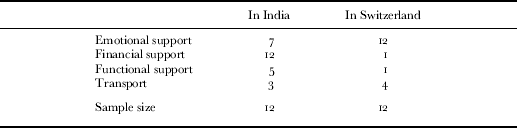
All the participants in India received financial support from their children, and in addition, 58 per cent received emotional support, 42 per cent received functional support, and one-quarter received help with transport (Table 1). The elders prided themselves on having children living abroad, as they were a source of substantial financial support, but ten had at least one child either living in the same household or in one of the nearby settlements. The most desired configuration was to have one or two children living abroad and at least one living at home or close to home. This arrangement allowed ample financial support from the children living abroad, increased the family's social status, and provided the emotional and functional support of the proximate children. The participants in India with children at home and working abroad or living in India's larger cities claimed that their children took care of all their needs. Dhondup, a man aged 74 years with four children, described his children's support:
My children live in Australia, America and Bombay [Mumbai]. The youngest daughter lives at home. They are good children and they keep regular positive contacts [by telephone]. We receive care from children in the form of financial and emotional support. The youngest daughter keeps constant checks to ensure that I have taken showers, eaten and so on.
The parents expected their children living at home or close by to provide regular help with transport, grocery shopping, cooking, washing and cleaning. Children who had settled abroad or in other Indian cities were held responsible mostly for financial support, and most regularly telephoned to check how their parents were getting on. All elders with children living at home and abroad indicated this allocation of support responsibilities. The elders who had no children living abroad but one or more in India's cities stressed that they were financially supported by their children and were satisfied with the care they received, but observed that their peers with children in the West received more support. For example, Dawa, aged 79 years, had four children and lived with one son and his wife, while his other children lived in neighbouring settlements. The co-resident couple were his primary care-givers and took care of the household chores. Despite being well cared for by them, Dawa insisted, ‘I am not rich. I must be the poorest in this camp. There are families who have children abroad who send them money, but I have no such children’. Gyaltsen, a man aged 92 years, and Passang, a woman aged 73 years, also had all their children in India. Both received financial support from them, and in return took care of the grandchildren so that the children had more time to work and less stress.
Support received from their children by exiled older Tibetans, 2007–08
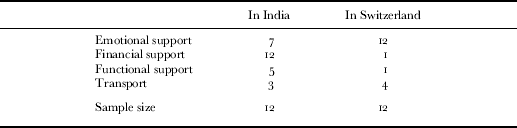
Note: Four elders in India and two in Switzerland did not have any children.
Women such as Dolma, aged 75 years, and Penpa, aged 79 years, had just one child and felt that they could not ask for much and that their needs could not be met by the child alone. Dolma's daughter, who had a full-time job and two children, also took care of Dolma's needs. Dolma was satisfied with the support her daughter provided, but felt that she would have received better care if she had more children. Similarly, Penpa, whose daughter lived in Switzerland, said she was the sole means of financial support for herself and her husband. The daughter sent them money regularly and they lived a fairly comfortable life, but Penpa and her husband said that it did not meet all their needs; for example, Penpa had fractured her hand and they could not pay for the surgery. Two men, Tashi, aged 64 years, and Gyalpo, aged 76 years, had no children because they had been monks. Tashi remained a monk in India; Gyalpo had joined the army. Tashi lived independently most of his life and hoped that he would be able to continue to do so. He also believed that his friends and neighbours in the community would support him if his needs rose.
The support received by elders living in Switzerland
In contrast to the elders in India, those in Switzerland mainly received emotional support from their children, mainly in the form of regular visits and in affirmations of their shared Tibetan identity. The children's interest in adhering to Tibetan identity and maintaining the Tibetan culture, and their ability to speak the Tibetan language were greatly valued (Table 1). When such affirmation was evident, the participants conveyed a sense of fulfilled expectations, as by Topgyal, aged 72 years:
My children are proud of their Tibetan identity, and respect the government and [its] laws. They have not had many problems with the law! Although they did not study well, they are successful because they now live their own life and have assimilated well into this country. They have not caused any problems for me, and I am happy with them.
The elders expected their children to be involved in their lives, and also hoped their children would include them in their lives. The elders enjoyed weekly or monthly visits from their children and anticipated regular phone calls and news. Some parents helped their children by babysitting for their grandchildren during the working week. These interactions allowed the elders to maintain frequent contact and active engagement in their lives. Most elders reported that they gave advice to their children, but stressed that they did not make decisions for them. Namgyal, a man aged 67 years with three sons, gave a clear account of his changed situation in Switzerland:
There [in Tibet] parents and children are dependent on one another. Here [in Switzerland], neither children nor parents are dependent on one another, because parents are financially independent, and children leave their parents for work and have their own family. Our parents helped us throughout our lives and made decisions for us; here, we help children with their education, and then, when they are 18 years-old, they make their own decisions.
Despite changes in the elders' decisional authority and the limited contact with their children, the parents appeared satisfied with their relationships with children. Most were content that their children retained some aspects of Tibetan identity, such as speaking the language and/or being involved in Tibetan activism and cultural activities. They hoped that the next generation would continue Tibetan traditions.
Unlike the elders living in India, those in Switzerland received benefits such as pensions and social security because they had worked and contributed to the Swiss retirement system for more than three decades. Consequently, they were economically secure in their old age, and many treasured their financial independence. Most were healthy, lived independently, and did not need more financial support, but they did expect that, if their needs increased, their children would provide them with the necessary support and care. Despite the elders' expectation of support from their children, they conceded that they would be fine if none of their children helped. They believed that their financial security would buffer them from future needs. According to Wangchuk:
In Tibet, children lived with and took care of their ageing parents. Here, children do not have to take care of their parents, and they do not have time to tend to their parents. Here, if I am ill, I will be placed in an assisted-living facility, and my children will come to visit me weekly if they want and/or have time. Here, children cannot help because they have their own lives. Also, it is the Swiss tradition that children live with their parents until they are 18 years-old, but after that they leave and take care of themselves. If children are good, it is good. If I need them, I will call them, and I expect that they will help me, [but] help from children is not needed in this country because I have worked all my life. I have saved money, and I receive old-age benefits.
As evident, elders in Switzerland hoped that their children would support them when in need, but tried not to expect too much, fearing that if they became dependent they might be unwelcome.
Intergenerational dissonance in Switzerland
When the elders in Switzerland perceived a discontinuation of Tibetan traditions, generally in association with intergenerational differences in cultural values and norms of behaviour, there was dissonance and a sense of disconnectedness from their children (cf. Choudhry Reference Choudhry2001; Kalavar and Van Willigen Reference Kalavar and Van Willigen2005; Treas and Mazumdar Reference Treas and Mazumdar2002). The perception of distancing could arise over not using the Tibetan language or neglecting the culture or religious beliefs, as among grandchildren. Concerns reflecting intergenerational dissonance were reported by two women, Sangmo (aged 70 years) and Dolkar (75 years), and a few others alluded to it. Both had one or more children married to non-Tibetans. Children from mixed marriages were particularly likely not to be fluent in the Tibetan language, and the elders then had difficulties communicating with their grandchildren (as well as the daughter-in-law or son-in-law). The elders regarded the Tibetan language and culture as their most precious legacy, which they diligently passed on to their children, and they wanted their grandchildren to inherit the same from their parents. Some elders were disappointed that their children had failed to transmit the Tibetan culture and language to the grandchildren.
Such intergenerational tensions were not present among all the elders whose children had married non-Tibetans. The elders who were proficient in German could communicate with their grandchildren and were not negative about mixed marriages. Yangchen, a woman aged 63 years, emphasised that mixed marriages were bound to happen because her children lived in Swiss society and culture. They had become Swiss and it was natural for them to seek Swiss partners. She stressed that, although some of her children had married non-Tibetans, they had maintained their Tibetan identity. Another parent, Yeshi, a man aged 72 years, stated that as long as the spouse was a good person who understood and appreciated the Tibetan cause, nationality did not matter. Yeshi asserted that someone not born to Tibetan parents can ‘become’ Tibetan as long as he or she understands the essential qualities of Tibetan culture (i.e. being a good and compassionate person), promotes the Tibetan cause, and appreciates Tibetan religion.
The relationship between dependency and desired longevity
The elders living in India were adamant that they did not want to become a burden on their children and were fairly specific about how many more years they wished to live – many said around another two to five years because they were still in reasonable health and felt that they could take care of themselves for that time. Lhakpa, a man aged 65 years, wanted to live as long as he could remain independent: ‘I expect to live until I can [no longer] take care of myself. Long life would be a problem for the children’. The elders believed that a long life was dependent on both good karma (one's fortune being the result of one's acts) and on good health. A few elders stated that living long was possible in India because of the blessing of His Holiness the Dalai Lama and because of their continuous involvement in religious activities that allowed them to accumulate positive karma. Gyaltsen, at 92 years the oldest participant in the study, hoped to live until his grandson was old enough to take care of him, but he understood that long life depended on his karma and there was nothing he could do if it was not his fortune to live long.
Most participants living in Switzerland wanted to live as long as possible if they maintained good health and were able to live independently. They emphasised that a long life was dependent upon good karma, good food and good relationships. Some felt that the better environment in Switzerland and good resources, such as health care, contributed to their long lifespan. Sonam described his enthusiasm for a long life: ‘I am 79 years-old now, and I never thought about how long I want to live. In Tibet, if one was 50 years-of-age, one was considered old, but here [in Switzerland], even if someone is 60 it is not considered old’. When describing their willingness to live longer, the elders' most often cited condition was whether they became too dependent on their children. According to Wangchuk, a man aged 70, ‘it is good to live long if one is healthy, but if one is ill, in hospital and in constant need of care, it is difficult for both the carer and the person receiving care’.
Discussion
The nature and dynamics of intergenerational support has changed for Tibetan elders in exile as a consequence of their new societal and economic environment. The elders in India needed and received financial support from their children, while those in Switzerland desired only emotional support. In traditional Tibet, filial piety involved children taking over family responsibilities, being resident in the parents' home, and providing them with the support they required to live out their old age devoted to religious activities (Goldstein and Beall Reference Goldstein and Beall1997). In exile, however, given that the migrants' circumstances had changed, the traditional notion of the parent–child relationship needed modification. Queen, Habenstein and Quadagno (Reference Queen, Habenstein and Quadagno1985) explained that family dynamics alter with changing environmental and social contexts. In India, the elders' children migrated to cities or abroad to achieve material progress, while in Switzerland, the adult children simply moved out of their parents' homes. The elders in both India and Switzerland lived quite comfortable lives. Those in Switzerland received social benefits from the government that allowed them to provide for their own needs in old age, while those in India received financial support from children. Nevertheless, the elders in India felt that dependence on their children might become unwelcome in the future and did everything possible to avoid asking for more support. For example, they did not ask for more financial support even when necessary, and they helped with raising grandchildren.
The elders in India with many children received collaborative care from all or several of their children, which reduced each child's responsibility and allayed the elder's fear of becoming very dependent on a single child. Also, having at least one child living in the West and one or more at or close to home was the most desired parent–child configuration. This arrangement enabled parents to enjoy financial support from the children living in the West, functional support from those residing with or close to them, and emotional support from all. These findings confirm those from intergenerational studies in Asian countries that have found that children who lived with their ageing parents were the primary care-givers, and that better-off children bargained with their siblings to decide who would provide which type of care (Frankenberg, Chan and Ofstedal Reference Frankenberg, Chan and Ofstedal2002; Lee, Parish and Willis Reference Lee, Parish and Willis1994; Knodel et al. Reference Knodel, Kespichayawattana, Saengtienchai and Wiwatwanich2010; Lin et al. Reference Lin, Goldman, Weinstein, Lin, Gorrindo and Seeman2003; Ofstedal, Reidy and Knodel Reference Ofstedal, Reidy and Knodel2004). Elders who did not have any children in the West were quick to point to the greater financial security enjoyed by those who did. The high satisfaction when financial support was received signified that it was more important than other types of support for the elders living in India. Emotional and functional support received from their children was treasured but not critical for their survival and clearly secondary, which of course was a sign of their financial insecurity. With no government social-security benefits or old-age pensions, the exiles in India were financially dependent on their children.
In Switzerland, by contrast, support from children was primarily emotional support. Studies concerning immigrant elders and intergenerational relationships in Canada and The Netherlands have indicated that older immigrants place great store on expressions of filial piety (Chappell and Kusch Reference Chappell and Kusch2007; de Valk and Schans Reference de Valk and Schans2008). They expected their children to visit weekly and to provide care for them when needed. Ahmadi and Tornstam (Reference Ahmadi and Tornstam1996) reported that elder Iranians living in Sweden depended on their children only for emotional support because they were economically independent in their host nation. Likewise, Tibetan elders were financially independent and expected and enjoyed visits from their children. They anticipated regular phone calls and updates. These interactions allowed them to maintain frequent contact with their younger relatives. Because the elders' involvement in their children's lives was limited, in comparison to what might have been in Tibet, and their decision-making roles were few, most elders reported that they only gave advice to their children. Similar changes in the status of older immigrants have been reported by other studies (Choudhry Reference Choudhry2001; Kalavar and Van Willigen Reference Kalavar and Van Willigen2005).
Among the elders living in Switzerland, intergenerational dissonance was observed when their expectations did not match their children's actions or behaviour or when the children expected different things from their parents. Disconnectedness was reported by a few elders who expressed concern or unhappiness when their grandchildren were not being socialised into Tibetan identities. Intergenerational dissonance also arose in some instances of children marrying non-Tibetans, because the elders were unable to communicate with their grandchildren and sons-in-law or daughters-in-law, but in other cases mixed marriages were completely accepted. Some parents reasoned that because their children had been socialised into Swiss culture, it was normal for them to choose Swiss partners. Another elder stressed the malleability of ‘Tibetanness’ and emphasised that one can become Tibetan as long as one understands the essential qualities of Tibetan culture. Those elders who accepted non-Tibetan in-laws were generally able to adjust their relationships with their children and grandchildren. Kleiger (Reference Kleiger1992, Reference Kleiger and Kleiger2002) noted the acquisition of Tibetan identity by non-Tibetans through their understanding of the Tibetan religion, culture and language.
The expectations of care had changed among the elders living in Switzerland. Most accepted that their children would not be able to provide hands-on care in the future because they had jobs and other responsibilities. The elders understood that employment was extremely important in their children's lives, and that their work and contributions to social security and pensions systems would allow them to remain independent in the future. Recognising the importance of paid work, the elders accepted the ‘different’ level of support that they currently received and did not have great expectations of future support.
Despite receiving the support they desired from their children, the elders in both India and Switzerland lived simple lives and were strongly motivated not to become a burden. A fear of becoming dependent in the future led some to express unwillingness to live a very long life. Most wished to live for another two to five years, for as long as they remained sufficiently healthy to be minimally dependent. They also stated that it would be better to die before ill health, to save their children from the stresses of intensive care-giving. Moreover, the participants knew that it would be difficult for the children to provide much support because they had dependent children and full-time work. These competing demands on their children diminished the position of the elders in the multi-generational family (Kelley Reference Kelley2005). The inclination to prefer an early death rather than a longer life might be seen as the ultimate adjustment to old age in a diaspora setting.
The study has some limitations. First, it was a qualitative study that used a convenience sample, and the sample may not be representative of all older Tibetans living in either India or Switzerland. Second, intergenerational relationships were examined only from the perspectives of the elders. Third, no quantitative data were obtained on how much financial support participants received from their children: such data were not gathered because to do so would have been regarded by the elders as insensitive and intrusive. Nevertheless, it was evident that the elders in Switzerland received minimal financial support from their children, while elders in India received sufficient resources to meet their basic needs.
Despite these limitations, this study is an original contribution to Tibetan studies and to our understanding of the circumstances of older refugees. It is believed to be the first comparative study of intergenerational relationships among older exiled Tibetans. It has shown the ways in which diasporic communities successively adapt to their new societal context. The lack of social benefits in old age, such as pensions and social security, made the elders in India highly dependent on their children for financial support. Conversely, the availability of old-age benefits in Switzerland enabled the elders to remain economically self-sufficient, and broadly they were satisfied with the emotional support received from their children. For the participants in India, the migration of the children to cities and to developed countries had changed the experience of old age, for many were left behind to fend for themselves in the Tibetan refugee settlements. On the other hand, such migrations provided the remittances for an elder to have a better material standard of life and, very importantly, in most cases was leading to a better future for the young migrant. Migrations, particularly those to the developed world, do however pose a threat to the continuation of Tibetan culture, religion, language and identity (Hess Reference Hess2006; Korom Reference Korom1999), which distressed many of the elders, particularly those in Switzerland. Therefore, the promotion of intergenerational understanding between elders and their younger relatives regarding their different values and expectations may help bridge the gap in their differences and foster cultural values of interdependence between and among several generations.
While the majority of the older Tibetans were being cared for by their children in both India and Switzerland, questions remain about the circumstances of those whose children were unable or did not want to support their parents. Not all of the children who migrated to India's cities or to the developed world were providing sufficient support to their parents. With further acculturation and greater distance from traditional Tibetan society, the third generation may not hold the same perceptions of filial piety. It should also be remembered that not all the elders had children. It is therefore increasingly important to create safety nets for older adults in the developing world, where the social protection enjoyed by older adults in developed countries is lacking.
Acknowledgements
I am thankful to the 30 Tibetan elders who shared their life experiences with me and made it possible to conduct this study. I acknowledge the support of my dissertation committee members, Dr Pamela B. Teaster, Dr Graham D. Rowles, Dr Nancy Schoenberg, Dr Joy Jacobs-Lawson, and Dr Peggy Hickman, for their guidance and expertise. Finally, I thank Dr Tony Warnes for his help in editing this manuscript.