


Introduction
On December 12, 2019, the UN Committee on the Elimination of Racial Discrimination (the Committee) issued its decision on the question of jurisdiction in the inter-state communication submitted by the State of Palestine against Israel.Footnote 1 It is among the three first inter-state communications ever before human rights treaty bodies and therefore sets numerous precedents on matters of procedure and in this case, on the question of jurisdiction and the unique nature of the Convention on the Elimination of Racial Discrimination (the Convention)—the first of a series of treaties codifying and expanding the scope of human rights law.
Background
Palestine's communication charged that Israel violated the core articles of the Convention (Articles 2, 3 and 5) with respect to Palestinians living in the Occupied Territory, including East Jerusalem. It maintained that under Articles 11–13 of the Convention, a state party may bring a petition to the Committee claiming that another state party has failed to meet its obligations under the Convention, thereby triggering a process of investigation and conciliation.
However, Israel countered that it does not recognize Palestine, and that when Palestine acceded to the Convention in 2014, Israel submitted a statement to establish its position that Palestine's status vis-a-vis the Convention should not be considered to create obligations or rights under the Convention between Israel and “the Palestinian entity.” Consequently, Israel argued that it has no treaty relations with Palestine and therefore no attendant treaty obligations with respect to Palestine. On that basis, Israel maintained that the Committee had no jurisdiction under Article 11 to consider the communication.
The Committee first took the decision that, as “the principal guardian of the Convention,” it has full powers and the duty to interpret the Convention with complete independence, including the competence to determine its jurisdiction over the present inter-state communication. To that end, the Committee proceeded on a preliminary basis to receive written submissions from the parties and to hear oral arguments on the issue of jurisdiction.
The Decision on Jurisdiction
The Committee's decision on jurisdiction was based on four main considerations:
1. the possibility of excluding treaty relations in the context of a multilateral treaty under general international law,
2. the possibility of excluding treaty relations in the context of human rights treaties,
3. the unique nature of the mechanism established under Articles 11 to 13 of the Convention and treaties containing the collective obligations of states parties, and
4. the Committee's decision in relation to the sixth periodic report of the Syrian Arab Republic in 1981.
Because the Committee dismissed the fourth issue as unrelated to the communication considered here, this note will describe the Committee's decision with respect to considerations 1 through 3.
The possibility of excluding treaty relations in the context of a multilateral treaty under general international law
As described above, Israel's non-recognition of Palestine as a state supported Israel's argument that it had no treaty relationship with Palestine, and therefore that Palestine has no right to take action against it under Articles 11 to 13 of the Convention. According to Israel, under general principles of international law, consent is the basis of all legal obligations, including in the context of multilateral treaties. States are permitted therefore, given an appropriate and timely reservation or objection, to preempt relations with another party to the treaty, thereby excluding obligations and rights under the treaty vis-à-vis that state party.
The Committee quickly addressed this issue, finding that it is possible under international law for a party to a multilateral treaty to unilaterally exclude treaty relations with new members.Footnote 2 However, the Committee noted that specific treaty regimes, such as human rights treaty regimes, could depart from this principle.
The possibility of excluding treaty relations in the context of human rights treaties
The Committee's Decision rests heavily on the jus cogens and erga omnes nature of obligations that all states have to combat racial discrimination.Footnote 3 The obligations contained in the Convention are erga omnes, and therefore states parties owe obligations under the Convention to the international community as a whole.
The object and purpose of the Convention places it inherently among those treaties seeking the promotion and protection of rights relating to core erga omnes obligations: treaties for the common good. Such treaties establish an interlocking network of states parties that agreed to protect the common good and that differ in nature from other treaties that seek to protect the interests of individual states by establishing a network of bilateral commitments. In the latter case, the commitments are reciprocal between states parties, permitting one party to exclude relations with another based on its own individual state interests.
Most modern human rights treaties fall into the former category, and hence are subject to a different legal order for the protection of “objective obligations,” which must benefit from “collective enforcement.”Footnote 4 However, the Committee reasoned that the Convention is in a special category even among other human rights treaties because of the unique status of the norms prohibiting racial discrimination, which has been a matter of the highest priority for the whole of the international community—on par with the treaties prohibiting the crime of genocide.
The Committee concluded that “it is undisputable that all States parties to the Convention have the obligation to act together against racial discrimination,”Footnote 5 and that the norms in the Convention are subject to collective guarantee and enforcement under the Convention. A state party therefore cannot bar another state party, through unilateral action, from triggering an enforcement mechanism that is essential to guarantee the equal enjoyment of the rights of individuals or groups as set forth in the Convention.Footnote 6
Unique nature of the mechanism in the Convention
The Committee also goes a step further to comment on the unique nature of the mechanism established under Articles 11 to 13 of the Convention. Unlike communication procedures in other human rights treaties, with the singular exception of the Genocide Convention, states parties do not need to grant permission for the Committee to entertain communications alleging another state party's non-compliance with the Convention. It is therefore an automatic mechanism that applies despite Israel's non-recognition of Palestine as a state.
The Committee emphasized that “it is the relationship that each State party has with the Convention, as supervised by the Committee, that is determinative, rather than the relationship that may exist on a bilateral basis between any two States parties. The obligations which States owe under articles 11 to 13” have the “common purpose of ensuring the effective prohibition of racial discrimination, an erga omnes norm, for the common good of the whole international community which cannot be derogated from by the unilateral action of one State party, and which has no relevance to the existence of any prior bilateral relationship between States.”Footnote 7
The Committee therefore decided that it has jurisdiction to examine the inter-state complaint of Palestine against Israel.
Conclusion
When the next session of the Committee convenes, given a determination that the complaint is admissible, the Chair of the Committee will name a five-member Conciliation Commission to prepare a report containing the facts, its findings on all relevant issues and recommendations. The parties will have three months to negotiate acceptable outcomes before the report is transmitted to all member states of the Convention.
Regardless of the potential for settlement between these two states, it is worth noting that the unique character of the Convention and its superior importance as recognized in this decision on jurisdiction will serve to elevate the regard given to the Convention going forward and the importance of the work of the Committee. In emphasizing that modern human rights treaties are not traditional multilateral treaties, and are subject to a different legal order that features regimes of collective enforcement, this Decision highlights the possibility of new pathways for human rights enforcement. Additionally, the inter-state complaint mechanism authorized under Articles 11–13 of the Convention will now be the focus of future efforts to address previously intractable failures of states to fulfill their obligations under the Convention.
CERD/C/l00/5
Advance unedited version
Distr.: General
12 December 2019
Original English
Committee on the Elimination of Racial Discrimination
Inter-State communication submitted by the State of Palestine against IsraelFootnote **, Footnote ***, Footnote ****
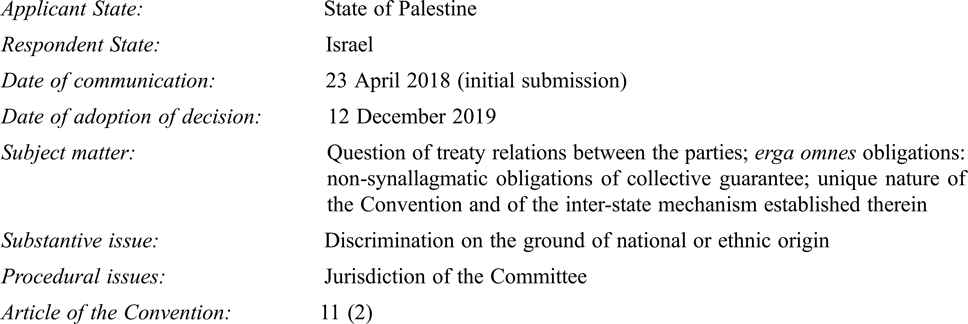
1.1 The State of Palestine, (“the Applicant State/ the Applicant”), acceded to the Convention on the Elimination of All Forms of Racial Discrimination on 2 April 2014. Israel (“the Respondent State/ the Respondent”) ratified the Convention on 3 January 1979.
1.2 On 23 April 2018, the Applicant submitted a communication against the Respondent under article 11 of the Convention, claiming that Israel has violated articles 2, 3 and 5 of the Convention with regard to Palestinian citizens living in the Occupied Palestinian Territory, including East Jerusalem.
1.3 On 7 November 2018, the Applicant resubmitted the matter to the Committee.
1.4 The present decision should be read in conjunction with CERD/C/100/3 and CERD/C/100/4.
I. Background
2.1 During its 98th session, the Committee asked the Secretariat to request on its behalf an advice on the legal issue of the Committee's jurisdiction regarding the inter-state communication submitted by the State of Palestine against Israel, to the Office of Legal Affairs in light of the submissions made by the two concerned States.
2.2 The Committee takes note of the reply of the Office of Legal Affairs in the form of an inter-office memorandum, dated 23 July 2019, which outlines the jurisprudence of various international and regional judicial and non-judicial bodies, as well as the work undertaken by the International Law Commission on the issue of reservations to treaties.
2.3 The Committee takes note of the conclusions made by the Office of Legal Affairs, according to which (a) both the Applicant and the Respondent are parties to the Convention; (b) a State party to the Convention is able, through a unilateral statement, to prevent the creation of obligations and rights under the Convention between itself and another specific State party. The statement made by Israel on 16 May 2014 is framed in such manner as to have that effect between itself and the State of Palestine; (c) there is nothing in the juridical nature of the legal relationships established between States parties under the Convention, or in articles 11 to 13 of the Convention that would bar one State party from issuing an unilateral statement suitably framed, the effect of which would be that a right does not vest in another specific State party to submit a valid and effective communication under article 11(l), and so trigger the procedures set in those articles. The statement has that effect vis-à-vis the State of Palestine. Therefore, the statement made by Israel precluded the Committee from examining the inter-State communication submitted by the State of Palestine.
2.4 During its 99th session, the Committee learned that the Respondent State had knowledge of the Office of Legal Affairs memorandum. This was brought to its attention through a note verbale from the Respondent State dated 20 August 2019, at a time the Committee had not decided which follow-up action it would give to the memorandum, either substantially or procedurally.
2.5 The Committee analysed the note verbale which conveyed the message that it would be bound by the opinion of the Office of Legal Affairs. On 22 August 2019, the Committee informed the Respondent that it considered the statements contained in the note verbale unacceptable and amounting to undue pressure on the independence of its members. It also decided that, in order to guarantee the fairness of the proceedings, the memorandum would be transmitted to the Applicant State, which was done on 23 August 2019. The Committee also indicated that these events would possibly delay the proceedings. On 26 August 2019, the Committee decided to postpone its decision regarding its jurisdiction with respect to the present inter-state communication to its l00th session.
2.6 On 25 August 2019, the Applicant provided observations on the memorandum of the Office of Legal Affairs. It considered that taking into account the fact that the Respondent had had access to the memorandum in unascertained circumstances, and in violation of its procedural good faith obligations arising under the Convention, it must be estopped from relying on the position taken by the Office of Legal Affairs.
2.7 However, the Committee does not consider that the principle of estoppel should be applied with such severity, and will consider the observations made by the Office of Legal Affairs on their own merit, as was its intention when the Committee requested its advice, with the aim of taking a thorough and independent decision.
2.8 The Applicant alleges that the memorandum lacks balance, as its submissions supporting its view that the Committee has jurisdiction were not given due weight. It also submits that the memorandum refers selectively to the practice of a small number of States that have challenged the position of the Human Rights Committee in its general comment No. 24 (1994) on issues relating to reservations made upon ratification or accession to the Covenant or the Optional Protocols hereto, or in relation to declarations under article 41 of the Covenant—the United States of America, the United Kingdom of Great Britain and France—while there has been no challenge by the overwhelming majority of the more than 170 contracting States of the Covenant on Civil and Political Rights. It further indicates that the memorandum acknowledges that general comment No. 24 is based on the fact that under treaties such as the Covenant or the Convention, “one State party cannot take action the effect of which would be that another State party could not trigger in respect of it, any enforcement machinery that the treaty creates”. ln addition, the Applicant indicates that the memorandum also acknowledges that a reservation purporting to inhibit the mechanism established in articles 1.1 to 13 of the Convention is impermissible.Footnote 1 According to the Applicant State, the above demonstrates that the memorandum is supportive of the position adopted by the Human Rights Committee in its general comment No. 24.
2.9 The Applicant also made observations regarding the practice of the International Law Commission with regard to reservations, the relevance of the erga omnes character of the obligations under the Convention, the lack of the necessity of a bilateral treaty relation to trigger the proceedings established in articles 11 to 13 of the Convention, and the proper interpretation of the Committee's decision issued while reviewing the sixth periodic report of the Syrian Arab Republic.Footnote 2
2.10 On 6 September 2019, the Respondent addressed a communication to the Committee in which it reassured that its note verbale of 20 August 2019 was in no way intended to exert undue pressure on the Committee, and that it deeply regretted that it could have been interpreted that way. It also indicated that the reference to substantive information contained in Office of Legal Affairs memorandum, that had come to it indirectly and through no inappropriate proactive measures of its own, should not be characterized in that way. The Respondent requested that the memorandum be transmitted to it, considering that it would be transmitted to the Applicant. The memorandum was transmitted to the Respondent on 13 September 2019.
2.11 On 11 October 2019, the Applicant reiterated its dismay regarding the “illegal” access the Respondent had had to the memorandum. It also indicated that the equality of the parties during an international dispute must be preserved, pursuant to article 2(3) of the Charter of the United Nations.Footnote 3 It also stated that it required assurances that no advantage whatsoever may result for the Respondent, from the fact that it had access to the memorandum in unascertained circumstances. The Applicant also noted that the Respondent has changed its position towards the Office of Legal Affairs, as it changed from denying any role to it to considering it “an alleged legal authority”, taking into account that the memorandum was favourable to its demands. The Applicant affirmed that, based on the principle of the compétence de la compétence, only the Committee can decide on its jurisdiction and competence.
2.12 On 13 November 2019, the Respondent reiterated that the Committee lacked jurisdiction. The Respondent highlighted that the memorandum concluded that the Respondent has validly excluded treaty relations with the Applicant, which precludes the Committee from examining the present inter-state communication. It further reiterates that the memorandum came to its attention through no improper proactive measures of its own. Moreover, the Respondent indicates that the Applicant's submissions ask the Committee to disregard established international law and practice, including its own.
2.13 The Respondent reiterates that the erga omnes character of substantive treaty provisions does not affect the issue of jurisdiction, as such provisions are different from the procedural mechanism established in article 11 of the Convention, which in its view is confirmed by the memorandum. It further reiterates that the Applicant's argument that its statement of l6 May 2014 is governed by the law of reservations, is untenable, as reservations and statements are different in nature and in the law that governs them. Regarding the Applicant's argument that the Respondent's objection to treaty relations renders article 11 of the Convention ineffective, the Respondent indicates that it simply produces a situation in which the mechanism is not intended to apply. The Respondent also indicates that the Applicant's attempt to distinguish the decision issued by the Committee regarding the Syrian periodic report is incorrect, as among other reasons, the legal validity of a statement excluding treaty relations with a non-recognized entity does not depend in any matter on the position of other State parties, even less of a non-recognized entity. Furthermore, the Respondent considers that the reference to the Human Rights Committee's General Comment No. 24 is irrelevant, as it conflates the concepts of reservation and statement of non-recognition. In addition, the General Comment refers to the interaction between the States parties to the International Covenant on Civil arid Political Rights (ICCPR) and not to the relation between the States parties to the Convention. Regarding the Applicant's allegation that the memorandum refers to the practice of a small number of States parties to the ICCPR, the Respondent indicates that the memorandum also examines extensively the practice of States parties to the Convention. Furthermore, the Respondent reiterates that the existence of treaty relations under the Convention is indispensable for entertaining proceedings under article 11 of the Convention, which is supported by the memorandum of the Office of Legal Affairs.
2.14 The Respondent indicates that it is willing to address the Applicant's allegations through alternative venues, including the reporting procedure under the Committee. It also requests the Committee be impartial by applying its previous decisions alongside the legal principle and precedent, in non-discriminatory manner.
2.15 On 25 November 2019, the Applicant reiterated that the Respondent is attempting to apply undue pressure on Committee's members by insisting to refer to an internal document, the memorandum of the Office of Legal Affairs. The Applicant further indicates that it agrees with the Respondent that the invocation of erga omnes obligations cannot create the basis for jurisdiction. However, the Committee has before it a different question, namely whether treaty relations are required when obligations erga omnes are at stake. Regarding the Respondent's observations on the Human Rights Committee's General Comment 24, the Applicant indicates that it is obvious that it does not refer to the Convention; however, the ICCPR and the Convention share exactly the same type of obligations with erga omnes character, with the only difference that the inter-state mechanism under the Convention is mandatory, while under lCCPR is optional which in the view of the Applicant, makes its argument even stronger.
2.16 Regarding the Respondent's argument that the inter-state mechanism is not intended to apply to the present case, the Applicant indicates that article 11 of the Convention, simply indicates that the inter-state mechanism can be triggered whenever “A State party considers that another State party is not giving effect to the provisions of the Convention”. Taking into account that both the Applicant and the Respondent are parties to the Convention, along with the fact that the Convention contain erga omnes obligations, article 11 can be applied, as it only requires that one State party considers that another State party is violating its obligations under the Convention. The Applicant adds that the Respondent should not be allowed to escape its obligations because of its refusal to respect such obligations as an occupying power and that such condition should not be used as an excuse to perpetuate the systematic discrimination and racism as demonstrated in the inter-state communication. The Applicant also briefly refers to the issue of the local remedies.
II. Decision
3.1 Before considering the appointment of an ad hoc Conciliation Commission pursuant to article 12(l) of the Convention, the Committee must be satisfied that it has jurisdiction to deal with the inter-state communication by the State of Palestine against Israel and whether the inter-state communication is admissible.Footnote 4
3.2 On 2 May 2019, the Committee, pursuant to its decision dated 14 December 2018, conducted hearings on the issue of jurisdiction, with the participation of the representative of\ the State of Palestine, as per article 11(4) and (5) of the Convention and the Rules of procedure adopted by the Committee on 29 April 2019. Israel has declined to take part in the hearings, indicating that the format proposed-the presence of both State parties concerned-was incompatible with its fundamental position as to the lack of treaty relations with the “Palestinian entity”.
3.3 On 12 December 2019, in accordance with article 11(5) of the Convention, both the Applicant and the Respondent States delivered oral statements to the Committee containing their views regarding the Committee's jurisdiction. Israel indicated that their participation in the meeting was without prejudice to its principled position that it did not recognize the “Palestinian entity” as a State party to the Convention and that they were not in treaty relations with it.
3.4 The Committee notes that the Applicant and the Respondent have submitted arguments on both jurisdiction and admissibility.Footnote 5 The Committee, however, considers that it must first establish if it has jurisdiction regarding the present inter-State communication. Therefore, submissions made on the issue of admissibility will not be considered at this stage.
3.5 The Committee takes note that the Respondent has raised the issue or lack of jurisdiction. The Committee, being the principal guardian of the Convention, considers that it has full powers and the duty to interpret the Convention with complete independence. This includes the issue ss to whether, given the circumstances of this particular case, it has competence to consider the present inter-State communication on the preliminary issue of jurisdiction.
3.6 The Committee considers that there are some elements that should be taken into account in relation to the Committee's jurisdiction:
(a) The possibility of excluding treaty relations in the context of a multilateral treaty under general international law;
(b) The possibility of excluding treaty relations in the context of human rights treaties;
(c) The unique nature of the mechanism established under articles 11 to 13 of the Convention, and treaties containing the collective obligations of States parties;
(d) The Committee's decision in relation to the sixth periodic report of the Syrian Arab Republic.
A. The possibility of excluding treaty relations in the context of a multilateral treaty under general international law
3.7 The Committee notes that the Respondent is party to the Convention, as it deposited its instrument of accession on 3 January 1979, and that the Convention entered into force for it on 2 February 1979, in accordance to article 19(2) of the Convention. The Committee further notes the Respondent's argument that there are no bilateral treaty relations under the Convention between it and the Applicant, and that the Respondent does not owe any obligation under the Convention to the Applicant,Footnote 6 as it has validly excluded any treaty relations with the Applicant by its official communication submitted to the UN Secretary General, depositary of the Convention, on l6 May 2014.Footnote 7
3.8 The Committee observes that the Respondent's statement of 16 May 2014 raises two issues: the validity of the Applicant's accession to the Convention, and the legal effects of the Respondent's statement regarding such accession.
3.9 With respect to the first point, the Committee notes that by resolution 67/19, the United Nations General Assembly decided to “accord to Palestine non-member observer status in the United Nations”. The Committee further notes that given that the Applicant has been a member of the UNESCO since 2011, it complies with the conditions established in articles 17 and 18 of the Convention. ln addition, the Committee notes that following the receipt of the Slate of Palestine's initial and second periodic reports on 21 March 2018, submitted under article 9 of the Convention, the Committee adopted the Concluding Observations on such reports during its 99th session. Therefore, the Committee considers that the Applicant is a State party to the Convention.
3.10 With respect to the second point. the Committee notes the Respondent's affirmation that it is well-established in treaty law and State practice that treaty relations do not need to exist among all the parties to a multilateral treaty, as it is recognized that treaty relations may be excluded in cases in which a State party expresses an objection to entering into treaty relations with an entity which it does not recognize. The Respondent indicates that this is supported among others, by the extensive use of such objections in State practice. In this regard, the Committee takes note of the non-exhaustive list of objections made by several States with the aim of excluding treaty relations between them and a non-recognized entity, provided by the Respondent.Footnote 8 The Committee further notes the Respondent‘s argument that consent is the basis of treaty obligations, so each party is only bound to the extent to which it has agreed to be bound.
3.11 The Committee also notes the Applicant's affirmation that the Respondent's argument that States may exclude treaty relations in a multilateral treaty through a declaration is not supported by State practice and opinio juris.
3.12 The Committee observes that statements of the kind made by the Respondent, are quite common in the practice of States with respect to multilateral treaties that are deposited with the Secretary General.Footnote 9 The Committee also observes that according to a well- established practice, a State's participation in a treaty to which an entity that it does not recognize as a State is a party, does not amount to recognition.Footnote 10 In addition, the Committee acknowledges that in general international law, treaty relations are based on consent, being the principle of free consent universally recognized.Footnote 11
3.13 The Committee acknowledges that under general international treaty law, a State party to a multilateral treaty may exclude treaty relations with an entity it does not recognize, through a unilateral statement. The Committee considers, however, as it will be developed further below, that particular treaty regimes, due to their particular character, may depart from those general principles.
3.14 Furthermore, the Committee takes note of the Respondent's argument that the study on the law and practice relating to reservations undertaken by the International Law Commission gives legal effect to State practice that treaty relations can be excluded by virtue of a State's statement.
3.15 The Committee notes that according to the International Law Commission: “A unilateral statement by which a State indicates that its participation in a treaty does not imply recognition of an entity which it does not recognize is outside the scope of the present Guide to Practice, even if it purports to exclude the application of the treaty between the declaring State and the non-recognized entity.”Footnote 12
3.16 The Committee also notes that in its accompanying commentary, the International Law Commission differentiated between two types of statements: One by which a party indicates that its participation in a treaty does not imply recognition of a non-recognized entity, and another by which a party “further indicates that its statement exclude the application of the treaty between itself and the non-recognized entity”. The Commission considered that the first type of statement does not have any legal effects, as the participation in a multilateral treaty does not imply recognition of every party to it. The Commission also considered that the second kind of statement “clearly purports to have (and does have) a legal effect on the application of the treaty, which is entirely excluded, but only in the relations between the declaring State and the non-recognized entity”.Footnote 13
3.17 The Committee notes the Respondent's argument that the statement made on l6 May 2014, falls under the second kind of statements, and that therefore, it had the effect of excluding any treaty relations between it and the ApplicantFootnote 14
3.18 The Committee agrees with the Respondent that its statement falls under the second type. The Committee, however, notes that the Commission, after having adopted the text indicating that the unilateral statement was “outside the scope of the present Guide to Practice, even if it purports to exclude the application of the treaty, between the declaring State and the non-recognized entity”, had recourse to an “accompanying commentary”. Such a commentary, which “confirms” that the second type of statement “clearly purports to have (and does have) a legal effect”, appears to have the effect of a non sequitur, considering that such a confirmation would lead to the undoing of’ the approved formal stand of the Commission, according to which the questioned unilateral declaration “is outside the scope of the present Guide to Practice”.
3.19 The Committee therefore considers that an undue weight has been placed on the scope of the Commission guide, as purportedly amended by the “accompanying commentary” in relation to the present unilateral declaration of the Respondent.
B. The possibility of excluding treaty relations in the context of human rights treaties
3.20 The Committee notes the Applicant's argument that the character of the Convention, as a human rights treaty, has a jus cogens and erga omnes character, and excludes the possibility of a State party to unilaterally exclude bilateral treaty relations vis-à-vis another State party. The Applicant adds that given that the obligations contained in the Convention are erga omnes, they are owed towards all other contracting parties, including itself.
3.21 The Committee further notes the Respondent's argument that even if the obligations under the Convention are considered to be erga omnes, this does not mean that the inter-state mechanism is available to address compliance issues in the absence of treaty relations, as such mechanism is regulated by treaty law. The Respondent further indicates that the Applicant conflates the substantive legal obligations of the contracting State parties under the Convention with a procedural provision, namely the inter-state mechanism. In this regard, the Committee notes the Applicant's argument that the Respondent's obligations under the Convention, include the mechanism or means to enforce these obligations; otherwise, it would be rendered obsolete.
3.22 The Committee notes that the concept of erga omnes obligations refers to specifically determined obligations that States owe to the international community as a whole, as stated by the International Court of Justice.Footnote 15 The Committee also notes that the Court has indicated that at least four norms that prohibit aggression, torture, genocide and racial discrimination have an erga omnes character. Obligations are invariably applicable erga omnes whenever the obligations relate to peremptory norms of international law or jus cogens.
3.23 The Committee notes that States and several international bodies have recognized the essential character of the principle of the prohibition of racial discrimination for the international community as a whole. Just after the Second World War, the United Nations General Assembly indicated that it was in the higher interests of humanity to put an immediate end to religious and so-called racial persecution and discrimination, and that governments should “take the most prompt and energetic steps to that end”.Footnote 16 In its Advisory Opinion on the Legal Consequences for States of the continued presence of South Africa in Namibia (South West Africa) Notwithstanding Security Council Resolution 276 (1970), the International Court of Justice indicated that “to enforce, distinctions, exclusions, restrictions and limitations exclusively based on grounds of race, colour, descent or national or ethnic origin” constituted a denial of fundamental human rights and was a flagrant violation of the purposes and principles of the United Nations Charter.Footnote 17 The Committee emphasizes that the International Law Commission has stated that the peremptory norms (jus cogens) that are clearly accepted and recognized include the prohibitions of aggression, genocide, slavery, racial discrimination, crimes against humanity and torture, and the right lo self-determination.Footnote 18 The Committee further notes that in the case of Al-Dulimi and Montana Management INC. v. Switzerland, the European Court of Human Rights, has noted this affirmation of the International Law Commission.Footnote 19
3.24 The Committee takes note that the Inter-American Court of Human Rights has gone further, as it has established that “the principle of equality before the law, equal protection before the law and non-discrimination belongs to jus cogens”.Footnote 20 The Court has reiterated this affirmation in several judgments.Footnote 21
3.25 The Committee is of the view that the Convention, in light of its object and purpose oriented towards the promotion and protection of rights relating to the prohibition of all forms of racial discrimination, and which contains core obligations applicable erga omnes, belongs to a category of international treaties, along with a number of regional instruments, which have a similar object and purpose. The objective of such category of treaties is the common good, in contrast with other treaties the object and purpose of which are restricted to the interest of individual State parties.
3.26 The Committee notes that regional human rights bodies have confirmed this assertion.Footnote 22 Indeed, the European Commission of Human Rights in the case Austria v. Italy,Footnote 23 based on article 24 of the European Convention of Human Rights,Footnote 24 held that such a Convention was essentially of an objective character, designed to protect the fundamental rights of the individual human beings from infringement by any of the High Contracting Parties rather than to create subjective and reciprocal rights for the High Contracting States themselves. Similarly, the European Court of Human Rights, in the case Ireland v United Kingdom, held that the European Convention, “unlike international treaties of the classic kind, (…) comprises more than mere reciprocal engagements between contracting States. It creates, over and above a network of mutual, bilateral undertakings, objective obligations which, in the words of the Preamble, benefit from a “collective enforcement”.Footnote 25
3.27 In line with this principle, the European Commission affirmed, in Cyprus v. Turkey, that “to accept that a Government may void ‘collective enforcement’ of the Convention under Art. 24, by asserting that they do not recognize the Government of the Applicant State, would defeat the purpose of the Convention”.Footnote 26 Further, the Commission held that the fact that Turkey did not recognize the Applicant State as the Government of Cyprus and did not consider it capable of lodging an application in its name did not prevent the Commission from considering the complaint that Cyprus had made, nor did it absolve Turkey of its obligation to cooperate with the Commission in the proceedings. Strong pronouncements on the collective enforcement of the European Convention can also be found in Loizidou vs. Turkey Footnote 27 and in Soering vs. United Kingdom. Footnote 28
3.28 The Committee also takes note of the stand of the Inter-American Court of Human Rights in its advisory opinion no. OC-2/82 on “the effect of reservations on the entry into force of the American Convention on Human Rights”.Footnote 29 The Court held that “modern human rights treaties in general, and the American Convention in particular, are not multilateral treaties of the traditional type concluded to accomplish the reciprocal exchange of rights for the mutual benefit of contracting States. (…) In concluding these human rights treaties, the States can be deemed to submit themselves to a legal order within which they, for the common good, assume various obligations, not in relation to other States, but towards all individuals within their jurisdiction”.Footnote 30
3.29 The Committee further notes that, in the case Ivcher-Bronstein vs. Peru, the Inter-American Court reaffirmed that “the American Convention and the other human rights treaties are inspired by a set of higher common values (centered around the protection of the human person), are endowed with specific supervisory mechanisms, are applied as a collective guarantee, embody essentially objective obligations, and have a special character that sets them apart from other treaties (which instead) govern mutual interests between and among the States parties.”Footnote 31
3.30 The Committee notes that the Inter-American Court also indicated, referring to the decision of the European Court of Human Rights in Soering vs. United Kingdom, that “regard must be had to (the European Convention's) special character as a treaty for the collective enforcement of human rights” and that “its provisions must be interpreted so as to make its safeguards practical and effective”.Footnote 32 According to the Inter-American Court, no analogy could therefore be made between declarations that States may make under article 36(2) of the Statute of the International Court of Justice, and those that States may make under the American Convention recognizing the jurisdiction of the Inter-American Court. While States may be able to withdraw the former, States parties to the American Convention cannot withdraw the latter.
3.31 On 4 November 1994, the Human Rights Committee adopted its General Comment No. 24 on issues relating to reservations made upon ratification or accession to the Covenant or the Optional Protocols thereto, or in relation to declarations under article 41 of the Covenant. The Committee notes that the Human Rights Committee indicated that the effect that human rights treaties “are not a web of inter-State exchanges of mutual obligations” and that “the principle of inter-State reciprocity has no place” in respect of them.Footnote 33 The Committee agrees with the affirmation of the Office of Legal Affairs memorandum that the Human Rights Committee has come close to adopting, if it has not actually adopted, the analysis of the nature of the substantive obligations created by human rights treaties that has been espoused in the jurisprudence under the European and American Conventions, which go against the notion that one State party can prevent another State party from invoking its failure to comply with its obligations under their respective treaty, and requiring it to conform its conduct with those obligations.Footnote 34
3.32 In this regard, the Committee notes that in the Joint Separate Opinion to the decision of the International Court of Justice issued in the case of Armed Activities on the Territory of the Congo, the judges issuing the separate opinion considered that “the Human Rights Commiittee, in its general comment No. 24, had sought to provide some answers to contemporary problems in the context of the International Covenant on Civil and Political Rights, with its analysis being very close to that of the European Court of Human Rights and the Inter-American Court. The practice of such bodies is not to be viewed as ‘making an exception’ to the law as determined in 1951 by the International Court; we take the view that it is rather a development to cover what the Court was never asked at that time, and to address new issues that have arisen subsequently”.Footnote 35
3.33 The Committee notes that the jurisprudence of the European and Inter-American systems of protection of human rights, as well as the General Comment of the Human Rights Committee, shows that the objective or non-synallagmatic nature of the substantive obligations contained in the European and American Convention of Human Rights has as a result, that any State party may trigger the collectives enforcement machinery created by the respective treaty, independently from the existence of correlative obligations between the concerned parties.Footnote 36
3.34 The Committee notes that while under general international law treaties States' obligations are interpreted in a restrictive way, in the field of international human rights treaties, an emphasis has been made on the element of the object and purpose of the treaty, so as to ensure an effective protection of the rights contained therein, as demonstrated by the case law of the European and Inter-American Courts of Human Rights. The Committee observes that human rights treaties, due to the non-synallagmatic character of its obligations which are implemented collectively, and to the fact that they establish mechanisms of supervision of their own, constitute a special category of treaties, to which certain rules of treaty law are not applicable. The Committee further notes that the special nature of human rights treaties is also determined by the fact that they are inspired in superior common values shared by the international community as a whole.
3.35 The Committee notes that the Convention is a human rights treaty which establishes a body responsible for supervising the implementation by the States parties of the obligations contained therein. It also notes that the Convention is based on superior common values, such as the protection of the dignity and equality inherent in all human beings, as well as the prohibition of racial discrimination, which, as established in the Convention's Preamble, contributes to the achievement of the world's peace and security. The Committee further notes that according to the Convention's Preamble, all Member States of the United Nations have pledged themselves to take joint and separate action tor the achievement of promoting and encouraging universal respect for and observance of human rights and fundamental freedoms for all, without discrimination.
3.36 The Committee further notes the particular character of the Convention within the category of human rights treaties. Bearing in mind its broadly recognised insidious and pervasive character, racial discrimination was the first violation of human rights to be taken care of by the international community, just alter the international crime of genocide. The Convention was the first of a series of treaties codifying and expanding the scope of human rights law. The Committee also notes that in more recent times, racial discrimination has been universally recognized as a scourge which must be combated by all available and appropriate means and as a matter of the highest priority for the international community.Footnote 37 Thus, the Committee considers that it is undisputable that all States parties to the Convention have the obligation to act together against racial discrimination. In this regard, the Committee notes that the claims brought forward in the present inter-state communication pertain to the interests of all the States parties to the Convention.
3.37 The Committee therefore considers, as it will be further developed, that given the nature of racial discrimination and, consequently, of the obligations contained in the Convention which are subject to a collective guarantee and enforcement, a State party cannot bar another State party, through a unilateral action, from triggering an enforcement mechanism created by the Convention, to the extent that such mechanism is essential to guarantee the equal enjoyment of the rights of individuals or groups set forth in the Convention.
C. Unique nature of the mechanism established under articles 11 to 13 of the Convention and treaties containing the collective obligations of States parties
3.38 The Committee notes that while other human rights instruments such as the International Covenant on Civil and Political Rights, the Convention against Torture and other Cruel, Inhuman or Degrading Treatment or Punishment and the American Convention of Human Rights provide for a facultative complaint mechanism which is open to States to adopt or not, article 11(1) of the Convention provides for an automatic inter-State complaint mechanism. This should indicate, if anything, a stronger desire of the drafters of the Convention to set up protective measures to ensure that the provisions of the Convention are adequately observed and complied with by all States parties.
3.39 Indeed, the Committed notes that under the inter-State communication procedure under articles 11 to 13 of the Convention, States parties do not need to give their prior agreement or consent to the Committee for the latter to be seized with an inter-State communication. The action is prompted by a State party that considers that another State party is not giving effect to the Convention's provisions. It is an automatic mechanism. In addition, the Committee notes that there has been no reservation of articles 11 to 13 of the Convention by any State party.
3.40 The Committee takes note of article 11(1) of the Convention that indicates: “If a State Party considers that another State Party is non giving effect to the provisions of this Convention, it may bring the matter to the attention of the Committee (…)”. Taking into account that there is no doubt that both the Applicant and the Respondent are States parties to the Convention,Footnote 38 and bearing in mind the specific character of the obligations contained in the Convention, the Committee is not persuaded that general international law rules should be interpreted so as to add conditions which are not present in the Convention.
3.41 The Committee also notes that the inter-state mechanism under the Convention provides a unique instrument to settle inter-State disputes, set up for the common good of all States parties. The Committee observes the mechanism's special nature which is conciliatory, opposite to adversarial. The Committee considers that given that the inter-state mechanism has been designed to be a conciliatory procedure, it should be practical, constructive and effective. Therefore, it considers that a formalistic approach cannot be adopted in this regard. Hence, even if the Committee is aware that at the end, the effectiveness of the mechanism established in articles 11–13 of the Convention would depend on the will of the States parties involved, it considers that it is not its role to stop them from trying to find an understanding. This conclusion becomes even more evident when taking into account the specific character of the obligations contained in the Convention.
3.42 Furthermore. the Committee emphasises that this mechanism aims at ensuring the collective good of all States parties. One of the obligations for all States parties is the prohibition of all forms of racial discrimination which, according to the International Court of Justice in Barcelona Traction,Footnote 39 is an erga omnes obligation.
3.43 The Committee further notes that the inter-state mechanism under articles 11–13 of the Convention complements another mechanism established by the Convention in its article 9, the reporting procedure. The Committee notes that both the Applicant and Respondent have been requested by the Committee to comply with their reporting obligations according to article 9, which they have done. The Committee notes that in that situation the Respondent saw no need to plead that its objection to treaty relations between itself and the Applicant nullifies its obligation to comply with the procedural duty under article 9 of the Convention. It is the relationship that each State party has under the Convention, as supervised by the Committee, that is determinative, rather than the relationship that may exist on a bilateral level between any two States parties. The obligations which States owe under articles 11 to 13 of the Convention on the one hand and article 9 on the other, are of the same family, with the common purpose of ensuring the effective prohibition of racial discrimination, an erga omnes norm, for the common good of the whole international community which cannot be derogated from by the unilateral action of one State party, and which has no relevance to the existence of any prior bilateral relationship between States.
3.44 In light of the aforementioned, and bearing in mind that given the particular nature of racial discrimination, responses to combat it require a non-formalistic approach, the Committee considers that it has jurisdiction to examine the inter-state complaint at hand without prejudice of the existence or not of treaty relations between the Applicant and the Respondent.
D. Committee's decision in relation to the sixth periodic report of the Syrian Arab Republic
3.45 The Committee takes note of the Respondent ’s argument that the Committee has itself already recognized that the article 11 mechanism cannot be resorted to in the absence of treaty relations, as confirmed by the decision made during the presentation of the sixth periodic report of the Syrian Arab Republic.Footnote 40 The Committee also notes the argument that such a decision would indicate that it has no jurisdiction under article 11 of the Convention regarding the inter-State communication submitted by the Applicant. The Committee does not agree with such an argument.
3.46 The most important facts and circumstances of the Syrian case are as follows:
(a) During the examination of its sixth periodic report (1981), the Syrian Arab Republic claimed that the rights under the Convention were being breached by Israel in the Golan Heights occupied by Israel. Allegations were made against activities carried out there by Israel;
(b) A member of the Committee raised a point of order to the effect that the stand of the Syrian Arab Republic amounted to an inter-State communication under article 11(1) of the Convention, which required the observance of a specific procedure;
(c) The representative of the Syrian Arab Republic recalled that, on acceding to the Convention, the Syrian Arab Republic had made a reservation that it was not thereby entering into a relationship with Israel pursuant to the Convention. The Syrian Arab Republic stated further that it was not invoking article 11 of the Convention;
(d) The Chairperson ruled that the relevant section of the periodic report of the Syrian Arab Republic did not constitute a communication under article 11(1) of the Convention;
(e) In explaining his decision, the Chairperson also stated that States parties to the Convention had not raised any objection to the reservation made by the Syrian Arab Republic at the time of its accession, yet article 11(2) clearly implied that a relationship under the Convention must exist between the two States parties concerned;Footnote 41
(f) The Chairperson's decision was upheld on appeal to the Committee by 11 votes to 2, with one abstention.
3.47 The Committee considers it appropriate to place the above-mentioned decision, which was taken some 38 years ago, in its proper context. The Chairperson's decision that article 11(1) of the Convention was not applicable was taken in relation to allegations made by the Syrian Arab Republic against Israel during the presentation of one of its periodic reports. This is a matter which is completely unrelated to an inter-State communication made pursuant to article 11(1). The Syrian Arab Republic did not initiate an inter-State communication pursuant to such a provision to denounce human rights violations committed by Israel under the Convention. The issue was raised by a member of the Committee on a point of order as to whether the complaint made against Israel would fall under an inter-state communication procedure pursuant to article 11(1), even though the Syrian Arab Republic had itself stated that it was not invoking that article. Therefore, article 11(1) could hardly have been applicable for lack of a willing complainant State to initiate that procedure.
3.48 The present inter-State communication is markedly different in that the statement made by the Respondent was not accepted by the Applicant State. Furthermore, in light of what has been observed above regarding the issue of erga omnes provisions contained in the Convention and the existence of a collective guarantee with respect to such provisions for which all the States parties are responsible, the question is left open as to whether the matter would not be decided differently today if an inter-State communication pursuant to article 11(1) was to be presented.
3.49 Based on the above, the Committee finds that the decision of the Committee in the Syrian case of 1981 is clearly distinguishable from the case at hand and that it does not apply to a unilateral declaration made by the Respondent.
3.50 Consequently, the Committee finds that it has jurisdiction to hear the inter-State communication lodged by the Applicant against the Respondent for the following reasons:
(a) Some provisions of general international law do not apply to human rights treaties due to the non-synallagmatic character of their obligations which are implemented collectively;
(b) The erga omnes nature of the core provisions of the Convention;
(c) The jurisprudence of the European Court of Human Rights and the Inter-American Court of Human Rights that brings a “breath of fresh air” to the “laissez faire” attitude of certain States parties, as well as the position taken by the Human Rights Committee in its general comment No. 24, confirm that any State party to a human rights treaty may trigger the collective enforcement machinery created by it, independently from the existence of correlative obligations between the concerned parties;
(d) The Convention is a human rights treaty which contains non-synalagmatic obligations of collective guarantee, and is based on superior common values;
(e) Within the category of human rights treaties, the Convention is of a particular character, taking into account that racial discrimination has been universally recognized as a scourge which must be combated by all available and pragmatic means, and as a matter of the highest priority for the international community as a whole, without consideration to bilateral issues between States parties.
(f) The unique conciliatory nature of the automatic mechanism under articles 11 to 13 of the Convention signals that it should be implemented in a manner that is practical, constructive and effective.
Annex
[Original: English]
Individual opinion of the following Committee's members: Marc Bossuyt, Rita Izák-Ndiaye, Keiko Ko, Yanduan Li and Maria Teresa Verdugo Moreno (dissenting)
1. The Members of the Committee on the Elimination of Racial Discrimination (hereafter: the Committee), signatories of the present minority opinion, regret to be unable to join the majority of the Committee in finding jurisdiction in respect of the inter-state communication submitted on 23 April 2018 by the Applicant State against Israel (Respondent State) because the latter State did not consent to enter into treaty relations with the former. A body set up by a treaty to monitor the treaty obligations of States should itself respect the rules of treaty law. The decision of the majority overlooks in particular the fundamental differences between an objection against the establishment of mutual treaty relations and a reservation to a treaty provision and between the substantive and the monitoring provisions of the Convention. The signatories therefore feel necessary to attach the following minority opinion to the present decision.
2. The Respondent State questions the jurisdiction of the Committee in respect of the inter-state communication submitted on 23 April 2018 by the Applicant, which it does not recognize as a State. The Applicant argues that, by transmitting the inter-state communication to the State party concerned, the Committee has implicitly decided that it has jurisdiction to deal with that communication. The Committee states that, by doing so, it has merely fulfilled a technical and procedural function as prescribed by article l1(1) of the Convention without having examined any issues of jurisdiction of the Committee or admissibility of the inter-state communication.Footnote 42
3. The Committee is aware that, while many States Members of the United Nations have recognized the State of Palestine as a State, others have not. Whether a State party is recognized by other States parties affects the relations between those States but not the relation between that State and the Committee. As far as the Committee is concerned, the State of Palestine is a State party to the Convention.Footnote 43
4. Israel also is a State party to the Convention and is bound to respect the obligations imposed by the Convention with respect to any person and territory over which it exercises jurisdiction. This obligation applies equally to its own territory and that which it occupies, regardless of whether it considers the State of Palestine to be a State party to the Convention.
5. Being parties to the same multilateral convention does not imply mutual recognition. States can explicitly recognize another State by making a declaration to that effect. States can also implicitly recognize each other by establishing nutual diplomatic relations or by concluding bilateral treaties between them. By becoming a party to a multilateral treaty, a State does not necessarily recognize all other States that are parties to that treaty.Footnote 44 Even less is a State that has already ratified or acceded to a multilateral treaty under the obligation to recognize a State, such as the State of Palestine, which later becomes a party to that treaty, or to enter into a treaty relation with that State. The jurisdiction of international supervisory bodies is based on the consent of States to enter into treaty relations with other States. Without said consent, the Committee does not have jurisdiction to hear inter-state communications.
6. Soon after the accession of the State of Palestine to the Convention (on 2 April 2014), Israel formally objected in a timely manner (on 16 May 2014) to enter into treaty relations with the State of Palestine.Footnote 45 The intended effect of those objections is to prevent any treaty relations between the State of Palestine and the objecting States. As stated by the International Law Commission, “[such a statement] clearly purports to have (and does have) a legal effect on the application of the treaty, which is entirely excluded, but only in relations between the declaring State and the non-recognized entity”.Footnote 46
7. As stated by the International Law Commission's Special Rapporteur “a unilateral statement by which a State indicates that its participation in a treaty does not imply recognition of an entity which it does not recognize as a State does not constitute either a reservation or an interpretative declaration”.Footnote 47 It was pointed out during the consideration by the Commission of the draft guideline on “reservations relating to ‘non-recognition”’ that the legal regime of reservations under the Vienna Convention on the Law of Treaties does not apply to statements (such as the one made by Israel), that, unlike reservations, these statements are made by States at any time, not only when signing or establishing their consent to be bound by a treaty; that they are made even with respect to treaties that contain provisions excluding, or permitting only specific types of, reservations; and that they do not concern the legal effect of the treaty itself or its provisions, but rather the capacity of the non-recognized entity to be bound by the treaty.Footnote 48
8. The position of a State objecting to enter into treaty relations with another State is fundamentally different from that of a State making a reservation to a provision of a treaty. The reserving State wishes to become a party to the treaty, while the objecting State precisely does not accept to become a party in respect of the State which is the object of such an objection. Such an objection is also totally different from an objection made by a State against a reservation made by another State. According to article 20, paragraph 4, (b) of the Vienna Convention on the Law of Treaties, “an objection by another contracting State to a reservation does not preclude the entry into force of the treaty as between the objecting and the reserving States unless a contrary intention is definitely expressed by the objecting State”. Unless such a contrary intention is expressed, both States enter into a treaty relation. An objection to enter into treaty relations, on the contrary, prevents the establishment of a treaty relation, regardless of whether another State protests against that objection. The Office of Legal Affairs also recognized in its memorandum that “Israel's present statement is to be regarded as having the effect of preventing the establishment of treaty relations under the Convention between it and the State of Palestine”.Footnote 49
9. Given that the binding nature of any treaty is based on the consent of the States parties to be bound by its obligations, international treaty law does not provide any means to overcome or to disregard an objection to enter into treaty relations. Treaty provisions are only binding upon States to the extent that they have consented to be bound by them. Supervisory bodies, such as the Committee, have only jurisdiction with respect to disputes between States parties that have entered into a treaty relation under the Convention. According to article 2, paragraph l (a) of the Vienna Convention on the Law of Treaties, a treaty is “an international agreement concluded between States”, not between States and supervisory bodies. It is that agreement among the States concerned that is the source of the binding nature of the Convention, as well as of the jurisdiction of the Committee, which is the product of that agreement.
10. The Vienna Convention on the Law of Treaties applies to human rights treaties equally as to any other treaty. No provision of that Convention allows for any exception in case of human rights treaties. The above mentioned memorandumFootnote 50 refers to contrary views adopted by the European and the American Courts of Human Rights and by the Human Rights Committee. However, those views relate to issues of reservations or non-recognition of States parties and not to the issue of an objection made by a State party to the accession of a new State party immediately after that accession. Fully aware of those views, the Legal Counsel, referring to constant State practice in respect of such objections, concluded nevertheless that they did not provide a legal basis for jurisdiction in respect of the communication of the State of Palestine against Israel. The objection of Israel to the accession of the State of Palestine to the Convention deprives the Committee of any legal basis to exercise jurisdiction in an inter-state dispute. This is not a formalistic approach but respect for the very essence of treaty law.
11. The Applicant invokes the jus cogens or erga omnes character of the Convention to establish the jurisdiction of the Committee. The jus cogens character prevents any State to conclude with any other State a treaty which would allow derogation from their obligations under the Convention. Such a treaty would be void (Vienna Convention on the Law of Treaties, art. 53).Footnote 51The erga omnes character means that any State party is bound to respect its obligations under the Convention, regardless of whether other States are parties to that Convention or whether other States parties abide by their obligations. However, this characterization concerns the substantive provisions of the Convention, not its procedural provisions. In no case, neither the jus cogens nor the erga omnes character result in the establishment of treaty relations between States if one of them has never accepted to enter in such a relationship and, a fortiori, if it has objected to it.
12. This has also been emphasized by the International Court of Justice, pointing out that “the erga omnes character of a norm and the rule of consent to jurisdiction are two different things’,Footnote 52 and the mere fact that rights and obligations erga omnes may be at issue in a dispute would not give the Court jurisdiction to entertain that dispute. The same applies to the relationship between peremptory norms of general international law (jus cogens) and the establishment of the Court's jurisdiction: the fact that a dispute relates to compliance with a norm having such a character, which is assuredly the case with regard to the prohibition of genocide, cannot of itself provide a basis for the jurisdiction of the Court to entertain that dispute. Under the Court's Statute that jurisdiction is always based on the consent of the parties”.Footnote 53
13. Consequently, even if the substantive provisions of the Convention prohibiting racial discrimination are considered to have a jus cogens or an erga omnes character, that character does not confer upon the Committee a jurisdiction for the procedure under articles 11 to 13 with respect to a State that has not accepted the jurisdiction of the Committee in relation to another State. This is even more obvious with respect to a State that has explicitly objected to it. Moreover, other provisions of the Convention, and in particular the provisions establishing a reporting procedure (art. 9), an inter-state communications procedure (arts. 11 to 13) and an individual communication procedure (art. 14), do not have that character.
14. The obligation to respect fundamental human rights and to prohibit torture contained in other core United Nations human rights treaties, such as the International Covenant on Civil and Political Rights and the Convention against Torture and Other Cruel, Inhuman or Degrading Treatment or Punishment, may also be considered to have a jus cogens or an erga omnes character. Nevertheless, the inter-state communications procedures in those conventions (article 41 of the Covenant and article 21 of the Torture Convention) are optional and not mandatory. In no way can those provisions be considered to be peremptory norms of general international law having a jus cogens or an erga omnes character. In any case, that character cannot give jurisdiction to the Human Rights Committee or the Committee against Torture to deal with inter-state communications between two States parties that have not both accepted it. Moreover, in inter-state communications, the Committee does not function only to monitor the implementation of the treaty obligations: in compliance with article 13(1), the Committee is required to appoint an ad hoc conciliation commission with the aim of settling disputes. Under international law, conciliation is only available when based on the consent of the parties.
15. As recalled in the above-mentioned memorandum, “there is also nothing in the practice of the States parties to the Convention that would suggest that they consider that a State party cannot take action that would result in articles 11 to 13 of the Convention not applying as between that State and other States parties”.Footnote 54 As a result, articles 11 to 13 of the Convention are not applicable to a State party that has objected to the establishment of a treaty relation with another State party that it does not recognize. That other State party may not avail itself of inter-state procedures against the objecting State party.
16. The Committee has already arrived at such a conclusion, when examining whether the allegation of the Syrian Arab Republic in its periodic report that Israel was not giving effect to the provisions of the Convention was governed by article 11 of the Convention.Footnote 55 Since the Syrian Arab Republic declared that its ratification of Convention “did not signify any relationship with Israel”, the Committee decided that the allegation did not constitute a communication under article 11 of the Convention on the grounds, inter alia, that “article 11, paragraph 2 clearly implied a relationship between two States parties”.Footnote 56 This can only be interpreted as the Committee considering that there was, without treaty relations between the two States parties concerned, no basis to exercise jurisdiction in an inter-state procedure between those States.
17. In the present case, the Office of Legal Affairs arrived at the same conclusion when it stated in its memorandum that “the absence of treaty relations under the Convention between Israel and the State of Palestine had the consequence that it was not possible for the State of Palestine to trigger the procedures that set out in article l1 of the Convention”Footnote 57 and that “the communication of Israel dated 16 May 2014 therefore, of itself, precluded the Committee from examining a communication filed by the State of Palestine against it under articles 11 to 13 of the Convention (and vice versa)”.Footnote 58
18. The conclusion is that Israel and the State of Palestine are both States parties to the Convention and are bound to fully respect the obligations imposed by the Convention. However, since Israel has objected—soon after the accession of the State of Palestine to the Convention—to enter into treaty relations with that State, which it does not recognize, the Committee lacks jurisdiction to deal with the inter-state communication submitted by the State of Palestine against Israel.


