Introduction
This article explores the impact of the COVID-19 crisis on the art markets, with a special focus on a French-speaking province of Belgium. A noticeable feature of recent art market reports and press articles published since the pandemic outbreak is their inclination to picture the art trade as an undifferentiated marketplace and to mostly consider the situation of leading cities and top-tier incumbent firms. This inclination reflects a broader bias in the field of art market studies that traditionally favors established economic agents and marketplaces. Despite an increased scholarly interest in the emergence of art markets outside Europe,Footnote 1 the focus on leading stakeholders has long mitigated the importance of less visible, but dynamic, markets where economic agents deal with art objects and collectibles of lower economic value. These low-priced goods – known as lowbrow art – mostly transit through the lower ends of the art market, in which buyers with lower economic capital are active players.Footnote 2
This category of goods recalls the cheaper, but largely consumed, “tableaux à la douzaine,” identified by J. M. Montias in seventeenth-century Delft inventories, which still constitute a significant proportion of the art market today.Footnote 3 According to the Art Basel and UBS global art market report, lowbrow art selling for less than US $1,000 represented 46 percent of global fine art auctions in 2019, whereas, in the private sector, 47 percent of transactions did not exceed $5,000.Footnote 4 The recent trend among top-tier firms to invest the middle- and low-end art markets by supplying less expensive cultural goods is more evidence of the growing importance of these segments. Charles Saatchi’s platform of affordable art (Saatchiart.com) or Sotheby’s recent purchase of Viyet, a company specializing in online sales of decorative art objects and furniture, are compelling examples of such a market extension strategy. Arguably, provincial art businesses are characterized by economic idiosyncrasies that distinguish them from high-end intermediaries, notably in terms of sellers and buyers’ profiles, type of offer, expertise, and sales strategies.Footnote 5
As an exogeneous event, the coronavirus pandemic has inevitably affected all segments of the art market – from its upper ends to its lower ends. It is therefore legitimate to assess the extent to which the pandemic has impacted the latter as well. Global estimates suggest that the primary market experienced an average loss of revenues of 36 percent in 2020, while top-tier auction houses such as Christie’s and Sotheby’s, active in the secondary market, emerged relatively unscathed. At the international level, online sale shares increased from 10 to 37 percent in the first six months of 2021, representing 25 percent of total market value.Footnote 6 The rapid recovery of the art market since the lifting of the sanitary measures in 2022, however, should not obscure the fact that the pandemic has led to countless cancellations and postponements of art events, staff downsizes, waves of lay-offs, and an unprecedented rate of bankruptcy, at all levels of the art market. If one would intuitively expect low-end stakeholders to be more vulnerable than branded players in times of economic turmoil – due to their lower financial strengthFootnote 7 – we argue that some of their economic characteristics could offer competitive advantages during the crisis. This assumption stems from aggregate data, according to which smaller incumbent firms, although affected by the pandemic, gained the most from new buyers who now represent about 35 percent of their online sales.Footnote 8 Opting for a micro perspective was therefore needed to highlight the reality faced by smaller stakeholders whose economic situation can hardly be compared with that of top-tier firms.
Based on 15 semi-structured interviews with art market intermediaries located in a French-speaking province of Belgium, this article investigates the following question: how did provincial gallerists, antique dealers, and auction houses experience the global health crisis, and can we identify specific economic characteristics that helped them overcome it? The article builds upon prior sociological research on the French art market, which shares several similarities with the Belgian French-speaking province under review. Building upon business and art market literature, we assume that (1) the local situation of our intermediaries; (2) the characteristics of the supply in the secondary art market; and (3) buyers’ purchasing incentives in this market segment contributed to mitigating the impact of the crisis on provincial art businesses. While the first assumption tends to be invalidated, our interviews support the second two assumptions by revealing the unexpected performance of the secondary art market (small antique dealers and auction houses). This finding is consistent with the situation of high-end auction houses, and recent academic papers showing that stagnant art markets experienced some revitalization during the pandemic.Footnote 9 More specifically, we attribute this performance to the use value of lowbrow cultural goods, the willingness of local auction houses to embrace the benefits of online two-sided markets, their ability to offset a pent-up demand among Generation Y, and the sector’s lower dependence on socialization. The article concludes by raising the attention of practitioners and researchers on three key points that deserve further consideration to sustain the positive externalities of the crisis: building Generation Y’s loyalty, preserving a healthy market, and reinforcing local stakeholders’ synergies.
The four main aims of this article are the following. First, by focusing on less visible and neglected market segments, our study appears as a valuable addition to a growing body of literature that examines the ex-post impact of the crisis on the art market.Footnote 10 Second, the extension of the traditional spectrum from the center to the periphery and from the high end to the low end constitutes another original feature of this article – in the vein of prior works dedicated to art markets’ local contexts.Footnote 11 The article shows that looking at other market life stages (for example, stagnancy) also reveals interesting economic and sociological mechanisms that are worth further exploring by art market researchers. Third, the provision of fresh empirical data on Belgium is also expected to shed light on this relatively underexplored context, whose low representativity at the European level affects the current state of knowledge.Footnote 12 Such an attempt is all the more important now that the art sector is also barely represented in Belgium national statistics, with therefore a limited understanding of how local art businesses were affected in this country.Footnote 13 Our findings serve to help regional and national authorities understand the specificities of this sector and the challenges it has faced over the past two years. The fourth contribution of this article is theoretical in nature. Building upon Raymonde Moulin’s and Francine Couture’s works on provincial markets for lowbrow art and cultural goods, it provides additional benchmarks aimed to better capture the specificities of the low-end markets. Despite their importance at the local level, persistent stereotypes still surround these markets, often viewed as informal, dusty, and narrow-minded compared to the dynamic creative economy.Footnote 14 As demonstrated by Hannah Neate, overcoming the derogatory vision of provinciality in the art world is crucial to envision it as a sophisticated place that shares similar values with dominant metropolitan cultures.Footnote 15 By promoting local artists and informal heritage goods,Footnote 16 intermediaries active in provincial art markets contribute to the economy and cultural life of most localities. Investigating low-end markets is therefore a promising way to detect not only alternative market dynamics but also buying habits that better reflect what is often pejoratively viewed as “second-rank,” “popular” preferences. Through this research, we attempted to disentangle specific supply and demand mechanisms and highlight the role that these local intermediaries play in provincial economies.Footnote 17 Last but not least, this article delivers informed recommendations to practitioners eager to sustain and build further upon the recent opportunities offered by the pandemic.
The next sections of this article are structured as follows. The first section recalls the main differences between the primary and the secondary market and singles out several economic characteristics of the high-end and low-end art markets from a comparative perspective. The second section introduces the sample and methodology used for this qualitative research. The third section reports and discusses the main outcomes of our semi-structured interviews. The impact of the COVID-19 crisis on provincial intermediaries is examined through the lens of three parameters: provinciality, supply, and demand. Recommendations based on the findings are formulated in the fourth section before proceeding to conclusions.
Theoretical framework: The transversal and vertical segmentation of the art market
As we expect low-end intermediaries’ economic characteristics to influence their ability to cope with the pandemic, understanding the configuration of the art market from a cross-segment perspective is the first necessary step. Paradoxically, very few publications engage in in-depth definition-seeking exercises. At this juncture, Moulin’s work remains the most comprehensive and still relevant analysis of the art market’s segmentation, despite the digital shifts experienced by those segments over the past decades.Footnote 18 The lack of state-of-the-art literature on the theoretical segmentation of the art market requires further attention by researchers. For this reason, the “middle” art market, whose exact delineation requires further scholarly discussions, will not be considered in this study. The present section is therefore limited to highlighting the main features of the art trade’s upper and lower ends. The discussion and visualizations provided mostly intend to serve as benchmarks for the present study and do not pretend to exhaustively address the complexity of this configuration.
According to economic theory, markets are usually vertically differentiated, with at least three distinct segments (the high-, middle-, and low-end markets) characterized by different quality standards,Footnote 19 brand appeal, buyers’ profiles, purchasing incentives, and aspirations in terms of social distinction.Footnote 20 The art market shares many similarities with polarized markets – namely, marketplaces “in which the bulk of the number of transactions (volume) is concentrated at the lower end of the market, while the bulk of sales value (prices) concentrated at the higher end of the market.”Footnote 21 This polarization is exacerbated by the presence of superstar artists and “leader” stakeholders based in metropolitan centers, most of them outcompeting with smaller art market intermediaries located in the periphery. Similarly, Richard Coffman differentiates organized markets from disorganized markets, the former benefiting from strong institutionalization and the active presence of top-tier firms.Footnote 22 The value of the traded goods is usually higher in organized markets, whereas an unquantifiable number of inexpensive items, particularly subjected to information asymmetry and authenticity issues, transit through disorganized markets, mostly encountered in the lower ends of the economy.Footnote 23
As expected, the art trade also appears as a vertically and horizontally segmented ecosystem, based on value ranges and product differentiation. In these segments, four main profiles of stakeholders (gallerists, art and antique dealers, auctioneers, brocanteurs) invest in direct business activities.Footnote 24 Yet the most common distinction operated by scholars and practitioners is transversal in nature, usually based on the work’s initial entry or reappearance on the art market. The primary art market designates the momentum when a work of art is put up for sale for the very first time, most often directly from the artist’s studio or through the intermediary of a gallerist.Footnote 25 The secondary art market is chiefly concerned with resales. After a given time interval, a work that is formerly held in private or public hands reappears on the market.Footnote 26 Those distinct momentums in the artwork’s life allow us to single out several typical characteristics of each market.
Arguably, gallerists are the main intermediaries of the primary markets, dealing with artworks executed by living contemporary artists. In this segment, the main source of uncertainty relates to the instability of aesthetic values, which require long-run stabilization through the synchronized actions of stakeholders (for example, art critics, curators, scholars, agents, collectors).Footnote 27 Art gallerists are at the frontline of the artistic life, with missions ranging from discovering, displaying, promoting, and/or legitimizing the works of living artists. Those missions are reflected in distinct types of firms – from commercial (or sales point) galleries, which are limited to displaying and selling artworks, to promotion galleries, which are run by gallerist entrepreneurs who work at creating the next big names.Footnote 28 Ultimately, these two business models induce different transaction costs and incomes for the owners.
Art and antique dealers, as well as auctioneers, are the main players of the secondary art market. The former are often assimilated to specialists, while the latter to generalists.Footnote 29 Second-hand dealers, also known as brocanteurs, occupy an intermediary position as generalists active in a more informal economy (garage sales, flea markets).Footnote 30 Whilst contemporary artworks can appear on the secondary market, this segment is mostly composed of goods falling within the category of “classic art,” as defined by Moulin.Footnote 31 Produced in past contexts, these goods have theoretically passed the test of time and are acknowledged by history. Unlike contemporary art, their cultural and economic value tends to remain relatively stable. Art dealers and auctioneers’ business activities therefore substantially differ from that of gallerists. Their role is to track old objects in collections and households, safeguard their auctorial, material, and historical authenticity, without developing and sustaining relationships with living artists. In this segment, the main source of uncertainty relates to the authentication and stability of authorship.
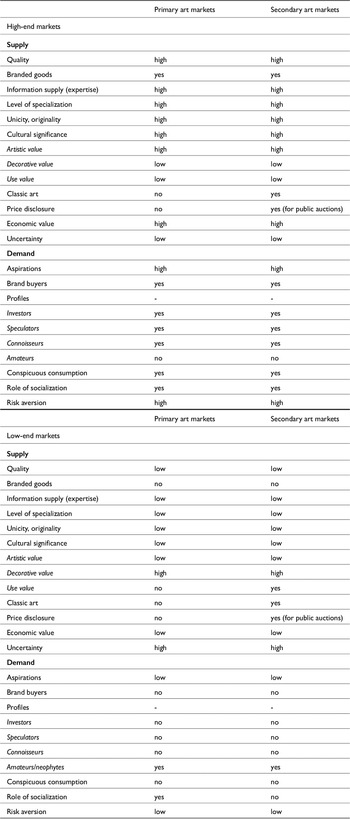
These key players of the primary and secondary market do business at all levels of the art trade. The horizontal segmentation of the art market is chiefly based on product differentiation, with segments specialized in different categories of goods offering unique visual and material characteristics and valuation mechanisms.Footnote 32 When it comes to the vertical segmentation, price ranges are traditionally used as indicators to disentangle the high-, middle-, and low-end markets.Footnote 33 The most referred-to typology is proposed by the UBS art market report, with low-end prices ranging up to $50,000, middle-market price ranging from $50,000 to $250,000 and from $250,000 to $1 million, and high-end prices exceeding $1 million.Footnote 34 Although arbitrary and disputable for it fails to capture the complexity of the art trade, this scale of value allows us to dissociate two opposite markets that are expected to have reacted differently to a crisis. In these extreme segments, prices convey different symbolic meanings regarding the artists’ reputation, the goods’ quality, and buyers’ social status, with direct impact on purchasing behaviors.Footnote 35 Table 1 displays the main characteristics that distinguish the high-end market from the low-end market, using both supply and demand as reference criteria.
Cross-comparative table between the primary/secondary and high-end/low-end markets (based on supply and demand)

Main sources: Moulin Reference Moulin1967, Reference Moulin1992, Reference Moulin2000, Moureau and Sagot-Duvauroux Reference Moureau and Sagot-Duvauroux2006, Bogdanova Reference Bogdanova, Beckert and Musselin2013. Note that the characteristics of the low-end market needs to be understood in comparison with those of the high-end.
Albeit inevitably reductive and subject to exceptions, this comparative table allows us to detect several features that may explain different reactions between the high-end and low-end markets during the pandemic.
Supply and suppliers
Artworks and cultural goods traded in the upper ends of the art market are among the most valuable assets, fetching six- to seven-figure prices. These high prices reflect not only the brand names of mediatic artists (contemporary art)Footnote 36 and consecrated masters (classic art) but also those of leader galleries and auction houses.Footnote 37 Based in metropolitan areas and usually structured as oligopolies, these firms strongly rely on reputational mechanisms and cutting-edge expertise as quality signals.Footnote 38 Goods traded in the high-end market are usually of the finest quality, with strong historical, cultural, and innovation values. They are often supplied with substantial information meant to secure buyers’ purchasing decision and increase their willingness to pay. The leading status and position of high-end intermediaries allow them to operate through international networks, without requiring face-to-face interactions.Footnote 39 This specificity explains the relative robustness of top-tier players in times of mandatory shutdowns and their ability to successfully expand their business online.
Despite similar visual characteristics, the supply in the low-end art markets substantially differs from the high-end markets. Lowbrow artworks and cultural goods, as defined by Moulin, are usually put up for sale through provincial commercial galleries and antique stores, without major promotion or certification efforts.Footnote 40 Most of these low-end suppliers are small- and medium-sized enterprises, often run by a multitasking owner.Footnote 41 They are specialized in the sales of local artists and local informal heritage, consistently with a home bias identified by prior research.Footnote 42 Embedded in a monopolistic competition framework, these less-organized and institutionalized businesses contribute to provincial economies and cultural ecosystems, without seeking further expansion.Footnote 43 Yet a noticeable shift since Moulin’s works is the opportunities offered by the Internet, enabling low-end intermediaries to approach an international clientele via their own websites or third-party platforms (for example, Drouot.com, Interrenchères, Invaluable), which experienced an unprecedented growth during the pandemic.Footnote 44
Compared to fine arts, another difference of lowbrow art lies in its lower aesthetic, historic, and cultural significance and its decorative value (utilitarian function).Footnote 45 Consistent with Harvey Leibenstein’s theory, the objective characteristics of these goods is what triggers consumers’ satisfaction.Footnote 46 Resulting from industrial production or executed by “ordinary” artists or craftspeople, these goods are relatively substitutable to each other, with similarities taking precedence over differences.Footnote 47 Their market availability also contrasts with the rarity effect observed in the high-end market. Yet, as correctly specified by several authors, quality is a relative and subjective notion anchored in the work’s characteristics. Its appreciation mostly depends on the subject’s cultural capital,Footnote 48 which suggests that quality can be appreciated as such in the low-end art market, with price differences across objects functioning as quality signals.Footnote 49 However, due to their lower cultural significance compared to museum-quality arts, lowbrow art and cultural goods are rarely accompanied by substantial information. Although minimum expertise is observed in the low-end market, the quality signals used in the high-end market to counteract credence goods’ information asymmetry and uncertainty are far less common in that segment.Footnote 50 As a result, the economic value of those goods is significantly lower, ranging from several dozen to a few thousand euros. Although price perception is commensurate to purchasing power, buyers do not run major financial risks when acquiring such works.
Demand
Table 1 also reflects two distinct consumer groups, with different price and quality sensitivities.Footnote 51 Individuals active in the high-end market represent a minority of wealthy, branded buyers, designated by Moulin as grands collectionneurs (or mega collectors). These buyers act as connoisseurs, investors, or speculators, but, most often, they show a mixed profile.Footnote 52 The extraordinarily high purchasing power of this social category – mostly composed of white and over 50-year-old men – allow them to seek prestige acquisitions that reveal high social and financial aspirations.Footnote 53 According to Ludvik Eger and colleague’s typology, these buyers belong to three generations in particular.Footnote 54 Baby boomers (1945–64) are defined as individualistic and competitive agents who particularly value self-fulfillment and appreciate face-to-face communication in their consumption habits. As a result, they preferably shop in locations close to their homes and avoid online purchases. Generation X (1965–82) encompasses individuals born in the information age who are therefore familiar with new information and communication technologies. According to the authors, these buyers are less price sensitive. Generation Y (1983–2000), also known as millennials, encompasses individuals who are also increasingly entering the high-end art market.Footnote 55 They are technology savvy and particularly willing to buy online at the benefit of leader art market players. They are achievement-oriented people eager to purchase goods that meet their personality and individual needs. According to several authors, this generation of buyers further envisions art as a lifestyle.Footnote 56
Upper-middle-class buyers (small bourgeoisie) are the main protagonists of demand in the low-end art markets, with purchasing incentives that differ from those observed in the market for luxury goods.Footnote 57 These unbranded amateurs belong to the three aforementioned generations and mostly seek fashionable, but affordable, items for decoration purposes.Footnote 58 The parameters that usually drive the market value of art in the high-end market – such as the artist’s nameFootnote 59 – are not as important in the low-end market, which is theoretically not subjected to superstar or speculation effects. The demand is particularly elastic, commensurate to income and inducing limited financial risks.Footnote 60 Other parameters likely to be valued by buyers are the level of craftsmanship, material quality, the object’s conditions, its decorative power, and storytelling as cognitive support.Footnote 61 In this respect, lowbrow art offers an appreciable level of uniqueness and quality that more modest buyers can afford,Footnote 62 with social distinction and value creation mechanisms being already at play in this market segment.Footnote 63 Yet, unlike low-end contemporary art galleries, antique dealers and auctioneers are not constrained by hosting social events such as vernissages, which is a significant difference that is likely to have impacted their business during the COVID-19 pandemic.
From a transversal perspective, Table 1 enables us to detect the main differences between each market segment. On the one hand, contemporary art versus classic art, price disclosure, and the role of socialization is what differentiates the primary market from the secondary market.Footnote 64 On the other hand, lowbrow art’s use value and buyers’ lower risk aversion is what distinguishes the high-end from the low-end markets, with more affordable, accessible, and usable goods supplied in the latter. A closer look at two strongly correlated parameters of the art market – that is, uncertainty and prices – contributes to showing the unique position of the low-end secondary art market within this ecosystem.
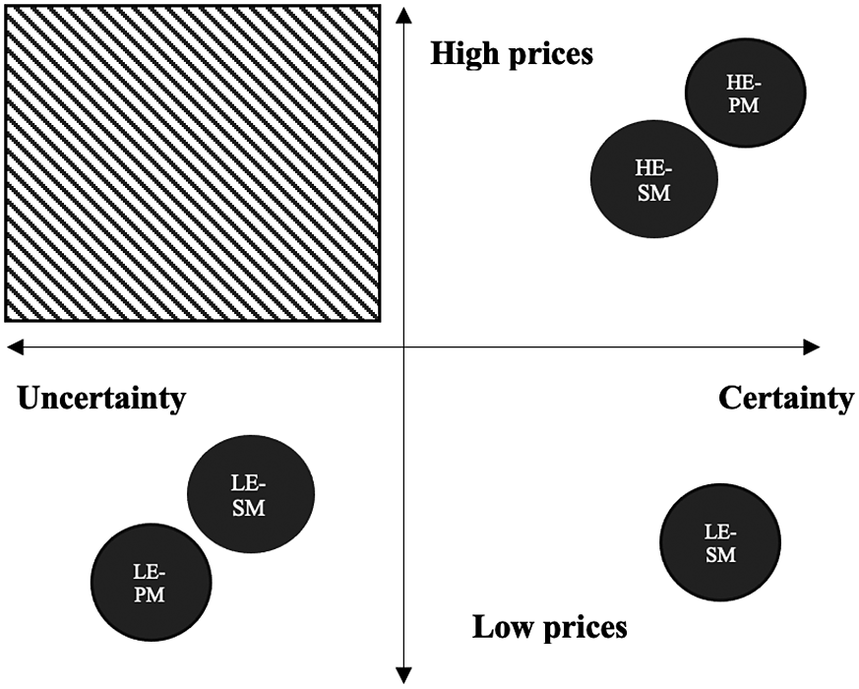
For both the high-end primary and secondary markets, high prices go hand in hand with higher degrees of certainty. Conversely, greater uncertainty and lower prices better reflect the low ends of both markets. Whilst high prices combined with a high degree of uncertainty is likely to lead to fatal market failure, the opposite scenario offers interesting perspectives. As clearly shown in Figure 1, the low-end secondary market has the potential to supply affordable goods with a reasonable degree of certainty given that minimum standards of expertise are encountered in this market segment, especially for frequently traded collectibles (for example, Delftware, Murano glassware, French antique wooden furniture).Footnote 65 In light of this theoretical framework, we explore how provincial intermediaries, active in the low-end art market, have performed between the spring of 2020 and the spring of 2021 and whether some of their economic properties have acted as competitive advantages or disadvantages in this unprecedented context.
Relationships between economic value and level of certainty across market segments
Note: HE is “high-end”; LE is “low-end”; PM is “primary market”; SM is “secondary market.”

Our first assumption (A1 Provinciality) suggests that provincial intermediaries could benefit from customers’ loyalty throughout the pandemic, which has proven essential in times of crisis.Footnote 66 Furthermore, buyers’ loyalty appears particularly prevalent in local retail stores, where social embeddedness is particularly at play and fosters steady seller-buyer relationships and even patronage.Footnote 67 In the art market specifically, a local presence entails greater proximity and face-to-face interactions.Footnote 68 Regular buyers and amateurs may have therefore been more sensitive to the critical situation faced by smaller antique dealers and gallerists. The concentration of intermediaries in a small, delineated area could also foster synergies and solidarity to overcome the pandemic.Footnote 69
According to our second assumption (A2 Supply), working with local artists and suppliers (private retailers owning lowbrow decorative goods) can entail greater flexibility, enabling intermediaries to adjust their business model more quickly than in the high-end market. The lower value of the traded goods, as well as the strict commercial status of provincial galleries and antique stores, may have also induced lower fixed costs and financial risks (for example, lower insurance and marketing costs, research costs).Footnote 70 Similarly, the use value of some items may have been appealing for people constrained to stay at home during indeterminate periods of time.
Our third assumption (A3 Demand) builds upon the statement that valuation mechanisms are renewed in contexts of increased uncertainty.Footnote 71 Since purchasing behaviors are less speculative in the low-end markets, regular buyers have certainly continued purchasing affordable art objects during those uncertain times, as long as their financial situation allowed them to do so.Footnote 72 We also expect non-regular buyers to have turned their attention to alternative purchases (lowbrow art and cultural goods) that they could immediately benefit from in times of strict lockdowns.Footnote 73 The possibility for those people to acquire affordable decorative objects, with disclosed prices and direct utility deriving from their use value, is expected to have played out in favor of the low-end secondary art market.
Methodology and sample
According to prior research, the impact that local contexts have on the art market is “mediated via the interpretative frameworks that market actors use in order to make sense of their actions in the environment.”Footnote 74 A qualitative research based on a deductive approach was consequently preferred to deepen sense-making activities of art market participants and get a more acute comprehension of what they experienced throughout the pandemic.Footnote 75 In-depth semi-structured interviews were conducted as the main data collection method. In order to guarantee the belonging of the respondents to the low-end market, we used the Belgian art market as a case study, with a special focus on primary and secondary intermediaries based in the French-speaking province of Liège. Several rationales justify this methodological choice. The Belgian art market barely represents 3 percent of the European art market’s value, the United Kingdom excluded.Footnote 76 On the art market map, Belgium chiefly stands out thanks to Brussels, whose strategic location at the heart of Western Europe makes it an important platform of the art trade.Footnote 77
Yet Belgium is also a complex federal country divided into three main regions: Flanders, Brussels Capital, and Wallonia. The Flemish art market benefits from an outstanding history, notably with fifteenth-century Bruges and sixteenth-century Antwerp.Footnote 78 If the latter still offers an appreciable concentration of art galleries, the Flemish art trade has decentralized to the wealthy coastal municipality of Knokke-Heist, whose market is primarily driven by local demand. Due to a series of cultural and political reasons that will not further be discussed in this article, the art market in Wallonia is lagging far behind Brussels and Flanders. Yet this lack of visibility does not mean that there is no art market in this part of Belgium. Local intermediaries operate in Namur, Mons, Spa, and Liège, in particular. The province of Liège has a population of about 1,100,000 inhabitants, with a 0.886 Human Development Index, as of 2018. Crossed by the Meuse River, Liège is a central hub of the Euregio Meuse-Rhine, located at 100 kilometers from Brussels, 23 kilometers from Maastricht (Netherlands), and 53 kilometers from Aachen (Germany). As the largest province, Liège not only distinguishes itself for its history as a prince-bishopric city of the Holy Roman Empire but also for its industrial revolution and its artistic avant-garde in the 1960s. Nowadays, about 40 galleries and five auction houses are active in this provincial area, all contributing to the inner workings of a stable, low-end art market. Yet, apart from occasional events curated by a local museum to showcase the works of local artists, the institutional landscape in Liège is still insufficient to make this market competitive at the national and international level, confirming its provincial status.Footnote 79
In total, 15 in-depth and face-to-face semi-structured interviews were conducted with three categories of for-profit organizations based in the province of Liège: five contemporary art gallerists, five antique and vintage furniture dealers, and five auctioneers whose anonymity is preserved according to the ethics of the General Data Protection Regulation.Footnote 80 Consistently with current definitions of low-end markets, mostly based on price ranges, we primarily used economic criteria to create our sample. In addition to being based in the province of Liège, respondents had to be in business for at least five years, to be registered with the Moniteur belge as a small or micro firm and under the legal status of Sociétés anonymes (SA) or a private limited liability company (SRL),Footnote 81 not to exceed an annual turnover of 500,000 euros, to sell artworks with average prices ranging between zero and 5,000 euros,Footnote 82 and to have an online visibility.Footnote 83 Informal discussions with non-profit organizations promoting visual arts and local contemporary artists complemented these interviews. On average, each meeting lasted 80 minutes, and data coding and analysis were done by using Atlas.ti. While each category of respondents may have deserved further exploration to reinforce the comparative approach, a satisfactory level of information saturation was reached with 15 interviews. Additional research was also done in the specialized art press and newspapers published between March 2020 and May 2021 to complete or support the respondents’ oral evidence.
Two main limitations of the present study need to be addressed. First, any research carried out during an ongoing pandemic necessarily lacks the critical distance to draw definitive conclusions or to predict the future evolution of the art market when the situation resumes.Footnote 84 The findings of this article must therefore be interpreted with caution, although the similarities they share with other papers and art market reports reinforce their credibility. Second, this qualitative research, based on a limited sample of respondents, only reflects a reality clearly delineated in space (the province of Liège) and time (the spring of 2021). Further data is needed to expand current findings and to test related assumptions statistically. Put differently, this study contributes more to opening new avenues for future research than providing an exhaustive overview of the situation experienced by provincial intermediaries. Nevertheless, the geographical and economic area under review offers several cultural and economic features likely to be encountered in other European regions and cities. This methodological choice, therefore, has some potential for more generalizable results.
Main findings
In this section, we discuss the outcomes of our 15 interviews by addressing, first, the experiences and opinions shared by all respondents and, then, our three main assumptions: (1) provinciality; (2) supply; and (3) demand. A distinction between the primary market and the secondary market is done throughout the analysis, consistently with our theoretical framework and previous works that identify differential effects of the pandemic on each segment.Footnote 85 Our findings tend to support this differential impact.
Common features
Viewed as non-essential businesses, all of our respondents were forced to close their doors from March to mid-May 2020. The compensating adjustments that they made throughout this period to stay in business allowed them to be better equipped to face the second and third lockdowns (November to December 2020 and March 2021).Footnote 86 Unlike essential stores, the retail work of gallerists, antique dealers, and auctioneers only constitutes one aspect of their business. Intermediaries of the primary and secondary markets continued their backstage activities throughout the year by dealing with suppliers (artists or private sellers), postponing exhibitions, rescheduling sales, and appraising works. Many backstage activities were relatively easy to move online, which facilitated the transition to remote work. While all respondents already had an online visibility before the pandemic outbreak, through a website or a Facebook page, only two-thirds of them had developed an effective online business model. That was particularly the case with secondary art market intermediaries that have largely benefited from the boom of third-party platforms such as Drouot.com or Catawiki.
Yet, although the art market has notably been slow to enter the cyber market, low-end intermediaries’ willingness to embrace digital technologies cannot directly be imputed to the crisis.Footnote 87 Originally, online art sales were mostly concerned with less expensive, second-hand goods, which tend to explain the ex-ante presence of low-end intermediaries in the online sphere.Footnote 88 Most respondents, however, admit that what was previously viewed as optional (for example, investing in Facebook ads) has now become crucial to sustain their business model.Footnote 89 Interestingly, half of the sample affirms that the improved use of social media, boosted by the pandemic, has significantly lowered some of their production costs (for example, communication and marketing costs). Similar evidence is found by another recent study that focused on Antwerp-based Bernaerts Auctioneers (in the Flemish-speaking part of Belgium), which successfully transited online during the pandemic, while preserving their narratives and the objects’ auction value.Footnote 90
In terms of staff management, none of the respondents reported any definitive lay-offs. This is in sharp contrast with official data suggesting that one-third of the galleries had to downsize their staff in 2020.Footnote 91 A key difference with the high-end market is the number of employees in micro firms, which do not exceed an average of 1.5 full-time equivalents. This concentration of workload in one or two multitasking workers (often the founder of the firm) is common within the cultural and creative sectors.Footnote 92 This format inevitably limits the risk of dismissals, unlike larger firms where subaltern tasks are delegated to specialized employees in times of economic growth or stability. The micro-firm status of those intermediaries, which is typical of the low-end market, seems to have facilitated the decision-making process and the development of alternative business strategies by avoiding administrative hurdles or hierarchical rigidity that are typical of top-tier firms, whose multiple branches established in different countries must coordinate.
While the Art Basel and UBS report also states that smaller galleries had little access to government assistance,Footnote 93 our 15 intermediaries did benefit from federal employment aids or a self-employed workers’ stimulus package. Although vital to overcome the hardest-hit months of 2020 and 2021, these aids were still judged largely insufficient to cover all operating costs. The lower rents or loans paid by our provincial intermediaries were not considered a particular advantage since they were necessarily proportional to the organizations’ turnover. Only a couple of respondents benefited from a temporary withdrawal or postponement of these fixed costs. If the crisis was a painful blow financially and morally, all respondents affirmed to do their utmost to stay in business in the coming months and years. This relative optimism was shared by other international small-size and medium-size galleries that were proportionally more confident regarding the end of 2020 than those active in the high-end market.Footnote 94
Provinciality (A1)
We originally assumed that the provincial location of our respondents may have fostered sectoral solidarity and customers’ loyalty during the crisis. Our interviews with both primary and secondary art market intermediaries tend to invalidate our first assumption from the outset. While we expected a local presence to create a greater sense of community between incumbent firms, the findings reveal a fierce competitive environment, frequently observed in monopolistic competitions, where synergies, federative movements, and joint initiatives remain marginal. Only three respondents affirmed to have participated in collaborative projects or benefited from the support of peer businesses and institutions in 2020. Exceptions are occasional purchases by museums, joint exhibitions, and temporary deposits in peer galleries. Other interviewees claimed that they paid closer attention to the marketing strategies developed by their direct rivals, according to mimicry logic, which is typical in uncertain times.Footnote 95 If this competitive situation may be specific to the province under review, the lack of solidarity and dialogue is questionable, especially since collaborations through professional associations are essential to guarantee the representation of low-end firms in times of crisis.Footnote 96 The concentration of galleries in delineated geographical areas is also known to foster emulative buying behaviors in the art market.Footnote 97 This is particularly the case in the high-end art market where leading players cluster in the same neighborhoods.Footnote 98 Smaller urban entities probably do not offer such opportunities for clustering, although their concentrated geographic configuration may suit initiatives based on collaboration, participation, and engagement.
On a similar note, none of the respondents noticed any particular gesture of solidarity by local buyers. If the latter’s purchasing habits did not radically changed during the crisis, remaining active in the art market cannot be interpreted as a supportive behavior per se. It is true, however, that regular buyers had limited opportunities to open the door of the gallery and therefore to engage in direct contacts with the owner, just as travel bans prevented Dutch and German buyers from visiting Liège. While abandoning the brick-and-mortar model was not an option, our respondents intend to further develop their online audience management in the future – an ambition shared by foreign galleries as well.Footnote 99 Yet targeting new buyers online raises the question of how to foster renewed purchases and to build customers’ loyalty in the long run, which has proven to be essential for cultural organizations in times of crisis.Footnote 100
Supply (A2)
As demonstrated in the first section, the profiles of suppliers differ between the primary and the secondary art market. Gallerists mostly depend on artists, while antique dealers and auctioneers chiefly rely on private sellers. The supply also varies greatly in the lower ends of the art market in terms of prices, quality standards, and information supply, with provincial gallerists supplying artworks by unbranded artists, and second-hand dealers selling lowbrow cultural goods. We expect these economic specificities to have affected each sector differently.
Primary art market
Maintaining strong relationships with local artists has not declined during the COVID-19 crisis.Footnote 101 Supporting the artists they sell, at least morally, was a priority among our provincial gallerists who declared that they had developed closer contacts in 2020 and 2021. Selling lowbrow artworks by local Belgian artists was also perceived as an advantage for low-end gallerists, unlike their high-end counterparts that were particularly affected by travel bans. Yet the cancellation of social events that allowed gallerists to canvass local artists (for example, graduation shows) or welcome new clients (for example, openings) clearly put their business at risk. Dealing with living artists also made more complex the job of provincial gallerists during the pandemic.
In the Federation Wallonia-Brussels, visual artists can rely on the “artist status” that allows them, under certain conditions, to be eligible for financial aids. Although periods of isolation can be conducive to creation,Footnote 102 these grants remain highly competitive, which has constrained many local artists to shift away from art or to solicit the financial support of their gallerists. However, as provincial sales-point galleries, their role is not to pro-actively support the artists as promotion galleries do. Four gallerists out of five claimed that they were unable to help their artists financially because of decreasing sales rates and insufficient liquidities. According to G4, selling “artworks for three or four thousand euros was particularly challenging over the past months.” Despite a passive online presence, this decreasing sales rate is explained by the fact that none of those five gallerists had developed an online sale system. According to G3, “there are many works that do not fit online sales” mostly because “their finesse and the emotions they generate are not perceptible via a computer screen or smartphone,” suggesting that “nothing replace the physical presence and direct contact with the artwork.” Another long-established gallerist (G1) advocates the same discourse, claiming that “it is just impossible to sell an artwork, even by internet. Can we buy a work on picture or via a screen? No, it’s not true, I don’t believe it at all. We are involved on social media, and we worked on that, but I did not receive any call, any request for private visit or anything else.”
The difficulty for low-end intermediaries to sell lowbrow artworks in times of crisis can be imputed to the unbranded nature of this production, which prevails at the provincial level.Footnote 103 Indeed, provincial art galleries provision the market with decorative art pieces that, unlike those of the high-end market, do not pretend to be innovative. In Richard Caves’s words, these mediators mostly “serve interior decorators and homemakers whose interest is in agreeable and harmonious surrounding.”Footnote 104 Yet, lowbrow painting or sculpture still requires a minimum acquaintance with art to be fully appreciated.Footnote 105 Despite their mere decorative purpose, the average prices of the works put up for sale by our gallerists still amount to around 2,000 euros, which remains a significant sum for amateurs to invest in decoration. Just as in the high-end art market, prices are not publicly disclosed in the provincial primary market, and this opacity can prevent novice buyers from confidently entering this segment.Footnote 106
Moreover, in periods of economic turmoil, safer investments are usually preferred. In the high-end market, buyers favor brand names whose aesthetic and economic values are relatively stabilized, which explains why classic artworks usually perform better.Footnote 107 Paradoxically, unbranded lowbrow art remains costly to an extent that might be prohibitive for neophytes in times of economic uncertainty. To bypass this specificity of the low-end primary art market, two of our respondents, interestingly, have developed an alternative business strategy that has affected the characteristics of their supply. G4 has deliberately moved from the primary market to the resale market to offset the sales deficit that she experienced with the works of local artists. According to her, “moving to the secondary market is more profitable because works are already acknowledged and increase customer’s trust. Now people are even less willing to invest in local artists they know little about.” This statement not only suggests that classic lowbrow art was also viewed as a safe haven during COVID-19, but it is also consistent with Sotheby’s’ predictions that boundaries between the primary and secondary art market will continue to blur in the future.Footnote 108 Another gallerist (G2) decided to offer more, but cheaper, works with prices amounting to only a few hundred euros. According to this gallerist, there was “an opportunity for lower budgets in 2021.” The devaluation process observed in this case is interesting for it reflects not only price elasticity in the low-end market but also the relative importance of reputation, as this gallerist did not seem concerned with making quantity prevailing over quality. In both cases, these alternative strategies reveal a business flexibility that high-end intermediaries can hardly afford.
Secondary art market
Expectedly, our interviews reveal different trends for intermediaries active in the secondary market, through which cultural goods validated at the lowest levels of the “art machine” are put up for sale.Footnote 109 What several intermediaries anticipated in March 2020 – namely, that fresh art objects would enter the art market – was corroborated by our findings. In terms of supply, art and antique dealers continued to acquire objects from private retailers, the dramatic effects of the pandemic having sadly played in favor of this sector, with the reappearance of many antiques following the death of the owners. Private sellers have also viewed the crisis as an opportunity to do a thorough spring cleaning and to sell personal items. While senior suppliers (baby boomers and Generation X) were the most reluctant to welcome strangers for home-based appraisals or to visit antique stores or salesrooms because of a “fear-for-health” effect, intermediaries were able to develop alternative operational systems such as virtual appraisals and on-phone appointments. Additional evidence of the low-end market’s greater flexibility, these strategies have allowed suppliers to manage their stock turnover efficiently over the past months.Footnote 110
Unlike gallerists, our provincial antique dealers and auction houses also had initiated their digital transition before the pandemic outbreak and were therefore relatively comfortable with selling online. The interviews suggest that these intermediaries did not substantially alter their supplies to better meet buyers’ expectations during the crisis. Unlike lowbrow contemporary art, lowbrow cultural goods transiting through the secondary art market benefit from a relatively acknowledged value and often offer a combination of material, decorative, and use value that is intrinsic to decorative arts and furniture. Lowbrow cultural goods such as antiques are now displayed online, pictured in front of a white background, with clearly highlighted attributes. This new method of exhibition constitutes a major marketing advance for the low-end secondary art market, which is contributing to renewing the image of a sector long perceived as dusty and to draining an international demand.
The lower and more heterogeneous prices (from a few dozen to a few hundred or thousand euros) that are observed in this market can also be viewed as attractive for buyers. This situation, however, may differ for specialized antique dealers who do not deal with hundreds of items. Only one art dealer from our sample, who had originally specialized in antique jewelry, reported having broadened his expertise to fine silverware. While this diversification strategy dated back to the end of 2019, he affirmed that diversifying his offer was essential to his business’s survival during the crisis. Another particularly interesting consequence of the growing demand for decorative arts, collectibles, and vintage furniture, reported by several respondents, was the development of a parallel market filled in with poorer-quality objects. A dealer specialized in vintage furniture (D7) reported that “these scam merchants take advantage of unknowledgeable buyers by selling them damaged pieces for uncompetitive prices. The problem is that these so-called antique dealers, unlike us, do not fill tax returns and make a lot of black money. And this is bad for our business.” A similar observation was reported by the Gazette Drouot that also warned buyers about an increased risk of art fraud during the crisis.Footnote 111
Similarly, another antique dealer had noticed the growing presence of self-proclaimed dealers and pseudo-experts on non-curated and free-access platforms such as Facebook MarketPlace, Catawiki, or eBay. According to her, this situation could be viewed as a negative externality of online sales, likely to increase quality uncertainty in the low-end market. The absence of gatekeepers on non-curated platforms tends to generate greater information asymmetries that open the door to opportunistic behaviors. Whilst further empirical research is needed to better gauge the magnitude of this phenomenon, such opportunistic behaviors are typical of markets dealing with credence goods.Footnote 112 Moreover, the supply of lower quality artworks, or even fakes, is a common practice in times of crisis, as demonstrated by papers dedicated to the booming art markets during World War II.Footnote 113 Yet the concerns expressed by these intermediaries should seriously be considered since unfair competition may be detrimental to more established low-end firms.Footnote 114
Our interviews therefore suggest that differences in supply between the primary and secondary art market have affected the ability of our respondents to cope with the coronavirus crisis. In the first case, the lack of brand names, combined with quite expensive and opaque prices, seem to have harmed the business of low-end gallerists, with severe management issues (stock turnover, inventory, and cash liquidities) and an abnormally weak demand. Their situation differs from that of leader gallerists who are active in the high-end market and who deal with branded artists and less uncertain works. The pandemic also had less of an affect on mega collectors who represent a small community of financially robust buyers, acquainted with the primary market’s inner workings. Provincial intermediaries involved in the resale market, who deal with cheaper, but more acknowledged, goods bearing a use value, also seem to be in a better position to face periods of strict lockdowns. The antique dealers and auctioneers considered in this study have managed to exploit the economic characteristics of their supply and digital technologies to renew their business practices and face the crisis in a more confident way. In this respect, the performance of the low-end secondary market echoes that of the high-end market, whose online and offline sales have significantly grown since the pandemic’s outbreak.Footnote 115 Additional considerations on demand, however, are needed to substantiate these preliminary findings.
Demand (A3)
As demonstrated in the theoretical framework of this study, provincial markets are less subjected to speculation, with fewer risk-averse buyers. In a context of generalized lockdown and limited leisure activities (for example, sport, traveling, shopping), we expected people to have turned their attention to alternative purchases, including lowbrow cultural goods. The possibility for those buyers to acquire inexpensive decorative objects, with disclosed prices and direct utility (decoration), is another argument that could explain the robustness of the low-end secondary art market over its primary counterpart.
Primary art market
As demonstrated by Olav Velthuis, socialization plays an essential role in the primary art market to create trustful and sustainable relationships between parties. Unlike leader promotion galleries, provincial commercial galleries strongly depend on face-to-face interactions – a necessary condition that was temporarily suspended during the pandemic.Footnote 116 According to our interviews, baby boomers and Generation X, unsurprisingly, were the generations of buyers that strictly complied with social distancing measures. Their lack of familiarity with digital technologies and preferences for in situ purchases explain why many of them deserted the primary art market.Footnote 117 As upper-middle-class amateurs – whose art needs differ from those of mega collectors – buying lowbrow art was not necessarily viewed as a priority in uncertain times. The fact that our gallerists did not launch online sales also limited the possibility for those traditional buyers to change their consumption habits. Generation Y, on the other hand, deserves further attention since official reports indicate a growing proportion of millennials willing to buy artworks and collectibles. According to Clare McAndrew, 70 percent of millennials claimed that the crisis had increased their interest in art collecting.Footnote 118
As a reminder, millennials are not only active users of digital technologies and social media, but they also attach significant importance to lifestyle.Footnote 119 As a result, they particularly value the social experience that surrounds the act of consumption. The role that socialization plays in their lives therefore has direct implications for the low-end primary art market. The impossibility for our five gallerists to organize exhibition openings and to offer free drinks in safe sanitary conditions prevented them from connecting to these prospective buyers. Even in the lower ends of the art market, social distinction is at play, with most deals being signed during these crucial social events. This finding is consistent with Larissa Buchholz, Garry Alan Fine, and Hannah Wohl, who argue that “in the absence of physical co-presence with the artworks and art world actors, participants struggle to evaluate and appreciate artworks, make new social ties, develop trust, and experience a shared sense of pleasure and collective effervescence.”Footnote 120 The reluctance of our provincial gallerists to move online has probably led to missed opportunities for the primary market, especially with Generation Y, which is particularly comfortable with online buying.
Secondary art market
While “high-touch” personal experiences are crucial in top-tier markets to get lucrative consignments and generate profitable sales, socialization appears less important for intermediaries selling lowbrow cultural goods. Provincial art dealers and auctioneers mostly deal with substitutable items that are preserved in many households. The pressure of exclusivity is therefore less prevalent in this market segment. The presence of our intermediaries on third-party platforms allows regular and non-regular buyers to easily purchase lowbrow cultural goods online, with public sales data for auctions and an increased willingness among antique dealers to disclose prices as well. As a result, eight of our antique dealers and auctioneers confirmed a sharp increase in both volume and value of sales. Interestingly, most of them had not anticipated such a performance, as expressed by other intermediaries in the press in March 2020.Footnote 121 Yet antique dealers and auctioneers have not noticed any particular shifts in buyers’ preferences. What sold before the pandemic has continued to sell but in larger proportions. The only exception is collectibles made in gold, such as antique jewels, for which the demand has escalated. A similar market trend was already observed in 2008, confirming the status of gold as a safe haven in times of economic crisis, despite its high volatility.Footnote 122 This shift in buying patterns is interesting since it reflects quite unusual investment behaviors in the low-end art market and greater importance placed on material value.
This observation leads us to consider another point previously introduced – namely, the use value of low-brow cultural goods. Several studies suggest that consumers refocused on their most basic needs during COVID-19 and that lower-income and younger consumers were the most likely to reduce their spending on non-essential goods. Our interviews provide more contrasted evidence when it comes to the low-end secondary art market.Footnote 123 Without necessarily earning high salaries or pretending to high-standing lifestyles, Generation Y tends to spend large amounts of money on leisure activities such as travel, cultural visits, food, and nights out.Footnote 124 The main consequence of travel bans and partial closure of the food industry was an unusual amount of time spent at home, with an increase of discrete activities such as working, learning, watching television shows, and browsing online sales.Footnote 125 Our study suggests that prolonged stays at home, combined with savings made on weekly leisure expenditures, created a “pent-up demand” that benefited our provincial art market.Footnote 126 Pent-up demand is defined as a sudden demand that arises in periods of uncertainty, when individuals are temporarily unable to satisfy their purchases for other goods.
By suspending regular leisure activities, the coronavirus crisis has displaced the demand toward other categories of goods, including collectibles and art objects, which are easily available online via third-party platforms. Most respondents evoked the eagerness of younger people belonging to Generation Y to purchase affordable decorative pieces to redesign or refurnish their interiors (for example, furniture, trinkets, dishware), influenced by social media such as Instagram or Pinterest. Interestingly, similar behaviors have been observed by Anita Archer and David Challis outside Europe.Footnote 127 Not only is this observation consistent with the boom in real estate observed in Belgium over the past months,Footnote 128 but it is also consistent with the psychographic shifts that the crisis has prompted, including local consumption and the purchase of second-hand objects and clothes.Footnote 129 It is also consistent with the observation that wealthy people locked in their residencies invested more money into interior design and renovations.Footnote 130 One may even argue that the utilitarian value of antiques and their ability to meet consumers’ basic need to live in a furnished home allowed them to fall within the category of essential goods whose consumption grew during the pandemic.Footnote 131
Research on the impact of crises on consumption behaviors also suggests that materialism grows in uncertain times. Enjoying hedonic moments during high-stress periods is essential, and the pleasure of purchasing crafted art objects contributes to this positive feeling.Footnote 132 Unlike lowbrow contemporary art, the lower economic value of lowbrow cultural goods also better matched the budgets saved by upper-middle-class buyers during the pandemic. Finally, another parameter stressed by most interviewees was the influence of television shows such as Affaires conclues. Broadcast in Belgium, this French television program allowed people to bring a cultural object to an expert, get a free appraisal, and sell the item to a panel of renowned art and antique dealers (through a system of auction). If the impact of such programs on art objects’ valuation mechanisms or popular taste shaping deserves further attention, this ideal conjecture tends to substantiate the performance of our provincial intermediaries over the past months.
Recommendations
While markets for lowbrow art objects remain sensitive to economic cycles and are subject to decreasing expenditures in times of crisis,Footnote 133 our qualitative research provides evidence that provincial art markets offer distinctive economic features that acted as competitive advantages during the COVID-19 crisis. Compared to the low-end contemporary art market, the secondary market was relatively spared by traditional social and financial constraints. Provincial antique dealers and auctioneers are less dependent on socialization and conspicuous consumption and benefit from the services of third-party platforms managed by other branded firms. They also offer a more diversified supply made up of affordable cultural objects bearing a hedonic and utilitarian value that meet certain needs in times of crisis. The recent entry of younger buyers belonging to Generation Y in this market segment tends to explain the relatively unexpected performance of the secondary art market in Liège between the spring of 2020 and the spring of 2021. In light of these findings, we suggest three recommendations to prompt provincial intermediaries to sustain the benefits of the crisis in the long run.
To build Generation Y’s loyalty
According to recent research, new consumption patterns observed during the crisis are expected to last over time.Footnote 134 In the art market, “local will be the new global driven by pandemic travel restrictions.”Footnote 135 These arguments should encourage the intermediaries considered in this study to take advantage of current trends for second-hand goods to renew their ageing customer base. Decorative objects and furniture belong to the category of durable goods, which means that they are unlikely to be frequently repurchased. Moreover, the return to normal living conditions, which has been observed over the past months, has led to the resumption of regular spending habits. For this reason, retaining and expanding new consumers should be a priority. The crisis could serve as a springboard to build Generation Y’s loyalty and further develop its taste for older objects. The generational cohort and bandwagon effects that are currently at playFootnote 136 are crucial to renew purchasing behaviors as long as art market players are willing to embrace these shifts and adjust their marketing strategies accordingly.Footnote 137
Better understanding Generation Y’s lifestyles could also encourage repeated purchases, which are essential for business survival.Footnote 138 While investing in social media and online sales is time-consuming and costly, this strategy also appears crucial for a sector subjected to persistent stereotypes. The global health crisis, therefore, offers a timely opportunity to renew the image of the low-end secondary art market, which has the competitive advantage of offering three topical arguments for young generations: (1) local consumption; (2) sustainable consumption (fewer but better things); and (3) the hedonic benefit of purchasing unique items resulting from ancestral savoir faire. These arguments are in line with Sotheby’s predictions, according to which “with much more time than usual in their hometowns and areas, many people have come to appreciate more acutely the sense of regional identity that was increasingly lost with globalization. This will mean that local styles and movements will become more pronounced and revered and will impact how and what auction houses and galleries choose to exhibit as well as heighten the importance of local museums as people rediscover their local regions.”Footnote 139 The effective promotion of these arguments requires substantial investments in marketing, but, in turn, bandwagon effects and compliance behaviors can be expected amongst Generation Y consumers who are easily influenced by trends and social media. Market growth reflected in higher prices would also send strong signals about the cultural value of older art objects and renew the image of provincial art markets.
Nevertheless, the positive outcomes of digital technologies on the secondary art market should not dismiss the potential adverse effects of online sales. Unlike the high-end market, which remains selective and delivers substantial information about traded goods, online oversupply is already a reality that complicates the decision-making process of novice buyers. The low-end art market is indeed known for dealing with less-documented goods. However, in a context of global competition, buyers may request more information about the lots they purchase online. Decorative art objects that were previously not even described in catalogued sales now require some basic information to be sold on two-sided markets (including good quality photographic reproductions and precise dimensions). Supplying information about lower-quality goods is another costly and time-consuming task that is not automatically profitable for intermediaries since sales revenues do not always cover search costs. Even in the low-end art market, poor information supply may affect buyers’ confidence and even blur the boundaries between established firms and amateur sellers. While several scholars argue that art market players should reach a balanced equilibrium between online and offline sales – while favoring the latter for top-quality worksFootnote 140 – the ultimate decision rests with each low-end firm, depending on its field of specialization and the existing forces of supply and demand.
Preserving a healthy market
Just as top-tier firms are considered gatekeepers of the art market, provincial intermediaries also have responsibilities when it comes to dealing with objects of minimum cultural significance. Our interviews reveal that the crisis has somewhat disrupted the low-end art market with, for example, the appearance of new players supplying poorer-quality objects. Pioneering low-end firms usually have a competitive advantage as they offer higher-quality products,Footnote 141 but opportunistic behaviors by newcomers can have damaging effects for more established firms. Building a strong brand name and maintaining its reputation, even at the provincial level, should be intermediaries’ priority in order to avoid the adverse effects of a higher demand for lowbrow cultural goods. To this end, supplying the most complete and honest information, investing in advertising, and strengthening online sales conditions and warranties to avoid payment delay or failure are immediate actions to be taken. Should the growth experienced by this sector intensify in the mid-run, along with the entry of new rival firms, pioneering intermediaries may be tempted to exit the low-end market to progressively move up toward the middle-end market. Provincial practitioners should be aware that such a transition requires significant investment costs and business model adjustments that must be carefully considered upstream.Footnote 142 In any event, developing a strong reputation is crucial not only to increase brand loyalty but also to be viewed as trustful reference intermediaries in an increasingly competitive low-end art market.
Union is strength
Provincial art markets, as any other markets, are profit-driven environments. However, unlike regular retail stores, antique dealers and auction houses are involved in the resale of items bearing a cultural value. This specificity offers potential for collaboration with peer organizations and institutions active in the promotion, preservation, and sales of local heritage goods. Collaborative efforts in the art market are indeed known to spill benefits over to each party’s business.Footnote 143 To this economic rationale can be added a political one, which is supported by researchers who have studied the tension between cultural identity and commercial interests.Footnote 144 The core business of provincial intermediaries is often focused on domestic art and local heritage, and this home bias may be of interest for public authorities.Footnote 145 More precisely, the indirect preservation and promotion work in which low-end dealers and auctioneers are involved may benefit cities’ brand image and visibility at both the national and international levels.
It is therefore surprising that, in times of crisis, none of our respondents had attempted to federate through collectives or trade unions. If the clustering of provincial auction houses on third-party platforms can be seen as a first attempt of joining business efforts, further collaborative undertakings are needed to reach a critical mass that is crucial for the sector’s representativity and survival. While digital technologies offer unprecedented business opportunities, developing synergies at the local level should still be regarded as a top-priority strategy to generate spillover effects, empower low-end intermediaries, and avoid policymakers treating these cultural firms as regular retail stores in time of global crisis.
Conclusions
While the global pandemic crisis has not altered the art worlds radically,Footnote 146 it has undeniably affected most art market players to varying degrees, depending upon their specialization and scope of business activities. The main goal of this qualitative research was to investigate the extent to which provincial intermediaries, active in the lower ends of the art market, have been impacted by the COVID-19 pandemic and to what extent economic differences between the primary and secondary market may explain uneven performance over the past months. We first provided a theoretical framework aimed to disentangle the main differences between the vertical (high and low ends) and transversal (primary/secondary) configuration of the art market. Based on 15 semi-structured interviews with gallerists, antique dealers, and auction houses based in the province of Liège (Belgium), this article has revealed the unforeseen performance of auction houses and antique dealers active in the low-end market.Footnote 147 To explain this performance, which was also observed in the high-end market, we have highlighted several factors – typical of provincial markets – likely to explain the ability of some intermediaries to better cope with a global crisis. More specifically, we have identified a greater degree of freedom in micro firms’ decision-making, the moderate role of socialization in the low-end secondary art market, the characteristics of the supply (affordability, use value), and Generation Y’s profiles and needs in times of strict lockdown.
In a context of reopening, we argue that low-end practitioners should work at sustaining the positive externalities that the pandemic has had on business. In particular, three main recommendations are formulated: increase newcomers’ loyalty to renew the demand; monitor the evolution of the online art market to circumvent potential negative externalities of online sales; and foster synergies within the sector to create positive emulation aimed to reinforce the credibility of provincial art markets. More broadly, this research invites art market scholars to pay further attention to the lower ends of the art market whose unique peculiarities, highlighted in this article, offer opportunities to challenge existing economic theories (for example, what does the notion of investment in art mean in the low-end markets?) as well as the notion of artistic quality or the controversial distinction between low-brow and high-brow arts. Additional case studies are also needed to strengthen the theoretical framework proposed in this article and to allow researchers to better understand the inner workings of these segments from both a micro- and macro-economic perspective. Exploring the lower ends of the art market is also a way to address the crucial notion of diversity within the art market by looking at other forms of supplied goods and less elitist profiles of buyers. The recent entry of low-end art market players in the cyber marketplace also offers researchers an unquantifiable number of fresh data that can be used to corroborate our qualitative findings statically.
Acknowledgments
I am grateful to the participants of the Tools for the Future: Researching Art Market Practices from Past to Present workshop (online, June 2021) for their valuable comments on a previous version of this article. Discussions on this topic with Kim Oosterlinck (Université libre de Bruxelles) and Emilie Garcia Guillen (Université libre de Bruxelles), and through the Groupe de Recherche en Sociologie de l’Art et de la Culture seminars of art and culture, were particularly helpful. I would also like to thank the two anonymous reviewers whose relevant comments have significantly contributed to improving the final version of this article.