INTRODUCTION
Apple (Malus domestica) is a fruit tree that grows well in temperate climate zones where most commercial varieties satisfy their required chilling temperature, which is often expressed as hours at less than 7 °C (Tromp, Reference Tromp, Tromp, Webster and Wertheim2005). Chilling units accumulated during the cold season enable the plant to overcome dormancy. Studies have used different models to calculate chilling unit accumulation: temperatures of 1.5–12.4 °C in the Utah Model (Richardson et al., Reference Richardson, Seeley and Walker1974), 1.6–13 °C in the North Carolina Model (Shaultout and Unrath, Reference Shaultout and Unrath1983) and 1.8–16.9 °C in the Low Chilling Model (Gilreath and Buchanan, Reference Gilreath and Buchanan1981) positively contribute to chilling unit accumulation. Sunley et al (Reference Sunley, Atkinson and Jones2006) carried out comparisons of various chill models (<7.2 °C, 0–7.2 °C, Lantin and Utah) and found a linear relationship among models except for the Utah model. As reviewed by Labuschagne et al. (Reference Labuschagne, Louw, Schmidt and Sadie2002) the chilling requirement of different varieties varies from 200 to 1100 hours, and can be higher in other apple cultivars and influenced by genetic variation. Bernardi (Reference Bernardi1988) categorized the chilling requirements of the cultivar Gala as low, Granny Smith as intermediate and Golden Delicious, Fuji and Jonagold as high. Legave et al. (Reference Legave, Farrera, Almeras and Calleja2008) reported that global warming (in France, 1976–2002) resulted in longer mean duration (3–5 days) needed to satisfy the chilling requirement of apple cultivars.
An increasing trend in production of temperate fruit crops has occurred in many sub-tropical and tropical countries (Erez, Reference Erez and Erez2000; Niegel, Reference Niegel1988; Williams and Menegazzo, Reference Williams and Menegazzo1988; Williams and Tax Tzoc, Reference Williams and Tzoc1990). Lack of effective winter chilling is one of the major problems in tropical areas when growing temperate fruits (Webster, Reference Webster, Tromp, Webster and Wertheim2005). Warm winters result in prolonged dormancy leading to poor flowering, very strong apical dominance, unsynchronized growth patterns and, consequently, low yields (Cook and Jacobs, Reference Cook and Jacobs2000; Jacobs et al., Reference Jacobs, Watermeyer and Strydom1981). Apple growing is commonly hampered by inadequate winter chilling in Kenya (Njuguna et al., Reference Njuguna, Leonard and Teddy2004) and Moroccan valleys (Mahhou et al., Reference Mahhou, Alahoui and Jadari2003). One of the possible solutions to avoid such problems is using low chilling requirement cultivars such as Anna (Erez, Reference Erez and Erez2000; Njuguna et al., Reference Njuguna, Leonard and Teddy2004; Webster, Reference Webster, Tromp, Webster and Wertheim2005). However, these cultivars do not always meet the demands of growers and consumers with respect to production volume and fruit quality. The other possible strategies are bringing the trees into an artificial dormancy by stopping the irrigation (Jones, Reference Jones1987), then defoliating by hand, followed or not followed by chemical treatment to break dormancy (using oils or other chemicals) (Diaz et al., Reference Diaz, Alvarez and Sandoval1987).
Defoliation, i.e. removal of mature foliage after harvest, prevents the buds entering into endo-dormancy after growth has stopped and instead stimulates them to regrow (Tromp, Reference Tromp, Tromp, Webster and Wertheim2005). The bud break of apples in the tropics, due to defoliation, is preceded by a large increase in both concentration and amount of gibberellins in the apex tissue of closed buds (Edwards, Reference Edwards1985; Taylor et al., Reference Taylor, Pharis, Loveys, Notodimedjo and Edwards1984) and a decline in abscissic acid concentration (Edwards, Reference Edwards1985) in the bud. As reviewed by Edwards (Reference Edwards1990) if the timing of defoliation is correct, bud burst follows within one to four weeks. Many chemicals show rest-breaking properties on buds but only a few have gained commercial acceptance (Erez, Reference Erez and Erez2000; Tromp, Reference Tromp, Tromp, Webster and Wertheim2005). Effects of chemicals such as Dormex (hydrogen cyanamide, CH2N2), potassium nitrate and winter oil (Willett and Westigard, Reference Willett and Westigard1988) on the bud break of apple trees have been evaluated in Kenya, Morocco and Zimbabwe and positive responses produced (Jackson and Bepete, Reference Jackson and Bepete1995; Mahhou et al., Reference Mahhou, Alahoui and Jadari2003; Njuguna et. al., Reference Njuguna, Leonard and Teddy2004).
Apple trees were introduced into the tropical mountains of southwestern Ethiopia (>2700 m asl), some 60 years ago by missionaries (Ralph Wiegand, South Ethiopia Kale Hiwot Church, personal communication), and in Adigrat, Tigray (>2500 m a.s.l.), some 35 years ago (Jozef Naudts, ADCS Food Security project, personal communication). At such high altitudes in the tropics, average temperatures are lower, which allows easier reaching of chilling conditions, but seasonal amplitudes remain low (Osborne, Reference Osborne2000). Unfortunately, systematic observations have been carried out only once in the Ethiopian highlands, on apple cultivars introduced in 1976 (Rice and Becker, Reference Rice and Becker1990). Productive apple trees have been mainly restricted to areas with a humid tropical mountain climate until the past 10 years. As a result, there is little knowledge available about the physiological responses of apple trees to the semi-arid–sub-humid northern highlands of Ethiopia that could be used to develop crop production systems.
This study was conducted with the aim of evaluating the response of apple cultivars to different dormancy-management practices in order to synchronize the life cycle of single apple trees in north Ethiopia with the northern hemisphere seasonal temperature variations.
MATERIALS AND METHODS
Study area
The experiments were conducted at two sites, Hagere Selam (HS) and Mekelle University (MU) campus, Tigray region, Ethiopia. The experimental site in HS is located at an altitude of 2650 m asl and receives, on average, 716 mm rain per year (Nyssen et al., Reference Nyssen, Vandenreyken, Poesen, Moeyersons, Deckers, Haile, Salles and Govers2005). The mean annual temperature is 15 °C, with average daily minimum and maximum temperatures of 9 and 22 °C (NMSA, 2007). If seasonality is high in respect to rainfall (70 to 80% in July–August), the temperature, though not too hot, shows a typical tropical pattern without great variability. The main cool period occurs during the boreal winter (coldest night temperatures) and a second cool period during the summer rainy season (coldest day temperatures), which is related to the abundant cloud cover of the rainy season. Daily temperature amplitude is greater than the average seasonal variations and is more apparent in the winter dry season. The climate is classified as a tropical mountain climate because of the high elevation, cool temperatures and small annual variability (Osborne, Reference Osborne2000). Annual variability of hours of sunshine follows a similar pattern to temperature, with least sunshine in July and August due to persistent cloud cover and a second minimum in December and January due to the astronomical position of the sun at southern latitudes.
Based on our data recorded on an hourly basis using a temperature data logger (Escort Junior) for three consecutive years, there was an average of 148 hours at less than 7 °C per year during the dormant season. The orchard is planted on the premises of a government tree nursery and spring water is applied by gravity for irrigation of the trees. A bee colony was provided, but could not be maintained. However, there are several bee hives in the 1.5-km-distant village, which are deemed sufficient to secure pollination and eventually fruit set (Visscher and Seeley, Reference Visscher and Seeley1982).
The other experimental site, MU main campus, is at 2150 m asl with a mean annual rainfall of less than 598 mm and a mean annual temperature of 11–24°C (NMSA, 2007), and follows the same pattern as at HS. Over three years, there was an average of 55 hours at less than 7 °C during the dormant season. Two beehives were installed in the orchard to assure pollination. The apple trees are planted in a mixed manner with the existing tropical fruit trees, such as avocados and guavas, and tap water is applied by hose for irrigation of the trees. Standard fruit tree management practices (Rice et al., Reference Rice, Rice and Tindall1987), such as irrigation and fertilization, were carried out uniformly in both orchards.
Experimental set-up
Five apple cultivars, Golden (Golden Delicious and Golden B.), Gala (Gala Must and Galaxy), Fuji Kiku, Granny Smith and Jonagold, were introduced from The Netherlands and Belgium to the experimental trial sites of HS and MU, taking into consideration the need for a mixed orchard to enhance cross-pollination. All apple trees for this experiment were planted as well-feathered two-year-old trees on M9 rootstock. The first batch of 200 fruit trees (Golden Delicious, Gala Must, Granny Smith and Jonagold, 50 trees of each cultivar) was planted in February 2003 and the second batch of 240 fruit trees (Golden B., Galaxy, Fuji Kiku and Granny Smith, 60 trees of each cultivar) was planted in March 2004. Apple cultivars and rootstocks were virus free. A complete randomized block design was used for the experiments. Soil variability at both sites and slope differences, waterlogging and shade effects at HS were used as sources of variability for blocking to assign the treatments. After observing the tendency of the tree to enter into dormancy, which is usually evident by some natural leaf drop, drought stress was induced, followed by defoliation and chemical/oil treatment for dormancy breaking, and then renewal of the irrigation. The treatment applications were carried out as indicated in Table 1. Although dates of application differed across years, it should be noted that plants were at the same stage of dormancy in both years.
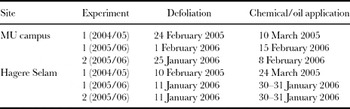
Dates of treatment applications at MU campus and Hagere Selam.

Experiment 1
The trees for experiment 1 were planted in 2003. The experiment was conducted for two successive years (2004/5 and 2005/6) using four treatments with minor adjustments. The treatments were: i) one defoliation per year only (SD); ii) one defoliation followed by a Dormex 1% treatment (D1%); iii) two defoliations per year (DD) for the first year, replaced by defoliation and Dormex 2% treatment in the second year (D2%); iv) control (no defoliation or chemical treatment). Defoliation was carried out in January/February of each year with the aim to harvest in July of the same year. Three-year-old apple trees of the cultivars Jonagold, Golden Delicious, Granny Smith and Gala Must on M9 rootstock were used. Based on availability of trees in the orchards, groups of five and three apple trees, at MU and HS, respectively, from each cultivar were chosen randomly.
Experiment 2
The trees for experiment 2 were planted in 2004. This experiment was conducted in 2005/6 with four treatments: i) one defoliation followed by 1% Dormex (SD + D1%); ii) one defoliation followed by 4% winter oil (WO4%); iii) one defoliation followed by 0.5% Dormex and 2% winter oil (SD + D0.5% + WO2%); iv) control (no defoliation or treatment with chemicals). The following apple cultivars were included: Fuji Kiku, Galaxy, Golden B. and Granny Smith. A group of five and four apple trees from each cultivar from MU and HS trial sites, respectively, were chosen randomly (Table 1).
Data collection
Phenological and yield data were collected as follows. Recording bud break and blooming began two weeks after chemical/oil application. The length of blooming period of each tree was recorded. The number of flowers per tree was recorded on weekly basis during the entire blooming period. The date of the first fruit set was recorded when the majority of flowers set fruit. The number of fruits per tree during the growing season was also recorded. Other measured parameters were average fruit size at harvest (using Digital Calliper, Mitutoyo 6 inches), average fruit weight (using a digital balance, SCIENTECH), fruit yield (total weight in kg per tree), soluble solids (°Brix), using a portable digital refractometer (ATAgo), and fruit firmness, using a hand penetrometer (TR Fruit Test). Fruit firmness and part of the fruit sugar concentration data from HS trial site are incomplete. Data were analysed statistically through analysis of variance (ANOVA) using JMP-Version 5 (SAS Institute). Means were compared, where applicable, using the Tukey–Kramer HSD (honestly significant difference) test at 5% level of probability.
RESULTS
Blooming and fruit set
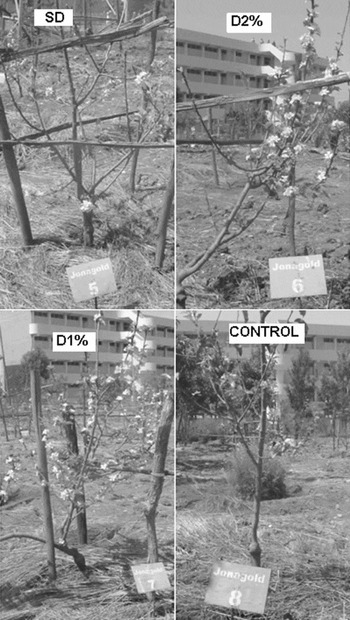
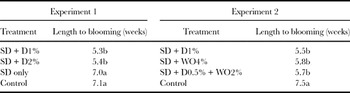
The average number of flowers per tree ranged from 14 to 42 during one flush of blooming (as trees bloom for weeks) in both years, although there was high flower drop during the first few weeks of the blooming period. The number of flowers per tree was significantly higher on Dormex-treated trees than SD and control trees (Figure 1). A similar result was obtained from winter oil application. However, the level of response to Dormex and winter oil was not similar with cultivars; the greatest positive response was observed in Jonagold. Trees that had received Dormex and winter oil separately or in combination showed significantly (p < 0.0001) earlier bud break and then blooming than control and SD trees (Table 2). The beginning and effectiveness of fruit set in both experiments and both sites showed similar trends to blooming (data not shown). Generally, the growth pattern of cultivars from bud break to fruit set was nearly synchronized and similar in both the Dormex- and winter-oil-treated trees.
Blooming response of Jonagold for defoliation and Dormex application at MU in 2005/06. SD single defoliation; D1% and D2% Dormex application with concentrations of respectively 1% and 2%.

Mean duration to onset of blooming in weeks in response to treatments in HS and MU in 2005–06 (experiment 1: n = 174; experiment 2: n = 174). SD: single defoliation; D0.5%, D1% and D2%: Dormex application with a concentration of respectively 0.5%, 1% and 2%; WO2% and WO4%: winter oil application with a concentration of respectively 2% and 4%.

Values with the same letter (within each experiment) are not significantly different at alpha = 0.05 (Tukey–Kramer HSD test).
Yield
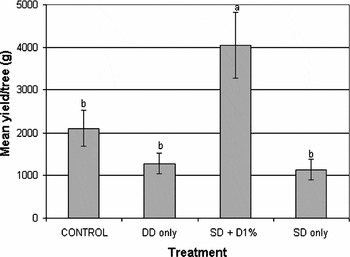
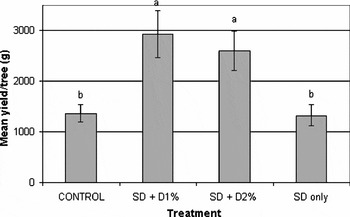
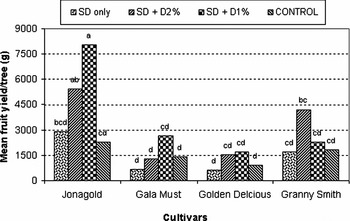
Experiment 1: In 2004/5, defoliated trees which received 1% Dormex showed significantly higher (p < 0.0001) mean fruit yield per tree. There was no significant difference among other treatments (Figure 2). Similarly, in 2005/6, trees treated with 1% and 2% Dormex give significantly higher yields per tree (p = 0.0002) while there was no significant difference between SD and control trees (Figure 3): rather the former resulted even in less yield than the latter in both years. There was also no significant difference between the two concentrations of Dormex. In 2004/5 yield per tree was doubled in all cultivars in response to the Dormex treatment applied after defoliation (data not shown). In 2005/6 Jonagold performed better than the other cultivars with a significantly higher yield for trees treated with Dormex while no difference was observed for the other cultivars (Figure 4).
Effect of Dormex on the mean fruit yield/tree in HS and MU (n = 128). SD and DD are single and two defoliations per year, respectively; D1% Dormex application with its concentration (2004/05). Values with the same letter are not significantly different at alpha = 0.05 (Tukey–Kramer HSD test).

Effect of Dormex on the mean fruit yield/tree in HS and MU (n = 144). SD: single defoliation; D1% and D2%: Dormex application with its concentration (2005/06). Values with the same letter are not significantly different at alpha = 0.05 (Tukey–Kramer HSD test).

Mean fruit yield per treed on apple cultivars in HS and MU (2005/06) in response to Dormex application (n = 96). SD: single defoliation; D1% and D2%: Dormex application with its concentration (2005/06). Values with the same letter are not significantly different at alpha = 0.05 (Tukey–Kramer HSD test).

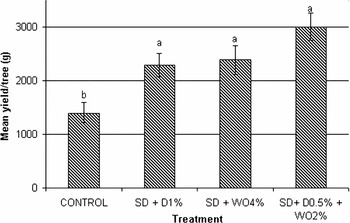
Experiment 2: In 2005/6, in both orchards the trees treated with Dormex and winter oil, separately or in combination, gave significantly higher fruit yields than the control trees (p < 0.0001) (Figure 5). Combining a lower dose of Dormex and winter oil gave better yields than treatment with one chemical only, and winter oil was as effective as Dormex. Similar to experiment 1, cultivars in experiment 2 showed good responses (more than 76% yield increase) to different rates and combinations of Dormex and winter oil (data not shown). Regardless of the difference in treatments and with all environmental differences between the two sites, in all sets of experiments cultivars (trees of the same age) performed better in their mean yield at MU than in HS (data not shown).
Effect of Dormex and winter oil on the mean fruit yield/tree in HS and MU in 2005–06 (n = 208). SD single defoliation; D0.5%, D1% and D2% Dormex applications and WO4% and WO2% winter oil applications with their concentration. Values with the same letter are not significantly different at alpha = 0.05 (Tukey–Kramer HSD test).

Yield components
Fruit weight, diameter and firmness: In experiment 1 (2005/6), Granny Smith and Jonagold cultivars had significantly (p < 0.001) higher fruit weight (212 and 205 g, respectively) than the Golden Delicious and Gala Must (148 and 125 g, respectively). Similarly, in experiment 2 (2005/6), Granny Smith showed significantly (p < 0.001) higher fruit weight (202 g) than Galaxy, Golden B, and Fuji Kiku, which were 151, 151 and 125 g, respectively. In experiment 1 (2005/6), Granny Smith and Jonagold were significantly (p < 0.001) larger in fruit diameter (80 and 79 mm, respectively) followed by Golden Delicious (71 mm) with the smallest fruit size on Gala Must (64 mm). In experiment 2 (2005/6), Granny Smith was significantly (p < 0.001) larger in fruit diameter (79 mm) than Golden B, Gala Must and Fuji Kiku with 70, 69 and 67 mm, respectively. For fruit firmness analysis in both experiment 1 and 2 (2005/6) the data from HS were excluded because of its incompleteness. Data analysis from MU showed that there was no significant treatment difference in fruit firmness. However, Golden Delicious showed significantly higher fruit firmness (p = 0.0014 and p < 0.0001, in experiment 1 and 2, respectively) than the other three cultivars.
Soluble solids (°Brix)
In experiment 1 (2005/6), the data from HS were also excluded. The data analysis from MU showed that there was no significant difference in the fruit sweetness due to treatments. In experiment 2 (2005/6), the data from HS were included and the analysis showed that there is a significant (p = 0.0174) difference in soluble solids (°Brix). The highest °Brix percentages were recorded in trees treated with Dormex followed by a combination of Dormex and winter oil, and winter oil only, whilst the lowest was from the control trees. There was also significant (p = 0.0011) difference in °Brix percentage among cultivars, but no significant interaction observed between treatments and cultivars. The highest °Brix was recorded from Golden B. (16.3%) followed by Fuji, Granny Smith and Galaxy, 14.8, 14.6 and 13.1%, respectively.
DISCUSSION
The application of Dormex and winter oil induced uniform and high blooming in all cultivars (as shown in Figure 1 for Jonagold), although there was variation between the cultivars tested. Dormex and winter oil application also reduced the commencement of blooming and then fruit set periods by about two weeks (Table 2). But the total flowering period was still five weeks, which is long in comparison with the flowering period in temperate zones (i.e. 2–3 weeks). It is critical to fulfil the required chilling requirement during the cold days of January and February. However, the beginning of treatments is highly dependent on temperatures during November and December, which adds to chilling accumulation naturally. Natural leaf drop due to this accumulation is used as an indication to start defoliation. In this aspect, trees at HS show earlier natural leaf drop than at MU, but the application of treatments differed by only two weeks. This could be the reason for the lower impact of the chemical and defoliation applications at HS than MU. Moreover, SD does not help much in causing the trees to prevent or break dormancy earlier than the control trees (Table 2). This agrees with findings by Edwards (Reference Edwards1990) indicating that time of defoliation is critical and delayed defoliation reduces bud burst. Therefore, due attention should be given to starting the applications as soon as the natural leaf drop begins. Two defoliations per year were found to be less effective for the tested cultivars under Tigray highland conditions.
A Dormex application, after defoliation, 2–3 weeks before dormancy break induced uniform blooming resulting in higher yield, as compared to the treatments SD and the controls (Figure 2). The non-significant difference between the two concentrations of Dormex (Figure 3) shows the possibility of using low application rates of Dormex. A higher dose of Dormex could, however, be important for late maturing cultivars such as Granny Smith (Figure 4). Yield from trees treated with the combination of a lower dose of Dormex with winter oil was similar to the individual treatments. Moreover, the effect of Dormex was similar to that of winter oil, which is safer during application and more environmentally friendly. These findings indicated the need for and possibility of reducing the Dormex concentration.
Although all cultivars respond positively to the application of Dormex (Figure 4) and winter oil there was variation in mean fruit yield among cultivars. Based on the observations on control trees (data not shown), this variation could be due to the genetic variation in chilling requirement in apple cultivars, as demonstrated by Labuschagne et al. (Reference Labuschagne, Louw, Schmidt and Sadie2002). This shows that attention should be given to selecting cultivars with low chilling requirement without compromising consumers’ preference. The sources of differences in the performance of cultivars between the two experimental sites could be related to waterlogging, competition for light and nutrients from hedge trees, and failure to establish bee hives for pollination at HS. This indicates that in addition to chilling unit accumulation, there are important interactions among cultivars and environmental factors that are responsible for terminating bud dormancy (Hauagge and Cummins, Reference Hauagge and Cummins1991).
Although the whole analysis shows significant differences in average fruit weight and diameter in response to treatments, the variance component estimate shows that the variation among cultivars contributed the highest share. This shows that yield components (fruit weight, diameter, firmness and sweetness) are more affected by the genotype than the application of Dormex and winter oil. The results of the fruit weight and the mean fruit diameter indicate the high quality apple fruits that can be produced under these tropical production circumstances in Tigray for all the tested varieties. A mean fruit weight of 205 g per fruit for a triploid apple cultivar like Jonagold can be considered as normal fruit weight and means five fruits per kg. Also the fruit weight of Granny Smith of 212 g indicates a very nice fruit quality for a diploid apple cultivar, while the other diploid cultivars like Golden Delicious, Gala and Fuji are rather small. This indicates that fruit thinning by hand will be a necessity for these apple cultivars.
The red coloration of the apples on the cultivars Gala Must, Galaxy and Jonagold was excellent and meets the standards necessary for commercialization of these fruits.
CONCLUSION
The lack of dormancy in tropical mountain conditions results in a very long flowering period (more than seven weeks) and a low level of bud breaking for the lateral buds and in a relatively low number of flower buds on the trees. This leads to rather low fertility of the trees with fruits produced only at the end of the shoots. The results obtained in these trials indicate clearly the positive effects of the dormancy-breaking agents on the productivity of the trees after defoliation with comparable results for both Dormex and winter oil. The defoliation treatment alone was not sufficient to break the dormancy of Golden Delicious, Granny Smith or Gala trees but showed promising results for Jonagold.
The increase in production was the result of a better synchronization in the flowering time of the different apple cultivars. The apple production was better spread over the whole tree on these treated trees. It was very interesting to observe the total absence of some important diseases, such as apple scab (Venturia inaequalis) and insects, such as codling moth (Cydia pomonella), and thus no treatments were necessary. This means that the production can easily be directed towards organic fruit production. The conclusion of these first two years of observations is clear and indicates that it is possible to develop new apple production in the northern Region of Tigray in Ethiopia.
Acknowledgements
The authors are grateful to all administrative and technical staff of the MU-IUC project who supported the field work and laboratory analysis. We are also indebted to members of Dogua Tembien District Administration Office and Agriculture and Rural Development Office for their unreserved co-operation. This research project was funded by the Mekelle University-Institutional University Cooperation Program (Ethiopia-Belgium). The first batch of studied apple trees was offered by the nursery Frijns, in Groot Welsden, the Netherlands and shipped to Ethiopia by the Nyssen and Goossens families (Belgium).