This essay examines the floral telegraph; A New Mode of Communication by Floral Signals, a rare Victorian novel published anonymously in 1836 and reprinted in 1850 with a new tagline – The Floral Telegraph; Or, Affection's Signals. The reprint includes an ascription to Captain Frederick Marryat, Royal Navy (1792–1848) (See Figure 5). The majority of Marryat's biographers, scholars, and archivists have doubted the posthumous ascription. Here, I challenge the critical consensus and argue that Marryat did indeed write The Floral Telegraph published in 1836 and that the attribution of 1850 is correct. I begin with a biographical sketch of Marryat, a brief synopsis of the novel, and a review of its scant, mostly skeptical reception. I then argue that the “floral code” presented in the text resembles (albeit through parody) Marryat's famous codebook for maritime flag signals and that the Captain's acknowledged interest in botany and horticulture gave him the fluency necessary to create the Table of Flowers (See Figure 6). In addition, Marryat had a strong relationship with the novel's publisher, Saunders and Otley, and he was the editor of the Metropolitan, a literary magazine which ran a favorable review shortly after The Floral Telegraph was first published. The narrative also reflects Marryat's stylistic tendency to satire and parody and his ideas about literacy and widespread publication seem to be inversely reflected in the ironic digressions of the unreliable narrator, Horace Honeycomb, and the diatribe against the “cursed and abominable art of Printing” (117) offered by the inventor of the floral code, Floribel. I conclude my essay by viewing The Floral Telegraph as representative of early Victorian issues of literacy, affect, and disembodied, long-distance communication in the age immediately preceding the advent of the electromagnetic telegraph.
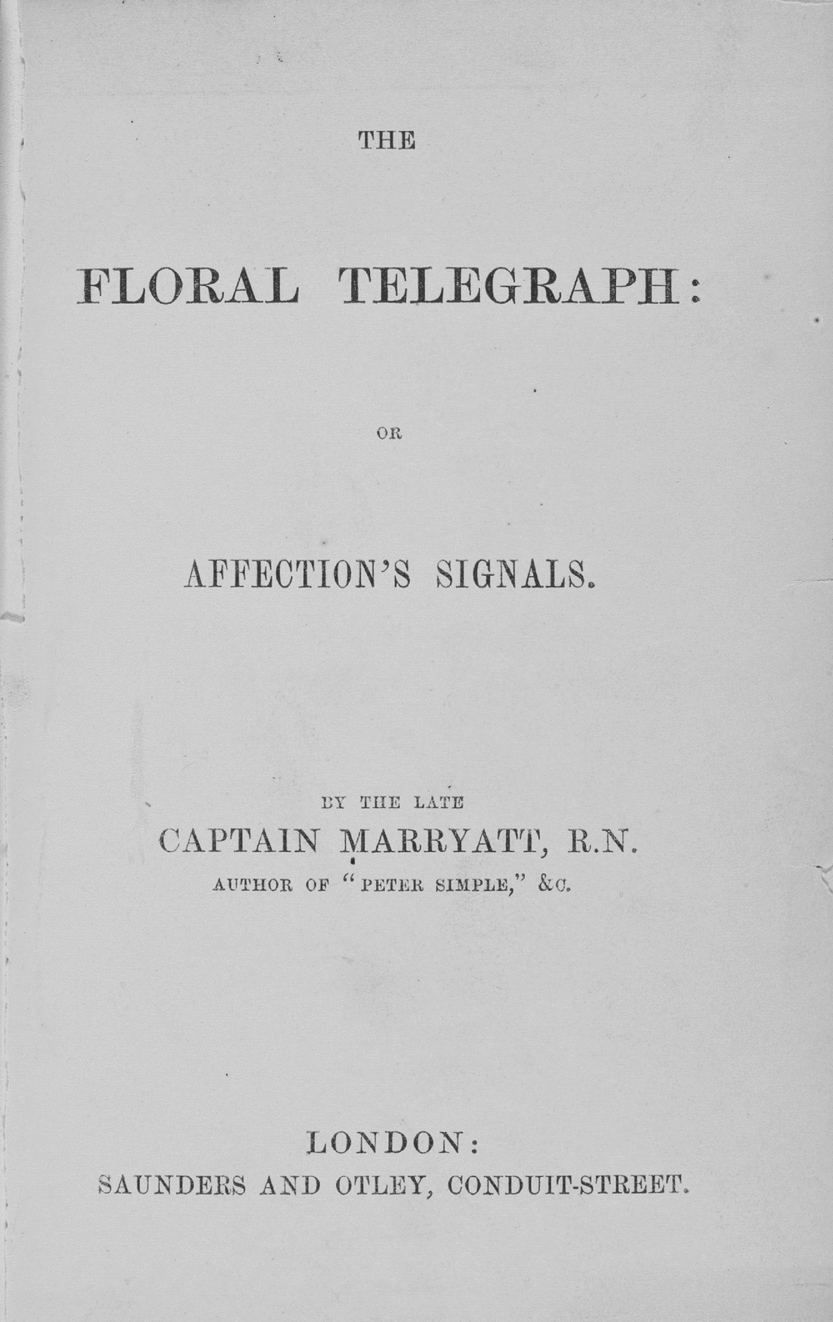
Title page from The Floral Telegraph: Or, Affection's Signals (London: Saunders & Otley, 1850).

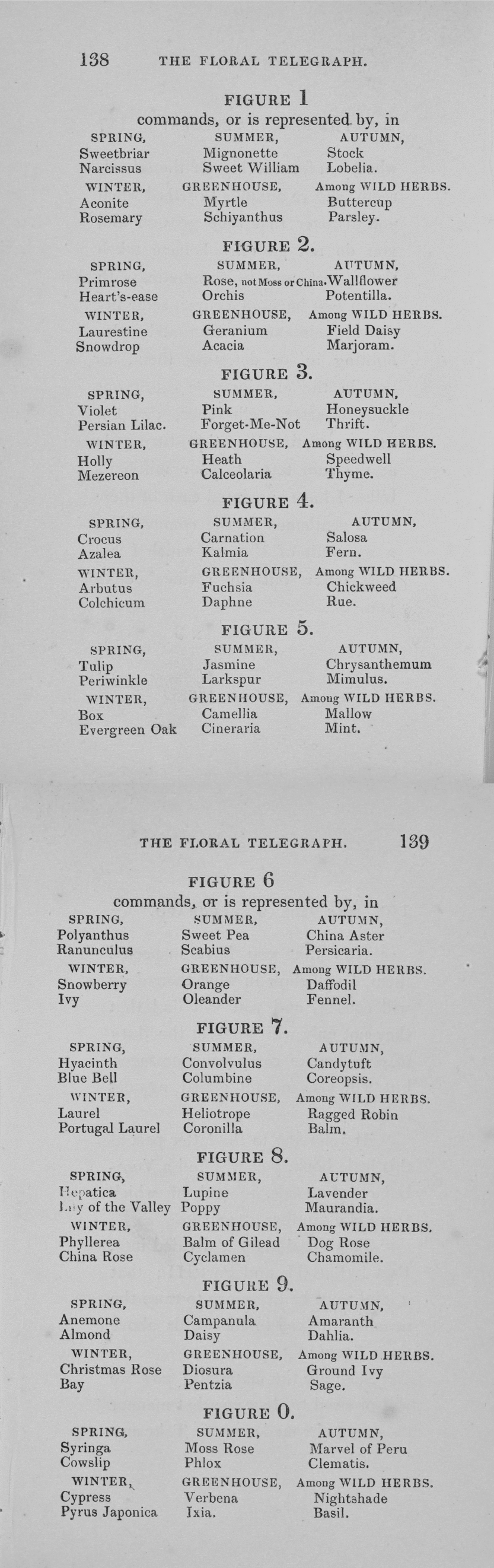
The “Table of Flowers” from The Floral Telegraph (London: Saunders & Otley, 1850), 138-9.
Biographical Sketch of the Captain
From the time he could walk, Frederick Marryat was determined to go to sea. His mother, Charlotte, was a renowned gardener and the first female fellow of the Horticulture Society of London. His father, Joseph, served in Parliament for the borough of Sandwich, was a Chairman at Lloyd's of London, and an agent for Grenada in the West Indies. Despite this comfortable upbringing, young Frederick repeatedly ran away with dreams of sailing over the horizon. Finally, in 1806, his parents accepted the inevitable and Frederick's father acquired for his fourteen-year-old son the position of midshipman on the Imperiuse, a 48-gun frigate commanded by Lord Cochrane. For the next twenty-four years, Marryat advanced in rank as he toured the coasts of France, Portugal, and Spain, traveled to Bermuda, waged war in Burma, and sailed back to Great Britain again. In 1830, after an illustrious career, Marryat retired from the Royal Navy with the rank of Captain.
After leaving the service, Marryat spent the rest of his life in a restless state. As one biographer notes: “Now he was a novelist, now a farmer, now yearning for the sea again; at one time he was on the point of buying a castle in Hungary, at another he thought of camping in the desert for a year or two” (Lloyd 251). Marryat mingled with high society and attended royal receptions with King William IV (Warner 97) and King Leopold in Belgium (Pocock 212); he dabbled in the arts and sciences as a member of the Royal Society and as a friend of Charles Dickens, George Cruikshank, and Charles Babbage. He made an unsuccessful bid for Parliament, during one debate threatening to “flog” a spectator and his son to make a point about acceptable forms of corporal punishment (Lloyd 256); and he was embroiled in heated literary disputes. In 1834 he beat with a cane the young novelist William Johnson Neale (Warner 94–96), and a few years later Marryat's unsavory comments during a tour of the United States led citizens of Saint Louis to hang the author in effigy (Pocock 157). From 1832 to 1836 Marryat owned and served as editor of the Metropolitan, and, as will be discussed shortly, shared his mother's passion for flowers. Marryat's famous connections, seemingly whimsical interests, and eccentric, sometimes violent behavior were eclipsed, however, by the spectacular success of his fiction.
Marryat has been described as “the most celebrated English novelist between Jane Austen and Charles Dickens” (Pocock 9). He wrote prolifically – publishing at least twenty-four novels between 1828 and 1848 – and autobiographically – culling much of his literary material from his years at sea. He wrote in the picaresque tradition of Tobias Smollett, but he entwined the picaresque with hardboiled, episodic adventure. The results were novels such as Mr. Midshipman Easy (1836) and Japhet in Search of a Father (1836). These popular novels carry a similar stripe: hand-to-hand combat, clever sea maneuvers, and last second escapes help the virtuous hero gain social status and rise through the ranks of His Majesty's fleet.
At its best, Marryat's prose displays a graceful swagger that resembles its picaresque protagonists, who are whisked into danger and just as quickly to safety in episode after loosely related episode. Contemporaneous critics such as Thomas Carlyle and Edgar Allan Poe picked apart Marryat's wooden characters and contrived plots.Footnote 1 Nevertheless, his stories attracted a broad readership and his books remained popular with young readers into the early twentieth century. Virginia Woolf said Marryat employed “language with the suggestiveness of a poet” (42) and she praised the realism displayed by his characters, even if, she added, “the intenser emotions of the human race are kept out” (43). Joseph Conrad wrote that Marryat embodied “the time when the nineteenth century was young” (75) and he warned that if the Captain's novels were lost to history, then it “would be irreparable, like the curtailment of national story or the loss of an historical document” (73). Ernest Hemingway read Marryat's novels and in a letter dated 20 December, 1925 he listed the Captain as one of his three favorite authors (qtd. in Spilka 315).
On the surface, The Floral Telegraph – an exquisitely illustrated text about a secret garden, a magical sylph, and a clandestine floral code – clashes with the rest of the Captain's more masculine oeuvre. It opens with a whimsical introduction by an anonymous editor and follows with Mr. Horace Honeycomb's dedication – a rhyming ode to “the fairest of the fair, the fair of England, Ireland, and Wales” (ix). Honeycomb's story begins on 25 June, 1835. While wandering through the grounds of a vast estate in Devonshire, Honeycomb discovers “a Time-crushed and yet a Time-embellished wall” (6) that leads to a secret garden in which he meets a beautiful sylph named Floribel. As a sylph “presiding genius over the Garden Flowers, more especially the Violet, the Greenhouses, and the Coquetry of this district” (37), it is Floribel's duty to “wanton over the face of the earth, and disperse the seed . . . of her particular care” (52), but she has been locked inside the garden for over a century due to a fatal accident involving two young lovers, Lionell and Violetta.
Floribel then recites the story of how, in the early eighteenth century, Lionell and Violetta fell in love and decided to elope. Unfortunately, Violetta's father, Sir Eustace, intercepted Lionell's note with the details of their secret plan. While Sir Eustace had deep respect for Lionell, the note was unsigned, and the father became outraged at the thought of some anonymous brute scheming to steal his daughter. On the night of the planned escape, Sir Eustace intercepted Violetta and Lionell at their rendezvous point – the flower garden where Honeycomb now stands. When Sir Eustace saw Violetta, he snatched his daughter's arm and fired his pistol at the man in the shadows. At that moment, Violetta lunged towards Lionell and the bullet passed through both young bodies. The couple died together on a bed of flowers (which Honeycomb recognizes as the varietal “Love Lies Bleeding” (20)). Sir Eustace was so distraught that he sealed the flower garden and Floribel was trapped inside.
Floribel argues that the deaths of Lionell and Violetta were not caused by human error on the part of Sir Eustace; instead, “the use of letters caused all the miseries” (111). Floribel then unleashes a bitter attack on all forms of written communication. She laments, “when the Devil and Dr. Faustus . . . invented the cursed and abominable art of Printing – when old clothes were, by their magic resuscitated into clean white paper —when ink, atramental ink, was poured forth like the poison from the fangs of some venomous monster” (117). To counteract the horrors of written communication, Floribel demands the adoption of another method of correspondence – the Telegraph of Flowers. She teaches Honeycomb how to use the two parts of this telegraph, the Table of Flowers and the Vocabulary, explains the practicality of her invention, and orders him, through the “mere mortal, every day, and common-place means” of “hateful typography,” to offer her invention to the world (166).
As the sun sets, Floribel disappears in a fragrant mist, and Honeycomb loses consciousness. He awakes in a bed flanked by Sir Aldobrand, the current owner of the estate upon which he had been walking, and a corpulent parson by the name of Dr. Snuffletext. At first, Honeycomb worries that his encounter with Floribel was merely a dream, but then his nephew enters the room and discovers Floribel's Table of Flowers and her Vocabulary. The discovery of the documents convinces Honeycomb that “I, the Author, did veritably, and in my own person, see the things that I said I saw” (183). He sets off to publish his account along with the Table of Flowers and the Vocabulary, which includes thousands of words and phrases and occupies the remaining 130 pages of the book.
The Reception of The Floral Telegraph
In june of 1836, the metropolitan magazine, a literary journal that Marryat owned and edited, announced a forthcoming release: “the public will shortly be furnished with a delightful little work far surpassing in amusement and invention everything that has yet appeared on the subject of floral language” (16: 49). That fall, London publishers Saunders and Otley released The Floral Telegraph; A New Mode of Communication by Floral Signals (months later they agreed to buy Marryat's stake in the Metropolitan). In December, the Metropolitan published a sparkling review of this “cleverly told, witty, and playful fiction” (Rev. of The Floral Telegraph 105). The review praises the invention of floral communication as “a ready-made method of talking in poetry,” but also notes, “no name is found in the title page” (17: 105). A clue about the author's identity appears later in the same issue under the heading “Literary News”:
A little publication on Flowers has just appeared, entitled the “Floral Telegraph”: it is an adaptation of the principle of naval signals to communications by flowers, and is susceptible of endless variety: it is said to be the production of a popular naval writer. (17: 114)
Beyond these three mentions, The Floral Telegraph did not stir much interest. The reprint of 1850 – The Floral Telegraph: Or, Affection's Signals – was attributed to “the late Captain Marryat, R.N.,” but the second edition also escaped popular attention. Nor has there been much scholarly attention, in part likely due to the difficulty of locating the text: according to Worldcat.org, only six copies of the 1836 printing and ten copies of the 1850 edition are currently held in libraries around the world.Footnote 2 Approximately twenty copies exist in microfilm format. It has not been digitized.
Restricted access to The Floral Telegraph does not account entirely for the lack of treatment it has received in Marryat biography and criticism. Twenty-four years after the Captain passed away, his daughter, Florence, released Life and Letters of Captain Marryat (Reference Marryat1872). Florence's book offers transcriptions of private documents as well as detailed memoirs from family and friends, but she does not mention of The Floral Telegraph. The next extended study of Marryat, David Hannay's The Life of Captain Frederick Marryat (1889), also fails to mention The Floral Telegraph. The index includes a bibliography of Marryat's works compiled by John P. Anderson of the British Museum. Interestingly, Anderson's bibliography does list “The Floral Telegraph; or Affection's Signals. London [1850], 12mo.,” but does not refer to the first publication of 1836.
In his introduction to The Novels of Captain Marryat (1895–1896), editor R. Brimley Johnson argues against the ascription of 1850 and the notion of Marryat as author of The Floral Telegraph. Johnson suggests that Marryat's name appears on “a book called The Floral Telegraph” that “was first published in 1850 by Saunders and Otley” (x; emphasis mine). Johnson, like Anderson, overlooks the fact that Saunders and Otley first published The Floral Telegraph in 1836 and that the 1850 edition is only a reprint with a new tagline, Marryat's name, and some seemingly inconsequential additions to the vocabulary section.Footnote 3 After acknowledging the book's existence, Johnson quickly concludes that The Floral Telegraph “is probably not Marryat's work” on the grounds that Marryat's daughter, Florence, “knows nothing of the book” (x). It is important to note here that Florence herself says the sketches and transcriptions found in Life and Letters “do not profess to rank as biography” (vii). She makes no claims for scholarly authority, and it would be unfair to blame her for not mentioning each one of her father's titles. Nonetheless, Johnson's elimination of The Floral Telegraph from the Captain's official collection seems premised primarily on Florence's failure to mention it.
The other pointed argument against the Marryat ascription appeared in 1951 as part of the bibliographic notes for Michael Sadleir's collection of Victorian fiction and poetry. In addition to thousands of other rare pieces, Sadlier gathered first editions of all of Marryat's works. In his notes, he boasts that these first editions are “for the most part in excellent original condition” (241). Writing about The Floral Telegraph, however, Sadleir follows Johnson's tack and creates a separate section for works, “Attributed to Marryat.” In this section, Sadleir includes the publication information for the anonymous publication, The Floral Telegraph; A New Mode of Communication by Floral Signals and the second edition that has Marryat's name on the title page, The Floral Telegraph; or, Affection's Signals. Then, in a divided note, Sadleir makes the following observation:
It has always seemed to be difficult to believe that Marryat had any share in this finical little work. The most masculine of authors, he cannot be imagined spending time and thought on a pretty-pretty boudoir trifle of the kind. (XIX Century Fiction 243)
The second direct argument against Marryat-as-author thus stems from a misogynistic conceit: the “most masculine of authors” could not have bothered to write a “pretty-pretty” book. Sadlier's preconceptions of Marryat lead him to consider a strange theory about how the Captain was linked to The Floral Telegraph. Sadleir writes:
It has been suggested to me by Dudley Massey (and I think the suggestion well worth recording) that the attribution to Marryat, which only appears on the later edition published after his death, was due to a confusion between The Floral Telegraph and The Floral Calendar, a small 8vo with coloured plates, compiled by Commander James Mangles, R.N., privately printed and issued in 1839 over the improve of F. W. Calder, Printer, 199 Oxford Street. (XIX Century Fiction 243)
Massey's suggestion amounts to a claim that the 1850 attribution of the second edition arose from a mix up with a calendar published by F. W. Calder in 1839. Both Marryat and Mangles served the Royal Navy, but a cursory examination of the two texts in question shows the unlikelihood that an employee at Saunders and Otley mistook a manuscript first published in 1836 by Saunders and Otley featuring hundreds of pages of orthographic text and six 4×6 color prints with a 6×9 monthly calendar filled with horticulture advice published by a different company. Although The Floral Telegraph does double as a codebook, one would require a unique concept of the genre to confuse an anonymously published novel with a gardening calendar. Such confusion on the part of Saunders and Otley employees in 1850 is even less likely considering that, as well as publishing the Metropolitan, their predecessors had bought the rights to and released six of Marryat's other novels between 1834 and 1836. Presumably, Saunders and Otley also held the rights to The Floral Telegraph when they printed it in 1836.
Provocatively, J. A. Sutherland writes that Saunders and Otley sold to Richard Bentley and Co., “seven of [Marryat's] copyrights for £1,500 or a bit more” in the late 1830s and “the Marryat property continued to make profits for the publisher [Bentley] for twenty years” (94–95). Sutherland does not specify the seven copyrights, but six of Saunders and Otley's copyrights to Marryat novels are undisputed: Peter Simple (1834), Jacob Faithful (1834), The Pacha of Many Tales (1835), The Pirate, and the Three Cutters (1836), Japhet in Search of a Father (1836), and Mr. Midshipman Easy (1836). The seventh to which Sutherland refers may have been The Floral Telegraph.
Around the midpoint of the nineteenth century, these copyrights were sold from Bentley to another publisher, Routledge (Sutherland 95). As we know, in 1850, Saunders and Otley republished The Floral Telegraph with Marryat's name on the title page. What if The Floral Telegraph was ignored in the exchange of copyrights from Saunders and Otley to Bentley, or from Bentley to Routledge? What if Marryat and Saunders and Otley agreed to publish The Floral Telegraph anonymously, fearing the flowery satire might negatively influence the “masculine” persona his readers expected? The facts as to what happened between Marryat and Saunders and Otley are unknown and will remain up to speculation unless conclusive evidence is found in the archive. Still, as I hope my essay has begun to demonstrate, one can look elsewhere for clues. The handful of scholarly studies devoted to Marryat have instead ignored the issue. Oliver Warner's Captain Marryat, a Rediscovery (1953), Maurice-Paul Gautiers's Captian Marryat: L'Homme el l’ Ouevre (1973), Louis J. Parascandola's Puzzled Which to Choose: Conflicting Social-Political Views in the Works of Captain Frederick Marryat (1997), and Tom Pocock's Captain Marryat: Seaman, Writer, Adventurer (2000) do not mention The Floral Telegraph. In the Cambridge Bibliography of English Literature published in 2000, editor Joanne Shattock places The Floral Telegraph under a separate heading of “Attributed Works,” mentions its “doubtful authorship,” and refers to Sadleir's discussion of the ascription (955–56).
Denial has not been exactly unanimous. In the first edition of the Cambridge Bibliography edited by F. W. Bateson and published in 1941, The Floral Telegraph is listed with Marryat's “Other Writings.” But even here the Bateson entry includes a parenthetical note: “Attributed to Marryat” (3: 386). Beverly Seaton's study of Victorian flower books – The Language of Flowers: A History (1995) – discusses both Captain Marryat as a “general literary hack” and The Floral Telegraph as “an amusing parody laced with standard satirical material (egotistical old men, faithless young women, and nephews waiting for their uncles to die)” (156). Seaton's brief analysis does imply that Marryat was the author, but, as her project is more concerned with the sincere language of flowers genre, she devotes only a few lines to The Floral Telegraph and seems unaware of any authorial dispute.
The most telling evidence for Marryat's authorship appears in Christopher Lloyd's biography, Captain Marryat and the Old Navy (1939). Lloyd spends three healthy pages reviewing Marryat's Code of Signals for the Use of Vessels Employed in the Merchant Service (1817) and concludes with the following triplet of sentences about The Floral Telegraph:
[Marryat's Code of Signals] gave rise to a trivial little book entitled The Floral Telegraph; or Affection's Signals by Mr. Horace Honeycombe [sic]. This prettily illustrated conceit enabled lovers to exchange messages by tying knots in the ribbons of bunches of flowers. Whether Marryat himself was the author we cannot say; but it appeared in the magazine he was then editing, and it certainly parodies his own work. (Lloyd 181)
Lloyd picks up on an important point, already noted above: Marryat was the majority owner, executive editor, and primary copywriter of the Metropolitan between 1832 and 1836. Lloyd goes so far as to suggest that the full text of The Floral Telegraph may have appeared in the Metropolitan, though I have found no evidence of this. During Marryat's tenure as editor, the journal published the announcement of the text's forthcoming publication, the news of its release, and the review titled “The Floral Telegraph.”
Though Lloyd treats the text only briefly, we find in his argument three pivotal facts which give credence to the ascription of 1850: 1) The code for speaking with bunches of flowers uses the same principles as the code for flag signals, which Marryat most certainly wrote. 2) In the years leading up to the text's original publication (1834 to 1836) Marryat had a strong working relationship with the book's publisher, Saunders and Otley. 3) Marryat's Metropolitan published a favorable review and suggested that the author of The Floral Telegraph was a “popular naval writer.” Here again though, Lloyd dismisses the book as “trivial” and a “prettily illustrated conceit” (181), declining to take a stance on the authorship and implying that even if Marryat did write The Floral Telegraph, the work does not deserve sustained consideration.
While the skeptics have not presented any conclusive evidence that Marryat was not the author, it would be difficult to locate a smoking gun to prove he was. Per Marryat's request, most of his papers were destroyed after his death and, as Sutherland notes, Saunders and Otley exemplifies the small Victorian publisher that poses difficulties for historians because “their papers have rarely been considered worth keeping” (221). In addition to the facts already treated – a “floral code” which spoofs Marryat's Code of Signals, Marryat's strong ties to Saunders and Otley, and a review that he likely planted – Marryat was familiar with beauty books, had a strong interest in flowers, and a keen sense for satire and parody.
The Officer's Code of Signals
As lloyd and seaton suggest, The Floral Telegraph parodies Marryat's famous codebook for merchant ships, Code of Signals. Marryat's code was the first popular flag system to allow merchant vessels to warn one another of nearby hazards, to expedite emergency rescue operations, and to communicate with those on shore such as family members, ship owners, and underwriters. One such underwriter was the author's father, Joseph Marryat. Frederick later admitted that Lloyd's of London had asked him to write the code and thus, it seems likely that Joseph Marryat's position as Chairmen of Lloyd's helped to initiate the enterprise (Warner 137). Pocock explains: “Once the new code had been accepted by Lloyd's, all its insurance agents, every ship-owner, the master of every merchantman, every pilot, coastguard and excise officer and soon every warship had to have a copy” (75). Marryat's non-fiction debut became an instant bestseller.
Joseph Marryat's position at Lloyd's generated favorable winds, but the young officer's codebook was itself seaworthy, so to speak. The system was concise, intelligible, and easy to use. Seventeen flags, each with its own colorful design, comprised the symbols. The first ten flags stood for the digits, 0–9. Five more flags directed the recipient to different sections of words and phrases: a list of English Men of War; a list of foreign Men of War; a list of the English Merchant Vessels; a list of Lighthouses, Ports, Headlands, Rocks, Shoals, Reefs, etc.; Sentences; and the Vocabulary. Each proper name, word, or phrase in the codex was assigned a section and a digit from one to four. The sender displayed certain flags to signify the number of the entry and placed a “directional” flag over the number to signify a certain section of the codebook. The recipient then used this information and Marryat's cipher to decode the signal. With seventeen flags, good visibility, and a copy of Marryat's Code of Signals, ships could code, send, receive, and decode thousands of commands and messages. An urgent message “Do no quit the vessel on any account, as the only chance of saving yourselves” was transmitted by showing flags “2” and “5.” Meanwhile, the more elaborate (and less time-sensitive) “I mean to keep sail set, and carry on all night, as I am anxious to get into port” was spoken with flags 4-5-7-6.
The flags of Code of Signals and the flowers of The Floral Telegraph do serve distinct discourse communities – merchant sailors and British ladies – but they feature similar operating systems. Code of Signals assigns to each digit a different flag; the Table of Flowers assigns to each digit twelve distinct floral species (See Figure 7). In The Floral Telegraph, each numerical figure from 0 to 9 is signified by twelve unique plants, which are divided into six sections to indicate when or where to find them: Summer Flowers, Autumn Flowers, Winter Flowers, Spring Flowers, Greenhouse, and Among Wild Herbs. The six divisions are designed to allow the floral telegrapher to gather the units needed to communicate during any season and in various locations across Great Britain and the Continent.
A floral telegraph using Bay, Verbena, Orange Flower, Myrtle, Amaranth, Mignonette, Moss Rose, Heath, and China Rose to mean “Tomorrow night between 10 and 11.” The center bouquet represents the floral telegraph tied together. The Floral Telegraph (London: Saunders & Otley, 1850), np.
For instance, to convey, “Your beauty exceeds that of these flowers,” one consults Part III of the Telegraph of Flowers Vocabulary and finds this particular phrase on page 317 listed as number 273. After noting the numerical code – 273 – one consults the Table of Flowers and gathers flowers to signify each number. For this example, say one collects Greenhouse flowers. The numeral “2” will be represented by the Germanium flower, “7” by Heliotrope, and “3” by Calceolaria (which is also called Lady's Purse). One attaches the Germanium, Heliotrope, and Calceolaria to a silk thread, which is then joined at either end to resemble a lei. Three knots are then tied before and after Germanium, Heliotrope, and Calceolaria to indicate the third section of the vocabulary. Finally, as Floribel states:
When you have completed your sentence, all you have to do is to gather up the Flowers into a bouquet, and tie them with another piece of ribbon, thread, or silk; the person to whom it is sent will untie it, spread it on the table, and, by means of the Vocabulary, read your communication. (145)
This mode of communication requires securing, coding, and decoding flowers. As a result, Floribel argues, it will suffice for almost all correspondence and especially for romantic exchanges, diplomatic correspondence, and other messages that thrive on sentiment.
Based on this evidence alone, it is conceivable that another writer with intimate knowledge of Marryat's codebook conceived of switching the seventeen flagship signals with one hundred and twenty different plants. Yet the yarn spun around the idea of coding and decoding “nature's affections” bears the Captain's distinct mark.
Botany, Beauty Books, and the Language of Flowers
In the years preceding the publication of The Floral Telegraph, Marryat was buoyed by a constant stream of creative output. In 1832 he took over editorial control of the Metropolitan: A Monthly Journal of Literature, Science, and the Fine Arts and immediately shortened the name to the Metropolitan Magazine. He likely wrote and certainly edited hundreds of pieces for the Metropolitan, including political opinions, travel reports, notices of new patents, meteorological charts, society gossip columns, obituaries, discussions of property values, and reviews of new works (like the review of The Floral Telegraph). With help from his co-editor and fellow veteran of the Royal Navy, Edward Howard, Marryat successfully steered the magazine into the more diverse and uncertain waters of “miscellany.” Along the way, his decision to write and release serial installments of his novels made him a trendsetter in the publishing world of London. Marryat was “one of the first to recognize the aesthetic and financial necessity of retaining audience interest from issue to issue” (Lawrence). Friends such as Harrison Ainsworth, William Thackeray, and Dickens followed Marryat's lead and began publishing serially in magazines, journals, and periodicals and then releasing entire novels in book form (Lloyd 253). By 1834, the naval officer-turned-writer was making waves in the literary world. He developed a healthy readership for his magazine and released a string of bestselling novels including Peter Simple, Japhet in Search of a Father, and Mr. Midshipman Easy. The positive reaction to these works secured Marryat's position in the ranks of popular British novelists and his books, like his flag signals, dispersed across both sides of the Atlantic. It was in the midst of this productive flurry that Saunders and Otley published The Floral Telegraph.
The contents of the Metropolitan provide evidence that Marryat had been interested in botany and horticulture in the years preceding the publication of The Floral Telegraph. Marryat oversaw the publication of the following articles and reviews: “A Catechism of Botany” (Apr. 1834), “The Flower Garden” (Jun. 1834), “Love's Botanica, A Key to the Study of Botany” (Aug. 1834), “Flowers of Loveliness . . . with Poetical Illustrations by the Countess of Blessington” (Dec. 1835), and “The Book of Flowers” (Apr. 1836). One of the most telling reviews from this period concerned Frederic Schoberl's The Language of Flowers; with Illustrative Poetry published by Saunders and Otley in 1834. In a statement that resembles Honeycomb's description of the floral code – “It gives a Language without Words; to soar/Beyond the mean it teaches” (The Floral Telegraph xi) – the reviewer (likely Marryat) says of The Language of Flowers: “It teaches the language of flowers – how to convey by those beautiful productions of nature, wishes, hopes, and sentiments; in fact, how to become practical poets in the most pleasing manner” (Rev. of The Language of Flowers 74). This new language, it is suggested, encourages speakers – especially young women and men – to make fresh associations between their feelings and the flowers found in their environment. Revealing the hidden meaning of each flower and plant and then conveying that meaning offers a path to spiritual awakening, a way to both illuminate and transcend human emotions. The reviewer of The Language of Flowers recommends that
In order to spiritualize ourselves, we should endeavor to give a sentiment to every thing – see half concealed and mysterious beauties in blossoms, discover ethereal revealings in the hues of a flower, and catch an inspiration from the graceful shape of a bud. (10: 74)
Similar associations between flowers, feelings, and the process of spiritualization underlie the new floral communication system of The Floral Telegraph. Floribel tells Honeycomb that the Telegraph of Flowers may cause “printed letters to be lost” but, “there shall be wanting no language to love, no source of beautiful expression to every feeling that enlivens, warms, and elevates the heart of mankind” (167). Floribel's Vocabulary contains an array of angry reprimands – “You are decidedly ill-dressed” (300) – and banal commands – “Treat me with more respect” (312) – and yet, as the subtitle of the 1850 edition suggests, the system is especially designed to signal affections.
Marryat was aware that matching affections and flowers was an emerging trend in book culture. Schoberl's book borrowed heavily from Charlotte de Latour's famous Le Language des Fleurs published in 1819, and, although the content was not original, Seaton writes that Schoberl's work with Saunders and Otley was “the first really popular English language of flowers book” (81). The general “language of flowers” genre featured beautifully illustrated arrangements labeled to suggest that certain flowers signified certain feelings – red roses say “love,” white lilies say “peace,” etc. The Metropolitan reviewer writes that using nature's floral signals to communicate is “the best method to avoid a commonplace manner of thinking” (10: 74), but the one-to-one correspondence advocated by The Language of Flowers may have appeared simplistic, even trivial, to the creator of what was at that time one of the most complex codes in worldwide circulation.
Latour, Schoberl, and other authors founded their language of flowers books on historical beliefs and cultural conventions that varied from region to region; the author of The Floral Telegraph would base his language on a fixed, universally recognized signaling system. The grammar used by the language of flowers matches specific flowers to specific sentiments; the Telegraph of Flowers links flowers to digits, which are then used to signal sentiments and many other messages. In Schoberl's language, a bouquet of honeysuckle and pink carnations signifies “Generous and Devoted Affection” and “Pure Love”; in the Telegraph of Flowers these flowers signify the numbers 3–3 which convey, respectively, “All” or “Home” or “The Music Party” depending on how many knots are tied into the bouquet. In short, Marryat's floral mode not only promises to say it with flowers; it promises to say anything with flowers.
Marryat was aware of the emerging market for books about flowers and would have had a unique ability to satirize (and synthesize) the Code of Signals with the ideas underpinning the language of flowers books. He also had an intimate relationship with Lady Blessington, one of the preeminent patronesses of “beauty book” culture.Footnote 4 After drawing Marryat into London's bohemian circle, Blessington invited the Captain to contribute to the annuals she edited – Keepsakes and The Book of Beauty (which is sometimes referred to as Heath's Book of Beauty). As The Floral Telegraph was about to be published, Marryat wrote in a letter to Lady Blessington: “I hope the Beauty Book goes on well. I know that you and Mrs. Norton and I are the three looked up to provide for the public taste” (qtd. in Lloyd 255–56). We cannot tell how seriously Marryat viewed his role as an arbiter of “public taste,” but his relationship with Lady Blessington and his work on her annuals suggest he was literate in the “beauty book” genre and, we also know, genuinely interested by flowers.
Marryat's fondness for flowers was instilled by his mother and persisted throughout his life, eventually providing part of the hook for Woolf's essay “The Captain's Deathbed.” Woolf's piece opens with the journal entry Marryat composed in his “boudoir room” on the day of his death in 1848:
Augusta [Marryat's daughter] . . . has just brought me three pinks and three roses, and the bouquet is charming . . . I feel convinced that Christianity is true . . . and that God is love . . . It is now half-past nine o'clock. World, adieu. (qtd. in Woolf 37)
Similar to the anonymous editor's characterization of Honeycomb in the preface of The Floral Telegraph, Woolf presents the Captain as a sentimental man – one who knows he has hours to live but can still enjoy a “charming” bouquet. Florence Marryat supported this image as well, writing of her father's love for flowers: “The more fancifully they were tied together, the better he liked it” (qtd. in Woolf 47). Note that though Florence “knew nothing” (Johnson x) of The Floral Telegraph she clearly suggests her father enjoyed flowers that had been “fancifully” tied together into ornate bouquets.
For her part, Woolf contrasts the softer image of the author writing about flowers on his deathbed with the blunt characters scattered throughout his hardboiled sea stories. In these “cruder” books, Woolf says, “we get closer to the art of fiction; we see the bones and the muscles and the arteries clearly marked” (42). The visibility of narrative bones, muscles, and arteries led critics to mark Marryat as a hack content to leave gaping holes in his plots and to bring characters into and out of the action at whim. Woolf offers a more nuanced critique, and concludes her essay by returning to the Captain on his deathbed: “the summer morning and the dying Captain after all his voyages stretched on the mattress in the boudoir room dictating those last words to his daughter about love and roses” (47).
The Captain's interest in flowers is also supported by the letters and diary entries he wrote in 1835 as he was moving somewhat aimlessly with his family through Belgium, Switzerland, and France. During this period, Marryat composed two of the early nineteenth century's greatest sea-tales – Mr. Midshipman Easy and Japhet in Search of a Father – and continued to help edit the Metropolitan, besides keeping a detailed notebook, which was published under the title, Diary of a Blasé. In the late spring of 1835, Marryat wrote to his mother from Spa, Belgium, to share an exciting discovery:
Since I have been here I have discovered what I fancy will be new in England, a variety of carnation, with short stalks; the stalks are so short that the flowers do not rise above the leaves of the plant, and you have no idea how pretty they are; they are all in a bush. There are two varieties here belonging to a man, but he will not part with them. He says that they are very scarce and only to be had at Vervier, a town eight miles off. They are celebrated for flowers at Liege, but a flower woman from Liege, to whom I showed them, said that she had never seen them there; so I presume the man is correct. Have you heard of them? (Life and Letters 224)
The above letter shows Marryat acting like a dedicated florist in search of a specific varietal, but he was generally fond of picking flowers and of flower gardens. In a letter addressed to Lady Blessington dated, 17 June 1835, Marryat recounted his restful routine while living abroad: “I walk about and pick flowers with the children, sit on a bench in the beautiful allées vertes, smoke my cigar and meditate till long after the moon is in the zenith. Then I lie on the sofa and read French novels, or I gossip with anyone I can pick up in the streets” (qtd. in Pocock 123). That same month, Marryat traveled to Liege and spent a day touring the college and the botanical garden (possibly to continue his search for the pretty carnation). He later mused:
To the college is annexed a botanical garden. There is nothing I dislike more than a botanical garden. I acknowledge the advantages, perhaps the necessity, of them; but they always appear to me as if there was disarrangement instead of arrangement. What may be called order and classification appears to me to be disorder and confusion. It may be well to class plants and trees for study, but certainly their families, although joined by man, were never intended to be united by God. Such a mixture in one partition, of trees, and shrubs, and creeping plants, all of which you are gravely told are of one family. I never believe it: it is unnatural. I can see order and arrangement when I look at the majestic forest-trees throwing about their wild branches, and defying the winds of heaven, while they afford shelter to the shrubs beneath, which in their turn protect and shelter the violets that perfume all around. This is beautiful and natural – it is harmony; but in the botanical garden everything is out of its place. (Diary of a Blasé 102)
In The Floral Telegraph, published less than a year later, the secret garden represents a similar aesthetic position. Untouched for over a century, the garden entwines the “wildness of the jungle with the rich beauties of cultivation” (13). The roses are “of a form so perfect, a size so magnificent” (13) despite overgrown pockets where the vines, weeds, and other foliage have “surrounded and strangled the rightful owners of the soil with a savage barbarity” (18). Distinct from the “unnatural” botanical garden in Liege, the secret garden of The Floral Telegraph weaves emblems of high culture such as fountains and Greek statues with the unrestrained growth of nature to create a “beautiful scene of desolation” (18).Footnote 5
Marryat's letters and diary entries show that he enjoyed flowers as well as views of majestic, untamed nature, but The Floral Telegraph seems to mock the impulse to describe the secret garden with poetic language. Honeycomb offers to transcribe Floribel's story “in hexameters, after the manner of Mr. Southey” (54) or in extended metaphors “after the fashion of Dr. Darwin's celebrated Epic” (55). However, Floribel, the inventor of a new, orderly communication system using floral signals bluntly denies the poet, offering, “A faded nettle for your hexameters” and advising, “acquit yourself but tolerably in plain prose” (55). Ironically, Floribel, the ethereal figure most intimate with gardens and flowers views poetry as a faulty, dangerous medium with stifling conventions. Thus, Marryat places Honeycomb's attempt to celebrate the beauty and overgrowth of the secret garden with tidy lines of poetry against Floribel's suggestion of replacing lines of poetry (and all written correspondence) with bouquets of coded flowers.
Marryat seems to have wanted readers to smirk at Honeycomb's aspirations to emulate Romantic poets, but Floribel's system takes a jab at a deeper fissure in the language of flowers. The language of flowers assumes that equating feelings with flowers is as natural, if not more natural, than linking them with words. Floribel's Telegraph of Flowers follows from this assumption, but it inserts digits into the equation. Purportedly designed to help its users escape the snares of printed words by using flowers to achieve a transcendent language of love, Floribel's system ignores the threat of shackling each species to a fixed digit – ferns mean “4,” daisies mean “9,” etc. Gathering the flowers and plants needed to communicate even the most basic sentiments would eventually give gardens an even more rigid layer of classification than the “order and arrangement” that appalled Marryat during his visit to the botanical garden at Liege. In a text that Sadlier calls a “pretty-pretty boudoir trifle” (XIX Century Fiction 243) and Lloyd a “prettily illustrated conceit” (181), it should not be surprising that Marryat leaves unresolved the epistemological and linguistic limitations of coding affections (whether through dactylic hexameter or knotted bouquets); however, I believe these constraints and conflicts serve to reflect Marryat's overall tendency to challenge stylistic conventions, reliable narrators, and the constraints of book publishing.
The Coy Captain
The content of the floral telegraph seems to correspond to the Captain's unique knowledge of codes and flowers, but the playful conflicts concerning the value of poetry or of speaking with flowers that symbolize numerals reflects his talent for genre-parody and self-mockery. It is worth noting that Sadleir, the most outspoken critic of the Marryat ascription, was also one of the first scholars to advocate that readers not take the picaresque novelist too seriously. In 1925, Sadleir's essay in the Yale Review advised future Marryat biographers and archivists:
. . . take care to secure examples of Marryat's engaging tendency to break off, to wink at the reader in a sort of breathless undertone, to confess the troubles or the shifts of authorship, gaily to boast, pertly to moralize, and then without change of countenance to take up his story once again and go rollicking on. (“Portrait” 784)
These tendencies are displayed throughout The Floral Telegraph. Take the following passage in which Floribel begins her story about the origin of flowers and the explanation of the Telegraph of Flowers (which is meant to replace all written communication) by confessing her misgivings about which style is best suited to her subject and her readership:
As Flowers are to be the subject of my theme, ought not then my style to be flowery? But there is also mystery in my communications. I would whisper my secret into every several ear, if such could be – should not, therefore, my style be enigmatical? To please some, it should be lively and I would fain please so favourite a portion of my readers – to please others, it should be learned, for even learned ladies may not, perhaps, disdain to take advantage of the precepts of this little book. But, in attempting to please all, I may, perhaps, please none – this is an awkward predicament, and I must therefore, indulge the hope that, although the opening address may not prove wholly satisfactory, the advantages to be derived from the Telegraph of Flowers may plead for the imperfection of my style. (112–13)
This self-conscious fretting about the style of her speech and how to please her “readers” precedes a diatribe against the invention of printed words, poisonous ink, and public literacy. By the end of her rant she concludes that writing with flowers is superior to other forms of written communication because bouquets maintain secrecy, avoid libel, and are more suited to transmitting affect than printed words. This playful parody about the troubles of authorship together with the pert moralizing is, according to Sadleir's earlier estimation, typical of Marryat's fiction. In his final judgment, the Sadleir of 1925 writes:
One may go to [Marryat] for cynical good sense; for knowledge of the world; for gaiety and laughter; for swift uproarious pantomime; for plots that ripple easily to their end or swirl over rocks or slide dangerously between steep banks; for vivid pictures of a vanished world; for agile simple English. (789)
In addition to these qualities, The Floral Telegraph shows Marryat's tendency to make outrageous boasts – such the ability to replace all written correspondence with flowers – and to parody institutions – such as writing and publishing. The style of The Floral Telegraph is a clear match for Sadleir's earlier description of Marryat, but Sadleir's later image of the Captain as “the most masculine of authors” makes it difficult to see the satire and parody in his novel's discussions of poetry, secret gardens, and sylphs. In other words, Sadleir, with recent memory more vivid than past, seems to have been so impressed by Marryat's dominant subjects (ships, sailors, and social advance) that he could not see the garden/forest for the flowers/trees.
Acknowledging Marryat's penchant for parody and satire effectively underscores our reading of Marryat as author, anonymous editor, and Horace Honeycomb, the unreliable narrator. In his preface, the editor claims that Honeycomb is a verbose, bourgeois flâneur, “remarkable for always selecting an excellent subject – himself” (iii). Honeycomb has the endearing tendency to “make rather liberal use of the pronoun I, with its objective me,” and the editor suggests that “all who thoroughly understand him will be grateful for it” (iv). Honeycomb's story about his encounter with Floribel will attract criticism and readers are likely to consider it, “nothing but the impressions of a long hallucination” (vi). The editor seems unconcerned about these protests: Honeycomb believes his “conference with a preternatural being” was real, and even if he hallucinated, the hallucination “must be acknowledged as a singular phenomenon in physiology” (vi).
The editor neither supports nor rejects the veracity of Honeycomb's story, but he does vouch for the existence of Floribel's cabbalistic manuscript containing the Table of Flowers and the three-part Vocabulary. He has seen with his own eyes this “queer black letter affair upon musty parchment” (vii). As for Honeycomb's narrative, the editor admits that his “editorial labors” have been “confined merely to the striking out of expletives, and the expunging of digressions, particularly about himself [Honeycomb]” (viii). This is another instance of Marryat's poking fun at himself by way of Honeycomb. That the narcissistic Honeycomb's narrative has been stripped of “digressions” is a farce – and its suggestion a move typical of Marryat.
The editor's joke about digressions draws out like a slack sail and then catches wind late in the narrative when Honeycomb makes a rather lengthy digression (and Marryat winks at his readers) in addressing those who “read running” and thus skip important information in the text (168). Honeycomb laments that no one reads carefully because they expect digressions and, “as works are now written, a book consisting wholly of digressions would be one quite as relevant to the subject as any that have lately appeared” (169). Digressing on the part of the writer and skimming or “read running” on the part of the audience leads information to be muddled in the exchange. Honeycomb explains that his own story should be read carefully because it was carefully crafted by an “estated gentleman of landed property of more than five hundred pounds a year” (168). After clarifying why readers should pay attention to his story, Honeycomb does not return to his encounter with Floribel; rather, he continues by defending digressions: “Were we always to come to the point at once, where would be all the pleasures of life? Wine and women would then immediately lose all attractions, for should we not be dead drunk in four minutes, and dead dead married in five?” (170). Honeycomb continues, blaming his tendency to digress upon current trends in fiction and arguing that his style is different than that of “the authors of the present day” who are “fully imbued with the policy of not letting their readers come to the point at once, that they will often write you three well printed volumes, without one single point in the whole” (170–71). Floribel finally interrupts the digression to remind Honeycomb that the sun is about to set. She must give him instructions for publishing her invention, which, she laments, will require words printed on paper instead of flowers tied into bouquets.
Marryat often engaged in such charades. Parascandola observes that “authorial intrusions” can be found throughout Marryat's novels, and “digressions in Marryat's early work often concern the process of writing” (11). In this case, the narrator digresses from a story (which, ironically, describes why written correspondence should be abandoned for coded flower bouquets) to defend writing that contains digressions and, as his own narrative begins to wander, he attacks contemporaneous authors for not coming to the point at once. For Marryat, such satirical intrusions often opened a didactic space in which to comment on social issues and urge reform.Footnote 6 The playful conflict between the editor and Honeycomb strongly resembles the ambivalent attitudes about novels and novelists found throughout Marryat's work. Floribel's argument against literacy and written communication, however, is distinct.
Widespread Literacy, Poisonous Print, and the Dangers of Education
Traces of marryat's concerns with writing and publishing fiction shine through the editor's shifty remarks and Honeycomb's arrogant digressions, but the most startling reflection of the author appears in the character of Floribel. On the one hand, it is ironic that Marryat, whom some scholars assumed was too “masculine” to write about flowers, creates a stereotyped, phantasmal female character that worries if her speech is too “flowery.” On the other, Floribel's vitriolic attack on widespread literacy and written communication seems to push past the boundaries of irony and to reflect deep misgivings, even paranoia that new publishing practices and a broadening readership would upset social norms.Footnote 7
To better understand Floribel's hatred of written communication (and the tensions surrounding print and literacy in the early nineteenth century), we can juxtapose her argument with Marryat's non-fiction piece on the “bad effects of sensational literature” (Life and Letters 184). Florence Marryat reprinted this essay in her biography and, while she does not include publishing information, it likely appeared in the Metropolitan during her father's tenure as owner and editor. The essay begins by noting the “many letters” Marryat received concerning the circulation of “unstamped publications, full of ribaldry, libel, and obscenity” (Life and Letters 184). Marryat says that these “cheap and obscene periodicals” are almost exclusively devoured by the “lower masses” that do not have “strength of mind or principle to oppose” (187). While educated readers of works such as Byron's Vision of Judgement will have enough sense to rebuff its attacks on morality, the anonymous, blasphemous, and immoral publications are harmful when directed at a more vulnerable population.
In Marryat's essay, the shift from “obscene” periodicals to “poisonous” print mirrors a shift in tone. The masses have begun to take cheap literature in “hebdomadal doses” (118), allowing immorality to spread like an evil virus and to erode the social fabric. Marryat alerts his audience:
[The unstamped publication] is gradually and quietly at work unhinging and vitiating the mass and the time will come when the evil fruits shall be abundant. Indeed if the evil be allowed to continue it would be better at once to stop all national education for every child that is taught to read is but prepared to receive the poison which is now so rapidly circulating. (Life and Letters 118)
Floribel's brief analysis of speech practices and the history of communication technologies follows a similar trajectory from the “obscene” and horrible to the deadly and “poisonous.” Before written communication, she explains, words were like air, “carried away, where the wind listeth, until the fluid no longer vibrates with their component sounds” (114–15). The invention of writing on paper “ushered into the world . . . an accumulation of typical horrors” (116). Fortunately, the “labor of Manuscript writing, and the few who knew how to write, did not allow the poison to disseminate too widely” (116). Illiteracy kept the dangers of written communication at bay, until “the devil and Dr. Faustus put their heads together, and invented the cursed and abominable art of Printing” and the “atramental ink, was poured forth like the poison from the fangs of some venomous monster” (117). The printing press was not a sign of progress; it increased the possibilities for corruption and the extent to which poisonous information could spread.
In addition to referring to written text as poison, both Marryat's essay and The Floral Telegraph question the value of public education. Floribel warns about, “the dangerous use of the pen, and the more dangerous universality of education, by which fathers and mothers now know how to read” (126). The Iron Age with its widespread literacy and education is “now at the zenith of its horrors,” and is perpetuated by “the folly to be wise, which pervades all classes, from the universities to the infant schools” (118). While the majority of The Floral Telegraph is satirical, these arguments reflect popular beliefs about the dangers of mass media and the perceived futility of educating the lower class. Literate children and improperly educated adults cannot resist anonymous, captivating, and poisonous content. Better not to teach them to read than to let them read rubbish, the argument maintains.
Marryat suggests that the problem posed by the creation of poisonous content and the development of literacy across classes is exacerbated by new modes of distribution. Floribel draws an analogy between the circulation of bad blood through the human body and the circulation of letters through the post office:
Out of the thousands and thousands of communications which are daily disseminated from the General Post Office, that great Aorta which pours forth its mischief by its ramifications, like the arteries and veins of the human body throughout the body politic – I say only reflect a minute, and then tell me . . . how many are there out of the thousands that do not contain some unpleasant communication, some tale that were better left untold! (The Floral Telegraph 119–20)
Increased distribution multiplies those situations where individuals receive bad news from family members and notes about failed business transactions. In other words, Floribel is outraged by nineteenth-century spam. The constant barrage of negative or superfluous writing makes those sending or receiving letters anxious and overburdened.
In the essay, Marryat seems anxious that publishers are losing control of what is written, how it is distributed, who reads it and, where it is read. He explains: “It is in secret that the virus is spread so that no one knows the real extent of it” (Life and Letters 189). Not only is immoral content circulated, it is impossible to know how many individuals are exposed to it and how thoroughly the “poison” has seeped into the body politic. The writers and publishers are partly to blame, but public education and other programs that promote literacy are also at fault. A populace of citizens educated for literacy (but not knowledgeable enough to discern veracity or morality) perpetuates lies and obscenities.
It is difficult to know if Marryat was actually so violently opposed to literacy, public education, and sensational literature as these two documents would suggest. Marryat's own Metropolitan led to an expanding readership that “was to make up a large percentage of Marryat's audience” (Parascandola 10). His success as a novelist was closely linked to the relatively cheap production and distribution of magazine copy and a general rise in literacy levels across the English-speaking world. Writing a story in which one of the main characters is horrified by written communication and the other, the bumbling poet Honeycomb, has a best friend by the name of “Dr. Snuffletext” may have been Marryat's way of parodying sentimental literature and adventure novels while simultaneously romanticizing literary practices like diary writing and floral codes.
Conclusion: Extended Signals in The Floral Telegraph
Should my reading be correct and marryat accepted as author of The Floral Telegraph, then scholars may uncover new perspectives on the Captain and his novels. For example, one could situate the code work of the flagship signals and the floral telegraph in relation to the “Difference Engine” (1823) and “Analytical Engine” (1837) developed by Marryat's schoolmate, friend, and the member who brought him into the Royal Society, Charles Babbage. Or one could relate Floribel's disgust with “poisonous ink” and “hateful typography” to commentators’ fears that sensational literature threatened to poison the minds of the uneducated. This would add nuance to the anxieties about democratic speech common from this period and interestingly illustrated by Marryat's American counterpart, Samuel F. B. Morse, in his paranoid outburst, “Foreign Conspiracy Against the Liberties of the United States” (1835). One could also read Marryat's elaborate parody of the feminine flower book genre and Honeycomb's complaints about “books as they are written” as an attempt to break free of the artistic constraints of the masculine adventure genre and the formulaic fiction that earned the author fame and success. Of course, one following this approach could unite Marryat's The Floral Telegraph with another famously ambivalent sea-novelist, Herman Melville, and his provocative proto-modernist narrative, “Bartleby, the Scrivener: A Story of Wall Street” (1853).
However, as a novel-codebook, it seems more fitting to situate The Floral Telegraph within – and cycle it through – another contemporaneous technology with godlike powers to “annihilate time and space” – the electromagnetic telegraph. When The Floral Telegraph was first published, the electromagnetic telegraph had not yet established itself as a paradigmatic technology. Indeed, at the time, Marryat's code of flag signals was still one of the most popular forms of long-distance communication. In 1833, King Louis Phillipe conferred Marryat with the Croix d'Officer of the Legion of Honor in recognition of the flag signaling system, which the French called, La Langue Télégraphique Universelle and which they used to supplement the blades and shutters of their famous semaphore telegraph line. In 1856, Samuel F. B. Morse traveled to France and received the same honor for his invention of the electromagnetic telegraph. Marryat created a universal system for naval communication; Morse did the same for electric communication.
The fourteen years separating the first and second edition of The Floral Telegraph saw a paradigm shift in communication technologies, from Marryat's code to Morse's. During this decade and a half the first wave of magnetic wires proliferated through England, France, Germany, and the United States and, by the second half of the nineteenth century, as Marryat's novels and his codebook began to fade from public consciousness, the number of Morse-coded telegraph messages written and published through electrical devices flowered into the millions.
Just as Marryat's text blurs the boundaries between novel and codebook, satire and romance, the publication year of 1836 sits on the threshold of a revolutionary transformation in which electric wires and lines would sweep across nations and wind through landscapes like vines through an untended garden. The electromagnetic telegraph – not the floral telegraph – became the dominant mode of communication. The new telegraph promised to seamlessly code letters and words and their corresponding affections into sputters of electricity translated into dot or dash, one or zero. Viewed in this context, The Floral Telegraph provides a proleptic example, and critique, of the electric telegraphy and subsequent digital networks that are celebrated for keeping lovers “in touch,” or scorned for failing to transmit true emotions.
Before communication went “electric,” Marryat concludes by way of a magical sylph that the burdens of sending affections through written words – lack of secrecy, exposure to libel, and the tendency for digressions – call for a more local, organic, individualized medium. The floral mode was a possible answer, a way to test “the wisest point . . . whether we cannot, even under such disadvantages, to a certain degree, obtain security” and still share intimate feelings (The Floral Telegraph 128). Of course, the experiment failed. Marryat did not seriously believe in Floribel's solution – to replace words and sentences with flowers and bouquets. Yet, historically contextualized, The Floral Telegraph offers an elegant and even prescient assessment of the communication technologies that arose in its immediate wake, continue to proliferate, and alternately dampen and electrify transmissions of affect.