Introduction
The Japanese butterfish Psenopsis anomala is an economically important demersal fish species that is widely distributed from southern Japan to the East China Sea and is commonly caught by trawl fishery along the north, north-east and west coasts of Taiwan (Wang & Chen, Reference Wang and Chen1995). The average annual landings of this species in Taiwan was ~4700 mt between 1999 and 2008 (59% from offshore, 37.5% from far-sea and 3.4% from coastal fisheries), the largest landings of this species by any nation (Hwang, Reference Hwang2006).
The surrounding waters of Guei-Shan Island off north-eastern Taiwan is a traditional and important trawl fishing ground. The trawl fishery catch in this region accounts for 1/6 of the total coastal trawl catch of Taiwan. This region has been intensively fished over the past few decades, resulting in changes in the size and species composition of the catch (Wang et al., Reference Wang, Chen and Joune2013). Catches of several commercially important fish, such as the Japanese butterfish, black croaker Atrobucca nibe, bigeye Priacanthus macracanthus, yellow sea-bream Dentex tumifrons, red tilefish Branchiostegus japonicus, lizardfishes (Synodontidae) and Japanese barracuda Sphyraena japonica, are now dramatically decreased (Liu & Cheng, Reference Liu and Cheng1999; Wang et al., Reference Wang, Ou, Chang and Liu2007).
The catch statistics of P. anomala can be traced back to the 1970s when this species had not yet been intensively targeted by the coastal and offshore trawl fisheries. The estimated catch-per-unit-effort (CPUE) of P. anomala from these fisheries showed significant increases during the early 1980s and reached a peak in the late 1980s and early 1990s. It fell significantly thereafter and remained low in recent years (Wang et al., Reference Wang, Chen and Liu2015). The groundfish surveys conducted in 2006 by the Fisheries Research Institute, Taiwan, also showed a significant drop in the catch of P. anomala in the northern and north-eastern waters of Taiwan since the early 1990s (S. S. Chin, personal communication, October 2010).
Despite the economic importance of P. anomala and the potential impact from intensive fishing, little is known about the life history, population or fishery biology of this species or variations in these characteristics caused by natural or anthropogenic disturbances in the waters off Taiwan. An age and growth estimate of P. anomala was reported in Kii Channel, Japan in the early 1970s using annulus counting on scales (Sakamoto & Suzuki, Reference Sakamoto and Suzuki1974). Hu et al. (Reference Hu, Yan and Li2006) also reported the growth, mortality and resource utilization of P. anomala in the East China Sea based on length frequency analyses. A preliminary study on the distribution pattern of P. anomala in Taiwan was conducted by Chen (Reference Chen1959). Wang & Chen (Reference Wang and Chen1989) described the gonad development based on a histological approach. The reproductive biology and energy storage cycle of this species were also described by Wang & Chen (Reference Wang and Chen1995) and Wu et al. (Reference Wu, Su, Liu, Weng and Wu2012). However, no further studies on fishery biology have been carried out. A recent study on the possible fishing impacts on reproductive traits of this species (Wang et al., Reference Wang, Chen and Liu2015) concluded that changes in the population structure could not be evaluated due to a lack of age and growth information. The present study aims to estimate the age and growth structure of this species in the waters off north-eastern Taiwan by using otolith annulus counting. The results derived from this study can provide critical information for future stock assessment and management of this species in this region.
Materials and methods
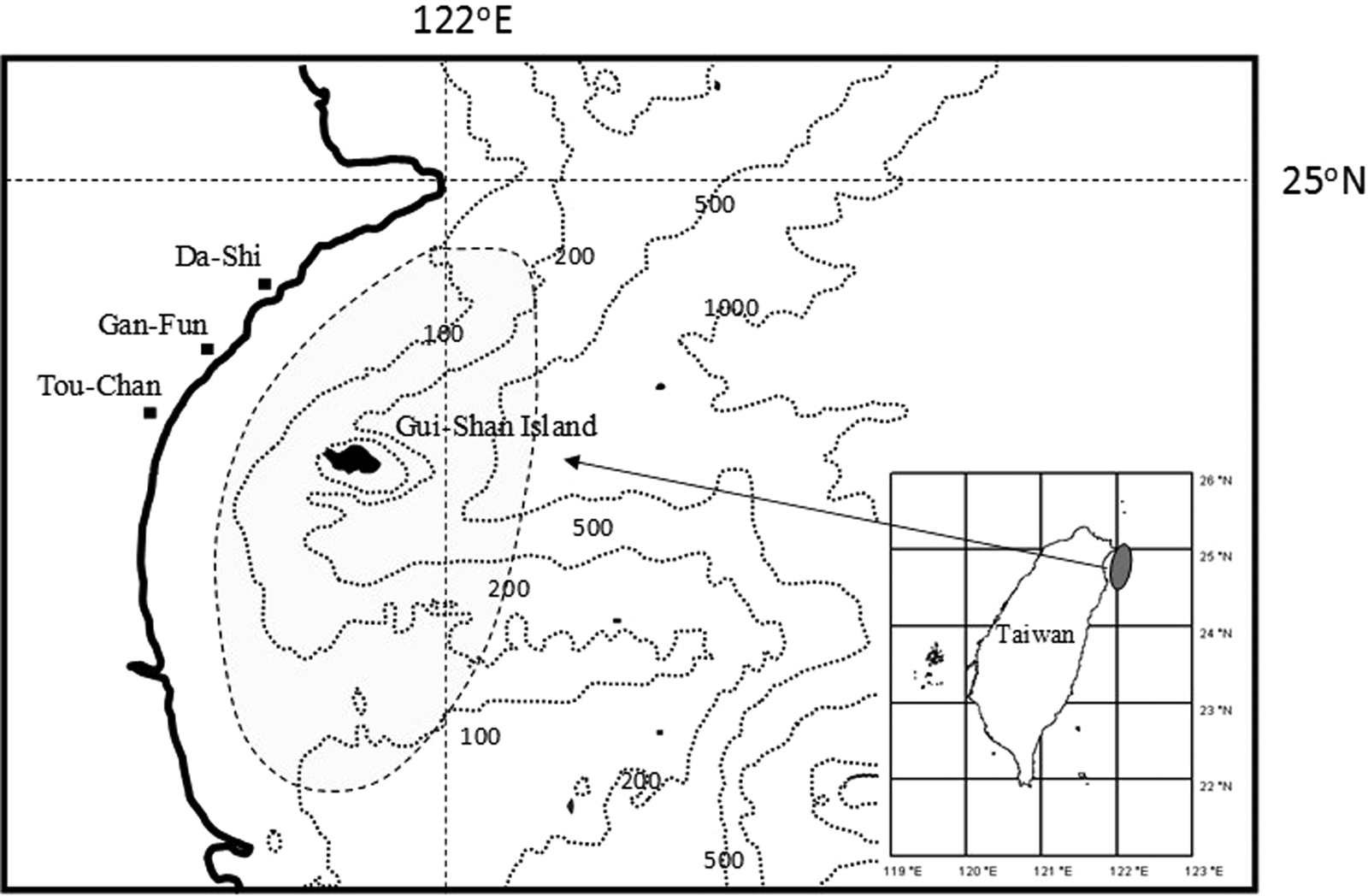
Samples of Japanese butterfish were opportunistically collected from catches of small bottom trawlers operated in waters surrounding Guei-Shan Island off north-eastern Taiwan on a bi-weekly basis from March 2007 to July 2008 (Figure 1). The operating depth of these vessels ranged from 50 to ~300 m, depending on the season and location. The mesh size used by these vessels was ~2.54 cm in the cod end.
Map showing the bathymetric contours of the sampling site (shaded area) of this study. The numbers are isobaths in metres.

All specimens brought to the laboratory were counted, the sex was identified, and measurements of total length (TL to the nearest 0.1 cm) and total weight (W to the nearest 0.01 g) of each individual were conducted. The sagittal otoliths were removed from all specimens, cleaned and stored dry. The relationship between total weight and total length was described using an allometric equation W = a × TLb. The difference in the log-transformed relationships between the sexes was examined using an analysis of covariance (ANCOVA).
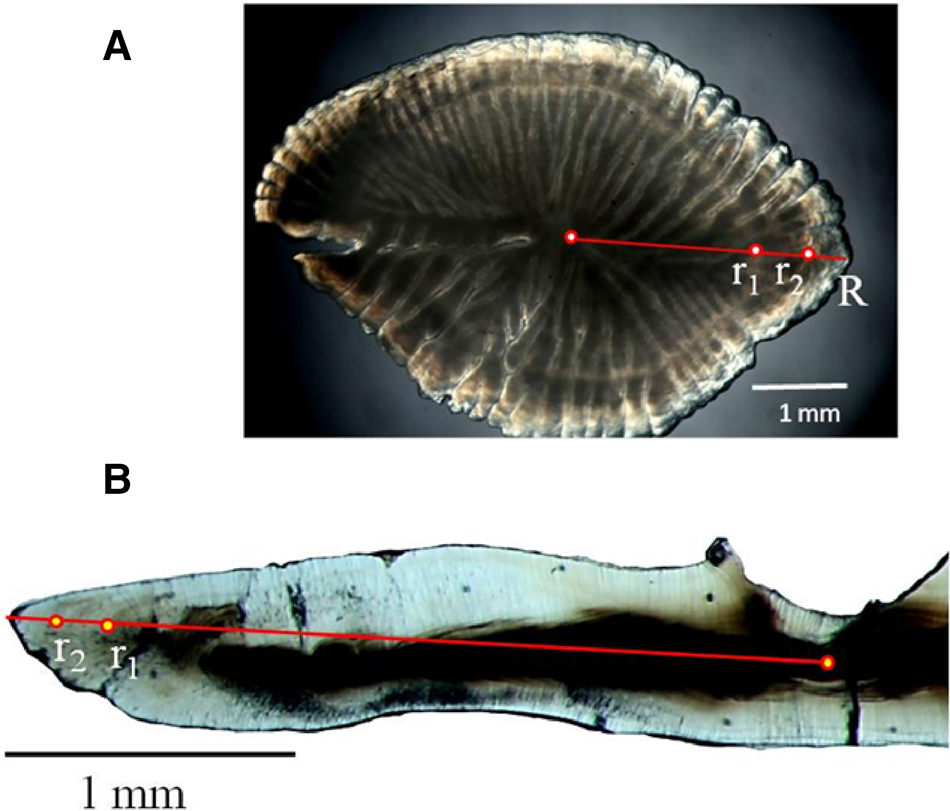
Because thin-sectioned otoliths had faint rings, interpreting rings in thin sections required more judgement decisions than did whole otoliths (Figure 2) especially for older age classes when growth rings packed together, the whole otoliths were thus used. After being immersed in glycerine for 30 min with the distal face upward, annuli images of the otoliths were photographed by a digital camera (Moticam 2300) attached to a binocular microscope (Zeiss SV6, magnification: 20×) under transmitted light against a bright background. The otolith images were processed using image analysis software (Motic images plus 2.0) to produce ring counts and radial measurements. The nucleus and the opaque zones of otolith appeared as dark rings and the translucent or haline zones as light rings. The combination of each opaque and subsequent translucent zone was considered to be an annulus (Figure 2A). Length and sex of the fish were unknown to the analyst who measured the otoliths using Motic images plus 2.0. A second reading was performed a month later by the same investigator. Annuli counts were accepted only if both counts were in agreement. A third count was carried out if the first two counts differed. If the third count did not agree with either of the previous two counts, the otolith sample was discarded.
Photos of the (A) whole and (B) cross-sectioned otolith from two aged 2+P. anomala. Lines showing the measured axis. R and r n represent the otolith radius and the ring radius for the n age class.

The time and periodicity of annulus formation was estimated using the monthly changes in the marginal increment ratio (MIR) of the otoliths (Hass & Recksiek, Reference Hass and Recksiek1995; Chiang et al., Reference Chiang, Sun, Yeh and Su2004; Chen et al., Reference Chen, Chen, Liu and Wang2007). The MIR was calculated as:
 $${\rm MIR}\,= \,\displaystyle{{R \hbox{-} r_{\rm n}} \over {r_{\rm n} \hbox{-} r_{{\rm n}-1}}} $$
where R = otolith radius; r n and r n−1 = the radius of ultimate and penultimate annuli.
The mean and standard error of the MIR were also computed for each month.
The index of the average percentage error (IAPE) (Beamish & Fournier, Reference Beamish and Fournier1981), as shown below, was calculated to compare the reproducibility of age determination between the two readings:
 $${\rm IAPE} = \displaystyle{1 \over N}\sum\limits_{\,j = 1}^N {\left({\displaystyle{1 \over R}\sum\limits_{i = 1}^R {\left({\displaystyle{{\vert {X_{ij}-X_j} \vert } \over {X_j}}} \right)} } \right)} \times 100\percnt $$
where N is the number of fish whose ages were determined, R is the number of readings, X ij is the i th age determination of the j th fish, and X j is the mean age calculated for the j th fish.
The relationship between TL and the otolith radius (R) was estimated using a linear regression: TL = a + bR. An ANCOVA was used to compare the TL-R relationship between sexes.
The von Bertalanffy growth function (VBGF) (von Bertalanffy, Reference von Bertalanffy1938) was fitted to the observed length at age data using non-linear (NLIN) procedure from the statistical package SAS (SAS Inc., 2008). The VBGF is described below:
 $$L_t = L_\infty \lcub 1-\exp \lsqb {-}k\lpar t-t_0\rpar \rsqb \rcub $$
Where L t is the length at age t, L ∞is the asymptotic length, k is the growth coefficient, t is the age (year from birth), and t 0 is the theoretical age at length 0. A maximum likelihood ratio test was used for examining the difference of the VBGF between sexes (Kimura, Reference Kimura1980). Small individuals (i.e. age 0+) were generally rare, and their sex was difficult to determine. They are important however, for the estimation of growth, so small unsexed individuals were randomly assigned a sex based on the sex ratio obtained from the same size class when fitting the model. Finally, the growth performance index (ϕ’ = log k + 2 log L ∞) (Pauly & Munro, Reference Pauly and Munro1984) was also used to compare the growth of P. anomala from different geographic regions.
Results
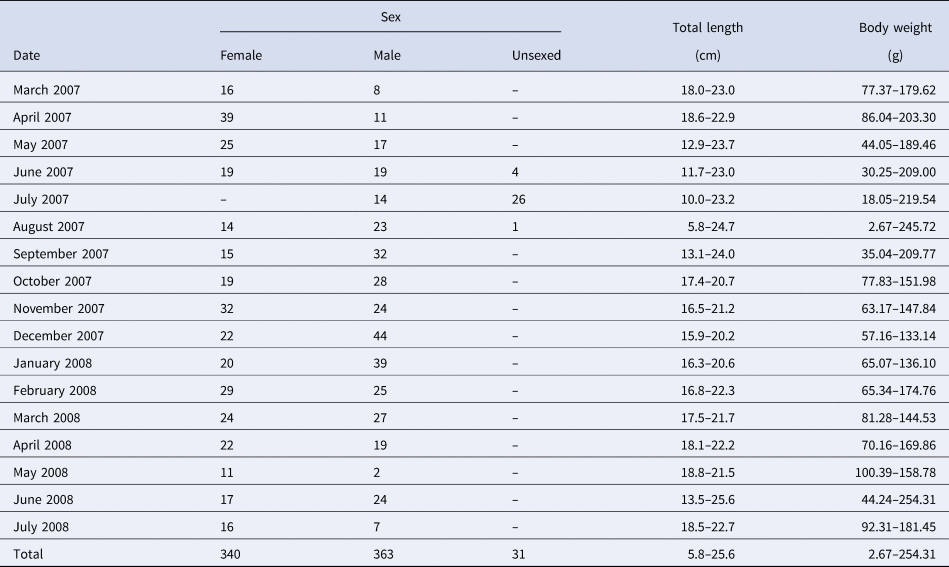
In total, 734 specimens (340 females, 363 males, 31 unsexed) were collected. The total length and weight of the specimens ranged from 5.8 to 25.6 cm and 2.67 to 254.31 g, respectively (Table 1).
Sampling date, sex composition and range of total length (TL, cm) and body weight (BW, g) of P. anomala used in this study

An analysis of covariance of the length-weight data suggested that the relationship between sexes significantly differed (ANCOVA) at the 5% level. Thus, the sex-specific W-TL relationships were described as follows:
Females: W = 0.0248 × TL 2.838 (n = 340, r2 = 0.898)
Males: W = 0.0424 × TL 2.647 (n = 363, r2 = 0.841)
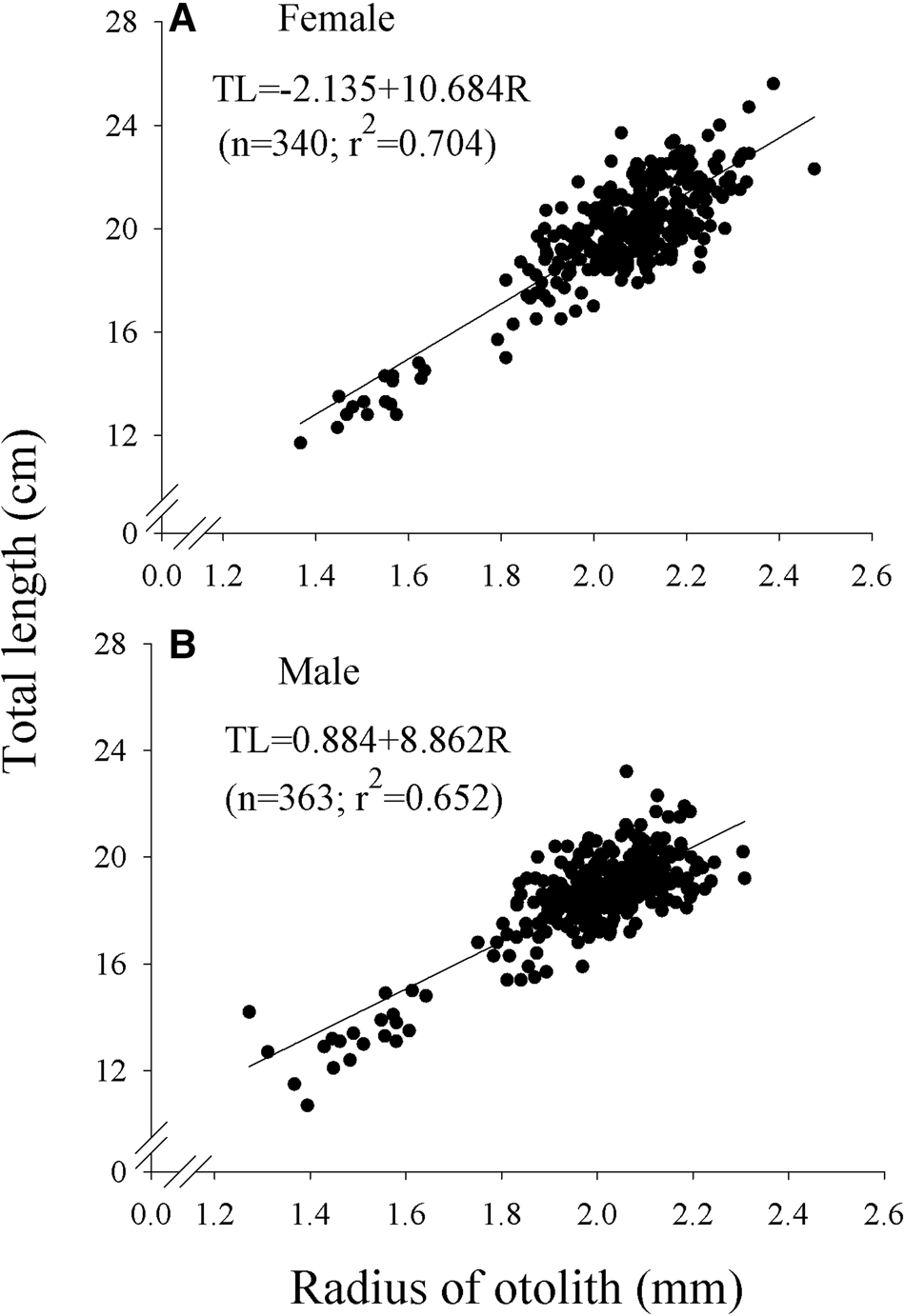
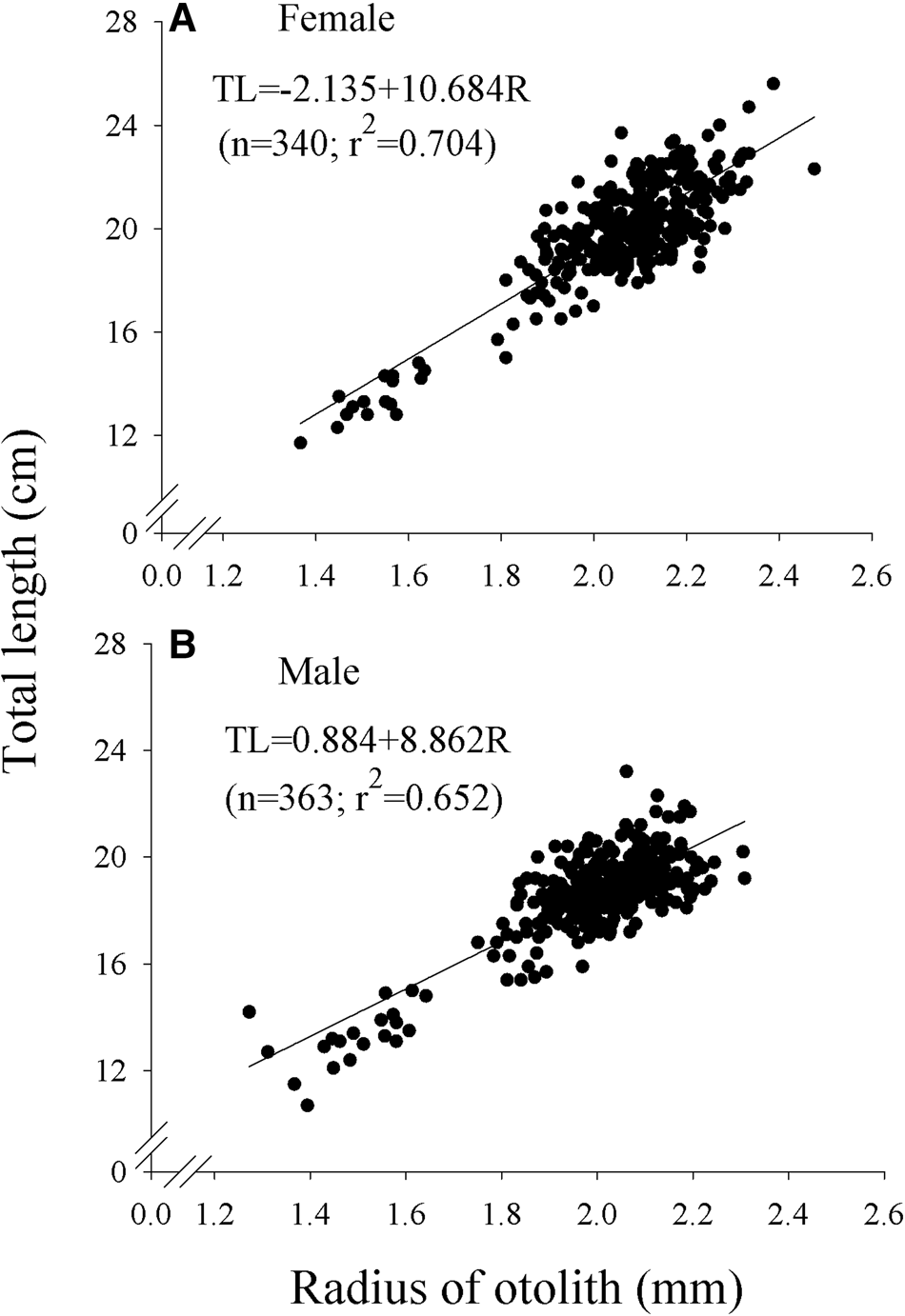
Although relatively high variabilities occurred on the relationships between otolith radius (R) and TL for both sexes especially for small individuals, significant difference between sexes on the TL-R relationship was found (ANCOVA, P < 0.05); the equations were described separately as follows:
Females: TL = – 2.135 + 10.684R (n = 340, r 2 = 0.704) (Figure 3A)
Males: TL = 0.884 + 8.862R (n = 363, r 2 = 0.652) (Figure 3B)
Relationships between the total length (TL) and radius of otolith (R) for (A) female and (B) male P. anomala.
The precision estimation provided an average IAPE of 5.13% for all the samples, indicating that the adopted ageing procedure yielded a reasonable level of consistency (or reproducibility) between readings (Campana, Reference Campana2001).
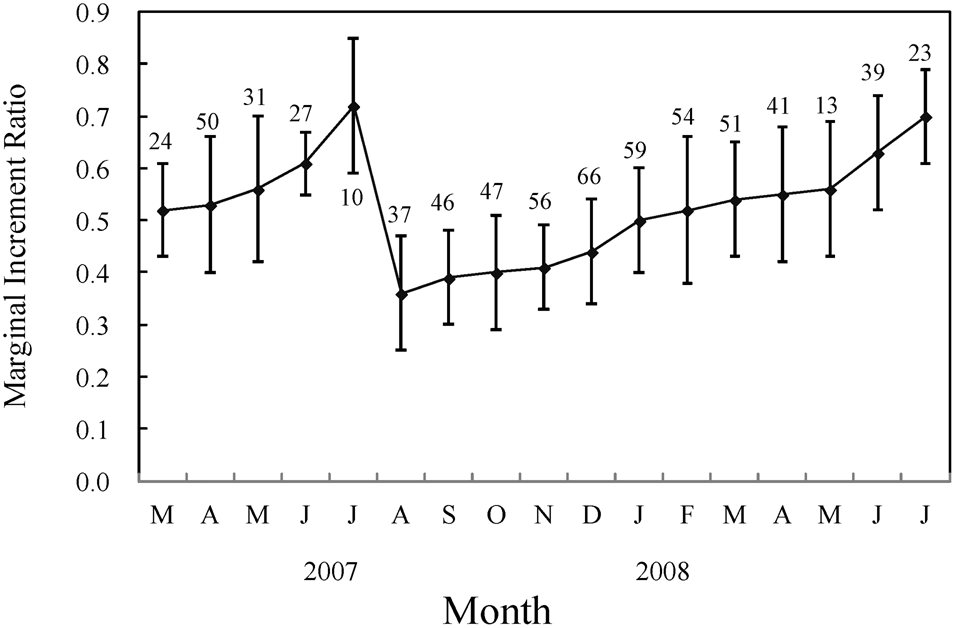
Monthly changes in the otolith marginal increment ratio (MIR) showed that the lowest value occurred in August and gradually increased before reaching a peak in July. The result suggested that annulus was formed once a year and the opaque zone began to form between July and August (Figure 4). Opaque material was first observed in these months, but continued to be deposited in subsequent months.
Monthly changes in the marginal increment ratio (mean ± 1 SD) of the otolith of P. anomala (numbers represent the sample size of each month).

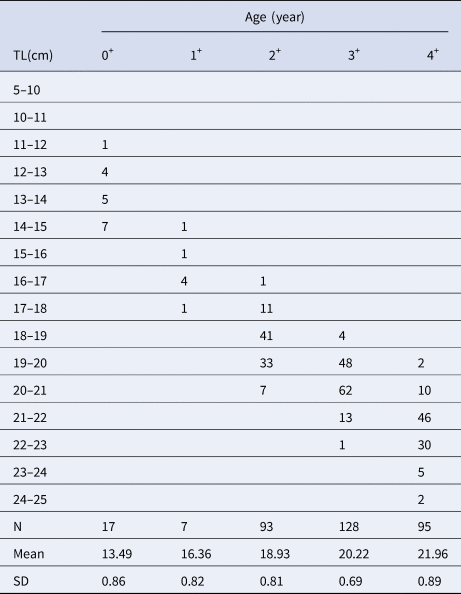
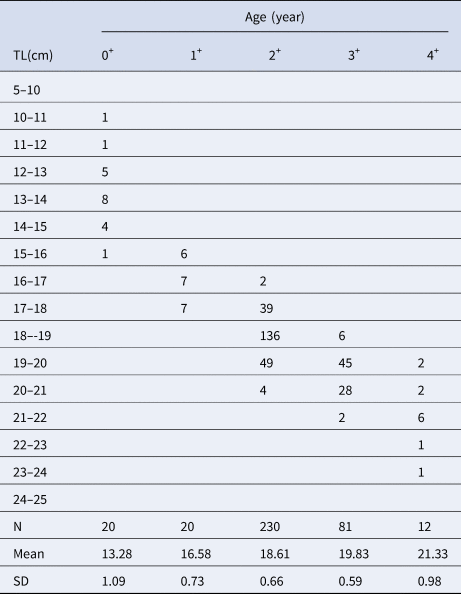
The size distributions and the mean sizes for each ring group of female and male P. anomala are shown in Tables 2 & 3. The estimated maximum ages for both females and males were 4. Large individuals for the oldest age group in both sexes were rare. The dominant age class was 3+ for females, accounting for 37.6% of the total, while together the age classes 2+ (27.4%) and 4+ (27.9%) accounted for another 55.3%. The age classes 0+ and 1+ only comprised ~7.1% of the catch (Table 2). The males however, were highly dominated by age class 2+ fish, accounting for ~63.4% of the total. The age class 3+ accounted for ~22.3%, and the remainder accounted for only 14.3% (Table 3).
Age-length key, sample size (N), mean length (Mean), and standard deviation (SD) in cm for female P. anomala

Age-length key, sample size (N), mean length (Mean), and standard deviation (SD) in cm for male P. anomala

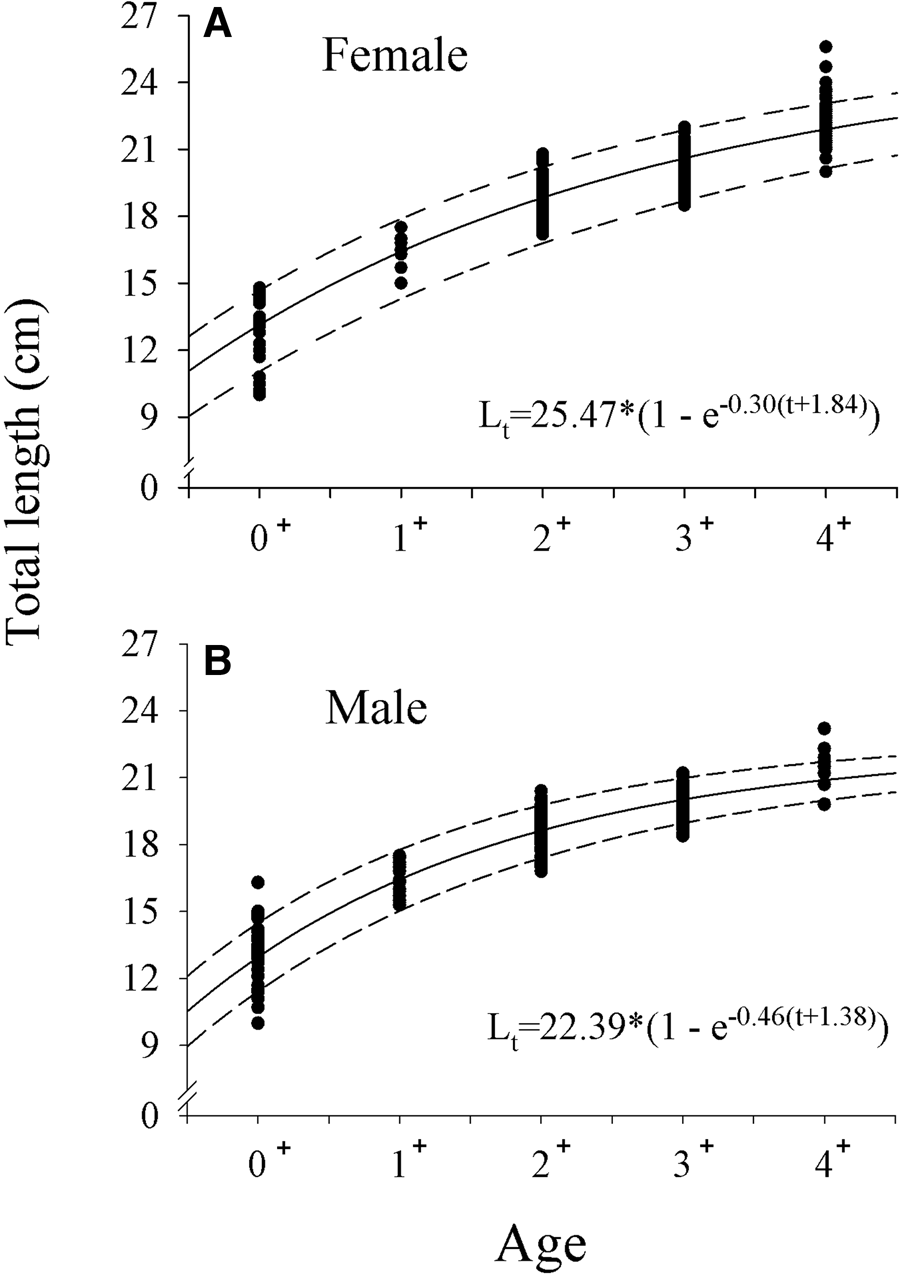
The sex-specific von Bertalanffy growth functions estimated based on the observed TL at age data using the non-linear method were significantly different (maximum likelihood ratio test, P < 0.05). The parameters of VBGF with standard error were estimated as: L ∞ = 25.47 ± 0.65 cm, k = 0.30 ± 0.03 year−1, and t 0 = −1.84 ± 0.16 year for females (n = 350, Figure 5A) and L ∞ = 22.39 ± 0.45 cm, k = 0.46 ± 0.04 year−1, and t 0 = −1.38 ± 0.13 year for males (n = 378, Figure 5B).
The growth curve in length (cm) for (A) female and (B) male P. anomala derived from the non-linear fitting method.

In addition, the growth equations in weight can also be obtained for both sexes. The equations were:
Female: Wt = 242.53(1 – e−0.30(t+1.34))2.838 (n = 350)
Male: Wt = 158.84(1 – e−0.46(t+1.38))2.647 (n = 378)
Based on the above estimation, the corresponding mean ages at first maturity for females and males derived from Wang & Chen (Reference Wang and Chen1995) were estimated to be ~1.0 and 0.71, respectively.
Discussion
Sample size distribution
Although the samples used in this study were opportunistically collected from the fish market each month, most of these individuals were between 17 and 20 cm TL and 18 and 22 cm TL for males and females, respectively. Individuals greater than 23 cm and less than 16 cm TL were rare. The lack of smaller individuals may be a consequence of discarding due to low commercial value, size selectivity of fishing gear or life stage-specific seasonal or vertical migration out of the fishing area.
Juvenile butterfish were found to aggregate and form a small shoal in shallow waters before they became demersal (Sakamoto & Suzuki, Reference Sakamoto and Suzuki1974). Based on the occurrence of the species in Kii Channel, Japan and juveniles collected by set nets, the authors suggested that P. anomala may migrate to shallow waters for spawning, and as a result, are less vulnerable to the bottom trawler. Moreover, Hu et al. (Reference Hu, Yan and Li2006) also reported that the catch of P. anomala in the East China Sea peaked in August and September when the fish were closest to the near shore waters, indicating a possible onshore migration of the species during this time. These observations appear to coincide with a lower summer catch and a lack of juveniles in the surrounding waters off Taiwan (Wang & Chen, Reference Wang and Chen1995; Wu et al., Reference Wu, Su, Liu, Weng and Wu2012). As juvenile P. anomala also could not be found even in the refuse pile of trawlers, which comprised many small-size (<10 cm) and low value fishes, during our sampling period, the gear selectivity thus seemed to be an unlikely reason for this lower catch. Instead, it is likely that adult fish migrate either out of the sampling areas (i.e. to the coast of China) or to the shallow waters where larvae were hatched and stay there during this period.
Annulus formation
As indicated above, thin-sectioned otoliths of butterfish had faint rings, thus, interpreting rings in thin sections required more judgement decisions than did whole otoliths, especially for older age classes because growth bands would be relatively tight together, meaning that an underestimate of true ages for these individuals could not be totally excluded. We tried the thin section method with various thicknesses, but the growth rings remained vague and not as clear as those from the whole otolith. The faint rings not only occurred near the otolith margin, but also were observed for all rings making identification difficult. Besides, the otolith of butterfish is very thin, adding another difficulty when reading compacted rings in thin sections. We also compared results of age readings from ~30 thin sectioned otoliths with those from the whole otoliths. The IAPE estimated from the former was much higher than the latter (i.e. ~11.1% vs 3.7%), and for those samples with consistent readings, two methods yielded the same result in ring counting. Thus, we decided to use the whole otolith for age estimation.
The annulus formation could be related to several possible causes, including a shortage of food, stress caused by migration and/or spawning, or changes in water temperature (Stevens, Reference Stevens1973; Campana, Reference Campana1983; Pratt & Casey, Reference Pratt and Casey1983). Cheree et al. (Reference Cheree, Demaria and Shenker2009) found that the annulus of the Pomacanthus arcuatus in the Florida Keys, USA was formed between May and September when the species spawned. Shimose & Tachihara (Reference Shimose and Tachihara2005) also demonstrated that the annulus formation of Lutjanus fulviflamma was related to spawning rather than to changes in seasonal water temperature. Similarly, the annulus of Choerodon schoenleinii in the south-western waters of Okinawa, Japan was formed after the end of the spawning season (Akihiko et al., Reference Akihiko, Kiyoaki and Toshihiko2010), indicating a possible influence of spawning. The formation of the annulus for P. anomala was between July and August, which coincides with the end of the spawning season (Wang & Chen, Reference Wang and Chen1995; Wang et al., Reference Wang, Chen and Liu2015). The seasonal water temperature during this period remains high and stable (i.e. not in a transitional time of seasons). Thus, it is possible that the annulus formation of P. anomala results from a high physiological stress induced by spawning.
Parameter estimates of growth model
In this study, the population of P. anomala was highly dominated by smaller individuals and younger age classes. The maximum observed size in this study was 25.6 cm for females and 23.2 cm TL for males, however, individuals larger than 23 cm for females (i.e. n = 7) and 22 cm TL for males (i.e. n = 2) were rare, accounting for only 2.1 and 0.6% of the samples, respectively. Although a relatively high variability of age reading for older age classes was observed, as the size ranges of the age 4+ class for females (across 6 size classes in Table 2) was slightly larger than age classes of 2+ and 3+ (i.e. across 5 size classes), a few large individuals in the age 4+ class were less likely to have a significant influence on the growth parameters estimate.
Besides, the NLIN method, which accounts for all individual variability, was believed to be more appropriate for the estimation of growth parameters (Vaughan & Kanciruk, Reference Vaughan and Kanciruk1982; Tetsuro et al., Reference Tetsuro, Kumiko and Michio2008), the high dominance of smaller individuals and younger age classes (i.e. age 2+ or 3+) of P. anomala may actually outweigh these size/age groups when fit to the growth model, and as a result, the asymptotic length is smaller than the largest sizes observed for both sexes.
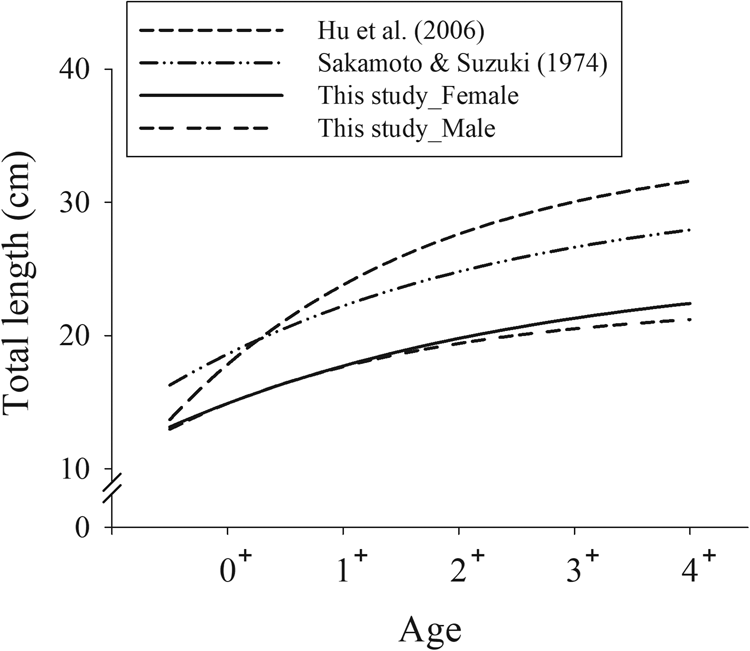
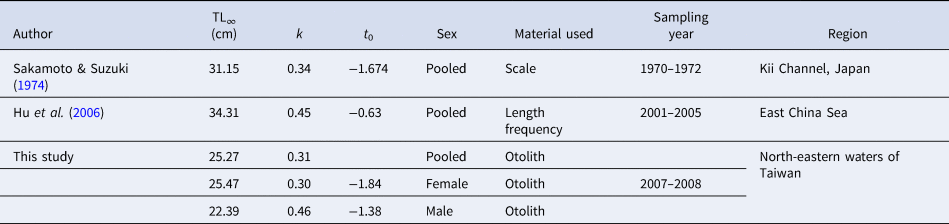
In addition, both the maximum observed sizes (as indicated above) and the estimated asymptotic length of P. anomala in our study (25.47 cm TL for females and 22.39 cm TL for males) were smaller than those reported in other geographic regions (Table 4, Figure 6) (Sakamoto & Suzuki, Reference Sakamoto and Suzuki1974; Hu et al., Reference Hu, Yan and Li2006). The largest individual observed and the asymptotic length estimated by Sakamoto & Suzuki (Reference Sakamoto and Suzuki1974) in the Kii Channel, Japan was 21.60 and 24.32 cm FL, respectively, which is equal to ~27.67 and 31.15 cm TL (based on the conversion equation provided by the authors). Although the maximum size observed was not described, the asymptotic length estimated for the East China Sea was 26.78 FL (~34.31 cm TL) (Hu et al., Reference Hu, Yan and Li2006). Apparently, the difference between the observed maximum sizes in these studies (25.60 cm vs 27.67 cm TL) was not as obvious as those seen for the estimated asymptotic lengths (25.47 vs 31.15 vs 34.31 cm TL) among the studies. The smaller asymptotic length especially for males also resulted in a higher estimated k in this study (0.46/year) compared with those reported by Sakamoto & Suzuki (Reference Sakamoto and Suzuki1974) (0.34/year).
Comparison of growth curves for P. anomala derived from different studies.

Comparison of estimated parameters of the von Bertalanffy growth function from different geographic locations and years

There are many possible explanations for these discrepancies. The differences may be due to the materials used to determine the age (i.e. scale vs length frequency vs otolith), and the influences of sampling years and sites across large geographic locations among studies (Table 4) also could not be excluded. Liu (unpublished data, 2009) reported that the growth of Pagrus major in southern Japan was faster than that reported in north-eastern Taiwan. The growth of Scomber japonicus in KuoSho, Japan was different from that in the East China Sea (Tetsuro et al., Reference Tetsuro, Kumiko and Michio2008). In addition to these possibilities, the differences in the size distribution of the samples used among the studies could also be a cause. As described earlier, the maximum observed size in the Kii Channel was larger than that observed in our study, though the sample size used in both studies was large (i.e. more than 700 individuals) and the samples were collected across all seasons; thus, a small sample size or sampling bias is an unlikely reason for this discrepancy. Alternatively, if large individuals migrate to the shallow waters or to the coast of China for spawning (Hu et al., Reference Hu, Yan and Li2006; Wang et al., Reference Wang, Chen and Liu2015), these fish would be less vulnerable to the bottom trawler and had little chance to be collected. Thus, further studies regarding the identification of stock structure of P. anomala and the migration patterns in the broad regions including the East China Sea and the surrounding waters of Taiwan are required and would provide valuable information for explaining these discrepancies.
Growth performance
The index of growth performance (ǿ) is a useful parameter for comparing the growth of different populations of the same species and/or different species of the same order (Sparre et al., Reference Sparre, Ursin and Venema1987). Differences in growth rate could be due to genetic reasons but could also result from differences in food abundance and water temperature among geographic regions (Jia & Chen, Reference Jia and Chen2011; Laurent et al., Reference Laurent, Patry, Jolivet, Cam, Le Goff, Strand, Charrier, Thébault, Lazure, Gotthard and Clavier2012). Silva et al. (Reference Silva, Carrerab, Masséc, Uriarted, Santose, Oliveiraa, Soaresa, Porteiroe and Stratoudakisa2008) showed that sardine growth performance is lower in the Mediterranean and declines across the north-eastern Atlantic from the English Channel to north Morocco. The decreased growth of Mediterranean sardines is possibly associated with the overall oligotrophy of this sea. The Branchiostegus japonicas found in the East China Sea and waters of Ji-Zhou Sea also showed a higher growth rate than those collected in the waters off north-eastern Taiwan (Liu et al., Reference Liu, Chen and Chen1996). Despite the potential influences of sampling gears used and size of fishes collected in studies discussed earlier, the estimated growth performance indices for P. anomala presented in this study were 2.29~2.36 for females and males. The ǿ value for P. anomala in the Kii Channel, Japan was 2.52 (Sakamoto & Suzuki, Reference Sakamoto and Suzuki1974) and was 2.51 in the East China Sea (Hu et al., Reference Hu, Yan and Li2006) for combined data from both sexes. Difference in growth performance among studies was likely due to the geographic variations (i.e. different latitude).
In conclusion, this study is the first attempt to provide information on the age and growth parameters of P. anomala in the waters off north-eastern Taiwan, which can be used as biological input parameters for future stock assessment of this species. Although a recent evaluation of the change in reproductive traits (including mean size of fish, size at first sexual maturity, energy reserve and fecundity) of P. anomala after decades of exploitation has been described (Wang et al., Reference Wang, Chen and Liu2015), it is not known whether such a change also implies changes in the population structure of the species. Thus, delineation of the stock structure and assessment of the stock status of this species in the surrounding waters of Taiwan is urgently needed. Such information would greatly improve our understanding of the fluctuations and ensure sustainable use of this highly exploited fish species in the region.
Acknowledgements
The authors would like to thank Mr Chao-Gu Chen, Wen-Yi Chen and Don-Shan Chen for helping with sample collection during this study.
Financial support
This research was supported by the Ministry of Science and Technology, Taiwan, under the research grant NSC 101-2621-M-019-003, and in part by the budget of National Taiwan Ocean University.