The preschool period is a developmental process in which children acquire various physical, mental, social and emotional outcomes and become ready for school. When children start preschool, they encounter a new environment and different experiences, and the school adjustment process begins. This process includes adoption of status change, participation in learning activities, and new social and emotional experiences (Fabian, Reference Fabian2000). For a child, adapting to a new and unfamiliar situation requires developing appropriate responses to this situation. School adjustment is defined as the child’s adjustment to the school environment (Spencer, Reference Spencer1999), and emphasises the development of competencies and skills in these areas in order to respond to cognitive, social, emotional and behavioural demands (Ladd, Reference Ladd, Sameroff and Haith1996). In other words, academic, social, emotional and behavioural competence is a sign of successfully adapting to school (Perry & Weinstein, Reference Perry and Weinstein1998). In recent years, children’s school adjustment has been considered in the social and behavioural dimension (Li & Lau, Reference Li and Lau2019; Shields et al., Reference Shields, Dickstein, Seifer, Giusti, Dodge Magee and Spritz2001; Sklad et al., Reference Sklad, Diekstra, Ritter, Ben and Gravesteijn2012; Wolfe et al., Reference Wolfe, Vannatta, Nelin and Yeates2015), which includes relationships with teachers and friends as well as academic success (Corcoran et al., Reference Corcoran, Cheung, Kim and Xie2018). According to Birch and Ladd (Reference Birch and Ladd1996), school adjustment is a dynamic process that includes the child’s cognitive skills, personality traits and relationships with other individuals. Berndt (Reference Berndt1999) evaluated school adjustment as the child’s motivation to be successful in school, participation in classroom activities, compliance with classroom rules, and performance in academic tasks. Similarly, Perry and Weinstein (Reference Perry and Weinstein1998) considered school adjustment as competencies in academic, social and behavioural fields. Ladd (Reference Ladd, Schneider, Attili, Nadel and Weissberg1989, Reference Ladd, Sameroff and Haith1996, Reference Ladd and Kail2003) evaluated school adjustment in four basic categories: perceptions and assessments of the school environment, emotions or emotional reactions in the classroom, participation in classroom and school activities, and school performance. Researches have also focused on improving children’s physical, cognitive, social and emotional skills during the school adjustment (Chen, Reference Chen2018; Domitrovich et al., Reference Domitrovich, Durlak, Staley and Weissberg2017; Sette et al., Reference Sette, Hipson, Zava, Baumgartner and Coplan2018). In this context, adjustment to school can be considered as a concept that requires tackling different tasks in cognitive, social, emotional, and behavioural dimensions.
School adjustment aims for the child to benefit socially, emotionally and academically in their environment. From an academic point of view, the first place where children meet the school adjustment process is in preschool education. Academic development consists of cognitive acquisition and motivation. Their indicators are cognitive achievement and academic efficacy (Perry & Weinstein, Reference Perry and Weinstein1998). Preschool children’s academic development is affected by school-related factors (Silva & Cain, Reference Silva and Cain2015). Preschool programs, factors related to teachers and school structure help to bring about positive results for children academically (Huang, Reference Huang2017; Montrosse-Moorhead et al., Reference Montrosse-Moorhead, Dougherty, La Salle, Weiner and Dostal2019; Weiland & Yoshikawa, Reference Weiland and Yoshikawa2013). Social cohesion refers to establishing positive relationships with peers and adults, and developing behaviours appropriate to one’s environment (Allsopp et al., Reference Allsopp, Santos and Linn2000; Ladd & Price, Reference Ladd and Price1987). It is seen that children who adapt to school have better social interactions, frequently use social skills and are accepted by their peers (Betts et al., Reference Betts, Rotenberg, Trueman and Stiller2012; Ladd et al., Reference Ladd, Ettekal and Kochenderfer-Ladd2017). The capacity to recognise, predict and reflect different emotional experiences is the basis of emotional adjustment (Saarni, Reference Saarni, Lewis and Saami1985). Emotions are closely related to harmony and academic performance exhibited at school (Sallquist et al., Reference Sallquist, Eisenberg, Spinrad, Reiser, Hofer, Zhou, Liew and Eggum2009; Valiente et al., Reference Valiente, Eisenberg, Spinrad, Haugen, Thompson and Kupfer2013). Children learn to regulate their emotions and control their behaviours with the decrease of dependence on adult intervention in the preschool period and the increasing interest in other children (Campbell, Reference Campbell, McCartney and Phillips2006). Self-regulation, such as obedience to rules, impulse control, focusing attention and delaying requests, and behavioural functions, including attention and emotions, are indicators of behavioural adjustment (Perry & Weinstein, Reference Perry and Weinstein1998). School adjustment provides children with strong foundations to overcome developmental difficulties (Graham et al., Reference Graham, Pears, Kim, Bruce and Fisher2018; Lakhani et al., Reference Lakhani, Jain and Chandel2017; Stipek, Reference Stipek, Luthar, Burack, Cicchetti and Weisz1997). Studies have shown the importance of the cognitive, social, emotional and behavioural skills that children develop in preschool for future academic success and a healthy life (Collie et al., Reference Collie, Martin, Nassar and Roberts2019; Duncan et al., Reference Duncan, Dowsett, Claessens, Magnuson, Huston, Klebanov, Pagani, Feinstein, Engel, Brooks-Gunn, Sexton, Duckworth and Japel2007; Jones et al., Reference Jones, Greenberg and Crowley2015). The adjustment of the child to school in the preschool period means they may experience fewer problems in their future education.
Changes in social and family life in recent years have made it compulsory to provide comprehensive support to children from an early age. Poverty, cultural differences and parental characteristics have led to the formation of a heterogeneous structure in preschool classrooms (Durlak et al., Reference Durlak, Weissberg, Dymnicki, Taylor and Schellinger2011; Pianta & Cox, Reference Pianta, Cox, Pianta and Cox1999). Studies on children’s development and education focus on children’s school adjustment in order to reduce the impact of these factors. According to the conceptual framework that connects children’s school adjustment to school and classroom characteristics, academic and social climate, resources and policies, and student characteristics form the school context. Teacher characteristics, teaching practices and classroom social relationships make up the classroom context (Perry & Weinstein, Reference Perry and Weinstein1998). Factors such as the structure of the school, the relationship of the child with the teacher and peers within the school, and the support offered to the child have an important effect on school adjustment (Brackett et al., Reference Brackett, Reyes, Rivers, Elbertson and Salovey2011; Chi et al., Reference Chi, Kim and Kim2018; Pakarinen et al., Reference Pakarinen, Kiuru, Lerkkanen, Poikkeus, Siekkinen and Nurmi2010; Poulou & Bassett, Reference Poulou and Bassett2018; Weiland & Yoshikawa, Reference Weiland and Yoshikawa2013). Developmental support for children from different backgrounds helps with school adjustment. Children who adapt to the school environment have the chance to take advantage of the learning opportunities offered to them.
Children starting preschool are faced with an environment full of new people, rules and routines, and changes. Demands such as independence from adults, getting along with other children, commitment to routines, being active for longer, and new responsibilities are among the changes that children face. Especially in the period when children have just started preschool education, they need professional support that will increase their participation in the school and classroom environment, and facilitate their adjustment to changes. Developmental counselling services offered by the school counsellor aim to help children to recognise themselves, realise their potential, and improve their abilities to adjust to school (Cook-Greuter & Soulen, Reference Cook-Greuter and Soulen2007; Hall et al., Reference Hall, Hall and Hornby2003). The school counsellor is an educational leader who contributes to the academic success of the child and supports the development of the child in every field (Gysbers & Henderson, Reference Gysbers and Henderson2014). The American School Counselor Association (ASCA, 2012) defined the tasks of school counsellors as conducting consultancy programs on a planned basis to provide students with the best possible counselling services, and collaborating with education stakeholders, including school principals, teachers and families, to meet the holistic needs of Pre-K–12 students. In Turkey, the school counsellor is responsible for implementing the preschool education guidance program to make activities parallel with outcomes and other teachers, working in cooperation with the school management and parents (Ministry of National Education [MoNE], 2012). The guidance and psychological counselling services offered to children within the program by counsellors working in preschool education is carried out in order to socialise the child, develop their self-confidence, and enable them to discover their limits, adapt to the school, and develop a positive attitude towards school and learning (MoNE, 2020). For this purpose, various activities are carried out in the context of the school and classroom to help children adapt to the school. In the literature, programs to support school adjustment (Domitrovich et al., Reference Domitrovich, Durlak, Staley and Weissberg2017; O’Farrelly et al., Reference O’Farrelly, Booth, Tatlow-Golden and Barker2020) and studies on factors affecting school adjustment (Bosman et al., Reference Bosman, Roorda, van der Veen and Koomen2018; Hosokawa & Katsura, Reference Hosokawa and Katsura2017; Ladd et al., Reference Ladd, Kochenderfer and Coleman1996; Ostrov et al., Reference Ostrov, Kamper-DeMarco, Blakely-McClure, Perry and Mutignani2019) are included. In this study, the practices of school counsellors working in preschool education for children’s school adjustment were examined. School compliance, academic (school engagement and academic skills), social-emotional (social competence, quality of relationship with teachers and friends; Arbeau et al., Reference Arbeau, Coplan and Weeks2010; Buhs & Ladd, Reference Buhs and Ladd2001; Hoglund et al., Reference Hoglund, Klingle and Hosan2015; Sasser et al., Reference Sasser, Bierman and Heinrichs2015) and behavioural (Gest et al., Reference Gest, Madill, Zadzora, Miller and Rodkin2014) studies are included in the literature. Considering the assessments related to the factors that make up school adjustment, in this study, children’s adjustment to school is examined in the academic (school performance), social (perceptions and assessments of the school environment), emotional (emotions or emotional reactions in the classroom), and behavioural (participation in classroom and school activities) dimensions (Birch & Ladd, Reference Birch and Ladd1996; Ladd, Reference Ladd, Schneider, Attili, Nadel and Weissberg1989, Reference Ladd, Sameroff and Haith1996, Reference Ladd and Kail2003).
This research aims to examine the practices of school counsellors working in preschool education institutions towards children’s school adjustment in academic, social, emotional, and behavioural dimensions. In this context, answers to the following questions were sought:
-
(1) What are the school counsellors’ practices for children’s academic adjustment to school?
-
(2) What are the school counsellors’ practices for children’s social adjustment to school?
-
(3) What are the school counsellors’ practices for children’s emotional adjustment to school?
-
(4) What are the school counsellors’ practices for children’s behavioural adjustment to school?
Method
Study Group
The study group of the research consisted of 30 school counsellors working in centres located in three provinces in preschools in Turkey. The participants were determined by criterion sampling method, which is a purposeful sampling method that is used in the selection of the study group, and which enables rich information to be obtained in line with the purpose of the research (Merriam, Reference Merriam2015). In the criterion sampling method, the participants of the research consist of people who meet certain criteria (Patton, Reference Patton2002). The participation criteria of the study were determined as working in public schools, working with children in the 4- to 6-year-old age group, and having graduate and postgraduate education status. Participants consisted of school counsellors who worked full time in 30 different public kindergartens and met the criteria suitable for the purpose of the study. Kindergartens where the participants work are public schools that serve full-time and half-time in the same geographical region. The variables related to the participants in the study are age, gender, professional seniority and education status. Table 1 contains demographic information about the study group.
Demographic information regarding the study group

When the demographic information about the study group was examined, 16 participants in the study (54%) were 21–30, 10 were 31–40 (33%), 3 were 41–50 (10%) and 1 was 51–60 years old (3%). The study group included 25 (83%) female and 5 (17%) male participants. Nineteen participants (64%) had 1–10 years of professional experience, 10 (33%) had 11–20 years and 1 participant (3%) had 31–40 years. It was determined that 23 participants (77%) were at the graduate level and 7 (23%) were at the postgraduate level.
Research Model
This study aimed to examine the practices of school counsellors working in preschool education towards children’s school adjustment in academic, social, emotional, and behavioural dimensions. The research is a qualitative study that examines participants’ experiences and how they make sense of these experiences from their perspectives (Corbin & Straus, Reference Corbin and Straus2008). Using qualitative research, the practices of school counsellors for children’s school adjustment were examined from their point of view in terms of academic, social, emotional, and behavioural dimensions.
Data Collection Tool and Data Collection
In this study, the interview technique was used as the data collection method and the interviews were carried out using a distance communication tool. The interview method aims to examine events taking place in individuals’ lives from their perspective (Patton, Reference Patton2002). The counsellors were asked four open-ended questions using a semistructured interview form. The semistructured interview form is a flexible and powerful tool for exploring individuals’ experiences (Rabionet, Reference Rabionet2011). The form used in this study consisted of two parts. In the first part there were questions about age, gender, professional experience and education level of the participants, and in the second part there were questions about the academic, social, emotional, and behavioural dimensions of school adjustment. The opinions of three domain experts were obtained regarding the prepared form, a pilot interview was held with two participants, and the interview form was finalised. Before the interviews, participants were informed about the purpose of the research. Each participant was interviewed individually and the data obtained were recorded.
Data Analysis
The data of the research were analyzed using the content analysis method, which aims to access the concepts and relational structures in the dataset. Content analysis includes the stages of organising, analysing and finally presenting the data (Creswell, Reference Creswell2016). In the first stage of the analysis, the data are prepared and arranged for analysis. At this stage, the interviews are transcribed and deciphered, and a data file is prepared. In the process of analysing the data in this study, general understanding was obtained by the first reading. Themes that were emphasised and repeated statements about the themes for participant practices were determined. Then the data were coded and a code list was created. Codes were collected under existing themes for the subpurposes of the research. The themes and codes that emerged at the last stage were reported and presented in tables. The tables contain sample answers for each theme and demonstrate which code they belong to. In addition, the total number of participants (n) for each code is presented. The opinions of the participants regarding the research findings are given with direct quotations. Codes for the participants (e.g., P.1, P.2) were used in direct quotations.
Validity and Reliability
Credibility, transferability, verifiability and consistency criteria, as determined by Lincoln and Guba (Reference Lincoln and Guba1986), were used to ensure validity and reliability in the study. The data obtained in the study were shared with direct quotations in order to ensure the credibility that expresses the extent to which the findings are compatible with reality. In order to provide transferability, which explains the extent to which the findings can be adapted to other contexts, subjective judgments were avoided and the research process was described in detail. At the end of the interviews, the answers given by the participants were shared with them, and they were asked whether they would like to add to or remove any part in order to ensure verifiability, which indicates that the research findings reveal the experiences and thoughts of the participants. In order to ensure consistency, which means achieving the same findings with the same participants in the same context, the data were analysed separately by two researchers in different time periods. The researchers came together and decided on the codes used in the study. For the consistency of the study, the formula [Agreement/(Disagreement + Agreement) X 100] developed by Miles and Huberman (Reference Miles and Huberman1994) was used. Accordingly, it was determined that the expert opinions were 91% in agreement with each other.
Results
This section includes findings for the academic, social, emotional, and behavioural adjustment themes.
Academic Adjustment
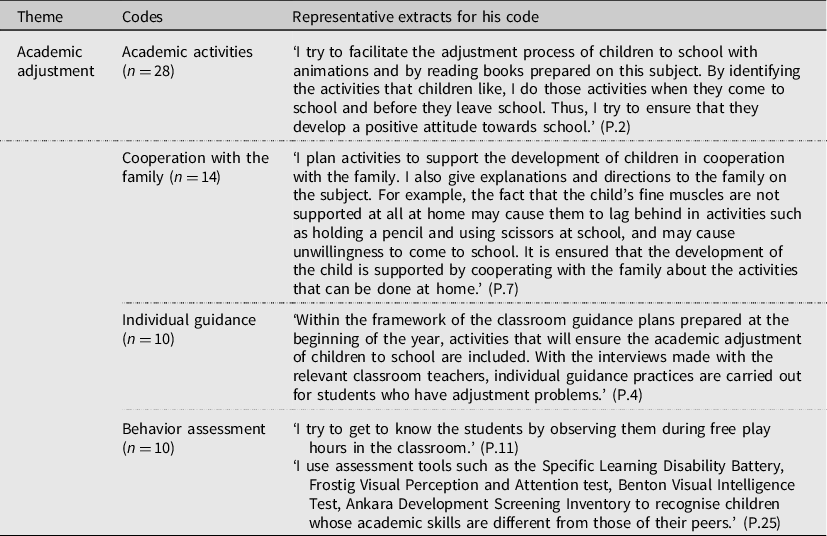
The practices of school counsellors working in preschool education institutions for the academic adjustment of children are presented in Table 2, together with the opinions of the participants.
Academic adjustment and representative extracts

As shown in Table 2, it was revealed that the participants mostly did academic activities (n = 28) for academic adjustment. This result explains that the counsellors tried to support the adjustment of children to school through different activities. It was found that the participants collaborated with the family (n = 14) regarding academic adjustment. Family support was deemed necessary by the counsellors during the school adjustment process. It was revealed that individual guidance practices (n = 10) were conducted to ensure academic harmony. Participants stated that they carried out individual guidance activities especially for children with adjustment problems. It was found that the participants conducted behavioural assessment practices (n = 10) towards academic compliance. This result shows that they assessed the development of children in the cognitive field and planned practices to support them in this field.
Social Adjustment
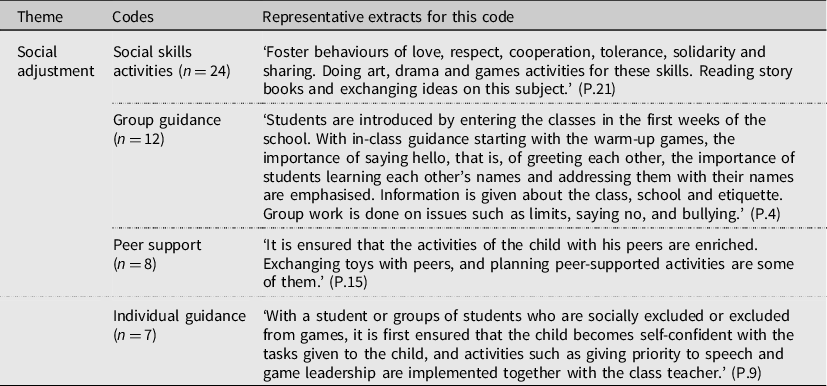
The practices of school counsellors working in preschool education institutions for the social adjustment of children are presented in Table 3, together with the opinions of the participants.
Social adjustment and representative extracts

According to Table 3, it was revealed that the participants mostly performed social skills activities (n = 24) for social adjustment. This result expresses that respect, cooperation and sharing activities to support social development were aimed to be gained by children. Participants stated that they were working on social cohesion with group guidance (n =12). It was found that they tried to facilitate children’s social adjustment process with peer support (n = 8). The supportive role of peer relationships in social development may have enabled this context to be taken into account in the school adjustment process. In the study, it was revealed that the participants did individual guidance practices (n = 7) for social cohesion. This result explains that the participants worked individually to support children socially.
Emotional Adjustment
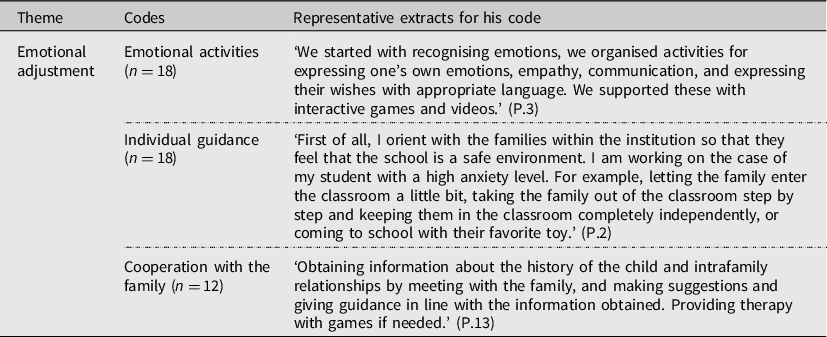
The work of school counsellors working in preschool education for the emotional adjustment of children is presented in Table 4, together with the opinions of the participants.
Emotional adjustment and representative extracts

According to Table 4, the participants performed activities for emotional adjustment. For emotional activities (n = 18), it was found that practices were carried out to recognise and express one’s emotions. For emotional adjustment, individual guidance (n = 18) was also provided. Participants stated that they tried to support children’s school adjustment through individual counselling activities related to emotions, such as anxiety and fear. It was found that the participants cooperated with the family in order to ensure the emotional adjustment of children (n = 12). Thus, obtaining support from families was deemed necessary by the participants in order to facilitate school adjustment.
Behavioural Adjustment
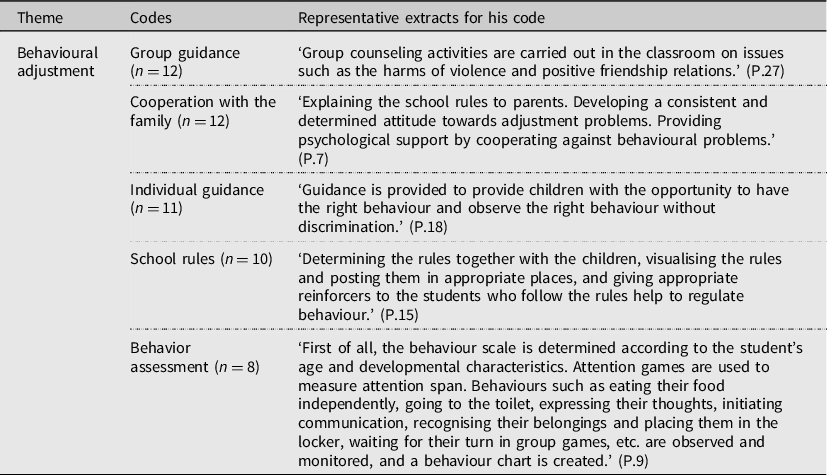
The practices of school counsellors working in preschool education institutions for the behavioural adjustment of children are presented in Table 5, together with the opinions of the participants.
Behavioral adjustment and representative extracts

According to Table 5, it was revealed that group guidance practices (n = 12) were conducted for behavioural adjustment, which aimed to develop positive behaviours. It was found that cooperation with the family (n = 12) ensured behavioural adjustment. This result indicates that the participants received support from children’s families in the process of adapting to the school and that participants also informed families about this issue. Thus, the participants tried to support the behavioural adjustment of the children through individual guidance practices (n = 11). Determining the school rules (n = 10) together with the children and applying these rules were other practices of the participants to ensure behavioural adjustment. It was found that the participants made assessments regarding the development of children using behavioural assessment techniques (n = 8). It was stated that assessments were deemed necessary in the planning and implementation of activities to support the behaviours that children are expected to acquire in the school adjustment process.
Discussion
The preschool period is a process in which development and learning is rapid and the foundations of academic and social success are laid. In this period, the systematic support of professionals for the efforts of children to adapt to the school helps them to come through this process successfully. This study examined the practices of school counsellors working in preschool education institutions for school adjustment in terms of academic, social, emotional, and behavioural dimensions. This research was limited to the findings obtained from school counsellors working with 4- to 6-year-old age group attending full-day public schools in Turkey and who have graduate and postgraduate education status.
When the results of the study were examined, it was revealed that the counsellors carried out academic activities, cooperation with the family, individual guidance, and behaviour assessment practices for the academic adjustment of children. It was found that academic activities are the most preferred practices by school counsellors in the school adjustment process. It can be said that counsellors aim to direct children’s attention to activities through reading books, animations, drama and games, and to increase their motivation through activities that they liked. These activities during the preschool adjustment period are valuable for the participation of children and they can positively support children’s readiness to learn. The academic field of school adjustment, which is evaluated as the child’s interest in the school environment, participation, success in school, and acquiring skills and motivation forms the basis of future school success of children (Ladd, Reference Ladd, Sameroff and Haith1996; Perry & Weinstein Reference Perry and Weinstein1998). Studies have revealed the relationship between academic skills and school adjustment (Blodgett & Lanigan, Reference Blodgett and Lanigan2018; Chi et al., Reference Chi, Kim and Kim2018; McWayne et al., Reference McWayne, Fantuzzo and McDermott2004). The school counsellors who collaborate with families and support the child can facilitate the school adjustment process. It has been found that school counsellors working in preschools think that the family’s childrearing style has an effect on school adjustment. A consistent and supportive family environment can support the child’s basic skills. In this direction, it is thought that school-family cooperation is necessary for the child to develop a positive attitude towards school and for the parents to create appropriate learning conditions. Studies reveal that there is a relationship between parents’ positive and supportive attitudes and school adjustment (Correia & Marques-Pinto, Reference Correia and Marques-Pinto2016; Kang et al., Reference Kang, Horn and Palmer2017; Pettit et al., Reference Pettit, Bates and Dodge1997). The results in this study indicate that the expectations for informing and cooperating with parents, which are among the job descriptions of school counsellors, were met by the school counsellors, and it was determined that the school counsellors carried out individual guidance practices to support academic adjustment. In the preschool period, what the child will learn, how much they will learn and how fast they can learn are directly proportional to the support offered to the child by their environment. Counselling services offered during this period aim to ensure that children adapt to school and the environment and develop a positive attitude towards learning (MoNE, 2020), and the school counsellors try to support the academic competence of the children with their individual guidance practices. At the same time, it is seen that school counsellors aim to help children who have adaptation problems to facilitate the school adjustment period. It was revealed that the counsellors conducted behavioural assessment practices for the academic adjustment of children. Assessment is an important tool in understanding and supporting children’s development (McAfee et al., Reference McAfee, Leong and Bodrova2016, and is needed to guide the child in the learning process. With a multifaceted assessment that puts the child in the centre, it can be ensured that the different abilities of children are revealed and that their achievements regarding their academic competence are supported.
It was found that the counsellors working in preschool education carried out social skills activities, group guidance, peer support and individual guidance activities for the social adjustment of children. These activities were frequently used by counsellors; thus, it can be seen that school counsellors try to support positive behaviours with activities for social development. In preschool education, children learn to express themselves, accept the existence of others, respect others’ rights, and to cooperate in a stimulating environment. In this context, social skills activities support children’s social adjustment. Similar studies reveal that school transition practices positively support children’s prosocial behaviour (Berger et al., Reference Berger, Benatov, Cuadros, VanNattan and Gelkopf2018; Cook & Coley, Reference Cook and Coley2017; Nicolopoulou et al., Reference Nicolopoulou, Cortina, Ilgaz, Cates and de Sá2015). It was found in this study that the school counsellors carried out group guidance activities for social cohesion with the aim of developing skills of communication, empathy, sharing, getting to know one’s peers, and playing games together. Group counselling activities carried out in the classroom or with a group determined according to needs will contribute to socialisation. Social-emotional competences are related to peer relationships, academic achievement and school adjustment (Franco et al., Reference Franco, Beja, Candeias and Santos2017; Nakamichi et al., Reference Nakamichi, Nakamichi and Nakazawa2019). The school counsellors in this study tried to ensure the social adjustment of children to the school with the support of their peers. The fact that peer relationships, which are seen as one of the most important components of school adjustment, were addressed by counsellors in the adjustment process can be considered as an expected result. The school counsellors aim to facilitate the adjustment process with positive peer relations and to ensure social acceptability. Studies on school adjustment reveal that children’s positive relationships with their peers affect their social adjustment and academic achievement (Betts et al., Reference Betts, Rotenberg and Trueman2009; Guo et al., Reference Guo, Zhou and Feng2018; Klima & Repetti, Reference Klima and Repetti2008; Ladd et al., Reference Ladd, Kochenderfer and Coleman1996; Ladd et al., Reference Ladd, Kochenderfer and Coleman1997). In the study, it was found that school counsellors carried out individual guidance practices for social adjustment to support children who are faced with negative social situations. Thus, it can be said that children try to create effective strategies to cope with new situations. Individual counselling activities can be expected to provide detailed information to school counsellors about getting to know children and how to guide them. It is thought that these practices aim to help the child socialise as a member of the school and class and develop positive relationships within the school. The positive behavioural support provided by school counsellors has positive effects on children’s behaviour (Benedict et al., Reference Benedict, Horner and Squires2007; Kok & Low, Reference Kok and Low2017), which supports the results obtained in the study.
It was found that counsellors conducted emotional activities, provided individual guidance, and cooperated with the family in order to support the emotional adjustment of children. School counsellors can help children to regulate emotions with supportive activities related to the positive and negative emotions they experience during the adjustment process. Emotional activities are thought to make children feeling better and thus support school adjustment. Similar studies have shown that children who can identify the emotional outlook of another person and the situations that trigger different emotional responses are better adapted to kindergarten (Graziano et al., Reference Graziano, Reavis, Keane and Calkins2007; Shields et al., Reference Shields, Dickstein, Seifer, Giusti, Dodge Magee and Spritz2001), and that a play-integrated school readiness program increased children’s happiness levels by decreasing their anxiety and psychological difficulty levels (Li et al., Reference Li, Mak, Chan, Chu, Lee and Lam2013). It was found in our study that the counsellors conducted individual guidance practices for emotional adjustment to support children who have adjustment problems in the first days of school, and that the school counsellors try to make the children feel safe and comfortable at school. Individual counselling activities that are carried out in parallel with the developmental characteristics of children are thought to improve children’s emotion regulation skills. Studies explain that emotion regulation skills positively support school adjustment (Betts et al., Reference Betts, Rotenberg and Trueman2009; Hernández et al., Reference Hernández, Eisenberg, Valiente, VanSchyndel, Spinrad, Silva, Berger, Diaz, Terrell, Thompson and Southworth2016; Sirotkin et al., Reference Sirotkin, Denham, Bassett and Zinsser2013). It was found that counsellors cooperated with the family so that the children could adapt emotionally to school. The school counsellors working in preschool education believe that the family should be informed about children being ready for adjustment to school. Children who grow up in a supportive family environment can be expected to adapt more easily to intimacy and separation. It was observed that the counsellors attached importance to cooperating with the families of children who had attachment problems and adjustment problems. Positive parent-child relationships and emotional support of the child by families facilitates school adjustment. Studies show that the emotional state in the family is related to adjustment to school (Garrett-Peters et al., Reference Garrett-Peters, Castro and Halberstadt2017; Scharf & Goldner, Reference Scharf and Goldner2018). These studies reveal the necessity of cooperating with the family in the school adjustment process.
It was found that the school counsellors carried out group guidance, cooperation with the family, individual guidance, school rules and behaviour assessment practices for the behavioural adjustment of children. The school counsellors focus on positive behaviours and aim to develop these behaviours with group guidance and individual guidance activities. At the same time, they aim to facilitate adaptation to school by reducing negative behaviours. Counselling services help children with interpersonal relationships and problem-solving practices. In individual or group counselling practices conducted for this purpose, an approach that focuses on behaviour is followed (Dougherty, Reference Dougherty2013; Gysbers & Henderson, Reference Gysbers and Henderson2014). School counsellors were found to cooperate with the family for behavioural adjustment. Family support can contribute to ensuring continuity in behavioural adjustment. It is thought that it is necessary to cooperate with the family in order to be a role model for the child with family behaviours and to reinforce positive behaviour at home. Studies have found that factors related to the family can affect children’s school adjustment (Coe et al., Reference Coe, Davies and Sturge-Apple2018; Garner et al., Reference Garner, Dunsmore and Bassett2020; Ratelle et al., Reference Ratelle, Duchesne and Guay2017). It was found in our study that school rules were deemed necessary by counsellors for behavioural adjustment and that determining the rules together with the children will support the behavioural assessment of the children. The counsellors also emphasised the importance of school rules in terms of behaviour management. Clarity and decisive application of school rules can support children’s behavioural regulation skills. Class and school rules can support the acquisition of positive behaviours and reduce negative behaviours. Studies show that transparent rules help prevent negative behaviours (Alter & Haydon, Reference Alter and Haydon2017; Konishi et al., Reference Konishi, Miyazaki, Hymel and Waterhouse2017). The school counsellors in our study conducted practices to assess the behaviours of the children. Among the primary tasks of the school guidance program, assessment (Erford, Reference Erford2011) is frequently carried out by counsellors. Multidimensional evaluation of children’s behaviours by counsellors can be seen as a positive factor in terms of supporting development. Assessment, which refers to the process of collecting information about children’s behaviour in the preschool period, aims to improve children’s learning experiences. Assessment plays a critical role in developing the learning process in line with the needs of the child and the family and in making decisions about the child (Brassard & Boehm, Reference Brassard and Boehm2011). Differences in children’s developmental characteristics and learning speeds may require multidimensional assessments. Behavioural assessment is carried out in order to learn about the strengths and weaknesses of children and to guide them to learn better. The results obtained in this study support the findings of studies that argue that effective practices support school adjustment.
Conclusion
This study has revealed the practices of school counsellors working in preschool education in Turkey on preschool children’s school adjustment. It was found that the ounsellors carried out various practices in academic, social, emotional, and behavioural areas for the children’s school adjustment. Academic adjustment activities were cooperation with the family, individual guidance, and behaviour assessment. Social adjustment activities were social skills activities, group guidance, peer support, and individual guidance activities. Emotional adjustment activities were individual guidance and cooperation with the family. Behavioural adjustment activities were group guidance, cooperation with the family, individual guidance, school rules, and behaviour assessment practices. The school counsellors implemented similar practices in different fields for the children’s school adjustment.
It was found that academic, social and emotional activities, cooperation with family and guidance work are the most frequently used practices in the adjustment process to school. The practices carried out by the school counsellors to support the children who have just started preschool education in the process of adjustment to the school are aimed at developmental guidance purposes. The counsellors provide professional support to children in the process of adjustment to school, with integrated practices with the preschool education program, cooperation with the family and guidance practices. Considering the importance of professional support for the development of preschool children, all children attending preschool education would benefit from these services. Individual practices can be conducted for academic adjustment by determining children’s learning styles, interests and abilities through assessment practices. In-school and out-of-school social activities that improve interpersonal relationships can be organised to support social cohesion. All school staff can cooperate to create a positive school atmosphere in which children will feel emotionally safe. School adjustment programs can be prepared and applied in order to foster behaviour regulation skills and to ensure behavioural adjustment.