


Introduction
Over a decade ago, the World Health Organisation recognised the unmet needs of autistic adults as a public health concern (World Health Organization, 2013). While mental health has been identified as an important focus for autistic adults (Curnow et al. Reference Curnow, Rutherford, Maciver, Johnston, Prior, Boilson, Shah, Jenkins and Meff2023), many authors have observed the paucity of research in the field (Howlin and Moss Reference Howlin and Moss2012; Maguire et al. Reference Maguire, Mulryan, Sheerin, McCallion and McCarron2022; Murphy et al. Reference Murphy, Wilson, Robertson, Ecker, Daly, Hammond, Galanopoulos, Dud, Murphy and McAlonan2016). There is variance in the estimated prevalence of co-morbid mental health diagnoses in autistic adults ranging from 15.4 to 79% (Curnow et al. Reference Curnow, Rutherford, Maciver, Johnston, Prior, Boilson, Shah, Jenkins and Meff2023; Lever and Geurts Reference Lever and Geurts2016; Lugo-Marín et al. Reference Lugo-Marín, Magán-Maganto, Rivero-Santana, Cuellar-Pompa, Alviani, Jenaro-Rio, Díez and Canal-Bedia2019). Studies to date have primarily assessed service user and staff experience of access to mental health services, rather than focusing on prevalence and needs of autistic people within mental health services. An Irish study by Doherty et al., noted that autistic individuals were more likely to attend primary care for mental health difficulties than non-autistic individuals (61% vs 27%) (Doherty et al. Reference Doherty, Neilson, O’Sullivan, Carravallah, Johnson, Cullen and Shaw2022). Further to this, a systematic review of autistic adults’ experiences demonstrated that autistic adults do not feel adequately supported by mental health services, and accessing mental health services can lead to a worsening of mental health conditions (Brede et al. Reference Brede, Cage, Trott, Palmer, Smith, Serpell, Mandy and Russell2022).
Despite considerable discussion and concern regarding the intersection between autism and mental health difficulties, little is known about the representation of autistic adults in secondary mental health services. A screening study in Sweden conducted between November 2019 and October 2020 found an 18.9% prevalence of autism within a psychiatry outpatient clinic (Nyrenius et al. Reference Nyrenius, Eberhard, Ghaziuddin, Gillberg and Billstedt2022); much higher than a previous screening study reporting a rate of 1.4% in a Swedish outpatient psychiatric population (Nylander and Gillberg Reference Nylander and Gillberg2001). Chang et al. (Reference Chang, Juang, Wang, Huang, Chen and Hwang2003) found a prevalence rate of just 0.6% in an adult psychiatric outpatient clinic in Taiwan These disparities may be attributed to multiple factors including changes in diagnostic processes in recent years, as well as varying population samples and methodology.
In this study, we aim to examine the prevalence and clinical presentation of autistic service users within a general adult mental health service in the HSE Dublin and Midlands region. To the best of our knowledge, this has not previously been done.
For the purposes of this article, the term ‘autism’ and ‘autistic person/people’ will be used. We will refer to the ICD-11 throughout in terms of diagnosis.
Methods
Setting
The Tallaght general adult mental health service is a community-based, secondary mental health service in Dublin, Ireland composed of three consultant psychiatrist-led multidisciplinary teams. This service is attached to a 52-bed mental health inpatient unit in Tallaght University Hospital and serves a population of 92,610 people.
Data collection
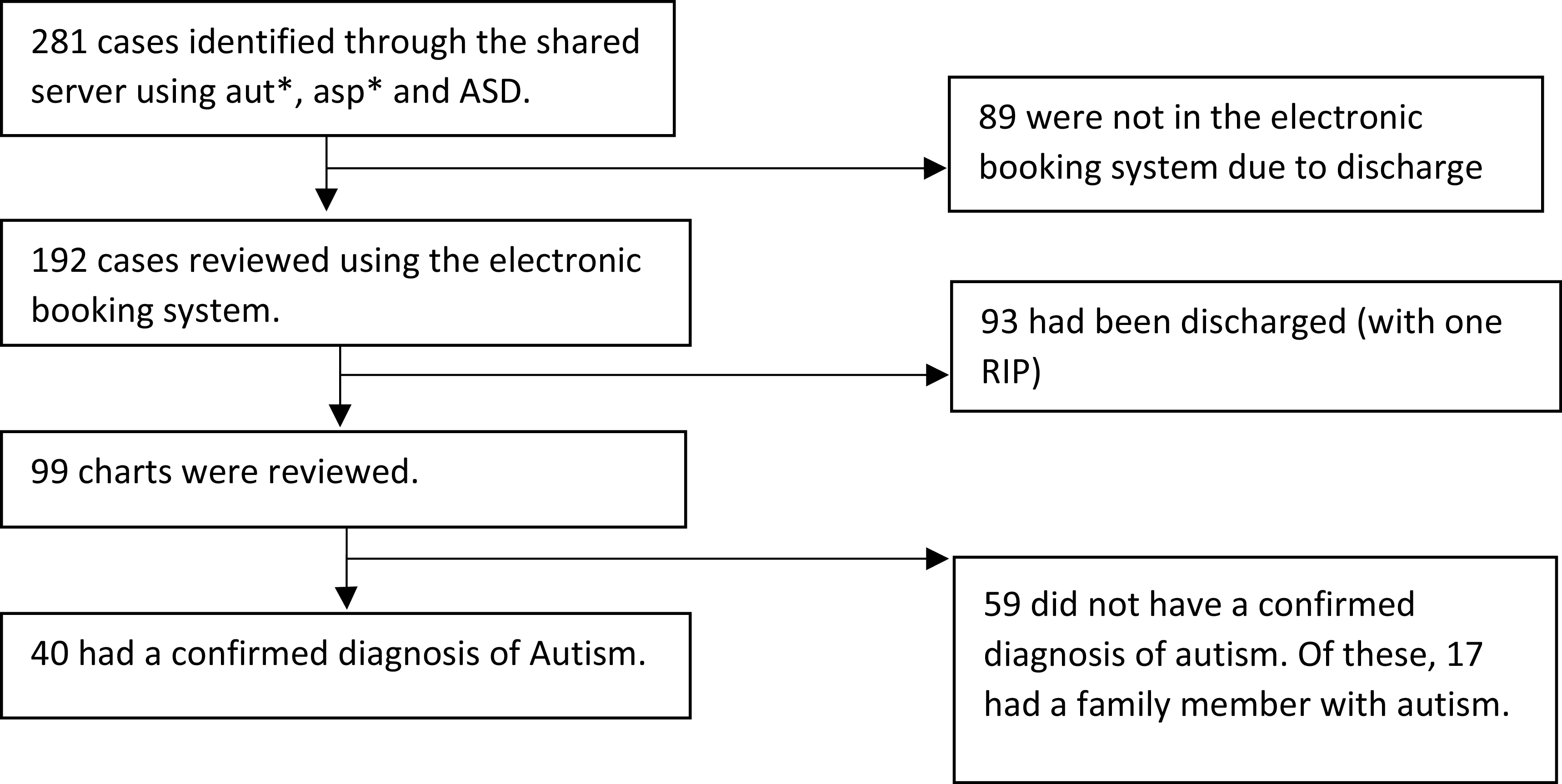
A baseline cross-sectional survey was conducted in July 2023 of autistic people, with a known diagnosis, within the service. The mental health team’s shared server was used to identify cases using the search terms aut*, asp*, and ASD, followed by a search of individual cases through the electronic booking system, and retrospective chart review at a single point of time in July 2023 as shown in Fig. 1 below.
July 2023 Baseline search of all cases in the service.

Data collection included
Demographic factors; Age, biological sex, relationship status, living arrangements at time of first assessment, employment status at time of first assessment, level of education at time of first assessment.
Autism diagnostic factors; Child and Adolescent Mental Health Services (CAMHS) attendance, source of autism diagnosis, age at time of autism diagnosis, co-occurring attention deficit hyperactivity disorder (ADHD), co-occurring intellectual disability (ID).
Mental health diagnostic factors; Mental health diagnosis, age at time of psychiatric diagnosis, substance misuse, suicidality and self-harm.
Service Provision; Psychological therapies (Psychology, and Cognitive Behavioural Therapy (CBT) provided by a Clinical Nurse Specialist (CNS) within the service), Occupational Therapy (OT), Individual Placement and Support (IPS), Speech and Language Therapy (SLT), Dietetics, Mental Health Social Work (MHSW), pharmacological interventions, and admission to the local inpatient mental health unit.
Data analysis
Descriptive statistics, Chi squared testing and non-parametric testing (Mann–Whitney U test) were employed as appropriate using IBM SPSS Statistics version 30.0 (IBM Corporation, NY, USA) and graphical representation using GraphPad Prism Version 10.6.1 for Windows, GraphPad Software, Boston, Massachusetts USA, www.graphpad.com.
Ethical approval
Approval was granted as a Quality Improvement Initiative from the St James Hospital/Tallaght Hospital ethics committee (RECSAF: 3582).
Results
Sociodemographic factors
In July 2023, of a total caseload of 1,270 service users, 3.1% (n = 40) service users had a confirmed diagnosis of autism. Of this cohort, 67.5% (n = 27) were male, 72.5% (n = 29) lived with parents or other family members, 35% (n = 14) were in active employment and 42.5% (n = 17) had engaged in higher or further education. The median age was 23 years (range 19–57 years).
Autism diagnostic factors
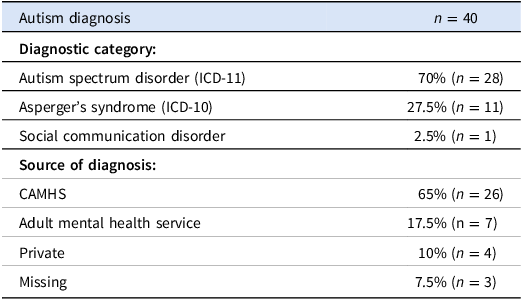
Of the cohort of autistic service users, 67.5% (n = 27) attended CAMHS, and 96% (n =26) of that cohort had received an autism diagnosis within their CAMHS team (See Table 1 below). Those diagnosed with autism prior to receiving a mental health diagnosis were younger on average than those diagnosed with autism after a mental health diagnosis (median 21.5 years versus 41.5 years; U (10, 14) = 27, p = 0.011). In this group, five had a diagnosed Intellectual Disability (ID); three with mild ID and two with moderate ID. Co-occurring ADHD was noted in 20% (n = 8).
Autism spectrum diagnostic categories and source of diagnosis

Table 1. Long description
A table detailing autism spectrum diagnostic categories and sources of diagnosis. The table has 7 rows and 2 columns. The first column lists diagnostic categories and sources of diagnosis, while the second column provides corresponding percentages and counts. Row 1: Autism spectrum disorder (ICD-11), 70 percent (n 28). Row 2: Asperger’s syndrome (ICD-10), 27.5 percent (n 11). Row 3: Social communication disorder, 2.5 percent (n 1). Row 4: CAMHS, 65 percent (n 26). Row 5: Adult mental health service, 17.5 percent (n 7). Row 6: Private, 10 percent (n 4). Row 7: Missing, 7.5 percent (n 3).
Mental health diagnoses
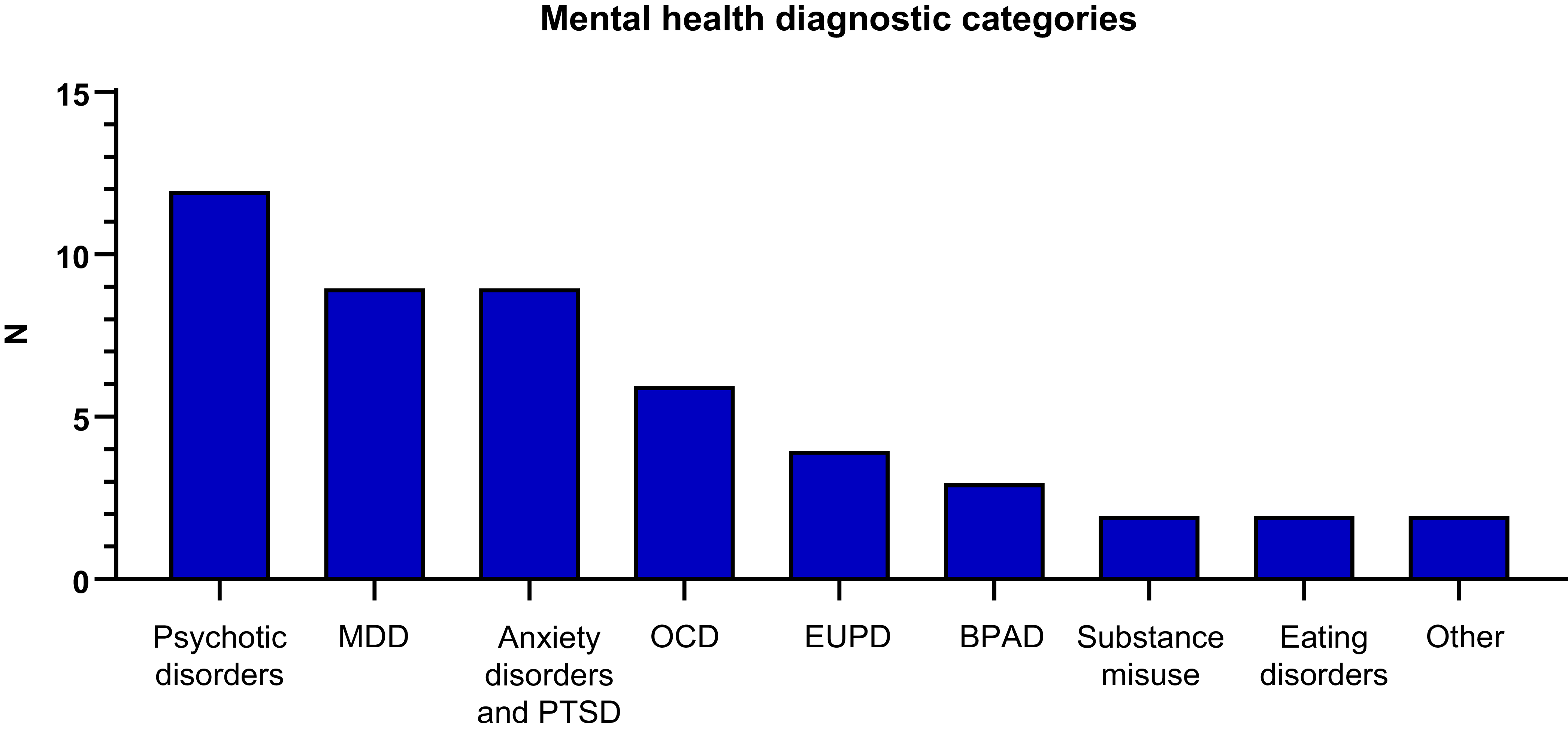
The most common reasons for referral to the mental health service were; transfers from CAMHS accounting for 27.5% (n = 11) of referrals and low mood accounting for 25% (n = 10) of referrals. Psychotic disorders were the most common mental health diagnosis 30% (n = 12). Of the whole group, 22.5% (n = 9) had more than one mental health diagnosis and 17.5% (n = 7) had a change of mental health diagnosis from initial assessment to the most recent review at time of data collection. Please see Figure 2 for all mental health diagnoses. Of the 40 service users in this cohort, 5% (n = 2) were noted to misuse alcohol, 10% (n = 4) were recorded as using cannabis, 5% (n = 2) engaged in polysubstance misuse and 2.5% (n = 1) were noted to have a gambling addiction.
Mental health diagnostic categories assigned to autistic service users. Note: Psychotic disorder = First episode psychosis, Schizophrenia, Schizoaffective disorder, affective psychoses, drug-induced psychosis; MDD = Major Depressive Disorder; PTSD = Post Traumatic Stress Disorder; OCD = Obsessive Compulsive Disorder; EUPD = Emotionally Unstable Personality Disorder; BPAD= Bipolar Affective Disorder, ‘Others’ = Tourette syndrome and Cyclothymia.

Self-harm and suicidality
Of the 40 autistic service users identified, 52.5% (n = 21) reported having engaged in self-harm or to have experienced suicidality. This was more frequent in those who did not have a psychotic disorder (25% with psychosis vs 67% without psychosis; X2(1) = 5.4, p = 0.02). Suicidality or self-harm were no more likely in those with co-occurring ADHD (38% with ADHD vs 59% without; X2(1) = 1.13, p = 0.29).
Service provision
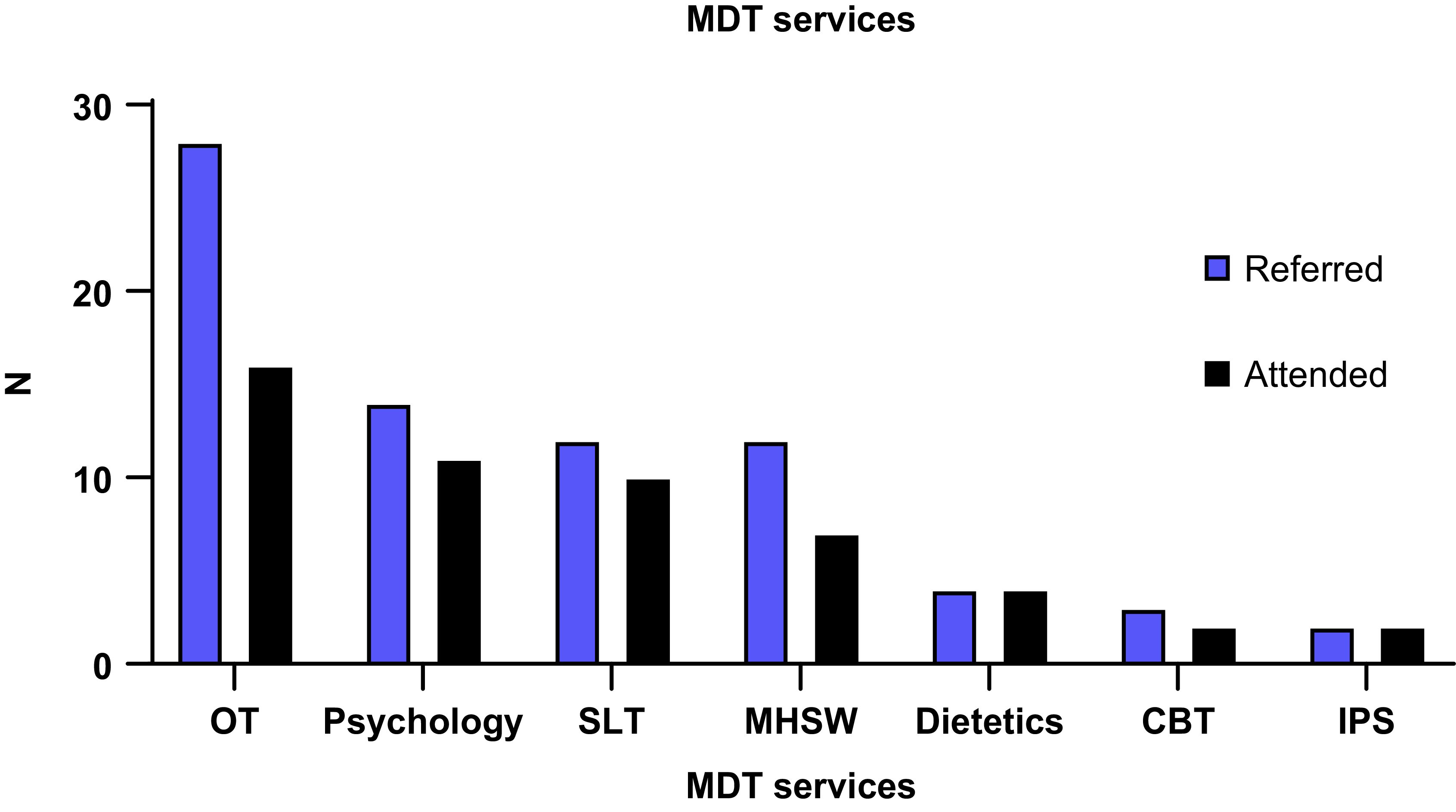
In total, 95% (n = 38) autistic service users were referred to a MDT service. Of these 30% (n = 12) did not attend these appointments, compared to just 10% (n = 4) missing a psychiatrist’s appointment. Autistic service users were most often referred to the occupational therapist (70%; n = 28). Please see Figure 3 below for referral rates to individual specialities.
Referrals to MDT services.

Of the 40 service users in this cohort, 17.5% (n = 7) had been admitted to the Tallaght University Hospital mental health inpatient unit. Five of these admissions were due to an acute psychotic episode, one was due to hypomania and one following a suicide attempt in the context of polysubstance misuse. Admissions averaged 4 weeks and 4 days (range 1–10 weeks). Please see supplementary material for prescribing practices for this cohort.
Discussion
Underrepresentation of autistic adults within a general adult mental health service
Given the higher incidence rates of psychiatric co-morbidities in those with an autism diagnosis, an overrepresentation of autism in psychiatric care may be expected (Nyrenius et al. Reference Nyrenius, Eberhard, Ghaziuddin, Gillberg and Billstedt2022). However autistic service users accounted for a small percentage (n = 40; 3.1%) of all service users in the Tallaght general adult mental health service. This is far below the screening-based prevalence rate of 18.9% in a Swedish outpatient population (Nyrenius et al. Reference Nyrenius, Eberhard, Ghaziuddin, Gillberg and Billstedt2022).
The prevalence of autism in the present study may simply be an accurate reflection of the local population. However, if the prevalence is an underrepresentation, it is likely multifactorial. In one Irish study, 80% of autistic respondents reported difficulty accessing primary care (Doherty, Reference Doherty, Neilson, O’Sullivan, Carravallah, Johnson, Cullen and Shaw2022) which in turn denies their access to secondary mental health care, and such barriers to care have been corroborated by physicians (Gallagher et al. Reference Gallagher, Crane, Dinneen, Ibrahim, Mulryan, Bolshakova, Harris, O’Rourke and Pellicano2025; Walsh et al. Reference Walsh, Lydon, Geoghegan, Carey, Creed, O’Loughlin, Walsh, Byrne and O’Connor2021a; Reference Walsh, O’Connor, Walsh and Lydon2021b).
Underrecognition may also be an issue within this service. A baseline search of all cases in the service identified 59 people where the term autism was recorded in their clinical data. Of these, 17 had a family member with autism, which accounts for the use of the search term. Retrospective chart review did not reveal an autism diagnosis for the remaining 42 people. This may indicate that autism was suspected but clinical diagnosis did not occur for this cohort. The scope of this study did not allow for further investigation.
The prevalence of co-occurring ADHD (20%, n = 8) in this study also falls below the estimated prevalence of 30–50% (Adamis et al. Reference Adamis, Langan, Gavin and McNicholas2025; Leitner Reference Leitner2014). Until 2018, a diagnosis of ADHD could not officially be made if an individual already had a diagnosis of autism (World Health Organisation, 2022), and so the prevalence of co-occurring autism and ADHD in general adult mental health clinics may increase in the coming years.
Further, of the 40 people diagnosed with autism in this study, the majority (67.5%; n = 27) had attended CAMHS, and 96% (n = 26) of that cohort had received an autism diagnosis within their CAMHS team. It was also discovered that those who received their autism diagnosis prior to a mental health diagnosis were younger on average. Both of these findings likely reflect greater recognition of autism in recent years in Ireland and may account for the delayed autism diagnosis of older adults, and for those who did not access CAMHS.
Clinical presentation of autistic adults within adult mental health services
Psychotic disorders accounted for 30% (n = 12) of mental health diagnoses of the autistic service users within our sample. Being a cross-sectional survey, this likely reflects service users with psychosis remaining within the mental health services rather than being discharged to primary care. It highlights that this is a cohort with major mental illness. This figure is in contrast with existing literature, which estimates the pooled prevalence rate for the co-occurrence of psychosis in adults with autism at 9.4% (Varcin et al. Reference Varcin, Herniman, Lin, Chen, Perry, Pugh, Chisholm, Whitehouse and Wood2022). Within this study, anxiety disorders and major mood disorders accounted for almost half of mental health diagnoses (45%; n = 18;), in keeping with previous findings in autistic populations (Dückert et al. Reference Dückert, Gewohn, König, Schöttle, Konnopka, Rahlff, Erik, Vogeley, Schulz, David and Peth2023; Ghaziuddin et al. Reference Ghaziuddin, Ghaziuddin and Greden2002; Stewart et al. Reference Stewart, Barnard, Pearson, Hasan and O’Brien2006). Of this study’s cohort, 20% were found to have more than one diagnosis; less than previous findings which refer to at least 40% of autistic adults meeting diagnostic criteria for at least one mental health difficulty (Allahdad et al. Reference Allahdad, Gluyas, Spain, Blainey, Doswell and Onyejiaka2024; Gotham et al. Reference Gotham, Marvin, Taylor, Warren, Anderson, Law, Law and Lipkin2015; Lai et al. Reference Lai, Kassee, Besney, Bonato, Hull, Mandy, Szatmari and Ameis2019; Lugo-Marin et al. Reference Lugo-Marín, Magán-Maganto, Rivero-Santana, Cuellar-Pompa, Alviani, Jenaro-Rio, Díez and Canal-Bedia2019). This could relate to diagnostic overshadowing and the low rate of comorbid ADHD in this sample, as mentioned above (Ahi Üstün et al. Reference Ahi Üstün, Yazıcı, İlhan and Saka2025; Folatti et al. Reference Folatti, Santangelo, Sanguineti, Inci, Faggioli, Bertani, Nisticò and Demartini2024; Gallagher and Mc Grath, Reference Gallagher and McGrath2022; Gesi et al. Reference Gesi, Giacovelli, Reibman and Dell’Osso2024; Uno et al. Reference Uno, Hayashi, Nakagawa, Otowa, Yamada and Iwanami2023). Within this study, just over half of autistic service users reported self-harm and/or having experienced suicidality, in keeping with international findings of heightened suicide risk in autistic adults (Hedley and Uljarevic, Reference Hedley and Uljarević2018). More recently in a systematic review and meta-analysis, Newell et al., found that the pooled prevalence of suicidal ideation in autistic and possibly autistic people without co-occurring ID was 34.2% (Newell et al. Reference Newell, Phillips, Jones, Townsend, Richards and Cassidy2023). These studies are not directly comparable however, as our data contains individuals with Asperger’s Syndrome and ASD diagnoses and includes five service users with co-occurring ID. The data indicates that autistic service users with either psychosis or a history of self-harm/suicidal ideation were deemed to require ongoing mental health services. Indeed 17.5% of our cohort required admission to the mental health inpatient unit.
Service provision
While previous studies have found that autistic adults attending mental health services report difficulties in receiving effective mental health support, and experience barriers to effective mental health care (Camm-Crosbie et al. Reference Camm-Crosbie, Bradley, Shaw, Baron-Cohen and Cassidy2019; Loizou et al. Reference Loizou, Pemovska, Stefanidou, Foye, Cooper, Kular, Greenburgh, Baldwin, Griffiths, Saunders, Barnett, Minchin, Brady, Ahmed, Parker, Chipp, Olive, Jackson, Timmerman and Sapiets2024), 95% (n = 38) of autistic service users in this study were offered MDT services. While the majority of service users were offered input from at least one MDT member, almost one third did not attend. This suggests that there may be a discrepancy between the mental health services offered and the experience of autistic service users who avail of mental health services. This could reflect the barriers to effective mental health care reflected in the literature (Brede et al. Reference Brede, Cage, Trott, Palmer, Smith, Serpell, Mandy and Russell2022; Camm-Crosbie et al. Reference Camm-Crosbie, Bradley, Shaw, Baron-Cohen and Cassidy2019; Dückert et al. Reference Dückert, Gewohn, König, Schöttle, Konnopka, Rahlff, Erik, Vogeley, Schulz, David and Peth2023; Doherty et al. Reference Doherty, Neilson, O’Sullivan, Carravallah, Johnson, Cullen and Shaw2022), including confusion about the role of MDT members, or difficulty in accessing different areas of the service.
Limitations
There were a number of limitations with this study. Firstly, it involved retrospective chart review and is subject to limitations such as missing data, as well as heterogeneous documentation. Secondly, a more in-depth review of services offered was beyond the scope of this study. Thirdly, as this was a single site survey in a mostly disadvantaged area as per the Pobal Deprivation Index, generalisability may be limited (Haase and Pratschke Reference Haase and Pratschke2022), particularly regarding the proportion of private autism assessments. Underdevelopment of public services for autistic adults is recognised (Health Service Executive 2026) and private autism assessment is available throughout Ireland. Within this study, only 10% of autism diagnoses were obtained via private consultation, and this may be higher in other geographical areas. Lastly, we could not gather data on use of primary care and voluntary services as these were not reliably recorded in the clinical notes.
Conclusions and recommendations
The underrepresentation of autistic individuals within the Tallaght general adult mental health service may be a product of two main factors; firstly that autistic service users are not accessing adult mental health services, as suggested in previous studies elsewhere (Dückert et al. Reference Dückert, Gewohn, König, Schöttle, Konnopka, Rahlff, Erik, Vogeley, Schulz, David and Peth2023; Loizou et al. Reference Loizou, Pemovska, Stefanidou, Foye, Cooper, Kular, Greenburgh, Baldwin, Griffiths, Saunders, Barnett, Minchin, Brady, Ahmed, Parker, Chipp, Olive, Jackson, Timmerman and Sapiets2024; Maddox et al. Reference Maddox, Crabbe, Beidas, Brookman-Frazee, Cannuscio, Miller, Nicolaidis and Mandell2019) and secondly, that there may be an underrecognition of autism within secondary mental health services.
Firstly, regarding access to services, a national model of care and clinical pathway for autistic people was recommended in 2017 (Health Service Executive 2017) but has not been fully developed within the geographical area, leaving a significant gap in services for autistic adults at both primary care and secondary mental health care level. Development of an autism pathway to meet the needs of this cohort was again recommended by the Autism Innovation Strategy in 2024 (Government of Ireland 2024), and the ‘Autism Assessment and Intervention Pathways Protocol’ was recently developed detailing standardised referral pathways and the need for single points of contact (Health Service Executive 2026). Further, these recommendations are consistent with the internationally recognised need for clear and integrated plans within a defined care pathway, in services that are comprehensive, integrated and responsive (Fulceri et al. Reference Fulceri, Gila, Caruso, Micai, Romano and Scattoni2023; National Institute for Health and Care Excellence 2016).
Secondly, there is potential underrecognition of autism within adult mental health services. It has been widely recommended that mental health services staff should receive training, with a focus on assessment, screening and diagnostic skills to identify those with autism (Crowley et al. Reference Crowley, O’Connell and Gervin2018; Gallagher and McGrath Reference Gallagher and McGrath2022; Houses of the Oireachtas 2023). This issue is also addressed in the ‘Autism Assessment and Intervention Pathways Protocol’ (Health Service Executive 2026) which outlines a range of validated screening tools and clinical diagnostic interviews, as well as a tiered approach to assessment and the incorporation of clinical judgement and individualised formulations.
Regarding clinical presentation and service provision, we found that one third of autistic service users in the study had a diagnosis of a psychotic disorder and half had self-harmed or experienced suicidal ideation; representing a cohort with complex mental health needs. While service users were offered a range of MDT interventions, the reasons for lack of uptake of these services need to be explored through Patient and Public Involvement in research. Autistic service users potentially need clearer communication and greater assistance in accessing MDT supports. Brede et al., noted, “complexity needs flexibility” (Brede et al. Reference Brede, Cage, Trott, Palmer, Smith, Serpell, Mandy and Russell2022), and Ireland’s mental health policy ‘Sharing the Vision’ expects mental health services to consider the “needs and social circumstances of its sector population, with flexibility as to how these needs are to be met.” (Department of Health 2020).
In conclusion, while autistic service users appear to account for a small number of secondary mental health service users, this is likely due to underrecognition of autism and to barriers in accessing mental health care. Autistic people identified in this study have major mental health difficulties and/or self-harm and suicidality; requiring an appreciation of the complexity of their needs. Further, they did not access the full mental health service provision available. This study echoes the conclusion of Gallagher et al. (Reference Gallagher, Crane, Dinneen, Ibrahim, Mulryan, Bolshakova, Harris, O’Rourke and Pellicano2025) that mental health services be “equipped and appropriately resourced to deliver inclusive, evidence-based care to autistic people across the lifespan” (Gallagher et al. Reference Gallagher, Crane, Dinneen, Ibrahim, Mulryan, Bolshakova, Harris, O’Rourke and Pellicano2025).
Supplementary material
The supplementary material for this article can be found at https://doi.org/10.1017/ipm.2026.10241.
Funding statement
This project received no specific grant from any funding agency, commercial, or not-for-profit sectors.
Competing interests
None of the authors have any conflict of interest to declare.
Ethical standards
The authors assert that all procedures contributing to this work comply with the ethical standards of the relevant national and institutional committee on human experimentation with the Helsinki Declaration of 1975, as revised in 2008. The authors assert that Tallaght University Hospital Audit Committee determined that ethical approval from the local Ethics Committee was not required for publication of this service evaluation. The authors have provided written confirmation of this from the Audit Committee and local clinical director.


 Open access

