One of the more iconic moments following the terrorist attacks on the United States on September 11, 2001 occurred through music, as members of Congress gathered on the steps of the Capitol and broke out into a seemingly spontaneous rendition of “God Bless America.”Footnote 1 The sight and sound of the leaders of the United States singing in unison demonstrated to the world a resolve in the face of tragedy and offered the nation a comforting assurance of unity. The narrative of unity was made even more powerful, many journalists noted with wonderment, by the overcoming of bitter political and partisan tensions that had marked Congress after a close election. The effect seemed to ripple across the globe as the media repeated the phrase “we are all Americans” in communities throughout the United States and around the world.Footnote 2 And yet, this sudden unity proved rather ephemeral, as political concerns over security, civil liberties, and military action quickly frayed the nation.
The task of commemorating 9/11 has likewise been marked by disunity. Art historian Erika Doss describes a steady shift in the twentieth century away from “statue mania” to the more modern “memorial mania.” The former “was symptomatic of turn-of-the-twentieth-century anxieties about national unity” and sought to create official public statements of national values.Footnote 3 By contrast, “memorial mania” and the modern United States are “focused on self-expression and personal feeling” such that “the traditional monument's invocation of a ‘unitary’ mass ethos may seem oppressive and exclusionary.”Footnote 4 The public discourse surrounding post-9/11 policy—with debates about military action, civil liberties, xenophobia, and border security, as well as a dominant heroic narrative that celebrates white, male firefighters—has indeed broached the issues of exclusion and oppression and has exposed a variety of political, religious, racial, and cultural tensions in the United States.
Official and unofficial memorials of 9/11 alike have had to engage these cultural tensions and in doing so balance competing impulses toward unity and disunity. Musical memorials to 9/11 are no exception, and John Adams's On the Transmigration of Souls—a twenty-five-minute, single-movement work scored for orchestra, chorus, children's chorus, and pre-recorded soundtrack—offers a rich case to explore the affective roles of disunity, multiplicity, and difference in the 9/11 memorial. Commissioned and premiered in 2002 by the New York Philharmonic, On the Transmigration of Souls was one of the first large-scale, official efforts to memorialize the victims of the 9/11 attacks on the World Trade Center.Footnote 5 Since its premiere, On the Transmigration of Souls has not been performed again by the New York Philharmonic nor by any other New York–based ensemble.Footnote 6 In 2003 and 2004, it was performed four times abroad but only once in the United States. The work's stature appears to have benefitted from geographic and temporal distance from 9/11. Between 2005 and 2012, it has been programmed forty-three times by a range of professional, community, and university ensembles, thirty-one of which were in the United States. In 2011, to mark the ten-year anniversary of 9/11, On the Transmigration of Souls was performed by ten ensembles in the United States and six overseas, more than twice the number of performances in any other year.
Building on Doss's work, this article explores how disunity both between and within music and text serves several aspects of the process of memorializing in On the Transmigration of Souls. First, disunity evokes the experience and processing of traumatic memories. Second, disunity both acknowledges absence and affirms presence, a key paradoxical relationship created by memorials. Third, disunity and multiplicity allows both creators of memorials and audiences to navigate among multiple competing identities, particularly for those citizens who did not fit the dominant narrative of white male heroism following 9/11. Finally, drawing on Judith Butler's work on mourning and on the process of “meaningful adjacencies” used by the designers of the 9/11 memorial, which allowed family members to help shape the arrangement of names on the memorial, disunity encourages reflection on how multiple perspectives recast the act of memorialization. Such reflection can further inform both performance and scholarship to be mindful toward what Butler calls the “ethical responsibility” of mourning.
To account for this multiplicity of perspectives, this study combines musical and cultural analysis with audience surveys conducted in six cities between 2010 and 2012. These surveys first asked audience members to rate from zero to ten how well each of twelve adjectives described On the Transmigration of Souls, and second asked audience members to describe in a more open-ended format their expectations and reactions to the work. (See Appendix A for a survey example.) The first part of the survey offered a more systematic method to see how audiences at large tended to ascribe certain adjectives to the work, and whether and how the rating of one adjective was correlated with the rating of others.Footnote 7 The second part allowed me to capture the breadth of responses while also identifying larger trends by examining commonly used words or associative images. The perspective provided by these surveys is necessarily selective, but nevertheless provides a fruitful beginning of a more comprehensive understanding of how musical memorials like On the Transmigration of Souls function for audiences.Footnote 8
Hearing Disunity in On the Transmigration of Souls
Before examining the various affective roles disunity plays in memorials, it is worth briefly noting the types of disunity that On the Transmigration of Souls, formally speaking, adopts. Inspired by the visual assemblage of missing persons posters that covered the area around Ground Zero, Adams began by creating a textual assemblage from fragments visible in photographs of these posters, quotations taken from the “Portraits of Grief” series that ran in the New York Times, and online websites and forums (see Appendix C). In the music, Adams makes use of both “vertical” collage, the simultaneous layering of distinct sonic events, and “horizontal” montage, the sequential juxtapositions of sonic events that emphasize rupture. On the Transmigration of Souls opens with a recording of a cityscape, itself a collage of three separately recorded tracks, as notated in the score: footsteps, a siren, and street noises comprising voices, traffic, and other background sounds. Over these tracks, we hear a mix of recorded voices: a boy repeats the word “missing,” soon joined by others who read the names of the dead, as the orchestra and chorus enter, playing and singing (on a wordless “oo”) open fifths. The instrumental forces begin small and ethereal—harp, strings, and celesta—but the work grows to employ the full orchestra, including at times a second ensemble within the orchestra playing a quarter-tone higher than the others, and the full chorus and children's chorus who sing other texts that Adams selected. The single-movement work is marked by two climaxes, each juxtaposed directly with passages that use sparse textures, quiet dynamics, and the quarter-tone ensemble.
Charles Ives, who favored simultaneous and unrelated sounds performed by distinct ensembles, inspired these forms of collage; Adams called Ives his “guardian angel” for this piece, whose style Adams likened to a “mixing board” approach.Footnote 9 In On the Transmigration of Souls, that approach is made literal, as the work requires the recorded music to be mixed live and carefully timed, balanced, and stereophonically played in conjunction with the live performance. As a result, the piece heightens differences in perspective depending on the hall itself and the location of the listener within it: recorded voices may be more or less prominent based on proximity to the speaker and volume, and a musical gesture may color whichever recorded voice or sound it coincides with in one performance, but not another.
Traumatic Memory and Fracturing Experience
After an emotionally traumatic experience, it is often suggested that we “pick up the pieces.” To pick up the pieces, even to mend them, does not erase the fissures or evidence of trauma, and the pieces may not fit together as they once did. Memorials perform the task of figuratively picking up the pieces, helping us to remember the lives of the dead as well as their deaths. Sociologist Neil Smelser sums up the paradoxical role of memorials: “To memorialize is to force a memory on us by the conspicuous and continuous physical presence of a monument; at the same time a memorial also conveys the message that now that we have paid our respects to a trauma, we are now justified in forgetting about it.”Footnote 10 In the case of 9/11, the quest for closure is difficult, if not impossible, as the world strives to understand the causes of 9/11 and still reels from its repercussions. The reconstruction of the World Trade Center site in New York required workers to literally pick up the pieces and transform the site simultaneously into a site of remembrance by creating a memorial (reflecting pools, gardens, a museum) and a site of forgetting by rebuilding the towers and transit stations that had occupied the site before.
Like its physical counterpart, On the Transmigration of Souls encompasses multiple sites and resists closure. Right from the start, the piece blurs boundaries by opening with the recorded sounds of the New York streets. Adams remarked, “I just love the idea of New Yorkers coming in off of Broadway, walking into the hall and sitting down, and the lights coming down and then the traffic sound coming back up. In that way it was very nice that it was the first piece on the program, because it created this wonderful kind of blur between life and art.”Footnote 11 Elsewhere, Adams has cited Ives's The Unanswered Question, a work Adams quotes in the piece, and his Fourth Symphony, which Adams considers “an imponderable behemoth of mysterious detail,” as inspirations for his use of overlapping sonic ideas.Footnote 12 Adams would seem to have drawn upon Ives in order to reflect on, rather than answer, the questions raised by 9/11. The use of pre-recorded sounds and an offstage trumpet implies a more unbounded sense of time and space than the confines of the visible stage allow, and the decision to conclude the work with material similar to its opening also suggests a repeated, open-ended meditation and resists the closure of a single narrative and teleological direction toward answers.
Through its juxtapositions of multiple sonic ideas, On the Transmigration of Souls not only resists closure but also emulates the processing of traumatic events. Theorists have suggested that trauma occurs not in the immediate reaction to an event, but later, when memories return to haunt the survivor.Footnote 13On the Transmigration of Souls does not recount a literal narrative of the day's events, but it does vividly depict the experience of being haunted by traumatic memories of those events.Footnote 14 The work opens with the real world sounds of an ordinary cityscape, which is then collaged with a minimalist orchestral/choral accompaniment and a disembodied voice that repeats the word “missing.” The pairing of street sounds and orchestra not only transports concertgoers out of the hall and into their memory of the streets of New York, but also suggests a pedestrian who suddenly experiences a traumatic flashback, forced to relive the events of 9/11.Footnote 15 The effect is enhanced by Adams's use of minimalism and repetition, which, as art historian Erika Doss and musicologist Mitchell Morris have observed, manipulate temporal and spatial experience in manners similar to what many survivors of trauma describe having experienced.Footnote 16 A similar effect is achieved later through the superimposition of a small ensemble of strings and piano within the orchestra playing a quarter-tone higher than the orchestra, producing an almost cinematic effect of mental distortion, of that imagined pedestrian being removed from, indeed, out of tune with, the normal world.
The two climaxes can be read as referencing the two towers (see Figure 1). Adams presents the two attacks as traumatic flashbacks by building up a sense of fear, releasing it, and quickly and disorientingly snapping back to a minimalist, dissociative quietude; a more narrative accounting might make the attack sudden and disruptive, only gradually fading away, not the reverse as happens here. The text from a missing persons poster—a plain, almost clinical description of a victim's eye color, hair color, birthdate, and weight along with a phone number—triggers the first climax. Another recorded voice then reads and rereads the name Carl Flickinger, but the name grows increasingly fragmented, as two other voices intone the word “missing,” electronically distorted and increasingly out of sync with each other (mm. 169–89). As the soundscape grows more fractured, the sense of trauma grows increasingly powerful, erupting into a brief full orchestral climax, and then drops off sharply at m. 213 into the same quiet, static music and street sounds that preceded the outburst, as if nothing had happened. The second climax begins when the chorus sings one of the more harrowing texts at m. 332: “I wanted to dig him out, I know just where he is.” This passage is a rare response to the aftermath of the collapse, rather than a memory of life before the trauma. The text reveals the temporal displacement felt after a traumatic experience, beginning with the past and the act of recollection—I wanted to dig him out—which becomes so vivid as to move to reliving the trauma in the present—I know just where he is. To this end, the sense of time grows distorted as some singers slow the text down whereas others speed it up. The orchestra mimics these voices, with a flurry of string notes against a slower, dissonant brass chorale and winds. The chorus's text then shatters into unconnected words—light, sky, day, and love—furthering the sense of rupture. Again, the episode ends abruptly (m. 445), with the return of the quarter-tone ensemble creating a lingering sense of displacement.
Waveform graph of volume levels of the New York Philharmonic recording of John Adams's On the Transmigration of Souls.

The conclusion of the work offers a moment of tranquility and gestures toward healing, closure, and forgetting. Adams transforms the line, “I see water and buildings”—the last words from American Airlines Flight 11, which crashed first into the World Trade Center—from its earlier, alarm-like setting into a peaceful observation that reads like a heavenly vision, or even an apt description of the 9/11 memorial in New York itself. The final words spoken in the piece, “I love you,” offer a benediction; with them, the music ascends and dissipates, a bell tolls, and we are once again returned to normal life with the cityscape that opened the work.
Memories of 9/11 are difficult to process—indeed, the chorus struggles to utter their first word, “remember,” insistently repeating “remem-” the first five times to acknowledge both the need to remember and the difficulty of the task. For many of the audience members I surveyed, memories proved just as difficult and insistent. On the Transmigration of Souls induced visceral responses, the potency of which may help explain why temporal and geographic distance from 9/11 has benefitted the work. Many recollected detailed visual memories of the footage or their own experiences on that day, some more sharply or traumatically remembered than others. A handful responded to my surveys with the adjective “creepy,” suggesting that revisiting these events was undesirable and not cathartic. Others seemed to find the memories meaningful and helpful, and still others’ responses read inconclusively, such as the audience member who wrote, “Disturbing. I saw it all again. Too vivid in a compelling way.”Footnote 17 Another felt “as if I was in a dream but knew it was real when I woke up.”Footnote 18 This description of “waking up” reinforces the power of both music and memorials to alter mental states. Several described physical reactions as well—holding their breath, crying, rocking; one audience member even alleged that the auditorium deliberately lowered the temperature to manipulate the audience into feeling chills. Others vividly felt or saw spirits or souls within the room, ascending. At least two people had what could be described as epiphanies:
I honestly feel that the piece changed my life and the way I will experience and write music from here on out. I will constantly be in search of music that is capable of quite literally moving my soul the way that On the Transmigration of Souls did.Footnote 19
I felt I had been privy to entering the realm of that which Death yields. As a listener, I connected with the experience of moving beyond this earthly plane. Even though I was aware of the chaos and anguish and despair of those still earth-bound, including ones loved and cared about, I rose to experience the deep, abiding comfort of acceptance of a new and different state of being, floating, if you will, in eternal peace and unconditional love; a safe harbor. Such was my concert experience. Back in the present, I will say that this is close to what my thinking has long held true, but this great work actually allowed me to access that place. It's a comfort to know of the comfort.Footnote 20
Of course, not all visceral reactions are unequivocally positive; memorials have the power to haunt in a difficult way, as one woman described in harrowing language:
I wanted to talk about it afterwards, but was too raw emotionally. I'm scared of nightmares, since I'm headed to bed one hour after the performance. Cacophony, intense, disturbing, visceral. The archival statements from loved ones were painful, painful—esp. in their chanting delivery—the pounding repetitions. I ‘saw’ the ones left behind and I am shaken. Loss—pain—the movement between worlds that took place during this tragedy. Love the title, it prepared me for what I was to hear. I found myself rocking in time with the sweeping beats—caught myself realizing I was rocking like a person in grief rocks, After leaving the aud[itorium], I found myself growing increasingly grief-filled. The experience of the music/performance seemed to grow inside me as I walked to my car and made small talk with others. Really feel I need to cry to wash away my distress but have to wait til my husband and kids are in the other room so I don't upset them.Footnote 21
For this last audience member, the memorial/concert provided both a rush of unpleasant emotions and a safe space to grieve, including a sense of privacy lacking outside its walls. In this sense, the performance as a whole mimics traumatic displacement from the real world.
Whereas these surveys suggest that recognition of trauma and tragedy was a central experience for most audience members, the affective quality of that experience varied. When given a series of adjectives to rate on a scale from zero to ten, approximately two thirds of audience members rated “emotional” and “somber” an eight or higher. “Tasteless” was rated the lowest, given a zero by a vast majority of audience members; however, those who rated “tasteless” a ten largely rated other adjectives (except “somber”) zeroes, suggesting that for some this was an overwhelming affective response. “Disturbing” was included on a smaller number of surveys, but yielded a fairly even distribution. A large plurality of listeners rated “uplifting” a zero, but the second largest rating was for five, and those who scored “uplifting” highest also tended to rate “somber” highly as well. If the work wasn't uplifting for audiences, “cathartic” and “spiritual” were more evenly distributed, hinting that for some, the work offered some hope and emotional closure (see Appendix B).
Expectations were sometimes met and sometimes not, revealing the multiple and contradictory goals memorials can be expected to fulfill. Some audience members were pleasantly surprised at the emotions:
[I expected] a lot more chaos, dissonance and violence, unresolved phrases—a question as conclusion. Instead we resolved at the end to other-worldly peace and beauty. It was surprising that the anger and outrage of the climax didn't come until the piece was more than halfway through. As a New Yorker, that was my first reaction that awful Tuesday morning. But the final resolution was ethereal and strangely comforting.Footnote 22
Others expressed disappointment that the music did not offer a hopeful resolution, or even a chance to find peace. A second listener “left the performance with an empty feeling . . . but was yearning for the closure and feeling of hope and the continuation of life going on—a better reflection of here we truly are today,” and suggested another movement that would, like the memorial in New York, “take 9/11 from tragedy to hope.”Footnote 23 One listener felt the work was true to life, but hoped it would offer more comfort: “I waited for the resolution—the lifting change to a major chord, but there was none—just as there is none in our lives.”Footnote 24 Another felt similarly about the resolution, but remarked more affirmatively, “I thought it would be more hopeful. But I preferred what was rather than what I expected.”Footnote 25 These statements reveal the multiple demands survivors place on the memorial in the face of trauma, whether we want truth or something life can't supply, comfort or a chance to reflect on sadness or anger. They also demonstrate that this work, like many modern memorials, resists any single reading, refuses closure, and offers new discoveries.
Absence and Fragmentation
The memorial's power relies on the absence of what is being memorialized; to memorialize is to make permanent presence out of absence. Adams literally places absence at the very outset of his work as a recorded voice repeatedly intones the word “missing,” underscored by a musical absence: an open fifth on D and A, which recalls the creatio ex nihilo opening of Beethoven's Ninth Symphony. Names and other remembrances soon follow, but these words do not simply replace or fill in the absence with presence. Rather, just as Adams honestly acknowledges trauma in the work, his selection and treatment of the text further emphasize absence and loss.
Adams engages the twin, paradoxical concepts of absence and presence in the memorial principally through the arranging and setting of text fragments. As Rosalind Krauss theorizes in her work on collage, assembled fragments operate as signs that stand in for the absent whole. This places absence at the center of the power of the fragment to signify, because the sign is a coupling of a material signifier and an immaterial signified, which “stresses that status of the sign as substitute, proxy, stand-in, for an absent referent.”Footnote 26 Literary scholar William Watkin has similarly proposed that mourners substitute metonyms for the lost. But as this substitution proliferates, Watkin observes, the multiplicity of metonyms only diminishes their power and reinforces the absence of the whole.Footnote 27 For the memorial, we intuitively understand this process of signification: the memorial, names on the wall, photographs, or other mementos stand in for the absent people we remember.
In On the Transmigration of Souls, the textual fragments—which are assembled from missing person posters, the New York Times “Portraits in Grief” series, and other sources—operate similarly. Adams's use of disunity in his text setting, particularly fragmentation and textual/musical juxtaposition, reinforces the connotation of absence. The phrase at m. 79, “You will never be forgotten,” is delivered with a touch of cruel irony: what should be the most confident statement of presentness, wholeness, is never given a complete utterance by any single voice but fragmented instead between the choruses. Immediately after this statement, there is a punctuating forte swell of F and C major chords that registers as the work's loudest, clearest, most triadic moment thus far. But the quarter-tone ensemble and celesta quickly muddy this moment of tonal clarity with a chromatically descending line that suggests the memory slipping away. Likewise, the monotone and staccato rendering of the line, “She looks so full of life in that picture” at m. 116 undermines the memory's offer of comfort. When the memories are tangible, physical items, Adams sets them in quick succession—“A gold chain around his neck, a silver ring, his middle finger, a small gap, his two front teeth, a little mole on his left cheek, a wedding band, a diamond ring”—evoking a confusing jumble that lacks the individuality of other memories and even conjures up disturbing images of dismembered body parts from the wreckage. Amassed here in fragmentary form, Adams's texts are unmoored from specific bodies, names, or lives, furthering the sense of loss.
The text setting mirrors a second point Krauss and Watkin raise: fragments and metonyms do not simply signify on their own, but also through opposition.Footnote 28 Because Adams's texts invoke generic yet intimate relationships—father, sister, lover—the absent are given meaning through their surviving loved ones. The recorded voices underscore the absence of the dead through their interaction with the live singers. Whereas the chorus sings mostly recollections from the survivors, opening with the word “remember,” the recording conveys largely the names of the dead, beginning with “missing.” The work opens with only pre-recorded sounds and a stage full of motionless, silent live musicians and singers, heightening this sense of absence. Later, the silencing of the live chorus following the second climax takes on a powerful resonance where the survivors are sonically absent and the dead/absent voices are present for the conclusion. As one listener remarked, “it gives the dead a voice.”Footnote 29
At the same time, the accrual of textual fragments connotes a form of presence in contrast to the minimalist elements of the work. Minimalism has been a popular aesthetic for memorials following Maya Lin's successful design for the Vietnam Veterans’ Memorial, and Adams's own reputation as a minimalist may have contributed to his selection for the commission. Central to minimalism's success in this regard has been a long-held perception that it is absent of external meaning, presenting what art critic Michael Kimmelman calls a “blank slate” for viewers, which suggests that an absence of meaning in a work allows room for our own meanings.Footnote 30 This view of minimalism as “aloof from politics and commerce and above personal feeling,” has been compellingly refuted by Anna Chave, who argues that minimalist art in the 1960s directly engaged with social and political issues.Footnote 31
Several scholars have advanced similarly politicized readings of minimalist music, especially Steve Reich's work. Reich's own comments about his music have largely focused on formal processes and skirted political content.Footnote 32 His early work Come Out (1966), which loops two tapes of the same spoken clip increasingly out of sync with one another, uses a recorded statement by Daniel Hamm following his beating by police officers during the 1964 Harlem Riot. Mitchell Morris and Sumanth Gopinath have both interpreted Reich's process of phasing in this piece as a political act, linking it to racial paranoia, a critique of government bureaucracy machine, or a form of aesthetic violence to mirror the brutality of the incident.Footnote 33 Reich returned to sampling spoken testimony in Different Trains (1988), which used recollections from Holocaust survivors, and WTC 9/11 (2010), which used phone calls, radio dispatches, and interviews surrounding 9/11. The association of minimalism with an absence of emotion or political ideology remains central to the works’ reception: critic Mark Swed assessed the WTC 9/11's use of recorded Jewish prayers as “more documentary than healing,” whereas Seth Colter Walls praised the marriage of minimalism and such documentary footage in his review, writing, “Even on the page, its warnings seems as though in want of a minimalist's interpretation.”Footnote 34 Amy Lynn Wlodarski, in a study of Reich's careful editing of Different Trains, asserts that the depersonalized objectivity suggested by both documentary interviews and minimalism is a false one, that primary and secondary acts of witness alike are aesthetic inventions.Footnote 35
Adams has not shied away from overt political statements, particularly in his operas; his The Death of Klinghoffer (1991) has proven particularly controversial. And yet in the many discussions of politics in his work, Adams's use of minimalism in particular is rarely explored, suggesting that minimalism retains its remove from political discussions.Footnote 36 Minimalism is not absent from On the Transmigration of Souls; the static harmonies, the repetition of names and the word “missing,” and the repeated melodic cells that characterize much of the choral writing all suggest a minimalist style as a sort of background into which other musical and textual ideas are placed. By background, I do not wish to further the notion that minimalism is somehow aloof or removed from the political content; on the contrary, I find its aesthetic of emptiness extremely meaningful for the memorial.
Minimalism within memorials, then, may be better viewed as not the absence of signification, but a strong signification of absence. Furthermore, the presentness of minimalism in these memorials, its stasis and size, reinforces that absence as permanent, such as the repetition of “missing” in On the Transmigration of Souls or the frequent construction of emptiness (e.g., pits, pools, recesses) in memorials. Such absences are quietly powerful and powerfully quiet. Although the relative “silence” of the Vietnam Veterans’ Memorial on the politics of the war has come to be seen as one of the design's great triumphs, its minimalist silence was not uncontroversial, nor was it apolitical at the time of its opening, and the uproar was strong enough to demand changes to the design that included a flag and a more traditional statue of soldiers in action.Footnote 37 The key part of Kimmelman's analysis is not that minimalism is a blank slate, but that when we confront its emptiness, we have a need to put something in and get something out. This need is affirmed by the actions of survivors at sites of destruction: plastering the missing posters at Ground Zero, or leaving photographs, teddy bears, cards, and other memorabilia along the fence in Oklahoma City or the wall of the Vietnam Veterans’ Memorial. These not only serve to put something familiar into the site, but also to cover up sites of absences we cannot bear to look at, to render the absence itself absent. But as On the Transmigration of Souls makes clear, such attempts never fully succeed. In Adams's assemblage of text fragments, the presentness of textual memories and the absentness of their minimalist and fractured musical setting are inseparable in the audience's experience. Each offsets the other: the text fills the minimalist absence with human presence, whereas the minimalist and fragmentary setting reaffirms the absence.
Adams characterized his work as a “memory space,” suggesting that he intended audiences to engage in a process similar to visitors to physical memorials.Footnote 38 But Adams's memorial—like its minimalist physical counterparts—is not a “blank slate.” Indeed, one audience membered complained, “It was often too busy to think my own thoughts. . . . Because it was described as a ‘memory place’ I expected at least some part of it to be tranquil enough that I would have peace of mind. I was disappointed.”Footnote 39 By constructing the act of remembering through text and music in such away that highlights absence, incompleteness, and loss, Adams begins as well the complex task of representing 9/11 in collaboration with audiences, which has proven a central challenge in the creation of modern memorials.
Post-9/11 Collective Identity, Inclusion, and Difference
The spontaneous amassing of objects into makeshift memorials at Union Square, the Vietnam Wall, or the fence at Oklahoma City simultaneously make private thoughts public and transform the public memorial into a private, deeply personal site. Part of the power of memorials comes from the confused, messy jumble of memorabilia, visual evidence of the lives affected by these tragedies. Official memorials, despite their manicured simplicity and unity, are no less messy. Their designs are shaped by intense debates over the politics of representation. In response, official memorials have increasingly constructed multiple sites of commemoration and made individual memories integral to the collective process of memorialization. The names on the Vietnam Wall alongside the Three Servicemen statue; the AIDS Quilt's mutable displays of collected individual panels; the memorial at Oklahoma City, which incorporates a portion of the fence that was originally constructed around the site where visitors continue to leave messages and mementos—all stress the prominent place individuals, both dead and living, hold within modern official memorials.
The memorialization of 9/11 has certainly proven contentious and challenging. In designing a single official memorial in New York, even the basic act of naming the dead was difficult because of the multiple causes of death. The memorial would have to include victims from the World Trade Center and the Pentagon, passengers and crew aboard the planes, as well as first responders; furthermore, the memorial would also have to include those who died in the 1993 bombing of the World Trade Center, whose memorial had been destroyed with the towers. Initial plans to list the many names randomly drew complaints from those who wished connections to be preserved. The solution agreed upon was to create what designers called “meaningful adjacencies.” Consulting with family and friends of the deceased, the designers aimed to place victims’ names alongside those they knew or had other ties with.Footnote 40 Doing so empowered the survivors for whom the memorial spoke and thus not only quelled many of their concerns, but also emphasized a stronger network of community among both victims and mourners.
The “Portraits of Grief” series in the New York Times, meanwhile, drew praise for its random ordering of obituaries, perceived as a model of inclusion because it disregarded class, race, power, gender, or any other divisions.Footnote 41 In death, it would seem, all were equal. Yet the series disguised the fact that the United States is a land of economic, social, and political inequality. As David Simpson has pointed out:
They seem regimented, even militarized, made to march to the beat of a single drum. . . . Reading the profiles in sequence, we find that they all start to sound the same, with only minute variations on the governing themes. The array of difference and creative idiosyncrasy that is often described as the proper core of a liberal democracy is here oddly flattened out.Footnote 42
Randomness can prove potent, even disturbing, by signaling the arbitrariness of the lives lost. Such a sentiment offers little of the comfort that many expect from memorials and risks trivializing or dehumanizing death.
Beyond the official memorial, 9/11 has been remembered through art and popular culture, where the white, male firefighter has emerged as the central heroic symbol. This depiction of has underscored tensions over race, gender and post-9/11 U.S. identity. Erika Doss has noted that a third of those killed were women, yet their presence in depictions of the event has been minimal.Footnote 43 A statue to be sculpted from a photograph drew angry reactions when the sculptor initially planned to change the three white firefighters to a white, a black, and a Hispanic firefighter.Footnote 44 Director Oliver Stone, meanwhile, created controversy in the film World Trade Center by casting a white actor to play Marine Sergeant Thomas, who was black. Since then, Jeffrey Melnick argues in his cross-disciplinary study 9/11 Culture: America Under Construction, it has been “impossible for an American artist to introduce race into any 9/11 equation without being accused of treason—or at least impertinence.”Footnote 45 Indeed, some pundits have labeled diversity and multiculturalism as the root behind the terrorist attacks, a threat to U.S. identity, or perhaps more pointedly to white male U.S. identity. Debates about multiculturalism have been particularly weighty after 9/11, including the dispute over the construction of the Park51 Islamic Community Center in lower Manhattan, and the 2009 Supreme Court case Ricci v. DeStefano, in which white firefighters successfully charged reverse discrimination when a promotion examination's results were thrown out after few minorities fared well on the exam. When Justice Ruth Bader Ginsburg charged firefighting to be “a profession in which the legacy of racial discrimination casts an especially long shadow,” it continued what has become a long, if not particularly effective, critique of the post-9/11 image of firefighter as hero.
On the Transmigration of Souls, with its use of names and personal remembrances, faces the same scrutiny over its representation of 9/11—perhaps more so because Adams borrowed his texts from other sources and adapted them without any external guidance from their authors or other survivors. Through his choices, Adams demonstrates an embrace, albeit somewhat limited, of diversity and inclusiveness. The names suggest a broad variety of ethnic backgrounds and include nineteen women among the eighty-two—an improvement over other depictions of the event though still a considerable underrepresentation (see Appendix C). The textual quotations set by Adams also support a more inclusive reading of the tragedy by providing perspectives from a variety of intimate relationships; the memory from the lover, for instance, does not mention gender, allowing it to speak for same-sex couples as well.
Despite his gestures toward inclusivity, Adams has elsewhere reinforced, perhaps unintentionally, the trope of white male heroism in the aftermath of 9/11. For instance, in one interview he said, “It's really just about loss, and about the mother who lost a son, the wife who lost a husband, the daughter who lost a father.”Footnote 46 Here Adams casually falls into the standard trope by positioning only men as the hypothetical victims, balanced by only women as grieving. In addition, the heteronormative nuclear family becomes the sole unit of bonding. More striking is a remark made while discussing the voices used for the recordings in which he draws special attention to the sound of an Israeli speaker: “I discovered that many of the people who died were foreign-born . . . so having a voice with a slight accent in it was very touching, to me.”Footnote 47 The comment demonstrates an awareness of the diversity among the victims, yet his essentializing of ethnic diversity into a single token voice is another form of underrepresentation, and does little to address the complex cultural tensions within the discourse around 9/11. In fact, Adams's specific designation of an Israeli friend as this voice highlights what remains unsaid about the religious, ethnic, and regional tensions among Israel, the United States, and other Middle Eastern nations that shaped the political narrative of the attack.Footnote 48
Audiences reacted strongly to the diversity and arrangement of names within the work. Adams's largely random, alphabetically organized selection of names suggests an equality of the dead, as the “Portraits of Grief” or Vietnam Wall do. For many audience members I surveyed, the names were an emotional and humanizing touch, but they were also political. Several asked whether Adams had permission to use the names; one interviewee found it “verging on ‘stealing’ voices à la [Steve Reich's] Different Trains.”Footnote 49 Because Adams did not include all the victims’ names, questions of representation and inclusion came to the forefront for many listeners. One “was distracted wondering just why these names were chosen,” whereas others condemned the choice as “disrespectful—all names or none!” or “unfair to the other people who died,” and suggested that “Adams seemed to be using their names for the sound and rhythm rather than for the meaning.”Footnote 50 One audience member was struck specifically by the ethnic representation of the names, remarking, “Persons with Hispanic names were overrepresented. Was this because they were overrepresented in the police, fire, rescue, etc. forces? Does it reflect a cultural value of helping others? Or maybe they weren't overrepresented at all but rather reflected the population of New York City different from Ann Arbor or Detroit.”Footnote 51 This comment demonstrates the power of a memorial to prompt attention to diversity and how 9/11 is represented and remembered. Rather than simply condemn or praise the presence of Hispanic names, the listener ponders possible cultural and geographic factors that might explain their abundance.
The focus on personal relationships and individual memories in On the Transmigration of Souls creates an intimate memorial coupled with the enormity of its orchestral and choral forces. Adams himself stressed the importance of intimacy in performance when he praised the recording made by the New York Philharmonic, of which he wrote: “even though the recording lacks the sense of spaciousness, it's far more successful because you can hear the voices in a very intimate way as if someone were breathing or whispering into your ear.”Footnote 52 This intimacy subverts the heroic model of the national memorial. Whereas many modern memorials, including the Vietnam Wall and the AIDS Quilt, have avoided epic or masculine designs, 9/11 has repeatedly attracted narratives that reaffirm epic, masculine, active ideals. Adams instead downplayed the traditionally triumphant, teleological, and “masculine” attributes of the epic memorial. The work is often reserved, reflective, and cyclical, and its two climaxes are abruptly followed by eerily quiet and static music, sapping them of their efficacy. Furthermore, because the climaxes themselves recall not resilience but the violence against U.S. citizens, they become moments of anti-heroic vulnerability.Footnote 53
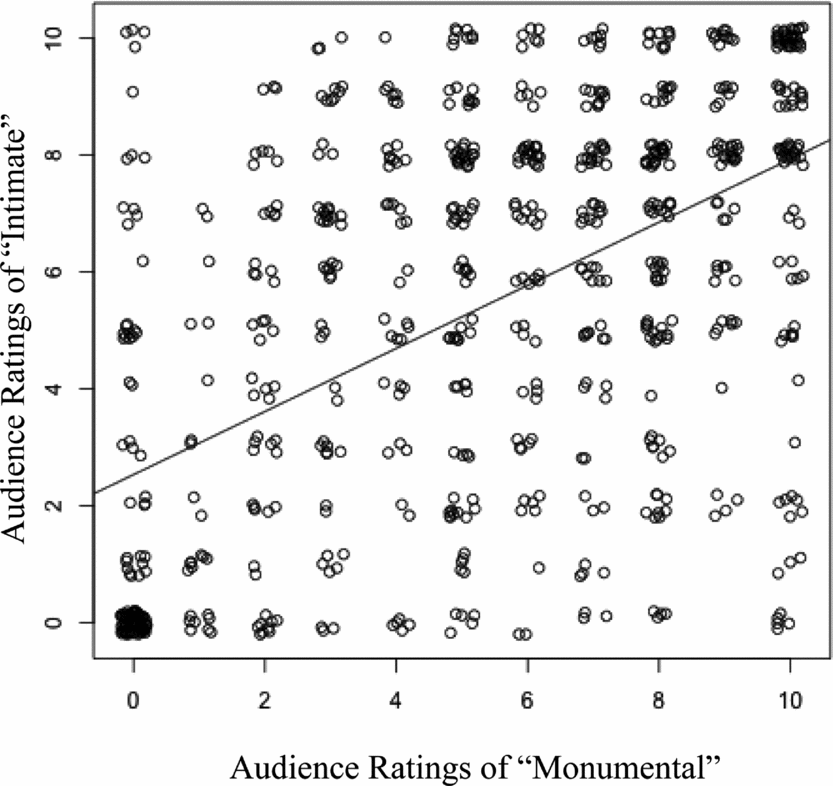
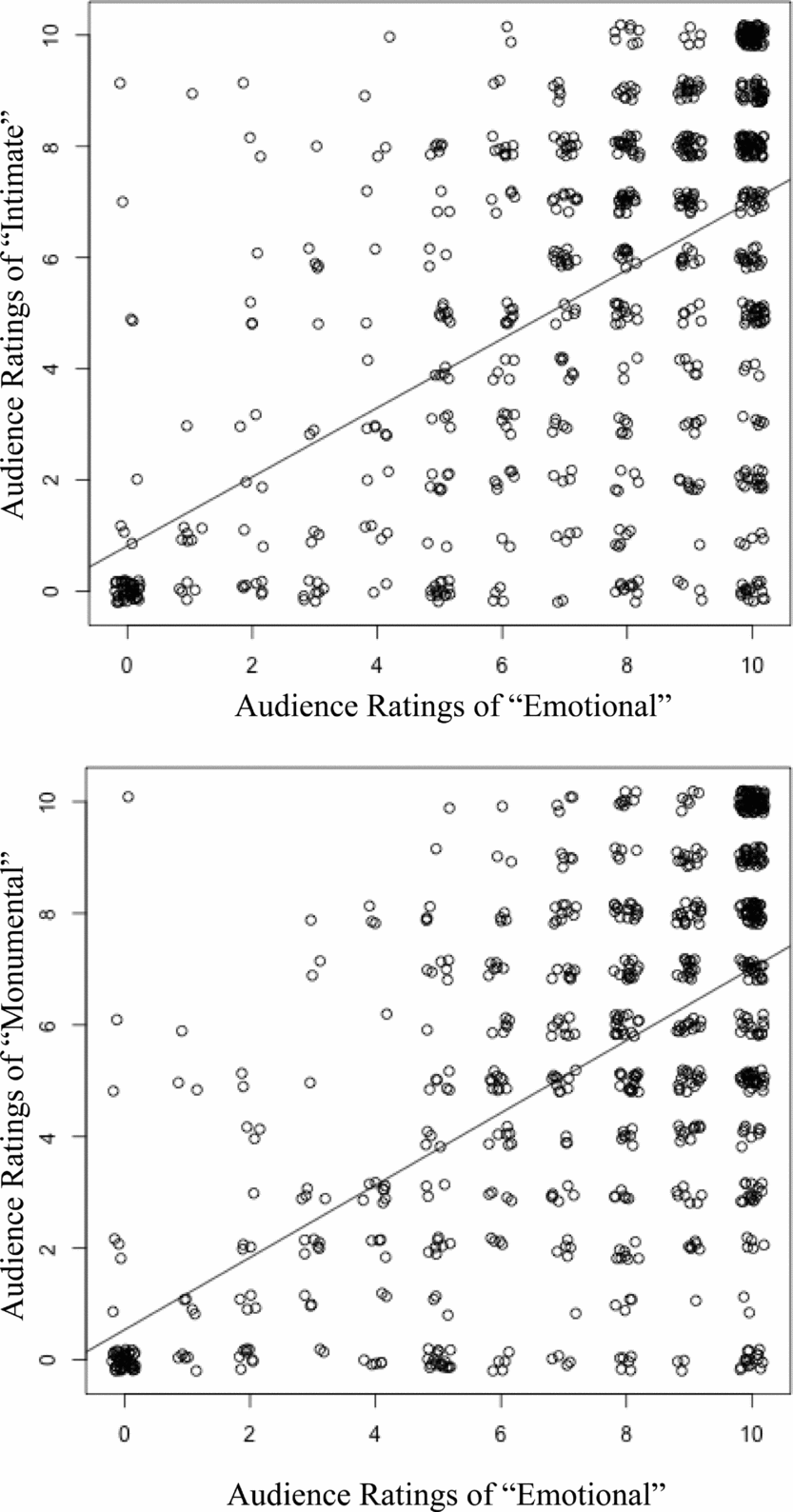
Surveyed audiences, too, felt the intimacy, though not universally. Although many rated “intimate” a zero, on the whole audiences ranked “intimate” fairly high, and “monumental” received a similar distribution of ratings (see Appendix B). A scatterplot of the two together demonstrates that many rated “intimate” and “monumental” both zero, or rated both ten, suggesting that the two adjectives are anything but mutually exclusive (Figure 2). The scatterplot shows the relative frequency of responses to both adjectives, where each audience member's rating of “monumental” and of “intimate” is depicted by a hollow circle; the darker the coordinate on the scatterplot, the more frequently audience members gave that particular pair of numeral ratings for “monumental” and “intimate.” “Monumental” and “intimate” were not only correlated, but also were the two adjectives most correlated with responses to the work as “emotional,” suggesting that the monumentality and intimacy of the worked together to elicit emotional responses. As the scatterplots reveal, for most of those surveyed the work could not be “monumental” or “intimate” without being equally or more “emotional” (Figure 3).Footnote 54
Audience ratings of “intimate” vs. “monumental” to describe John Adams's On the Transmigration of Souls.
Audience ratings of “intimate” vs. “emotional” and “monumental” vs. “emotional” to describe John Adams's On the Transmigration of Souls.
The work prompted an intimate response as many listeners reflected on those who were close to them. Some had friends in New York and recalled the worry they felt on 9/11, and a few knew victims of the attack, but many also projected the emotions onto their own families and communities. One listener said the work “reminded me of father's passing and last moments with him.”Footnote 55 Here, a memorial to a larger tragedy helped this listener to create a private memorial for a different moment of loss. Another, in reflecting on loved ones who had recently passed away, sought to “make a connection between my own personal grief and that of the recorded voices (since I knew of no one who died in the terrorist attacks personally).”Footnote 56
Although modern memorials frequently emphasize individual and personal responses, they do so within a public and collective framework. Visitors to a public memorial site use that memorial to extrapolate and contextualize their personal experience in a variety of ways. 9/11 reinforced and emboldened statements of U.S. national identity but it also elicited local and international responses as well. Responses to 9/11 cut across religious, political, racial, and other cultural lines, redefining U.S. identity in the process. Several audience members found empathy a powerful tool to create a sense of local and national identity “Those were my people on 9/11,” wrote one audience member; another suggested that the work perfectly captured “our loss—not just 3,000 lives but also our national innocence.”Footnote 57 Their language, “my people” and “our loss,” is inclusive, invoking a shared ethos, one of the cornerstones of national identity. Others found in the work an even broader, global sense of community and were prompted to reflect on a number of other tragedies, including the Syrian civil war, Hurricane Katrina, AIDS, Rwanda, Los Desaparecidos, the Holocaust, Hiroshima, and Kent State. Two audience members reflected not simply on global tragedies but on the role of the memorial in drawing attention to human loss. “Who will pen a memorial for the people of Iraq?” asked one audience member, and another mused, “Still, it also prompted me to wonder what kinds of tragic events merit and/or receive commemoration, especially in musical works of this caliber and stature.”Footnote 58
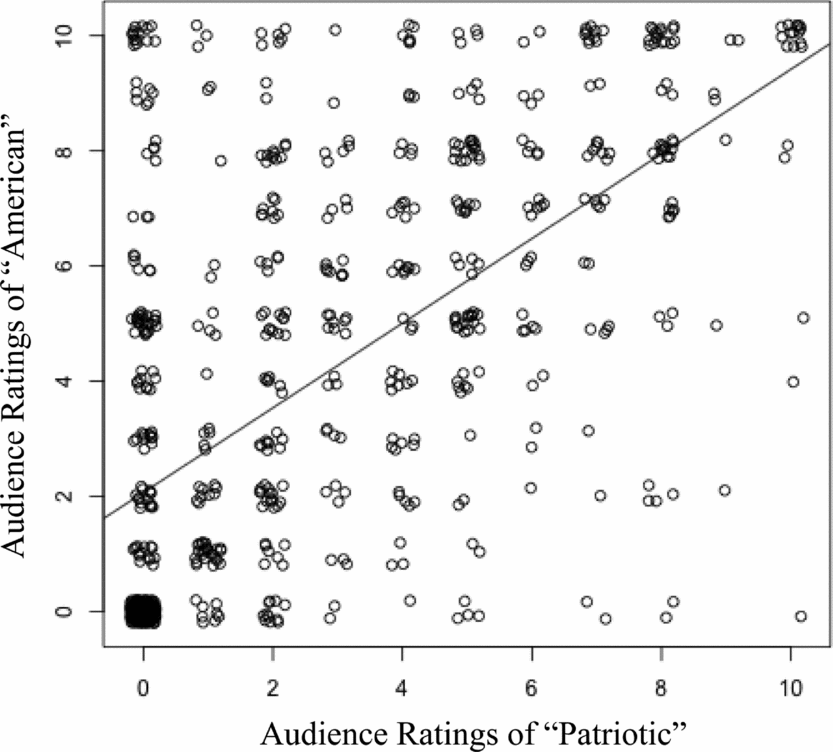
These responses differed from what audiences conveyed on the surveys as their expectations, which largely centered on patriotic sentiments. For some, this was a disappointment; at the performances in Madison, Wisconsin and Elgin, Illinois, On the Transmigration of Souls was performed alongside “The Star-Spangled Banner,” which not only heightened the somber nature of Adams's work but also drew raves from several in attendance as a more appropriate gesture of remembrance. One listener in Madison claimed that On the Transmigration of Souls “made me stand up and almost SHOUT the national anthem . . . to get the huge bad taste out of my senses.”Footnote 59 For others, a perceived lack of overt patriotism was a relief, particularly for those who felt overwhelmed by such displays elsewhere. A second audience member in Madison remarked, “[I] thought it would be trying to inspire patriotism in me. I was so glad that I felt it did not manipulate me in that way. I got so tired of how 9/11 events were eventually used to promote hyper-patriotism and justify wars.”Footnote 60 Nearly 40% of audience members surveyed gave “patriotic” a rating of zero, and nearly 30% scored “American” a zero (see Appendix B). Responses to “American” and “patriotic” were among the highest correlations on the survey.Footnote 61 A scatterplot demonstrates that although several rated “American” higher than “patriotic”—including a prominent cluster of audience members who rated the work a ten for “American” and a zero for “patriotic”—very few rated “patriotic” higher than “American.” This suggests that many listeners still conceive of patriotism as a central subset “American” identity, but for others it is possible to be “American” without being overtly patriotic (Figure 4).
Audience ratings of “American” vs. “patriotic” to describe John Adams's On the Transmigration of Souls.
Adams consciously avoided what he called “the Coplandesque brand of sentiment,”Footnote 62 explaining that he opposed “lockstep, unquestioning patriotism” and what Philip Roth has termed the “kitschification” of 9/11.Footnote 63 But his position on crafting a distinctly “American” work is more complex. He accepted the commission because he felt that “America, quite possibly the world's most fertile and creative musical culture during the twentieth century, did not have a single orchestral work that could satisfy the need for collective emotional experience.”Footnote 64 Adams cites the use of Brahms's Ein deutsches Requiem, Mahler's Resurrection Symphony, and Beethoven's Eroica Symphony as great works U.S. citizens have turned to in times of tragedy. By contrast, U.S. music has fallen short, Adams argues, producing only small statements: Ives's The Unanswered Question, Barber's Adagio for Strings, and Copland's Quiet City. Are the Enlightenment profundities of Beethoven or the “yearning spiritual quests” of Mahler “no longer possible in our more ironic and painfully self-conscious contemporary climate?” he asks, implying a desire to recapture them.Footnote 65
Charles Ives, The Unanswered Question, mm. 16–17.

John Adams, On the Transmigration of Souls, mm. 46–50.
Perhaps Adams's closest link to a specifically national response is represented in the quotation and allusion to two of the works he praises. Adams repeatedly draws on The Unanswered Question, which, like the Adams piece, layers musical worlds: a questioning trumpet, “answered” by a quartet of flutes, and an offstage string quartet that represents “the silence of the Druids, who know, see, and hear nothing,” according to Ives's accompanying text. The iconic “question” posed in the trumpet is alluded to by an offstage trumpet at m. 44, which plays a transposition of the final four notes of Ives's theme at m. 49 (Examples 1a and 1b). The trumpet solo at mm. 57–59 bridges its allusion to The Unanswered Question with a paraphrase of Aaron Copland's Quiet City (Examples 2a and 2b). The strings—onstage, inverting Ives's original conception—quote directly from The Unanswered Question at several places, starting at m. 27, with its fullest yet most fractured quotation reserved for the end at m. 445, after the second climax has subsided and the cityscape audio track returns. Here the pure triads of Ives's string writing fade in and out, as if heard on a distant radio signal, or like the flashing beam of a lighthouse.Footnote 66
Aaron Copland, Quiet City, one measure before Rehearsal 2.

John Adams, On the Transmigration of Souls, mm. 56–60.

Ives and Copland are two of the most emblematically U.S. composers, but in turning to Ives at his “most elevated philosophical mode” and to Copland at his most reflective, Adams ultimately tempers his original nationalistic goals toward something that is at once more intimate and more universal.Footnote 67 His characterization of the work as a “memory space” suggests such an aim for the work. Furthermore, Adams did not include any specific references to the United States or to 9/11 in the title or text of the work. Audience members who attended concerts where the conductor did not preface the performance with spoken remarks and who did not read the programs notes frequently commented that they did not know the work was a 9/11 piece until they read my survey or the notes afterwards, helping to explain how audiences found themselves contemplating such a broad range of global and historical tragedies while listening.
In her work on memorialization in the United States, Marita Sturken theorizes that cultural memory of times of trauma produces “a field of contested meanings in which Americans interact with cultural elements to produce concepts of the nation . . . where both the structures and the fractures of a culture are exposed.”Footnote 68 Calls for national unity are a commonplace reaction following traumatic events like 9/11, when the nation feels most vulnerable; however, as David Simpson's critique of the “Portraits of Grief” series attests, unity comes at a cost. For instance, the NAACP called “for people to put aside differences and for people to rally around things we have together such as family and faith” after 9/11, yet differences like race, faith, and political views quickly became points of exclusion.Footnote 69 Memorials can help overcome cultural difference rather than simply overlook it by avoiding a singular national perspective and instead embracing and connecting individual perspectives. The system of “meaningful adjacencies” provides a compelling example, and the diverse and thoughtful comments about the politics of naming and representation in On the Transmigration of Souls suggest musical memorials can similarly foster awareness of differences in post-9/11 U.S. identity.
Conclusion: Hearing Community around On the Transmigration of Souls
In Precarious Life: The Powers of Mourning and Violence, a collection of essays meditating on 9/11, Judith Butler articulates the importance of connection through tragedy:
Many people think that grief is privatizing, that it returns us to a solitary situation and is, in that sense, depoliticizing. But I think it furnishes a sense of political community of a complex order, and it does this first of all by bringing to the fore the relational ties that have implications for theorizing fundamental dependency and ethical responsibility.Footnote 70
Memorials continue this work, seemingly private and intimate spaces that nevertheless confront visitors with other mourners and the public evidence of their experiences. Musical memorials, however, can be significantly more challenging. Given that physical memorials encourage active participation, how might the concert hall serve not just as a “memory space” but also as a site of memorialization that allows for dialogue and individual participation? What powerful ideas of citizenship and collective identity might emerge if audience members were to share their perspectives with one another, creating new meaningful adjacencies?
The reactions raised within my surveys suggest an interest in—and in some cases even a need for— a space for discussion within a community. In evaluating On the Transmigration of Souls, audiences frequently considered broader implications of memorializing 9/11. Many commented not simply on Adams's composition, but on the performances it was paired with— Beethoven's Symphony No. 5 and Symphony No. 9, Brahms's Ein deutsches Requiem, and “The Star-Spangled Banner” among them—which effectively functioned as memorials as well in this performance context. Others used the Adams to conclude more abstractly or reflectively about what a musical memorial of 9/11 should or should not sound like. In many cases, the comments were relevant to a larger public discourse not simply aesthetically but politically too. For instance, my survey offered participants a forum to air contentious and germane political concerns about war and patriotism in a post-9/11 United States:
[I] experienced profound sadness, sorrow—our country's reaction to 9/11—with great fear we responded and recent history shows the results. How differently it all might have been if we had responded with great love.
[I] thought it would be trying to inspire patriotism in me. I was so glad that I felt it did not manipulate me in that way. I got so tired of how 9/11 events were eventually used to promote hyper-patriotism and justify wars
I was disturbed late in the piece when I heard the chorus sing, almost chant-like, “Lies!” Later, I realized they were singing “Love” and “Light,” but that is not what it sounded like at the time. Given the anger and backlash the Muslim community felt, this deeply troubled me and I honestly felt repulsion and offended. . . . What a transition then when the MSO played the national anthem, which felt like a cleansing act.
This has none of the hope of the Brahms. If there is no God, then Adams had it right. Otherwise, Brahms did.
A graphic documentation that will inspire future jihadists. Between the lines the composer was saying we deserved this. This type of piece would only be brace and interesting if he had to write it in a country without freedom.
Little more than a soundtrack to events and terrible destruction. It was literal, lacked a hopeful resolution and reflected a bias of guilt, not grief or healing. Who paid for this self-indulgent sound poem? Probably my taxes?
Garbage, awful, disgrace to the USA. This might be the most misguided piece of music I've ever heard.Footnote 71
Much insight could be gained by offering audiences, performers, and administrators the opportunity to share with and learn from one another. Several performances featured a pre-concert lecture, but none offered a post-concert discussion, akin to a theater performance's “talkback,” where audiences could have more authority to offer informed feedback and share their experiences. Some orchestras have created online “virtual lobbies,” which could similarly invite participation in the memorial process.Footnote 72 As orchestras consider programming and media, they might also consider New York City radio stations WNYC and WXQR, which observed the tenth anniversary of 9/11 by soliciting and playing listeners’ suggestions for the music they wished to share with fellow New Yorkers for the occasion.Footnote 73
Memorials not only elicit different readings for different viewers, but may also elicit different readings for the same viewer upon multiple visits. One performer eloquently recounted her and her husband's different responses to On the Transmigration of Souls:
Through our intensive rehearsals, I found the Adams so challenging technically that I wasn't really able to realize its emotional freight until very late in the arc of preparation and performance. However, by the penultimate night of our three concerts in Denver, I had a breakthrough. From the “Light” sequence on, I was suddenly overwhelmed with a vivid mental image: that of the Towers, gleaming, blazing, falling in billows of white smoke and ash. . . . In contrast, my husband heard the piece for the first time that weekend, and his response sharpened my impression that the work is almost impenetrable on first exposure. As it ended, he was mostly unmoved. What he'd heard was a cacophony of sound from which few words of meaning emerged, and no memorable tonality remained after the last chord had died out. Therefore, I'm convinced that, except perhaps for the rare individual, the piece best repays the repeat listener (or performer). Many of my choral cohort reacted as I did, and some only began to get the emotional payoff late in the final performance.Footnote 74
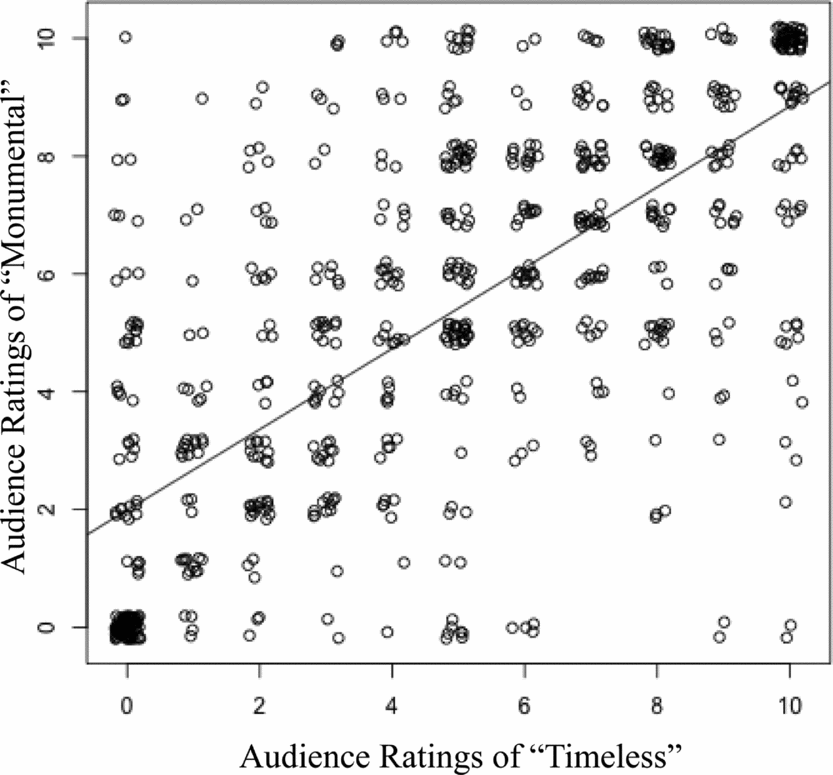
Like other memorials, the music encourages repeated reflection, something Adams invites when he ends the work with the same soundscape that begins it; mourning is not a task quickly dispensed with. Likewise, it is imperative to consider how the work will change with time. Surveys reveal a divided public on the question of how “timeless” On the Transmigration of Souls is (see Appendix B). The rating of “timeless” was strongly correlated with “monumental”—the only two that were strongly correlated in my survey—suggesting that monuments are first and foremost meant to last, and that many might base the success of On the Transmigration of Souls as a monument to 9/11 on whether it maintains a lasting presence in performance (Figure 5).Footnote 75 Adams's use of a children's choir suggests an interest in involving a new generation in the process of memorializing, and audience members most often drew hope or conjured up a sense of innocence upon hearing their voices, although some wondered what it meant to them to sing about a barely remembered event. One audience member reflected on her experience of overhearing children in the audience: “Two young girls attended the concert—ages 7 and 9! Sat behind us with their grandpa. They asked many questions during the first few minutes. How does one teach children of disasters such as 9/11? Is this piece appropriate for children? No easy answers!”Footnote 76
Audience ratings of “monumental” vs. “timeless” to describe John Adams's On the Transmigration of Souls.
Indeed, there are no easy answers to the questions of how and why we memorialize, or easy ways to understand the memorials we encounter; our collective demands on them are too complex. Concert halls can and should serve as sites for communities to participate in memorializing; likewise, scholars can similarly open approaches to memorial works by attending to the rich, polysemic meanings they offer. There is certainly no shortage of examples of musical memorials that employ multiple texts or perspectives as a central strategy: tribute albums, benefit concerts, the WNYC and WQXR 9/11 playlist, and collaborative compositions like Le Tombeau de Claude Debussy that engage multiple voices in a single commemoration, or the multi-source musical and textual compilations that constitute Richard Wernick's Kaddish-Requiem, Arthur Bliss's Morning Heroes, Steven Stucky's August 4, 1964, or perhaps most iconic of all, Benjamin Britten's War Requiem. But hearing the audience's many voices is just as important as hearing the composers’, and musicological scholarship benefits from addressing further aspects of performance and reception.
One promising model is James Herbert's essay on the inescapable and mutual tension between faith and skepticism in which he analyzes twin memorial objects, Britten's War Requiem and Coventry Cathedral, both of which navigate between past and post-war present. Herbert delivers a nuanced examination of how juxtapositions both within and between each shade the religious meanings found within:
Yet the War Requiem abjures the clarity of the cathedral's stringent polemic, for the musical composition allows for a reciprocity of inflection between the two juxtaposed sides; either can turn on the other. The fact that this requiem was composed for this cathedral on this occasion constitutes on its own an intriguing and knotty inversion of poles. When the chaos of modern warfare plays itself off against the (perhaps no longer) eternal verities of the church and does so within a setting dedicated to the proposition that the modern church can overcome the destructiveness of past wars, then neither the modern nor the ancient, neither the comfortably whole nor the perspicuously fragmented, can unambiguously assume the mantle of moral authority.Footnote 77
For performances of On the Transmigration of Souls, similar tensions proliferate: between the timeless concert hall and the street sounds that fill it in Adams's work, between the comfort of tradition heard in Beethoven and Brahms and the modern dissonance of Adams. Herbert concludes that these tensions produce many interpretations of the War Requiem, leaving us powerless to adjudicate between them.Footnote 78 The richness of Herbert's comparisons lies in their messiness and disunity, in the way they open up questions he cannot answer, an approach more in line with the process of memorialization than a more tightly argued analysis might suggest.
This approach of eschewing a single reading may be most obviously suited to works like the War Requiem or On the Transmigration of Souls, which draw from multiple sources and juxtapose or overlap different sonic ideas, but is not limited to these. Luke Howard's work tracing the reception history of far more unified memorial works, such as Henryk Górecki's Symphony No. 3 and Barber's Adagio for Strings, uncovers a surprisingly complex history of public attitudes toward both the works in question and memorials in general. Howard describes Górecki's symphony as “an audible Rorschach test,” with audiences hearing “the musical allusions they wanted to hear.”Footnote 79 Audience expectations of and responses to On the Transmigration of Souls have likewise provided much fodder for my own inquiry, and have demonstrated the malleability of meaning and its independence from authorial intent and control.
Furthermore, scholarly examination of musical memorials is well poised to make the case that physical memorials should be understood as a process, a continually unfixed object where meanings are constructed simultaneously by a diverse public. Much has been written about physical memorials as iconographic or architectural objects; far less attention has been devoted to memorials as spaces that viewers move through, interact with, and change. Environmental factors, such as time of day, season, or weather impact the visual experience of memorials like the Vietnam Wall, as might the presence of flags, wreaths, flowers, photographs, cards and other official or unofficial ceremonial objects. Both Herbert's and Howard's works consider musical memorials similarly, not as fixed scores but as sites of memorialization and meaning-making that change over time.
While pondering how memorials are encountered and understood, I read one audience member's concern following a performance of On the Transmigration of Souls that crystallized my own reasons for undertaking this project:
During the break my girlfriend and I sussed it up pretty quickly: we were surprised with how literal the piece was, and this was a bad thing. All the choices were made for us. This had a lot to do with the soundbites and the literal (read: too obvious and lacking poetics) nature of the choral lyrics. Everyone should have the opportunity to remember the events of 9/11 in their own way, and Adams didn't allow the listener to do that. It's expected that the composer needs to lead the listener into an experience, but once led into that space, and wrestling with that content, the listener should have more agency to interpret the music (or dance, or poetry, or sculpture, etc.) as suits him/her. The Transmigration piece was far too literal, far too obvious, far too directed. That actually offends me as an audience member. Offends me because I want to participate. That doesn't mean I need to pick up a flute and blow, but rather that I want to play a role in my own cognitive and affective experience of the work. There was something about this piece that I felt didn't permit that. The work was too narrow. I had hoped for something that offered more psychological spaciousness for me to explore.Footnote 80
What struck me about this note was not that one listener walked away feeling somewhat manipulated and forced by the music (in fact, several others felt similarly) but that his concerns echoed so well my own goals for opening a space for audience involvement within scholarship on musical memorials and for embracing the multiplicity of potential readings. That so many audience members had so much to say and wanted to participate in the process of memorializing 9/11 seems the perfect complement to the polyvocal, open-ended, and reflective composition Adams created. A community of scholars and performers can do a great service by opening up performances of these works as moments of dialogue, by seeking out the questions and tensions rather than offering answers in the form of program notes or lectures. Attending to the disunity of both the memorial and the community heightens the understanding of the complexity of the connections found therein, thereby fulfilling Butler's concept of an “ethical responsibility” of memorializing, a process begun by the composer but only realized by a community gathered together to reflect, remember, and respond.
Appendix A: Sample Survey distributed by the author at performances of John Adams's On the Transmigration of Souls
1) On a scale from 0 (not at all) to 10 (completely), how well do the following words describe your impression of the piece?

2) What other words, images, or memories came to mind while listening?
3) What message, if any, did the piece deliver to you?
4) What message, if any, did you expect the piece to deliver to you?
5) If you have any other thoughts, please share them below.

Surveys were collected at performances of the work by:
• The Colorado Symphony Orchestra, Denver, CO, 28–30 May 2010.
• The Harvard-Radcliffe Orchestra and Harvard Glee Club, Cambridge, MA, 29–30 April 2011.
• The Elgin Choral Union, Elgin, IL, 11 September 2011.
• The Madison Symphony Orchestra, Madison, WI, 16–18 September 2011.
• The University of Northern Iowa Concert Choral, Women's Chorus, and Northern Iowa Symphony, Cedar Falls, IA, 11 October 2011.
• Detroit Symphony Orchestra and UMS Choral Union, Detroit, MI, 24–26 February 2012.
Language varied somewhat between surveys.
Appendix B: Collected Results of Audience Ratings of Adjectives describing John Adams's On the Transmigration of Souls
Survey responses to rating On the Transmigration of Souls as “American”
Survey responses to rating On the Transmigration of Souls as “cathartic”
Survey responses to rating On the Transmigration of Souls as “disturbing” Note: “disturbing” was not included on surveys conducted at performances in Denver or Harvard.
Survey responses to rating On the Transmigration of Souls as “emotional”
Survey responses to rating On the Transmigration of Souls as “intimate”
Survey responses to rating On the Transmigration of Souls as “monumental”
Survey responses to rating On the Transmigration of Souls as “patriotic”
Survey responses to rating On the Transmigration of Souls as “somber”
Survey responses to rating On the Transmigration of Souls as “spiritual”
Survey responses to rating On the Transmigration of Souls as “tasteless”
Survey responses to rating On the Transmigration of Souls as “timeless”
Survey responses to rating On the Transmigration of Souls as “uplifting”
Appendix C: Names and Text used in John Adams's On the Transmigration of Souls
Missing
Remember
We will miss you . . .we all miss you . . .we all love you.
I'll miss you, my brother, my loving brother.
It was a beautiful day.
You will never be forgotten.
She looks so full of life in that picture.
I see water and buildings
The windows on the World
A gold chain around his neck, a silver ring . . . his middle finger . . . a small gap . . . his two front teeth . . . a little mole on his left cheek . . . a wedding band . . . a diamond ring.
Charlie Murphy. Cantor Fitzgerald. 105th Floor. Tower One North.
Weight: 180 pounds. Height: 5’11”. Eye color: hazel Hair color: brown. Date of birth: July ninth, 1963. Please call . . . ‘We love you, Chick.’
Louie Anthony Williams. One World Trade Center. Port Authority, 66th Floor. ‘We love you, Louie. Come home.’
The sister says: “He was the apple of my father's eye.”
The father says: “I am so full of grief. My heart is absolutely shattered.”
The young man says “He was tall, extremely good-looking, and girls never talked to me when he was around.”
Her sister says: “She had a voice like an angel, and she shared it with everyone, in good times and bad.”
The mother says: “He used to call me every day. I'm just waiting.”
The lover says: “Tomorrow will be three months, yet it feels like yesterday since I saw your beautiful face, saying, ‘Love you to the moon and back, forever.’”
The man's wife says: “I loved him from the start. . . . I wanted to dig him out. I know just where he is.”
Light . . . Day . . . Sky . . . Love
My sister.
My brother.
I love Dave Fontana.
My daughter.
My son.
I see water and buildings
I love you.