INTRODUCTION
Chagas' disease, the causative agent of which is the protozoan Trypanosoma cruzi, is one of the main health problems in Latin American countries, affecting approximately 18 million people. Infection with T. cruzi results in an acute phase, followed by an indeterminate asymptomatic phase. Several decades after the initial infection, approximately 30% of infected individuals become chronic and develop progressive heart or digestive disease (WHO, 1999). Cardiac involvement is characterized by degeneration and loss of cardiac myocytes, tissue parasitism, mononuclear cell infiltration, fibrosis, hypertrophy and hyperplasia of the myocardium (Higuchi et al. 1987; Arnaiz, Fichera and Postan, 2002). However, the mechanisms responsible for the structural changes of the pathology remain unknown. Moreover, the lack of a vaccine and the absence of consensus about chemotherapy efficacy in the chronic phase of the infection are other factors that prevent circumventing this endemia.
In the mammalian host, T. cruzi displays the extracellular and non-replicative bloodstream trypomastigote and the intracellular replicative amastigote forms. Mammalian cell recognition, adhesion and penetration by trypomastigotes are mediated by parasite surface attachment molecules, most of them belonging to the trans-sialidase (TS) protein superfamily (Schenkman and Eichinger, 1993; Frash, 2000). These antigens are also implicated in other important functions such as immune response modulation (Frash, 1994; Norris and Schrimpf, 1994; Wizel, Nunes and Tarleton, 1997; Millar and Kahn, 2000) and pathogenesis (Mucci et al. 2002; Joensen et al. 2003; Tribulatti et al. 2005).
Cumulative evidence has shown that immunoprotection during T. cruzi infection in humans and mice is mediated by CD4 Th1 and CD8 Tc1 cells, which exert their antiparasitic effect, in part, by secreting gamma interferon (IFN-γ) (Wizel, Nunes and Tarleton, 1997; Rodrigues et al. 1999; Martin and Tarleton, 2004). Genetic immunization generates both major histocompatibility complex (MHC) class I- and II-restricted T cell responses (Nagata et al. 2004) and CpG motifs present in plasmid DNA induce a series of immunomodulatory cytokines such as interleukin 12 (IL-12) and IFN-γ, promoting a Th1 immune response (Chu et al. 1997). For this reason, this strategy has been extensively used for experimental vaccination in T. cruzi infection and several authors have reported protective immunity by DNA immunization with plasmids containing genes encoding for members of TS superfamily (Wizel, Garg and Tarleton, 1998; Garg and Tarleton, 2002; Boscardin et al. 2003).
Tc13 is a TS family protein bearing 5 amino-acid (EPKSA) repeats at its C-terminal region. Tc13 antigens are expressed in the surface of amastigotes and trypomastigotes (Souto-Padron et al. 1989; Campetella et al. 1992) and we have recently defined 2 Tc13 subfamilies according to the presence or absence of GPI addition site, indicating that some members may be shed into the medium (García et al. 2003). We have also described that a Tc13 member of Tulahuén strain of T. cruzi (Tc13 Tul) interacts with β1-adrenergic receptor through the EPKSA portion and displays an agonist activity in vitro (Joensen et al. 2003; García et al. 2003). While this suggests that Tc13 may participate in the pathogenesis of Chagas' disease, it still remains to be determined if this effect is produced in vivo, where surface-attached and secretory Tc13 populations are expressed at the same time and the host immune response is playing a crucial role in controlling the infection. The characterization of the immune response elicited by Tc13 antigens is critical to the understanding of the role of Tc13 molecules in the outcome of T. cruzi infection. This led us to study the effects of Tc13 Tul administration of plasmid DNA to BALB/c mice in order to evaluate the immune response elicited, the histopathological changes of T. cruzi target organs and the capability to confer protection in the acute and chronic phases of the experimental infection.
MATERIALS AND METHODS
Mice and parasites
Six- to eight-week-old female BALB/c mice were used in all the experiments. Parasites of the Tulahuén strain, stock Tul2 of T. cruzi were used in this study. Bloodstream trypomastigotes were maintained in vivo by serial passage of blood-form trypomastigotes in BALB/c mice. For DTH and ELISA assays, trypomastigotes were collected from the extracellular medium of infected monolayers of VERO cells.
Animal handling and experimental design conform to the ethical treatment of animals established by the Argentinean Animal Protection Society.
Plasmid construction
Tc13 Tul #5 clone (GenBank Accesion no. AF092099) (García et al. 2003) subcloned in pQE31 (Qiagen) was excised with BamHI and KpnI and its 3′ protruding end was digested with T4 DNA polymerase according to standard protocols. The fragment obtained was ligated with pcDNA 3·1 (+) (Invitrogen) cut with BamHI and EcoRV. A 5′ adapter containing the ATG codon and Kozak sequence (5′-AGCTTGCCACCATGGCG-3′/5′-GATCCGCCATGGTGGAC-3′) was inserted in HindIII/BamHI sites of the recombinant plasmid. Adapter insertion was confirmed by PCR using the forward chain of the adapter and a Tc13 Tul reverse primer. Automatic DNA sequencing of all the constructions was performed using the BigDye Terminator Cycles Sequencing Kit (Perkin-Elmer) on an ABI PRISM 377 sequencer (Perkin-Elmer).
Plasmids were produced in E. coli XL1-Blue and purified by Plasmid Mega-kit (Qiagen). DNA concentration was estimated by OD260nm and confirmed by agarose gels stained with ethidium bromide. Each plasmid was diluted in sterile PBS at a concentration of 1 mg/ml.
In vitro and in vivo gene expression
In vitro expression of Tc13 Tul antigen was assessed by transient transfection of COS7 cells with pcDNA-Tc13 Tul. Transfection with pcDNA and pcMβ (Clontech) were used as negative and positive controls, respectively. Briefly, COS7 cells were seeded at a concentration of 1·8×104 cells/well in 24-well plates containing a cover-slip on the bottom of each well. After 24 h cells were transfected with each plasmid DNA (2 μg/well) using the Promega Protection Kit (Promega) according to the manufacturer's instruction. Cover-slips containing the adhered cells were harvested after 48 h of incubation and cells were fixed with ice-cold methanol and blocked with 1% skimmed milk in PBS. After the blocking step, COS7 cells transfected with pcDNA3.1-Tc13 Tul and pcDNA were probed with rabbit serum anti-EPKSA repeats (1[ratio ]50 dilution) (kindly given by Dr Campetella, Instituto de Investigaciones Biotecnológicas, Universidad de San Martín, Buenos Aires, Argentina) or normal rabbit serum as control. After washes, cells were incubated with anti-rabbit immunoglobulin biotinylated (1[ratio ]100 dilution, Dako) and then stained with fluorescein conjugated streptavidin (1[ratio ]100 dilution, Vector Laboratories). For pcMβ transfection positive control, cells were incubated with an anti-β galactosidase monoclonal antibody followed by FITC-conjugated anti-mouse IgG (Sigma). Slides were mounted in buffered glycerin and visualized by fluorescence microscopy with a magnification of ×400.
To evaluate in vivo expression of Tc13 Tul antigen, 30 μg of plasmid DNA (pcDNA-Tc13 Tul or pcDNA as control) were injected by intra-muscular route into the Tibialis anterioris of female BALB/c mice. Ten days after inoculation animals were killed and the inoculated muscle was dissected and immediately fixed in 10% buffered formalin for 24 h. Tissues were then dehydrated in absolute ethanol, cleared in xylene and embedded in paraffin. Sections, 3–5 μm thick, were mounted on silane-treated slides, de-paraffined and probed with rabbit anti-EPKSA serum or normal rabbit serum as mentioned above for the in vitro expression protocol.
DNA immunization and infection
Six- to eight-week-old female BALB/c mice (5–10 animals per group) were injected in the right Tibialis anterioris muscle with pcDNA-Tc13 Tul or with pcDNA as control. The immunization protocol consisted in 4 bi-weekly doses and a final dose applied 21 days after the fourth dose of 50 μg of plasmid DNA/mouse/dose.
Thirty-five days after the last plasmid dose, mice were infected by intra-peritoneal injection of 2×10³ bloodstream trypomastigotes of Tulauhén strain, stock Tul2. Mice were approximately 6 months old at the moment of the infection. Parasitaemia was determined by direct light microscopy and survival was daily recorded. Experiments of DNA immunization and infection were performed 3 times, independently, using 5–6 mice per group. Animals which survived to the acute infection were killed in the chronic phase, 14 weeks after challenge, being approximately 9 months old at this stage.
Measurement of delayed-type hypersensitivity (DTH)
Twenty-five days after the last immunization, 5 to 6-month-old mice were injected in their footpads with trypomastigote lysates from culture-derived T. cruzi (50 μg/mouse in 30 μl). Footpad induration was measured with a micrometer (Mitutoyo) 24 and 48 h after the lysate injection. Experiments were performed 3 times, independently, with 3–5 mice per group.
Measurement of antibody response
The presence of anti-T. cruzi IgG antibodies in serum samples from immunized and non-immunized mice was evaluated by enzyme-linked immunosorbent assay (ELISA) using recombinant Tc13 Tul fused to maltose binding protein (MBP-Tc13 Tul) (5 μg/ml) (or MBP, 2 μg/ml, as control) and trypomastigote or epimastigote lysates (20 μg/ml) as source of antigen. Sera were collected 21 days after the last immunization.
Briefly, flat-bottomed (96-well) plates (Immulon 2, Dynatech) were coated overnight at 4 °C with 50 μl/well of each antigen diluted in PBS. Plates were blocked for 1 h at RT with 100 μl/well of 5% skimmed milk in PBS. After being washed 3 times with PBS-0·05% Tween20 (PBS-T), plates were incubated for 1 h at RT with pooled sera (50 μl/well) added in 2-fold dilutions beginning at 1[ratio ]20. When using MBP-Tc13 Tul or MBP as antigens sera were diluted in PBS-1% skimmed milk with 20 μg/ml of MBP for competence. After washes, plates were incubated for 1 h at RT with 50 μl/well of horseradish peroxidase-labelled goat anti-mouse IgG (Jackson) diluted 1[ratio ]2000 in PBS-1% skimmed milk with the addition of 10 μg/ml of MBP in case the recombinant proteins were used as targets. Colour was developed with 50 μl/well of o-phenylenediamine dihydrochloride (OPD), and optical density was read at 490 nm with an ELISA microplate reader (Dynatech).
ELISPOT assay for the detection of Tc13-specific IFN-γ-producing cells
The enzyme-linked immunospot (ELISPOT) assay was used to quantitate IFN-γ secreting cells after stimulation with recombinant MBP-Tc13 Tul or MBP alone as control. Nitrocellulose-coated 96- well plates (Millipore Corp.) were incubated with 100 μl/well of anti-mouse IFN-γ antibody (BD Biosciences) 5 μg/ml in sterile PBS overnight at 4 °C, washed with PBS and blocked with RPMI-10% Fetal Bovine Serum (FBS) for 2 h at RT. Spleen cells of non-immunized and immunized mice were collected 21 days after the last immunization (age of mice: 5–6 months old) and plated in duplicate at 4×10⁵ cells/well in wells containing 100 μl of either RPMI-10% FBS, MBP 6·8 μg/ml or MBP-Tc13 Tul 20 μg/ml and incubated overnight at 37 °C, 5% CO2. As a positive control, cells were plated with 5 ng/ml phorbol myristic acetate (PMA) and 500 ng/ml ionomycin. Plates were washed twice with H2O and 3 times with PBS-T and then incubated with 100 μl of biotinylated anti-mouse IFN-γ (BD Biosciences) 2 μg/ml overnight at 4 °C. Afterwards, plates were washed 3 times with PBS-T and incubated with 100 μl of peroxidase-labelled streptavidin (Kirkegaard & Perry Laboratories) diluted 1[ratio ]500 during 1 h 30 min at RT. Individual IFN-γ producing cells were detected as dark spots, after 15 min of colour development with 3-amino-9 ethylcarbazol (Sigma) dissolved in 0·1 mol/L sodium acetate buffer (pH 5·0) containing 0·05% H2O2. Spots were counted using a stereoscopic microscope (Carl Zeiss). The mean number of spots in duplicate wells was obtained for each condition.
Histopathological analysis
Mice immunized with pcDNA-Tc13 Tul or pcDNA and a control group without immunization were sacrificed 19 weeks after the last immunization. Mice immunized with pcDNA-Tc13 Tul or pcDNA chronically infected with T. cruzi and a non-immunized chronically infected control group were killed 14 weeks after challenge. All mice were approximately 9 months old at the moment of killing.
Mice were anaesthetized with ether, bled by eyeball puncture for serological studies and killed by cervical dislocation. Complete autopsies and histopathological analyses were performed on immunized and/or infected and uninfected control mice. Heart, skeletal muscle, liver and spleen were removed and fixed in 10% buffered formalin, dehydrated in absolute ethanol, cleared in xylene and embedded in paraffin. Sections (5 μm) were stained with haematoxylin and eosin and evaluated by light microscopy. Interstitial lymphocyte infiltrates in the myocardium (myocarditis) were scored according to the extent of inflammation as: normal (−); focal (+); multifocal (++); diffuse with partial wall involvement (+++) and total wall involvement (++++) (Sun and Tarleton, 1993). The scoring of skeletal muscle inflammation was based on a modification of a previously described method (Ben Younes-Chennoufi et al. 1988) as normal (−); few cellular infiltrates (+); diffuse infiltrates (++); abundant infiltrates (+++) and granulomatous infiltrates (++++). The tissue parasite burden was classified as without nests (−); 1 to 3 nests (+); 3 to 6 nests (++) and more than 6 nests (+++). Liver damage was evaluated by the presence of areas of hepatocellular degeneration or necrosis, inflammation and hyperplasia of Kupffer cells. Cellular necrosis rounded by leukocytes and fibrin was classified as normal, without lesions (−); focal, with little and isolated necrosis areas (+); multifocal, with multiple necrosis areas spreading in the liver (++) and diffuse, with multiple and big necrosis areas throughout the liver (+++). Spleen abnormalities included (a) reactive changes: subtle alteration in size and shape of lymphoid follicles without active germinal centres and (b) follicular hyperplasia: expansion of lymphoid follicles with active germinal centres with lymphoblastic and immunoblastic cells, apoptosis and mitosis.
Statistical analysis
One-way ANOVA followed by Bonferroni's multiple comparison test was used to compare the OD490s obtained by ELISA and the number of IFN-γ secreting cells obtained by ELISPOT. Repeated measures-ANOVA was used to compare induration in DTH reactions, followed by a simple effect test to study the interactions. When the interactions were significant, the Tukey test for multiple comparison procedure with α=0·05 was used. Parasitaemia were converted to ln (parasite/ml+0·5) and the curves were divided into 3 sections according to the days post-infection (p.i.) (days p.i. 0 to 15, days p.i. 15 to 31 and days p.i. 31 to 40). Each section of the curve was analysed by repeated measure experimental design with one among subjects factor (treatments) and one within subjects factor (days p.i.) and orthogonal contrasts was performed to compare their slopes and curvatures. Log-rank test was used to compare mouse survival times after challenge with T. cruzi. Two-sided Fisher exact contingency table analysis was used to compare histological findings while the Fisher exact test was used to compare pcDNA versus pcDNA-Tc13 Tul groups.
RESULTS
In vitro and in vivo expression of Tc13 Tul gene
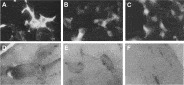
A T. cruzi gene encoding for a Tc13 antigen lacking the N-terminal portion and containing 45 EPKSA repeats from the Tulahuen strain, stock Tul2, Tc13 Tul (García et al. 2003) was cloned in pcDNA 3.1 mammalian expression vector. The expression of Tc13 Tul protein was determined in vitro by immunofluorescent staining with an anti-EPKSA repeats polyclonal rabbit serum of COS7 cells transiently transfected with the recombinant plasmid. The specific serum showed the cytoplasmic expression of Tc13 Tul (Fig. 1A). In contrast, no fluorescence was observed either after incubation of anti-EPKSA with COS7 cells transfected with pcDNA3.1 (Fig. 1B) or when pcDNA-Tc13 Tul transfected cells were stained with normal rabbit serum (Fig. 1C).

Fig. 1. In vitro and in vivo expression of Tc13 Tul. Tc13 Tul in vitro expression was evaluated by COS7 cell transfection with pcDNA-Tc13 Tul (A and C) or pcDNA (B). Two days after transfection, methanol-fixed monolayers were assayed with anti-EPKSA polyclonal rabbit serum (A and B) or normal rabbit serum (C) followed by fluorescein-labelled anti-rabbit IgG. Tc13 Tul in vivo expression was studied using female BALB/c mice inoculated with pcDNA-Tc13 Tul (D and E) or pcDNA (F) in the Tibialis anterioris muscle. Ten days after inoculation sections of skeletal muscle were assayed with anti-EPKSA poylclonal rabbit serum followed by fluorescein-labelled anti-rabbit IgG. Magnification, (A–E)×400, (F)×250.
The in vivo expression of Tc13 Tul antigen was evaluated by inoculating pcDNA-Tc13 Tul in mice skeletal muscle, followed by immunohistochemical analysis of muscle sections 10 days after inoculation, using anti-EPKSA rabbit serum as detection antibody. The specific serum recognized both cytoplasmic and membrane-associated Tc13 Tul antigens, observed as cytoplasmic spots and strengthening of plasmatic membrane, respectively (Fig. 1D and E). Muscle sections from pcDNA-immunized mice did not reveal Tc13 Tul expression (Fig. 1F) and neither did the incubation with normal rabbit serum (data not shown).
Immune response elicited by genetic immunization with Tc13 Tul
With the aim to study the immune response elicited by genetic immunization with Tc13 Tul, 6 to 8-week-old female BALB/c mice were inoculated as described in the Materials and Methods section with pcDNA-Tc13 or pcDNA as control. Mice were 17–19 weeks old at the end of the inoculation protocol.
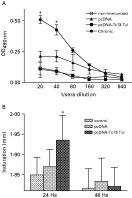
To test the ability of the Tc13 Tul antigen delivered as naked DNA to elicit a humoral immune response, pooled sera from immunized mice were evaluated for the presence of specific IgG antibodies by using recombinant Tc13 Tul as target antigen in ELISA assays. Tc13 Tul specific antibodies were not detectable in sera of animals immunized with pcDNA-Tc13 Tul (Fig. 2A). The lack of a humoral response was also observed by Western blotting against the recombinant Tc13 Tul; ELISA and indirect immunofluorescence (IFI) against trypomastigote lysates (data not shown). Conversely, non-immunized mice chronically infected with T. cruzi showed an anti-Tc13 humoral response significantly higher than non-infected animals (Fig. 2A).

Fig. 2. Humoral and cellular immune responses induced by genetic immunization with Tc13 Tul antigen. (A) Antibody production of pcDNA-Tc13 Tul or pcDNA immunized mice evaluated by ELISA using MBP-Tc13 Tul as target antigen. Sera were collected 21 days after the last immunization. Non-immunized/non-infected and chronically Trypanosoma cruzi-infected mice were used as negative and positive controls, respectively. Results are presented as the mean±S.D. of the OD490 of pooled sera from 5 mice for each group serially diluted from 1/20 to 1/640. *P<0·05 compared with non-immunized and pcDNA-Tc13 Tul immunized groups. (B) Footpad swelling in mice after local inoculation with a trypomastigote lysate. Values are presented as the mean induration (mm)±S.D. Data come from 3 independent experiments. P value by repeated measures-ANOVA=0·016371. The * indicates P<0·05 by Tukey test compared with non-immunized and pcDNA-immunized groups at 24 h post-inoculation.
In order to determine whether immunization with plasmid Tc13 Tul elicits a specific cellular immune response, delayed-type hypersensitivity (DTH) was measured 24 and 48 h after injection of a trypomastigote lysate in the footpad of immunized and non-immunized mice. By 24 h after inoculation pcDNA-Tc13 Tul immunized mice presented a cutaneous reaction significantly different from control non-immunized and pcDNA immunized groups. The footpad induration disappeared after 48 h of the lysate inoculation (Fig. 2B).
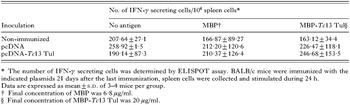
As it is well documented that IFN-γ plays an important role in protective immunity (Zhang and Tarleton, 1996; Reis et al. 1997; Martin and Tarleton, 2004), in part by its trypanocidal activity (Nogueira and Cohn, 1977), the frequency of IFN-γ-producing splenic cells of immunized mice was estimated 3 weeks after the last immunization by in vitro stimulation with recombinant MBP-Tc13 Tul. In order to subtract the MBP effect, cells were incubated with this protein at the same concentration used in the fusion protein. Since spleens of pcDNA-Tc13 Tul-immunized mice presented the same number of IFN-γ secreting cells as control mice immunized with pcDNA, we conclude that DNA immunization with Tc13 Tul did not induce a Tc13-specific release of this cytokine (Table 1). On the other hand, positive responses were observed upon stimulation of spleen cells with PMA/ionomycin (data not shown).

Taken together, these results support the conclusion that immunization with pcDNA-Tc13 Tul does not induce memory B cells but specific memory T cells with no capacity to produce IFN-γ.
Histopathological analysis of tissues after genetic administration of Tc13 Tul
In order to study whether Tc13 Tul DNA immunization might exert any pathological effect in tissues, heart, liver and spleen from pcDNA-Tc13 or pcDNA-immunized mice were evaluated 5 months after the last inoculation.
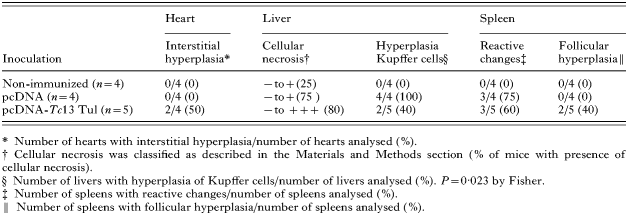
In heart sections, the presence of interstitial hyperplasia in 50% of pcDNA-Tc13 Tul- immunized animals was the most striking finding observed (Table 2).
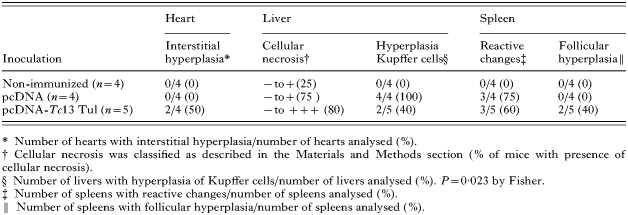
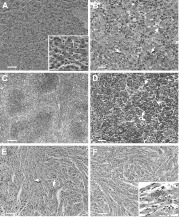
Hepatotoxicity signs, as multifocal and/or diffuse areas of cellular necrosis, were accompanied by non-specific reactive changes, as hyperplasia of Kupffer cells, in both pcDNA-Tc13 Tul and pcDNA immunized mice, but not in the non-immunized group (P=0·023) (Table 2 and Fig. 3A and B). Nevertheless, the severity of the hepatotoxicity was greater in pcDNA-Tc13 Tul than in pcDNA-immunized mice (Table 2).

Fig. 3. Histopathology of liver, spleen and heart of pcDNA-Tc13 Tul immunized mice. (A and B) Hepatotoxicity observed after 5 months of pcDNA-Tc13 Tul immunization. (A) Liver section with expanded sinusoids by diffuse hyperplasia of Kupffer cells and few scattered lymphocytes. Insert shows details of Kupffer cells lining sinusoids. Scale bar, 250 μm. (B) Areas of coalescing hepatocellular necrosis with fibrin and leukocytes (area between the shadow arrows) and Kupffer cell hyperplasia (white arrow). Scale bar, 100 μm. (C and D) Consequences on spleen microarchitecture observed after 5 months of pcDNA-Tc13 Tul immunization. (C) Serial spleen paraffin section with reactive changes. Note the different size and shape of the lymphoid follicles with reduction of the marginal zone. Scale bar, 500 μm. (D) Follicular hyperplasia of splenic lymphoid follicles. Note the pleomorfism of cell population, cellular debris and apoptosis (white arrows). Scale bar, 100 μm. (E) Heart section of a non-immunized Trypanosoma cruzi-chronically infected mouse showing moderate mononuclear inflammation (shadow arrow) accompanied by parasite nests (white arrow) (note the 4 nests/high field). Scale bar, 250 μm. (F) Heart section of pcDNA-Tc13 Tul immunized mice chronically infected with T. cruzi displaying a decrease in the cardiac pathology with scattered interstitial inflammation and tissue parasitism (2 nests/high field). Scale bar, 250 μm. The magnified picture shows 1 parasite nest/high field. Scale bar, 100 μm.
Splenic microarchitecture from both pcDNA-Tc13 Tul and pcDNA inoculated mice appeared mild to moderately altered with enlargement of the lymphoid follicles (Table 2 and Fig. 3C). However, follicular hyperplasia, characterized by the expansion of the lymphoid germinal centres, was only observed in the pcDNA-Tc13 Tul immunized group (Table 2 and Fig. 3D).
From the above observations we can conclude that genetic immunization with pcDNA-Tc13 Tul induces hepatotoxic effects and reactive changes in heart, liver and spleen.
Evaluation of the protective response of Tc13 Tul genetic immunization during the acute phase of T. cruzi infection
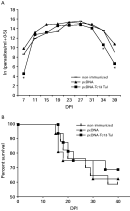
To test whether Tc13 Tul DNA immunization might induce protective immunity against T. cruzi infection, BALB/c mice immunized with pcDNA-Tc13 Tul or pcDNA were challenged with bloodstream trypomastigotes from Tulahuén strain, stock Tul2. Mice immunized with pcDNA-Tc13 Tul displayed a significant decrease in the parasitaemia at 7, 34 and 39 days post-infection, indicating Tc13 Tul exerted a protective effect in the early and late acute phase of T. cruzi infection (Fig. 4A). However, pcDNA-Tc13 Tul immunization did not change the survival rate (Fig. 4B).
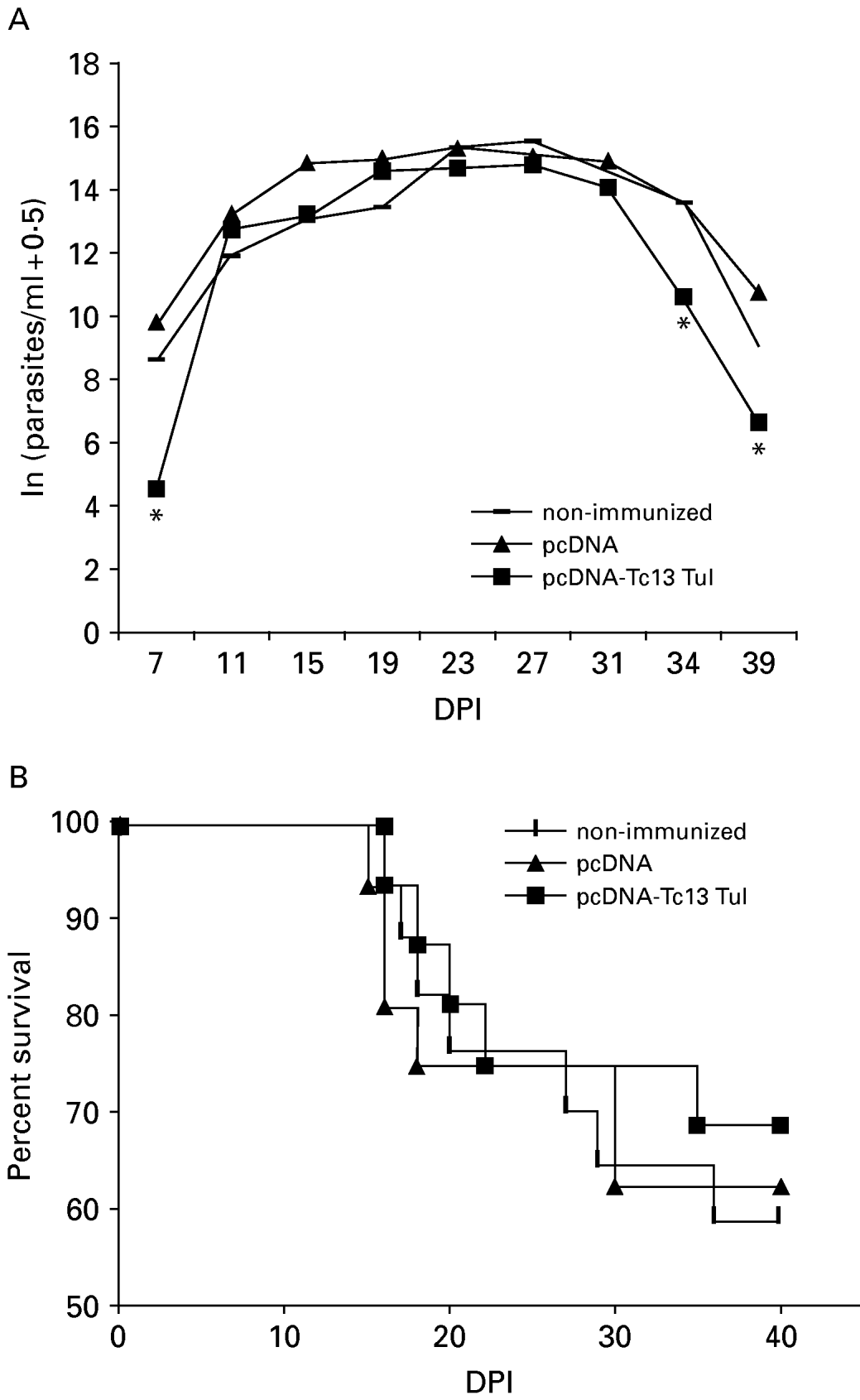
Fig. 4. Parasitaemia and mortality of DNA-immunized mice with Tc13 Tul. BALB/c mice immunized with pcDNA-Tc13 Tul or pcDNA and a control group without immunization were challenged with 2×10³ bloodstream trypomastigotes from Tulahuén strain, stock Tul2 per mouse, 35 days after the last immunization (mice were approx. 6 months old at this stage). (A) Course of infection estimated by the number of parasites/ml of blood. Results were converted to ln (parasite/ml+0·5) and the means for each group are shown (non-immunized n=11; pcDNA n=11; pcDNA-Tc13 Tul n=10). *P<0·05 compared with pcDNA-immunized and non-immunized groups. (B) Curves of survival of non-immunized (n=17), pcDNA (n=16) and pcDNA-Tc13 Tul (n=16) immunized mice. DPI, days post-infection. Data come from 3 independent experiments.
Histopathological analysis of Tc13 Tul DNA-immunized mice chronically infected with T. cruzi
Though genetic immunization with Tc13 Tul did not prevent from death in the acute phase of the infection, the lower levels of parasitaemia observed in pcDNA-Tc13 Tul-immunized mice prompted us to study if there was a relationship between this parameter and tissue damage in the chronic phase.
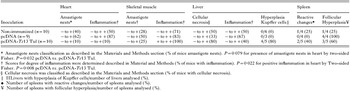
The examination of heart sections from non-immunized chronically infected mice exhibited different degrees of myocarditis with a very low number of parasite nests (Table 3 and Fig. 3E). Interestingly, the analysis of pcDNA-Tc13 Tul-treated mice revealed a lower degree of myocarditis with respect to pcDNA or non-immunized groups (P=0·022) (Table 3). In this group, minimal inflammatory infiltrates, predominantly containing mononuclear cells, were observed diffusely distributed throughout the myocardium and no signs of degeneration were observed in the myocardial fibres (Fig. 3F). Moreover, amastigote nests were displayed in only 10% of pcDNA-Tc13 Tul-immunized mice (P=0·079) (Table 3 and Fig. 3F). When pcDNA and pcDNA-Tc13 Tul-immunized groups were compared, a statistically significant decrease in the percentage of mice with either inflammation or parasite nests (P=0·032 and P=0·008, respectively) was observed in the latter group.

While skeletal muscle of all analysed groups showed a moderate degree of myositis with low numbers of parasite nests, signs of inflammation were present in all Tc13 Tul-immunized mice (Table 3).
Hepatitis, characterized by multifocal mononuclear inflammation and cellular necrosis was observed all over the hepatic tissue in all mice groups analysed (Table 3). Thus, it was difficult to clearly discriminate the hepatitis and hepatotoxic effects produced by Tc13 Tul immunization from those induced by T. cruzi infection. Nevertheless, these manifestations were quite intensified in pcDNA-Tc13 Tul-immunized mice and hyperplasia of Kupffer cells was only present in this group. Unexpectedly, despite the presence of hepatitis, livers did not show parasite nests.
Follicular hyperplasia was mainly recorded in spleens from either pcDNA-Tc13 Tul or pcDNA-immunized mice (Table 3).
In summary, the most relevant feature detected in pcDNA-Tc13 Tul-treated mice was a decrease of heart damage in the chronic experimental infection. However, in skeletal muscle and liver, Tc13 Tul immunization appeared to exacerbate the pathological consequences of the infection.
DISCUSSION
Tc13 is a TS family protein (also called group IV) not, as yet, fully characterized although, despite some important functions of the C-terminal EPKSA repeats that have been recently described (Buscaglia et al. 1999; Joensen et al. 2003; Alvarez, Buscaglia and Campetella, 2004), little knowledge exists about the immune and pathological manifestations induced by whole Tc13 molecules in vivo. With the aim of determining the role of Tc13 antigens in the outcome of T. cruzi infection, we investigated the immune response elicited, the presence of histological changes and the capacity to confer protection against the infection after genetic immunization of BALB/c mice with Tc13 Tul antigen. First, we demonstrate, by immunohistochemical assays with a serum against the Tc13 C-terminal portion that pcDNA-Tc13 Tul construct was efficiently expressed in vitro and in vivo. Therefore, we confirmed that the complete Tc13 Tul molecule is translated in both systems and that genetic immunization is effective in our experimental conditions.
Genetic immunization with Tc13 Tul induced a positive T. cruzi-specific DTH, suggesting the generation of a memory cellular immune response, as DTH reaction is absolutely dependent on the presence of memory T cells, either CD4+ or CD8+ (Müller et al. 1993; Bunce and Bell, 1997; Black, 1999). Although in other models DTH response is maintained after 48 h post-inoculation (Dannenberg, 1991; Silverstein, 2002), accordingly with our results, it has been extensively documented that immunization of mice with T. cruzi antigens (recombinant proteins or parasite fractions) elicits maximal footpad or ear induration at 24 h post-inoculation, decreasing to levels comparable to those found in non-immunized controls at 48 h post-inoculation (Liew et al. 1987; Carlomagno et al. 1996; Gomes et al. 1999; Leon, Wang and Engman, 2003). Since tripomastigote lysates were used as immunogen in the DTH assay, the positive response observed in Tc13 Tul immunized mice indicates that Tc13 Tul genetic immunization enabled animals to respond to Tc13 antigen concentrations present in the parasite, somehow resembling the response which could be achieved after a natural infection. On the other hand, the Tc13 Tul immunized group also showed reactive changes and follicular hyperplasia in the spleens, further supporting that the immunization protocol activated immune mechanisms in the host. Conversely, Tc13 Tul DNA immunization did not elicit a specific humoral immune response. The effectiveness of T. cruzi genes as DNA vaccines to induce a detectable antibody response has been shown to be dependent on the portion of the encoding antigen, the presence or absence of signal peptide (Boscardin et al. 2003), as well as on the mouse strain used (Wizel et al. 1998). On the other hand, Wizel et al. (1998) have shown that the lack of a humoral response does not prevent a protective effect of genetic vaccination after challenge.
Since IFN-γ has been shown to be essential for controlling T. cruzi infection (Zhang and Tarleton, 1996; Reis et al. 1997; Martin and Tarleton, 2004), we evaluated whether spleen cells from DNA-immunized mice with Tc13 Tul were capable of secreting this cytokine. In vitro stimulation with the recombinant MBP-Tc13 Tul protein did not show positive IFN-γ ELISPOT responses in pcDNA-Tc13 Tul-immunized animals. However, it is important to take into account that stimulation with recombinant Tc13 Tul mainly induces CD4+ rather than CD8+ memory T-cell responses. The design of peptides containing putative sites for binding to the MHC-I H-2d molecule would allow a more accurate evaluation of CD8+ T-cell responses to this antigen. In this regard, several T-cell epitopes capable of inducing IFN-γ secretion by either CD4+ or CD8+ T-cells and conferring protection against T. cruzi have been described in members of the TS superfamily (Kahn and Wleklinski, 1997; Wizel et al. 1997; Rodrigues et al. 1999; Martin and Tarleton, 2004) supporting their usefulness as vaccine candidates. However, in agreement with our findings, none of these epitopes are present in the Tc13 Tul sequence.
Considering that we have recently suggested that Tc13 Tul antigen is involved in pathogenic events in the outcome of T. cruzi infection (García et al. 2003; Joensen et al. 2003), one of the main goals of our study was the evaluation of the histopathological changes induced by genetic immunization with Tc13 Tul. We found that Tc13 Tul genetic immunization induces an intense hepatotoxicity. The observed histological features might be primarily ascribed to the immune responses generated by the immunization and not to a direct action of the antigen itself, since by genetic immunization antigens are mainly presented by the endogenous pathway and only small quantities of protein are released from cells (Whitton et al. 1999). However, we can not rule out that hepatotoxicity may be a consequence of CpG motifs present in the Tc13 Tul DNA sequence. It is worth mentioning that although less intense, hepatotoxicity was also observed after immunization with pcDNA alone. Accordingly, the untoward effects on liver and lymphoid organ morphology induced by CpG administration have been recently described (Heinkenwalder et al. 2004). Altogether, these observations indicate that DNA vaccination is not an inocuous methodology.
Another effect assigned to pcDNA-Tc13 Tul immunization is the presence of interstitial hyperplasia in the heart. There is evidence showing that the interstitial compartment is the first to respond to cardiac injury (Olivetti et al. 1991) and that Tc13 Tul exerts a β1-adrenergic activity in vitro (Joensen et al. 2003). Therefore, we may speculate that the interstitial hyperplasia observed might be due to an increase of the cardiac frequency induced by low quantities of Tc13 Tul released into blood that are capable of activating cardiac β1-adrenergic receptors. Concerning this hypothesis, it would be relevant to study the histological changes induced by Tc13 Tul antigen administered as recombinant protein and confirm whether the effect previously observed in heart by in vitro assays are also observed in vivo. As a whole, these observations suggest that the immune response to Tc13 Tul may be involved in the pathogenesis of Chagas disease.
Further supporting the observation that Tc13 Tul genetic immunization may be involved in pathology rather than protection, we found that immunization with pcDNA-Tc13 Tul did not protect against the acute phase of the infection, in spite of the decrease observed in peripheral blood parasitism. These observations are in agreement with the lack of Tc13 Tul-specific secretion of IFN-γ by pcDNA-Tc13 Tul-immunized animals, suggesting that Tc13 Tul DNA immunization is not useful for prophylactic vaccination. Despite the fact that several genetic immunization protocols with members of groups I and II of the TS superfamily protein have proven to be protective, resulting in an increased survival rate of challenged mice (Wizel et al. 1998; Costa et al. 1999; Garg and Tarleton, 2002), we here demonstrate that this is not the case for a TS antigen belonging to the group IV, such as Tc13 Tul.
Surprisingly, in spite of the lack of protection with Tc13 Tul DNA-vaccination in the acute phase of the infection, mice immunized with Tc13-Tul showed a decrease in the severity of myocarditis in the chronic phase. It has been documented that a decrease in parasite burden in the acute phase is associated with a decrease of clinical symptoms in the chronic phase (Tarleton, 2001). Thus, the decrease in parasite burden at the beginning and the end of the parasitaemia curve induced by DNA immunization with Tc13 Tul might control the progression of the infection leading to a concomitant decrease in disease severity. Altogether, our data indicate that, in a model of infection characterized by a low parasite burden in the chronic phase of the infection (Postan, McDaniel and Dvorak, 1984; Antúnez and Cardoni, 2000), Tc13 Tul DNA immunization induces local protection restricted to the heart. Conversely, this protective effect was not found in the skeletal muscle, where intense inflammation was observed. These contrasting findings may be due to the myotropic characteristics of the Tulahuén strain of T. cruzi along with the inflammation induced by the intra-muscular administration of CpG (Stan et al. 2001). This may result in an extreme localized aggression that would mask the putative protective effect of Tc13 Tul at this site. Further studies will determine whether genetic immunization with Tc13 Tul induces a distinct cytokine profile in heart compared to skeletal muscle.
Summarizing, we demonstrate that genetic immunization with Tc13 Tul induces immune responses mainly associated with pathology rather than protection against the infection. Based on the assumption that genetic immunization should mimic an intracellular infection (Whitton et al. 1999), we might speculate that in the outcome of a natural T. cruzi infection the effects we observed here might be induced by Tc13 antigens present in the amastigote surface.
This work was supported by the Instituto Nacional de Parasitología ‘Dr. Mario Fatala Chabén’, A.N.L.I.S. ‘Dr. Carlos G. Malbrán’, the Consejo Nacional de Investigaciones Científicas y Tecnológicas (CONICET, Argentina), the NASA/ChagaSpace Network and the Network for Research and Training in Parasitic Diseases at the Southern Cone of Latin America SIDA/SAREC. S.A.L., L.E.F. and A.M.R. are members of the Research Career of CONICET.