INTRODUCTION
Biological aspects of intertidal shore crabs have been modestly explored in the eastern Mediterranean (Shiber, Reference Shiber1981; Warburg & Schwartz, Reference Warburg and Schwartz1993; Warburg et al., Reference Warburg, Amar, Davidson, Sayag, Schwartz, Tudiver and Yifrach2007). The crab community in the rocky intertidal of the eastern Mediterranean is dominated by four species: Xantho poressa (Olivi, 1792); Eriphia verrucosa Forskåll, 1775; Pachygrapsus marmoratus (Fabricius, 1787) and P. transversus (Gibbes, 1850) (Flores & Paula, Reference Flores and Paula2001). The first two crabs are carnivorous living in the infra and mesolittoral while P. marmoratus and P. transversus (Grapsidae) are conspicuous elements of the supralittoral zone and have an omnivorous diet (Flores & Paula, Reference Flores and Paula2001). Grapsids are known to occupy specific niches in intertidal rocky shores, where they form dense populations and constitute an essential component of the community. Their success in the intertidal zone is mainly due to semi-terrestrial habits, aerial respiration and omnivorous diet (Masunari & Dubiaski-Silva, Reference Masunari and Dubiaski-Silva1998).
Pachygrapsus marmoratus is a cold-temperate crab that spreads over the north-eastern Atlantic Ocean and throughout the Mediterranean and the Black Seas, where it is very common (Falciai & Minervini, Reference Falciai and Minervini1992; Flores & Paula, Reference Flores and Paula2002a). The congeneric P. transversus is more thermophilic and is distributed over the warm parts of the eastern Pacific and the eastern and western Atlantic Oceans. Its first record in the Mediterranean dates back to the 1920s (Vaccaro & Pipitone, Reference Vaccaro and Pipitone2005). The species is particularly common in the Levantine basin with a patchy and irregular occurrence elsewhere in the Mediterranean (Holthuis & Gottlieb, Reference Holthuis and Gottlieb1958; Shiber, Reference Shiber1981; Udekem D'Acoz, Reference Udekem D'Acoz1999; Vaccaro & Pipitone, Reference Vaccaro and Pipitone2005). Pachygrapsus transversus has been considered a non-indigenous species that has reached the Mediterranean Sea by man-mediated transport and has expanded later to the western Mediterranean either from the eastern Atlantic or from the eastern Mediterranean (Wolff, Reference Wolff1954; Holthuis & Gottlieb, Reference Holthuis and Gottlieb1958; Udekem D'Acoz, Reference Udekem D'Acoz1999; Vaccaro & Pipitone, Reference Vaccaro and Pipitone2005). However, recent work suggests that the species is probably native to the Mediterranean and that several factors may explain its scattered occurrence (Ateş et al., Reference Ateş, Kocataş, Katağan and Özcan2010; Froglia, Reference Froglia2010; Crocetta et al., Reference Crocetta, Mifsud, Paolini, Piscopo and Schembri2011).
Some aspects of the life cycle of P. marmoratus have been studied in the Atlantic and western Mediterranean, while information on P. transversus is only available from Brazil (Vernet-Cornubert, Reference Vernet-Cornubert1958; Flores & Negreiros-Fransozo, Reference Flores and Negreiros-Fransozo1998, Reference Flores and Negreiros-Fransozo1999; Flores & Paula, Reference Flores and Paula2002a, Reference Flores and Paulab). No other information seems to exist in the literature from the eastern Mediterranean, where the two species coexist. Both species share the same rocky habitat of the Levant, where they comprised about 95% of the intertidal crab community (Warburg et al., Reference Warburg, Amar, Davidson, Sayag, Schwartz, Tudiver and Yifrach2007). Their presence along the Levantine coast certainly creates a niche overlap due to their typical grapsid lifestyle, including breeding patterns (Flores & Negreiros-Fransozo, Reference Flores and Negreiros-Fransozo1998), distribution in the littoral zone (Falciai & Minervini, Reference Falciai and Minervini1992), activity patterns (Cannicci et al., Reference Cannicci, Paula and Vannini1999) and feeding ecology (Abele et al., Reference Abele, Campanella and Salmon1986; Cannicci et al., Reference Cannicci, Gomei, Boddi and Vannini2002). This co-occurrence raises interesting questions pertaining to interspecific interactions and niche partitioning.
The objectives of this study were to detect whether the two species were uniformly distributed on the same rocks or not and to identify possible overlaps in their life cycle by studying their population structures, reproductive cycles and settlement patterns along the rocky shores of the eastern Mediterranean Sea.
MATERIALS AND METHODS
Sampling
Sampling took place along the rocky shores of Tyre, in Lebanon (33°16′N 35°11′E). Crabs were collected on a weekly basis during 12 months (September 2006–August 2007). They were captured by hand while grazing on the substratum or from underneath boulders from three selected adjacent rocky sites. Sampling started at sunset, when crabs were most active and lasted until about 40 crabs were captured from each site. Water temperature and salinity were recorded regularly from each site.
Sampling sites were chosen for their topographical characteristics encompassing the main littoral habitats available and in which the two species occur: Site A (55 × 10 m) was exposed to wave action and consisted of a vermetid platform, a small beach covered with cobbles and pebbles and a small manmade concrete wall. Site B (30 × 6 m) included a vermetid reef, rocks, pebbles and a patch of sand. It was weakly exposed to wave action due to a natural barrier situated offshore. Site C (50 × 5 m) was selected on the other side of the peninsula with much reduced wave exposure. It could be described as a platform with overhangs, and situated on the edge of a 2000 m2 tide pool.
Measurements
All specimens were sedated by cold seawater and fixed in 4% buffered formaldehyde for 24 h. They were transferred afterwards into 70% alcohol for processing. Crab species were identified and measured to the nearest 0.01 mm using a digital Vernier calliper (Ultra-Cal IV; acc. 0.02 mm) and a dissecting microscope. The carapace (CW) and abdominal widths (AW) were respectively determined as the widest distance between the lateral sides of the carapace, just behind postorbital teeth and by the widest distance at the abdomen between lateral sides. All crabs were grouped afterwards into 2 mm CW size-classes.
The sizes of ovigerous females used for the fecundity analysis ranged from 10.4 to 31.2 mm CW (N = 39) for P. marmoratus and from 9.0 to 21.1 mm CW (N = 103) for P. transversus. The volumetric method was used for estimating fecundity (Flores & Paula, Reference Flores and Paula2002b). The egg number was obtained from randomly selected ovigerous females (29 P. marmoratus; 28 P. transversus). Pleopods were removed and eggs were detached from each other using a dissecting needle. The eggs were transferred into 100 mL jars filled with ethanol and stirred until they were homogenously distributed. Five samples of 3 mL each were pipetted and eggs counted under a dissecting microscope. The average egg number was then multiplied by 3% leading to an estimate of the absolute fecundity (F abs), the total number of eggs per female. Relative fecundity (F rel) was estimated afterwards by dividing F abs by AW for all specimens. Five eggs/individuals were randomly selected from 10 ovigerous females for each species and were used to measure egg diameter.
Recruits were defined as the first juvenile stage found on the reef following the settlement process of the first post-larval stage (Adams & Ebersole, Reference Adams, Ebersole and Nagelkerken2009). Since the sex of some of the smallest recruits could not be determined macroscopically with certitude, these were labelled as ‘unsexed’ and represented respectively 3.2% for P. marmoratus and 1.8% for P. transversus of the sample.
Statistical analyses
Kolmogorov–Smirnov tests were used to check for normality for CW measurements and size frequency distributions. Variance and mean equality were examined using f-tests and t-tests respectively when comparing two normally distributed samples. Non-parametric comparison tests included Mann–Whitney for two samples and Kruskal–Wallis test for multiple samples.
Differences in size distribution comparisons were tested using Mann–Whitney test. Morphometric measurements were scatter-plotted against CW or AW. They were linearized by a logarithmic transformation and the best fitting regressions were calculated. The parametric paired t-test was used to compare the egg numbers within similar size-ranges (2 mm size-classes) for the two species, after checking for normality (Kolmogorov–Smirnov test). Fecundities (F abs; F rel) and egg sizes were compared using Student's t-tests and the Mann–Whitney test respectively. Sex ratios were analysed using Chi-square goodness-of-fit tests against an expected ratio of 1:1 (males:females). All statistical analyses were performed using SPSS for Windows (17.0.0), copyright© SPSS Inc. or Microsoft® Excel 2010.
RESULTS
Population structure
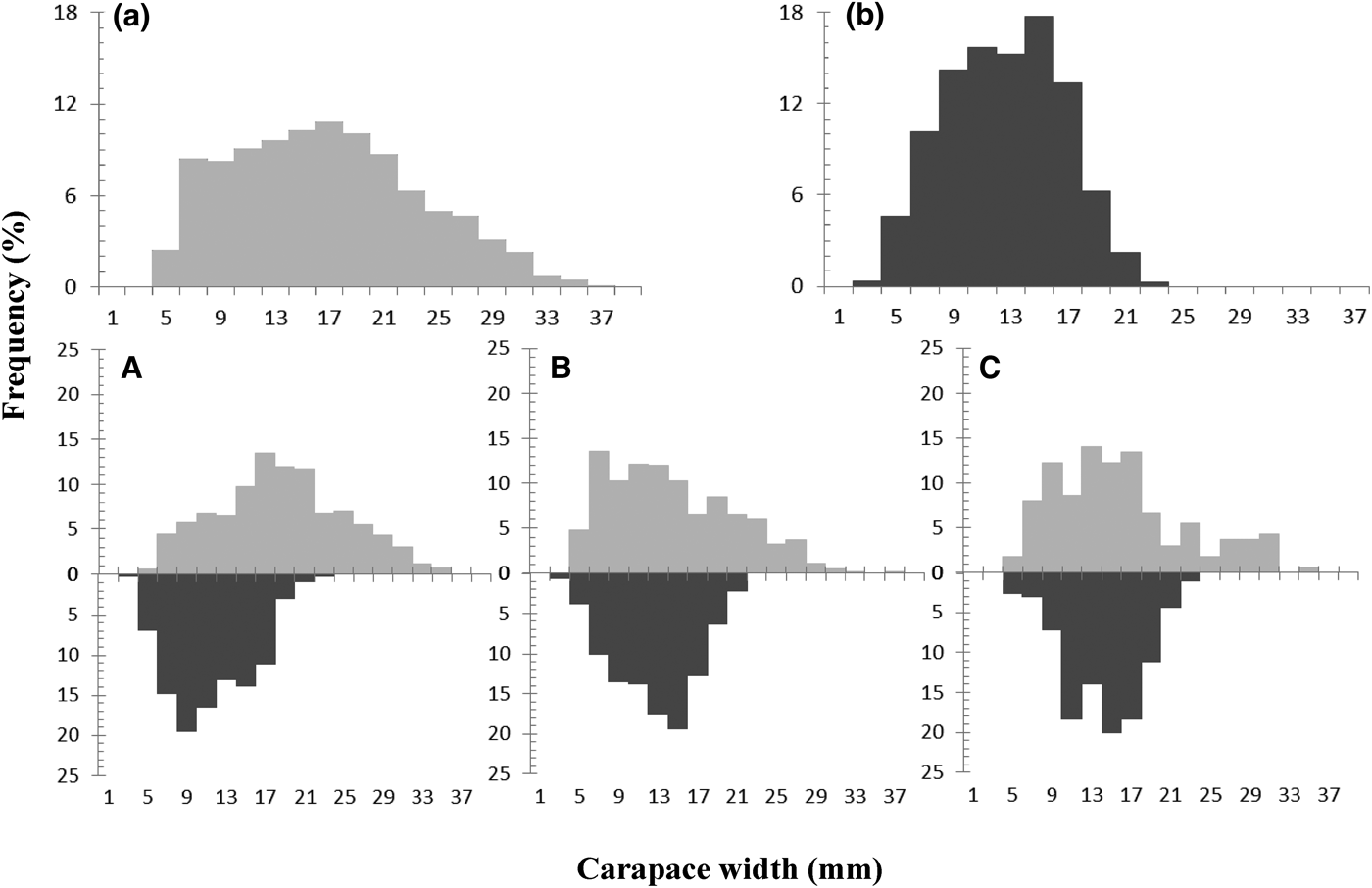
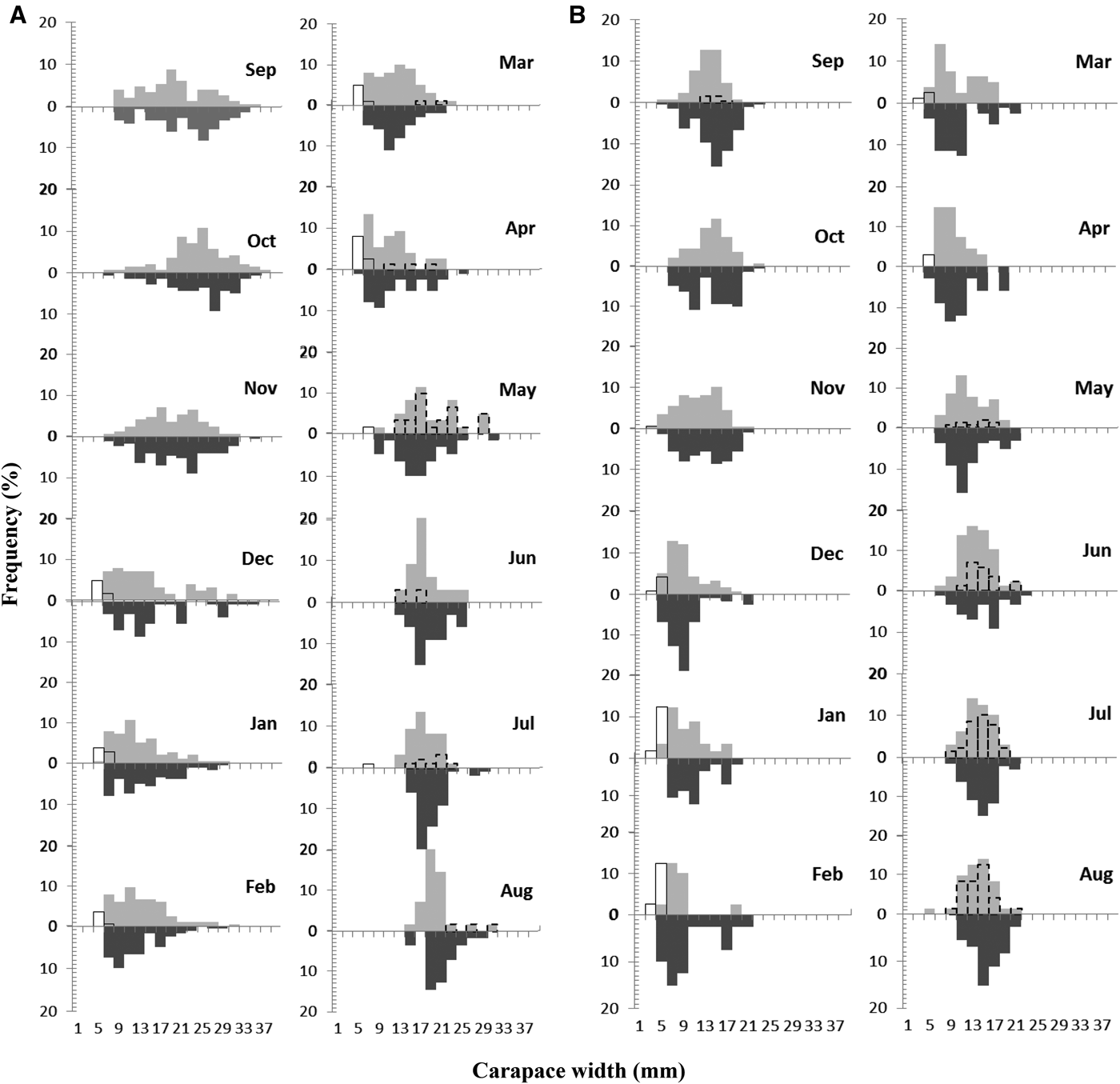
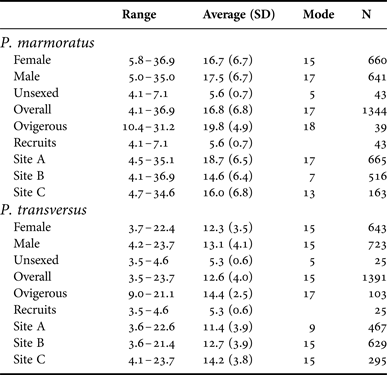
A total of 1344 Pachygrapus marmoratus and 1391 P. transversus were collected and examined during the study period (Figure 1). Sizes ranged from 4.1 to 36.9 mm CW for P. marmoratus and from 3.5 to 23.7 mm CW for P. transversus, while the most common size classes (mode) were 17 mm CW and 15 mm CW respectively (Table 1). Females (average CW) were significantly smaller than males for both species (P < 0.05) (Table 1), while P. marmoratus females and males (taken separately or pooled) were significantly larger than those of P. transversus (P < 0.05). Size frequency distributions for P. marmoratus females and males were normal (P > 0.05) when sexes were taken separately but not when pooled (P < 0.05). Pachygrapsus transversus females were also normally distributed (P > 0.05), but not the males (P < 0.05) or the pooled data (P < 0.05). The comparison of the overall distribution for both species showed that they differed significantly from each other (P < 0.05) (Figure 1). Size frequency distribution showed unimodal patterns at any given month and that both species were present in the studied area throughout the year (Figure 2).
Size frequency distributions of Pachygrapsus marmoratus (grey bars) and P. transversus (black bars) collected from the coast of Lebanon (eastern Mediterranean). (a, b) overall sampled population; (A, B, C) sampled sites.

Monthly size frequency distributions of (A) Pachygrapsus marmoratus and (B) P. transversus collected from the coast of Lebanon (eastern Mediterranean). Females: grey bars; males: black bars; unsexed: transparent bars; ovigerous: dashed bars.
Descriptive statistics for Pachygrapsus marmoratus and P. transversus collected from the coast of Lebanon (eastern Mediterranean).
All measurements are in mm CW; N: number of individuals.
The overall sex ratio did not deviate significantly from 1:1 for P. marmoratus (1:1.03, P > 0.05, N = 1301) and was found to be slightly in favour of males (1:0.89, P < 0.05, N = 1366) in P. transversus. Monthly variations of sex ratio for P. marmoratus showed a dominance of females in October (1:1.24, N = 139), August (1:1.20, N = 55) and from December to March (1:1.05 to 1:1.25, N = 535) while males were more common the rest of the year. In P. transversus, males dominated most of the year (1:0.75 to 1:0.97, N = 1207), with the exception of June (1:1.72, N = 87) and August (1:1, N = 72) (Figure 2). The sex ratio did not deviate significantly from 1:1 in each of the three sites for any of the two crab species (P > 0.05).
Location
Different intra- and interspecific size-frequency distributions occurred between the three sampled sites. Distribution differed significantly between sites for P. marmoratus (H = 115.2, P < 0.05) and for P. transversus (H = 86.3, P < 0.05) (Figure 1, Table 1). In site A, carapace width of P. marmoratus were comparable to the overall size-frequency distribution for the species whereas those of P. transversus were relatively smaller (Figure 1). Neither species exhibited normal distribution (P. marmoratus: KS Z = 1.404, P < 0.05; P. transversus: KS Z = 1.459, P < 0.05), nor a similar size structure (Mann–Whitney: Z = −18.6, P < 0.05).
While ranges were similar to the overall population for both species in site B, the majority of P. marmoratus (73%) and P. transversus (93%) ranged in size between 7 and 19 mm CW (Figure 1, Table 1). Site B was thus characterized by the presence of a specific range of crab size. The distribution in site B was not normal for P. marmoratus (KS Z = 1.754, P < 0.05), unlike for P. transversus (KS Z = 1.058, P > 0.05), and interspecific comparison within this site showed clear differences in size structure (Z =−3.7, P < 0.05). When large sized P. marmoratus (>24 mm CW, size exceeding the maximum size found for P. transversus) were excluded from the statistics, the two species’ distribution turned out to be comparable (Z = −1.2, P > 0.05). Site C did not display noticeable specificity (Figure 1, Table 1) where both species exhibited normal distribution (P. marmoratus: KS Z = 1.165, P > 0.05; P. transversus: KS Z = 0.785, P > 0.05). As in site B, size structure was significantly different (t = 3.077, P < 0.05) when all sizes were considered and turned insignificant (t = −0.712, P > 0.05) when omitting very large P. marmoratus (>24 mm CW).
Reproduction
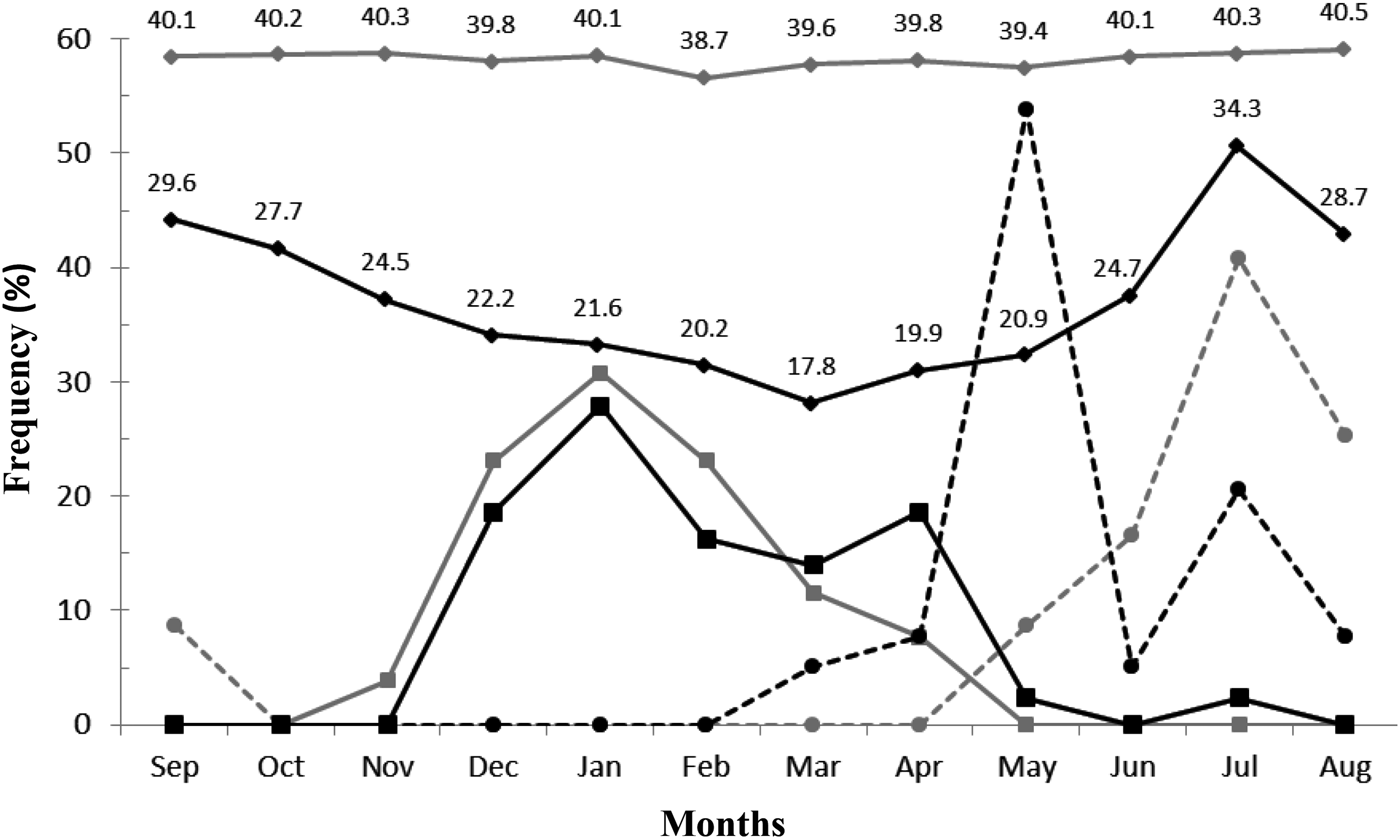
Ovigerous P. marmoratus were present from late March until late August, indicating a 5 month reproductive season (Figures 2 & 3). This was first characterized by the presence of a few ovigerous females of larger sizes (≥17 mm CW), while smaller females appeared bearing eggs in April. The smallest ovigerous female was 10.4 mm CW (Table 1). Spawning peaked in May where 53.8% of females were bearing eggs (Figure 3). Egg-carrying P. transversus appeared in May and lasted until the end of August 2007. However, in September 2006 ovigerous females were already present. Based on that, we consider a 5 month reproductive period for P. transversus, ranging from May to September (Figures 2 & 3). Unlike, in P. marmoratus, no relationship between the size of ovigerous females and period of their appearance was detected. The smallest ovigerous female was 9.0 mm CW and maximum spawning activity was recorded in July (40.8%) (Table 1, Figure 3).
Monthly variation of the presence of ovigerous females (circles) and recruits (squares) of Pachygrapus marmoratus (black lines) and P. transversus (grey lines) along the coast of Lebanon (eastern Mediterranean). Mean surface water temperatures (°C) and salinities are represented respectively in black and grey diamonds.
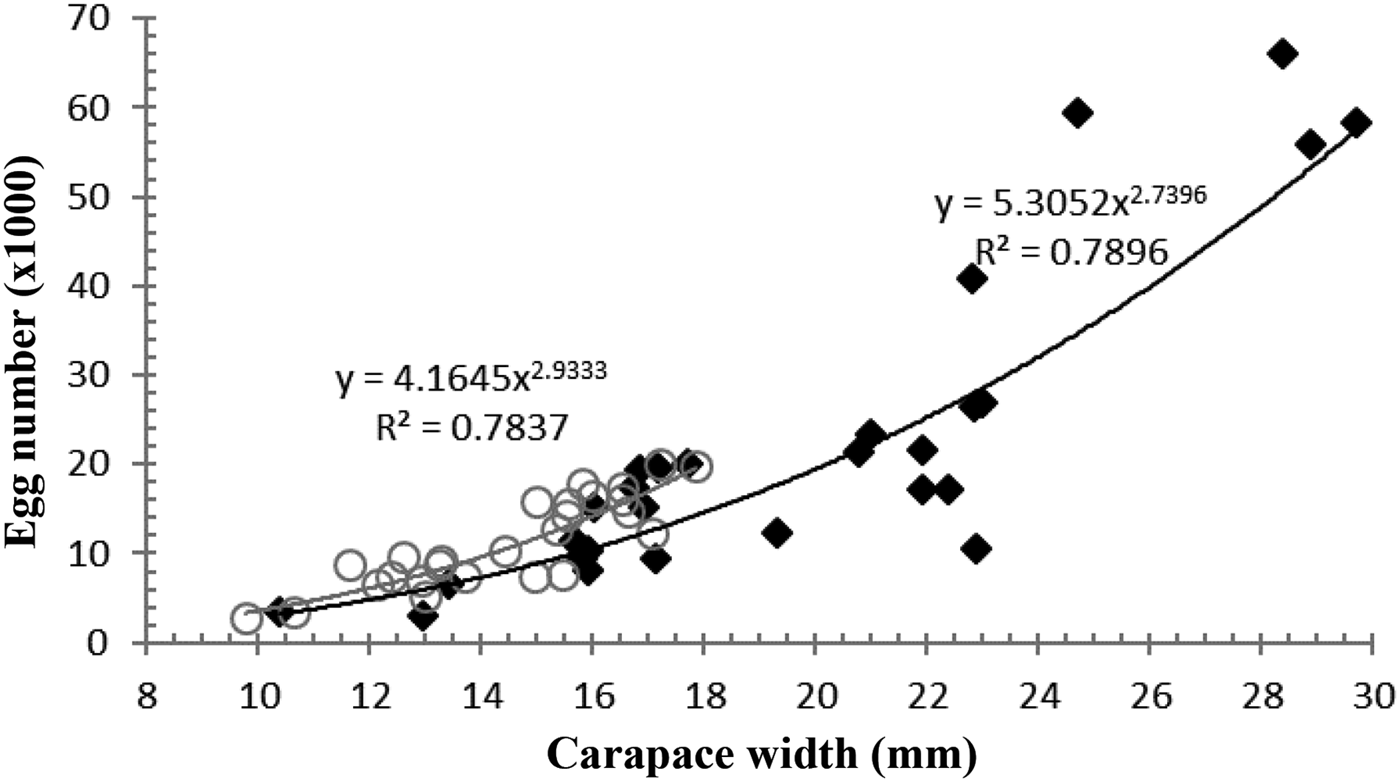
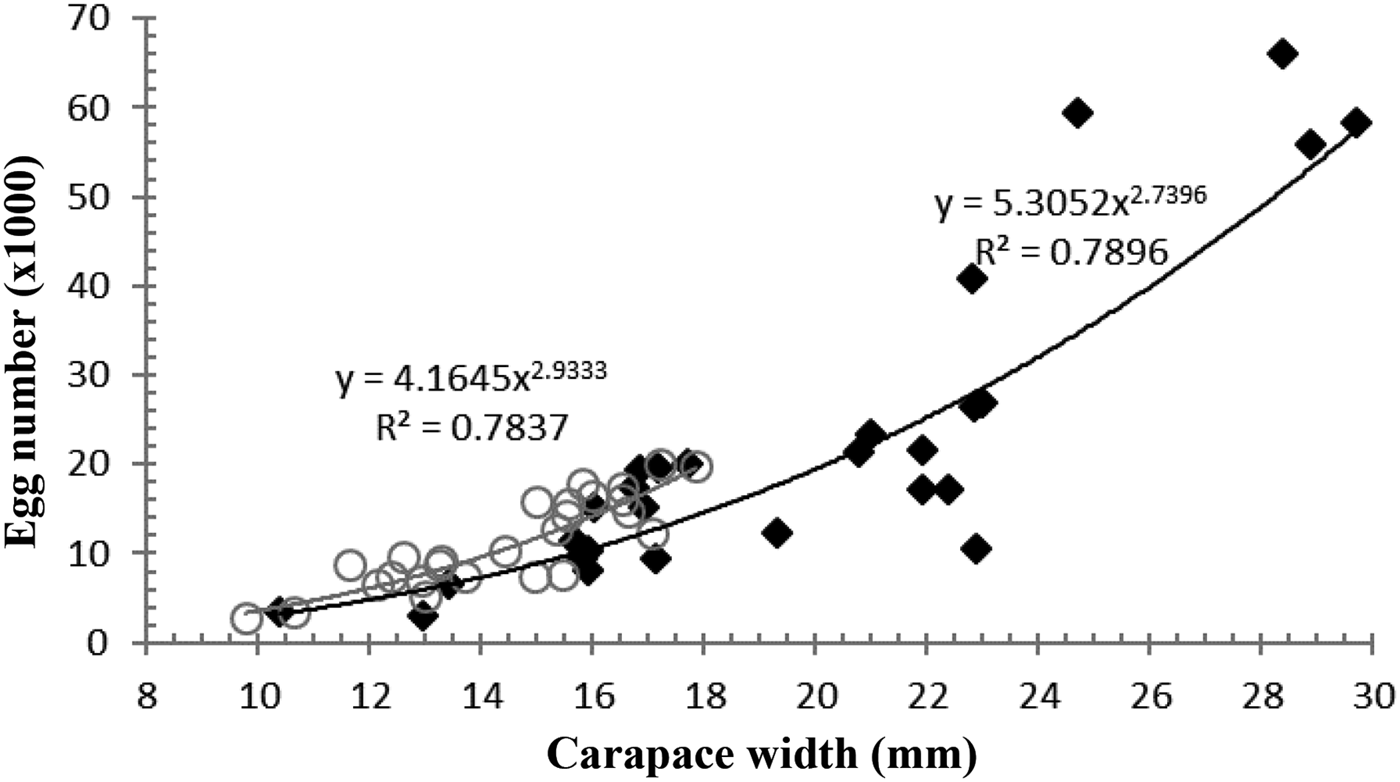
Mean absolute fecundity (F abs) ranged from 3100 to 65,967 eggs female−1 (22,402 ± 17,207 eggs female−1) and F rel was 1356 ± 720 eggs mm−1 for P. marmoratus. Similarly, F abs ranged from 2860 to 19,967 eggs female−1 (11,146 ± 5053 eggs female−1) and F rel was 1267 ± 443 eggs mm−1 for P. transversus. Both F abs and F rel were higher in P. marmoratus than in P. transversus (P < 0.05). The comparison of egg number did not show significant differences between the two species for the same size classes (P > 0.05). A trend of increasing fecundity with larger sizes (CW) was observed for both species (Figure 4). Mean egg sizes ranged from 29 to 38 µm in diameter (33.6 ± 2.20 µm, N = 48) and from 23 to 38 µm (27.5 ± 3.08 µm, N = 56) respectively for P. marmoratus and P. transversus. Mean egg size was significantly larger in P. marmoratus (P < 0.05).
Fecundity-size relationships of Pachygrapsus marmoratus (black diamonds) and P. transversus (grey circles) collected from the coast of Lebanon (eastern Mediterranean).
Recruitment
The recruitment season of P. marmoratus started in December and peaked in January where recruits constituted 27.9% (Figure 3). They appeared regularly on all sites over 5 months (6 December–7 May). Pachygrapsus transversus recruits appeared from 8 November to 4 April, indicating also a 5 months recruitment period (Figure 3). Recruitment was also maximal for P. transversus in January (30.8%).
DISCUSSION
The number and size range of collected individuals in this study were large enough to be considered representative of the two crab populations living along the Lebanese coast. The largest collected P. marmoratus was 36.9 mm CW. Specimens as large as 40 mm CW have been reported from the Atlantic coasts of Portugal and England (Flores & Paula, Reference Flores and Paula2002a; Ingle & Clark, Reference Ingle and Clark2006). The major source of predation on vermetid reefs in Lebanon seems to be harvesting by anglers, predation by Eriphia verrucosa (Warburg & Schwartz, Reference Warburg and Schwartz1993), and probably interactions with the congeneric P. transversus. Maximum sizes for P. transversus were comparable to those available in the literature (Flores & Negreiros-Fransozo, Reference Flores and Negreiros-Fransozo1999).
Sex ratio did not vary significantly from 1:1 for the overall sampled population of P. marmoratus. Similar proportions were found in populations living along the Portuguese coast (Flores & Paula, Reference Flores and Paula2002b). In the current study, sex ratio was in favour of males in P. transversus and this seems to characterize the species as it has been repeatedly reported from the Mediterranean and from distant locations in the western Atlantic (Flores & Negreiros-Fransozo, Reference Flores and Negreiros-Fransozo1999; Warburg et al., Reference Warburg, Amar, Davidson, Sayag, Schwartz, Tudiver and Yifrach2007). Variation in sex ratio for P. transversus seems to be size-dependent, where smallest individuals settled in nurseries in a 1:1 ratio, while males clearly dominated the adult stage (1:0.80) (Flores & Negreiros-Fransozo, Reference Flores and Negreiros-Fransozo1999). The current study did not take into consideration pre-recruitment stages making a comparison at settlement impossible but the sex ratio recorded from Lebanon (1:0.89) was comparable to the population living in Brazil. Furthermore, females were rare in the largest size-classes (>18 mm CW), which is comparable to another region for P. transversus (Abele et al., Reference Abele, Campanella and Salmon1986; Flores & Negreiros-Fransozo, Reference Flores and Negreiros-Fransozo1999). The disproportionate size distribution of adults was attributed to behavioural reasons where adult males spent more effort than females in grazing away from their shelter (Abele et al., Reference Abele, Campanella and Salmon1986). This could lead to the sampling of more males than females. Another explanation would be that energy is channelled in females to reproduction at the expense of growth; hence their smaller sizes (Flores & Negreiros-Fransozo, Reference Flores and Negreiros-Fransozo1999).
Site A showed a different size structure between the two species (P < 0.05) and seemed to be particularly suitable for P. marmoratus whose population characteristics (mean, range and mode) were similar to the entire population. Site A did not seem favourable for large size-classes of P. transversus. This is shown by the distribution skewed towards smaller individuals and the most common size class (9 mm CW) being smaller than the overall population (15 mm CW) of P. transversus (Figure 1). Sites B and C imposed size restrictions on the crabs using them as habitats. The average sizes and modes were lower for P. marmoratus than those of the overall distribution for this species and were similar for P. transversus. It is evident that P. marmoratus is larger in size than P. transversus (P < 0.05, Table 1). The difference in species distribution recorded in both sites B and C became insignificant when we excluded from the analysis individuals P. marmoratus that were larger than the maximum size attained by P. transversus (P > 0.05). Sites B and C are thus suitable for small-sized crabs, regardless of the species. They were suitable for small-sized P. marmoratus but certainly more advantageous to P. transversus because of the species' naturally smaller body size, allowing all size-classes of its population to be present. The presence of individuals larger than 24 mm CW (20% of P. marmoratus) seems to be the result of wandering individuals from nearby areas, as deduced from field observations.
Size-frequency distribution of shore crab populations occupying the same site is related to physical factors that characterize each site. The major factors that determined distribution for nine crab species in Tasmania were substrate availability, type of cover, salinity range and wave action (Griffin, Reference Griffin1971). Griffin's study indicated that the habitat was one important factor that imposed restriction to size-frequency distribution in a population. It is unclear what makes site A favourable to larger individuals of P. marmoratus and not to large P. transversus. A factor related to microhabitat structure might be disadvantageous to larger crabs of the latter species. Population size seems to be related to the structure of available shelters (Warburg et al., Reference Warburg, Amar, Davidson, Sayag, Schwartz, Tudiver and Yifrach2007). Relatively large cavities and boulders were present in site A and absent in both sites B and C, providing a spacious shelter for large P. marmoratus individuals. These cavities and boulders were probably too exposed for smaller ones making them exclusively used by top-sized individuals. The size variety of crevices in site A allowed a broader size-frequency distribution as opposed to narrow bulky distributions available in sites B and C. Site characteristics seem to be a major limiting factor for larger P. marmoratus in the eastern Mediterranean, as shown by the lack of suitable crevices availability in sites B and C.
Cannibalism and predation among Pachygrapsus have been documented in various studies (Gore et al., Reference Gore, Scotto and Becker1978; Abele et al., Reference Abele, Campanella and Salmon1986; Vaccaro & Pipitone, Reference Vaccaro and Pipitone2005). Older and more experienced P. transversus might be competing with younger P. marmoratus of similar sizes in sites B and C. In fact, P. transversus was more aggressive while handling than P. marmoratus (personal observation). The presence of large sized P. marmoratus might also have an effect on P. transversus in site A, particularly larger ones. The population of shore crabs is thus not uniform on the vermetid reefs but dependent on the site characteristics, including the presence of shelters. Since the two species were very common, a certain equilibrium seems to exist on the rocky shores where each of the two species may have an advantage in some areas, allowing for niche partitioning.
Both species of crabs were present on the reefs during the 12-month study period. Pachygrapsus marmoratus started spawning in late March, which means that fertilization sometimes occurred earlier. Incubation stretched from March to August as shown by the presence of ovigerous females during this period. The oldest females were first to appear carrying eggs while younger ones became ovigerous later. Multiple broods probably occurred resulting in multiple batches that hatched progressively. This coincided with the increase in temperature and salinity in the vicinity of the sampled locations. Incubation of P. marmoratus eggs started a month earlier in Lebanon than previous studies made in Portugal and Monaco, but peaked in May concurrently with the two studies (Vernet-Cornubert, Reference Vernet-Cornubert1958; Flores & Paula, Reference Flores and Paula2002a). The earlier incubation recorded from Lebanon is probably due to warmer climatic conditions occurring in the Levantine coast.
Incubation of P. transversus eggs occurred from May to September in the current study, following the increase in temperature and salinity but with a 2-month delay (Figure 3). Ovigerous females were present all year long in SE Brazil, with highest proportions between December and February (warm period) (Flores & Negreiros-Fransozo, Reference Flores and Negreiros-Fransozo1998, Reference Flores and Negreiros-Fransozo1999). The reduction in the incubation period could be explained as an adaptation of the species’ physiological processes to different environmental conditions occurring in the eastern Mediterranean Sea. Large-sized females formed the majority of ovigerous females at the beginning and the end of the reproductive season for P. marmoratus in Lebanon, as in other study areas (Vernet-Cornubert, Reference Vernet-Cornubert1958; Flores & Paula, Reference Flores and Paula2002b). This was less evident for P. transversus and is probably due to a faster growth rate, so young of the year (recruits) could reach maturity just in time to spawn along with older adults.
This study also showed that within similar size classes (2 mm CW), the two species carried similar number of eggs (P > 0.05). The average egg diameter being significantly larger in P. marmoratus, a larger volume of eggs can be carried by P. marmoratus within the same size class. Pachygrapsus marmoratus also displayed higher fecundities (F abs; F rel) than P. transversus, which indicated more fertilized eggs, more larvae and probably a higher chance of dispersal and survival. The higher fecundities detected in P. marmoratus were most probably due to the fact that the species can grow to larger sizes than P. transversus. A higher fecundity was also associated with larger female crabs as their larger abdomen width (AW) allows them to carry more eggs (Figure 4).
Recruits of P. marmoratus appeared in December in the current study. The recruitment of the species occurred between late September and November in Portugal (Flores & Paula, Reference Flores and Paula2002a). Recruits have also been observed in September in Monaco (Vernet-Cornubert, Reference Vernet-Cornubert1958). In Lebanon, the season started 1 to 2 months later than along the Portuguese and the French Mediterranean coasts, and lasted 5 months. Cold water temperatures certainly play an important role in the biological cycle of P. marmoratus (Falciai & Minervini, Reference Falciai and Minervini1992; Flores & Paula, Reference Flores and Paula2002a). Lower water temperatures in Portuguese or French Mediterranean seawater during the winter may have a negative impact on the settlers. Other factors, such as the presence of food on the reef, may also be limiting. The lowest water temperatures reached in the winter season in Lebanese waters may be comparable to the autumn in Portuguese or French Mediterranean seawater. Newly hatched larvae probably started to be released in April (in Monaco incubation took 18–31 days at 14–24°C seawater temperature; Vernet-Cornubert, Reference Vernet-Cornubert1958) and started to recruit around December in Lebanon. The settlement of the species from the pelagic life may be adaptable to environmental conditions occurring in the region. The recruitment season of P. transversus started in May and lasted until September in the Brazilian subtropical environment (Flores & Negrieros-Fransozo, Reference Flores and Negreiros-Fransozo1999). This period corresponded to the late autumn – early spring in the northern hemisphere and the recruitment period could be considered comparable to the one observed in Lebanon (November–April). This suggested that some environmental factors, such as water temperature, might be similar along the two coasts during this time.
In this study, the settlement of the first post-larval stages, such as megalopae, was not observed for any of the two species as this would require the deployment of specific small meshed nets on the rocks (Flores & Paula, Reference Flores and Paula2002c). Therefore, settlement cannot be precisely timed but rather estimated to take place a couple of months prior to recruitment; that is around October–December for P. marmoratus and September–November for P. transversus (Figure 3).
Furthermore, P. transversus spawned 2 months later than P. marmoratus. Assuming that the incubation period of P. transversus was similar to that of P. marmoratus (i.e. 3–4 weeks), then pelagic life would have started around June and lasted until November. By then crabs would have settled and started to recruit, a process that extended from November until April (Figure 3). Recruits of P. transversus appeared 1 month earlier than those of P. marmoratus despite the fact that the recruitment period for both species lasted about 5 months. It seems that spawning and settlement in the studied area are directly related to the preferred climate each of the two species has evolved in (temperate versus tropical). The ability to settle earlier than P. marmoratus is probably an advantage to P. transversus, resulting in earlier use of reef resources, higher availability of refuges and probably reduced competition by P. marmoratus recruits. The incubation season of P. transversus did not overlap with recruitment as in P. marmoratus.
The life cycles of the two species certainly overlapped at times, leading probably to competition during some periods. Pachygrapsus marmoratus was at an advantage when it started incubating 2 months earlier than P. transversus when seawater temperature was lower. On the other hand, P. transversus was at an advantage when it settled a month earlier than P. marmoratus before water temperature decreased further (Figure 3). This is evidently a form of niche partitioning taking place between the two congeneric species along the Levant shores.
The current study was a contribution to the study of two shore crabs living side by side in the easternmost Mediterranean. The co-occurrence of two congeneric crabs of different biogeographic origins and the seasonal partitioning of resources was an interesting case study that deserved attention. This situation may be subject to change in the presence of climate change, an asset to P. transversus to expand its range further towards unoccupied areas in the north-western Mediterranean Sea.
ACKNOWLEDGEMENTS
This work is part of an MSc thesis done at the Marine Laboratory of the American University of Beirut. We thank Drs R. Sadek and A. Ghantous for their advice in statistical analysis, Mr A. Kajajian for his help in lab work and Ms A. Suleiman and Y. Alawieh for their help during fieldwork.
FINANCIAL SUPPORT
This work was supported by a University Research Board grant from the American University of Beirut.