Implications
This study suggests that when the heaviest piglets from a large litter are transferred to a nurse sow either 7 or 21 days into lactation, there is minimal impairment in growth compared with piglets reared by their mother. However, competition at the udder increased with the nurse sow’s stage of lactation, which may impair piglets’ welfare. Hence, matching piglet age with the nurse sow’s stage of lactation is important for optimising nurse sow strategies. Further studies should investigate the effect of transferred piglets’ weight on the success of nurse sow strategies, and use larger sample size to investigate survival.
Introduction
Genetic selection for large litters has resulted in more piglets being born alive (Agriculture and Horticulture Development Board (AHDB) Pork, 2017), which represents a challenge for both piglets and sows (Rutherford et al., Reference Rutherford, Baxter, D’Eath, Turner, Arnott, Roehe, Ask, Sandøe, Moustsen, Thorup, Edwards, Berg and Lawrence2013). If the number of piglets born alive exceeds the number of functional teats, one consequence is a high level of fighting at the udder for access to a functional teat, which can hinder the uptake of adequate colostrum and milk (Rutherford et al., Reference Rutherford, Baxter, D’Eath, Turner, Arnott, Roehe, Ask, Sandøe, Moustsen, Thorup, Edwards, Berg and Lawrence2013). Selection for large litters in commercial hybrid sows has not been accompanied by a concomitant improvement in milk quality/composition (Hurley, Reference Hurley2015) or yield (Quesnel, Reference Quesnel2011). Therefore, there is likely more competition between piglets during nursing in hyper-prolific hybrid sows, which potentially compromises piglets’ pre-weaning growth and places piglets failing to win this competition at greater risk of dying in early lactation (Rutherford et al., Reference Rutherford, Baxter, D’Eath, Turner, Arnott, Roehe, Ask, Sandøe, Moustsen, Thorup, Edwards, Berg and Lawrence2013). Therefore, management strategies are needed to optimise survival and growth of all the piglets born into large litters (for a review, see Baxter et al., Reference Baxter, Jarvis, D’Eath, Ross, Robson, Farish, Nevison, Lawrence and Edwards2013). As the behaviour of both sow and piglets is important to optimise survival and growth of piglets, notably during nursing bouts, evaluation of these strategies should include behavioural measures.
Cross-fostering is a commonly used management procedure, which equalises litters of sows that farrowed in the same period of time by fostering extra piglets from large litters (i.e. over 14 piglets born alive) to smaller litters (i.e. up to 12 piglets born alive), where functional teats are available. The timing of fostering is important to optimise its success, as fostering too early may compromise colostrum intake; whereas, fostering too late may reduce acceptance by the foster sow and cause distress (i.e. negative state due to failure to cope with intense stressor; Ward et al., Reference Ward, Blanchard and Bolivar2008) to the piglets, which have already bonded with their mother and established a teat order (Baxter et al., Reference Baxter, Rutherford, D‘Eath, Arnott, Turner, Sandøe, Moustsen, Thorup, Edwards and Lawrence2013). A common problem of cross-fostering is that the foster sow may be able to discriminate between her own offspring and fostered piglets, and might reject or show aggressiveness towards the latter (Reese and Straw, Reference Reese and Straw2006). Furthermore, in hyper-prolific herds, the majority of sows are likely to farrow large litters thereby limiting opportunities for cross-fostering.
Using nurse sows to raise whole litters of super-numerous piglets is an increasingly popular management strategy to overcome these challenges. For instance, in Denmark, where the number of piglets weaned per sow is the highest in EU (AHDB Pork, 2017), on average 15% (up to 45%) of sows are used as nurse sows after weaning their own litter (Pedersen, Reference Pedersen2016). There are two types of nurse sow strategy, known as ‘one-step’ and ‘two-step’ (Baxter et al., Reference Baxter, Rutherford, D‘Eath, Arnott, Turner, Sandøe, Moustsen, Thorup, Edwards and Lawrence2013). ‘One-step’ involves weaning a sow’s own piglets at 21 days of lactation, and then transferring new-born piglets (post-colostrum intake) to that sow to rear until weaning. ‘Two-step’ also involves weaning piglets at 21 days, but instead of receiving new-born piglets, the nurse sow receives 7-day-old piglets to rear to weaning. The sow from which the 7-day-old piglets were removed then receives surplus new-born piglets. The two-step strategy is the one most commonly used on Danish farms (up to 85% of survey respondents; Pedersen, Reference Pedersen2016). Normal farm practices imply transferring to the nurse sow an equal or lower number of piglets than she has reared. In addition, success of the strategies is likely to be optimal when fostering heavier piglets, which should cope better with fostering (Heim et al., Reference Heim, Mellagi, Bierhals, de Souza, de Fries, Piuco, Seidel, Bernardi, Wentz and Bortolozzo2012) as they have a better chance of survival and can compete more successfully for a teat than lighter piglets (e.g. Tuchscherer et al., Reference Tuchscherer, Puppe, Tuchscherer and Tiemann2000; Milligan et al., Reference Milligan, Fraser and Kramer2001; Baxter et al., Reference Baxter, Rutherford, D‘Eath, Arnott, Turner, Sandøe, Moustsen, Thorup, Edwards and Lawrence2013).
Although they have as yet received little scientific attention, nurse sow strategies are theoretically a promising method of rearing surplus piglets as some of the challenges associated with traditional cross-fostering are removed. For example, the absence of the sows’ own offspring should reduce aggression arising from competition for a teat and possible aggression of the sow towards fostered piglets. However, one concern is the nurse sow’s capacity to produce a sufficient quantity and quality of milk during the extended lactation period. Indeed, there is a decrease in fat, protein and energy content between days 2 and 21 of lactation (Hurley, Reference Hurley2015), which emphasises the importance of investigating the effect of feeding neonatal piglets with milk from a sow 21 days into lactation. Thorup (Reference Thorup2015) showed that piglets transferred to a nurse sow in early lactation had a higher growth and survival rate than piglets transferred to a nurse sow in late lactation. However, the implications of nurse sow strategies on piglets’ behaviour and welfare have not been investigated. The two-step strategy could have more negative implications for piglets’ welfare than the one-step strategy, as 4- to 7-day-old piglets have bonded with their mother and hence could experience distress when separated from her (Newberry and Swanson, Reference Newberry and Swanson2008). The production of high-pitched vocalisations (i.e. screams) by the isolated piglet is a measure of acute separation-induced distress (Weary and Fraser, Reference Weary, Ross and Fraser1997).
The present study investigated different nurse sow strategies. The main hypothesis was that both ‘one-step’ and ‘two-step’ would be effective rearing strategies, that is, the welfare of transferred piglets (assessed using growth rate, survival and aspects of piglet and sow behaviour) would not be different to those reared by their mother. As the commercial approach is to select heavier piglets for fostering, it was also expected that piglets transferred to a nurse sow in early lactation would have similar growth rates to piglets remaining with their birth mother and a higher growth rate than piglets transferred to a nurse sow in late lactation. It was predicted that there would be more aggression during nursing bouts in litters of transferred piglets than in litters of piglets remaining with their birth mother. Finally, it was predicted that 7-day-old piglets would experience more distress after transfer to a nurse sow than new-born piglets.
Material and methods
Animals and experimental design
This experiment was conducted on a commercial farm in Co. Cork, Ireland, and involved a total of 47 sows and 596 piglets. This farm was selected for the study, as the farm staff had experience with nurse sow strategies and the weekly farrowing allowed evaluation of both one-step and two-step nurse sow strategies. Data were collected on the rearing sows (nurse and mother) to evaluate the effect of the strategies on selected measures of welfare (Schmitt et al., Reference Schmitt, Baxter, Boyle and O’Driscoll2018). Sample size was based on power calculation (SAS 9.4; SAS Institute Inc., Cary, NC, USA) using weaning weights from the available literature (Thorup, Reference Thorup2015). With a sample size of 10 litters per treatment, the power was estimated at 0.8. The genetic background of the piglets was Large White×Landrace×PIC337.
Piglets were born in conventional farrowing pens (2.7×1.7 m; sow crate: 2.25×0.64 m) equipped with a heated mat on each side of the pen (1.55×0.37 m; maintained at 30°C). No straw or bedding was provided to the sows or piglets. Farrowing rooms were ventilated through fan chimneys (negative pressure principle), and temperature was maintained at 23°C until the last farrowing and then lowered to 20°C until weaning. Each week, a sow having a large litter (15 or more piglets born alive) was selected as a ‘donor’ for the experiment. Litter size was the only selection criterion, although lame sows or sows with a poor body condition were not selected. Only one primiparous sow (gilt) was recruited in the trial. The four (±1.0) heaviest (1.8±0.04 kg) and most vigorous (highest scores in the ‘bucket test’ of Muns et al., Reference Muns, Silva, Manteca and Gasa2014) piglets from this sow were selected (balanced for sex) and transferred at 1 day old to a nurse sow. For the bucket test, piglets were isolated for 30 s in a round enclosure and scored for locomotion (0=does not move to; 2=walks along the bucket limits twice) and head movements (0=no movements; 1=circular head movements or searching behaviour). The ‘one-step’ and ‘two-step’ strategies were applied alternatively every week; thus, 1-day-old piglets could be transferred to a nurse sow either 21 days into lactation (‘one-step’, 1STEP21; n=10) or 7 days into lactation (‘two-step’, 2STEP7; n=9). The 7-day-old piglets from 2STEP7 were transferred to a nurse sow 21 days into lactation (‘two-step’, 2STEP21; n=9). The 21-day-old piglets from 1STEP21 and 2STEP21 were weaned and not considered further in the study. Details of the timing of the transfers and schematic representation of the two strategies can be found in Schmitt et al. (Reference Schmitt, Baxter, Boyle and O’Driscoll2018). The rest of the donor sows’ litter would either remain intact (RI, n=10 litters) or have ~2 (±1.1) piglets removed or added as appropriate to equalise litter weight (remain equalised (RE), n=9 litters). Piglets added to RE sows were selected by matching the average weight in the litter, and thus to reduce weight variability in those litters. In 1STEP21 and 2STEP7 litters, piglets from non-experimental sows also born within the same 24-h period were added to the recruited piglets to make up the remainder of the litter. Thus, after the nurse sow strategies were applied, all experimental litters had about 12 (±0.1) piglets. Nurse sows were recruited according to their maternal ability (i.e. 12 piglets alive and no piglet crushed at the time of selection) and body condition (visual appraisal by farm staff based on a 1 to 5 scale of increasing condition; Muirhead and Alexander, Reference Muirhead and Alexander1997). For ethical reasons, piglets in any of the experimental treatments not thriving during lactation (i.e. failing to gain weight) were removed from the experiment, transferred to a non-experimental sow and recorded as ‘rearing failure’.
All post-weaning accommodations were fully slatted (plastic coated) and contained a collective feeder, a nipple water dispenser and at least two ropes. Pigs were weaned at ~30.8 (±0.04) days of age and were moved to first stage weaner accommodation (enclosure: 3×2.35 m; 33 pigs; maintained at 27°C). Pigs were transferred to the second stage weaner accommodation at ~51.9 (±0.04) days of age (enclosure: 6×2.3 m; 40 pigs; maintained at 23°C). However, pigs were moved according to the visual appraisal of their body condition by the farm staff, implying some age differences between pigs at these time points.
Nutrition
All diets were formulated and milled on the farm. Details of the sow nutrition can be found in Schmitt et al. (Reference Schmitt, Baxter, Boyle and O’Driscoll2018). In brief, sows were fed increasing amounts of lactation diet (35 MJ/day at farrowing to 112 MJ/day at weaning). Piglets were given a mix of water and electrolytes 24 h post-farrowing. From 16 days of age, they received creep feed once a day in a plastic trough attached to the slats. Three days before weaning, piglets received a weaner diet containing 18.00% protein, 14.80 MJ/kg digestible energy and 10.20 MJ/kg net energy, which was also given in the first stage weaner accommodation. When pigs were moved to second stage weaner accommodation, they received a diet containing 18.28% protein, 14.35 MJ/kg digestible energy and 10.28 MJ/kg net energy. In both the first and second stage weaner accommodation, feed was provided ad libitum (probe feeding system; Spotmix; Schauer, Agrotronic GmbH, Prambachkirchen, Austria) in a long trough system (2 m long; allowing ~15 pigs to eat simultaneously).
Measurements
Survival and transfers
The death of experimental piglets was recorded from D0 until weaning. Piglets which were removed from the experiment because they failed to gain weight were also recorded and analysed separately.
Weight
Piglets were weighed individually on D0, D1, and every Friday until weaning (D3, D10, D17, and D24). They were also weighed at weaning (W), 7 days after weaning (W7) and at transfer to the second stage weaner accommodation (S2). Average daily gain (ADG) was calculated between each of these time points.
Behaviour following transfer to the nurse sow
Only piglets transferred to a nurse sow were observed. Piglets were identified with sequential numbers marked on their back, renewed between observation days. Direct observations were carried out by a single observer, not blinded to treatments.
Piglets were transferred to the nurse sow as a group and placed on the heat pad. Behavioural observations of transferred piglets and nurse sows were conducted for 5 min immediately and 1, 2 and 4 h after transfer. Observations were carried out using all occurrence continuous sampling (Martin et al., Reference Martin, Bateson and Bateson1993). Instances of naso–naso contact (i.e. voluntary gentle touch of a piglet’s snout against another’s snout) with the sow and/or with the other piglets, and the number of play events (i.e. nudge, chase, push, push-overs, spring/leap, pivot, toss head, run, rolling; Blackshaw et al., Reference Blackshaw, Swain, Blackshaw, Thomas and Gillies1997; Martin et al., Reference Martin, Ison and Baxter2015) were recorded and considered socially positive. The number of high-pitched piglet vocalisations (i.e. screams and squeals) and escape attempts from the pen were recorded as indicators of piglets’ acute distress.
Nursing behaviour
Two entire nursing bouts were directly observed for each litter on D0 (i.e. at transfer), D1, D2, D6, D9, D16 and D23. Two trained observers, not blinded to treatments, carried out the observations (inter-observer reliability=88%). Because of nurse sow reluctance to nurse in the hours following transfer, the first post-transfer nursing bout was observed ~20 h after transfer for these litters. Nursing behaviour of RI, RE and 2STEP21 litters only were also observed on the day preceding transfer (i.e. the day of birth for RI and RE piglets). A nursing bout started when at least half of the litter massaged the udder (Andersen et al., Reference Andersen, Berg and Bøe2005), accompanied by grunts from the sow. The nursing bout was considered ‘ended’ when less than half of the piglets were still active at the udder, when the sow stood up or rolled to lie on her udder, or after 5 min, whichever came first. The percentage of nursing bouts ended by the sow was calculated. Milk let-down and nutritive nursing was considered when piglets suckled intensively for few seconds without interspersing with teat massage or moving around (Heim et al., Reference Heim, Mellagi, Bierhals, de Souza, de Fries, Piuco, Seidel, Bernardi, Wentz and Bortolozzo2012).
Teat disputes (i.e. two or more piglets trying to suckle from the same teat and biting or pushing each other with their head or shoulders; De Passille and Rushen, Reference De Pastille and Rushen1989) and the identity of piglets involved was recorded. This permit to calculate the percentage of piglets involved in fights, the average number of fights per piglet and the average number of fights per minute of the nursing bout (i.e. fight intensity). The number of piglets missing a nursing bout (i.e. not suckling when milk let-down occurred) was recorded.
Establishment of teat order
Teat pairs were numbered along the udder starting from anterior teats. During each observation of nursing, the teat that a piglet used during milk let-down was recorded to determine teat fidelity. For a given day, piglets which suckled the same teat during the two nursing bouts observed received a score of 0 (i.e. no change), and piglets which suckled from two different teat pairs received a score of 1 (i.e. change). Piglets which attended only one suckling were omitted from this analysis. Then, the percentage of teat changes (PTC) in the litter was calculated from these scores.
The preferred teat pair was determined for each day as the most suckled teat. Thus, the most preferred teat was suckled twice during two consecutive nursing bouts, or once if only one nursing bout was attended. If a piglet suckled equally from two teats, it did not have a preferred teat. A variable ‘switch’ was created for each pair of observation days (D0 to D1, D1 to D3, D3 to D6, D6 to D9, D9 to D16 and D16 to D23) to assess teat preference stability across days. ‘Switch’ had a value of 1 if the piglet changed preferred teat, or 0 if it did not. The percentage of changes across days was calculated for each litter from these scores.
Statistical analyses
This was performed using SAS 9.4. The experimental unit was either the piglet (individual measures) or the sow (group measures). General linear models and generalized linear mixed models (GLMM) were fitted by Residual Pseudo Likelihood approximation method. Statistically significant terms were determined when α level was below 0.05, and tendencies were considered when α level was between 0.05 and 0.1. Results are presented as means±SE. For overall effects of treatment and day in ANOVA (GLM and GLMM), F-values and corresponding degrees of freedom (DF, in subscript) are reported, and t-values and corresponding DF (subscript) are reported for pair-wise comparisons. For non-parametric tests, the χ 2 value and corresponding DF (subscript) are reported. When parity and number of teats were relevant and had significant effects on response variable, they were kept as covariates in the models.
Survival and ‘rearing failure’ data were analysed using Kruskal–Wallis non-parametric test (PROC NPAR1WAY). Dwass, Steel, Critchlow–Fligner method was used to perform pair-wise comparisons between treatments. Data on ‘rearing failure’ facilitated an investigation of the risk of piglets failing to gain weight in the different treatments.
Weights, ADGs and CV of weights were normally distributed with regards to their residuals and analysed using GLM, accounting for a repeated effect of day and a random effect of sow and replicate. Weights were log-transformed to enhance the fitness of the model; back-transformed data are reported for better understanding. The analysis of pre-weaning data excluded 2STEP21 litters, as these piglets were ~7 days older than the other piglets and thus no valid comparison could be made between treatments. However, post-weaning analyses were conducted for all treatments. Piglets removed from an experimental sow during the course of the lactation (‘rearing failure’ piglets) were excluded from the analysis from the time point at which they were transferred.
Behaviour following transfer was analysed using GLMM (PROC GLIMMIX) with a Poisson distribution and accounting for the repeated effect of time on the sow. The analysis was performed using all four observations but, given the differences between the first observation and the three subsequent ones, a second analysis was performed on the first observation alone. These analyses were performed only on litters reared by nurse sows (1STEP21, 2STEP7 and 2STEP21).
Nursing behaviour variables and their residuals were normally distributed and analysed using GLMs (PROC MIXED), accounting for the repeated effect of a period of observation within day and sow, and the random effect of replicate and observer. The variable ‘number of fights per piglet’ was log-transformed to enhance fitness of the model (back-transformed data are reported). The termination of nursing bouts was analysed as a binary variable using GLMM (PROC GLIMMIX), accounting for the random effect of sow.
The percentages of teat changes within and across days normally distributed and analysed using GLMs that accounted for the random effect of replicate and for the repeated effect of day. All litters were considered for the analysis of PTC during lactation. The effect of transfer on the PTC of new-born piglets (i.e. RI and RE) and 7-day-old piglets (i.e. 2STEP21) was assessed.
Results
Survival and transfers
There was no effect of treatment on pre-weaning live born mortality rates (χ 2=6.4, df=4, P>0.1) or on the failure of sows to rear piglets (i.e. sum of dead and ‘rearing failure’ piglets; χ 2=5.8, df=4, P>0.2). The average live born mortality rate was 7.3±2.70% and the average rearing failure rate was 11.7±3.60%.
Weights and growth
Lactation
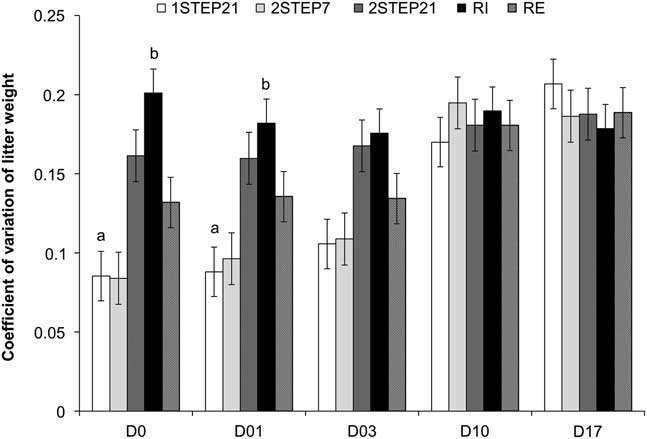
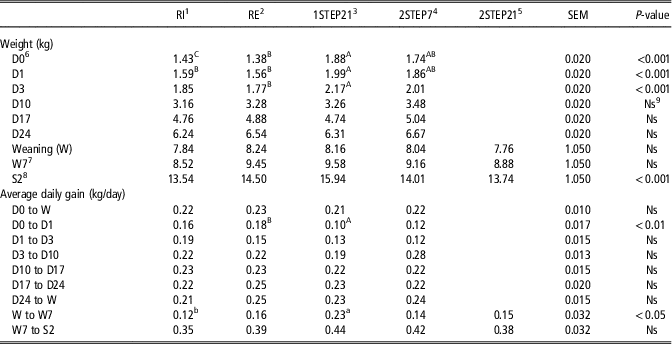
Pre-weaning weights differed between treatments and days (F 18, 2474=13.02, P<0.001; Table 1). 1STEP21 piglets were heavier than RI and RE piglets on D0 (t 26.2=5.48 and t 31=5.67, respectively, P<0.001) and D1 (t 26.2=4.63 and t 31=6.71, respectively, P<0.005). On D3, 1STEP21 piglets were heavier than RE piglets (t 31.1=4.04, P<0.05) and tended to be heavier than RI piglets (t 26.2=3.62, P<0.07). 2STEP7 piglets were heavier than RE piglets on D0 (t 26.1=4.31, P<0.005). Between D0 and D1, RE piglets had higher ADG than 1STEP21 piglets (t 33.7=−3.52, P<0.01) and tended to have higher ADG than 2STEP7 piglets (t 33.9=−2.50, P=0.09) (Table 1). 1STEP21 and 2STEP7 piglets did not differ significantly in weight throughout lactation (t 25.7=−0.03, P>0.9). From D7 until weaning, there was no treatment difference in weight or ADG. The CV of weight of 1STEP21 and 2STEP7 litters was lower than RI litters on D0 (t 258=−5.42 and t 258=−5.35, respectively, P<0.001) and 1 (i.e. t 258=−4.38 and t 258=−3.88, respectively, P<0.05). The CV of weight in 1STEP21 and 2STEP7 litters increased gradually between D0 and D24 (P<0.05) (Figure 1).
Mean (±SE) CV to the mean litter weight in litters of new-born piglets reared by their mother in an intact litter (RI) or in an equalised litter (RE), new-born piglets reared by a nurse sow 21 (1STEP21) or 7 (2STEP7) days into lactation and 7-day-old piglets reared by a nurse sow 21 days into lactation (2STEP21). D0 was the day of transfer of new-born piglets onto the nurse sow, and D01, D03, D10 and D17 are the days relative to D0. a,bDifferent superscript letters indicate significant differences (P<0.05).

Mean (±SE) weights (kg) and average daily gain (kg/day) of new-born piglets reared by their mother in an intact litter (RI) or in an equalised litter (RE), new-born piglets reared by a nurse sow 21 (1STEP21) or 7 (2STEP7) days into lactation and 7-day-old piglets reared by a nurse sow 21 days into lactation (2STEP21)

Different superscript letters indicate significant differences (a,b P<0.05, A,B,C P<0.01).
1 RI piglets remained with their mother in an intact litter.
2 RE piglets remained with their mother in an equalised litter (i.e. mixed with fostered piglets).
3 1STEP21 piglets were transferred at 1 day old onto a nurse sow 21 days into lactation.
4 2STEP7 piglets were transferred at 1 day old onto a nurse sow 7 days into lactation.
5 2STEP21 piglets were transferred at 7 day old onto a nurse sow 21 days into lactation.
6 D0 is the day of transfer, 1 day after the birth of RI and RE piglets.
7 W7 stands for ‘7 days post-weaning’ (~5 weeks old).
8 S2 stands for second stage weaner accommodation (~8 weeks old).
9 Ns means that the effect was statistically non-significant (P>0.05).
Post-weaning
There was no overall treatment effect on piglet post-weaning weight (F 4,29.6=1.17, P>0.05; Table 1), but there was a treatment by day interaction (F 8,758=3.72, P<0.001). 1STEP21 pigs were heavier than RI pigs at entry to the second stage weaner accommodation (t 35.4=2.88, P<0.01), but this difference was not significant after adjustment for multiple comparisons. Indeed, 1STEP21 pigs had a higher ADG than RI pigs (P<0.05) during the week following weaning (t 24.9=3.17, P<0.05; Table 1).
Behaviour following transfer to the nurse sow
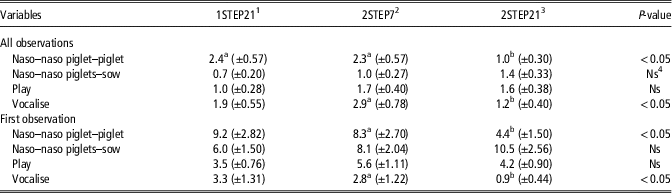
No escape attempts were observed in any treatment. Piglets performed more of the behaviours which were observed directly after transfer than in the following hours (P<0.01; Table 2). During the first observation after transfer, 2STEP7 piglets performed more naso–naso contacts with each other and vocalised more than 2STEP21 piglets (t 8=3.61, P<0.01; t 8=3.89, P<0.005, respectively; Table 3). No treatment difference was found in play behaviour (F 2,8=1.62; P>0.2) or the number of naso–naso contacts with the sow (F 2,8=2.35; P>0.01).
Mean (±SEM) number of naso–naso contacts between piglets, naso–naso contacts between piglets and sow, play behaviours and vocalisations recorded during the four 5-min direct observation periods following transfer of piglets to nurse sows (all treatments combined; 1STEP2: 10 litters and 120 piglets, 2STEP7: nine litters and 106 piglets and 2STEP21: nine litters and 108 piglets)

The first observation was performed directly after transfer of piglets to the nurse sow and subsequent observations were performed after1, 2 and 4 h.
A,BDifferent superscript letters indicate significant differences (P<0.005).
1 Ns means that the effect was statistically non-significant (P>0.05).
Mean (±SEM) number of naso–naso contacts between piglets, naso–naso contacts between piglets and sow, play behaviours and vocalisations recorded during the 5-min direct observations following transfer of piglets onto the nurse sow

There were 10 1STEP21 litters observed (n=120 piglets), nine 2STEP7 litters (n=106 piglets) and nine 2STEP21 litters (n=108 piglets).
a,bDifferent superscript letters indicate significant differences (P<0.05).
1 1STEP21 piglets were transferred at 1 day old onto a nurse sow 21 days into lactation.
2 2STEP7 piglets were transferred at 1 day old onto a nurse sow 7 days into lactation.
3 2STEP21 piglets were transferred at 7 day old onto a nurse sow 21 days into lactation.
4 Ns means that the effect was statistically non-significant (P>0.05).
Overall the observations, 2STEP21 piglets vocalised less (t 89=2.88, P<0.05) and performed fewer naso–naso contacts with other piglets than 2STEP7 (t 89=3.11, P<0.01) and 1STEP21 piglets (t 89=2.34, P<0.05) (Table 3). 2STEP7 piglets also tended to have fewer naso–naso contacts with the sow than 2STEP21 piglets (t 89=−1.19, P<0.08, Table 3). No treatment effect was detected in play behaviour (F 2,89=1.55, P>0.2).
Nursing behaviour
All variables investigated significantly decreased between D1 and D23 (P<0.001) except the percentage of nursing bouts ended by the sow, which significantly increased (P<0.001) (data not presented).
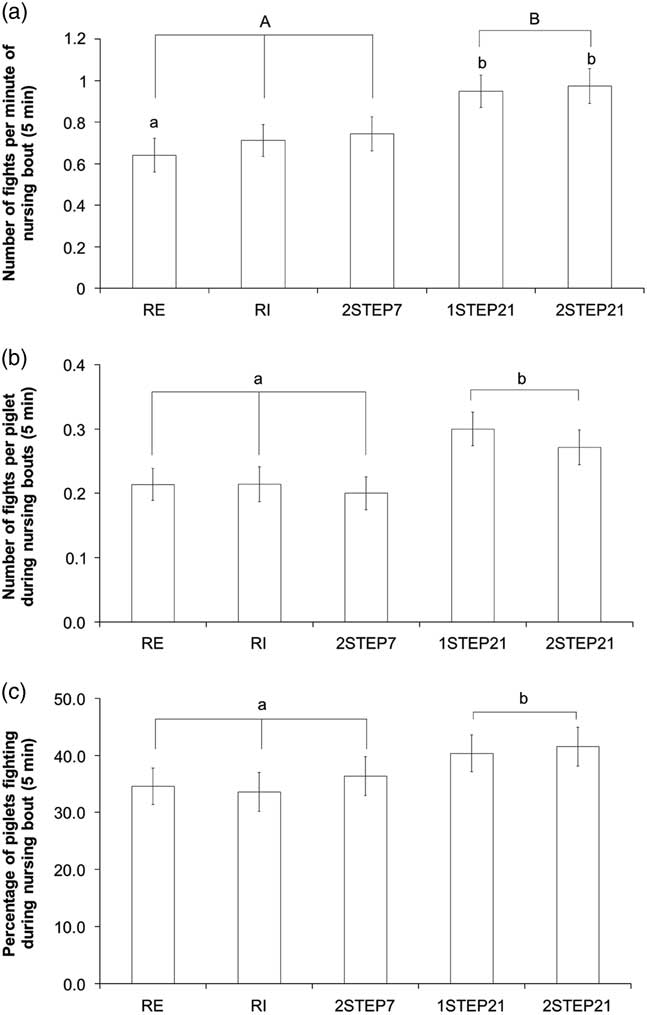
Overall, treatment affected the number of fights per minute (F 4,115=4.61, P<0.05; Figure 2a), the percentage of piglets fighting (F 1,147=2.71, P<0.05; Figure 2b), the number of fights per piglet (F 4,133= .70, P<0.05; Figure 2c) and nursing duration (F 4,107=2.72, P<0.05). The percentage of piglets missing nursing bouts tended to be affected by treatment (F 4,140=1.98, P=0.1, data not presented); on average, 9.4±1.20% of piglets missed a nursing bout. Litters reared by sows in early lactation (i.e. RI, RE and 2STEP7) showed less fighting behaviour (Figure 2) and had fewer piglets missing nursing bouts (8.5±1.16% v. 10.8±1.18%; F 1,145=7.22, P<0.001) than litters reared by sows in late lactation (i.e. 1STEP21 and 2STEP21). 2STEP21 litters had shorter nursing bouts than RI (215±12.8 s v. 258±12.2 s, t 107=−2.81, P<0.05) and 1STEP21 litters (215±12.8 s v. 253±12.6 s, t 81.7=2.80, P<0.05). 2STEP21 sows tended to terminate a greater percentage of nursing bouts than RI sows (24±6.7% v. 60±9.3%, t 595=2.93, P<0.06).
Fighting behaviours of piglets during nursing bouts in litters of new-born piglets reared by their mother in an intact litter (RI) or in an equalised litter (RE); new-born piglets reared by a nurse sow 21 (1STEP21) or 7 (2STEP7) days into lactation and 7-day-old piglets reared by a nurse sow 21 days into lactation (2STEP21). (a) Number of fights per minute, (b) percentage of piglets fighting, (c) number of fights per piglet. Different superscript letters indicate significant differences (a,b P<0.05; A,B P<0.001).

Teat order establishment and stability
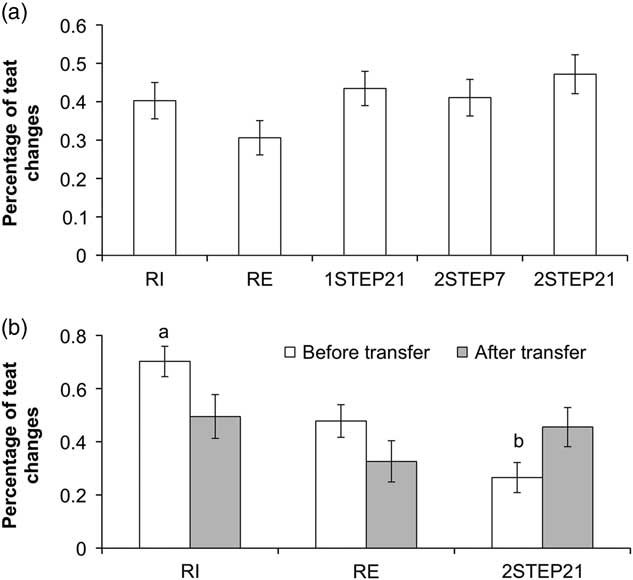
Overall, the percentage of teat changes did not differ between treatments (F 4,31.5 = 1.92, P>0.1, Figure 3a) and days (F 5,83.5=1.93, P<0.1). The interaction between treatment and day on PTC before and after transfer of piglets was significant (F 2,24.2=3.74, P<0.05, Figure 3b), but pair-wise comparisons were not significant (P>0.05). Before transfer, 2STEP21 litters had lower PTC than RI litters (t 14.9=−5.28) and tended to have lower PTC than RE litters (t 11.6=−2.77, P<0.1), but after transfer there was no treatment difference in PTC (F 2,22.8=1.37, P>0.2).
(a) Mean (±SEM) percentage of teat changes in litters with: new-born piglets reared by their mother in an intact litter (RI) or in an equalised litter (RE), new-born piglets reared by a nurse sow 21 (1STEP21) or 7 (2STEP7) days into lactation and 7-day-old piglets reared by a nurse sow 21 days into lactation (2STEP21). (b) Mean (±SEM) percentage of teat changes before and after transfer to the nurse sow of RE, RI and 2STEP21 piglets. a,bDifferent superscript letters indicate significant differences (P<0.05).

Discussion
Effectiveness of the strategies
There are many different strategies used to rear ‘surplus’ piglets that arise from very large litter sizes producing more piglets than available teats. They include split (early) weaning, which contradicts the recommendations of the EU legislation (The Council of the European Union, 2008), split suckling, which represents considerable additional workload for the farm staff, or artificial rearing, which could have negative effects on piglets’ performance and welfare (Baxter et al., Reference Baxter, Rutherford, D‘Eath, Arnott, Turner, Sandøe, Moustsen, Thorup, Edwards and Lawrence2013). There is also the use of nurse sows, which, despite being an increasingly ubiquitous practice on commercial farms, has received little scientific investigation into the impacts on sows and piglets. This study investigated the effects of different fostering strategies on piglet growth and behaviour compared with piglets remaining with their mother. Both nurse sow strategies were effective in rearing 1-day-old piglets transferred from large litters. Indeed, survival and growth performance of transferred piglets was not different to that of piglets remaining with their mother. However, it is important to note that the heaviest and most vigorous piglets in the litter were transferred (as per typical farm practice) because they are more likely to survive than their lighter littermates (e.g. Tuchscherer et al., Reference Tuchscherer, Puppe, Tuchscherer and Tiemann2000; Milligan et al., Reference Milligan, Fraser and Kramer2001; Baxter et al., Reference Baxter, Rutherford, D‘Eath, Arnott, Turner, Sandøe, Moustsen, Thorup, Edwards and Lawrence2013), and thus hypothesised to be better placed to cope with the challenge of fostering (Heim et al., Reference Heim, Mellagi, Bierhals, de Souza, de Fries, Piuco, Seidel, Bernardi, Wentz and Bortolozzo2012). Also, as piglets with a lower birth weight seemed to be able to catch up with heavier piglets at weaning/slaughter (Douglas et al., Reference Douglas, Edwards, Sutcliffe, Knap and Kyriazakis2013), leaving them with their mother might promote this compensatory growth. Therefore, we did not control for effect of transfer on the smallest piglets in the litter, or for the effect of remaining with their mother on the heaviest piglets, and results are interpreted with this caveat. Further studies should include such control groups in order to draw stronger conclusions on the effectiveness of the nurse sows strategies.
It is also highly likely that the effectiveness of any nurse sow strategy will depend on the maternal abilities of the sow. In the current study, ‘maternal ability’ was determined simply by selecting sows in good body condition, with at least 12 piglets and that had not crushed a piglet from farrowing until selection. This proxy measure of sow rearing potential is an easy way for farmers to make judgements on sows, and the present study suggests that it is appropriate in conventional farrowing systems. However, for nurse sow strategies to be achievable (i.e. rear surplus piglets from large litters), our results suggest that other characteristics may be involved. Indeed, the stage of lactation and the temperament (e.g. restlessness) of the sow could influence the fighting behaviour at the udder, thus affecting the growth and welfare of transferred piglets. For instance, nursing behaviour of sows has been shown to correlate with pre-pubertal response to behavioural tests (i.e. open field; Thodberg et al., Reference Thodberg, Jensen and Herskin2002), and the frequency of nursing bouts has been shown to correlate negatively with competition at the udder (Pedersen et al., Reference Pedersen, Studnitz, Jensen and Giersing1998).
More detailed measures of sow maternal abilities might be needed to validate the use of nurse sows in farrowing systems where sows are loose-housed, as piglet pre-weaning survival is even more reliant on maternal behaviour in such systems (Ocepek and Andersen, Reference Ocepek and Andersen2017).
Growth performance
Because heaviest piglets within each litter were selected for transfer to a nurse sow, 1STEP21 and 2STEP7 piglets were heavier than RI and RE piglets on D0, but this difference was not detectable 2 days after. Moreover, the CV of weight was lower in transferred litters than in remained litters on D0, but CVs did not differ anymore by D10. These findings suggest that transferred piglets experienced growth check during the week following transfer, and may have been unable to express their full growth potential during lactation. This could be due to a discrepancy between their needs and milk quality (see Hurley, Reference Hurley2015 for a review) or to delayed nursing following transfer (i.e. no nursing was observed in the 4 h following transfer). As nurse sows are usually lactating for at least 7 days, some of their teats might not have been used by the previous litter, and thus had stopped producing milk. Thus, it is best practise to only give a nurse sow the same number of piglets or fewer piglets than what she has been suckling to ensure that piglets have at least one teat each to suckle after being transferred.
All treatments were weaned at approximately the same age and at the same weight; however, 1STEP21 pigs had an ADG twice as high as RI pigs in the 1st week post-weaning, and thus were 2 kg heavier by 8 weeks of age. This could either be related to their poor pre-weaning performance (compensatory growth), or to their higher growth potential related to heavier birth weight. In addition, the lower milk quality or higher reluctance of the sow to milk the transferred litter could have led 1STEP21 piglets to consume solid food earlier than the other treatments, which would reduce the impact of changing from liquid to solid diets following weaning.
Behaviour following transfer to the nurse sow
Transferred piglets were more active directly after transfer than in the following hours, probably because they were exploring their new environment, the nurse sow and their new littermates (i.e. for piglets in mixed litters, 1STEP21 and 2STEP7). Naso–naso contacts are a means of communication between piglets and the sow (Blackshaw et al., Reference Blackshaw, Swain, Blackshaw, Thomas and Gillies1997) and probably also between piglets. Therefore, the higher occurrence of naso–naso contacts in mixed litters, compared with stable litters (i.e. 2STEP21), may reflect the interest that unfamiliar piglets have for one another.
Different piglets’ vocalisations are partly indicative of their coping capacity to being separated from their mother (Weary and Fraser, Reference Weary, Ross and Fraser1997). Thus, contradicting our initial hypothesis, our results suggest that 1-day-old piglets coped less well, and thus experienced greater distress, with transfer than 7-day-old piglets, as 2STEP21 piglets vocalised less than 2STEP7 and 1STEP21 piglets. Further investigation should address long-term effects of transfer on social and play behaviours, as early play experience pre-weaning seems to improve post-weaning social play and coping with mixing at weaning (Donaldson et al., Reference Donaldson, Newberry, Špinka and Cloutier2002).
Nursing behaviour and teat order
All fighting variables recorded (i.e. number of fights per piglet, percentage of piglets involved in fights and number of fights per minute) declined gradually over time, suggesting that conflicts for teat ownership were solved as time passed. However, at the end of lactation (D23), there was still ~30% of the piglets fighting over teats, 0.2 teat fights per piglet and one piglet missing the nursing bout (i.e. about 13%), showing that conflicts were not fully resolved. Competition at the udder increases with litter size (Andersen et al., Reference Andersen, Nævdal and Bøe2011), likely explaining the difference between the results of this study and previous work (Hemsworth et al., Reference Hemsworth, Winfield and Mullaney1976; Puppe and Tuchscherer, Reference Puppe and Tuchscherer1999), where litter size was smaller and stability was reached earlier (i.e. 2nd week of lactation). Indeed, litters above 10 piglets may experience more difficulty in retrieving preferred teat pairs during synchronous nursing bouts, suggesting higher competition (Hemsworth et al., Reference Hemsworth, Winfield and Mullaney1976). This supports intervention strategies to ensure large litters do not remain as such, as failure to establish teat order would result in higher competition at the udder, probably accompanied by lower growth of the piglets and more lesions at the sow’s udder.
Unexpectedly, all fighting variables and the percentage of teat changes increased numerically at the end of the lactation for all treatments. A first causation could be that the ease of udder access was impaired by the farrowing crate design (Moutsen et al., Reference Moutsen, Lahrmann and D’Eath2011), which was narrower on one side and therefore hard to access as the piglets grew (personal observation). Second, sows might be less willing to position correctly during nursing bouts later in lactation as they initiated weaning (Pedersen et al., Reference Pedersen, Studnitz, Jensen and Giersing1998). This is supported by our finding that litters reared by nurse sows in late lactation (i.e. 1STEP21, 2STEP21) performed more fighting behaviour, had a greater percentage of piglets missing a nursing bout and shorter nursing bouts than litters reared by early lactation sows (i.e. RI, RE, 1STEP7); even though 2STEP21 piglets were not introduced to new piglets, and RE and 1STEP7 piglets were.
Despite the fact that 1STEP21 and 2STEP21 sows were both in late lactation at transfer, their behaviour was subtly different during nursing bouts. Indeed, 1STEP21 sows had longer nursing bouts and terminated fewer of them, thus allowing the piglets to spend more time massaging the udder. This suggests that the age of the transferred piglets influenced nurse sows’ nursing behaviour. Sows might be aware of the piglets’ nursing needs, probably through communication between the piglets and the sow around nursing bouts (i.e. vocalisation and massaging of udder; Algers, Reference Algers1993). In 2STEP21 litters, fostered piglets and nurse sows had bonded with their previous mother and offspring (respectively) before transfer, thus re-establishing communication might have required adaptation (Algers, Reference Algers1993). Thus, sows seemed to be able to adapt their nursing behaviour to piglets’ needs. Selection of nurse sows could thus include a behavioural criterion on the sows’ willingness to nurse the piglets and not to terminate the nursing bout.
Removing the heaviest piglets from large litters (i.e. RI and RE) resulted in a 30% (numerical) decrease in PTC, suggesting better access to the teats, which is the logical consequence of reducing litter size. Contrarily, fostering a whole litter of 7-day-old piglets (i.e. 2STEP21) onto a nurse sow (numerically) increased PTC by 70%, likely reflecting the adaptation to the nurse sow’s udder and the need to re-establish teat order.
In conclusion, the present results suggest that, provided that heaviest and vigorous piglets are selected to be transferred, the nurse sow strategies tested have minimal implications for their performance. Although there were some negative effects with regard to growth and competitive behaviour, particularly for piglets transferred to sows late in lactation, these strategies represent potential management tools for managing large litters on commercial farms in the absence of alternative systems. However, given the small number of litters involved in the present study, these results have to be considered with caution.
Acknowledgements
This research was funded by the Irish Department of Agriculture, Food and the Marine through the FIRM/RSF/CoFoRD 2013 Research Call (project no. 13S428). The authors thank Sophie Verstraeten, Sebastien Laboute and David Clarke for helping in data collection, the farm staff and Jim Grant for statistical analysis consultancy.
Declaration of interest
The authors declare that they did not have a conflict of interest in the conduction of this study.
Ethics statement
Ethical approval for this study was granted by Teagasc Animal Ethics Committee (approval no. TAEC90/2015). The experiment was carried out in accordance with Irish legislation (SI no. 543/2012) and the EU Directive 2010/63/EU for animal experimentation.
Software and data repository resources
None of the data were deposited in an official repository.