Introduction
The taxonomy of persistently sterile leprose lichens has advanced greatly over the last thirty years. In the 1990s, when most of these species were included in the genus Lepraria, more detailed studies of morphology and especially chemistry began to lead to a better understanding of the taxa, and to a sustained increase in the number of accepted species (Laundon Reference Laundon1992; Tønsberg Reference Tønsberg1992). In the absence of sexual structures, Lepraria was regarded as a form-genus of unknown phylogenetic position, and taxonomic advances were mainly made at the species level. Ekman & Tønsberg (Reference Ekman and Tønsberg2002) showed that most species of Lepraria formed a monophyletic group related to the crustose to fruticose genus Stereocaulon; however, Lepraria flavescens Clauzade & Cl. Roux was shown to belong in Lecanora, and L. lesdainii (Hue) R. C. Harris and L. obtusatica Tønsberg were only distantly related to each other and to the other species in the analysis. Nelsen et al. (Reference Nelsen, Lumbsch, Lücking and Elix2008) showed that Lepraria usnica Sipman belonged in Pilocarpaceae and that L. coriensis (Hue) Sipman occurred outside Lecanorales. Lendemer & Hodkinson (Reference Lendemer and Hodkinson2013) showed that Lepraria coriensis, L. texta K. Knudsen et al. and some newly described leprose species belonged in the genus Leprocaulon, previously comprising fruticose species, and Leprocaulon was placed in a newly erected order Leprocaulales. Hodkinson & Lendemer (Reference Hodkinson and Lendemer2013) showed that Lepraria moroziana Lendemer and L. obtusatica belonged in Arthoniales.
Despite the transfer of many species to other genera, Lepraria is still a large genus, comprising at least 82 accepted species. Although sexual reproductive structures are absent, speciation in this genus has evidently continued. Saag et al. (Reference Saag, Saag and Randlane2009) gave a useful summary of the genus, but at least 24 species have been described since their survey.
Laundon (Reference Laundon2003) described a new leprose species from Great Britain (type locality) and Canada as Lecanora ecorticata, which was said to contain usnic acid as the major substance, with atranorin, zeorin and fatty acids reported as accessory substances (either present or absent in individual specimens). The placement in Lecanora was based on chemistry. Lendemer & Hodkinson (Reference Lendemer and Hodkinson2013) included leprose species containing usnic acid and zeorin in their study and showed that these belonged either in Lecanora s. lat. or in Leprocaulon. Although Lecanora ecorticata had been described as a leprose species with usnic acid and zeorin, its status in regard to the other usnic acid-containing species could not be assessed due to the lack of molecular data for L. ecorticata, and the authors excluded the name from western North America.
Although the holotype of Lecanora ecorticata was said to contain zeorin, the holotype was lost while on transit during a loan, and three paratypes analyzed by Martin Kukwa (annotations within the herbarium packets) contained up to two terpenoids, but no zeorin. To remove the uncertainty surrounding the identity of the species, the chemistry and phylogenetic relationships of L. ecorticata are investigated here.
Materials and Methods
Chemistry
Specimens were investigated by thin-layer chromatography (TLC) in solvent systems A and G, using standard methods (Orange et al. Reference Orange, James and White2010).
Sequence acquisition
DNA was extracted from recently collected or frozen specimens using the Qiagen DNeasy Plant Mini Kit; the manufacturer's instructions were followed except that warm water was used for the final elution. PCR amplification was carried out using Bioneer AccuPower PCR Premix 50 μl reaction tubes. The following regions were amplified:
1. The two internal transcribed spacer regions and the 5.8S region (ITS1-5.8S-ITS2) of the nuclear ribosomal gene, using the primers ITS1F and ITS4.
2. Part of the large ribosomal subunit, using the primers nu-LSU-155-5ʹ, LR3, LR5 and LR7.
3. Part of the small subunit of the mitochondrial ribosomal DNA (mtSSU) using the primers mrSSU1 and mrSSU3R.
4. Part of the RNA polymerase II largest subunit (RPB1) gene, using the primers RPB1-AF, RPB1-Cr and RPB1-gR1asc.
The PCR thermal cycling parameters for the first three followed Orange et al. (Reference Orange, Earland-Bennett, Hitch and Powell2017), and those for RPB1 followed Gueidan et al. (Reference Gueidan, Roux and Lutzoni2007).
Sequencing was performed by The Sequencing Service (College of Life Sciences, University of Dundee; www.dnaseq.co.uk) using Applied Biosystems BigDye v3.1 chemistry on an Applied Biosystems 3730 automated capillary DNA sequencer.
Phylogenetic analysis
Alignment of assembled sequences was carried out using BioEdit (http://www.mbio.ncsu.edu/BioEdit/ bioedit.html). ClustalW was used to create an initial alignment, which was edited manually and trimmed to remove long free ends. The initial alignments of ITS, LSU and mtSSU were degapped and realigned in PRANK (Löytynoja & Goldman Reference Löytynoja and Goldman2010; Löytynoja Reference Löytynoja and Russell2014), using the web interface at http://wasabiapp.org/software/prank/. The initial RPB1 alignment was degapped and realigned in MACSE (Ranwez et al. Reference Ranwez, Harispe, Delsuc and Douzery2011), using the web interface at http://mbb.univ-montp2.fr/macse. All parts of the resulting alignments were used for analysis, except for poorly aligned regions of RPB1, which were excised.
BLAST searches in GenBank of each gene region were carried out to find closely related sequences. Subsequently, the dataset used for a study of the phylogeny of Ramalinaceae (Kistenich et al. Reference Kistenich, Timdal, Bendiksby and Ekman2018) was used to investigate the placement of the newly generated sequences.
Phylogenetic relationships and support values were investigated using maximum likelihood (ML) bootstrapping, as implemented in RAxML (Stamatakis Reference Stamatakis2006; Stamatakis et al. Reference Stamatakis, Hoover and Rougemont2008), hosted on the CIPRES Science Gateway (Miller et al. Reference Miller, Pfeiffer and Schwartz2010). After initial analyses of each gene region separately, sequences were concatenated using SequenceMatrix (Vaidya et al. Reference Vaidya, Lohman and Meier2011).
Analyses with RAxML used rapid bootstrapping with 1000 iterations and the GTRGAMMA substitution model; a search for the best-scoring ML tree was carried out with the bootstrap analysis in a single run. For the concatenated dataset, a partitioned analysis was carried out, using ITS, LSU, mtSSU, and the three codon positions of RPB1 and of RPB2 as partitions. Boreoplaca ultrafrigida Timdal and Ropalospora lugubris (Sommerf.) Poelt were used as outgroup.
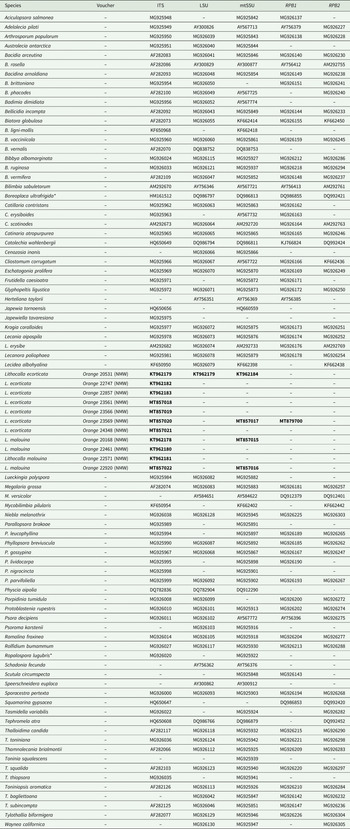
The resulting trees were visualized using MEGA v4 (Tamura et al. Reference Tamura, Dudley, Nei and Kumar2007). Support values of ≥ 70% ML bootstrapping were regarded as significant. Sequences used in the analyses are shown in Table 1.
Specimens of Lithocalla and related species used in the phylogenetic analyses (Fig. 2) with voucher information and GenBank Accession numbers. New sequences are in bold. * = outgroup.

Pairwise distances between ITS sequences of putative Lecanora ecorticata were calculated using MEGA v4.
Results
Chemistry
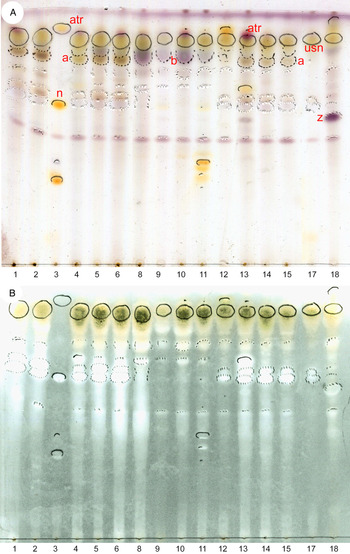
TLC data were obtained from c. 11 specimens from Great Britain (of which 5 were sequenced), 2 from Norway, and 10 from the Falkland Islands (of which 5 were sequenced). The following substances were found (Fig. 1):
-
Usnic acid: constant, major compound.
-
Fatty acids: two rather well-defined spots R f class 4–5 in G (major or minor), appearing as a single spot R f class 6 in solvent system A; traces of additional fatty acids.
-
Unidentified terpenoid A, R f class 6 in solvent system G, dirty grey-brown after heating, UV+ dull pink; accompanied by an ill-defined trace of terpenoid UV+ dull purple after heating, immediately above in solvent system G.
-
Unidentified terpenoid B, faint purplish after heating, R f class 6 in G, UV+ violet-purple.
-
Traces of additional terpenoids. Note that the purplish spot in Fig. 1A at R f class 3 is not a terpenoid; similar spots are often present on chromatograms of a wide range of lichen species. Zeorin was absent in all specimens.
-
Atranorin: traces in five British specimens and one Falkland Island specimen. In solvent system G, atranorin overlaps with usnic acid, and because of this it is indicated by a purple coloration (e.g. Fig. 1A, lane 13).
-
Stictic acid: present in a single collection from the Falkland Islands.
It was not possible to resolve all the minor terpenoids and fatty acids using TLC, and the substances are best understood when numerous samples are run together on the same plate. However, terpenoid A was restricted to material from Europe, and terpenoid B to material from the Falkland Islands. European material contained two main fatty acids, whereas material from the Falkland Islands lacked these, and instead had a trace of fatty acid at a slightly higher position in G.
Thin-layer chromatography of Lithocalla in solvent system G. A, plate after treatment with sulphuric acid and heating. B, the same plate before heating, sprayed with water to reveal fatty acids. Lanes 1, 2, 4–6, 12–17, Lithocalla ecorticata; lanes 8–11, L. malouina; lane 18, Leprocaulon calcicola; lane 3, control with norstictic acid and atranorin. Labels: a = terpenoid A, b = terpenoid B, atr = atranorin, usn = usnic acid, n = norstictic acid, z = zeorin. Collection numbers of samples in lanes: 1, Orange 9704; 2, 7572; 4, 8541; 5, 10336; 6, 17628; 8, 20168; 9, 22461 (part); 10, 22461 (part); 11, 22571; 12, 20531; 13, 22747; 14, 8753; 15, 8898; 17, 22857; 18, hb. Earland-Bennett.

Phylogenetic analysis
ITS sequences were newly prepared for 11 specimens (one sequence extending well into the LSU), mtSSU sequences for 4 specimens and an RPB1 sequence for one specimen (Table 1).
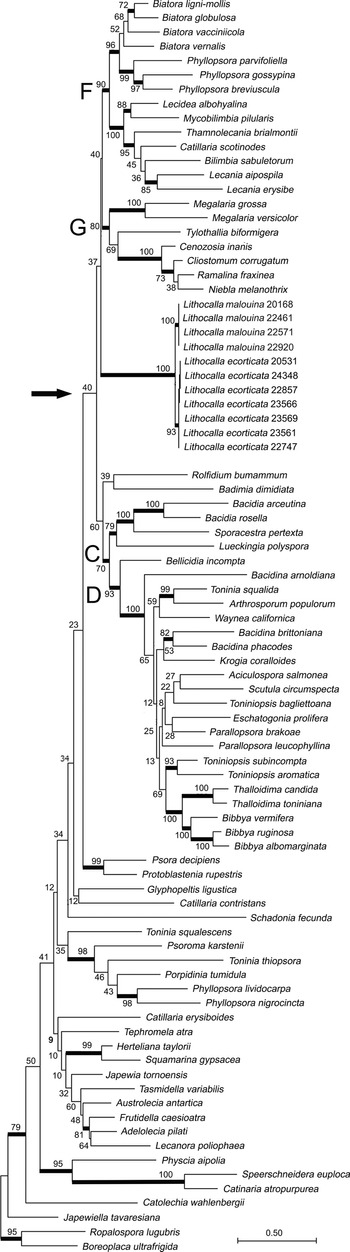
BLAST searches of the ITS, LSU and mtSSU regions returned mostly members of the family Ramalinaceae, or species until recently placed in Ramalinaceae, such as Japewia tornoensis (Nyl.) Tønsberg, as the most closely related sequences. A search using the RPB1 sequence did not return any closely related sequences. Maximum likelihood analyses of each gene region separately with sequences of Ramalinaceae and others of Kistenich et al. (Reference Kistenich, Timdal, Bendiksby and Ekman2018) suggested in each case that the sequence was nested within Ramalinaceae, but with very low support values (data not shown). As support values were so low, a meaningful comparison of the topology of the tree resulting from each analysis was not possible, and a concatenated alignment of the four gene regions was prepared for further analysis. Following an analysis using most of the sequences of Kistenich et al. (Reference Kistenich, Timdal, Bendiksby and Ekman2018), a more manageable reduced dataset was prepared and analyzed; sequences used are shown in Table 1. Ramalinaceae was recovered, but with low support. However, Clades A, C, D, F and G of Kistenich et al. (Reference Kistenich, Timdal, Bendiksby and Ekman2018) were recovered with good support (only one member of Clade E was used in the reduced analysis). Lithocalla collections form a strongly supported clade, which is basal to Clades F and G, but with poor support. Within Lithocalla there are two main strongly supported clades, representing material from Great Britain and the Falkland Islands, respectively (Fig. 2).
Phylogenetic relationships of Lithocalla, based on a maximum likelihood (ML) analysis of the five-gene alignment. Sequence and voucher information is presented in Table 1. The tree was rooted using Boreoplaca ultrafrigida and Ropalospora lugubris. The ML bootstrap value is shown adjacent to each branch. Branches in bold indicate a support of ML bootstrap ≥ 70%. The starting node of Ramalinaceae is indicated by an arrow. The starting nodes of Clades C, D, F and G recovered in an analysis of Ramalinaceae by Kistenich et al. (Reference Kistenich, Timdal, Bendiksby and Ekman2018) are indicated by a letter.

Pairwise differences between ITS sequences from 10 putative Lecanora ecorticata specimens suggested a relatively high intraspecific diversity, if it was assumed that all belong to a single species. Average pairwise distances for all 10 sequences were 0.0018 to 0.0351 (mean 0.0209). Average pairwise distances between the British specimens were in the range 0.0018–0.0053 (mean 0.0039); the three Falkland Island sequences were identical. The intraspecific diversity in the British material is comparable to that found in 13 out of 15 members of Parmeliaceae investigated by Del-Prado et al. (Reference Del-Prado, Cubas, Lumbsch, Divakar, Blanco, Amo de Paz, Molina and Crespo2010), whereas the considerably higher diversity amongst all 10 sequences was comparable to that of Parmotrema reticulatum (Taylor) M. Choisy, which has been shown to comprise a number of lineages representing cryptic species (Del-Prado et al. Reference Del-Prado, Divakar and Crespo2011, Reference Del-Prado, Divakar, Lumbsch and Crespo2016).
The analysis suggests that Lecanora ecorticata is a member of the Ramalinaceae, but of uncertain position within the family, and with no closely related genera. However, because of the low support values it is possible that it belongs outside Ramalinaceae. Because there are no closely related genera, a new genus is established below for L. ecorticata. Based on the limited material available, the genus is considered to comprise two closely related species, of which the second is described here as new.
Taxonomy
Lithocalla Orange gen. nov.
MycoBank No.: MB 836548
Thallus crustose, leprose, diffuse, arising from aggregations of separate granules, eventually forming a cracked crust; lower parts of thallus comprising decolourized granules, medulla and hypothallus not developed. Prothallus occasionally seen in shade, sparse. Photobiont a green alga. Ascomata and conidiomata unknown.
Type species: Lithocalla ecorticata (J. R. Laundon) Orange.
Phylogenetic placement
Ascomycota, Lecanorales, Ramalinaceae.
Chemistry
Usnic acid, atranorin (accessory), stictic acid (accessory), fatty acids, terpenoids.
Etymology
Derived from the Greek nouns Lithos (stone) and Callos (beauty), a reference to the beautiful pale yellow colonies dusting rock overhangs. The name has a Latin termination, and should be treated as feminine.
Lithocalla ecorticata (J. R. Laundon) Orange comb. nov.
MycoBank No.: MB 836550
Lecanora ecorticata J. R. Laundon, Nova Hedwigia 76, 100–102 (2003).—Lepraria ecorticata (J. R. Laundon) Kukwa, Mycotaxon 97, 64 (2006); type: Great Britain, England, Devon (Vice-County (V.C.) 4), Ilfracombe, Torrs Walks, 21/50.47, on shaded vertical rocks, 1 September 1971, J. R. Laundon 2851 (BM—holotype [lost]) [Thin-layer chromatography: atranorin, usnic acid and zeorin, according to the protologue]; Wales, V.C. 49, Caernarvonshire, Beddgelert, Bethania, 2.25 miles south of Snowdon, SH626.509, abundant on underhang of wall running alongside a rough track, 30 April 1983, R. O. Millar (BM – 000763146—lectotype, designated here! MBT 393476) [Thin-layer chromatography: usnic acid, some terpenoids (in traces), 2005, Martin Kukwa].
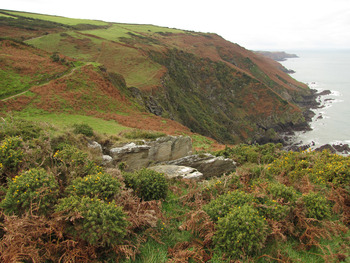
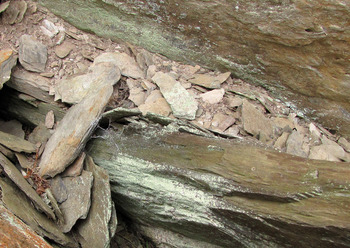
Rock outcrop supporting Lithocalla ecorticata (Orange 23566) at the type locality of the species, Torrs Park, North Devon. In colour online.

Lithocalla ecorticata (Orange 23566) on rain-sheltered surfaces at the type locality of the species. In colour online.

Prothallus absent or occasionally sparsely present in shade. Thallus crustose, diffuse, often forming large colonies, arising from aggregations of separate granules to form a leprose crust, pale yellow-green (Munsell 5GY 7–8/2), becoming blue-grey in deep shade; thallus eventually up to 2 mm thick, but then most of the thickness is of dead decolourized granules; thicker thalli may become cracked; granules fine, 60–100 μm diam., ecorticate, without projecting hyphae. Medulla and hypothallus absent.
Ascomata and conidiomata unknown.
Chemistry
Unidentified terpenoid A at R f class 6 in solvent system G, dirty grey-brown after heating, UV+ dull pink (minor), additional trace of a terpenoid at R f class 6, immediately below usnic acid; two fatty acids, R f class 4–5 in G (major or minor), appearing as a single spot R f class 6 in solvent system A, traces of additional fatty acids; usnic acid (major); atranorin (accessory, minor). Zeorin is absent. Thallus K−, C−, KC+ pale yellow, PD−.
Ecology
On rain-sheltered siliceous rocks, extending further into sheltered cavities than most other British lichens, and typically forming pure stands. It is sometimes conspicuous on drystone walls in woodland, picking out the recesses with a pale yellow colour. Lepraria incana (L.) Ach. is often associated with it but does not extend as far into shelter. The species is widespread in Great Britain, though mainly in the north and west. On the basis of confirmed material, it occurs from sea level up to 480 m altitude (North Wales), but probably extends much higher. Confirmed specimens have been seen from south-west Norway (to 640 m altitude in Aurland). Other records need confirmation (see below).
Notes
Laundon (Reference Laundon2003) reported atranorin, usnic acid and zeorin in the holotype of Lecanora ecorticata. In eight additional specimens he found usnic acid (always present), atranorin (present in two), zeorin (present in two), and an unidentified fatty acid (present in three). Thin-layer chromatography of the three British paratypes in BM (Coppins & Brinklow 12859, Millar, and James s. n.) performed by Martin Kukwa in 2005–2006 (annotations in the herbarium packets) showed usnic acid and up to two terpenoids (but no zeorin); a trace of atranorin was found in one specimen.
The report of zeorin in the holotype of Lecanora ecorticata, and the subsequent loss of the holotype while in transit for a loan, have cast doubt on the identity of this species in a world context, although in Great Britain it has been recorded consistently. Laundon cited four paratypes, three from Great Britain and one from Canada. The British paratypes belong to a species which is locally frequent, especially in north and west Britain on base-poor siliceous rocks. The type locality of Lecanora ecorticata was visited in October 2016; there was little doubt that only one leprose usnic acid-containing species was present, and that this belonged to the widespread British species (Figs 3 & 4). The rock here is too acidic to support Leprocaulon calcicola Earl.-Benn. et al., the British species that most closely resembles Lecanora ecorticata. Two specimens from the type locality were collected and ITS sequences prepared, and these agree with sequences from other parts of Britain. Thus, the lost holotype is considered here to have been conspecific with the British paratypes, and the report of zeorin in the holotype is considered to be due to a contaminant. Lepraria incana often grows adjacent to L. ecorticata, and could be a source of the contamination, although in this case divaricatic acid should also be visible on the TLC plate. One of the paratypes of Lecanora ecorticata (from Beddgelert) is designated here as a lectotype. Orange 23569 is a recent, sequenced, collection from this locality.
The species (as Lecanora ecorticata or Lepraria ecorticata) has been reported from several European countries but many reports are evidently incorrect, and all need to be re-examined. Published records include France (Roux et al. Reference Roux, Poumarat, Monnat, Van Haluwyn, Gonnet, Gonnet, Bauvet, Houmeau, Boissière and Bertrand2020; very rare, record based on Aptroot et al. (Reference Aptroot, Jordaens, Sparrius, Spier and van den Broeck2007), no data on chemistry), Germany (Boch & Sparrius Reference Boch and Sparrius2006; chemistry not mentioned but the substratum of granite in the company of Lepraria incana sounds correct. John et al. Reference John, Pungin and Dolnik2016; zeorin, divaricatic acid, usnic acid, thus probably a mixture with Lepraria incana), Belgium (Diederich et al. Reference Diederich, Ertz, van den Broeck, van den Boom, Brand and Sérusiaux2009, a redetermination of the record of Lecanora leuckertiana Zedda in Sérusiaux et al. (Reference Sérusiaux, Diederich, Ertz and van den Boom2003); calcareous rock, zeorin), Czech Republic (Bayerová & Kukwa Reference Bayerová and Kukwa2004; zeorin), Slovakia (Vondrák et al. Reference Vondrák, Malíček, Šoun and Pouska2015; chemistry not mentioned, but all on bark), Poland (Kukwa Reference Kukwa2006; zeorin, some on bark), Russia (Tarasova et al. Reference Tarasova, Sonina, Androsova and Stepanchikova2016; zeorin) and Belarus (Tsurykau et al. Reference Tsurykau, Golubkov and Bely2016; zeorin, all on bark). All records with zeorin, or on bark, can be assumed to be incorrect.
Outside Europe, Lithocalla ecorticata has been reported from India (Bajpai et al. Reference Bajpai, Upreti and Nayaka2018; zeorin reported as present or absent), Mongolia (Hauck et al. Reference Hauck, Tønsberg, Mayrhofer, De Bruyn, Enkhtuya and Davkhlan2013; zeorin reported), Borneo (Paukov et al. Reference Paukov, Sipman, Kukwa, Repin and Teptina2017), Canada (Laundon Reference Laundon2003; chemistry not stated), Chile (Kukwa Reference Kukwa2006; chemistry not specifically stated but material from Poland was reported to have zeorin), China (Kukwa Reference Kukwa2006) and Antarctica (Øvstedal & Lewis Smith Reference Øvstedal and Lewis Smith2004). Lendemer & Hodkinson (Reference Lendemer and Hodkinson2013) pointed out that Leprocaulon knudsenii Lendemer & B.P. Hodk. and other taxa might well have been determined as L. ecorticata on the basis of morphology and chemistry, before molecular data were available, and they provisionally excluded L. ecorticata from the flora of western North America.
Material of leprose, usnic acid-containing species should be investigated with molecular methods whenever possible, until the taxonomy and distribution are clarified.
Additional specimens examined
Paratypes of Lecanora ecorticata: Great Britain: England: V.C. 1, West Cornwall, Isles of Scilly, Island of Tresco, Great Rock, in sheltered underhang, 16 iv 1968, P.W. James (BM – 000763144) [Thin-layer chromatography: usnic acid, trace of two terpenoids (no zeorin), 26 Jan. 2006, Martin Kukwa]. Scotland: V.C. 98, Main Argyll, Cowall, Benmore Forest, Clach Bheinn, ‘The Bishop’, 26/12.89, on mica-schist in deep underhang, forming an extensive effuse cover over the rock, 1988, B. J. Coppins 12859 & R. K. Brinklow (BM – 000763136) [Thin-layer chromatography: usnic acid, perhaps with a trace of atranorin, 2000, J. R. Laundon; usnic acid, two terpenoids (no zeorin), trace of atranorin, 26 Jan. 2006, Martin Kukwa].
Non-paratypes: Great Britain: Wales: V.C. 43, Radnorshire, near Rhayader, Wenallt, 22/944.696, 1991, Orange 8541 (NMW – C.2004.002.221); V.C. 44, Carmarthenshire, near Rhandirmwyn, Dinas, 22/7778.46407, 2015, Orange 22857 (NMW – C.2015.005.76); V.C. 48, Merioneth, near Corris, Minffordd, Nant Cildydd, 23/7388.1136, 2015, Orange 22747 (NMW - C.2015.005.70); Minffordd, Dol-y-cae, Cadair Idris National Nature Reserve, SH7272.1154, 2019, Orange 24348 (NMW); V.C. 49, Caernarvonshire, NE of Beddgelert, Nantgwynant, SH6269.5072, 2016, Orange 23569 (NMW); V.C. 52, Anglesey, Cemaes, Porth Padrig, 23/375.943, 1995, Orange 10336 (NMW – C.2004.002.226); Amlwch, Parys Mountain, 23/4433.9052, 2011, Orange 20531 (NMW – C.2015.005.77). England: V.C. 4, North Devon, Ilfracombe, Torrs Park, 21/5053.4721, 2016, Alan Orange 23561 (NMW); Ilfracombe, Torrs Park, SS5036.4723, 2016, Orange 23566 (NMW); V.C. 5, Withypool, River Barle upstream of Landacre Bridge, 21/711.499, 1993, Orange 9704 (NMW – C.2004.002.219); V.C. 34, West Gloucestershire, Hope Mansel, Beechwood, 32/632.184, 1989, Orange 7572 (NMW – C.2003.002.68). Scotland: V.C. 97, Westerness, Morvern, Loch Aline, Am Miodar, 17/6845.4473, 2008, Orange 17628 (NMW – C.2007.001.333).—Norway: Hordaland: Kvam, Torvikbygd, Kolltveit, 32VLM416846, 1991, Orange 8753 (NMW – C.2004.002.216). Sogn og Fjordane: Aurland, Vassbygdi, south side of Vassbygdvatnet, 32 VMN076487, 1991, Orange 8898 (NMW – C.2004.002.215); Aurland, Høgås, 32VMN031541, 1991, Orange 9033 (NMW – C.2004.002.217).
Lithocalla malouina (Øvstedal) Fryday & Orange comb. nov.
MycoBank No.: MB 837877
Lepraria malouina Øvstedal, Lichenlogist 44, 494 (2012); type: Falkland Islands, Weddell Island, summit of Circum Peak, UTM 21F TC 3039 [51.927500°S, 60.923500°W], 650 ft [198 m], 6 January 1968, H. A. Imshaug (42023) & R. C. Harris (MSC-0108539-holotypus).
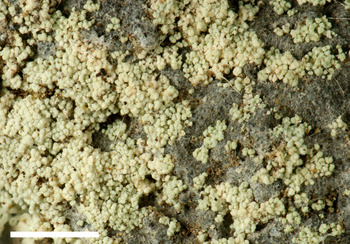
Lithocalla malouina is similar in morphology to Lithocalla ecorticata but differs in chemistry and ITS sequence. The ITS region differs from Lithocalla ecorticata in 14 transitions, 2 transversions, a 1 bp indel and a 3 bp indel. The thallus contains terpenoid B but lacks the terpenoid A found in L. ecorticata. Fatty acids occur in traces but the two main fatty acids present in L. ecorticata are absent.
Lithocalla malouina, Orange 22571. Scale = 1 mm. In colour online.

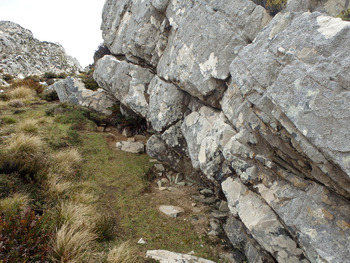
Lithocalla malouina, habitat. Locality of Orange 22920, on stones below rain-sheltered south-facing overhang; visible on several stones below centre. In colour online.

Chemistry
Unidentified terpenoid B at R f class 6 in G (minor; faint purplish after heating, UV+ violet-purple), traces of fatty acids, usnic acid (major), rarely stictic acid, rarely atranorin (minor). Thallus K−, C−, KC+ pale yellow, PD−.
Ecology and distribution
On shaded and rain-sheltered, often south-facing siliceous rock and stones below rock overhangs; Falkland Islands.
Notes
Material of Lithocalla from the Falkland Islands is morphologically indistinguishable from European material, but there are significant differences in the ITS sequence, small differences in the mtSSU sequence, and consistent small differences in chemistry. Consequently, material from the two regions is regarded here as two separate species. The existence of Lithocalla in these two distant regions suggests that the genus may be widespread in temperate regions of the world, although reports to date of Lithocalla from Asia, North America and Antarctica need to be confirmed. The status of the two species can be better assessed once molecular data from other parts of the world are available.
Lithocalla malouina was described as containing stictic acid and usnic acid, but stictic acid is not constant. Alan Fryday (personal communication) recently confirmed the presence of stictic acid in the holotype, but found it to be absent in three paratypes. Stictic acid was present in only one (Orange 22571) out of ten specimens collected by the author between 2011 and 2015.
Selected specimens examined
Falkland Islands: West Falkland: north-west of Port Purvis, near Seal Cave, 51.3548°S, 59.3655°W, on rocks below a high overhang, 2011, Orange 20168 (NMW – C.2015.004.126); near Port Howard, Mount Maria, 51.60919°S, 59.55919°W, alt. 275 m, on rock below overhang on SW-facing crags, 2015, Orange 22461 (NMW – C.2015.004.127); north-east of Port Stephens, 52.05007°S, 60.68256°W, on stones below overhanging rocks, 2015, Orange 22571 (NMW – C.2015.004.128); Saunders Island, headland east of Rookery, 51.31378°S, 60.07867°W, 2015, Orange 23012 (FINH). East Falkland: Riverside, near Vantan Arroyo, 51.73810°S, 58.28033°W, 2015, Orange 22920 (NMW).
Discussion
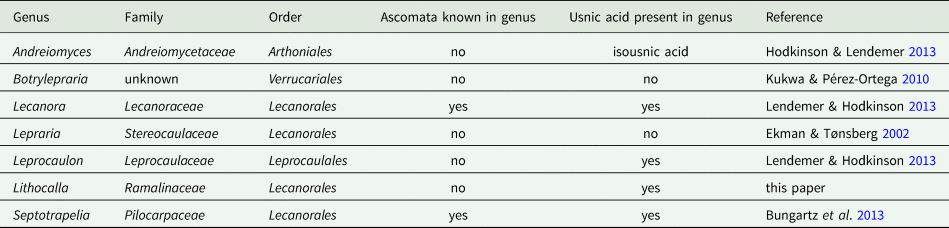
Lithocalla represents a new lichen lineage, in addition to those already known, that contain persistently sterile or rarely fertile leprose species. Examples of other such lineages are shown in Table 2. All the genera in the table have leprose species that have been combined in Lepraria at some point since 1990, but the majority are now excluded following mostly molecular analyses. However, Botryolepraria was initially segregated based on morphology and chemistry (Canals et al. Reference Canals, Hernández-Mariné, Gómez-Bolea and Llimona1997), and this species is more byssoid than truly leprose. With the transfer of Lepraria coriensis and L. texta to Leprocaulon (Lendemer & Hodkinson Reference Lendemer and Hodkinson2013), there are only two species still attributed to Lepraria that contain usnic acid. One of these, Lepraria leuckertiana, is likely to belong in Lecanora, the genus in which it was first described. The other, Lepraria straminea Vain., was regarded as dubiously belonging in Lepraria by Øvstedal & Lewis Smith (Reference Øvstedal and Lewis Smith2001), and very probably belongs elsewhere. Thus, despite the great chemical diversity in Lepraria (Saag et al. Reference Saag, Saag and Randlane2009), usnic acid appears to be absent from the genus.
Examples of lichen genera containing leprose species.
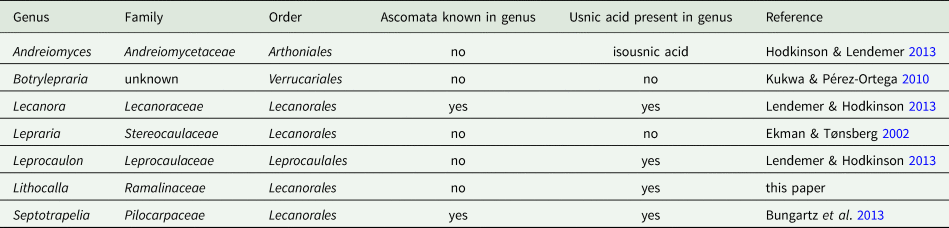
There are few lichens with a crustose, truly leprose thallus, which contain usnic acid together with either fatty acids or zeorin but without other major compounds. Lithocalla differs from all of these by the absence of zeorin. The minor terpenoids present in Lithocalla are unlikely to be confused with zeorin in thin-layer chromatography, and reports of zeorin are considered to be due to the presence of contaminants or to confusion with morphologically similar species. Leprocaulon knudsenii is morphologically similar and also occurs on non-calcareous rocks; it contains only usnic acid and zeorin (Lendemer & Hodkinson Reference Lendemer and Hodkinson2013). Leprocaulon textum (K. Knudsen et al.) Lendemer & B.P. Hodk. in addition, contains fatty acids and atranorin in at least minor amounts (Knudsen & Elix Reference Knudsen, Elix, Nash, Gries and Bungartz2007). Leprocaulon calcicola contains only usnic acid and zeorin, but in the field it lacks the yellow tinge of Lithocalla and it occurs on mortared walls (Orange et al. Reference Orange, Earland-Bennett, Hitch and Powell2017). Leprocaulon coriense (Hue) Lendemer & B.P. Hodk. and L. beechingii Lendemer differ in the well-delimited lobes often with raised margins (Elix Reference Elix2006; Lendemer Reference Lendemer2020). Lecanora leuckertiana has a cottony medulla (Zedda Reference Zedda2000), whereas a medulla is absent in Lithocalla. Lecanora thysanophora R.C. Harris has a conspicuous prothallus (Harris et al. Reference Harris, Brodo and Tønsberg2000). In Septotrapelia usnica (Sipman) Kalb & Bungartz a medulla is usually present, and the granules can become coarse and pseudocorticate (Elix Reference Elix2006; Bungartz et al. Reference Bungartz, Hillmann, Klaus and Elix2013). The combination of usnic acid and zeorin can be found in other sorediate crustose lichens but these have at least some corticate areas, for example Lecanora compallens Herk & Aptroot and L. orosthea (Ach.) Ach. Chaenotheca furfuracea (L.) Tibell and Psilolechia lucida (Ach.) M. Choisy have a brighter yellow-green thallus containing pulvinic acid derivatives and rhizocarpic acid, respectively.
Although analyses suggest that Lithocalla occupies an isolated position within the family Ramalinaceae, data from additional gene regions are needed to confirm its position in the family, and its relationship to other genera. If Lithocalla is really a member of the Ramalinaceae, then it appears to be the only leprose genus in the family. Of the 32 genera delimited by Kistenich et al. (Reference Kistenich, Timdal, Bendiksby and Ekman2018), only 12 contained species that produced vegetative propagules, and only Biatora and Mycobilimbia contained species that were both crustose and produced vegetative propagules.
Acknowledgements
Fieldwork in the Falkland Islands in 2015 was funded by the UK Government through DEFRA (Department for Environment, Food and Rural Affairs) and the Darwin Initiative. The National Trust kindly granted permission to collect samples from their property at Ilfracombe. I would like to thank two anonymous reviewers for their helpful comments. Many thanks to Alan Fryday for pointing out that Lepraria malouina might belong in Lithocalla, and for carrying out thin-layer chromatography on type material.
Author ORCID
Alan Orange, 0000-0002-3181-5435.