Introduction
The shift towards an ‘activating’ welfare state has dominated labour-market and social policies in many countries of the European Union (EU) over the last two decades. The primary aim of ‘activation policies’ is to increase the proportion of the population participating in the labour market in order to reduce poverty, social exclusion and segregation. Most particularly, these measures are intended to relieve the social security system and to cover the demand for labour at a moderate cost despite a declining and ageing population (Macnicol Reference Macnicol2008: 584–6; McQuaid and Lindsay Reference McQuaid and Lindsay2005: 203ff.). Since 1997, this shift in policy has been supported by the EU's European Employment Strategy, which attaches particular importance to older workers, as equally do many national reform programmes (Annesley Reference Annesley2007; Carmel, Hamblin and Papadopoulus Reference Carmel, Hamblin and Papadopoulus2007; Jepsen, Foden and Hutsebaut Reference Jepsen, Foden and Hutsebaut2002). In a number of countries, labour-market and social policies have been correspondingly adapted to the model of ‘active ageing’ by removing options and incentives that encourage early withdrawal from the labour force and by maintaining or restoring older workers' employability.
As yet, this policy shift has not been fully carried out in many European countries. Early exit options are being kept open because of difficult labour-market situations, especially for disabled and older workers, and because of public opinion; so certain groups of benefit payment recipients are exempt from activation policies (Ebbinghaus Reference Ebbinghaus2006: 240–2, 262–77; Larsen Reference Larsen2008; Peters et al. Reference Peters, van der Ende, Desczka and Viertelhanzen2008; Social Protection Committee Reference Social Protection2008). Disability pensions in The Netherlands and long-term sickness benefits in Sweden are examples of the continuing relevance of early-exit paths from the labour market, even though both countries have recently tried to stem exits taking these routes (Henkens and Schippers Reference Henkens, Schippers and Taylor2008: 145ff.; Sweden, Ministry of Health and Social Affairs 2008: 25ff.). Also, a number of countries still maintain withdrawal options using unemployment payments. In many cases older unemployed people are entitled to a prolonged benefit claim, often to bridge the interval before becoming eligible for an early retirement pension. In some countries, e.g. France, Poland and, until recently, Germany and the United Kingdom, this group can or could opt for exemption from the obligation to seek and accept a job without losing their claim for financial support. Thus for these benefit recipients, the strict linkage between payment claims and preparedness to work has been uncoupled; in this way, a fundamental principle of activating labour-market policy has been broken.
This paper deals with the reasons for the frequent use of the respective dispensation clause for older unemployed people in Germany, called the Leistungsbezug unter erleichterten Voraussetzungen [Facilitated Receipt of Benefits (FRB)]. From 1986 until 2007, the FRB was maintained as an element of German labour-market policy, despite being a relic of outdated early-retirement policies and not sitting well with the political aim of increasing the employment rate of older workers.Footnote 1 Clearly, the FRB fulfilled an important function politically and administratively as well as for the older unemployed themselves, which may explain its durability and widespread use. In the framework of politics and labour administration, two characteristics made the FRB outstandingly attractive. Firstly, it reduced visible unemployment by several hundred thousand each year, because those receiving the FRB were removed from the unemployment statistics.Footnote 2 Secondly, it increased – in terms of business economics – the efficiency and effectiveness of the public employment service, because it relieved the employment agencies of their duty to find work for a clientele characterised by low re-employment rates. It was therefore politically expedient and in the interest of the public employment service to maintain the FRB, but one question remained: what influenced unemployed people to opt for or against the FRB? Do those who opt for this exemption lack the necessary motivation to work, as is often suggested in public and policy discussions, which stress that social protection for the older unemployed and their subsequent pension entitlements offer a permanent and financially acceptable alternative to gainful employment, making them prefer leisure to work? Or do they retire involuntarily, with a feeling of resignation, because in their own estimation they have little chance of re-entering working life? This paper aims to answer these questions by using data from a survey conducted in 2005 and 2006 with older benefit recipients eligible for the FRB.
Surveying the labour-market behaviour of this group against the background of the FRB diminishes a common methodological problem: unemployed benefit payment recipients must usually be available for employment; therefore questions about their inclination to work, their readiness to compromise and their job-search behaviour will probably lead to answers that reflect social expectations rather than the attitudes and beliefs of the respondents. These distortions can be expected to be less relevant or even non-existent with FRB payment recipients, who are legally entitled to cease seeking employment. Until 2007, all unemployed persons in Germany aged 58 or more years in receipt of unemployment insurance benefit for the short-term unemployed, or of the means-tested unemployment assistance (up to 2004), or of Unemployment Benefit II for the long-term unemployed (from 2005) belonged to this group.Footnote 3 What characterises the FRB is the fact that this option offered many advantages and very few disadvantages to claimants. When older unemployed people opted for the FRB, they did not have to provide evidence of their re-employment efforts; were not obliged to accept any suitable job or to participate in employment and training measures; and were allowed to spend up to 17 weeks per year away from their place of residence (for the regular unemployed this was just three weeks) without losing their entitlement. In return, they had to take up the retirement pension as soon as they had reached the age limit for receiving a full unreduced pension. In addition, as those making use of the FRB were not registered as unemployed, many labour-market measures were no longer available to them.
The following empirical analysis focuses on a subset of people covered by the FRB: the mostly long-term unemployed recipients of Unemployment Benefit II, the basic income support benefit for persons in need who are able to work. Among older unemployed people, this subset comes under extraordinary pressure to re-enter employment, because the claimants have to spend their savings (apart from a modest exemption limit) before receiving support, and they are granted only the socio-economic minimum subsistence benefit. Furthermore, it can be presumed that the surveyed unemployed people did not give up their jobs in the expectation of a company early-retirement scheme, because these agreements are usually based on a continuous history of employment, receipt of unemployment insurance benefit and finally receipt of pension payments, mostly supplemented by company redundancy payments. Consequently, the tendency to opt for retirement will be less evident in the sub-group of recipients of Unemployment Benefit II than in the total group of older unemployed persons. However, the increased pressure to seek employment coincides with their obviously low employment prospects associated with long-term unemployment and other obstacles. Therefore these people represent a challenging target group for an activating labour-market policy.
Below we examine the possible reasons for the high usage of the FRB from the perspectives of, first, micro-economic labour-supply models, and second, theories and findings concerning the psycho-social effects of long-term unemployment. After describing the data, the hypotheses derived from the theories will first be tested against the motives reported by the older unemployed. These subjective statements will be supplemented by a logit analysis of the socio-economic factors that influenced the decision for or against claiming the FRB. The last section summarises the results and draws final conclusions.
Interpretations of the labour-market withdrawal of the older unemployed
Choosing the FRB as a micro-economic labour-supply decision
Micro-economic labour-supply models regard the suppliers of labour as individuals acting rationally and striving to maximise their utility. Most models take it for granted that human beings only reap utility through either income (or more precisely income-related opportunities to consume) or leisure, and that gainful employment can have no or negative utility if the working conditions cause harm. Therefore, by being granted benefit payments without an imperative obligation to accept work, unemployed people might be prevented from working for the income they could gain on the labour market according to their individual productivity. This problem arises when the personal utility of benefit payments and leisure time exceeds the personal utility of the attainable market wage less the potential disutility caused by unpleasant work. Most labour-supply theories in the neoclassical standard model assume voluntary unemployment: the respective individuals could find new jobs (and know this) if they were willing to work for the wage appropriate to their productivity (Hielscher and Ochs Reference Hielscher and Ochs2009: 13ff.; Koch, Stephan and Walwei Reference Koch, Stephan and Walwei2005: 420ff.). Consequently, the FRB encourages older unemployed people to retire from the labour market by allowing them to draw payments without any obligation to work. Many critics refer to this image of human nature, viewing the FRB as an impediment to the labour-market integration of older unemployed people because of the negative incentive to work (Eichhorst Reference Eichhorst2006); these critics subscribe to the hypothesis of voluntary retirement.
Nevertheless, it can be assumed that the older unemployed do not base their labour-supply decision exclusively on maximising present utility, but also take into account their financial prospects after retirement. Dynamic labour-supply models concerning the transition into retirement take this consideration into account and state that older people choose the time of withdrawing from the labour market to maximise their utility from earned income and pension payments as well as leisure time for their remaining prospective life span. In fact, the influence of economic calculations on the individual retirement decision can be proved empirically for many industrialised countries (see e.g. Börsch-Supan Reference Börsch-Supan2000; Gruber and Wise Reference Gruber and Wise2002). When these findings are applied to the situation of the older unemployed, it is expected that their choice depends particularly on their entitlements from the statutory pension insurance scheme – the most important pillar of old-age income in Germany – and on further entitlements they might accrue by becoming re-employed as compared to staying in unemployment until retirement. Furthermore, the income of other members of the household and other income sources (e.g. rental income), household property and debt have to be taken into consideration when calculating consumption capabilities before and during retirement. Consequently, the empirical examination of the hypothesis of voluntary retirement has to account for the entire income and property situation, including the future pensions of the household. The available data do not completely meet these requirements, but the empirical analysis allows for the economic calculations of the interviewees insofar as the subjective estimation of future retirement income and property are included in the logit analysis as explanatory variables.
However, taking up the FRB does not inevitably express a general renunciation of a working life, but might also be a utility-maximising choice for the group of basically employment-focused people. The FRB exempts older unemployed people from the obligation to accept jobs that do not meet their minimum expectations regarding the type of occupation, wage, working conditions or travel-to-work distance. This fact should be of considerable importance to the examined group of recipients of Unemployment Benefit II, who encounter rigid criteria concerning the suitability of job offers. Older unemployed people with long working lives should value this option in particular because of their typically high individual reservation wage that often comes close to their last regular income, even if the last received wage was some time ago (Bender et al. Reference Bender, Koch, Meßmann and Walwei2008).Footnote 4 Moreover, the FRB releases the recipients from several duties linked with registered unemployment, such as providing evidence of one's efforts to gain a new job or participating in employment and training schemes. This interpretation will be called hypothesis of striving for autonomy.
The economic approach outlined above to an explanation of the withdrawal of older people from the labour market states that the choice of the FRB can be characterised as an individual decision to supply one's own labour: the older unemployed opt for the FRB, if work for the market wage rate or under the conditions offered by the employment agency turns out to be unattractive to them. This approach assumes that these people look at re-employment as a realistic prospect even after a long period of unemployment, and that most prefer leisure time to gainful employment as long as the financial losses are acceptable. However, the results of psychological and sociological research concerning the individual consequences of long-term unemployment question the general validity of these assumptions.
The socio-psychological interpretation: choosing the FRB as involuntary retirement
A comprehensive meta-analysis of psychological studies in various industrial nations indicates that unemployed and employed people differ little in their attitude to work (Paul and Moser Reference Paul and Moser2006: 602–5). In both groups, the majority attribute a high value to gainful employment, whatever the type of occupation and the associated social prestige and pay. The intrinsic commitment to gainful employment appears to be a comparatively stable characteristic: it does not alter when people lose their jobs or re-enter employment, and remains virtually constant even after a long period of unemployment. The studies in the meta-analysis measured the individual's attitudes towards work with the help of ‘scales of work involvement, Protestant work ethic or similar concepts’ (Paul and Moser Reference Paul and Moser2006: 595), and tried to capture the non-monetary psycho-social need for work. In this way, the studies demonstrated that the high regard for gainful employment held by a large part of the economically-active population exceeds that from the purely economic returns from labour. This esteem for work is the result of a lifelong process of socialisation and reflects the dominant work ethic in modern employment-focused societies as well as its negative complement, the tendency to stigmatise the unemployed (Goffman Reference Goffman1963; Kirchler Reference Kirchler1991: 84–115).
Accordingly, prominent unemployment theories highlight the psycho-social functions that are frequently fulfilled by gainful employment (e.g. Warr's Reference Warr1987 vitamin model) or are even exclusive to it (e.g. Jahoda's Reference Jahoda1983 theory of latent deprivation), including for example the meaning of work for the social identity and social status of the individual (cf. Riach and Loretto Reference Riach and Loretto2009), the appreciation of others and self-respect. Following Paul and Moser's (Reference Paul and Moser2006) results, the strong emotional link to gainful employment is one of the reasons for the deterioration in the state of mind of unemployed people. The findings of their meta-analysis of studies of this deterioration indicated a ‘motivational incongruence’ (Grawe Reference Grawe2004) between individual goals and perceived goal attainment, which resulted in considerable distress, particularly among poorly-qualified people. Thus in contrast to a widely-held opinion, in most cases no process of adaptation or habituation takes place even after extended unemployment, although the weakening of the bonds between the unemployed and the working world might have been expected to improve the wellbeing of the recipients under certain circumstances (Paul and Moser Reference Paul and Moser2006: 620ff.; see alsoJackson and Taylor Reference Jackson and Taylor1994: 563–5; Koch, Stephan and Walwei Reference Koch, Stephan and Walwei2005: 428–33; Nordenmark and Strandh Reference Nordenmark and Strandh1999: 581–4). Consequently, these results contrast sharply with traditional economic models of labour supply which assume that leisure time is prioritised if the desired level of consumption can be reached without working.
Reflecting another facet of unemployment, empirical studies have shown that the majority of the unemployed try to find new employment as soon as possible, but also report that these people lose confidence and the hope of re-entering employment after extended unemployment. A methodologically outstanding panel-study from The Netherlands, involving 242 unemployed men aged 40–55 years, documented this change as taking place primarily within the first three years after dismissal. Increasing resignation was reflected clearly in job-search behaviour: most of the older unemployed undertook serious efforts to find new employment at the beginning of their unemployment, whereas the intensity of their search lessened fairly rapidly with time. After one year, only 39 per cent of the participants were still actively looking for a job and after five years not a single one (Henkens, Sprengers and Tazelaar Reference Henkens, Sprengers and Tazelaar1996: 563, 568, 570–3).
Futile job applications might prove particularly discouraging to the older unemployed if they assume that a rejection has been exclusively because of their advanced age rather than their aptitude for the job or general capability (cf. Riach and Loretto Reference Riach and Loretto2009: 108ff. relating to Great Britain). In addition to the negative signals of advanced age and long-term unemployment, the way back into employment is frequently impeded by hurdles such as poor health, poor or obsolete qualifications, or limited mobility (e.g. Büttner et al. Reference Büttner, Knuth, Schweer, Stegmann, Behling, Huber and Staudinger2009: 37ff. concerning Germany). These multiple handicaps reduce the chances of re-employment both objectively and subjectively, thereby leading to the individual's estimation of being unable wholly to fulfil the requirements of the labour market (e.g. Porcellato et al. Reference Porcellato, Carmichael, Hulme, Ingham and Prashar2010: 97 regarding Great Britain). Moreover, employment agencies tend to give the older unemployed the discouraging message that they are hard-to-place or even that there are no placement prospects. In German surveys, a considerable proportion of the older unemployed reported a lack of interest on the part of employment agencies and the majority claimed to be unsupported and backed insufficiently or not at all (Brauer and Korge Reference Brauer, Korge, Brauer and Korge2009: 13; Büttner et al. Reference Büttner, Knuth, Schweer, Stegmann, Behling, Huber and Staudinger2009: 44; Krone Reference Krone, Brauer and Korge2009: 269ff.). Likewise, the fact that the participation of older unemployed people in training and employment measures is far below average in Germany indicates that the efforts of placement officers regarding this group are often no longer directed at occupational reintegration (Heinemann, Gartner and Jozwiak Reference Heinemann, Gartner and Jozwiak2006).
For most older unemployed people, therefore, the prospect of re-entering employment recedes. They do not regard themselves as being in a position to make a labour-supply decision, but of having to choose between long-term unemployment and retirement. In this situation, the older unemployed are expected to opt mostly for the FRB, precisely because of their strong propensity to work: firstly, taking the alternative role of a retired person helps to reduce the motivational incongruence by making it easier to accept the end of the working career and to devote oneself to new activities and lifestyles; secondly, compared to the stigmatised status of being long-term unemployed, being early-retired is to a degree socially acceptable (Brauer and Clemens Reference Brauer, Clemens, Brauer and Korge2009: 29). In this interpretation, opting for the FRB is primarily the result of a lack of prospects of re-employment. It is here called the hypothesis of involuntary retirement.
Data and the analysis sample
The following analysis is based on data from the cross-sectional survey Life Situation and Social Protection in 2005 which was conducted on behalf of the Institute for Employment Research (IAB) throughout the Federal Republic of Germany between November 2005 and March 2006. The study aimed to examine the effects of the recent welfare-state reform initiated by the launch of Social Code II in January 2005. With this reform, the old two-track system of Unemployment Assistance and Social Assistance was replaced by the new integrated system of Unemployment Benefit II for all persons in need able to work (see note 3). The survey addressed the recipients of Unemployment Benefit II in January 2005 and the recipients of the former Unemployment Assistance, who lost their entitlement to benefits as a consequence of the reform. In the main study, 20,832 people aged 15–65 years were interviewed, mainly by telephone, with some face-to-face interviews. As a result of incomplete address data, in 173 of 439 districts of the Federal Republic of Germany only those recipients of Unemployment Benefit II who had drawn Unemployment Assistance in December 2004 were included, so that in these districts former recipients of Social Assistance are missing.
The analysis was confined to respondents who were entitled to the FRB for older unemployed people, i.e. all those in this group were aged 58 or more years at the time of the interview. In order to prevent biased results, the study was restricted to the 266 districts with complete data. Because of this limitation, recipients living in East Germany were over-represented, so that the descriptive analyses had to be performed separately for East and West German districts. Altogether 70 per cent of the East German and 52 per cent of the West German recipients in the group under consideration used the FRB.
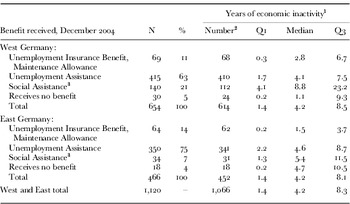
The analysis sample was very heterogeneous. As a consequence of the reform of the German welfare system, respondents transferred from different social security systems on to the new Unemployment Benefit II. The largest group were recipients of former Unemployment Assistance (63% in West Germany and 75% in East Germany) (Table 1). In contrast, the recipients of former Social Assistance were only 7 per cent of those examined in East Germany, and 21 per cent in West Germany. The interviewees in receipt of insurance-based support in December 2004 (mainly Unemployment Insurance Benefit) were more or less equally represented in both parts of the country (11% in West Germany, 14% in East Germany). The different origins of the interviewees is reflected by the duration of non-employment already experienced when they became entitled to the FRB; non-employment in this case means not being employed in more than minor employment. Table 1 combines the percentiles of this duration, differentiated between East and West and according to the kind of payment received in December 2004. The recipients of the former Social Assistance had been non-employed for longest: one-half had left regular employment at least 8.8 years (West) or 5.4 years (East) before getting the option to take up the FRB, whereas in both parts of Germany the shortest non-employment durations were among former recipients of insurance-based benefits (median West: 2.8, East: 1.5). In between we find the recipients of former Unemployment Assistance (median West: 4.1, East: 4.6). Thus the sample was generally characterised by a long absence from regular employment: in both parts of Germany, one-half of the interviewees aged 58 or more years had not been employed for at least 4.2 years prior to their entitlement to the FRB.
Recipients of Unemployment Benefit II receiving or eligible for the FRB, Germany, 2005–06

Notes: FRB: Leistungsbezug unter erleichterten Voraussetzungen [Facilitated Receipt of (Unemployment) Benefits]. For details, see text. Q1: lower quartile or 25% percentile. Q3: upper quartile or 75% percentile. 1. Years not employed in more than minor employment (to the date of entitlement to FRB). 2. Number of persons with no missing values for unemployment duration. 3. Excluding recipients who received Social Assistance in addition to Unemployment Insurance Benefit, Maintenance Allowance or Unemployment Assistance.
Source: IAB survey, Life Situation and Social Protection in 2005 (QS I); weighted data, author's calculations.
The motives for claiming the FRB: the recipients' statements
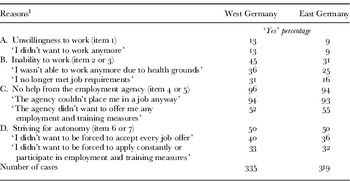
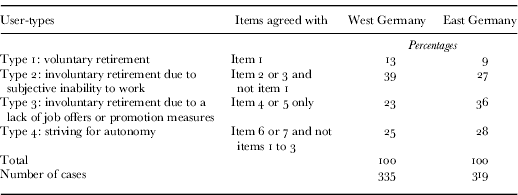
The reasons for leaving the labour force will first be examined by considering the interviewees' self-reported motives. These were ascertained in a consistent way by inviting the respondents to agree or disagree with discrete statements about possible individual motivations. The discrete items can be assigned to four categories: lack of willingness to work, lack of ability to work, wish for autonomy, and a lack of job offers or support on the part of the respective agency in charge. Based on these categories, four types of FRB recipients were distinguished. As Table 2 shows, few recipients accounted for their decision by an unwillingness to re-enter employment; only 13 per cent of West Germans and 9 per cent of East Germans declared that they were not willing to work.Footnote 5 This finding contrasts sharply with the political grounds for introducing the FRB, i.e. to remove from the unemployment statistics and from the client-load of the public employment service unemployed people who were believed to refuse to be placed in a job because of their advanced age. Moreover, this result is inconsistent with the hypothesis of voluntary retirement: for most of the interviewees, retirement into the FRB did not seem to be the result of a utility-maximising decision in favour of leisure and against gainful employment.
Self-reported motives for the decision to claim the FRB

Notes: FRB: Leistungsbezug unter erleichterten Voraussetzungen [Facilitated Receipt of (Unemployment) Benefits]. 1. Responses to the question, ‘Why have you decided to draw benefits under facilitated conditions?’
Source: IAB survey, Life Situation and Social Protection in 2005 (QS I); weighted data, author's calculations.
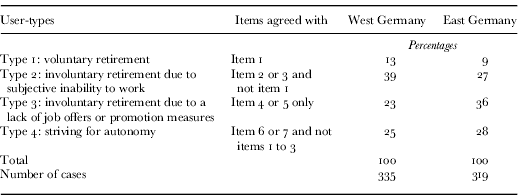
Instead, health problems and a feeling of inability to meet occupational demands played an important part (Table 2). At least one of the two motives that reflect the self-assessment of having a limited ability to work was answered in the affirmative by 45 per cent of the West German and 31 per cent of the East German interviewees. Excluding those recipients who did not want to work anyway, 39 and 27 per cent remained in this group (Table 3). These people chose the FRB primarily because they no longer felt able to work. Even more frequently, the choice of the FRB seems to have been a reaction to a lack of support. Nearly all the interviewees declared that the employment service was not able to offer them a job and more than half of the recipients in both the East and West agreed with the statement that the agency in charge did not want to offer employment or training measures (Table 2). At least 23 per cent of the West Germans and 36 per cent of the East Germans even gave the lack of job offers and promotion measures as the sole reason for their retirement (Table 3). Aggregating this group and the older unemployed who would have liked to re-enter employment but felt unable to do so because of poor health or other reasons amounts to 62 and 63 per cent of the interviewed recipients, respectively. Thus a clear majority of the unemployed questioned retired involuntarily (types 2 and 3, TABLE 3).Footnote 6
Classification of the recipients of the FRB according to their self-reported motives
Note: FRB: Leistungsbezug unter erleichterten Voraussetzungen [Facilitated Receipt of (Unemployment) Benefits].
Source: IAB survey, Life Situation and Social Protection in 2005 (QS I); weighted data, author's calculations.
The last two items refer to unemployed people's wish for independence from the employment agency: 40 per cent of West Germans and nearly as many in the East (36%) gave the advantage of not having to accept any job offered as a reason for their decision (Table 2). Moreover, approximately one-third of the interviewees in both parts of the country did not want to be under an obligation to apply for jobs continuously or to participate in employment and training measures. Nevertheless, this does not point to a denial of gainful employment in general: 25 and 28 per cent of the recipients, respectively, answered to at least one of the two items in the affirmative, but also still wanted to work and felt able to do so in respect to their health and their general capacity (Table 3). Therefore it can be assumed that this group chose the FRB primarily to escape the obligations of an activating labour-market policy, as is consistent with the hypothesis of striving for autonomy.
These results indicate that in most cases discouragement was the reason why the unemployed opted for the FRB, not their unwillingness to work. This interpretation is backed up by the results of the IAB survey regarding job-search behaviour: as expected, only 17 per cent of the recipients of the FRB in West and East Germany were still actively looking for employment at the time of the interview. Most of the remaining recipients justified their rejection of search activities with their estimation that they could not be placed because of their advanced age; this motive was affirmed by 73 per cent in West Germany and 82 per cent in East Germany. It has to be stressed that in contrast to these results, only 25 and 35 per cent, respectively, declared that the labour market had no available jobs offering an adequate payment.Footnote 7 Therefore, opting for the FRB seemed to be an involuntarily accepted rather than a strategically chosen pre-retirement option. For the majority of the interviewees, the decision to take up the FRB was apparently the result of a choice between long-term unemployment and pre-retirement rather than gainful employment and leisure time.
Socio-economic determinants of the individual decision
Supplementing the subjective perspective of the unemployed, the influence of socio-economic factors on the individual decision for or against the FRB was investigated. Two models were developed: a binary logit regression that examines the choice for or against this regulation as the outcome that has to be explained; and a multinomial logit regression in which the dependent variable consists of the four types of FRB recipients described above together with the non-recipients of the FRB. The selection of the independent variables in both models was based on the literature on the determinants of the transition into retirement (e.g. Börsch-Supan Reference Börsch-Supan2000; Drobnič Reference Drobnič2002; Ebbinghaus Reference Ebbinghaus2006), and on studies of the wage concessions of unemployed people (Bender et al. Reference Bender, Koch, Meßmann and Walwei2008). The first set of factors considered were those assumed to have an impact on the propensity to work and on the orientation towards retirement of the older unemployed, and which therefore are likely to influence the probability of a voluntary transition into pre-retirement. Included are indicators of old-age income, the status of being married as an indicator of the wish for leisure time with a family, the last occupational status as an indicator of the commitment to work, the duration of exclusion from regular employment as an indicator of processes of adaptation and habituation, and gender (which should have an effect only for West Germans).Footnote 8
Secondly, the models incorporate factors that should affect the inclination to opt for the FRB in order to gain autonomy. This inclination should be low for people with a strong economic pressure to re-gain employment or poor individual labour market prospects, because they are supposed to be more willing to make concessions and to accept the obligations imposed by the employment agency in order to ensure their access to professional support. The set of variables influencing this readiness involves the above-mentioned variables as well as knowledge of the German language and the regional labour-market situation (measured by residency in West or East Germany, as the average unemployment rate in East Germany was twice as high during the examined period of time).
Thirdly, the models contain factors that influence the risk of an involuntary change into pre-retirement caused by (subjective) inability to work, such as a (severe) disability, the duration of exclusion as an indicator of the erosion of qualifications and self-confidence, and the last occupational status as an indicator of skill level and previous (un-)healthy working conditions. The fourth group of variables were the factors that impact on the likelihood of deciding in favour of the FRB because of a lack of job offers or promotion measures. As before, the regional labour-market situation, previous occupational status, the duration of exclusion and German-language skills should be important in this group; in addition to these factors, gender should have an influence too, because the proportion of women participating in promotion measures from active labour-market policy is much below average (Bundesagentur für Arbeit 2006: 123ff.; Heinemann, Gartner and Jozwiak Reference Heinemann, Gartner and Jozwiak2006: 32ff.). The period of entitlement to the FRB, the age at the beginning of this period, and the type of benefit payment before receiving Unemployment Benefit II were taken into account as control variables.Footnote 9
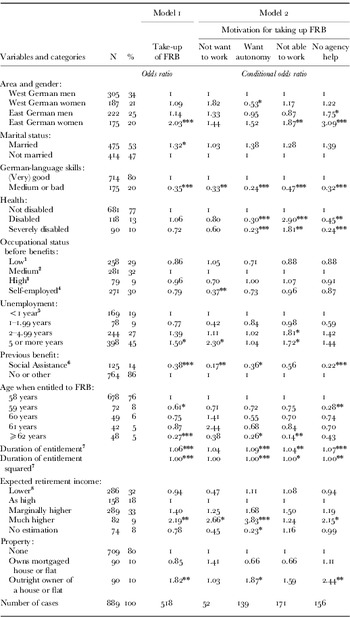
Table 4 shows the results of the binary model as odds ratios and the results of the multinomial model as conditional odds ratios. An odds ratio above 1.0 indicates an increased inclination to opt for the FRB, caused by the regarded characteristic compared with the respective referential category, whereas a result below 1.0 indicates a negative relationship. Accordingly, a conditional odds ratio above or below 1.0 indicates an increased or reduced risk of belonging to the respective type of user and not to the group of non-recipients of the FRB, compared with the referential category. The strongest positive effect on the propensity of the older unemployed to withdraw from the labour force was caused by an optimistic estimation of their own old-age income, as the results of the binary model demonstrate (Table 4, column 4). The interviewees that counted on a substantial improvement of income when entering retirement and property owners without mortgages clearly opted in favour of the FRB more often than interviewees owning poorer securities. Thus besides lacking employment prospects, economic calculations evidently influenced the exit of the older unemployed from the labour force. Moreover, the married, East German women and the unemployed who had been out of regular employment for at least five years, showed a significantly greater tendency to take up the FRB. By contrast, those with medium or poor knowledge of the German language rarely made use of the FRB compared to those with good or excellent knowledge.
Factors influencing claims for the early retirement FRB, Germany, 2005–06

Notes: Binary and multinomial logistic regression; base outcome in both models: decision not to claim the FRB (Leistungsbezug unter erleichterten Voraussetzungen [Facilitated Receipt of Benefits]). McFadden's R 2: Model 1 0.18, Model 2 0.15. Adjusted R 2: Model 1 0.35, Model 2 0.15. 1. Unskilled or semi-skilled worker, white-collar worker with low-grade occupation. 2. Skilled worker, journeyman, foreman, white-collar worker with skilled occupation. 3. Master craftsman, foreman, white-collar worker with highly skilled occupation. 4. Including self-employed farmers, liberal professions, freelance workers, contract workers, unpaid family workers and unknown occupational status. 5. Duration between the end of last period of major employment and the beginning of entitlement to the FRB. 6. Before Social Code II. 7. Duration of the period of entitlement to the FRB at the time of the interview in months. 8. Own and partner's retirement income compared with the current household income.
Source: IAB survey, Life Situation and Social Protection in 2005 (QS I); unweighted data, author's calculations.
Significance levels: * p<0.10, ** p<0.05, *** p<0.01.
The results of the multinomial model reveal the interviewees' considerations underlying this labour-market behaviour: according to these, the expectation of a substantial improvement of their material situation after retirement and a duration of exclusion from regular employment of more than five years significantly increased the inclination to opt for the FRB explained by a lack of willingness to work (Table 4, column 5). The first of these two results is expected from micro-economic reasoning and might therefore indicate that some interviewees regarded the decision to accept the FRB as to a degree an economic labour-supply decision (see alsoJackson and Taylor Reference Jackson and Taylor1994: 559, 563). The second finding is also consistent with the micro-economic labour-supply model: the effect of duration of exclusion might be the result of an increasing alienation from the employment process, of habituation to a life without work, and of the diminishing attainable market wage and therefore might be explained by the increasing attractiveness of leisure. On the other hand, this effect might also reflect the effort of bringing individual aims in line with deteriorating job prospects, removing the motivational incongruence in this way (‘I do not want to work anyway’).
In contrast, the self-employed and those of unknown previous occupational status demonstrated an extremely modest tendency to decide in favour of pre-retirement because of unwillingness to work. This might be explained by a comparatively strong propensity to work among the former self-employed: self-employment typically requires an extraordinary commitment to work and is often linked with high income and prestige; therefore it can be assumed that these people identify with work and their profession far more than average. Another reason might be the insufficient old-age income provision of self-employed persons that may not be completely accounted for in the model by the available indicators.
Anticipation of a favourable financial standing in retirement was the only factor that had a positive influence on the probability to choose the FRB in striving for autonomy (Table 4, column 6). Obviously those expecting an increased household income during retirement and those owning property without mortgages were rarely willing to expose themselves to the obligations of an activating labour-market policy and, in particular, refused to make concessions regarding the standards of a new job compared to those older unemployed under intense financial pressure to improve their own old-age provision by re-entering employment. In contrast, women in West Germany, those unable or unwilling to estimate their future retirement income and (severely) disabled persons had a comparatively weak inclination to opt for the FRB in striving for autonomy. This last group indicates that the older unemployed tend to avoid activation less frequently if help and support are offered in return by the institution in charge: in Germany additional labour-market instruments are available for (severely) disabled persons to offset their disadvantages in the competition for jobs. Beyond that, the increased inclination of this group to make concessions might be due to their poor labour-market prospects as well as to a higher than average propensity to work: disabled unemployed people might strive exceptionally hard for re-employment to improve their social integration and self-esteem because of double discrimination as both disabled and unemployed.
At the same time, however, (severely) disabled persons opted for the FRB significantly more than average, because they did not feel able to meet the demands of a job (Table 4, column 7). The same was true for people who had experienced two or more years of exclusion from the labour market as well as for East German women. The latter group also decided in favour of the FRB more often, giving a lack of job offers and employment promotion measures as a reason, compared to West German men and women, but also in comparison with men in East Germany (Table 4, column 8). The odds of East German women making use of this regulation as a reaction to a lack of support were three times those of the reference category (West German men), demonstrating one of the strongest positive effects of all. The withdrawal of East German women into pre-retirement is therefore primarily a result of resignation: widespread among them is a feeling of being bound to lose on the labour market compared to other unemployed persons, and of a lower expectation of receiving help from the public employment service. Similar results were found among East German men, whose take-up of the FRB because of a lack of job offers and supporting measures was also above average, reflecting the poor labour-market situation in East Germany. Contrary to all expectations, older people that anticipated a better financial situation in retirement also had higher odds of belonging to this type of user than those anticipating a low retirement income. Conversely, the likelihood of opting for the FRB on the grounds of missing institutional support was very low among disabled people. This is in accordance with the results above and indicates better assistance or at least the expectation of better assistance for older unemployed people with a disability.
Finally, those with a poor knowledge of the German language seem to have made no use of the FRB as a result of a lack of information; low linguistic competence reduced the odds of belonging to any of the four groups of FRB recipients equally across all four groups. This leads to the conclusion that many of those with poor linguistic competence had not been informed about this regulation in a way that they could understand, which highlights the importance of the information and advisory services for the labour-market behaviour of unemployed people – note that the migratory background of the interviewees itself proved to have no significant effect on the choice for or against the FRB (seeBrussig and Wübbeke Reference Brussig, Wübbeke, Kuhn and Ochsen2009: 271, 273).
Summary and outlook
For the older unemployed in Germany, the FRB has broken a basic principle of activating labour-market policy: it allowed people to draw benefit payments until they are entitled to a pension without committing them to search for and accept reasonable jobs. The fact that the FRB or equivalent early-exit paths exist in several European countries despite major welfare-state reforms driven by the philosophy of activation evinces important tensions and contradictions between political aims and social realities: on the one hand, early retirement has to be restricted to realise the labour force potential of those in the older working ages and thereby to stabilise social protection or insurance systems and to reduce dependency and social exclusion in old-age; on the other hand, the reintegration of older unemployed people brings about considerable problems that all too often make their activation appear unprofitable from the viewpoint of efficiency – by contrast, early retirement reduces visible unemployment as well as the amount of work imposed on employment agencies. In addition, early exit routes for older workers are generally very popular with the voters, so the political utility of maintaining these options is evident. It is less clear what disposes unemployed people themselves to leave the labour force, although a deeper insight into their motives could help to improve labour-market policy for this group.
The paper has addressed this question by examining the reasons why the majority of the long-term unemployed people aged 58 or more years in Germany withdrew from the labour market by claiming the FRB: did they retire primarily because of unwillingness to work (as micro-economic labour-supply models suggest) or because of a sense of resignation caused by few and unsuitable employment opportunities (as socio-psychological unemployment studies propose)? The motives for claiming the FRB reported by the recipients indicate that the retirement of the older long-term unemployed from the labour market was not mainly because of a lack of motivation to be in gainful employment. Only about one-eighth of the interviewees taking the option gave unwillingness to work as a reason for their choice. Another quarter stated a limited readiness to co-operate and work: this group primarily opted for the FRB because they refused to take any job, to apply repeatedly for jobs or to participate in job promotion measures. Nevertheless, the empirical analysis shows that according to their own statements, the majority of the interviewed recipients of the FRB wanted to re-enter gainful employment, in particular those with insufficient financial security in old age. Thus the common move of the older long-term unemployed into early retirement is not primarily a decision that maximises individual utility (by implementing a preference for leisure time than gainful employment) and cannot therefore be seen primarily as a consequence of the disincentives of the social security system. Instead, the most important reason for the exit of older unemployed persons from the labour force can be found in their lack of employment prospects: more than 60 per cent of those participating in the FRB declared their inability to cope with the challenges of a job due to poor health or other impediments, or claimed that the respective agency could not provide sufficient help, particularly job offers.
Several reasons suggest that these results can be transferred to other European countries. Psychological studies of the unemployed in many industrialised countries have identified a strong commitment to gainful employment even after a long period of joblessness (Paul and Moser Reference Paul and Moser2006). There is also the financial strain on families of long-term unemployed benefit recipients combined with retrenchment of the welfare state in several European countries (see e.g. Henkens and Schippers Reference Henkens, Schippers and Taylor2008: 146 relating to The Netherlands; Frerichs and Naegele Reference Frerichs, Naegele and Taylor2008: 198ff. referring to Germany). This almost certainly leads to an increased desire to re-enter gainful employment, particularly since the number of older workers without good pension entitlements has also risen. At the same time, older workless people are confronted with poor job prospects in many European countries (European Commission Reference European2009: 68–87), presumably resulting in a high incidence of the discouraged worker phenomenon among older people across Europe.
Finally, it has to be considered that the jobless in Germany are supported significantly more often by unemployment benefits than in other European countries which tend to support this group using sickness-benefit or disability-benefit paths (Börsch-Supan Reference Börsch-Supan and Wise2010; Erlinghagen and Knuth Reference Erlinghagen and Knuth2010: 71–4). Therefore it can be anticipated that the reasons for older people's retirement from the labour market identified in this study will be similar to those for recipients of incapacity benefits in other European countries so long as (like German recipients of Unemployment Benefit II) they are still able to work for at least three hours a day and if their social security is comparable. Recent studies relating to older Incapacity Benefit recipients and to other people below state pension age who are not in work in the United Kingdom have provided confirmatory evidence (Beatty and Fothergill Reference Beatty, Fothergill, Loretto, Vickerstaff and White2007: 70–3; Humphrey et al. Reference Humphrey, Costigan, Pickering, Stratford and Barnes2003: 93–108; Riach and Loretto Reference Riach and Loretto2009: 108–10; see alsoSocial Protection Committee Reference Social Protection2008: 29 concerning Organisation for Economic Co-operation and Development findings and results for Finnish disabled persons).
The current trend in several European countries to abolish the active job-search dispensation for older benefit recipients and to integrate them in ‘activation programmes’ has to be appreciated against the background of this study (Social Protection Committee Reference Social Protection2008: 21). Their involvement could send the signal that older unemployed persons are no longer ‘written off’ by policy makers and employment agencies, but regarded as a vital part of the labour force. Transcending this partly symbolic effect, the inclusion of the older unemployed into a regime of employment-oriented activation may help to improve their job prospects and will certainly raise their quality of life. A comparative analysis of more than 250 studies from different European countries pointed out that for hard-to-place unemployed people programmes of activation form the base for later labour-market reintegration by helping to cope with psycho-social and health problems, by strengthening self-confidence and by spreading new skills. Nevertheless, activation schemes prove less effective for people burdened with multiple barriers to an immediate integration into regular employment (Fromm and Sproß Reference Fromm and Sproß2008: 103–5). Furthermore, measures can only be expected to be successful if ‘the programmes are experienced as being useful and not as being an instrument of repression. … A case manager giving time and attention to the interests and needs of his clients, not forcing them to participate in measures they experience as senseless … is an important requirement’ (Fromm and Sproß Reference Fromm and Sproß2008: 105). These findings are congruent with this study's results, in that a quarter of the sample opted for the FRB solely because of certain minimum demands regarding a job or because of trying to avoid certain measures although fundamentally being willing to work.
By contrast, a policy of activation that relies on coercion and financial restrictions, which thus signals to the public and to the benefit recipients that the causes of unemployment are primarily in the weaknesses of the unemployed themselves, and that does not provide tailor-made support and co-operation, cannot be expected to produce enduring re-integration into the labour force. Such an approach will rather increase the risk of poverty and social exclusion and aggravate mental and physical problems, thus raising barriers to employment instead of reducing them (concerning single aspects seeBrussig and Knuth Reference Brussig and Knuth2010: 319ff.; Frerichs and Naegele Reference Frerichs, Naegele and Taylor2008: 197–9; Hielscher and Ochs Reference Hielscher and Ochs2009, regarding Germany; Dean, MacNeill and Melrose Reference Dean, MacNeill and Melrose2003: 24; Hirsch Reference Hirsch2003: 27ff.; Joyce et al. Reference Joyce, Smith, Sullivan and Bambra2010; McQuaid and Lindsay Reference McQuaid and Lindsay2005 with respect to the United Kingdom; Rosdahl and Weise Reference Rosdahl, Weise, Loedemel and Trickey2000: 178ff. concerning Denmark; Gallie, Pangam and Jacobs Reference Gallie, Pangam and Jacobs2003; Konle-Seidl and Eichhorst Reference Eichhorst, Grienberger-Zingerle, Konle-Seidl, Eichhorst, Kaufmann and Konle-Seidl2008: 439–41 providing cross-country evidence). Although employment promotion may be expensive in the case of groups regarded as unattractive on the labour market, some promising recent programmes focused on social activation and employability in different European countries underline that respective investments will prove profitable for a socially inclusive society.
Acknowledgements
I would like to thank Martin Brussig (Institut Arbeit und Qualifikation, IAQ, University Duisburg-Essen) for the productive exchange of ideas as well as Bridget Henderson and Alex Becker for checking the text.