INTRODUCTION
Nematological surveys conducted in the period 2008–2009 for a project (PICT/SECYT No.2/33345), on biodiversity of meiofauna in San Julián Bay, Santa Cruz province, and in Río Negro, Patagonia, Argentina, revealed a new species of Chaetonema (Anoplostomatidae) and a new species belonging to genus Admirandus (Oncholaiminae).
The family Anoplostomatidae Gerlach & Riemann, 1974 consists of two subfamilies: Chaetonematinae Gerlach & Riemann, 1974 (males with precloacal tubule) and Anoplostomatinae Gerlach & Riemann, 1974 (males with bursa). Chaetonematinae are characterized by extreme sexual dimorphism in amphid structures. We describe here one new species of Chaetonema: Chaetonema patagonica sp. nov.
The family Oncholaimidae Filipjev, 1916 comprises seven subfamilies and 27 genera. The subfamily Adoncholaiminae Gerlach & Riemann, 1974 includes four genera (Meyersia Hopper, Reference Hopper1967; Kreisoncholaimus Rachor, Reference Rachor1969; Adoncholaimus Filipjev, Reference Filipjev1918 and Admirandus Belogurov & Belogurova, 1979). Adoncholaimus and Admirandus are the most related genera. They differ by the position of Demanian system glandular duct openings, these being precloacal openings in Adoncholaimus and postcloacal openings in Admirandus (Belogurov & Belogurova, Reference Belogurov and Belogurova1979; Tchesunov et al., Reference Tchesunov, Mokievsky and Vu Thanh2010; Shimada & Kajihara, Reference Shimada and Kajihara2014). We describe here one new species of Admirandus: Admirandus sanjuliensis sp. nov. and the role of the position of glandular ducts is discussed.
MATERIALS AND METHODS
Description of site studied
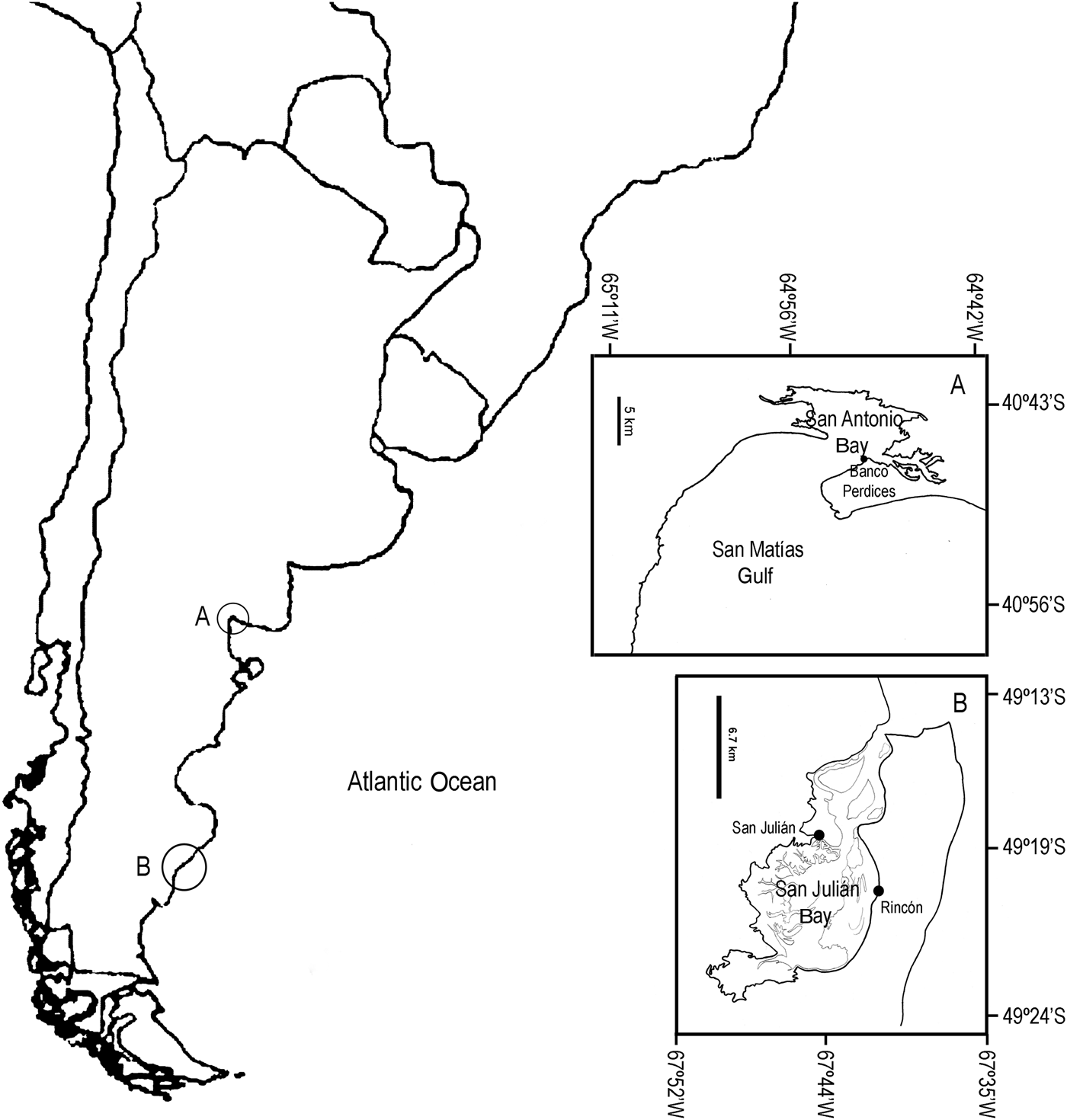
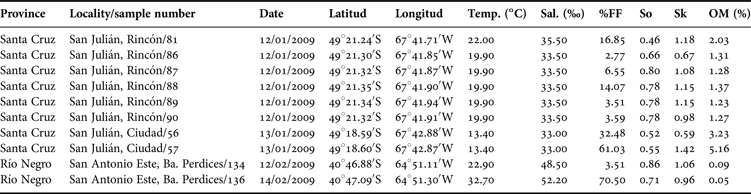
Samples for species description were obtained from Argentine littoral coasts at two different sites along Argentine Patagonian beaches (Figure 1, Table 1).
Map showing the study sites, San Antonio Este and San Julián Bay.

Localities, samples, dates and environmental parameters (Temp., temperature in sediments); Sal., salinity; % FF, % fine fraction; SO, sorting; SK, kurtosis; OM organic matter).

The northernmost site (Banco Perdices) is in San Antonio Bay, Río Negro province. This bay is located in the north-west of San Matías Gulf. It is composed by a shallow channel system with small islands and sandbanks, which are completely covered at high tide. The tidal amplitude reaches 9.30 m, with low tides exposing a width muddy area of 7 km. Banco Perdices is characterized by an extensive littoral zone covered with Spartina sp. in the upper fringe.
The southernmost site (San Julián Bay) is located in Santa Cruz province on the Atlantic coast of South America. It is situated in the high latitude Patagonian desert characterized by constant winds (>9 m s−1), with an annual mean of 40 km h−1 (Gassó & Stein, Reference Gassó and Stein2007), dust storms and low, irregular rain regimes (<200 mm per year) and air temperatures between 8 to 10°C. The bay is an inlet, 19.9 km long, and runs parallel to the coast, separated from the sea by a long and narrow peninsula. It has two distinct areas within, one near the entrance to the bay (length/width 6.8/5.3 km) and one towards the very end, ‘Rincón’ (length/width 11.8/8.2 km), separated by a narrow passage where the city of Puerto San Julián is situated.
Chaetonema patagonica sp. nov. has a wide distribution along the Patagonian coast. It was found in Banco Perdices in San Antonio Este, Río Negro near the city of San Julián and Rincón, San Julián Bay, Santa Cruz.
Admirandus sanjuliensis sp. nov. was found in Rincón at middle littoral/mean tide and low-littoral/low tide, un-vegetated habitat.
Sampling techniques and treatment
All species described below were found in samples obtained by hand, at each site and level location, with a cylindrical Plexiglas core (inner diameter 2.8 cm). They were preserved in cold 5% formaldehyde in filtered seawater stained with rose bengal, decanted and sieved through both 500 and 50 µm mesh sieves. The nematodes present on the 50 µm sieve were transferred to a solution consisting of alcohol 96°/distilled water/glycerin (2:2:1) and left in it for 1 week in a desiccator until nematodes were in pure glycerin. Then they were counted and mounted in pure glycerine prior to being identified to species level. Demanian system drawings were performed from nematodes stained in a solution of Blue Nile stained-glycerin for 5 min and then mounted in pure glycerin. Drawings were made using a Zeiss microscope incorporating a drawing device and photographs were taken with Zeiss and Olympus BX51 microscopy, both equipped with differential interference contrast (DIC). The granulometric analysis samples were oven dried at 85°C for 24 h and subsequently sieved through a series of sieves (2, 1, 0.5, 0.125 and 0.063 mm) and the grain size determined on the basis of the weight of each size fraction (Giere et al., Reference Giere, Eleftheriou, Murison, Higgins and Thiel1988). The de Man's ratios, a, b and c used in this paper are calculated as standard. The classification followed for the systematic position of the species was Lorenzen (Reference Lorenzen1981, Reference Lorenzen1994) and De Ley & Blaxter (Reference De Ley and Blaxter2004).
Holotypes and paratypes are deposited in the Collection of Nematodes of the Centro Nacional Patagónico, CNP-NEM recognized as National Service of Biological Data of Argentina and included in their web page from 2011 (http://www.gbif.org/dataset/06df03fc-8973-490c-af74-089fffae9e24; http://www.gbif.org/dataset/d592283b-b00e-4a39-9499-289842ccddf1).
Abbreviations used in the tables
A%, amphid diameter as percentage of corresponding body diameter; Abd, anal body diameter; Aw, amphid width; Ah, amphid height; BdA, body diameter at amphid level; Bdcs, body diameter at level of cephalic setae; Bdnr, body diameter at level of nerve ring; Bdph, body diameter at level of pharyngeal end; Csl, cephalic setae length; Csl%, cephalic setae length as proportion of head diameter; DaA, distance from anterior end to amphid; Daa/c, distance from anterior end to anus/cloaca; Danr, distance from anterior end to nerve ring; Daph, distance from anterior end to pharyngeal end; Dav, distance from anterior end to vulva; G, gubernaculum length in microns; Gcd, gubernaculum length as proportion of cloacal body diameter; L, total body length; Mbd, maximum body diameter; S, spicular length in microns, along the arc; Scd, spicule chord length as proportion of cloacal body diameter; Tl, tail length; Ta, tail in anal diameters; V%, distance from the anterior end to the vulva opening in percentage of total length.
RESULTS AND DICUSSION
SYSTEMATICS
Phylum nematoda Potts, 1932
Class enoplea Inglis, 1983
Subclass enoplia Pearse, 1942
Order enoplida Filipjev, 1929
Suborder enoplina Chitwood & Chitwood, 1937
Superfamily enoploidea Dujardin, 1845
Family anoplostomatidae Gerlach & Riemann, Reference Gerlach and Riemann1974
Subfamily chaetonematinae Gerlach & Riemann, Reference Gerlach and Riemann1974
emended diagnosis (Modifications from diagnosis of Smol & Coomans, Reference Smol, Coomans, Abebe, Andrássy and Traunspurger2006)
Chaetonematinae
Amphids with extreme sexual dimorphism in their structure (formerly the amphids in the male were mistaken for the Steiner's organ cf. Lorenzen (Reference Lorenzen1981, Reference Lorenzen1994)). In many species, the four cephalic setae are situated anterior to the six outer labial setae. The males have a precloacal tubule or setae. Marine.
Type and only genus: Chaetonema Filipjev, 1927
Chaetonema patagonica sp. nov.
(Figures 2 & 3; Table 2)
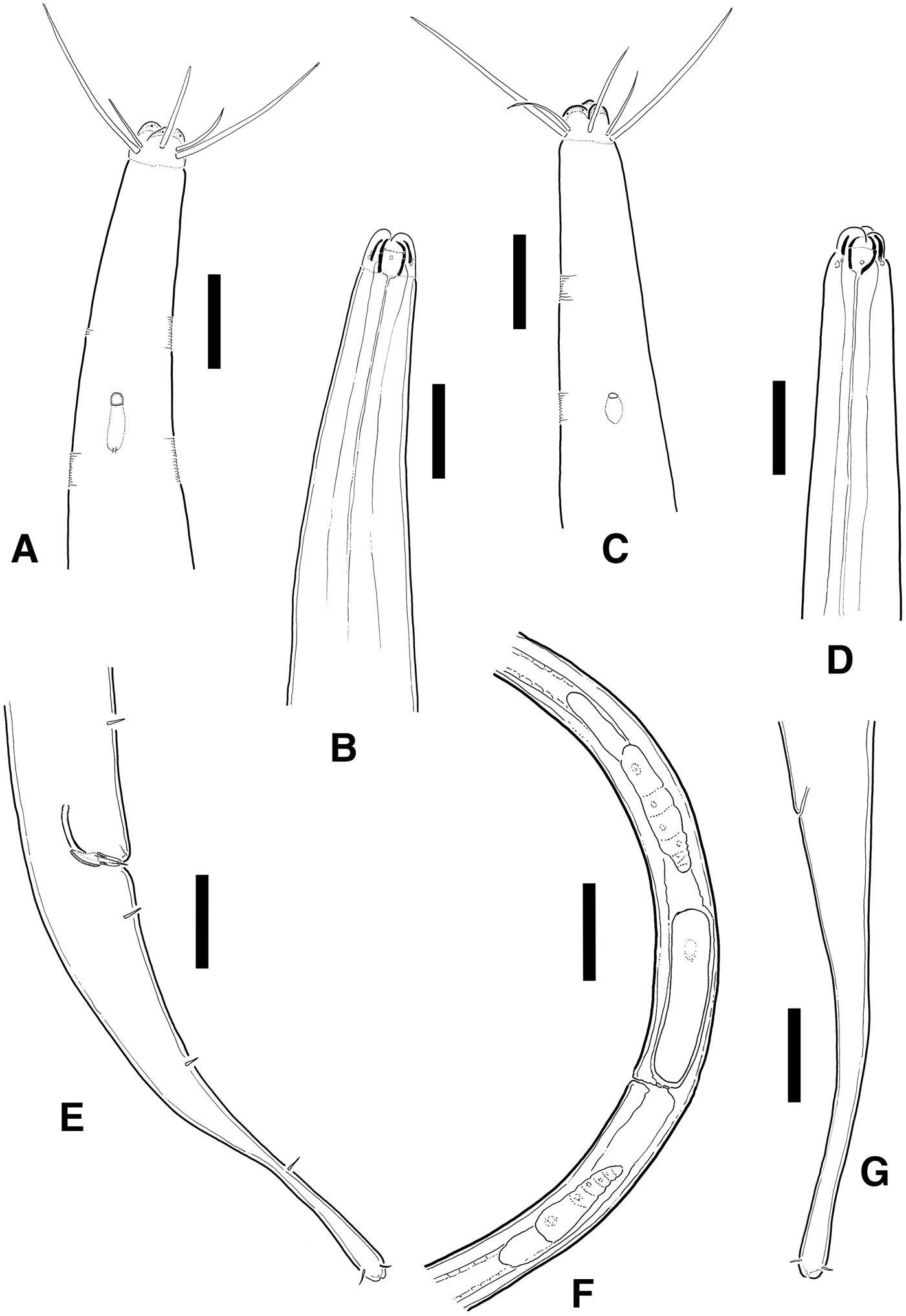
Chaetonema patagonica sp. nov.: (A) head region of holotype male (external); (B) head region of holotype male (internal); (C) head region of paratype female (external); (D) head region of paratype female (internal); (E) posterior end of holotype male, showing copulatory apparatus; (F) uterus view on vagina level of paratype female; (G) posterior end of paratype female. Scale bars: A–E, G 20 µm; F 100 µm.

Chaetonema patagonica sp. nov.: (A) photo holotype male amphid level; (B) photo holotype male estoma; (C) entire male; (D) entire female; (E) tail paratype female; (F) photo tail holotype male; (G) photo vulva opening paratype female. Scale bars: A–B, E–G, 20 µm; C–D, 100 µm.

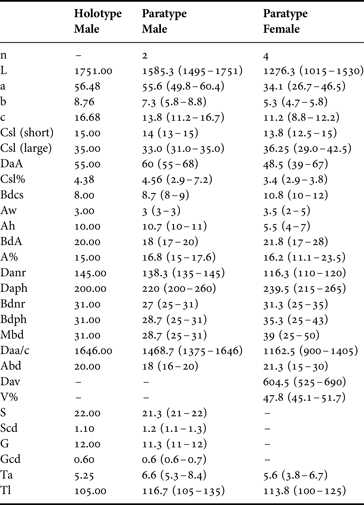
Morphometrics of Chaetonema patagonica sp. nov. All measurements are in μm and in the form: mean ± SD (range).

TYPE MATERIAL
Holotype: adult male. Registration number CNP-NEM N°4438; type locality: Ciudad de San Julián, San Julián Bay/57; coordinates: 49°18.59′S 67°42.87′W; coll. C.T. Pastor de Ward, 13 January 2009.
Paratypes: one adult male CNP-NEM N°4176 and one adult female CNP-NEM N°4492; Ciudad, San Julián Bay/56–57; coll. C.T. Pastor de Ward, 13 January 2009.
-
– One adult female CNP-NEM N°10642 and four juveniles CNP-NEM N°11372; 11385; 11559 and 27719; Rincón, San Julián Bay/86,88–89; coll. C.T. Pastor de Ward, 12 January 2009.
-
– Two adult females CNP-NEM N°17014 and 17266; Ba. Perdices, San Antonio Bay/136; coll. V. Lo Russo- G. Villares, 14 February 2009.
-
– One juvenile CNP-NEM N°16973; Ba. Perdices, San Antonio Bay/134; coll. V. Lo Russo- G. Villares, 12 February 2009.
ETYMOLOGY
This species name is derived from the word ‘Patagonia’ in reference to the coast on which it was found.
MATERIAL EXAMINED
Measurements: see Table 2.
DESCRIPTION
Male (holotype): Body cylindrical, extremely thin, tapering acute towards both ends. Cuticle finely striated. Head with three lips, each with distinct pair of inner labial papillae. Ten setae (6 + 4) in two close crowns: six 35 µm (5–6 HD) and four 15 µm. Amphideal fovea bottle shape, larger in males (10 µm in length and 3 µm wide and 55 µm from anterior end, Figure 2A) than in females (5.5 µm in length and 3.5 µm wide and 48.5 µm from anterior end, Figure 2C); amphideal aperture in males nearly square shape (Figure 2A) and oval in females (Figure 2C). The Steiner's organ is very delicate, it is found 2–3 µm behind the amphideal fovea.
Buccal cavity cylindrical, 7 µm in height and 5 in width, without observed teeth. Presence of a distinct cephalic capsule, 9 µm in length. Pharynx cylindrical without differentiations surrounding the buccal cavity. Nerve ring is positioned at 51.9% of oesophagus. Excretory gland and excretory pore 90 µm from anterior end.
Reproductive system diorchic with anterior and posterior outstretched testis. Short, arquate spicules, tubular gubernaculum. One precloacal seta and three postcloacal subventrally. Tail conical with the opening of three caudal glands positioned precaudally.
Female (paratype): With the exception of the amphids, similar to males. Female reproductive system didelphic, amphidelphic with antidromously reflexed ovaries situated to the left of intestine, with anterior and posterior ovaries always situated on opposite sides. The vulva located at median is a thin slit. Mature egg 90 × 20 µm.
DIAGNOSIS AND RELATIONSHIPS
Chaetonema patagonica sp. nov. can most easily be differentiated from the other four species of the genus by an amphid bottle shape, arched spicule, tubular gubernaculum, and only one setae instead of precloacal organ. Platt (Reference Platt1973), gave last key to Chaetonema genus. We add here a new key to accommodate the new species. Chaetonema steineri Filipjev, Reference Filipjev1927, C. longisetum (Steiner, Reference Steiner1916) and C. vicinum Gerlach, Reference Gerlach1954 are not included because they are considered here as species inquirendae because only females or juveniles are known.
KEY FOR THE SPECIES OF GENUS CHAETONEMA (KEY TO MALES)
-
1. Precloacal supplement absent 2
-
— Precloacal supplement present 3
-
-
2. Amphid bottle shape (10 µm), spicule 22 µm C. patagonica sp. nov.
-
— Amphid elongated groove, ending horse-shoe shape (100 µm long), spicule 40 µm (2.5 abd long) C. riemanni Platt, Reference Platt1973
-
-
3. Precloacal supplement a narrow, rod-like structure; spicule 30 µm (1.3 abd long) C. amphora Wieser, 1953
-
— Precloacal supplement well cuticularized, complicated ‘clasping’ structure 4
-
-
4. Longest cephalic setae 17 µm, 2 h.d.; L = 1168 µm C. cancellatum Gerlach, 1956.
-
— Longest cephalic setae 30 µm, 3 h.d. long; L = 1670–2220 µm C. captator Wieser, 1953.
-
Suborder oncholaimina De Coninck, 1965
Superfamily oncholaimoidea Filipjev, Reference Filipjev1916
Family oncholaimidae Filipjev, Reference Filipjev1916
Subfamily adoncholaiminae Gerlach & Riemann, Reference Gerlach and Riemann1974
Genus Admirandus Belogurov & Belogurova, 1979
emended diagnosis (Modifications from diagnosis of Tchesunov et al., Reference Tchesunov, Mokievsky and Vu Thanh2010)
Oncholaimidae
Outer labial and cephalic sensilla papilliform. Buccal capsule elongate, length to width ratio c. 1.5:1 to 3:1. Three onchs in the buccal cavity: the largest the right subventral, the other two lower ones equal. Ovaries paired. Demanian tube system generally of the Adoncholaimus type, but with pre- or postcloacal terminal canals and pores situated pre-cloacal (1) and on the tail (2). Presence of terminal canals as long ducts. The spicules curved, relatively long, slender, proximally cephalated, distally pointed, slightly broadening only in front of the distal end. Gubernaculum present. Midventral preanal supplementary organ present or not. Tail with anterior conical and posterior cylindrical portions.
Admirandus sanjuliensis sp. nov.
(Figures 4–7; Table 3)
Admirandus sanjuliensis sp. nov.: (A) head region of holotype male (internal); (B) head region of paratype female (internal); (C) head region of holotype male (external); (D) subventral view of paratype male; (E) head region of paratype female (external); (F) posterior end of holotype male, showing copulatory apparatus; (G) posterior end of paratype female. Scale bars: A–E, G, 20 µm; F, 100 µm.

Admirandus sanjuliensis sp. nov.: (A) genital apparatus of holotype male; (B) uterus view on vagina level of paratype female; (C) posterior end of paratype female with Demanian porus. Scale bars: A–B, 200 µm; C, 100 µm.

Admirandus sanjuliensis sp. nov.: (A) entire male ; (B) photo anterior end holotype external; (C) cardia holotype; (D) photo anterior end holotype internal; (E) subventral view paratype male; (F) sublateral view holotype male; (G) photo tail holotype male. Scale bars: B-F, 20 µm; A, 100 µm.

Admirandus sanjuliensis sp. nov.: (A) entire female; (B) photo anterior end paratype female; (C) photo tail (partim) paratype female with three tubes opening (T1, T2 &T3); (D) photo of tail female paratype. Scale bars: B–D, 20 µm; A, 100 µm.

Morphometrics of Admirandus sanjuliensis sp. nov. All measurements are in μm and in the form: mean ± SD (range).

TYPE MATERIAL
Holotype: adult male. Registration number CNP-NEM N°11072; type locality: Rincón, San Julián Bay/87; coordinates: 49°21.32′S 67°41.87′W; coll. C.T. Pastor de Ward, 12 January 2009.
Paratypes: four adult males and five adult females. Registration numbers CNP-NEM No. 11073 (male 2/87); CNP-NEM No. 284 (male 3/90); CNP-NEM No. 11060 (male 4/87); CNP-NEM No. 9844 (male 5/81); CNP-NEM No. 9979 (female 1/81); CNP-NEM No. 10975 (female 2/87); CNP-NEM No. 9935 (female 3/81); CNP-NEM No. 285 (female 4/90); CNP-NEM No. 286 (female 5/90); type locality: Rincón, San Julián Bay; coll. C.T. Pastor de Ward, 12 January 2009.
ETYMOLOGY
From the Spanish word ‘San Julián’, in reference to the bay where it was found for the first time.
MATERIAL EXAMINED
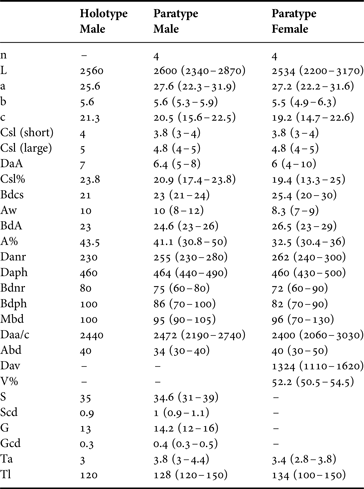
Measurements: see Table 3.
DESCRIPTION
Male (holotype): Body cylindrical, tapers slightly towards the anterior end and has a conical tail terminus. Cuticle smooth. Six inner small labial papillae, 6 outer labial (5 µm long) and 4 cephalic setae (4 µm long). Stoma square to rectangular in shape, length to width ratio 1:1.2, pharyngeal muscles surrounding the posterior part of the stoma. Three onchia in the buccal cavity, the largest right-subventral, the other equal. Amphids cup shaped (10 µm diam, 43.5% bda), located 8 µm from anterior end. Pharynx, cylindrical (460 µm long), anteriorly surrounding buccal cavity. Cardia is small. Ventral gland located at the cardia level and opens through an ampulla 100 µm from anterior end.
Reproductive system is diorchic, with opposed and outstretched testes (posterior of 490 µm in length; anterior testis length not seen), in anterior left and posterior right position to the intestine. Spicules, short, slightly curved 35 µm (0.9 abd) in chord length. Gubernaculum formed by one central tubular piece. One pair of short pre-cloacal setae and one pair of papillae, between 2 and 5 µm from the cloaca. One pair of postcloacal papillae and eight pairs of pericloacal setae 5 µm long. Tail 120 µm long (3 abd), approximately conical-cylindrical in shape with one pair of setae in the middle of the tail. There are three caudal glands present with their bodies precloacal and their openings in the spinneret.
Female (paratype): Females are similar to males in general body shape, anterior sensilla, amphids and cuticle. Ovaries paired, antidromously reflexed, anterior and posterior right of the intestine. Tail 120 µm (3 abd). Demanian tube system generally as Adoncholaimus type with three Demanian ducts, one precloacal and two postcloacal, see Figures 5C and 7C.
DIAGNOSIS AND RELATIONSHIPS
Admirandus sanjuliensis sp. nov. is characterized by the position of the Demanian pores, one preanal and two postanal, the configuration of pre- and post-cloacal papillae and setae, and by having the shortest stoma in the genus.
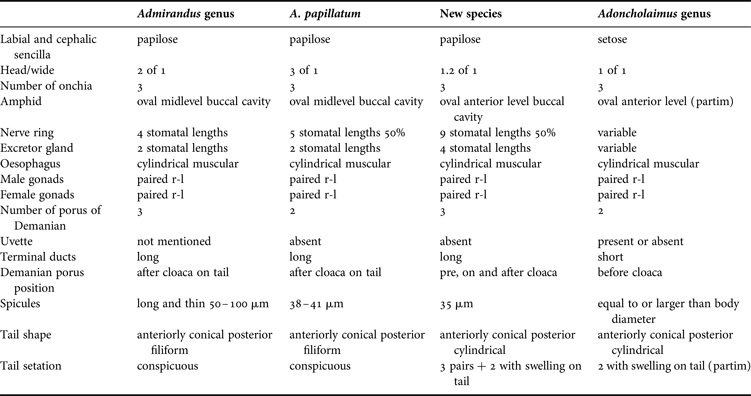
Table 4 presents a detailed comparison between the genera Admirandus and Adoncholaimus, together with A. papillatus and our new species. Our new species and A. papillatus have an intermediate position between the genera Admirandus and Adoncholaimus and could thus be included either in Adoncholaimus or in Admirandus, depending on what characters are considered more important. The type of sensilla (papilliform), the number of Demanian pores and the length of the terminal ducts indicate that our new species belongs to Admirandus. By contrast, the stoma proportion, the tail shape and length, and the tail setae (with the presence of two pairs of setae over the swelling on tail as many species of the genus), indicate that our species belongs to Adoncholaimus.
Comparative chart of Admirandus and Adoncholaimus genera characteristics with A. papillatum and the new species.

The Demanian pores position is intermediate between two genera.
Here we follow Tchesunov et al. (Reference Tchesunov, Mokievsky and Vu Thanh2010) when he says: ‘Adoncholaimus species have terminal ducts of the demanian system opening anterior to the anus, and the number of the terminal ducts is nearly constantly two. By contrast, Admirandus possess three terminal ducts and they open on the tail.’ And we follow Shimada & Kajihara (Reference Shimada and Kajihara2014) in their opinion about Adoncholaimus: ‘We follow their [Belogurov & Belogurova (Reference Belogurov and Belogurova1979)] view and have added the new definition ‘terminal pores with short terminal ducts opening on body cuticle in preanal region.’ So the number and position of Demanian pores and the duct lengths are the most important characters to separate both genera. So the presence of three Demanian pores with long ducts points to Admirandus while two with short ducts to Adoncholaimus (Table 4). Admirandus papillatus has two pores with long ducts that open on the tail. This species also present an intermediate position but as this agrees with two of the three main characters of Admirandus, was placed in this genus. Also agrees with other important characters of Admirandus as the stoma proportion and the tail shape and setae on it.
Admirandus sanjuliensis sp. nov. differ from A. belogurovi Tchesunov et al., Reference Tchesunov, Mokievsky and Vu Thanh2010 and A. multicavus Belogurov & Belogurova, Reference Belogurov and Belogurova1979, by having a nearly longer as wide stoma.
KEY FOR THE SPECIES OF GENUS ADMIRANDUS
-
1. Demanian system with 2 gland openings A. papillatus (Kreis, Reference Kreis1932)
-
— Demanian system with 3 gland openings 2
-
-
2. Stoma nearly longer as wideA. sanjuliensis sp. nov.
-
— Stoma, two times longer than wide 3
-
-
3. Spicule length less than 50 µmA. belogurovi Tchesunov et al., Reference Tchesunov, Mokievsky and Vu Thanh2010
-
— Spicule longer than 50 µm A. multicavus Belogurov & Belogurova, Reference Belogurov and Belogurova1979
-
ACKNOWLEDGEMENTS
We thank anonymous referees for valuable comments.
FINANCIAL SUPPORT
This work was financed by PICT/SECYT No. 2/33345 and CONICET (2008–2009).