In over 40 published studies, the competition model (MacWhinney, Reference MacWhinney and MacWhinney1987, Reference MacWhinney2005; MacWhinney & Bates, Reference MacWhinney and Bates1989) has been used to study crosslinguistic differences in sentence processing. In these studies, cues such as word order, agreement marking, case marking, or animacy are placed into competition in a crossed factorial (analysis of variance [ANOVA]) design, thereby allowing us to determine the relative patterns of cue strength across languages. The overwhelming majority of these studies have utilized combinations of both grammatical sentences such as the dog chases the bear and ungrammatical sentences such as the bear the dogs chases. These sentences are composed of two full noun phrases (NPs) and a single transitive verb. The participant's task is to decide which noun is the actor.
To date, the only competition model study that has examined processing with pronouns instead of full NPs is McDonald (Reference McDonald1986) for Dutch. This emphasis in competition model experiments on sentences with full NPs is potentially a serious problem. Competition model experiments have repeatedly shown that cue strength is a function of cue reliability. However, it could be that this finding does not extend to sentences that combine pronouns with full NPs. We know that full NPs and pronouns invoke very different processes in terms of coreference and interpretation (Gordon, Grosz, & Gilliom, Reference Gordon, Grosz and Gilliom1993). Full NPs are more likely to refer to newly mentioned discourse entities, whereas pronouns are mostly used to refer to entities that are given either anaphorically or deictically (Halliday & Hasan, Reference Halliday and Hasan1976). This means that when we hear a pronoun, we are likely to search for its referent, whereas this may not be necessary for a full NP. In addition, full NPs are often complex and may contain low-frequency words, whereas pronouns are all short, common words. It is possible that these differences have a further impact on processing and cue strength. McDonald's study of pronominal case marking in Dutch adds support to these concerns. In Dutch, it is possible to use object–verb–subject (OVS) word order in questions, such as Wat zag zij? (literally: what saw she?). It is also possible to use OVS in reversed actives, such as De man zag zij (literally: The man saw she.). In these sentences, the nominative pronoun zij appears after the verb. Although it appears in a noncanonical position, the pronoun zij is still interpreted by adults as the subject. McDonald showed that, despite the high reliability of pronominal case marking in Dutch, children do not depend on this cue until after age 8. Although it is possible to account for this delay as a result of the fact that sentences in which case conflicts with word order are comparatively rare (McDonald & MacWhinney, Reference McDonald and MacWhinney1991), it is also possible that pronominal case is being processed in some fundamentally different way from other syntactic, morphological, or lexical cues that have been studied in competition model research. A study of relative clause processing in Dutch by Kaan (Reference Kaan2001) adds some further concern. Kaan showed that the presence of the pronoun jullie as the second NP in Dutch relative clause sentences with NP + NP + V structures tended to weaken the use of an SOV interpretation format, even though the pronoun was not overtly marking case. This type of study suggests that the processing of pronouns could be very different from the processing of nouns. If this type of effect were shown to be generally present, the competition model might have to be revised or even rejected to account for facts regarding the processing of pronouns.
We begin this inquiry with a brief review of the status of the word order and pronominal case cues in English. A major finding in competition model studies (MacWhinney, Bates, & Kliegl, Reference MacWhinney, Bates and Kliegl1984) has been that English assigns the role of the agent to the nominal that appears directly before the verb. For example, native English speakers interpret the boy kissed the girl by choosing the boy as the agent. When the girl is moved before the verb in a phrase like the boy the girl kissed, native speakers change their agent interpretation from boy to girl. Although this OSV word order is ungrammatical when it appears by itself, it is grammatical when used within an embedded clause in English, as in I met the boy the girl kissed. It is also acceptable in topicalized constructions (Prince, Reference Prince, Culicover and McNally1998), such as this ice cream, I like, but the one I had yesterday was terrible. In addition to this primary word order cue of preverbal positioning in the SV pattern, English also relies on a postverbal positioning cue in the VO pattern to cue the role of the direct object. Together, these two cues compose the canonical SVO word order of English.
In English, case marking has a very restricted range of application. Although Old English (van Kemenade, Reference van Kemenade1987) marked case on both the noun and the pronoun, the marking of case on the noun was lost during the transition to Middle English. In Modern colloquial English, only pronominal contrasts, such as the one between he and him or the one between she and her, still mark the distinction between the subject and the object. Thus, in the sentence he combed her, the pronouns provide evidence for case assignment by indicating that the actor is a male and the patient is a female. Because the distinction between nominal pronouns like he and she and accusative pronouns like she and her is so consistent in English, we can think of this as a highly reliable, grammaticalized cue (Hopper & Traugott, Reference Hopper and Traugott1993). However, some dialects permit sentences with accusative pronouns in subject position, as in him caught a bad cold or me and him went to the store. Together, these facts indicate that we need to better understand the actual contribution of pronominal case to sentence interpretation in English.
Preverbal positioning and pronominal case are not the only cues to case role assignment in English. Interpretation can also be influenced by cues involving noun animacy and S–V agreement. However, because of the overwhelming strength of the preverbal positioning cue, it is difficult to observe the role of these cues in canonical SVO sentences. However, if we look at the noncanonical VNN order, where preverbal positioning is absent, we can observe these effects more clearly. In sequences such as Examples 1 and 2, listeners are likely to choose “the boy” as the actor because the animacy cue favors the choice of an animate entity as actor.
1. Pushes the boy the marble.
2. Pushes the marble the boy.
3. Pushes the boys the girl.
4. Pushes the girl the boys.
Similarly, the effect of the S–V agreement cue can be illustrated by the contrast between Examples 3 and 4 where the agreement match between “girl” and “pushes” favors the choice of “the girl” as the actor over “the boys.” This VNN frame can also be used to illustrate the effects of pronominal case, as in Examples 5 and 6.
5. Combs he her.
6. Combs her he.
Despite the obvious ungrammaticality of these sequences, it is clear that the male pronoun “he” indicates the actor and that the female pronoun “her” indicates the patient.
Researchers have occasionally expressed concerns regarding the use of ungrammatical sentences in competition model experiments (Gibson, Reference Gibson1992). The strength of the English word order cues means that sentences that violate the SVO pattern are usually ungrammatical. However, languages with freer word order such as Japanese (Sasaki & MacWhinney, Reference Sasaki, MacWhinney and Shirai2005), Croatian (Devescovi, D'Amico, Smith, Mimica, & Bates, Reference Devescovi, D'Amico, Smith, Mimica, Bates and Hillert1998), and Hungarian (Pléh, Reference Pléh, MacWhinney and Bates1989) have allowed researchers to make direct comparisons between competition sentences that are “accidentally” grammatical because of systematic gaps in an otherwise consistent case-marking system and equivalent ones that are ungrammatical. These comparisons have shown that ungrammaticality per se plays no role in determining either choice or latency data. The choice and latency results are determined instead by the strengths of the cues involved in each particular sentence type. These tests of the effects of ungrammaticality have supported the practical and theoretical soundness of using competition as a way of understanding cue strength and sentence processing.
The basic finding of the competition model research has been that cue strength is a direct function of cue validity, particularly in adult monolingual speakers. Cue validity is determined by availability (the ratio of the times the cue is actually present over the times the cue could be present) and reliability (the ratio of the times the cue is correct over the times the cue is present). Studies with young children have shown that availability is an important factor at first, but that reliability soon takes over as the major determinant of cue strength. Availability and reliability can be computed by examining corpora of both spoken and written language (McDonald & Heilenman, Reference McDonald and Heilenman1991).
In addition to the computation of basic cue reliability, it is also possible to examine the smaller subset of sentences in which two particular cues compete directly (McDonald, Reference McDonald1987). This third type of cue validity is called conflict reliability. For example, in sentence Examples 7 and 8, word order competes with pronominal marking.
7. Him chased the dog.
8. The dog chased she.
In these sentences, it could be that word order continues to dominate over case marking. In that case, we would say that word order is higher than pronominal case marking in terms of conflict reliability. As we noted earlier, the Dutch sentences corresponding to Examples 7 and 8 are quite grammatical and are interpreted by adults as based on OVS order.
Of course, sentences such as Examples 7 and 8 never occur in our English corpora. Moreover, no study has yet examined the actual processing of sentences such as Examples 7 and 8 in English. So, the evaluation given so far regarding the interpretation of such sentences is merely intuitive. Because we have no study in which word order has been placed in direct competition with pronominal case marking, our understanding of the relative hierarchy of cue strength in English remains incomplete in regard to the important and highly reliable cue of pronominal case marking.
When we begin to compose sentences to test the competition between word order and pronominal case marking, we soon realize that the pronominal case cue actually breaks down into two cues. When the verb is transitive, there can be two, one, or zero pronouns in either nominative or accusative case, as illustrated for a subset of the possible NVN sentence types in Examples 9 through 13.
9. The boy combed the girl.
10. He combed the girl.
11. Him combed the girl.
12. Him combed her.
13. Him combed she.
In order to study these cues systematically, we constructed an orthogonalized design in which possible word orders are crossed with possible case markings for each of the two possible nominals. The experiment reported here is based on this design.
METHOD
Participants
The participants were 20 adult native English speakers who were studying or working at Carnegie Mellon University. Their ages varied between 18 and 50.
Design
The stimuli were sentences with two nominal phrases and a transitive verb. The nominal phrases were realized either through pronouns or nouns with a definite article. Stimuli were composed by random selection during the running of the experiment from lists of words using the random access method built in to E-Prime (MacWhinney, St. James, Schunn, Li, & Schneider, Reference MacWhinney, James, Schunn, Li and Schneider2001). The verb was selected randomly from a list of seven simple action verbs in the past tense, such as “pushed,” “visited,” and “kissed.” Nouns were randomly selected from lists including five kinship terms referring to males, such as “father” or “son,” and five kinship terms referring to females, such as “mother” or “daughter.” Kinship terms were chosen because there is no question about their gender status. The pronouns were “he,” “she,” “him,” and “her.” The three factors in the design were word order, first nominal marking, and second nominal marking. The three levels of the word order factor were NVN, NNV, and VNN. The three levels for the first nominal marking factor were noun, accusative, or object pronoun (“him” or “her”), and nominative or subject pronoun (“she” or “he”). The three levels for the second nominal marking factor were the same as for the first nominal marking. This 3 × 3 × 3 design yielded 27 conditions. There were two replicates in each cell for a total of 54 sentences. E-Prime was configured to produce sentence stimuli that consisted of one nominal referring to a female and one referring to a male. This was done to avoid the confusion of identifying two pronouns with a single actor in sentences such as “he pushed him” and “he him pushed.” When the first nominal was selected to be male, E-Prime automatically generated a female for the second nominal, and vice versa for initial nouns referring to females. In addition, the program balanced the selection of the nominal kinship terms across utterances.
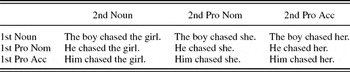
Table 1 illustrates stimuli for the NVN order. Because of the method of random insertion from lists, the verbs and nouns vary across these cells. However, the pronouns are as given in the table. Illustrations of the NNV order use the same nine cells with the same contents, but with the verbs at the end. Illustrations of the VNN order involve the verb at the beginning.
Illustrations of stimuli for the noun–verb–noun order with three levels for the two nominals

Note: Pro, pronoun; Nom, nominative; Acc, accusative.
Procedure
Participants were asked to read sentences consisting of a simple action verb with two nominals. When a sentence appeared on a screen, participants were asked to determine who performed the action described in the sentence. If they thought the first noun referred to the actor, they were supposed to press 1. If they thought the second noun referred to the actor, they were supposed to press 2.
RESULTS
The dependent variable was the percentage of choice of the first nominal as the actor. The analysis used repeated-measures ANOVA (3×3×3). Because the stimuli were generated by random insertion from lists across subjects through E-Prime, item analyses were not necessary.
Overall analysis
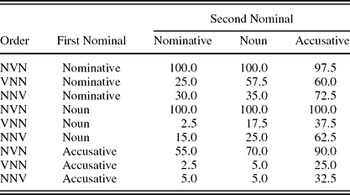
The main effects were significant for all three factors: word order, F (2, 38) = 98.381, p < .0001, first nominal, F (2, 38) = 40.794, p < .001, and second nominal, F (2, 38) = 32.301, p < .001. The mean first nominal choices for the word order factor were 90% for NVN, 31% for NNV, and 26% for VNN order. These percentages closely match those reported previously (MacWhinney et al., Reference MacWhinney, Bates and Kliegl1984) for sentences with two nouns. The full set of cell means is given in Table 2. Each cell mean in that table represents the proportion of first noun choices for the sentences that were in that cell.
Cell means by the three factors

Note: N, noun; V, verb.
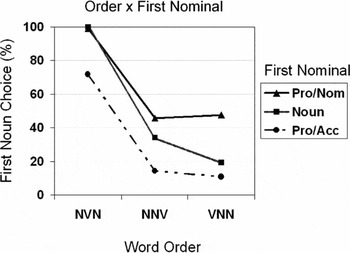
There was a highly significant interaction between word order and first nominal marking, F (4, 76) = 5.762, p < .001. However, Figure 1 shows that this interaction is due to a ceiling effect for the first pronoun in the canonical NVN order. In addition, this figure shows that, across all three orders, presence of a nominative or subject pronoun as first nominal promotes first nominal choice, whereas presence of an accusative or object pronoun as the first nominal weakens first nominal choice.
The interaction of word order with first nominal marking. Pro, pronoun; Nom, nominative; Acc, accusative; N, noun; V, verb.

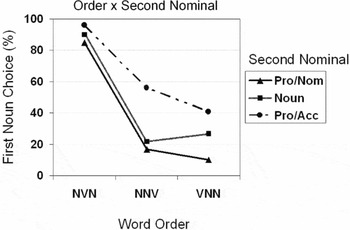
The interaction of word order and second nominal marking was also highly significant, F (4, 76) = 11.634, p < .001. Figure 2 illustrates that this interaction was also due to a ceiling effect in the NVN order. In addition, sentences with an accusative pronoun in second position had different response patterns in NNV and VNN orders. The relevant comparison pairs are Examples 14–15, 16–17, and 18–19. Sentences with VNN order (Examples 15, 17, and 19) have somewhat higher first nominal choice and VSO interpretation than sentences with NNV order, despite overall lower levels for VNN. This is because the placement of a pronoun in preverbal position in NNV order tends to support its candidacy for the actor role, thereby weakening the choice of the first nominal.
14. The girl him chased.
15. Chased the girl him.
16. She him chased.
17. Chased she him.
18. Her him chased.
19. Chased her him
The interaction of word order with second nominal marking. Pro, pronoun; Nom, nominative; Acc, accusative; N, noun; V, verb.

Analyses by word orders
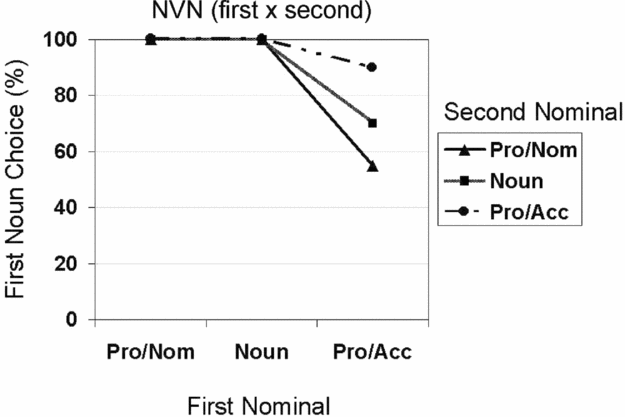
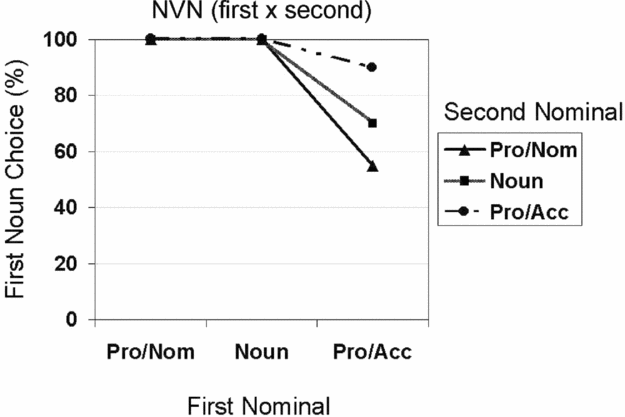
In order to analyze the interaction of the two nominal marking factors in greater detail, we computed separate two-way ANOVAs for each of the three word orders. For the NVN order, the interaction of the two factors was highly significant, F (4, 76) = 7.415, p < .0001, which is illustrated in Figure 3. This interaction was due to a ceiling effect when the first nominal was a noun or a nominative pronoun. Only when the first nominal was an accusative pronoun could we see the further effect of second nominal marking. These data show that the combined cues of SV word order and nominative case marking completely override potentially conflicting cues provided by the second nominal. The strongest tendency to interpret sentences in terms of an OVS order occurred for sentences with an initial accusative pronoun and a final nominative pronoun, such as “him chased she.” In these sentences, the two pronominal cues are able to work together to effectively compete against the strong word order cue. However, even here, the choice of the first noun 55% of the time for these sentences indicates that the effect of word order is still a bit stronger than the combined effect of the two pronominal case-marking cues.
The interaction of the two nominal factors for the noun–verb–noun (NVN) order. Pro, pronoun; Nom, nominative; Acc, accusative.
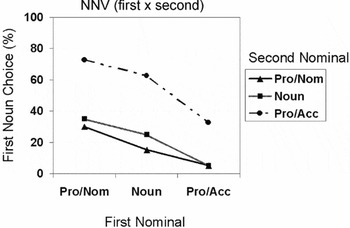
In the noncanonical NNV order, there was a highly significant effect for first nominal marking, F (2, 38) = 17.370, p < .001, as well as for second nominal marking, F (2, 38) = 31.159, p < .001. The interaction between the two nominal factors was not significant, F (4, 76) = 0.768, p = .550, as illustrated in Figure 4. As we noted before, the strong preverbal positioning cue tends to force interpretation of NNV as OSV. However, in this noncanonical order, when the preverbal nominal is an accusative pronoun, the case marking cue can overpower the word order cue, as long as the first nominal is either unmarked or marked as nominative.
The interaction of the two nominal factors for the noun–noun–verb (NNV) order. Pro, pronoun; Nom, nominative; Acc, accusative.

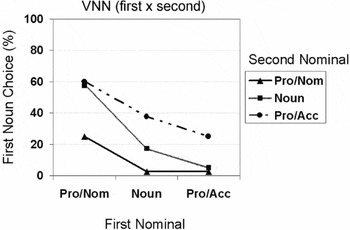
The results for the noncanonical VNN order, as illustrated in Figure 5, were similar to those for NNV. The main effects were highly significant, first nominal, F (2, 38) = 25.186, second nominal, F (2, 38) = 22.447, p < .001; and the interaction was not. The main difference between these two orders was that the effect of accusative marking on the second nominal was weaker in VNN than in NNV. The VNN order has no preverbal positioning cue. It instead uses the weaker postverbal positioning cue that tends to favor VOS order overall. However, when the first nominal is a nominative pronoun, there is a marked increase in VSO order.
The interaction of the two nominal factors for the verb–noun–noun (VNN) order. Pro, pronoun; Nom, nominative; Acc, accusative.

Maximum likelihood analysis
The primary goal of this study has been to clarify the relative strengths of the word order and pronominal marking cues in English. Using ANOVAs, we were able to detect a variety of significant effects because of pronominal marking. However, an ANOVA does not provide a clear measure of relative cue strength. To do this, we can use maximum likelihood estimation (MLE; Bates, McDonald, MacWhinney, & Appelbaum, Reference Bates, McDonald, MacWhinney and Appelbaum1991; Massaro, Reference Massaro1987; McDonald & MacWhinney, Reference McDonald, MacWhinney, MacWhinney and Bates1989). MLE analysis also allows us to construct a cue strength hierarchy so we can compare results across competition model studies.
We conducted the MLE analysis using the Solver add-in package for Microsoft Excel. The equations used for the model fitting are based on the Luce (Reference Luce1959) choice ratio. In the two-choice case in these sentences, the ratio involves the product of cues favoring first nominal choice over the product of cues for first nominal choice and cues for second nominal choice. We constructed one four-cue model and one five-cue model. The four-cue model used the following four cues:
1. Nominative case on the first nominal: this cue was coded as positive (favoring first noun choice) when the first nominal was nominative, negative when the first nominal was accusative, and missing when the first nominal was a noun.
2. Accusative case on the second nominal: this cue was coded as positive (favoring first noun choice) when the second nominal was accusative, negative when the second nominal was nominative, and missing when the second nominal was a noun.
3. Preverbal positioning of the first nominal: this cue was coded as positive in NVN, negative in NNV, and missing in VNN.
4. Postverbal positioning of the second nominal: this cue was coded as positive in NVN, negative in VNN, and missing in NNV.
The five-cue model used the same case-marking cues but broke word order down into NVN, NNV, and VNN. Both models are capable of expressing the notion of SVO canonicality for English, but in a different fashion. In the five-parameter model, canonicality is encoded directly in the NVN cue that supports the canonical SVO interpretation. In the four-parameter model, canonicality relies on the combined effects of the preverbal positioning cue and the postverbal positioning cue. These two cues work together in SVO order, thereby producing the canonicality effect. VNN order only triggers the postverbal positioning cue, and NNV order only triggers preverbal positioning cue; therefore, these two orders do not demonstrate the heavily deterministic results shown in Table 2 for the NVN order.
For each model, we built a set of 27 equations for the 27 cells of the ANOVA design. Solver then worked to find a set of cue weights that can be plugged into the 27 equations to best predict the observed values in the cells. Solver also computed the root mean square deviation (RMSD) between the predicted and observed values. This was done by squaring each of the 27 deviations, summing the squares, and then taking the square root of the sum.
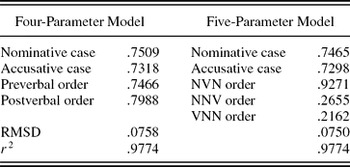
The results of this analysis are given in Table 3. The lower the RMSD, the better the fit of the model. Past research in this area has shown that RMSD values lower than 0.10 represent a good fit of the model to the data. The best fits yet found in this research reach the level of 0.05. The fits of these two models were at 0.07, which represents a good fit. The fit of the five-cue model was not much better than that of the four-cue model. Given this, the four-cue model is strongly preferred, because models with more parameters are always going to have an advantage over models with fewer parameters. That adding this additional parameter did not lead to a marked improvement in the RMSD indicates that the cue partitioning in the four-cue model was a better match to the actual cue structure used by subjects.
Maximum likelihood estimation parameter estimates, RMSD, and correlations

Note: RMSD, root mean square deviation; N, noun; V, verb. The values are r 2 correlations.
The results for the four-cue model differed in two regards from those found in other competition model MLE analyses (McDonald & MacWhinney, Reference McDonald, MacWhinney, MacWhinney and Bates1989). The first is that the spread of parameter values in this model was much less than in other studies. When reading these parameter estimates, it is helpful to understand that the parameter values for the cues can vary between zero and one. A cue with virtually no strength at all will have a parameter value close to 0.5. If the cue is a strong cue to first nominal choice, its value will approach 1.0. If the cue is a strong cue against first nominal choice, its value will approach zero. In the four-cue model, all cues were coded as favoring first nominal choice. In the five-cue model, two of the word order cues (NNV and VNN) disfavored first nominal choice. For the four-cue case, we see that Solver found it best not to move the value of any cue too close to 1.0. Instead, the cues were bunched in a pack between 0.73 and 0.80. This indicates that all of the cues in this experiment were being used at a nearly equal level of strength. This provides us with a fairly clear answer to the basic question motivating this research. We wanted to understand whether the reliable pronominal marking cue would be able to compete successfully with the powerful word order cue. These results show that this competition is indeed very tight.
However, within this restricted range, the strongest cue is not the usual preverbal positioning cue, but is instead the postverbal positioning cue. This is the second major difference between this set of results and earlier results (Evans & MacWhinney, Reference Evans and MacWhinney1999; McDonald & MacWhinney, Reference McDonald, MacWhinney, MacWhinney and Bates1989). The important thing here is not that the postverbal positioning cue is somewhat stronger than the preverbal positioning cue but that the preverbal positioning cue did not emerge as absolutely dominant in this experiment. This result again indicates that all four cues are being weighted together here in a highly competitive manner.
DISCUSSION
This study has closed several major gaps in our understanding of sentence interpretation in English. These results extend the range of constructions to which the competition model has been applied. Because that model had concerned itself so frequently with sentences constructed from two nouns and a verb, one might question the ability of the model to account for other syntactic configurations, particularly those involving pronouns instead of nouns. The current results show that the competition model can provide an accurate account for the processing of sentences with both pronouns and nouns in various configurations.
In terms of the broader issues of psycholinguistic theory, we have always known that both pronominal case marking and word order must be useful and important cues to sentence interpretation. However, the details of this interaction in English had never been studied. We now know that, when the two cue types are put into competition across various word orders, both play an important role. Word order only dominates case in canonical NVN order. In that order, there are two word order cues present: preverbal positioning and postverbal positioning. In the noncanonical VNN and NNV orders, only one of these word order cues is present at a time. In those orders, case is able to compete with the single word order cue and often dominates it.
The results also show that the marking of case on the first and second nominal play important and separate roles in determining actor choice. When these two pronominal marking cues cooperate, they can work to almost overcome the strong preverbal positioning cue in NVN order. In noncanonical NNV order, they can actually dominate the single word order cue. These results show how English, if its word order were a bit freer, would start to behave more like Dutch. Dutch provides a particularly good comparison with English, because both languages have lost nominal case marking, but preserved pronominal case marking. Because Dutch, unlike English, allows for both SVO and OVS order in main clauses and variable order in subordinate clauses, it has more sentences in which word is ambiguous and pronominal case could be a useful cue. Although Dutch children still rely primarily on word order, by age 8 they shift to relying more on pronominal case when the two cues are in competition (McDonald, Reference McDonald1986). The role of case marking in noncanonical orders in English seems to echo these patterns in Dutch.
Work by Childers and Tomasello (Reference Childers and Tomasello2001) has highlighted the importance of pronominal case marking in first language learning. This study looked at children's learning of novel verbs in combination with either nouns or pronouns. It found that children were better able to pick up the meaning of new verbs when they were combined with pronouns, as in Example 20, than with nouns, as in Example 21.
20. He miffed it.
21. The dog miffed the banana.
These results indicate the importance of the redundant role information provided by pronouns. By themselves, nouns give no cues to agenthood. When children are learning new verbs, this lack of role information from the novel verbs is particularly severe, because much of early role assignment learning is based on individual lexical items (MacWhinney, Reference MacWhinney and Kuczaj1982; Tomasello, Reference Tomasello2000). By using the highly reliable role information available from pronouns, children can move more quickly to learning about the thematic roles and positions of NPs that cooccur with new verbs.
The results of the current study also have important implications for the study of second language acquisition. First, these results help us better understand the fact that English learners of Japanese are able to pick up the marking of the nominative and accusative cases relatively quickly (Sasaki, Reference Sasaki1991, Reference Sasaki1994, Reference Sasaki1997). In competition model terms, we can see this as positive transfer of a strong cue in L1 to a matching strong cue in L2. Second, these results help us understand various patterns in second language learning of English pronominal marking. All of the major source languages that have been studied (German, Spanish, Chinese, Korean, Japanese, Russian, etc.)Footnote 1 have methods for marking the nominative–accusative distinction on both nouns and pronouns. This means that the conceptual basis of case marking on the English pronoun system presents no serious challenge to these learners. In contrast, learners may not realize how much English relies on consistent pronominal marking for case, number, and gender. Unlike many other languages (Chinese, Romance, Japanese, Hebrew), English cannot permit pronoun deletion. In addition, English relies heavily on pronoun gender as a way of marking anaphoric coreference. Speakers of source languages that lack gender distinctions, such as Chinese or Hungarian, often find this additional marking confusing. In both of these areas, the effective learning of English as a second language can be guided by emphasizing the importance of the pronominal system as a way of guiding accurate sentence interpretation. The results of the current study provide detailed empirical support for this cue-based instructional approach.
ACKNOWLEDGMENTS
This research was supported in part by the Japan Society for the Promotion of Science (to Y.Y.) and by a doctoral SLA graduate scholarship from the Department of Modern Languages at Carnegie Mellon University. We also acknowledge the support of the Pittsburgh Science Learning Center. Our thanks also go to Carnegie Mellon University for data collection and to anonymous reviewers for comments on earlier versions of the manuscript. Parts of this work were presented at the 2003 Annual Meeting of the Cognitive Science Society.