

The author has worked within an orthopaedic setting for many years, mainly with patients of all ages who have been diagnosed with rheumatoid arthritis (RA). The author has always been interested in rheumatology nursing and the coping mechanisms that these patients portray towards such a chronic disease. The author has met both patients who are psychologically well adapted to their deformities as well as patients with severe body image issues. The author often reflects upon these cases and wished to consolidate her knowledge by conducting a literature search regarding the psychological well-being of patients with RA. The author will then be able to improve the care offered to these patients by reflecting on clinical experience and applying knowledge to practice. The author believes that all nurses and allied health professionals that have contact with this group of patients should be aware of these issues.
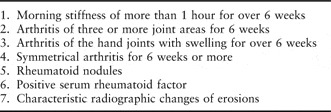
Rheumatoid arthritis is the most common form of chronic systematic inflammatory joint disease [Oliver, Reference Oliver2007] and a common cause of disability. It is characterised by exacerbation and remission of joint inflammation associated with pain, heat, stiffness, swelling and eventually joint destruction [Hill, Reference Hill2006]. RA is diagnosed when four or more characteristics are met (see Table 1), and is found in approximately 1–3% of the population. It can present at any age, however peak onsets are between 35 and 50 years of age and it is two to three times more likely in women than men. However, this sex difference equals by the age of 69 as the prevalence of RA increases with age [Ryan, Reference Ryan2007]. Life expectancy is reduced by up to 15 years with 5-year survival reduced by 50% in patients having severe disease with extra-articular features. This places them in the same prognostic group of patients with triple vessel coronary disease and Hodgkin’s disease [Hosie and Field, Reference Hosie and Field2002].
Rheumatoid arthritis is diagnosed when four or more of the following criteria are met [Hosie and Field, Reference Hosie and Field2002]

Hill [Reference Hill2006] suggests clinical features also include loss of mobility, fatigue, anxiety and depression.
When diagnosed with RA, patients require time to adjust to the alterations in everyday functions and may remain in denial about the condition for anything up to 5 years [Hill and Ryan, Reference Hill and Ryan2000]. Barry [Reference Barry2004] states that chronic psychosocial distress commonly causes musculoskeletal pain and that RA patients often have problems with depression, anxiety, decreased self-esteem, loss of confidence, loss of independence and security (career and home), increased stress due to social changes and disability and fear of becoming dependent and disabled.
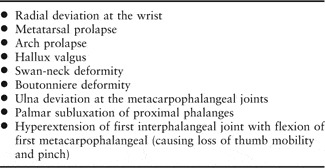
The exact prevalence of depression among RA patients is unknown but it is thought to be 20–30% of those diagnosed [Hill and Ryan, Reference Hill and Ryan2000]. The causative factors being social stress, lack of social support, increased pain levels and reduced ability to engage in activities [Ryan, Reference Ryan2007]. The strongest predictors of depression in RA patients were high tension and low self-esteem. Other predictors are thought to be fatigue, pain and extent of physical disability [Cornell, Reference Cornell2007]. Monaghan et al [Reference Monaghan, Sharpe, Denton, Levy, Schrieber and Sensky2007] suggest that women with RA have lower levels of self-esteem, compared to healthy women, and high levels of body image dissatisfaction. This is mainly linked with the physical appearance changes seen in RA, where progression of disease (uncontrolled inflammation) sees damage to the tendons and ligaments surrounding the joint, causing joint instability, corresponding with deviation and resulting in deformity [Ryan, Reference Ryan2007]. Such deformities are listed in Table 2.
Rheumatoid arthritis-associated deformities [Ryan, Reference Ryan2007]

Monaghan et al [Reference Monaghan, Sharpe, Denton, Levy, Schrieber and Sensky2007] suggest that psychosocial issues (attitude, psychopathology and social functioning) are also strongly associated with body image disturbance. These authors found that both disability and physical appearance predicted depression in RA and did so independently. This was not true for anxiety. They found the only predictor of anxiety was linked to the number of actively inflamed joints, linking anxiety to severity of disease, not to appearance concerns. MacSween et al [Reference MacSween, Brydson and Fox2004] state that patient’s physical self-perceptions are an important outcome of clinical treatment and are related to adherence and persistence in physical activity and mental well-being. Therefore both are important in the rehabilitation process and clinical management of an RA patient.
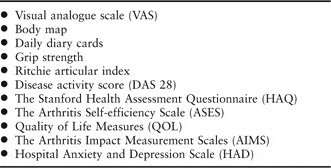
Hill and Ryan [Reference Hill and Ryan2000] recognise that the practitioner can play a vital therapeutic role in caring for, educating and empowering the RA patient, enabling them to take control of their illness and their lives. The practitioner should be able to identify depressive symptoms and be equipped with the necessary skills/knowledge to help patients through a depressive episode, especially if related to an increase in disease severity. However, some patients may require additional intervention of anti-depressants or referral to psychiatrist or psychologist [Hill and Ryan, Reference Hill and Ryan2000]. The assessment tools listed in Table 3, aids practitioners in measuring the activity and progression of the disease and the efficiency or non-efficiency of treatment, and assess the effect the disease has on the patient [Hill, Reference Hill2006].
Clinical assessment tools [Hill, Reference Hill2006]

The last two assessment tools are more relevant to the subject of this article. Their use is not to diagnose depression, but to give a helpful indication of depression when referring a patient to psychiatrists/psychologists [Hill, Reference Hill2006].
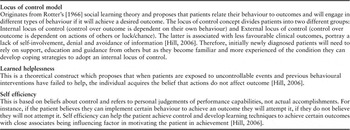
Rheumatoid arthritis, its manifestations and side effects from medication can influence attractiveness and alter body image leading to loss of self-esteem and affect personal attitude. To overcome this and achieve a sense of control, the patient must obtain a degree of empowerment over the disease, develop adaptive attitudes and engage in behaviours that will improve their functioning and have strategies to cope with the changing nature and symptoms of RA. This is known as Cognitive Behavioural Therapy [Monaghan et al, Reference Monaghan, Sharpe, Denton, Levy, Schrieber and Sensky2007]. Helping patients identify what they can succeed in as opposed to what they cannot, develops positive thinking and is adaptable to all aspects of personal functioning [Hill, Reference Hill2006]. Other theoretical models of control used in practice can be seen in Table 4.
Theoretical models of control

Bayliss et al [Reference Bayliss, Ellis and Steiner2007] states that self-management of RA leads to optimal health outcomes. However, barriers to self-management can negatively affect disease outcome, mortality and quality of life. These barriers include inadequate social support, difficulties with time management, troubled emotional state, low self-efficacy, conflicting personal health beliefs, physical limitations, lack of knowledge about condition and the presence of comorbid diseases. Bayliss et al [Reference Bayliss, Ellis and Steiner2007] suggest potential barriers that may be amenable to intervention include identifying and treating depressive symptoms, providing individualised patient education and enhancing physical functioning (physiotherapy, aids and support). Bodenheimer et al [Reference Bodenheimer, Lorig, Holman and Grumbach2002] state that self-management education complements traditional patient education in supporting patients to live the best possible quality of life. Whereas traditional patient education offers information and technical skills, self-management education teaches problem-solving skills.
To conclude, RA can have a multifactorial effect on all domains of function, from the obvious physical elements of pain, stiffness and fatigue to the psychosocial elements where the disease affects the patient’s emotions/personal perceptions, social life and quality of life. Hill and Ryan [Reference Hill and Ryan2000] suggest that nurses, therefore, need not only concentrate on the physical manifestations but also on addressing the psychological and social needs that ultimately affect the patient’s well-being if the patients are to recognise the benefits of treatment regimens and comply to them [Oliver, Reference Oliver2007].
It then proceeds that assessment regarding these patient’s concerns of appearance should be part of routine treatment of patients with RA, even in absence of objective disfigurement. Appearance concerns and depression are closely interrelated and should be considered together in the psychological functioning of an RA patient. Cognitive Behavioural Therapy aims to help patients develop more adaptive attitudes towards the disease and engage in behaviours that will improve their functioning. The author now feels more equipped to apply knowledge to practice, and now has a lateral understanding of the many factors involved with appearance and psychological distress in RA patients. The author’s care will now take a more patient-centred approach, further individualising care and increasing empathy when dealing with this patient group. A greater understanding regarding the difficulties of patients self-managing their RA has now been established, along with how patients and professionals should collaborate together to maintain stabilisation and empowerment towards self care.