Disasters are a major cause of death and suffering among humans around the world and the number of affected people is increasing every year.Reference Sundnes and Birnbaum 1 The impact of a disaster may include physical and psychosocial health problems, damage to property, economic disruption, and environmental effects. 2 The goal of disaster management is to save lives and protect people from further harm,Reference Sundnes and Birnbaum 1 and response activities include attempts to reverse adverse health effects.Reference Stallings 3 Common health-related problems after typhoons and flash floods include both individual and community dimensions, for example, severe injuries to medical facilities reducing the ability to serve the population with adequate medical care, a potential risk for increased communicable diseases, shortness of food and fresh water, and personal injures. 4 These challenges were also identified or expected after the Haiyan typhoon. 5 The total response after sudden-onset disasters should have a multidisciplinary approach and should include public health, emergency medicine interventions, and psychosocial response in addition to other humanitarian responses.Reference Sundnes and Birnbaum 1 , Reference Bartels and van Royen 6 , Reference Rahardjo, Wiroatmodjo and Koeshartono 7
Typhoon Haiyan (also called Typhoon Yolanda) in the Philippines in November 2013 is thought to be one of the worst natural disasters in history. Around 14.9 million people lost their homes, 26,000 were injured, and about 7000 died in the disaster. 5 In Tacloban, a city of about 250,000 habitants in the Leyte province, the typhoon caused severe infrastructural damages such as an almost complete loss of electricity and breakdown of telephone communications, mobile communications, Internet, radio, and TV. Access to public information and means of communication were therefore impeded for several weeks after the typhoon.Reference Austin and Bailey 8
After the request of local authorities, through the United Nations system, First Response Radio, a nongovernmental organization providing disaster radiobroadcasting in disasters, (www.firstreponse.org) accessed Tacloban on day 5 after the typhoon and began disaster radio broadcasting on the same day by using temporary technical solutions. The concept was to broadcast popular music and official information to the public. Officials and responding relief organizations were offered use of the radio to communicate with the public. About 500 solar cell–driven or windup radios were distributed free to affected people by the city administration and responding organizations, placed in temporary evacuation centers, schools, and private homes. Also, loudspeakers were used to broadcast the radio. Radio served as the key source for information in the affected areas after the typhoon.Reference Austin and Bailey 8
From a community resilience perspective, resilience occurs when resources are sufficient and robust or can buffer the effects of the disaster and compensate for gaps in functions caused by the disaster. When the adaption process is manifest, “population wellness” is reached, defined as high and nondisparate levels of mental and behavioral health, role functioning, and quality of life in constituent populations.Reference Norris, Stevens and Pfefferbaum 9 The theory of community resilienceReference Norris, Stevens and Pfefferbaum 9 emerges from the networking of 4 robust, redundant, and rapidly accessible sets of adaptive capacities: economic development, social capital, information, and communication and community competence.Reference Norris, Stevens and Pfefferbaum 9 Crisis communication is today seen as an integrated and essential part of disaster management measures, 4 , Reference Coppola 10 , Reference Perry and Lindell 11 and good communication with the public is essential to enhance resilience 12 and reduce morbidity, mortality, and social and psychological impacts in crises.Reference Rogers, Amlot and Rubin 13 The challenge of communication with the affected community in disasters has been well documented, and the importance of communication strategies in situations when no ordinary media are available and during long periods of power outrages has been highlighted.Reference Burger, Gochfeld and Jeitner 14 Communication and information about accessible help, positive coping strategies, and human rights in disasters are seen as an important tool to facilitate recovery among affected populations.Reference Rogers, Amlot and Rubin 13 , 15 In this article, the term disaster radio will be used to describe a radio station serving a disaster-affected area with specific disaster-related information, either by temporary technical solutions or by ordinary means.
The use of radio in disaster settings for early warning systems or disaster preparedness has been evaluated,Reference Norris, Stevens and Pfefferbaum 9 , Reference Romo-Murphy, James and Adams 16 , Reference Rundblad, Knapton and Hunter 17 but knowledge about the use of disaster radio in a health promotion perspective is according to our knowledge limited. The aim in this study was to describe how disaster radio was used to communicate vital messages and health-related information to the public in one affected region after Typhoon Haiyan.
Methods
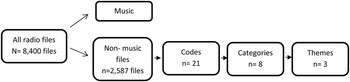
A mixed-methods techniqueReference Sandelowski 18 using quantitative descriptive analyses and qualitative content analysis inspired by KrippendorfReference Krippendorff 19 , Reference Graneheim and Lundman 20 was used. The data consisted of English language radio log files covering 24 hours of radio broadcastings for the first 17 days of radio broadcasting (days 5 to 22 after the typhoon). All files were tagged with a file name describing the content or music title. In total 8400 radio log files were available. Content analysis is a method used in both quantitative and qualitative research to analyze the manifest and latent content of communication and texts.Reference Krippendorff 19 In the first step, a qualitative content analysisReference Krippendorff 19 , Reference Graneheim and Lundman 20 was performed. Music files were separated from nonmusic files, leaving 2587 files consisting of information messages. These were transferred to an Excel (Microsoft Corp, Redmond, WA) document for further analysis. All files were divided into 21 different codes depending on the content of the file.Reference Graneheim and Lundman 20 Thereafter, all codes were compared internally and externally and assigned to 1 of 8 categories that emerged from the analysis, describing the content of the data.Reference Graneheim and Lundman 20 In the last step, the categories were assigned to 3 themes, describing the latent content of the broadcasted information and messages (Figure 1).Reference Graneheim and Lundman 20
Steps in the Content Analysis of the Radio Log Files.

All files with unclear content and an additional 5 to 10 files randomly selected from each code were listened to as complete audio files to verify their content and classification. In total, 35 files were selected for listening. No files were moved from their original code or category after the verification. No log files was excluded in any step of the analysis process.
In the quantitative analysis,Reference Sandelowski 18 all files related to the categories found in the qualitative analysis were analyzed with a focus on frequency related to day, time, and content of the broadcast. A specific, deeper analysis of health-related messages on code level was also performed by analyzing the content of the message related to day and frequency. The analysis was presented in diagrams. The analysis process was conducted by the head researcher and co-researchers (AA and MG) together. The interpretation of the findings and discussion were made by all authors. The study was approved by The National Ethics Committee, the Philippines.
Results
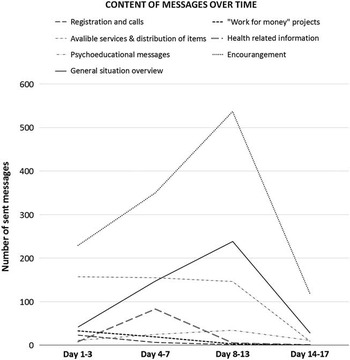
In total, 2587 files were identified as nonmusic files and these were analyzed by frequency related to day, time, and content of the broadcast. In total, messages of encouragement were the most frequently broadcast (1233 messages), followed by information about businesses and banks (112 messages), availability of access to the Internet (93 messages), calls to boil water (88 messages), and distribution of relief items (73 messages) (Figure 2).
Content of Messages Over Time.

The content and focus of the messages changed over time. During the first week (days 1 to 7), information covering registration of missing persons, calls for foreign nationals, fresh water access points, availability of petrol, accessible roads, and operational medical facilities were frequently sent. On days 3 to 5, information about public transport including evacuation flights peaked, and the most frequent messages were encouragement, followed thereafter by information about available official services and distribution of relief items (Figure 2).
During the second week (days 8 to 13), access to shelter, calls for people to return to their ordinary workplaces, boil water calls, immunization calls, and psychoeducational messagesReference Krippendorff 19 were most frequently broadcast. At this stage, information about a relocation plan for residential areas, waste and rubble management, security-related information, and media updates also began to be broadcast.
From day 11 to day 17, approximately 2 weeks after the typhoon, the information flow focused more distinctly on disaster preparedness strategies such as warning systems, information about the reopening of schools, and measures to prevent endemic diseases. Specific messages about accessible Internet facilities, general situation updates, media updates, and messages of encouragement were all broadcast with about the same intensity during all 17 days covered in this study.
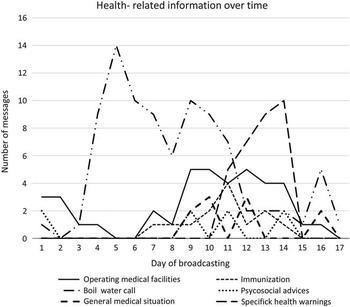
Health-related information was only a minor part of the total load of information broadcast from day 1 to day 17 (Figure 2). The messages in the category of health-related information included information about access to operational medical facilities, general information from official health authorities, calls for immunization programs against measles, information about the policy of a general health insurance company, and advice on how to avoid and recognize specific health threats such as dengue fever and leptospirosis. The first health-related messages were concerned with operational medical facilities. This information was repeated during the first 2 days but was then absent during the next 4 days before being updated and broadcast more frequently from day 7 to day 14. The advice to boil drinking water was most frequently broadcast from day 3 to day 11 (Figure 3).
Content of the Messages Containing Health-Related Information Over Time.
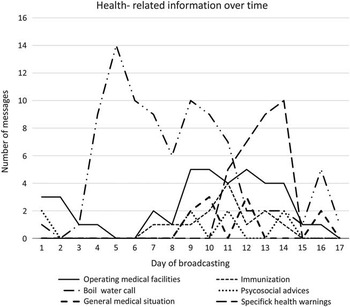
Senders of health-related messages were mainly official health authorities but also private insurance companies and medical facilities. Psychoeducational messages consisted of longer interviews with the head of the governmental psychosocial support team and representatives from UNICEF and information about psychosocial reactions and advices. Psychoeducational messages were first broadcast on day 1. Thereafter, there was a gap until day 9 (Figure 3).
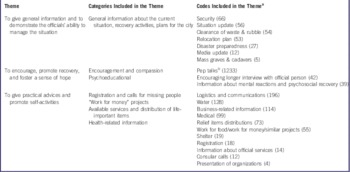
In the qualitative analysis, 21 codes were found that described 8 categories and 3 themes of the radio broadcasts and their latent messages to the listeners (Table 1). The first theme was (1) “to give general information and demonstrate the officials’ ability to manage the situation.” The theme included 273 messages. Within this theme was information on how officials presented information about the current situation in the city and nearby areas, early recovery actions, recovery plans, and reinforcement of the city. Information about operational medical facilities and security-related information was also given, mainly during the first days.
“This is an official announcement of the Tacloban City Administrator. As you all know, the Leyte province region eight is proclaimed as a disaster area. So far, we have counted 2672 dead bodies, and the number will rise….we continue to collect bodies and we place them in [XXX] [local name]. I kindly ask everyone to be patient, it has been raining the last three days, and that [has] made this harder…All bodies are treated with dignity and all are carried by hand, and that takes some time, but we will continue until the last body is found.”
“We are now trying to normalize this society, to open up all business and to continue the life. The situation has stabilized, and we are now working hard to get plans for recovery.”
Qualitative Analysis of the Text Files

a Number of messages in each code listed in parentheses, with the most frequent message listed first.
b Pep talks consisted of short, generally addressed messages to the affected community presented by famous or influential persons such as artists, media personalities, actors, politicians, and religious leaders.
The theme also included general media updates from both local and worldwide news. During the last week, information about strategies for rubble and debris clearance was broadcast as part of the city recovery plan.
The theme of giving general information and demonstrating the officials’ ability to manage the situation was used each day of broadcasting and was mainly broadcast during the daytime.
The second theme was (2) “to encourage, promote recovery, and foster a sense of hope.” This theme was the most frequently broadcast. It included 1314 messages. Most (about 94%) of these were short, encouraging messages from famous or powerful people to the affected people, aiming to encourage hope, courage, and confidence for the future. These messages were intended to convey compassion and sympathy to the affected people.
“Taclobanos, keep strong, we will build this up from down. Together, we will manage.”
“It is a common misunderstanding that children do not understand. Some children have nightmares, some complain [of] physical pains…such as abdominal pains…or they don’t want to be separated from parents. If you can, try to talk to your child about what happened. It is important that the normal life will keep going. If it is possible to see friends, play and…if the child wants to play basketball, then encourage them to do so.”
Psychoeducational advice about the normality of stress reactions and information about how to enable psychosocial recovery from an individual perspective was also provided, in addition to interviews with people with high credibility, for example, the head of the Psychosocial Response Team. The theme to encourage, promote recovery, and radiate a sense of hope was broadcast every day, 24 hours a day, and senders included both governmental and nongovernmental organizations as well as famous persons.
The third theme was (3) “to give practical advice and encourage self-activity.” This theme covered 732 messages ranging from practical support and advice from authorities and relief organizations to encouraging people to act, for example, to provide themselves with essential supplies or to encourage health promotional behavior. Information about reopening of businesses, banks, and other services was given as well as information about general redeployment and possibilities to get involved in work for money and work for food projects.
“For the education cluster, I will report that no schools are operational now, when they are for now used as evacuation and temporary shelter areas. In [XX],[ YY], and [ZZ], Learn to Play Boxes and two tents [have] been put up and children are welcome. Also ten tents for school in [DD] [have] been sent and will be opened for children’s activities tomorrow. Cluster of Education has met with the private schools, we hope to be able to sync so that all schools in [SS] will be possible to open again on the 10 of January.”
In this theme, information about incoming help and when and where vital supplies such as food and shelter could be picked up was sent. One of the most frequently broadcast messages was about operational Internet connections.
“This is information about telecom possibilities in the Tacloban area. The mobile net is still not functional but all telecom operators are working to get it operational. The estimation at this time is that [XXX] [local telecom company] will open their lines first, and they recommend that you text messages to save limited capacity.”
The theme included the very first disaster radio broadcast. Logistical information about possibilities for evacuation from the area by commercial or military airplanes was also broadcast frequently, mainly during the first week. Although the theme was most noticeable during the first week after the disaster, it was present during all 17 days.
Discussion
Disaster impact can be viewed from different perspectives. This study has shown several important findings on how radio broadcasts can be used to communicate life-essential information and health-related messages to the public after a natural disaster.
In community resilience theory, Norris et alReference Norris, Stevens and Pfefferbaum 9 suggest that accurate, truthful, quick information is essential to enhance health. Also Cretikos et alReference Cretikos, Eastwood and Dalton 21 have suggested that health care systems should work more proactively to use radio as a tool for communication in disasters, and Hartman et alReference Hartman, Roades and Santos 22 strongly advise humanitarian actors in general to consider radio as a tool to communicate with the community. Therefore, the gap in health-related information flow from day 4 to day 6 and the total interruption of psychoeducational messages from day 2 to day 9 shown in this study is striking. The reasons for this are unknown. This finding could indicate that medical organizations involved in the disaster response were unfamiliar with using radio or found it inconvenient for communication with the affected community or that other information sources filled the needs for health-related information during these days. Another possibility is that the organizations considered the information needs to be fulfilled for the time being, that the organizations themselves were overwhelmed by the situation, or that the radio station was not instructed to prioritize these messages. The willingness and possibilities of humanitarian responders to actually provide information via the radio station is centralReference Austin and Bailey 8 and needs to be further studied.
Disasters are stressful not only to the individuals directly affected but also for the community at large, based on the principle that community members are exposed together and therefore recover together.Reference Norris, Stevens and Pfefferbaum 9 To facilitate psychosocial recovery after disasters from both an individual and a community perspective, evidence-based principles have been suggested, including to promote a sense of safety, to promote calm, to promote a sense of self-efficacy and collective efficacy, to promote contactness, and to promote hope.Reference Hobfoll, Watson and Bell 23 Radio broadcasting after disasters is also suggested to calm fears.Reference Sugimoto, Nomura and Tsubokura 24 , 25 According to a survey made after Typhoon Haiyan, many people in the severely affected area felt that they received insufficient aid-related information in the aftermath of the typhoon.Reference Hartman, Roades and Santos 22 To communicate with an affected population in environments that lack electricity and ordinary communication is a great challenge. Such circumstances are a reality in most sudden-onset disasters. From a sender’s perspective, the use of disaster radio as described in this study seems to be a way to facilitate and promote psychosocial recovery when usual individual approaches are impossible given the large number of potentially affected people, limited resources, and damaged infrastructures.
The fact that information about availability of access to the Internet was broadcast often and with the same intensity from day 1 to day 17 may indicate that this was an important need to meet in this disaster situation. The Internet can be used to locate family and friends and to find information about the current situation.Reference Romo-Murphy, James and Adams 16 , 26 These are also well-known factors to promote psychosocial recovery.Reference Hobfoll, Watson and Bell 23 , 26 , Reference Brymer, Jacobs and Layne 27
Our use of a combination of quantitative and qualitative analysis meant that more information was obtained and thereby increased the validity of the results.Reference Sandelowski 18 One of the challenges of conducting disaster research is access to data and data collecting procedures.Reference Stallings 3 Both quantitative and qualitative research approaches are useful to study the impact of disasters and disaster response.Reference Stallings 3 , Reference Girratano, Savage and Barcelona-deMendoza 28
In the analysis process, the suggested condensation of codesReference Graneheim and Lundman 20 was not performed because each radio log file was already clearly and concisely described. It was felt that further condensation would not improve the quality of the analysis. The data consisted in total of about 400 hours of radio broadcast. In this study, it was not possible to transcribe and analyze every single radio message. Therefore, after separating music files and nonmusic files, all files with an unclear description or files that appeared frequently in the analysis were listened to in their entirety to ensure credibility.Reference Graneheim and Lundman 20 Because of technical problems with saving data, two-way communications between the radio station and the public, such as SMS messages, could not be retrieved as planned. No attempt was therefore made to analyze two-way communications.
In this study, one of the researchers (KH) had personal experiences from being deployed in a response team to the studied disaster and geographic area. The co-authors had no such personal experience. The data could therefore be understood in their original context and analyzed with an increased depth and qualityReference Girratano, Savage and Barcelona-deMendoza 28 at the same time as a neutral analysis not influenced by personal experiences was ensured.
Radio broadcasts were analyzed from the sender’s perspective. The perception of the use of disaster radio by the affected population is also essential in order to optimize and further develop the use of disaster radio. Further research could also help to identify the degree of impact of the information and the identification of optimal ways of framing messages. The use and impact of disaster radio for post-disaster epidemics are also indicated as well as the willingness and possibilities for health professionals and authorities to use disaster radio as a tool for communication.
This study covered a particular disaster, the typhoon in the Philippines, and a specific geographic area, and the results may not be applicable or generalizable to all disasters.Reference Stallings 3 Even so, the study may serve as a valuable contribution to the science of developing and evaluating effective disaster response interventions in future disasters.
Conclusion
This study has shown that disaster radio can serve as a means of transmitting vital messages, official information, health-related advice, and psychosocial support during and after disasters. Such communication could be seen as an important response to enhance community resilience. In the study, health-related messages comprised a minor part of all information messages broadcast. That could indicate a potential for an increased use of radio to communicate health-related information to the community in a disaster.
Acknowledgment
We acknowledge the contribution of Mike Adams, international coordinator of First Response Radio, who kindly provided radio log files, audio files, and essential information for this study.