We are fascinated with the compelling challenge posed by Cramer et al. to the latent variable approach, and with their alternative, network approach to the understanding of psychiatric comorbidity. Whereas the determination of the empirical status of both approaches – latent and network – awaits future research, herein we argue that such research would greatly benefit from an intensive, intra-individual, longitudinal prospective study design, preferably using time-series analysis (TSA).
The preponderance of cross-sectional data pertaining to the anxiety and depression comorbidity often yields perplexing results. Most cross-sectional studies investigating comorbidity are in essence based on the assessment of prevalence, aimed at examining the likelihood of a secondary syndrome in the presence of a primary one. Studies applying such an approach generally tend to conclude that anxiety leads to depression (Breslau et al. Reference Breslau, Schultz and Peterson1995; Hettema et al. Reference Hettema, Prescott and Kendler2003; Kessler et al. Reference Kessler, Nelson, McGonagle, Liu, Swartz and Blazer1996; Lewinsohn et al. Reference Lewinsohn, Zinbarg, Seeley, Lewinsohn and Sack1997). As cited by Cramer et al., longitudinal, inter-individual studies focusing on point prevalence, suggest differently. Namely, these studies show that both disorders are equally likely to be the first in a comorbidity sequence (Moffitt et al. Reference Moffitt, Harrington, Caspi, Kim-Cohen, Goldberg, Gregory and Poulton2007). Moreover, longitudinal studies focusing on subthreshold symptomatology indicate that mixed presentation of anxiety and depression tends to culminate in either full recovery, or in pure presentation (Barkow et al. Reference Barkow, Heun, Wittchen, Ustun, Gansicke and Wolfgang2004).
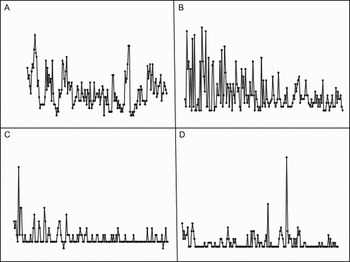
While employing inter-individual, longitudinal research on comorbidity advances the field, herein we argue that the logic behind such studies should be taken further to examine intra-individual unfolding of symptomatology. In an ongoing project examining intra-individual trajectories, and associations, involving anxiety and depression, we find, first and foremost, intense fluctuations in symptoms, cognitions, and affective variants of both disorders. These frequent fluctuations across a 2- to 6-month period were unique to participants reporting elevated levels of both anxiety and depression. Such a pattern is sharply contrasted with the relatively stable manifestation of anxiety and depression in participants exhibiting, to begin with, elevated levels of either, but not both, anxiety and depression.
To illustrate, in Figure 1 we present the variability of fear, as representing the affective component of anxiety, in four participants initially assessed using the Beck Depression Inventory (BDI) and Beck Anxiety Inventory (BAI). Participants were also assessed as to their affect by using the PANAS-X (Positive Affect Negative Affect Schedule, expanded version; Watson & Clark Reference Watson and Clark1994), for a period of 2 months, three times daily. Two of the four participants had elevated scores on both the BDI and BAI, and the remaining two had elevated scores on either. As shown in Figure 1 (top), participants with a mixed presentation exhibited marked fear fluctuations.
Figure 1.
Plot of fear (PANAS-X; Watson & Clark Reference Watson and Clark1994) across study assessment period. A and B: Variability in mixed anxiety and depression participants. C: Variability in anxiety participant. D: Variability in the depression participant.
Aimed originally for forecasting and control of economical and political trends, TSA involves describing and predicting the pattern of behavior of a variable based on its own past values, while considering the effects of slowly adjusted, gradual accumulation (namely, auto-regressive processes) versus local influences (moving-average processes). The most common and widely used technique for analyzing and forecasting time series is based on the Box and Jenkins (Reference Box and Jenkins1976) methodology, which includes a three-step strategy for selecting the best forecasting model from a general class of regression-based models. Having selected a model, it then becomes possible to estimate parameters, check the goodness of fit to the data, and then use the fitted model to enhance understanding of the dynamic laws governing the investigated phenomenon. Box and Jenkins also offer a strategy for assessing causality by using transfer-noise function modeling, aimed at assessing the trajectory from an input series (such as an anxiety symptom) into a dynamic system and on to the output series (such as a depression symptom). Implementation of this approach enables the evaluation of the duration, direction, and intensity of influence of one construct on the other.
In another project, we examined three participants suffering from generalized anxiety Disorder (GAD) and major depressive disorder (MDD) comorbidity. These participants were followed up daily for an extensive period of 6 months, and TSA was utilized to determine fluctuations and trajectories. We found cognitive vulnerability to emerge as a key component shaping the causal network between symptoms of anxiety and depression. Specifically, in two of the three participants, the looming maladaptive cognitive style (LMCS; Riskind et al. Reference Riskind, Williams, Gessner, Chrosniak and Cortina2000), pertaining to the tendency to generate mental scenarios of potentially threatening situations as rapidly rising in risk, was causally related to subsequent increase in depressive symptoms. As well, in two of the three, LMCS was causally related to a subsequent increase in hopelessness, itself a cognitive vulnerability dimension to depression. In none of the participants did symptoms of depression, or depressive vulnerabilities, cause subsequent increases in anxiety or its vulnerabilities. These findings are particularly intriguing because they suggest that cognitive vulnerability to anxiety might cause both depression and its specific cognitive vulnerability, but not vice versa.
Put in the context of Cramer et al.'s argument, our findings suggest that anxiety and depression are multidimensional, and that specific dimensions of anxiety (but not depression) are causally related to specific dimensions of depression. On the face of it, this is consistent with the network approach, and we hope that the use of TSA will shed further light on distinct causal configurations involving anxiety and depression.





 You have
Access
We are fascinated with the compelling challenge posed by Cramer et al. to the latent variable approach, and with their alternative, network approach to the understanding of psychiatric comorbidity. Whereas the determination of the empirical status of both approaches – latent and network – awaits future research, herein we argue that such research would greatly benefit from an intensive, intra-individual, longitudinal prospective study design, preferably using time-series analysis (TSA).
The preponderance of cross-sectional data pertaining to the anxiety and depression comorbidity often yields perplexing results. Most cross-sectional studies investigating comorbidity are in essence based on the assessment of prevalence, aimed at examining the likelihood of a secondary syndrome in the presence of a primary one. Studies applying such an approach generally tend to conclude that anxiety leads to depression (Breslau et al. Reference Breslau, Schultz and Peterson1995; Hettema et al. Reference Hettema, Prescott and Kendler2003; Kessler et al. Reference Kessler, Nelson, McGonagle, Liu, Swartz and Blazer1996; Lewinsohn et al. Reference Lewinsohn, Zinbarg, Seeley, Lewinsohn and Sack1997). As cited by Cramer et al., longitudinal, inter-individual studies focusing on point prevalence, suggest differently. Namely, these studies show that both disorders are equally likely to be the first in a comorbidity sequence (Moffitt et al. Reference Moffitt, Harrington, Caspi, Kim-Cohen, Goldberg, Gregory and Poulton2007). Moreover, longitudinal studies focusing on subthreshold symptomatology indicate that mixed presentation of anxiety and depression tends to culminate in either full recovery, or in pure presentation (Barkow et al. Reference Barkow, Heun, Wittchen, Ustun, Gansicke and Wolfgang2004).
While employing inter-individual, longitudinal research on comorbidity advances the field, herein we argue that the logic behind such studies should be taken further to examine intra-individual unfolding of symptomatology. In an ongoing project examining intra-individual trajectories, and associations, involving anxiety and depression, we find, first and foremost, intense fluctuations in symptoms, cognitions, and affective variants of both disorders. These frequent fluctuations across a 2- to 6-month period were unique to participants reporting elevated levels of both anxiety and depression. Such a pattern is sharply contrasted with the relatively stable manifestation of anxiety and depression in participants exhibiting, to begin with, elevated levels of either, but not both, anxiety and depression.
To illustrate, in Figure 1 we present the variability of fear, as representing the affective component of anxiety, in four participants initially assessed using the Beck Depression Inventory (BDI) and Beck Anxiety Inventory (BAI). Participants were also assessed as to their affect by using the PANAS-X (Positive Affect Negative Affect Schedule, expanded version; Watson & Clark Reference Watson and Clark1994), for a period of 2 months, three times daily. Two of the four participants had elevated scores on both the BDI and BAI, and the remaining two had elevated scores on either. As shown in Figure 1 (top), participants with a mixed presentation exhibited marked fear fluctuations.
Plot of fear (PANAS-X; Watson & Clark Reference Watson and Clark1994) across study assessment period. A and B: Variability in mixed anxiety and depression participants. C: Variability in anxiety participant. D: Variability in the depression participant.
Aimed originally for forecasting and control of economical and political trends, TSA involves describing and predicting the pattern of behavior of a variable based on its own past values, while considering the effects of slowly adjusted, gradual accumulation (namely, auto-regressive processes) versus local influences (moving-average processes). The most common and widely used technique for analyzing and forecasting time series is based on the Box and Jenkins (Reference Box and Jenkins1976) methodology, which includes a three-step strategy for selecting the best forecasting model from a general class of regression-based models. Having selected a model, it then becomes possible to estimate parameters, check the goodness of fit to the data, and then use the fitted model to enhance understanding of the dynamic laws governing the investigated phenomenon. Box and Jenkins also offer a strategy for assessing causality by using transfer-noise function modeling, aimed at assessing the trajectory from an input series (such as an anxiety symptom) into a dynamic system and on to the output series (such as a depression symptom). Implementation of this approach enables the evaluation of the duration, direction, and intensity of influence of one construct on the other.
In another project, we examined three participants suffering from generalized anxiety Disorder (GAD) and major depressive disorder (MDD) comorbidity. These participants were followed up daily for an extensive period of 6 months, and TSA was utilized to determine fluctuations and trajectories. We found cognitive vulnerability to emerge as a key component shaping the causal network between symptoms of anxiety and depression. Specifically, in two of the three participants, the looming maladaptive cognitive style (LMCS; Riskind et al. Reference Riskind, Williams, Gessner, Chrosniak and Cortina2000), pertaining to the tendency to generate mental scenarios of potentially threatening situations as rapidly rising in risk, was causally related to subsequent increase in depressive symptoms. As well, in two of the three, LMCS was causally related to a subsequent increase in hopelessness, itself a cognitive vulnerability dimension to depression. In none of the participants did symptoms of depression, or depressive vulnerabilities, cause subsequent increases in anxiety or its vulnerabilities. These findings are particularly intriguing because they suggest that cognitive vulnerability to anxiety might cause both depression and its specific cognitive vulnerability, but not vice versa.
Put in the context of Cramer et al.'s argument, our findings suggest that anxiety and depression are multidimensional, and that specific dimensions of anxiety (but not depression) are causally related to specific dimensions of depression. On the face of it, this is consistent with the network approach, and we hope that the use of TSA will shed further light on distinct causal configurations involving anxiety and depression.