Matching at the human leukocyte antigen (HLA) locus is crucial to the prevention of severe graft-versus-host disease (GVHD) in both HLA-matched and matched unrelated donor (MUD) transplants. Failure to match patient and donor at HLA class I and class II alleles can lead to rejection and/or GVHD, depending on the allele mismatch (Ref. Reference Petersdorf1). Numerous studies of fully HLA-matched transplants compared with one- or two-antigen-mismatched transplants have shown that the degree of GVHD is directly proportional to the degree of HLA mismatch. However, GVHD still occurs in patients when their donors are fully matched at the HLA loci. Therefore, other genes, in addition to minor histocompatibility genes and killer-immunoglobulin-like receptor (KIR) genes, might also impact upon GVHD and overall survival. These non-HLA-encoded genes include those involved in the immune response, such as cytokines.
Polymorphisms within the 5′ or 3′ regulatory sequences of genes, such as single-nucleotide polymorphisms (SNPs) or microsatellites, can alter transcription factor binding, and hence the level of protein produced. Cytokine gene polymorphisms occur naturally within the normal population (Refs Reference Bidwell2, Reference Bidwell3) and can result in individuals producing higher or lower levels of cytokines. Their impact therefore affects both the quality and quantity of, for example, the cytokine or cytokine receptor, and in the transplant setting may influence the cytokine storm associated with GVHD. Cytokine gene polymorphisms (CGPs) have been investigated in a number of diseases where there is an immune pathology, such as autoimmune diseases, cancer and transplantation. Immunosuppressed, solid-organ transplant patients with a ‘high-producer’ tumour necrosis factor α (TNF-α) genotype and ‘low-producer’ interleukin 10 (IL-10) genotype are more likely to reject their graft (Ref. Reference Turner4). These findings led to studies in the haematopoietic stem cell transplant (HSCT) field, with TNFA and IL10 gene polymorphisms being the first to be investigated. In recent years, the number of different polymorphisms studied has increased. Molecules that are secreted by cells, those expressed on the cell surface and those within the cell – all of which may have an impact on other areas of the immune response – have been analysed. These molecules may be involved in various complications of HSCT other than GVHD, including relapse, survival and immunity to infection. Since T cells, cytokine release and the immunobiology associated with GVHD can also give rise to beneficial graft versus leukaemia (GVL) effects, CGPs involved in GVHD may have a concomitant effect on GVL. The biology of the transplant, including disease status and type of transplant, may also influence the effect of CGPs. Therefore, their clinical impact and subsequent potential use in therapeutic or selection algorithms may vary depending on the HSCT cohort under study.
Pathogenesis of graft-versus-host disease
The aetiology of GVHD has been investigated through both basic and clinical studies. Murine transplant models have facilitated the elucidation of the mechanisms involved in acute GVHD (aGVHD) and the roles of particular cell types and soluble mediators. Classically, aGVHD has been defined as occurring within the first 100 days post-transplant. Recent changes in conditioning regimens, such as the use of reduced-intensity conditioning (RIC), have altered this timeframe owing to the reduced impact of the regimens on toxicity and the immune system. After RIC, aGVHD commonly occurs post day 100. The overall grade of aGVHD ranges from grade I to IV in severity and predicts the clinical course of the disease. This grading system was established by Glucksberg in 1974 (Ref. Reference Glucksberg5) and by an International Bone Marrow Transplant Registry (IBMTR) consensus in 1995 (Ref. Reference Przepiorka6). In brief, grade I denotes mild disease and a good clinical prognosis; grade II indicates moderately severe disease with further organ involvement (skin, gut and liver); and grade III and IV are the most severe life-threatening stages, with multiorgan involvement and increased mortality.
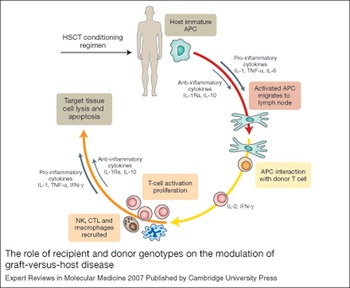
A three-phase model of aGVHD has been proposed (Refs Reference Antin and Ferrara7, Reference Krenger, Hill and Ferrara8) and the genotype of both the recipient and donor may influence the disease severity (Fig. 1). The conditioning regimen and its damaging effect upon host tissues constitute the first phase, where cells – particularly antigen-presenting cells (APCs), such as dendritic cells (DCs) – become activated, resulting in the production of numerous cytokines including IL-1, TNF-α, IL-6 and interferon γ (IFN-γ). These cytokines induce the expression of host HLA class II antigens, and adhesion molecules (e.g. the intercellular cell adhesion molecule ICAM-1) important for recognition by donor T cells on target tissues. In addition, conditioning regimens, particularly myeloablation, cause endothelial and epithelial damage in the intestinal mucosa and other epithelial targets. This allows the translocation of bacterial components such as lipopolysaccharides across the lumenal epithelium and subsequent binding to pattern recognition receptors (PRRs) such as the toll-like receptors (TLRs) and nucleotide-binding oligomerisation domain (NOD)-containing proteins (Refs Reference Eckmann9, Reference Harris, KuoLee and Chen10). This, in turn, elicits the additional release of IL-1 and TNF-α by host-derived macrophages (Ref. Reference Nestel11). The second phase centres on activation of the incoming donor T cells promoted by this inflammatory milieu, which requires the presence of host APCs (direct alloantigen presentation) (Ref. Reference Shlomchik12) and donor APCs (the ‘indirect pathway’, where processing and presentation of host antigen is by the donor APC) (Ref. Reference Matte13). A recent report showing that 100% APC (Langerhans cell) chimerism is achieved by day 100 in the skin of HSCT patients is consistent with the hypothesis of a transition from aGVHD to chronic GVHD (cGVHD) and related to indirect antigen presentation by donor APCs (Ref. Reference Collin14). Activated donor T cells in the third phase of GVHD in turn release IL-2 and IFN-γ, promoting cytotoxic-T-cell and natural-killer-cell responses. Monocytes are stimulated in response to this and produce IL-1 and TNF-α. The final effector phase results in damage to host tissues (skin, gut and liver) and is mediated directly by cytokines (e.g. IL-1, TNF-α and IFN-γ), or together with cytotoxic T cells or natural killer cells, via pathways dependent on perforin and granzyme (Refs Reference Maeda15, Reference Graubert16).
The role of recipient and donor genotypes on the modulation of graft-versus-host disease. The haematopoietic stem cell transplantation (HSCT) conditioning regimen activates host tissues, resulting in the production of inflammatory cytokines. This is influenced by the recipient genotype shown in red. Once the donor T cells are infused, they become activated in the inflammatory milieu and further cytokines are produced. Cytokine production by leukocytes can now be influenced by the donor genotype illustrated in yellow. The interaction of the donor and host genotype is illustrated in orange. If the risk genotypes (recipient/donor) are present (large grey arrow), the incidence or severity of graft-versus-host disease (GVHD) may be increased. If protective genotypes (recipient/donor) are present, the incidence or severity of GVHD may be reduced (small grey arrow). This figure is adapted, with permission, from Ref. Reference Cullup and Stark51 (© 2005 Taylor and Francis).

Although the pathogenesis of aGVHD is relatively well understood, our understanding of the mechanisms responsible for cGVHD is relatively poor. This is due, at least in part, to the paucity of animal models for this condition. cGVHD is defined as occurring after 100 days post-transplant, usually after aGVHD, but it can also occur de novo. cGVHD is a multiorgan disease, defined as limited and extensive, and several grading systems exist (Refs Reference Shulman17, Reference Akpek18, Reference Greinix19) to assess its severity and extent. The occurrence of cGVHD seems to be dependent on the continued presence of host-reactive donor T cells (Ref. Reference Claman20). However, it is unclear whether such lymphocytes are host-specific or simply host-reactive, as a result of donor and recipient sharing common epitopes.
Non-HLA polymorphisms in HSCT
Over the past decade, an increasing amount of data has demonstrated a role of non-HLA gene polymorphisms in HSCT outcome. For this review, we summarise results concerned with polymorphic genes for pro-inflammatory and anti-inflammatory cytokines and cytokine receptors. However, investigations involving genes of other immune response molecules have also been studied and are briefly reviewed. The vast majority of this research has been carried out on HLA-matched sibling transplants rather than on MUD HSCT cohorts. The data generated from non-HLA polymorphism research have been analysed with respect to transplant outcome, including aGVHD, cGVHD, transplant-related mortality, overall survival, relapse and infection (for recent review, see Ref. Reference Mullighan and Bardy21).
If polymorphic genes are located within the major histocompatibility complex (MHC) on chromosome 6 (e.g. TNF and the heat-shock protein HSPA1), it is likely that these genes will be identical between HLA-identical siblings. However, in both the HLA-matched and MUD transplant setting, genotypes of other genes including those of cytokines not situated on chromosome 6, such as IL-1 and IL-6 genes, will differ between patient and donor. In these cases, both patient and donor genotypes are examined for associations with HSCT outcome (Ref. Reference Mullighan and Bardy21).
HLA-matched sibling studies: cytokine and cytokine-receptor gene polymorphisms
TNFA
TNF-α is a multifunctional pro-inflammatory cytokine produced mainly by monocytes and macrophages, which has the ability to upregulate adhesion and MHC molecule expression and can directly induce cell death (effector phase). It also possesses anti-tumour activity and plays a major role in the GVHD immune response (Ref. Reference Lichtman, Krenger, Ferrara, Ferrara, Deeg and Burakoff22). The gene encoding TNF-α (TNFA) is highly polymorphic and located within the class III region of the MHC complex on chromosome 6, close to the HLA region and lymphotoxin and HSP genes.
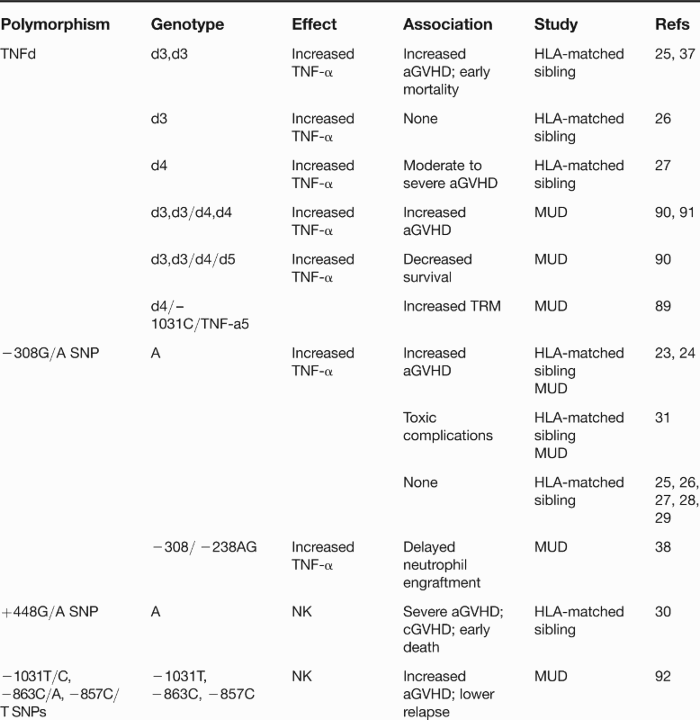
TNFA polymorphisms have been widely studied with respect to HSCT outcome. One of these polymorphisms is a SNP within the gene promoter region at position –308 (TNFA –308). This SNP has been linked with a diverse range of diseases and inconsistently associated with GVHD following HLA-matched sibling transplantation (Table 1). Several small studies have reported a positive association with aGVHD (Refs Reference Takahashi23, Reference Wang24); however, the majority of the larger studies found no such association (Refs Reference Middleton25, Reference Socié26, Reference Nordlander27, Reference Rocha28, Reference Lin29, Reference Mullighan30). TNFA –308, along with the TNFB +1069 polymorphism, has also been linked with toxic complications, with the highest incidence of such complications in TNFA and/or TNFB heterozygous recipients (Ref. Reference Bogunia-Kubik, Polak and Lange31).
TNFA polymorphisms and haematopoietic stem cell transplantation outcome
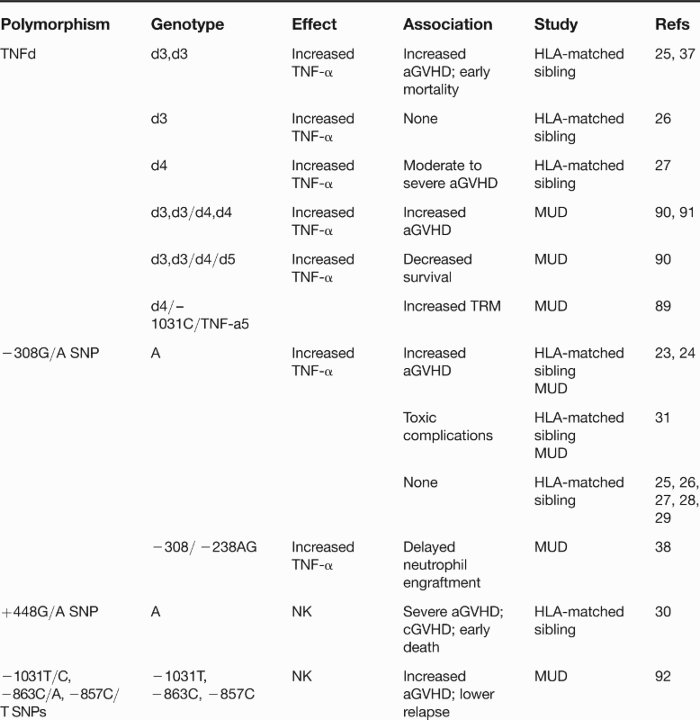
Abbreviations: aGVHD, acute graft-versus-host disease; cGVHD, chronic graft-versus-host disease; HLA, human leukocyte antigen; MUD, matched unrelated donor; NK, not known; SNP, single-nucleotide polymorphism; TNF, tumour necrosis factor; TRM, transplant-related mortality.
Another SNP within TNFA is located at position +488. The A allele of this SNP has been associated with GVHD in two independent HLA-matched sibling cohorts. Patients with this allele developed significantly higher grades of aGVHD than +488A-negative patients. The A allele has also been associated with cGVHD and early death (Ref. Reference Mullighan30).
A number of microsatellite polymorphisms occur within TNFA: TNFa, TNFb, TNFc, TNFd and TNFe (Refs Reference Nedospasov32, Reference Holzinger33, Reference Udalova34). The TNFd3 and TNFa2 alleles have been associated with higher TNF-α production, whereas the TNFa6 allele correlates with decreased production (Refs Reference Turner4, Reference Pociot35, Reference Turner36). In terms of HSCT, the TNFd3 homozygous genotype is associated with an increased incidence of aGVHD and early death (Refs Reference Middleton25, Reference Cavet37), whereas the TNFd4 allele correlates with the development of moderate to severe aGVHD (Ref. Reference Nordlander27).
An important factor potentially influencing any association between TNFA polymorphisms and GVHD is the location of the gene within the MHC class III region. TNFA polymorphisms are in linkage disequilibrium with HLA class I and class II genotypes. As certain HLA genotypes are known to influence GVHD development, association with TNFA genotype may be secondary to or interact with the HLA associations (Refs Reference Mullighan and Bardy21, Reference Shaw38). Table 1 lists TNFA genotype associations with transplant outcome.
TNFRSF1B
The actions of TNF-α are mediated by two receptors: TNF superfamily receptor (TNFRSF) 1 and receptor 2. TNFRSF2 is most abundant on endothelial and haematopoietic cells and, upon TNF-α binding, it induces apoptosis of CD8+ cells and stimulates haematopoietic cell proliferation (Ref. Reference Zheng39). The TNFRSF1B gene is located on chromosome 1 at position 1p36. A SNP (M/R) occurs within exon 6 of this gene at codon 196. The R allele of this SNP has been linked with the development of systemic lupus erythematosus (SLE), and the recipient RR genotype has been associated with an increased incidence of extensive cGVHD following HLA-matched sibling HSCT (Refs Reference Stark40, Reference Morita41). The R allele has also been found to associate with an exacerbated immune response and lower soluble TNFRSF2 levels compared with the M allele.
IL10
IL-10 is a potent inhibitor of T-cell proliferative responses and suppresses pro-inflammatory cytokine production. The gene of this cytokine maps to chromosome 1 (1q31-32) and is highly polymorphic, containing several microsatellites and five SNPs that have been resolved into conserved haplotypes representing high-level (GCC), intermediate-level (ATA) and low-level (ACC) producers of IL-10 (Ref. Reference Edwards-Smith42).
Several studies have examined the role of IL10 polymorphisms in HSCT; however, at present, the data are conflicting. Initial studies demonstrated that the ACC haplotype and the longer IL10 –1064 (CA)n microsatellite (>12) alleles associated with the development of severe (grade III–IV) aGVHD in HLA-matched sibling transplant recipients treated with cyclosporine alone or cyclosporine plus methotrexate (Refs Reference Middleton25, Reference Cavet37). The ATA/ATA of the recipient has been shown to decrease the risk of aGVHD in a large cohort of HLA-matched sibling transplants (Ref. Reference Lin29). A study of peripheral blood stem cell (PBMC) transplants also demonstrated that the presence of some IL10 haplotypes (ACC/ACC vs ATA/ATC vs ATA/ATA) increased the incidence of cGVHD, and individuals possessing the ATA haplotype required longer immunosuppression and were more susceptible to invasive pulmonary aspergillosis (Refs Reference Kim43, Reference Seo44). Several other studies have also reported associations between IL10 polymorphisms and the risk of GVHD (Refs Reference Mullighan and Bardy21, Reference Socié26, Reference Rocha28).
IFNG
IFN-γ is a pleiotropic cytokine with potent pro-inflammatory actions important in both the innate and adaptive immune response, and is essential for the induction and regulation of antimicrobial and anti-tumour immunity (Ref. Reference Yang45). Within the first intron of the IFNG gene on chromosome 12q14-15 there is a (CA)n microsatellite polymorphism. This polymorphism has two common alleles – allele 2 and allele 3 – both of which exhibit differences in IFN-γ production in vitro. Allele 2 is associated with increased levels of IFN-γ, whereas allele 3 has been linked with decreased production. IFNG microsatellite alleles have also been linked with a variety of immunological diseases and, in addition, in HLA-matched sibling transplantation an association between recipient 3/3 homozygosity and an increased risk of aGVHD has been reported (Ref. Reference Cavet46). Other studies have also shown an association between the possession of the 3/3 genotype, or lack of the 2/2 genotype, and acute or chronic GVHD (Refs Reference Bogunia-Kubik47, Reference Mlynarczewska48). The mechanism behind these associations is currently unknown, but may be explained if IFN-γ has a negative feedback regulatory role, as seen in some murine models. Weekly injections of IFN-γ in a subacute murine model of GVHD prevent the condition and increase survival. By contrast, mice receiving stem cells from IFN-γ-knockout donors have been shown to develop accelerated lethal GVHD (Ref. Reference Brok49). Presence of the IFNG 3/3 genotype has also been associated with increased risk of Epstein–Barr virus (EBV) reactions after sibling or MUD HSCT (Ref. Reference Bogunia-Kubik50).
IL1 family
There are ten members of the IL1 family. IL-1α and IL-1β (genes IL1A and IL1B) are agonists, and the IL-1 receptor antagonist (IL-1Ra; gene IL1RN) is a specific receptor antagonist, which is relatively unique in cytokine biology. Binding of IL-1 to its receptor leads to induction of various genes including other cytokines (i.e. IL-6) and chemokines, nitric oxide synthase and type 2 cyclooxygenase, all of which are involved in the inflammatory response and stimulation of lymphocytes. The IL1 family and its polymorphisms have therefore been associated with a wide range of inflammatory diseases.
Polymorphisms in IL1A, IL1B and IL1RN have been extensively investigated in HLA-matched sibling transplants, and their associations with HSCT outcome have recently been reviewed (Ref. Reference Cullup and Stark51). Allele 2 (donor-derived) of the IL1RN variable number tandem repeat (VNTR) downregulates IL-1 production and consequently correlates with less-severe aGVHD. The same allele in the recipient genotype is associated with aGVHD (Refs Reference Rocha28, Reference Cullup52). The presence of allele 2 (donor genotype) in either the VNTR or –889 polymorphisms of IL1A has also been associated with cGVHD (Ref. Reference Cullup53).
IL6
IL-6 is a pro-inflammatory cytokine that plays a central role in immune, inflammatory and acute phase responses. It is produced by numerous cell types, induces the development of cytotoxic T cells in the presence of IL-2 and synergises with IL-13 to promote haematopoietic stem cell differentiation and maturation. Consequently, IL-6 plays a major role in the biology of GVHD and HSCT (Ref. Reference Lichtman, Krenger, Ferrara, Ferrara, Deeg and Burakoff22).
The IL6 gene is located on chromosome 7p21 and, like many other cytokine genes, has been found to be polymorphic – containing both microsatellites and SNPs (Refs Reference Terry, Loukaci and Green54, Reference Ferrari55). A G/C SNP exists in the promoter region at position –174. In both normal and HSCT populations, the G allele of this SNP correlates with higher serum IL-6 levels (Ref. Reference Fishman56). Several studies have also found the G allele associated with both aGVHD and cGVHD following HLA-matched sibling transplantation (Refs Reference Mullighan and Bardy21, Reference Socié26, Reference Cavet46, Reference Karabon57).
Transforming growth factor β (TGFB)
TGF-β is a pleiotropic cytokine with unique and potent immunoregulatory properties. Two SNPs exist within its gene, at positions –800 (G/A) and –509 (C/T), both of which associate with variations in plasma TGF-β concentration. The TT genotype of the –509 polymorphism is associated with greater TGF-β production (Ref. Reference Banovic58). In the HSCT setting, no association between these polymorphisms and transplant outcome has been reported (Refs Reference Cavet46, Reference Grainger59). However, a highly significant association was demonstrated between the high expression phenotype of the –509 C/T SNP and severe GVHD, when the TGFB genotype of patients with no or mild GVHD was compared with those who developed more severe grades of the condition (Ref. Reference Leffell60).
Polymorphisms also exist at codons 10 and 25 of TGFB, both of which result in amino acid substitutions (Leu/Pro and Arg/Pro respectively). A significant link between TGFB codon 10 polymorphism (donor-derived) and the development of aGVHD has been reported following paediatric HSCT (Ref. Reference Hattori61). The high-producer G/G genotype is also linked with the development of severe aGVHD following both sibling and MUD transplantation (Ref. Reference Leffell60). Several other polymorphisms within TGFB and TGFBR genes exist and have been reported to influence HSCT outcome in sibling transplant cohorts (Refs Reference Grainger59, Reference Hattori61).
Chemokines and chemokine receptors
Inflammation and tissue damage can be inflicted directly by cytokines or by cytotoxic T lymphocytes (CTLs), macrophages and polymorphonuclear granulocytes. The infiltration of such cells to sites of inflammation is dependent upon chemotaxis. Therefore, the relationship between chemokines and their receptors is also likely to be influenced by polymorphisms present within their genes. A recent renal transplant study identified polymorphisms that were associated with acute rejection in CCR5 and CCR2 genes (Ref. Reference Yigit62). A CCR5 gene deletion mutation (Δ32) results in complete loss of chemokine receptor function and hence protection from aGVHD (Ref. Reference Bogunia-Kubik63). The loss of tissue-specific homing by T cells to the gut and liver – key GVHD target organs – has been illustrated in murine bone marrow transplant (BMT) studies on knockout mice (Refs Reference Welniak64, Reference Wysocki65, Reference Terwey66). Genetic associations of other chemokines and their receptors will be analysed in the HSCT field given recent clinical (Refs Reference Faaij67, Reference Jaksch, Remberger and Mattsson68) and experimental (Refs Reference Duffner69, Reference Varona70) data of chemokine and/or receptor expression in GVHD target organs. Patients can also be at risk of developing infections to which their immune system does not optimally respond. A CCR5 gene polymorphism (–2554 G/T in the promoter) has been linked to susceptibility to cytomegalovirus (CMV) infection after transplantation (Ref. Reference Loeffler71). The virus evading immune attack by T cells because homing to sites of inflammation is prevented.
Innate immunity
Other, non-cytokine genes associated with innate immunity have been assessed for their impact on HSCT outcome. There are a number of key molecules that allow mammals to sense pathogens, such as PRRs, which in turn activate the immune response via both the innate and adaptive pathways. These molecules obviously play a very important role in post-transplant complications, especially infectious episodes. Among these PRRs are the transmembrane TLRs, which have a potent ability to activate APCs, which subsequently provokes innate immunity (Refs Reference Xu, Liu and Komai-Koma72, Reference Kaisho and Akira73, Reference Kaisho and Akira74). APCs also have ligands for different TLRs that are differentially expressed on the cell surface. TLR4 is a major receptor for lipopolysaccharides and has been implicated in the pathogenesis of GVHD. Polymorphisms in the TLR4 gene have been associated with hyporesponsiveness to lipopolysaccharides. This leads to a reduced risk of aGVHD, but consequently results in an increased risk of Gram-negative bacteraemia. However, there was no hyporesponsiveness in those patients given prophylaxis for infection or GVHD (Ref. Reference Lorenz75). Polymorphisms in the TLR1 and TLR6 genes have been investigated in patients with invasive aspergillosis following HSCT, with patient genotype being associated with an increased risk of infection (Ref. Reference Kesh76). These results suggest that the impact of patient genotype is influenced by the period of immunosuppression post transplant before donor immune reconstitution occurs.
Intracellular PRRs, such as NOD-like receptors, which are associated with inflammatory bowel disease, are important molecules for study in HSCT because the gastrointestinal tract is damaged by conditioning regimens and is a target organ for GVHD. There are three SNPs in NOD2/CARD15 (nucleotide-binding oligomerisation domains containing 2/caspase recruitment domain family number 15) – SNP8, SNP12 and SNP13 – which are involved in defective NF-κB responses. Possession of two or more NOD2/CARD15 variants is associated with more severe GVHD and increased transplantation-related mortality (TRM) in both HLA-matched siblings and matched unrelated transplants (Ref. Reference Holler77). In a second cohort of HLA-matched siblings (Ref. Reference Holler78), the genetic risk could be modulated through different types of gastrointestinal decontamination before transplantation. In T-cell-depleted transplants, possession of NOD2/CARD15 SNPs is associated with lower disease-free survival rates (Ref. Reference Granell79). These results illustrate that the altered immune response associated with NOD gene variants after HSCT is dependent on the type of immunomodulation (e.g. bacterial decontamination) and on the type of immunosuppression (e.g. T-cell depletion) administered.
The incidence of severe infections post transplant has been investigated by several groups. Severe bacterial infectious episodes are associated with myeloperoxidase gene (MPO) SNPs, with the AG or AA donor genotype rather than the wild-type CC genotype being associated with the most severe infections. Mannose-binding lectin (MBL) binds a range of pathogens and opsonises them for phagocytosis. Human MBL is encoded by MBL2 on chromosome 10. SNPs in the promoter region affect serum MBL levels, and low MBL levels give an elevated risk of infection in immunocompromised individuals. In an Australian HSCT cohort, MBL2 mutations in the recipient and/or donor genotype were associated with a risk of major infection following allogeneic HSCT (Ref. Reference Mullighan80). However, this association was not observed in an independent study (Ref. Reference Rocha28).
FcγRIIa is expressed in Langerhan cells, dendritic cells, endothelial cells and leukaemic cells, and is genetically polymorphic. The FcγRIIa-R 131 genotype in the recipient has been associated with an increased incidence of severe infection, and time to neutrophil recovery is delayed when the donor genotype is FcRIIIb HNA-1a/HNA-1b (Ref. Reference Rocha28). In a more recent study (Ref. Reference van der Straaten81), 73 acute monocytic leukaemia (AML) patients were analysed for FcγRIIa polymorphisms as candidates for aGVHD. A mismatch between donor and patient FcγRIIa-R/R 131, FcγRIIa-H/H 131 and FcγRIIa-R/H 131 genotypes were associated with an increased probability of GVHD. The presence of FcγRIIa allotypes on DCs, Langerhan cells and endothelial cells suggests that they may be candidate minor histocompatibility antigens (mHags) through their recognition by donor T cells. This type of mismatching and potential relevance in GVHD of candidate mHags was also shown for the CD31 adhesion molecule (PECAM-1) (Ref. Reference Cavanagh82), where the Val/Asn/Gly haplotype in the donor significantly associated with incidence of GVHD and donor heterozygosity at codon 125 or 563 associated with worse overall survival. Several other HLA-matched sibling studies have examined associations between PECAM1 polymorphisms and HSCT outcome with inconsistent results (Refs Reference Cavanagh82, Reference Behar83, Reference Nichols84, Reference Grumet85).
Other polymorphisms associated with HSCT outcome
Steroid hormone receptors are implicated in the development of the immune system; consequently, these genes could have an impact on the reconstitution of the incoming donor graft. Steroid hormone receptor polymorphisms, such as the RFLPs within intron 8 of the vitamin D receptor (VDR) and intron 1 of the estrogen receptor (ESR1) genes, were found to correlate with aGVHD and lower overall survival (Refs Reference Middleton86, Reference Middleton87).
Other polymorphisms studied include the FAS –670 and HSPA1L 2763 SNPs. The FAS –670 G allele has been correlated with infection and cGVHD following HSCT (Ref. Reference Mullighan30), whereas the HSPA1L SNP has been linked to the development of toxic complications in two independent transplant cohorts (Ref. Reference Bogunia-Kubik and Lange88).
MUD studies: cytokine and cytokine-receptor gene polymorphisms
TNFA
In MUD HSCT, the TNFd microsatellite polymorphism has been associated with several transplant outcomes, including GVHD, TRM and survival (Refs Reference Keen89, Reference Bettens90). TNF-α serum levels and TNFd genotypes correlate with aGVHD, with patients homozygous for the TNFd3 or TNFd4 alleles having significantly higher TNF-α levels during conditioning and more frequently developing aGVHD (Ref. Reference Remberger91). More recently, TNFd has been associated with TRM rather than GVHD (Ref. Reference Keen89). The presence of the d4 allele in conjunction with the TNFA 1031C allele in either recipients or donors significantly increases the incidence of TRM. A further allele associated with the TNFd4/1031C haplotype, TNFa5 has been linked with TRM. The TNFd microsatellite has also been associated with HSCT survival. A gradual decrease in survival rates has been observed for MUD transplant recipients possessing TNFd3/d3, d4 and d5 (Ref. Reference Bettens90).
TNFA –308 is another TNF-α polymorphism frequently examined in HSCT. In the MUD setting, the TNFA*2 allele (donor-derived) of this SNP has been associated with severe aGVHD (III–IV) and strong linkage disequilibrium between the TNFA –308 and –238 SNPs and extended HLA haplotypes have been demonstrated. The TNFA –308/238 AG haplotype is also associated with significantly delayed neutrophil engraftment (Refs Reference Takahashi23, Reference Shaw38).
TNFA –863 (C/A) and –857(C/T) polymorphisms in donors and/or recipients correlate with a higher incidence of GVHD and a lower rate of relapse. By restricting the analysis to HLA A-, HLA B- and DRB1-matched pairs, the effect of HLA linkage disequilibrium with TNFA was revealed. GVHD outcome was still linked with recipient genotype; however, the association with relapse was no longer observed (Ref. Reference Ishikawa92). Table 1 summarises TNFA associations in MUD transplant cohorts.
TNFRSF1B
Recipients of TNFRSF1B –196R-positive unrelated donors have a higher incidence of severe GVHD and a lower rate of relapse than patients receiving transplants from 196M homozygous donors (Ref. Reference Ishikawa92).
IL10
An association between allele length at the IL10 –1064 (CA)n microsatellite and survival has been reported: longer recipient IL10 alleles (>12) correlated with decreased survival (Ref. Reference Bettens90). In addition, in a mixed sibling and unrelated donor transplant cohort, the donors of cGVHD patients frequently possessed a greater number of CA repeats (allele 13 or above) (Ref. Reference Takahashi23).
There appears to be a significant link between TRM and the IL10 SNP GCC haplotype. Presence of the donor R2-GCC haplotype is associated with a higher incidence of TRM, whereas possession of the R3-GCC haplotype (donor-derived) decreases the risk of TRM (Ref. Reference Keen89). These findings conflict with current HLA-matched sibling studies, as the majority of these have found associations with GVHD rather than TRM (Refs Reference Lin29, Reference Cavet37, Reference Ishikawa92).
IFNG
The genotype of the IFNG intron 1 (CA)n microsatellite constitutes a risk for acute and chronic GVHD following HLA-matched sibling HSCT (Refs Reference Cavet46, Reference Mlynarczewska48). These associations have not yet been observed in the MUD setting. However, transplant recipients possessing the 3/3 genotype of this polymorphism have been shown to present with a significantly higher EBV copy number than those with other genotypes in a mixed cohort of sibling and MUD transplants (Ref. Reference Bogunia-Kubik50).
IL1 family
IL1 polymorphism research in the MUD setting is limited to one study performed on a small paediatric cohort. The presence of the IL1A –889 T allele in either the recipient or donor is associated with significantly improved survival and decreased TRM. No association with aGVHD was demonstrated; however, trends were observed between the incidence of cGVHD and the IL1A –889 A allele and allele 2 of the IL1RN VNTR (Ref. Reference MacMillan93).
IL2
IL-2 is a pro-inflammatory cytokine that plays a key role in immune response production, and has been implicated in the initiation and maintenance of GVHD (Ref. Reference Ferrara and Deeg94). A T/G SNP exists within the IL2 gene promoter region at position –330. The G allele of the polymorphism associates with early and sustained elevation of IL-2 production (high-producer genotype) and an increased risk for aGVHD after MUD HSCT (Ref. Reference MacMillan95).
IL7R
IL-7 is a 25 kDa glycoprotein that plays an important role in the regulation of lymphopoiesis via IL-7 receptors (IL-7R). These receptors comprise a γc and an α chain. Sequencing of the α chain has revealed the existence of four SNPs (+510C/T, +1237A/G, +2087T/C and +3110A/G), all of which result in amino acid substitutions. The +1237 SNP within donors associates with survival and TRM following MUD transplantation, with the highest mortality being linked with the GG genotype. Considering the functions of IL-7, these findings seem to suggest a possible role for this SNP in T-cell and immune reconstitution following MUD HSCT (Ref. Reference Shamim96).
IL13
IL-13 is a Th2-type cytokine that suppresses the cytotoxic actions of macrophages, inhibits the production of pro-inflammatory cytokines and plays a major role in various inflammatory diseases (Ref. Reference Joshi97). In terms of HSCT, IL-13 research is currently extremely limited. However, its production has recently been associated with GVHD following MUD transplantation. Recipients who developed severe grades of aGVHD (III) had extremely high pre-transplant IL-13 production by donor T cells, whereas those developing little or no aGVHD had donors that produced no IL-13 pre HSCT (Ref. Reference Jordan98).
Several SNPs have been identified within IL13 and linked with raised IgE levels and a number of immunological or inflammatory diseases (Refs Reference Joshi97, Reference Ohashi99, Reference Steck100, Reference Yang, Qiao and Dong101). To date, no studies associating these polymorphisms with HSCT outcome in any transplant setting have been published.
IL18
IL-18 is a pro-inflammatory cytokine that induces Th1-type cell differentiation and cytotoxic-T-cell function. The gene has three polymorphisms at positions –137 (G/C), –607 (C/A) and –656 (G/T) within its promoter region and three main haplotypes exist: GCG, CAT and GAT. The GCG haplotype in recipients is associated with a decreased risk of TRM at day 100 and 1 year post-transplant, and with improved overall survival. IL18 haplotypes had no effect on aGVHD in this cohort (Ref. Reference Cardoso102). However, associations between IL-18 and aGVHD have been demonstrated by well-established murine BMT models. Neutralisation of IL-18 by antibodies increases aGVHD-related mortality, whereas administration of the cytokine significantly improves survival and reduces the pathological features of aGVHD (Ref. Reference Reddy103).
Innate immunity and other non-HLA polymorphisms
Polymorphism studies involving other non-cytokine genes, particularly those associated with innate immune responses, have also been performed. In terms of MUD transplantation, only the NOD-like receptor polymorphisms have an impact on HSCT outcome. Possession of two or more NOD2/CARD15 variants (linked with a defective antibacterial NF-κB response) increases the risk of severe aGVHD (grade III–IV) and TRM (Refs Reference Holler77, Reference Holler78).
Pharmacogenomics in HSCT
Studying genetic variability as a determinant of an individual's drug response has the potential to improve HSCT outcome. Consequently, several polymorphisms associated with drug metabolism have been studied in relation to HSCT (Ref. Reference Mullighan and Bardy21). To date, polymorphisms of genes involved in the metabolism of drugs used in conditioning regimens and prophylaxis strategies have been associated with GVHD, survival, toxicity and platelet recovery following HSCT (Refs Reference Ulrich104, Reference Rocha105). A SNP (C677T) within the gene encoding methylenetetrahydrofolate reductase (MTHFR), an enzyme involved in methotrexate metabolism, has recently been associated with HSCT outcome. The 677 TT genotype (with lower enzyme activity) was linked with increased mucositis and delayed platelet engraftment in HSCT recipients receiving methotrexate (Ref. Reference Ulrich104). These findings have been confirmed (Ref. Reference Robien106); however, one study (Ref. Reference Kalayoglu-Besisik107) found no association with HSCT outcome. This SNP has also been investigated in a mixed cohort of sibling and unrelated transplants. An association between the CT and TT genotypes of HLA-matched siblings and a decreased incidence of GVHD was demonstrated (Ref. Reference Murphy108). By contrast, a link between the CT and TT genotypes and severe GVHD has also been observed (Ref. Reference Rocha105). More recently, associations between the C677T SNP and levels of liver enzymes, platelet recovery and TRM in HLA-matched sibling HSCT has been reported (Ref. Reference Kim109).
SNPs associated with the P450 (CYP) cytochrome family and the multidrug-resistance 1 gene (ABCB1) are of interest, not only in HSCT but also in solid-organ transplantation. Recently, a P450 cytochrome SNP (CYP3A5) and four ABCB1 SNPs [T–129C, C1236T, G2677(T,A) and C3435T] were investigated for any association with interindividual cyclosporine variation in renal transplant recipients. No association was observed with the CYP SNP; however, the recipient wild-type genotype in ABCB1 C1236T was associated with lower values of dose-adjusted peak drug concentration and dose-adjusted area under the concentration-time curve, compared with carriers of the mutant allele (Ref. Reference Anglicheau110). In terms of HSCT, a P450 polymorphism (CYP2B6) has been investigated for any association with transplant outcome. Recipient alleles of the CYP2B6 polymorphism were not only linked with lower P450 enzyme expression and higher accumulation of cytotoxic metabolites, but also with mucositis, haemorrhagic cystitis and veno-occlusive disease of the liver (Ref. Reference Rocha105). At present, no studies associating the ABCB1 polymorphisms with HSCT outcome have been published.
Clinical implications and applications
SNPs are relatively abundant in the human genome, but only a proportion will give rise to functional alterations of the encoded proteins leading to biological variation and activity of cytokines, receptors, pharmacogenes or other molecules related to disease exacerbation.
Interaction between SNPs and the environmental factors that may play a role in HSCT outcome, such as exposure to high-dose chemotherapy and/or immunosuppressive drugs, may influence how certain cytokine gene SNPs interact or function. This has been described as the concept of environmentally determined genetic expression (EDGE). This type of approach may be particularly valuable in describing genetic association studies of complications after chemotherapy of HSCT, including not only GVHD, but also infection, mucositis and veno-occlusive disease (Ref. Reference Kallianpur111).
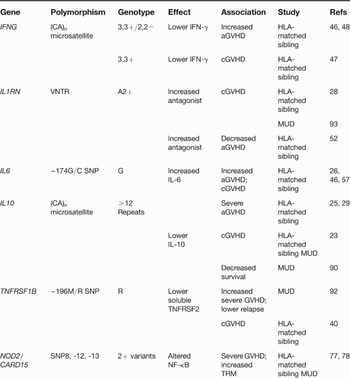
In HSCT, obvious problems of analysis arise owing to the heterogeneity of the patient cohort. This is reflected in the fact that although a number of polymorphisms are consistently associated with HSCT outcome (some of which are summarised in Table 2), the same SNP can be associated with aGVHD rather than cGVHD and/or survival or relapse depending on the transplant cohort – that is, HLA-matched sibling, MUD or mixed. For example, some HSCT transplant centres use peripheral blood stem cells rather than bone marrow, which may give rise to increased cGVHD in older patients. Other centres are increasingly using reduced-intensity conditioning regimes, giving rise to a smaller ‘cytokine storm’ and a later onset of acute or chronic GVHD. Some of the SNPs/alleles are relatively rare, which means that larger and more homogeneous data sets are required for a multifactorial analysis and prognostic index model generation. Any HSCT genotypic analysis needs to take into account the ‘environment’ – clinical risk factors, such as age, female-to-male transplants, CMV status of patient and donor, stage of disease at transplant and time from diagnosis to transplant – as well as the conditioning and therapeutic regimen, all of which play a major role. Several of these factors have been included in clinical risk models for determining the outcome of HSCT (Refs Reference Socié26, Reference Gratwohl112, Reference Gratwohl113, Reference Weisdorf114, Reference Niederwieser115). In addition, the immune status of the recipient and donor, thymic function (Ref. Reference Clave116) and immune reconstitution are critical factors in determining successful HSCT (Ref. Reference Talvensaari117).
Polymorphisms consistently associated with haematopoietic stem cell transplantation outcome

Abbreviations: aGVHD, acute graft-versus-host disease; cGVHD, chronic graft-versus-host disease; HLA, human leukocyte antigen; IFNG, interferon γ; IL, interleukin; MUD, matched unrelated donor; NOD, nucleotide-binding oligomerisation domain; NF, nuclear factor; SNP, single nucleotide polymorphism; TNFRSF, tumour necrosis factor superfamily receptor; TRM, transplant-related mortality; VNTR, variable number tandem repeat.
Other problems arising in studying non-HLA genetics in diverse HSCT populations are the potential differences in allele frequencies between ethnic groups across, for example, Europe, Japan and the USA. One recent study comparing the incidence of aGVHD in HLA-identical sibling transplants within the Japanese, white and African Americans, Scandinavians and the Irish (Ref. Reference Oh118) showed significant differences between the American groups and the Irish compared with the Japanese or Scandinavians. Similar differences were described for TRM, and indicate that genetic differences other than HLA may affect transplant outcome. Several studies on allele frequencies in transplant populations worldwide and comparative studies are currently being undertaken (Refs Reference Kubistova119, Reference Laguila Visentainer120). Consequently, allele frequency data needs to be taken into account before analysis.
More complex statistical methods and bioinformatic tools still need to be developed and confirmed in second or third confirmatory prospective patient–donor cohorts before results will be sufficiently mature to be used in the clinic. One such algorithm for predicting mortality of patients with GVHD using only clinical parameters, such as bilirubin levels, treatment with steroids and performance score, has been developed (Ref. Reference Leisenring121). Clinical models for overall survival for chronic myelogenous leukaemia (CML) also include clinical factors, which make up a risk score that can be applied to the clinic (Ref. Reference Gratwohl113). These types of clinical risk assessments may also benefit from the addition of non-HLA genotypes. An individualised scoring system for patients could then be used to assess therapies and clinical protocols. However, there are several problems in the reporting of genetic association with complex diseases (Ref. Reference Ollier122). Selection bias needs to be avoided and negative studies need to demonstrate that they were carried out on large enough cohorts with sufficient statistical power to detect any association. False-positive results owing to chance associations need also to be considered in the analysis. Negative associations have, for example, included the TNFd microsatellite, which has shown variable association with GVHD and outcome, with many studies demonstrating no association at all (summarised in Table 1) (Refs Reference Mullighan and Bardy21, Reference Middleton25, Reference Socié26, Reference Nordlander27, Reference Rocha28, Reference Lin29, Reference Keen89). Other negative associations include those for IL1B –511, IL1RN –9261, IL6 –174, IL10 –592A/C and –1082 A/G, TNFA –308, IL4R –1902 and –3223, IL1RN VNTR86 intron 2 and IL2, as well as negative associations with cord-blood transplants (Refs Reference Lin29, Reference Bettens90). Complications arising post transplantation are related to the HSCT procedure itself; the functional genomic response of the patient or donor engrafting cells arise because of the allogeneic or infectious onslaught. However, genetic association with a complex disease requires identification of functional gene polymorphisms, which are potentially inherent in the development of the disorder. The mechanisms of gene association studies compared with methods used for analysis of the complications arising after HSCT are therefore very different. In the latter case, the heterogeneity of the HSCT cohort (type of transplant, diagnosis, and T-cell depletion strategies) needs to be taken into account to stratify and/or further analyse the data. This type of approach to data analysis is not necessarily applicable for patients with a complex disease, where subgroup analysis should be avoided (Ref. Reference Colhoun, McKeigue and Davey Smith123).
Despite these potential difficulties, research into non-HLA genetics and transplant outcome will give insight into the biology of HSCT, including the pathophysiology of GVHD and GVL. Genotyping cohorts of patients and donor pairs with, for example, NOD2/CARD15 polymorphisms may aid in donor selection and/or altered HSCT protocols, whereas analysis of particular pharmacogenes may lead to altered prophylaxis regimens.
Research in progress
The aims of current research into the role of non-HLA genetics in predicting outcome are to develop an improved insight into the basic science of HSCT and to develop a risk or prognostic index for use in the clinical setting based on individual risk genotypes. These goals rely, to a large extent, on the standardised definition of clinical outcomes, especially when large and expensive studies are planned. A lack of such common language can profoundly affect the interpretation of biological studies, especially when observing outcomes such as GVHD or infection. A good example of a consensus on these topics is the recent US National Institutes of Health consensus on cGVHD (Ref. Reference Filipovich124). Research initiatives require linking and coordination of HSCT research groupings with clinical information and patient and donor DNA. This approach is being followed by several groups across Europe (Ref. Reference Dickinson125), which aim to improve the science of non-HLA genetics for translation to the clinic in the future.
Acknowledgements and funding
The authors thank the peer reviewers for helpful suggestions and discussion. Funding for current research on non-HLA gene polymorphisms and support to J.H., H.C. (Australia) is via European Commission grants: TRANSNET (MCRTN-CT-2004-512253) TRANSMODULATE (MCOIF-CT-2004-509939) and STEMDIAGNOSTICS (LSHB-CT-2007-037703), the Leukaemia Research Fund, and the Tyneside Leukaemia Research Association.