Implications
In this paper, the complete sequence of the Tibetan Mastiff mitochondrial genome was determined. The phylogenetic relationships among other species of Canidae, including the Tibetan Mastiff, were analyzed.
These data will play an important role in the protection of the Tibetan Mastiff and will be useful for studying the speciation of large dogs worldwide and the phylogenetic relationships among Canidae.
Introduction
The Tibetan Mastiff, which mainly inhabits high and cold zones at altitudes of 3000 to 5000 m, belongs to the second-protection group of animals in China and is the only Canine ‘living fossil’ of the snowfield, that is, it has remained unchanged by time and environment (Ma, Reference Ma2008; Ren et al., Reference Ren, Yang, Ye, Xu, Zhao and Wu2009). However, large profits can be made from the sale of Tibetan Mastiffs, and since the 1980s, the outflow of Tibetan Mastiffs has been a serious problem. This has resulted in a year-on-year decline in the wild population. At present, there are about 300 000 Tibetan Mastiffs; however, no more than 100 of them are high quality, pure breed specimens. Of these, less than 20 are in America and 10 are in Taiwan, China. Thus, the purebred Tibetan Mastiff is at the edge of extinction (Wang et al., Reference Wang, Shi, Yu, Feng and Song2003).
The mitochondrial genome is widely used to study species origin, molecular evolution and for phylogenetic analysis. Since Anderson et al. (Reference Anderson, Bankier, Barrell, de Bruijn, Coulson, Drouin, Eperon, Nierlich, Roe, Sanger, Schreier, Smith, Staden and Young1981) first sequenced the human mitochondrial genome, about 700 vertebrate mitochondrial genomes have been sequenced (Li et al., Reference Li, Wu, Ji, Yan and Amato2007). The first Canine mitochondrial genome (from Sapsaree, a Korean native dog) was sequenced in 1998 (Kim et al., Reference Kim, Lee, Jeong and Ha1998), and subsequently the mitochondrial genomes of 25 domestic breed dogs, the gray wolf (Canis lupus; Björnerfeldt et al., Reference Björnerfeldt, Webster and Vilà2006), the coyote (Canis latrans; Björnerfeldt et al., Reference Björnerfeldt, Webster and Vilà2006) and the red fox (Vulpes vulpes; Arnason et al., Reference Arnason, Gullberg, Janke, Kullberg, Lehman, Petrov and Vainola2006) have been sequenced. The partial mitochondrial genome of the Tibetan Mastiff has been reported (Li et al., Reference Li, Liu, Li, Zhao, Dong, Pan, Sun, Li, Xu and Xie2008; Webb and Allard, Reference Webb and Allard2009); however, the genome characteristics and differences from other domestic dogs were not made clear. Therefore, we sequenced the complete mitochondrial genome of the Tibetan Mastiff and analyzed its characteristics in comparison to those of other Canidae. The data will provide a theoretical basis for the protection and utilization of the Tibetan Mastiff and contribute to the ongoing studies on the origins and domestication of domestic dogs.
Material and methods
DNA, PCR amplification and sequencing
Five milliliter blood samples were obtained from healthy adult Tibetan Mastiffs in the Police Dog Base of Xigang, Nanjing. Genomic DNA was extracted by the standard phenol-chloroform method. The quality of the DNA was examined by UV-spectrophotometry after electrophoresis in 0.5% agarose (Promega, Madison, WI, USA).
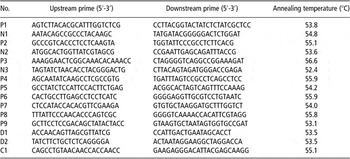
Using the mitochondrial genome sequence of the domestic dog (GenBank accession no. U96639), 15 primers were designed by Primer Premier 5.0 software (Premier Biosoft International, Palo Alto, CA, USA). The amplified fragments generated by these primer pairs ranged from 900 to 2010 bp, and the amplified fragments produced by abutting primers overlapped by at least 100 bp (Table 1).
Primer sequences used in this study

Each 25-μl reaction mixture contained 30 ng of genomic DNA, 1.5 mmol/l MgCl2, 1 × reaction buffer, 0.2 mmol/l of dNTP, 0.01% glutin, 1.0 U of Taq DNA polymerase and 0.2 μmol/l of each primer. Amplification conditions consisted of an initial denaturation at 94°C for 5 min; 35 cycles of denaturation at 94°C for 30 s, annealing for 45 s and extension at 72°C for 1 min; and a final extension of 72°C for 10 min. The PCR products were visualized on a 1.5% agarose gel. The purified PCR products were obtained using a Geneclean Kit (Qbiogene, Carlsbad, CA, USA) and sequenced by Shanghai Invitrogen Biotech Co. (Shanghai, China).
Phylogenetic analysis
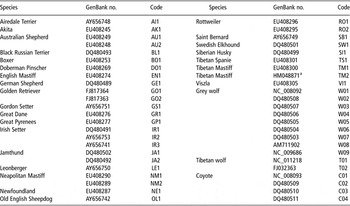
The known mitochondrial genomes of 48 representative species of Canidae (33 domestic dogs, 9 gray wolves, 2 Tibetan wolves and 4 coyotes) were selected for use in phylogenetic analysis with the Tibetan Mastiff. We obtained mitochondrial genome sequences of the above-mentioned species by searching the GenBank database (http://www.ncbi.nlm.nih.gov) and by tracking its literature (Table 2).
Experimental samples used in this study

aSequence produced during this work.
The analyses of the sequence alignment, arrangement and sequence divergence were carried out by the EditSeq and MegAlign programs of the DNAStar 5.02 software (DNAStar Inc., Madison, WI, USA). The base composition and the Kimura 2-parameter genetic distance (s.d.) among the different species were determined by the MEGA4.1 software (Tamura et al., Reference Tamura, Dudley, Nei and Kumar2007). Phylogenetic trees were constructed by the neighbor-joining (NJ) and maximum-parsimony (MP) methods in the MEGA4.1 software (Tamura et al., Reference Tamura, Dudley, Nei and Kumar2007). Support for individual branches was assessed by bootstrap percentage (BP) values computed after 1000 replicates of the closest stepwise addition option.
Results
Characteristics of the Tibetan Mastiff mitochondrial genome
The length of the Tibetan Mastiff mitochondrial genome was determined to be 16 710 bp (GenBank no. HM048871) and showed an average of 99.48% homology with the sequences of the designed primers (from GenBank no. U96639). There are three base insertions: a one base insert at nt2680 and a two base insert at nt9913, which result in a one base increase in the length of the tRNA-Leu gene and a change in the start codon in the ND4L gene from ATG to GTG, as is shown in other canids (Arnason et al., Reference Arnason, Gullberg, Janke, Kullberg, Lehman, Petrov and Vainola2006; Björnerfeldt et al., Reference Björnerfeldt, Webster and Vilà2006). In addition, there is a 20 bp deletion at nt16108. The mitochondrial genome sequence (excluding the D-loop region) of the Tibetan Mastiff presented here showed 99.81% homology with the other Tibetan Mastiff mtDNA sequence (excluding the D-loop region, GenBank no. EU408300, Webb and Allard, Reference Webb and Allard2009). There is a one-base insertion at nt 775 bp, which results in a one-base increase in the ND1 gene.
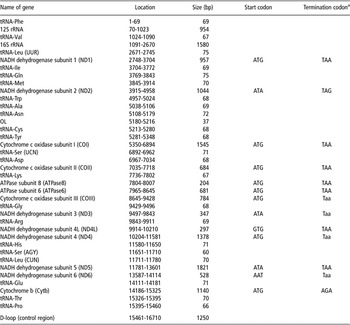
The base composition of the Tibetan Mastiff mtDNA is 28.7% T, 25.6% C, 31.6% A and 14.1% G. The AT content (60.3%) is significantly higher than the GC content (39.7%), which is consistent with the base composition of the mitochondrial genomes of other Canids (Kim et al., Reference Kim, Lee, Jeong and Ha1998; Arnason et al., Reference Arnason, Gullberg, Janke, Kullberg, Lehman, Petrov and Vainola2006; Björnerfeldt et al., Reference Björnerfeldt, Webster and Vilà2006). Table 3 details the genes, their location and the length of the Tibetan Mastiff mitochondrial genome. The genome contains 13 protein-coding genes, 22 tRNA genes, 2 rRNA genes (12S rRNA and 16S rRNA) and 1 non-coding region. The components and their arrangements are the same as for other Canids (Arnason et al., Reference Arnason, Gullberg, Janke, Kullberg, Lehman, Petrov and Vainola2006) and other mammals (Xu et al., Reference Xu, Gullberg and Arnason1996; Lin et al., Reference Lin, Sun, Liu, Yang, Chang, Cheng, Mao and Huang1999; Gu et al., Reference Gu, Zhao, Li and Wu2007; Hiendleder et al., Reference Hiendleder, Lewalski and Janke2008).
Characteristics of the Tibetan Mastiff mitochondrial genome

aIncomplete stop signals are denoted by lowercase letters.
Protein-coding genes
The total length of the Tibetan Mastiff mtDNA that encodes the 13 protein-coding genes is 11 410 bp. The longest gene is NADH5 (1821 bp) and the shortest gene is ATPase8 (204 bp; Table 3), as is seen in other Canids. The genome uses four initiation codons: eight genes use ATG; NADH2, NADH3 and NADH5 use ATA; NADH6 uses AAT; and NADH4 uses GTG. The stop codons of 11 genes are complete termination codons (TAA, TAG or AGA) and four genes (COIII, NADH3, NADH4 and NADH6) use incomplete termination codons, as is seen in other Canids (Kim et al., Reference Kim, Lee, Jeong and Ha1998; Arnason et al., Reference Arnason, Gullberg, Janke, Kullberg, Lehman, Petrov and Vainola2006; Björnerfeldt et al., Reference Björnerfeldt, Webster and Vilà2006).
As in some other mammals, there are four overlapping reading frames in the Tibetan Mastiff, ATPase8/ATPase6, ATPase6/CoIII, NADH4/NADH4L and NADH5/NADH6, which overlap by 43, 1, 7 and 15 bp, respectively (Table 3).
Among Canids, the length, initiation codon and stop codon are the same for the CytB, NADH5, ATPase8, ATPase6, COI, COII and COIII genes. Some genes have 1 to 2 bp changes in length. For example, the NDH4L genes of the Old English Sheepdog, Leonberg and Saint Bernard are 2 bp longer at the 5′ end than the NDH4L gene in other species. In the Tibetan Spaniel and Canis lupus laniger, there are 1- and 2-bp deletions at the 5′ end of the NADH1 and NADH2 genes, respectively.
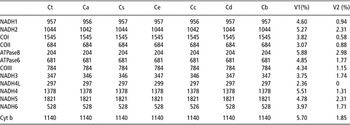
The alignment of the 13 protein-coding genes revealed 530 variable sites (4.64% variable sites) among domestic dogs, showing 95.46% homology. There was 98.43% homology and the number of variable sites was 57 (1.57% polymorphic loci) in an Amino acid sequence of 13 protein-coding genes in domestic dogs, of which 24.56% (14 mutation sites) amino acid variation happened in ND5. Of the 13 protein-coding genes, the variation ratio of ATPase 8, both in nucleotide sequence and in amino acid sequence, was the biggest (Table 4). Although there were some changes in the length of the ND4L gene, there was no variation in its amino acid sequence in domestic dogs; nevertheless, amino acid sequences such as ATPase8, ATPase6 and so on changed despite no change in their lengths.
Lengths of protein-coding genes in the Tibetan Mastiff and other domestic dogs mitochondrial genome

Ct indicates the following species: Swedish Elkhound, German sheep and Black Russian; Cd indicates gray wolves; Cb indicates coyotes; Cc indicates Tibetan wolf; Ca indicates the following species: Akita, Viszla, Rottweiler, Newfound, Nepolitan mastiff, GreatDane, Great Pyreness, Golden Retrieve, English Mastiff, Dobersp, Canis lupus lupus, AustralianShepherd and Boxer; Ce indicates the following species: Leonberg, English old sheep and SaintBernaid; Cs indicates the following species: Jamthund, Siberian Husky, Irish Setter, Gordon Setter and Airedale; P and C indicate harber seal and cat, respectively; V1,V2 indicate the percentage of variable sites in nucleotide and amino acid sequence in 13 protein-coding genes among domestic dogs, respectively.
The non-coding region (D-loop region)
The complete length of the D-loop region in the Tibetan Mastiff is 1250 bp. It is located between the tRNA-Pro and tRNA-Phe genes (Table 3). Compared with the sequence of the designed primers (from GenBank no. U96639), there are 20 bases of deletions/insertions; however, none of them are in the repeat region.
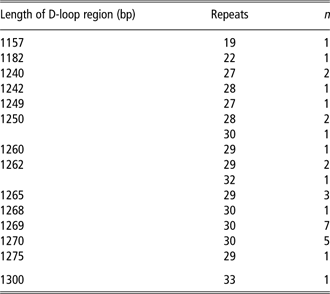
There are large differences in the lengths of the D-loop regions among the mitochondrial genomes of Canids, ranging from 1157 to 1353 bp (Gundry et al., Reference Gundry, Allard, Moretti, Honeycutt, Wilson, Monson and Foran2007). The lengths of the control regions are different because of the varying numbers of repetitive motifs. In Canids, the repetitive motif is 5′-GTACACGT(G/A)C-3′ and is located between CSBI (conserved sequenced block I) and CSBII. In this study, the repeat number ranged from 19 (Gordon setter) to 33 (Old English Shepherd).
From Table 5, we observed a correlation between the increased number of repeats and the increase in the length of the D-loop. For example, only 19 repeat units exist in the shortest D-loop (1157 bp), whereas there are 33 repeat units in the longest D-loop (1300 bp). However, there are exceptions: 30 repeat units were present in the D-loop of 1250 bp length, and 32 repeat units were seen in the D-loop of 1262 bp length, suggesting that in the D-loop region, not only do variations in the number of repeat units occur, but they also show base deletions/insertions. Thus, we found that the arrangement of overlaps in the mitochondrial genome is not the only reason for length polymorphisms, which differ from other mammals such as pigs, rabbits and cats (Sbisa et al., Reference Sbisa, Tanzariello, Reyes, Pesole and Saccone1997; Kim et al., Reference Kim, Lee, Jeong and Ha1998; Li et al., Reference Li, Liu, Li, Zhao, Dong, Pan, Sun, Li, Xu and Xie2008).
Summary of the lengths of the D-loop region and the number of repeats in Canidae samples

Repeats indicate the number of 10 bp repeat units; n indicates the number of individuals.
tRNA and rRNA genes
There are 22 tRNA genes in the mitochondrial genome of the Tibetan Mastiff. Their lengths range from 66 to 75 bp. The total length of the Tibetan Mastiff mtDNA that encodes the tRNA genes is 1521 bp, which compares favorably with other Canidae (1516 to 1522 bp), and is longer than that of the cat (1507 bp), and seal and pig (both 1510 bp). In Canidae, compared to the Tibetan Mastiff, there was one extra base (A) in tRNA-Arg in the Black Russian Terrier and the German Shepherd. A 2 bp deletion was observed in tRNA-His (CT) and tRNA-Glu (AT), respectively, in some domestic dogs, such as Akita and Australian Shepherd. In the gray wolf (NC_009686), compared to the Tibetan Mastiff, there were 1-, 2- and 2-bp insertions in tRNA-Leu (C), tRNA-Ala (TC) and tRNA-Glu (AT). The structural features of the Canidae mitochondrial tRNA molecules and the smallest size of tRNA-Ser-AGY were the same as for other mammalian tRNAs. The sequence alignment of the 22 tRNA genes revealed 50 variable sites (3.28%), showing 96.72% homology in domestic dogs.
Two rRNA genes are present in the Tibetan Mastiff mitochondrial genome. The lengths of the 12 and 16 s rRNA genes are 954 and 1580 bp, respectively. In Canidae, the length of 12S rRNA was almost the same except for a 1-bp (T) insertion at nt 737 in coyotes. For the 16S rRNA, a 1-bp deletion (T) was found in coyotes (NC_008093 and DQ480510), and three 1-bp insertions (C, A, A) occurred at nt610, nt938 and nt997, respectively, in the gray wolf (DQ480504). The sequence alignment of the two rRNA genes showed 97.40% conservation and 66 variable sites (2.60%) in domestic dogs.
Phylogenetic analysis
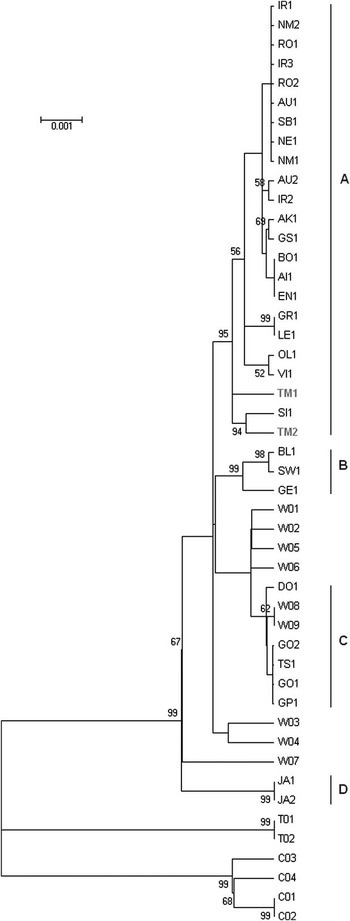
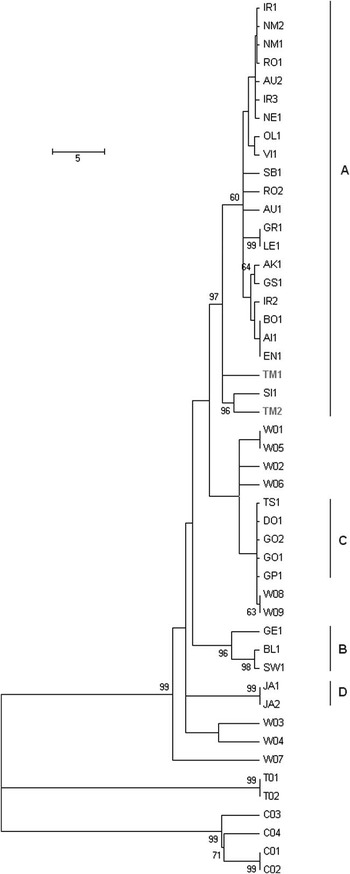
We constructed phylogenetic trees for 48 individuals of Canidae based on the amino acid sequences of 12 protein-coding genes in the H-chain, using the NJ and MP methods (Figures 1 and 2). The topological structures of both trees were almost identical. The outgroup (Coyote, Canis latrans) clustered alone as one group (BP = 99%), the Tibetan wolf (Canis lupus laniger) clustered together (BP = 99%), and gray wolves and domestic dogs clustered into another group (BP = 99%). Thirty-three domestic dog breeds were divided into four groups: the Tibetan Mastiff clustered with most of the domestic dogs (clade A; BP = 97%); the Black Russian Terrier, German Shepherd and Swedish Elkhound clustered together (clade B; BP = 96%); the Golden Retriever, Tibetan Spaniel, Doberman Pinscher and Great Pyrenees formed clade C and the Jamthund clustered as clade D (BP = 99%). The number of individuals in clade A (23, 69.70%) was higher than those in clade B (3, 9.09%), clade C (5, 15.15%) and clade D (2, 6.06%).
A neighbor-joining tree of Canidae was constructed from 12 mitochondrial protein-coding genes. Percentage bootstrap values are shown on interior branches.

A maximum-parsimony tree of Canidae was constructed from 12 mitochondrial protein-coding genes. Percentage bootstrap values are shown on interior branches.

Discussion
The goals of this study were to detail the characteristics of mtDNA of the Tibetan Mastiff, to compare the mtDNA sequence with those of other domestic dogs to determine the length and sequence variations of the genes and to make a contribution to the reference mtDNA database of the domestic dog. At the same time, we constructed phylogenetic trees using 12 protein-coding genes to determine the phylogenetic relationships among Canidae.
In all animals, the length of the mitochondrial genome is not absolute due to variation (heteroplasmy) caused by differing numbers of the repetitive motif in the control region. Canidae mtDNA is distinguished from other Carnivora (such as cast and harbor seals) mtDNA sequences by its possession of only one type of repeat in the control region (Arnason and Johnsson, Reference Arnason and Johnsson1992; Lopez et al., Reference Lopez, Cevario and O’Brien1996). In the mtDNA genome of the Tibetan Mastiff, the control region is shorter than average (1559 bp) due to the presence of only one type of repetitive motif. Analysis of the copy number of the repeat motif among Canidae confirmed one point: the repeat is responsible for the high intra-species D-loop region variation and for the generation of heteroplasmy. This is also the case for the Northern and Southern elephant seal species, in which the sequence composition, arrangement and copy number variation of the repeats differ considerably within and between lineages (Hoelzel, Reference Hoelzel1993). However, we found different repeat numbers in the same length of the D-loop, and even in the same breed there were different lengths of D-loop regions and different numbers of repeat units, which is consistent with the report of Gundry et al. (Reference Gundry, Allard, Moretti, Honeycutt, Wilson, Monson and Foran2007).
For the amino acid mutation in 13 protein-coding genes of domestic dogs, we found that 36 mutations, taking up 63.16% of the total mutations, happened in NADH dehydrogenase subunits (ND1ND6), which is probably because of their important function. NADH dehydrogenase complex functions in the creation of transmembrane proton gradients, which are necessary for ATP synthesis (Weiss et al., Reference Weiss, Friedrich, Hofhaus and Preis1991). In humans, several fatal and degenerative mitochondrial diseases have been associated with mutations that lead to NADH dehydrogenase deficiencies (Wallace, Reference Wallace1994).
Comparing the percentage of variable sites among the complete mitochondrial genomes of Canidae, we found that rRNA genes were the most conserved, followed by the tRNA genes, the protein-coding genes and, lastly, the D-loop region, which is consistent with the report by Hurst et al. (Reference Hurst, Bartlett, Davidson and Bruce1999). Thus, the D-loop was the best choice for the analysis of the origin and phylogeny of species. However, in recent years, 12 protein-coding genes have been widely used to construct the phylogeny of higher-level taxa (Ursing et al., Reference Ursing, Slack and Arnason2000; Delisle and Strobeck, Reference Delisle and Strobeck2005; Arnason et al., Reference Arnason, Gullberg, Janke and Kullberg2007; Cui et al., Reference Cui, Liu, Li, You and Chu2009). Stepien and Kocher (Reference Stepien and Kocher1997) reported that short mitochondrial gene fragments could only be used to a limited extent to resolve phylogenetic relationships at higher taxonomic levels. In this study, the phylogenetic trees showed that 69.70% of dogs belonged to clade A and that 93.94% of dogs belonged to clades A, B and C, which is consistent with the reported result of Savolainen et al. (Reference Savolainen, Zhang, Luo, Lundeberg and Leitner2002). Coyotes and Tibetan wolves, respectively, clustered alone and gray wolves and domestic dogs clustered together. The sequence divergence between the Tibetan Mastiff and the gray wolf (0.70) was smaller than that between the Tibetan Mastiff and the Tibetan wolf (3.30), and between the Tibetan Mastiff and coyote (5.27). This suggested that the Tibetan Mastiff originated from the gray wolf, the same as with other domestic dogs (Vilà et al., Reference Vilà, Savolainen, Maldonado, Amorim, Rice, Honeycutt, Crandall, Lundeberg and Wayne1997; Leonard et al., Reference Leonard, Wayne, Wheeler, Valadez, Guillen and Vilà2002; Verginelli et al., Reference Verginelli, Capelli, Coia, Musiani, Falchetti, Ottini, Palmirotta, Tagliacozzo, De Grossi Mazzorin and Mariani–Costantini2005; Boyko et al., Reference Boyko, Boyko, Boyko, Parker, Castelhano, Corey, Degenhardt, Auton, Hedimbi, Kityo, Ostrander, Schoenebeck, Todhunter, Jones and Bustamante2009; Pang et al., Reference Pang, Kluetsch, Zou, Zhang, Luo, Angleby, Ardalan, Ekström, Sköllermo, Lundeberg, Matsumura, Leitner, Zhang and Savolainen2009), and is consistent with the results of Li et al. (Reference Li, Liu, Li, Zhao, Dong, Pan, Sun, Li, Xu and Xie2008). For the protein-coding genes, tRNAs and rRNAs, a decreasing trend in the number of identified variable sites, also showed that there was a closer relationship between domestic dogs and gray wolves than between domestic dogs and coyotes. The Tibetan Mastiff clustered with most of the domestic dogs in clade A, and the sequence divergence between the Tibetan Mastiff and these domestic dogs was 0.20, which was markedly smaller than that between the Tibetan Mastiff and the other 10 domestic dogs in clades B, C and D; 0.53). These data suggested that the genetic relationship between the Tibetan Mastiff and the clade A domestic dogs was close. In clade A, the smallest sequence divergence existed between the Tibetan Mastiff and the Saint Bernard, Viszla, Newfoundland and the Old English Sheepdog, suggesting a closer relationship between the Tibetan Mastiff and domestic dogs such as the Saint Bernard and Old English Sheepdog.
Acknowledgments
This work was supported by a Research Grant for young teachers of the China Agricultural University and Nanjing Agricultural University (no. NC2007007).