Introduction
Currently, about 2 million Europeans are diagnosed with dementia every year (Wancata et al., Reference Wancata, Musalek, Alexandrowicz and Krautgartner2003). Most of these people continue to live in the community, but various cognitive and neuropsychiatric symptoms become more pronounced as the disease progresses and contribute to placement in institutionalized care (Hope et al., Reference Hope, Keene, Gedling, Fairburn and Jacoby1998; Buhr et al., Reference Buhr, Kuchibhatla and Clipp2006). Although intensive support programs for people with dementia and their caregivers can delay institutionalization (Spijker et al., Reference Spijker2008), about 70% of these people in the Netherlands are eventually placed in a residential or nursing home (de Klerk, Reference de Klerk2001).
While caring for one person with dementia can be a difficult task, caring for a group of patients can be a real challenge. Neuropsychiatric symptoms are very common, and more than 80% of the cognitively impaired nursing-home residents in the Netherlands have at least one clinically significant neuropsychiatric symptom (Zuidema et al., Reference Zuidema, Derksen, Verhey and Koopmans2007). The most frequently observed behaviors (prevalences of 30–35%) are aggression/agitation, apathy, and irritability. In other countries, similar incidences of these behaviors occur among people with dementia whether they are institutionalized or not (Lyketsos et al., Reference Lyketsos, Lopez, Jones, Fitzpatrick, Breitner and DeKosky2002; Engelborghs et al., Reference Engelborghs2005). Care staff find it difficult to cope with the aggressive, hostile, stubborn, resistant, and unpredictable behavior of residents (Brodaty et al., Reference Brodaty, Draper and Low2003a), so that working with cognitively impaired people is associated with much stress (Novak and Chappell, Reference Novak and Chappell1996).
Unmet needs can trigger neuropsychiatric symptoms (Hancock et al., Reference Hancock, Woods, Challis and Orrell2006), as can language disorders (Potkins et al., Reference Potkins2003), discomfort, or pain. The residents’ impaired communication skills make it very difficult for care staff to identify and address the source of the disturbed behavior.
Antipsychotic drugs are frequently used in dementia care to treat neuropsychiatric symptoms (Snowdon et al., Reference Snowdon, Day and Baker2006), but these medications only relieve the symptoms and do not treat the underlying causes of the behavior. Furthermore, these drugs are known to cause serious side effects (e.g. stroke or increased mortality rates), and are not suitable for routine use (Schneider et al., Reference Schneider, Dagerman and Insel2005). Nonpharmacological interventions are preferred to drugs in the treatment of neuropsychiatric symptoms.
Interventions therefore need to be investigated to encourage and ease communication between care staff and residents. Communication is achieved by speech, writing, gesture, posture, gaze, affect, and intonation. These are specific to the place and purpose, or the context, of the communication. Care staff need to be aware of how residents signal the need to communicate and how to react to the signals.
Several reviews about the use of nonpharmacological interventions in dementia care have recently been published (Brodaty et al., Reference Brodaty, Green and Koschera2003b; Livingston et al., Reference Livingston, Johnston, Katona, Paton and Lyketsos2005; Verkaik et al., Reference Verkaik, van Weert and Francke2005), but these do not focus on people with dementia in institutional care or the effects of communication strategies on neuropsychiatric symptoms.
The aims of this systematic review were to appraise (1) the effectiveness of communication-enhancing interventions for the care staff and/or residents with dementia in institutional care settings, and (2) the effects of these interventions on neuropsychiatric symptoms.
Methods
Search strategy
We searched Pubmed, PsychInfo, and Web of Science (1980 – February 2007) for controlled, nonpharmacological, intervention studies that included institutionalized people with dementia and/or care staff. The following search strategy was used:
• (communication OR interaction)
• AND (nursing homes OR nursing home OR residential facilities OR residential facility OR hospitals OR hospital OR institutionalized OR institutionalised OR inpatient OR inpatients OR long-term care OR geriatric nursing OR in-patients OR patients OR residents OR ward OR wards OR “care unit” OR “care units” OR residential OR “assisted living” OR in-patient)
• AND (vascular dementia OR lewy body disease OR alzheimer's OR alzheimer OR “Alzheimer Disease” [MeSH] OR “Lewy Body Disease” [MeSH] OR “Dementia, Vascular”[MeSH] OR “Dementia” [MeSH: noexp])
• AND (controlled OR trial).
We also identified trials in an additional search of the Cochrane Library in February 2007 using the words Dementia [MESH] AND interact* OR communicat*, and we reviewed the references of the studies we included to identify any other relevant studies.
Inclusion criteria
The studies to be included in this review had to meet all of the following criteria:
1. Type of study: a randomized or nonrandomized controlled trial with the full text obtainable in English or Dutch. A randomized or nonrandomized controlled trial was defined as a study that compared the results from the intervention group to the results from one or more comparison groups receiving the usual intervention or no intervention at all; or a standardized, comparable intervention without the communication component.
2. Participants: people with dementia living in residential care homes or in nursing homes and/or professional caregivers working in long-term care facilities with people with dementia. The inclusion criteria for the trial required a diagnosis of dementia or screening for cognitive impairment of resident participants. If groups of residents were mixed with nonresidents, at least 80% of the participants had to be residents or else their separate results needed to be available.
3. Intervention: an intervention aimed at improving the communication of participants. Multi-component interventions had to include a communicative component. Communication was defined as sharing information by speaking, writing, body movements, or other signaling behavior.
4. Outcomes: at least one outcome measure was required to address the quantity and/or quality of communication performance or else no productive communication (e.g. apathy or noncompliance) of the participants.
Reviews of trials, pharmacological interventions, and studies in which the participants served as their own control group were excluded.
Screening the studies
Two independent reviewers (EV and MVD) assessed the candidate studies for inclusion in three screening rounds. During the first round, they screened articles by title and type of article to determine whether they met the inclusion criteria. In the second round (abstracts) and the third round (full text), they screened the remaining articles if the abstract or full text was available. Studies that failed to meet the inclusion criteria were excluded. In cases of doubt, the articles were included in the next review round.
Quality of the studies
Two researchers (EV and AS) assessed the methodological quality of the studies independently and discussed the results for consensus. They assessed the following criteria, after Higgins and Green (Reference Higgins and Green2008), to check for differences in methodological quality between studies: selection bias (method of randomization, allocation concealment, inclusion/exclusion criteria specified, and similarity of groups at baseline), performance bias (assessors blinded to outcome), attrition bias (characteristics of participants lost to follow-up described, and intention-to-treat analysis), and detection bias (power calculation and valid outcome measures). Blinding of participants was not included as a quality criterion because it is impossible for the types of interventions included in this review.
Data collection and analysis
First, the characteristics of the interventions and outcome measures used for communication and neuropsychiatric symptoms were extracted from the articles. The interventions were then sorted by type so that we could extract their effectiveness on communication and neuropsychiatric symptoms, when data were available.
We performed a meta-analysis using the Cochrane Collaboration Group's Review Manager 5 (The Cochrane Collaboration, Copenhagen, Denmark) when two or more studies were randomized controlled trials and the outcome measures and type of intervention could be compared. Because of the continuous nature of the data and differences in the outcome measures used, we calculated a standardized mean difference (SMD), which is a uniform standardized score, to compare the data from experimental groups with the data from the control groups. We calculated SMDs (for the experimental group and the control group) as the difference between the mean change in communication or neuropsychiatric symptoms, before and after the intervention, divided by the standard deviation of the difference.
If a measurement was repeated, the data from the first measurement after the intervention were used as post-intervention data in the meta-analysis. In case multiple intervention and/or control groups were included in a study, these groups were combined and included as a single group in the meta-analysis (Higgins and Green, Reference Higgins and Green2008).
Statistical significance was set at p < 0.05. We set up a fixed-effects model for each meta-analysis. If the statistical heterogeneity, as calculated by the I2 statistical test, was significant (p < 0.05), the analyses were repeated with the random-effects model (Egger et al., Reference Egger, Smith and Phillips1997; Higgins and Green, Reference Higgins and Green2008). Significant between-group effects for both communication or neuropsychiatric symptoms of intervention studies that could not be included in the meta-analyses were described separately for each type of intervention study.
Results
Search results
The search retrieved 721 articles that met the search criteria. After we excluded reviews and pharmacological trials, 488 articles remained. The first screening round resulted in 85 titles of articles that met the inclusion criteria or raised doubt. We screened the abstracts of these 85 articles, and 35 articles remained for full-text assessment in the final screening round. Thirteen of the 35 articles did not meet the inclusion criteria; thus, 22 articles describing 19 different intervention studies were included in this review.
Description of the studies
We identified two overall “types” of interventions within the 19 studies. The first type (10 studies) is a communicative session or intervention for residents carried out by a trained specialist or staff member at a “set-time session”. The aim of the second type (9 studies) was to teach care staff to apply communication techniques in daily care activities, the “daily-care” intervention.
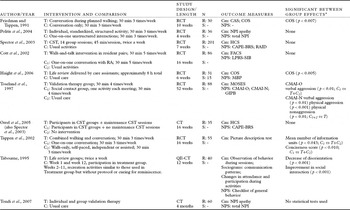
The ten set-time sessions or interventions included a walking program combined with conversation (Friedman and Tappen, Reference Friedman and Tappen1991; Cott et al., Reference Cott, Dawson, Sidani and Wells2002; Tappen et al., Reference Tappen, Williams, Barry and DiSesa2002), group validation therapy (Toseland et al., Reference Toseland, Diehl, Freeman, Manzanares, Naleppa and McCallion1997; Tondi et al., Reference Tondi, Ribani, Bottazzi, Viscomi and Vulcano2007), life review programs (Tabourne, Reference Tabourne1995; Haight et al., Reference Haight, Gibson and Michel2006), cognitive stimulation therapy (Spector et al., Reference Spector2003; Orrell et al., Reference Orrell, Spector, Thorgrimsen and Woods2005), and activity therapy (Politis et al., Reference Politis, Vozzella, Mayer, Onyike, Baker and Lyketsos2004). Table 1 shows the study characteristics of the set-time intervention studies. The number of participating residents in each study ranged from 30 to 201, and the severity of the dementia ranged from moderate (mean study group Mini-mental State Examination (MMSE) score 18.6) to severe (mean study group MMSE score 6). The intervention period varied from 6 to 52 weeks.
Characteristics and findings of set-time studies

*Significant effects in favor of treatment group unless otherwise stated.
C = control group; CAPE-BRS = Clifton Assessment Procedures for the Elderly- Behavior Rating Scale; CAS = Communication Assessment Scale for the Cognitively Impaired; Cm = communication; CMAI-N = Cohen Mansfield Agitation Inventory – Nursing staff-derived; CMAI-O = Cohen Mansfield Agitation Inventory – Observer-derived; COS = Communication Observation Scale for the Cognitively Impaired; CST = Cognitive Stimulation Therapy; CT = controlled trial; FACS = Functional Assessment of Communication Skills for Adults, social communication and communication of basic needs relative to the independence dimension; GIPB = Geriatric Indices of Positive Behavior; HCS = Holden Communication Scale; LPRS-SIB = London Psychogeriatric Rating Scale – Socially Irritating Behavior; MBP = Revised Memory and Behavior Problem Checklist; MOSES = Multidimensional Observation Scale for Elderly Subjects, irritability and withdrawal scales; NPI = Neuropsychiatric Inventory; NPS = neuropsychiatric symptoms; QE-CT = quasi-experimental controlled trial; R = residents; RA = research assistant; RAID = Rating Anxiety in Dementia; RCT = randomized controlled trial; S = care staff; T = treatment group.
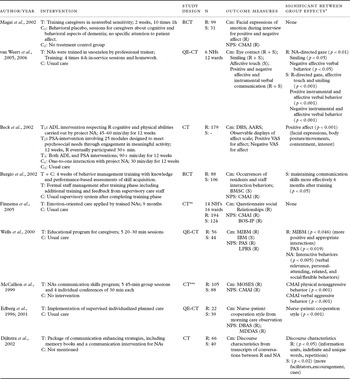
The nine daily-care intervention studies consisted of training programs aimed solely at teaching care staff communication techniques (McCallion et al., Reference McCallion, Toseland, Lacey and Banks1999; Dijkstra et al., Reference Dijkstra, Bourgeois, Burgio and Allen2002; Magai et al., Reference Magai, Cohen and Gomberg2002; Finnema et al., Reference Finnema2005; van Weert et al., Reference van Weert, van Dulmen, Spreeuwenberg, Ribbe and Bensing2005; Reference van Weert, Janssen, van Dulmen, Spreeuwenberg, Bensing and Ribbe2006) or multicomponent training or educational programs that also included communication techniques (Edberg and Hallberg, Reference Edberg and Hallberg1996; Reference Edberg and Hallberg2001; Wells et al., Reference Wells, Dawson, Sidani, Craig and Pringle2000; Beck et al., Reference Beck2002; Burgio et al., Reference Burgio, Stevens, Burgio, Roth, Paul and Gerstle2002). Table 2 shows the study characteristics of the daily-care intervention studies. The numbers of residents varied from 22 to 194, and the numbers of staff members varied from 31 to 124. One study trained specially hired certified nurses to carry out the intervention (Beck et al., Reference Beck2002). The mean study group MMSE score was less than 10 in four studies, indicating that the participants were in a severe stage of dementia (McCallion et al., Reference McCallion, Toseland, Lacey and Banks1999; Wells et al., Reference Wells, Dawson, Sidani, Craig and Pringle2000; Burgio et al., Reference Burgio, Stevens, Burgio, Roth, Paul and Gerstle2002; Magai et al., Reference Magai, Cohen and Gomberg2002). The other five studies included participants with moderate or mild, as well as severe, dementia. All daily-care intervention studies started with a training period for the care staff. After this period, the intervention was implemented in daily care. Seven studies assessed outcome measures at several times after implementation, varying from 2 weeks to 12 months (Edberg and Hallberg, Reference Edberg and Hallberg1996; Reference Edberg and Hallberg2001; McCallion et al., Reference McCallion, Toseland, Lacey and Banks1999; Wells et al., Reference Wells, Dawson, Sidani, Craig and Pringle2000; Beck et al., Reference Beck2002; Burgio et al., Reference Burgio, Stevens, Burgio, Roth, Paul and Gerstle2002; Magai et al., Reference Magai, Cohen and Gomberg2002; Finnema et al., Reference Finnema2005). Each of two studies had only one post-intervention assessment of outcomes, which took place at four weeks (Dijkstra et al., Reference Dijkstra, Bourgeois, Burgio and Allen2002) and 18 months (van Weert et al., Reference van Weert, van Dulmen, Spreeuwenberg, Ribbe and Bensing2005; Reference van Weert, Janssen, van Dulmen, Spreeuwenberg, Bensing and Ribbe2006).
Characteristics and findings of daily care studies

*Significant effects in favor of treatment group unless otherwise stated; **Multi-sited, matched groups; ***Randomized by nursing home unit.
AARS = Apparent affect rating scale; ADL = Activities of daily living; BMSC: Behavior Management Skills Checklist; BOS-IP = Behavior Observational Scale for Intramural Psychogeriatrics; C = Control group; Cm = Communication CMAI = Cohen Mansfield Agitation Index; CT = Controlled trial; DBAS = Demanding Behavior Assessment Scale; DBS = Disruptive behavior scale; IBM = Interaction Behavior Measure; LPRS = London Psychogeriatric Rating Scale; MDDAS = Multi-Dimensional Dementia Assessment Scale two subscales used: behavior and psychiatric symptoms; MIBM = Modified Interaction Behavior Measure; MOSES = Multidimensional Observation Scale for Elderly Subjects; NA: Nursing assistant; NH = Nursing home; NPS = Neuropsychiatric symptoms; PAS = Pittsburgh Agitation Scale; PSA = Psychosocial activity; QE-CT: Quasi-experimental controlled trial; R = Residents; RCT = Randomized controlled trial; S = Care staff; T = Treatment group; VAS = Visual Analogue Scale.
Methodological quality
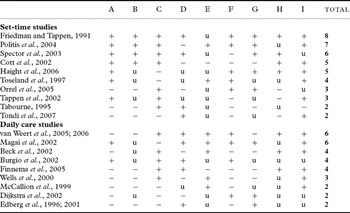
There were great differences in the methodological quality of the studies. None of the 19 studies fulfilled all nine quality items. Table 3 shows the results of the quality assessment and the total quality score for each study. The decision whether the criteria were fulfilled or not was based on the information provided in the article, and if this information was inadequate, the decision was labeled “unknown”. Overall, the quality of the daily care intervention studies seemed poorer (mean fulfilled criteria 3.7 ± 1.6) than the quality of the set-time studies (mean fulfilled criteria 4.5 ± 2.1).
Quality assessment and total score of included studies

Quality criteria: A = randomization, B = allocation concealment, C = inclusion/exclusion criteria specified, D = similarity of groups at baseline, E = assessors blinded to outcome, F = characteristics of participants lost to follow-up described, G = intention-to-treat analysis, H = power calculated, I = outcome measures valid.
+ = criterion fulfilled, − = criterion not fulfilled, u = unknown if criterion is fulfilled.
Effects of the interventions on communication
Five set-time studies, which also had the highest scores for total quality, used quantitative outcome measures for communication that could be compared (Friedman and Tappen, Reference Friedman and Tappen1991; Cott et al., Reference Cott, Dawson, Sidani and Wells2002; Spector et al., Reference Spector2003; Politis et al, Reference Politis, Vozzella, Mayer, Onyike, Baker and Lyketsos2004; Haight et al., Reference Haight, Gibson and Michel2006). The data from these studies were pooled in a meta-analysis, and a total of 371 residents with dementia (193 in experimental groups and 178 in control groups) were included. The study by Cott et al. (Reference Cott, Dawson, Sidani and Wells2002) had two control groups, and we combined data from both groups before we entered them in the meta-analysis (Higgins and Green, Reference Higgins and Green2008). Standardized mean differences (SMDs) were calculated, and we chose the random-effects model because of the heterogeneity-of-treatment effects across studies (χ2 = 24.59, df = 3, p = 0.0001, I2 = 84%). The estimated overall effect was not significant for the treatment groups (SMD = 0.53, 95% CI = –0.07–1.14, p = 0.09; Figure 1).
Forest plot, which shows no significant overall effect of set-time studies on communication outcomes.
Each study is represented by a black square (■) and a horizontal line, which correspond to the point estimate and the 95% confidence intervals (CIs) of the standardized mean difference (SMD). The solid vertical line corresponds to no effect of treatment (SMD 0). The area of the black squares reflects the weight of the study in the meta-analysis. The diamond (♦) represents the combined SMD, calculated in a random effects model with its 95% CI.
df = degrees of freedom; Mean = the mean change in communication outcome and the corresponding standard deviation (SD) for patients in the control and experimental groups, respectively; Total = number of patients included in analysis.

Among the set-time studies that were not included in the meta-analysis, a group life review intervention found a significant improvement in social interaction for the experimental group (Tabourne, Reference Tabourne1995), and a walk-and-talk intervention showed significant positive effects for the conversation-only group (Tappen et al., Reference Tappen, Williams, Barry and DiSesa2002). The other three set-time intervention studies did not show any significant effects on communication outcomes.
It was not possible to pool data for communication outcome data for the daily care intervention studies because the only two studies that fulfilled the quality criterion for randomization did not use communication outcomes that were suitable for a meta-analysis (Burgio et al., Reference Burgio, Stevens, Burgio, Roth, Paul and Gerstle2002; Magai et al., Reference Magai, Cohen and Gomberg2002).
Four of the daily-care intervention studies included a multicomponent training and education program for care staff that had a communication component (Edberg and Hallberg, Reference Edberg and Hallberg1996; Reference Edberg and Hallberg2001; Wells et al., Reference Wells, Dawson, Sidani, Craig and Pringle2000; Beck et al., Reference Beck2002; Burgio et al., Reference Burgio, Stevens, Burgio, Roth, Paul and Gerstle2002). Positive effects on communication were found in all of these studies. Effects on interactive behaviors, nurse–patient cooperation style, and nursing assistants maintaining their communication skills were evident for caregivers. Effects on residents were found for positive affect and interactive behavior.
Five studies investigated the effects of communication skill training for care staff. One of these studies did not include a communication measurement (McCallion et al., Reference McCallion, Toseland, Lacey and Banks1999). The studies that found positive significant effects were an intervention combining a package of communication-enhancing strategies and memory books for nursing assistants (Dijkstra et al., Reference Dijkstra, Bourgeois, Burgio and Allen2002) and an intervention integrating snoezelen in 24-hour dementia care (van Weert et al., Reference van Weert, van Dulmen, Spreeuwenberg, Ribbe and Bensing2005; Reference van Weert, Janssen, van Dulmen, Spreeuwenberg, Bensing and Ribbe2006). The first study found effects on discourse characteristics for residents and care staff. Snoezelen aims to communicate at a nonverbal level through the stimulation of the primary senses. Teaching care staff applying these techniques during morning care proved to be effective, even for residents with moderate-to-severe dementia.
The study of Magai et al. (Reference Magai, Cohen and Gomberg2002) showed no significant effect on communication outcomes after 12 weeks. However, a sharp increase in positive affect was reported for the intervention group in the first six weeks after the training and the authors suggest that training programs should include refresher sessions in order to remain effective.
Effects of the interventions on neuropsychiatric symptoms
Data for effects on neuropsychiatric symptoms in four set-time studies were pooled (Toseland et al., Reference Toseland, Diehl, Freeman, Manzanares, Naleppa and McCallion1997; Spector et al., Reference Spector2003; Politis et al., Reference Politis, Vozzella, Mayer, Onyike, Baker and Lyketsos2004; Haight et al., Reference Haight, Gibson and Michel2006). Two of these studies had also been included in the meta-analysis for communication outcomes, and the total score for quality was 4 or more for all four studies.
A total of 312 residents with dementia (171 in experimental groups and 141 in control groups) were included in the meta-analysis. We calculated the SMDs for this meta-analysis, and we used a fixed-effects model because the test for statistical heterogeneity was not significant (χ2 = 4.94, df = 3,p = 0.18, I2 = 39.2%). The result was that the estimated overall effect on neuropsychiatric symptoms was zero (SMD = 0.00, 95% CI = –0.23–0.22, p = 0.97; Figure 2).
Forest plot, which shows no significant overall effect of set-time studies on neuropsychiatric outcomes.
Each study is represented by a black square (■) and a horizontal line, which correspond to the point estimate and the 95% confidence intervals (CIs) of the standardized mean difference (SMD). The solid vertical line corresponds to no effect of treatment (SMD 0). The area of the black squares reflects the weight of the study in the meta-analysis. The diamond (♦) represents the combined SMD, calculated in a fixed effects model with its 95% CI.
df = degrees of freedom; Mean = the mean change in communication outcome and the corresponding standard deviation (SD) for patients in the control and experimental groups, respectively; Total = number of patients included in analysis.

Among the studies unsuitable for meta-analysis, a group life review intervention found a significant decrease of disorientation for the experimental group (Tabourne, Reference Tabourne1995), and a combined group-and-individual validation therapy intervention found a decrease of the mean neuropsychiatric inventory score in the treatment group and a slight increase in the control group, but no statistical test for significance was used (Tondi et al., Reference Tondi, Ribani, Bottazzi, Viscomi and Vulcano2007). Two studies did not include a measurement for neuropsychiatric symptoms (Friedman and Tappen, Reference Friedman and Tappen1991; Tappen et al., Reference Tappen, Williams, Barry and DiSesa2002).
It was impossible to pool data for neuropsychiatric symptom outcomes within the subset of daily care intervention studies. The two studies that fulfilled the quality criterion for randomization used the Cohen-Mansfield Agitation Inventory as an outcome measure, but neither reported separate results for this questionnaire (Burgio et al., Reference Burgio, Stevens, Burgio, Roth, Paul and Gerstle2002; Magai et al., Reference Magai, Cohen and Gomberg2002).
The only two studies that found significant positive effects on neuropsychiatric symptoms were an abilities-focused program (Wells et al., Reference Wells, Dawson, Sidani, Craig and Pringle2000), and a program of communication skills for nursing assistants (McCallion et al., Reference McCallion, Toseland, Lacey and Banks1999).
The training of care staff led to positive effects on residents’ calm-functional behavior, agitation behavior, and physically nonaggressive behavior assessed after three months, and verbally aggressive behavior assessed after three and six months. Other daily care intervention studies did not find significant effects (Edberg and Hallberg, Reference Edberg and Hallberg1996; Reference Edberg and Hallberg2001; Beck et al., Reference Beck2002; Burgio et al., Reference Burgio, Stevens, Burgio, Roth, Paul and Gerstle2002; Magai et al., Reference Magai, Cohen and Gomberg2002) or did not include a scale for measuring effects on the neuropsychiatric symptoms of the residents (Dijkstra et al., Reference Dijkstra, Bourgeois, Burgio and Allen2002; van Weert Reference van Weert, van Dulmen, Spreeuwenberg, Ribbe and Bensing2005; Reference van Weert, Janssen, van Dulmen, Spreeuwenberg, Bensing and Ribbe2006).
Discussion
A total of 19 intervention studies fulfilled the inclusion criteria for this review and two overall types of interventions were identified: structured and communicative sessions at set-times, and communication techniques in activities of “daily care”. The latter include training programs for care staff. A meta-analysis of five set-time interventions (communication) and another meta-analysis of four set-time interventions (neuropsychiatric outcomes) found no significant overall effects. Positive effects for communication outcomes are shown in individual studies when set-time interventions are single-task sessions, such as life review or one-on-one conversation, and when care staff apply communication techniques in daily care activities. The effect of both types of communication interventions on the neuropsychiatric symptoms of people with dementia is divergent.
The difference in effectiveness between single- and multi-task interventions might be explained by people with dementia having difficulty performing dual tasks (Petterson et al., Reference Petterson, Olsson and Wahlund2007). Furthermore, exercise may not benefit the cognitive functioning of people with dementia when cardiovascular risk factors are present (Eggermont et al., Reference Eggermont, Swaab, Luiten and Scherder2006). Tappen and colleagues’ study (Reference Tappen, Williams, Barry and DiSesa2002) reported that participants were afraid of falling and needed considerable assistance with ambulation, or stopped walking when they were asked a question.
The positive results for the life review interventions are consistent with findings of a review on the effectiveness of reminiscence therapy on dementia patients, which suggested some potential benefits such as improvements in cognition (Woods et al., Reference Woods, Spector, Jones, Orrell and Davies2005). People with dementia are still able to recall memories from past life events, with the more important life events often being remembered quite clearly, even in the severe stages of the disease (Fromholt and Larsen, Reference Fromholt and Larsen1991). Reminiscence, or life reflection, is therefore a sensible and simple strategy for improving communication between residents and staff.
Training programs for care staff to be used in daily care have positive effects on verbal and nonverbal communication outcomes among care staff as well as residents with dementia. It is known that factors increasing the effectiveness of an educational or training program for healthcare professionals are longer training periods, active participation during the training, and individual attention (Grol and Wensing, Reference Grol and Wensing2006). We indeed found that effective programs used interactive courses (Edberg and Hallberg, Reference Edberg and Hallberg1996; Reference Edberg and Hallberg2001; Wells et al., Reference Wells, Dawson, Sidani, Craig and Pringle2000), a little self-study (Edberg and Hallberg, Reference Edberg and Hallberg1996; Reference Edberg and Hallberg2001; Wells et al., Reference Wells, Dawson, Sidani, Craig and Pringle2000) and individual attention via a supervisory system (Burgio et al., Reference Burgio, Stevens, Burgio, Roth, Paul and Gerstle2002). The results of the study of Magai et al. (Reference Magai, Cohen and Gomberg2002) add to this knowledge in showing that training programs should include refresher sessions to remain effective.
In spite of the effects on communication, the effects of both types of communicative interventions on neuropsychiatric symptoms were marginal. This is remarkable since communication difficulties are associated with neuropsychiatric symptoms (Potkins et al., Reference Potkins2003). If so, one would expect positive effects on neuropsychiatric symptoms in the studies included in this review. In most studies either no effects on behavior were found or no outcome measure for neuropsychiatric symptoms were included. Only four out of the 19 studies found positive effects for specific problematic behaviors in residents. Only one study found positive effects on both communication and neuropsychiatric symptoms. This particular study used a quasi-experimental design and only fulfilled three of the nine methodological quality criteria, so it was difficult to draw a conclusion (Wells et al., Reference Wells, Dawson, Sidani, Craig and Pringle2000).
The two daily care interventions that had the best methodological quality both studied the effects of nonverbal communication techniques on communication between residents and care staff (van Weert et al., Reference van Weert, van Dulmen, Spreeuwenberg, Ribbe and Bensing2005; Reference van Weert, Janssen, van Dulmen, Spreeuwenberg, Bensing and Ribbe2006; Magai et al., Reference Magai, Cohen and Gomberg2002). The snoezelen study showed positive effects for communication outcomes.
Methodological weaknesses were common in most of the research projects and the methodological quality of the studies was generally poor. The quality of the set-time studies was better than the quality of the daily care interventions, but the variability was too great to draw overall conclusions. As for the results of the meta-analyses and conclusions of this review, the following should be kept in mind. First, given the kinds of intervention studies we reviewed, it was not possible to blind the residents, care staff, or therapists in the treatment groups. To get reliable and objective data, it is important to at least blind the outcome assessors (Egger et al., Reference Egger, Smith and Phillips1997). Unfortunately, for seven set-time studies, it remains unclear whether this was done properly (Friedman and Tappen, Reference Friedman and Tappen1991; Tabourne, Reference Tabourne1995; Tappen et al., Reference Tappen, Williams, Barry and DiSesa2002; Spector et al., Reference Spector2003; Orrell et al., Reference Orrell, Spector, Thorgrimsen and Woods2005; Haight et al., Reference Haight, Gibson and Michel2006; Tondi et al., Reference Tondi, Ribani, Bottazzi, Viscomi and Vulcano2007).
Second, both the quality criteria for random assignment and allocation concealment were fulfilled for only four set-time studies (Friedman and Tappen, Reference Friedman and Tappen1991; Cott et al., Reference Cott, Dawson, Sidani and Wells2002; Spector et al., Reference Spector2003; Politis et al., Reference Politis, Vozzella, Mayer, Onyike, Baker and Lyketsos2004) and none of the daily care intervention studies. Using the Cochrane criteria, only two of the daily care intervention studies used a truly random method to assign participants to study groups (Higgins and Green, Reference Higgins and Green2008). Therefore, it was impossible to pool data for daily care intervention studies.
Third, the reliability and validity of the outcome measures that were used for communication were questionable. The validation of outcome measures in some studies included in this review was not justified, or instruments were specially developed and evaluated for the study (Tabourne, Reference Tabourne1995; Edberg and Hallberg, Reference Edberg and Hallberg1996; Reference Edberg and Hallberg2001; Burgio et al., Reference Burgio, Stevens, Burgio, Roth, Paul and Gerstle2002; Dijkstra et al., Reference Dijkstra, Bourgeois, Burgio and Allen2002; Spector et al., Reference Spector2003; Orrell et al., Reference Orrell, Spector, Thorgrimsen and Woods2005).
However, these reservations apart, we conclude that there are promising effective psychosocial interventions to be used in residential settings. Moreover, the lack of effect on the neuropsychiatric symptoms of residents with dementia is no reason to preclude improving communication in high-level residential care facilities. Instead of measuring effects on neuropsychiatric problems, researchers might think about improvements that retain the positive behaviors of the people in care. Some papers in this review describe improvements in positive behaviors of affect and mood (Beck et al., Reference Beck2002; Haight et al., Reference Haight, Gibson and Michel2006), but our results for neuropsychiatric symptoms might not be significant because they included negative behaviors (e.g. agitation) that did not, and perhaps cannot, improve (Magai et al., Reference Magai, Cohen and Gomberg2002; Burgio et al., Reference Burgio, Stevens, Burgio, Roth, Paul and Gerstle2002; Finnema et al., Reference Finnema2005).
This review indicates that care staff can improve their communication with residents with dementia when strategies are embedded in daily care activities or interventions are single-task sessions at set times. Staff training should include time for personal feedback, interactive learning and refresher sessions. These results offer the possibility of improving the quality of care, but not directly of reducing neuropsychiatric symptoms. More research is needed to study the effect of communication interventions on neuropsychiatric symptoms.
Conflict of interest
None.
Description of authors’ roles
E. Vasse formulated the research question, carried out the search strategy, assessed the methodological quality of the studies, analyzed the data, and wrote the paper. M. Vernooij-Dassen assisted with formulating the research question, analyzing the data, and writing the paper. A. Spijker assessed the methodological quality of the studies. M. Olde Rikkert and R. Koopmans assisted with writing the paper.
Acknowledgments
We are grateful to Dr Irena Draskovic, Senior Researcher, who used her technical and statistical skills to help us use Review Manager 5.