Organizational citizenship behavior (OCB), referring to voluntary behavior that enhances and maintains the social and psychological context supporting task performance (Organ, Reference Organ1997), has been included as an important aspect of job performance (Gonzalez-Mulé, DeGeest, McCormick, Seong, & Brown, Reference Gonzalez-Mulé, DeGeest, McCormick, Seong and Brown2014). As work in organizations is increasingly organized in teams, OCB research at the group or unit level has received much attention. Researchers have distinguished team OCB (reflecting the extent to which teammates as a whole engage in OCB) from individual-level OCB (Ehrhart, Reference Ehrhart2004; Ehrhart & Naumann, Reference Ehrhart and Naumann2004; Liu, Gong, & Liu, Reference Liu, Gong and Liu2014; Nohe & Michaelis, Reference Nohe and Michaelis2016) and empirical work has demonstrated that the team or unit level of OCB significantly contributes to team and organizational success (Chun, Shin, Choi, & Kim, Reference Chun, Shin, Choi and Kim2013; Podsakoff, Whiting, Podsakoff, & Blume, Reference Podsakoff, Whiting, Podsakoff and Blume2009). Yet we lack in understanding the conditions under which high levels of team OCB are likely to emerge (Ehrhart & Naumann, Reference Ehrhart and Naumann2004; Euwema, Wendt, & van Emmerik, Reference Euwema, Wendt and van Emmerik2007).
Emotional intelligence (EI), defined as the ability to sense and understand one's own and others' emotions and to utilize related information to influence others through emotional regulation and control (Mayer, Salovey, and Caruso, Reference Mayer, Salovey and Caruso2008; Zeidner, Matthews, and Roberts, Reference Zeidner, Matthews and Roberts2004), has been examined as an antecedent that contributes to OCB in a set of studies (e.g., Carmeli & Josman, Reference Carmeli and Josman2006; Day & Carroll, Reference Day and Carroll2004). Although the accumulating evidence has demonstrated that EI has the potential to yield OCB benefits (Miao, Humphrey, & Qian, Reference Miao, Humphrey and Qian2017), this work has mainly focused on the linkage of EI and OCB at the individual level. Considering that the empirical findings related to individual-level OCB cannot be simply generalized to team-level due to their conceptual differences (Choi, Reference Choi2009; Morgeson & Hofmann, Reference Morgeson and Hofmann1999), in this research we seek to build a base of knowledge about the influence of team EI on team OCB.
Team EI based on individual level EI scores has been manipulated using various aggregation methods (e.g., average, maximum, minimum). The best team member regarding EI (maximum EI) who has desirable interpersonal skills might play a ‘strategic core’ role in teams by lubricating the social fabric that permeates daily interactions, which would contribute to team success. The core role perspective posits that some individuals have greater influence than others based on their status in the team (Humphrey, Morgeson, & Mannor, Reference Humphrey, Morgeson and Mannor2009; Summers, Humphrey, & Ferris, Reference Summers, Humphrey and Ferris2012). A multilevel approach argues that team processes are inherently multilevel phenomena that have a bottom-up emergence from team member interactions (Kozlowski & Chao, Reference Kozlowski and Chao2018). In this study, we draw on the strategic core role theory and the multilevel theory literature to examine both mediating mechanisms and boundary conditions of the effects of maximum EI on team OCB.
Specifically, we based the research on the strategic core role theory and examined how maximum EI in teams interacts with team diversity in EI to impact intrateam trust. The theory of a strategic core in teams emphasizes that researchers need to consider both parts of the whole (i.e., the roles within the team) and the entire team when examining team phenomena; it argues that some individuals have greater influence than others (Humphrey, Morgeson, & Mannor, Reference Humphrey, Morgeson and Mannor2009; Summers, Humphrey, & Ferris, Reference Summers, Humphrey and Ferris2012; Wu, Tsui, & Kinicki, Reference Wu, Tsui and Kinicki2010). We focus on the individual team members with maximum EI in teams who might occupy the central position of social networks or emerge as leaders and have greater social influence on team members as the strategic core role of teams, and examined whether the properties of the parts of team (i.e., maximum EI) interacts with the characteristics of the entire team (i.e., team diversity in EI) to impact team processes (i.e., intrateam trust).
We also investigated whether mean intrateam trust and team trust divergence serve as key mechanisms through which the team EI (the interaction of maximum EI and EI diversity) influences team OCB. According to the multilevel theory literature (Kozlowski, Reference Kozlowski2015; Kozlowski & Chao, Reference Kozlowski and Chao2012), most constructs emerge at the group level involving both compositional and compilational processes. These constructs can be featured by shared properties (e.g., intrateam trust) as well as by structural properties (e.g., trust asymmetry). Intrateam trust have often been assumed underlying mechanisms for relating team EI to team performance (Barczak, Lassk, & Mulki, Reference Barczak, Lassk and Mulki2010; Chang, Sy, & Choi, Reference Chang, Sy and Choi2012; Rezvani, Barrett, & Khosravi, Reference Rezvani, Barrett and Khosravi2019). Focusing on sharing perceptions of trust overlooks configural properties of trust and may thus limit our understanding of the effects of trust at the team level. We thus extend prior research by examining intrateam trust as a mediator linking the interaction of maximum EI and EI diversity with team OCB and trust divergence as a boundary condition influencing the mediation effect of intrateam trust.
In this research we make several contributions to the literature. First, team-level variables, such as procedural justice climate (Ehrhart, Reference Ehrhart2004), demographic diversity (Choi, Reference Choi2009), and unit leadership (Nohe & Michaelis, Reference Nohe and Michaelis2016), have been identified as potential antecedents of team OCB. Team EI as an antecedent of team OCB has not received much attention. By examining how team EI qualities (the interaction of maximum EI and EI diversity) and team trust relate to team OCB, we address the dynamic interplay between the parts of the whole (an extreme individual within a team) and the entire team to further understanding of the emergence of team-level OCB.
Second, our study contributes to the team EI literature at least in two ways. On the one hand, past research has mainly examined the relationships between team EI composition and group effectiveness by aggregating EI using the average value of team members(e.g., Rezvani, Khosravi, & Ashkanasy, Reference Rezvani, Khosravi and Ashkanasy2018; Wang, Reference Wang2015; Zhang, Ding, Schutte, & Li, Reference Zhang, Ding, Schutte and Li2020a). We add to the literature on team EI composition by focusing on a maximum-score model of team EI. More important, we model group-focused (variations) and individual-focused (maximum) EI both at the group level in predicting team processes and outcomes. In doing so, we are able to discover new and unique EI insights that may be missed by examining the effects of EI on team effectiveness in isolation at the group level.
On the other hand, although research on the mediating mechanisms by which team EI influences team functioning has increased recently (e.g., Chang, Sy, & Choi, Reference Chang, Sy and Choi2012; Lee & Wong, Reference Lee and Wong2019; Rezvani, Barrett, & Khosravi, Reference Rezvani, Barrett and Khosravi2019; Rezvani, Khosravi, & Ashkanasy, Reference Rezvani, Khosravi and Ashkanasy2018), how team EI affects team processes and outcomes via moderation effects has been underexplored (for few exceptions, see Wang, Reference Wang2015; Zhang et al., Reference Zhang, Ding, Schutte and Li2020a). We enrich this stream of research by identifying and examining EI diversity as an input-based boundary condition and trust divergence as an emergence-based boundary condition of the effect of maximum EI on team OCB via intrateam trust.
Conceptual backgroundn and hypotheses
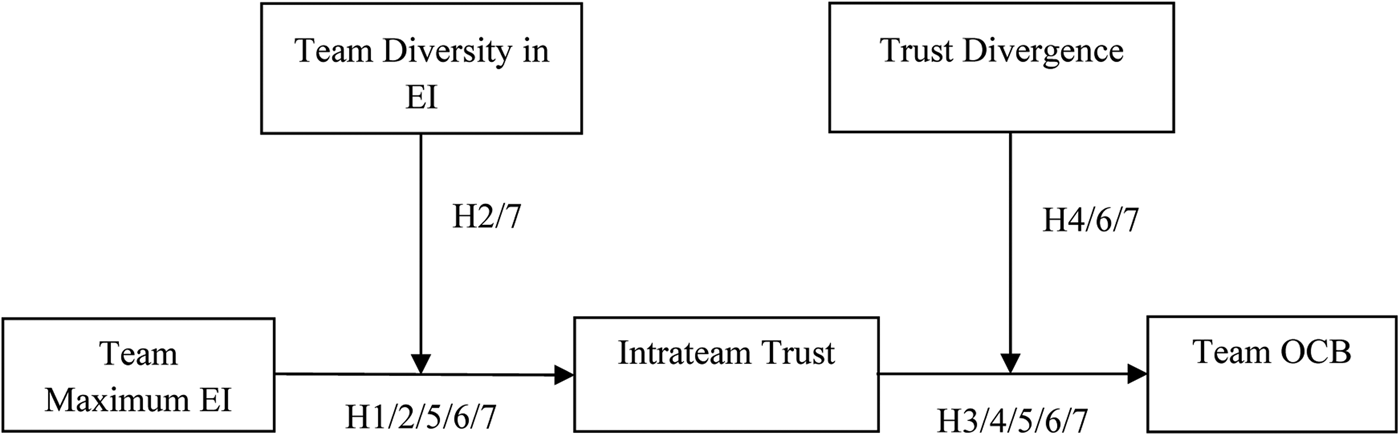
The conceptual model tested in this study is presented in Figure 1 which focuses on the influence of maximum EI on team OCB while considering the mediating role of intrateam trust and the moderating effect of EI diversity and trust divergence. These research hypotheses associated with this model are discussed in more detail below.
Proposed model (H = Hypothesis).

Team maximum emotional intelligence and intrateam trust
Theoretical research and empirical evidence suggest a wide variety of measures to formally operationalize individual EI into team EI (Côté, Reference Côté, Neale, Mannix and Anderson2007; Elfenbein, Reference Elfenbein, Druskat, Sala and Mount2006). We conceptualize team EI using an individual attribute-based approach and examine the role of maximum EI member as an input for team functioning. Researchers distinguish between trait-based individual EI models and ability-based individual EI models (Zeidner, Matthews, & Roberts, Reference Zeidner, Matthews and Roberts2004). We used the EI definition of an ability model in which EI refers an individual difference with regard to how individuals identify, understand, regulate, and use their own emotions and those of others in adaptive ways (Mayer et al., Reference Mayer, Salovey and Caruso2008; Zeidner, Matthews, & Roberts, Reference Zeidner, Matthews and Roberts2004). The maximum team member's EI score was used to represent the team maximum EI.
Intrateam trust depicts a collectively held perception toward the positive expectations of the intentions or behavior of teammates (De Jong & Dirks, Reference De Jong and Dirks2012; Rousseau, Sitkin, Burt, & Camerer, Reference Rousseau, Sitkin, Burt and Camerer1998); it has been studied as a variable of team process in the team EI literature. Several studies have examined the positive effects of team EI on intrateam trust (e.g., Chang, Sy, & Choi, Reference Chang, Sy and Choi2012; Rezvani, Khosravi, & Ashkanasy, Reference Rezvani, Khosravi and Ashkanasy2018). However, extant work has been limited to examining the relationship between team average levels of EI and intrateam trust. Little attention has been paid to the effects of alternative models of team EI (e.g. maximum EI, minimum EI) on intrateam trust. We drew on the strategic core role theory and investigated how a team's maximum EI affects intrateam trust.
The theory of strategic core role in teams suggests that some individuals in a team are more critical and that the characteristics of these individuals should be more influential (Humphrey, Morgeson, & Mannor, Reference Humphrey, Morgeson and Mannor2009). Humphrey and his colleagues identified that some features (e.g., those occupying a central position in the workflow) can be considered as core roles (also see Grijalva, Maynes, Badura, and Whiting, Reference Grijalva, Maynes, Badura and Whiting2020). The EI literature suggests that the higher EI an individual has, the more likely the individual is to occupy a central position of advice networks (Miners, Reference Miners2008) and friendship networks (Zhang, Li, and Schutte, Reference Zhang, Li and Schutte2020b) and to emerge as a leader(Côté, Lopes, Salovey, & Miners, Reference Côté, Lopes, Salovey and Miners2010; Paik, Seo, & Jin, Reference Paik, Seo and Jin2019). Thus, it is likely that the individual team member with maximum EI might play a core role in a team and should be more influential. Based on the core role approach, we argue that team EI operationalized as the team's maximum measured score might influence intrateam trust in two primary ways.
First, we expect that maximum EI in teams influences intrateam trust by facilitating expressions of positive affectivity (i.e., positive mood states and emotions). Domain abilities of EI include accurate recognition and adaptive regulation of emotions that should render those with high EI scores more likely to exhibit behaviors such as positive affect and optimism (Bozionelos & Singh, Reference Bozionelos and Singh2017; Parke, Seo, & Sherf, Reference Parke, Seo and Sherf2015). High EI individuals may tend to view themselves and neutral stimuli in a manner consistent with positive affectivity (Day & Carroll, Reference Day and Carroll2004). Research has demonstrated that people simulate the facial expressions, voices, and gestures of others during interactions, theoretically producing similar affectivity (Olson, Reference Olson2006). Those who engage in social interactions with high EI individuals might produce and display similar positive affectivity, which further spreads to other team members through emotion contagion. Team affect is the collective manifestation of individual affect. In team contexts, team positive affect might be induced by positive affect of individuals with highest EI (i.e., maximum EI) through a process of emotion contagion share. Empirical studies have shown that positive affect influences cooperative, prosocial behaviors, which may facilitate trust development (Williams, Reference Williams2001). Based on the above information, it is reasonable to expect that the levels of maximum EI in teams will influence intrateam trust elevation.
Second, we expect that the maximum EI may affect intrateam trust through use of affect-improving interpersonal affect regulation. As an interpersonal aspect of EI, interpersonal affect regulation involves regulatory behaviors that either improve or worsen emotions of others (Niven, Totterdell, & Holman, Reference Niven, Totterdell and Holman2009). High EI individuals know how to adaptively use affect regulation strategies. When others encounter adversity, they may use interpersonal emotion regulation to improve their emotions by showing support and authentic interest, so as to trigger or strengthen others' positive emotions (Madrid, Totterdell, Niven, & Vasquez, Reference Madrid, Totterdell, Niven and Vasquez2018). A team member with high EI may make other team members feel positive when she or he undertakes affect-improving behaviors. Because maximum EI individuals tend to be in a central position in the social network or emerge as leaders, they have the chance to engage in a greater number of social exchanges and enhance the positive interpersonal tone for the team by use of affect-improving interpersonal affect regulation. This in turn should enhance perceptions of team trust. We thus posit the following:
Hypothesis 1: maximum EI is positively associated with intrateam trust.
Moderating effect of EI diversity
The theory of strategic core role argues that team research needs to consider both parts of the whole and the entire team (Humphrey, Morgeson, & Mannor, Reference Humphrey, Morgeson and Mannor2009; Wu, Tsui, & Kinicki, Reference Wu, Tsui and Kinicki2010). In the team EI literature, researchers have employed various statistical operationalizations (e.g., mean and variance reflecting the properties of the whole team, maximum and minimum reflecting the properties of the parts of team) in investigations of how team EI is related to team effectiveness (Côté, Reference Côté, Neale, Mannix and Anderson2007; Elfenbein, Reference Elfenbein, Druskat, Sala and Mount2006; Macht, Nembhard, & Leicht, Reference Macht, Nembhard and Leicht2019). Few scholars, however, have investigated how EI of the entire team and EI of parts of the team work together to affect team effectiveness. Diverse research has demonstrated that contextual characteristics shape the linkage of individual differences with their outcomes (Madrid et al., Reference Madrid, Totterdell, Niven and Vasquez2018; Meyer, Dalal, & Hermida, Reference Meyer, Dalal and Hermida2010; Tett & Burnett, Reference Tett and Burnett2003). A team with different diversity in EI may play a contextual role in shaping the individual differences-outcomes relationship. Based on diversity literature and the strategic core role theory, we examined whether team diversity in EI (the entire team) moderates the relationship between maximum EI (parts of the whole) and intrateam trust.
A team with all members high or low on EI will see smaller variance or low diversity in EI. Groups with low diversity in EI may fit together more smoothly and may be better able to coordinate their activities (Elfenbein, Reference Elfenbein, Druskat, Sala and Mount2006), which would strengthen the impact of the core role EI (i.e., maximum EI). That is, the highest EI member should be most dominant when team EI diversity is low. This is because groups composed of individuals with similar levels of EI may work in an identical manner to experience similar positive affect or interpersonal tone induced by maximum EI members. Conversely, a team with a mixture of high-EI and low-EI members will see higher variance and may experience conflict resulting from highly EI individuals competitively attempting to play leadership roles. When several high EI individuals coexist in a team, team members will receive mixed signals, which would weaken the effects of the core role (i.e., maximum EI). That is, high diversity in EI is likely to hinder the effects of maximum EI on team effectiveness. From these ideas and H1, the following hypothesis was posed:
Hypothesis 2: The relationship between maximum EI and intrateam trust is moderated by EI diversity. The relationship is stronger for lower levels of EI diversity.
Intrateam trust and team OCB
OCBs are behaviors that go beyond task demands but serve to facilitate organizational functioning (Lee & Allen, Reference Lee and Allen2002). McNeely and Meglino (Reference McNeely and Meglino1994) classified OCB into two categories. One is directed to providing help for other individuals (e.g., a colleague in trouble), and the other is directed to providing help for the organization (e.g., offer ideas for improving things). Following Chan (Reference Chan1998) typology and McNeely and Meglino (Reference McNeely and Meglino1994) suggestion, in this study team OCB is operationalized as actions aiming at helping the team and focusing on the team as a whole. We aggregated individual team members' ratings of their team's OCB to generate team OCB score. Consistent with Ehrhart (Reference Ehrhart2004) group norms approach, team OCB refers to the team's shared perception of the levels of normative OCB that occurs within the team. That is, team OCB derives from individual behavior and is manifested as an emergent group phenomenon, which needs time to come into existence and is created through interactions among the members.
Based on a social exchange perspective, Dirks and Skarlicki (Reference Dirks and Skarlicki2009) explained how trust affects performance. They suggested that individuals are more likely to share resources with colleagues they trust and are more likely to receive more resources from those who trust them. These resources are beneficial for individual performance. Nohe and Michaelis (Reference Nohe and Michaelis2016) examined how trust in the leader affects team OCB and argued that team members who trust the leader are likely to engage in social exchange relationships in which followers reward good leader treatment through behaviors that benefit the leader. The leader-member social exchange relationship will further stimulate OCB among team members, thereby promoting the emergence of social exchanges among individual members.
Building on the perspective of social exchange and previous work on the link between trust and performance (Dirks & Skarlicki, Reference Dirks and Skarlicki2009; Konovsky & Pugh, Reference Konovsky and Pugh1994; Nohe & Michaelis, Reference Nohe and Michaelis2016), we argue that teammates should feel obliged to reciprocate with the individual OCB (for example, actively solving collective problems) when trust in the team is high. Once individual team members show OCB, they will influence others to take similar behaviors through the social-exchange processes. When individual team members continue to exhibit OCB, these interaction norms will gradually form in the team, which in turn develop into a normative mode of behavior among team members. Thus, we posit the following:
Hypothesis 3: Mean intrateam trust is positively associated with team OCB.
Moderating effect of trust divergence
According to multilevel theory literature, most emergent group constructs can be divided two categories. One is shared group construct which is based on the compositional emergence, and the other is configural group construct which is based on the compilational emergence. Intrateam trust as sharing perceptions by aggregating team members' ratings have often been assumed underlying mechanisms for relating team EI to team performance (Barczak, Lassk, & Mulki, Reference Barczak, Lassk and Mulki2010; Chang, Sy, & Choi, Reference Chang, Sy and Choi2012; Rezvani, Barrett, & Khosravi, Reference Rezvani, Barrett and Khosravi2019). Focusing on sharing perceptions of trust (i.e., intrateam trust) overlooks configural properties of trust and therefore is incomplete to understand the effects of trust at the team level. We used the term trust divergence, referring to configurations of individual team members' perception of the overall level of trust within the team (i.e., the deviation of individual members' scores) and extended prior research by investigating the combinational impact of average and disparity levels of trust within teams on team OCB.
High trust divergence describes a situation in which teammates have very dissimilar perceptions about intrateam trust. We assume that trust divergence will moderate the relationship between mean intrateam trust and team OCB. De Jong and Dirks (Reference De Jong and Dirks2012) argued that an effective social exchange relationship in a team requires not only a high average level of trust, but also a low dispersion of trust among teammates. Extend this argument, we posit that mean intrateam trust will have a stronger positive impact on team OCB when trust divergence is low, as lower divergence makes a more balanced model of social resources exchange among teammates, featured by mutual sharing and acceptance of resources. Conversely, the positive effect of average intrateam trust within a team will be attenuated when trust divergence is large, as trust divergence leads to a more imbalanced exchange structure that inhibits the reciprocity of resources. We thus posit the following:
Hypothesis 4: Trust divergence moderates the positive relationship between mean intrateam trust and team OCB, such that the positive relationship is weaker for higher levels of trust divergence than for lower levels of divergence.
Maximum EI, team trust, and team OCB
Extant research has theoretically proposed and empirically examined the relationship between maximum EI and team outcomes (e.g., Côté, Reference Côté, Neale, Mannix and Anderson2007; Elfenbein, Reference Elfenbein, Druskat, Sala and Mount2006; Hjertø & Paulsen, Reference Hjertø and Paulsen2016). However, evidence supporting the relationship between maximum EI and group effectiveness has been inconclusive. Research by Macht, Nembhard, & Leicht (Reference Macht, Nembhard and Leicht2019), Chang, Sy, and Choi (Reference Chang, Sy and Choi2012), and Hjertø and Paulsen (Reference Hjertø and Paulsen2016) found that high levels of maximum EI were positively related to team performance, whereas Quoidbach and Hansenne (Reference Quoidbach and Hansenne2009) and Elfenbein (Reference Elfenbein, Druskat, Sala and Mount2006) failed to find support for this relationship. Due to the inconclusive empirical evidence on the main effects of maximum EI, we didn't expect that team maximum EI to directly impact team OCB. Instead, we expect that one teammate with a very high EI score may enhance internal teamwork dynamics. For example, a maximum EI team member may help the group act appropriately by sensing the interests and tone of the other party (Elfenbein, Reference Elfenbein, Druskat, Sala and Mount2006). Therefore, maximum EI is most likely to directly impact team processes for team outcomes.
Currently, researchers have mainly focused on team average EI and assumed interpersonal perceptions as underlying mechanisms in relating team EI to team outcomes (Barczak, Lassk, & Mulki, Reference Barczak, Lassk and Mulki2010; Lee & Wong, Reference Lee and Wong2019; Rezvani, Khosravi, & Ashkanasy, Reference Rezvani, Khosravi and Ashkanasy2018). Little is known about how team maximum EI affects team outcomes via its influence on team processes. We are interested in how a core role characteristic (i.e., maximum EI) can contribute to the emergence of team OCB. We have proposed that maximum EI is associated with intrateam trust (H1) and intrateam trust is related to team OCB (H3). Combining H1 with H3, we further propose that individual-focused EI at group level (i.e., maximum EI) indirectly impacts team OCB through intrateam trust in teams. Thus,
Hypothesis 5: Mean intrateam trust mediates the relationship between maximum EI and team OCB.
Based on the multilevel theory (Kozlowski, Reference Kozlowski2015; Kozlowski & Chao, Reference Kozlowski and Chao2012), we argue that focusing solely on shared properties without considering configural properties of group processes is insufficient to obtain a full picture of the processes through which maximum EI influences team outcomes. We thus investigate the combination of the shared and configural factors that could explain the linkage of maximum EI with team OCB. We have argued that trust divergence moderates the effect of intrateam trust on team OCB (H4) and that intrateam trust mediates the relationship between maximum EI and team OCB (H5). Along this logic, we propose that trust divergence will alter the strength of the indirect relationship between maximum EI and team OCB via intrateam trust. As noted previously, high trust divergence breaks a balanced model of social exchange of resources among teammates, thereby weakening the positive impact of mean intrateam trust on team OCB. Accordingly, we expect that the indirect positive effect of maximum EI on team OCB through mean levels of trust will be weakened when trust divergence is high. In contrast, when trust divergence is low, the indirect positive effect of maximum EI on team OCB through average levels of trust will be stronger. We thus expect the following:
Hypothesis 6: The mediated effect of intrateam trust on the maximum EI-team OCB relationship is stronger for low team trust divergence than high divergence.
On the basis of H2, H4, and H5, we further suggest an integrative model to account for dispersion in EI diversity and trust (see Figure 1). Specifically, we frame the relations of maximum EI with team OCB within an input-process-output model (Ilgen, Hollenbeck, Johnson, & Jundt, Reference Ilgen, Hollenbeck, Johnson and Jundt2005) and expect that EI diversity interacts with maximum EI (an input) in affecting team OCB (a team outcome) through a combination of the emergence of convergent and divergent trust perceptions (a process). Following the previously outlined logic of the roles of EI diversity and trust divergence, we expect that the positive effect of maximum EI on team OCB through intrateam trust will be strongest when both team trust divergence and team diversity in EI are low. We thus posit the following:
Hypothesis 7: This mediated effect of intrateam trust on the maximum EI-team OCB relationship is stronger for lower levels of EI diversity and trust divergence than for higher levels of EI diversity and trust divergence.
Method
Sample and procedure
The initial sample consists of 567 students, including senior business undergraduate and postgraduate students, enrolled at various management courses (e.g., Talents Assessment, Organization Human Resource Development) at a business university in China. All courses required students to form small teams to work on a semester long project, resulting in a total of 130 teams ranging from three to six members. Incomplete data reduced the sample size to 129 with 563 respondents. The average team size was 4.36 (SD = .93). The respondents had an average age of 20.55 years old (SD = 1.31). 78.4% of them were female.
Participants were randomly assigned to project teams by the lecturer to rule out potential self-selection bias. Team members worked together on a project as part of a management course requiring them to practice a business-related activity (e.g., talents recruitment and assessment, human resource development). Each project team determined what topic it would choose to research, how to arrange the schedule, how to organize and distribute team workload, and the format of presentations and final papers. The lecturer provided guidance in the classroom. Much of the project work required students to work interdependently with team members, both in and out of the classroom.
Data were collected from participants through questionnaires distributed in class during regular lecture period at various points in the course. Before collecting research data, the lecturer explained the purpose of the study to the respondents and assured all responses were confidential. Eighty-five project teams filled out questionnaires at two time points. At the time teams were established (T1), participants responded to the questionnaire on EI and demographic characteristics. At the end of the project (T2), approximately 2 months later, individual participants responded to questions about their perceptions of team-level variables (i.e., intrateam trust and team OCB). Forty-four teams filled out questionnaires at the end of the project. At the first part of the class, participants completed the measures of T1. At the second session (about 30 min later), participants completed the measures of T2.
Measures
The three focal constructs (see Table 1) were measured with items that have been validated in previous studies, using five- or seven- point Likert scales.
Reliability and internal consistency of EI, intrateam trust and TOCB scales

Note. EI, emotional intelligence; TOCB, team organizational citizenship behavior.
Emotional intelligence
We used a 16-item scale to measure EI (Wong & Law, Reference Wong and Law2002). Participants rated all items using a scale ranging from 1 (strongly disagree) to 5 (strongly agree). A sample item is ‘I can always calm down quickly when I am very angry.’ Cronbach's alpha for all 16 items was .84. Maximum EI was the maximum individual EI score in teams. We measured team EI diversity by calculating the intragroup standard deviation of EI.
Team-level trust
We measured intrateam trust using a five-item scale that has been used with previous group samples (Simons & Peterson, Reference Simons and Peterson2000). Respondents rated five questions on a scale ranging from 1 (never) to 7 (always). A sample item is ‘I believe that we trust each other a lot in my team.’ Cronbach's alpha for the intrateam trust scale was .87. We aggregated individuals' perceptions of intra-team within each team to assess their teams' trust. In this study, the average r wg (J) of perception of intra-team trust across the 129 teams was .91; the respective ICC1 and ICC2 values obtained from these analyses were .23 and .57, which provided support for aggregation. The standard deviation was used to obtain trust divergence scores for each team.
Team organizational citizenship behavior
We assessed every member's extra-role performance in teams using a four-item scale adapted from Lee and Allen (Reference Lee and Allen2002). This scale assessed organizational citizenship behavior directed at the organization. In each of the four items, ‘organization’ was replaced with ‘group’. A sample items is ‘Offer ideas to improve the functioning of the group.’ Participants rated all items on a scale ranging from 1 (strongly disagree) to 5 (strongly agree) for each of their team members. Cronbach's alpha for the scale was .90. After averaging the peer ratings of each of their fellow team members for everyone's OCB, we then aggregated individual team member's OCB within each team to generate their teams' OCB for the team-level analyses. Checks for aggregating the ratings from the team members to the team level yielded acceptable values: mean r wg = .96, intraclass correlation (ICC)(1) = .37, ICC(2) = .72, providing support for aggregation.
Control variables
Because previous literature has demonstrated that team size, age, gender, and cognitive ability were associated with team processes and outcomes (e.g., Troth, Jordan, Lawrence, & Tse, Reference Troth, Jordan, Lawrence and Tse2012; Zhang et al., Reference Zhang, Ding, Schutte and Li2020a), we included them as control variables. The average scores of these variables were used to generate team-level metrics when assuming the relationships reported in our hypotheses. We collected participants' grade point average (GPA) as a proxy for cognitive ability, which was obtained with the approval authorized by participants and administrators. We included a dummy variable to control for possible systematic differences between two cohorts in the sample.
Results
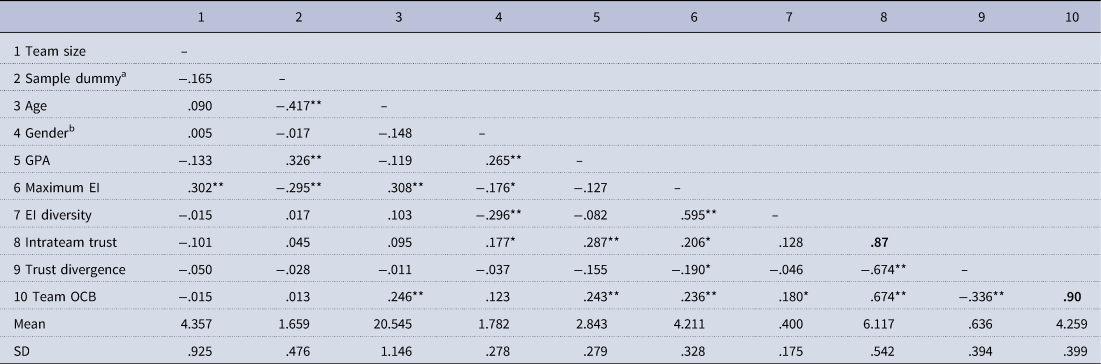
Table 2 presents the descriptive statistics and a correlation matrix for the study variables. The control variables were held constant in all analyses. The independent variables were mean-centered prior to creating the cross-product terms.
Means, standard deviations, and correlations among key variables (N = 129)

GPA, grade point average; EI, emotional intelligence; OCB, Organizational citizenship behavior.
a Dummy coded: 1 = two months interval; 2 = half an hour interval.
b Dummy coded: 1 = male; 2 = female.
Note. Scale reliabilities are on the diagonal in bold.
*p < .05. **p < .01.
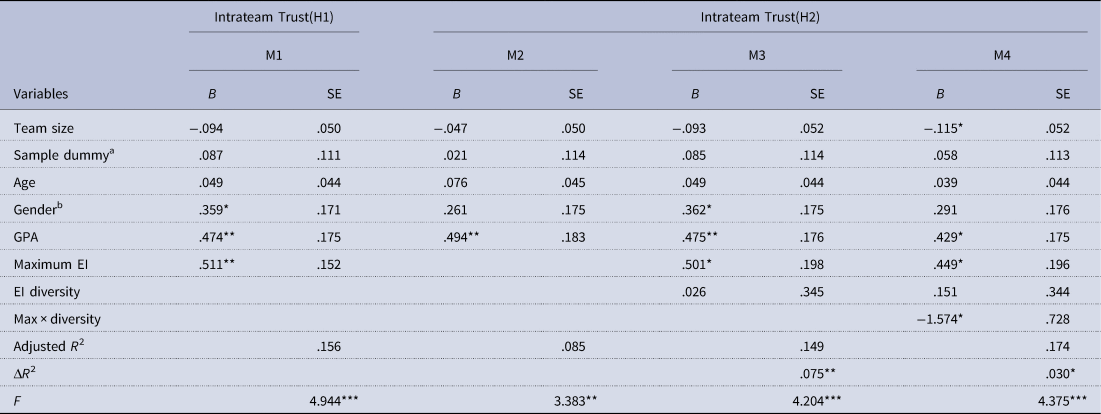
Hypotheses 1–4 were tested via ordinary least squares (OLS) and hierarchal multiple regression analysis. We hypothesized that maximum EI was positively related to intrateam trust (H1). Model 1 in Table 3 shows that the effect of maximum EI on intrateam trust was significant (B = .51, t = 3.37, p = .001), which supports H1.
Results of hypotheses 1–2 testing (N = 129)

Max × diversity, Maximum EI × EI diversity; GPA, grade point average.
a Dummy coded: 1 = two months interval; 2 = half an hour interval.
b Dummy coded: 1 = male; 2 = female.
Note. Unstandardized regression coefficients (i.e., B) were used.
*p < .05. **p < .01.
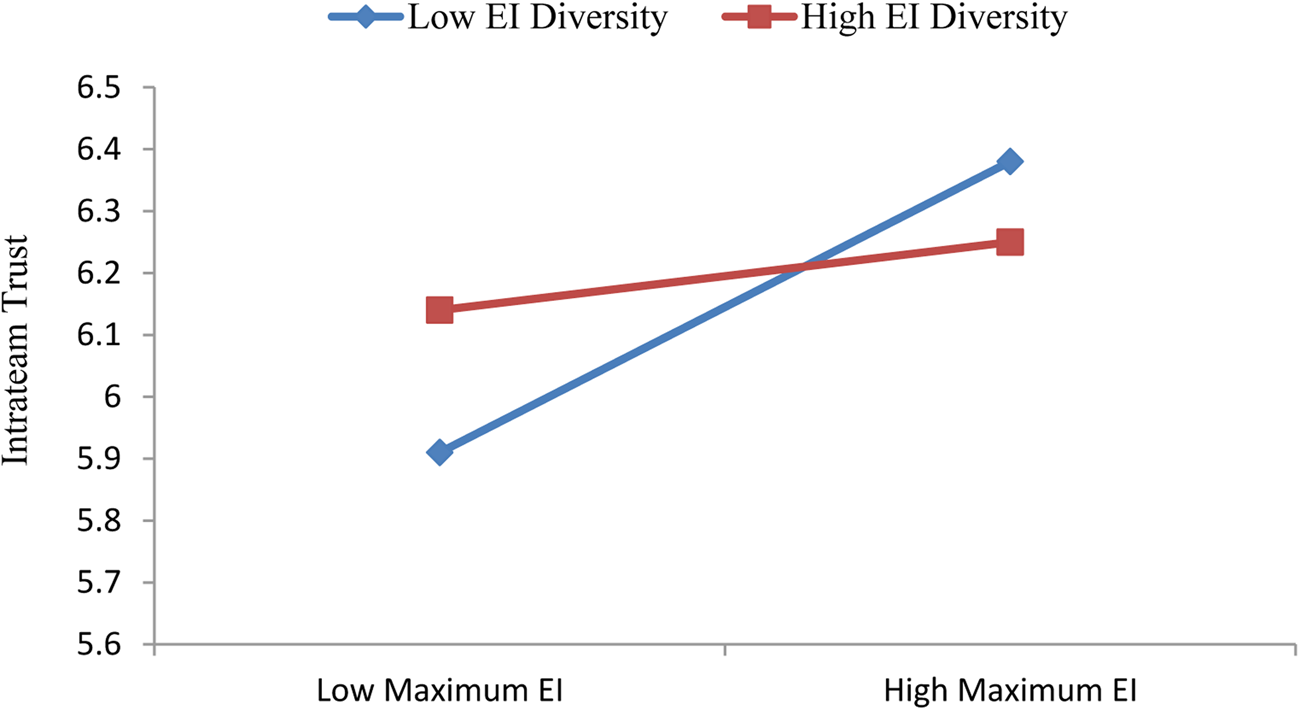
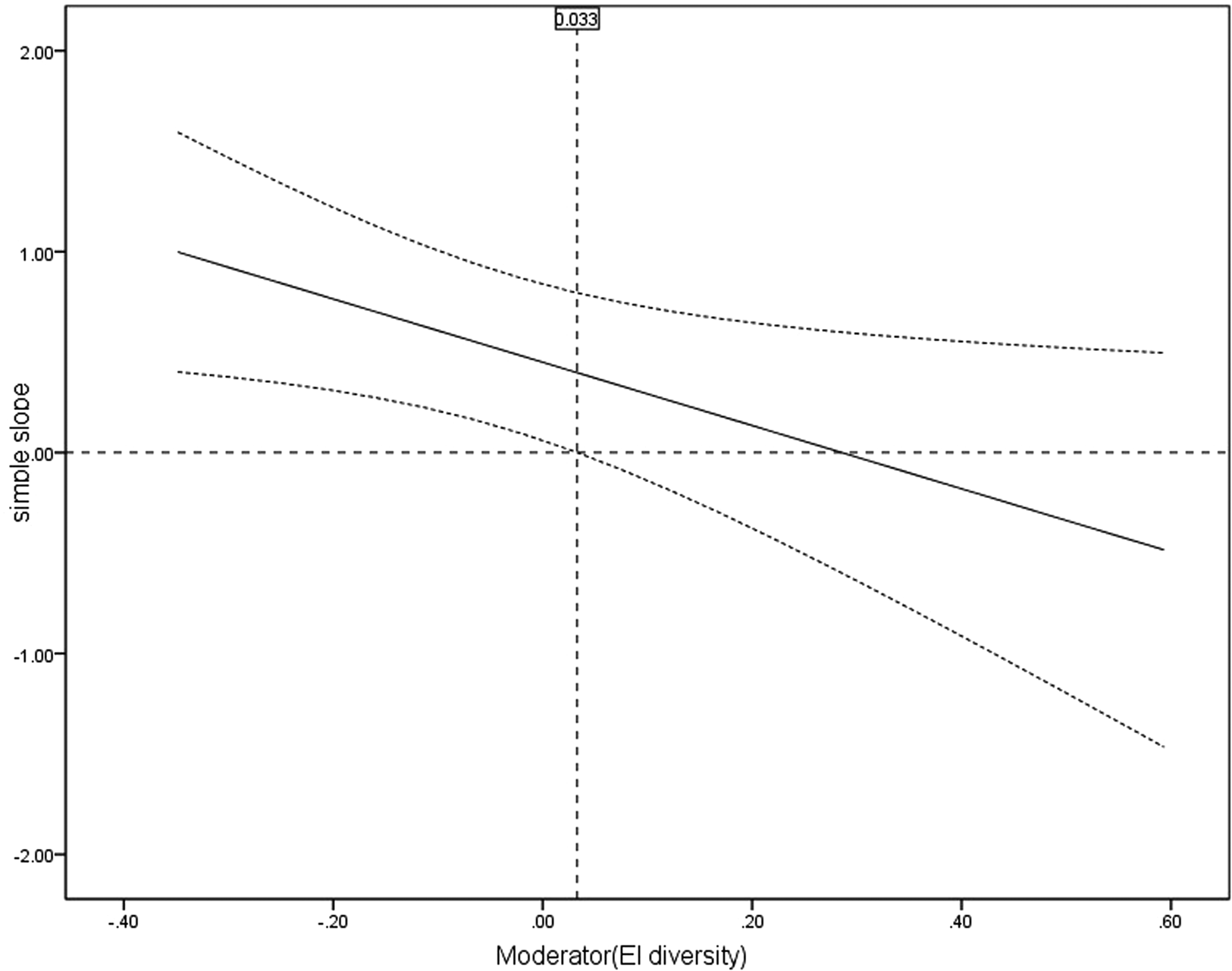
H2 stated that maximum EI would relate more positively to intrateam trust in lower levels of EI diversity contexts. The results showed a significant interaction between EI diversity and maximum EI in predicting intrateam trust (B = −1.57, t = −2.16, p = .033; Model 4, Table 3). Plotting this interaction confirms that the positive impact of maximum EI on intrateam trust is stronger under the condition of low (versus high) EI diversity (see Figure 2). According to methodological recommendations (Gardner, Harris, Li, Kirkman, & Mathieu, Reference Gardner, Harris, Li, Kirkman and Mathieu2017), we identified for each value of EI diversity whether maximum EI significantly predicted intrateam trust (De Cremer, van Dijke, Schminke, De Schutter, & Stouten, Reference De Cremer, van Dijke, Schminke, De Schutter and Stouten2018). We found a positive significant relationship between maximum EI (predictor) and intrateam trust (criterion) for EI diversity values lower than .43 (see Figure 3) or .19 standard deviations above the mean of EI diversity.
EI diversity moderates the effect of maximum EI on intrateam trust. Moderator values for ‘high’ and ‘low’ are the sample mean ± 1 standard deviation.

Regions of significance: Estimated coefficient of maximum EI on intrateam trust by EI diversity. Maximum EI predicts intrateam trust for EI diversity values ⩽ .43(or .19 standard deviations above the mean of .40). Region of significance values are based on centralized variables (95% CI).

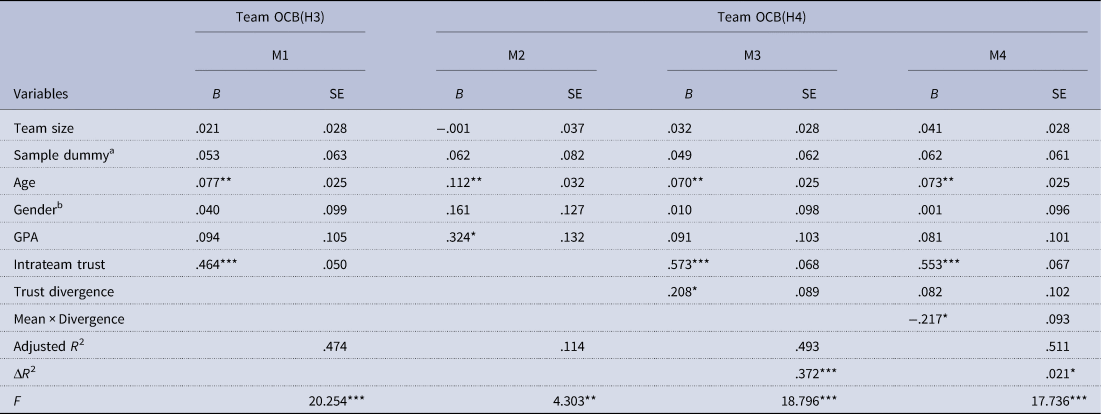
We hypothesized that intrateam trust was positively related to team OCB (H3). Model 1 in Table 4 shows that the effect of intrateam trust on team OCB was significant (B = .46, t = 9.23, p < .001), which supports H3.
Results of hypotheses 3–4 Testing (N = 129)

Note. Unstandardized regression coefficients (i.e., B) were used.
a Dummy coded: 1 = two months interval; 2 = half an hour interval.
b Dummy coded: 1 = male; 2 = female. Mean × Divergence = Intrateam trust × Trust divergence; GPA, grade point average.
*p < .05. **p < .01.
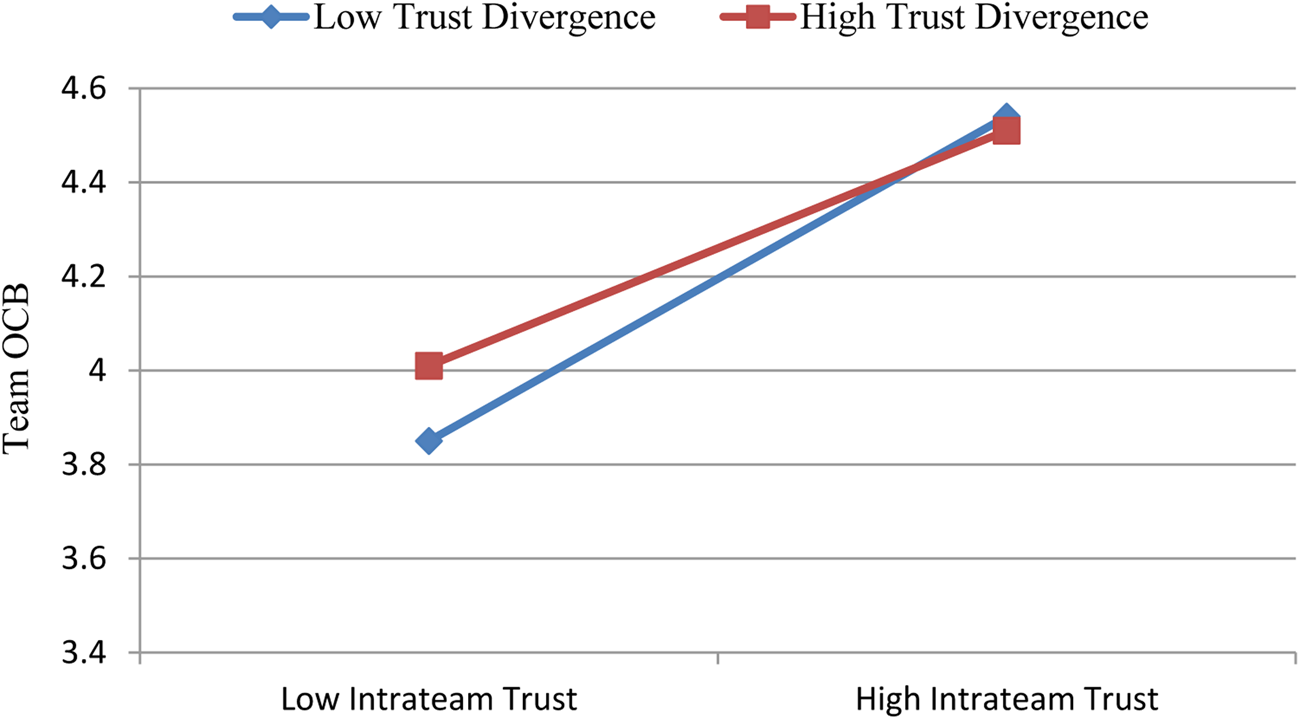
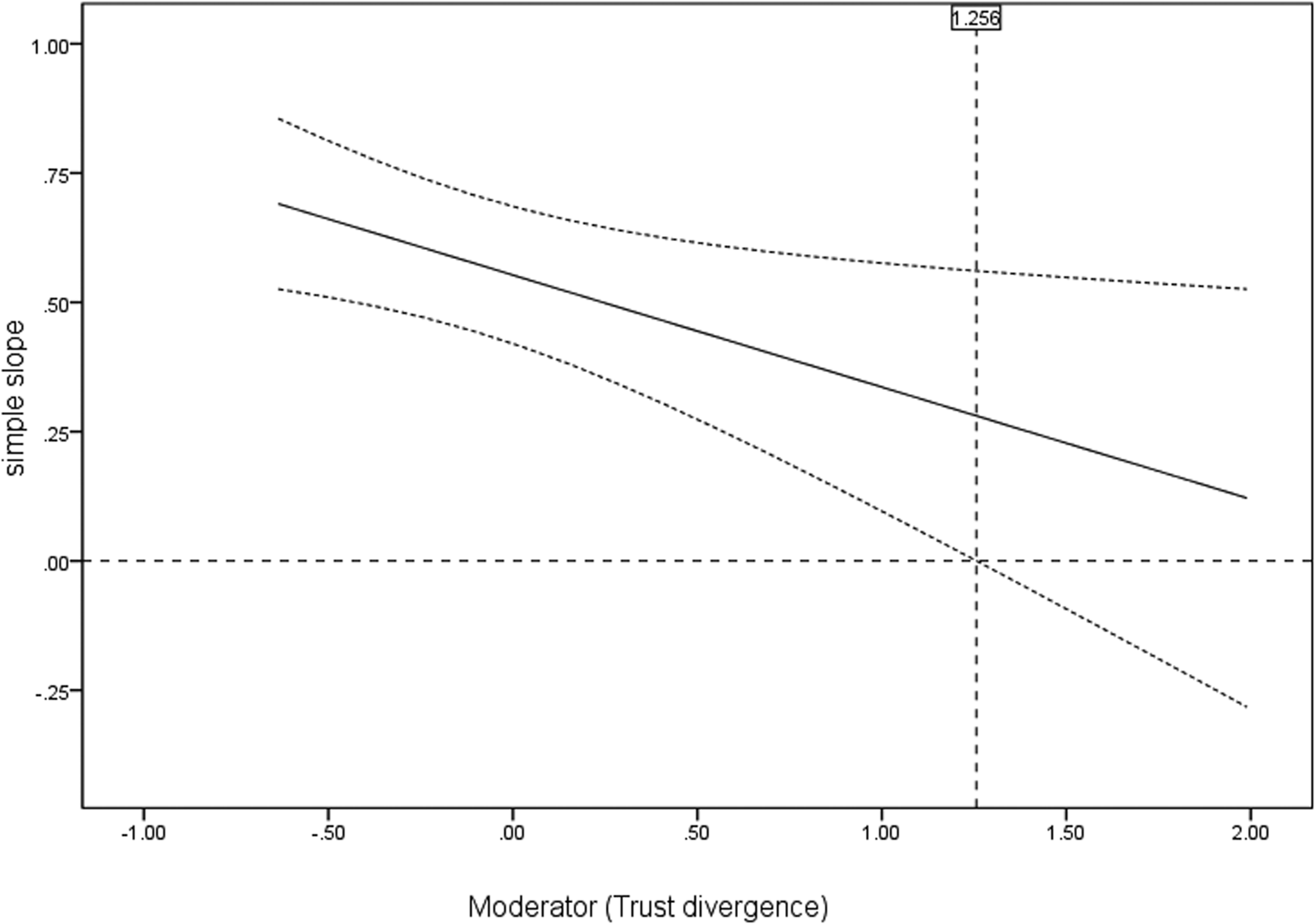
H4 stated that intrateam trust would relate more positively to team OCB in lower levels of trust divergence contexts. The results showed a significant interaction between intrateam trust and trust divergence in predicting team OCB (B = −.22, t = −2.34, p = .021; Model 4, Table 4). Plotting this interaction confirms that the positive effect of intrateam trust on team OCB is weaker under the condition of high (versus low) trust divergence (see Figure 4), with the simple slopes tests demonstrating both slopes are significantly different from zero (p < .05). To further decompose this interaction, we identified regions in the range of trust divergence in which the effect of intrateam trust on team OCB is significant or not (Mohr, Lichtenstein, & Janiszewski, Reference Mohr, Lichtenstein and Janiszewski2012). The Johnson–Neyman point for p < .05 (t = 1.98) for the trust divergence moderator occurs at a value of 1.89(see Figure 5), or 3.19 standard deviations above the mean of .64.
Trust divergence moderates the effect of intrateam trust on team OCB. Moderator values for ‘high’ and ‘low’ are the sample mean ± 1 standard deviation.

Regions of significance: Estimated coefficient of intrateam trust on team OCB by trust divergence. Intrateam trust predicts team OCB for trust divergence values ⩽ 1.89(or 3.19 standard deviations above the mean of .64). Region of significance values are based on centralized variables (95% CI).

Hypotheses 5–6 were tested via the bootstrapping-based path analytic approach of Edwards and Lambert (Reference Edwards and Lambert2007) in Mplus 6.11. After performing bootstrapping with a sample size of 2,000, we found that the indirect effect for maximum EI → intrateam trust → team OCB was .229 (p = .002), with 95% CI = [.081–.376]. The finding indicates that maximum EI was significantly positively related to team OCB via intrateam trust, which supports H5.
Hypothesis 6 proposed the moderating effect of trust divergence on the relationship between maximum EI and team OCB is mediated by intrateam trust. Results from the bootstrapping-based path analysis with a sample size of 2,000 show that the indirect effect for maximum EI on team OCB through intrateam trust is significantly positive for lower levels of trust divergence (−3 SD) (indirect effect = .40; 95% CI = [.10–.76]), whereas the indirect effect for maximum EI on team OCB through intrateam trust is not significant for higher levels of trust divergence ( + 3 SD)(indirect effect = .15; 95% CI = [−.01 to .48]). These results are consistent with the expectation that there is a significant indirect effect of maximum EI on team OCB via intrateam trust at relatively low, but not at high, levels of trust divergence, which supports H6.
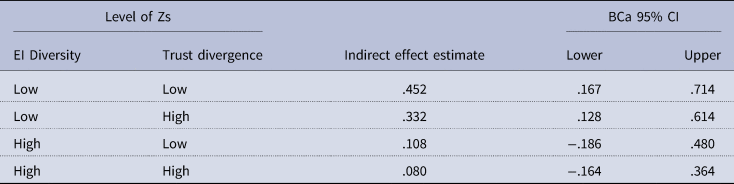
Hypothesis 7 proposed that the positive indirect relationship between maximum EI and team OCB via intrateam trust is stronger for lower levels of EI diversity and trust divergence than for higher levels of diversity and divergence. In line with prior research (Han, Han, & Brass, Reference Han, Han and Brass2014), we used the SPSS macro designed by Preacher, Rucker, and Hayes (Reference Preacher, Rucker and Hayes2007) to test this hypothesis. The results (see Table 5) show that the mediated relationship between maximum EI and team OCB via intrateam trust is significant when both EI diversity and trust divergence are low (indirect effect = .45; 95% CI = [.17–.71]) and are nonsignificant when both are high (indirect effect = .08; 95% CI = [−.16 to .36]. Therefore, H7 was supported.
Moderated mediation analysis: mediated relationship of maximum EI with team OCB via intrateam trust

BCa, Bias corrected and accellerated; CI, confidence interval.
Note. CIs containing zero are interpreted as nonsignificant. Moderator values are the sample mean ± 1 standard deviations. Results are based on 5,000 bootstrap samples. The analysis includes the same control variables as the Hypotheses 1–4 tests.
Discussion
The findings of this study provide critical insights into a commonly existing, yet understudied, EI phenomenon in team contexts. The maximum EI score of team members was an important predictor of team processes and outcomes. We found that EI diversity (i.e., dispersion in EI) moderated the relationship between maximum EI and intrateam trust. Trust divergence (i.e., dispersion in trust) moderated the relationship between intrateam trust and team OCB. Completing the picture, the relationship between maximum EI and team OCB was mediated by intrateam trust and this indirect relationship varied depending on EI diversity and trust divergence. Given the lack of empirical studies on team maximum EI, the current findings provide valuable insights for the EI area. Our findings that diversity of EI in teams strengthened the relationship between team maximum EI and team OCB through a combination of compositional and compilational emergence processes (i.e., mean trust and trust divergence) also points to the value of bringing the characteristics of the team itself (i.e., team diversity in EI) to bear in understanding team phenomena related to EI.
Theoretical implications
Our findings have several theoretical implications. First, although extant research has examined team EI in predicting team performance (e.g., Chang, Sy, & Choi, Reference Chang, Sy and Choi2012; Côté, Reference Côté, Neale, Mannix and Anderson2007; Elfenbein, Reference Elfenbein, Druskat, Sala and Mount2006), it focused only on in-role performance (i.e., team task performance). Team EI as an antecedent of team OCB has not received much attention. Considering that team task performance and team extra-role performance (e.g., team OCB) are two important aspects of group performance, our research contributes to painting a more complete picture of the effects of EI on team performance by addressing potential team EI factors that may foster team OCB.
Second, although EI has been found to be an antecedent of OCB at the individual level of analysis, it had not been studied with regard to team OCB. We added to the limited understanding of the origins of team OCB by identifying the role of team-level EI antecedents (both EI diversity and maximum EI) as well as the role of trust in eliciting the emergence of team OCB. Relatedly, our study extends the known consequences of maximum EI. To date, research has demonstrated the effects of maximum EI on aspects of in-role team performance. Our research is the first to examine whether and how maximum EI actually affect aspects of extra-role performance at a team level.
Third, we develop and provide empirical support for a more nuanced model that integrates the literatures on team EI composition, multilevel theory, and the strategic core role theory. Specifically, we extend recent theory and research by investigating new conditions under which team EI may have its effects on teams, and by exploring the sharing perceptions-related mediating and within-team dispersion-related moderating mechanisms through which team EI influence team outcomes. Furthermore, by modeling individual- and team-focused EI both at group level within the framework of integrating the strategic core role theory with multilevel theory, we extend prior research that has investigated the positive effects of EI on performance either at individual level (e.g., Cole, Cox, & Stavros, Reference Cole, Cox and Stavros2019; Farh, Seo, & Tesluk, Reference Farh, Seo and Tesluk2012; Silva & Coelho, Reference Silva and Coelho2019) or at team level (e.g. Hjertø & Paulsen, Reference Hjertø and Paulsen2016; Wang, Reference Wang2015); specifically, we identified the role of combining team-focused EI with individual-focused EI in predicting intrateam trust for team outcomes which is contingent on trust divergence.
Finally, our contribution to the literatures on trust and EI lies in demonstrating the importance of considering the dispersion that exists within teams for improving conceptual understanding of these team-level constructs. Research on within-team dispersion of trust and EI is meaningful because it captures unique properties of trust and EI that only emerge at the team level but not at the individual level of analysis. Our findings regarding EI diversity and trust divergence demonstrate that within-team dispersion operates as a contingency factor that moderates the relationships of group constructs with relevant team-level processes and outcomes. Our study answers calls for research on dispersion levels of constructs (De Jong & Dirks, Reference De Jong and Dirks2012) and enriches this line of research by indicating that dispersion is a substantively meaningful property that deserves attention.
Practical implications
The findings of this study provide several practical implications. First, our findings offer guidelines and practical suggestions for creating staffing decision rules in team-based organizations. Results of this research indicate the critical effect a single member has on team OCB. The findings suggest that a single maximum EI member can improve team effectiveness. Teams with a highest EI member with a high score on EI will perform better than teams with the highest EI member with a lower EI score. These findings imply performance is reduced to the best-member's level. Managers need to consider these findings when choosing individuals for teams. Results of the current study indicate that low variability is predictive of maximum EI for team effectiveness. Teams staffed with a mixture of high EI and low-EI members will be less effective than more homogeneous teams. This implies that staffing specialists should consider the existing EI composition of a team when selecting new members. In regard to EI, selecting team members who are similar optimizes the effect of maximum EI on intrateam trust for team OCB.
Second, it has been suggested that an employee's OCB is only manifested by his/her voluntariness(Organ, Reference Organ1997), so it seems that OCB may be difficult to be motivated by managers and institutional arrangements, which would partly explain why many researchers have investigated the antecedents of OCB by focusing on the employee's individual traits. By elevating OCB from the individual level to the team level and examining the effects of maximum EI, we provide new insight into the ways in which OCB can be managed and enhanced within organizations. Specifically, our findings suggest that EI takes its relationships with team member behavior through the expression of positive affect or interpersonal affect regulation, which is a behavior that can be fully enacted and managed; therefore, acknowledge the potential for organizations to capitalize on our results. OCB is interactive and ‘social’ in nature; a focus on employees' positive emotion may be an effective way to arouse voluntary behaviors. A practical implication of this is that training could be developed to enhance employees' use of a wide range of interpersonal affect regulation strategies. For example, training teammates in the use of affect-improving interpersonal emotion regulation behaviors, like praising teammates' merits, confirming their achievements, demonstrating authentic interest, and listening to their concerns, might maximize the beneficial effects of positive affectivity on team OCB.
Limitations and future directions
As with all studies, our research has limitations. First, participants in this study were students working in course-related project teams for course credit, which may threaten the external validity of our results. Future research could replicate the findings of this study by examining whether the pattern of findings occurs in organizational settings in which the work is performed by project teams or other kinds of team (e.g., customer-service team).
Second, the team maximum EI as-input model may be best invoked to predict the condition involving low levels of EI diversity examined in the present study. Beyond EI diversity, a host of other factors (e.g., task interdependence, team personality composition) could influence the relationships between maximum EI and team effectiveness. Furthermore, explanations of team effectiveness can improve as researchers consider a three-way interaction effect among maximum EI, task characteristics (e.g., disjunctive task, additive task), and the characteristics of the team itself (e.g., diversity in personality, team cognitive ability) to predict team processes and outcomes, comparing to the explanation offered by either two-way interaction in isolation.
Third, we relied on several untested theoretical assumptions. We theoretically assumed but did not test that both positive affectivity and interpersonal regulation of affect as affective transmitting processes in connecting team maximum EI and intrateam trust. We have also argued that maximum EI individuals would emerge as leaders and occupy the centrality of social networks. We invite further research to directly assess positive affect or interpersonal regulation of affect strategies and examine whether the maximum EI individual would take the core role by assessing central status in teams or emerging as a leader.
Finally, the design of the study cannot establish causality. Future experimental research using randomized controlled designs might further investigate the impact of maximum EI on team functioning. For example, an intervention study might randomly assign teams to experimental and control conditions and then examine the impact of attempting to raise the EI of one team member in the experimental group teams to a high level through EI training, following which the team level functioning of the experimental group teams and the control group teams could be compared after several months.
Conclusion
Drawing upon integration of the strategic core role theory with multilevel theory, we proposed and tested an integrative model in which the nature of the team itself (i.e., EI diversity), mean trust, and team trust divergence interact with the maximum team members' EI processes in predicting team OCB. The results indicated that the relationship of maximum EI with team OCB was mediated by intrateam trust and this relationship was contingent upon both EI diversity (an input-based factor) and trust divergence (a process-based factor) in teams. These findings advance our understanding of the role of EI in team settings by demonstrating that both individual-focused and group-focused EI factors affect team performance via a combination of convergent and divergent trust perceptions at the team level. We call for additional research to continue to investigate the specific compositional effects of EI at the team level, both independently and jointly, in influencing team processes for team outcomes.
Acknowledgement
The study reported here was supported by the Natural Science Foundation of China (No. 71971141).
Financial support
The data that support the findings of this study are available on request from the corresponding author.
Conflict of interest
The authors declare no conflict of interest.