Introduction
Anorexia nervosa (AN) is characterized by restricted eating and severely low weight. Eating disorder-related psychopathology and starvation have widespread and profound effects on cognitive functioning (Lena et al. Reference Lena, Fiocco and Leyenaar2004; Southgate et al. Reference Southgate, Tchanturia, Treasure, Wood, Allen and Pantelis2009). Cognitive alterations in AN patients may exist prior to the onset of the disorder and contribute to its development, or they may be disease related and potentially sustain the disorder by mechanisms of reinforcement (Kaye et al. Reference Kaye, Fudge and Paulus2009).
With regard to memory performance, there is ample evidence to suggest that eating disorder-related information is selectively processed by AN patients, resulting in enhanced memory function for AN-related stimuli in incidental, explicit and self-referential memory tasks (‘memory bias’) (Sebastian et al. Reference Sebastian, Williamson and Blouin1996; Hermans et al. Reference Hermans, Pieters and Eelen1998; Williamson et al. Reference Williamson, Muller, Reas and Thaw1999; Pietrowsky et al. Reference Pietrowsky, Krug, Fehm and Born2002; Lee & Shafran, Reference Lee and Shafran2004; Suslow et al. Reference Suslow, Ohrmann, Lalee-Mentzel, Donges, Arolt and Kersting2004; Nikendei et al. Reference Nikendei, Weisbrod, Schild, Bender, Walther, Herzog and Friederich2008; Tekcan et al. Reference Tekcan, Caglar Tas, Topcuoglu and Yucel2008). However, studies that have focused on various facets of general memory performance have shown a range of contradictory results. Some authors have reported immediate (Hamsher et al. Reference Hamsher, Halmi and Benton1981; Jones et al. Reference Jones, Duncan, Brouwers and Mirsky1991; Green et al. Reference Green, Elliman, Wakeling and Rogers1996; Kingston et al. Reference Kingston, Szmukler, Andrewes, Tress and Desmond1996; Mathias & Kent, Reference Mathias and Kent1998; Bayless et al. Reference Bayless, Kanz, Moser, McDowell, Bowers, Andersen and Paulsen2002; Moser et al. Reference Moser, Benjamin, Bayless, McDowell, Paulsen, Bowers, Arndt and Andersen2003) and delayed (Jones et al. Reference Jones, Duncan, Brouwers and Mirsky1991; Mathias & Kent, Reference Mathias and Kent1998; Bayless et al. Reference Bayless, Kanz, Moser, McDowell, Bowers, Andersen and Paulsen2002) verbal recall deficits in acute AN patients whereas others have revealed normal (Szmukler et al. Reference Szmukler, Andrewes, Kingston, Chen, Stargatt and Stanley1992; Mathias & Kent, Reference Mathias and Kent1998; Lauer et al. Reference Lauer, Gorzewski, Gerlinghoff, Backmund and Zihl1999; Moser et al. Reference Moser, Benjamin, Bayless, McDowell, Paulsen, Bowers, Arndt and Andersen2003; Connan et al. Reference Connan, Murphy, Connor, Rich, Murphy, Bara-Carill, Landau, Krljes, Ng, Williams, Morris, Campbell and Treasure2006; Nandrino et al. Reference Nandrino, Doba, Lesne, Christophe and Pezard2006; Bosanac et al. Reference Bosanac, Kurlender, Stojanovska, Hallam, Norman, McGrath, Burrows, Wesnes, Manktelow and Olver2007) or even superior (Hatch et al. Reference Hatch, Madden, Kohn, Clarke, Touyz, Gordon and Williams2010) immediate verbal recall and normal delayed verbal recall (Kingston et al. Reference Kingston, Szmukler, Andrewes, Tress and Desmond1996; Mathias & Kent, Reference Mathias and Kent1998; Nandrino et al. Reference Nandrino, Doba, Lesne, Christophe and Pezard2006; Bosanac et al. Reference Bosanac, Kurlender, Stojanovska, Hallam, Norman, McGrath, Burrows, Wesnes, Manktelow and Olver2007; Hatch et al. Reference Hatch, Madden, Kohn, Clarke, Touyz, Gordon and Williams2010). By contrast, verbal recognition performance seems to be less affected in AN (Palazidou et al. Reference Palazidou, Robinson and Lishman1990; Mathias & Kent, Reference Mathias and Kent1998; Bayless et al. Reference Bayless, Kanz, Moser, McDowell, Bowers, Andersen and Paulsen2002; Moser et al. Reference Moser, Benjamin, Bayless, McDowell, Paulsen, Bowers, Arndt and Andersen2003; Connan et al. Reference Connan, Murphy, Connor, Rich, Murphy, Bara-Carill, Landau, Krljes, Ng, Williams, Morris, Campbell and Treasure2006; Hatch et al. Reference Hatch, Madden, Kohn, Clarke, Touyz, Gordon and Williams2010).
As a result of low weight, chronic AN is associated with severe brain alterations that make it difficult to differentiate between state- and trait-related cognitive alterations. Although there is some evidence that starvation-driven cognitive alterations improve with weight restoration, subtle impairments in certain cognitive domains, such as cognitive flexibility, are found to persist (Roberts et al. Reference Roberts, Tchanturia, Stahl, Southgate and Treasure2007). Longitudinal studies on memory performance have been conducted with the aim of distinguishing trait from state features (Hamsher et al. Reference Hamsher, Halmi and Benton1981; Szmukler et al. Reference Szmukler, Andrewes, Kingston, Chen, Stargatt and Stanley1992; Green et al. Reference Green, Elliman, Wakeling and Rogers1996; Kingston et al. Reference Kingston, Szmukler, Andrewes, Tress and Desmond1996; Lauer et al. Reference Lauer, Gorzewski, Gerlinghoff, Backmund and Zihl1999; Moser et al. Reference Moser, Benjamin, Bayless, McDowell, Paulsen, Bowers, Arndt and Andersen2003; Gillberg et al. Reference Gillberg, Rastam, Wentz and Gillberg2007; Chui et al. Reference Chui, Christensen, Zipursky, Richards, Hanratty, Kabani, Mikulis and Katzman2008; Hatch et al. Reference Hatch, Madden, Kohn, Clarke, Touyz, Gordon and Williams2010). However, a major limitation of these studies has been that patients failed to reach a normal weight (Hamsher et al. Reference Hamsher, Halmi and Benton1981; Szmukler et al. Reference Szmukler, Andrewes, Kingston, Chen, Stargatt and Stanley1992; Green et al. Reference Green, Elliman, Wakeling and Rogers1996; Kingston et al. Reference Kingston, Szmukler, Andrewes, Tress and Desmond1996; Lauer et al. Reference Lauer, Gorzewski, Gerlinghoff, Backmund and Zihl1999; Hatch et al. Reference Hatch, Madden, Kohn, Clarke, Touyz, Gordon and Williams2010) and/or failed to include a control group (Lauer et al. Reference Lauer, Gorzewski, Gerlinghoff, Backmund and Zihl1999; Moser et al. Reference Moser, Benjamin, Bayless, McDowell, Paulsen, Bowers, Arndt and Andersen2003) or to undertake neuropsychological pre-assessment (Gillberg et al. Reference Gillberg, Rastam, Wentz and Gillberg2007; Chui et al. Reference Chui, Christensen, Zipursky, Richards, Hanratty, Kabani, Mikulis and Katzman2008). Because of the long duration of the disorder, investigating long-time recovered AN patients is a suitable alternative method for the investigation of trait alterations and for more effectively controlling for the confounding factors of starvation and emaciation.
Two cross-sectional studies have reported conflicting findings when comparing acute AN patients and weight-restored AN patients who had reached and held a weight in the normal range for at least 3 (Bosanac et al. Reference Bosanac, Kurlender, Stojanovska, Hallam, Norman, McGrath, Burrows, Wesnes, Manktelow and Olver2007) and 6 months (Jones et al. Reference Jones, Duncan, Brouwers and Mirsky1991). Whereas Jones et al. (Reference Jones, Duncan, Brouwers and Mirsky1991) detected verbal recall deficits in acute AN that did not persist in weight-restored patients, Bosanac et al. (Reference Bosanac, Kurlender, Stojanovska, Hallam, Norman, McGrath, Burrows, Wesnes, Manktelow and Olver2007) only found recall deficits in weight-restored patients.
Diagnostic issues may contribute to such conflicting findings in the literature (Southgate et al. Reference Southgate, Tchanturia, Treasure, Wood, Allen and Pantelis2009); to our knowledge, all previous studies on memory performance in AN did not differentiate between AN subtypes, with only one study having exclusively assessed restricting-type AN patients (Nandrino et al. Reference Nandrino, Doba, Lesne, Christophe and Pezard2006).
The aim of the present study was to compare aspects of memory performance in DSM-IV (APA, 1994) ‘restricting-type’ (AN-RESTR), ‘binge-eating/purging-type’ (AN-PURGE) and long-time ‘weight-restored’ AN patients (AN-W-R) and healthy controls (CONTROL). We hypothesized that general memory performance would be impaired in AN patients independent of diagnostic subgroup and stage of the disease (i.e. in AN-RESTR, AN-PURGE and AN-W-R) compared with the controls.
Method
Sample
In a cross-sectional comparison study, 34 female patients with AN-RESTR were compared with 19 female patients with AN-PURGE, 16 weight-restored AN patients (11 with former restricting subtype AN) (AN-W-R) and 30 female controls (CONTROL). Patients with acute manifestations of AN were recruited consecutively from the in-patient units of our department within their first week of admission. Weight-restored AN patients were recruited from patient registers at our hospital. Control participants were recruited through advertisements and were healthy females with normal-range weight and without a lifetime diagnosis of a psychiatric illness. Diagnoses were made using the German version of SCID-I (First et al. Reference First, Spitzer, Gibbon and Williams1997; Wittchen et al. Reference Wittchen, Zaudig and Fydrich1997). To be included in the study groups, diagnostic criteria of the respective AN subtype (‘restricting type’, ‘binge-eating/purging type’) had to have been fulfilled for at least 24 months prior to participation or for the entire duration of illness if less than 24 months. Criteria for inclusion in the group of weight-restored AN patients were adopted in line with previous studies (Tchanturia et al. Reference Tchanturia, Morris, Surguladze and Treasure2002, Reference Tchanturia, Morris, Anderluh, Collier, Nikolaou and Treasure2004; Holliday et al. Reference Holliday, Tchanturia, Landau, Collier and Treasure2005; Southgate et al. Reference Southgate, Tchanturia, Treasure, Wood, Allen and Pantelis2009) and included a history of DSM-IV (APA, 1994) AN and a body mass index (BMI)>18.5 kg/m2, with regular menstruation according to Morgan–Russell outcome criteria (Morgan & Hayward, Reference Morgan and Hayward1988) and no contraceptive medication, and normal eating patterns for at least 12 months. General inclusion criteria were age between 18 and 35 years, right-handedness, normal or corrected-to-normal vision, and native German language. Exclusion criteria were a life-threatening condition, insufficient knowledge of the German language, bipolar disorder, or a medical history of psychosis or craniocerebral injury, and psychopharmacological medication for control participants. Weight-restored AN patients and control participants each received €20 for participation. Written, informed consent was obtained from all participants and the study was approved by the local Ethics Committee of the University of Heidelberg Medical School (No. 320/2005).
Procedure and design
Upon arrival at the study location, participants were informed about the course and duration of the study. All participants were asked to avoid eating or drinking caffeinated beverages for 1 h and alcohol for 24 h before testing. The German version of SCID-I (First et al. Reference First, Spitzer, Gibbon and Williams1997; Wittchen et al. Reference Wittchen, Zaudig and Fydrich1997) was used for mental diagnosis. Interviews were conducted by trained psychologists or research assistants. Height and body weight were measured and registered. Further testing included vision and handedness (Oldfield, Reference Oldfield1971).
Participants completed a battery of self-report questionnaires including the German versions of the nine-item depression module of the Patient Health Questionnaire (PHQ-9; Kroenke & Spitzer, Reference Kroenke and Spitzer2002; Gräfe et al. Reference Gräfe, Zipfel, Herzog and Löwe2004; Lowe et al. Reference Lowe, Spitzer, Grafe, Kroenke, Quenter, Zipfel, Buchholz, Witte and Herzog2004), the Hospital Anxiety and Depression Scale (HADS; Zigmond & Snaith, Reference Zigmond and Snaith1983; Herrmann & Buss, Reference Herrmann and Buss1994; Herrmann et al. Reference Herrmann, Buss and Snaith1995) and the Eating Disorder Inventory-2 (EDI-II; Garner, Reference Garner1991; Thiel et al. Reference Thiel, Jacobi, Horstmann, Paul, Nutzinger and Schussler1997; Paul & Thiel, Reference Paul and Thiel2005). To control for verbal- and education-related intelligence, participants completed the Multiple Selection Vocabulary Test (MWT-B; Lehrl, Reference Lehrl2005).
Neuropsychological assessment of memory performance comprised three subtests from the Wechsler Memory Scale – Revised (WMS-R; Wechsler, Reference Wechsler1945, Reference Wechsler1987; Haerting et al. Reference Haerting, Markowitsch, Neufeld, Calabrese, Deisinger and Kessler2000) that assessed logical short- and long-term memory and working memory. The logical memory subtests consist of two short stories that are read aloud to the participant. The participant is subsequently asked to retell each of the stories as closely as possible to the original immediately after hearing the story (immediate recall) and after an interval of 30 min (delayed recall). A maximum score of 50 is attainable for the immediate recall and for the delayed recall task. The digit span subtests allow conclusions to be drawn regarding short-term memory capacity (digit span forwards) and working memory capacity (digit span backwards).
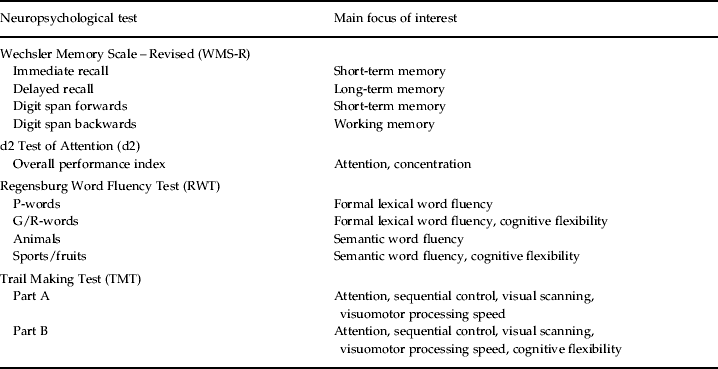
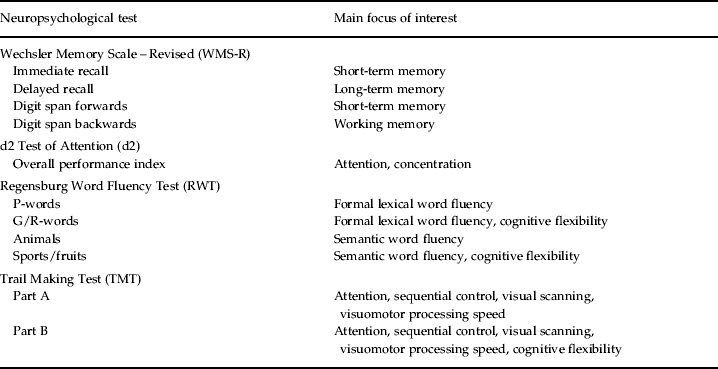
To validate the neuropsychological memory performance, additional neuropsychological tasks assessing attention/selective attention (d2 Test of Attention, d2; Brickenkamp, Reference Brickenkamp1972, Reference Brickenkamp2002), lexical and semantic word fluency (Regensburg Word Fluency Test, RWT; Aschenbrenner et al. Reference Aschenbrenner, Tucha and Lange2000), visuomotor processing speed (Trail Making Test Part A, TMT-A; Reitan, Reference Reitan1958) and cognitive flexibility (TMT-B; Reitan, Reference Reitan1958) were used. Before each test, oral and written instructions were delivered by a research assistant. Neuropsychological testing lasted approximately 60 min. Table 1 presents the individual neuropsychological tests included in the experiment and a brief description of their main focus of interest.
Neuropsychological tests and the main focus of interest
Statistical analysis
Clinical, demographic and psychometric data, and also neuropsychological test data, were analysed using Statistica version 8 (Statsoft Inc., USA). ANOVAs were conducted with the between-factor ‘Group’ (AN-RESTR v. AN-PURGE v. AN-W-R v. CONTROL) and with clinical scores (age, BMI) serving as dependent variables. To control for potential differences in the time patients have been exposed to the negative impact of starvation (i.e. duration of illness), an ANOVA was performed with the between-factor ‘Group’ (AN-RESTR v. AN-PURGE v. AN-W-R). Differences in educational level were examined using a χ2 test on the number of participants with A-levels. With regard to psychometric and neuropsychological evaluation, ANOVAs were performed with the between-factor ‘group’ (AN-RESTR v. AN-PURGE v. AN-W-R v. CONTROL) and with psychometric test scores (PHQ-9, HADS, EDI-II, MWT-B) and neuropsychological test scores (WMS-R, d2, RWT, TMT) as dependent variables. As preceding exploratory analyses did not reveal any statistical differences between AN-RESTR and AN-PURGE groups with respect to the neuropsychological test results or between weight-restored patients with former restricting and those with binge-eating/purging subtype with respect to the WMS test results, the two subtypes were subsumed to form a single AN-W-R group. Main effects were further examined using Fisher's least significant difference (LSD) post-hoc tests. The results were adjusted using the Bonferroni approach.
Spearman correlations were calculated between the duration of illness and WMS-R test results in the patient groups and also between WMS-R immediate recall/delayed recall scores and all other neuropsychological test results within the four study groups. Concerning potential influences of mental co-morbidity, depression and anxiety were controlled for by including PHQ-9 and HADS anxiety subscale scores as a covariate in the ANOVAs. To test for potential influences of psychopharmacological medication, ANOVAs were also recalculated with drug-free participants only. A p value <0.05 (two-tailed) was considered statistically significant.
Results
Clinical, demographic and psychometric assessment of participants
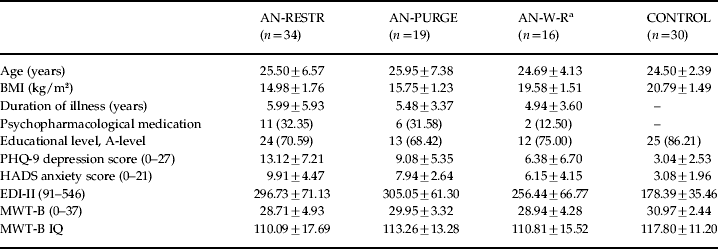
Table 2 presents the results of the clinical, demographic and psychometric assessments for AN-RESTR, AN-PURGE, AN-W-R and CONTROL. To test for differences with regard to clinical variables, ANOVAs were conducted with the between-factor ‘group’ (AN-RESTR v. AN-PURGE v. AN-W-R v. CONTROL) and with clinical scores (age, BMI) as the dependent variable.
Clinical, demographic and psychometric characteristics of patients with restrictive-type anorexia nervosa (AN-RESTR), purging-type AN (AN-PURGE), weight-restored AN (restrictive and purging type; AN-W-R) and control participants (CONTROL)
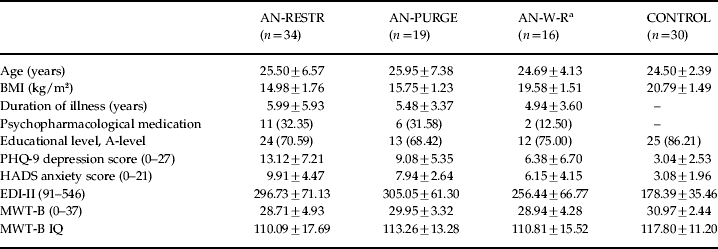
BMI, Body mass index; PHQ-9, nine-item Patient Health Questionnaire; HADS, Hospital Anxiety Depression Scale; EDI-II, Eating Disorder Inventory 2; MWT-B, Multiple Selection Vocabulary Test.
Values are given as n (%) or mean ± standard deviation.
a Length of time to recovery=5.69±3.57 years.
Groups did not differ with respect to age [F(3, 95)=0.36, p<0.781]. AN-RESTR and AN-PURGE groups showed a significantly lower BMI than AN-W-R and CONTROL [F(3, 93)=89.3, p<0.001]. There was no significant difference in BMI between AN-RESTR and AN-PURGE groups (p=0.402) or between AN-W-R and CONTROL (p=0.109). An ANOVA was also conducted with the between-factor ‘Group’ (AN-RESTR v. AN-PURGE v. AN-W-R) and with ‘duration of illness’ serving as the dependent variable. With respect to the duration of illness, patient groups (AN-RESTR, AN-PURGE, AN-W-R) showed no differences [F(2, 66)=0.3, p=0.771]. At the time of the experiment, 11 of the 34 AN-RESTR patients, six of the 19 AN-PURGE patients and two of the 16 AN-W-R patients were receiving psychopharmacological medication (AN-RESTR: antidepressants n=4, neuroleptic drugs n=14; AN-PURGE: antidepressants n=1, neuroleptic drugs n=4, benzodiazepines n=1; AN-W-R: antidepressants n=2). In line with defined exclusion criteria, all controls were drug free.
Potential differences in educational level were tested for using a χ2 test on the number of participants with A-levels. Patient groups did not differ from the CONTROL group with respect to educational level (AN-RESTR, p=0.137; AN-PURGE, p=0.138; AN-W-R, p=0.347).
With regard to psychometric variables, ANOVAs were conducted with the between-factor ‘group’ (AN-RESTR v. AN-PURGE v. AN-W-R v. CONTROL) and with psychometric test scores (PHQ-9, HADS, EDI-II, MWT-B) as dependent variables. For PHQ-9 depression scores, the main effect of ‘group’ [F(3, 74)=13.1, p<0.001] proved significant, with higher depression scores being found in AN-RESTR than in both AN-W-R (p=0.006) and CONTROL (p=0.001) and higher depression scores in AN-PURGE than in CONTROL (p=0.035). For HADS anxiety scores, the significant main effect of ‘group’ [F(3, 86)=18.3, p<0.001] was due to higher scores in AN-RESTR compared to both AN-W-R (p<0.003) and CONTROL (p<0.001) and also in AN-PURGE compared to CONTROL (p<0.001) and in AN-W-R compared to CONTROL (p<0.004). No difference was found between AN-PURGE and AN-W-R (p=0.073). For EDI-II scores, a significant effect of ‘group’ [F(3, 75)=20.0, p<0.001] was found, with higher EDI-II scores in AN-RESTR (p<0.038) and AN-PURGE (p<0.028) compared to AN-W-R and also in AN-W-R compared to CONTROL (p=0.001). No difference was found between patient groups and the CONTROL group with respect to MWT-B scores [F(3, 95)=2.0, p<0.117].
Neuropsychological assessment
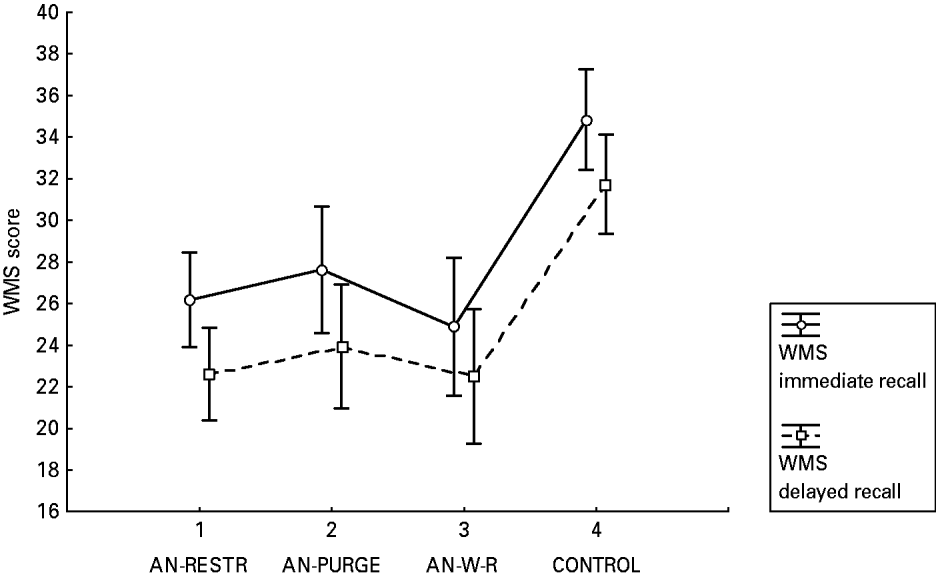
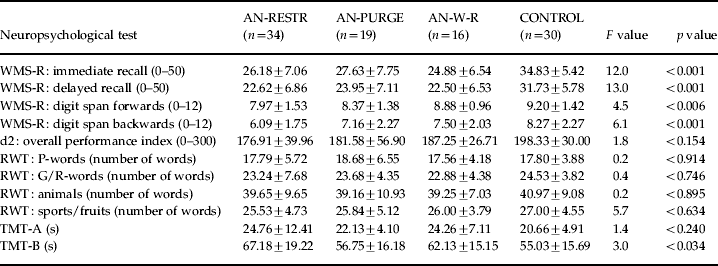
Table 3 presents neuropsychological test scores for AN-RESTR, AN-PURGE, AN-W-R and CONTROL groups. ANOVAs were conducted with the between-factor ‘group’ (AN-RESTR v. AN-PURGE v. AN-W-R v. CONTROL) and with neuropsychological test scores (WMS-R, d2, RWT, TMT) as dependent variables. Significant main effects of ‘group’ were found for WMS-R immediate recall scores [F(3, 95)=12.0, p<0.001; see Fig. 1] and WMS-R delayed recall scores [F(3, 95)=13.0, p<0.001; see Fig. 1], with patient groups (AN-RESTR, AN-PURGE, AN-W-R) showing lower scores than the CONTROL group (all p<0.001). No differences were found between individual patient groups. In comparison to population-based reference data (Haerting et al. Reference Haerting, Markowitsch, Neufeld, Calabrese, Deisinger and Kessler2000), the CONTROL group scored in the medium to upper range (67th rank for WMS-R immediate recall and 78th percentile rank for WMS-R delayed recall), whereas the patient groups scored in the lower range (14th to 29th percentile rank for WMS-R immediate recall and 19th to 28th percentile rank for WMS-R delayed recall). WMS-R test results for immediate and delayed recall remained significant after conservative Bonferroni adjustment for 11 statistical tests. There was no correlation between memory performance in terms of immediate and delayed recall scores and duration of illness in patient groups (all p>0.050). Following Bonferroni adjustments, group differences with respect to all other neuropsychological tests failed to reach the level of significance. There was no correlation between test scores and WMS-R immediate or delayed recall scores within the four groups examined.
Test results of the Wechsler Memory Scale – Revised (WMS-R) for immediate and delayed recall for patients with restrictive-type anorexia nervosa (AN-RESTR; n=34), purging-type AN (AN-PURGE; n=19), weight-restored AN (restrictive- and purging-type AN; AN-W-R; n=16), and control participants (CONTROL; n=30). The results are shown as means with 95% confidence intervals. Main effects group: WMS immediate recall [F(3, 95)=12.0, p<0.001]; WMS delayed recall [F(3, 95)=13.0, p<0.001].

Neuropsychological test results for patients with restrictive-type anorexia nervosa (AN-RESTR), purging-type AN (AN-PURGE), weight-restored AN (restrictive and purging type; AN-W-R) and control participants (CONTROL)

WMS-R, Wechsler Memory Scale – Revised; d2, d2 Test of Attention; RWT, Regensburg Word Fluency Test; TMT, Trail Making Test.
Values are given as mean±standard deviation.
F and p values of the main effect ‘Group’ of ANOVAs conducted.
As a meta-analytic review (Roberts et al. Reference Roberts, Tchanturia, Stahl, Southgate and Treasure2007) revealed that AN patients and weight-restored individuals show impaired cognitive flexibility (e.g. TMT-B), TMT-B findings are presented here in more detail. Prior to Bonferroni adjustment, a significant main effect of group was found for TMT-B test scores [F(3, 92)=3.0, p<0.034]. Post-hoc analyses showed higher scores for AN-RESTR compared to both AN-PURGE (p<0.040) and CONTROL (p<0.006) and also higher scores for AN-W-R compared to both AN-PURGE (p<0.036) and CONTROL (p<0.018). No difference was found between AN-RESTR and AN-W-R (p<0.334).
Effects of co-morbidity and medication
When controlling for mental co-morbidity by including PHQ-9 depression and HADS anxiety scores as ANOVA covariates, the main effects of group and related statistical patterns were replicated for WMS-R immediate recall [F(3, 72)=5.3, p=0.003] and WMS-R delayed recall [F(3, 72)=3.9, p=0.002]. To control for a psychopharmacological medication bias, ANOVAs were conducted again with 22 AN-RESTR, 13 AN-PURGE and 14 AN-W-R without psychopharmacological medication and CONTROL participants. Again, the main effects of group and related statistical patterns were replicated for WMS-R immediate recall [F(3, 75)=11.9, p<0.001] and delayed recall [F(3, 75)=13.3, p<0.001].
Discussion
The present study examined general memory performance in acute AN patients of different subtypes (restricting type and binge-eating/purging type) compared with weight-restored AN patients and normal healthy controls. Memory performance was assessed using the WMS-R (Wechsler, Reference Wechsler1945, Reference Wechsler1987; Haerting et al. Reference Haerting, Markowitsch, Neufeld, Calabrese, Deisinger and Kessler2000); a well-established instrument within neuropsychological memory research of AN patients (Witt et al. Reference Witt, Ryan and Hsu1985; Jones et al. Reference Jones, Duncan, Brouwers and Mirsky1991; Mathias & Kent, Reference Mathias and Kent1998; Bayless et al. Reference Bayless, Kanz, Moser, McDowell, Bowers, Andersen and Paulsen2002) and the most commonly used measure of memory (Retzlaff et al. Reference Retzlaff, Butler and Vanderploeg1992). The main finding of the present study was an impaired immediate and delayed verbal recall performance in acute AN patients that was found irrespective of AN subtype, and that persisted in weight-restored AN patients. The potential influences of psychiatric co-morbidity (i.e. depression, anxiety) and psychopharmacological medication were controlled for and had no significant influence on the findings. Furthermore, the observed group differences were restricted to memory function; no significant differences were found in neuropsychological tasks assessing attention/selective attention, lexical and semantic word fluency, visuomotor processing speed, or cognitive flexibility. However, in line with the literature (Roberts et al. Reference Roberts, Tchanturia, Stahl, Southgate and Treasure2007), the TMT-B revealed impaired cognitive flexibility in patients with restrictive AN and also in weight-restored AN patients, with a small effect size that failed to reach the level of significance after correction for multiple comparisons.
The results regarding memory impairment are in accordance with previous studies that have used the WMS to assess immediate recall (Jones et al. Reference Jones, Duncan, Brouwers and Mirsky1991; Mathias & Kent, Reference Mathias and Kent1998; Bayless et al. Reference Bayless, Kanz, Moser, McDowell, Bowers, Andersen and Paulsen2002) and delayed recall (Mathias & Kent, Reference Mathias and Kent1998; Bayless et al. Reference Bayless, Kanz, Moser, McDowell, Bowers, Andersen and Paulsen2002) in AN patients. The consistency of findings based on the WMS suggests that methodological differences between the neuropsychological memory tests applied might have contributed to the heterogeneity of findings on memory performance in AN found in the literature. One fundamental difference between the various neuropsychological memory tasks that have been used in previous AN research is that immediate recall has been tested with respect to single words (Jones et al. Reference Jones, Duncan, Brouwers and Mirsky1991; Szmukler et al. Reference Szmukler, Andrewes, Kingston, Chen, Stargatt and Stanley1992; Green et al. Reference Green, Elliman, Wakeling and Rogers1996; Mathias & Kent, Reference Mathias and Kent1998; Lauer et al. Reference Lauer, Gorzewski, Gerlinghoff, Backmund and Zihl1999; Bayless et al. Reference Bayless, Kanz, Moser, McDowell, Bowers, Andersen and Paulsen2002; Moser et al. Reference Moser, Benjamin, Bayless, McDowell, Paulsen, Bowers, Arndt and Andersen2003; Connan et al. Reference Connan, Murphy, Connor, Rich, Murphy, Bara-Carill, Landau, Krljes, Ng, Williams, Morris, Campbell and Treasure2006; Nandrino et al. Reference Nandrino, Doba, Lesne, Christophe and Pezard2006; Bosanac et al. Reference Bosanac, Kurlender, Stojanovska, Hallam, Norman, McGrath, Burrows, Wesnes, Manktelow and Olver2007; Hatch et al. Reference Hatch, Madden, Kohn, Clarke, Touyz, Gordon and Williams2010), numbers (Hamsher et al. Reference Hamsher, Halmi and Benton1981) or contextual information (Jones et al. Reference Jones, Duncan, Brouwers and Mirsky1991; Kingston et al. Reference Kingston, Szmukler, Andrewes, Tress and Desmond1996; Mathias & Kent, Reference Mathias and Kent1998; Lauer et al. Reference Lauer, Gorzewski, Gerlinghoff, Backmund and Zihl1999; Moser et al. Reference Moser, Benjamin, Bayless, McDowell, Paulsen, Bowers, Arndt and Andersen2003). As a larger share of the studies reviewed in this article reveal story recall deficits (Jones et al. Reference Jones, Duncan, Brouwers and Mirsky1991; Kingston et al. Reference Kingston, Szmukler, Andrewes, Tress and Desmond1996; Mathias & Kent, Reference Mathias and Kent1998; Bayless et al. Reference Bayless, Kanz, Moser, McDowell, Bowers, Andersen and Paulsen2002; Moser et al. Reference Moser, Benjamin, Bayless, McDowell, Paulsen, Bowers, Arndt and Andersen2003) compared to unimpaired story recall (Kingston et al. Reference Kingston, Szmukler, Andrewes, Tress and Desmond1996; Lauer et al. Reference Lauer, Gorzewski, Gerlinghoff, Backmund and Zihl1999) and an opposite trend is seen for word recall tasks, with less studies revealing word recall deficits (Jones et al. Reference Jones, Duncan, Brouwers and Mirsky1991; Green et al. Reference Green, Elliman, Wakeling and Rogers1996; Bayless et al. Reference Bayless, Kanz, Moser, McDowell, Bowers, Andersen and Paulsen2002; Hatch et al. Reference Hatch, Madden, Kohn, Clarke, Touyz, Gordon and Williams2010) than normal word recall (Szmukler et al. Reference Szmukler, Andrewes, Kingston, Chen, Stargatt and Stanley1992; Mathias & Kent, Reference Mathias and Kent1998; Lauer et al. Reference Lauer, Gorzewski, Gerlinghoff, Backmund and Zihl1999; Moser et al. Reference Moser, Benjamin, Bayless, McDowell, Paulsen, Bowers, Arndt and Andersen2003; Connan et al. Reference Connan, Murphy, Connor, Rich, Murphy, Bara-Carill, Landau, Krljes, Ng, Williams, Morris, Campbell and Treasure2006; Nandrino et al. Reference Nandrino, Doba, Lesne, Christophe and Pezard2006; Bosanac et al. Reference Bosanac, Kurlender, Stojanovska, Hallam, Norman, McGrath, Burrows, Wesnes, Manktelow and Olver2007; Hatch et al. Reference Hatch, Madden, Kohn, Clarke, Touyz, Gordon and Williams2010), AN patients can be said to show more pronounced impairments in recalling contextual information. This assumption is supported in the present study, where short-term memory performance assessed with the digit span forwards task was found to be preserved in AN patients. The phenomenon of weak central coherence in AN patients may contribute to this observation (Lopez et al. Reference Lopez, Tchanturia, Stahl and Treasure2009). Dysfunctional global- rather than local-processing style in AN patients may explain their greater difficulty in recalling context-dependent information. This is supported by two studies that have assessed both story and word recall performance (Mathias & Kent, Reference Mathias and Kent1998; Moser et al. Reference Moser, Benjamin, Bayless, McDowell, Paulsen, Bowers, Arndt and Andersen2003); both studies revealed impaired recall performance for stories but not for words.
In the weight-restored AN patients examined in the current study, we observed persistent memory impairment for contextual information. Despite a significant improvement in mental morbidity, weight-restored AN patients continued to show significantly higher levels of eating-disorder psychopathology (EDI-II) and anxiety (HADS anxiety subscale) as compared with healthy controls. This is in line with previous studies that have assessed weight-restored AN patients (Bosanac et al. Reference Bosanac, Kurlender, Stojanovska, Hallam, Norman, McGrath, Burrows, Wesnes, Manktelow and Olver2007; Hatch et al. Reference Hatch, Madden, Kohn, Clarke, Touyz, Gordon and Williams2010). The findings of impaired memory performance, however, are only partly confirmed by previous cross-sectional studies that have compared acute AN patients with weight-restored AN patients (Jones et al. Reference Jones, Duncan, Brouwers and Mirsky1991; Bosanac et al. Reference Bosanac, Kurlender, Stojanovska, Hallam, Norman, McGrath, Burrows, Wesnes, Manktelow and Olver2007). Even though Jones et al. (Reference Jones, Duncan, Brouwers and Mirsky1991) also used the WMS-R to assess recall performance, they only found recall deficits in acute AN patients and not in weight-restored AN patients. When taking a closer look at the descriptive data of Jones et al. (Reference Jones, Duncan, Brouwers and Mirsky1991), however, it is clear that the weight-restored AN patients in fact attained even lower WMS scores and a smaller standard deviation that the acute AN patients, and that the results did not prove significant because of the sample size. Bosanac et al. (Reference Bosanac, Kurlender, Stojanovska, Hallam, Norman, McGrath, Burrows, Wesnes, Manktelow and Olver2007) used the Cognitive Drug Research battery (CDR; Wesnes et al. Reference Wesnes, Ward, Ayre and Pincock1998) and demonstrated impaired recall in weight-restored AN patients but no verbal recall deficits in underweight AN patients.
At a neuronal level, the findings suggest that hippocampal function (Axmacher et al. Reference Axmacher, Mormann, Fernandez, Cohen, Elger and Fell2007, Reference Axmacher, Schmitz, Weinreich, Elger and Fell2008, Reference Axmacher, Elger and Fell2009 a, Reference Axmacher, Haupt, Cohen, Elger and Fellb) is altered in AN. Although long-term memory encoding of complex information seems to be associated with hippocampal activation (hippocampus-dependent working memory), the maintenance of single items has been shown to induce hippocampal deactivations (hippocampus-independent working memory; Axmacher et al. Reference Axmacher, Elger and Fell2009 a). The authors of these studies of hippocampal function have postulated that the hippocampus is not only beneficial for long-term memory encoding (Axmacher et al. Reference Axmacher, Schmitz, Weinreich, Elger and Fell2008) but is also important for working-memory function, in particular when multiple items are being processed (Hannula et al. Reference Hannula, Tranel and Cohen2006; Axmacher et al. Reference Axmacher, Haupt, Cohen, Elger and Fell2009 b).
Impaired functioning of the hippocampus in AN is supported by region-specific structural changes and also by increased resting-state perfusion in the amygdala-hippocampal formation (Giordano et al. Reference Giordano, Renzetti, Parodi, Foppiani, Zandrino, Giordano and Sardanelli2001; Takano et al. Reference Takano, Shiga, Kitagawa, Koyama, Katoh, Tsukamoto and Tamaki2001; Connan et al. Reference Connan, Murphy, Connor, Rich, Murphy, Bara-Carill, Landau, Krljes, Ng, Williams, Morris, Campbell and Treasure2006). However, previous studies have failed to find an association between neuronal alterations and memory function in AN (Kingston et al. Reference Kingston, Szmukler, Andrewes, Tress and Desmond1996; Connan et al. Reference Connan, Murphy, Connor, Rich, Murphy, Bara-Carill, Landau, Krljes, Ng, Williams, Morris, Campbell and Treasure2006; Chui et al. Reference Chui, Christensen, Zipursky, Richards, Hanratty, Kabani, Mikulis and Katzman2008). These studies failed to use memory tests to assess context-dependent information (Connan et al. Reference Connan, Murphy, Connor, Rich, Murphy, Bara-Carill, Landau, Krljes, Ng, Williams, Morris, Campbell and Treasure2006; Chui et al. Reference Chui, Christensen, Zipursky, Richards, Hanratty, Kabani, Mikulis and Katzman2008) or did not correlate results to hippocampal structure (Kingston et al. Reference Kingston, Szmukler, Andrewes, Tress and Desmond1996).
Starvation-induced changes to metabolic factors might play a central role in disturbances to hippocampal assignment; an influence of steroids (oestrogens, cortisol, allopregnanolone, dehydroepiandrosterone), neuropeptides (ghrelin, leptin, neuropeptide Y) and neurotrophic factors (brain-derived neurotrophic factor) on learning and memory processes is becoming increasingly evident (Li et al. Reference Li, Aou, Oomura, Hori, Fukunaga and Hori2002; Bernardi et al. Reference Bernardi, Pluchino, Begliuomini, Lenzi, Palumbo and Luisi2004; Paulus et al. Reference Paulus, Schulz and Lehnert2005; Oomura et al. Reference Oomura, Hori, Shiraishi, Fukunaga, Takeda, Tsuji, Matsumiya, Ishibashi, Aou, Li, Kohno, Uramura, Sougawa, Yada, Wayner and Sasaki2006). The present findings indicate that memory impairments persist in AN patients following weight recovery. However, previous brain-imaging research provides no evidence to suggest that structural changes in the hippocampus or abnormalities in the basal state persist after recovery (Wagner et al. Reference Wagner, Greer, Bailer, Frank, Henry, Putnam, Meltzer, Ziolko, Hoge, McConaha and Kaye2006; Muhlau et al. Reference Muhlau, Gaser, Ilg, Conrad, Leibl, Cebulla, Backmund, Gerlinghoff, Lommer, Schnebel, Wohlschläger, Zimmer and Nunnemann2007). The present findings emphasize that further research is needed in this area.
Limitations
Although differences in educational level and intelligence may have influenced the findings, the groups did not differ with respect to the number of participants with A-levels, performance on the MWT-B (Lehrl, Reference Lehrl2005) or on the RWT (Aschenbrenner et al. Reference Aschenbrenner, Tucha and Lange2000) as measures of pre-morbid intelligence and executive function. Similarly, although decrements in more complex aspects of attention and information processing may have been associated with impairments in general memory performance (Green et al. Reference Green, Elliman, Wakeling and Rogers1996; Lauer et al. Reference Lauer, Gorzewski, Gerlinghoff, Backmund and Zihl1999), patient groups and control subjects did not differ in their scores on the d2 (Brickenkamp, Reference Brickenkamp1972, Reference Brickenkamp2002) or the TMT-A (Reitan, Reference Reitan1958), both of which constitute measures of attentive achievement. Measures of cortisol or oestrogen were not included in analyses.
Conclusions
In conclusion, the present study found memory performance impairments in acute AN patients irrespective of AN subtype and in weight-restored AN patients. This finding suggests that impaired memory performance is either a stable trait characteristic or a scar effect of chronic starvation that may play a role in the development and/or persistence of the disorder. Future research should include structural and functional neuroimaging to elucidate neural networks of context-dependent memory function under consideration of oestrogen and cortisol levels in longitudinal and cross-sectional designs and also focus on long-time recovered patients.
Declaration of Interest
None.