




No CrossRef data available.
Article contents
Development of Wernicke encephalopathy in a terminally ill cancer patient consuming an adequate diet: A case report and review of the literature
Published online by Cambridge University Press: 13 April 2006
Abstract
Malignancy-associated primary thiamine deficiency has been documented in several experimental tumors, clinical case reports, and in patients with fast growing malignancies. We report a terminally ill cancer patient who developed delirium. Close examination of the patient demonstrated that delirium was caused by thiamine deficiency, although she had been consuming an average of 990 cal/day for the past 3 weeks. Malabsorption or consumption by the tumor was considered the mechanism of thiamine deficiency. Early recognition and subsequent treatment resulted in successful palliation of delirium. In terminally ill cancer patients, clinicians must remain aware of the possibility of Wernicke's encephalopathy, when the patients develop unexplained delirium, even if the patient has been consuming adequate amounts of food. Early intervention may correct the symptoms and prevent irreversible brain damage, and the quality of life for the patient may improve.
Keywords
Information
- Type
- CASE REPORTS
- Information
- Copyright
- © 2005 Cambridge University Press
INTRODUCTION
Wernicke's encephalopathy is a neurologic disorder, characterized by the triad of ocular abnormalities, ataxia, and a global confusional state, a triad not frequently encountered (James et al., 1985). Experimental and clinical studies have demonstrated that it results from deficiencies in vitamin B1 or thiamine. These deficiencies in vitamin B1 may occur in chronic alcoholism, when the dietary intake of thiamine is inadequate, and may occur under any condition in which a poor nutritional state developed (James et al., 1985). In addition, malignancy-associated primary thiamine deficiency has been reported in several experimental tumors, clinical case reports (Onishi et al., 2004), and in some patients with fast growing malignancies (Seligmann et al., 2001).
If untreated, Wernicke's encephalopathy causes severe and irreversible damage to the brain (Korsakoff syndrome), leading to death. The mortality rate is about 10%–20% (Onishi et al., 2004). Although Wernicke's encephalopathy is recognized in 0.8%–2.8% of autopsy samples, only 0.06%–0.13% of patients are clinically diagnosed in the general population (James et al., 1985). Few cases are reported in terminally ill cancer patients (Macleod, 2000; Onishi et al., 2004) because this disorder often remains unrecognized. The main reason is that because Wernicke's encephalopathy is most often associated with chronic alcohol abuse, physicians may be prone to overlook Wernicke's encephalopathy in other patients (James et al., 1985; Onishi et al., 2004).
We encountered a terminally ill cancer patient with Wernicke's encephalopathy, although the patient had no medical history of psychiatric illness or alcohol or drug abuse, there had not been any vomiting (spontaneous or self-induced), and there was no starvation. On the contrary, the patient had an adequate dietary intake. Early recognition of Wernicke's encephalopathy and subsequent treatment resulted in successful palliation of delirium.
CASE REPORT
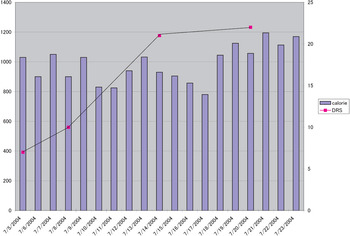
A 70-year-old married woman was diagnosed as having cortical carcinoma of the adrenal gland in January 2001 and underwent surgery. In April 2002, local recurrence with metastases to the lung was recognized and she was treated using hormone therapy with mitotane. As it was not effective, chemotherapy was performed with cisplatin, adriamycin, and etoposide. After three courses of chemotherapy, she developed many side effects and the chemotherapy was discontinued in January 2004. On June 23, 2004, she showed awareness of the immediate situation. One week later, she complained of lumbago and abdominal pain from the tumor and presented with disorientation in time and place. Thereafter she was hospitalized. In hospital, she presented with poor attention and concentration, impairment of recent memory, and insomnia, but she did not show appetite loss, ocular abnormalities, or gait disturbances. On the delirium rating scale (DRS; Onishi et al., 2004), she scored 24 points (delirium level). Her psychiatric features fulfilled the Diagnostic and Statistical Manual of Mental Disorders, 4th edition (DSM-IV) criteria (Onishi et al., 2004) for delirium. She had no medical history of psychiatric illness or alcohol or drug abuse, nor had she been vomiting (spontaneous or self-induced). It was indicated on the nursing charts that she had eaten about 70% of the 1400 cal/day diet served in the hospital (Fig. 1). A family member reported that she had eaten as usual before she had been admitted in the hospital. Peripheral blood counts, serum electrolytes, creatinine, glucose, and liver function tests were normal or unchanged over the long term. The serum albumin level was low (2.1 g/dl: 3.8–5.3 g/dl).

Serum thiamine level was 14 ng/ml (normal range: 20–50 ng/ml).
It was considered that the predominant etiological factor for acute delirium was thiamine deficiency. We administered 100 mg of thiamine intravenously per day. The next day, an improvement of her cognition and insomnia was observed. Two days later, she could maintain concentration and talk with the staff and family members. She scored 7 points (normal level) on DRS 3 days after thiamine administration. Five days later, laboratory examination demonstrated that the level of thiamine was 679 ng/ml (normal range 20–50 ng/ml). Symptomatic control of delirium was achieved, despite overall clinical deterioration. The clinical findings, effective alleviation of the syndromes of delirium after thiamine administration, and low levels of thiamine in the serum fulfilled the criteria proposed by Francis et al. (1990) for delirium induced by thiamine deficiency. Ten days later, the patient died.
DISCUSSION
Wernicke's encephalopathy results from deficiencies in vitamin B1 or thiamine. Such deficiencies in vitamin B1 occur in chronic alcoholics, food faddists, in the elderly, and in certain clinical situations that result in inadequate thiamine intake, defective utilization, or accelerated thiamine loss (Seligmann et al., 2001). In these cases, poor nutrition due to poor absorption of dietary intake was a clue to the diagnosis. In addition, thiamine deficiency in patients with terminal cancer has been reported recently (Onishi et al., 2004).
However, our case is uncharacteristic in that the patient developed Wernicke's encephalopathy while she had sufficient dietary intake. Our case indicates that patients with terminal cancer are at risk of developing Wernicke's encephalopathy despite adequate food intake.
The possible mechanisms of thiamine deficiency include insufficient intake of thiamine, decreased formation of thiamine pyrophosphate, reduced hepatic thiamine storage, inhibition of intestinal thiamine transport (Hoyumpa, 1986), and thiamine consumption by the rapid-growth of tumor cells (van Zaanen & van der Lelie, 1992). In our case, decreased formation of thiamine pyrophosphate might be considered because this process requires ATP (Hoyumpa, 1986), and reduced intestinal thiamine transport might also be considered because the general condition was deteriorated.
There are several factors that make diagnosis of Wernicke's encephalopathy difficult in terminally ill cancer patients. First, the clinical presentation of Wernicke's encephalopathy is variable, and typical clinical signs are lacking (ocular signs are present in 29%–93%, ataxia in 23%–70%, and delirium in 82%–90%; only 16% of patients show the classical triad and 19% have no clinical signs); second, in terminally ill cancer patients, poor performance status makes neurological examinations difficult; third, although poor nutritional state is the only prerequisite for the development of Wernicke's encephalopathy, the poor nutritional state commonly occurring in terminally ill cancer patients may be overlooked (Onishi et al., 2004); fourth, although Wernicke's encephalopathy occurs in terminally ill cancer even if the patients have adequate nutrition, in most cases, Wernicke's encephalopathy is not considered in the differential diagnosis if the patient has a history of adequate dietary intake.
To prevent the development of this encephalopathy in terminally ill cancer patients, clinicians must remain aware of the possibility of thiamine deficiency when a patient presents with unexplained delirium even if the patient has eaten adequately. If there is any doubt, intravenous thiamine administration even before a definitive diagnosis is established is recommended to prevent the progression or correct the symptoms and to prevent irreversible brain damage, as well as to improve quality of life at the end of life for the patients.
In conclusion, we encountered a terminally ill cancer patient who developed Wernicke's encephalopathy, although the patient had an adequate dietary intake.
Our case suggests that malabsorption and/or decreased formation of thiamine pyrophosphate might be considered causes of delirium and Wernicke's encephalopathy in terminally ill cancer patients.
Our case also suggests that Wernicke's encephalopathy should be considered in the differential diagnosis of delirium, even if the patient has had adequate food intake.
References
REFERENCES
Francis, J.,
Martin, D., &
Kapoor, W.N.
(1990).
A prospective study of delirium in hospitalized elderly.
JAMA,
263,
1097–1101.Google Scholar
Hoyumpa, A.M.
(1986).
Mechanisms of vitamin deficiencies in alcoholism.
Alcoholism: Clinical and Experimental Research,
10,
573–581.Google Scholar
Macleod, A.D.
(2000).
Wernicke's encephalopathy and terminal cancer: Case
report.
Palliative Medicine,
14,
217–218.Google Scholar
Onishi, H.,
Kawanishi, C.,
Onose, M.,
et al.
(2004).
Successful treatment of Wernicke encephalopathy in terminally ill
cancer patients: Report of 3 cases and review of the literature.
Supportive Care in Cancer,
12,
604–608.Google Scholar
Seligmann, H.,
Levi, R.,
Konijn, A.M.,
et al.
(2001).
Thiamine deficiency in patients with B-chronic lymphocytic
leukaemia: A pilot study.
Postgraduate Medical Journal,
77,
582–585Google Scholar
van Zaanen, H.C.T. &
van der Lelie, J.
(1992).
Thiamine deficiency in hematologic malignant tumors.
Cancer,
69,
1710–1713.Google Scholar
 You have
Access
- 20
- Cited by