INTRODUCTION
Since the 1980s, much research has been conducted concerning the impacts of climate change on global crop production (Long et al. Reference Long, Ainsworth, Leakey, Nösberger and Ort2006; Lobell & Field Reference Lobell and Field2008; Shiferaw et al. Reference Shiferaw, Prasanna, Hellin and Bänziger2011). The most common method of studying the impact of climate change on crop production is to run crop models under baseline and future climate-change scenarios, and then compare measures such as yield, water-use efficiency (WUE) and crop productivity (Rosenzweig & Parry Reference Rosenzweig and Parry1994; Sirotenko et al. Reference Sirotenko, Abashina and Pavlova1997; Lobell et al. Reference Lobell, Schlenker and Costa-Roberts2011). Early studies used the coarse-grid scenarios deduced from GCMs (Global Circulation Models) to analyse the impact of climate change on crop production at given sites, and now the fine-grid scenarios generated from Regional Climate Models (RCMs) are used at the regional scale. Xiong et al. (Reference Xiong, Holman, Conway, Lin and Li2008) and Qin et al. (Reference Qin, Yao, Cao, Zhang and Cao2011) discussed the downscaling technique of climate models, and Jiang & Jin (Reference Jiang and Jin2009) introduced an upscaling method for rice model parameters. Tsvetsinskaya et al. (Reference Tsvetsinskaya, Mearns, Mavromatis, Gao, McDaniel and Downton2003) and Xiong et al. (Reference Xiong, Balkovič, van der Velde, Zhang, Izaurralde, Skalský, Lin, Mueller and Obersteiner2014) analysed the impacts of different spatial scales on simulated results. In some research, different future socioeconomic scenarios with changes in, for example, arable land and irrigation area have been used to evaluate the impact of climate change on food production (Rosenzweig et al. Reference Rosenzweig, Strzepek, Major, Iglesias, Yates, McCluskey and Hillel2004; Fischer et al. Reference Fischer, Shah, Tubiello and van Velhuizen2005; Liu & Lin Reference Liu and Lin2007; Xiong et al. Reference Xiong, Lin, Jiang, Li and Xu2010). Meanwhile, as global warming causes abnormal weather events to be more frequent and stronger, some scientists have analysed the impacts of changes in climate variability on simulated results (Chen et al. Reference Chen, Jin, Zheng and Liu2004; Jin & Zhu Reference Jin and Zhu2008). Furthermore, uncertainties in assessing the effects of climate change on agricultural production have also been discussed due to the uncertainty of future scenarios and regional application of crop models (Carter et al. Reference Carter, Saarikko and Niemi1996; Xiong et al. Reference Xiong, Xu, Lin and Tian2005; Yao et al. Reference Yao, Qin, Zhang, Lin and Boken2011).
Most of the above research was based on the assumption that cropping systems, varietal types and cultivation methods in the future scenarios remain at their current level. The reason for such an assumption is for the convenience of comparing simulated yields, evapotranspiration and WUE under future scenarios with those for the current climate. Some scientists realized that such an assumption was not reasonable, and further analysed adaptation practices, such as adjustment of sowing dates (Jin et al. Reference Jin, Ge, Shi and Gao2002; Bassu et al. Reference Bassu, Asseng, Motzo and Giunta2009), use of new crop species and varieties with longer growing seasons (Olesen et al. Reference Olesen, Jensen and Petersen2000; Gao et al. Reference Gao, Miao, Zhang and Liang2003; Liu et al. Reference Liu, Wang, Yang and Wang2010) and changes in cropping systems (Hoque Reference Hoque1984; Tubiello et al. Reference Tubiello, Donatelli, Rosenzweig and Stockle2000; FAO 2002). Agricultural production practices should match the climatic conditions. Current cropping system and cultivation methods are generally suited to the current climate. However, with a warming climate, the current cropping systems, variety types and cultivation techniques may not match the changed environments, so farmers may need to change these to adapt to the future climate. For example, high-temperature resistant rice varieties with a long growth period can be used to adapt to hot climates; the multiple cropping index can be increased to make full use of heat resources; sowing dates can be adjusted to avoid high temperature, typhoons and other natural disasters; and more developed cultivation techniques can be employed to guarantee high grain yields. These measures indicate essentially the self-adaptation process in agricultural production. Thus, the possible changes in cropping systems and cultivation techniques for the future climate should be analysed at given sites first, and the changes in measures such as yield and WUE compared.
The objective of the current study was firstly to analyse the possible changes of cropping system, varietal type and sowing dates for three rice planting zones in Fujian Province. This would then enable an evaluation of the effect of climate change on rice production in Fujian Province considering the self-adaptation adjustments of rice production. Finally, possible levels of rice yields and yield stability of overall rice output in Fujian after considering the self-adaptation adjustment could be obtained.
MATERIALS AND METHODS
Study of regional overview and site selection
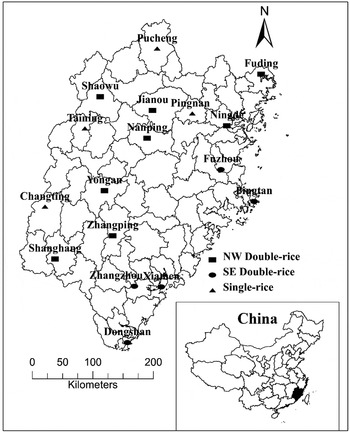
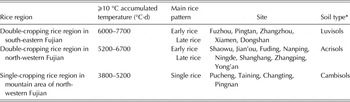
The terrain of Fujian Province is generally high in the northwest and low in the southeast. Differences in terrain and the mountainous topographical environment result in a significant vertical distribution of agroclimate in this province. Fujian has good light, temperature and water resources, with annual average temperature of 17·0–21·6 °C, annual precipitation of 1000–2000 mm and annual total radiation of 4200–4800 MJ/m2. This is generally sufficient to meet the needs of rice production. The eastern and southern coastal areas of Fujian are suitable for growing double rice. The rest of Fujian is mostly mountainous or hilly areas. Single rice is usually the only choice in mountainous areas of high altitude (⩾500 m), while double rice is a popular trend in hilly valleys of low altitude. Frequent meteorological disasters during the growing season, likely to cause drastic reduction of rice output, include high temperatures, storms, typhoons and seasonal drought. Using distributional features of agroclimate resources in Fujian (Meteorological Bureau of Fujian 1990; Tong Reference Tong1990) as well as research findings on fine planning and optimized distribution of crops (Fujian Meteorological Research Institute, Resources Planning Office of Fujian Province 2008), the province was classified into three rice regions (Jiang et al. Reference Jiang, Jin, Yang, Zhu and Lin2012): two double-rice regions in south-eastern and north-western Fujian, and one single-rice region in the mountain areas of north-western Fujian (Fig. 1). From these regions, 17 sites (Table 1) were selected to conduct a simulation experiment on rice production under different climate-change scenarios.
Distribution of the rice planting locations in Fujian Province. NW and SE represent north-western and south-eastern in Fujian, respectively.

Classification for rice patterns and 17 representative sites in different rice regions in Fujian Province

* The soil type is based on the World Reference Base Soil Taxonomy (WRB) according to Shi et al. (Reference Shi, Yu, Xu, Warner, Wang, Sun, Zhao and Gong2010).
Generation of climate-change scenarios
In the Special Report on Emissions Scenarios (SRES) issued in 2000 (IPCC 2000), there was a comprehensive consideration of the world's population growth, economic development, technological progress, environmental conditions, globalization and principle of fairness, based on which six scenarios for emissions of greenhouse gases and sulphide aerosol were developed (IPCC 2007). The concentration scenarios retrieved by these emissions scenarios can be the input for the global climate-change model to simulate the impacts of greenhouse gases and sulphide aerosol emissions on global climate change in the future. On this basis, future global and regional climate change can be simulated. Three climate scenarios from the A2, B2 and A1B emission schemes, designed for high emission of carbon dioxide (CO2) with little international cooperation and rapid population increment, medium–low emission with sustainable development of world economy and more possible emission with more international cooperation and new energy use, respectively, have always been used in the evaluation impact of climate change on agricultural production. According to the three emission scenarios (A2, B2 and A1B) in SRES, the current study adopted the RCM ‘PRECIS’, developed in the UK, to generate three climate-change scenarios in the studied area during the base period (1961–90) and the future period (2021–50). These were analysed and revised by the European Centre for Medium-Range Weather Forecasts (Jin et al. Reference Jin, Fang, Ge, Zheng and Chen1994; Jones et al. Reference Jones, Noguer, Hassell, Hudson, Wilson, Jenkins and Mitchell2004), contributing to obtaining the daily meteorological data of the 17 sites in the studied area over the years, such as maximum and minimum temperature, precipitation and total solar radiation.
Determination of CERES-Rice model and its genetic parameters
The current paper adopted the CERES-Rice model as the ‘effect’ model to assess the research. Data entry for the model was divided into two parts: controllable and uncontrollable input items. The former included rice variety, sowing date, planting density and depth, irrigation date and volume, date and amount of nitrogen, phosphorus and potassium (NPK) fertilizer use, fertilizer type and varietal genetic parameters; the latter included daily weather data, longitude and latitude of site as well as soil type. The ultimate output of the model included rice yield, yield components, above-ground biomass, duration of each development stage, soil moisture, factors to keep nitrogen balanced, root density, and nitrogen and water deficiency indices. Running of the CERES-Rice model was supported by the Decision Support System for Agrotechnology Transfer (DSSAT) software platform, and the latest version, DSSAT4·5, was used.
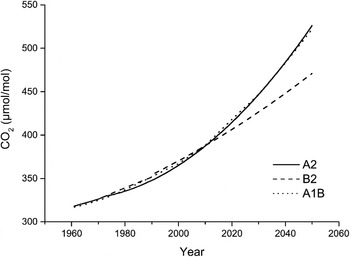
With the enhancement of CO2 in free air, the pressure differential of CO2 concentration between free air and mesophyll cells will be greater. Stomatal resistance will also rise, so the rate of photosynthesis would increase and transpiration rate would decrease. Through the CERES-Rice model and DSSAT4·5 platform a CO2 gain module was designed especially, with the ability to simulate the direct physiological influence on photosynthesis and transpiration of rice when the concentration of atmospheric CO2 is enriched (Ritchie et al. Reference Ritchie, Alocilja, Singh, Uehara, LaRue Pollard and Cervantes1987). The average concentration of atmospheric CO2 under the three emission scenarios in IPCC (International Panel on Climate Change) in the two periods (Fig. 2) could be used as the input value when running the CERES-Rice model.
Average concentration of atmospheric carbon dioxide (CO2) according to three emission schemes from the International Panel on Climate Change (IPCC).

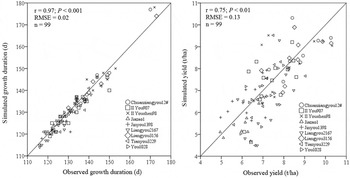
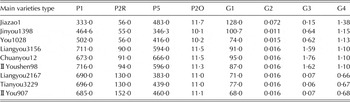
Eight genetic parameters were designed in the CERES-Rice model to describe the features of rice varietal types. In the current research, nine representative rice varieties were selected on the basis of testing data of the rice regions in Fujian. Rice yields and information on the growth period of each variety distributed in the 22 testing stations in 2006 were accumulated in order to debug and determine the model parameters by using the ‘Trial and Error Method’ (Dettori et al. Reference Dettori, Cesaraccio, Motroni, Spano and Duce2011) (Table 2). The parameters were verified by comparing the yields and growth period information with that of the same varieties and sites in 2007 (Fig. 3). The results showed that the CERES-Rice model had good applicability in the studied area. Daily meteorological data (2006–2007) required to debug genetic parameters and verify the CERES-Rice model were taken from National Meteorological Information Center (http://data.cma.cn/site/index.html). In the sites requiring default solar radiation data, the value of solar radiation was calculated by resorting to the length of day and the longitude and latitude using the methods in Sun et al. (Reference Sun, Liang and Yang2007). The representative soil types and the typical profile information of each site, together with the properties and physicochemical structures of soil at diverse depths, were determined from Soil Species of Fujian (1990) (unpublished data).
Verification results of CERES-Rice model in the main rice regions in Fujian Province.

Genetic parameters of representative rice cultivars in Fujian Province

P1: Thermal time period from seedling emergence to end of juvenile phase during which the rice plant is not responsive to photoperiod.
P2R: Extent to which phasic development leads to panicle initiation is delayed for each hour increase in photoperiod above P2O.
P5: Thermal time from beginning of grain filling to physiological maturity.
P2O: Critical photoperiod or the longest day length over which the development rate would be decreased.
G1: Potential spikelet number coefficient as estimated from the number of spikelets/ g of main culms dry weight at anthesis.
G2: Single grain weight under ideal growing conditions.
G3: Tillering coefficient relative to IR64 cultivar under ideal conditions.
G4: Temperature tolerance coefficient.
Establishment of agricultural climatic indices
Index of rice yield stability
Climate change had impacts not only on rice yield, but also on the stability of rice output. The current research employed the following formula to estimate the degree of rice yield stability:
 $$\Delta {\rm SD\%} = \left \vert {\displaystyle{{\mu c \pm \sigma _{\mu c}} \over {\mu a}}} \right \vert \times 100$$
 $$\mu c = \mu b\,-\mu a$$
ΔSD% in this formula indicates the percentage change of the standard deviation of rice yields of a certain site. The higher is the value of ΔSD%, the lower the stability of rice yield will be. Formula (2) represents the difference (μc) between the average simulated yield every year under various climate-change scenarios (μb) in the future period (2021–50) and that (μa) in a base period (1961–90). The integrated variance (σ μc ) can be calculated by the formula below:
 $$\sigma _{\mu c} = \sqrt {\sigma ^2 _{\mu a} + \sigma ^2 {}_{\mu b}} $$
 $$\sigma _{\mu a} = \displaystyle{{\sigma _a} \over {\sqrt {n_a}}} ;\,\sigma _{\mu b} = \displaystyle{{\sigma _b} \over {\sqrt {n_b}}} $$
where σ b is the standard deviation of the simulated yields over the years in the future period, σ a is the standard deviation in the base period, and n a and n b are the number of years in each period.
Under future emission scenarios, the rice-based cropping systems in some regions of Fujian might change. In this case, the following formula can be used to estimate the change of rice yield stability:
 $$F = \sum\limits_{i = 1}^n {\displaystyle{{\left \vert {Y_i - \overline Y} \right \vert} \over {n\overline Y}}} $$
where F is the fluctuation coefficient of yield, Y
i
is rice yield of the ith year (i = 1, 2, …, n), n is length of year and
 $\overline Y $
is average rice yield. The higher is the value of F, the greater the inter-annual fluctuation of rice yield will be, and vice versa.
Estimated model of overall rice output
To estimate the percentage change of the overall rice output in Fujian, it was presumed that the current rice acreage in the studied area remained unchanged under future emission scenarios. On the basis of Jin et al. (Reference Jin, Fang, Ge, Zheng and Chen1994), the following statistical model was used for the estimation:
 $$TYC{\rm \%} = \sum\limits_{i = 1}^3 {(RY_i /TY) \times RYC_i \%} \quad i = 1,{\rm} 2,{\rm} 3 \ldots $$
where TYC% represents the percentage change of the overall output of Fujian in the future, RY i is the simulated average output of the rice region i (i = 1, 2, 3) over the years in the base period and TY is that of the whole province; RYC i % represents the percentage change in rice region i under the three future emission scenarios.
Specific schemes in assessing climate-change impacts
The current study, firstly simulated the yields of all rice regions in the base and future periods separately. There were two cases in this operation: the first was to assume that the future rice-based cropping system, varietal type and cultural practice remained the same without considering the self-adaptation ability of rice production – the rice yields of representative varieties in each site were simulated under different emission scenarios and then compared with the base yields. On this basis, the possible impacts of climate change on rice yields were analysed. The second case was to study the self-adaptation adjustment that emerged both in rice production patterns and management practices under the future emission scenarios. The simulated rice yields obtained after the adjustment required re-simulation for comparison with the base yields. The research conducted here contributed to calculating the percentage change of the simulated yields with or without considering the self-adaptation adjustment under the same scenarios. It was believed that the analyses made when self-adaptation ability was considered were much more scientific and reasonable than those that did not consider it.
Self-adaptation of varietal types
With temperature rising in the future, the length of rice growing seasons will be prolonged on the one hand and, on the other hand, the process of rice development will be accelerated and the growth period of rice shortened. To make full use of heat resources, reduce the damage from high temperatures and achieve higher rice output will inevitably involve adjusting varietal types or type of maturity to adapt to future climate change. To simulate the kind of self-adaptation ability of varietal types, the first step was to simulate – using the CERES-Rice model – the average yield per unit of the representative varieties of different sites in three rice regions in the base period, and the result was regarded as the yield level of the existing varieties in this period. The next step was to consider the possible changes of varietal type and rice yields in various emission scenarios in the following two situations: (1) To assume that future varietal types did not change, and by running the CERES-Rice model in the related sites in different rice regions, the simulated yields in the future without considering the self-adaptation ability of varietal types were obtained; (2) to perform the simulation experiment by changing the varieties of different maturity types using the CERES-Rice model in the related sites in three rice regions, and then compare the result of the experiment with the simulated yields in the base period and that of situation (1) to detect any obvious improvement in yield after rice varieties were changed. Finally, the varieties or combinations of varieties with high productivity and yield stability, which were the potential suitable outcomes screened by self-adaptation in future, were selected in this way. There were two requirements in the screening process: one was to assume that the future rice-based cropping systems and management practices in the fields remained at the base period level; and the other was as much as possible to replace early-maturity with medium–late maturity rice of longer growth stage.
Self-adaptation of suitable sowing dates of rice
As temperature rises and the growing season of rice is prolonged, the future suitable sowing dates for rice in the studied area will inevitably go through some self-adaptation process, in which the sowing date will adjust itself automatically to lead to a high rice yield. The current study followed the principle of ‘safety + high yield’ in simulating the self-adaptation ability of the suitable sowing date of rice. Adherence to this principle was realized by the following method: for double early and single early rice, the rice must be sown on the safe sowing dates or at an appropriate later time so as to avoid the damage of low temperature. The safe sowing dates of indica rice can be defined as the early days in spring when the average daily temperature is ⩾10 °C for 3 days in a row. On this basis, in the current study 5 days was used as time step, the CERES-Rice model under three different emission scenarios was run to simulate the sowing dates and suitable sowing dates that guaranteed high yield and stability were selected after the adjustment of self-adaptation. For late rice, despite taking the 10-day rotation between two growing seasons into consideration, it was also necessary to ensure that rice began to ear before the safe full-heading stage. The safe full-heading stage of indica rice referred to the whole daytime of the consecutive 3 days in which the temperature was ⩾22 °C. In the simulation process, it was assumed that the future rice-based cropping systems, varietal types and management practices in the fields were kept at the base period level.
Self-adaptation of future rice-based cropping systems
As the climate warms, the effective temperature summation of the growing seasons of rice in the studied area will increase substantially, so that double-rice planting will tend to be available in fields of mountain areas with high altitude. In the rice region of the mountain area of north-western Fujian, where only single-rice planting currently occurs, farmers would probably switch to double rice for higher yields. To simulate the self-adaptation process of rice-based cropping systems, the current study selected four sites in the single-rice region of the mountain area in north-western Fujian and conducted a simulation experiment of ‘single to double’ under the three emission scenarios separately. The specific procedure of the current research started with the simulation and determination of the early and late rice varieties with high productivity and stability in each site. Then, by considering the different combinations of varieties in two seasons, the possible optimized combination after reorganizing the systems was screened out through the experiment, and the simulated yield of the new combination was obtained. This was compared with the simulated yield of single rice in the base period under the same scenarios, and combined with the F-value to determine the necessity of reorganizing the cropping systems of one site in the future. At the same time, the percentage change of rice yields after replacing single with double rice was obtained. In the current experiment, it was assumed that the management measures of water and fertilizer in all sites under different emission scenarios in the future remained at the base period level.
RESULTS
Self-adaptation of varietal types under different emission scenarios
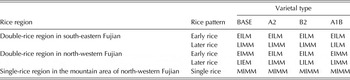
Considering both high yield and stability (with low ΔSD%), the current work simulated and established the results of the self-adaptation adjustment based on varietal types or types of maturity under the future emission scenarios in three rice regions of Fujian (Table 3). It was clear that rice of medium–late maturity with longer growth period had a higher yield under conditions of increasing temperature. This increment was because the varieties with long growth period were able to counteract the shortening of the growth period caused by high temperature, thus keeping the total duration of photosynthesis at a high level.
Self-adaptation of rice varietal types to climate change under three emission scenarios in three rice regions of Fujian Province

EILM, early indica with late maturity; LIMM, late indica with medium maturity; LILM, late indica with late maturity; EIMM, early indica with medium maturity; LIEM, late indica with early maturity; MIMM, medium indica with medium maturity.
Self-adaptation of sowing dates under different emission scenarios
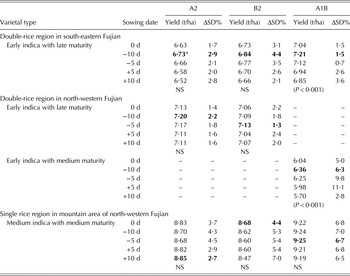
The simulated results (Table 4) indicated that yields in most sites increased by different degrees after the self-adaptation adjustment of the sowing dates of double early rice and single rice under different scenarios. Since the difference in stability indices between various sowing dates (with 5-day time step) was not distinct, the suitable sowing dates should still be judged mainly by the simulated yields. The suitable sowing date for early rice in the double-rice region of south-eastern Fujian was 10 days earlier than the base dates under the three emission scenarios. The suitable sowing date for early rice in the double-rice region of north-western Fujian was 10 days earlier than the base dates under scenarios A2 and A1B, while under B2 the simulated yield reached a maximum when the date was 5 days early. In the rice region of the north-western mountain area of Fujian, the suitable sowing date for single rice varied with different emission scenarios: the date was 5 days earlier compared with the base dates under scenario A1B, but 10 days later under scenario A2. However, the simulated yield decreased for all sowing dates earlier or later under scenario B2, suggesting that yield was highest when the sowing date was similar to the base dates. One possible explanation was that sometimes the simulated yield did not depend completely on the suitability of sowing dates, and was also affected by conditions of temperature, light and water allocation. For example, the sowing date may run into extremely low temperatures if it is too early, and into extremely high temperatures if it is too late, both of which would be detrimental to rice yield and yield formation.
Simulated yields (t/ha) and stability index (ΔSD%) differing in rice-based cropping systems, varietal types and sowing dates under three emission scenarios in different rice regions of Fujian Province

0 d: same with the BASEs; –10 d: 10 days advanced; –5 d: 5 days advanced; +5 d: 5 days delayed; +10 d: 10 days delayed; NS, not significant. *Bold type shows the suitable sowing date, which gained the maximum simulated yield.
Self-adaptation of varietal types and sowing dates under emission scenarios
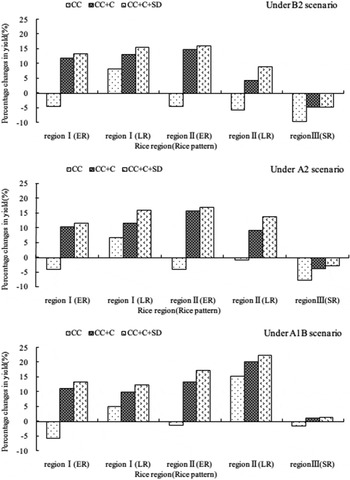
The self-adaptation ability of rice production included cropping systems, varietal type and cultivation method. This section presents a comprehensive analysis of the superimposed effect of the self-adaptation of varietal types and that of sowing dates in all rice regions of Fujian under various emission scenarios. Considering the impacts of climate change on rice production, without considering self-adaptation ability of rice production, resulted in yield of the double-rice region in north-western Fujian and of the singe-rice region in the mountain area of north-western Fujian both declining under scenarios A2 and B2 (Fig. 4). However, there was a slight increase (6·9 and 8·4%, respectively) of the late rice yield of the double-rice region in south-eastern Fujian (Fig. 4). Of all regions, the single-rice region in the mountain area of north-western Fujian suffered the greatest loss in production, with a decrease of 7·6 and 9·6% under scenarios A2 and B2, respectively. The simulated yields of early rice and single rice also tended to decline under scenario A1B in all regions, among which early production in the double-rice region in south-eastern Fujian showed the greatest reduction of 5·8%.
Change in rice yields under the three emission scenarios when self-adaptation was considered, compared with the base yields in different rice regions of Fujian Province. CC, effects of climate change alone; CC + C, combined effects of climate change and self-adaptive cultivars; CC + C + SD, combined effects of climate change and self-adaptive cultivars and sowing date.

If the self-adaptation ability of cultivars was considered (CC + C, Fig. 4) by assuming that the varieties in each rice region were changed to those of medium–late maturity with a long growth period and high productivity, the simulated yields increased significantly compared to those where self-adaptation was not considered. All double-rice yields tended to increase under the three emission scenarios, and the late rice of the double-rice region in north-western Fujian showed the greatest yield increase of 20·3% under scenario A1B. Compared to the situation where the self-adaptation ability of varieties was not considered, the simulated yields of single rice under scenarios A2 and B2 had a slower downward trend with reductions of 3·8 and 4·9%, respectively; under scenario A1B, the simulated yield of single rice even increased slightly, by 1·1%. When the self-adaptation ability of sowing date was also considered (CC + C + SD, Fig. 4), except for single rice which showed a relatively small yield change under scenario B2, all varieties of the three regions under scenarios A2 and A1B had yield increases of different degrees compared with that considering only self-adaptation of varieties. Compared with the simulated base yields, the greatest yield increase was for late rice of the double-rice region in north-western Fujian under scenario A1B, which was 22·5%; the second greatest was for early rice of the double-rice region in north-western Fujian, by 17·3, 16·1 and 17·2% under scenarios A2, B2 and A1B, respectively.
Changes of rice cycles under various emission scenarios
As the temperature continues to rise in the future, multiple cropping index in the studied area is expected to increase. Table 5 shows the results of the simulation experiment in which the rice-based cropping system was changed from single to double rice under various emission scenarios in the four sites of the single-rice region in the mountain area of Fujian.
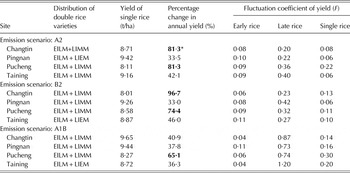
Changes in annual rice yields and fluctuation coefficient (F) when changing single rice to double rice under three emission scenarios in the single-rice region in mountain area of north-western Fujian

EILM + LIMM, early indica with late maturity + late indica with medium maturity; EILM + LIEM, early indica with late maturity + late indica with early maturity. * Bold type shows where percentage change in annual yield (%) >50%.
The simulated yields of the two growing seasons both increased to different degrees after the ‘single to double’ adjustment in the rice-based cropping system in the single-rice region of the mountain area in Fujian under the three emission scenarios (Table 5). However, the result did not suggest that all four sites were suited to double-rice planting. Considering human and financial resources, as well as other factors, it is generally believed that farmers will be more encouraged to plant new crops if yield is increased by 50%. As a consequence, the current study took the amount of increase by ⩾50% as the threshold for determining whether to change systems or not. The analysis showed that it was appropriate to change single to double rice only in Changting and Pucheng under scenarios A2 and B2, while under scenario A1B the change was only appropriate in Pucheng.
Stability is another factor to consider in adjusting the self-adaptation of rice cycle, that is, the annual fluctuation coefficient of yield (F) should not be too high. Analysis of F-value of the annual simulated yields of the four mountain sites under various emission scenarios suggested that when F > 0·3, yields were reduced nearly to zero for at least six of the 30 years of the future period; when F ⩾ 1·0, yields were not normal for at least two-thirds of the whole period; and when F < 0·3, normal yields occurred for most of the years. Based on the findings it could be concluded that F = 0·3 was the threshold value to ensure stability of rice yields. When F > 0·3, it was unsuitable to change to double rice even if some years might produce a high yield. The reason for late rice in the four sites having relatively high F-values after changing from single to double rice under three emission scenarios in future (Table 5) was probably the early arrival of autumn in mountain areas. The resulting low temperature, cold dew and wind are likely to damage late rice in the late stages of its development, which would be detrimental to grain filling.
In conclusion, before 2050, in the four sites of the single-rice region in the mountain areas of Fujian, Changting was the only district where the application of double rice under scenarios A2 and B2 was available, and the existing cycles of single rice in all regions under scenario A1B should not be adjusted.
Changes of the overall rice output based on self-adaptation adjustment in Fujian
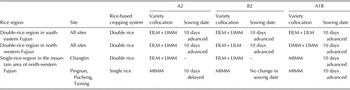
The previous sections showed that rice production in Fujian in the future would be able to adapt to drastic climate change through the self-adaptation adjustment of varieties, sowing date and rice-based cropping system. Table 6 shows the possible results of the self-adaptation adjustment of production patterns and management practices under scenarios A2, B2 and A1B in different rice regions of Fujian.
Rice production pattern and management based on self-adaptation under three emission scenarios in different rice regions of Fujian Province

EILM + LIMM, early indica with late maturity + late indica with medium maturity; EILM + LIEM, early indica with late maturity + late indica with early maturity; EILM + LILM, early indica with late maturity + late indica with late maturity; EIMM + LIMM, early indica with medium maturity + late indica with medium maturity; MIMM, medium indica with medium maturity.
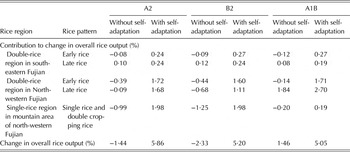
Production patterns and management practices based on self-adaptation (Table 6) were taken as the new input items. By running the CERES-Rice model separately under the three emission scenarios, combined with Eqn (4), the change of overall rice output in Fujian in the future when considering the self-adaptation adjustment was simulated (Table 7). It should be clarified that of all sites in the single-rice region of the mountain areas in north-western Fujian, under scenarios A2 and B2, Changting was the only district where it would be suitable to change to double rice, while the other three sites should retain single rice; under scenario A1B the four sites in this region should all retain single rice.
Contribution (%) of overall output of rice regions to that of Fujian Province with self-adaptation and without self-adaptation under three emission scenarios (A1, B2 and A1B)

When assessing the impacts of climate change on future production of rice in Fujian, the results differed greatly according to whether the self-adaptation ability of rice production to climate change was considered or not (Table 7). The overall simulated rice yields in the three rice regions under various scenarios increased by different degrees when considering the ability of self-adaptation; there was no exception for double early, late or single rice, and the overall simulated output of early rice, which declined when self-adaptation ability was not considered, actually increased. When self-adaptation ability was considered, the future overall simulated rice yields in Fujian had similar change trends: yields increased by 7·3 and 7·5% under scenarios A2 and B2, respectively. The simulated results were more optimistic for scenario A1B, with yield increases when the self-adaptation adjustment was not considered; and since double rice was not suitable in the single-rice region when self-adaptation was considered, the yield increase in Fujian of only 3·6% was not comparable to that under the two other scenarios.
DISCUSSION
Self-adaptation adjustment is an important feature of agricultural production; however, this has failed to attract much attention in previous assessments and research on the impacts of climate change. Many scholars assumed that the cropping systems, varietal types and management practices were maintained at the current level when they assessed the impacts of climate change on crop production (Yang et al. Reference Yang, Shen, Zhao, Zhao, Xu, Wang, Liu and Zhang2010), which was clearly contradictory to actual agricultural development, and an assumption that was especially untenable in the face of drastic climate change. Aiming at dealing with these problems, the current study introduced self-adaptation ability to the assessment of impacts of climate change on rice production in Fujian. The first step was to estimate the potential changes – which were taken as a corollary of the self-adaptation of rice production – of rice-based cropping systems, varietal types and sowing dates under different emission scenarios in the future through simulation experiments as well as agricultural climatic indices. The next step was to simulate changes in the rice yields of the whole province and all its rice regions after self-adaptation adjustment was considered. Every aspect of the outcome of this assessment was more optimistic, scientific and rational than that assuming no adjustment. Of course, agricultural self-adaptation is an extremely complex process related to issues of society, economy and scientific and technological progress, and it is impossible to estimate the changes of these factors on the basis of present knowledge, thus it is only feasible to focus on such potential changes as in agricultural production patterns and management practices. Moreover, self-adaptation of agricultural production is a rather slow process, and it remains uncertain as to whether its adjustment will be sufficiently timely in the face of drastic climate change. In light of this problem, many scholars suggested that some adaptive measures and strategies should be developed to guide farmers and production departments to adapt to new environmental changes (Jin et al. Reference Jin, Ge, Shi and Gao2002; Yang et al. Reference Yang, Shen, Zhao, Zhao, Xu, Wang, Liu and Zhang2010). The present authors assented to this viewpoint, and the methods used in the current study were actually consistent with the development of many of the adaptive strategies, which could be understood as assessment research based on adaptability. From a higher standpoint, understanding the importance of adaptation to climate change is in itself a self-adaptation to the environment. However, there were three limitations in the present study. First, the self-adaptation ability of rice production to future extreme weather or climate events was not considered. It is necessary to conduct further research on such problems to reduce or evade high temperature damage during heading and flowering stages by adjusting sowing dates and selecting high-temperature resistant varieties, and to deal with the damage of typhoons and storms in the late developing stage of rice by adjusting sowing dates and selecting lodging-resistant varieties. Second, in the process of simulating the direct effects of CO2 enrichment by the CERES-Rice model, the simulated yields of rice might increase without considering the daily change of CO2 in paddy fields. Some scholars thought that the self-adaptation of rice to increased CO2 concentration could be verified by the phenomenon of obvious effects of environments of high CO2 concentration (Long et al. Reference Long, Ainsworth, Leakey, Nösberger and Ort2006), and would weaken gradually as the concentration declines. However, this concept requires further study. Third, the accelerated decomposition of soil organic matter at high temperature, which would require consequent adjustments to fertilizer application, was not considered in studying the self-adaptation of rice production. Some potential changes to cultivation practices such as seeding rate and planting density were also not considered, but these practices were controllable and would be solved in the future by scientific and technological development.
CONCLUSION
The growth period of different rice varieties was obviously reduced, while the growing season was extended significantly in the rice regions of Fujian Province because of global warming. Hence, more options for suitable combinations of varieties would be provided in the future. Replacing varieties of early-maturity whose growth period was short and productivity was low with those of medium–late maturity, long growth period and high productivity was probably an effective way to make full use of heat resources and improve local rice yields. The simulated yields of double rice of all rice regions in Fujian under the three emission scenarios decreased when self-adaptation of varietal types was not considered, and increased when self-adaptation was considered; and the reduction in single rice yields also slowed obviously. When the self-adaptation adjustment of sowing dates was also considered, the simulated yields of rice were further improved.
Under scenarios A2, B2 and A1B, compared to without considering the self-adaptation adjustment of rice production, the simulated yields of early rice in the double-rice region in south-eastern Fujian increased by 15·9, 18·0 and 19·2%, and that of late rice by 9·2, 7·4 and 7·4%, respectively. In the double-rice region of north-western Fujian, the simulated yields of early rice increased by 21·2, 20·5 and 18·9%, and that of late rice by 14·7, 14·8 and 7·2% compared to without consideration of self-adaptation adjustment of rice production for scenarios A2, B2 and A1B, respectively. The simulated yields of single cropping rice in the single-rice region in the mountain areas of north-western Fujian increased by 4·9, 5·0 and 2·9% under scenarios A2, B2 and A1B, respectively. Heat resources of the single-rice region were sufficient for planting single-rice once, but not for a second season; whereas in some districts such as Changting, double cropping rice was likely to be promoted under scenarios A2 and B2. In conclusion, comprehensive consideration of the self-adaptation ability of rice-based cropping system, varietal type as well as sowing date indicated that overall simulated output of rice in Fujian under scenarios A2, B2 and A1B increased by 5·9, 5·2 and 5·1%, respectively, compared with the base yields.
The current study was sponsored by the Natural Science Foundation of Fujian Province (grant no. 2014J01091), Programs of Open Foundation of key laboratory of China Meteorological Administration (grant no. AMF201302) and the Fund for Independent Innovation of Agricultural Sciences in Jiangsu Province (grant no. CX(12)3055).